Programa de Pós-Graduação em Atenção Integral à Saúde
http://dx.doi.org/10.21527/2176-7114.2020.38.5-9
Identifying Febrile Humans Using
Infrared Thermography Screening:
Possible Applications During Covid-19 Outbreak
Valmir Oliveira Silvino
1, Regis Bernardo Brandim Gomes
2, Sérgio Luiz Galan Ribeiro
3,
Davyson de Lima Moreira
4, Marcos Antonio Pereira dos Santos
5ABSTRACT
Since the first case of Covid-19 reported in late 2019, it has quickly spread throughout the world and became a pandemic. Because of its high transmission rate, Covid-19 is a huge threat to public health worldwide. Fever is a common symptom of patients with severe acute respiratory syndromes (Sars), including Covid-19 disease. Infrared thermography (IT) is widely used to mass-screen the skin temperature of people in crowded places, such as hospitals and airports. This is of importance for patients and health professionals as it drastically decreases the risk of transmission due to the minimal contact between the evaluator and the subject. Infrared thermography strategy has already been widely used for the screening of febrile peo-ple during the outbreak of other pandemics such as H1N1 and Ebola. We here describe the potential of IT to identify febrile people who may be infected with COVID-19 and provide recommendations for their monitoring and management during this pandemic based on literature data.
Keywords: Covid-19. Sars. Mass-screening. Fever. Skin temperature.
IDENTIFICAÇÃO DE SERES HUMANOS FEBRIS USANDO TRIAGEM POR TERMOGRAFIA INFRAVERMELHA: POSSÍVEIS APLICAÇÕES DURANTE A PANDEMIA DE COVID-19
RESUMO
Desde o primeiro caso de COVID-19 relatado no final de 2019, a doença se espalhou rapidamente por todo o mundo e se tornou uma pandemia. Devido à sua alta taxa de transmissão, a COVID-19 é uma enorme ameaça à saúde pública em todo o mundo. A febre é um sintoma comum de pacientes com síndromes respiratórias agudas graves (SARS), incluindo a doença de COVID-19. A termografia infravermelha (TI) é amplamente usada para rastrear em massa a temperatura da pele em locais com grande aglomeração, como hospitais e aeroportos. Isso é importante para pacientes e profissionais de saúde, pois di-minui drasticamente o risco de transmissão devido ao contato mínimo entre o avaliador e o sujeito. A estratégia de TI já foi amplamente utilizada para a triagem de pessoas febris durante o surto de outras pandemias, como o H1N1 e o Ebola. Aqui, descrevemos o potencial da TI para identificar pessoas febris que podem estar infectadas com COVID-19 e fornecemos reco-mendações para seu monitoramento e gerenciamento durante essa pandemia com base em dados da literatura.
Palavras-chave: COVID-19. SARS. Rastreamento em massa. Febre. Temperatura da pele. RECEBIDO EM: 29/4/2020
MODIFICAÇÕES SOLICITADAS EM: 5/5/2020 ACEITO EM: 6/5/2020
1 Federal University of Piauí, Department of Biophysics and Physiology, Nucleus of Study in Physiology Applied to Performance and Health (NEFADS), Teresina, PI, Brazil.http://lattes.cnpq.br/4642858363901537. https://orcid.org/0000-0002-1992-5199. [email protected]
2 Oswaldo Cruz Foundation, Eusébio, CE, Brazil. http://lattes.cnpq.br/2521004210048823. https://orcid.org/ 0000-0001-7603-5101. [email protected] 3 Federal University of Piauí, Department of Biophysics and Physiology, Nucleus of Study in Physiology Applied to Performance and Health (NEFADS), Teresina,
PI, Brazil. http://lattes.cnpq.br/7314116104718310. https://orcid.org/0000-0002-5251-0518. [email protected]
4 Department of Natural Products, Farmanguinhos, Oswaldo Cruz Foudantion, Rio de Janeiro, RJ, Brazil. http://lattes.cnpq.br/7863875298510179. https:// orcid.org/0000-0002-3060-0395. [email protected]
INTRODUCTION
The coronavirus disease 2019 (Covid-19) is a severe acute respiratory syndrome mainly spread through respiratory or physical contact. The outbreak first took place in Wuhan, China, in December 2019 and quickly spread across several regions worldwide. Regardless of the intense control measures to identi-fy and control the disease, its effects on public health are already devastating. Covid-19 patients usually suf-fer from several symptoms, such as fatigue, shortness of breath, dry cough, and high fever (KIMBALL et al., 2020).
Fever is the most common presenting symptom in patients with Covid-19 disease (YAN et al., 2020). Wang et al. (2020) observed that the majority of the patients affiliated hospitals of Nanchang university, Nanchang, China, from Jan 21 to Feb 2, 2020 presen-ted fever (91%). Fever is considered to be a complex and potent biologic response to infection and injury. The increase in body temperature plays a huge role in cell signaling and gene expression patterns, which affects the innate immune system function and cell apoptosis and recovery (HASDAY et al., 2011). In times like these, the academic community plays a huge role in directing strategies to combat the spread of the di-sease (CARVALHO; LIMA; COELI, 2020)
Fever can be classified as acute, sub-acute and chronic, depending on the duration (<7 days, 7 < 14 days, and >14 days, respectively). Moreover, it can be classified as low grade fever (38.1-39ºC), mode-rate grade fever (39.1-40ºC), high grade fever (40.1-41.1ºC), and hyperpyrexia (>41.1ºC) depending on the body temperature (OGOINA, 2011). It has been repor-ted that most of the patients infecrepor-ted with Covid-19 in Beijing presented low to moderate grade fever (<39.1ºC) (TIAN et al., 2020). Furthermore, Guan et al. (2020) extracted data from 552 hospitals in 30 provin-ces and observed that fever was identified in 43.8% of the patients on presentation but developed in 88.7% during hospitalization. This is an indicator that the in-cidence of fever increases as the disease progresses.
Over the past few years, due to the outbreak of pandemics such as H1N1 and Ebola, several countries carried out mass-screening in public places. They ai-med to decrease the spread of these pandemics by li-miting the exposition of people with flu-like symptoms in common public spaces, such as airports and hospi-tals. However, manual screening can represent a high risk of contamination for the health professional (SAN-CHES et al., 2013). Because of that, the use of thermo-graphic cameras has emerged as an efficient and safe
method of skin temperature mass-screening (RING
et al., 2008). Currently, infrared thermography (IT) is
the best viable mass fever screening for outbreaks of both infectious disease pandemics such as Ebola virus (GHASSEMI et al., 2018) and severe acute respiratory syndromes (Sars) such as H1N1 influenza pandemic (HEWLETT et al., 2011; PASCOE et al., 2010). The quick notification and visualization method of infection ca-ses in the early stages should be incorporated as the standard for epidemiological surveillance (LANA et al., 2020). Therefore, IT can be a useful tool for early iden-tification, diagnostic documentation, and prognostic evaluation of Covid-19 cases.
INFRARED THERMOGRAPHY AS A TOOL
TO COMBAT INFECTIOUS DISEASES
Infrared thermography, also known as the ther-mal image, is an imaging approach used for a wide range of medical applications (BRIOSCHI; BRIOSCHI, 2009) able to register images with cancer (ARORA
et al., 2008), peripheral vascular disorders
(BAGAVA-THIAPPAN et al., 2009) and fever (HEWLETT et al., 2011). This equipment can be found in the Brazilian market from R$ 2,500 up to R$ 70,000 depending on the image quality. Moreover, it is a practical tool in sports sciences (QUESADA, 2017) and physical training evaluations (MENEZES et al., 2018). In recent years, it has become a more accessible tool of remote sensing for body temperature. The IT device is composed of a portable camera (around 3 kg and 220 mm x 135 mm x 130 mm). Its portability and practicability enable the transport and management of the device in several si-tuations. Taking into consideration fever as one of the main symptoms of the Covid-19 pandemic, the use of IT seems to be a promising tool against the spread of the disease.
The skin temperature can be monitored to es-tablish a baseline temperature of the individual. This is important because body temperature is closely re-lated to inflammation and systemic infection with the presence of fever. On the other hand, the primary temperature of the subject must also be assessed, as a 38ºC fever does not necessarily indicate a disease if the previous temperature were superior. For this rea-son, the International Organization for Standardiza-tion (ISO) provides general guidelines for the deploy-ment, implementation, and operation of a screening thermograph intended to be used for non-invasive febrile temperature screening of individuals under in-door environmental conditions to prevent the spread of infection of pandemics (ISO, 2008, 2009).
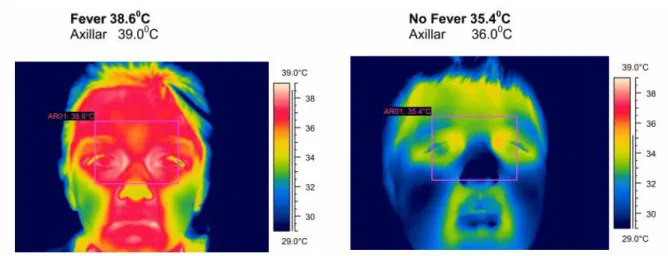
Figure 1 – Fever screening thermography
Source: Pascoe et al. (2010).
IT system can acquire thermal images series be-tween 10°C and 40°C at 60 frames per second, whi-ch is demonstrated through a captured image of 320 x 240 pixels of resolution. Considering the human body core temperature, it can screen febrile patients by measuring the skin temperature of the frontal area of the face. If the temperature is over 37.5°C, which represents a fever state, an alarm system will go off. Once the fever state is confirmed, further diagnostic methods such as serological, molecular, and radiologi-cal are recommended in order to detect the contami-nation (OZMA; MAROUFI; KHODADADI, 2020).
The human adult face has several thermoanato-mic points, symmetrically positioned in both right and left sides of the face. The areas of high intensity in the face are medial palpebral commissure, labial commis-sure, temporal, supratrochlear and external acoustic meatus (HADDAD et al., 2016). The thermal imaging of the eye region is the fastest non-contact region for fever assessment (RING et al., 2013).
The IT uses a thermovisor to capture the emis-sions of heat from different parts of the body and display them in a screen with a rainbow color pallet, which represents different levels of body temperatu-re. The temperature must be screened in a controlled ambient, at around 22ºC. The imaging is displayed in a 320 x 240 pixels screen with a numeric representation of heat (0.1ºC of accuracy). The software of the came-ra processes all images, which can be used for further analysis. However, there are some limitations regar-ding the assessment of skin temperature using IT, such as the distance between the subject and the evaluator and the temperature of the ambient, which can alter the results of the screening. Moreover, the use of cos-metics, creams, gels or any other type of skin
treat-ment, as well as heavy clothes, can distort the radia-tion emission, resulting in an underestimaradia-tion of skin temperature (QUESADA, 2017).
On the other hand, the guidelines suggested by the ISO must be carefully followed, as there is a need for quality assurance, regular calibration, training and documentation of the data collected. The thermal imaging must be seen as the first stage of the evalua-tion. The suspected passenger must then be medically checked in order to confirm any infection exposure. Currently, some facial recognition devices are being used to check the temperature of the skin in public places. The use of IT would extend this procedure to a simultaneous temperature check. It is already well established that a series of multifaceted public inter-ventions are associated with improved control of the Covid-19 (PAN et al., 2020). The use of IT technology might as well contribute to these strategies in order to decrease the spread of the pandemic.
WHY SCREEN FEBRILE PATIENTS WITH
INFRARED THERMOGRAPHY?
To this day, there are no viable means to diagno-se and monitor all cadiagno-ses of Covid-19 infection. Howe-ver, it is possible to track the virus by notifying the ca-ses of fever, followed by further analysis. In April and May 2003, during a Sars outbreak, over 72.000 patien-ts and visitanpatien-ts entered the facilities of the Taipei Me-dical University-Wan Fang Hospital, in Taiwan. A total of 305 febrile patients (0.42%) were detected through IT. Further analysis verified that three patients were contaminated with Sars. This suggests that IT is an ef-ficient and reliable tool to mass-screen suspected pa-tients in the early stages of severe acute respiratory syndromes with fever (CHIU et al., 2005).
Infrared thermal imaging technology has been widely used in several clinical settings, including to as-sess emitted temperature and detect several diseases, such as seasonal influenza (NEGISHI et al., 2020), vas-cular disorder (BAGAVATHIAPPAN et al., 2009), breast cancer (ARORA et al., 2008), H1N1 influenza (HEWLE-TT et al., 2011), and Ebola (GHASSEMI et al., 2018). A mass-screening system using IT technology could significantly improve the prospect for conducting high quality Covid-19 pandemic countermeasures. Howe-ver, credibility and acceptance of thermal imaging is subject to critical use of the technology and appro-priate comprehension of thermal physiology.
IT represents the best approach regarding the mass-screening of febrile subjects during the outbreak of infectious pandemics, such as H1N1, Ebola, and Co-vid-19. They can accurately estimate the body skin temperature when following appropriate standards. Therefore, this method should also be used in public places by authorities in order to identify subjects with Covid-19 in the early stages of the disease. This wou-ld be extremely helpful to combat the spread of the pandemic.
CONCLUSION
The outbreak of the Covid-19 pandemic has shown to be a big challenge globally, taking in consi-deration its elevated rate and speed of contamination. In order to better face this challenge, it is necessary to quickly identify those who are presenting the symp-toms of the disease. Infrared thermography is a fast, painless, noncontact, and noninvasive imaging me-thod used for the diagnosis of fever. Here we have su-ggested the use of IT as a strategy to quickly and safely mass-screen the skin temperature, in order to detect febrile people who may be infected with the Covid-19. Public authorities should establish and improve the in-tervention system based on scientific advice and the standard procedures, to effectively deal with the pro-blems caused by this public health emergency. More importantly, as Covid-19 has already affected coun-tries in all continents, this could assist other regions on how to decrease the spread of the disease and pre-vent possible local outbreaks
REFERENCES
ARORA, N. et al. Effectiveness of a noninvasive digital infra-red thermal imaging system in the detection of breast can-cer. American Journal of Surgery, v. 196, n. 4, p. 523-526, 2008.
BAGAVATHIAPPAN, S. et al. Infrared thermal imaging for de-tection of peripheral vascular disorders. Journal of Medical Physics, v. 34, n. 1, p. 43-47, 2009.
BRIOSCHI, M. L.; BRIOSCHI, E. F. C. Diagnóstico dos distúrbi-os inflamatóridistúrbi-os sistêmicdistúrbi-os por imagem infravermelha (par-te final). Revista de Oxidologia, p. 44-48, 2009.
CARVALHO, M. S.; LIMA, L. D. de; COELI, C. M. Science during the pandemic. Cadernos de Saúde Pública, v. 36, n. 4, p. 3-5, 2020.
CHIU, W. T. et al. Infrared thermography to mass-screen suspected sars patients with fever. Asia-Pacific Journal of Public Health, v. 17, n. 1, p. 26-28, 2005.
GHASSEMI, P. et al. Best practices for standardized perfor-mance testing of infrared thermographs intended for fever screening. PLoS ONE, v. 13, n. 9, p. 1-24, 2018.
GUAN, W. J. et al. Clinical Characteristics of Coronavirus Dis-ease 2019 in China. The New England journal of medicine, v. 382, n. 18, p. 1.708-1.720, 2020.
HADDAD, D. S. et al. A new evaluation of heat distribution on facial skin surface by infrared thermography. Dentomax-illofacial Radiology, v. 45, n. 4, p. 1-10, 2016.
HASDAY, J. D. et al. Fever, hyperthermia, and the lung: it’s all about context and timing. Transactions of the American Clinical and Climatological Association, v. 122, p. 34-47, 2011.
HEWLETT, A. L. et al. Evaluation of an Infrared Thermal De-tection System for Fever Recognition during the H1N1 Influ-enza Pandemic. Infection Control & Hospital Epidemiology, v. 32, n. 5, p. 504-506, 2011.
ISO. International Organization for Standardization. TC121/ SC3-IEC SC62D: Particular requirements for the basic safety and essential performance of screening ther- mographs for human febrile temperature screening. 2008. p. 1-69. ISO. International Organization for Standardization. ISO/TR 13154:2009 ISO/TR 8-600: Medical electrical equipment – deployment, implementation and operational guidelines for identifying febrile humans using a screening thermo-graph. 2009. p. 1-18.
KIMBALL, A. et al. Asymptomatic and Presymptomatic SARS-CoV-2 Infections in Residents of a Long-Term Care Skilled Nursing Facility – King County, Washington, March 2020. MMWR. Morbidity and Mortality Weekly Report, v. 69, n. 13, p. 377-381, 2020.
LANA, R. M. et al. The novel coronavirus (SARS-CoV-2) emergency and the role of timely and effective national health surveillance. Cadernos de Saúde Pública, v. 36, n. 3, p. e00019620, 2020.
MENEZES, P. et al. Effects of Strength Training Program and Infrared Thermography in Soccer Athletes Injuries. Sports, v. 6, n. 4, p. 148, 2018.
NEGISHI, T. et al. Contactless Vital Signs Measurement System Using RGB-Thermal Image Sensors and Its Clinical Screening Test on Patients with Seasonal Influenza. Sensors, v. 20, n. 8, 2020.
OGOINA, D. Fever, fever patterns and diseases called “fe-ver” – A review. Journal of Infection and Public Health, v. 4, n. 3, p. 108-124, 2011.
OZMA, M. A.; MAROUFI, P.; KHODADADI, E. Clinical mani-festation, diagnosis, prevention and control of SARS-CoV-2 (Covid-19) during the outbreak period. Le Infezioni in Medi-cina, v. 2, p. 153-165, 2020.
PAN, A. et al. Association of Public Health Interventions With the Epidemiology of the COVID-19 Outbreak in Wu-han, China. Jama, p. 1-9, 2020.
PASCOE, D. D. et al. International standards for pandemic screening using infrared thermography. Medical Imaging 2010: Biomedical Applications in Molecular, Structural, and Functional Imaging, v. 7.626, p. 76261Z1-8, 2010.
QUESADA, J. I. P. Application of Infrared Thermography in Sports Science. New York: Springer, 2017.
RING, E. F. J. et al. Detecting Fever in Polish Children by In-frared Thermography. International Conference on Quanti-tative InfraRed Thermography, 9, p. 35-38, 2008.
RING, E. F. J. et al. New standards for fever screening with thermal imaging systems. Journal of Mechanics in Medicine and Biology, v. 13, n. 2, p. 1-13, 2013.
SANCHES, I. J. et al. Fusão 3D de imagens de MRI/CT e ter-mografia. Revista Brasileira de Engenharia Biomédica, v. 29, n. 3, p. 298-308, 2013.
TIAN, S. et al. Characteristics of COVID-19 infection in Bei-jing. Journal of Infection, v. 80, n. 4, p. 401-406, 2020. WANG, M. et al. Typical radiological progression and clinical features of patients with coronavirus disease 2019. Aging, v. 12, p. 1-8, 2020.
YAN, C. H. et al. Association of chemosensory dysfunction and Covid-19 in patients presenting with influenza-like symptoms. International Forum of Allergy & Rhinology, p. 1-18, 2020.