Global human frequencies of predicted
nuclear pathogenic variants and the role
played by protein hydrophobicity in
pathogenicity potential
Luı´sa Pereira1,2, Pedro Soares1, Petr Triska1,3, Teresa Rito1, Agnes van der Waerden1, Biao Li4, Predrag Radivojac4& David C. Samuels5
1Instituto de Patologia e Imunologia Molecular da Universidade do Porto (IPATIMUP), Porto 4200-465, Portugal,2Faculdade de Medicina da Universidade do Porto, Porto 4200-319, Portugal,3Instituto de Cieˆncias Biome´dicas da Universidade do Porto (ICBAS), Porto 4050-313, Portugal,4School of Informatics and Computing, Indiana University, Bloomington, IN 47405, USA, 5Center for Human Genetics Research, Department of Molecular Physiology and Biophysics, Vanderbilt University Medical Center, Nashville, TN 37232-0700, USA.
Mitochondrial proteins are coded by nuclear (nDNA) and mitochondrial (mtDNA) genes, implying a complex cross-talk between the two genomes. Here we investigated the diversity displayed in 104 nuclear-coded mitochondrial proteins from 1,092 individuals from the 1000 Genomes dataset, in order to evaluate if these genes are under the effects of purifying selection and how that selection compares with their mitochondrial encoded counterparts. Only the very rare variants (frequency,0.1%) in these nDNA genes are indistinguishable from a random set from all possible variants in terms of predicted pathogenicity score, but more frequent variants display distinct signs of purifying selection. Comparisons of selection strength indicate stronger selection in the mtDNA genes compared to this set of nDNA genes, accounted for by the high hydrophobicity of the proteins coded by the mtDNA. Most of the predicted pathogenic variants in the nDNA genes were restricted to a single continental population. The proportion of individuals having at least one potential pathogenic mutation in this gene set was significantly lower in Europeans than in Africans and Asians. This difference may reflect demographic asymmetries, since African and Asian populations experienced main expansions in middle Holocene, while in Europeans the main expansions occurred earlier in the post-glacial period.
T
he genomic era is enabling the production of massive datasets (such as The Cancer Genome Atlas1) created by large consortia focused on addressing the genetics behind complex diseases. The disease oriented projects have been complemented by consortia aiming to characterize the diversity of general human populations, such as HapMap2and 1000 Genomes3. These extensive datasets are providing valuable evidence about the global frequency of single nucleotide variants or polymorphisms (SNVs or SNPs), including those variants that have been reported to cause disease as well as those merely predicted to be pathogenic. For instance, the analysis of the pilot phase of the 1000 Genomes Project estimated that on average each person carries approximately 250 to 300 loss-of-function SNVs (LOF) in annotated genes and 50 to 100 SNVs previously implicated in inherited dis-orders, and that the rate ofde novogermline base substitution mutations is approximately 1028per base pair per generation3. An update on the 1000 Genomes project4revealed numbers that are even more astounding: indi-viduals typically carry more than 2,500 non-synonymous variants at conserved positions, 20–40 variants iden-tified as damaging at conserved sites and about 150 LOFs (stop-gains, frameshift indels in coding sequence and disruptions to essential splice sites). However, as most of these variants are common (.5%) or low-frequency (0.5–5%), their pathological potential can be questioned. If only the rare (,0.5%) variants are considered as potentially pathological, as those authors recommend, the numbers decrease: 130–400 non-synonymous variants per individual, 10–20 LOF variants, 2–5 damaging mutations, and 1–2 variants identified previously from cancer genome sequencing. Another work focusing in 114 genes selected by an expert panel for their association with medically actionable genetic conditions possibly undiagnosed in adults showed that among the 1,000 exomes surveyed, a total of 585 instances of 239 unique variants were identified as disease causing in the Human GeneSUBJECT AREAS:
POPULATION GENETICS MITOCHONDRIAL GENOME DISEASE GENETICS RARE VARIANTS
Received 11 August 2014
Accepted 5 November 2014
Published 21 November 2014
Mutation Database, of which 16 unique autosomal-dominant var-iants in 17 individuals were assessed to be pathogenic or likely patho-genic, and one participant had two pathogenic variants for an autosomal-recessive disease5.
This considerable amount of potentially pathogenic variants in the general population is a consequence of the recent exponential expan-sion of the population size displayed by all current human popula-tions6, leading to an excess of rare genetic variants, which are estimated to be quite young in the timescale of the modern human evolution. In fact, Fu et al.7, by using a simulation approach to gen-erate series of coalescent trees for specific demographic models (hav-ing the limitation of a very high variance of the age estimate for each SNV), showed that approximately 73% of all protein-coding SNVs and approximately 86% of SNVs predicted to be deleterious arose in the past 5,000–10,000 years, and that disease genes contained a sig-nificantly higher proportion of recently arisen deleterious SNVs than other genes. Another very important genomic signature driven by past demography is the fact that Europeans have an excess of dele-terious variants in essential and Mendelian disease genes compared to Africans5,7,8matching a weaker purifying selection due to the out-of-Africa dispersal around 60 thousand years ago9. Dorschner et al.5 quantified frequencies of,3.4% for European descent and,1.2% for African descent of the high-penetrance pathogenic SNVs in adults. Lohmueller et al.8, by performing exon resequencing, described that for SNPs segregating only in European-Americans (EAs) or in African-Americans (AAs), the proportion of non-syn-onymous SNPs was significantly higher in the EA sample (55.4%) than in the AA sample (47.0%; p,2.3310237); as well as for SNPs that are inferred to be ‘probably damaging’ (15.9% in EA; 12.1% in AA; p,3.3310211); and that in general, EAs have more homo-zygous genotypes for synonymous, non-synonymous and for the damaging allele at ‘probably damaging’ SNPs than AAs, while AAs have more heterozygous genotypes for all classes of SNPs. However, Boyko et al.10found that the distributions of fitness effects of new mutations do not differ between AAs and EAs, although the alleles segregating in EAs were on average more deleterious than those segregating in African Americans consistent with Lohmueller et al.8. Abecasis et al.4confirmed that low-frequency variants show substantial geographic differentiation, and advanced that this is fur-ther increased by the action of purifying selection (whose strength is driven by evolutionary conservation and coding consequence) and that rare-variant load varies substantially across biological pathways. In the context of complex diseases, mitochondrial disorders epi-tomize the complexity as they result from the interplay between the mitochondrial (mtDNA) and nuclear (nDNA) genomes, with each genome using different models of transmission and even genetic codes (in the human mtDNA genetic code UGA codes for tryptophan and not for termination; AUG codes for methio-nine and not for isoleucine; AGA and AGG do not code for argi-nine, and were once thought to be termination codons11; AUA and AUG are both initiation codons)12. The maternally non-recombin-ing human mtDNA is a double-stranded circular molecule of ,16.6-kilobase (kb), coding for 13 essential components of the respiratory chain (seven subunits of complex I - NADH–ubiqui-none oxidoreductase; one of complex III subunit – ubiquinol cyto-chrome c reductase; three of the complex IV - cytochrome c oxidase; and two of complex V - ATP synthase), two ribosomal RNA genes and 22 transfer RNA genes. The majority of the mito-chondrial respiratory chain polypeptides are coded by biparental inherited nuclear genes, as also happens for many proteins import-ant for maintaining the mtDNA, such as the mtDNA polymerasec
(POLG1), the helicase-like protein Twinkle, theTP, TK, DGKand ANT1 protein products that are responsible for maintaining an appropriate balance of free nucleotides within the mitochondrion, andTFAM, TFBM1andTFBM2which are needed for intra-mito-chondrial transcription and translation13.
Disruption of either nDNA or mtDNA encoded genes can cause mitochondrial dysfunction, and new insights into these disorders must necessarily address the basic forces which act upon the two highly differentiated genomes14. We previously characterized the effect of selection upon the mtDNA genome through conducting a phylogenetic evaluation of the observed non-synonymous mutations versus all possible single nucleotide variations and a quantitative analysis of the pathogenicity potential of these mutations15. Evidence pointed for the observable effect of purifying selection act-ing upon the mtDNA non-synonymous potentially-pathogenic mutations (MutPred pathogenicity score higher than 0.7; in a scale between 0, no pathogenicity, to 1, highly pathogenic16). This puri-fying selection is common to human and other mammals, such as cow, dog, pig and chimpanzee17. Interestingly, this selection is absent on cancer tissues whose characteristics render them free from many normal selective forces18. A special case of cancer, which is designated as the oncocytic tumor and is characterized by an abnormally high number of mitochondria and mtDNA, is significantly associated with highly-pathogenic non-synonymous mtDNA mutations, indi-cating a positive selection of this phenotype18.
In this work, we investigated the pathological potential of all non-synonymous SNPs that could occur from single nucleotide substitu-tions across 104 nuclear genes encoding mitochondrial proteins, including both oxidative phosphorylation proteins and regulatory proteins (of transcription, replication, stress protective, fission and fusion) (Supplemental Data Table S1). Although these genes only account for a subset of the estimated 1500–2000 genes encoding proteins targeted to mitochondria, they encode major proteins involved in mitochondrial pathways. We contrasted observed popu-lation diversity from the 1000 Genomes project with theoretical values for all possible non-synonymous mutations to ascertain the effect of purifying selection in these genes. We further compared signs of selection in these nDNA genes against mtDNA genes. We also investigated in these nuclear genes the proportion of individuals in this population database carrying potentially pathogenic SNPs and compared such values across different population groups. By focus-ing on the mitochondrial pathways, we shed light on the burden of mitochondrial diseases worldwide.
Results
In the 1000 Genomes database, we identified 706 non-synonymous variants in the 104 nuclear genes from 1,092 individuals, although 12 of these variants were not in Hardy-Weinberg equilibrium and there-fore were removed from further analysis. A total of 360 non-syn-onymous variants were observed once; and 97 were observed twice, usually in two individuals from the same population (hence likely shared by recent common ancestry). By comparing the probability distributions of the pathogenicity scores in observed amino acid variants and in the 171,873 possible amino acid variants (Figure 1), we detected clear signs of purifying selection. The very rare variants (minor allele frequency; MAF,0.1%) were not statistically different from the group of all possible variants (p50.34 by t-test), even though it was the largest group (478 variants). All other groups (156 rare with 0.1%,MAF ,1%; 27 intermediate with 1% ,
MAF,5%; and 33 common with MAF.5%) were significantly different from the set of all possible variants (p51.931029; p
5 0.00071; p57.8310212, respectively). This pattern is similar to the one observed for the mtDNA genes15.
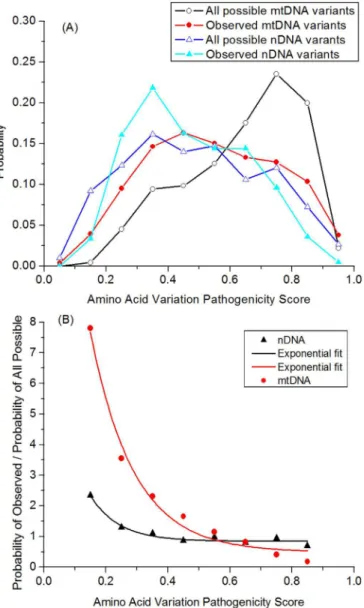
Although both nDNA and mtDNA encoded mitochondrial genes are under the effect of purifying selection, the set of all possible variants for the nuclear genes has a mean pathogenicity score of 0.544, which is lower than the mean value displayed by the mtDNA variants, of 0.640. The difference is even more remarkable when comparing the distributions of the pathogenicity scores (Figure 2A). For all possible variants in the mtDNA encoded proteins, the distribution is strongly skewed to high predicted
pathogenicity scores, while the distribution for the nuclear encoded genes is more moderate. These results have a great influence in measuring the effect of selection, which can be done by dividing the distribution of pathogenicity scores for all observed protein var-iants by the distribution of scores for all possible varvar-iants (Figure 2B). Selection functions for both mtDNA and nDNA genes were consist-ent with an exponconsist-ential decay (nDNA: adjusted R2
50.748 and p-value51.2831025; mtDNA: adjusted R2
50.956; p-value54.812 31026), although the exponential decay is especially strong for the mtDNA, indicating a stronger purifying selection.
Our data indicate a differential potential for pathogenicity between the two genomes, with much higher potential pathogenicity in the mtDNA. One well-known property of proteins coded by ver-tebrate mtDNA is their high hydrophobicity compared to the pro-teins coded by the nDNA. We further investigated whether this chemical property could account for the different theoretical patho-genicity patterns of the proteins.
We began by ascertaining if the amino acids that have different codons between nDNA and mtDNA, due to the differing genetic codes, could be the main contributors to this issue (Figure S6), since this directly affects the range of amino acid changes that can be created by a single nucleotide change. The differences between the genetic codes would mean more opportunities to create tryptophan and methionine in mtDNA through single nucleotide variations, compared with more expected isoleucine and arginine in nDNA.
Indeed, comparing with our nDNA gene set, mtDNA coded proteins show higher proportions of tryptophan and methionine, and lower proportion of arginine, but also much higher percentage of isoleu-cine. This observation suggests that there is no simple correspond-ence between the differcorrespond-ence in genetic codes and differcorrespond-ences in hydrophobic amino acid content of proteins. Interestingly, patho-genicity values are higher in almost all amino acids for mtDNA coded proteins, meaning that the pathogenicity risk of a non-synonymous mutation in the mtDNA is higher than for a mutation in the same amino acid in the nDNA coded genes for mitochondrial proteins. This difference is present even in amino acids with the same genetic code in both nDNA and mtDNA, ruling that difference out as an explanation for the greater predicted pathogenicity of mtDNA var-iants (Figure S14.A, Supplemental Results Section 4).
The impact of hydrophobicity is clearer when we performed the analyses at the protein level (Figure 3A). All mtDNA coded proteins except for ATP8 have higher average hydrophobicity and higher average MutPred score than the proteins coded by nDNA (correla-tions are presented in Supplemental Results Section 1). These results Figure 1|Assessing Selection as a Function of the Pathogenicity Score
Across Variant Frequency Classes.Probability distributions of all possible and observed amino acid variant pathogenicity scores for (A) very rare
variants (MAF,0.1%); (B) rare variants (0.1%,MAF,1%); (C)
intermediate variants (1%,MAF,5%); and (D) common variants
(MAF.5%). The solid line denotes the pathogenicity score distribution
for all possible single nucleotide variants in the 104 genes assessed, for comparison. Pathogenicity scores calculated using MutPred, with high values representing greater pathogenicity.
hold true when using SIFT as a measure of pathogenicity (see Figure S10 Supplemental Results Section 2), suggesting that the solvent accessibility incorporated in MutPred algorithm does not critically influence the correlation between MutPred and hydrophobicity values. Curiously, ATP8 has been shown to be the most polymorphic mtDNA gene in both human (in the upper extreme when consider-ing the amount of polymorphic sites or only the set of polymorph-isms with a frequency of at least 0.1%14) and other species (presenting the higher average of radically changing amino acid properties per residue19). Further confirmation is evident when plotting the differ-ence in mean pathogenicity score between nDNA and mtDNA per amino acid, which is strongly associated with the amino acid hydro-phobicity (Figure 3B, p50.0013, R2
50.45 by linear regression). Between nDNA and mtDNA encoded proteins, hydrophobic amino acids show little difference in pathogenicity, but less hydrophobic ones display clear difference in it (Figure S14.B, Supplemental Results Section 4).
This positive correlation between overall pathogenicity and patho-genicity in proteins is consistent with previous findings of stability disruption in pathogenic variants20 as well as the enrichment of
structural features, such as helix and sheet propensity, and depletion of intrinsically disordered regions21,22at sites of pathogenic variation. Indeed, we found that the average propensity for intrinsically dis-ordered regions (assessed by VSL2B predictor23) was significantly lower for the set of 13 mtDNA-encoded proteins compared to the 104 nuclear DNA coded proteins (0.229 vs. 0.421; p52.531027; t-test), with no significant differences in protein average length (294.2 vs. 253.1; p50.533; t-test) in the two groups. The higher propensity towards intrinsic disorder for nDNA proteins may be related to requirements for mitochondrial import or to their func-tional roles24,25. In the 117 proteins assessed in this study, the VSL2B values were highly correlated (R5 20.73, p,0.0001) with the hydrophobicity values, preventing any useful multivariable model testing involving both VSL2B and hydrophobicity simultaneously. The Aliphatic index was also highly correlated with the hydropho-bicity (R50.89, p,0.0001). Considering this, we performed a multivariate linear regression analysis for the MutPred pathogenicity score with hydrophobicity and the Instability Index. In this multi-variate model both hydrophobicity (p51.131024) and the instab-ility index (p 5 4.631026) are significantly associated with the pathogenicity score.
We then turned to the question of how many potentially patho-genic SNPs in these nuclear genes for critical mitochondrial proteins were observed in each individual and compared these numbers across different population groups (Figure 4). We restricted this analysis to non-admixed populations in the 1000 Genomes database by leaving out all Hispanic populations and the single African American population, while retaining the ‘‘Utah residents with Northern and Western European ancestry’’ as part of the European population. Such criterion finally selected 850 individuals. For this assessment of predicted pathogenicity we were conservative and further considered only the group of variants that satisfy all these criteria: (1) showing consensus predicted pathogenicity among three widely used tools (MutPred, Polyphen and SIFT; see Table S2); (2) being in HW equilibrium in all three continental population groups; and (3) having a frequency.0.5%. A total of 202 individuals (23.8% of the 850 individuals; Table S6) had at least one predicted patho-genic hit in the 104 nDNA genes coding mitochondrial proteins. There were 154 SNVs that were predicted pathogenic, for which the vast majority of subjects that were carriers had only one of these SNVs (183; 90.6%). A minor proportion of individuals had two of these SNVs (17; 8.4%) or three SNVs (2; 1.0%). Proportionally, a higher fraction of Africans display at least one predicted pathogenic SNV (32.4%), than Asians (28.3%) and Europeans (16.1%). The proportions of carriers and non-carriers of predicted pathogenic variants in the three population groups are highly significant differ-ent (p 5 0.000009), due to the low proportion of carriers in Europeans (two by two population groups comparisons: Africans 3Asians, p50.355; Africans3Europeans, p50.000013; Asians 3Europeans, p50.00018). The vast majority (97.4%) of the pre-dicted pathogenic SNVs was limited to a single population group, and just two of these SNVs were shared between Africa and Asia, and another two between Africa and Europe. Proportionally to the sam-ple size, Africans had more non-synonymous SNPs than Europeans and Asians, but their average MutPred was 0.641 compared with 0.702 and 0.677 in the latter, respectively. Thus, these data seem to contradict the expectation based on the higher proportion of non-synonymous mutations in non-African populations in the whole genome. However, Abecasis et al.4showed that the population bias in the non-synonymous variation proportion varies greatly between different pathways. For the oxidative phosphorylation pathway, which highly matches the nDNA genes studied here, the authors estimated a value of 0.595 for the excess of non-synonymous per kb for the rare SNPs (MAF,0.5%), while typically the correspond-ing value across all proteins for rare SNPs is in the range 1–2. However, that value for rare SNPs in the oxidative phosphorylation Figure 3|Assessing Hydrophobicity Influence at the Protein and Amino
Acid Level, Using GRAVY Measure.(A) Average pathogenicity score for each of the nDNA and mtDNA coded proteins vs average hydrophobicity of the protein. (B) Distribution of the difference in mean pathogenicity score between nDNA and mtDNA for each amino acid vs amino acid
hydrophobicity. The line shows a linear fit (R2
50.45, p50.0013).
pathway is at the low end of the range 0.5–1.5 found for overall common variants (the set already pruned by purifying selection). This indicates for the oxidative phosphorylation pathway a stronger purifying selection on the nuclear encoded genes than on nDNA genes in general.
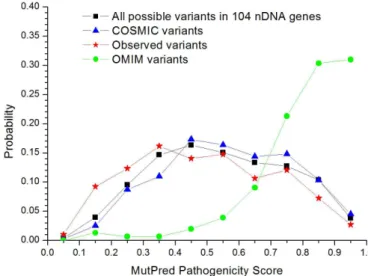
We also checked the OMIM and the COSMIC databases for these 104 genes. OMIM reports 155 non-synonymous SNPs, mostly dis-playing very high MutPred values (Figure 5). Of these, 19 were detected in the 1000 Genomes database, eight with MutPred score
.0.7 (all in single individuals except one SNP in two African indi-viduals from the same population) and the remaining 11 with MutPred score,0.7 (mostly present in several individuals, consist-ent with lower pathogenicity). The COSMIC dataset comprises 603 non-synonymous SNPs in these nDNA genes, and its MutPred dis-tribution curve resembles the curve for all possible non-synonymous variants, showing that the somatic mutations reported are indistin-guishable from a random selection from the set of all possible amino acid SNPs and have therefore escaped the effects of purifying selec-tion, as also occurs for somatic mtDNA mutations in cancer18. Only nine of the 603 non-synonymous SNPs in the COSMIC dataset were found in the 1000 Genomes database with MutPred values varying from 0.454 to 0.875. The non-synonymous mutations reported in OMIM, COSMIC and 1000 genomes for these 104 genes have a high bias to affect the residue arginine (Figure 6A), as also occurs overall in the genome26, but this bias is surprisingly strong in the OMIM data-set. The authors point out that as four out of the six codons for
arginine contain CpG dinucleotides (in the non-wobble positions, so always non-synonymous), the 10–50 times higher mutation rate in those dinucleotides than in others leads to a higher mutability of arginine when compared with the other amino acids. In the OMIM dataset, a remarkably large proportion (41.5%) of these arginine mutations are to tryptophan (Figure 6B), while the corresponding proportion is only 11.5% in 1000 Genomes and 9.3% in the COSMIC datasets.
Discussion
Our results show that the very rare variants (MAF,0.1%) in the nDNA genes encoding mitochondrial proteins are consistent with a random set from all possible variants with no discernable selection having had time to occur upon them. All other classes of variant frequencies do display distinct signs of purifying selection eliminat-ing variants with high pathogenicity scores, to such an extent that for common variants no more than 10% display MutPred pathogenicity values higher than 0.7. Hydrophobicity seems to account for the very high pathogenic values that variants can reach in mtDNA genes, when comparing to the nDNA coded genes. The high hydrophobi-city of these proteins is one of the reasons proposed for the retention of the mitochondrial genome27, as it would be difficult to transport their protein products into the organelle if coded by the nDNA. Other authors believe the transfer of genes from mitochondria to the nucleus is still ongoing and, given enough time, the mtDNA will be lost28, while a third hypothesis states that certain genes have been preferentially maintained in mitochondria to locally adjust gene expression according to the redox or metabolic state of individual mitochondria29,30. Whatever the reason, the maintenance of the mtDNA requires a complex cross-talk between the two genomes. It is curious that despite the fact that the average protein pathogenicity does increase as the protein hydrophobicity increases, at the extreme high range of protein hydrophobicity (for values higher than 0.377, which encompasses all mtDNA encoded proteins except ATP8 and includes a few nDNA encoded proteins; Figure 3A and Supplemental Results Section 1) the relationship appears to change to a negative correlation. We should be careful in interpreting this evidence, as at that range of the graph there are very few data points.
Possibly the high hydrophobicity of proteins coded by mtDNA also rendered this genome more prone to very pathogenic mutations. Recently, Badgujar et al.31showed that most mutations in the BRCA1 gene are located at the hydrophobic core, and that the evaluation of Figure 4|Evaluating Pathogenic Mutations Across Population Groups.
(A) Number of overall predicted pathogenic mutations on our 104 genes across population groups (top number) and when divided by OXPHOS/ non-OXPHOS function (bottom pair of numbers). (B) Frequency of carriers of predicted pathogenic mutations in the three population groups. Error bars are 95% confidence intervals and p-values are from Fisher’s exact tests.
its pathogenicity (by applying functional assays) depends on how they destabilize the hydrophobic environment of the protein struc-ture. They even suggest that small molecules that could stabilize the hydrophobic environments of BRAC1, reducing the pathogenicity of the mutations, could be used as potential drugs for targeted cancer therapy. Also, for the hereditary human forms of encelophalopathies or prion diseases, four of its mutations occur in the hydrophobic core of the PrP prion protein, and these have been shown to have a significant effect on the dynamics and stability of the protein, includ-ing the propensity to misfoldinclud-ing32. This hydrophobicity-driven faster selection force in mtDNA-coded compared with nDNA-coded mito-chondrial proteins is even more significant when taking in consid-eration that selection has more power to determine variation in larger populations, while genetic drift has more influence in smaller populations33, and that the effective population size of a nuclear allele is four times that of a mitochondrial allele.
The African populations had more potential pathogenic muta-tions (when being conservative in this classification) in our gene set than did the European and Asian populations, although the aver-age MutPred pathogenicity score was lower: 32.4% individuals with
one pathogenic mutation and 0.641 average MutPred pathogenicity score in Africans; 28.3% and 0.677 in Asians; and 16.1% and 0.702 in Europeans. The issue of European and Asian populations having more non-synonymous mutations than Africans is still under debate. All authors agree that demography was very important, but they differ in the modeling parameters/complexity used to evaluate selec-tion overall the genome, getting at contradictory results5,7,8,10. A major demographic difference between African and non-African populations was the older expansion experienced in Africans, leading to the out-of-Africa migration, setting the time zero for European and Asian populations – many of the models rely greatly on this event. But the class of rare and potentially pathogenic mutations consists primarily of new mutations, dating not more than 5,000– 10,000 years ago. Worldwide mtDNA phylogenetic studies34–39are showing that despite the occurrence of previous population expan-sions, all human populations experienced a dramatic effective popu-lation size expansion since the Holocene, 11,700 years ago, when current climatic conditions were established, leading to the emer-gence of agriculture and domestication, which further fuelled the population expansions. This is the time frame for the development of the rare pathogenic variants – so, all population groups should display comparable signs for the rare class of variants. Heterogeneity can result from differences in the population expansion strength across space and time within the Holocene. In Europe the main population expansions took place at the post-glacial period (the last glacial maximum was more aggressive in the northern hemisphere), with a lower impact of the Neolithic on European populations38,40,41. In contrast, in Africa and Asia recent population expansions merging the more recent Neolithic diffusions in the regions (in the last 5 millennia), seem to have been significant36,37,42–44. Further heterogen-eity can be caused by the differential purifying selection strengths on proteins in different biochemical pathways – which is compatible with the observation that the rare-variant load varies substantially across biological pathways and population groups4. Thus our iden-tified significant lower rate of predicted pathogenic SNP carriers in Europe is compatible with a strong purifying selection in the oxid-ative phosphorylation pathway (coded by nDNA) pruning more efficiently the main post-glacial European variant pool, and less so the main middle-Holocene/Neolithic Asian and African variant pools. The evidence found here of a faster selection in the mtDNA genome than in the nuclear genome also fits nicely with our previous finding that there were no differences in the purifying selection strength between population groups for mtDNA coded OXPHOS proteins15, efficiently eliminating potentially pathogenic mtDNA mutations consistently in African, Asian and European populations.
Methods
The genetic diversity of the mitochondrial proteins coded by the nuclear and
mitochondrial genomes.We selected 104 mitochondrial proteins coded by nuclear
genes (Table S1), including both oxidative phosphorylation (OXPHOS) proteins and regulatory proteins (of transcription, replication, stress protective, fission and fusion). These nDNA encoded mitochondrial proteins were chosen for the importance of these pathways for mitochondrial diseases, hence the interest in the predicted pathogenicity of variants in these proteins. Both sets of proteins have to migrate to the mitochondrion, but only the OXPHOS proteins will be integrated together with the mtDNA coded ones in complexes inserted in the mitochondrial inner membrane. As we are mainly interested in non-synonymous mutations, the upstream and downstream flanking regions of the gene were ignored. The genetic diversity information for each gene coding these 104 proteins was extracted from the 1000 genomes ensembl browser (http://browser.1000genomes.org), through the available tools that generate VCF files. Currently, 1000 Genomes displays information for 1,092 individuals, of which 246 are from Africa (including African-Americans; 185 without that admixed population), 379 from Europe, 286 from Asia and 181 from America. The polymorphic positions were inputed into the ‘‘variant effect predictor’’ to check its location in exons/introns and status, in order to infer the list of observed non-synonymous positions (Tables S2 and S3). Genotypes and population frequencies of these polymorphisms were ascertained in the 1000 Genomes web site. The Hardy-Weinberg equilibrium (HWE) was checked by using the software Arlequin45, for the global population level for each SNP, and in the cases were values were statistically significant (p,0.001), the HWE was checked within each of the Figure 6|Pathogenic Non-synonymous Mutations in 1000 Genomes,
OMIM and COSMIC.Frequencies of amino acids in the 104 nDNA encoded proteins and of amino acids mutated in 1000 Genomes, OMIM and COSMIC datasets in which (A) represents the reference amino acid and (B) the variant amino acid. For comparison, the ‘‘frequency in protein’’ value is repeated in both panels.
four continental populations and SNPs were removed if they had p,0.001 in any of the continental populations.
We compared with information from 14,642 complete mtDNA genomes (available in the GenBank database, for the 1000 Genomes project, and our own unpublished complete sequences; Table S4), representing worldwide populations. The OMIM and COSMIC datasets were also checked for mutations in these genes (Tables S7 and S8).
Pathogenicity inference.A PERL script was used to infer all possible non-synonymous variants from all possible SNPs in the 104 nDNA genes, based on the GRCh37 human reference for one of the protein coding transcripts (usually the one coding the longer protein sequencing) available for each gene in the 1000 Genomes ensembl browser (the selected transcript identifiers are reported in Table S1). The list of all possible non-synonymous variants was then assessed by the MutPred algorithm46to infer pathogenicity scores. MutPred generates probability-like scores for amino acid substitutions to estimates their pathogenicity. We used the same version of MutPred (1.2) as before17in calculating the pathogenicity scores for variants in the nuclear genes. The MutPred scores for the observed non-synonymous mutations were checked in this list. Other pathogenicity scores, such as PolyPhen47 and SIFT48were inferred in the tool ‘‘variant effect predictor’’ of 1000 Genomes ensembl browser, for the observed polymorphisms, in order to correlate the prediction between the three classifiers (Supplemental Results Section 2). Furthermore, SIFT predictor was estimated for all possible non-synonymous variants in the nDNA and mtDNA coded proteins, by using SIFT online tools (http://sift.jcvi. org/).
Protein physicochemical properties.Several physicochemical properties (Table S5), such as hydrophobicity or hydropathy, deduced from the protein sequences were determined by using the ProtoParam tool available on the ExPASy Server49. We were mainly interested in having a measure of hydrophobicity or hydropathy of the protein, and this tool provides the grand average of hydropathy (GRAVY) as the sum of hydropathy values of all the amino acids divided by the number of residues in the sequence, based on the Kyte and Doolittle scale50, which takes into account values from water-to-vapor energy transfer and from internal-external distribution of amino acid residues. We also estimated the: Instability Index, which provides an estimate of the stability of the protein in a test tube, based on the observation that the occurrence of certain dipeptides is significantly different in the unstable proteins compared with those in the stable ones; and Aliphatic Index defined as the relative volume occupied by aliphatic side chains (alanine, valine, isoleucine, and leucine), which may be regarded as a positive factor for the increase of thermostability of globular proteins.
We also used the MitoProt II web site51to estimate other hydrophobicity measures based on several hydrophobicity scales. The estimated measures are: H17, the max-imal local hydrophobicity of a segment; MesoH (Mesohydrophobicity), the average regional hydrophobicity over an extended region of the sequence; MuHD, the max-imal Eisenberg’s hydrophobic moment with 6 angles of 750, 950, 1000and 1050, with a scanning window of 18 residues; Hmax, the maximal hydrophobicity of 7 neigh-boring residues on the maximal alpha segment, with alpha having the values of 75, 95, 100 and 105 degrees. The scales used are: the Kyte and Doolittle (KD); the Goldman, Engelman and Steitz scale (GES)52, which quantifies the free energy of water-oil transfer for residues in an a-helical structure; the Gunnar von Heijne scale 1 (GVH1)53, a statistical scale obtained from the amino acid frequencies in the central part of a transmembrane segment with respect to the non-membranous stretches; and the Eisenberg’s consensus scale (ECS)54, designed to mitigate the effects of outlaying values in any one scale produced by the peculiarities of the method, and is simply an average of four scales. We tested the effect of some of these diverse measures in the results (Supplemental Results Section 3).
We used the VSL2B for protein disorder prediction, which is applicable to proteins with more than 25 amino acids and can accurately identify short disordered regions that are often misclassified by other disorder predictors.
Statistical analyses.All comparisons of mean values were calculated in Origin 7 (www.originlab.com), by using two-tailed t-tests assuming unequal variances. The observed non-synonymous SNP lists for nDNA and mtDNA coded proteins consisted in single instances of each variant, as it is difficult to infer if a nDNA variant present in several individuals is shared by ancestry or by state. Although it is easier to infer recurrence in the mtDNA, we followed the same rule, for comparison sake. Nonetheless, we evaluated the influence of the nDNA SNPs’ frequency in the MutPred pathogenicity inference by performing comparisons between very rare variants (MAF,0.1%), rare (0.1%,MAF,1%), intermediate (1%,MAF,5%) and common (MAF.5%).
A selection function for the amino acid variants was calculated by dividing the probability distributions for the set of all observed non-synonymous mutations and all possible non-synonymous mutations (created by a single nucleotide change from the reference sequence) into ten equal intervals of the MutPred pathogenicity scores (0 to 0.1, etc.) and taking the ratio of the two probabilities within each bin. The nonlinear curve fit of the selection function to the pathogenicity score and the adjusted R2were calculated in Origin 7.
The multivariate general linear regression analysis for MutPred values with hydrophobicity and Instability Index was performed in R.
1. Hudson, T. J.et al. International network of cancer genome projects.Nature464, 993–998, doi:10.1038/nature08987 (2010).
2. Project, T. I. H. The International HapMap Project.Nature426, 789–796, doi:10.1038/nature02168 (2003).
3. Abecasis, G. R.et al. A map of human genome variation from population-scale sequencing.Nature467, 1061–1073, doi:10.1038/nature09534 (2010). 4. Abecasis, G. R.et al. An integrated map of genetic variation from 1,092 human
genomes.Nature491, 56–65, doi:10.1038/nature11632 (2012).
5. Dorschner, M. O.et al. Actionable, Pathogenic Incidental Findings in 1,000 Participants’ Exomes.Am J Hum Genet93, 631–640, doi:10.1016/ j.ajhg.2013.08.006 (2013).
6. Coventry, A.et al. Deep resequencing reveals excess rare recent variants consistent with explosive population growth.Nat Commun1, 131, doi:10.1038/
ncomms1130 (2010).
7. Fu, W.et al. Analysis of 6,515 exomes reveals the recent origin of most human protein-coding variants.Nature493, 216–220, doi:10.1038/nature11690 (2013). 8. Lohmueller, K. E.et al. Proportionally more deleterious genetic variation in
European than in African populations.Nature451, 994–997, doi:10.1038/ nature06611 (2008).
9. Soares, P.et al. The Expansion of mtDNA Haplogroup L3 within and out of Africa.Mol Biol Evol29, 915–927, doi:10.1093/molbev/msr245 (2012). 10. Boyko, A. R.et al. Assessing the evolutionary impact of amino acid mutations in
the human genome.PLoS Genet4, e1000083, doi:10.1371/journal.pgen.1000083 (2008).
11. Temperley, R., Richter, R., Dennerlein, S., Lightowlers, R. N. & Chrzanowska-Lightowlers, Z. M. Hungry Codons Promote Frameshifting in Human Mitochondrial Ribosomes.Science327, 301–301, doi:10.1126/science.1180674 (2010).
12. Anderson, S.et al. Sequence and organization of the human mitochondrial genome.Nature290, 457–465 (1981).
13. Chinnery, P. F. inHuman Mitochondrial DNA and the Evolution of Homo sapiens
Vol. 18Nucleic Acids and Molecular Biology(ed H.-J.; Macaulay Bandelt, V.; Richards M.) Ch. 1, 3–15 (Berlin Heidelberg, Springer-Verlag, 2006). 14. Pereira, L.et al. The diversity present in 5140 human mitochondrial genomes.Am
J Hum Genet84, 628–640, doi:10.1016/j.ajhg.2009.04.013 (2009).
15. Pereira, L., Soares, P., Radivojac, P., Li, B. & Samuels, D. C. Comparing Phylogeny and the Predicted Pathogenicity of Protein Variations Reveals Equal Purifying Selection across the Global Human mtDNA Diversity.Am J Hum Genet88, 433–439, doi:10.1016/j.ajhg.2011.03.006 (2011).
16. Li, B.et al. Automated inference of molecular mechanisms of disease from amino acid substitutions.Bioinformatics25, 2744–2750, doi:10.1093/bioinformatics/ btp528 (2009).
17. Soares, P.et al. Evaluating purifying selection in the mitochondrial DNA of various mammalian species.PLoS One8, e58993, doi:10.1371/
journal.pone.0058993 (2013).
18. Pereira, L., Soares, P., Maximo, V. & Samuels, D. C. Somatic mitochondrial DNA mutations in cancer escape purifying selection and high pathogenicity mutations lead to the oncocytic phenotype: pathogenicity analysis of reported somatic mtDNA mutations in tumors.BMC Cancer12, 53, doi:10.1186/1471-2407-12-53 (2012).
19. da Fonseca, R. R., Johnson, W. E., O’Brien, S. J., Ramos, M. J. & Antunes, A. The adaptive evolution of the mammalian mitochondrial genome.BMC Genomics9, 119, doi:10.1186/1471-2164-9-119 (2008).
20. Wang, Z. & Moult, J. SNPs, Protein Structure, and Disease.Hum Mutat17, 263–270 (2001).
21. Mort, M.et al. In Silico Functional Profiling of Human Disease-Associated and Polymorphic Amino Acid Substitutions.Hum Mutat31, 335–346 (2010). 22. Vacic, V.et al. Disease-Associated Mutations Disrupt Functionally Important
regions of Intrinsic Protein Disorder.PLoS Comput Biol8, e1002709 (2012). 23. Peng, K., Radivojac, P., Vucetic, S., Dunker, A. K. & Obradovic, Z.
Length-Dependent Prediction of Protein Intrinsic Disorder.BMC Bioinformatics7, 208 (2006).
24. Schmidt, O., Pfanner, N. & Meisinger, C. Mitochondrial Protein Import: From Proteomics to Functional Mechanisms.Nat Rev Mol Cell Bio11, 655–667 (2010). 25. Homma, K., Fukuchi, S., Nishikawa, K., Sakamoto, S. & Sugawara, H. Intrinsically
Disordered Regions Have Specific Functions in Mitochondrial and Nuclear Proteins.Mol Biosyst8, 247–255 (2012).
26. de Beer, T. A.et al. Amino acid changes in disease-associated variants differ radically from variants observed in the 1000 genomes project dataset.PLoS Comput Biol9, e1003382, doi:10.1371/journal.pcbi.1003382 (2013). 27. Claros, M. G.et al. Limitations to in vivo import of hydrophobic proteins into
yeast mitochondria. The case of a cytoplasmically synthesized apocytochrome b.
Eur J Biochem228, 762–771 (1995).
28. Palmer, J. D. Organelle genomes: going, going, gone!Science275, 790–791 (1997). 29. Allen, J. F. Why chloroplasts and mitochondria contain genomes.Comp Funct
Genomics4, 31–36, doi:10.1002/cfg.245 (2003).
30. Race, H. L., Herrmann, R. G. & Martin, W. Why have organelles retained genomes?Trends Genet15, 364–370 (1999).
32. van der Kamp, M. W. & Daggett, V. Pathogenic mutations in the hydrophobic core of the human prion protein can promote structural instability and misfolding.J Mol Biol404, 732–748, doi:10.1016/j.jmb.2010.09.060 (2010). 33. Lanfear, R., Kokko, H. & Eyre-Walker, A. Population size and the rate of
evolution.Trends Ecol Evol29, 33–41, doi:10.1016/j.tree.2013.09.009 (2014). 34. Fernandes, V.et al. The Arabian cradle: mitochondrial relicts of the first steps
along the southern route out of Africa.Am J Hum Genet90, 347–355, doi:10.1016/ j.ajhg.2011.12.010 (2012).
35. Pereira, L.et al. Population expansion in the North African late Pleistocene signalled by mitochondrial DNA haplogroup U6.BMC Evol Biol10, 390, doi:10.1186/1471-2148-10-390 (2010).
36. Rito, T.et al. The first modern human dispersals across Africa.PLoS One8, e80031, doi:10.1371/journal.pone.0080031 (2013).
37. Soares, P.et al. Climate change and postglacial human dispersals in southeast Asia.Mol Biol Evol25, 1209–1218, doi:10.1093/molbev/msn068 (2008). 38. Soares, P.et al. The archaeogenetics of Europe.Curr Biol20, R174–183,
doi:10.1016/j.cub.2009.11.054 (2010).
39. Atkinson, Q. D., Gray, R. D. & Drummond, A. J. mtDNA variation predicts population size in humans and reveals a major Southern Asian chapter in human prehistory.Mol Biol Evol25, 468–474, doi:10.1093/molbev/msm277 (2008). 40. Pala, M.et al. Mitochondrial DNA signals of late glacial recolonization of Europe
from near eastern refugia.Am J Hum Genet90, 915–924, doi:10.1016/ j.ajhg.2012.04.003 (2012).
41. Fu, Q., Rudan, P., Paabo, S. & Krause, J. Complete mitochondrial genomes reveal neolithic expansion into Europe.PLoS One7, e32473, doi:10.1371/
journal.pone.0032473 (2012).
42. Gignoux, C. R., Henn, B. M. & Mountain, J. L. Rapid, global demographic expansions after the origins of agriculture.Proc Natl Acad Sci U S A108, 6044–6049, doi:10.1073/pnas.0914274108 (2011).
43. Zheng, H. X.et al. Major population expansion of East Asians began before neolithic time: evidence of mtDNA genomes.PLoS One6, e25835, doi:10.1371/ journal.pone.0025835 (2011).
44. Zheng, H. X., Yan, S., Qin, Z. D. & Jin, L. MtDNA analysis of global populations support that major population expansions began before Neolithic Time.Sci Rep2, 745, doi:10.1038/srep00745 (2012).
45. Excoffier, L., Laval, G. & Schneider, S. Arlequin (version 3.0): an integrated software package for population genetics data analysis.Evol Bioinform Online1, 47–50 (2005).
46. Zhidkov, I., Livneh, E. A., Rubin, E. & Mishmar, D. MtDNA mutation pattern in tumors and human evolution are shaped by similar selective constraints.Genome Res19, 576–580, doi:10.1101/gr.086462.108 (2009).
47. Adzhubei, I., Jordan, D. M. & Sunyaev, S. R. Predicting functional effect of human missense mutations using PolyPhen-2.Curr Protoc Hum GenetChapter 7, Unit7 20, doi:10.1002/0471142905.hg0720s76 (2013).
48. Ng, P. C. & Henikoff, S. Predicting deleterious amino acid substitutions.Genome Res11, 863–874, doi:10.1101/gr.176601 (2001).
49. Gasteiger, E.et al. inThe Proteomics Protocols Handbook(ed J.M. Walker) 571– 607 (Berlin Heidelberg, Springer-Verlag, 2005).
50. Kyte, J. & Doolittle, R. F. A simple method for displaying the hydropathic character of a protein.J Mol Biol157, 105–132 (1982).
51. Claros, M. G. & Vincens, P. Computational method to predict mitochondrially imported proteins and their targeting sequences.Eur J Biochem241, 779–786 (1996).
52. Engelman, D. M., Steitz, T. A. & Goldman, A. Identifying nonpolar transbilayer helices in amino acid sequences of membrane proteins.Annu Rev Biophys Biophys Chem15, 321–353, doi:10.1146/annurev.bb.15.060186.001541 (1986). 53. von Heijne, G. Membrane protein structure prediction. Hydrophobicity analysis
and the positive-inside rule.J Mol Biol225, 487–494 (1992).
54. Eisenberg, D. Three-dimensional structure of membrane and surface proteins.
Annu Rev Biochem53, 595–623, doi:10.1146/annurev.bi.53.070184.003115 (1984).
Acknowledgments
FCT, the Portuguese Foundation for Science and Technology, supported this work through the research project PTDC/CS-ANT/113832/2009 and the personal grant to P.S. (SFRH/ BPD/64233/2009). P.T. has a PhD grant from the People Programme (Marie Curie Actions) of the European Union’s Seventh Framework Programme FP7/2007–2013/ under REA grant agreement no. 317184. The Instituto de Patologia e Imunologia Molecular da Universidade do Porto is an Associate Laboratory of the Portuguese Ministry of Science, Technology, and Higher Education and is partially supported by FCT. L.P. had a mobility grant from The Luso-American Development Foundation.
Author contributions
L.P. and D.C.S. designed the study and wrote the manuscript. L.P., P.S., P.T., T.R., A.W., B.L., P.R. and D.C.S. performed the analyses. All authors reviewed and approved the manuscript.
Additional information
Supplementary Informationaccompanies this paper at http://www.nature.com/ scientificreports
Competing financial interests:The authors declare no competing financial interests.
How to cite this article:Pereira, L.et al. Global human frequencies of predicted nuclear pathogenic variants and the role played by protein hydrophobicity in pathogenicity potential.Sci. Rep.4, 7155; DOI:10.1038/srep07155 (2014).
This work is licensed under a Creative Commons Attribution-NonCommercial-NoDerivs 4.0 International License. The images or other third party material in this article are included in the article’s Creative Commons license, unless indicated otherwise in the credit line; if the material is not included under the Creative Commons license, users will need to obtain permission from the license holder in order to reproduce the material. To view a copy of this license, visit http:// creativecommons.org/licenses/by-nc-nd/4.0/