M
ESTRADO
C
IÊNCIAS
A
TUARIAIS
T
RABALHO
F
INAL DE
M
ESTRADO
R
ELATÓRIO DE
E
STÁGIO
S
ETTING
A
SSUMPTIONS
–
D
IFFERENT
W
AYS TO
M
EASURE
T
HE
F
UNDING
P
OSITION OF A
UK
P
ENSION
S
CHEME
M
ARIA
I
NÊS
P
EREIRA
R
OSA
M
ESTRADO
C
IÊNCIAS
A
TUARIAIS
T
RABALHO
F
INAL DE
M
ESTRADO
R
ELATÓRIO DE
E
STÁGIO
S
ETTING
A
SSUMPTIONS
–
D
IFFERENT
W
AYS TO
M
EASURE
T
HE
F
UNDING
P
OSITION OF A
UK
P
ENSION
S
CHEME
M
ARIA
I
NÊS
P
EREIRA
R
OSA
O
RIENTAÇÃO:
D
ANIELAD
INISP
ATEIROO
NOFREA
LVESS
IMÕESAbstract
A pension fund is defined as an investment product in which the members of the scheme pay
contributions in order to receive an income at retirement. This is a very simplistic definition when
compared to the United Kingdom's Pension funds, which are complex and very specific financial
products.
This report is a result of an internship at the Willis Towers Watson Lisbon office, in the area of
retirement, where the main scope of the work was in UK pension schemes’ Actuarial Valuations.
Those Actuarial Valuations will result in a statutory and mandatory formal report to the government,
showing the funding position of the scheme, which needs to be regulated at least every three years.
The responsible actuary will present in this report results computed according to different scenarios,
which are defined using different economic and demographic assumptions, therefore allowing to
estimate the value of future liabilities.
The main goal of this project is to study the different ways of measuring the funding position of a
pension scheme, regarding the setting of assumptions. This will result in a practical demonstration
of the impact of the defined assumptions on the results obtained. In order to do that, two pension
schemes will be used, from companies that have been the focus of the internship.
For academic purposes, this internship report contributes to a better understanding on measuring
the funding position of pension schemes, and also on the application of knowledge obtained in the
master’s, for example on survival models, life annuities, financial markets and other subjects/topics.
Key words: Pension Funds, Actuarial Assumptions, Defined Benefits Plan, Retirement Benefits, Funding Methods,
Resumo
Um fundo de pensões é um produto de investimentos, onde cada membro desse fundo paga
contribuições para na idade de reforma receber uma pensão. Este á uma definição de fundos de
pensões é extremamente simples, ao comparar com fundos de pensões provenientes do Reino
Unido, onde eles são bastante complexos e específicos.
Este relatório resulta de um estágio realizado no escritório de Lisboa da Willis Towers Watson, na
área de Fundos de Pensões, onde a maioria do trabalho desempenhado foi em relação a avaliações
atuariais de fundos de pensões do Reino Unido.
Estas avaliações atuariais resultam num relatório formal e obrigatório, pelo menos de três em três
anos, apresentado ao governo que regula esta área. O atuário responsável irá apresentar neste
relatório resultados obtidos quanto ao valor de obrigações que o esquema terá no futuro, referente
a diferentes possíveis cenários. Estes cenários são definidos conforme os pressupostos económicos
e demográficos que são usados durantes os cálculos.
O objetivo principal deste projeto é analisar as diferentes formas de avaliar a posição de
financiamento de um fundo de pensões, tendo em conta a escolha dos pressupostos. Como
resultado desse estudo teremos uma análise prática do impacto dos pressupostos escolhidos nos
resultados obtidos. Neste estudo foram usados dois esquemas, com os quais trabalhei durante o
meu estágio curricular.
Academicamente, este relatório de estágio contribuiu bastante para o meu conhecimento quanto
á avaliação do nível de financiamento de um fundo de pensões, bem como para a aplicação prática
de conhecimento adquirido durante o meu mestrado, em áreas como modelos de sobrevivência,
cálculo de pensões, mercados financeiros, entre outros.
Palavras-chave: Fundos de Pensão, Pressupostos Atuariais, Planos de benefícios definidos, Benefícios de reforma,
Acknowledgments
Firstly, I would like to express my gratitude to my supervisor Daniela Pateiro, for her helpful advice
and for all the support and availability during this internship. Then, I would like to thank Professor
Onofre Simões for all the guidance and supervision. I am very grateful for the opportunity to work
and learn from them.
A very special thanks to my family and closer friends, especially to my mother and Francisco for
supporting me on my choices throughout this journey.
Last but not least, I acknowledge Joana Pereira and Pedro Cruz, from Willis Towers Watson, for the
Contents
1. Introduction ... 1
2. Introduction to UK pension funds ... 3
2.1 State Pensions ... 3
2.2 Occupational Pensions ... 4
2.3 Personal Pensions ... 6
2.4 Valuation Process of a UK pension fund ... 6
3. Assumptions Analysis... 8
3.1 Principle of Prudence ... 10
3.2 Demographic Assumptions ... 11
3.2.1 Mortality Tables ... 11
3.2.2 Continuous Mortality Investigation ... 12
3.3 Economic Assumptions ... 15
3.3.1 Retail Price Index & Consumer Price Index ... 16
3.3.2 Common Approaches to set Economic Assumptions ... 17
4. Valuation funding requirements ... 20
4.1 Technical Actuarial Standards ... 20
4.2 Technical Provisions ... 22
4.3 Types of Valuation Funding Requirements ... 23
4.3.1 Neutral Basis ... 23
4.3.2 Cash Equivalent Transfer Values Basis ... 24
4.3.3 Section 179 / Pension Protection Fund Basis ... 25
4.3.4 Solvency Basis ... 26
4.3.5 Optional Funding Requirements ... 27
5. Practical Study: Assumptions and Funding Level Analysis ... 28
5.1 Purpose ... 28
5.2 The two schemes... 28
5.3 Individual Scheme Analysis ... 34
5.4 Inter-valuation Period Analysis ... 36
5.5 Comparative Scheme Analysis ... 38
6. Conclusions ... 39
References ... 40
Appendix ... 45
Appendix A – History of UK pension funds ... 45
Appendix B - Optional Funding Requirements ... 46
List of figures
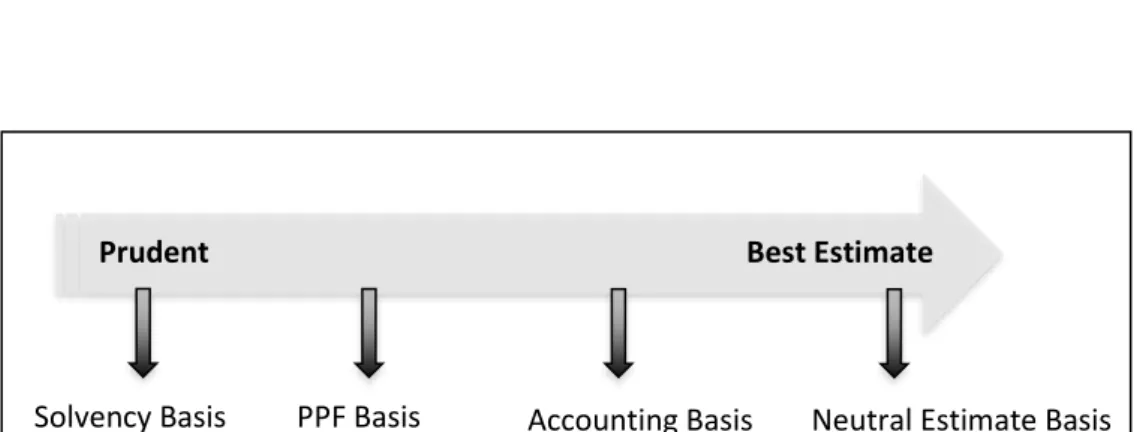
Figure 1: Main objectives of an actuarial pension valuation from WTW internal documents 6 Figure 2: Plot of a zero coupon gilt curve at 20/07/2017 18 Figure 3: Plot of a zero swap gilt curve at 26/07/2017 19 Figure 4: Chart with the position of each funding requirement on the level of prudence 27
List of tables
Table I : Economic Assumptions of Scheme A 29
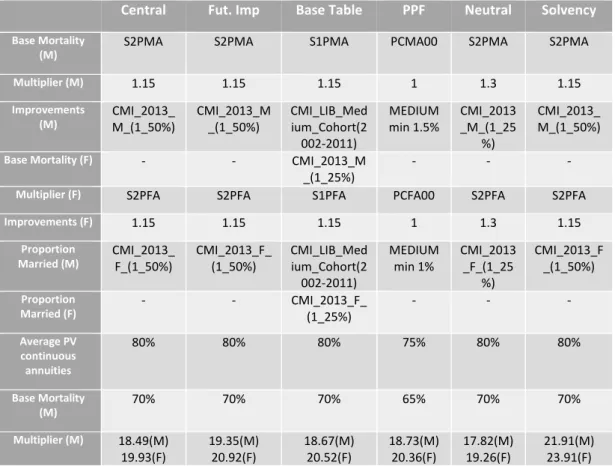
Table II: Demographic Assumptions of Scheme A (part A) 30 Table III: Demographic Assumptions of Scheme A (part B) 31 Table IV Funding Level of each funding requirement of Scheme A (part A) 31 Table V: Funding Level of each funding requirement of Scheme A (part B) 31
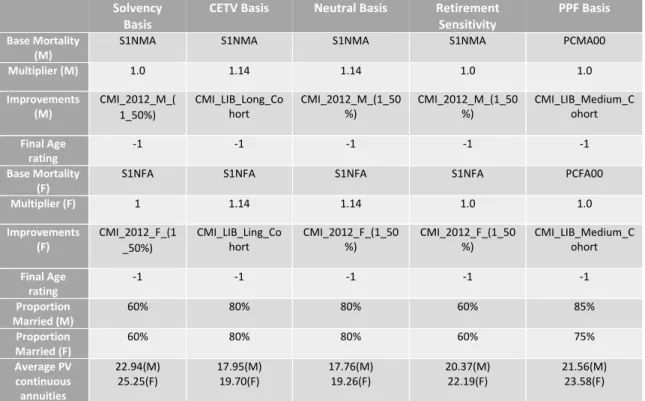
Table VI: Economic Assumptions of Scheme B (part A) 32
Table VII: Economic Assumptions of Scheme B (part B) 32
Acronyms
ASB Actuarial Standard Board
BAS Board of Actuarial Standards
BSP Basis State Pension
CARE Career Average Revalued Earning Scheme
CETV Cash Equivalent Transfer Values
CMI Continuous Mortality Investigation
CPI Consumer Price Index
DB Defined Benefits Schemes
DC Defined Contribution Schemes
FRC Financial Reporting Council
GMP Guarantee Minimum Pension
GPPS Group Personal Pensions Scheme
HCPI Harmonised Consumer Price Index
ICE Initial Cash Equivalent
IFoA Institute and Faculty of Actuaries
IFRS International Financial Reporting Standards
N/A Not Applicable
NIC National Insurance Contributions
NRA Normal Retirement Age
OFNS Office for National Statistics
PPF Pension Protection Fund
PPS Personal Pensions Scheme
PR Pension Regulator
PREC Professional Regulation Executive Committee
RPI Retail Price Index
SAPS Self- Administrated Pension Scheme
SERPS State Earning Related Pension Scheme
SOA Society of Actuaries
SPA State Pension Age
SPS Stakeholder Pensions
TAS Technical Actuarial Standards
TPs Technical Provisions
1
1. Introduction
This report is a summary of a five-month curricular internship at Willis Towers Watson (WTW), developed as a final project in the Master degree in Actuarial Science. More precisely, the internship took place in the WTW Lisbon Service Centre (LSC), where the main line of business is the valuation of UK schemes. Although the LSC is expanding its scope to other countries and different actuarial services, during these five months the work consisted of UK pension funds valuations.
Comparing with Portugal and most European countries, the United Kingdom is very unique in relation to
retirement benefits, not only because of the different existing types of funds, but also due to the
particularities and restricted rules imposed by the Pension Regulator, “the UK regulator of workplace pension
schemes” (Pensions Regulator website (f)). In order to satisfy all the requirements imposed by the government, each company will need to send to the regulator an actuarial report showing the financial
position of their particular scheme, annually or in three-year intervals. In these reports, the responsible
actuary ensures that the company has enough funds to fulfil its obligations on the payments to members
who retire from the company and also to their dependants, in case of a member’s death. The reports will
present analytically the funding requirement of the scheme, which will be the ratio between the computed
liabilities and the existing assets. If the scheme does not verify all the government rules, the actuary must
suggest a recovery plan to the fund.
During the internship, internal software, templates and actuarial Excel tools have been used to first set up
schemes, secondly compute the value of their obligations, and finally, in order to guarantee excellence in
every stage of the process, some checks are processed against the results obtained in the previous valuation.
For reference, the work developed follows a process, which is divided in two main phases. First we proceed
with the treatment of the data, where an extensive study on the membership, pension values, increases, and
salaries is done. Following it, come the benefits and funding level calculations, for each funding requirement
asked by the company or scheme’s trustees. This can be a very challenging task due to the dependence on
each scheme rules and assumptions, and the range of particularities a UK scheme can have. After getting the
results, the work goes on to our consultant colleagues in the UK, who will advise the company or the trustees
about the investment strategy and management of the pension fund for the next years.
In these five months a special attention was given to the actuarial assumptions used to produce a pension
valuation, both economic and demographic. Those assumptions are estimates of variables derived by
actuaries in order to specify important information of the plan in the calculations. For a normal valuation it
will be required to set assumptions which represent the current market conditions, particular properties of
the scheme, as pension increases, salary increases, age of retirement, mortality statistics for that particular
2 The main purpose of this internship is to highlight the relevance of adequately defining actuarial assumptions
related to pension funds. The detailed analysis of the impact of the chosen assumptions on the liabilities
results, and the dependence on the market conditions and financial position of the scheme on those settings,
will also be included.
This report is divided in two main parts, the first part corresponds to Chapters 2, 3 and 4, which will present
all the relevant concepts about UK Pension Funds. This legal and theoretical knowledge about the specific
schemes from the United Kingdom were acquired during the training period of the internship. The aim was
to explain the relevant concepts for the understanding of the rest of the report, and to transmit the most
important rules and particularities related to this actuarial work, in this country. Due to the limitations of
space and time, the information in the first part is a bit condensed and little interconnected, which can lead
to a slight more difficult reading.
In Chapter 2, a brief introduction of the UK Pension Funds, with focus on state pensions processed with
defined benefits, is given. If the reader is interested in the history of the UK pension schemes, Appendix A
gives a brief explanation about the progress of pension schemes in the country. Following this, Chapter 3
presents a detailed analysis of both the economic and demographic assumptions, with the aim of clarifying
the reader about the utility of these assumptions in a pension valuation, and a general knowledge about the
methods that are used to build them.
For each pension valuation, the actuary will ask for results obtained from different scenarios, which will be
defined as Funding Requirements, in Chapter 4.
Finally in Chapter 5 a practical analysis will be done. This analysis is the application of the theoretical concepts
referred in part one, and reflects the practical work done during the internship. Along with the numeric
results there will be an analysis on two particular schemes, which have been studied during the internship.
3
2. Introduction to UK pension funds
2.1
State Pensions
For the past 60 years, the UK government provides a state pension to the people entitled to it. This pension intends to ensure that everyone is supported in the old age by a basic amount of money. These schemes do not depend on how much citizens have earned during working life, but on the NICc they have done while working (Crawford and Tetlow, 2010).
The UK State pension is divided into three main elements: Basic State Pension, Additional Pensions and Pension Guarantee (Blake, 2003).
The Basic State Pension (BSP), also known as Retirement Pension, is a weekly endowment paid to a person over the State Pension Age (SPA), who made the minimum number of contributions to the NI defined by the Government. The SPA was 65 years old for men and 60 years old for women until April 2010. After that, the female SPA has been increasing one month every year (by date of birth) to be equated to the men’s. Since then, the SPA for both men and women has been increasing, and it may reach 68 years in 2020. Furthermore, people get this “contribution-based” benefit full amount if they make the necessary number of contributions. Otherwise they will get penalties in the weekly amount, by a pre-defined formula. Last but not least, if a citizen wants to increase his or her pension, he or she can defer the receipt of the benefit.
The Additional Pension intends to pay an extra amount over the BSP. It started with the Graduated Pension, between April 1961 and April 1975. During those years the UK government was giving a small amount of 1£ a week, to those who were qualified for that, according to the payment of a number of fixed amount of NICs. This extra benefit on retirement was followed by the State Earnings Related Pension Scheme (SERPS) from April 1975 until April 2002. In this case, a fixed percentage
(25%) of their earnings above a “lower earnings limit” was paid to those entitled to it. That
qualification was based on a “band range” between the lower earnings level and the upper earnings level, in each tax year. In order to pay lower values to the National Insurance, the employers also had the possibility of contracting-out the SERPS, by paying a minimum guaranteed pension (this is only possible for people under an occupational pension scheme).
With the supplementary objective of giving an additional retirement income to the workers, the Guaranteed Minimum Pension (GMP) 2 was created. The GMP is a complex supplement pension system managed as an occupational pension, which will provide a promised income to the worker. This guaranteed level of scheme pension is funded with additional contributions to the NI and paid according to the same principles as the state pensions, but have the main difference of being optional. This specific pension is famous for being complex because it has an intrinsic relation with inflation. As a consequence of that, we need to consider two different amounts of GMP, one related to service before 06/04/1988 and one related to service after or on 06/04/1988, the date when
2 According to the Pensions Terminology, the GMP is the minimum pension provided for employees who were contracted out between April 1978
4 specific rules changed. Following that, the existence of the GMP adds additional complexity to the
scheme’s benefits, as the way these amounts increase are different from the way the remaining scheme’s benefits are calculated. This pension is provided by schemes that are contracted out. A pension scheme is contracted out when it provides benefits in place of State Second Pension and holds a contracting out certificate or appropriate scheme certificate granted by the National Insurance Contributions Office.
With the objective to provide higher pension amounts to people with low earnings, the UK government decided to change from SERPS to the Second State Pension, which is nowadays in use.
The Second State Pension was introduced by the Child Support, Pensions and Social Security Act 2000, but it only was enforced in April 2002. It is very similar to the SERPS, regarding the benefits people receive, and the requirements that allow their entitlement. Moreover, it started with an earnings-related pension policy but now it is a flat-rate pension. The main goal of the extra state pension is to help people for whom a private pension is not an option, and also to assist those with moderate earnings to build up a better second pension.
2.2
Occupational Pensions
A pension is a fixed amount of money paid at regular intervals of time, under some conditions, to a
person or to a person’s surviving dependents, with consideration of past services. That amount comes from an investment fund to which that person or their employer has contributed during their working life.
In simple terms, a pension scheme is just a way to save money for later life with more favourable tax treatments, compared with other kinds of savings.
As this work is focused on the UK Occupational Pension Schemes, in particular on Defined Benefit Pension Schemes, this report will mainly focus on those specific types of schemes. The main concept around the Occupational Pension Schemes is the fact that they are not public – they are set by an employer or a trade union, and paid to the member of the scheme, employee of the company. This type of private pension funds was created under the Pension Scheme Act 1993, (and later amended by the Pension Scheme Acts 1995 and 2008), and their greatest characteristic is the fact that they are fully managed by employers or organizations on behalf of employees.
These savings plans can be defined as:
1. Contributory, if both the employer and the employee make contributions to the fund.
2. Non-contributory, if exclusively the employer contributes.
5 Occupational pension schemes are sub-divided in two categories, according to how benefits are computed: Defined Benefit Schemes (DB) and Defined Contributions Schemes (DC).
A DB pension scheme promises a guaranteed benefit to the employee. It is guaranteed since the formula used to compute it is known ahead of time and is available to everyone. This category of pension schemes can be also divided in Final Salary Scheme or Career Average Revalued Earning Scheme (CARE Scheme) (Pires, 2017). The first, as the name says, pays to the employee a percentage of the final pensionable salary at retirement. The second, the CARE Scheme, is calculated in a similar way, but instead of calculating the total pension amount using the final pensionable salary at retirement, it will use average earnings over the entire career – the pension accrued each year is calculated and revalued up to retirement age. Summing up, the main difference between them is the one between the formulas below, where (1) refers to the Final Salary Rule and (2) to the CARE rule.
(1) 𝑃𝑒𝑛𝑠𝑖𝑜𝑛 = 𝛼% ∗ 𝑦𝑒𝑎𝑟𝑠 𝑜𝑓 𝑠𝑒𝑟𝑣𝑖𝑐𝑒 ∗ 𝑓𝑖𝑛𝑎𝑙 𝑝𝑒𝑛𝑠𝑖𝑜𝑛𝑎𝑏𝑙𝑒 𝑠𝑎𝑙𝑎𝑟𝑦
(2) 𝑃𝑒𝑛𝑠𝑖𝑜𝑛=𝛼%∗ 𝑆𝑎𝑙𝑎𝑟𝑦𝑦𝑒𝑎𝑟1∗𝑅𝑒𝑣𝑦1 𝑡𝑜𝑟𝑒𝑡𝑎𝑔𝑒+𝛼%∗ 𝑆𝑎𝑙𝑎𝑟𝑦𝑦𝑒𝑎𝑟2∗𝑅𝑒𝑣𝑦2 𝑡𝑜𝑟𝑒𝑡𝑎𝑔𝑒+…+𝛼%∗
𝑆𝑎𝑙𝑎𝑟𝑦𝑦𝑒𝑎𝑟𝑛∗𝑅𝑒𝑣𝑦𝑛𝑡𝑜𝑟𝑒𝑡𝑎𝑔𝑒
Therefore, as the pension value is known in advance, the changes on the amount depend only on
the years of service, member’s salary history, and on the accrual rate. These Defined Benefit
Schemes are typically administered by specialized trustees or, in case of government workers, by the government itself. The trustees hold the legal power of managing the pension schemes, mainly the assets of the scheme, and the obligation to ensure that the scheme has enough means in accordance with the terms of the trust. Often the trustees can be members of the scheme, employees of the sponsoring employer, or both.
In the DB schemes early retirement benefits are admitted, with a penalty in the monthly pension, and also post-retirement benefits, which are higher than the usual. The company administers portfolio management and investment risk of the fund, so consequently the employer assumes all the associated risk (PR (a), 2004).
On the opposite side, in the Defined Contributions Schemes the employer, or both the employer and the employee, make regular payments to the fund, and this fund is used to buy a pension when the employee retires. This is also called Money Purchase Scheme, where the amount of pension depends on the bulk of money invested, on how long it stays invested, on the interest rates and also on the projected mortality rates. This means that there is guarantee on the amount of money that the pensioner is going to receive at the retirement age. Nowadays many companies are replacing DB plans for DC plans, due to both reduced expenses and the long-term obligations associated with the DB schemes.
6 person as a property interest which cannot be impaired or taken away without the consent of the
owner” (OECD Working Party on Private Pensions, 2005). Depending on the type of scheme offered by the company, if those rules allow for vesting, this means that the employee accrues the total right to receive the amount of benefits that he/she has earned in his/her pension scheme.
Last but not least, although some companies define a vesting schedule in order to determine when the employee acquired full ownership of the assets, in other cases, the vesting is immediate. With immediate vesting pensions, the member of the scheme is entitled to receive the benefits instantly after the contribution is made. In this case, the members are able to receive pension benefits whether they stay in the company for five years or five days.
2.3
Personal Pensions
Personal or individual pensions are tax-privileged ways of investing money, normally used to finance retirement or death pensions.
Those accounts are funded in a voluntary and private way, which means that each person can easily decide when to contribute, the amount of the contributions and the type of contribution (which for example can be an individual savings plan, insurance, and others).
The level of the pension each member will receive depends just on the money he/she has invested
and how the fund’s investment has yielded. Personal pensions are mainly DC based, and are divided in three main types: Stakeholder Pensions (SPS), Personal Pensions Scheme (PPS) and Group Personal Pensions Scheme (GPPS), which will not be described in detail, since this report will focus only on Occupational Pensions.
2.4
Valuation Process of a UK pension fund
A pension valuation is a process carried out by an actuary on a regular basis, in order to test future funding or current solvency. More precisely, this mathematical analysis of the financial condition of a pension fund intends to measure the value of assets in order to cover Technical Provisions (prudent measure of liabilities), and then conclude about the funding position of the scheme (Jackson and Hamilton, 1968).
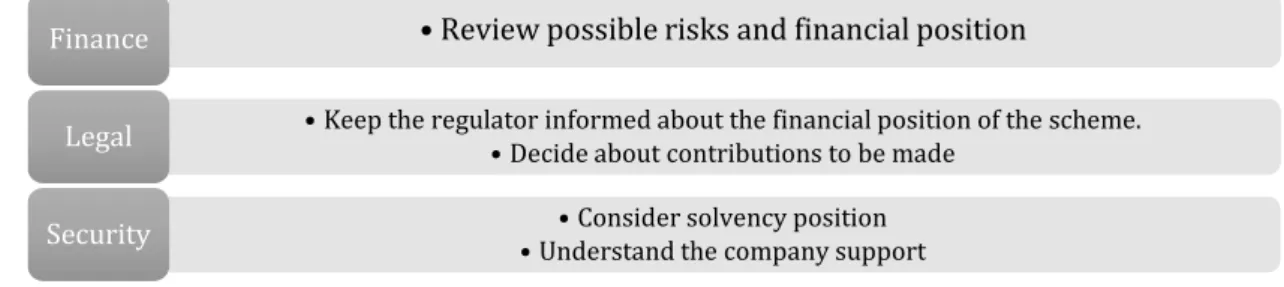
In detail, an actuarial valuation has the objectives shown on figure 1.
Figure 1: Main objectives of an actuarial pension valuation from WTW internal documents
In the case of a scheme that does not meet the funding objectives, the trustees will need to provide a recovery plan. In this special report, the scheme’s trustees need to decide a specific time frame
•Review possible risks and financial position
Finance
•Keep the regulator informed about the financial position of the scheme. •Decide about contributions to be made
Legal
7 for when this recovery is proposed to be done, and also need to agree on the level of contributions that are needed. As each scheme is different, the rules for the recovery plans are not predefined and thus each board of trustees needs to agree on the plan for that particular company, always with the objective of returning to full funding (Cordwell, 2008).
The Scheme Valuation also has to foresee the amount of benefits and income from contributions and investments which the company is going to face (Vivian, 2014). This mandatory action needs to be done at least once every three years. Between valuation dates, the company just needs to update the funding position, observe, and act over possible changes. In the end, the funding statement is reported to the members of the fund.
The following paragraphs will present in detail the valuation process in Willis Towers Watson. The Valuation process of a UK Pension fund has three main stages:
1. Planning, when the Trustees decide which data is going to be required, determine deadlines for each phase of the process, and update the financial strategy (established by the company).
2. Selecting the assumptions and methods that are going to be used, depending on each scheme, and the funding position in the last valuation.
3. The practical process, when the actuary uses its own software, in order to compute the amount of benefits and contributions. It consists of four steps.
3.1 Analysing pension data
To perform any sort of calculations, data is fundamental (EIOPA, 2015). Data is provided by the
pension scheme’s data administrators and includes several items that are essential to perform the actuarial valuation, such as dates of birth, service dates, salary figures, pension amounts and other relevant information.
At this step, an actuarial analyst will check if there are any data items needed for the calculations that are missing and will then proceed to verify that the data is robust enough for valuation purposes.
As an example, the analyst will check the reasonableness of movements of membership and whether pension amounts provided have received the appropriate increase since the last valuation. After finishing this analysis, and if there are some queries left, it should be sent back to the client.
3.2 Performing a run on last valuation’s assumptions
In this stage, the scheme’s liabilities are calculated using the new data but still with the assumptions chosen at last valuation. This stage will help to understand if and why the funding position has changed, and also to discuss if the forecasts and assumptions used in the last valuation meet reality.
3.3 Performing a run on the new assumptions
8 Those are the preliminary results, which are sent to the client with the respective comparisons between the different types of valuations, and also the comparison with the last valuation.
3.4 Reporting Workstage
At this step, a presentation of the results is prepared for the meeting with the trustees, including both the preliminary and the final sets. Independently of the trustee approach, the company needs to agree with the final results from a list of different valuations computed with several sets of assumptions and send the final report to the Pensions Regulator (PREC, 2012).
3. Assumptions Analysis
9 pension scheme will portrait the scheme’s financial position in a more realistic way, which is fundamental from a managerial and investments point of view.
The process of setting assumptions to a specific scheme is the actuary’s responsibility, and in order to define them he/she is required to apply his/her technical actuarial knowledge and a fair professional judgement. The actuary not only needs to develop the correct assumptions to use in the valuation, but must also provide a clear explanation of the reasons for the choice.
In some cases, the set of actuarial assumptions to use can be defined by the government as a law. For example, when doing a Pension Protection Fund (PPF) Valuation, the assumptions to use should be the ones defined previously by the corresponding Board.
The Pension Regulator provides, in the Pension Act, some guidance about this work for each specific type of valuation.
The final stage of an actuarial valuation of UK pension plans is the final decision about the assumptions to be applied. This is made by the trustee of the scheme, and preferably this decision is made together with a representative of the company and the responsible actuary.
Independently of the approach used to set the assumptions, the scheme actuary should always consider three points (American Academy of Actuaries, 2004):
Nature of the pension scheme;
All the available and relevant data, and general information;
Possible reasons to believe that trends will change in the future.
In addition, there is a general principle that actuaries should always follow in order to define actuarial assumptions, the Principle of Prudence. According to this general guideline, the assumptions choice should be conservative and it should not overestimate nor underestimate the value of contributions and expenses. This principle is going to be further explained ahead.
Concerning the approaches to define an appropriate and correct actuarial valuation, this report will focus on the two basic models in use: Financial Economics Perspective and Best Estimate Perspective.
The first approach is mainly used to determine economic assumptions, and its main characteristic is its relation to the current market conditions. This means that actuaries make decisions according to the market basis approach. In simple terms, this is a method where the value of an asset is determined by the real price of similar items. After getting those values it is possible to consider some adjustments, which will make them more appropriate to the corresponding scheme. For example, a possible adjustment to make can be related to the risk. In order to better represent the level of risk in question, actuaries can change the discount rate (Rosenberg, 2014). It is easy to explain this with a practical example of a Solvency Valuation. In this case, the fund should not be exposed to any risk, so a risk-free discount rate is used.
10 amount recognised as a provision shall be the best estimate of the expenditure to settle the present
obligation at the end of the reporting period” (IFRS – IAS 37, 2009).
In other words, the best estimate approach should represent the most likely scenario of a pension scheme. The assumptions defined with this method must be comprehensive, explicit, reasonable, supportable, internally consistent, and finally they should represent the future expected trends. Furthermore, the actuary should ensure correlation between all the assumptions in use, based on the same approaches. This method is crucial in order to compute the minimum funding requirements for a PPF Valuation or the minimum amount of contributions for other types of valuations. This best estimate approach is consistent with current market prices (in order to define some market assumptions), unless there is reliable evidence that justifies a change in the trend (Blum and Otto, 1998). Related with market assumptions, the most important one will be the discount rate, which should reflect the risk specific and also the current market value of money. Regarding the non-market assumptions, it should be mostly based on the specific data of each scheme. Only in the case of not having enough data, or a not perfectly correct one, actuaries are able to use published information. In this case they need to clearly explain the decision, prove similarities between schemes, and properly analyse the assumption previously used to get those values.
3.1
Principle of Prudence
“The economic and actuarial assumptions must be chosen prudently, taking account, if applicable, of an appropriate margin for adverse deviation”, see in The Occupational Pension Schemes
Regulations 2005 Regulation 5(4) (a) – (c).
When selecting economic and demographic assumptions for a pension fund valuation, there are no defined rules and approaches, there is only guidance and advice. The only principle which actuaries must follow, while setting those assumptions, is related with prudence.
According to the market conditions, the actuary should be conservative when measuring the amount of assets, and should also not underestimate the amount of liabilities (Smits, 2006). This principle asks for records that reflect the realistic environment, with the objective of achieving a good match between the value of liabilities and appropriate investments.
Moreover, this key accounting principle predicts changes that sometimes may occur, when reflecting an expected variation on the level of risk. In this case, the actuary is free to be more or less prudent, depending on the change.
The actuary should comply with the actual legislation, with the principle of prudence, with all the existent professional guidance, and also it is recommended to use recognised and certified actuarial methods when computing final and intermediaries’ calculations.
11 consequence, contributions). On the other hand, the companies interest is always addressed to reduce the level of prudence and funding (i.e. lower liabilities and, by consequence, contributions). Furthermore, while reporting the chosen assumptions, the actuary should consider that as long as the level of prudence goes down, he/she should increase the level of support, the justifications about the results and produce an extra and more complex analysis.
Of course, the prudence concept is just a general guideline, the actuary should use his/her professional judgement and always consider the purpose of the respective valuation in his/her decisions.
3.2
Demographic Assumptions
Demographic assumptions are all the premises related to the demographic characteristics of a person and also all the non-economic attributes which may be needed, for example the proportion of married members, the difference in the age of the member and the spouse, and others. This information is going to influence mostly the timing of the benefit payment and also the probability of this being made.
While producing a pension valuation, a number of different assumptions will be required related to mortality, retirement, termination of employment, disability, marriage, divorce, transfer out of the scheme, household composition, and others. Some of them are optional, but most are mandatory, such as the mortality assumptions, which are those with the largest impact on the result. For this reason this report will mainly focus on it. Most of the demographic assumptions are related with mortality rates, a measure of deaths over a given population in a defined interval of time (ASB (a), 1999).
3.2.1 Mortality Tables
A mortality table is a result of a huge compilation of data by actuaries and statisticians. These tables supply the rate of death at any given age, according to the number of deaths that occur for a very large number of individuals of that age, at a particular interval of time. These indispensable tables are normally separated by gender, socio-economic status, smoking status, types of occupation, and other factors that can affect the probability of death OFNS, 2016).
Mortality rates records are mainly used in a Defined Benefit scheme when computing the contribution rates, the value of liabilities, the transfer values, the member’s benefit on retirement, in some calculations related to the Pension Protection Fund, and also when an insurance company takes some or all of the scheme’s liabilities.
12 assumed that people live more than they actually do, this can lead to too high contribution rates and consequently to extra costs for the sponsors, and probably to closure of the scheme to new entrants. On the opposite, in the situation of overestimate future mortality, which means that people die later than assumed by the actuary, the scheme may face a problem of having no assets to cover the corresponding liabilities, given by the low contribution rates, and consequently leading to the pensioners not receiving the amount they were expecting. Also in the case of buyout liabilities to an insurance company, it will be sold for a lower value than the actual, thus the company will make a smaller profit.
It is possible to set a simple and clear approach of how to decide about mortality assumptions in three main points (PR (c), 2008).
1. Decide which appropriate base tables and margins of prudence to use; 2. Define how to apply future improvement rates;
3. Clearly justify the methodology used and the final proposed mortality rates;
Given the impact of these assumptions in the valuations and in order to turn this approach regulated and controlled by a special board, the IfoA created the Continuous Mortality Investigation (CMI). Additionally, in Appendix C, a comparison between the UK and Portugal relating to the mortality study developed in both countries is presented.
3.2.2 Continuous Mortality Investigation
The Continuous Mortality Investigation is a private company, overseen by an Executive Committee and owned by the Institute and Faculty of Actuaries. This committee is entirely funded by the subscriptions, which are paid annually by companies and associations for the published papers. It is an impartial, independent and authoritative company with the main objective of providing mortality and sickness rate tables for the UK life insurers and pension funds.
The CMI purpose can be expressed in five specific points:
Divide the insured lives, annuitants and pensioners in classes, and for each one provide a vast research related with mortality and morbidity experience;
Analyse those statistics and publish them in appropriate reports;
Prepare mortality and morbidity tables divided in categories for subscribers’ use;
Estimate future long-term trends in mortality and morbidity rates.
Much of the CMI’s work is documented in some Working Papers. These documents are divided in
different lines of business: annuities, assurance, income protection, mortality projections, self-administrated pension scheme mortality, and others.
13 on data from dependants and pensioners of occupational schemes with at least 500 members (CMI (a), 2011).
As it was said before, in a pension fund valuation, for the demographic assumptions, the actuary has to define the mortality table to use, and which improvements are going to be applied for that particular group of members. In order to support this necessity, the CMI has been also publishing some working papers related to that. These mortality improvements are adjusted to the mortality rates, which will make them more appropriate to each scheme. On the other hand, they can also represent big changes that have occurred, resulting from natural catastrophes.
The Continuous Mortality Investigation provided a CMI Projection Model, which is a software in a Microsoft Excel format. This document is available for all the subscribers, and is prepared to give appropriate results for all types of membership and pension funds. The actuary who is going to use it just needs to introduce some inputs related to the nature of the scheme. The necessary information to obtain the results is the initial improvements, which is the last year for which the rates of mortality are known, the long-term projection assumptions, date of calculation, the base mortality table scaling factor, the defined retirement age and, finally, the interest rate (CMI (d), 2017). In Working Paper 99, it is possible to learn about how the actuary should apply the CMI Mortality Projection Model.
Also, as described in the Working Paper 98 (CMI (d), 2017), the main objective of the CMI Mortality Projection Model is to provide some projection on future mortality rates and also on future improvements. In a general way, historical data are used to project those rates by applying the method of interpolating, using current rates.
This process starts with a vast calibration to the dataset, which should contain information about deaths and exposure data from age 20 to age 100. After that, in order to obtain the total improvements, the age-period and the cohort components, a model of central mortality rates is applied. In detail, the model is called the Age Period Cohort Improvement Model, and assumes a Poisson Model for deaths and the method of maximum likelihood. For further details see (CMI (c), 2017). In the following stage, the model projects the age period and the components of mortality improvements to the future, using a convergence function. Next the model basically sums the information of the cohort components and the age period, and gives the overall mortality improvements. As a final stage, the life expectancies and annuity tables are calculated with basis on the obtained projected mortality improvements and on the specified base table.
The final product of this model is a table with a naming convention in the following format,
CMI_YYYY_G[L%]. Where the year should represent the model version, the “G” should be the gender
and “L” should be the long-term rate (CMI I, 2017).
Just to give a more mathematical sense about mortality rates (4) and mortality improvements (3), find below the analytic definitions of that rates represented.
14 (4) 𝑀𝑜𝑟𝑡𝑎𝑙𝑖𝑡𝑦 𝑅𝑎𝑡𝑒 = 𝑞𝑥 = 𝑚𝑖𝑛(𝑞𝑥𝑏𝑎𝑠𝑒∗ 𝑠𝑐𝑎𝑙𝑖𝑛𝑔 𝑓𝑎𝑐𝑡𝑜𝑟 ,1)
In the above formulas, the 𝑞𝑥 (probability of death between age x and age x+1) is the mortality rate
used to calculate life expectancies and annuities, and the 𝑞𝑥𝑏𝑎𝑠𝑒 is the mortality table from the base
table.
This model is updated annually since 2009 and so it reflects the latest experience. With a general analysis of the results obtained in the last years, it can be seen that the initial improvements are lower for females at the youngest ages, but higher for males at pensioner ages. Additionally, it is clear that due to socio-economic conditions and cold winters, the mortality has increased since the peak of the highest mortality improvements, which was in 2004 for males, and 2006 for females. (Ridscale, 2016).
The procedure described is applied for the Self Administrated Pension Schemes, but for the general population the annual mortality improvements can be calculated in an easier way. This difference on the complexity of the methodologies is due to the fact that in the general population schemes there are less changes in the dataset year over year, and also because the improvements are higher in the SAPS for both males and females, for all ages. (SOA, 2011)
The previous description about the model to calculate mortality improvement refers to the use of the mortality base table. The CMI board also provides these tables, and currently the actuaries use
the ones called “S2” series of mortality tables. These new tables are based on recent data retrieved
from occupational schemes between 2004 and 2011 and were published in the CMI Working Papers 71 (CMI (b), 2014). The main difference between the newest SAPS tables ‘S2’ and the first ‘S1’ is the extent to lower ages which is a consequence of the increase in the life expectancy.
The set of “S2” mortality tables is divided according to the status of the member, such as ill-heath pensioners, normal health pensioners, all pensioner and dependants. Also they are divided by gender, with the exception of dependant’s members where only females are considered. Apart from the type of membership and gender, these mortality tables also differentiate according to the benefit amount. There are Light, Middle and Heavy tables, depending on the amount of benefits in comparison with a pre-defined value (CMI (f), 2017).
The graduation methodology to set these tables is done on an amount basis, which means that the weight given to each record will be higher for the ones with a higher amount of benefits. In order to compute the expected number of deaths at each age, a model based on central exposed to risk is used. The underlying assumption is that deaths follow a Poisson distribution. According to this approach, the expected number of deaths at age x (𝑞𝑥) is computed through the expression (5).
(5) qx= 1 − e− ∫ μ01 x+t dt
In order to fit the instantaneous rate of mortality (𝜇𝑥+𝑡) the Gompertz–Makeham approach is
15 The final results of these calculations are the values of 𝑞𝑥and 𝜇𝑥,which are provided in a set of tables
in a Microsoft Excel format.
As previously mentioned, each scheme has its own purposes and membership, so it is possible that for some schemes these tables are no longer appropriate. Given this, the actuary or the person using the base table, is responsible to ensure that they are correctly using the base mortality tables for that specific scheme.
3.3
Economic Assumptions
In order to test the financial position of a pension fund, a number of different scenarios needs to be set. Each of these scenarios will have their own economic assumptions, and so they will represent types of economic situations that can possibly happen. This allows to study the impacts that different economic changes can have on the scheme’s funding position. For this reason, and also given the huge impact that an economic assumption represents in a valuation, this topic is one of those that requires more commitment from the actuaries.
The economic assumptions used in a UK Pension Valuation are a set of premises that will most likely define the economic situation of the scheme in the following years. In almost all schemes it is necessary to set assumptions related with salary increases, pension increases, pension revaluations, inflation, discount rates and also, depending on the purpose of the valuation, there are some specific requirements that differ from scheme to scheme.
The main question is: “How to define economic assumptions?”. There is no correct answer for that, given that it is very dependent on the scheme properties, the valuation purpose, the weight of the scheme in respect of amount of liabilities, etc. There are some assumptions prescribed by law, but most of them are defined between the actuary, the trustees and the board of the company. Sometimes it may be helpful to speak to the scheme’s investment advisor to have a better
understanding of how the scheme’s assets are likely to change over time, since this is very important while setting economic assumptions.
It is the actuary’s responsibility to provide the proposed assumptions to the trustees and to produce
a clear and complete description about the choice. With all necessary information, the company’s
board has the entire responsibility to formally select the final chosen assumption for that valuation.
Preferably, this should be done in a meeting with the actuaries, the trustees and the company’s
representatives, so they can discuss each point of view.
16 In the background, these assumptions are predictions of what can happen in the economy of the scheme, in the future. Therefore, they also represent an opportunity for the actuary to present some possible changes in the future, unusual events, economic catastrophes, and others.
Following in this chapter, some of the most common methods to calculate some of the rates will be presented. However, there are some considerations that actuaries should have in mind for every economic assumption.
The first is related with the involved costs, that is, the actuaries should reflect about the cost of setting new assumptions (ASB (b), 2013). For example, if they were dealing with a small plan, it is possible that it would be preferable to use assumptions already settled from a general research. Secondly, sometimes it can be most favourable to apply a rounding technique in order to select assumptions. Certainly, it depends on the purpose and materiality of the plan, but in this case the actuary will spend less time and money.
Another important advice to consider is the difficulty of measuring items, such as adverse deviation or plan provisions. For this purpose, the actuary can opt to adjust some already existent economic assumptions instead of creating them from the beginning.
Moreover, when deriving assumptions to carry out valuations, it is very important to consider how these assumptions are expected to change in response to changes in market conditions over time. According to the TAS – Technical Actuarial Standards, the created assumptions will be reasonable for the proposed objective if they comply with the following properties:
The assumptions are appropriate for the purpose;
The assumptions reflect the actuary’s professionalism judgement;
The assumptions take into account historic and current economic data until the date of valuation;
The assumptions reflect the actuary’s opinion about what will occur in the future;
The assumptions do neither reflect pessimism nor optimism.
3.3.1 Retail Price Index & Consumer Price Index
Inflation is the rate of change of prices for goods and services, easily seen as the measure of change in the cost of buying a “basket” of products. While valuating a pension scheme, the inflation rates are used to set the statutory minimum increase for pensions, both for revaluation up to retirement and for pensions in payment.
17 There are small differences between them. Both are calculated from the same underlying data, however the statistician department changed the methodology in use and its coverage. Compared to the RPI, the CPI method of calculation underestimates the inflation in the UK and it is usually around one per cent lower.
The main reason for this change was due to the European influence. The UK Statistic Authority and the Office for National Statistics (ONS) believe that the old UK RPI measure is no more internationally acceptable, and on the other hand, the consumer price inflation is used in most of the European Countries measured by the HCPI (Harmonised Consumer Price Index). This new index is measured according to the same methodology in all European Area, so this can bring many advantages, as the fact that it is easier to share and compare data from country to country.
The changes have been made and nowadays most of the pension’s increases are measured with the
CPI, except those that were announced in the past (and set as RPI in the Scheme Rules), which remain based on the RPI. Furthermore, some schemes still use the old index, and as a consequence of the change, for some schemes it would be necessary to modify pension rules and statements. Both the RPI and the CPI are announced each year by the government according to the most actual price inflation. There are also monthly updates to the indexes.
3.3.2 Common Approaches to set Economic Assumptions
Discount Rate Assumption
Setting the correct discount rate is imperative if one wants to produce a correct pension plan valuation. The chosen index will be used whenever you need to calculate the present value of an expected future payment. Precisely, it will be useful when projecting values as contributions, pension costs, or the anticipated investment return for the pension fund. Last but not least, it will be implicit in the asset allocation and in the settlement of new strategies.
This specificity of the interest rate can be used by a pension plan in three different formats. It is possible to set it as a single rate, as a dual rate, specifying different values for post-retirement and pre-retirement or finally, it can be expressed by a yield curve (a line that plots the yield of fixed interest securities against the time to maturity of the corresponding financial products).
18 pensioner members the matching between assets and liabilities will be referent to the following 10 or 15 years, based on long-term bond yields.
The next methodology of measuring the discount rate is characterized by the use of Gilt and Swap Curves. Gilts are products, normally bonds, with low investment risk, and issued by the British government. The gilt curves are applied with the objective of guaranteeing that the scheme achieves self-sufficiency, so this approach is advisable for schemes with a significant gilt portfolio. In practice, the method represents the actual liabilities of the scheme as a portfolio of gilts with similar duration and inflation. Calculated with an annual effective compounding basis, the zero coupon gilt yield curve represents the interest rate term structure of the UK nominal government securities.
The methodology to produce this curve is based on real and daily data of price of conventional gilts. With this data an annual zero coupon nominal yield curve is fitted using a variable roughness penalty approach. Below a plot of a real zero coupon gilt curve, of a specific date, is given. This figure shows the relation between the spot rate and the yield to maturity, between 0 and 100 years.
Source: ONS – Office of National Statistics Figure 2: Plot of a zero coupon gilt curve at 20/07/2017
With a very similar approach, the actuaries also use the zero coupon swap rates. In order to compute those Zero-Coupon Swap Nominal Yield Curves the actuaries receive data directly from real market participants and investors on banks. The data in use is basically the medium prices at which the transaction of a zero-coupon nominal interest rate swap is done. After receiving the data, actuaries just need to extrapolate the rates of a maturity of one hundred years.
-4 -3 -2 -1 0
0 5 10 15 20 25 30 35 40 45 50 55 60 65 70 75 80 85 90 95
100
Sp
o
t
Rat
e %
Time to Maturity
19 Source: ONS – Office of National Statistics
Figure 3: Plot of a zero swap gilt curve at 26/07/2017
Investment Return
This rate is a measure of the efficiency of an investment. It gives an analytical comparison between the cost of an investment and the respective amount of return. Generally, it is measured using the Consumer Price Index levels in short-term. For pension valuation purposes, in order to compute the value of liabilities which the scheme will face, a forecast of this value will be calculated for the next year, and an average for two to five years in the future (Owadally, 2003).
Pension Increase Assumption
The pension increase assumption is represented as a single rate, which depends on some characteristics of the member, like age, service and productivity, but also depends on some market conditions, such as inflation.
In order to define it, the actuary should consider a specific plan-sponsor with similar characteristics and use its historic and current data.
Inflation Assumption
The rate of inflation is the expected increase in the price of a standardized product, or a group of them, in a specified time range.
Hence, in order to select a single inflation rate, the actuary should only consider existent forecasts and, he/she should base calculations in the existent data, as CPI, price deflator and other financial rates related with open market.
Salary Increase Assumption
As the name says, the salary increase assumption refers to how much the salary of an active member will grow in the following years. Similarly to the pension increase assumption, this rate depends on some socio-economic characteristics and it can be different from member to member.
Normally it is valued using CPI, by adding a margin to the inflation assumption.
0 0.5 1 1.5 2
0 5 10 15 20 25 30 35 40 45 50 55 60 65 70 75 80 85 90 95
100
Sp
o
t
Rat
e %
Time to Maturity
20
4. Valuation funding requirements
One of the main material sections of the actuarial report, in a Pension Funds Valuation, is the funding position of the scheme. According to the results obtained, the Board of Trustees will report to the Regulator whether the scheme is overfunded or underfunded, and if they conclude that the scheme has not enough assets to cover the liabilities (is underfunded), the trustee, with the
actuary’s help, should prepare a recovery plan for the following years (PR (d), 2009).
With this imposition, the trustees not only need to present the result about the funding position, but they also must prepare and revise a statement of funding principles. According to this, actuaries create several different ways to define the funding position. Depending on the scheme and on the objective of the trustees and the employers, the report must show not only the results coming from those different funding principles, but also the assumptions and considerations about them. The next section will explain some of the main common funding principles in UK pension funds valuations. Notice that some of them are mandatory by the Pension Regulator, others are only needed when the scheme is underfunded, and others can be requested by the companies (if these want to study a specific case).
4.1
Technical Actuarial Standards
In order to discuss UK pension schemes, and more precisely upon the selection of appropriate assumptions for each used funding method, it is necessary to introduce the Technical Actuarial Standards.
The Financial Reporting Council (FRC), through the UK Corporate Governance Code is responsible for promoting high quality governance in areas like Audit, Assurance, Accounting and Actuarial. They provide codes, standards and methodologies for these areas of financial activities, in order to ensure fairness, give confidence to the investor and also to force the market to be more regulated and transparent.
In order to do that, the FRC created a section called Board of Actuarial Standards (BAS), which
produces the famous “original TAS”, an important document that was in force since 1 October 2011. Recently, in December 2016, this document was revised, and from 1 July of the present year the
“Revised TAS” was in effect.
These standards are divided into three main chapters: the Generic TAS, the Specific TAS and the Framework for FRC Technical Actuarial Standards.
21 The specific TAS are focused on specific areas, where there is a high degree of risk to the public interest related to the work in question. Inside the Specific TAS there are the TAS 200: Insurance, TAS 300: Pensions and finally TAS 400: Funeral Plan Trusts.
Last but not least, the FRC provides a third document where the actuaries and trustees can find an explanation of the status of the TAS and also how they should be applied in the real world.
The FRC believes that “users for whom actuarial information is created should be able to place a
high degree of reliance on that information’s relevance, transparency of assumptions, completeness
and comprehensibility including the communication of any uncertainty inherent in the information”,
as it is written in the TAS M – Modelling, page 3 (FRC (a), 2010). This council considers that actuarial information, which may be either the chosen assumptions or the used methods, can be very crucial for a valuation, in the sense that it can change completely the results. For that reason, and also to protect the employees, the FRC developed those documents, with all the standards and rules to be applied in actuarial valuation of a UK pension scheme.
As this report is focused on UK Occupation Pension Valuation, the most relevant subjects present in these documents are in the Generic TAS (the matter about the documentation and models) and also, the TAS 300: Pension, in particular, the guidance in the assumptions choice.
In this environment, models can be defined as technical simplifications of reality, which should fit the purpose they serve. They are used especially for projecting assets and liabilities of a scheme, from one valuation date to the next one, and also to calculate the level of funding of that pension scheme. In the Generic TAS it is possible to find information about the way models in use should be described in the report, and also which documents should be included in it. Also attention is called to the trustees and actuaries to guarantee that their reports contain the description of all models used in the preparation of the actuarial work.
These reports must also include the description of the limitations and satisfactions of the model, measured according to the compliance with regulatory requirements, calibration for qualitative
assumptions and also regarding the importance of the “object being modelled” to the scheme
(amount of pension related, for example). Usually the report has the comparisons of the outputs with the actual experience, tests of sensitivity and analysis of member’s movements. Finally, they
need to conclude about liabilities’ values and the funding position with a corresponding description
and advice.
22 In the TAS 300: Pensions there are some advices that the trustees should always keep in mind: all the changes related with the rules of a pension scheme should be made with the consent of the governing body; when trustees and sponsors are sharing work they should always be fully professional and ethical; practitioners need to follow the professional standards described in the Actuarial Code; it is important that trustees have the information always updated and with quality, so they can take all the important decisions based on truthful data.
Another very important chapter present in this document is related with Actuarial Assumptions. In global sense, applicable to both demographic and economic assumptions, there are some rules that trustees and actuaries need to follow. The Financial Council explains that an assumption will be appropriate in a given situation if it is based on sufficient information. Furthermore, it is very important when choosing the assumptions that the real state of the economic world, on the effective date of calculation in known. All the changes that are made in one assumption from one valuation to another should be reported, well explained, including not only the change but also what led to it, and a comparison between the old and the new decision.
Regarding the economic assumptions, especially the discount rate, it is really important that the explanations allow the users to understand how they are derived, all the involved implications of adopting them, and in which cash flows they are applied.
Trustees and actuaries, when setting demographic and economic assumptions should always take
into account that “different assumptions are appropriate to different circumstances and for different purposes”.
4.2
Technical Provisions
It is defined by the Pension Regulator that Technical Provisions (TP) measure the extent of liabilities to pay pension benefits, in relation to past service, as they fall due.
As it was said before, the majority of the UK pension funds are DB based, hence they are subject to a funding objective in each formal valuation. That funding objective is acquired when the pension scheme has sufficient and appropriate assets to cover its liabilities. Thus, in order to decide whether a scheme is funded or underfunded, the trustees need to calculate the value of the liabilities under a Technical Provisions basis.
Ideally, the Technical Provisions should be determined so that they will be sufficient on average, for paying the funded part of the pension when the interest and mortality rates are taken into account.
In detail, this amount also called “pension liability” can be divided into two categories. The first
23 There are many different ways of computing the TP of a scheme, and each one has its own method. First of all, trustees need to know in detail everything about the nature of the scheme’s liabilities, its investment strategy, the employer covenant, and the data on demographics. After having this information, the Board needs to choose an accrued benefit funding method (which will be described further on), and be very careful about the data chosen to value the benefits. Also very important are the assumptions in the calculation and, as it was mentioned above, for that decision the trustee should contact the responsible actuary.
The main rule for the assumptions choice is prudence, which means that when considering that premise we are avoiding risk and taking a margin to the anticipated experience assumption. Prudence should also be related with the capacity of the employer to support a range of likely adverse outcomes. This rule is mostly linked with the economic actuarial assumptions, where actuaries should take into account the evolution of expenses over time (including future ones), considering its nature and according to inflation.
Regarding demographic assumptions, trustees should start with an analysis of the plan membership, about long-term trends and recent changes. Then, they should consider relevant statistics applicable to similar schemes, and finally be aware of possible changes in the future, with respect to that particular scheme. Generally, assumptions should be evidence-based.
As a final review, trustees should check if the chosen assumptions are consistent with the current market data, the characteristics of the business and the whole undertaking.
4.3
Types of Valuation Funding Requirements
4.3.1 Neutral Basis
Another mandatory way to estimate the value of liabilities of a given scheme is according to the Neutral Basis. Imposed by the Pension TAS, neutral basis is set with the same method of computing Technical Provisions, but removing all the prudence margins. In this kind of calculations the trustees always choose measures, assumptions and judgments that are neutral and do not represent either optimistic or pessimistic opinions. Additionally, these decisions should not incorporate any adjustments that reflect the desired outcome.
The main objectives of this method is to help the trustees to understand the impact of their decisions about measures, assumptions, and others, as well as to test if the Technical Provisions and the neutral basis are effectively in the same line and in accordance with each other. This is also very useful to help trustees to identify how margins in the TP change over time, and the level of prudence of it.