Drum, drama, dream and music: Listening and multimodality
José Carlos Godinho
Instituto Politécnico de Setúbal - ESE INET-md/CIPEM
Portugal
Abstract This paper approaches some pedagogical strategies to guide children in listening
to music, namely (a) the activities of playing rhythms and (b) the activities of telling, miming and imagining stories along with recorded music, which might function as possible ways of preparing children’s minds for attending musical concerts. It has been argued that the acts of listening, performing and composing can nourish each other when working in articulation. The present paper combines the notions of articulation and simultaneity, by arguing that listening to music can be enhanced by simultaneous performance. It discusses some theories that describe musical thinking and understanding as complex operations dealing with different types of information, perceived through different modes (aural, visual,
kinaesthetic, etc.). Listening to music with simultaneous multimodal activities gives origin to mental activations whose complexity can have benefits on the analytical capacity and, consequently, on meaningful musical understanding, mental representation and memory. Some empirical studies show that children exposed to the multimodal experiences of miming stories and playing rhythms while listening to music demonstrate stronger musical memory and higher levels of understanding of the musical pieces than they would do if they would listen in more passive ways. Children categorise different sections of the music, refer to their expected or surprising sequential interaction and show awareness of the whole musical form by comparing sections and identifying recurrence, transformation and contrast. In terms of memory, children tend to preserve stronger and more detailed mental images that allow them to be more successful in future identification of fragments from the musical pieces. There is also some evidence that children tend to judge more positively the musical pieces they listen to, when they mime or play. The results might inspire teachers and musical performers in adopting preparatory listening schemes to be developed with children before attending musical concerts.
Keywords listening with participation; listening and multimodality; musical memory; musical
understanding; music education
Introduction
Listening to music has become one of the most important ways through which people engage with music. The technological development allows the rapid access to all kinds of recorded music, in computers and smart phones, and music concerts and festivals are important social gatherings around different types of music. For the majority of people, who are not composers and do not play any musical instrument, listening is, in fact, the way of engaging with music and of getting meaning and aesthetic pleasure.
Listening to music plays also an important role in educational settings. Although for some pedagogues listening is valued as an integral part of performing and creating (Elliott, 1995; Loane, 1984; Sloboda, 1988), allowing control, regulation and assessment of each musical decision, other writers have valued listening as an activity in itself (Reimer, 1989; Swanwick, 1979). Inspired in these ideas, many music curricula, namely the Portuguese curriculum for basic education, are structured around three pillars – composing, performing and listening – and listening to recorded music in classroom has become an important strategy to learn music.
However, although listening seems to be an enjoyable activity in informal contexts, listening to recorded music in classroom might not always be associated with pleasurable fruition. Informal learning is usually dedicated to the kind of music one identifies with, whereas in educational settings the choice often favours styles of music that tend to be less familiar to children, such as classical music, which might activate negative meanings and alienation among children (Green, 2006). Listening activities in the classroom need, thus, careful design in order to allow successful response and learning on the part of children (Espeland, 1987).
Listening to music for educational purposes also includes the attendance of concerts organized by schools, but this might be equally problematic if children do not spontaneously identify themselves with the musical idioms or even if children are asked to listen quietly and in physical passivity. Young children frequently lack interest and motivation and they tend not to learn many relevant things from those musical concerts. In fact, whereas performing and composing involve active music making, where children sing, move or play instruments, listening in the audience might result in a poorer context of experience, with less perception modalities being activated. For example, a pianist on the stage is likely to develop a stronger interaction with the music (listening, watching the score, doing performing gestures…), than the person sitting and listening in the audience. The perception modalities involved are potentially more powerful for the pianist than for the listener.
Of course, active listening might well refer to the mental activity that occurs during listening situations and not necessarily to the active physical participation of moving, playing or singing. Concerts of classical music usually have silent and quiet audiences who, however, develop high levels of mental activity throughout the performances. But this mental activity depends on what Jean Piaget called abstract, mental operations that, according to him, have their origin in former concrete, physical operations (e.g. Piaget, 1971). This means that the internal processes of thinking have their genesis on external acts. Therefore, due to their longer experience, listeners that have engaged regularly with music making and playing are better prepared to maintain high levels of mental activity while listening quietly.
Aiming to prepare children’s minds for the quiet but mentally active process of listening, the present paper focuses on diverse pedagogical strategies that support listening activities in the elementary music classroom and that have been developed and published in Portugal (e.g. Godinho, 2016 and 2017; Godinho & Brito, 2010). These pedagogical materials deliberately involve children in active participation during the listening situations, either playing rhythmic instruments or miming stories along with the musical pieces. The listening activities are slightly transformed into performing activities, where children become a kind of “musicians in the orchestra” or “mime performers”. These active ways of listening to music favour attention, understanding, memory and personal identification, even with unfamiliar musical idioms, and might work as a possible preparation of children’s minds for attending concerts.
1. Listening to music with participation and multimodality
The title of the present paper articulates music with the words drum, drama and dream, which symbolically refer to the acts of (1) listening and playing percussion instruments and of (2) listening and miming stories, as well as to (3) the mental imagery that is activated during those listening activities. What is suggested is that the physical activity of playing rhythms
and of doing gestures, associated with the multimodal information given by the stories and the musical instruments themselves, installs complex patterns of activity in the brain that tend to be preserved and reactivated in future, supporting mental processing in positive ways.
The pedagogical strategies here discussed are aligned with different studies and projects (Cohen, 1997; Espeland, 1987) that were also concerned with authentic listening
experiences in educational settings. Espeland (1987) has advocated that the active response on the part of the listener is crucial in musical understanding and, therefore, his project involved the children in activities of verbal, visual, and kinetic expression. These activities were mainly the result of creative group work by the children, and watching the group discussions and solutions for each musical piece allowed teachers to have access to the ways children understand the music they listen to.
The idea that the physical active response can constitute a window into one’s musical understanding was also developed by Cohen (1997) through two kinds of processes: firstly, she created some kinaesthetic analogues for the musical pieces, or “musical mirrors,” which she modelled for her students, allowing them to enter into her listening experience, by inviting them to perform the analogues with her; secondly, she asked her students to create their own kinaesthetic analogues for the musical pieces they listened to, which represented their musical understanding and personal response to the music.
These active ways of responding to music facilitate the development of student’s musical thinking, but they also promote classroom reflection and discussion on salient features of the musical pieces. It also stimulates an interest in repeated listening, even in the presence of unfamiliar musical pieces. In this sense, it has been argued that the creative active response in listening situations has positive effects on musical understanding and mental
representation (Blair, 2006). Less clear, though, is whether the guided active response, through imitation of physical movement induced by the teacher (which is the case of the present pedagogical strategies), would have similar positive effects on the ways children remember and understand music.
Taylor (1989) has shown that children tend to recognize better the musical pieces they have listened to with physical movement. Nevertheless, the recognition of known musical pieces among other unknown pieces depends on a general memory and not necessarily on a detailed memory that requires deeper knowledge of the musical pieces. The extent to what children would be able not only to recognize but also to identify musical fragments from a particular musical piece, which they listen to with instructed rhythmic percussion or expressive movement, was the question that motivated further research.
Some studies conducted by the present author have shown that children who played
rhythms on small percussion instruments along with recorded music tended to recognize and to identify musical fragments in future with more success than children who had listened in more passive and quiet ways (Godinho, 2000, 2003). These results not only give evidence about the potential of congruent multimodal material in mental processing, but also illustrate some theories of embodied knowledge, which refer to “knowledge in the hands, which is forthcoming only when bodily effort is made, and cannot be formulated in detachment from that effort” (Merleau-Ponty, 1962, p. 144). The results also echo Hallam’s discussion on musical memory by professional musicians (Hallam, 1997). According to their statements, much of their musical memory is “in the arms and hands”; music flows when playing the
instruments, whereas it might be difficult to remember it in other contexts. In similar ways, children seemed to remember and to identify musical fragments with the help of mental traces of physical movement.
It is like a pattern really. I do not know how they (the fingers) do it . . . they just sort of know where to go. If I think really hard about where they are meant to go they cannot do it. If I just let them go, they tend to work better as well. (Hallam, 1997, p. 94)
Because the physical movement of playing percussion instruments affected positively the detailed musical memory, both in terms of its conservation power (children recognize the musical piece in future) and of mental organization (children identify and allocate isolated fragments in the musical whole), other studies were conducted with a positive expectation that the movement of miming stories along with recorded music would have similar effects in children’s mind. The results also suggest that the complex context of miming a story, which includes the sound, the space and the equipment, the individual actions, the social
interactions, and so forth, has positive effects on the strength and detail of children’s mental representation of music and memory (Godinho, 2015 and 2016).
The following sections will describe with more detail some strategies of playing rhythms (drum) and miming stories (drama) along with recorded music, as well as some of the effects that they tend to have on children’s mental processes and “mental representation” (dream), taken “either as a synonym of mental image or as a synonym of neural pattern” (Damásio, 1999, p. 320).
2. Drum: Playing rhythms along with recorded music
Any strategy dealing with activities being performed simultaneously with recorded music needs careful conception and design, in order to reinforce the expressive and structural features of the musical pieces. The rhythmic accompaniment created for the 3rd movement (Gavotta) from Prokofiev’s Symphony 1 in D major (op. 25) might illustrate this concern, in terms of the chosen rhythms, instrumental timbre and pitch, dynamics and instrument distribution.
The symphony was written for a classical orchestra with strings, 2 flutes, 2 oboes, 2 clarinets, 2 bassoons, 2 French horns, 2 trumpets and timpani. The third movement,
Gavotta, presents two contrasting melodies, structured in ABA form. In the first A, the strings have the main role, and the second and third melodic fragments are repeated. In the first half of part B, the woodwinds become more relevant, giving space to the strings in the second half. The woodwinds do the second presentation of part A, but they do it in a very softer way, in contrast with the strength of the first A. By the end of the piece, the strings play again the melodic line, but they maintain the soft character and they do a decrescendo until the final pianissimo. A schematic score of Gavotta is presented in Figure 1.
Figure 1. Schematic score of Prokofiev’s Gavotta
The rhythmic score created to accompany the music used only two rhythmic motifs (Figure 2): the first motif is repeated throughout the whole music, except for the end of parts A, where the second motif is played.
Figure 1. Rhythmic motifs for Prokofiev’s Gavotta
The simplicity of the rhythm to be performed by children allows it to be learned without any written support. For analytical reasons, though, the whole rhythmic score is presented in Figure 3. The instruments symbols are placed above the rhythmic line, according to their sequence in the performance. The cheerfulness of part A is enhanced by the timbres of the drums and tambourines; the short and precise sound of the claves was chosen to support the conclusive rhythmic motif at the end of parts A. The low pitch of the timpani helps to cool down the character of the first half of part B, whereas the brilliancy of the triangle enhances the higher pitched second half. The trillos in part B are graciously supported by a small bell that shakes in a playful manner.
Figure 3. Rhythmic score to accompany Prokofiev’s Gavotta
The strategy of playing rhythms along with recorded music is aimed to underline the expressive character, the musical phrases, their repetition and contrast and the overall structure. Being a support to listening, and in spite of the dynamics variations that might be suggested, the instruments should play softly, in order to ensure good listening of the recording. For the same reason but also for expressive reasons, the number of instruments
playing simultaneously should be adjusted to the dynamics of the musical piece. In Prokofiev’s Gavotta, fewer instruments may play the last part A, due to its soft character. Although this is a strategy on listening to music, it becomes also a performing act. In this sense, children should be invited to play correctly but also expressively with suggestive arm gestures and postural attitude. The mental representation from the music being listened to is multimodal and articulates different kinds of information, among which kinetic information plays a decisive role. The next strategy explores more deeply the importance of movement in listening to music.
3. Drama: Reciting and miming stories along with recorded music
Prokofiev’s Gavotta has also been used in listening activities with young children with the application of a different strategy, which consists on reciting and miming a story. The present author created the story and the gestures, after an attentive, empathic and analytical
listening of the musical piece. The overall form (ABA) and the expressive character of each part, as described above, were determinant in imagining a story also with three scenes (Figure 4).
Figure 4. Graphical scheme of the mime for Prokofiev’s Gavotta
In this sense, the lively first A refers to an old rabbit giving some scary advice to his grandson about a dangerous crocodile; the repetition of the second half, describes the disobedience of the young rabbit and his physical encounter with the crocodile. The low and mysterious part B refers to the scared and stressed young rabbit after meeting the crocodile. The soft and delicate reappearance of part A includes the same kind of advice as the first part, but given by the young rabbit to his friends. It works as the moral conclusion of the story, which is whispered, in order to match the final decrescendo of the music.
The text of the story was written as spoken lyrics, which use the rhythm of the main melody. In this way, children are invited to learn these lyrics by heart and, then, to recite them with expressive physical gestures. Table 1 presents both the text of the story and the
Table 1. Story and mime for Prokofiev’s Gavotta
After the learning phase of reciting the story with physical gestures, children are invited to repeat the gestures, but in silence, i.e. reciting the story inside their minds. This works as the last preparation before the listening phase. When the music is finally listened to, it is
accompanied by the miming gestures, in silence.
4. Dream: Mental patterns of activation when listening to music
The mind that listens to recorded music with simultaneous activities of playing rhythms and miming stories processes music in multimodal mental patterns of activation, which include verbal, aural, visual, spatial and kinetic information. The expectation of the benefits that such activation would have in children’s musical minds has been demonstrated in several studies that have uncovered some effects on memory, understanding and taste.
Experiments that compared children that listened to recorded music with simultaneous activities with children that listened in physical passivity have shown that musical memory is stronger and more detailed in the active groups. After the treatment phases, all groups were subject to a memory aural test, in which they had to identify small fragments from the musical pieces by pointing to their exact position in the guiding scores. The number of identifications was significantly higher for children that had played rhythms or that had done the miming gestures. In the experiment reported in Godinho 2003 and 2006, children that just listened and watched the teacher pointing to the rhythmic score identified a mean of 1.13 fragments out of six, whereas children with simultaneous performing actions identified a
Story Mime
Albertino Rabbit tells his grandson Pointing with one hand It is dangerous to walk alone Pointing with the other hand ‘Cause in the jungle lives Crocodilo Shaking both hands near the face And little bunnies are flesh and bone Hands like paws; hands like eating Step by step the crocodile approaches Hands stepping forward
Big big jaws and suddenly… (click click) Opening arms and… fingers clicking twice Yet Little Rabbit paid no attention One hand touching on ear
And to the jungle he went alone Two fingers walking on the other arm Face to face he was with Crocodilo Holding hands near the face
Big big jaws and narrowly… (click click) Opening arms and… fingers clicking twice What a fright! Oh, what a fright! Both hands touching the heart
It seems my heart is everywhere Both hands touching different parts of the chest What a fright! Oh, what a fright! Both hands touching the heart
It seems my heart is everywhere Both hands touching different parts of the chest My poor head is still on fire Hands touching the forehead
I’m so hot I cannot bare Hands shaking like fans in front of the face My poor head is still on fire Hands touching the forehead
I’m so hot I cannot bare Hands shaking like fans in front of the face Now the little rabbit tells his buddies Pointing with one hand
It is dangerous to walk alone Pointing with the other hand ‘Cause in the jungle lives Crocodilo Shaking both hands near the face And little bunnies are flesh and bone Hands like paws; hands like eating Step by step the crocodile approaches Hands stepping forward
mean of 2.46 fragments out of six (t = 8.79, p<.01). In a more recent experiment (Godinho, 2016), children that just listened and watched the teacher telling a story and doing the mime, identified a mean of 2.22 fragments out of six, whereas children that did the miming gestures identified a mean of 3.08 fragments out of six (t = 2.82, p < 0.01).
The same identification test (Godinho, 2016) allowed the analysis of the incorrect choices of children, uncovering some of the musical understanding underlying the process of
identification. Here again, the children that had a performing task while listening to music seemed to have a better understanding of the musical piece and of the fragments, since their choices had to do with musical phrase similarity and with structural relationships. On the other hand, the more passive children tended to base their choices in less complex elements, just like rhythmic or dynamics similarities.
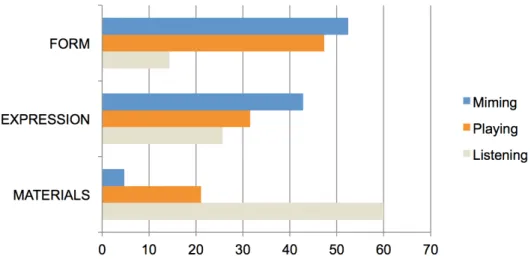
Another experiment that compared the conditions of playing rhythms or miming stories with the condition of listening in physical passivity (Godinho, 2015) asked children to write down some sentences that would describe the musical piece they had listened to. The analysis of these writings has also shown different levels of musical understanding between the groups. The assessment scale used in the analysis was Swanwick’s model of musical
understanding, which includes the layers of Materials, Expression, Form and Value (e.g. Swanwick, 1999). The writings of the more passive children tended to focus mainly in the sound materials used in the musical piece, such as the types of instruments and the dynamics levels. On the other hand, the more active children dedicated their writings to the description of the expressive character of the different parts of the music and to the ways they related to each other in sequential relationships. Figure 5 shows that 60% of the passive children were allocated to the first layer of Materials, against 21% of the percussion group and 5% of the miming group. In significantly different ways, only 14% of the passive children reached the third layer of Form, against 47% of the percussion group and 52% of the miming group.
Figure 5. Graphical distribution of children’s descriptions throughout the layers of musical understanding In quite spontaneous ways, many children in all groups decided to include in their writings their own judgements about the musical piece. This happened, for example, in an
experiment with Prokofiev’s Gavotta (Godinho, 2015), and it was clear that children, who had participated with performing tasks, had a more positive attitude towards the musical piece. No children from the active groups had negative appreciations and 60% of the playing group
and 66% of the miming group declared spontaneously that they liked the music. On the other hand, 70% of the more passive children decided to judge the music, but only 45% said that they liked the music and 25% openly declared they did not like the music (Figure 6).
Figure 5. Graphic of the percentage distribution of children’s descriptions throughout the layers of musical understanding
5. Further discussion
Various studies have uncovered the benefits of listening to recorded music with simultaneous activities of playing rhythms or miming stories. The results suggest that listening with active physical participation has positive effects on the ways children represent music in mind, allowing deeper understanding and stronger and more detailed memory from the musical pieces.
A major influence that the strategies seem to have on children’s mental representation of music can be related to the creation in the classroom of more complex multimodal experiences. Adding physical actions to the experience allows the activation of more differentiated mental patterns, which include a greater variety of information received from different sensory modes being processed (and reactivated) in parallel, that is,
simultaneously, and in meaningful connections. In fact, connectionism offers a definition of knowledge that goes beyond what we can verbally articulate, explain, or even be aware of (Eysenck & Keane, 1995; McClelland et al, 1986; Rogers & McClelland, 2014; Rumelhart et al, 1986). The connectionist interpretation of the mental processing implies that knowledge may include what is perceived, what the environment sends through our sensory channels, what we may feel, what we may imagine. Mental representation is seen as a connected complex of everything lived, remembered, and imagined, where reality coexists with “ourselves.” As Damásio (1999) also suggests, “the signalling devices located throughout our body structure – in the skin, in the muscles, in the retina, and so on – help construct neural patterns which map the organism’s interaction with the object” (p. 320).
The physical interaction with, say, Prokofiev’s musical phrases seem to leave mental traces that are most probably reactivated in future and that allow recognition and detailed
identification. As Smith (1979) has demonstrated, the learning context plays a fundamental role in memory, whether it is physically or just mentally reinstalled and in Baddeley’s terms (Baddeley, 1982), different elements from the experience can constitute themselves as
important interactive contextual elements, due to their spatial-temporal coexistence with (musical) objects. The results seem to reinforce the idea that musical memory and mental representation are based on a cerebral map strongly moulded by the representations of a body (cf. Damásio, 1999; Leman, 2007) that interacts with music in generalized and differentiated ways. The mime gestures and movements, in close relationship with the expressive character of the musical pieces and their sections, become fundamental elements of musical knowledge, which goes beyond what can be verbally articulated and which resembles the “knowledge in the hands,” or embodied knowledge, of Merleau-Ponty (1962).
It should be acknowledged that, in spite of the differences, all children in the studies
developed and showed reliable learning of the musical excerpts. Having children being able to identify an average of two or three musical excerpts out of six, after listening to the musical pieces only three times, gives evidence of the powerful multimodal experience that combined aural, visual, and verbal perception in the learning phase. The rhythmic scores, the percussion instruments, the stories content and sequence, the gestures of the storyteller, and even the drawings (available to all children) might have played an important role in assisting all listeners in the process of mentally representing and meaningfully perceiving the music.
In particular, the scores (used to guide the rhythmic play) and the sequence of drawings (used to guide the mime) might have been important in mapping the music itself, helping the mind to use them as structured spatial images and a memory support. Some previous reports suggest indeed that the visualization of iconic representations of music can help individuals to organize mental images, particularly as far as temporal sequence is concerned (McNamara, Hardy, & Hirtle, 1989). These authors suggest that iconic representations support music with a spatial dimension, and that spatial memory has been found to preserve temporal information. Other theorists refer to the power of pictorial support for music even if it is just imagined and not actually perceived. Prausnitz (1983), talking about his experience as conductor and teacher, refers to the need of creating mental images of whole pieces of music and points out some strategies to do so based on visual and kinaesthetic
associations. Delis et al. (1978) also provided evidence of this construction of emotional or representational images by listeners to help them recall and organize different parts of a musical piece. In their experiment, listeners remembered musical extracts best when they were labelled with concrete representational titles as opposed to abstract conceptual ones. By its own nature, the studied strategies might have an immediate applicability in listening to recorded music in the classroom but also in preparing children to attend musical concerts. Playing rhythms and miming stories along with recorded music in the classroom will most probably affect children’s mental representation in positive ways, during the activities and in future. During the concerts, children will be able to empathize with the musical pieces, by remembering and reactivating the mental patterns of what was experienced in the classroom.
The nature and quality of the playing or miming schemes need, however, to be monitored, as well as the extent to which they allow and enhance the relationship with the musical material. The results of most memory aural tests show that some of the phrases were better identified than others, with large differences of success, and this might suggest that the congruence of the rhythm-music or mime-music overlapping have different levels of efficacy throughout the musical pieces. Being a guided and modelled strategy to listen to music in classroom
settings, this kind of activity requires that rhythmic scores, stories and mimes be carefully planned and designed, expressively and structurally suitable and faithful to the musical pieces. Further research will be needed to assist on the creation of listening material that can be used more confidently as valid pedagogical resources.
References
Baddeley, A. D. (1982). Domains of recollection. Psychological Review, 89, 708-729. http://dx.doi.org/10.1037/0033-295X.89.6.708
Blair, D. V. (2006). Look at what I heard! Music listening and student-created musical maps (Doctoral dissertation). Oakland University. Retrieved from
http://deborahvblair.weebly.com/uploads/1/1/7/6/11768168/ dblair.diss.2006.pdf
Cohen, V. W. (1997). Explorations of kinaesthetic analogues for musical schemes. Bulletin of the Council for Research in Music Education, 131, 1-13.
Damásio, A. (1999). The feeling of what happens: Body, emotion and the making of consciousness. San Diego, CA: A Harvest Book Harcourt, Inc.
Delis, D., Fleer, J., & Kerr, P. (1978). Memory for music. Perception and Psychophysics, 23, 215-218.
Elliott, D. (1995). Music matters: A new philosophy of music education. New York, NY: Oxford University Press.
Espeland, M. (1987). Music in use: Responsive music listening in the primary school. British Journal of Music Education, 4, 283-297. http:// dx.doi.org/10.1017/S026505170000615X Eysenck, M. W., & Keane, M. T. (1995). Cognitive psychology: A student’s handbook. Hove, United Kingdom: Psychology Press.
Godinho, J. C. (2000). Audience-listening and audience-performing: A study of the effect of context on mental representation of music (Doctoral dissertation). Institute of Education, University of London. Retrieved from http://eprints.ioe.ac.uk/19236/
Godinho, J. C. (2003). The effects of complex musical experience on the mental representation of music. In R. Kopiez, A. C. Lehmann, I. Wolther, & C. Wolf (Eds.), Proceedings of the 5th Triennal Conference European Society for the Cognitive Sciences of Music (pp. 152-155). 8-13
September, Hochschule für Musik und Theater Hanover.
Godinho, J. C. (2006). O corpo na representação mental da música [The body in the mental representation of music]. In B. S. Ilari (Ed.), Em Busca da Mente Musical: Ensaios sobre os processos cognitivos em música – Da perceção a` produção [Searching the musical mind: Essays on the cognitive processes in music – From perception to production] (pp. 353-379). Curitiba, Brazil: Editora UFPR.
Godinho, J. C. (2015). Audição musical participada: Efeitos na compreensão musical e na competência argumentativa em juízos de valor espontâneos [Listening to music with participation: Effects on musical understanding and on argumentative competence in spontaneous
judgements]. Revista Portuguesa de Educação Artística, 5, 27-44.
Godinho, J. C. (2016). Miming to recorded music: Multimodality and education.
Psychomusicology: Music, Mind, and Brain (Special Issue on The Multimodal Experience of Music), 26 (2), 189-195. http://dx.doi.org/10.1037/pmu0000145
Godinho, J. C. (2016). Música Cinco [Music Five]. Lisboa: Santillana. [Pupil’s book] Godinho, J. C. (2017). Música Seis [Music Six]. Lisboa: Santillana. [Pupil’s book]
Godinho, J. C., & Brito, M. J. N. (2010). As artes no jardim-de-infância: Textos de apoio para educadores de infância [Arts in the kindergarten: Support texts for kindergarten teachers]. Lisboa, Portugal: Ministério da Educação, DGIDC.
Green, L. (2006). Popular music in and for itself, and for ‘other’ music: current research in the classroom. International Journal of Music Education, 24 (2), 101-118.
Hallam, S. (1997). The development of memorisation strategies in musicians: Implications for education. British Journal of Music Education, 14, 87-97.
http://dx.doi.org/10.1017/S0265051700003466
Leman, M. (2007). Embodied music cognition and mediation. Cambridge, MA: MIT Press. Loane, B. (1984). On ‘listening’ in music education. British Journal of Music Education, 1, 27-36. http://dx.doi.org/10.1017/S0265051700004113
McClelland, J. L., Rumelhart, D. E., & The PDP Research Group. (1986). Parallel distributed processing: Explorations in the microstructure of cognition: Vol. 2. Psychological and biological models. Cambridge, MA: The MIT Press.
McNamara, T. P., Hardy, J. K., & Hirtle, S. C. (1989). Subjective hierarchies in spatial memory. Journal of Experimental Psychology: Learning, Memory, and Cognition, 15, 211-227.
http://dx.doi.org/10.1037/0278-7393.15.2.211
Merleau-Ponty, M. (1962). Phenomenology of perception. London, United Kingdom: Routledge & Kegan Paul.
Piaget, J. (1971). Biology and Knowledge: An Essay on the Relations between Organic Regulations and Cognitive Processes. Edinburgh: Edinburgh University Press.
Prausnitz, F. (1983). Score and podium: A complete guide to conducting. New York: Norton, Inc. Reimer, B. (1989). A philosophy of music education. Upper Saddle River, NJ: Prentice Hall, Inc. Rogers, T. T., & McClelland, J. L. (2014). Parallel Distributed Processing at 25: Further
explorations in the microstructure of cognition. Cognitive Science, 38, 1024-1077. http://dx.doi.org/10.1111/cogs.12148
Rumelhart, D. E., McClelland, J. L., & The PDP Research Group. (1986). Parallel distributed processing: Explorations in the microstructure of cognition: Vol. 1. Foundations. Cambridge, MA: The MIT Press.
Sloboda, J. (1988). The generative processes in music: The psychology of performance, improvisation, and composition. New York, NY: Oxford University Press.
Smith, S. M. (1979). Remembering in and out of context. Journal of Experimental Psychology: Human Learning and Memory, 5, 460-471. http://dx.doi.org/10.1037/0278-7393.5.5.460 Swanwick, K. (1979). A basis for music education. Windsor, UK: NFER Nelson.
http://dx.doi.org/10.4324/9780203422434
Swanwick, K. (1999). Teaching music musically. London: Routledge.
Taylor, D. (1989). Physical movement and memory for music. British Journal of Music Education, 6, 251-260. http://dx.doi.org/10.1017/ S026505170000721X