1
2019/2020
José Luís Simães Mendes Ferreira da Costa
Daily low-dose of Tadalafil improves pain and frequency in
Bladder pain syndrome/Interstitial cystitis patients
2
José Luís Simães Mendes Ferreira da Costa
Daily low-dose of Tadalafil improves pain and frequency in
Bladder pain syndrome/Interstitial cystitis patients
Mestrado Integrado em Medicina
Área: Ciências Médicas e da Saúde
Tipologia: Dissertação
Trabalho efetuado sob a Orientação de:
Professor Doutor Rui Pinto
Trabalho organizado de acordo com as normas da revista:
LUTS-LOWER URINARY TRACT SYMPTOMS
3
UC Dissertação/Projeto (6º Ano) - DECLARAÇÃO DE INTEGRIDADE
Eu, José Luis Simães Mendes Ferreira da Costa abaixo assinado, nº mecanográfico 201709074, estudante do 6º ano do Ciclo de Estudos Integrado em Medicina, na Faculdade de Medicina da Universidade do Porto, declaro ter atuado com absoluta integridade na elaboração deste projeto de opção.
Neste sentido, confirmo que NÃO incorri em plágio (ato pelo qual um indivíduo, mesmo por omissão, assume a autoria de um determinado trabalho intelectual, ou partes dele). Mais declaro que todas as frases que retirei de trabalhos anteriores pertencentes a outros autores, foram referenciadas, ou redigidas com novas palavras, tendo colocado, neste caso, a citação da fonte bibliográfica.
Faculdade de Medicina da Universidade do Porto, 20 / 04 / 2020
4
UC Dissertação/Projeto (6º Ano) – DECLARAÇÃO DE REPRODUÇÃO
NOME
José Luís Simães Mendes Ferreira da Costa
NÚMERO DE ESTUDANTE E-MAIL
201709074 [email protected]
DESIGNAÇÃO DA ÁREA DO PROJECTO
Urologia - Ciencias Medicas e da Saude- Medicina Clinica
TÍTULO DISSERTAÇÃO/MONOGRAFIA (riscar o que não interessa)
Daily low-dose of Tadalafil improves pain and frequency in Bladder pain syndrome/Interstitial cystitis patients
ORIENTADOR
Rui Miguel Correia de Almeida Pinto
COORIENTADOR (se aplicável)
ASSINALE APENAS UMA DAS OPÇÕES:
É AUTORIZADA A REPRODUÇÃO INTEGRAL DESTE TRABALHO APENAS PARA EFEITOS DE INVESTIGAÇÃO, MEDIANTE DECLARAÇÃO ESCRITA DO
5
É AUTORIZADA A REPRODUÇÃO PARCIAL DESTE TRABALHO (INDICAR, CASO TAL SEJA NECESSÁRIO, Nº MÁXIMO DE PÁGINAS, ILUSTRAÇÕES, GRÁFICOS, ETC.) APENAS PARA EFEITOS DE INVESTIGAÇÃO, MEDIANTE DECLARAÇÃO ESCRITA DO INTERESSADO, QUE A TAL SE COMPROMETE.
DE ACORDO COM A LEGISLAÇÃO EM VIGOR, (INDICAR, CASO TAL SEJA NECESSÁRIO, Nº MÁXIMO DE PÁGINAS, ILUSTRAÇÕES, GRÁFICOS, ETC.) NÃO É PERMITIDA A REPRODUÇÃO DE QUALQUER PARTE DESTE TRABALHO.
Faculdade de Medicina da Universidade do Porto, 20 / 04 / 2020
Assinatura conforme cartão de identificação:
6
Gostaria de dedicar este trabalho,
À minha família, pais, avós e tios, por me apoiarem e aconselharem toda a minha vida. Cheguei aqui graças a vocês.
Aos meus enormes amigos por me acompanharem ao longo desta tão gratificante e, infelizmente, finita jornada
7
Daily low-dose of Tadalafil improves pain and frequency
in Bladder pain syndrome/Interstitial cystitis patients
José Simães a, Pedro Abreu-Mendes a b, Pedro Pereira b, Nuno Dias b, Francisco Cruz a b c, Paulo
Dinis a b c, Rui Pinto a b c
a Faculdade de Medicina da Universidade do Porto b Departamento de Urologia CHU São João
c I3s - i3S Institute Investigation and Innovation in Health Porto, Portugal
Correspondence:
José Simães, Rui Pinto FMUP, Porto
Adress : Hospital de São João, Alameda Prof. Hernâni Monteiro, 4200-319 Porto, Portugal Email: [email protected], [email protected]
8
Abstract
INTRODUCTION AND OBJECTIVE: Bladder Pain Syndrome/Interstitial Cystitis (BPS/IC)
is a chronic inflammatory disease characterized by suprapubic pain associated with other lower urinary tract symptoms: increased frequency, urinary urgency, and nocturia. Increasing evidence suggests that bladder afferent hyperexcitability, through neurogenic bladder inflammation and urothelial dysfunction, plays a key role in the pathophysiology of BPS/IC. The rationale of using phosphodiesterase type 5 inhibitors (PDE5i) would be to hinder cyclic guanosine monophosphate cGMP pathway and decrease bladder afferent hyperactivity. Consequently, relaxation of the detrusor, improvement of microcirculation and decreasing adrenergic nociceptive overactivity would be noted. We aimed to evaluate efficacy, tolerability, and safety of a daily low dose of 5 mg tadalafil in refractory BPS/IC patients.
METHODS: A total of 13 refractory BPS/IC female patients, previously evaluated with a
physical examination, bladder diary, bladder-pain related visual analog score (VAS), O’Leary-Sant Scores (OSS) for symptoms and problems and quality of life (QoL) question from IPSS, were treated with a daily low-dose of tadalafil (5 mg, oral) for 3 months. Patients were evaluated after 4 and 12 weeks, for the same parameters. Adverse events and urinary tract infections were also assessed. Results are shown as mean values ± standard deviation. T-test was used for comparisons.
RESULTS: BPS/IC patient's age was 43±13 years. At baseline, pain intensity in VAS (0-10)
was 6.7±1.4, OSS was 25,7±4,3, day and night frequency were 12,6±5,2 and 4,4±2,7, respectively; maximal bladder capacity (CC) was 185,7±56.9 ml and QoL score (0-6) was 5±1. Urinary frequency, OSS and QoL were significantly improved at 1-month follow-up (10±2.5, 21,9±4,1 and 4±1,5, respectively, p<0.05). Pain intensity and volume voided were significantly improved at a 3-month follow-up (3,5±2 and 266,7±60,5, p<0.05). Patients referred to urinary frequency as the most important reported parameter improved at 1-month follow-up and pain at 3 1-months. Seven patients had Hunner’s lesions but there were no differences between ulcer and non-ulcerated patients. Two patients dropped out due to unsatisfactory results and 2 due to persistent headache and/or tachycardia. No urinary tract infections were reported, during the trial.
CONCLUSIONS: Daily low-dose tadalafil is an easy, well-tolerated and effective treatment
for refractory BPS/IC in women. key words: Bladder, Pain, Tadalafil
9
Introduction
International Continence Society (ICS), defined in 2002, “painful bladder syndrome” as “a complaint of suprapubic pain related to bladder filling, accompanied by other symptoms such as increased daytime and night-time frequency, in the absence of proven urinary infection or other obvious pathology” 1. The European Society for the Study of Interstitial Cystitis (ESSIC) preferred Bladder Pain Syndrome (BPS) to clarify the terminology. In 2008’s consensus from this Society, BPS was defined as a chronic (> 6 months) pelvic pain, pressure, or discomfort perceived to be related to the urinary bladder, accompanied by at least one other urinary symptom such as persistent urge to void or frequency 2. The term Interstitial Cystitis (IC) should be reserved for a specific phenotype in cystoscopic and histologic features: the presence of Hunners lesions 1-3. During a transition period, ESSIC has agreed to include IC in the overall term (BPS/IC) to facilitate the name’s changing. BPS/IC affects more women (45/100000) than men (8/1000000), with an overall prevalence of 10,6/100000 4,5. Regarding age factor, the disease traditionally affects patients older than 40 years old, however, recent studies are not so clear 6. There are no cohesive data regarding younger BPS/IC patients (bellow 18). Additionally, no genetic influence has been identified 7.
According to the American guidelines, the impact of BPS/IC on psychosocial health and QoL is so severe that it could ultimately ruin work-life, psychological well-being, personal relationships and general health 8. BPS/IC patients have significantly more pain, sleep dysfunction, catastrophizing events, depression, anxiety, stress, social functioning difficulties and more sexual dysfunction than non-BPS/IC age-matched women 9. All these symptoms have also a direct relationship with the disease severity 10.
BPS/IC is an exclusion diagnosis, hence there is no gold standard routine to access it2,11. All the guidelines agree that the initial step should be the assessment of pain10. The following steps are still controversial. According to ESSIC, the second step should be bladder biopsies with hydrodistention, the American Association suggests undergoing this invasive procedure only in more complex or refractory cases10.
The pathophysiology of BPS/IC remains incompletely understood. Several theories have been postulated: urothelial permeation theory; the anti-proliferative factor theory; the glycosaminoglycan theory; the infection theory; mast cell theory and neuroendocrine theory 7.
Histological changes may be due to the migration and degranulation of mast cells and to the up-regulation of the immune system.
According to the neuroendocrine theory, the BPS/IC is considered a multifactorial disease. One of the main actors is cyclic guanosine monophosphate (cGMP). Its pathway is
10
responsible for signal transduction both in central and peripheral nervous system being especially responsible, through the activation of protein kinase G (PKG), for the inhibition of the nervous pain signaling. cGMP seems to be very important for the regulation of nociceptor fibers and is regulated by specific phosphodiesterases (PDE) 5, 6 and 9 (that inhibit the GMP degradation to 5-GMP), being PDE5 (PDE5) the most relevant enzyme 12. According to the American guidelines, most treatments are targeted at symptom control and no treatment works overtime for the majority of patients 10,11. The treatment approach should be therefore patient-tailored, to optimize life quality.
This study aims to assess the efficacy, tolerability, and safety of an oral daily low dose of tadalafil (5 mg) in refractory BPS/IC patients.
11
Patients and Methods
Patients
Thirteen females, previously diagnosed with BPS/IC, according to ESSIC criteria, and refractory to previous medical therapy. The subjects were subdivided, during the analyses of the results, according to the presence or absence of the HL. Patients were previously advised to change their negative lifestyle choices, such as excessive drinking, and quit smoking before starting this trial.
Study Design
This was an open-label exploratory trial. Patients who accepted to participate, started an oral daily low-dose of tadalafil (5 mg), for 12 weeks. There was no dose titration option. The evaluation of symptoms and complaints was performed at the 4th week and the 12th week.
Evaluation
Patients were evaluated at 3 different moments: at baseline, and 4th and 12th week after intervention. The evaluation compromised physical examination for trigger points, 3-day bladder diary to evaluate bladder maximum capacity (CC), bladder-pain related visual analog score (VAS), O’Leary-Sant Scores (OSS) for symptoms and problems and quality of life (QoL). Urinary tract infections (UTI) were also screened. Adverse events (AE) were assessed.
Statistical Analysis
Data analysis was performed with statistical package for the social science (SPSS version 26.0). Data evaluation at 2- time points were deltas against the baseline and presented as mean±standard deviation. Differences were assessed by appropriate exact nonparametric Mann-Whitney U test (P <0.05 was considered statistically significant).
12
Results
Demographics
The trial included 13 female patients, with the mean age of 46±15 years. Six patients presented Hunner’s lesions, being classified as 3C according to ESSIC classification. One patient had an inconclusive biopsy and was classified has 3B. Regarding previous treatments, all were refractory to systemic therapies, 2 patients didn’t have any history of intravesical therapies and 8 underwent intra-trigonal injection of 100 units of Onabotulinum toxin A (BontA). Patients demographics are presented in table 1.
Outcomes (VAS/Frequency/OSS/CC/Qol)
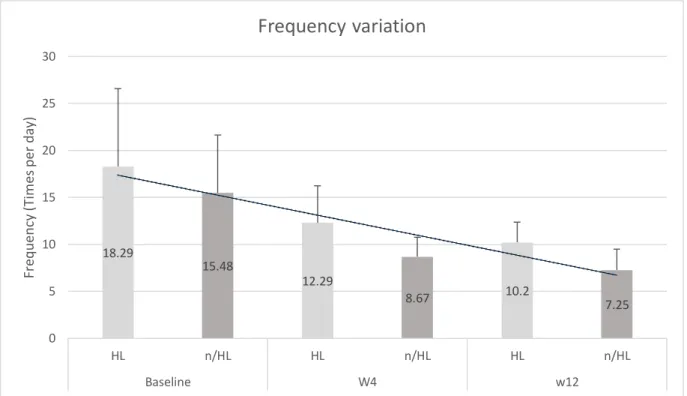
At baseline, pain intensity in VAS (0-10) was 6.7±1.4, OSS was 25,7±4,3, day and night frequency were 12,6±5,2 and 4,4±2,7, respectively; maximal bladder capacity was 185,7±56.9 ml and QoL score (0-6) was 5±1. Compared with baseline, the urinary frequency was significantly improved at week 4 (16,9±7,16 to 8,3±2,6 ). This trend towards reduction was maintained at the 12-wk. Differences were statistically significant between baseline and week 4 and w12 (p<0.01, in both).
Pain intensity was majorly improved at the 12-week (6,71±1,38 to 3,5±1,87) and was statistically significant at that time point (p<0,01).
OSS decreased through the 3 months’ study (25,7±4,29 to 17,83±5,95), and the difference was statistical significative in the transition between baseline and w4 (p=0,01) and w12 (p<0,01).
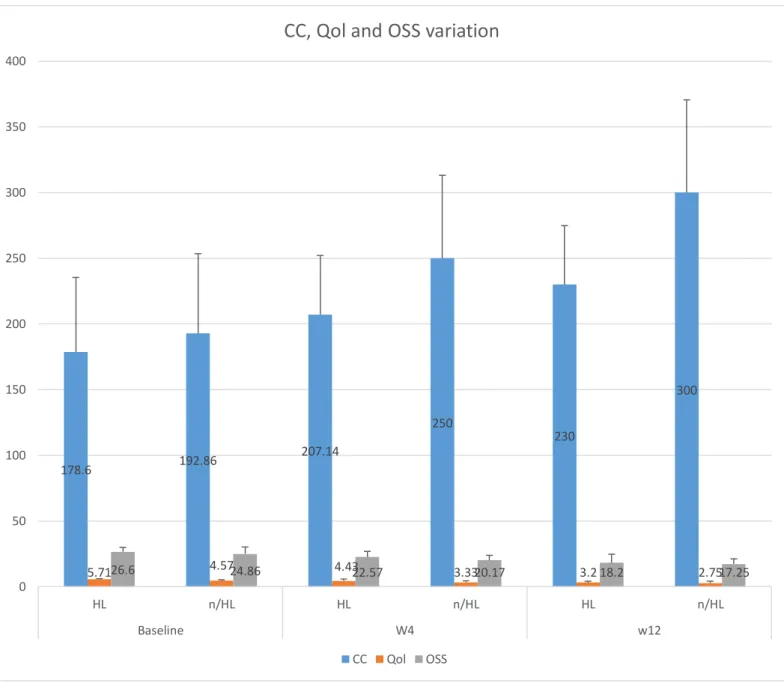
QoL scale presented a gradual improvement (5,14±0,86 to 3±1,26) at weeks 4 and 12, and differences were statistically significant along the trial (p=0,02 and p<0,01, respectively). CC, evaluated through micturitions in the 3-day bladder diary, also suffered a major improvement, with an increasing volume of voided urine per micturition (185,7±56,9 to 266,7±60,5). This difference was only statistically significant at week 12 (p= 0,01).
When comparing patients with and without HL at baseline, as seen in table 4, no statistical differences between the groups were noted except the QoL score, significantly worse in the HL group. The comparison between groups are shown in table 3 and Figure 1, 2 and 3. A more pronounced improvement in non-ulcer patients, when compared with HL patients, is seen but this difference is not statistically significant in all variables measure (p>0,05 when compared to the different values). Frequency improvement was always statistically significant in non-HL patients (p<0,05) while it was only statistically significant at 3 month follow up on ulcer patients (p=0,04). VAS and OSS improvement was statistically significant only at 3 months of follow up.
13
According to patients, while urinary frequency was the most important reported parameter improved at 1-month follow-up, the pain improvement was the most important at 3 months.
Adverse Effects
After 1 month in therapy, 4 patients dropped out from the study: 2 due to the lack of symptom improvement and 2 had persistent headache and/or tachycardia.
14
Discussion
Pain is the hallmark symptom of BPS/IC, it occurs in the region of the pelvis, urogenital floor, or external genitalia usually. Besides, most patients experience urgency, and/or urinary frequency. 13.
The primary outcomes were pain and urinary frequency. Our patients reported urinary frequency as the most important reported parameter improved at 1-month follow-up, and pain the most important 12-wk. No significant differences were registered in terms of improvement between ulcerated and non-ulcerated patients in these parameters.
Jain NK et al 12 conducted a pre-clinical trial to explore the role of the nitric oxide (NO)-cGMP pathway in nociceptive conditions. Peripheral nociception was assessed by acetic acid-induced chemo-nociception or carrageenan-induced hyperalgesia, while central nociception was assessed by tail-flick and hot-plate methods. The use of sildenafil, a member of the PDE5-I like tadalafil, induced a dose-dependent anti-nociception. Moreover, this analgesia was blocked by methylene blue, a guanylate cyclase inhibitor (inhibits the formation of cGMP).
Other pre-clinical trial conducted by Huang LJ et al 14 proved the contribution of γ-aminobutyric acid (GABA) receptors to the effect of sildenafil in neuropathic pain. These authors postulated that, prior to sildenafil injection, through the administration of GABA-A receptor antagonist (bicuculline) and GABA-B receptor antagonist (baclofen), sildenafil effect in blocking neuropathic pain was jammed, witch demonstrated that both GABA receptors are involved in this anti-neuropatic pain pathway of sildenafil.
Minagawa T et al showed that tadalafil dose-dependently decreased single afferent activities in both Aδ and C-fibers during intravesical saline instillation. Tadalafil significantly inhibited the acrolein-induced hyperactivity of both fibers, showing that systemic administration of tadalafil reduces mechanosensitive afferent activities of both fibers 15. A long way has to be walked to understand the real function of PDE5-i in bladder nociception. Nevertheless, our hypothesis relies on PDE5-I as a new drug to control pain in BPS/IC patients. Taladafil is commercially available in low-dose, the 5-mg, and is the ideal drug to start the experimentation in these patients.
BPS/IC patients also experience urinary frequency and urgency. This could be due to a characteristic increased sensitivity16 of detrusor muscle caused by elevated urinary potassium or adrenergic nociceptive overactivity (17). These are probably mediated by an increased RhoA/Rho-kinase (ROCK) signaling. It is known that this pathway, in the vascular soft muscle, is disabled by the GMPc-protein kinase G. Fibbi Bet al investigated the PDE5
15
tissue distribution and activity in human lower urinary tract tissues (urethra, prostate, and bladder), concluding that the highest expression and biological activity of PDE5 was found in the bladder17. Morelli and coworkers demonstrated that the increase of GMPc in the bladder, by the use of a PDE5-i, can block ROCK signaling18.
Bittencourt JA et al conducted a trial using a sample of Bladder neck strips pre-contracted
with phenylephrine and tested with N(omega)-nitro-L-arginine methyl ester (L-NAME) an inhibitor of nitric oxide synthase, and 1H-[1,2,4]oxadiazolo[4,3-a]quinoxaline-1-one (ODQ) a guanylyl cyclase inhibitor. The results shown that sildenafil induced a smooth muscle relaxation and that, this effect, was almost blocked by L-NAME and ODQ, demonstrating that there´s a dependence of the nitric oxide and GMPc formation pathway19.
Xin W et al led a trial to investigate the effects of PDE pharmacological blockade on human urinary bladder smooth muscle excitability. The use of PDE5-i caused relaxation of human urinary bladder smooth muscle, by decreasing the global intracellular Ca(2+)20.
Oger S et al , using a sample of human bladder pre-contracted with carbachol, showed that Sildenafil relaxed carbachol-pre-contracted human detrusor strips by inhibition of guanylate cyclase, concluding that Sildenafil-induced relaxation of human detrusor smooth muscle involves cGMP signalling pathways.21.
Elisardo et al, based on the fact that this over contraction could also be caused in patients who have low bladder vascularity due to endothelium dysfunction, demonstrated that the chronic use of a PDE5-i could revert this disfunction. It was also showed that sildenafil can modulate the number of endothelium progenitor cells, which can explain the benefice of this substance on the endothelium reparation and normal function22. So, taladafil probably works through relaxation of the bladder detrusor muscle18,19,23, improvement of microcirculation 22, and reabsorption of excessive potassium in the bladder24 by inhibiting the cGMP- dependent protein kinase G-RhoA/Rho-kinase signaling pathway and cGMP-dependent nitric oxide or carbonic oxide signaling pathway16,18.
Several studies support that BPS/IC can be dichotomic phenotyped in two different entities: patients presenting with HL in cystoscopy (classification 3C) considered to have IC and patients with a normal cystoscopy, considered to have BPS. 25-27. Compared to the non-ulcerated type, patients with HL present higher urinary frequency and lower bladder capacity25,27. Van Moh F et al compared the characteristics between men and women with and without HL, concluding that participants with HL reported less intense urologic pain and more nocturia. Also, close to half of Hunner IC patients had non-urologic pain outside the pelvis28.
16
Besides this, Killinger et al conducted a survey to assess if pain characteristics in women grouped by IC/BPS subtype, with and without lesions, would be different, No difference in pain distribution or characteristics in ulcerative and non-ulcerative groups29. Braunstein et
al also concluded that no significant differences between symptom duration, history of gross
hematuria, history of comorbid disease or VAS score between the 2 groups30.
Therefore, it is tempting to assume that probably there are significant overlaps in symptomatology between the 2 groups. The results from our study point in that same direction, since there were no statistical differences between ulcer and no ulcer patients. This suggests that cystoscopy is needed to accurately identify patients with HL, since the clinical evaluation insufficient to distinguish the two groups. However, more research is needed in larger samples to determine whether differences exist.
Regarding QoL´s exception, Troxel WM et al settled that was highly prevalent in women with IC/BPS poor sleep quality, a short sleep duration (≤ 6 hours) and trouble sleeping due to IC/BPS symptoms, all associated with greater IC/BPS QOL impairment31. Moreover, El
Khoudary SR et all determined that BPS/IC symptom severity was an independent predictor
of worse QOL on physical pain, general health, and mental health in women 32. HL patients have a greater rate of frequency and a lower bladder capacity and, consequently, associated with a worst QoL´s baseline.
In 2014, Chen et al conducted a placebo-controlled trial, in 2014, to evaluate the efficacy of daily low-dose sildenafil for the treatment of BPS patients, in 3 months. The authors concluded that sildenafil improved symptoms, problem index scores and urodynamic index (first desire to void, strong desire to void, and maximum cystometric capacity) when compared to placebo. No significant change in the VAS score was observed between 2 groups except at week 12 in the treatment group24.
Since our study is an open study, the absence of a control group did not allow us to take safe conclusions since patients the placebo effect isn’t measurable. More studies including a placebo group should be promoted.
Besides, a small sample and lack of patient compliance were also some limitations in our study.
No serious AE were observed during the trial. Similar to other oral treatments, low-dose sildenafil might be used as a second-line therapy in patients´ refractory to previous tried therapies.
The absence of unanimous guidelines in terms of which therapeutic escalation should be used, allied to a large number of patients that do not respond to the usual first-lines (analgesic, amitriptyline, pentosane sulfate), the pain control is achieved, in many patients,
17
after experimenting several drugs, sometimes in combination regimen. In this context, and because tadalafil appears to have a quick effect in frequency and pain, it seems to be a drug with a possible role in a sub-set of refractory patients.
18
Conclusions
In conclusion, daily low-dose sildenafil is an effective, simple and well-tolerated therapy for IC patients. Further randomized, controlled multicenter trials with a larger population and a longer follow-up period are warranted to confirm these results.
19
References
1. Abrams P, Cardozo L, Fall M, et al. The standardisation of terminology in lower urinary tract function: report from the standardisation sub-committee of the International Continence Society. Urology. 2003;61(1):37-49.
2. van de Merwe JP, Nordling J, Bouchelouche P, et al. Diagnostic criteria, classification, and nomenclature for painful bladder syndrome/interstitial cystitis: an ESSIC proposal. Eur Urol. 2008;53(1):60-67.
3. Pinto R, Lopes T, Frias B, et al. Trigonal injection of botulinum toxin A in patients with refractory bladder pain syndrome/interstitial cystitis. Eur Urol. 2010;58(3):360-365.
4. CLEMENS JQ, MEENAN RT, ROSETTI MCOK, GAO SY, CALHOUN EA. PREVALENCE AND INCIDENCE OF INTERSTITIAL CYSTITIS IN A MANAGED CARE POPULATION. Journal of Urology. 2005;173(1):98-102.
5. Clemens JQ, Link CL, Eggers PW, Kusek JW, Nyberg LM, Jr., McKinlay JB. Prevalence of painful bladder symptoms and effect on quality of life in black, Hispanic and white men and women. J Urol. 2007;177(4):1390-1394.
6. Temml C, Wehrberger C, Riedl C, Ponholzer A, Marszalek M, Madersbacher S. Prevalence and Correlates for Interstitial Cystitis Symptoms in Women Participating in a Health Screening Project. European Urology. 2007;51(3):803-809.
7. Patnaik SS, Lagana AS, Vitale SG, et al. Etiology, pathophysiology and biomarkers of interstitial cystitis/painful bladder syndrome. Arch Gynecol Obstet.
2017;295(6):1341-1359.
8. Clemens JQ, Brown SO, Calhoun EA. Mental health diagnoses in patients with interstitial cystitis/painful bladder syndrome and chronic prostatitis/chronic pelvic pain syndrome: a case/control study. J Urol. 2008;180(4):1378-1382.
9. Tripp DA, Nickel JC, Fitzgerald MP, Mayer R, Stechyson N, Hsieh A. Sexual functioning, catastrophizing, depression, and pain, as predictors of quality of life in women with interstitial cystitis/painful bladder syndrome. Urology. 2009;73(5):987-992.
10. Hanno PM, Erickson D, Moldwin R, Faraday MM. Diagnosis and treatment of interstitial cystitis/bladder pain syndrome: AUA guideline amendment. J Urol. 2015;193(5):1545-1553.
11. Malde S, Palmisani S, Al-Kaisy A, Sahai A. Guideline of guidelines: bladder pain syndrome. BJU Int. 2018;122(5):729-743.
12. Jain NK, Patil CS, Singh A, Kulkarni SK. Sildenafil-induced peripheral analgesia and activation of the nitric oxide-cyclic GMP pathway. Brain research. 2001;909(1-2):170-178.
13. McKernan LC, Walsh CG, Reynolds WS, Crofford LJ, Dmochowski RR, Williams DA. Psychosocial co-morbidities in Interstitial Cystitis/Bladder Pain syndrome (IC/BPS): A systematic review. Neurourol Urodyn. 2018;37(3):926-941.
14. Huang LJ, Yoon MH, Choi JI, Kim WM, Lee HG, Kim YO. Effect of sildenafil on neuropathic pain and hemodynamics in rats. Yonsei Med J. 2010;51(1):82-87. 15. Minagawa T, Aizawa N, Igawa Y, Wyndaele J-J. Inhibitory effects of
phosphodiesterase 5 inhibitor, tadalafil, on mechanosensitive bladder afferent nerve activities of the rat, and on acrolein-induced hyperactivity of these nerves. BJU
International. 2012;110(6b):E259-E266.
16. Filippi S, Morelli A, Sandner P, et al. Characterization and functional role of androgen-dependent PDE5 activity in the bladder. Endocrinology.
2007;148(3):1019-1029.
17. Fibbi B, Morelli A, Vignozzi L, et al. Characterization of Phosphodiesterase Type 5 Expression and Functional Activity in the Human Male Lower Urinary Tract. The
journal of sexual medicine. 2010;7(1):59-69.
18. Morelli A, Filippi S, Sandner P, et al. Vardenafil modulates bladder contractility through cGMP-mediated inhibition of RhoA/Rho kinase signaling pathway in
20
spontaneously hypertensive rats. The journal of sexual medicine. 2009;6(6):1594-1608.
19. Bittencourt JA, Tano T, Gajar SA, et al. Relaxant effects of sildenafil on the human isolated bladder neck. Urology. 2009;73(2):427-430.
20. Xin W, Cheng Q, Soder RP, Rovner ES, Petkov GV. Constitutively active phosphodiesterase activity regulates urinary bladder smooth muscle function: critical role of KCa1.1 channel. Am J Physiol Renal Physiol. 2012;303(9):F1300-1306.
21. Oger S, Behr-Roussel D, Gorny D, et al. Signalling pathways involved in sildenafil-induced relaxation of human bladder dome smooth muscle. Br J Pharmacol. 2010;160(5):1135-1143.
22. Elisardo CV, Agata LG, Jones BG, et al. Novel Therapeutic Targets for Phosphodiesterase 5 Inhibitors: current state-of-the-art on systemic arterial hypertension and atherosclerosis. Current Pharmaceutical Biotechnology. 2016;17(4):347-364.
23. Yoshimura N, Seki S, de Groat WC. Nitric oxide modulates Ca(2+) channels in dorsal root ganglion neurons innervating rat urinary bladder. Journal of
neurophysiology. 2001;86(1):304-311.
24. Chen H, Wang F, Chen W, et al. Efficacy of Daily Low-dose Sildenafil for Treating Interstitial Cystitis: Results of a Randomized, Double-blind, Placebo-controlled Trial—Treatment of Interstitial Cystitis/Painful Bladder Syndrome With Low-dose Sildenafil. Urology. 2014;84(1):51-56.
25. Peeker R, Fall M. Toward a precise definition of interstitial cystitis: further evidence of differences in classic and nonulcer disease. J Urol. 2002;167(6):2470-2472. 26. Whitmore KE, Fall M, Sengiku A, Tomoe H, Logadottir Y, Kim YH. Hunner lesion
versus non-Hunner lesion interstitial cystitis/bladder pain syndrome. Int J Urol. 2019;26 Suppl 1:26-34.
27. Peters KM, Killinger KA, Mounayer MH, Boura JA. Are ulcerative and nonulcerative interstitial cystitis/painful bladder syndrome 2 distinct diseases? A study of coexisting conditions. Urology. 2011;78(2):301-308.
28. Van Moh F, Vetter J, Lai HH. Comparison of urologic and non-urologic presentation in interstitial cystitis/bladder pain syndrome patients with and without Hunner lesions. Neurourol Urodyn. 2018;37(8):2911-2918.
29. Killinger KA, Boura JA, Peters KM. Pain in interstitial cystitis/bladder pain syndrome: do characteristics differ in ulcerative and non-ulcerative subtypes? Int Urogynecol J. 2013;24(8):1295-1301.
30. Braunstein R, Shapiro E, Kaye J, Moldwin R. The role of cystoscopy in the diagnosis of Hunner's ulcer disease. J Urol. 2008;180(4):1383-1386.
31. Troxel WM, Booth M, Buysse DJ, et al. Sleep disturbances and nocturnal symptoms: relationships with quality of life in a population-based sample of women with interstitial cystitis/bladder pain syndrome. J Clin Sleep Med. 2014;10(12):1331-1337.
32. El Khoudary SR, Talbott EO, Bromberger JT, Chang CC, Songer TJ, Davis EL. Severity of interstitial cystitis symptoms and quality of life in female patients. J
21
22
Table 1 (Patient´s demographics)
n/HL HL
Age 39± 9 48±16
N 7 7
Previous local therapies 2 6
Compatible Histology ( ESSIC class C)
2 6
> 6 months disease time 7 7
23
Table 2- study results
Baseline w4 P value (Bas-w4) w12 P value (Bas-w12) VAS 6,71± 1,38 5,33±1,87 0.056 3,5±1,87 0.001 Freq 16,9±7,16 9,88±2,47 0.01 8,3±2,6 0.001 CC 185,7±56,9 238,9±48,6 0.07 266,7±60,5 0.01 QoL 5,14±0,86 4,1±1,5 0.01 3±1,26 0.001 OSS 25,7±4,29 21,9±4,14 0.01 17,83±5,95 0.001
Abbreviations: VAS visual analogue scale, Freq frequency, CC clean-catch, QoL quality of life, OSS O'Leary-Sant, W4 week four, W12 week twelve
24
Table 3- study results between ulcer and non ulcer patients
Abbreviations: n/HL non Hunner lesion, HL Hunner lesion, VAS visual analogue scale, Freq frequency, CC clean-catch, QoL quality of life, OSS O'Leary-Sant, W4 week four, W12 week twelve
Baseline w4 P value (Bas-w4) w12 P value (Bas-w12) Baseline w4 P value (Bas-w4) w12 P value (Bas-w12) HL HL HL n/HL n/HL n/HL VAS 7±1,41 6±1,82 0.26 4,4±1,52 0.01 6,43±1,40 4,6±1,82 0.09 3,25±2,06 0.04 Freq 18,29±8,28 12,29±3,95 0.12 10,2±2,17 0.04 15,57±6,19 8,67±2,07 0.02 7,25±2,22 0.01 CC 178,6±56,7 207,14±44,99 0.32 230±44,7 0.11 192,86±60,74 250±63,25 0.13 300±70,7 0.04 QoL 5,71±0,49 4,43±1,51 0.07 3,2±1,10 0.01 4,57±0,79 3,33±1,21 0.06 2,75±1,41 0.12 OSS 26,6±3,26 22,57±4,28 0.07 18,2±6,57 0.04 24,86±5,24 20,17± 3,60 0.08 17,25±3,95 0.02
25
Table 4 Hunner lesion and non Hunner lesion comparison
Baseline P value (HL-n/HL) w4 P value (HL-n/HL) w12 P value (HL-n/HL) HL n/HL HL n/HL HL n/HL VAS 7±1,41 6,43±1,40 0.46 6±1,82 4,6±1,82 0.22 4,4±1,52 3,25±2,06 0.39 Freq 18,29±8,28 15,57±6,19 0.5 12,29±3,95 8,67±2,07 0.06 10,2±2,17 7,25±2,22 0.08 CC 178,6±56,7 192,86±60,74 0.65 207,14±44,99 250±63,25 0.2 230±44,7 300±70,7 0.15 QoL 5,71±0,49 4,57±0,79 0.01 4,43±1,51 3,33±1,21 0.18 3,2±1,10 2,75±1,41 0.67 OSS 26,6±3,26 24,86±5,24 0.48 22,57±4,28 20,17± 3,60 0.29 18,2±6,57 17,25±3,95 0.8
Abbreviations: n/HL non Hunner lesion, HL Hunner lesion, VAS visual analogue scale, Freq frequency, CC clean-catch, QoL quality of life, OSS O'Leary-Sant, W4 week four, W12 week twelve
26
27
Abbreviations: n/HL non Hunner lesion, HL Hunner lesion, VAS visual analogue scale, W4 week four, W12 week twelve
Graphic 1- VAS variation
7.41 6.43 6 4.6 4.4 3.25 0 1 2 3 4 5 6 7 8 9 10 HL n/HL HL n/HL HL n/HL Baseline W4 w12 V A S (1 -10)
VAS variation
28
Abbreviations: n/HL non Hunner lesion, HL Hunner lesion, W4 week four, W12 week twelve
18.29 15.48 12.29 8.67 10.2 7.25 0 5 10 15 20 25 30 HL n/HL HL n/HL HL n/HL Baseline W4 w12 Fr equenc y (T im es per da y)
Frequency variation
29
Abbreviations: n/HL non Hunner lesion, HL Hunner lesion, CC clean-catch, QoL quality of life, OSS O'Leary-Sant, W4 week four, W12 week twelve
Figure 3 - CC, Qol and OSS variation
178.6 192.86 207.14 250 230 300 5.7126.6 4.5724.86 4.4322.57 3.3320.17 3.218.2 2.7517.25 0 50 100 150 200 250 300 350 400 HL n/HL HL n/HL HL n/HL Baseline W4 w12
CC, Qol and OSS variation
30
Agradecimentos
Ao concluir esta dissertação, resta-me expressar os meus mais sinceros agradecimentos a todas as pessoas envolvidas neste projeto e que me possibilitaram a sua realização. Em primeiro lugar, agradeço ao meu orientador, Professor Doutor Rui Pinto, pelo facto de, desde o início e, reconhecendo o meu interesse e gosto pela área da Urologia, me ter dado a oportunidade de experienciar a prática clínica, integrando-me na consulta, bem como na realização dos exames - experiências únicas que levo para a vida. Agradeço ainda, pela valiosa troca de ideias, por toda a disponibilidade, amizade e cordialidade ao longo de todo o trabalho.
Um especial agradecimento ao Doutor Pedro Mendes pela amizade, constante disponibilidade e pelos preciosos conselhos.
Por último, o meu agradecimento sincero aos restantes coautores pelo importante contributo para este desafio, bem como aos pacientes que frequentaram o estudo - sem eles nada seria possível.
31