C O N F E R E N C E
P R O C E E D I N G S
Published by IATED Academy iated.org
INTED2020 Proceedings
14th International Technology, Education and Development Conference March 2nd-4th, 2020 — Valencia, Spain
Edited by
L. Gómez Chova, A. López Martínez, I. Candel Torres IATED Academy
ISBN: 978-84-09-17939-8 ISSN: 2340-1079
V-153-2020
Book cover designed by J.L. Bernat
All rights reserved. Copyright© 2020, IATED
The papers published in these proceedings reflect the views only of the authors. The publisher cannot be held responsible for the validity or use of the information therein contained.
THE ROLE OF PERSONALITY TRAITS OF MANAGERS ON THE
PERFORMANCE OUTCOMES OF HIGHER EDUCATION
INSTITUTIONS (HEIS)
P. Mucharreira
1, M. Antunes
2, M.R. Justino
2, J. Texeira Quirós
31Institute of Education, University of Lisbon (PORTUGAL)
2ISCAL – Lisbon Accounting and Business School of the Lisbon Polytechnic Institute
(PORTUGAL)
3University of Extremadura (SPAIN)
Abstract
This research aims to study the role that managers' personality traits have in the decision-making process and their relationship on the performance outcomes of Portuguese higher education institutions (HEIs), through a literature review that supports the presentation of a research model proposed by the authors. Nowadays, companies and their managers are increasingly pressured to achieve certain goals and levels of performance to ensure the financial sustainability of their institutions and to remain competitive in the markets. Sometimes these goals are somewhat ambitious and difficult to achieve, which means that decision-makers must have certain personality traits to show resistance and resilience in dealing with obstacles and strengthen their capacity to solve problems in the adversities that arise in the day to day business. This research proposal assumes that the personality traits of managers, namely extroversion, pleasantness, neuroticism, conscientiousness, and openness to experience, will have a relevant impact on decision making, which will be reflected in organizational performance. On the other hand, also the emotional adjustment, that is, the emotional states that the managers might develop, in relation to stress, anxiety, and depression, defined by personality traits, can also influence the way they deal with situations for decision making, also affecting institutional performance. In organizations, people experience a wide range of affective states, and this applies also to managers [1]. In several academic researches, personality traits have become a topic of great interest, especially when analyzing the relationships between the characteristics of managers and their behavior and attitudes in a professional environment. This research is justified concerning the perspective of personality traits and emotional states of managers and how these dynamics might have an influence on making decisions and their attitudes and, consequently, what kind of relationship can we find between this psychology perspective and organizational performance of HEIs. Regarding the methodology, the data will be obtained through the application of a questionnaire prepared by the authors, to evaluate the different dimensions of the proposed research model. The research will consist of the answers given by members of the management boards of Portuguese universities and polytechnics. In the treatment of quantitative data, the use of the structural equations model (SEM) is considered, to investigate the possible relationships between the different dimensions incorporated in the model. Concerning the discussion of results, it is intended to characterize the effects of personality traits of educational managers and their emotional adjustment in higher education institutions in Portugal, seeking to understand their role and possible relations with the financial sustainability and other performance outcomes of these institutions.
Keywords: Personality traits, Emotional adjustment, Styles of leadership, Financial sustainability, Higher education.
1 INTRODUCTION
Nowadays, HEIs face increasing challenges posed by competitive and dynamic markets. This leads to disruptive changes that force organizations to change their strategy to survive. Expansion of the global economy, as well as, a global competition, new developments and innovations, rapid changes and new technologies, customer expectations, quality management, demographic changes, and demand for specific skills, pose a huge challenge to the flexibility of an organization that operates in this scenario. Organizations need to change and adopt new ways to remain competitive. In this sense, these institutions require managers with leadership skills that promotes better organizational performance [2]. Effective leadership promotes effective organizational functioning, leading employees, teams, and organizations to perform well. In this way, it is essential to analyze the factors that can influence the performance of managers. Researches on this topic has revealed that personality traits decisively
Proceedings of INTED2020 Conference
influence people's motivations, behaviors, and perceptions, including their values, social behavior, and organizational behaviour [3-4].
2 THEORETICAL FRAMEWORK
Organizations are constantly undergoing rapid change as a result of many factors. Some of these factors are external, such as competition, global market trends and technological changes. However, some of the changes over time also occur within organizations themselves, such as employee’s motivation, innovation strategies, and organizational culture. All these factors tend to affect the performance of these organizations, and a key factor that also has the potential to decisively affect the organizational performance of organizations is the leadership styles adopted by their managers [5].
Organizational performance comprises the results of an organization, which can be measured against defined outcomes, goals and objectives. Organizational performance is the ability to acquire and process financial, physical, and human resources appropriately to achieve the organization's objectives [6].
According to Harbor [7], organizational performance can be measured through the implementation of a series of measures that represent the result of the organization’s activity. Other authors, namely Peterson et al. [8], defined organizational performance as the ability of organizations to use their resources efficiently in order to produce results consistent with their strategic objectives. Other studies have considered organizational performance as something that allows to evaluate the success of organizations and to achieve their success [9].
Nowadays, companies, and more precisely their managers, are increasingly pressured to achieve certain results and levels of performance to ensure the financial sustainability of their companies and to remain competitive in the markets, which are increasingly aggressive and complex. Sometimes these goals are somewhat ambitious and difficult to achieve, which means that decision-makers must have certain characteristics in terms of their personality traits to show resistance and resilience to deal with the obstacles and problem-solving abilities in the day-to-day business adversities, considering both the internal and external constraints inherent in the business world.
The performance of institutions depends on the quality of the decisions that are made by their managers. These decisions relate to a constant need for information that ensures a rational management of resources and strategies. Performance evaluation systems, composed of financial and non-financial indicators, play a key role in the strategic definition of the organization because they provide value creation associated with the strategic objectives [10].
In view of this framework, this research proposal assumes that the five main personality traits of managers, namely extroversion, pleasantness, neuroticism, conscientiousness, and openness to experience, will have a relevant impact on the decision-making process, which will be reflected in organizational performance and the objectives achieved by HEIs. Personality traits are characteristics of individual behavior that allow for a better understanding of why people act differently in similar situations. These characteristics are decisive in achieving the defined objectives, and among the several examples, we can highlight innovation capacity, proactive personality, generalized efficacy, self-control and attitude towards risk.
Although there are several models that focus on the study of personality traits, the Big Five Model [11] has been the most widely used to analyze the individual personality differences [12]. This model consists of five personality traits which are Extroversion, Neuroticism, Agreeableness, Conscientiousness, and Openness to Experience.
Extroversion represents assertiveness, sociability, energy, and positive emotions [13]. Extroverted people are communicative, affectionate, active, and enthusiastic [14], also self-confident, dominant, and exciting, and able to develop an interpersonal relationship with others and externalize their emotions. Neuroticism contrasts emotional stability and captures the tendency to experience a variety of disruptive thoughts and emotions. On the other hand, neuroticism can be characterized as the degree of some negative personality traits, such as unhappiness, impulsivity, aggressiveness and anxiety [12], since neurotic people tend to be unhappy and they feel insecure about their life circumstances. Individuals who are characterized as neurotic are insecure, anxious, and more susceptible to stress, as they are likely to interpret common situations as threatening [15].
Agreeableness includes such characteristics as altruism, trust, and humility. People with this characteristic are more trustworthy than people who do not reveal this distinctive aspect, and these people turn out to be manipulative, pessimistic, and selfish. Kind people also strive to build and maintain harmony and prefer to use compromising strategies to deal with any conflict [16].
Conscientiousness identifies directed, planned, and organized task behavior, such as thinking before acting, following norms, and prioritizing tasks. Highly conscious people are self-disciplined, trustworthy, ambitious, and efficient [12]. Other authors, associate conscientiousness with self-discipline, to the conquest of efforts, obedience, and competence, since their persistence and self-discipline characteristics, enables them to accomplish tasks or achieve goals in a successful way [17].
Finally, openness to experience is characterized by receptivity to new ideas and flexibility. This characteristic indicates the degree of intellectual curiosity, creativity and the individual tendency to learn, try new things, and consider new ideas. Individuals who reveal this personality trait in a prominent way are imaginative, open-minded, without prejudice, and curious [12]. Consequently, the Big Five Personality Traits have very important effects, especially in terms of decision-making and leadership styles.
On the other hand, the role of leadership is extremely important when it comes to defining the organization's mission and vision, as well as setting goals, developing strategies, policies and procedures to achieve organizational goals efficiently and effectively [18]. According to Harris et al. [19], quality leadership is equally critical for institutions and their managers to be able to act and respond in a timely manner to changes taking place abroad. Also, according to Mitonga-Monga and Coetzee [20], leadership styles are defined as a combination of different characteristics, personality traits, and behaviors adopted by leaders to interact like other employees in the organization, performing behaviors to combine the organizational and personal interests, seeking to achieve the specific objectives of the organization.
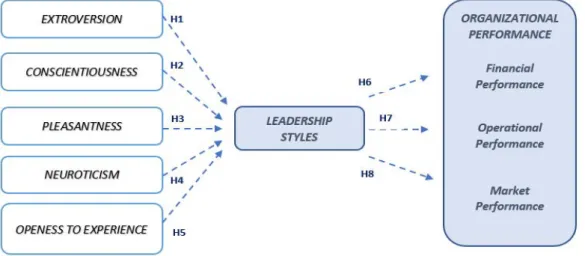
Based on the several researches carried out on these subjects, eight research hypotheses are now presented with the aim to respond to the possible relationship between the five personality traits, leadership styles and organizational performance.
- H1: "Extroversion" influences the leadership style adopted by HEIs managers. - H2: "Conscientiousness" influences the leadership style adopted by HEIs managers. - H3: “Pleasantness" influences the leadership style adopted by HEIs managers. - H4: “Neuroticism" influences the leadership style adopted by HEIs managers.
- H5: “Openness to experience" influences the leadership style adopted by HEIs managers. - H6: Leadership style adopted by HEIs managers influences financial performance of HEIs. - H7: Leadership style adopted by HEIs managers influences operational performance of HEIs. - H8: Leadership style adopted by HEIs managers influences market performance of HEIs. Completed the description of the fundamentals that led to the construction of the initial issues based on literature review, it is now presented to the proposed research model as illustrated in the figure 1:
Figure 1. Research model.
3 METHODOLOGY
Regarding to methodology, this research is of a qualitative nature, although using quantitative techniques, being the data related to personality traits and leadership styles obtained through the application of a survey elaborated by the authors to evaluate the different dimensions of the proposed conceptual model. The data concerned with organizational performance of HEIs will be obtained through a database from another research developed by the authors [21]. The sample will consist of about 200 email addresses of members of the management boards of Portuguese universities and polytechnics. In the treatment of quantitative data, the use of the structural equations model (SEM) is considered, to investigate the possible relationships between the different dimensions incorporated in the model. The survey will be elaborated with closed questions, using a five-point Likert scale to evaluate the respondents' conceptions about the dimensions considered, where 1 represents "strongly disagree" and 5 represents "strongly agree". For the characterization of respondents and organizations, nominal and ordinal scales will be used. Concerning the discussion of results, it is intended to characterize the effects of personality traits of educational managers and their emotional adjustment in higher education institutions in Portugal, seeking to understand their role and possible relations with the financial sustainability and other performance outcomes of these institutions.
4 FINAL CONSIDERATIONS
This research, that is still in development, is of great relevance because it assumes a combination of two important areas of knowledge, namely, Management and Psychology, which is an innovative approach, since there are only a few references in the literature that link these two areas of expertise. Although there are many factors to consider when it is intended to study the viability and the success of organizations in highly competitive markets, the effects of decision-making by managers, determined by their personality traits and the human behavior, cannot be ignored at all. In the same way, also the emotional states of managers will have a determining effect on the results achieved by their organizations. An individual's personality refers to the way he or she reacts, perceives, thinks, and behaves as a single person and an individual in his or her environment. So, the way managers deal with and solve problems, how they make their decisions, or even how they deal with adversity, will undoubtedly contribute to determining the organization's success. Following a corporate approach, we think that this field of study will bring a great enrichment for the knowledge of organizations behavior, because, increasingly, the behavioral and cognitive component cannot be neglected in the analysis of the results of the companies, because the managers are the people who make the decisions and have to constantly seek to develop their capacities of resistance, resilience and look for the best strategies to solve problems.
This research is justified by the observation of a reality still relatively little studied at the level of organizational behaviors of HEIs, particularly about the perspective of personality traits and emotional states of their managers and how these dynamics might have influence on making decisions and their leadership styles and, consequently, what kind of relationship can we find between this psychology perspective and organizational performance.
ACKNOWLEDGEMENTS
This work was supported by IDI&CA 2019 (4th edition), of the Lisbon Polytechnic Institute, in the scope
of the research activities developed at the IPL/2019/PSYCORP_ISCAL - IDI&CA 2019.
REFERENCES
[1] Q. Huy, “Emotional balancing of organizational continuity and radical change: The contribution of middlemanagers”, Administrative Science Quarterly, no. 47, pp. 31–69, 2002.
[2] M. G. Antunes, P. R. Mucharreira, M. R. Justino and J. Texeira Quirós, “The relationship between learning organizations and organizational performance in portuguese higher education institutions (HEI)”, INTED 2019 Proceedings – Exploring New Frontiers in Education. Valencia, Spain: IATED Academy, pp. 2723-2730, 2019.
[3] R. F. Krueger, B. M. Hicks, C. J. Patrick, S. R. Carlson, W. G. Iacono and M. McGue, “Etiologic connections among substance dependence, antisocial behavior, and personality: Modeling the externalizing spectrum”, Journal of Abnormal Psychology, no. 111, pp. 411–424, 2002.
[4] R. Fischer and D. Boer, “Motivational basis of personality traits: A meta-analysis of value-personality correlations”, Journal of Personality, vol. 83, no. 5, pp. 491-510, 2015.
[5] J. M. Ng’ethe, G. S. Namusonge and M. A. Iravo, “Influence of Leadership Style on Academic Staff Retention in Public Universities”, International Journal of Business and Social Science, no. 3, pp. 297-302, 2012.
[6] A. Madella, E. Bayle and J. L. Tome, “The organizational performance of national swimming federations in mediterranean countries: a comparative approach”, European Journal of Sport
Science, vol. 5, no. 4, pp. 207-220, 2005.
[7] J. L. Harbour, The performance paradox: Understanding the real drivers that critically affect
outcomes. Boca Raton: CRC Press, 2008.
[8] W. Peterson, G. Gijsbers and M. Wilks, An organizational performance assessment system for
agricultural research organizations: Concepts, methods, and procedures. The Hague: International
Service for National Agricultural Research, 2003.
[9] J. P. Antony and S. Bhattacharyya, “Measuring organizational performance and organizational excellence of SMEs – Part 2: An empirical study on SMEs in India”, Measuring Business Excellence, vol. 14, no. 3, pp. 42-52, 2010.
[10] J. K. H. Nga and G. Shamuganathan, “The influence of personality traits and demographic factors on social entrepreneurship start up intentions”, Journal of Business Ethics, vol. 95, no.2, pp. 259-282, 2010.
[11] R. R. McCrae, “The five-factor model and its assessment in clinical settings”, Journal of Personality
Assessment, no. 57, pp. 399-414, 1992.
[12] V. Berglund, I. Seva and M. Strandh, “‘Subjective well-being and job satisfaction among self-employed and regular employees: Does personality matter differently?”, Journal of Small Business
& Entrepreneurship, vol. 28, no. 1, pp. 55-73, 2015.
[13] G. Band, R. Sao and A. Dalal, “‘Study and Impact of Gender on Personality Traits”, Int. Journal of
Organizational Behaviour & Management Perspectives, vol. 3, no. 2, pp. 873-879, 2014.
[14] P. Paramanandam and R. Radhamani, “Big Five Personality and Occupational Stress Among the Managerial Personnel of Automobile Industry”, Pratibimba, vol. 14, no. 1, pp. 23 -30, 2014.
[15] P. T. Costa and R. R. McCrae, Revised NEO Personality Inventory (NEO-PIR) and NEO Five Factor
Inventory (NEO-FFI) professional manual. Odessa, FL: Psychological Assessment Resources,
1992.
[16] J. Camps, J, Stouten and M. Euwema, “The Relation Between Supervisors’ Big Five Personality Traits and Employees’ Experiences of Abusive Supervision”, Frontiers in Psychology, vol. 7, no. 112, pp. 1-11, 2016.
[17] P. T. Costa, R. R. McCrae and D. A. Dye, “Facet scales for agreeableness and conscientiousness: A revision of the NEO Personality Inventory”, Personality and Individual Differences, no. 12, pp. 887–898, 1991.
[18] G. Y. Xu and Z. S. Wang, The impact of transformational leadership style on organizational
performance: The intermediary effects of leader-member exchange. Long Beach, CA, USA, IEEE
Xplore, 2008.
[19] A. Harris, K. Leithwood, C. Day, P. Sammons and D. Hopkins, “Distributed leadership and organizational change: reviewing the evidence”, Journal of Educational Change, vol. 8, no. 4, pp. 337-347, 2007.
[20] J. Mitonga-Monga and M. Coetzee, “Perceived leadership style and employee participation”, African
Journal of Business Management, vol. 6, no. 15, 2012.
[21] M. G. Antunes, P. R. Mucharreira, M. R. Justino and J. Texeira Quirós, “The Role of TQM, Innovation and Internationalization Strategies on the Financial Sustainability of Higher Education Institutions (HEIS)”, ICERI 2018 Proceedings – Meeting the Challenges of 21st Century Learning. Seville, Spain: IATED Academy, pp. 9778-9787, 2018.