EUROPEAN ORGANIZATION FOR NUCLEAR RESEARCH (CERN)
CERN-PH-EP/2012-266 2013/03/19
CMS-TOP-11-022
Evidence for associated production of a single top quark
and W boson in pp collisions at
√
s = 7 TeV
The CMS Collaboration
∗Abstract
Evidence is presented for the associated production of a single top quark and W bo-son in pp collisions at √s = 7 TeV with the CMS experiment at the LHC. The ana-lyzed data corresponds to an integrated luminosity of 4.9 fb−1. The measurement is performed using events with two leptons and a jet originated from a b quark. A multivariate analysis based on kinematic properties is utilized to separate the tt back-ground from the signal. The observed signal has a significance of 4.0 σ and corre-sponds to a cross section of 16+−54pb, in agreement with the standard model expecta-tion of 15.6±0.4+−1.01.2pb.
Submitted to Physical Review Letters
c
2013 CERN for the benefit of the CMS Collaboration. CC-BY-3.0 license
∗See Appendix A for the list of collaboration members
1
Electroweak production of single top quarks has been first observed by the D0 [1] and CDF [2] experiments at the Tevatron. Single-top-quark production proceeds via three processes: the t-channel exchange of a virtual W boson, the s-channel production and decay of a virtual W boson, and the associated production of a top quark and a W boson (tW). The latter chan-nel, which has a negligible production cross section at the Tevatron, represents a significant contribution to single-top-quark production at the Large Hadron Collider (LHC). Associated tW production is a very interesting production mechanism because of its interference with top quark pair production [3–5], its sensitivity to new physics [6–8] and its role as a background to SUSY and Higgs searches. The ATLAS and Compact Muon Solenoid (CMS) experiments have measured the cross section for t-channel production [9, 10] while evidence for tW associated production has been presented by the ATLAS experiment [11]. This Letter presents the first study from the CMS experiment of tW production in pp collisions at√s=7 TeV.
Figure 1: Leading order Feynman diagrams for single-top-quark production in the tW mode, the charge-conjugate modes are implicitly included.
The production cross section for tW has been computed at approximate next-to-next-to-leading order (NNLO), the theoretical prediction of the cross section for tW in pp collisions at √s = 7 TeV, assuming a top-quark mass (mt) of 172.5 GeV, is 15.6±0.4+−1.01.2pb [12], the first uncertainty
corresponds to scale variation and the second to parton distribution function (pdf) sets. The leading order Feynman diagrams for tW production are shown in Fig. 1. The definition of tW production in perturbative QCD mixes with top quark pair production (tt) at next-to-leading order (NLO) [4, 5]. Two schemes are proposed to describe the tW signal: “diagram removal” (DR) [3], where all NLO diagrams which are doubly resonant, such as those in Fig. 2, are excluded from the signal definition; and “diagram subtraction” (DS) [3, 13], in which the differential cross section is modified with a gauge-invariant subtraction term, that locally can-cels the contribution of tt diagrams. The DR scheme is used in this Letter, but it has been verified that the number of predicted events after full selection is consistent between the two approaches within the statistical uncertainties of the simulated samples. The differences are accounted for in the systematic uncertainties.
In the standard model, top quarks decay almost exclusively to a W boson and a b quark. The study presented here has been performed in the channels in which both W bosons decay lep-tonically into a muon or an electron and a neutrino, with a branching fractionB(W → `ν) = (10.80±0.09)%, where` =e or µ [14]. The dilepton final states of the tW process are character-ized by the presence of two isolated leptons with opposite charge, a jet from the fragmentation of a b quark, and a substantial amount of missing transverse energy (ETmiss) due to the presence of the neutrinos. The primary source of background events arise from tt production, followed by Z/γ?+jets processes.
The analysis uses fits to a discriminant variable built from kinematic quantities combined with a multivariate technique. A second analysis, intended as a cross-check of the robustness of the
t ¯ t g g ¯b W t ¯ t g g ¯b W t ¯ t q ¯ q ¯b W t
Figure 2: Feynman diagrams for tW single-top-quark production at next-to-leading order that are removed from the signal definition in the DR scheme, the charge-conjugate modes are im-plicitly included.
selection, is performed using event counting. In both cases, a sample collected at√s = 7 TeV by CMS, corresponding to an integrated luminosity of 4.9 fb−1, is used.
The central feature of the CMS apparatus is a superconducting solenoid of 6 m internal diam-eter, providing a magnetic field of 3.8 T. Within the field volume are a silicon pixel and strip tracker, a lead tungstate crystal electromagnetic calorimeter, and a brass/scintillator hadron calorimeter. Muons are measured in gas-ionization detectors embedded in the steel return yoke. Extensive forward calorimetry complements the coverage provided by the barrel and endcap detectors. A more detailed description can be found in Ref. [15].
Single-top-quark events in all channels have been simulated with thePOWHEGevent generator version 301 [16], designed to describe the full NLO properties of these processes, while MAD -GRAPH 5.1.1 [17] is used for tt and for the inclusive single-boson production (V+X), where V= W, Z and X can indicate light or heavy partons. The remaining background samples are simulated usingPYTHIA version 6.4.24 [18], including diboson production and QCD multijet production enriched in events with electrons or muons produced in the decay of b and c quarks, and muons from the decay of long-lived hadrons. The CTEQ 6.6M pdf sets [19] are used for all simulated samples. All generated events undergo a full simulation of the detector response using GEANT4 [20, 21]. The value used for the top-quark mass is mt=172.5 GeV.
Approximate NNLO theoretical predictions are used to normalize tt production (σtt = 163+−1110pb) [22], W+jets and Z/γ? +jets processes are normalized to complete NNLO calculations for the inclusive cross sections, and NLO cross sections are used for diboson pro-cesses [23]. Unless otherwise stated, the theoretical values of the cross section have been used in this Letter to normalize the simulation in figures and tables.
Leptons, jets and ETmissare reconstructed by the CMS particle flow (PF) algorithm [24], which performs a global event reconstruction and provides the full list of particles identified as elec-trons, muons, photons, and charged and neutral hadrons.
Events are collected using dilepton triggers with electrons or muons. The lepton transverse energy thresholds are symmetric, the highest used in these triggers is 17 GeV while the lowest is 8 GeV. The two selected leptons must originate from the same primary vertex and have op-posite charge. The primary vertex used is defined as the reconstructed vertex with the highest pT of associated tracks and is required to have at least four tracks, with longitudinal (radial)
distance of less than 24 (2) cm from the center of the detector. Muon (electron) candidates are required to have a transverse momentum pT > 20 GeV and pseudorapidity |η| < 2.4(2.5);
events with additional leptons passing looser quality criteria are vetoed.
To remove low invariant mass Drell–Yan (Z/γ?) events, the invariant mass of the lepton pair (m``) is required to be greater than 20 GeV. In the ee and µµ final states, events are also
re-3
jected if m``is between 81 and 101 GeV, compatible with the Z boson mass; this veto removes
background from Z/γ? +jets, as well as from ZZ and WZ processes. In the ee and µµ de-cay channels, a requirement is applied on the EmissT as well to further reduce the contribution from events without genuine Emiss
T (mostly Z/γ?+jets and QCD multijet production). Since the
Emiss
T resolution is degraded in events with high pileup, an additional quantity is used
(tracker-ETmiss), calculated using only the charged particles associated with the primary vertex. Events are selected if both EmissT and tracker-EmissT are larger than 30 GeV.
Jets are defined according to the anti-kT algorithm [25] with a distance parameter of 0.5. Jets
within|η| <2.4 and with pT >30 GeV are considered in the analysis.
Exactly one jet is required to be present in the event, and it must be identified as coming from a b quark. The identification of b jets is done according to an algorithm that reconstructs the secondary vertex of the decay of the b quark [26, 27], resulting in a discriminating variable sensitive to the lifetime of b hadrons. The selection on this discriminant yields a b-tagging efficiency of 62% with a mistag rate of 1.4% for jets with pT between 50 and 80 GeV. Events
with additional b-tagged jets with pT >20 GeV are removed. After this selection, the sample is
dominated by tt events and tW signal.
Additionally, events with exactly two jets, in which either one or both jets have been b tagged, are used in the fit. Three regions are defined per dilepton final state: one region with one jet that is b tagged (1j1t) where the tW signal is substantial, and two regions with two jets, where the tt background is dominant, and exactly one or two b tags are required (2j1t and 2j2t, respectively). A smaller background comes from Z/γ? events. It is found that in high-pileup scenarios the ETmiss distribution for Z/γ? events is not properly modeled by the simulation, leading to dis-agreement between data and simulation. To solve this problem, the Z/γ? simulation is cor-rected to match the missing transverse energy distribution observed in the data using events from the Z resonance.
The contributions of other backgrounds, i.e., diboson production (WW, WZ, ZZ), QCD, W+jets, and other single-top-quark processes, are small, less than 1% of the selected events, and esti-mated from simulation.
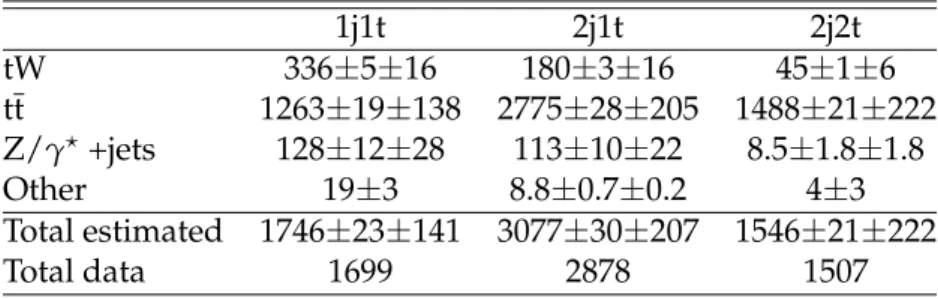
Table 1: Event yields in the different regions. The simulation is quoted with statistical (first) and systematic uncertainties (second). When only one uncertainty is quoted, it is the total one.
1j1t 2j1t 2j2t tW 336±5±16 180±3±16 45±1±6 tt 1263±19±138 2775±28±205 1488±21±222 Z/γ?+jets 128±12±28 113±10±22 8.5±1.8±1.8 Other 19±3 8.8±0.7±0.2 4±3 Total estimated 1746±23±141 3077±30±207 1546±21±222 Total data 1699 2878 1507
The number of events in the signal and two control regions is presented for data and simulation in Table 1. The approximate composition of the sample at this level is 70% tt events with 20% tW events in the signal region. In the 2j1t region the tt content represents 90% of the events, while tW events are less than 6%. In the 2j2t region, more than 95% of the events are tt events. A multivariate analysis based on boosted decision trees (“BDT” analysis) [28, 29] is used, test-ing the overall compatibility of the signal event candidates with the event topology of the tW associated production. Four variables are chosen to train the BDT based on their ability to
[GeV] T H 0 50 100 150 200 250 300 350 400 450 500 Events / 20 GeV 0 50 100 150 200 250 300 Data tW t t *+jets γ Z/ Other Systematic -1 = 7 TeV, 4.9 fb s CMS,
of the system [GeV]
T p 0 20 40 60 80 100 120 140 160 180 200 Events / 6.67 GeV 0 50 100 150 200 250 300 350 Data tW t t *+jets γ Z/ Other Systematic -1 = 7 TeV, 4.9 fb s CMS,
Figure 3: Distributions of HT and the pTof the system composed of the leptons, EmissT and the
jet, in data and simulation after jet selection in the signal region (1j1t).
separate the tW signal from the dominant tt background. These variables are HT, defined as
the scalar sum of the transverse momenta of the leptons, jet, and ETmiss; the pT of the system
composed of the leptons, EmissT and jet; the pT of the jet with the highest energy; and the
dif-ference in angular separation, φ, between the direction associated to the EmissT and the closest of the two selected leptons. The distributions of HT and the pTof the system composed of the
leptons, ETmissand the jet, are presented, in the signal region (1j1t), in Fig. 3. The presence of the tW signal over the background is visible in all the distributions. The distributions of the other two variables are available in Appendix A.
BDT discriminant -1.0 to -0.99 -0.99 to -0.7 -0.7 to 0.7 0.7 to 0.99 0.99 to 1.0 Events 0 100 200 300 400 500 600 700 Data tW t t *+jets γ Z/ & Other Systematic -1 = 7 TeV, 4.9 fb s CMS,
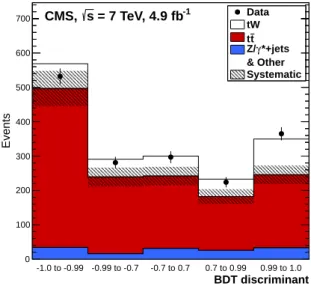
Figure 4: Distribution of the BDT discriminant in the signal region (1j1t) in data and simulation.
The output of the BDT is a single discriminant value for every event ranging from−1 (background-like) to+1 (signal-like). The distribution of the BDT discriminant is shown for the 1j1t signal region in Fig. 4. Even if the tW signal does not peak strongly at+1, its distribution
discrim-5
inates it with respect to tt and other backgrounds. Maximum signal sensitivity is achieved through a simultaneous fit to 9 categories: the three BDT discriminant shapes (1j1t, 2j1t, and 2j2t) in the three final states (ee, eµ and µµ). The two tt enriched regions are included to control the rate of this background in the signal region.
The impact of each individual source of uncertainty on the analysis has been estimated in every region and final state. The dominant systematic uncertainty that affects the rate of the tW signal is associated with the b-tagging efficiency, with values between 3% and 6% for the different final states. The b-tagging efficiency uncertainty is also important for the tt background yield, with values between 1.5% and 4.0%. The main systematic uncertainty for the tt background is due to the factorization/renormalization scale used in the simulation, up to 11%, with values around 2% for tW signal. Also for tt, the uncertainties due to jet energy scale (7%) and the threshold used to match the matrix element generator to the parton shower model in simulation (3%) are important. The statistical uncertainty is the largest contribution to the uncertainty of the measured cross section, with a 20% effect. The complete information about the systematic uncertainties is available in tabulated form in Appendix A.
A binned likelihood fit is performed on the distributions of the BDT discriminant. Template shapes for the signal and backgrounds are taken from simulation. Distributions are included separately in the fit for each of the three dilepton channels (ee, eµ, and µµ) in the signal region (1j1t) and control regions (2j1t and 2j2t). Signal and background rates are allowed to vary in the fit, using the systematic uncertainties on the background rates as constraint terms in the likelihood function. The signal rate and 68% confidence level (CL) interval is determined using the profile likelihood method. The sources of theoretical uncertainty that affect the template shape are then considered. For each uncertainty,±1 σ systematic shifts are applied to the sim-ulated samples to obtain revised templates. Differences in signal rate found using the revised templates are taken as systematic uncertainties and are added in quadrature to the 1 σ inter-val from the fit using the baseline templates. The expected significance is einter-valuated using the median and central 68% of the values obtained from pseudo-experiments generated using the theoretical prediction of the standard model tW cross section.
An excess of events over the expected background is observed with a significance of 4.0 σ, compatible with the expected significance of the tW signal, 3.6+−0.80.9σ. The measured cross
sec-tion, including both statistical and systematic uncertainties, is 16+−54 pb, in agreement with the standard model prediction.
The measurement can be used to determine the absolute value of the Cabibbo-Kobayashi-Maskawa matrix element |Vtb|, following the same technique as in [10], assuming that |Vtd|
and|Vts|are much smaller than|Vtb|:
|Vtb| = s σtW σtWth =1.01+−0.160.13(exp.)+0.03 −0.04(th.) (1)
where σtWth is the standard model prediction computed assuming|Vtb| =1. Using the standard model assumption of 0≤ |Vtb|2 ≤1, a value of|Vtb| =1.00 is inferred, with a 90% confidence
level interval of [0.79,1.00]. This is based on profile likelihood intervals, the same method used for the cross section measurement and intervals. Studies with pseudo-experiments were performed, showing the validity of the profile likelihood method in presence of the boundary
|Vtb| ≤1.0.
A second analysis (“count-based” analysis), used as a cross-check, is performed using event counts. After the jet selection step, instead of building the BDT discriminant, events are
re-1j1t 2j1t 2j2t Events 500 1000 1500 2000 2500 3000 3500 Data tW t t *+jets γ Z/ Other Systematic -1 = 7 TeV, 4.9 fb s CMS,
Figure 5: Event yields in data and simulation in the signal region (1j1t) and the two tt-enriched control regions for the count-based analysis. Simulation yields are scaled to the outcome of the fit.
quired in addition to have HT > 60 GeV in the eµ channel, where no invariant mass and EmissT
requirements are applied. The analysis uses a statistical model of Poisson event counts in the three dilepton final states in the signal region (1j1t) and control regions (2j1t and 2j2t).The event yield for each process in every region is affected by different sources of systematic uncertainties, equivalent to the ones calculated for the BDT analysis. These are included in the model as nui-sance parameters. The same methods for the cross section measurement and the significance calculation as in the BDT analysis have been used. Figure 5 shows the event yields selected by the count-based analysis for each region, in data and simulation, in which the simulation yields have been normalized to the outcome of the maximum likelihood fit. The observed significance of the tW signal obtained with the count-based analysis is 3.5 σ, with an expected significance of 3.2±0.9 σ. The count-based analysis measures a cross section of 15±5 pb. These results are consistent with those obtained with the BDT analysis.
In summary, using 4.9 fb−1of data collected with the CMS experiment at the LHC, evidence has been found for the associated production of a single top quark and W boson in pp collisions at
√
s = 7 TeV with a significance of 4.0 σ and a measured cross section of 16+−54pb.
We congratulate our colleagues in the CERN accelerator departments for the excellent perfor-mance of the LHC machine. We thank the technical and administrative staff at CERN and other CMS institutes, and acknowledge support from: BMWF and FWF (Austria); FNRS and FWO (Belgium); CNPq, CAPES, FAPERJ, and FAPESP (Brazil); MES (Bulgaria); CERN; CAS, MoST, and NSFC (China); COLCIENCIAS (Colombia); MSES (Croatia); RPF (Cyprus); MoER, SF0690030s09 and ERDF (Estonia); Academy of Finland, MEC, and HIP (Finland); CEA and CNRS/IN2P3 (France); BMBF, DFG, and HGF (Germany); GSRT (Greece); OTKA and NKTH (Hungary); DAE and DST (India); IPM (Iran); SFI (Ireland); INFN (Italy); NRF and WCU (Ko-rea); LAS (Lithuania); CINVESTAV, CONACYT, SEP, and UASLP-FAI (Mexico); MSI (New Zealand); PAEC (Pakistan); MSHE and NSC (Poland); FCT (Portugal); JINR (Armenia, Be-larus, Georgia, Ukraine, Uzbekistan); MON, RosAtom, RAS and RFBR (Russia); MSTD (Ser-bia); SEIDI and CPAN (Spain); Swiss Funding Agencies (Switzerland); NSC (Taipei); TUBITAK and TAEK (Turkey); STFC (United Kingdom); DOE and NSF (USA).
References 7
References
[1] D0 Collaboration, “Observation of Single Top-Quark Production”, Phys. Rev. Lett. 103 (2009) 092001, doi:10.1103/PhysRevLett.103.092001, arXiv:0903.0850. [2] CDF Collaboration, “Observation of Electroweak Single Top Quark Production”, Phys.
Rev. Lett. 103 (2009) 092002, doi:10.1103/PhysRevLett.103.092002, arXiv:0903.0885.
[3] S. Frixione et al., “Single-top hadroproduction in association with a W boson”, JHEP 07 (2008) 029, doi:10.1088/1126-6708/2008/07/029, arXiv:0805.3067.
[4] A. S. Belyaev, E. E. Boos, and L. V. Dudko, “Single top quark at future hadron colliders: Complete signal and background study”, Phys. Rev. D 59 (1999) 075001,
doi:10.1103/PhysRevD.59.075001, arXiv:hep-ph/9806332. [5] C. D. White et al., “Isolating Wt production at the LHC”, JHEP 11 (2009) 074,
doi:10.1088/1126-6708/2009/11/074, arXiv:0908.0631.
[6] T. M. P. Tait and C.-P. Yuan, “Single top quark production as a window to physics beyond the standard model”, Phys. Rev. D 63 (Dec, 2000) 014018,
doi:10.1103/PhysRevD.63.014018.
[7] Q.-H. Cao, J. Wudka, and C.-P. Yuan, “Search for new physics via single-top production at the LHC”, Phys. Lett. B 658 (2007) 50, doi:10.1016/j.physletb.2007.10.057. [8] V. Barger, M. McCaskey, and G. Shaughnessy, “Single top and Higgs associated
production at the LHC”, Phys. Rev. D 81 (2010) 034020, doi:10.1103/PhysRevD.81.034020.
[9] ATLAS Collaboration, “Measurement of the t-channel single top-quark production cross section in pp collisions at√s =7 TeV with the ATLAS detector”, Phys. Lett. B 717 (2012) 330, doi:10.1016/j.physletb.2012.09.031, arXiv:1205.3130.
[10] CMS Collaboration, “Measurement of the t-channel single top quark production cross section in pp collisions at√s = 7 TeV”, Phys. Rev. Lett. 107 (2011) 091802,
doi:10.1103/PhysRevLett.107.091802, arXiv:1106.3052.
[11] ATLAS Collaboration, “Evidence for the associated production of a W boson and a top quark in ATLAS at sqrt(s) = 7 TeV”, Phys. Lett. B 716 (2012) 142,
doi:10.1016/j.physletb.2012.08.011, arXiv:1205.5764.
[12] N. Kidonakis, “Two-loop soft anomalous dimensions for single top quark associated production with a W- or H-”, Phys. Rev. D 82 (2010) 054018,
doi:10.1103/PhysRevD.82.054018, arXiv:1005.4451.
[13] T. M. P. Tait, “The t W- mode of single top production”, Phys. Rev. D 61 (1999) 034001, doi:10.1103/PhysRevD.61.034001, arXiv:hep-ph/9909352.
[14] Particle Data Group Collaboration, “Review of particle physics”, Phys. Rev. D. 86 (2012) 010001, doi:10.1103/PhysRevD.86.010001.
[15] CMS Collaboration, “The CMS experiment at the CERN LHC”, JINST 3 (2008) S08004, doi:10.1088/1748-0221/3/08/S08004.
[16] S. Frixione, P. Nason, and C. Oleari, “Matching NLO QCD computations with parton shower simulations: the POWHEG method”, JHEP 11 (2007) 070,
doi:10.1088/1126-6708/2007/11/070.
[17] J. Alwall et al., “MadGraph 5 : Going Beyond”, JHEP 06 (2011) 128, doi:10.1007/JHEP06(2011)128, arXiv:1106.0522.
[18] T. Sj ¨ostrand, S. Mrenna, and P. Z. Skands, “PYTHIA 6.4 physics and manual”, JHEP 05 (2006) 026, doi:10.1088/1126-6708/2006/05/026.
[19] J. Pumplin et al., “New generation of parton distributions with uncertainties from global QCD analysis”, JHEP 07 (2002) 012, doi:10.1088/1126-6708/2002/07/012. [20] GEANT4 Collaboration, “GEANT4—a simulation toolkit”, Nucl. Instrum. Meth. A 506
(2003) 250, doi:10.1016/S0168-9002(03)01368-8.
[21] J. Allison et al., “Geant4 developments and applications”, IEEE Transactions on Nuclear Science 53 (2006) 270, doi:10.1109/TNS.2006.869826.
[22] N. Kidonakis, “Next-to-next-to-leading soft-gluon corrections for the top quark cross section and transverse momentum distribution”, Phys. Rev. D 82 (2010) 114030, doi:10.1103/PhysRevD.82.114030, arXiv:1009.4935.
[23] R. Gavin et al., “FEWZ 2.0: A code for hadronic Z production at next-to- next-to-leading order”, Comput. Phys. Commun. 182 (2011) 2388, doi:10.1016/j.cpc.2011.06.008,
arXiv:1011.3540.
[24] CMS Collaboration, “Particle–Flow Event Reconstruction in CMS and Performance for Jets, Taus, and EmissT ”, CMS Physics Analysis Summary CMS-PAS-PFT-09-001, (2009). [25] M. Cacciari, G. P. Salam, and G. Soyez, “The Anti-k(t) jet clustering algorithm”, JHEP 04
(2008) 063, doi:10.1088/1126-6708/2008/04/063, arXiv:0802.1189.
[26] CMS Collaboration, “Commissioning of b-jet identification with pp collisions at√s = 7 TeV”, CMS Physics Analysis Summary CMS-PAS-BTV-10-001, (2010).
[27] CMS Collaboration, “Performance of b-jet identification in CMS”, CMS Physics Analysis Summary CMS-PAS-BTV-11-001, (2011).
[28] L. Breiman et al., “Classification and Regression Trees”. Chapman and Hall, 1984. [29] Y. Freund and R. E. Schapire, “A Decision-Theoretic Generalization of On-Line Learning
and an Application to Boosting”, J. of Computer and System Sciences 55 (1997) 119, doi:10.1006/jcss.1997.1504.
9
A
Supplemental Information
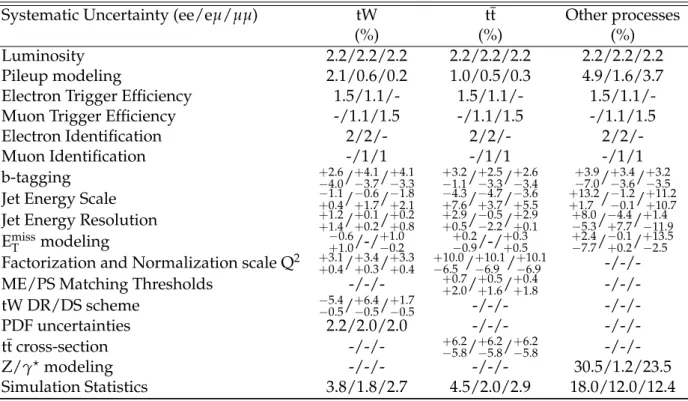
This document presents additional material to the publication. Figure 6 shows the distributions of the two variables of the BDT not presented before, and Tables 2 and 3 contain information related to the systematic uncertainties that affect the analysis.
The distributions of the pT of the jet with the highest energy and the difference in angular
separation, φ, between the direction associated to the EmissT and the closest of the two selected leptons, in data and simulation, are presented in the signal region (1j1t) in Fig. 6.
of the leading jet [GeV]
T p 0 50 100 150 200 250 300 Events / 10 GeV 0 50 100 150 200 250 300 Data tW t t *+jets γ Z/ Other Systematic -1 = 7 TeV, 4.9 fb s CMS,
, closest lepton) [rad.]
miss T (E φ ∆ 0 0.5 1 1.5 2 2.5 3 Events / 0.2 rad. 0 20 40 60 80 100 120 140 160 180 200 220 Data tW t t *+jets γ Z/ Other Systematic -1 = 7 TeV, 4.9 fb s CMS,
Figure 6: Distributions of the pT of the jet with the highest energy and the difference in φ
between the direction associated to the Emiss
T and the closest lepton in data and simulation after
jet selection in the signal region (1j1t).
Table 2 presents the impact of each individual source of systematic uncertainty on the rate of the different processes in the signal region for each final state. When two numbers are listed for a single uncertainty, the upper number is the effect on the rate when the systematic uncertainty source is scaled up and the lower is for when it is scaled down. Entries marked with a “-” either do not apply for that particular final state/process, or have a negligible effect. Other processes refers to Z/γ?and the rest of backgrounds, that have almost negligible contributions.
Table 3 presents the contribution to the uncertainty of the measured cross section of the differ-ent sources of uncertainty considered in the analysis. This is estimated by fixing each source one at a time and measuring the effect in the cross section uncertainty.
Table 2: Impact of each individual source of systematic uncertainty on the rate of the different processes in the signal region for each final state. Other processes refers to Z/γ?and the rest of backgrounds, that have almost negligible contributions.
Systematic Uncertainty (ee/eµ/µµ) tW tt Other processes
(%) (%) (%)
Luminosity 2.2/2.2/2.2 2.2/2.2/2.2 2.2/2.2/2.2
Pileup modeling 2.1/0.6/0.2 1.0/0.5/0.3 4.9/1.6/3.7 Electron Trigger Efficiency 1.5/1.1/- 1.5/1.1/- 1.5/1.1/-Muon Trigger Efficiency -/1.1/1.5 -/1.1/1.5 -/1.1/1.5
Electron Identification 2/2/- 2/2/-
2/2/-Muon Identification -/1/1 -/1/1 -/1/1
b-tagging −+2.64.0/+−4.13.7/−+4.13.3 +−3.21.1/−+2.53.3/+−2.63.4 +−3.97.0/+−3.43.6/+−3.23.5 Jet Energy Scale +−1.10.4/−+0.61.7/+−1.82.1 −+4.37.6/+−4.73.7/−+3.65.5 ++13.21.7 /−−1.20.1/++11.210.7 Jet Energy Resolution ++1.21.4/++0.10.2/++0.20.8 ++2.90.5/−−0.52.2/++2.90.1 +−8.05.3/−+4.47.7/+−1.411.9 EmissT modeling −+0.61.0/-/−+0.21.0 +−0.20.9/-/++0.30.5 +−2.47.7/−+0.10.2/+−13.52.5 Factorization and Normalization scale Q2 ++3.10.4/++3.40.3/++0.43.3 +−10.06.5 /+−10.16.9 /+−10.16.9 -/-/-ME/PS Matching Thresholds -/-/- ++0.72.0/++0.51.6/++0.41.8 -/-/-tW DR/DS scheme −−5.40.5/−+6.40.5/+−1.70.5 -/-/-
-/-/-PDF uncertainties 2.2/2.0/2.0 -/-/-
-/-/-tt cross-section -/-/- +−6.25.8/−+6.25.8/+−6.25.8
-/-/-Z/γ? modeling -/-/- -/-/- 30.5/1.2/23.5
Simulation Statistics 3.8/1.8/2.7 4.5/2.0/2.9 18.0/12.0/12.4
Table 3: Contribution to the uncertainty of the measured cross section of the different sources of uncertainty considered in the BDT analysis.
Systematic Uncertainty ∆σ (pb) ∆σσ
Luminosity 0.69 0.04
Pileup modeling 0.24 0.02 Electron trigger efficiency 0.35 0.02 Muon trigger efficiency 0.38 0.02 Electron identification 0.70 0.04 Muon identification 0.45 0.03
b-tagging 0.30 0.02
Jet Energy Scale 2.42 0.15 Jet Energy Resolution 0.58 0.04 Emiss
T modeling 0.40 0.05
tW Q2 0.34 0.02
tt Q2 0.29 0.02
ME/PS Matching Thresholds 1.62 0.10 tW DR/DS scheme 0.94 0.06 PDF uncertainties 0.34 0.02 tt cross section 0.96 0.06 Z/γ?modeling 0.67 0.04 Statistical 3.33 0.21 Total 4.95 0.31
11
A
The CMS Collaboration
Yerevan Physics Institute, Yerevan, Armenia
S. Chatrchyan, V. Khachatryan, A.M. Sirunyan, A. Tumasyan
Institut f ¨ur Hochenergiephysik der OeAW, Wien, Austria
W. Adam, E. Aguilo, T. Bergauer, M. Dragicevic, J. Er ¨o, C. Fabjan1, M. Friedl, R. Fr ¨uhwirth1, V.M. Ghete, J. Hammer, N. H ¨ormann, J. Hrubec, M. Jeitler1, W. Kiesenhofer, V. Kn ¨unz, M. Krammer1, I. Kr¨atschmer, D. Liko, I. Mikulec, M. Pernicka†, B. Rahbaran, C. Rohringer,
H. Rohringer, R. Sch ¨ofbeck, J. Strauss, A. Taurok, W. Waltenberger, G. Walzel, E. Widl, C.-E. Wulz1
National Centre for Particle and High Energy Physics, Minsk, Belarus
V. Mossolov, N. Shumeiko, J. Suarez Gonzalez
Universiteit Antwerpen, Antwerpen, Belgium
M. Bansal, S. Bansal, T. Cornelis, E.A. De Wolf, X. Janssen, S. Luyckx, L. Mucibello, S. Ochesanu, B. Roland, R. Rougny, M. Selvaggi, Z. Staykova, H. Van Haevermaet, P. Van Mechelen, N. Van Remortel, A. Van Spilbeeck
Vrije Universiteit Brussel, Brussel, Belgium
F. Blekman, S. Blyweert, J. D’Hondt, R. Gonzalez Suarez, A. Kalogeropoulos, M. Maes, A. Olbrechts, W. Van Doninck, P. Van Mulders, G.P. Van Onsem, I. Villella
Universit´e Libre de Bruxelles, Bruxelles, Belgium
B. Clerbaux, G. De Lentdecker, V. Dero, A.P.R. Gay, T. Hreus, A. L´eonard, P.E. Marage, A. Mohammadi, T. Reis, L. Thomas, G. Vander Marcken, C. Vander Velde, P. Vanlaer, J. Wang
Ghent University, Ghent, Belgium
V. Adler, K. Beernaert, A. Cimmino, S. Costantini, G. Garcia, M. Grunewald, B. Klein, J. Lellouch, A. Marinov, J. Mccartin, A.A. Ocampo Rios, D. Ryckbosch, N. Strobbe, F. Thyssen, M. Tytgat, P. Verwilligen, S. Walsh, E. Yazgan, N. Zaganidis
Universit´e Catholique de Louvain, Louvain-la-Neuve, Belgium
S. Basegmez, G. Bruno, R. Castello, L. Ceard, C. Delaere, T. du Pree, D. Favart, L. Forthomme, A. Giammanco2, J. Hollar, V. Lemaitre, J. Liao, O. Militaru, C. Nuttens, D. Pagano, A. Pin, K. Piotrzkowski, N. Schul, J.M. Vizan Garcia
Universit´e de Mons, Mons, Belgium
N. Beliy, T. Caebergs, E. Daubie, G.H. Hammad
Centro Brasileiro de Pesquisas Fisicas, Rio de Janeiro, Brazil
G.A. Alves, M. Correa Martins Junior, T. Martins, M.E. Pol, M.H.G. Souza
Universidade do Estado do Rio de Janeiro, Rio de Janeiro, Brazil
W.L. Ald´a J ´unior, W. Carvalho, A. Cust ´odio, E.M. Da Costa, D. De Jesus Damiao, C. De Oliveira Martins, S. Fonseca De Souza, D. Matos Figueiredo, L. Mundim, H. Nogima, V. Oguri, W.L. Prado Da Silva, A. Santoro, L. Soares Jorge, A. Sznajder
Instituto de Fisica Teorica, Universidade Estadual Paulista, Sao Paulo, Brazil
T.S. Anjos3, C.A. Bernardes3, F.A. Dias4, T.R. Fernandez Perez Tomei, E.M. Gregores3, C. Lagana, F. Marinho, P.G. Mercadante3, S.F. Novaes, Sandra S. Padula
Institute for Nuclear Research and Nuclear Energy, Sofia, Bulgaria
V. Genchev5, P. Iaydjiev5, S. Piperov, M. Rodozov, S. Stoykova, G. Sultanov, V. Tcholakov,
University of Sofia, Sofia, Bulgaria
A. Dimitrov, R. Hadjiiska, V. Kozhuharov, L. Litov, B. Pavlov, P. Petkov
Institute of High Energy Physics, Beijing, China
J.G. Bian, G.M. Chen, H.S. Chen, C.H. Jiang, D. Liang, S. Liang, X. Meng, J. Tao, J. Wang, X. Wang, Z. Wang, H. Xiao, M. Xu, J. Zang, Z. Zhang
State Key Lab. of Nucl. Phys. and Tech., Peking University, Beijing, China
C. Asawatangtrakuldee, Y. Ban, Y. Guo, W. Li, S. Liu, Y. Mao, S.J. Qian, H. Teng, D. Wang, L. Zhang, W. Zou
Universidad de Los Andes, Bogota, Colombia
C. Avila, J.P. Gomez, B. Gomez Moreno, A.F. Osorio Oliveros, J.C. Sanabria
Technical University of Split, Split, Croatia
N. Godinovic, D. Lelas, R. Plestina6, D. Polic, I. Puljak5
University of Split, Split, Croatia
Z. Antunovic, M. Kovac
Institute Rudjer Boskovic, Zagreb, Croatia
V. Brigljevic, S. Duric, K. Kadija, J. Luetic, S. Morovic
University of Cyprus, Nicosia, Cyprus
A. Attikis, M. Galanti, G. Mavromanolakis, J. Mousa, C. Nicolaou, F. Ptochos, P.A. Razis
Charles University, Prague, Czech Republic
M. Finger, M. Finger Jr.
Academy of Scientific Research and Technology of the Arab Republic of Egypt, Egyptian Network of High Energy Physics, Cairo, Egypt
Y. Assran7, S. Elgammal8, A. Ellithi Kamel9, S. Khalil8, M.A. Mahmoud10, A. Radi11,12
National Institute of Chemical Physics and Biophysics, Tallinn, Estonia
M. Kadastik, M. M ¨untel, M. Raidal, L. Rebane, A. Tiko
Department of Physics, University of Helsinki, Helsinki, Finland
P. Eerola, G. Fedi, M. Voutilainen
Helsinki Institute of Physics, Helsinki, Finland
J. H¨ark ¨onen, A. Heikkinen, V. Karim¨aki, R. Kinnunen, M.J. Kortelainen, T. Lamp´en, K. Lassila-Perini, S. Lehti, T. Lind´en, P. Luukka, T. M¨aenp¨a¨a, T. Peltola, E. Tuominen, J. Tuominiemi, E. Tuovinen, D. Ungaro, L. Wendland
Lappeenranta University of Technology, Lappeenranta, Finland
K. Banzuzi, A. Karjalainen, A. Korpela, T. Tuuva
DSM/IRFU, CEA/Saclay, Gif-sur-Yvette, France
M. Besancon, S. Choudhury, M. Dejardin, D. Denegri, B. Fabbro, J.L. Faure, F. Ferri, S. Ganjour, A. Givernaud, P. Gras, G. Hamel de Monchenault, P. Jarry, E. Locci, J. Malcles, L. Millischer, A. Nayak, J. Rander, A. Rosowsky, I. Shreyber, M. Titov
Laboratoire Leprince-Ringuet, Ecole Polytechnique, IN2P3-CNRS, Palaiseau, France
S. Baffioni, F. Beaudette, L. Benhabib, L. Bianchini, M. Bluj13, C. Broutin, P. Busson, C. Charlot, N. Daci, T. Dahms, M. Dalchenko, L. Dobrzynski, R. Granier de Cassagnac, M. Haguenauer, P. Min´e, C. Mironov, I.N. Naranjo, M. Nguyen, C. Ochando, P. Paganini, D. Sabes, R. Salerno, Y. Sirois, C. Veelken, A. Zabi
13
Institut Pluridisciplinaire Hubert Curien, Universit´e de Strasbourg, Universit´e de Haute Alsace Mulhouse, CNRS/IN2P3, Strasbourg, France
J.-L. Agram14, J. Andrea, D. Bloch, D. Bodin, J.-M. Brom, M. Cardaci, E.C. Chabert, C. Collard, E. Conte14, F. Drouhin14, C. Ferro, J.-C. Fontaine14, D. Gel´e, U. Goerlach, P. Juillot, A.-C. Le
Bihan, P. Van Hove
Centre de Calcul de l’Institut National de Physique Nucleaire et de Physique des Particules, CNRS/IN2P3, Villeurbanne, France, Villeurbanne, France
F. Fassi, D. Mercier
Universit´e de Lyon, Universit´e Claude Bernard Lyon 1, CNRS-IN2P3, Institut de Physique Nucl´eaire de Lyon, Villeurbanne, France
S. Beauceron, N. Beaupere, O. Bondu, G. Boudoul, J. Chasserat, R. Chierici5, D. Contardo, P. Depasse, H. El Mamouni, J. Fay, S. Gascon, M. Gouzevitch, B. Ille, T. Kurca, M. Lethuillier, L. Mirabito, S. Perries, L. Sgandurra, V. Sordini, Y. Tschudi, P. Verdier, S. Viret
E. Andronikashvili Institute of Physics, Academy of Science, Tbilisi, Georgia
V. Roinishvili
RWTH Aachen University, I. Physikalisches Institut, Aachen, Germany
G. Anagnostou, C. Autermann, S. Beranek, M. Edelhoff, L. Feld, N. Heracleous, O. Hindrichs, R. Jussen, K. Klein, J. Merz, A. Ostapchuk, A. Perieanu, F. Raupach, J. Sammet, S. Schael, D. Sprenger, H. Weber, B. Wittmer, V. Zhukov15
RWTH Aachen University, III. Physikalisches Institut A, Aachen, Germany
M. Ata, J. Caudron, E. Dietz-Laursonn, D. Duchardt, M. Erdmann, R. Fischer, A. G ¨uth, T. Hebbeker, C. Heidemann, K. Hoepfner, D. Klingebiel, P. Kreuzer, M. Merschmeyer, A. Meyer, M. Olschewski, P. Papacz, H. Pieta, H. Reithler, S.A. Schmitz, L. Sonnenschein, J. Steggemann, D. Teyssier, M. Weber
RWTH Aachen University, III. Physikalisches Institut B, Aachen, Germany
M. Bontenackels, V. Cherepanov, Y. Erdogan, G. Fl ¨ugge, H. Geenen, M. Geisler, W. Haj Ahmad, F. Hoehle, B. Kargoll, T. Kress, Y. Kuessel, J. Lingemann5, A. Nowack, L. Perchalla, O. Pooth, P. Sauerland, A. Stahl
Deutsches Elektronen-Synchrotron, Hamburg, Germany
M. Aldaya Martin, J. Behr, W. Behrenhoff, U. Behrens, M. Bergholz16, A. Bethani, K. Borras, A. Burgmeier, A. Cakir, L. Calligaris, A. Campbell, E. Castro, F. Costanza, D. Dammann, C. Diez Pardos, G. Eckerlin, D. Eckstein, G. Flucke, A. Geiser, I. Glushkov, P. Gunnellini, S. Habib, J. Hauk, G. Hellwig, H. Jung, M. Kasemann, P. Katsas, C. Kleinwort, H. Kluge, A. Knutsson, M. Kr¨amer, D. Kr ¨ucker, E. Kuznetsova, W. Lange, W. Lohmann16, B. Lutz, R. Mankel, I. Marfin, M. Marienfeld, I.-A. Melzer-Pellmann, A.B. Meyer, J. Mnich, A. Mussgiller, S. Naumann-Emme, O. Novgorodova, J. Olzem, H. Perrey, A. Petrukhin, D. Pitzl, A. Raspereza, P.M. Ribeiro Cipriano, C. Riedl, E. Ron, M. Rosin, J. Salfeld-Nebgen, R. Schmidt16, T. Schoerner-Sadenius, N. Sen, A. Spiridonov, M. Stein, R. Walsh, C. Wissing
University of Hamburg, Hamburg, Germany
V. Blobel, J. Draeger, H. Enderle, J. Erfle, U. Gebbert, M. G ¨orner, T. Hermanns, R.S. H ¨oing, K. Kaschube, G. Kaussen, H. Kirschenmann, R. Klanner, J. Lange, B. Mura, F. Nowak, T. Peiffer, N. Pietsch, D. Rathjens, C. Sander, H. Schettler, P. Schleper, E. Schlieckau, A. Schmidt, M. Schr ¨oder, T. Schum, M. Seidel, J. Sibille17, V. Sola, H. Stadie, G. Steinbr ¨uck, J. Thomsen,
Institut f ¨ur Experimentelle Kernphysik, Karlsruhe, Germany
C. Barth, J. Berger, C. B ¨oser, T. Chwalek, W. De Boer, A. Descroix, A. Dierlamm, M. Feindt, M. Guthoff5, C. Hackstein, F. Hartmann, T. Hauth5, M. Heinrich, H. Held, K.H. Hoffmann, U. Husemann, I. Katkov15, J.R. Komaragiri, P. Lobelle Pardo, D. Martschei, S. Mueller,
Th. M ¨uller, M. Niegel, A. N ¨urnberg, O. Oberst, A. Oehler, J. Ott, G. Quast, K. Rabbertz, F. Ratnikov, N. Ratnikova, S. R ¨ocker, F.-P. Schilling, G. Schott, H.J. Simonis, F.M. Stober, D. Troendle, R. Ulrich, J. Wagner-Kuhr, S. Wayand, T. Weiler, M. Zeise
Institute of Nuclear Physics ”Demokritos”, Aghia Paraskevi, Greece
G. Daskalakis, T. Geralis, S. Kesisoglou, A. Kyriakis, D. Loukas, I. Manolakos, A. Markou, C. Markou, C. Mavrommatis, E. Ntomari
University of Athens, Athens, Greece
L. Gouskos, T.J. Mertzimekis, A. Panagiotou, N. Saoulidou
University of Io´annina, Io´annina, Greece
I. Evangelou, C. Foudas, P. Kokkas, N. Manthos, I. Papadopoulos, V. Patras
KFKI Research Institute for Particle and Nuclear Physics, Budapest, Hungary
G. Bencze, C. Hajdu, P. Hidas, D. Horvath18, F. Sikler, V. Veszpremi, G. Vesztergombi19
Institute of Nuclear Research ATOMKI, Debrecen, Hungary
N. Beni, S. Czellar, J. Molnar, J. Palinkas, Z. Szillasi
University of Debrecen, Debrecen, Hungary
J. Karancsi, P. Raics, Z.L. Trocsanyi, B. Ujvari
Panjab University, Chandigarh, India
S.B. Beri, V. Bhatnagar, N. Dhingra, R. Gupta, M. Kaur, M.Z. Mehta, N. Nishu, L.K. Saini, A. Sharma, J.B. Singh
University of Delhi, Delhi, India
Ashok Kumar, Arun Kumar, S. Ahuja, A. Bhardwaj, B.C. Choudhary, S. Malhotra, M. Naimuddin, K. Ranjan, V. Sharma, R.K. Shivpuri
Saha Institute of Nuclear Physics, Kolkata, India
S. Banerjee, S. Bhattacharya, S. Dutta, B. Gomber, Sa. Jain, Sh. Jain, R. Khurana, S. Sarkar, M. Sharan
Bhabha Atomic Research Centre, Mumbai, India
A. Abdulsalam, R.K. Choudhury, D. Dutta, S. Kailas, V. Kumar, P. Mehta, A.K. Mohanty5, L.M. Pant, P. Shukla
Tata Institute of Fundamental Research - EHEP, Mumbai, India
T. Aziz, S. Ganguly, M. Guchait20, M. Maity21, G. Majumder, K. Mazumdar, G.B. Mohanty, B. Parida, K. Sudhakar, N. Wickramage
Tata Institute of Fundamental Research - HECR, Mumbai, India
S. Banerjee, S. Dugad
Institute for Research in Fundamental Sciences (IPM), Tehran, Iran
H. Arfaei22, H. Bakhshiansohi, S.M. Etesami23, A. Fahim22, M. Hashemi, H. Hesari, A. Jafari, M. Khakzad, M. Mohammadi Najafabadi, S. Paktinat Mehdiabadi, B. Safarzadeh24, M. Zeinali
INFN Sezione di Baria, Universit`a di Barib, Politecnico di Baric, Bari, Italy
15
Filippisa,c,5, M. De Palmaa,b, L. Fiorea, G. Iasellia,c, G. Maggia,c, M. Maggia, B. Marangellia,b, S. Mya,c, S. Nuzzoa,b, N. Pacificoa,b, A. Pompilia,b, G. Pugliesea,c, G. Selvaggia,b, L. Silvestrisa, G. Singha,b, R. Vendittia,b, G. Zitoa
INFN Sezione di Bolognaa, Universit`a di Bolognab, Bologna, Italy
G. Abbiendia, A.C. Benvenutia, D. Bonacorsia,b, S. Braibant-Giacomellia,b, L. Brigliadoria,b, P. Capiluppia,b, A. Castroa,b, F.R. Cavalloa, M. Cuffiania,b, G.M. Dallavallea, F. Fabbria, A. Fanfania,b, D. Fasanellaa,b,5, P. Giacomellia, C. Grandia, L. Guiduccia,b, S. Marcellinia, G. Masettia, M. Meneghellia,b,5, A. Montanaria, F.L. Navarriaa,b, F. Odoricia, A. Perrottaa, F. Primaveraa,b, A.M. Rossia,b, T. Rovellia,b, G.P. Sirolia,b, R. Travaglinia,b
INFN Sezione di Cataniaa, Universit`a di Cataniab, Catania, Italy
S. Albergoa,b, G. Cappelloa,b, M. Chiorbolia,b, S. Costaa,b, R. Potenzaa,b, A. Tricomia,b, C. Tuvea,b
INFN Sezione di Firenzea, Universit`a di Firenzeb, Firenze, Italy
G. Barbaglia, V. Ciullia,b, C. Civininia, R. D’Alessandroa,b, E. Focardia,b, S. Frosalia,b, E. Galloa, S. Gonzia,b, M. Meschinia, S. Paolettia, G. Sguazzonia, A. Tropianoa,b
INFN Laboratori Nazionali di Frascati, Frascati, Italy
L. Benussi, S. Bianco, S. Colafranceschi25, F. Fabbri, D. Piccolo
INFN Sezione di Genovaa, Universit`a di Genovab, Genova, Italy
P. Fabbricatorea, R. Musenicha, S. Tosia,b
INFN Sezione di Milano-Bicoccaa, Universit`a di Milano-Bicoccab, Milano, Italy
A. Benagliaa,b, F. De Guioa,b, L. Di Matteoa,b,5, S. Fiorendia,b, S. Gennaia,5, A. Ghezzia,b, S. Malvezzia, R.A. Manzonia,b, A. Martellia,b, A. Massironia,b,5, D. Menascea, L. Moronia,
M. Paganonia,b, D. Pedrinia, S. Ragazzia,b, N. Redaellia, S. Salaa, T. Tabarelli de Fatisa,b
INFN Sezione di Napolia, Universit`a di Napoli ”Federico II”b, Napoli, Italy
S. Buontempoa, C.A. Carrillo Montoyaa, N. Cavalloa,26, A. De Cosaa,b,5, O. Doganguna,b, F. Fabozzia,26, A.O.M. Iorioa,b, L. Listaa, S. Meolaa,27, M. Merolaa, P. Paoluccia,5
INFN Sezione di Padovaa, Universit`a di Padovab, Universit`a di Trento (Trento)c, Padova, Italy
P. Azzia, N. Bacchettaa,5, D. Biselloa,b, A. Brancaa,5, R. Carlina,b, P. Checchiaa, T. Dorigoa, F. Gasparinia,b, U. Gasparinia,b, A. Gozzelinoa, K. Kanishcheva,c, S. Lacapraraa, I. Lazzizzeraa,c, M. Margonia,b, A.T. Meneguzzoa,b, J. Pazzinia,b, N. Pozzobona,b, P. Ronchesea,b, F. Simonettoa,b, E. Torassaa, M. Tosia,b, S. Vaninia,b, P. Zottoa,b, A. Zucchettaa,b, G. Zumerlea,b
INFN Sezione di Paviaa, Universit`a di Paviab, Pavia, Italy
M. Gabusia,b, S.P. Rattia,b, C. Riccardia,b, P. Torrea,b, P. Vituloa,b
INFN Sezione di Perugiaa, Universit`a di Perugiab, Perugia, Italy
M. Biasinia,b, G.M. Bileia, L. Fan `oa,b, P. Laricciaa,b, G. Mantovania,b, M. Menichellia, A. Nappia,b†, F. Romeoa,b, A. Sahaa, A. Santocchiaa,b, A. Spieziaa,b, S. Taronia,b
INFN Sezione di Pisaa, Universit`a di Pisab, Scuola Normale Superiore di Pisac, Pisa, Italy
P. Azzurria,c, G. Bagliesia, T. Boccalia, G. Broccoloa,c, R. Castaldia, R.T. D’Agnoloa,c,5, R. Dell’Orsoa, F. Fioria,b,5, L. Fo`aa,c, A. Giassia, A. Kraana, F. Ligabuea,c, T. Lomtadzea,
L. Martinia,28, A. Messineoa,b, F. Pallaa, A. Rizzia,b, A.T. Serbana,29, P. Spagnoloa, P. Squillaciotia,5, R. Tenchinia, G. Tonellia,b, A. Venturia, P.G. Verdinia
INFN Sezione di Romaa, Universit`a di Roma ”La Sapienza”b, Roma, Italy
P. Meridiania,5, F. Michelia,b, S. Nourbakhsha,b, G. Organtinia,b, R. Paramattia, S. Rahatloua,b, M. Sigamania, L. Soffia,b
INFN Sezione di Torino a, Universit`a di Torino b, Universit`a del Piemonte Orientale (No-vara)c, Torino, Italy
N. Amapanea,b, R. Arcidiaconoa,c, S. Argiroa,b, M. Arneodoa,c, C. Biinoa, N. Cartigliaa, M. Costaa,b, N. Demariaa, C. Mariottia,5, S. Masellia, E. Migliorea,b, V. Monacoa,b, M. Musicha,5, M.M. Obertinoa,c, N. Pastronea, M. Pelliccionia, A. Potenzaa,b, A. Romeroa,b, M. Ruspaa,c, R. Sacchia,b, A. Solanoa,b, A. Staianoa, A. Vilela Pereiraa
INFN Sezione di Triestea, Universit`a di Triesteb, Trieste, Italy
S. Belfortea, V. Candelisea,b, M. Casarsaa, F. Cossuttia, G. Della Riccaa,b, B. Gobboa,
M. Maronea,b,5, D. Montaninoa,b,5, A. Penzoa, A. Schizzia,b
Kangwon National University, Chunchon, Korea
S.G. Heo, T.Y. Kim, S.K. Nam
Kyungpook National University, Daegu, Korea
S. Chang, D.H. Kim, G.N. Kim, D.J. Kong, H. Park, S.R. Ro, D.C. Son, T. Son
Chonnam National University, Institute for Universe and Elementary Particles, Kwangju, Korea
J.Y. Kim, Zero J. Kim, S. Song
Korea University, Seoul, Korea
S. Choi, D. Gyun, B. Hong, M. Jo, H. Kim, T.J. Kim, K.S. Lee, D.H. Moon, S.K. Park
University of Seoul, Seoul, Korea
M. Choi, J.H. Kim, C. Park, I.C. Park, S. Park, G. Ryu
Sungkyunkwan University, Suwon, Korea
Y. Cho, Y. Choi, Y.K. Choi, J. Goh, M.S. Kim, E. Kwon, B. Lee, J. Lee, S. Lee, H. Seo, I. Yu
Vilnius University, Vilnius, Lithuania
M.J. Bilinskas, I. Grigelionis, M. Janulis, A. Juodagalvis
Centro de Investigacion y de Estudios Avanzados del IPN, Mexico City, Mexico
H. Castilla-Valdez, E. De La Cruz-Burelo, I. Heredia-de La Cruz, R. Lopez-Fernandez, R. Maga ˜na Villalba, J. Mart´ınez-Ortega, A. S´anchez-Hern´andez, L.M. Villasenor-Cendejas
Universidad Iberoamericana, Mexico City, Mexico
S. Carrillo Moreno, F. Vazquez Valencia
Benemerita Universidad Autonoma de Puebla, Puebla, Mexico
H.A. Salazar Ibarguen
Universidad Aut ´onoma de San Luis Potos´ı, San Luis Potos´ı, Mexico
E. Casimiro Linares, A. Morelos Pineda, M.A. Reyes-Santos
University of Auckland, Auckland, New Zealand
D. Krofcheck
University of Canterbury, Christchurch, New Zealand
17
National Centre for Physics, Quaid-I-Azam University, Islamabad, Pakistan
M. Ahmad, M.H. Ansari, M.I. Asghar, J. Butt, H.R. Hoorani, S. Khalid, W.A. Khan, T. Khurshid, S. Qazi, M.A. Shah, M. Shoaib
National Centre for Nuclear Research, Swierk, Poland
H. Bialkowska, B. Boimska, T. Frueboes, R. Gokieli, M. G ´orski, M. Kazana, K. Nawrocki, K. Romanowska-Rybinska, M. Szleper, G. Wrochna, P. Zalewski
Institute of Experimental Physics, Faculty of Physics, University of Warsaw, Warsaw, Poland
G. Brona, K. Bunkowski, M. Cwiok, W. Dominik, K. Doroba, A. Kalinowski, M. Konecki, J. Krolikowski
Laborat ´orio de Instrumenta¸c˜ao e F´ısica Experimental de Part´ıculas, Lisboa, Portugal
N. Almeida, P. Bargassa, A. David, P. Faccioli, P.G. Ferreira Parracho, M. Gallinaro, J. Seixas, J. Varela, P. Vischia
Joint Institute for Nuclear Research, Dubna, Russia
I. Belotelov, P. Bunin, M. Gavrilenko, I. Golutvin, I. Gorbunov, A. Kamenev, V. Karjavin, G. Kozlov, A. Lanev, A. Malakhov, P. Moisenz, V. Palichik, V. Perelygin, S. Shmatov, V. Smirnov, A. Volodko, A. Zarubin
Petersburg Nuclear Physics Institute, Gatchina (St. Petersburg), Russia
S. Evstyukhin, V. Golovtsov, Y. Ivanov, V. Kim, P. Levchenko, V. Murzin, V. Oreshkin, I. Smirnov, V. Sulimov, L. Uvarov, S. Vavilov, A. Vorobyev, An. Vorobyev
Institute for Nuclear Research, Moscow, Russia
Yu. Andreev, A. Dermenev, S. Gninenko, N. Golubev, M. Kirsanov, N. Krasnikov, V. Matveev, A. Pashenkov, D. Tlisov, A. Toropin
Institute for Theoretical and Experimental Physics, Moscow, Russia
V. Epshteyn, M. Erofeeva, V. Gavrilov, M. Kossov, N. Lychkovskaya, V. Popov, G. Safronov, S. Semenov, V. Stolin, E. Vlasov, A. Zhokin
Moscow State University, Moscow, Russia
A. Belyaev, E. Boos, V. Bunichev, M. Dubinin4, L. Dudko, A. Gribushin, V. Klyukhin,
O. Kodolova, I. Lokhtin, A. Markina, S. Obraztsov, M. Perfilov, S. Petrushanko, A. Popov, L. Sarycheva†, V. Savrin, A. Snigirev
P.N. Lebedev Physical Institute, Moscow, Russia
V. Andreev, M. Azarkin, I. Dremin, M. Kirakosyan, A. Leonidov, G. Mesyats, S.V. Rusakov, A. Vinogradov
State Research Center of Russian Federation, Institute for High Energy Physics, Protvino, Russia
I. Azhgirey, I. Bayshev, S. Bitioukov, V. Grishin5, V. Kachanov, D. Konstantinov, V. Krychkine, V. Petrov, R. Ryutin, A. Sobol, L. Tourtchanovitch, S. Troshin, N. Tyurin, A. Uzunian, A. Volkov
University of Belgrade, Faculty of Physics and Vinca Institute of Nuclear Sciences, Belgrade, Serbia
P. Adzic30, M. Djordjevic, M. Ekmedzic, D. Krpic30, J. Milosevic
Centro de Investigaciones Energ´eticas Medioambientales y Tecnol ´ogicas (CIEMAT), Madrid, Spain
M. Aguilar-Benitez, J. Alcaraz Maestre, P. Arce, C. Battilana, E. Calvo, M. Cerrada, M. Chamizo Llatas, N. Colino, B. De La Cruz, A. Delgado Peris, D. Dom´ınguez V´azquez, C. Fernandez
Bedoya, J.P. Fern´andez Ramos, A. Ferrando, J. Flix, M.C. Fouz, P. Garcia-Abia, O. Gonzalez Lopez, S. Goy Lopez, J.M. Hernandez, M.I. Josa, G. Merino, J. Puerta Pelayo, A. Quintario Olmeda, I. Redondo, L. Romero, J. Santaolalla, M.S. Soares, C. Willmott
Universidad Aut ´onoma de Madrid, Madrid, Spain
C. Albajar, G. Codispoti, J.F. de Troc ´oniz
Universidad de Oviedo, Oviedo, Spain
H. Brun, J. Cuevas, J. Fernandez Menendez, S. Folgueras, I. Gonzalez Caballero, L. Lloret Iglesias, J. Piedra Gomez
Instituto de F´ısica de Cantabria (IFCA), CSIC-Universidad de Cantabria, Santander, Spain
J.A. Brochero Cifuentes, I.J. Cabrillo, A. Calderon, S.H. Chuang, J. Duarte Campderros, M. Felcini31, M. Fernandez, G. Gomez, J. Gonzalez Sanchez, A. Graziano, C. Jorda, A. Lopez Virto, J. Marco, R. Marco, C. Martinez Rivero, F. Matorras, F.J. Munoz Sanchez, T. Rodrigo, A.Y. Rodr´ıguez-Marrero, A. Ruiz-Jimeno, L. Scodellaro, I. Vila, R. Vilar Cortabitarte
CERN, European Organization for Nuclear Research, Geneva, Switzerland
D. Abbaneo, E. Auffray, G. Auzinger, M. Bachtis, P. Baillon, A.H. Ball, D. Barney, J.F. Benitez, C. Bernet6, G. Bianchi, P. Bloch, A. Bocci, A. Bonato, C. Botta, H. Breuker, T. Camporesi,
G. Cerminara, T. Christiansen, J.A. Coarasa Perez, D. D’Enterria, A. Dabrowski, A. De Roeck, S. Di Guida, M. Dobson, N. Dupont-Sagorin, A. Elliott-Peisert, B. Frisch, W. Funk, G. Georgiou, M. Giffels, D. Gigi, K. Gill, D. Giordano, M. Girone, M. Giunta, F. Glege, R. Gomez-Reino Garrido, P. Govoni, S. Gowdy, R. Guida, M. Hansen, P. Harris, C. Hartl, J. Harvey, B. Hegner, A. Hinzmann, V. Innocente, P. Janot, K. Kaadze, E. Karavakis, K. Kousouris, P. Lecoq, Y.-J. Lee, P. Lenzi, C. Lourenc¸o, N. Magini, T. M¨aki, M. Malberti, L. Malgeri, M. Mannelli, L. Masetti, F. Meijers, S. Mersi, E. Meschi, R. Moser, M.U. Mozer, M. Mulders, P. Musella, E. Nesvold, T. Orimoto, L. Orsini, E. Palencia Cortezon, E. Perez, L. Perrozzi, A. Petrilli, A. Pfeiffer, M. Pierini, M. Pimi¨a, D. Piparo, G. Polese, L. Quertenmont, A. Racz, W. Reece, J. Rodrigues Antunes, G. Rolandi32, C. Rovelli33, M. Rovere, H. Sakulin, F. Santanastasio, C. Sch¨afer, C. Schwick, I. Segoni, S. Sekmen, A. Sharma, P. Siegrist, P. Silva, M. Simon, P. Sphicas34, D. Spiga, A. Tsirou, G.I. Veres19, J.R. Vlimant, H.K. W ¨ohri, S.D. Worm35, W.D. Zeuner
Paul Scherrer Institut, Villigen, Switzerland
W. Bertl, K. Deiters, W. Erdmann, K. Gabathuler, R. Horisberger, Q. Ingram, H.C. Kaestli, S. K ¨onig, D. Kotlinski, U. Langenegger, F. Meier, D. Renker, T. Rohe
Institute for Particle Physics, ETH Zurich, Zurich, Switzerland
L. B¨ani, P. Bortignon, M.A. Buchmann, B. Casal, N. Chanon, A. Deisher, G. Dissertori, M. Dittmar, M. Doneg`a, M. D ¨unser, J. Eugster, K. Freudenreich, C. Grab, D. Hits, P. Lecomte, W. Lustermann, A.C. Marini, P. Martinez Ruiz del Arbol, N. Mohr, F. Moortgat, C. N¨ageli36, P. Nef, F. Nessi-Tedaldi, F. Pandolfi, L. Pape, F. Pauss, M. Peruzzi, F.J. Ronga, M. Rossini, L. Sala, A.K. Sanchez, A. Starodumov37, B. Stieger, M. Takahashi, L. Tauscher†, A. Thea, K. Theofilatos,
D. Treille, C. Urscheler, R. Wallny, H.A. Weber, L. Wehrli
Universit¨at Z ¨urich, Zurich, Switzerland
C. Amsler38, V. Chiochia, S. De Visscher, C. Favaro, M. Ivova Rikova, B. Millan Mejias, P. Otiougova, P. Robmann, H. Snoek, S. Tupputi, M. Verzetti
National Central University, Chung-Li, Taiwan
Y.H. Chang, K.H. Chen, C.M. Kuo, S.W. Li, W. Lin, Z.K. Liu, Y.J. Lu, D. Mekterovic, A.P. Singh, R. Volpe, S.S. Yu
19
National Taiwan University (NTU), Taipei, Taiwan
P. Bartalini, P. Chang, Y.H. Chang, Y.W. Chang, Y. Chao, K.F. Chen, C. Dietz, U. Grundler, W.-S. Hou, Y. Hsiung, K.Y. Kao, Y.J. Lei, R.-W.-S. Lu, D. Majumder, E. Petrakou, X. Shi, J.G. Shiu, Y.M. Tzeng, X. Wan, M. Wang
Chulalongkorn University, Bangkok, Thailand
B. Asavapibhop, N. Srimanobhas
Cukurova University, Adana, Turkey
A. Adiguzel, M.N. Bakirci39, S. Cerci40, C. Dozen, I. Dumanoglu, E. Eskut, S. Girgis, G. Gokbulut, E. Gurpinar, I. Hos, E.E. Kangal, T. Karaman, G. Karapinar41, A. Kayis Topaksu,
G. Onengut, K. Ozdemir, S. Ozturk42, A. Polatoz, K. Sogut43, D. Sunar Cerci40, B. Tali40,
H. Topakli39, L.N. Vergili, M. Vergili
Middle East Technical University, Physics Department, Ankara, Turkey
I.V. Akin, T. Aliev, B. Bilin, S. Bilmis, M. Deniz, H. Gamsizkan, A.M. Guler, K. Ocalan, A. Ozpineci, M. Serin, R. Sever, U.E. Surat, M. Yalvac, E. Yildirim, M. Zeyrek
Bogazici University, Istanbul, Turkey
E. G ¨ulmez, B. Isildak44, M. Kaya45, O. Kaya45, S. Ozkorucuklu46, N. Sonmez47
Istanbul Technical University, Istanbul, Turkey
K. Cankocak
National Scientific Center, Kharkov Institute of Physics and Technology, Kharkov, Ukraine
L. Levchuk
University of Bristol, Bristol, United Kingdom
J.J. Brooke, E. Clement, D. Cussans, H. Flacher, R. Frazier, J. Goldstein, M. Grimes, G.P. Heath, H.F. Heath, L. Kreczko, S. Metson, D.M. Newbold35, K. Nirunpong, A. Poll, S. Senkin, V.J. Smith, T. Williams
Rutherford Appleton Laboratory, Didcot, United Kingdom
L. Basso48, K.W. Bell, A. Belyaev48, C. Brew, R.M. Brown, D.J.A. Cockerill, J.A. Coughlan,
K. Harder, S. Harper, J. Jackson, B.W. Kennedy, E. Olaiya, D. Petyt, B.C. Radburn-Smith, C.H. Shepherd-Themistocleous, I.R. Tomalin, W.J. Womersley
Imperial College, London, United Kingdom
R. Bainbridge, G. Ball, R. Beuselinck, O. Buchmuller, D. Colling, N. Cripps, M. Cutajar, P. Dauncey, G. Davies, M. Della Negra, W. Ferguson, J. Fulcher, D. Futyan, A. Gilbert, A. Guneratne Bryer, G. Hall, Z. Hatherell, J. Hays, G. Iles, M. Jarvis, G. Karapostoli, L. Lyons, A.-M. Magnan, J. Marrouche, B. Mathias, R. Nandi, J. Nash, A. Nikitenko37, A. Papageorgiou,
J. Pela, M. Pesaresi, K. Petridis, M. Pioppi49, D.M. Raymond, S. Rogerson, A. Rose, M.J. Ryan,
C. Seez, P. Sharp†, A. Sparrow, M. Stoye, A. Tapper, M. Vazquez Acosta, T. Virdee, S. Wakefield, N. Wardle, T. Whyntie
Brunel University, Uxbridge, United Kingdom
M. Chadwick, J.E. Cole, P.R. Hobson, A. Khan, P. Kyberd, D. Leggat, D. Leslie, W. Martin, I.D. Reid, P. Symonds, L. Teodorescu, M. Turner
Baylor University, Waco, USA
K. Hatakeyama, H. Liu, T. Scarborough
The University of Alabama, Tuscaloosa, USA
Boston University, Boston, USA
A. Avetisyan, T. Bose, C. Fantasia, A. Heister, J. St. John, P. Lawson, D. Lazic, J. Rohlf, D. Sperka, L. Sulak
Brown University, Providence, USA
J. Alimena, S. Bhattacharya, D. Cutts, Z. Demiragli, A. Ferapontov, A. Garabedian, U. Heintz, S. Jabeen, G. Kukartsev, E. Laird, G. Landsberg, M. Luk, M. Narain, D. Nguyen, M. Segala, T. Sinthuprasith, T. Speer, K.V. Tsang
University of California, Davis, Davis, USA
R. Breedon, G. Breto, M. Calderon De La Barca Sanchez, S. Chauhan, M. Chertok, J. Conway, R. Conway, P.T. Cox, J. Dolen, R. Erbacher, M. Gardner, R. Houtz, W. Ko, A. Kopecky, R. Lander, O. Mall, T. Miceli, D. Pellett, F. Ricci-tam, B. Rutherford, M. Searle, J. Smith, M. Squires, M. Tripathi, R. Vasquez Sierra, R. Yohay
University of California, Los Angeles, Los Angeles, USA
V. Andreev, D. Cline, R. Cousins, J. Duris, S. Erhan, P. Everaerts, C. Farrell, J. Hauser, M. Ignatenko, C. Jarvis, C. Plager, G. Rakness, P. Schlein†, P. Traczyk, V. Valuev, M. Weber
University of California, Riverside, Riverside, USA
J. Babb, R. Clare, M.E. Dinardo, J. Ellison, J.W. Gary, F. Giordano, G. Hanson, G.Y. Jeng50, H. Liu, O.R. Long, A. Luthra, H. Nguyen, S. Paramesvaran, J. Sturdy, S. Sumowidagdo, R. Wilken, S. Wimpenny
University of California, San Diego, La Jolla, USA
W. Andrews, J.G. Branson, G.B. Cerati, S. Cittolin, D. Evans, F. Golf, A. Holzner, R. Kelley, M. Lebourgeois, J. Letts, I. Macneill, B. Mangano, S. Padhi, C. Palmer, G. Petrucciani, M. Pieri, M. Sani, V. Sharma, S. Simon, E. Sudano, M. Tadel, Y. Tu, A. Vartak, S. Wasserbaech51,
F. W ¨urthwein, A. Yagil, J. Yoo
University of California, Santa Barbara, Santa Barbara, USA
D. Barge, R. Bellan, C. Campagnari, M. D’Alfonso, T. Danielson, K. Flowers, P. Geffert, J. Incandela, C. Justus, P. Kalavase, S.A. Koay, D. Kovalskyi, V. Krutelyov, S. Lowette, N. Mccoll, V. Pavlunin, F. Rebassoo, J. Ribnik, J. Richman, R. Rossin, D. Stuart, W. To, C. West
California Institute of Technology, Pasadena, USA
A. Apresyan, A. Bornheim, Y. Chen, E. Di Marco, J. Duarte, M. Gataullin, Y. Ma, A. Mott, H.B. Newman, C. Rogan, M. Spiropulu, V. Timciuc, J. Veverka, R. Wilkinson, S. Xie, Y. Yang, R.Y. Zhu
Carnegie Mellon University, Pittsburgh, USA
B. Akgun, V. Azzolini, A. Calamba, R. Carroll, T. Ferguson, Y. Iiyama, D.W. Jang, Y.F. Liu, M. Paulini, H. Vogel, I. Vorobiev
University of Colorado at Boulder, Boulder, USA
J.P. Cumalat, B.R. Drell, W.T. Ford, A. Gaz, E. Luiggi Lopez, J.G. Smith, K. Stenson, K.A. Ulmer, S.R. Wagner
Cornell University, Ithaca, USA
J. Alexander, A. Chatterjee, N. Eggert, L.K. Gibbons, B. Heltsley, A. Khukhunaishvili, B. Kreis, N. Mirman, G. Nicolas Kaufman, J.R. Patterson, A. Ryd, E. Salvati, W. Sun, W.D. Teo, J. Thom, J. Thompson, J. Tucker, J. Vaughan, Y. Weng, L. Winstrom, P. Wittich
Fairfield University, Fairfield, USA
21
Fermi National Accelerator Laboratory, Batavia, USA
S. Abdullin, M. Albrow, J. Anderson, L.A.T. Bauerdick, A. Beretvas, J. Berryhill, P.C. Bhat, I. Bloch, K. Burkett, J.N. Butler, V. Chetluru, H.W.K. Cheung, F. Chlebana, V.D. Elvira, I. Fisk, J. Freeman, Y. Gao, D. Green, O. Gutsche, J. Hanlon, R.M. Harris, J. Hirschauer, B. Hooberman, S. Jindariani, M. Johnson, U. Joshi, B. Kilminster, B. Klima, S. Kunori, S. Kwan, C. Leonidopoulos, J. Linacre, D. Lincoln, R. Lipton, J. Lykken, K. Maeshima, J.M. Marraffino, S. Maruyama, D. Mason, P. McBride, K. Mishra, S. Mrenna, Y. Musienko52, C. Newman-Holmes, V. O’Dell, O. Prokofyev, E. Sexton-Kennedy, S. Sharma, W.J. Spalding, L. Spiegel, L. Taylor, S. Tkaczyk, N.V. Tran, L. Uplegger, E.W. Vaandering, R. Vidal, J. Whitmore, W. Wu, F. Yang, F. Yumiceva, J.C. Yun
University of Florida, Gainesville, USA
D. Acosta, P. Avery, D. Bourilkov, M. Chen, T. Cheng, S. Das, M. De Gruttola, G.P. Di Giovanni, D. Dobur, A. Drozdetskiy, R.D. Field, M. Fisher, Y. Fu, I.K. Furic, J. Gartner, J. Hugon, B. Kim, J. Konigsberg, A. Korytov, A. Kropivnitskaya, T. Kypreos, J.F. Low, K. Matchev, P. Milenovic53, G. Mitselmakher, L. Muniz, M. Park, R. Remington, A. Rinkevicius, P. Sellers, N. Skhirtladze, M. Snowball, J. Yelton, M. Zakaria
Florida International University, Miami, USA
V. Gaultney, S. Hewamanage, L.M. Lebolo, S. Linn, P. Markowitz, G. Martinez, J.L. Rodriguez
Florida State University, Tallahassee, USA
T. Adams, A. Askew, J. Bochenek, J. Chen, B. Diamond, S.V. Gleyzer, J. Haas, S. Hagopian, V. Hagopian, M. Jenkins, K.F. Johnson, H. Prosper, V. Veeraraghavan, M. Weinberg
Florida Institute of Technology, Melbourne, USA
M.M. Baarmand, B. Dorney, M. Hohlmann, H. Kalakhety, I. Vodopiyanov
University of Illinois at Chicago (UIC), Chicago, USA
M.R. Adams, I.M. Anghel, L. Apanasevich, Y. Bai, V.E. Bazterra, R.R. Betts, I. Bucinskaite, J. Callner, R. Cavanaugh, O. Evdokimov, L. Gauthier, C.E. Gerber, D.J. Hofman, S. Khalatyan, F. Lacroix, M. Malek, C. O’Brien, C. Silkworth, D. Strom, P. Turner, N. Varelas
The University of Iowa, Iowa City, USA
U. Akgun, E.A. Albayrak, B. Bilki54, W. Clarida, F. Duru, J.-P. Merlo, H. Mermerkaya55,
A. Mestvirishvili, A. Moeller, J. Nachtman, C.R. Newsom, E. Norbeck, Y. Onel, F. Ozok56, S. Sen, P. Tan, E. Tiras, J. Wetzel, T. Yetkin, K. Yi
Johns Hopkins University, Baltimore, USA
B.A. Barnett, B. Blumenfeld, S. Bolognesi, D. Fehling, G. Giurgiu, A.V. Gritsan, Z.J. Guo, G. Hu, P. Maksimovic, S. Rappoccio, M. Swartz, A. Whitbeck
The University of Kansas, Lawrence, USA
P. Baringer, A. Bean, G. Benelli, R.P. Kenny Iii, M. Murray, D. Noonan, S. Sanders, R. Stringer, G. Tinti, J.S. Wood, V. Zhukova
Kansas State University, Manhattan, USA
A.F. Barfuss, T. Bolton, I. Chakaberia, A. Ivanov, S. Khalil, M. Makouski, Y. Maravin, S. Shrestha, I. Svintradze
Lawrence Livermore National Laboratory, Livermore, USA
J. Gronberg, D. Lange, D. Wright
University of Maryland, College Park, USA
T. Kolberg, Y. Lu, M. Marionneau, A.C. Mignerey, K. Pedro, A. Skuja, J. Temple, M.B. Tonjes, S.C. Tonwar, E. Twedt
Massachusetts Institute of Technology, Cambridge, USA
A. Apyan, G. Bauer, J. Bendavid, W. Busza, E. Butz, I.A. Cali, M. Chan, V. Dutta, G. Gomez Ceballos, M. Goncharov, K.A. Hahn, Y. Kim, M. Klute, K. Krajczar57, P.D. Luckey, T. Ma, S. Nahn, C. Paus, D. Ralph, C. Roland, G. Roland, M. Rudolph, G.S.F. Stephans, F. St ¨ockli, K. Sumorok, K. Sung, D. Velicanu, E.A. Wenger, R. Wolf, B. Wyslouch, M. Yang, Y. Yilmaz, A.S. Yoon, M. Zanetti
University of Minnesota, Minneapolis, USA
S.I. Cooper, B. Dahmes, A. De Benedetti, G. Franzoni, A. Gude, S.C. Kao, K. Klapoetke, Y. Kubota, J. Mans, N. Pastika, R. Rusack, M. Sasseville, A. Singovsky, N. Tambe, J. Turkewitz
University of Mississippi, Oxford, USA
L.M. Cremaldi, R. Kroeger, L. Perera, R. Rahmat, D.A. Sanders
University of Nebraska-Lincoln, Lincoln, USA
E. Avdeeva, K. Bloom, S. Bose, D.R. Claes, A. Dominguez, M. Eads, J. Keller, I. Kravchenko, J. Lazo-Flores, H. Malbouisson, S. Malik, G.R. Snow
State University of New York at Buffalo, Buffalo, USA
A. Godshalk, I. Iashvili, S. Jain, A. Kharchilava, A. Kumar
Northeastern University, Boston, USA
G. Alverson, E. Barberis, D. Baumgartel, M. Chasco, J. Haley, D. Nash, D. Trocino, D. Wood, J. Zhang
Northwestern University, Evanston, USA
A. Anastassov, A. Kubik, L. Lusito, N. Mucia, N. Odell, R.A. Ofierzynski, B. Pollack, A. Pozdnyakov, M. Schmitt, S. Stoynev, M. Velasco, S. Won
University of Notre Dame, Notre Dame, USA
L. Antonelli, D. Berry, A. Brinkerhoff, K.M. Chan, M. Hildreth, C. Jessop, D.J. Karmgard, J. Kolb, K. Lannon, W. Luo, S. Lynch, N. Marinelli, D.M. Morse, T. Pearson, M. Planer, R. Ruchti, J. Slaunwhite, N. Valls, M. Wayne, M. Wolf
The Ohio State University, Columbus, USA
B. Bylsma, L.S. Durkin, C. Hill, R. Hughes, K. Kotov, T.Y. Ling, D. Puigh, M. Rodenburg, C. Vuosalo, G. Williams, B.L. Winer
Princeton University, Princeton, USA
N. Adam, E. Berry, P. Elmer, D. Gerbaudo, V. Halyo, P. Hebda, J. Hegeman, A. Hunt, P. Jindal, D. Lopes Pegna, P. Lujan, D. Marlow, T. Medvedeva, M. Mooney, J. Olsen, P. Pirou´e, X. Quan, A. Raval, B. Safdi, H. Saka, D. Stickland, C. Tully, J.S. Werner, A. Zuranski
University of Puerto Rico, Mayaguez, USA
E. Brownson, A. Lopez, H. Mendez, J.E. Ramirez Vargas
Purdue University, West Lafayette, USA
E. Alagoz, V.E. Barnes, D. Benedetti, G. Bolla, D. Bortoletto, M. De Mattia, A. Everett, Z. Hu, M. Jones, O. Koybasi, M. Kress, A.T. Laasanen, N. Leonardo, V. Maroussov, P. Merkel, D.H. Miller, N. Neumeister, I. Shipsey, D. Silvers, A. Svyatkovskiy, M. Vidal Marono, H.D. Yoo, J. Zablocki, Y. Zheng
23
Purdue University Calumet, Hammond, USA
S. Guragain, N. Parashar
Rice University, Houston, USA
A. Adair, C. Boulahouache, K.M. Ecklund, F.J.M. Geurts, W. Li, B.P. Padley, R. Redjimi, J. Roberts, J. Zabel
University of Rochester, Rochester, USA
B. Betchart, A. Bodek, Y.S. Chung, R. Covarelli, P. de Barbaro, R. Demina, Y. Eshaq, T. Ferbel, A. Garcia-Bellido, P. Goldenzweig, J. Han, A. Harel, D.C. Miner, D. Vishnevskiy, M. Zielinski
The Rockefeller University, New York, USA
A. Bhatti, R. Ciesielski, L. Demortier, K. Goulianos, G. Lungu, S. Malik, C. Mesropian
Rutgers, the State University of New Jersey, Piscataway, USA
S. Arora, A. Barker, J.P. Chou, C. Contreras-Campana, E. Contreras-Campana, D. Duggan, D. Ferencek, Y. Gershtein, R. Gray, E. Halkiadakis, D. Hidas, A. Lath, S. Panwalkar, M. Park, R. Patel, V. Rekovic, J. Robles, K. Rose, S. Salur, S. Schnetzer, C. Seitz, S. Somalwar, R. Stone, S. Thomas, M. Walker
University of Tennessee, Knoxville, USA
G. Cerizza, M. Hollingsworth, S. Spanier, Z.C. Yang, A. York
Texas A&M University, College Station, USA
R. Eusebi, W. Flanagan, J. Gilmore, T. Kamon58, V. Khotilovich, R. Montalvo, I. Osipenkov, Y. Pakhotin, A. Perloff, J. Roe, A. Safonov, T. Sakuma, S. Sengupta, I. Suarez, A. Tatarinov, D. Toback
Texas Tech University, Lubbock, USA
N. Akchurin, J. Damgov, C. Dragoiu, P.R. Dudero, C. Jeong, K. Kovitanggoon, S.W. Lee, T. Libeiro, Y. Roh, I. Volobouev
Vanderbilt University, Nashville, USA
E. Appelt, A.G. Delannoy, C. Florez, S. Greene, A. Gurrola, W. Johns, P. Kurt, C. Maguire, A. Melo, M. Sharma, P. Sheldon, B. Snook, S. Tuo, J. Velkovska
University of Virginia, Charlottesville, USA
M.W. Arenton, M. Balazs, S. Boutle, B. Cox, B. Francis, J. Goodell, R. Hirosky, A. Ledovskoy, C. Lin, C. Neu, J. Wood
Wayne State University, Detroit, USA
S. Gollapinni, R. Harr, P.E. Karchin, C. Kottachchi Kankanamge Don, P. Lamichhane, A. Sakharov
University of Wisconsin, Madison, USA
M. Anderson, D. Belknap, L. Borrello, D. Carlsmith, M. Cepeda, S. Dasu, E. Friis, L. Gray, K.S. Grogg, M. Grothe, R. Hall-Wilton, M. Herndon, A. Herv´e, P. Klabbers, J. Klukas, A. Lanaro, C. Lazaridis, J. Leonard, R. Loveless, A. Mohapatra, I. Ojalvo, F. Palmonari, G.A. Pierro, I. Ross, A. Savin, W.H. Smith, J. Swanson
†: Deceased
1: Also at Vienna University of Technology, Vienna, Austria
2: Also at National Institute of Chemical Physics and Biophysics, Tallinn, Estonia 3: Also at Universidade Federal do ABC, Santo Andre, Brazil