A Work Project, presented as part of the requirements for the Award of a Masters Degree in Management from the NOVA – School of Business and Economics.
IMPACT OF MOBILE APP USER ACQUISITION ON MANAGERIAL DECISIONS: EVIDENCE FROM EMPIRICAL EXPERIMENT
FRANCISCO MANUEL DA SILVA BRÁS GASPAR VIEIRA CABRAL 1719
A Project carried out on the Management Masters, under the supervision of: João Silveira Lobo
ABSTRACT
In this research we conducted a mixed research, using qualitative and quantitative analysis to study the relationship and impact between mobile advertisement and mobile app user acquisition and the conclusions companies can derive from it. Data was gathered from management of mobile advertisement campaigns of a portfolio of three different mobile apps. We found that a number of implications can be extracted from this intersection, namely to product development, internationalisation and management of marketing budget. We propose further research on alternative app users sources, impact of revenue on apps and exploitation of product segments: wearable technology and Internet of Things.
Keywords: mobile advertising, mobile app user acquisition, mobile advertising marketing channel mix, managerial implications from mobile advertising performance.
INDEX Introduction 4 Literature Revision 6 Discussion 7 Method 7 Sampling Process 8 Data Collection 9
Mobile Advertising Ecosystem 10
Mobile Advertising Performance 16
Managerial Implications to Mobile App Managers from Mobile Advertising 21
Conclusion 22
Further Research 23
INTRODUCTION
Father and son have plans to lunch in a new restaurant in a famous Lisbon square. For the father, this square is particularly special due to the numerous restaurants and boutiques he knows from his youth, whereas for the son, the merit of Principe Real is being the environment where new businesses and ideas have a place to thrive. The restaurant was hand-picked by the father, a restaurant connoisseur for more than 40 years, that has recently found how the restaurant search and discover mobile app Zomato, changed the way he discovered new restaurants. They both arrived at the spot in a Uber’s car that the son ordered from his smartphone. He had previously used this transportation network mobile app in London and had became a regular user in Lisbon since the app was made available. It is not only in the life of this father and son, separated by more than 40 years of existence, but also on the daily routine of a fast growing majority of today’s world population, that smartphones have become an ubiquitous tool. A tool that not only solves problems better than its closest precedents (cellular phones) but empowers new and disruptive solutions, creating enormous value to the society.
Smartphone penetration (60% of all mobile phone users in the world, totalling over 3.2 billion people in the world owning a smartphone. This number is growing every year in the past 5 years) and decreasing costs of widespread internet access in developed and 1
developing countries alike are changing the way people live, communicate, do business, travel and get education and health assistance worldwide (Ghose, 2014). Smartphones
Figures from the most recent IAB study on Internet Advertising Revenue Report. Source: 1
are a main driver of social and economic value to customers, distributors, producers, enterprises, publishers and supporting services. Apart from generating profit to its makers, smartphones serve as a revenue-generator to a large group of other industries as a sales channel, media consumption, software as service and many other.
A layer of products and services sits on top of this infrastructure and technology ecosystem, commonly described as “Apps”. A mobile app is simply a software that is designed to run on a mobile operating system (iOS, Android, Windows Phone and others) and is distributed through each operating system own store (App Store, Google Play, Windows Phone Store and others) being operational by every user who has it downloaded on its smartphone. Solely on Apple App Store, there are 1.4 million apps, 2
available in more than 20 categories (including games, social networking, health & fitness and kids).
In this context, getting a customer to download a company’s app is no easy feat, as literally millions of other apps (not only competitors) occupy that space on customers’ mind, smartphone screen and engagement time. It is estimated that 10.4% of total 3
mobile advertising investment is used at driving mobile app installs in 2015, the second year with a YoY growth rate of above 80%. As consumers change and their relationship with brands evolve, it is absolutely critical for businesses to be present in this environment. Customers are increasingly spending more time on their smartphones and
Numbers disclosed by Apple in a Press Release from January 8, 2015. Source: http:// 2
www.apple.com/pr/library/2015/01/08App-Store-Rings-in-2015-with-New-Records.html According to an eMarketer study from March 24, 2105. Source: http://www.emarketer.com/ 3
this tendency shows no sign of slowing down. Brands are competing fiercely for a space in consumers’ smartphones and are choosing mobile marketing to do so.
As a result, mastering mobile user acquisition strategy through mobile marketing is an absolutely key competence for today’s businesses.
LITERATURE REVISION
Extensive research has been made on mobile advertising, a field that has been changing drastically in the past two decades due to, not only the fast technology evolution of mobile phones at a hardware and software level, but also the massive changes in consumer behaviour towards this category of products.
Studies on mobile advertising include research on user’s acceptance of mobile advertising (Bauer, 2005), understanding factors that influence mobile advertising (Reyck, 2003), privacy issues related with data collection and relationship with international law (Cleff, 2007), measurement of the interactivity of mobile advertisement (Gao, 2010) and the intrinsic differences of marketing a service or product on mobile (Chan, 2014).
Another relevant stream of work has been done in analysing the app economy and its growing demand (Ghose, 2014), the impact of user base nationality on apps (Lim, 2015) and usage patterns and installation behaviours from thousands of Android users (Bohmer, 2011).
We found that there is literature gap concerning the intersection of this two fields of work: mobile advertising applied to mobile app user acquisition. First, studies on mobile advertising focus on its impact on existing businesses and marketing mixes, not
capturing its relevance on mobile app user acquisition. Second, research on mobile apps and the app economy have not extensively covered its relationship with mobile advertising and the impact that it holds on managerial decisions.
DISCUSSION
Method
With the objective of understanding the impact of mobile app advertising on managerial decisions we have conducted qualitative research through observation and quantitative research in the form of data collection. Both researches were conducted in the same setting, through a daily involvement in the activities of a digital consulting firm in Lisbon, accompanying three different consulting projects, all focused on mobile app user acquisition across the globe. This mixed approach, referred to as “Mixed methods research” (Johnson, 2007), was followed in order to provide a better understanding of the dynamics of the mobile app acquisition space and its stakeholders’ relationships while presenting quantitative data to sustain the analysis and conclusions (Johnson, 2007). It is documented that using mixed methods to answer research questions is a way to achieve complementarity, being added that one of the most common paths is using participant observation and collection of large-sample data to provide input that neither could do separately (Small, 2011).
Hence, we will gather information on the mobile advertisement user acquisition ecosystem, understand dynamics between stakeholders and cross that analysis with data and trends derived from marketing investment and understand what companies and brands can learn from it.
Sampling Process
The target population of this research is existing companies or business units that have mobile apps available in the market as a product or service and that are investing in mobile app user acquisition strategies through mobile advertising in various markets. Unable to reach all companies that are doing this type of activity in the business world, we focused on finding a sample that was, reachable and that well represented the ecosystem portrayed above. The selected sample was three companies that worked with a consulting firm in Lisbon, whose relationship was primarily focused on mobile app user acquisition through mobile advertising. This sample was chosen due to three main factors:
I. Geographic and professional proximity between the researchers, the consulting firms and its clients that gave favourable conditions to conduct this project with the depth it required;
II. Horizontal and vertical diversity of the sample, as it allowed us to work with mobile apps from different industries (fashion and sports), operating in different markets in different languages (more than 25 countries and 3 languages), investing in multiple channels (Facebook, Twitter, YouTube and other) and having products in various platforms (iOS, Android, Apple Watch, Android Wear). On top of that, we were given direct access to different stakeholders in each company (CEOs, marketing departments, developers, designers and project managers) and partners along the mobile advertising ecosystem.
III. Relevancy of the activities observed, as we were able to monitor almost 385.000 downloads across the globe and relationships with more than 10 partners.
Data Collection
As stated, two types of sources were used in this research to improve the understanding of this reality and sustain analysis and conclusion. Data collection on both sources was made during a 17-month period, between January of 2014 and May of 2015.
The first source was observation. We observed the daily activity of the digital consulting firm in its relationship with stakeholders on the mobile advertising and took frequent notes of such interactions. This observation included meetings between the consulting firm and its clients, where strategic decisions were made concerning the ongoing management of advertising campaigns and improvements to the mobile app. It also included meetings with numerous partners to solve problems related with the hands-on management of advertising campaigns and a constant feedback loop on new features and solutions. Lastly we were present in internal discussions, that included discussions on best tactics to achieve strategic goals and best practices of campaign management. Additionally, we also had access to actual hands-on operation of advertising channels and tens of weekly reports on activities. This qualitative data helps researchers to understand the dynamics of relationships between stakeholders and gather insight and know-how on all phases of these relationships.
The second source was data collection from investment made in this period, channeled exclusively to acquire mobile app users to the mobile apps object of this research.
Investment was made on a number of different mobile advertising channels and results from these platforms, download figures from app stores and activity logs with behaviour analysis on users were made available. This data allows us to have a quantitative understanding on the effectiveness of each channel as well as the relationship between them and draw implications from that numeric analysis.
Mobile Advertising Ecosystem
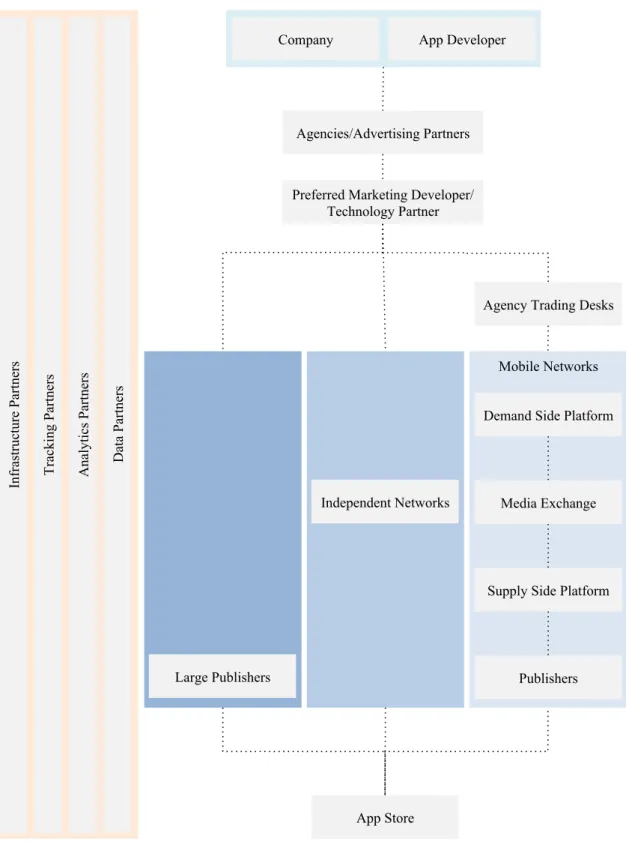
Observing, analysing and understanding the identity and role of each stakeholder in the mobile advertising ecosystem is absolutely critical as it enables us to limit the problem we are focusing on and increase our perception of it. From the observation conducted, we have defined every stakeholder on this ecosystem, and mapped it in Table 1 to provide better understanding on how these players interact. Below, we present each stakeholder, as we have not find a published description of this industry that represented reality with the needed detail.
Company: Companies and brands who build a mobile application with various objectives, including but not limited to branding, new sales channel, media consumption (news, music or video), manage client relationship, track physical product delivery, companion app for existing service, engage customers and provide 24/7 client support . 4
They invest in mobile advertising to distribute their app and acquire new customers. App Developer: Third-party companies or in-house teams that partner with businesses to conceptualise, develop, release and support mobile apps. They materialise companies’
Examples of apps, in the same order: Coke Drink, Booking, Flipboard, Nespresso, Amazon, 4
vision to the mobile app and manage all the developing processes, from a technological standpoint to compliance with App Stores policies, for example. They are either
Table 1 - Mobile Advertising in the context of Mobile App user acquisition.
T ra cki ng P art ne rs A na lyt ic s P art ne rs
Company App Developer
Media Exchange
Supply Side Platform Demand Side Platform
Publishers
App Store
Agencies/Advertising Partners
Preferred Marketing Developer/ Technology Partner Independent Networks Infra st ruc ture P art ne rs
Agency Trading Desks
Large Publishers D at a P art ne rs Mobile Networks
integrated in a business or are payed on a project-basis, typically per feature and hours of development and support.
Agencies/Advertising Partners: Brands and companies can design, implement and manage customer acquisition campaigns internally or externally. Externally they deal with agencies, advertising partners, freelancers or other businesses that provide this type of services. These stakeholders partner with businesses and app developers to market a new app, leveraging their experience and innovation in the ecosystem to deliver campaigns. Their goal is to achieve the lowest possible user acquisition price. Agencies are rewarded with a percentage of advertising investment, fixed fee, hourly fee or by achieving pre-determined goals.
Preferred Marketing Developers and Technology Partners: Multiple networks and demand side platforms establish partnerships with third-party companies and allow them to build platforms on top of their existing offer. They have a common interest in providing better tools for advertisers to manage their campaigns more effectively and potentially increase their spending. Preferred marketing developers typically charge a percentage of investment to advertisers and pay a fee to networks and other platforms. Agency trading desk: Departments of larger agencies or independent agencies that deal directly with demand side platforms or media exchange and negotiate deals, typically 5 6
in bulk, to buy advertising space on behalf of it clients. Agency trading desks are loosing relevance as mobile advertising market continues shifting to a paradigm of programmatic and real-time buy of advertising space.
Explained in the next page. 5
Explained in the next page. 6
Mobile Networks: Organisations that incorporate the functions of demand side platforms, media exchange, supply side platforms and access to publishers that become a single point of contact with advertisers. Mobile networks are commonly specialised in segments of mobile advertising, such as platforms, geographical area, audience gender and age and others. They typically charge a percentage of investment.
Demand Side Platform: Online platforms that allow businesses and advertisers to buy impressions, clicks or installs in a programatic way from an array of numerous publishers and media exchanges. These buying platforms provide numerous targeting options: device, carrier, geo-location, operating system and context and offer a limited portfolio of creatives: banners, rich media and video. Buying platforms charge companies based on metrics delivered, through an action-based method.
Media Exchange: The technology that coordinates transactions and programatic buying between supply side platforms and demand side platforms. Media exchange enable real-time bidding from both parties and ensures balance between supply and demand in this market. It exist in the form of a proprietary technology from various companies that create a market for selling and buying advertising.
Supply Side Platform: Online service that gathers multiple mobile app publishers and enables them to sell their advertising space in a programatic way, deciding the minimum they are willing to receive for either impressions or clicks in an ad in their mobile apps. App developers and publishers monetise their user engagement through selling advertise and supply side platforms gather this advertising space and resell it to advertisers.
Publishers: Mobile apps that sell space in their app as an advertising space to the whole ecosystem. These apps can be of any App Store category and provide different types of inventory (different sizes, formats and call-to-action). Publishers leverage their users, their engagement and data to increase their product’s value for advertisers. They sell their advertising space to supply side platforms.
Independent Networks: Mobile apps that for a few reasons, such as having a large user base, dominate a market niche or have singular targeting capabilities, bypass supply side platforms, media exchanges and demand side platforms and directly sell their advertising inventory to advertisers. Networks build their own internal technology and provide a platform for advertisers to programmatically and in real-time bid for impressions, clicks or installs.
Large Publishers: Publishers of content in mobile that have access to either a large audience in its mobile apps or a very relevant, targeted segment of audiences, that may directly negotiate with companies and advertisers the price and placement of mobile advertisement.
App stores: When referring to mobile app instals, the vast majority of ads redirect to the app’s page on the device’s app store. Here, the app has the opportunity to show screenshots of its product, portrait most important features and explain its main benefits. It is on the app stores that users choose whether or not to download a certain app. App stores take a cut of the price payed by a customer when downloading an app, and future in-app purchases processed.
Data Partners: Companies that support businesses and networks in the process of capturing, analysing and empowering action on mobile consumer behaviour across the
purchase funnel. These companies design solutions in the field of remarketing, cross-selling and up-cross-selling while increasing the potential and effectiveness of mobile marketing campaigns.
Analytics Partners: Independent services that monitor events in this ecosystem, from app stores download, sales and updates to activity logs in apps and performance of specific advertising channels. One of their data sources is directly from app stores, which they present with the objective of providing an insightful overview of downloads per day, geography, app store ranking, featuring in the app stores and other metrics. Tracking Partners: Third-party stakeholders that act in partnership with advertisers, demand side platforms, media exchanges, supply side platforms and publishers to measure, track and allocate key metrics on this process. They roll-out a set of technology solutions to solve tracking, typically an SDK and then sell a SaaS platform 7 8
to monitor activity in real-time. Tracking partners are most commonly payed on a tiered per-event base system.
Infrastructure Partners: Services that ensure the whole ecosystem is functioning properly, supporting most of the stakeholders in this processes though the following activities: data warehousing, API management and request processing.
Mobile advertising is a complex ecosystem where data-driven analysis and strict observations of performance are critical to ensure proper budget allocation and increase investment from advertisers.
Software Development Kit is a set of technology tools to facilitate standard operations. 7
Software as a Service is a upcoming type of service delivering from companies, hosting the 8
We have observed that mobile app advertising strategy is primarily defined by the company in cooperation with advertising agencies. Usually, the company sets the tone for creative assets, copywriting and identity of the brand while marketing channel mix and operationalisation are responsibility of advertising agencies. Multiple interactions exist between the advertising agency and all the other partners to ensure proper campaign setup, management and reporting. Performance is highly depended on the effectiveness of these two steps of the process - strategy definition and execution.
Mobile Advertising Performance
On this section we will present the most relevant subset of results attained during the design, implementation and management of mobile advertisement campaigns. Data refers to investment from three different mobile apps with the following aggregated characteristics:
I. Companies operate in two industries: fashion and sports.
II. Total investment of slightly more than 400.000€, achieving almost 385.000 directly attributed installs in this period.
III. Campaigns targeted more than 25 markets across the globe. The most relevant markets, in alphabetic order were: Argentina, Australia, Brazil, Canada, Colombia, Malaysia, Mexico, South Africa, South Korea, Spain, Turkey, United Arab Emirates, United Kingdom, United States and Venezuela.
IV. All companies had mobile apps available in iOS and Android, though the launch of Android in two of those companies was during the period in analysis.
V. Text, photography, graphic images and video were all used as advertising assets, being refreshed at a regular pace.
VI. Almost daily optimisation routines and techniques were applied in all cases, with the usage of different bidding types (cost-per-click , cost-per-mile and 9 10
cost-per-action ) and frequent shifts of budget between market segments. 11
VII.The channels explored were, in alphabetic order: AdWords, AirPsuh, Apptoide, Facebook, Twitter, and YouTube.
Results presented below were all indexed to focus discussion on the comparison between variables and relative performance and not on absolute performance. As the same business approach was followed to plan, implement and manage all investment, focusing on relative performance of variables allows us to draw valid conclusions. Furthermore, absolute values of these variable are likely to change due to a variety of different factors: competition, operating system penetration on a given country, emergence of new formats and channels. However, as relative numbers represent trends, they will change less than absolute numbers. Below, the most relevant results, aggregated by vertical.
Operating System: Companies have invested in iOS and Android, with different level of commitment to each operating ecosystem and different time windows. During the time in analysis, two of the three companies studied launched their Android apps. This fact also provided us valuable insights on cost per install evolution and reaction of users to
Advertiser pays for each click of a user on an ad. 9
Advertiser pays for each 1.000 impressions served. 10
Advertiser pays for each specific action, for example an install. 11
novelty. Across all companies and countries the general trend is that installs in Android are cheaper to obtain.
Channel: Budget allocation per channel was made in order to achieve companies’ objectives in terms of volume of installs and cost per install. There were no commitments or constraints to any of the tested channels. This fact allowed campaign optimisation to focus solely on achieving the best results. Facebook was the cheapest channel and yielded the most volume. Other channels yielded higher cost per install which added to the increased difficulty in campaign setup, optimisation, tracking and attribution capped the investment in these channels.
Furthermore, and adding another layer to the previous analysis, we can breakdown cost per channel per industry. Table 4 reveals that, despite Facebook being the cheapest overall channel, Twitter outperformed it in both industries. Results from Table 3 and Table 2 - Cost per install per Operating System
Android 100
iOS 111
Table 3 - Cost per install per Channel
AdWords 377
Mobile Networks 283
Facebook 100
Twitter 102
Table 4 seem odd, but they are consistent. The explanation lies on the fact that investment was asymmetrically allocated between industries and channels.
Gender: On our research, we have used a fashion app that only targeted women and a sports and a sports news app that only targeted men. According to our research, gender behaviour on mobile and its responsiveness to mobile advertising is different. Turning female mobile users into a company’s mobile app user seems to be relatively cheaper. However, this conclusion might be biased by the industries we operated in.
Country: Investment and emphasis from stakeholders was not homogeneous between countries. Yet, country mix was constantly being tweaked and updated to meet objectives of each company and maximise effectiveness of advertising campaigns. Creative assets were all localised with the exception of Malaysia, South Korea and 12
United Arab Emirates. Quick analysis on Table 6 shows that there clusters of countries with relatively similar CPI. For instance, Australia, Canada, United Kingdom and Table 4 - Cost per install per Channel per Industry
Industry Twitter Facebook
Fashion 100 114
Sports 217 237
Table 5 - Cost per install per Gender
Female 100
Male 206
Produced in local language. 12
United States yield higher costs than most countries due to high competition and investment from a world-high number of advertisers in these markets. On the other hand, Brazil, Colombia, Mexico, Spain, Turkey and Venezuela proved to be excellent countries to enter in the mobile app market.
Age: Another interesting result from our research is the differences in cost per install across age brackets. As a trend, cost per install increases as age increases. We identified that younger consumers are more willing to try new mobile app (with the exception of 13-17) and that they respond better to mobile advertising. Additionally, as younger Table 6 - Cost per install per Country (top 15)
Argentina 218 Australia 298 Brazil 148 Canada 301 Colombia 100 Malaysia 246 Mexico 123 South Africa 218 South Korea 204 Spain 121 Turkey 101
United Arab Emirates 206
United Kingdom 256
United States 290
consumers also spend more time on their devices, it is also the age bracket that drove more installs in absolute volume and where more investment was made.
Managerial Implications to Mobile App Managers from Mobile Advertising
Companies and app developers can extract many insights from mobile advertising to support business and product decisions. In this section, we will summarise the managerial activities that can leverage the insights gathered mobile advertising activities.
Product Development: Understanding discrepancies in user acquisition costs between platforms can increase the effectiveness of products and services attempting to establish themselves in the mobile app ecosystem. As a trend, acquiring customers using iOS is more expensive than acquiring Android users. When planning in which operating system to test a new concept, launch a new sales channel, user acquisition cost discrepancies between operating systems should be a factor.
Internationalisation: As portrayed in the previous section, there are strong asymmetries in the acquisition cost of users from country to country. When planning a new country Table 7 - Cost per install per Age
13-17 205 18-25 103 26-35 100 36-45 123 46-55 191 56-64 199 65+ 231
to invest in, it is crucial to include distribution cost in the analysis. Furthermore, each country has different market penetrations of mobile phones, which sets a natural cap on market potential. Understanding this reality supports internationalisation decisions. Management of Marketing Budget: Marketing channel mix is an on-going decision that directly affects effectiveness of marketing budget and that can ultimately validate or invalidate a business models. Mobile apps should be intentional abut this management, focusing the majority of the investment on the most effective channels and continuously be looking for new opportunities on different channels. With our research, we have found that Facebook and Twitter are the better combination of channels to achieve high volumes and low cost per install across the globe. Additionally, seasonality plays an important role in many businesses and understanding its effect on acquisition costs is absolutely critical to maximise the efficiency of marketing budget allocation. For a mobile app, data extracted form mobile app user acquisition empowers companies to actively shift investment to months where acquisition costs are lower with an unprecedented ease.
CONCLUSION
We proposed to study in what areas, mobile app advertising influences and changes decisions made by companies in the mobile app ecosystem. We added to the existing literature on mobile advertising (e.g. Chan, 2014) by observing and mapping various stakeholders during a 17-month period, in the context of a digital consulting firm managing three different mobile app user acquisition initiatives to companies in two industries and a long-list of partners, from mobile networks to data partners and
publishers. Not only through observation, but also through collecting data on mentioned mobile advertising campaigns in this timeframe. We have found that mobile advertising does have an impact on managerial decisions, namely in the areas of product development, internationalisation and management of marketing budget. Our study, however has some weaknesses and limitations: it only analyses data from two industries which makes our results difficult to extrapolate to other industries and all companies that contributed are based in Lisbon which does not increase the diversity of business practice we were exposed to.
FURTHER RESEARCH
While conducting this research and after presenting this findings and conclusions, we have detected three further questions that could be explored in future researchers in order to help bring light on this subject, complement the present work and add depth to its applicability.
The first example of further investigations related to the present research is simply replicate the present methodology and approach to alternative sources of mobile app user acquisition and understand its impact on managerial decisions. For the presented reason we have only focused our analysis on one channel: mobile advertising. Studying other channels such as TV and PR would provide additional data points and insights that could help validate conclusions from this research and bring new implications on the subject.
The second question is related to the revenue generated by mobile apps. On this research project we have primarily focused on marketing activities, expenditure,
effectiveness and its impact on managerial decisions. To provide an additional layer of analysis, performing a study on the revenue side of mobile apps, would provide managers a more complete outlook on mobile app ecosystem. This new perspective would empower managers to better access potential return on investment and increase scope and depth on future business decisions on products and services that are present on mobile.
Finally, and taking into consideration recent macro-trends on consumer behaviour and new product launches, there are two product segments that are currently seeing dramatic increase in volume and are starting to reach mass consumption: wearable technology and the commonly described as Internet of Things. Both markets are still very young, but brands and marketers are already finding new and innovative ways to reach customers. Studying the dynamics of this ecosystem on an early stage would allow us to gain insight on its success factors.
REFERENCES
Bauer, HH. 2005. “Driving consumer acceptance of mobile marketing: a theoretical framework and empirical study.” J Electron Commer Res; 6(3):181-191.
Bohmer, M. 2011. “Falling asleep with Angry Birds, Facebook, Kindle: A large scale study on mobile application usage,” Proc. 13th Int. Conf. Human Comput. Interaction Mobile Devices Services, 47–56.
Cleff EB. 2007. “Privacy issues in mobile advertising international review of law.“ Comput Technol, 21(3):225-236
Chen, Peng Ting. 2014. “Mobile advertising setting analysis and its strategic implications” Technology in Society, 39:129-141.
Gao, Q. 2010. “Measuring perceived interactivity of mobile advertisements.” Behav Inform Technol, 29(1):35-44.
Ghose, Anindya. 2014. “Estimating Demand for Mobile Applications in the New Economy.” Management Science, 60(6):1470-1488.
Johnson, R. Burke. 2007. “Toward a Definition of Mixed Methods Research” Journal of Mixed Methods Research, 1:112-133.
Lim, Soo Sing. “Investigating Country Differences in Mobile App User Behavior and Challenges for Software Engineering” IEEE Transactions On Software Engineering, 41(1):40-64.
Reyck, B. 2003. “Broadcast scheduling for mobile advertising.” Oper Res, 51(4): 509-517.
Small, Mario. 2011. “How to Conduct a Mixed Methods Study: Recent Trends in a Rapidly Growing Literature” Annual Review of Sociology, 37:57-86.
Wong, Choy-Har. 2015. “Mobile advertising: The changing landscape of the advertising industry” Telematics and Informatics, 32:720-734.