Building Successful Brands through
Marketing Communications: development
of a framework
Parfois Case Study
Dissertation presented to the
Universidade Católica Portuguesa in the modality of internship to obtain the degree of Master in Marketing
by
Emanuela Baltazar Marques
under orientation of
Prof. Dra. Joana Pinto Leite César Machado
Católica Porto Business School, Universidade Católica Portuguesa 2017
iii
Acknowledgements
To the restless teacher and counsellor, Joana Machado, who work tirelessly and helped me through this important phase. Thank you for the guidance, the inputs and the advices. Thank you again for the knowledge and experience you shared with me and thank you for being a constantly available tutor.
To Mojobrands Brand Lifestyle for so kindly accepted me as one of them throughout these six months. I am also very grateful to the agency for allowing me to learn what an agency environment is like and discovering my passion about this area. Thank you for all the great moments we enjoyed during this journey and for the great friends I made. A special thanks to Mafalda Correia and Tiago Barquinha for always being concerned with our self-improvement and development. Thank you for always being ready to guide us, give advices and ultimately, for being excellent role models.
To my master colleagues Catarina, João, Diogo and Manel that were my team, my new family. Thank you for all the great advices and for teaching me to have strength when I most needed it. Indeed, I owe you the conclusion of this thesis.
To my parents, my unconditional supporters who always believed in my abilities and were so kindly available to anything necessary. Thank you for providing me with this experience and for allowing me to pursue this master’s degree.
To my family and friends, thank you for your patience and constant support.
v
Abstract
Nowadays, brand building strategies are crucial. The increase in competition offering similar products, lead to an urge for brands to differentiate themselves and to communicate their message more efficiently.
This master’s thesis explored the concept of successful brands and what distinguishes them from average brands. Between the many criteria companies need to accomplish when building a successful brand, this study focuses on the marketing communication strategies and how to apply them so that a correct brand building is possible. Firstly, a more complete knowledge of what successful brands are, as well as how to build them is gathered. Secondly, it was fundamental to understand the importance of marketing communications and integrated marketing communications to build a successful brand. Furthermore, a model of how to build a successful brand through marketing communications is proposed.
In this study, we followed the single case study method focusing on the marketing communications sector of an established successful brand that Mojobrands has been working with, Parfois. The proposed model was applied to the brand to test its validity on a practical level.
The investigation concluded that the proposed model can be applied in practical situations. Indeed, the conceptual framework can be a practical and simple tool available for companies and agencies to apply to their brands and plan successful marketing communication strategies that will aid them developing successful brands.
Keywords: Successful brands, Brand building, Marketing communications, Integrated Marketing Communications
vii
Index
Acknowledgements ... iii Abstract ... v Index ... vii Image Index ... ix Table Index ... xi Acronym Index ... xi Introduction ... 13Context and general research gap ... 13
Theoretical research gap ... 14
Managerial research gap ... 15
Document structure ... 16
Chapter 1 ... 17
Company and Functions Characterization ... 17
Chapter 2 ... 19
Literature Review ... 19
2.1 Introduction ... 19
2.2 Brands ... 20
2.3 Successful brands ... 23
2.3.1 Successful brand’s criteria ... 25
2.3.2 Building a successful brand ... 27
2.4 Branding ... 37
2.5 Marketing communications ... 39
2.5.1 Integrated marketing communication ... 47
2.5.2 Marketing communication mix ... 56
2.5.3 Marketing communication models ... 62
Chapter 3 ... 67 Proposed Model ... 67 3.1 Overall strategy ... 71 3.2 Communications strategy ... 72 Chapter 4 ... 84 Methodology ... 84
viii
4.1 Selection of the object of analysis ... 85
Chapter 5 ... 87
Parfois Case Study ... 87
5.1 The company ... 87
5.2 Communication strategies ... 91
5.3 Discussion ... 108
Chapter 6 ... 110
Findings ... 110
6.1 Theoretical and managerial implications, limitations and hints for further research ... 111
Bibliography ... 113
ix
Image Index
Figure 1 - PCDL Model (Ghodeswar, 2008). ... 28
Figure 2 – CBBE or Brand Resonance Model (Keller, 2001a, 2008). ... 30
Figure 3 - Subdimensions of brand-building blocks (Keller, 2001a, 2008). .... 31
Figure 4 - Building customer-based brand equity Model (Keller, 2008). ... 34
Figure 5 - Baeva's proposed model (Baeva, 2011). ... 35
Figure 6 - Steps for an effective marketing communications strategy (Kotler and Keller, 2009). ... 44
Figure 7- Convergence/divergence of IMC definitions (Kliatchko, 2005). ... 49
Figure 8 - IMC a four-stage model (Kitchen and Shultz, 2001). ... 51
Figure 9 - Integrating marketing communications to build brand equity (Kotler and Keller, 2009). ... 54
Figure 10 - Marketing communications options (Keller, 2008). ... 57
Figure 11 - Response Hierarchy Models (Kotler and Keller, 2009) ... 63
Figure 12 - AIDA model (E. St. Elmo Lewis, 1899). ... 64
Figure 13 - The Marketing Communication Tetrahedron (Keller, 2001b). ... 65
Figure 14 - Successful Brands’ Communication Egg (SBCE) ... 70
Figure 15 - Parfois information (Orbis directory, 2015) ... 89
Figure 16 – Parfois’ growth (Parfois’ website, n.d.). ... 90
Figure 17 – Parfois’ current markets (Parfois’ website, n.d.). ... 90
Figure 18 - Parfois' store I (Vogue, 2016) ... 93
Figure 19 - Parfois store II (own development). ... 93
Figure 20 - Parfois description of their stores (Parfois, 2016.). ... 94
Figure 21 - Parfois' store products (own development). ... 94
Figure 22 - Parfois' social media followers (Parfois, 2017) ... 96
x
Figure 24 - Parfois Facebook rankings II (RankU.pt, 2017) ... 97
Figure 25 - Parfois product post (Parfois, (2016). ... 98
Figure 26 – Parfois’ website homepage (Parfois, 2017). ... 100
Figure 27 – Parfois’ products display.(Parfois, 2017)... 101
Figure 28 – Parfois’ product in detail (Parfois, 2017) ... 101
Figure 29- Parfois SS'17 event (Parfois, 2017) ... 104
Figure 30 – Parfois’ newsletter subscription form (Parfois, 2016) ... 106
Figure 31 - Parfois' newsletter I (Parfois, 2017) ... 106
Figure 32 - Parfois newsletter II (Parfois, 2017) ... 107
Figure 33 - Parfois' newsletter III (Parfois, 2017) ... 107
xi
Table Index
Table 1- Brand classification (Maurya and Mishra, 2012). ... 22
Table 2 - Successful brand's criteria (own development). ... 26
Table 3 - Marketing communications orientations (Fill and Jamieson, 2011). 41 Table 4 - IMC definitions (Kitchen and Burgmann, 2010). ... 48
Table 5 - Marketing communication's tools (own development). ... 59
Table 6 - Brand building models comparison (own development) ... 68
Table 7 - Company size categories (Orbis directory, 2015) ... 89
Table 8 - Parfois Social Media overview (own development). ... 99
Acronym Index
AIDA – Awareness, Interest, Desire, Action AMA – American Marketing Association CBBE – Customer Based Brand Equity FCB – Foote, Cone and Belding
IMC – Integrated Marketing Communications MCT – Marketing Communications Tetrahedron
PCDL- Positioning, Communicating, Delivering, Positioning PR - Public Relations
13
Introduction
Context and general research gap
In the ambit of the Master’s Degree in Marketing from Católica Porto Business School, Universidade Católica Portuguesa, and the curricular internship in Mojobrands as Project Assistant, the present Masters Dissertation was developed under the theme Building Successful Brands through Marketing Communications:
development of a framework. Parfois Case Study. The main objective of this research
is to understand the contribution of marketing communications for the development of successful brands. To do so, the research will be based on the current literature and available frameworks in the area. The knowledge gathered will allow us to develop a model that aims to explain how to build a successful brand through marketing communications.
The marketing communications environment is constantly changing. Indeed, nowadays technology developments and the Internet significantly influence how communications are processed and developed.
At the same time, branding has become a key marketing priority for most companies (Aaker and Joachimsthaler, 2000; Kapferer, 2008). In fact, technological advances make it easier for brands that are competitors to imitate their rivals’ functional advantages (Chernatony, 2001). Thus, with the increase in competition, brands need to understand how they can differentiate their offerings and how to reach target audiences more efficiently. However, there is little consensus on how brands and branding should be developed in the modern interactive marketplace (Keller, 2009). In fact, marketers face difficult matters everyday regarding branding and their brands (Keller, 2003). Moreover,
14
developing clear and cohesive brand communications can lead a brand to grow and gain the loyalty of their target audience (Ghodeswar, 2008).
In conclusion, new perspectives are needed to understand brand building guidelines in this rapidly changing communication context (Keller, 2009).
Theoretical research gap
According to Holm (2006) for over twenty years, communications are being increasingly discussed in the academic field and, indeed, many authors developed knowledge on how to build a successful brand. Marketing communications is, according to them, one of the critical tools to use in order to reach that goal. However, there is still a lack of empirical knowledge on this matter.
Moreover, Integrated Marketing Communication (IMC) is being the target of a series of studies that reveal its importance to a marketing communication strategy. However, many of the existent frameworks for developing a successful brand often do not contemplate IMC. Thus, communication planning and brand building frameworks are incomplete in the sense that they do not consider all relevant aspects companies should follow to build a successful brand.
As Kay (2006, p.743) stated, “marketing literature on branding has raised some important new directions as how companies can acquire brand strength”. The existent rules for branding emerged from studying the various perspectives to build successful brands. However, the rules behind branding decisions that have emerged “can appear inconsistent or even contradictory” (p.743).
In summary, “the contingencies or alternative paths to consider in building strong brands need to be better explored” (Kay, 2006, p.743).
15
Managerial research gap
The creation of new brands highlights the need for companies to differentiate themselves and standout from the immense number of competitors.
Indeed, the physical features of a product are not enough to generate the strong competitive advantage that is needed to succeed in a brands’ flooded environment (Anselmsson and Johansson, 2008 cited by Anselmsson and Anders, 2013, p.1613).
As Keller (2001b, p.819) stated, “the challenges faced by marketers in designing, implementing, and evaluating marketing communication programs are markedly different from those faced by marketers 20 or 30 years ago”. As such, there is a need for new studies on this matter that integrate the most relevant conclusions from previous research.
Managers need to have clear and practical guidelines as they face difficulties in adapting to a new market environment where the traditional marketing strategies are being replaced with new communication tools, as well as the presence of educated consumers and more competitors make it harder for a brand to thrive (Keller, 2003).
Also, “practitioners and scholars have questioned marketing communication’s credibility because it has not been linked to firm shareholder value” (Luo and Donthu, 2006, p.70). These marketing area professionals fear for the returns of marketing communications expenditures. Indeed, several authors as well as managers fear that the expenses with marketing communication do not represent a positive investment (Luo and Donthu, 2006). A successful brand building program can show managers how marketing expenditures and investments can translate into actual profits for the company (Luo and Donthu, 2006).
16
Document structure
Following this introduction, this paper is organized as follows: Chapter 1 presents the description of Mojobrands Brand Lifestyle and the functions that were developed during the six months of internship. Chapter 2 includes the literature review. In this chapter, we explain the concepts that form the basis of this investigation, namely: brands; successful brands and their criteria; building a successful brand; branding; marketing communications. Chapter 3 presents the proposed model and its explanation. Chapter 4 includes the research methodology, the data collection methods and the choice of the object of analysis. Chapter 5 presents the case study of Parfois and the discussion of the results. Finally, Chapter 6 presents the main findings of this research as well as its limitations and hints for further research.
17
Chapter 1
Company and Functions Characterization
The final stage of the Master’s Degree involved a six months’ internship that took place in Mojobrands Brand Lifestyle. The company is a Porto-based agency with subsidiaries in Lisbon and Madrid, that operates as brand consultants. In fact, in Mojobrands the brand is the main driver of the agency business.
The company focuses on branding related activities, brand activation, communication strategies, advertising, naming and event planning, among other functions. All company strategies are tailormade and adapted to the specific context in which the client’s brand is inserted.
Throughout the internship, I had the role of being project assistant with the functions of managing projects, direct contact with the clients, copywriting and also developing creative inputs.
Besides defining consultancy, the agency aims to play a relevant role on brand building through marketing communications strategies. This is the area where the agency can act directly to help their clients. Therefore, the proposed model in this research should also aid Mojobrands in planning and designing successful communication strategies for their client’s brands.
The object of analysis for this investigation is one of the biggest clients of the agency, Parfois. The agency carried out the task of developing the new seasons’ launch events and has been working with the client for a long time.
19
Chapter 2
Literature Review
2.1 Introduction
The constant shifts in the market environment affect brands, whether it is “by the change in market demand, consumer preferences, technological advances” or other external factors (Rajagopal, 2008, p.32). Therefore, brands see themselves forced to state their position in the market and define in what aspects they can differentiate themselves from competitors (Rajagopal, 2008).
Brands have acquired a growing importance over the years. Nowadays, brands and brand management “have become a central focus of the modern economy and a staple of business theory and business practice” (Desai and Waller, 2011, p.1425). They have the ability to be present in almost every aspect of our lives economically, socially, culturally, in sports and even in religion (Kapferer, 2008). Indeed, brands represent an important matter to consider if consumers and companies make choices between the different services and products available (Keller, 2001).
The following chapter will analyse some concepts that are vital for this research, namely: brands; successful brands and their criteria; branding; marketing communications; integrated marketing communications and the marketing communication mix.
20
2.2 Brands
Etymologically, “the word brand is derived from the Old Norse word brandr, which means to burn, as brands were and still are the means by which owners of livestock mark their animals to identify them” (Keller, 2008, p.30). Indeed, according to Keller a brand exists “whenever a marketer creates a new name, logo, or symbol for a new product” (Keller, 2008, p.30). Even though brands have existed since the beginning of trade activities, the increase in brand importance started mid-1980’s (Maurya and Mishra, 2012).
Due to their growing importance in business management, there is a large
amount of literature regarding “brand theories, brand strategies, brand meaning, brand components, and brand functions” (Desai and Waller, 2011, p.1425). However it is difficult to find a short and clear definition of what a brand is
(Desai and Waller, 2011, p.1425). Indeed, according to (Moore and Reid, 2008), only a few studies focus on what exactly a brand is. Each author defends their definition which make it more difficult to understand the meaning of brands and of brand managementitself (Kapferer, 2008).
The authors mentioned below, have different perspectives of how a brand should be defined. However, they all complement each other and allow for a full understanding of the brand definition.
The American Marketing Association (AMA) definition does not reflect the progress and evolution of the term. They define brands as: a "Name, term, design,
symbol, or any other feature that identifies one seller's good or service as distinct from those of other sellers”(AMA, 2016). Many authors defend that this definition does
not contemplate all brand roles, meanings and values and is, therefore incomplete. Thus Keller (2008, p.30) defends that we can make a “distinction between the AMA definition of a brand with a small b and the industry’s concept of a Brand with a big B”.
21
Keller (2008) and Ghodeswar (2008) believe that brands go beyond the product and are able to develop awareness, reputation, benefits, thoughts and feelings through images and experiences. Keller (2008), Ghodeswar (2008), Desai and Waller (2011), agree that brands lead to consumer understanding, knowledge and are, therefore, means to reach them. Chernatony and Riley (1997, p.89) state that “brands act as shorthand devices for information and trust, facilitating purchase decision”.
Brands can have certain dimensions that differentiate their products from others that satisfy the same need (Keller, 2008). These differences may be directly related to functional and product related aspects, or more emotional and symbolic aspects (Keller, 2008, p.31). In this line of thought, Rumelt, Schendel and Teece (1991) classify brands as strategic assets “that have the responsibility of creating and developing competitive advantages for firms” (cited by Castelo, Cabral, & Coelho, 2016, p.16).
A brand can also be an instrument of legal protection for the firm as it “can retain intellectual property rights and give a legal title to the brand owner” (Keller, 2008, p.35).
For Simeon (2006), brands are able to create value overtime if they create brand equity, and have the ability to retain and attract consumers by developing a positive image among target audiences.
Kapferer (2008) defends that a brand can be built at all points of contact with the consumer and is therefore the result of the whole consumer experience with the brand.
Maurya and Mishra, (2012, p.128) believe that the concept of a brand changes and evolves according to “social (cultural), economic, political, technological, legal system and across the geography”.
Maurya and Mishra (2012) used a framework developed by Chernatony, Riley and Harris (1998) where they divided the definitions of a brand into 12 themes.
22
This framework allows us to have a broader view of the complex definition of a brand (Maurya and Mishra, 2012):
Table 1- Brand classification (Maurya and Mishra, 2012).
By analysing Table 1 we can conclude that a brand can assume many roles and is therefore a complex term, which surpasses the AMA simplistic definition.
Keller (2008, p.34) summarized the main brand roles as the following: “Consumers identification of the source of the product;
Assignment of responsibility to product maker; Risk reducer;
Search cost reducer;
Promise, bond, or pact with the maker of the product; Symbolic device;
Manufacturers means of identification to simplify handling or tracing; Means of legally protecting unique features;
23
Signal of quality level to satisfied consumers;
Means of endowing products with unique associations; Source of competitive advantage;
Source of financial returns”.
2.3 Successful brands
This chapter analyses what successful brands are and in what way do they differ from regular brands.
In a broader manner, successful brands, powerful brands or strong brands1 are defined as brands that can fit and adapt well in the surrounding environment and can survive and grow regardless of the competition (Ghodeswar, 2008). Those brands are easily identifiable by consumers and can either be a product, place or service. Thus, they are perceived as an offer that fits more effectively with consumer needs than competitors’ (Chernatony et al. 1998).
According to Doyle and Stern, (2006) the characteristic that better explains the definition of this type of brands is the added value they provide to consumers. These brands are able to satisfy some psychological needs, besides meeting their functional requirements.
Successful brands also add long-term value to the company by providing some relevant benefits. Indeed, these brands may offer companies special rewards on the market. Temporal (2000) says that successful brands provide “long-term security and growth, higher sustainable profits, and increased asset value because they achieve competitive differentiation, premium prices, higher sales volumes, economies of scale and reduced costs, and greater security of demand” (cited by Ghodeswar, 2008, p. 5). Also, Ghodeswar (2008) adds that
24
these brands enjoy enough power to be able to support new product or service launches. Successful brands also add valuable because they guarantee future income streams. Moreover, those brands are perceived by the consumer as being irreplaceable and that no other competing brand can provide the same benefits (Baeva, 2011). Kay (2006, p.742) considers that having a successful brand is a very important managerial resource: “it can help establish distribution networks, enable brand extensions to aid consumer acceptance of new products, and strengthen pricing flexibility”.Successful brands are aware that their consumers trust them and will buy their brand repeatedly; those consumers are also able to help the brand even in times of crisis (Chernatony, McDonald, and Elaine, 2011).
Among the various benefits that a brand can create to a company, Keller (2008, p.69) gathered in literature some marketplace benefits that a successful brand can benefit from:
“Improved perceptions of product performance; Greater loyalty;
Less vulnerability to competitive marketing actions; Less vulnerability to marketing crises;
Larger margins;
More inelastic consumer response to price increases; More elastic consumer response to price decreases; Greater trade cooperation and support;
Increased marketing communication effectiveness; Possible licensing opportunities;
25
Keller (2008, p.97) highlighted some other benefits that these brands can attain “such as helping the firm to attract or motivate better employees, generate greater interest from investors, and garner more support from shareholders”.
That being said, Chernatony et al. (2011, p.20) defended that “the title successful brand has to be earned”. The company has to make an effort in order for the brand to match emotional needs as well as provide concrete and rational benefits “that are sustained by a marketing mix that is compatible, believable and relevant” (p.20).
It is essential to reach a consensus regarding the criteria to define a successful brand for an correct use of the definition of success (Chernatony et al., 1998). However, Chernatony et al. (1998, p.765), highlighted that, although several studies (e.g. McBumie and Glutterbuck, 1988) mentioned some strategies to achieve brand success, it is difficult to find in the literature well defined criteria. Kay (2006, p.742) also notices the need for the definition of precise guidelines for the development of strong brands, because many of the studies face “conceptual ambiguities and practical difficulties”.
2.3.1 Successful brand’s criteria
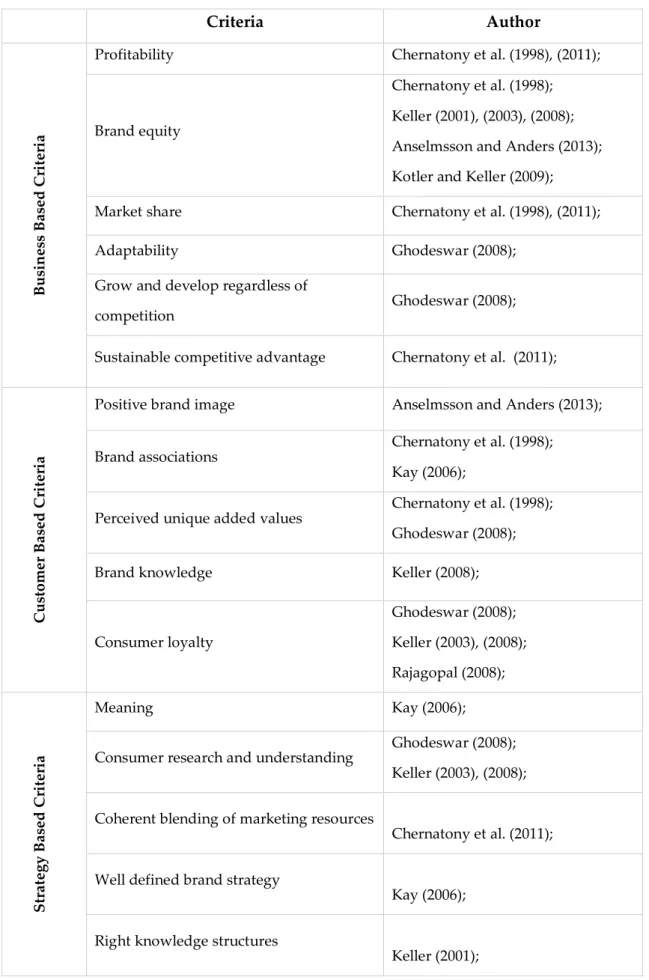
Several authors believe that to be regarded as successful, a brand should also fulfill some relevant requirements. The following table provides an overall view of the perspectives from different authors that we analyzed, and summarizes the criteria a brand should reach in order to be classified as successful.
26 Criteria Author Bu si n es s Bas ed Cr it er ia
Profitability Chernatony et al. (1998), (2011);
Brand equity
Chernatony et al. (1998); Keller (2001), (2003), (2008); Anselmsson and Anders (2013); Kotler and Keller (2009); Market share Chernatony et al. (1998), (2011); Adaptability Ghodeswar (2008);
Grow and develop regardless of competition
Ghodeswar (2008); Sustainable competitive advantage Chernatony et al. (2011);
Cu st o m er Bas ed Cr it er ia
Positive brand image Anselmsson and Anders (2013); Brand associations Chernatony et al. (1998);
Kay (2006);
Perceived unique added values Chernatony et al. (1998); Ghodeswar (2008); Brand knowledge Keller (2008);
Consumer loyalty Ghodeswar (2008); Keller (2003), (2008); Rajagopal (2008); S tr at eg y Bas ed Cr it er ia Meaning Kay (2006);
Consumer research and understanding Ghodeswar (2008); Keller (2003), (2008); Coherent blending of marketing resources
Chernatony et al. (2011); Well defined brand strategy
Kay (2006); Right knowledge structures
Keller (2001); Table 2 - Successful brand's criteria (own development).
27
In conclusion, there is not a consensus regarding the criteria a brand needs to accomplish to be considered a successful brand, thus it became clear that a successful brand should gather all these requirements.
2.3.2 Building a successful brand
After analyzing the value that a successful brand can create for the company and for the consumer, as well as the necessary criteria the brand should accomplish to be considered a successful brand, this chapter analyses how those brands are in fact built.
Aaker, (1996), Joachimsthaler and Aaker (1997) and Keller (1998) consider that the recent marketing studies focus mainly on the manager’s goal to build a successful brand. Indeed, the literature available considers that the process of building a successful brand can be independent from other company’s concerns (Kay, 2006). Building successful brands is thus a management priority (Aaker, 1991, 1996).
According to Chernatony et al. (2011), building brands is not a simple task, faces many difficulties and is a big challenge that companies face nowadays. Aaker and Joachimsthaler (2000, cited by Ghodeswar, 2008, p.6) highlight some of the difficulties: “to be noticed, to be remembered, to change perceptions, to reinforce attitudes, and to create deep customer relationships”. Chernatony et al. (2011) mentions the importance of a rigorous approach on branding strategies in order for brands to be able surpass the challenge.
In fact, to consider brand building as a simple task of “naming products, or about getting the right promotion with the name prominently displayed, or getting the design right” is a very narrow perspective (Chernatony et al., 2011, p.28).
28
In order to understand what involves building a successful brand, we are going to analyze three frameworks developed by: Ghodeswar (2008), Keller (2001, 2003, 2008) and Baeva (2011).
2.3.2.1 Positioning, Communication, Delivering, Leveraging (PCDL)
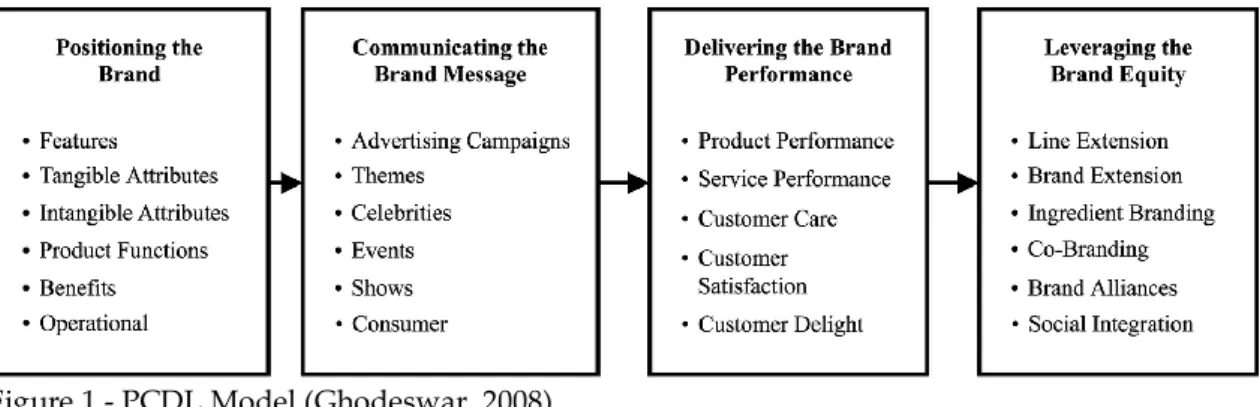
Figure 1 - PCDL Model (Ghodeswar, 2008).
This framework was developed under literature review and case studies with the purpose of identifying important elements for a correct brand building (Ghodeswar, 2008). Ghodeswar (2008) starts by highlighting the importance of dedication, commitment and planning to build a brand and the great amount of time involved in building a successful brand.
The PCDL model has four stages, building a successful brand requires the development of those four stages: positioning the brand, communicating the brand message, delivering the brand performance, and leveraging the brand equity.
In the first stage, the author considers the importance of “creating the perception of a brand in the consumer’s mind and of achieving differentiation, that it stands apart from competitors’ brands/offerings and that it meets the consumer’s needs/expectations” (p.4). The author believes that if companies manage to position correctly their brand to meet consumer’s needs, they will achieve competitive advantage (p.4). Secondly, on the communication stage, the
29
desired positioning is communicated to the target audience. Brands have to reach consumers in innovative and attractive ways in order to stand out. This can be achieved by “long-term integrated communication strategies demonstrating the brand’s value to the target consumer. The message should be consistent with the brand values, brand personality and other brand identity dimensions” (p.7). Thirdly, the brand should upgrade its performance. Through customer care, for example, the brand’s offering can be complemented and elevated by eliciting a positive brand image. Also, what a brand delivers should be consistent with the promise to ensure that customers are getting what they expect (p.7). Finally, through “line extensions, brand extensions, ingredient branding and co-branding, etc.” the brand can leverage its brand equity. The process of leveraging is all about “linking the brand to some other entity that creates a new set of associations from the brand to the entity as well as affect existing brand associations” (Keller, 2003 cited by Ghodeswar, 2008, p.7).
The author concluded that “consistency of integrated communications and message (…) are critical to the success of brand-building efforts by delivering a consistent, self-reinforcing brand image” (Ghodeswar, 2008).
30
2.3.2.2 Keller’s Customer-Based Brand Equity (CBBE) model or Brand
Resonance model
Figure 2 – CBBE or Brand Resonance Model (Keller, 2001a, 2008).
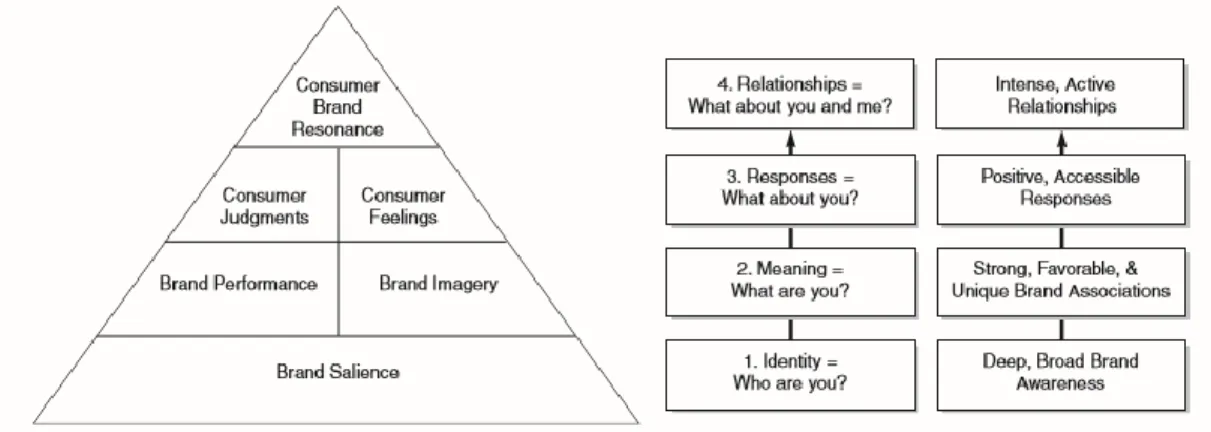
According to Keller (2001a, p.3), this model is built upon the basis that the “power of a brand lies in what customers have learned, felt, seen and heard about the brand over time”. Having that in mind, the author developed the CBBE model where he considers that building a successful brand involves four steps (Keller, 2001a, p.17):
1. “Establishing the proper brand identity, breadth and depth of brand awareness;
2. Creating the appropriate brand meaning through strong, favorable, and unique brand associations;
3. Eliciting positive, accessible brand responses;
4. Forging brand relationships with customers that are characterized by intense, active loyalty”.
The four steps aim to answer a set of questions that customers ask about a brand, namely: who are you? (brand identity); what are you? (brand meaning);
31
what about you? or what do I think or feel about you? (brand responses) and what about you and me? or what kind of association and how much of a connection would I like to have with you? (brand relationships)” (Keller, 2008, p.107).
In order to achieve these four steps and answer the respective questions, the author highlights the need to establish six brand-building blocks: brand salience, brand performance, brand imagery, brand judgements, brand feeling, and finally and brand resonance (Keller, 2001a).
Thus, on the base of the pyramid, the first step “is to ensure identification of the brand with customers and an association of the brand in customers’ minds with a specific product class or customer need” (p.5). The second step aims to “firmly establish brand meaning in the minds of the consumer by strategically linking a host of tangible and intangible brand associations” (p.5). The third step elicits “the proper customer responses to this brand identity and brand meaning” (p.5). The fourth and final step, on the top of the pyramid aims “to convert brand response to create an intense, active loyalty relationship between customers and the brand” (Keller, 2001a, p.5).
The author reminds that a brand can only move to the next step if the previous one was well established to reach the goal of brand resonance.
32
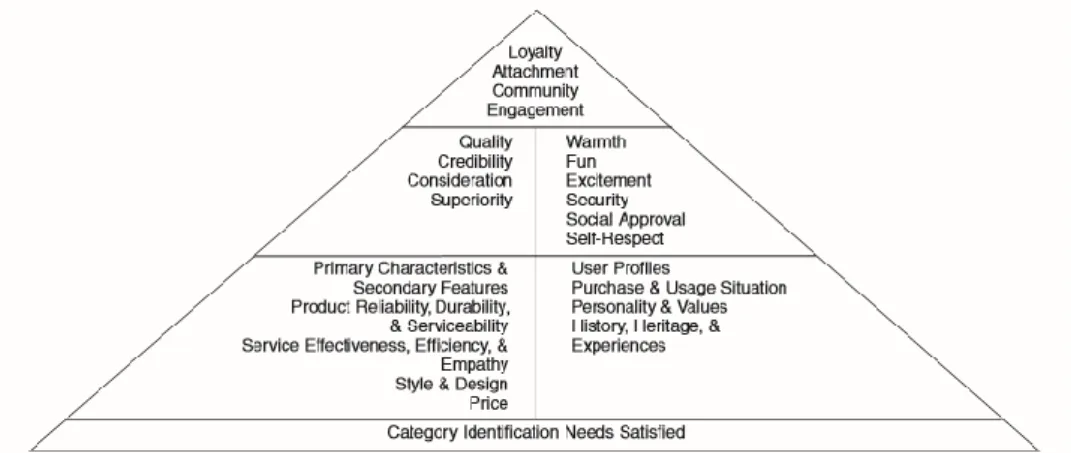
Figure 3 shows what a brand needs to achieve/develop in each building block in order to finally achieve brand resonance. According to Keller (2001a, p.17), successful brands are able to succeed on these six areas and therefore “entail the full execution of all four steps in building a brand”.
When all steps of the model are well established, the brand reaches brand resonance. To achieve brand resonance means to elicit the correct cognitive and emotional customer reactions to the brand (Keller, 2001a). Here, “customers express a high degree of loyalty to the brand in such way that they actively seek means to interact with the brand and share their experiences with others”(p.1). Firms can obtain several benefits by achieving the last step. Indeed, “brand resonance reflects a completely harmonious relationship between customers and brand” (Keller, 2001a, p.17).
The author concludes that a brand with these characteristics well defined can result in customer’s believing that the brand and its products are relevant and are their “kind of product”(Keller, 2001a, p.17).
In sum, the model considers that “the success of the marketing programs will depend on how consumers responded and this depends on the knowledge created in consumers’ minds” (Keller, 2001a, p.17). The model “provides a road map and guidance for brand building, a yardstick by which brands can assess their progress in their brand-building efforts as well as a guide for marketing research initiatives” (Keller, 2008, p.122).
The CBBE model reinforces the fact that “there are no shortcuts in building a brand” (Keller, 2001a, p.23). Indeed Keller (2008, p.125) adds that the time needed to develop the right awareness and “understanding so that firmly held and felt beliefs and attitudes about the brand are formed that can serve as the foundation for brand equity”, is proportional to the time needed to create a powerful brand.
33
Keller (2008) developed another framework that summarized all steps needed to achieve brand equity and therefore build a successful brand, as we can see in Figure 4. Here the author highlighted that marketers must (Keller, 2008, p.554):
• “Understand brand meaning and market appropriate products and services in an appropriate manner;
• Properly position the brand;
• Provide superior delivery of desired benefits;
• Employ a full range of complementary brand elements, supporting marketing activities, and secondary associations;
• Embrace integrated marketing communications and communicate with a consistent voice;
• Measure consumer perceptions of value and develop a pricing strategy accordingly;
• Establish credibility and appropriate brand personality and imagery. • Maintain innovation and relevance for the brand;
• Strategically design and implement a brand architecture strategy;
• Implement a brand equity management system to ensure that marketing actions properly reflect the brand equity concept”.
34
Figure 4 - Building customer-based brand equity Model (Keller, 2008).
In summary, according to (Keller, 2008, p.132) building a successful brand “requires establishing breadth and depth of brand awareness; creating strong, favorable, and unique brand associations; eliciting positive, accessible brand responses; and forging intense, active brand relationships”.
35
2.3.2.3 Baeva’s proposed model
Figure 5 - Baeva's proposed model (Baeva, 2011).
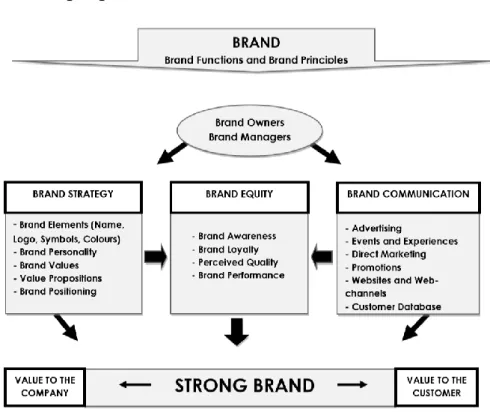
With this investigation, Baeva (2011) illustrated the steps needed for companies to develop a successful brand. In order to do so, the author highlighted three crucial steps to build a successful brand and their sub components.
Firstly, brand owners and managers should define their brand strategy: brand elements (brand name, logo, symbols and colours); brand personality; brand values; value propositions and brand positioning. Secondly, they should plan brand communication, namely: advertising, events and experiences; direct marketing; promotions; websites and web-channels and customer database.
Those two steps will lead to brand equity, by creating: brand awareness; brand loyalty; perceived quality and brand performance.
According to the author, brand managers have “a key role in determining the brand strategy and its elements; those when managed in a sustainable way will contribute to the achievement of higher brand equity, reinforced by the brand
36
communication” (Baeva, 2011. p.57). Brand strategy and brand communication are essential tools to create brand equity. Brand equity is in turn the central aspect for the creation of a relationship between the company and its consumers, and therefore for the creation of a successful brand (Baeva, 2011). Thus, brand strategy, brand communications and brand equity will increase brand value and will lead to a successful brand.
A successful brand creates value to both customers and the company by increasing “corporate profits over the long term, and this way enhances the overall corporate value”(Baeva, 2011, p.58).
In conclusion, it became clear that the authors have different perspectives on how to build a successful brand. However, the three models agree that the creation of value for both consumers and the company is a key element to reach the successful brand status. The three models also agree that brand communications are also critical tools for building a successful brand, and thus, in this research we are going to focus on that matter.
37
2.4 Branding
Branding can be defined as “the marketing practice of creating a name, symbol or design that identifies and differentiates a product from other products”(Entrepreneur, 2016).
In fact, the importance of the concept is supported by many authors.
Salzer-Morling and Strannegard (2004, cited by Simeon, 2006) perceive branding as being the development of brands and images that eventually lead to the creation of a product with commercial success.
For Keller, (2003) branding is all about creating differences and transporting brand equity to products and services.
For Strizhakova and Price (2008), Srivastava and Gregory (2010) and Kapferer (2008) “branding strategies are developed by the organization with the goal of positioning and identifying the brand, attracting potential customers, creating brand awareness and increasing profitability” (cited by Baeva, 2011, p.13).
Rajagopal, (2008, p.30) and Kay (2006, p.744) also consider that branding is the first step to build awareness “by naming the offer, but also by distinguishing the offer from other similar products or services within an established category” through the development of a personality that will distinguish it from competitors.
Kapferer (2004 cited by Maurya and Mishra, 2012, p.122), analyses the concept a little deeper and states that branding goes beyond naming something and creating images. For the author, branding “consists in transforming the product category; it requires a corporate long term involvement, a high level of resources and skills”.
Over the years, branding has seen some changes. In the new market paradigm, where new media has arisen, the consumer becomes even more in control (Keller, 2009). Therefore, nowadays branding approaches that “put emphasis on mass
38
media techniques seem questionable in a marketplace where customers have access to massive amounts of information about brands, products and companies and in which social networks have, in some cases, supplanted brand networks” (p.139). There is a need for new perspectives and branding guidelines to keep up with the constantly shifting communication context (Keller, 2001b).
In conclusion, branding identifies products and services and helps to build sales, but varies according to each brand’s characteristics (Kay, 2006, pp.743-744). However, differentiating a brand is not enough. As Kay (2006, p.744) stated, “while the strongest brands are often considered unique in their product or service category, they suggest that being different, in itself, does not create a strong brand”.
In the next chapter, we are going to analyze what a brand should do, regarding marketing communications, in order to reach the successful brand status.
39
2.5 Marketing communications
As explained in the previous chapter, in order to build a successful brand consumers must have the right structures of knowledge available to be able to respond favorably to marketing activities. (Keller, 2001b). Indeed, “marketing communications can play a crucial role in shaping that knowledge” (Keller, 2001b, p.140).
Communication can be defined as “a transactional process between two or more parties whereby meaning is exchanged through the intentional use of symbols” (Engel et al., 1994 cited by Holm, 2006, p.27). Blythe (2000 cited by Holm, 2006, p.27) highlighted some key elements of the communication process:
“Communication is intentional;
It is a deliberate effort made to bring out a response;
It is a transaction and the participants are all involved in the process; It is symbolic where words, pictures, music and other stimulants are
used to convey thoughts”.
Communication is also “the process by which individuals share meaning” (Fill, 1999 cited by Holm, 2006, p.29). Here, dialogue only occurs when the participants of the communication process share knowledge and understand each other. Only this way, communications are able “to achieve their objectives of influencing attitudes, knowledge and/or behavior, to persuade” (Holm, 2006, p.29). Persuasion is one of the main reasons why companies need to communicate (Fill, 1999 cited by Holm, 2006, p.29).
Communication has a huge role in marketing. It enables a back and forth interaction between the brand and the consumer. In marketing communications consumers are on the other side of the dialogue. Communications makes the
40
story and message of the brand heard despite the noise. That is why, “brand theorists, although in different forms, see a sender, a message, and a receiver” (Salzer-Mörling and Strannegård, 2004, p.228).
According to Fill and Jamieson, (2011), many marketing communications definitions have a promotional outlook. That means that those definitions consider the “use of communications to persuade people to buy products and services” (p.9). Thus, the focus is “on products and on one-way communications, and a short-term perspective” (p.9). However, as Schultz and Shultz (1998 cited by Kliatchko, 2005, p.8) mentioned, in the current market environment the customer holds the power. Schultz and Kitchen (2000) highlight four elements that led to the practical changes in marketing communications – “digitalization, information technology, intellectual property and communication systems” (cited by Kliatchko, 2005, p.8). Thus in the new paradigm, “communication should not be considered merely as a support or a tactical activity, but as a strategic management tool seen in terms of investments, returns, and how it contributes to business results and the success of the organization as a whole” (Schultz and Schultz 1998 cited by Kliatchko, 2005, p.25).
New studies now embrace the renewed marketing and marketing communications environment where mass marketing is no longer the central approach (McKenna 1988, 1991, 1997; Achrol 1991; Clancy and Shulman 1991; Webster 1992; Tedlow and Jones 1993; Blattberg et al. 1994; Hunt 1994; Lazer et al. 1994; Reitman 1994; Schultz et al. 1996; Newell 1997; Peppers and Rogers 1997, 1999a, 1999b; Pavlik 1998; Zyman 1999; Schultz and Kitchen 2000a; Schultz 2003a, 2003b cited by Kliatchko, 2005, p.8). Kliatchko (2005) reinforces that marketing communications are not limited to basic tools such as advertising and Public Relations (PR). Rather, marketing communications entail all other forms of communications, “marketing elements, activities and functions that influence the
41
relationship between the audience or relevant public, and the organization and its brands” (Kliatchko, 2005, p.30).
Marketing communications allow brands and organizations to present themselves to their audiences. The goal is to “stimulate a dialogue that will, ideally, lead to a succession of purchases and complete engagement” (Fill and Jamieson, 2011, p.9). The quality and satisfaction of the exchange process will determine the repetition or not of the process. Fill and Jamieson (2011, p.9) conclude that “communication is a very important and integral part of the exchange process, and it is the skill and judgement of management that determine, in most cases, success or failure. Marketing communications is an audience-centered activity”.
Table 3 depicts some of the main orientations through which marketing communications have evolved (Fill and Jamieson, 2011, p.27):
Table 3 - Marketing communications orientations (Fill and Jamieson, 2011).
In conclusion, due to the shifts in the marketplace, the set of tools and tasks of marketing communications are becoming wider and communication shifted from the basic functional information to a relational approach. Besides awareness and persuasion, “new goals such as developing understanding and preference,
42
reminding and reassuring customers were recognized as important aspects of the communications effort” (p.27). The increasing search for customized offers, shifted “the focus from mass to personal communications” and one-to-one and direct marketing approaches began to gain more importance (Fill and Jamieson, 2011, p.27).
Marketing communications allow a brand to reach the following objectives:
1. “Inform and make potential customers aware of an organization’s offering;
2. Communication may attempt to persuade current and potential customers of the desirability of entering an exchange relationship; 3. Communication can also be used to reinforce experiences” (Fill and
Jamieson, 2011, p.23);
4. “Remind consumers” about “detailed product information or ignore the product all together to address other issues” (Keller, 2001, p.823).
Fill and Jamieson (2011, p.23) agree that marketing communications perform the following roles:
“Provide reassurance or comfort either immediately prior to an exchange or, more commonly, post-purchase. It helps to retain current customers and improve profitability;
Marketing communications can act as a differentiator, particularly in markets where there is little to separate competing products and brands;
Offer a means of exchange itself, for example communication for entertainment, for potential solutions and concepts for education and self-esteem;
43
Communications can also be seen as a means of perpetuating and transferring values and culture to different parts of society or networks”.
Fill and Jamieson (2011) illustrated in a simple way the importance of marketing communications. They explained that mineral waters are very similar products, however “it is the communication surrounding the products that have created various brand images, enabling consumers to make purchasing decisions” (pp.23-24). In these situations, the images created differentiate the brand from similar competitors “and position the brand so that consumers’ purchasing confidence and positive attitudes are developed” (Fill and Jamieson, 2011, pp.23-24).
The careful planning of a communication strategy is crucial for the development of an effective marketing communications strategy. Figure 6 shows the steps a brand should follow in order to correctly plan the communication strategy. Kotler and Keller (2009, p.482) suggest that brands need to begin by identifying the target audience, then they should determine the objectives, design communications, select the channels, establish the budget, decide on the media mix, measure results and finally manage IMC.
44
Figure 6 - Steps for an effective marketing communications strategy (Kotler and Keller, 2009).
After planning, Keller (2008, p.220) stated that in order for the communication process to be successful and achieve the expected outcomes, the communication strategy must fulfill these five steps:
1. “Exposure; 2. Attention;
3. Comprehension;
4. Yielding (a person must respond favorably to the intended message or arguments of the communication);
5. Intentions; 6. Behavior”.
Indeed, for marketing communications to successfully convey brand information to consumers, two steps must occur (Keller, 1994, p.5). First, consumers must initially encode the relevant brand information and store it
45
correctly in memory; second, consumers must later retrieve the relevant brand information from memory when making a product or service decision. In other words, for marketing communications to work, “the appropriate brand information has to get into memory and be retained over time so that it can later
get out of memory to affect consumer decision-making” (Keller, 1994, p.5).
A correct employment of marketing communications may bring many relevant benefits for the brand. Moreover, marketing communications allow the creation of points of difference and dialogue. They help brands to stand out in a “cluttered environment” and to make those competitive advantages heard (Keller, 2001, p.823). Furthermore, “marketing communications help the firm in eliciting favorable responses from customers” (Duncan and Moriarty 1998 cited by Madhavarm et al., 2005, p.69). Thirdly, they can also increase brand familiarity (Keller, 1993; Yoo et al., 2000 cited by Kemp and Bui, 2011, p.430). Keller, (2001b, p.823) agrees and adds that “marketing communications can contribute to greater brand purchases and sustained consumer loyalty”. Additionally, “the attitude towards a brand, or consumer’s overall evaluations of a brand, can form the basis for purchase intentions as well as actual behavior” (Wilkie, 1986; Ajzen and Fishbein, 1980 cited by Kemp and Bui, 2011, p.430). Indeed, “brand communications can play a crucial role in the adoption of a product (Van den Bulte and Lilien, 2001; Jae Wook et al., 2008) and “repeat purchase behavior can lead to brand commitment” (cited by Kemp and Bui, 2011, p.430).
These benefits that marketing communications can achieve for a brand, later translate into brand equity “by establishing the brand in memory and linking strong, favorable, and unique associations to it” (Keller, 2001, p.140). As Keller (2001b) stated, one of the most important benefits retrieved from building a successful brand is the increment of marketing communication effectiveness. In a general sense, “as a result of the strength and equity of the advertised brand, consumers may be more willing to attend to additional communications from the
46
brand, process these communications more favorably and have a greater ability to later recall the communications or their accompanying cognitive or affective reactions” (Keller, 2001b, p.140).
In conclusion, companies can use marketing communications to create value and build a competitive advantage. This “value can be seen in the consistency, timing, volume or expression of the message” (Fill and Jamieson, 2011, p.25). To increase the value of the offering the marketer can use several combinations of methods, all aiming to raise benefits and reduce costs (Holm, 2006, p.24). Creating an effective communication through all those methods and tools will eventually lead to a higher customer value (McGrath, 2005a; Edelman, 2004; Gonring, 1994; Nowak and Phelps,1994 cited by Kitchen and Burgmann, 2010, p.2) In the marketing communication mix chapter we are going to analyze the communication tools that a brand can use to convey its message efficiently and effectively.
47
2.5.1 Integrated marketing communication
“Integrated marketing communications is a way of looking at the whole marketing process from the view point of the customer” Kotler, (2003, p.491)
Nowadays, many companies are considering Integrated Marketing
Communications (IMC) as a way of improving the management and integration of marketing communication processes. This need of improvement derives from the “hostile marketing environment” and its influences on brand equity, as well as the “increase expectations related to marketing performance” (Baker and Mitchell, 2000; Beard,1996; Cornelissen 2001; Duncan and Mulhern 2004; Kitchen and Schultz, 1999; Low, 2000; Phelps 1996 cited by Reid et al., 2013, p.11). IMC can therefore be seen as a “natural evolution” in marketing communications (Kliatchko, 2005, p.7).
Although IMC has a high importance for the creation of brand value, this concept has only been paid attention to recently. This can be explained because “there is not yet a common understanding of its real meaning and there is a lack of a generally accepted definition” (Holm, 2006, p.24). Therefore many authors concluded that there is still ambiguity in what concerns the IMC definition, “with no consistent or mutually agreed upon meaning, and with many areas in need of clarification” (Baker and Mitchell 2000; Beard 1996; Cornelissen 2001; Duncan and Mulhern 2004; Kitchen and Schultz 1999; Low 2000; Phelps 1996 cited by Reid et al., 2013, p.11).
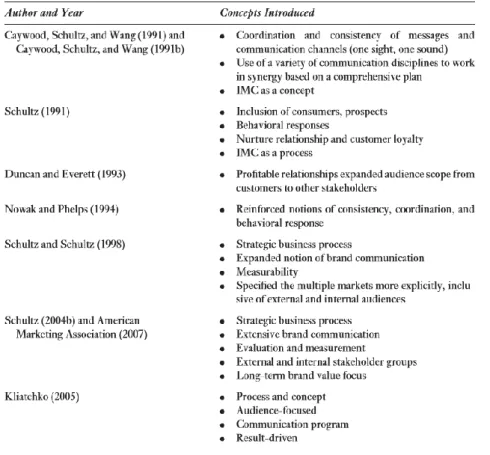
Kitchen and Burgmann (2010) highlighted several IMC definitions defended by different authors. Table 4 shows the various definitions that point out that IMC goes beyond the simple coordination of messages.
48
Table 4 - IMC definitions (Kitchen and Burgmann, 2010).
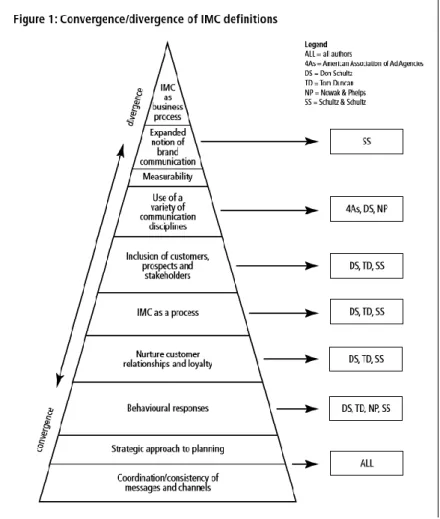
Figure 7 completes the knowledge of the previous table by highlighting the many aspects where several authors agree on when defining IMC and where they mostly diverge. Indeed, many agree that IMC is a coordination of messages, however, as seen before, IMC can be a lot more complex.
49
Figure 7- Convergence/divergence of IMC definitions (Kliatchko, 2005).
Through table 4 and figure 7 we can conclude that IMC is generally regarded as “a cross-functional process for creating and nourishing profitable relationships with customers and other stakeholders by strategically controlling or influencing all messages sent to these groups and encouraging data-driven, purposeful dialogue with them” (Duncan 2002, cited by Holm, 2006, p.8). Burnett and Moriarty (cited by Keller, 2008, p.249) add that IMC is a “practice of unifying all marketing communication tools — from advertising to packaging— to send target audiences a consistent, persuasive message that promotes company goals”. Moreover, IMC is also considered a business process.
50
Kitchen et al. (2004) and Low (2000) also did a review of IMC definitions. According to these authors any IMC definition should be reduced to five crucial attributes (Kliatchko 2002 cited by Kliatchko, 2005, p.7):
1. “The communication effort should be directed at consumers in order to affect behavior;
2. An outside-in approach should be utilized, that is, start with the customer first when developing a communication strategy;
3. A well-established relationship between the company and the customer is necessary;
4. To deliver a message correctly all communication activities should be included with contact points integrated into the strategy;
To establish an effective IMC strategy, a complete change of mindsets is necessary. Moreover, IMC “involves a dynamic series of progressive and interdependent steps, such as database building and management of consumer information, developing and planning messages to be delivered using a variety of channels, and evaluating and measuring synergistic brand communication programs” (Kliatchko, 2005, p.24).
Indeed, embracing an IMC program “demands a global and comprehensive view of the company’s total business” (Kliatchko, 2005, p.24). To be implemented, IMC requires the involvement of the whole organization. It needs to consider all layers of a company and business (Reid et al., 2013).
51
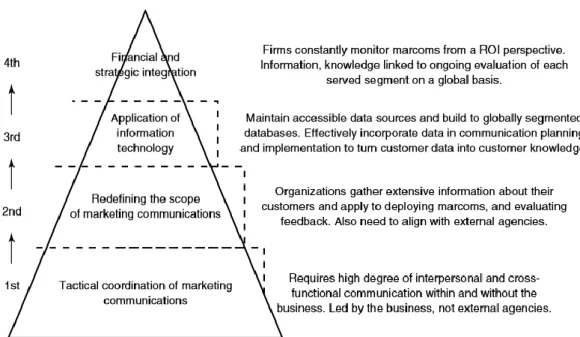
Figure 8 - IMC a four-stage model (Kitchen and Shultz, 2001).
Kitchen and Schultz (2001) developed a four stage model (figure 8) where they explain the steps needed to develop a successful and effective IMC program (cited by Kitchen and Burgmann, 2010). The model suggests that planning and coordinating communication programs are only a small part of an IMC approach. Indeed, there is a need to go further and gather consumer information, evaluate feedback, build databases and incorporate data into the communication planning and finally proceed to a financial and strategic integration.
Keller (2001, p.822) stated that IMC programs must entail that: “multiple types of communication options are employed; communication options are designed in a way to reflect the existence and content of other communication options in the program”.
Furthermore, Keller (2008, pp.248-249) believes that there are four fundamental criteria to assure a correct and effective IMC strategy:
1. “Coverage – proportion of the audience reached by each communication option, and how much overlap exists among communication options.
52
2. Contribution – ability of a marketing communication to create the desired response and communication effects from consumers in the absence of exposure to any other communication option;
3. Commonality – every communication option should “coordinate the entire marketing communication program to create a consistent and cohesive brand image in which brand associations share content and meaning; 4. Complementarity – communication options are often more effective when
used in tandem. Complementarity describes the extent to which different associations and linkages are emphasized across communication options; 5. Conformability – conformability refers to the extent that a marketing
communication option is robust and effective for different groups of consumers. The reality of any IMC program is that when consumers are exposed to a particular marketing communication, some consumers will have already been exposed to other marketing communications for the brand, and others will not. We consider a marketing communication option conformable when it achieves its desired effect regardless of consumers’ past communication history;
6. Cost – evaluations of marketing communications on all of the preceding criteria must be weighed against their cost to arrive at the most effective and efficient communication program”.
Many authors highlight the importance of employing an IMC strategy for building a successful brand. Indeed, by strategically managing brand messages, IMC can contribute to the building of a successful brand (Reid et al., 2013). Thus, many academic researchers and marketers employ IMC to support their brands (e.g. Duncan and Moriarty 1997; Edell, 1993; Keller 1996; Moore and Thorson 1996; Percy 1997; Schultz, Tannenbaum, and Lauterborn 1994 cited by Keller, 2001, pp.821-822).
53
Kitchen, Joanne, and Tao (2004) also suggest that IMC is the major communication development of the last decade, and that it is a potential driver of competitive advantage (cited by Reid et al., 2013, p.12).
The role of IMC in building successful brands can be summarized as the following:
IMC facilitates the management of marketing communication (Kitchen, Joanne, and Tao’s, 2004 cited by Reid et al., 2013);
“IMC can better inform, influence, motivate, and enlighten consumers about new and existing products because of its integrative nature and its strategic long-term focus on the actual brand” (Keller, 2001 cited by Kitchen and Burgmann, 2010, p.5);
“all target audiences are considered; individual and one-to-one communication is encouraged; synergy and recall increase; results in financial benefits” (McGrath, 2005a; Reid, 2003; Pickton and Hartley,1998 cited by Kitchen and Burgmann, 2010, p.6);
“Organizations employing IMC would have a greater capacity to achieve their stated direct and indirect campaign objectives, including increased brand awareness, positive brand attitude and preference, brand action intention, and purchase facilitation” (Rossiter and Bellman 2005 cited by Reid et al., 2013, p.20);
“Brands are harder to damage once customer loyalty has been achieved through coherent IMC” (Kitchen and Burgmann, 2010, p.5);
IMC makes the brand less vulnerable to competition (Reid et al., 2013, p.20).
54
Figure 9 - Integrating marketing communications to build brand equity (Kotler and Keller, 2009).
IMC recognizes the added value of a comprehensive plan that understands the roles of the many communication tools and strategies, “and combines these disciplines to provide clarity, consistency, and maximum communication impact” (Caywood, Schultz, and Wang, 1991 cited by Kitchen and Burgmann, 2010, p.2).
To increase the value of the brand offer, marketers can use several combinations of methods with the goal of increasing benefits and reducing costs (Holm, 2006, p.24). A competitive brand needs the coordination of all communication disciplines (figure9) (Kitchen and Burgmann, 2010, p.4).
More important is to adjust objectives and strategies to the changing marketing and communication realities (Holm, 2006, p.26).
Some authors have related IMC to the decline in effectiveness of television advertising, which encouraged organizations to redirect resources towards other media (e.g., Duncan and Everett, 1993; Kitchen and Schultz, 1999; Rust and Oliver 1994 cited by Dewhirst and Davis, 2005). The numerous tools and several combinations illustrate the complexity of IMC and confirm that decisions concerning IMC are a strategic issue (Holm, 2006).
55
In summary, IMC can be viewed and explained as “one voice, one look” (Dewhirst and Davis, 2005, p.82). The concept of IMC entails that marketing communication plays a central role within an organization. Its application has an influence on all “other areas of the business operation” (Kitchen and Burgmann, 2010, pp.24-25). Hence, we can conclude that applying an integrated approach would “encompass and take into account all other areas of business operations” (Kitchen and Burgmann, 2010, pp.24-25). Vargo and Lusch (2004, cited by Madhavarm et al., 2005, p.69) suggest that: “IMC should replace diverse, limited-focus promotional tools; brand management should be used for initiating and maintaining a continuing dialogue with the customers and for enhancing relationships”.
If we accept that “communication is the foundation of all human relationship” Duncan, (2002, cited by Holm, 2006, p.24), we also have to accept that “only strategically oriented integrated brand communications can help business to reach a sustainable competitive position”. Integration and customization of the message “have become increasingly crucial factors in building and maintaining successful brands”, as companies try to stand out from competitors and win customers (Keller, 2008, p.179). Indeed, if companies disregard IMC and different messages are not delivered coherently this may lead to an inconsistent brand image, which can negatively influence consumer purchasing behavior (McGrath, 2005b; Stammerjohan et al., 2005; Stewart, 1996; Schultz, 1993 cited by Kitchen and Burgmann, 2010, p.5).
56
2.5.2 Marketing communication mix
The marketing communications mix embodies an array of tools that allow brands to reach their target audiences effectively. Also, the correct use of marketing communications mix allows the development of a coherent IMC strategy.
Marketing communications options can have many forms (Hoeffler and Keller, 2003, p.432). Keller (2008) gathered some of the main tools available for marketing communications in Figure 10.
Within this range of options, many authors such as Ghodeswar (2008), Hoeffler and Keller (2003); Kotler and Keller (2009), agree that the majority of the marketing communication tools converge into these categories: personal selling, advertising, sales promotions, merchandising, public relations, direct marketing and more recently, online communications.
57
Figure 10 - Marketing communications options (Keller, 2008).
The communication tools can be used “in various combinations and different degrees of intensity” (Fill and Jamieson, 2011, p.33). According to Keller (1994, p.11) they allow the development of the “desired brand image and knowledge structures“ and as well as “strong favorable and unique brand associations”. Moreover, Ghodeswar (2008) added that if repetition is made in a creative way and through different types of media, successful brands are easily built.
However, as mentioned in the IMC chapter, regardless of “which options are chosen, the entire marketing program should be coordinated to create a consistent and cohesive brand image” (Keller, 1994, p.11). Indeed, the wide number of options available reminds that it is necessary for marketers “to understand the collective contribution of the program. This collective contribution will depend not only on the main effects of each communication option but also the interaction effects among communication options” (Keller, 2001, p.824). This necessity is also referred by Kitchen and Burgmann (2010, p.7):