arXiv:1204.5638v2 [hep-ex] 30 Jun 2012
CERN-PH-EP-2012-098
Submitted to: Physical Review Letters
Search for supersymmetry in events with three leptons and
missing transverse momentum in
√
s
=
7 TeV
pp
collisions
with the ATLAS detector
The ATLAS Collaboration
Abstract
A search for the weak production of charginos and neutralinos decaying to a final state with
three leptons (electrons or muons) and missing transverse momentum is presented. The analysis
uses 2.06 fb
−1of
√
s =
7 TeV proton-proton collision data delivered by the Large Hadron Collider and
recorded with the ATLAS detector. Observations are consistent with standard model expectations
in two signal regions that are either depleted or enriched in
Z
-boson decays. Upper limits at 95%
confidence level are set in R-parity conserving phenomenological minimal supersymmetric and
sim-plified models. For the simsim-plified models, degenerate lightest chargino and next-to-lightest neutralino
masses up to 300 GeV are excluded for mass differences from the lightest neutralino up to 300 GeV.
momentum in
s
= 7 TeV pp collisions with the ATLAS detector
The ATLAS Collaboration
A search for the weak production of charginos and neutralinos decaying to a final state with three leptons (electrons or muons) and missing transverse momentum is presented. The analysis
uses 2.06 fb−1 of√s = 7 TeV proton-proton collision data delivered by the Large Hadron Collider
and recorded with the ATLAS detector. Observations are consistent with standard model expec-tations in two signal regions that are either depleted or enriched in Z-boson decays. Upper limits at 95% confidence level are set in R-parity conserving phenomenological minimal supersymmetric and simplified models. For the simplified models, degenerate lightest chargino and next-to-lightest neutralino masses up to 300 GeV are excluded for mass differences from the lightest neutralino up to 300 GeV.
PACS numbers: 14.80.Ly, 14.80.Nb, 12.60.Jv
Supersymmetric (SUSY) extensions [1–9] of the stan-dard model (SM) naturally address the gauge hierarchy problem [10–12] by postulating the existence of SUSY particles, or “sparticles”, with spin differing by one-half unit with respect to that of their SM partner. If R-parity [13–17] is conserved, sparticles can only be pair-produced and will eventually decay into SM par-ticles and the lightest SUSY particle (LSP) which is
stable. Charginos ( ˜χ±i , i = 1, 2) and neutralinos ( ˜χ0j,
j = 1, 2, 3, 4) are the mass eigenstates formed from the linear superposition of the SUSY partners of the Higgs and electroweak gauge bosons. These are the higgsinos, and the winos, zino, and bino, collectively known as
gaug-inos. Naturalness requires ˜χ±i and ˜χ
0
j (and third
gener-ation sparticles) to have masses in the hundreds of GeV range [18]. In scenarios where first and second genera-tion sfermion masses are larger than few TeVs, the direct production of weak gauginos may be the dominant SUSY process at the Large Hadron Collider (LHC).
Leptonic decays of charginos include sneutrinos (˜νℓ±
),
sleptons (˜ℓ±
ν) or W bosons (W±(∗)χ˜0
1), while those of
unstable neutralinos include sleptons (ℓ ˜ℓ±) or Z bosons
(Z(∗)χ˜0
1). When both gauginos decay leptonically, a
dis-tinctive signature with three leptons and significant miss-ing transverse momentum can be observed, the latter originating from the two undetected LSPs and the neu-trinos.
This letter presents the first search with the ATLAS detector for the weak production of charginos and neu-tralinos decaying to a final state with three leptons (elec-trons or muons) and missing transverse momentum. The
analysis is based on 2.06 fb−1 of proton-proton collision
data delivered by the LHC at a center-of-mass energy √
s = 7 TeV between March and August 2011. The search significantly extends the current mass limits on charginos and neutralinos [19–22] and yields sensitivity in the mass region preferred by naturalness.
In this analysis, observations are interpreted in the phenomenological minimal supersymmetric SM (pMSSM
[23]) and in simplified models [24]. In the pMSSM the
masses of the ˜χ±i and ˜χ0j depend on the gaugino masses
M1 and M2, the Higgs mass parameter |µ|, and tan β,
the ratio of the expectation values of the two Higgs dou-blets. The masses of the gluinos, squarks and left-handed sleptons are chosen to be larger than 1 TeV, while the right-handed sleptons (including third-generation ones)
are assumed to be degenerate with mℓ˜R= (mχ˜
0
2+mχ˜
0
1)/2.
In these scenarios, decays to sleptons are favored. In the simplified models, the masses of the relevant
par-ticles (mass degenerate wino-like ˜χ±
1 and ˜χ02; bino-like
˜
χ0
1; ˜ν; ˜ℓL) are the only free parameters of the
the-ory. The ˜χ±
1 and ˜χ02 are produced via the s-channel
exchange of a virtual gauge boson and decay via left-handed sleptons, including staus, and sneutrinos of mass
m˜ν = m˜ℓL= (mχ˜
0
1 + mχ˜
±
1)/2) with a branching ratio of
50% each.
ATLAS [25] is a multipurpose particle detector with forward-backward symmetric cylindrical geometry. It in-cludes an inner tracker (ID) immersed in a 2 T mag-netic field providing precision tracking of charged par-ticles for pseudorapidities |η| < 2.5 [26]. Calorimeter sys-tems with either liquid argon or scintillating tiles as the active media provide energy measurements over the range |η| < 4.9. The muon detectors outside the calorime-ters are contained in a toroidal magnetic field produced by air-core superconducting magnets with field integrals varying from 1 to 8 T·m. They provide trigger and high-precision tracking capabilities for |η| < 2.4 and |η| < 2.7, respectively. Electrons must satisfy tight identification
criteria and fulfil |η| < 2.47 and ET> 10 GeV, where |η|
and ETare determined from the calibrated clustered
en-ergy deposits in the electromagnetic calorimeter matched to an ID track. Muons are reconstructed by combining tracks in the ID and tracks in the muon spectrometer [27]. Reconstructed muons are considered as candidates if they
have transverse momentum pT> 10 GeV, |η| < 2.4, and
transverse impact parameter with respect to the primary
muons, well separated from each other and from candi-date jets. “Signal” leptons are tagged leptons for which the scalar sum of the tracks’ transverse momenta within
∆R ≡p(∆φ)2+ (∆η)2< 0.2 around the lepton
candi-date is less than 10% of the ET for electrons, and less
than 1.8 GeV for muons. Jets are reconstructed from clustered energy deposits calibrated at the
electromag-netic scale using the anti-ktalgorithm [28] with a radius
parameter of 0.4. The jet energy is corrected to account for the non-compensating nature of the calorimeter us-ing correction factors obtained from Monte Carlo (MC) simulation and parameterized as a function of the jet
ET and η [29]. Jets considered in this analysis have
ET> 20 GeV and |η| < 2.8. Jets are identified as
con-taining a b-quark, and thus called “b-tagged”, using a multivariate technique based on quantities such as the impact parameter of the tracks associated to the sec-ondary vertex, tracks in jet and other jet shape infor-mation, consistent with the expected topology of b-quark decays. The b-tagging algorithm [30] correctly identifies b-quark jets in top decays with an efficiency of 60% and misidentifies jets containing light flavor quarks and glu-ons with a rate of < 1%, for jets with |η| < 2.5 and jet
ET> 20 GeV. The missing transverse momentum, ETmiss,
is the magnitude of the vector sum of the transverse
mo-mentum or transverse energy of all pT> 10 GeV muons,
ET> 10 GeV electrons, ET> 20 GeV jets, and calibrated
calorimeter clusters with |η| < 4.5 not associated to these objects [31].
Several MC generators are used to simulate SM processes and SUSY signals relevant for this
analy-sis. HERWIG [32] is used to simulate diboson
pro-cesses (W W(∗), ZZ(∗), W Z(∗)), while MadGraph [33] is
used for the t¯tW(∗)/Z(∗) processes. MC@NLO [34] is
cho-sen for the simulation of single and pair production of top quarks, while ALPGEN [35] is used to simulate
W(∗)/Z(∗)+jets. Expected diboson yields are
normal-ized using next-to-leading order (NLO) QCD predic-tions obtained with MCFM [36, 37]. The top-quark pair-production contribution is normalized to approximate next-to-next-to-leading (NNLO) order calculations [38]
and the t¯tW(∗)/Z(∗) contributions are normalized to
NLO results [39]. The QCD NNLO FEWZ [40, 41] and
MCFM cross-sections are used for NNLO normalization
of the Z+light-flavor jets and Z+heavy-flavor jets pro-cesses, respectively. The choice of the parton distribu-tion funcdistribu-tions (PDFs) depends on the generator. MRST
2007 LO∗[42] sets are used for HERWIG, CTEQ6L1 [43] with
MadGraph and ALPGEN, and CTEQ6.6 [44] with MC@NLO.
The pMSSM and simplified model samples are produced with HERWIG and HERWIG++ [45], respectively, and the yields are normalized to the NLO cross-sections obtained from PROSPINO [46] using the PDF set CTEQ6.6 with the renormalization/factorization scales set to the aver-age of the relevant gaugino masses. Fragmentation and hadronization for the ALPGEN and MC@NLO (MadGraph)
samples are performed with HERWIG (PYTHIA [47]). For all MC samples, the propagation of particles through the ATLAS detector is modeled using GEANT4 [48, 49]. The effect of multiple proton-proton collisions from the same or different bunch crossings is incorporated into the simu-lation by overlaying additional minimum bias events onto hard scatter events using JIMMY [50]. Simulated events are weighted to match the distribution of the mean num-ber of interactions per bunch crossing observed in data.
The data sample was collected with a single-muon
trigger (pT>18 GeV) or a single-electron trigger (ET>20
or 22 GeV, depending on the instantaneous luminosity). At least one signal lepton is required to have triggered
the event and have pT(ET) above 20 GeV (25 GeV) for
muons (electrons). Events recorded during normal run-ning conditions are analyzed if at least one of the re-constructed primary vertices has more than four tracks associated to it. Events containing jets with |η| < 4.9 and failing the quality criteria described in Ref. [29] are rejected to suppress both collisional and non-collisional background. Selected events must contain exactly three
signal leptons. As leptonic decays of ˜χ0
j yield same-flavor
opposite-sign (SFOS) lepton pairs, the presence of at least one such pair is required. The invariant mass of any SFOS lepton pair must be above 20 GeV to suppress background from low mass resonances and the missing
transverse momentum must satisfy Emiss
T > 50 GeV.
Two signal regions are then defined: a “Z-depleted” region (SR1), with no SFOS pairs having invariant mass within 10 GeV of the nominal Z-boson mass; and a “Z-enriched” one (SR2), where at least one SFOS pair has an invariant mass within 10 GeV of the Z-boson mass. Events in SR1 are further required to contain no b-tagged jets to suppress contributions from b-jet-rich backgrounds, where a fake lepton could originate from a heavy-flavor decay. The SR1 and SR2 selections target SUSY events with intermediate slepton or on-mass-shell Z-boson decays, respectively.
Several SM processes contribute to the background in SR1 and SR2. A background process is considered “ir-reducible” if it leads to events with three real and iso-lated leptons, referred to as “real” leptons below. These
include diboson (W Z(∗) and ZZ(∗)) and t¯tW/Z(∗)
pro-duction, where the gauge boson may be produced off-mass-shell. Their contribution is determined using the corresponding MC samples , for which lepton and jet se-lection efficiencies are corrected to account for differences with respect to data. A “reducible” process has at least one “fake” object, that is either a lepton from a semilep-tonic decay of a heavy-flavor quark or an electron from an isolated photon conversion. The contribution from misidentified light-flavor quarks is negligible. The re-ducible background includes single- and pair-production
of top-quark and W W(∗) or W(∗)/Z(∗)produced in
asso-ciation with jets or photons. The dominant component is the production of top quarks, with a contribution of 1%
or less from Z(∗)+jets production. The reducible
back-ground is estimated using a “matrix method” similar to that described in Ref. [51].
In this implementation of the matrix method, the
sig-nal lepton with the highest pTor ETis taken to be real,
which is a valid assumption in 99% of the cases, based on MC studies. The number of observed events with one or two fakes is then extracted from a system of linear equa-tions linking the number of events with two additional signal or tagged candidates to the number of events with two additional candidates that are either real or fake. The coefficients of the linear equations are functions of the real lepton identification efficiencies and of the fake object misidentification probabilities. The identification efficiency is measured in data using lepton candidates from Z → ℓℓ decays.
Misidentification probabilities for each fake type (heavy flavor, conversion) and for each reducible back-ground process are obtained using simulated events with one signal and two tagged leptons. These misidentifica-tion probabilities are then corrected using the ratio (fake scale factor) of the misidentification probability in data and that in MC simulation obtained in dedicated control samples. For heavy flavor fakes, the correction factor is measured in b¯b events, while for conversion fakes it is de-termined in a sample of photons radiated from a muon in Z → µµ decays. A weighted average misidentication probability is then calculated by weighting the corrected type- and process-dependent misidentification probabili-ties according to the process cross-section.
An additional source of background is due to events with two signal leptons and one virtual photon converting
into two muons, one with pT above 10 GeV. The
contri-bution from events in which both muons from the virtual
photons have pTabove 10 GeV is negligible due to the
re-quirement on the dilepton pair invariant mass. For events with only one muon above threshold, an upper limit of 0.5 ± 0.5 in SR1 and of 0.7 ± 0.7 in SR2 is obtained from data as follows. The number of observed events with
ex-actly two signal leptons and Emiss
T > 50 GeV is rescaled
by the probability that any of the signal leptons could have radiated the converted photon. This probability is
measured in events with Emiss
T < 50 GeV as the ratio of
number of events with three signal muons with trilep-ton invariant mass within 10 GeV of the nominal Z bo-son mass to the number of events with two signal muons having the dilepton mass in the same mass window.
The matrix method has been tested using MC events and shown to be accurate within 2%. The background predictions have been validated in a region dominated
by Z(∗)+jets production (VR1: three signal leptons,
30< Emiss
T < 50 GeV) and in one dominated by top
pair-production (VR2: three signal leptons, SFOS lepton
pairs vetoed, Emiss
T > 50 GeV). The data and predictions
are in agreement within the quoted statistical and sys-tematic uncertainties as shown in Table I.
Several sources of systematic uncertainty are consid-ered in the signal regions. The systematic uncertain-ties affecting the MC based estimates (irreducible back-ground yield, misidentification probabilities, signal yield) include the theoretical cross section uncertainty due to scale and PDFs, the acceptance uncertainty due to PDFs, jet energy scale, jet energy resolution, lepton en-ergy scale, lepton enen-ergy resolution, lepton efficiency, b-tagging efficiency, event quality selection, and the uncer-tainty on the luminosity. In SR1, the total unceruncer-tainty on the irreducible background is 17%. This includes the uncertainty on the acceptance due to PDFs (14%), that on the theoretical cross section due to scale and PDFs (7%), and that from the limited number of simulated events (10%), while all the remaining uncertainties on the irreducible background in this signal region range between 0.5-5%. The total uncertainty on the reducible background is 29%. This includes an uncertainty on the object misidentification probability of 10-30% from the sources listed above. The uncertainty from the
depen-dence of the misidentification probability on ETmiss (0.4–
17%) and the uncertainty on the fake scale factors (10– 50%) are also included in the total, together with the uncertainty from the limited number of data events with three tagged leptons, of which at least one is a signal lep-ton. The total uncertainties on the signal cross-section range between 10-15%. These include uncertainties due
to the renormalization and factorization scale, αS, and
PDFs. The maximum uncertainty obtained from either the CTEQ6.6 or the MSTW [52] PDF set is used. In SR2, the values of systematic uncertainties are similar to those ob-tained in SR1. The only exceptions are the uncertainty from the limited number of simulated events (4%) and the uncertainty on the reducible background (52%). In all of the above, the value used for the uncertainty on the luminosity is 3.7%.
The numbers of observed events and the prediction for SM backgrounds in SR1 and SR2 are reported in Ta-ble I. The probability that the background fluctuates to the observed number of events or higher is calcu-lated in the frequentist approach and found to be 19%
in SR1 and 6% in SR2. The distributions of the ETmiss
in the two signal regions are presented in Fig. 1. The yield in SR1 for one of the simplified model scenarios
(mχ˜± 1, mχ˜ 0 2, mℓ˜L, mχ˜ 0 1= 250, 250, 175, 100 GeV) is also
shown for illustration purposes.
No significant excess of events is found in either sig-nal region. Upper limits on the visible production cross-section of 9.9 fb in SR1 and 23.8 fb in SR2 are placed at 95% confidence level (CL) with the modified
frequen-tist CLs prescription [53]. No corrections for the effects
of experimental resolution, acceptance and efficiency are applied. All systematic uncertainties and their corre-lations are taken into account via nuisance parameters. The corresponding expected limits are 7.1 fb and 14.1 fb, respectively. In SR2, the observed limit on the visible
TABLE I. Expected numbers of events from SM backgrounds
(Bkg.) and observed numbers of events in data, for 2.06 fb−1,
in control regions VR1 and VR2, and in signal regions SR1 and SR2. Both statistical and systematic uncertainties are included. Selection VR1 VR2 SR1 SR2 t¯tW(∗)/Z(∗) 1.4±1.1 0.7±0.6 0.4±0.3 2.7±2.1 ZZ(∗) 6.7±1.5 0.03±0.04 0.7±0.2 3.4±0.8 W Z(∗) 61±11 0.4±0.2 11±2 58±11 Reducible Bkg. 56±35 14±9 14±4 7.5±3.9 Total Bkg. 125±37 15±9 26±5 72±12 Data 122 12 32 95 [GeV] miss T E 50 100 150 200 250 300 Events / 20 GeV -1 10 1 10 2 10 Data 2011 Total SM Reduc.bkgd WZ ZZ (*) /Z (*) W t t SM+SUSY ref. point [GeV] miss T E 50 100 150 200 250 300 = 7 TeV s
∫
L dt = 2.06 fb-1 ATLASFIG. 1. ETmiss distributions for events in signal regions SR1
(left) and SR2 (right). The error band includes both statisti-cal and systematic uncertainty, while the errors on the data points are statistical only. The SUSY reference point used in SR1 is described in the text.
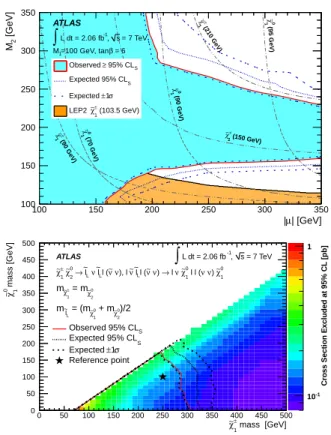
cross-section is less stringent than the expected limit be-cause of the upwards fluctuation in the number of events in data with respect to the expected background. SR1 provides better sensitivity in the parameter space consid-ered and the limits are interpreted in simplified models
and pMSSM scenarios with M1= 100 GeV and tan β = 6
(Fig. 2). The chosen M1 value leads to a sizable mass
splitting between ˜χ±1 and ˜χ01and therefore to a large
ac-ceptance. The value of tan β does not have a significant
impact on σ(pp → ˜χ±i χ˜0j) × BR( ˜χ
±
i χ˜0j → ℓℓℓ ˜χ01), which
varies by ∼10% if tan β is raised to 10.
In the simplified models, degenerate ˜χ±
1 and ˜χ02masses
up to 300 GeV are excluded for large mass differences
from the ˜χ0
1. Care has to be taken when interpreting
the simplified model limit in the context of a pMSSM scenario, where the mass of the sneutrino is lighter than the mass of the left-handed slepton, leading to higher lepton momenta from chargino decays and to a change
in the branching ratios of the ˜χ0
2. | [GeV] µ | 100 150 200 250 300 350 [GeV]2 M 100 150 200 250 300 350 (90 GeV) 1χ∼± 1 (150 GeV) ± χ∼ (210 GeV) 1χ∼± (70 GeV) 1χ ∼0 (90 GeV) 1χ ∼0 (95 GeV) 1χ ∼0 = 7 TeV s , -1 L dt = 2.06 fb
∫
= 6 β =100 GeV, tan 1 M ATLAS S 95% CL ≥ Observed S Expected 95% CL σ 1 ± Expected (103.5 GeV) ± 1 χ∼ LEP2 mass [GeV] 1 ± χ∼ 0 50 100 150 200 250 300 350 400 450 500 mass [GeV]1 0χ∼ 0 50 100 150 200 250 300 350 400 450 500 C ro s s S e c ti o n E x c lu d e d a t 9 5 % C L [ p b ] -1 10 1 = 7 TeV s , -1 L dt = 2.06 fb∫
0 1 χ∼ ) ν ν l l ( 0 1 χ∼ ν l → ) ν ν∼ l ( L l ~ ν∼ ), l ν ν∼ l ( L l ~ ν L l ~ → 0 2 χ∼ ± 1 χ∼ ATLAS 0 2 χ∼ = m ± 1 χ∼ m )/2 0 2 χ∼ + m 0 1 χ∼ m = ( L l ~ m S Observed 95% CL S Expected 95% CL σ 1 ± Expected Reference pointFIG. 2. Observed and expected 95% CL limit contours for chargino and neutralino production in the pMSSM (upper) and simplified model (lower) scenarios. For the simplified models, the 95% CL upper limit on the production cross-section is also shown. Interpolation is used to account for the discreteness of the signal grids.
In summary, results from the first ATLAS search for the weak production of charginos and neutralinos decay-ing to a final state with three leptons (electrons or muons) and missing transverse momentum are reported. The
analysis is based on 2.06 fb−1 of proton-proton collision
data delivered by the LHC at√s =7 TeV. No significant
excess of events is found in data, where upwards fluctua-tions of less than 2-sigma are observed. The null result is interpreted in pMSSM and in simplified models. For the simplified models with intermediate sleptons considered in this paper, degenerate lightest chargino and next-to-lightest neutralino masses are excluded up to 300 GeV for mass differences to the lightest neutralino up to 300 GeV.
ACKNOWLEDGEMENTS
We thank CERN for the very successful operation of the LHC, as well as the support staff from our institutions without whom ATLAS could not be operated efficiently. We acknowledge the support of ANPCyT, Argentina; YerPhI, Armenia; ARC, Australia; BMWF, Austria;
ANAS, Azerbaijan; SSTC, Belarus; CNPq and FAPESP, Brazil; NSERC, NRC and CFI, Canada; CERN; CONI-CYT, Chile; CAS, MOST and NSFC, China; COLCIEN-CIAS, Colombia; MSMT CR, MPO CR and VSC CR, Czech Republic; DNRF, DNSRC and Lundbeck Founda-tion, Denmark; EPLANET and ERC, European Union; IN2P3-CNRS, CEA-DSM/IRFU, France; GNAS, Geor-gia; BMBF, DFG, HGF, MPG and AvH Foundation, Germany; GSRT, Greece; ISF, MINERVA, GIF, DIP and Benoziyo Center, Israel; INFN, Italy; MEXT and JSPS, Japan; CNRST, Morocco; FOM and NWO, Netherlands; RCN, Norway; MNiSW, Poland; GRICES and FCT, Portugal; MERYS (MECTS), Romania; MES of Rus-sia and ROSATOM, RusRus-sian Federation; JINR; MSTD, Serbia; MSSR, Slovakia; ARRS and MVZT, Slovenia; DST/NRF, South Africa; MICINN, Spain; SRC and Wallenberg Foundation, Sweden; SER, SNSF and Can-tons of Bern and Geneva, Switzerland; NSC, Taiwan; TAEK, Turkey; STFC, the Royal Society and Lever-hulme Trust, United Kingdom; DOE and NSF, United States of America.
The crucial computing support from all WLCG part-ners is acknowledged gratefully, in particular from CERN and the ATLAS Tier-1 facilities at TRIUMF (Canada), NDGF (Denmark, Norway, Sweden), CC-IN2P3 (France), KIT/GridKA (Germany), INFN-CNAF (Italy), NL-T1 (Netherlands), PIC (Spain), ASGC (Tai-wan), RAL (UK) and BNL (USA) and in the Tier-2 fa-cilities worldwide.
[1] H. Miyazawa, Prog. Theor. Phys. 36, 1266 (1966) [2] P. Ramond, Phys. Rev. D3, 2415 (1971)
[3] Y. Golfand, E. Likhtman, JETP Lett. 13, 323 (1971) [4] A. Neveu and J. H. Schwarz, Nucl. Phys. B31, 86 (1971) [5] A. Neveu and J. H. Schwarz, Phys. Rev. D4, 1109 (1971) [6] J. Gervais and B. Sakita, Nucl. Phys. B34, 632 (1971) [7] D. Volkov and V. Akulov, Phys. Lett. B46, 109 (1973) [8] J. Wess and B. Zumino, Phys. Lett. B49, 52 (1974) [9] J. Wess and B. Zumino, Nucl. Phys. B70, 39 (1974) [10] E. Witten, Nucl. Phys. B188, 513 (1981)
[11] N. Sakai, Z. Phys. C11, 153 (1981)
[12] S. Dimopoulos, Nucl. Phys. B193, 150 (1981) [13] P. Fayet, Phys. Lett. B64, 159 (1976) [14] P. Fayet, Phys. Lett. B69, 489 (1977)
[15] G. R. Farrar and P. Fayet, Phys. Lett. B76, 575 (1978) [16] P. Fayet, Phys. Lett. B84, 416 (1979)
[17] S. Dimopoulos and H. Georgi, Nucl. Phys. B193, 150 (1981)
[18] K. L. Chan, U. Chattopadhyay, P. Nath, Phys. Rev. D58,
096004 (1998)
[19] Tech. Rep. LHWG-note-2001-05 (CERN, Geneva, 2001) [20] V. Abazov et al. (D0), Phys. Lett. B680, 34 (2009) [21] T. Aaltonen et al. (CDF), Phys. Rev. Lett. 101, 251801
(2008)
[22] ATLAS Collaboration, Phys. Lett. B709, 137 (2012) [23] A. Djouadi, J.L. Kneur, G. Moultaka, Comput. Phys.
Commun. 176, 426 (2007)
[24] J. Alwall, P. Schuster, N. Toro, Phys. Rev. D79, 075020 (2009)
[25] ATLAS Collaboration, JINST 3, S08003 (2008)
[26] ATLAS uses a right-handed coordinate system with its origin at the nominal interaction point (IP) in the cen-tre of the detector and the z-axis along the beam pipe. The x-axis points from the IP to the centre of the LHC ring, and the y-axis points upward. Cylindrical coordi-nates (R, φ) are used in the transverse plane, φ being the azimuthal angle around the beam pipe. The pseu-dorapidity is defined in terms of the polar angle θ as η = − ln tan(θ/2).
[27] ATLAS Collaboration, JHEP 12, 60 (2010)
[28] M. Cacciari, G.P. Salam, G. Soyez, JHEP 04, 063 (2008) [29] ATLAS Collaboration, submitted to Eur. Phys. J. C,
arXiv:1112.6426 (2011)
[30] ATLAS Collaboration, ATLAS-CONF-2011-102,
https://cdsweb.cern.ch/record/1369219
[31] ATLAS Collaboration, Eur. Phys. J. C72, 1844 (2012) [32] G. Corcella et al., JHEP 0101, 010 (2001)
[33] J. Alwall, M. Herquet, F. Maltoni, O. Mattelaer, T. Stelzer, JHEP 06, 128 (2011)
[34] S. Frixione and B.R. Webber, JHEP 0206, 029 (2002) [35] M. Mangano et al., JHEP 0307, 001 (2003)
[36] J. M. Campbell, R. K. Ellis, Phys. Rev. D60, 113006 (1999)
[37] J. M. Campbell, R. K. Ellis, C. Williams, JHEP 07, 018 (2011)
[38] M. Aliev, et al., Comput. Phys. Commun. 182, 1034 (2011)
[39] A. Kardos et al., arXiv:1111.0610 (2011)
[40] K. Melnikov, F. Petriello, Phys. Rev. D74, 114017 (2006) [41] C. Anastasiou et al., Phys. Rev. D69, 094008 (2004) [42] A. Sherstnev, R. Thorne, Eur. Phys. J. C55, 553 (2008) [43] J. Pumplin et al., J. High Energy Phys. 0207, 2002 (012) [44] P. M. Nadolsky et al, Phy. Rev. D78, 013004 (2008) [45] M. Bahr et al., Eur. Phys. J. C58, 639 (2008) [46] W. Beenakker et al., Nucl. Phys. B492, 51 (1997) [47] T. Sjostrand, S. Mrenna, P. Skands, JHEP 05, 026 (2006) [48] GEANT4 Collaboration, Nucl. Instrum. Meth. A506,
250 (2003)
[49] ATLAS Collaboration, Eur.Phys.J C70, 823 (2010) [50] J.M. Butterworth, J.R. Forshaw, M.H. Seymour, Z. Phys.
C72, 637 (1996)
[51] ATLAS Collaboration, Eur. Phys. J. C71, 1577 (2011) [52] A. Martin, W. Stirling, R. S. Thorne, G. Watt, Eur. Phys.
J. C63, 189 (2009)
The ATLAS Collaboration
G. Aad48, B. Abbott111, J. Abdallah11, S. Abdel Khalek115, A.A. Abdelalim49, O. Abdinov10, B. Abi112,
M. Abolins88, O.S. AbouZeid158, H. Abramowicz153, H. Abreu136, E. Acerbi89a,89b, B.S. Acharya164a,164b,
L. Adamczyk37, D.L. Adams24, T.N. Addy56, J. Adelman176, S. Adomeit98, P. Adragna75, T. Adye129, S. Aefsky22,
J.A. Aguilar-Saavedra124b,a, M. Aharrouche81, S.P. Ahlen21, F. Ahles48, A. Ahmad148, M. Ahsan40,
G. Aielli133a,133b, T. Akdogan18a, T.P.A. ˚Akesson79, G. Akimoto155, A.V. Akimov94, A. Akiyama66, M.S. Alam1,
M.A. Alam76, J. Albert169, S. Albrand55, M. Aleksa29, I.N. Aleksandrov64, F. Alessandria89a, C. Alexa25a,
G. Alexander153, G. Alexandre49, T. Alexopoulos9, M. Alhroob164a,164c, M. Aliev15, G. Alimonti89a, J. Alison120,
B.M.M. Allbrooke17, P.P. Allport73, S.E. Allwood-Spiers53, J. Almond82, A. Aloisio102a,102b, R. Alon172,
A. Alonso79, B. Alvarez Gonzalez88, M.G. Alviggi102a,102b, K. Amako65, C. Amelung22, V.V. Ammosov128,
A. Amorim124a,b, G. Amor´os167, N. Amram153, C. Anastopoulos29, L.S. Ancu16, N. Andari115, T. Andeen34,
C.F. Anders20, G. Anders58a, K.J. Anderson30, A. Andreazza89a,89b, V. Andrei58a, X.S. Anduaga70, A. Angerami34,
F. Anghinolfi29, A. Anisenkov107, N. Anjos124a, A. Annovi47, A. Antonaki8, M. Antonelli47, A. Antonov96,
J. Antos144b, F. Anulli132a, S. Aoun83, L. Aperio Bella4, R. Apolle118,c, G. Arabidze88, I. Aracena143, Y. Arai65,
A.T.H. Arce44, S. Arfaoui148, J-F. Arguin14, E. Arik18a,∗, M. Arik18a, A.J. Armbruster87, O. Arnaez81, V. Arnal80,
C. Arnault115, A. Artamonov95, G. Artoni132a,132b, D. Arutinov20, S. Asai155, R. Asfandiyarov173, S. Ask27,
B. ˚Asman146a,146b, L. Asquith5, K. Assamagan24, A. Astbury169, B. Aubert4, E. Auge115, K. Augsten127,
M. Aurousseau145a, G. Avolio163, R. Avramidou9, D. Axen168, G. Azuelos93,d, Y. Azuma155, M.A. Baak29,
G. Baccaglioni89a, C. Bacci134a,134b, A.M. Bach14, H. Bachacou136, K. Bachas29, M. Backes49, M. Backhaus20,
E. Badescu25a, P. Bagnaia132a,132b, S. Bahinipati2, Y. Bai32a, D.C. Bailey158, T. Bain158, J.T. Baines129,
O.K. Baker176, M.D. Baker24, S. Baker77, E. Banas38, P. Banerjee93, Sw. Banerjee173, D. Banfi29, A. Bangert150,
V. Bansal169, H.S. Bansil17, L. Barak172, S.P. Baranov94, A. Barbaro Galtieri14, T. Barber48, E.L. Barberio86,
D. Barberis50a,50b, M. Barbero20, D.Y. Bardin64, T. Barillari99, M. Barisonzi175, T. Barklow143, N. Barlow27,
B.M. Barnett129, R.M. Barnett14, A. Baroncelli134a, G. Barone49, A.J. Barr118, F. Barreiro80, J. Barreiro Guimar˜aes
da Costa57, P. Barrillon115, R. Bartoldus143, A.E. Barton71, V. Bartsch149, R.L. Bates53, L. Batkova144a,
J.R. Batley27, A. Battaglia16, M. Battistin29, F. Bauer136, H.S. Bawa143,e, S. Beale98, T. Beau78,
P.H. Beauchemin161, R. Beccherle50a, P. Bechtle20, H.P. Beck16, S. Becker98, M. Beckingham138, K.H. Becks175,
A.J. Beddall18c, A. Beddall18c, S. Bedikian176, V.A. Bednyakov64, C.P. Bee83, M. Begel24, S. Behar Harpaz152,
P.K. Behera62, M. Beimforde99, C. Belanger-Champagne85, P.J. Bell49, W.H. Bell49, G. Bella153, L. Bellagamba19a,
F. Bellina29, M. Bellomo29, A. Belloni57, O. Beloborodova107,f, K. Belotskiy96, O. Beltramello29, O. Benary153,
D. Benchekroun135a, K. Bendtz146a,146b, N. Benekos165, Y. Benhammou153, E. Benhar Noccioli49,
J.A. Benitez Garcia159b, D.P. Benjamin44, M. Benoit115, J.R. Bensinger22, K. Benslama130, S. Bentvelsen105,
D. Berge29, E. Bergeaas Kuutmann41, N. Berger4, F. Berghaus169, E. Berglund105, J. Beringer14, P. Bernat77,
R. Bernhard48, C. Bernius24, T. Berry76, C. Bertella83, A. Bertin19a,19b, F. Bertolucci122a,122b, M.I. Besana89a,89b,
N. Besson136, S. Bethke99, W. Bhimji45, R.M. Bianchi29, M. Bianco72a,72b, O. Biebel98, S.P. Bieniek77,
K. Bierwagen54, J. Biesiada14, M. Biglietti134a, H. Bilokon47, M. Bindi19a,19b, S. Binet115, A. Bingul18c,
C. Bini132a,132b, C. Biscarat178, U. Bitenc48, K.M. Black21, R.E. Blair5, J.-B. Blanchard136, G. Blanchot29,
T. Blazek144a, C. Blocker22, J. Blocki38, A. Blondel49, W. Blum81, U. Blumenschein54, G.J. Bobbink105,
V.B. Bobrovnikov107, S.S. Bocchetta79, A. Bocci44, C.R. Boddy118, M. Boehler41, J. Boek175, N. Boelaert35,
J.A. Bogaerts29, A. Bogdanchikov107, A. Bogouch90,∗, C. Bohm146a, J. Bohm125, V. Boisvert76, T. Bold37,
V. Boldea25a, N.M. Bolnet136, M. Bomben78, M. Bona75, M. Bondioli163, M. Boonekamp136, C.N. Booth139,
S. Bordoni78, C. Borer16, A. Borisov128, G. Borissov71, I. Borjanovic12a, M. Borri82, S. Borroni87,
V. Bortolotto134a,134b, K. Bos105, D. Boscherini19a, M. Bosman11, H. Boterenbrood105, D. Botterill129,
J. Bouchami93, J. Boudreau123, E.V. Bouhova-Thacker71, D. Boumediene33, C. Bourdarios115, N. Bousson83,
A. Boveia30, J. Boyd29, I.R. Boyko64, N.I. Bozhko128, I. Bozovic-Jelisavcic12b, J. Bracinik17, P. Branchini134a,
A. Brandt7, G. Brandt118, O. Brandt54, U. Bratzler156, B. Brau84, J.E. Brau114, H.M. Braun175, B. Brelier158,
J. Bremer29, K. Brendlinger120, R. Brenner166, S. Bressler172, D. Britton53, F.M. Brochu27, I. Brock20, R. Brock88,
E. Brodet153, F. Broggi89a, C. Bromberg88, J. Bronner99, G. Brooijmans34, W.K. Brooks31b, G. Brown82,
H. Brown7, P.A. Bruckman de Renstrom38, D. Bruncko144b, R. Bruneliere48, S. Brunet60, A. Bruni19a, G. Bruni19a,
M. Bruschi19a, T. Buanes13, Q. Buat55, F. Bucci49, J. Buchanan118, P. Buchholz141, R.M. Buckingham118,
A.G. Buckley45, S.I. Buda25a, I.A. Budagov64, B. Budick108, V. B¨uscher81, L. Bugge117, O. Bulekov96,
A.C. Bundock73, M. Bunse42, T. Buran117, H. Burckhart29, S. Burdin73, T. Burgess13, S. Burke129, E. Busato33,
P. Bussey53, C.P. Buszello166, B. Butler143, J.M. Butler21, C.M. Buttar53, J.M. Butterworth77, W. Buttinger27,
S. Cabrera Urb´an167, D. Caforio19a,19b, O. Cakir3a, P. Calafiura14, G. Calderini78, P. Calfayan98, R. Calkins106,
L.M. Caminada14, S. Campana29, M. Campanelli77, V. Canale102a,102b, F. Canelli30,g, A. Canepa159a, J. Cantero80,
L. Capasso102a,102b, M.D.M. Capeans Garrido29, I. Caprini25a, M. Caprini25a, D. Capriotti99, M. Capua36a,36b,
R. Caputo81, R. Cardarelli133a, T. Carli29, G. Carlino102a, L. Carminati89a,89b, B. Caron85, S. Caron104,
E. Carquin31b, G.D. Carrillo Montoya173, A.A. Carter75, J.R. Carter27, J. Carvalho124a,h, D. Casadei108,
M.P. Casado11, M. Cascella122a,122b, C. Caso50a,50b,∗, A.M. Castaneda Hernandez173, E. Castaneda-Miranda173,
V. Castillo Gimenez167, N.F. Castro124a, G. Cataldi72a, P. Catastini57, A. Catinaccio29, J.R. Catmore29,
A. Cattai29, G. Cattani133a,133b, S. Caughron88, D. Cauz164a,164c, P. Cavalleri78, D. Cavalli89a, M. Cavalli-Sforza11,
V. Cavasinni122a,122b, F. Ceradini134a,134b, A.S. Cerqueira23b, A. Cerri29, L. Cerrito75, F. Cerutti47, S.A. Cetin18b,
A. Chafaq135a, D. Chakraborty106, I. Chalupkova126, K. Chan2, B. Chapleau85, J.D. Chapman27, J.W. Chapman87,
E. Chareyre78, D.G. Charlton17, V. Chavda82, C.A. Chavez Barajas29, S. Cheatham85, S. Chekanov5,
S.V. Chekulaev159a, G.A. Chelkov64, M.A. Chelstowska104, C. Chen63, H. Chen24, S. Chen32c, X. Chen173,
A. Cheplakov64, R. Cherkaoui El Moursli135e, V. Chernyatin24, E. Cheu6, S.L. Cheung158, L. Chevalier136,
G. Chiefari102a,102b, L. Chikovani51a, J.T. Childers29, A. Chilingarov71, G. Chiodini72a, A.S. Chisholm17,
R.T. Chislett77, M.V. Chizhov64, G. Choudalakis30, S. Chouridou137, I.A. Christidi77, A. Christov48,
D. Chromek-Burckhart29, M.L. Chu151, J. Chudoba125, G. Ciapetti132a,132b, A.K. Ciftci3a, R. Ciftci3a, D. Cinca33,
V. Cindro74, C. Ciocca19a, A. Ciocio14, M. Cirilli87, M. Citterio89a, M. Ciubancan25a, A. Clark49, P.J. Clark45,
W. Cleland123, J.C. Clemens83, B. Clement55, C. Clement146a,146b, Y. Coadou83, M. Cobal164a,164c, A. Coccaro138,
J. Cochran63, P. Coe118, J.G. Cogan143, J. Coggeshall165, E. Cogneras178, J. Colas4, A.P. Colijn105, N.J. Collins17,
C. Collins-Tooth53, J. Collot55, G. Colon84, P. Conde Mui˜no124a, E. Coniavitis118, M.C. Conidi11,
S.M. Consonni89a,89b, V. Consorti48, S. Constantinescu25a, C. Conta119a,119b, G. Conti57, F. Conventi102a,i,
M. Cooke14, B.D. Cooper77, A.M. Cooper-Sarkar118, K. Copic14, T. Cornelissen175, M. Corradi19a, F. Corriveau85,j,
A. Cortes-Gonzalez165, G. Cortiana99, G. Costa89a, M.J. Costa167, D. Costanzo139, T. Costin30, D. Cˆot´e29,
L. Courneyea169, G. Cowan76, C. Cowden27, B.E. Cox82, K. Cranmer108, F. Crescioli122a,122b, M. Cristinziani20,
G. Crosetti36a,36b, R. Crupi72a,72b, S. Cr´ep´e-Renaudin55, C.-M. Cuciuc25a, C. Cuenca Almenar176,
T. Cuhadar Donszelmann139, M. Curatolo47, C.J. Curtis17, C. Cuthbert150, P. Cwetanski60, H. Czirr141,
P. Czodrowski43, Z. Czyczula176, S. D’Auria53, M. D’Onofrio73, A. D’Orazio132a,132b, C. Da Via82, W. Dabrowski37,
A. Dafinca118, T. Dai87, C. Dallapiccola84, M. Dam35, M. Dameri50a,50b, D.S. Damiani137, H.O. Danielsson29,
V. Dao49, G. Darbo50a, G.L. Darlea25b, W. Davey20, T. Davidek126, N. Davidson86, R. Davidson71, E. Davies118,c,
M. Davies93, A.R. Davison77, Y. Davygora58a, E. Dawe142, I. Dawson139, R.K. Daya-Ishmukhametova22, K. De7,
R. de Asmundis102a, S. De Castro19a,19b, S. De Cecco78, J. de Graat98, N. De Groot104, P. de Jong105,
C. De La Taille115, H. De la Torre80, F. De Lorenzi63, B. De Lotto164a,164c, L. de Mora71, L. De Nooij105,
D. De Pedis132a, A. De Salvo132a, U. De Sanctis164a,164c, A. De Santo149, J.B. De Vivie De Regie115,
G. De Zorzi132a,132b, W.J. Dearnaley71, R. Debbe24, C. Debenedetti45, B. Dechenaux55, D.V. Dedovich64,
J. Degenhardt120, C. Del Papa164a,164c, J. Del Peso80, T. Del Prete122a,122b, T. Delemontex55, M. Deliyergiyev74,
A. Dell’Acqua29, L. Dell’Asta21, M. Della Pietra102a,i, D. della Volpe102a,102b, M. Delmastro4, P.A. Delsart55,
C. Deluca148, S. Demers176, M. Demichev64, B. Demirkoz11,k, J. Deng163, S.P. Denisov128, D. Derendarz38,
J.E. Derkaoui135d, F. Derue78, P. Dervan73, K. Desch20, E. Devetak148, P.O. Deviveiros105, A. Dewhurst129,
B. DeWilde148, S. Dhaliwal158, R. Dhullipudi24,l, A. Di Ciaccio133a,133b, L. Di Ciaccio4, A. Di Girolamo29,
B. Di Girolamo29, S. Di Luise134a,134b, A. Di Mattia173, B. Di Micco29, R. Di Nardo47, A. Di Simone133a,133b,
R. Di Sipio19a,19b, M.A. Diaz31a, F. Diblen18c, E.B. Diehl87, J. Dietrich41, T.A. Dietzsch58a, S. Diglio86,
K. Dindar Yagci39, J. Dingfelder20, C. Dionisi132a,132b, P. Dita25a, S. Dita25a, F. Dittus29, F. Djama83,
T. Djobava51b, M.A.B. do Vale23c, A. Do Valle Wemans124a, T.K.O. Doan4, M. Dobbs85, R. Dobinson29,∗,
D. Dobos29, E. Dobson29,m, J. Dodd34, C. Doglioni49, T. Doherty53, Y. Doi65,∗, J. Dolejsi126, I. Dolenc74,
Z. Dolezal126, B.A. Dolgoshein96,∗, T. Dohmae155, M. Donadelli23d, M. Donega120, J. Donini33, J. Dopke29,
A. Doria102a, A. Dos Anjos173, A. Dotti122a,122b, M.T. Dova70, A.D. Doxiadis105, A.T. Doyle53, M. Dris9,
J. Dubbert99, S. Dube14, E. Duchovni172, G. Duckeck98, A. Dudarev29, F. Dudziak63, M. D¨uhrssen 29,
I.P. Duerdoth82, L. Duflot115, M-A. Dufour85, M. Dunford29, H. Duran Yildiz3a, R. Duxfield139, M. Dwuznik37,
F. Dydak29, M. D¨uren52, J. Ebke98, S. Eckweiler81, K. Edmonds81, C.A. Edwards76, N.C. Edwards53,
W. Ehrenfeld41, T. Eifert143, G. Eigen13, K. Einsweiler14, E. Eisenhandler75, T. Ekelof166, M. El Kacimi135c,
M. Ellert166, S. Elles4, F. Ellinghaus81, K. Ellis75, N. Ellis29, J. Elmsheuser98, M. Elsing29, D. Emeliyanov129,
R. Engelmann148, A. Engl98, B. Epp61, A. Eppig87, J. Erdmann54, A. Ereditato16, D. Eriksson146a, J. Ernst1,
M. Ernst24, J. Ernwein136, D. Errede165, S. Errede165, E. Ertel81, M. Escalier115, C. Escobar123, X. Espinal Curull11,
B. Esposito47, F. Etienne83, A.I. Etienvre136, E. Etzion153, D. Evangelakou54, H. Evans60, L. Fabbri19a,19b,
C. Fabre29, R.M. Fakhrutdinov128, S. Falciano132a, Y. Fang173, M. Fanti89a,89b, A. Farbin7, A. Farilla134a,
J. Farley148, T. Farooque158, S. Farrell163, S.M. Farrington118, P. Farthouat29, P. Fassnacht29, D. Fassouliotis8,
W. Fedorko88, M. Fehling-Kaschek48, L. Feligioni83, D. Fellmann5, C. Feng32d, E.J. Feng30, A.B. Fenyuk128,
J. Ferencei144b, W. Fernando5, S. Ferrag53, J. Ferrando53, V. Ferrara41, A. Ferrari166, P. Ferrari105, R. Ferrari119a,
D.E. Ferreira de Lima53, A. Ferrer167, D. Ferrere49, C. Ferretti87, A. Ferretto Parodi50a,50b, M. Fiascaris30,
F. Fiedler81, A. Filipˇciˇc74, F. Filthaut104, M. Fincke-Keeler169, M.C.N. Fiolhais124a,h, L. Fiorini167, A. Firan39,
G. Fischer41, M.J. Fisher109, M. Flechl48, I. Fleck141, J. Fleckner81, P. Fleischmann174, S. Fleischmann175,
T. Flick175, A. Floderus79, L.R. Flores Castillo173, M.J. Flowerdew99, T. Fonseca Martin16, D.A. Forbush138,
A. Formica136, A. Forti82, D. Fortin159a, D. Fournier115, H. Fox71, P. Francavilla11, S. Franchino119a,119b,
D. Francis29, T. Frank172, M. Franklin57, S. Franz29, M. Fraternali119a,119b, S. Fratina120, S.T. French27,
C. Friedrich41, F. Friedrich43, R. Froeschl29, D. Froidevaux29, J.A. Frost27, C. Fukunaga156,
E. Fullana Torregrosa29, B.G. Fulsom143, J. Fuster167, C. Gabaldon29, O. Gabizon172, T. Gadfort24, S. Gadomski49,
G. Gagliardi50a,50b, P. Gagnon60, C. Galea98, E.J. Gallas118, V. Gallo16, B.J. Gallop129, P. Gallus125, K.K. Gan109,
Y.S. Gao143,e, A. Gaponenko14, F. Garberson176, M. Garcia-Sciveres14, C. Garc´ıa167, J.E. Garc´ıa Navarro167,
R.W. Gardner30, N. Garelli29, H. Garitaonandia105, V. Garonne29, J. Garvey17, C. Gatti47, G. Gaudio119a,
B. Gaur141, L. Gauthier136, P. Gauzzi132a,132b, I.L. Gavrilenko94, C. Gay168, G. Gaycken20, E.N. Gazis9, P. Ge32d,
Z. Gecse168, C.N.P. Gee129, D.A.A. Geerts105, Ch. Geich-Gimbel20, K. Gellerstedt146a,146b, C. Gemme50a,
A. Gemmell53, M.H. Genest55, S. Gentile132a,132b, M. George54, S. George76, P. Gerlach175, A. Gershon153,
C. Geweniger58a, H. Ghazlane135b, N. Ghodbane33, B. Giacobbe19a, S. Giagu132a,132b, V. Giakoumopoulou8,
V. Giangiobbe11, F. Gianotti29, B. Gibbard24, A. Gibson158, S.M. Gibson29, D. Gillberg28, A.R. Gillman129,
D.M. Gingrich2,d, J. Ginzburg153, N. Giokaris8, M.P. Giordani164c, R. Giordano102a,102b, F.M. Giorgi15,
P. Giovannini99, P.F. Giraud136, D. Giugni89a, M. Giunta93, P. Giusti19a, B.K. Gjelsten117, L.K. Gladilin97,
C. Glasman80, J. Glatzer48, A. Glazov41, K.W. Glitza175, G.L. Glonti64, J.R. Goddard75, J. Godfrey142,
J. Godlewski29, M. Goebel41, T. G¨opfert43, C. Goeringer81, C. G¨ossling42, T. G¨ottfert99, S. Goldfarb87,
T. Golling176, A. Gomes124a,b, L.S. Gomez Fajardo41, R. Gon¸calo76, J. Goncalves Pinto Firmino Da Costa41,
L. Gonella20, S. Gonzalez173, S. Gonz´alez de la Hoz167, G. Gonzalez Parra11, M.L. Gonzalez Silva26,
S. Gonzalez-Sevilla49, J.J. Goodson148, L. Goossens29, P.A. Gorbounov95, H.A. Gordon24, I. Gorelov103,
G. Gorfine175, B. Gorini29, E. Gorini72a,72b, A. Goriˇsek74, E. Gornicki38, B. Gosdzik41, A.T. Goshaw5,
M. Gosselink105, M.I. Gostkin64, I. Gough Eschrich163, M. Gouighri135a, D. Goujdami135c, M.P. Goulette49,
A.G. Goussiou138, C. Goy4, S. Gozpinar22, I. Grabowska-Bold37, P. Grafstr¨om29, K-J. Grahn41, F. Grancagnolo72a,
S. Grancagnolo15, V. Grassi148, V. Gratchev121, N. Grau34, H.M. Gray29, J.A. Gray148, E. Graziani134a,
O.G. Grebenyuk121, T. Greenshaw73, Z.D. Greenwood24,l, K. Gregersen35, I.M. Gregor41, P. Grenier143,
J. Griffiths138, N. Grigalashvili64, A.A. Grillo137, S. Grinstein11, Y.V. Grishkevich97, J.-F. Grivaz115, E. Gross172,
J. Grosse-Knetter54, J. Groth-Jensen172, K. Grybel141, D. Guest176, C. Guicheney33, A. Guida72a,72b, S. Guindon54,
H. Guler85,n, J. Gunther125, B. Guo158, J. Guo34, V.N. Gushchin128, P. Gutierrez111, N. Guttman153,
O. Gutzwiller173, C. Guyot136, C. Gwenlan118, C.B. Gwilliam73, A. Haas143, S. Haas29, C. Haber14,
H.K. Hadavand39, D.R. Hadley17, P. Haefner99, F. Hahn29, S. Haider29, Z. Hajduk38, H. Hakobyan177, D. Hall118,
J. Haller54, K. Hamacher175, P. Hamal113, M. Hamer54, A. Hamilton145b,o, S. Hamilton161, L. Han32b,
K. Hanagaki116, K. Hanawa160, M. Hance14, C. Handel81, P. Hanke58a, J.R. Hansen35, J.B. Hansen35,
J.D. Hansen35, P.H. Hansen35, P. Hansson143, K. Hara160, G.A. Hare137, T. Harenberg175, S. Harkusha90,
D. Harper87, R.D. Harrington45, O.M. Harris138, K. Harrison17, J. Hartert48, F. Hartjes105, T. Haruyama65,
A. Harvey56, S. Hasegawa101, Y. Hasegawa140, S. Hassani136, S. Haug16, M. Hauschild29, R. Hauser88,
M. Havranek20, C.M. Hawkes17, R.J. Hawkings29, A.D. Hawkins79, D. Hawkins163, T. Hayakawa66, T. Hayashi160,
D. Hayden76, H.S. Hayward73, S.J. Haywood129, M. He32d, S.J. Head17, V. Hedberg79, L. Heelan7, S. Heim88,
B. Heinemann14, S. Heisterkamp35, L. Helary4, C. Heller98, M. Heller29, S. Hellman146a,146b, D. Hellmich20,
C. Helsens11, R.C.W. Henderson71, M. Henke58a, A. Henrichs54, A.M. Henriques Correia29, S. Henrot-Versille115,
F. Henry-Couannier83, C. Hensel54, T. Henß175, C.M. Hernandez7, Y. Hern´andez Jim´enez167, R. Herrberg15,
G. Herten48, R. Hertenberger98, L. Hervas29, G.G. Hesketh77, N.P. Hessey105, E. Hig´on-Rodriguez167, J.C. Hill27,
K.H. Hiller41, S. Hillert20, S.J. Hillier17, I. Hinchliffe14, E. Hines120, M. Hirose116, F. Hirsch42, D. Hirschbuehl175,
J. Hobbs148, N. Hod153, M.C. Hodgkinson139, P. Hodgson139, A. Hoecker29, M.R. Hoeferkamp103, J. Hoffman39,
D. Hoffmann83, M. Hohlfeld81, M. Holder141, S.O. Holmgren146a, T. Holy127, J.L. Holzbauer88, T.M. Hong120,
L. Hooft van Huysduynen108, C. Horn143, S. Horner48, J-Y. Hostachy55, S. Hou151, A. Hoummada135a,
J. Howarth82, I. Hristova15, J. Hrivnac115, I. Hruska125, T. Hryn’ova4, P.J. Hsu81, S.-C. Hsu14, Z. Hubacek127,
F. Hubaut83, F. Huegging20, A. Huettmann41, T.B. Huffman118, E.W. Hughes34, G. Hughes71, M. Huhtinen29,
M. Hurwitz14, U. Husemann41, N. Huseynov64,p, J. Huston88, J. Huth57, G. Iacobucci49, G. Iakovidis9,
M. Ibbotson82, I. Ibragimov141, L. Iconomidou-Fayard115, J. Idarraga115, P. Iengo102a, O. Igonkina105, Y. Ikegami65,
M. Ikeno65, D. Iliadis154, N. Ilic158, M. Imori155, T. Ince20, J. Inigo-Golfin29, P. Ioannou8, M. Iodice134a,
R. Ishmukhametov39, C. Issever118, S. Istin18a, A.V. Ivashin128, W. Iwanski38, H. Iwasaki65, J.M. Izen40,
V. Izzo102a, B. Jackson120, J.N. Jackson73, P. Jackson143, M.R. Jaekel29, V. Jain60, K. Jakobs48, S. Jakobsen35,
J. Jakubek127, D.K. Jana111, E. Jansen77, H. Jansen29, A. Jantsch99, M. Janus48, G. Jarlskog79, L. Jeanty57,
I. Jen-La Plante30, P. Jenni29, A. Jeremie4, P. Jeˇz35, S. J´ez´equel4, M.K. Jha19a, H. Ji173, W. Ji81, J. Jia148,
Y. Jiang32b, M. Jimenez Belenguer41, S. Jin32a, O. Jinnouchi157, M.D. Joergensen35, D. Joffe39, L.G. Johansen13,
M. Johansen146a,146b, K.E. Johansson146a, P. Johansson139, S. Johnert41, K.A. Johns6, K. Jon-And146a,146b,
G. Jones118, R.W.L. Jones71, T.J. Jones73, C. Joram29, P.M. Jorge124a, K.D. Joshi82, J. Jovicevic147, T. Jovin12b,
X. Ju173, C.A. Jung42, R.M. Jungst29, V. Juranek125, P. Jussel61, A. Juste Rozas11, S. Kabana16, M. Kaci167,
A. Kaczmarska38, P. Kadlecik35, M. Kado115, H. Kagan109, M. Kagan57, E. Kajomovitz152, S. Kalinin175,
L.V. Kalinovskaya64, S. Kama39, N. Kanaya155, M. Kaneda29, S. Kaneti27, T. Kanno157, V.A. Kantserov96,
J. Kanzaki65, B. Kaplan176, A. Kapliy30, J. Kaplon29, D. Kar53, M. Karagounis20, M. Karnevskiy41,
V. Kartvelishvili71, A.N. Karyukhin128, L. Kashif173, G. Kasieczka58b, R.D. Kass109, A. Kastanas13, M. Kataoka4,
Y. Kataoka155, E. Katsoufis9, J. Katzy41, V. Kaushik6, K. Kawagoe69, T. Kawamoto155, G. Kawamura81,
M.S. Kayl105, V.A. Kazanin107, M.Y. Kazarinov64, R. Keeler169, R. Kehoe39, M. Keil54, G.D. Kekelidze64,
J.S. Keller138, J. Kennedy98, M. Kenyon53, O. Kepka125, N. Kerschen29, B.P. Kerˇsevan74, S. Kersten175,
K. Kessoku155, J. Keung158, F. Khalil-zada10, H. Khandanyan165, A. Khanov112, D. Kharchenko64, A. Khodinov96,
A. Khomich58a, T.J. Khoo27, G. Khoriauli20, A. Khoroshilov175, V. Khovanskiy95, E. Khramov64, J. Khubua51b,
H. Kim146a,146b, M.S. Kim2, S.H. Kim160, N. Kimura171, O. Kind15, B.T. King73, M. King66, R.S.B. King118,
J. Kirk129, A.E. Kiryunin99, T. Kishimoto66, D. Kisielewska37, T. Kittelmann123, A.M. Kiver128, E. Kladiva144b,
M. Klein73, U. Klein73, K. Kleinknecht81, M. Klemetti85, A. Klier172, P. Klimek146a,146b, A. Klimentov24,
R. Klingenberg42, J.A. Klinger82, E.B. Klinkby35, T. Klioutchnikova29, P.F. Klok104, S. Klous105, E.-E. Kluge58a,
T. Kluge73, P. Kluit105, S. Kluth99, N.S. Knecht158, E. Kneringer61, E.B.F.G. Knoops83, A. Knue54, B.R. Ko44,
T. Kobayashi155, M. Kobel43, M. Kocian143, P. Kodys126, K. K¨oneke29, A.C. K¨onig104, S. Koenig81, L. K¨opke81,
F. Koetsveld104, P. Koevesarki20, T. Koffas28, E. Koffeman105, L.A. Kogan118, S. Kohlmann175, F. Kohn54,
Z. Kohout127, T. Kohriki65, T. Koi143, G.M. Kolachev107, H. Kolanoski15, V. Kolesnikov64, I. Koletsou89a, J. Koll88,
M. Kollefrath48, A.A. Komar94, Y. Komori155, T. Kondo65, T. Kono41,q, A.I. Kononov48, R. Konoplich108,r,
N. Konstantinidis77, A. Kootz175, S. Koperny37, K. Korcyl38, K. Kordas154, A. Korn118, A. Korol107, I. Korolkov11,
E.V. Korolkova139, V.A. Korotkov128, O. Kortner99, S. Kortner99, V.V. Kostyukhin20, S. Kotov99, V.M. Kotov64,
A. Kotwal44, C. Kourkoumelis8, V. Kouskoura154, A. Koutsman159a, R. Kowalewski169, T.Z. Kowalski37,
W. Kozanecki136, A.S. Kozhin128, V. Kral127, V.A. Kramarenko97, G. Kramberger74, M.W. Krasny78,
A. Krasznahorkay108, J. Kraus88, J.K. Kraus20, F. Krejci127, J. Kretzschmar73, N. Krieger54, P. Krieger158,
K. Kroeninger54, H. Kroha99, J. Kroll120, J. Kroseberg20, J. Krstic12a, U. Kruchonak64, H. Kr¨uger20, T. Kruker16,
N. Krumnack63, Z.V. Krumshteyn64, A. Kruth20, T. Kubota86, S. Kuday3a, S. Kuehn48, A. Kugel58c, T. Kuhl41,
D. Kuhn61, V. Kukhtin64, Y. Kulchitsky90, S. Kuleshov31b, C. Kummer98, M. Kuna78, J. Kunkle120, A. Kupco125,
H. Kurashige66, M. Kurata160, Y.A. Kurochkin90, V. Kus125, E.S. Kuwertz147, M. Kuze157, J. Kvita142, R. Kwee15,
A. La Rosa49, L. La Rotonda36a,36b, L. Labarga80, J. Labbe4, S. Lablak135a, C. Lacasta167, F. Lacava132a,132b,
H. Lacker15, D. Lacour78, V.R. Lacuesta167, E. Ladygin64, R. Lafaye4, B. Laforge78, T. Lagouri80, S. Lai48,
E. Laisne55, M. Lamanna29, L. Lambourne77, C.L. Lampen6, W. Lampl6, E. Lancon136, U. Landgraf48,
M.P.J. Landon75, J.L. Lane82, C. Lange41, A.J. Lankford163, F. Lanni24, K. Lantzsch175, S. Laplace78, C. Lapoire20,
J.F. Laporte136, T. Lari89a, A. Larner118, M. Lassnig29, P. Laurelli47, V. Lavorini36a,36b, W. Lavrijsen14,
P. Laycock73, O. Le Dortz78, E. Le Guirriec83, C. Le Maner158, E. Le Menedeu11, T. LeCompte5,
F. Ledroit-Guillon55, H. Lee105, J.S.H. Lee116, S.C. Lee151, L. Lee176, M. Lefebvre169, M. Legendre136,
B.C. LeGeyt120, F. Legger98, C. Leggett14, M. Lehmacher20, G. Lehmann Miotto29, X. Lei6, M.A.L. Leite23d,
R. Leitner126, D. Lellouch172, B. Lemmer54, V. Lendermann58a, K.J.C. Leney145b, T. Lenz105, G. Lenzen175,
B. Lenzi29, K. Leonhardt43, S. Leontsinis9, F. Lepold58a, C. Leroy93, J-R. Lessard169, C.G. Lester27, C.M. Lester120,
J. Levˆeque4, D. Levin87, L.J. Levinson172, A. Lewis118, G.H. Lewis108, A.M. Leyko20, M. Leyton15, B. Li83,
H. Li173,s, S. Li32b,t, X. Li87, Z. Liang118,u, H. Liao33, B. Liberti133a, P. Lichard29, M. Lichtnecker98, K. Lie165,
W. Liebig13, C. Limbach20, A. Limosani86, M. Limper62, S.C. Lin151,v, F. Linde105, J.T. Linnemann88,
E. Lipeles120, A. Lipniacka13, T.M. Liss165, D. Lissauer24, A. Lister49, A.M. Litke137, C. Liu28, D. Liu151, H. Liu87,
J.B. Liu87, M. Liu32b, Y. Liu32b, M. Livan119a,119b, S.S.A. Livermore118, A. Lleres55, J. Llorente Merino80,
S.L. Lloyd75, E. Lobodzinska41, P. Loch6, W.S. Lockman137, T. Loddenkoetter20, F.K. Loebinger82, A. Loginov176,
C.W. Loh168, T. Lohse15, K. Lohwasser48, M. Lokajicek125, V.P. Lombardo4, R.E. Long71, L. Lopes124a,
D. Lopez Mateos57, J. Lorenz98, N. Lorenzo Martinez115, M. Losada162, P. Loscutoff14, F. Lo Sterzo132a,132b,
M.J. Losty159a, X. Lou40, A. Lounis115, K.F. Loureiro162, J. Love21, P.A. Love71, A.J. Lowe143,e, F. Lu32a,
H.J. Lubatti138, C. Luci132a,132b, A. Lucotte55, A. Ludwig43, D. Ludwig41, I. Ludwig48, J. Ludwig48, F. Luehring60,