Platform for Quality of Experience Evaluation in Real Time
Applications over LTE networks
Luis Miguel Cardoso Pereira
[email protected]
Orientador
Doutor Osvaldo Arede dos Santos
Coorientador
Doutor Paulo Jorge Coelho Marques
Dissertação apresentado à Escola Superior de Tecnologia do Instituto Politécnico de Castelo Branco para cumprimento dos requisitos necessários à obtenção do grau de Mestre em Desenvolvimento de Software e Sistemas Interativos, realizada sob a orientação científica do Doutor Osvaldo Arede dos Santos e coorientação do Doutor Paulo Jorge Coelho Marques, do Instituto Politécnico de Castelo Branco.
III
Composição do Júri
Presidente do júri
Doutor Alexandre José Pereira Duro da Fonte
Professor Adjunto da UTC de Informática da Escola Superior de Tecnologia do
Instituto Politécnico de Castelo Branco
Vogais
Doutor Nuno Manuel Garcia dos Santos
Professor Auxiliar da Universidade da Beira Interior
Doutor Vasco Nuno da Gama de Jesus Soares
Professor Adjunto da UTC de Informática da Escola Superior de Tecnologia do
Instituto Politécnico de Castelo Branco
Doutor Osvaldo Arede dos Santos
Professor Adjunto da UTC de Informática da Escola Superior de Tecnologia do
Instituto Politécnico de Castelo Branco (Orientador)
V
Agradecimentos
Este trabalho foi realizado em cooperação com várias empresas e quero deixar um agradecimento a essas empresas que permitiram e possibilitaram a realização deste trabalho, são elas a Portugal Telecom Inovação (PTIN), Instituto Politécnico de Castelo Branco (IPCB), Instituto de Telecomunicações (IT) e Mecalbi – Engineering Solutions, Lda (MECALBI).
Como as empresas são constituídas por pessoas e são elas a parte principal das empresas, quero deixar aqui um especial agradecimento aos principais responsáveis destas empresas neste projeto: Eng. Álvaro Gomes (PTIN), Valdemar Monteiro (IT), Shahid Mumtaz (IT), Jonathan Rodriguez (IT), Fernando Mateus (MECALBI), Jorge Amaral (MECALBI) e Professor Doutor Paulo Marques (IPCB).
Quero deixar também um especial agradecimento ao Professor Doutor Osvaldo Santos, orientador deste trabalho, por todo o apoio e ajuda disponibilizada ao longo da realização deste trabalho.
Quero ainda deixar um especial agradecimento ao Professor Doutor Paulo Marques, coorientador deste trabalho, por todo o apoio, ajuda e confiança que colocou em mim ao me confiar esta tarefa no projeto Green-T.
VII
Resumo
Atualmente existem vário simuladores para várias tecnologias de redes sem fios (LTE, UMTS, Wi-Fi ...). Quase todos eles simulam valores para diferentes utilizadores como por exemplo de taxas de transferência (Mbit/s), a potência recebida, a SNR, entre outros valores, dependendo do tipo de simulação.
A maioria dos resultados apresentados pelos simuladores correspondem apenas a números, como valores de taxa de transferência ou BER. Então, é difícil entender o impacto desses valores numa comunicação real. Pretende-se com este projeto dar a utilizador por exemplo 2 Mbits/s de taxa de transferência (uplink/downlink), um valor BER de 1 × 10⁻⁶ ou
uma potência recebida em torno 1NW obtidos num cenário de simulação e em tempo real e para um cenário real o utilizador experienciar as condições de comunicação e interatividade com as mesmas aplicações utilizadas na realidade.
O desenvolvimento da plataforma proposta neste projeto tem como objetivo verificar e avaliar em tempo real a QoS e a QoE obtida para um utilizador simulado naquele momento e para o cenário simulado. Isso permite que os utilizadores experienciem a interatividade com aplicações para diferentes cenários de simulação.
Esta plataforma tem como objetivo converter os valores numéricos obtidos apenas por ferramentas de simulação, para uma experiência em tempo real para um determinado cenário simulado. Inicialmente, a rede pretendida a simular é LTE, mas outros protocolos e tipos de rede poderão ser utilizados e testados nesta plataforma, desde que sejam baseados no protocolo IP, tal como o LTE.
Palavras-chave
IX
Abstract
There are many simulators for various wireless technologies (LTE, UMTS, WI-FI …). Almost all of them have different values for users as bitrate, received power, SNR, among other values depending on the simulation type.
Most of the simulators results are just numbers like bitrate or BER values. So is difficult to understand the impact of those values in a real communication. It is intended with this project to give a user for instance 2Mbits/s bitrate, a BER value of 1 × 10⁻⁶ or a received power around
1𝑛𝑊 in a simulation scenario and he could in real time and real scenario experience the communication conditions and interactivity with applications.
The development of the platform proposed in this project aims to verify in real time the QoS and QoE which simulated user experiences in that moment on the simulated scenario. This allows users to experience the interactivity with applications for different simulation scenarios.
This platform aims to convert the values merely numerical, obtained by simulation tools, to a real-time experience for the scenario simulated. Initially the target network is LTE, but other network protocols will be allowed to use ant test, since that they are IP based protocols like LTE.
Key-words
XI
Index
Composição do Júri ... III Agradecimentos ... V Resumo ... VII Abstract ... IX Index of figures ... XV Index of tables ... XXI Index of Example Codes ... XXI List of Acronyms ... XXIII
1 Introduction ... 1
1.1 Green-T project ... 1
1.2 Green-T a Hybrid Approach ... 2
1.3 Purpose of using a Real Time Link ... 4
1.3.1 Concepts and initial proposal ... 4
1.3.2 Communication protocols ... 4
2 State of the Art ... 9
2.1 Long Term Evolution ... 9
2.1.1 Evolved Packet System Architecture ... 9
2.1.2 Radio Protocol Architecture ... 10
2.1.3 LTE network elements ... 14
2.1.4 LTE Terminal States ... 15
2.1.5 Link level and System level simulators ... 17
2.2 Overview on the main LTE Simulators ... 18
2.2.1 Metrifly ... 18
2.2.2 Technical University of Vienna LTE based system simulator... 18
2.2.3 LTE eNB Emulator – NPT3081 ... 22
2.2.4 Steepest Ascent 3G Evolution Lab - LTE Toolbox and Blockset ... 24
2.2.5 Polaris Networks ... 29
2.2.6 QUALNET Multi-standard Network Evaluator ... 31
2.2.7 IXIA LTE UEs emulator ... 33
2.2.8 WinProp LTE Radio Network Planning tool ... 40
3 System Level Simulator ... 47
3.1 System Level Simulator - overview ... 47
3.2 System Level Simulator – Graphical User Interface ... 52
XIII
4.1 LTE Emulator requirements ... 55
4.2 Real Time Link platform implementation ... 58
4.2.1 Redirect IP Packets Block ... 59
4.2.2 LTE Protocol Stack... 63
4.2.3 Gigabit Ethernet Link ... 66
4.3 RTL GUI ... 78
4.3.1 eNodeB side ... 78
4.3.2 User Equipment side... 78
4.3.3 ENodeB Statistics and Connection Settings ... 79
5 Integration with the System Level Simulator ... 81
5.1 Interface between RTLE and SLS GUI... 85
5.2 RTL SLS GUI communication ... 85
5.3 Running SLS with RTLE ... 86
5.3.1 SLS connection ... 87
5.3.2 Run the simulation ... 89
5.3.3 Run a new simulation ... 91
5.4 Example scenarios used for demonstration of emulator capabilities ... 92
5.4.1 Scenario 1: Web browser ... 93
5.4.2 Scenario 2: Video Streaming ... 93
5.4.3 Scenario 3: File Transfer ... 94
5.4.4 Scenario 4: VoIP ... 94
5.4.5 Discussion ... 95
5.5 Security features ... 97
6 Conclusions and future work ... 99
6.1 Future Work ... 99
7 References ... 101
8 Anexes ... 105
XV
Index of figures
Figure 1: Green-T LTE Emulator. ... 3
Figure 2: implementation scenario. ... 4
Figure 3: hybrid TCP/IP model. ... 5
Figure 4: Architecture of LTE protocols (downlink) (Dahlman, Parkvall, & Sköld, 2011). ... 5
Figure 5: encapsulation of the data in LTE (without considering segmentation/concatenation in protocols). ... 5
Figure 6: encapsulating a TCP segment in an Ethernet frame. ... 6
Figure 7: encapsulation of traffic to be transmitted between computers. ... 6
Figure 8: Emulator implementation Scheme... 7
Figure 9: LTE Evolved Packet System (based on (3GPP TS 23.401 v12.2.0, 09-2013)). ... 10
Figure 10: LTE radio protocol architecture (Tutorialspoint, 2015). ... 10
Figure 11: Control Plane UE – MME (3GPP TS 23.401 v12.2.0, 09-2013). ... 11
Figure 12: Protocol structure between UE and PDN GW (3GPP TS 23.401 v12.2.0, 09-2013). ... 11
Figure 13: LTE Terminal States and Transition (Kai & Lihua, 2010). ... 15
Figure 14: Schematic block diagram of the LTE system level simulator (Mehlführer et al., 2011). ... 19
Figure 15: Three possible scenarios in the Vienna LTE link level simulator allow us to adjust the scale of the simulation complexity: single-downlink, single-cell multi-user, and multi-cell multi-user (Mehlführer et al., 2011). ... 19
Figure 16: UE and cell throughput CDFs: TxD and OLSM, max C/I and round robin schedulers (Mehlführer et al., 2011). ... 21
Figure 17: Sector SINR, calculated with distance dependent macroscale pathloss only (left) and additional lognormal-distributed space-correlated shadow fading (right) (Mehlführer et al., 2011). ... 22
Figure 18: Test setup example for UE protocol stack development (EikoSeidel, 2008). ... 23
Figure 19: Communications Standards Libraries ( The MathWorks, Inc, s.d.)... 24
Figure 20: Physical Channels ( The MathWorks, Inc, s.d.). ... 27
Figure 21: Physical Signals ( The MathWorks, Inc, s.d.). ... 27
Figure 22: Downlink Shared Channel Functions ( The MathWorks, Inc, s.d.). ... 28
Figure 23: Physical Channels & Signals ( The MathWorks, Inc, s.d.). ... 28
Figure 24: Physical Uplink Shared Channel Functions ( The MathWorks, Inc, s.d.). ... 29
Figure 25: Qualnet Number of Handover results (SCALABLE Network Technologies, Inc, s.d.). ... 33
Figure 26: Typical lxload access test configuration (Ixia, s.d.)... 34
Figure 27: Statistics displayed in real time during a test. ... 36
Figure 28: Air interface definition for LTE (awe-communications, s.d.). ... 41
Figure 29: Air interface settings for LTE (awe-communications, s.d.). ... 41
Figure 30: Transmission mode definition for LTE (awe-communications, s.d.). ... 43
Figure 31: SNIR targets depending on the modulation and coding scheme for LTE (awe-communications, s.d.). ... 44
Figure 32: Definition of simulation parameters (awe-communications, s.d.). ... 45
Figure 33: Definition of individual cell load (awe-communications, s.d.). ... 45
Figure 34: System Level Simulator components. ... 48
XVII
Figure 36: Functional Block Diagram […]. ... 50
Figure 37: Segmentation and concatenation of packets to be transmitted […]. ... 51
Figure 38: Wireless System Level Simulator. ... 51
Figure 39: Interface between Link and System Level. ... 52
Figure 40: System Level Simulator Graphical User Interface: main window view. ... 52
Figure 41: Example results, from left to right: left: “BSs and UEs Map” graphic”, “BSant Throughput” charts and “EU Cell ID and Dist” charts. ... 53
Figure 42: Practical implementation of the emulator. ... 56
Figure 43: maximum distance supported by different standards Gigabit Ethernet. ... 57
Figure 44: Real Time Link overall structure. ... 59
Figure 45: redirect IP packets block diagram. ... 61
Figure 46: ROHC implementation scenario (1/2). ... 64
Figure 47: ROHC implementation scenario (2/2). ... 65
Figure 48: scheme of connection establishment (uplink and downlink). ... 69
Figure 49: BLER vs. SNR plot for different modulation and coding (Mumtaz & Rodriguez, March 2013). ... 70
Figure 50: errors generator function results for different error rates values. ... 71
Figure 51: normal sequence of IP packets. ... 71
Figure 52: sequence of IP packets with delays introduced between them. ... 71
Figure 53: LTE Frame structure (Dahlman, Parkvall, & Sköld, 2011). ... 72
Figure 54: relationship between the file on disk, a file mapping object, and a file view (Microsoft, s.d.). ... 74
Figure 55: RTL Header ... 77
Figure 56: copy the two first bytes from variable “size” to “data”. ... 77
Figure 57: eNodeB Link main window. ... 78
Figure 58: User Equipment Link main window. ... 79
Figure 59: eNodeB Link statistics and Connection Settings window. ... 79
Figure 60: LTE emulator, main software modules. ... 81
Figure 61: Simulation process: communication interfaces and sequence events. ... 82
Figure 62: Emulation process: communication interfaces and sequence events. ... 83
Figure 63: RTL SLS GUI communication flowchart. ... 86
Figure 64: data transferred between SLS and RTLE. ... 86
Figure 65: RTLE eNodeB main window – not connected with SLS GUI. ... 87
Figure 66: RTLE eNodeB main window – connecting with SLS GUI. ... 88
Figure 67: RTLE eNodeB main window – SLS connected. ... 88
Figure 68: RTLE User Equipment window – running. ... 89
Figure 69: SLS not connected window. ... 89
Figure 70: RTLE User Equipment window – running SLS simulation. ... 89
Figure 71: RTLE eNodeB main window – running SLS simulation. ... 90
Figure 72: System Level Simulator main window – running. ... 90
Figure 73: RTLE User Equipment window – running. ... 91
Figure 74: RTLE eNodeB main window – SLS simulation finished. ... 91
Figure 75: Scenario 1 implementation... 93
Figure 76: Scenario 2 implementation... 94
Figure 77: Scenario 3 implementation... 94
XIX
Figure 79: example of communication without delays using the ping tool, delay = 0 microseconds. ... 95 Figure 80: example of communication with delays using the Ping tool, delay = 25000 microseconds. ... 96 Figure 81: Received stream without errors. ... 96 Figure 82: Received stream with BER = 1E-5 (right)... 96
XXI
Index of tables
Table 1: Summary of the main functions in each LTE layer. ... 12
Table 2: EPS architecture components and their main features. ... 14
Table 3: Network Overview statistics. ... 36
Table 4: Per-Sector UE statistics. ... 36
Table 5: Per-Sector Cell statistics. ... 37
Table 6: Session statistics. ... 38
Table 7: Global statistics. ... 38
Table 8: Current Attach-Detach statistics. ... 39
Table 9: Cumulative Attach-Detach statistics. ... 39
Table 10: Handover statistics. ... 39
Table 11: Real Time Link Requirements Summary. ... 58
Table 12: values of Ethernet Type field according to the IP version. ... 62
Table 13: example input arguments in delayUs() function. ... 73
Table 14: LTE simulation parameters for emulator demonstration. ... 92
Index of Example Codes
Example Code 1: source code to fill the Ethernet header frame (simplified). ... 63Example Code 2: Signalling used with ROHC communications in RTL Header. ... 65
Example Code 3: example code that shows how to set TCP_NODELAY option. ... 68
Example Code 4: example code to enable NON-BLOCKING sockets. ... 68
Example Code 5: Sleep function declaration. ... 72
Example Code 6: delayUs function declaration. ... 72
Example Code 7: structure of data to exchange between processes. ... 75
Example Code 8: Use of the ProcessBuilder to start the SLS. ... 82
Example Code 9: Signalling used in SLS communications (some of the values defined in RTL Header for communication with SLS). ... 85
XXIII
List of Acronyms
Acronym Definition #
3GPP Third Generation Partnership Project
3GPP AAA 3GPP Authentication Authorization and Accounting Server A
ALE Automatic Link Establishment
AM Acknowledged Mode
APN Access Point Name AS access stratum ASAPS
API Application Programming Interface B
BER Bit Error Rate BLER Block Error Rate C
CP Control Plane
CN Core Network
CS Circuit Switching
CSV Comma Separated Values D
DCI Downlink Control Information DIS Distributed Interactive Simulation
DL Downlink
DSP Digital Signal Processing E
E-UTRA Evolved UMTS Terrestrial Radio Access
E-UTRAN Evolved Universal Terrestrial Radio Access Network EDGE Enhanced Data rates for GSM Evolution
eNB eNodeB
XXV ePDG Evolved Packet Data Gateway EPC Evolved Packet Core
EPS Evolved Packet System F
FDD Frequency Division Duplex
FDMA Frequency Division Multiple Access FFT Fast Fourier Transform
FT Functional Tester FTP File Transfer Protocol G
GSM Global System for Mobile Communications GUI Graphical User Interface
H
HARQ Hybrid Automatic Repeat Request HLA High Level Architecture
HO Handover
HSDPA High-Speed Downlink Packet Access HSUPA High-Speed Uplink Packet Access
HSS/AuC Home Subscriber Server/Authentication Centre
HTTP Hypertext Transfer Protocol I
IP Internet Protocol
IPTV Internet Protocol television IPv4 Internet Protocol version 4 IPv6 Internet Protocol version 6 J
K L
LTE Long Term Evolution M
XXVII Mbps Megabit/second
MIMO Multiple-input and multiple-output MME Mobility Management Entity MMSE Minimum Mean Square Error N
NAS Non Access Stratum O
OFDM Orthogonal frequency-division multiplexing P
PCRF Policy and Charging Rules Function PDCP Packet Data Convergence Protocol PDN-GW Packet Data Network Gateway PDU(s) Protocol Data Unit(s)
PHY Physical Layer
PPDR Public Protection and Disaster Relief Q
QAM Quadrature amplitude modulation QCI QoS Class Identifier
QoE Quality of Experience QoS Quality of Service R
RF Radio Frequency
RLC Radio Link Control
RMC Reference Measurement Channel RNP Radio Network Planning
ROHC Robust Header Compression RRC Radio Resource Control
RSRP Reference Signal Received Power RSRQ Reference Signal Received Quality RSSI Received Signal Strength Indication RTLE Real Time Link Emulator
XXIX S
SAE System Architecture Evolution S-GW Serving Gateway
SC-FDMA Single-carrier FDMA SDU(s) Service Data Unit(s)
SOFDMA Scalable Orthogonal Frequency Division Multiplexing Access SNIR Signal to Noise Plus Interference Ratio
T
TCP Transmission Control Protocol TDD Time Division Duplex
TIREM Terrain Integrated Rough Earth Model TR Technical Report
TTI Transmission Time interval TAU Tracking Area Update TS Technical Specification
TX Transmitter
U
UDP User Datagram Protocol
UE User Equipment
UL Uplink
UMTS Universal Mobile Telecommunications System
UP User Plane
V
VoLTE Voice Over LTE W
WCDMA Wideband Code Division Multiple Access X
Y Z
1
1 Introduction
In current days to support the growing demand for packet-based mobile broadband systems, the 3rd Generation Partnership Project (3GPP) (3GPP, s.d.) has introduced the next step of the current 3G cellular networks, the Long Term Evolution (LTE). An advanced access network, the Evolved-UMTS Terrestrial Radio Access Network (E-UTRAN) and an Evolved Packet Core (EPC) network have been defined. It is clear that the level of optimization from the 2nd Generation to the 4th Generation mobile networks is a topic worth of investigation for both industrial and academic communities. Optimization tools such as system level simulators are not easily available for these communities and there is a lack of differentiation between the network simulation and network emulation. In fact, vendors of mobile communication equipment’s have implemented their own simulators, and other simulators, developed in academia-industrial cooperation, can be purchased using a commercial license, because their source codes are not publicly available. Current freely available simulators don’t consider many relevant aspects of the LTE emulation, such as realistic applications, or a complete LTE protocol stack implementation, and multi-cell environments with uplink flows. In this document will be described the implementation of an innovative LTE Emulator composed by a System Level Simulator (SLS) and the Real Time Link Emulator (RTLE). From one side the SLS take into consideration all network aspects such as planning, scheduling, and interference. From the other side the RTLE take into consideration aspects regarding the LTE protocol stack and the information exchange between a LTE UE and a LTE eNodeB.
1.1 Green-T project
GREEN-T is a CELTIC-Plus project (Instituto de Telecomunicações, 2015) which lists as one of its goals to develop and implement a 4G emulator, allowing the end-user to evaluate the quality of experience of real-time based services. There are many simulators for various wireless technologies (LTE, UMTS, WI-FI) and almost all of them have as outputs different values, such as bitrate, received power, SNR, depending on the simulation type. In spite of the reliability of these simulators, it is difficult to understand the impact of those values in real communication. This document describes the implementation of an LTE emulator based on system simulator results where the end user can experience real time and real scenario communication conditions and interactivity with applications. This platform aims to convert the merely numerical values, obtained through the use of simulation tools, to a real-time experience for the simulated scenario. We demonstrate a 2Mbits/s bitrate video application, with a BER value of around 1 × 10⁻⁶ or a received power around 1 𝑛𝑊 in a simulation
scenario. In spite of the fact that the implementation was based on the LTE, protocols of other 4G and 5G networks will be allowed to be used and tested, since they are IP based protocols like LTE.
One of the biggest impediments of future wireless communications systems is the need to limit the energy consumption of the battery-driven devices so as to prolong the operational times and to avoid active cooling. GREEN-T also aims to overcome the energy trap of 4G mobile systems by investigating and demonstrating energy saving technologies for multi-standard wireless mobile devices, exploiting the combination of cognitive radio and cooperative strategies while still enabling the required performance in terms of data rate and QoS to support active applications. This notion is further extended by investigating lightweight
2
security approaches, which is a pivotal requirement of 4G systems that will constitute a multitude of players from network operators to services providers cooperating under a converged service platform. In this scope, this document describes the implementation of an LTE emulator, which allows users to measure their quality of experience, in this specific case, of multimedia services. Given the need to analyse in real time various parameters such as quality of service (QoS) and quality of experience (QoE), we propose to develop a platform to meet those requirements. The intended platform must support the most commonly used services on the internet like Web Browsing, File Download, IPTV / Online Media and Voice over LTE.
In annex 8.1 it is presented one Green-T project paper. That paper was presented at WICON - 8th International Wireless Internet Conference (www.wicon.org) that was held in Lisbon 2015.
1.2 Green-T a Hybrid Approach
As discussed previously different simulation and emulation processes can be envisaged, depending on the objectives in mind. A system level simulator and particularly a Radio Network Planning (RNP) tool should provide to the radio network planner an accurate view of the radio behavior. Nevertheless, to speed up the simulation in such complex scenarios some simplifications are assumed and basically only the PHY level is considered. The average behavior of the upper protocol layers are previously simulated using a link level simulator and the outputs feed the SLS. Despite some link level simulators could replicate with significant accuracy the link performance, they use interference and traffic models that only hardly could evaluate the user link performance on specific situations (e.g. environment, service and mobility). To overcome this drawback Green-T project proposes a Hybrid approach based on: System Level Simulator - to evaluate the performance of LTE networks in large scenarios (eNodeBs and users) as close as possible of the real one and in line with the most advanced commercial RNPs tools.
A Real Time Link Emulator – To replicate the most important LTE protocols features and to emulate a specific user and eNodeB of the simulated environment. For this emulated user, a service and a trajectory could be defined in the simulated scenario and shown in real time a real application, to evaluate not only the QoS but also the QoE (Quality of Experience).
Figure 1 depicts the overall Green-T LTE Emulator with the two modules, the System Level Simulator and the Real Time Link Emulator.
3
Figure 1: Green-T LTE Emulator.
Despite the fact that the RTL uses the SLS outputs as inputs (delays, error in the radio link scheduled users and services in UL and DL) the SLS and RTL could work as independent systems and the RTL inputs could be provided by other source.
For very simple scenarios SLS and RTL will be synchronized to work in real time but for more complex ones and because the simulation time escalates this is not possible. On those cases the SLS executes the simulation procedures, in the defined scenario, and then the results will be feed in the RTL in order to evaluate, in real time, the QoE of user for the service\application. The SLS will display the status of the network during the RTL running time, particularly the RTL user location in the SLS scenario and network statistics.
This document intends to describe mainly the Real Time Link Emulator module. A brief overview on the System Level Simulator will be given just to introduce some concepts related with the RTL, although this module, SLS, is out of scope of this document. For a better description on the SLS you should refer to the technical reports of Green-T project.
4
1.3 Purpose of using a Real Time Link
Given the need to analyse in real time various parameters such as quality of service (QoS) and quality of experience (QoE), we, at Green-T project, propose to develop a platform to meet those requirements. The intended platform must support the most commonly used services on the internet like Web Browsing, File Download, IPTV / Online Media and Voice Over LTE (VoLTE).
1.3.1 Concepts and initial proposal
To emulate an eNodeB independent from the emulation of the User Equipment, we (at Green-T Project) present a solution based on two devices, with two different computers, which allows a better processing performance. Figure 2 shows a simplified schematic of the connection between UE and eNodeB.
Figure 2: implementation scenario.
The purpose of this connection is to demonstrate, at real time, the functionalities of the services and applications in a simulated environment, both for the evaluation of the QoE and the QoS at the UB and eNodeB (UL/DL). So, one of the crucial aspect here is the simulation time, which cannot be greater than the time defined for the LTE. Another aspect to consider is that the connection between the two emulators, besides having to work in a transparent mode, should not introduce errors or delays (greater than 2ms) to prevent significant interference with the simulation time – though we might want to introduce simulated errors for testing purposes.
As the speed of the LTE in the Downlink is up to 100Mbps (in release 8) the connection between the two emulators must operate at least at this transfer rate. As an initial approach, the 1000BASE-T standard Gigabit Ethernet technology is a possible solution, since the distances between the two emulators are relatively short. Also this technology allows data transfers up to 1Gbps, and there is no need to purchase additional hardware components, as many recent computers already have a Gigabit Ethernet interface compatible with this standard.
1.3.2 Communication protocols
The Gigabit Ethernet technology mentioned above corresponds only to the physical layer of the TCP/IP model, so we still have to define the protocols to use in the remaining layers.
The TCP/IP model is characterized by four layers, Network Access, Internet, Transport and Application (Microsoft, s.d.). But is possible to represent the TCP/IP model using a hybrid
User Equipment Emulator
eNodeB Emulator
5
mode, where the network access can be divided into two parts, the physical layer and link layer. Figure 3 presents this model organized in 5 layers (BAUDOIN, 2001).
Figure 3: hybrid TCP/IP model.
1.3.2.1 LTE Protocols
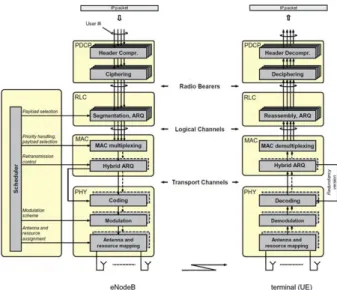
In the LTE protocol stack we will consider (in a first approach) the User Plane protocol layers, in the Figure 4 is represented the architecture of LTE protocols for User Plane in downlink (the LTE protocol architecture is described in more detail on section 2.1 of this document).
Figure 4: Architecture of LTE protocols (downlink) (Dahlman, Parkvall, & Sköld, 2011).
1.3.2.2 Implementation
The eNodeB processes information to the physical layer, where the data structure to send to UE can be represented as shown in Figure 5, presented below:
Figure 5: encapsulation of the data in LTE (without considering segmentation/concatenation in protocols).
When this processing completes the data is transferred to the receiver; and as the channel of transmission will not be the air, unguided spreading, but through Gigabit Ethernet, it is necessary to put the information in a TCP segment, according to the corresponding
PHY MAC RLC PDCP DATA... DATA... DATA... DATA... IP DATA...
6
specifications. TCP is chosen here because we require an error-free data transfer between the emulators, and only TCP has mechanisms for error correction (Microsoft, s.d.).
Figure 6 represents a TCP segment encapsulated in Ethernet frame.
Figure 6: encapsulating a TCP segment in an Ethernet frame.
Figure 7 shows the basic form of the final packet data, after the encapsulation of information from the eNodeB in a TCP segment, to transfer between the two computers.
Figure 7: encapsulation of traffic to be transmitted between computers.
When the information is received on the target computer, emulating the UE, only the information contained in the TCP segment will be "delivered" to the emulator of the User Equipment; the data delivered structure will be as shown in Figure 5 above, which is exactly the information sent by the eNodeB without undergoing any change. This ensures a transparent connection between the two emulators.
1.3.2.3 Errors and delays
In a real scenario, the transmission of information between the eNodeB and the UE will register some delays, due to the propagation/reception time and due to many physical phenomena, being noise and multipath propagation the most significant. So, the receiver may not receive always the same information, as there are many factors and noise sources that may interfere in the signal, causing the alteration or destruction of the original information.
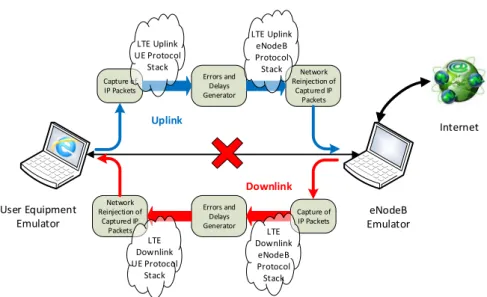
Since one of the objectives of the emulator is to represent and test an LTE system in scenarios closer to reality as possible, we will consider adding a specific module to simulate errors and delays. This module would be added to the “Network Program” to simulate these effects in the signal transmission.
The delays to introduce in the simulation will depend on the physical position of the User Equipment, for the greater distance in relation to this eNodeB the greater the delay in signal propagation. It will not be a constant value, but rather a dynamic value, corresponding to the relative position of the UE. Similarly, the introduction of errors will be a dynamic characteristic that may vary with time, with the position of the equipment and with the type of simulation (radio propagation environment urban, sub-urban or rural).
The module responsible for these tasks must be synchronized with both emulators, in order to adjust itself automatically, in respect to the signal alterations that it must introduce in the signal to transmit.
Figure 8 shows the overall RTLE system architecture.
Ethernet IP TCP DATA... DATA... DATA... FCS
7
Figure 8: Emulator implementation Scheme. User Equipment Emulator eNodeB Emulator Internet Capture of IP Packets Errors and Delays Generator Network Reinjection of Captured IP Packets LTE Uplink UE Protocol Stack LTE Uplink eNodeB Protocol Stack Capture of IP Packets Errors and Delays Generator Network Reinjection of Captured IP Packets LTE Downlink UE Protocol Stack LTE Downlink eNodeB Protocol Stack Uplink Downlink
9
2 State of the Art
This section is a survey of available software simulation tools for the LTE cellular system and related 3GPP protocols. The main technical characteristics and features are described and compared. This study is important to establish a benchmark for the Green-T LTE protocol simulator and for the definition of an up-to-date list of system requirements. It is also given a very first approach and overview on LTE and on its main features and architecture.
2.1 Long Term Evolution
Long Term evolution (LTE), widely known as 4G, is a standard for high speed wireless communications, developed by the 3GPP (3rd Generation Partnership Project) and is specified in its Release 8 document series (first release). LTE is based on the GSM (Global System for Mobile Communications)/EDGE (Enhanced Data rates for GSM Evolution) and UMTS/HSPA network technologies towards an end-to-end all-IP system, achieving increased capacity and speed using a different radio interface together with core network improvements. LTE first release (release 8), provided downlink peak rates of 150Mbit/s, uplink peak rates of 50Mbit/s and QoS provisions enabling a transfer latency of less than 10ms in LTE network. Currently 3GPP works on Release 12 and 13 of the standard. With increased data rates, improved spectrum efficiency and packet-optimized system, LTE technology is set to drive machine to machine technology and data intensive applications (LteWorld, s.d.). 3GPP is also working in order to implement Public Protection and Disaster Relief (PPDR), also known as Public Safety, communications in LTE. These new LTE features have specific requirements related with security and reliability due to the sensitive information that is transmitted in these networks.
2.1.1 Evolved Packet System Architecture
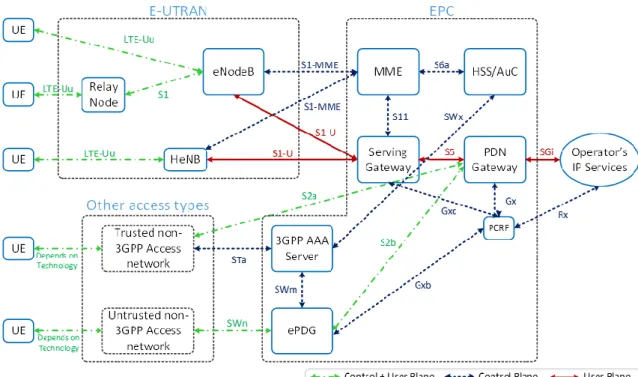
The Evolved Packet System (EPS) is a 3GPP term which refers to a complete end-to-end system, that is, the User Equipment (UE), Evolved Universal Terrestrial Radio Access Network (E-UTRAN) and Core Network (CN), designated in LTE by Evolved Packet Core (EPC) (Olsson, Sultana, Rommer, Frid, & Mulligan, 2009). The main LTE module that constitutes the E-UTRAN is the Evolved NodeB (eNodeB or eNB), the LTE Relay Node shown in Figure 9 is a feature of release 10 and its purpose is to improve network coverage and bandwidth. The EPC can have multiple modules (depending on the network operator requirements), the main ones are the Mobility Management Entity (MME), Serving Gateway (SGW), Packet Data Network Gateway (PDN GW), Home Subscriber Server/Authentication Centre (HSS/AuC) and the Policy and Charging Rules Function (PCRF). When Interworking with other technologies the Evolved Packet Data Gateway (ePDG) and the 3GPP Authentication Authorization and Accounting Server (3GPP AAA) are also important modules that shall be considered. Figure 9 depicts the modules described above with the corresponding inter-module interfaces.
10
Figure 9: LTE Evolved Packet System (based on (3GPP TS 23.401 v12.2.0, 09-2013)).
2.1.2 Radio Protocol Architecture
The radio protocol architecture for LTE can be separated into Control Plane architecture and User Plane architecture, as shown in Figure 10 (Tutorialspoint, 2015):
Figure 10: LTE radio protocol architecture (Tutorialspoint, 2015).
At User Plane side, the application creates data packets that are processed by protocols such as TCP, UDP and IP, while in the Control Plane the radio resource control (RRC) protocol writes the signalling messages that are exchanged between the eNodeB and the UE. In both cases, the information is processed by the Packet Data Convergence Protocol (PDCP), the Radio Link Control (RLC) protocol and the medium access control (MAC) protocol, before being passed to the physical layer for transmission, see Figure 11.
11
Control Plane
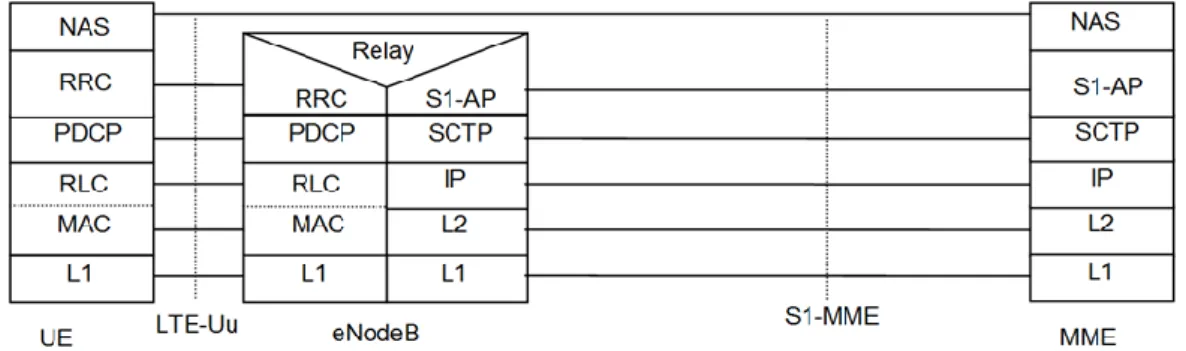
The Control Plane consists of protocols for control and support of the User Plane functions (3GPP TS 23.401 v12.2.0, 09-2013):
Controlling the evolved UMTS Terrestrial Radio Access (E-UTRA) network access connections, such as attaching to and detaching from E-UTRAN;
Controlling the attributes of an established network access connection, such as activation of an IP address;
Controlling the routing path of an established network connection in order to support user mobility;
Controlling the assignment of network resources to meet changing user demands. Figure 11 refers to the control plane protocol stack between the UE and the MME. Additional variants can also be considered (i.e.: MME-MME, SGW-PDN GW, MME-HSS), which are outside the scope of this deliverable. For detailed information on these variants please refer to 3GPP TS 23.401 (3GPP TS 23.401 v12.2.0, 09-2013).
Figure 11: Control Plane UE – MME (3GPP TS 23.401 v12.2.0, 09-2013).
User Plane
The User Plane carries the network's user’s traffic. The most common scenario used for User Plane and its protocol stack is depicted in Figure 12:
12
The main functions for each of the LTE layers are briefly described in Table 1.
Table 1: Summary of the main functions in each LTE layer.
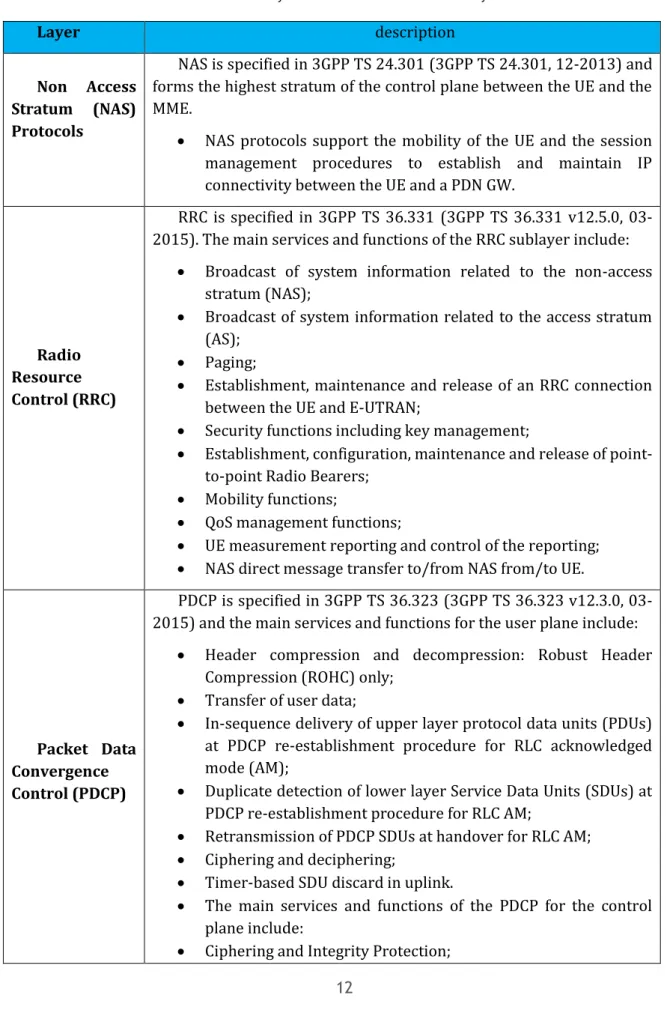
Layer description
Non Access Stratum (NAS) Protocols
NAS is specified in 3GPP TS 24.301 (3GPP TS 24.301, 12-2013) and forms the highest stratum of the control plane between the UE and the MME.
NAS protocols support the mobility of the UE and the session management procedures to establish and maintain IP connectivity between the UE and a PDN GW.
Radio Resource Control (RRC)
RRC is specified in 3GPP TS 36.331 (3GPP TS 36.331 v12.5.0, 03-2015). The main services and functions of the RRC sublayer include:
Broadcast of system information related to the non-access stratum (NAS);
Broadcast of system information related to the access stratum (AS);
Paging;
Establishment, maintenance and release of an RRC connection between the UE and E-UTRAN;
Security functions including key management;
Establishment, configuration, maintenance and release of point-to-point Radio Bearers;
Mobility functions;
QoS management functions;
UE measurement reporting and control of the reporting; NAS direct message transfer to/from NAS from/to UE.
Packet Data Convergence Control (PDCP)
PDCP is specified in 3GPP TS 36.323 (3GPP TS 36.323 v12.3.0, 03-2015) and the main services and functions for the user plane include:
Header compression and decompression: Robust Header Compression (ROHC) only;
Transfer of user data;
In-sequence delivery of upper layer protocol data units (PDUs) at PDCP re-establishment procedure for RLC acknowledged mode (AM);
Duplicate detection of lower layer Service Data Units (SDUs) at PDCP re-establishment procedure for RLC AM;
Retransmission of PDCP SDUs at handover for RLC AM; Ciphering and deciphering;
Timer-based SDU discard in uplink.
The main services and functions of the PDCP for the control plane include:
13
Transfer of control plane data.
Radio Link Control (RLC)
RLC is specified in 3GPP TS 36.322 (3GPP TS 36.322 v12.2.0, 03-2015). The main services and functions of the RLC sublayer include:
Transfer of upper layer PDUs;
Error Correction through ARQ (only for AM data transfer); Concatenation, segmentation and reassembly of RLC SDUs (only
for unacknowledged mode (UM) and AM data transfer);
Re-segmentation of RLC data PDUs (only for AM data transfer); In sequence delivery of upper layer PDUs (only for UM and AM
data transfer);
Duplicate detection (only for UM and AM data transfer); Protocol error detection and recovery;
RLC SDU discard (only for UM and AM data transfer); RLC re-establishment.
Medium Access Layer (MAC)
MAC is specified in 3GPP TS 36.321 (3GPP TS 36.321 v12.5.0, 03-2015) and the main services and functions of the MAC sublayer include:
Mapping between logical channels and transport channels; Multiplexing/demultiplexing of MAC SDUs belonging to one or
different logical channels into/from transport blocks (TB) delivered to/from the physical layer on transport channels; Scheduling information reporting;
Error correction through Hybrid ARQ (HARQ); Priority handling between logical channels of one UE;
Priority handling between UEs by means of dynamic scheduling; Transport format selection;
Padding.
Physical Layer (Layer 1)
Air Interface Physical Layer is specified in 3GPP TS 36.201 (3GPP TS 36.201 v12.2.0, 2015), 3GPP TS 36.211 (3GPP TS 36.211 v12.5.0, 03-2015), 3GPP TS 36.212 (3GPP TS 36.212 v12.4.0, 03-03-2015), 3GPP TS 36.213 (3GPP TS 36.213 v12.5.0, 03-2015) and 3GPP TS 36.214 (3GPP TS 36.214 v12.2.0, 03-2015).
The LTE air interface physical layer offers data transport services to higher layers. The access to these services is through the use of a transport channel via the MAC sub-layer. The physical layer is expected to perform the following functions in order to provide the data transport service:
Error detection on the transport channel and indication to higher layers;
FEC encoding/decoding of the transport channel; Hybrid ARQ soft-combining;
14
Rate matching of the coded transport channel to physical channels;
Mapping of the coded transport channel onto physical channels; Power weighting of physical channels;
Modulation and demodulation of physical channels; Frequency and time synchronisation;
Radio characteristics measurements and indication to higher layers;
Multiple Input Multiple Output (MIMO) antenna processing; Transmit Diversity (TX diversity);
Beamforming; RF processing.
2.1.3 LTE network elements
The most relevant EPS architecture components are depicted in Table 2.
Table 2: EPS architecture components and their main features.
Component Security Features
UE
The User Equipment allows a user access to network services. Ciphering, integrity and replay protection of NAS signalling; Ciphering, integrity and replay protection of RRC signalling; Ciphering of User Plane data at PDCP layer.
eNodeB
The evolved NodeB is a logical node responsible for radio transmission / reception in one or more cells to/from the UE (also commonly called as LTE base station).
Ciphering, integrity and replay protection of RRC signalling; Ciphering of User Plane data at PDCP layer.
MME
The Mobility Management Entity is the key control-node for the LTE access-network. The main security feature is ciphering, integrity and replay protection of NAS signalling.
HSS/AuC
The Home Subscriber Server/Authentication Centre is a database that contains user-related and subscriber-related information (3GPP, s.d.). It also provides support functions in:
Mobility management; Call and session setup;
User authentication and access authorization.
AAA Server
Provides authentication, authorization, policy control and routing information to packet gateways. It performs EAP-SIM/AKA authentication of Subscriber Identity Module (SIM) devices directly to the Home Location Register (HLR)/HSS for a seamless and secure access to the networks.
15
ePDG
The Evolved Packet Data Gateway is responsible for interworking between the EPC and untrusted non-3GPP networks that require secure access, such as a Wi-Fi, LTE metro, and femtocell access networks.
S-GW
The Serving Gateway is the point of interconnect between the radio-side and the EPC. As its name indicates, this gateway serves the UE by routing the incoming and outgoing IP packets. It is the anchor point for the intra-LTE mobility (i.e. in case of handover between eNodeBs) and between LTE and other 3GPP accesses (3GPP, s.d.).
PDN-GW
The Packet Data Network Gateway is the point of interconnect between the EPC and the external IP networks, it routes packets to and from the PDNs. The PDN GW also performs various functions such as IP address / IP prefix allocation or Policy control and charging (3GPP, s.d.).
PCRF
The Policy and Charging Rules Function is responsible mainly for supporting the detection of service data flow, the charging system based on this data flow, and policy enforcement.
2.1.4 LTE Terminal States
LTE standard defines three states for the UE, Idle, Connected and Detached, Figure 13 shows the EU states and transitions.
Figure 13: LTE Terminal States and Transition (Kai & Lihua, 2010).
LTE IDLE: is a state in which the UE is registered in the mobile network, however it is not active. This corresponds to the low power consumption mode. In this state, the mobile location (Tracking Area or Location Area level) is known to the Packet Core domain. In case of service activation, the UE is able to switch for the LTE-Active mode using a short period of time. In addition to that, the UE when in LTE-IDLE is ruled be cell reselection algorithms without any control from the mobile network. In LTE-IDLE mode, an EPS bearer may or may not be present between the network and the terminal. This allows a terminal in IDLE mode to resume a previously active data session without having to set up the EPS bearers again and renegotiate the associated Quality of Service attributes.
LTE-ACTIVE is the real active state in which the terminal is exchanging data and signaling information with the network. This corresponds to the higher power consumption state a UE has. This state is the only one where the terminal has a RRC connection being set up. In all other states, the terminal is not even known by the Access Network. In LTE-ACTIVE, the terminal
16
location is also more accurate as the network knows its current cell, and the terminal mobility is ruled by the handover algorithms controlled by the network.
LTE-DETACHED corresponds to an initial state in which the UE is switched on but is not yet registered in the mobile network. This could happen because the UE has not yet registered, or because the registration has failed in the case when non suitable network is available.
17
2.1.5 Link level and System level simulators
LTE, the current evolutionary step in the third Generation Partnership Project (3GPP) roadmap for future wireless cellular systems, was introduced in 3GPP Release 8. Besides the definition of the novel physical layer, LTE also contains many other remarkable innovations.
Most notable are (i) the redevelopment of the system architecture, now called System Architecture Evolution (SAE), (ii) the definition of network self-organization, and (iii) the introduction of home base-stations. The main reasons for these profound changes in the Radio Access Network (RAN) system design are to provide higher spectral efficiency, lower delay (latency), and greater multi-user flexibility than the currently deployed networks.
In the development and standardization of LTE, as well as in the implementation process of equipment manufacturers, simulations are necessary to test and optimize algorithms and procedures. This has to be carried out on the physical layer (link level) and in the network (system level) context:
1) Link level simulations allow for the investigation of channel estimation, tracking, and prediction algorithms, as well as synchronization algorithms; Input Multiple-Output (MIMO) gains; Adaptive Modulation and Coding (AMC); and feedback techniques. Furthermore, receiver structures (typically neglecting inter-cell interference and impact of scheduling, as this increases simulation complexity and runtime dramatically), modelling of channel encoding and decoding, physical-layer modelling crucial, for system level simulations, and the like, are typically analysed on link level. Although MIMO techniques have been investigated quite extensively over the past few years, there are still a lot of open questions that need to be resolved, both in theory and in practical implementation. For example, LTE offers the flexibility to adjust many transmission parameters, but it is not clear up to now how to exploit the available Degrees of Freedom to achieve the optimum performance.
2) System level simulations focus more on network related issues, such as resource allocation and scheduling, multi-user handling, mobility management, admission control, interference management, and network planning optimization. Furthermore, in a multi-user oriented system, such as LTE, it is not clear which figures of merit should be used to assess the performance of the system. The classical measures of (un)coded Bit Error Ratio (BER), (un)coded Block Error Ratio (BLER), and throughput are not covering multi-user scenario properties. More comprehensive measures of the LTE performance are, for example, fairness and multi-user diversity. However, these theoretical concepts have to be mapped to performance values that can be evaluated by means of simulations. Around the world, many research facilities and vendors are investigating the above mentioned aspects of LTE. For that purpose, commercially available simulators applied in industry, as well as simulators applied in academia, have been developed. Also, probably all major equipment vendors have implemented their own, proprietary simulators. Regardless of the simulation tools being commercial/non-commercial, the development framework (C, C++, MATLAB, WM-SIM,...), or their claimed performance/flexibility, one fact is shared by all of the simulators: their closed implementation disables access to implementation details and thus to any assumption that may have been included. As such, the reliability of the results relies purely on the faith of a proper implementation. Independent validation of results in such closed simulation environments is not easy, very time-consuming, and
18
often not feasible. Since the results were obtained with closed tools, simply repeating the same experiment is a daunting task.
2.2 Overview on the main LTE Simulators
This section is a survey of available software simulation tools for the LTE cellular system and related 3GPP protocols. The main technical characteristics and features are described and compared. This study is important to establish a benchmark for the Green-T LTE protocol simulator and for the definition of an up-to-date list of system requirements.
2.2.1 Metrifly
The Metrifly tool (Metrifly, s.d.) allows to analyse network performance from user devices, and store it in the cloud, to show what is happening on user’s networks, the actual coverage, and the quality customers see. This tools covers the entire performance analysis cycle, from collection to evaluation.
2.2.1.1 Key features (from (Metrifly, s.d.)):
Measure wireless networks: the client application provides on-demand measurement of several performance indicators for the current Wi-Fi and Mobile networks;
Report to the Cloud: measurements are securely reported to the cloud platform, where they are processed and aggregated into consistent data sets taking into account access points, cells, and locations and network conditions;
Analyse in Real Time: the collected measurements are available for detailed analysis on the cloud platform, allowing detailed performance comparison of different carrier networks, locations, or access points, through visual tools like charts or tables.
Wireless metrics on the fly with Wi-Fi, 3G and 4G support
2.2.2 Technical University of Vienna LTE based system simulator
Technical University (TU) of Wien, developed a LTE system level simulator based on MATLAB [1]. In (Ikuno, Wrulich, & Rupp, 2010) is referred that “The LTE system level simulator implementation offers a high degree of flexibility. Extensive use of the Object-oriented programming (OOP) capabilities of MATLAB, introduced with the 2008a Release have been made for the implementation. Having a modular code, with a clear structure based in objects, results in a much more organized, understandable and maintainable simulator structure, in which new functionalities and algorithms can be easily added and tested”.
The simulator is freely available on the internet (Vienna University of Technology, s.d.) under an open license, free for non-commercial academic use, which facilitates research and enables a closer cooperation between universities and research facilities.
19
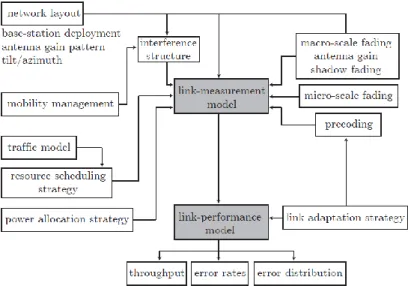
Figure 14: Schematic block diagram of the LTE system level simulator (Mehlführer et al., 2011).
It is possible to adjust the scale of the simulation to the specific needs. This is achieved by introducing three different simulation types with largely different computational complexity (Figure 15):
Figure 15: Three possible scenarios in the Vienna LTE link level simulator allow us to adjust the scale of the simulation complexity: single-downlink, single-cell multi-user, and multi-cell multi-user (Mehlführer et al., 2011).
The link measurement model abstracts the measured link quality used for link adaptation and resource allocation. On the other hand, the link performance model determines the link Block Error Ratio (BLER) at reduced complexity. As figures of merit, the simulator outputs traces containing throughput and error rates, from which their distributions can be computed. Implementation-wise, the simulator flow follows the pseudocode below. The simulation is performed by defining a Region Of Interest (ROI) in which the eNodeBs and UEs are positioned and a simulation length in Transmission Time Intervals (TTIs). It is only in this area where UE movement and transmission of the Downlink Shared Channel (DLSCH) are simulated.
20
2.2.2.1 Link measurement model
The System Level Simulator in order to abstract the measured link quality uses the Signal to Interference and Noise Ratio (SINR) as metric; specifically, a per subcarrier post-equalization symbol SINR as described in (Ikuno, Wrulich, & Rupp, 2010): “The link measurement model abstracts the measurements for link adaptation and resource allocation and aims at reducing run-time computational complexity by pre-generating as many parameters needed as possible. This shifts most of the computational burden to an off-line task that pre-generates and stores the results in trace files that can be (re-)used at simulation time. Special care has been taken as to account for the spatial and time correlation of the channel present in a wireless cellular system. To this effect, the link quality model has been split into three parts, which are afterwards combined to obtain post-equalization symbol SINR expressions: (i) macroscopic pathloss, (ii) shadow fading, and (iii) small-scale fading (SISO and MIMO).”
2.2.2.2 Path loss vs. distance in terms of model used
In the same document, (Ikuno, Wrulich, & Rupp, 2010), is also described how the simulato handles the relation between the pathloss and the distance between a UE and a eNodeB: “The macroscopic pathloss between an eNodeB sector and UE is used to jointly model both the propagation pathloss due to the distance and the antenna gain. It is noted as LM,bi,uj , where bi denotes the i-th transmitter: 0 for the attached eNodeB (desired signal) and 1, . . . , Nint for the Nint interfering eNodeBs and uj the j-th UE, which then determines the (x, y) position. It is implemented as a pathloss map that can be computed once and, as long as the network layout is kept the same, be reused. The map specifies for each point in the simulated ROI the macroscopic pathloss between any point (x, y) and each transmitter.”
2.2.2.3 Shadowing
In (Ikuno, Wrulich, & Rupp, 2010) the shadowing is defined as: “Shadow fading, LS,bi,uj , is caused by obstacles in the propagation path between the UE and the eNodeB and can be interpreted as the irregularities of the geographical characteristics of the terrain introduced with respect to the average pathloss obtained from the macroscopic pathloss model. It is typically approximated by a log-normal distribution of mean 0 dB and standard deviation 10 dB” and in the same article is also described how the simulator handles with the shadowing. 2.2.2.4 Channel modelling
The LTE System-Level Simulator takes a special attention to the Channel modelling during simulations and (Ikuno, Wrulich, & Rupp, 2010) has the following description for the Channel modelling: “While the losses caused by the macroscopic pathloss and the shadow fading are position-dependent and time-invariant, small-scale fading is modeled as a time-dependent process (Mehlführer et al., 2011). For each of the modeled MIMO transmission modes (Transmission Diversity (TxD) and Open Loop Spatial Multiplexing (OLSM)), a model based on a simple Zero Forcing (ZF) receiver has been developed. As of this version, systems with two transmit antennas have been modeled, but the derived SINR expressions can be easily extended for the LTE transmit modes using four antenna ports. Based on the derived models, a trace of fading parameters modeling the time-and-frequency variant behavior of the channel has been generated. These fading-parameters furthermore allow for a generation prior to the system level simulation itself, which reduces the run-time computational complexity significantly. The channel modeling aims at computing a per-layer SINR. In LTE, a spatial layer
21
is the term used for the different streams generated by spatial multiplexing. A layer thus can be described as a mapping of symbols onto the transmit antenna ports. Each layer is then identified by a (precoding) vector of size equal to the number of transmit antenna ports.” 2.2.2.5 Use cases and demonstration results
In this section we present use cases for LTE SISO and MIMO networks using TxD or OLSM transmit modes and offered for free under an academic, non-commercial use license. The main purpose of this tool is to assess the network performance increase of new scheduling algorithms.
Testing Fractional Frequency Reuse (FFR) strategies implemented at the scheduler level, as well as the network impact of different receiver types and channel quality feedback strategies, provided accurate modeling of those, can also be tested. SINR optimization via electrical and mechanical tilting and with pathloss maps imported from network planning tools can also be easily added, thus enabling validation simulations against network planning tools, which usually use an even more abstract modeling of the physical layer.
The availability of its source code allows its results to be cross-checked and validated and researchers to compare algorithms in a standardized system. Together with the LTE link-level simulator, it forms, to the best of the authors’ knowledge, the only link-and-system LTE simulation suite openly available for research purposes. Illustrative results of the LTE system simulator are depicted below.
Figure 16: UE and cell throughput CDFs: TxD and OLSM, max C/I and round robin schedulers (Mehlführer et al., 2011).
22
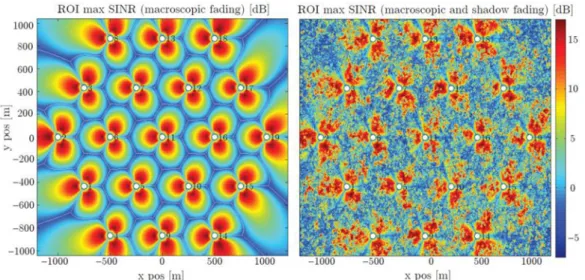
Figure 17: Sector SINR, calculated with distance dependent macroscale pathloss only (left) and additional lognormal-distributed space-correlated shadow fading (right) (Mehlführer et al., 2011).
The Simulators of the University of Vienna LTE consist of a link level and a system level simulator. Both simulators are available under a non-commercial open source academic-use license and thereby enable researchers to implement and test algorithms in the context of LTE. The open source availability of the simulators facilitates researchers to reproduce published results in the context of LTE, and thus supports the comparison of novel algorithms with previous state-of the-art.
2.2.3 LTE eNB Emulator – NPT3081
The NPT3081 protocol development and test system for LTE (EikoSeidel, 2008) is described in (NOMOR research) as an “eNodeB emulator, designed specifically to meet the needs of design teams who want to develop and optimize LTE protocol software. It provides an implementation of the eNodeB protocol stack with a detailed physical layer emulation in realistic multi-cell, multi-user environment. Unlike usual conformance test systems that rely on a complete design before carrying out first tests, the NPT3081 supports network development with traffic sources, test scenarios and network peer entities from the very first day of the design phase.
While not being a highly expensive and complex conformance test tool, the NPT3081 can be used as PC based development environment by the software engineers for various purposes.”
2.2.3.1 Features
Peer network entity to generate and process bit exact PDCP, RLC and MAC packets; Initial test environment that generates error messages and various statistics of the
data transfer (e.g. bit rates, error rates, delay, retransmission rates);
Load generator for different eNodeB scheduler and different network load and traffic sources;
Optimization of vendor specific UE algorithms (e.g. uplink logical channel multiplexing).
The NPT3081 is a suitable tool to facilitate protocol development for mobile devices. Develop, verify and test the MAC, RLC, PDCP and RRC protocol stack without actual availability
23
of RF (Radio frequency) hardware and lower layer DSP (Digital Signal Processing) software. This makes it the perfect environment to start LTE protocol development, do initial testing and for protocol optimisation later on.
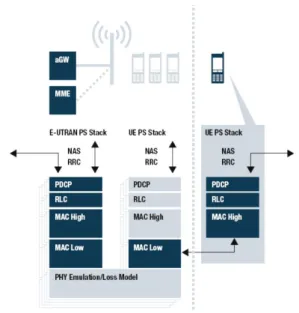
Figure 18 below illustrates a realisation where a customized PHY/MAC API allows the exchange of packets and lower layer primitives between emulator and protocol implementation.
Figure 18: Test setup example for UE protocol stack development (EikoSeidel, 2008).
Alternatively network interfaces (such as S1-u or S1-c) can also be used for message exchange and testing.
Key Features:
LTE specification compliant protocol stack (MAC, RLC, PDCP, RRC); Detailed PHY (Physical Layer) emulation;
Realistic system load in multi-cell and multi-user environment; Bit-exact packet exchange via API’s;
Easily configurable set of scenarios; Various data and error logs;
Quasi real-time capability allows connection to target hardware; Testing/optimisation with live applications possible.
2.2.3.2 Summary
The verification and test process is supported by data and error log files. The data log file, on the one hand, continuously provides side information for downlink and uplink transmission and the error log file, on the other hand, traces warnings and errors which occurred during a test run. Additionally various statistics can be captured the support the optimization process.
24
2.2.4 Steepest Ascent 3G Evolution Lab - LTE Toolbox and Blockset
Steepest Ascent's software product portfolio consists of a set of Communication and DSP simulation libraries ( The MathWorks, Inc, s.d.). The software products are offered across various platforms including The MathWorks MATLAB® and Simulink®, and Agilent
SystemVue®.
Figure 19: Communications Standards Libraries ( The MathWorks, Inc, s.d.).
2.2.4.1 3G Evolution Lab - LTE Toolbox and Blockset
3G Evolution Lab - LTE Toolbox and LTE Blockset for The MathWorks MATLAB® and
Simulink® is a comprehensive physical layer simulation Toolbox for the uplink and downlink
of Release 8 (v8.8.0/v8.9.0) of the 3GPP Evolved Universal Terrestrial Radio Access (E-UTRA) standard. The library accelerates PHY algorithms development, supports golden reference verification and enables custom test & measurement waveform generation.
It provides models to perform channel coding/decoding and modulation/demodulation operations implementing the full physical layer transmit/receive processing chain, from transport channels and control information to OFDM and SC-FDMA modulated waveforms. Receive models are available to recover the transmitted signals. Full two- and four-antenna MIMO layering and pre-coding are supported.
2.2.4.2 Product Overview
The toolbox features functions to perform channel coding/decoding and modulation/demodulation operations implementing the full physical layer transmit/receive processing chain, from transport channels and control information to OFDM and SC-FDMA modulated waveforms. Receive models are offered to recover the transmitted signals. Channel coding for transport channels and control information is available for uplink and downlink. Test Models and Reference Measurement Channel (RMCs) waveform generators are available to easily generate reference waveforms.
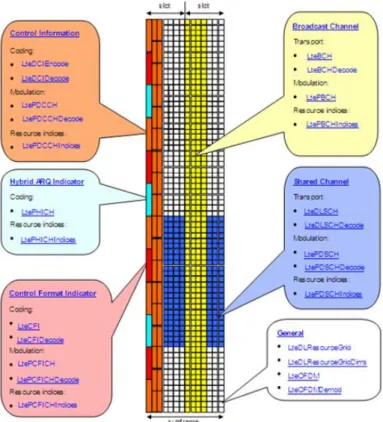
The current version supports v8.8.0/v8.9.0 of the 3GPP TS36.21x standard series. The Steepest Ascent development roadmap includes tracking compliance from Release 8 through Release 10 and beyond.