Chestnut (Castanea sativa Mill.) Fruit Composition & Quality
Effects of Industrial Processing on Nutrients & Secondary Metabolites
Tese apresentada para o efeito de obtenção do grau de Doutor em Ciências Agrárias e Florestais, de acordo com o disposto no nº 2 do artigo 8 do Decreto-Lei nº388/70 (Decreto-Lei nº 216/92, de 13 de Outubro).
Orientador: Doutor Eduardo dos Santos Rosa, Professor Catedrático da Universidade de Trás-os-Montes e Alto Douro
Co-Orientador: Doutor Jorge Ventura Ferreira Cardoso, Professor Auxiliar da Universidade de Trás-os-Montes e Alto Douro
Fundação para a Ciência e a Tecnologia - FCT (bolsa com a referência SFRH/BD/23426/2005), no âmbito do POCI 2010 - Formação Avançada para a Ciência - Medida IV.3 e do Fundo Social Europeu (FSE).
Os trabalhos desenvolvidos nesta tese, enquadraram-se nas actividades do Centro de Investigação e de Tecnologias Agro-Ambientais e Tecnológicas (CITAB) e dos Departamentos de Agronomia e de Biologia e Ambiente (DeBA) da Universidade de Trás-os-Montes e Alto Douro. Foram suportados pelo projecto VALCAST II - “Valorização da castanha Portuguesa e optimização do seu processamento”, financiado pelo programa IDEIA-POCI 2010/Agência de Inovação (ADI - Refª 13-05-04-FDR-00005), e pela bolsa de doutoramento (SFRH/BD/23426/2005) atribuída pela FCT.
Aos meus pais e irmã Ao meu marido
A
GRADECIMENTOS
Ao longo deste percurso foram muitas as pessoas que encontrei e que enriqueceram de forma muito especial o meu caminho. Sem a sua presença, sabedoria e apoio amigo não poderia chegar até aqui e por isso sinto-me profundamente grata.
Ao orientador desta dissertação, Professor Doutor Eduardo Augusto dos Santos Rosa o meu agradecimento por me ter proporcionado a possibilidade de trabalhar e crescer nesta área científica e pela importante colaboração ao longo do desenvolvimento deste trabalho. Pela indispensável disponibilização do laboratório que permitiu desenvolver parte dos estudos realizados e pelo sempre presente estimulo ao aperfeiçoamento de uma visão crítica e de rigor científico.
Ao meu co-orientador, Professor Doutor Jorge Ventura Ferreira Cardoso, o meu muito obrigada por estar sempre presente, por ter sido o meu guia científico ao longo deste percurso, disponibilizando sempre todos os recursos necessários à elaboração deste trabalho. Pela constante compreensão, palavras de apoio e incentivo, bem como pela extrema perfeição e rigor científico com que sempre me orientou.
Ao Doutor Richard Neil Bennett, o meu profundo agradecimento pelo auxílio e orientação na execução de variadas determinações analíticas (fitoquímicos), bem como pela valiosa colaboração na elaboração dos artigos científicos.
Ao Professor Doutor Fernando Hermânio Ferreira Milheiro Nunes, pelo indispensável auxílio no desenvolvimento das metodologias de quantificação dos açúcares e pela disponibilização do laboratório e de todos os recursos necessários. Um agradecimento também ao técnico Carlos da Costa Matos pelo prestimoso auxílio e palavras de incentivo.
Gostaria também de agradecer à Professora Doutora Cristina García-Viguera (CEBAS, Espanha) e ao Professor Doutor Stéphane Quideau (Universidade de Bordeaux, França) pelas variadas e valiosas contribuições para esta pesquisa.
Ao Professor Doutor António Fontaínhas Fernandes, o meu agradecimento pelas palavras de estímulo, apoio e pelo impulso inicial que me conduziu ao caminho de investigação científica.
Ao Professor Doutor Miguel Rodrigues e a todos os técnicos do Laboratório de Nutrição Animal pela disponibilização de todos os meios e recursos bem como pelo carinho com que sempre me receberam. Em especial à Maria Angelina Marques, Maria Inês Pires, Manuel Henrique Augusto e Cármen Sofia Moura.
Aos técnicos do DeBA, em particular à Maria Natália Teixeira, Helena Ferreira, Maria Augusta Martins, Donzília Costa e Ana Fraga, que disponibilizaram parte do seu tempo sempre que necessário, um muito obrigada.
Em especial gostaria de agradecer à Cesaltina Carvalho, pelo carinho com que me recebeu bem como pelos conhecimentos transmitidos na execução das técnicas que com ela aprendi. Por ter sido e por ser muito mais que uma valiosa colaboradora neste trabalho, uma amiga que sempre me ouviu, apoiou e incentivou em todos os momentos.
Aos técnicos dos Laboratórios de Horticultura e Viticultura por disponibilizarem todos os recursos necessários à consecução das práticas laboratoriais. Um agradecimento especial à D. Rosa Paula Carvalho pelo indispensável auxílio na execução de algumas determinações analíticas e à D. Donzília Costa pela prestimosa ajuda relacionada com assuntos burocráticos.
Ao técnico Cristóvão Lucas dos Santos do Departamento de Engenharias pelo indispensável auxílio na aprendizagem da utilização do calorímetro de combustão para a determinação da energia bruta.
Um especial obrigada à Engenheira Isabel Adrega do Gabinete de Planeamento e Políticas (GPP) pela indispensável ajuda e disponibilização de dados estatísticos.
À empresa Sortegel - Produtos Congelados S.A., pela valiosa e indispensável colaboração no fornecimento das amostras para a realização deste trabalho. O meu sentido agradecimento, a todos os que disponibilizaram o seu tempo e atenção para ajudar na recolha das amostras, em especial ao Engenheiro Alcino Celestino Pires.
Um agradecimento também à FCT pelo apoio financeiro da minha bolsa de doutoramento.
A todos os meus amigos que de uma forma muito especial estiveram sempre presentes enriquecendo o meu saber e a minha alma ao longo deste percurso.
Aos meus pais e irmã que tudo fizeram para me fazer chegar mais longe, pelas lágrimas de alegria a cada passo, pelas palavras de conforto imensurável e pelo olhar e gestos repletos de carinho em todos os momentos, obrigada com muito amor.
R
ESUMO
O castanheiro é cultivado um pouco por toda a Europa do Sul (principalmente Itália, Portugal, França e Espanha), Turquia, América do Norte, América do Sul (Chile e Bolívia), Ásia (China, Japão e Coreia), Austrália e Nova Zelândia, onde os seus frutos são consumidos em larga escala. Face ao seu conteúdo em amido, açúcares livres, fibra, proteínas, lípidos, vitaminas e sais minerais, bem como em outros compostos biologicamente activos, tais como polifenóis, reconhece-se que a castanha constitui uma importante fonte alimentar rica em compostos benéficos para a saúde. Contudo, o facto de existirem ainda muito poucos estudos sobre a composição química deste fruto e sua variação ao longo das diferentes fases de processamento industrial, constituiu o principal objectivo para a realização do presente trabalho, o qual se encontra estruturado em oito capítulos, iniciando-se com uma breve descrição do estado de arte (Introdução Geral - Capítulo 1), sendo de seguida fornecida informação detalhada acerca de cada uma das actividades de investigação desenvolvidas (Capítulos 2 a 7), terminando com um capítulo dedicado à síntese dos resultados chave, conclusões finais e perspectivas de futuros trabalhos (Capítulo 8).
Para a realização dos estudos apresentados contámos com a colaboração da Sortegel, Produtos Congelados, S.A. (Sortes-Bragança), principal empresa no sector da transformação industrial de castanha em Portugal. Assim, de acordo com a linha de processamento adoptada e implantada nesta empresa, seleccionaram-se as seguintes etapas para a recolha das amostras destinadas às diversas determinações analíticas: A - após recepção das castanhas pela empresa e no momento da calibração (etapa controlo); B - após três meses de conservação a ±0°C e humidade relativa de 90%; C - após descasque industrial por queima a uma temperatura de 800-1000 ºC durante 1 a 2 segundos; D - após congelação num túnel com um fluxo de CO2 a -65 °C durante 15 a 20 minutos.
Em cada campanha e para cada uma das cultivares escolhidas para estudo, constituiu-se um lote com aproximadamente 400kg de castanhas com a mesma origem/proveniência (souto de um médio a grande produtor). De cada lote colheram-se aleatoriamente três amostras (repetições) em cada uma das etapas atrás referidas da linha de processamento. Cada amostra colhida foi subdividida em várias sub-amostras, consoante a natureza dos diversos tipos de análises efectuadas. Avaliou-se o efeito da cultivar, da etapa de processamento e da interacção cultivar x etapa de processamento no conteúdo de importantes nutrientes e não-nutrientes, e calculou-se a
contribuição de cada um destes factores para a variação total observada nos diversos constituintes determinados.
Num estudo preliminar (Capítulo 2), relativo à campanha de 2005, procedeu-se a uma análise comparativa da composição química das amostras colhidas à recepção/calibração (etapa A) das três mais importantes cultivares portuguesas de castanha - Judia, Longal e Martaínha. Os valores obtidos revelaram diferenças significativas entre as três cultivares para a maioria dos parâmetros estudados. No conjunto das análises efectuadas, estas cultivares apresentaram elevados teores de amido (57,5-64,9g 100g-1 MS) e apreciáveis níveis de constituintes da parede celular (NDF - 12,6 a 16,9g 100g-1 MS), não sendo de menosprezar as concentrações de proteína bruta (3,9-5,2g 100g-1 MS), gordura bruta (1,6-2,6g 100g-1 MS) e cinzas totais (1,8-2,3g 100g-1 MS). Observou-se um efeito significativo da cultivar no teor de aminoácidos livres, incluindo vários aminoácidos essenciais. Estas cultivares apresentaram um conteúdo significativo de polifenóis, com predomínio dos ácidos gálico e elágico (3,5-9,1 e 2,7-10,5mg g-1 peso fresco, respectivamente) entre os taninos hidrolisáveis e condensados, os quais são conhecidos pelos seus efeitos positivos na saúde.
Nesse mesmo estudo, procedeu-se também à avaliação do efeito das etapas de processamento acima descritas na composição química das cultivares Longal e Judia. A análise de variância com base num factor de variação demonstrou existirem, para a maioria dos constituintes analisados, diferenças significativas entre estas duas cultivares em cada uma das etapas de processamento amostradas. Por sua vez, a análise de variância com base em dois factores de variação revelou que a etapa de processamento e a interacção cultivar x etapa de processamento foram os factores que mais contribuíram para a variação observada.
Os estudos que se seguiram reportam-se às campanhas de 2006 e 2007, recaindo o primeiro destes anos sobre as três cultivares portuguesas já consideradas na campanha de 2005, isto é Judia, Longal e Martaínha, e duas cultivares estrangeiras conhecidas pelas sua boa aptidão para a transformação, uma de origem espanhola, mais propriamente da região da Galiza e designada por “Puga do Bolo”, e outra originária da região de Viterbo (Itália) e conhecida por “Marron Vero” ou “Viterbes”. Na campanha de 2007, do conjunto de cultivares a estudar foi excluída a “espanhola” e introduzida, em seu lugar, a variedade portuguesa Lada. Esta opção baseou-se, por um lado, no fraco poder de conservação registado na cultivar “espanhola” e, por outro lado, no facto de existirem indicações de que a cultivar Lada parece possuir características tecnológicas favoráveis ao processo de transformação, o que naturalmente interessava averiguar. Por sua vez, apesar das características apresentadas justificarem que a “italiana” continuasse a integrar o conjunto de cultivares a analisar no âmbito dos estudos previstos, não foi possível à
Sortegel garantir o seu fornecimento. Assim, nesta campanha os estudos incidiram nas mesmas três principais cultivares portuguesas que já tinham feito parte do lote de cultivares analisadas nas duas anteriores campanhas, às quais se juntou a Lada.
Os resultados das análises efectuadas nas amostras de castanha referentes às campanhas de 2006 e 2007 encontram-se apresentados e discutidos nos artigos correspondentes aos Capítulos 3 (matéria seca, cinzas totais, amido, gordura e energia bruta), 4 (proteína bruta, aminoácidos livres e compostos fenólicos) e 5 (minerais, açúcares livres, carotenóides e vitaminas C e E).
Para a totalidade de cultivares e etapas de processamento analisadas, registaram-se elevados conteúdos de amido (48,7-54,9g 100g-1 MS), responsáveis pelos altos níveis de energia bruta (410,1-427,8kcal 100g-1 MS), e teores relativamente baixos de proteína bruta (4,1-5,4g 100g-1 MS) e principalmente de gordura bruta (1,9-4,4g 100g-1 MS). Em ambos os anos de colheita, a interacção cultivar x etapa de processamento foi o factor que mais contribuiu para a variação observada nos teores de amido, enquanto que a variação ao nível dos teores de matéria seca e de fibra ficou a dever-se mais ao efeito da cultivar e da etapa de processamento, respectivamente.
No conjunto dos aminoácidos essenciais a Thr apresentou os valores mais elevados (3,6-10,0mg 100g-1 PF), enquanto que a Asn (14,9-36,4mg 100g-1 PF) foi o mais representativo entre os aminoácidos não essenciais presentes na totalidade das amostras.
Entre os factores testados em cada ano de estudo, a etapa de processamento foi o que mais contribuiu para a variação observada no conteúdo de compostos fenólicos totais (6,6-18,3mg g-1 PF). Na campanha de 2007, este factor, juntamente com a interacção cultivar x etapa de processamento, foram os principais responsáveis pela variação ocorrida nos teores de ácido gálico, enquanto que a variação nos teores de ácido elágico dependeu em maior proporção da cultivar.
Relativamente à composição em sais minerais, o fósforo (99,8-156,4mg 100g-1 MS) e principalmente o potássio (629,2-811,1mg 100g-1 MS) constituem os elementos predominantes em todas as amostras analisadas, e outros minerais com funções metabólicas importantes, tais como o cálcio, magnésio, ferro, zinco e manganês foram também encontrados.
Entre os açúcares livres, cuja variação no conteúdo total foi determinada em maior grau pela etapa de processamento, em ambos os anos de colheita, a sacarose assumiu uma posição de destaque (8,8-14,9g 100g-1 MS).
Foram também encontrados teores assinaláveis de luteína (0,1-0,6µg g-1 PF), ésteres de luteína (0,1-0,4µg g-1 PF) e vitamina C (4,2-7,2 e 3,1-6,8mg 100g-1 PF, para os ácidos ascórbico e desidroascórbico, respectivamente).
À semelhança do verificado anteriormente, estes estudos confirmam a existência de uma notória variação na composição química e valor nutritivo da castanha, em função quer da cultivar, quer do ano de colheita. Mas foi igualmente demonstrado, pela primeira vez, que essa variação é também determinada pelo processamento industrial inerente à obtenção de castanha congelada. Com efeito, sendo certo que este processamento permite o alargamento do período de armazenamento e comercialização da castanha, possibilitando o seu consumo mais regular e praticamente durante todo o ano, os estudos realizados permitiram concluir que a composição química e nutricional da castanha foi afectada, tanto negativa como positivamente.
Assim, em termos gerais e ao comparar os valores obtidos nas amostras em fresco (etapa A) e nas amostras congeladas (etapa D), observou-se um acréscimo significativo nos teores de NDF (12,7-19,9 e 16,3-18,2g 100g-1 MS), compostos fenólicos totais (6,6-12,0 e 10,6-16,9mg g-1 PF), Thr (4,9-6,8 e 3,6-7,9mg 100g-1 PF) e Ala (3,3-6,5 e 4,0-5,7mg 100g-1 PF) em 2006 e 2007, respectivamente, bem como de δ-tocoferol (0,3-0,4µg g-1 PF em 2006) e γ-tocoferol (25,2-27,3µg g-1 PF em 2007), enquanto que os teores de amido total (53,8-51,3 e 54,9-51,0g 100g-1 MS), Glu (14,7-9,2 e 13,9-10,9mg 100g-1 PF) e ácido ascórbico (6,4-5,4 e 7,2-5,1mg 100g-1 PF) em 2006 e 2007, respectivamente, e ainda de gordura bruta (2,9-2,5g 100g-1 MS em 2007), sofreram um decréscimo estatisticamente significativo.
Num outro estudo (Capítulo 6) procedeu-se à análise da composição química dos resíduos resultantes do processo de descasque, isto é, pericarpo (casca externa) e tegumento (casca interna), os quais representaram em média entre 8,9 e 13,5% e entre 6,3 e 10,1% do peso total dos frutos, respectivamente. Estes componentes são gerados em grandes quantidades e possuem um elevado potencial como fonte de valiosos co-produtos. Assim, avaliou-se a composição em polifenóis e taninos das amostras de pericarpo e tegumento das castanhas colhidas nas etapas A e B do processamento industrial e pertencentes às quatro cultivares nacionais (Judia, Longal, Martaínha e Lada) analisadas na campanha de 2007. Registaram-se assinaláveis teores de fenólicos totais e de baixo peso molecular (ácidos gálico e elágico), taninos condensados e elagitaninos, incluindo castalagina, vescalagina, acutissimina A e acutissimina B. Os valores mais elevados de fenólicos totais e taninos condensados foram encontrados ao nível do tegumento. Neste estudo, testaram-se também vários meios de extracção a duas diferentes temperaturas (20 e 70 ºC), verificando-se que a solução acetona:água (70:30) a 20 ºC foi a que permitiu uma maior extracção, não só de fenólicos totais (68,5-136,4mg g-1 PF)
nos dois tipos de amostras e para a totalidade das cultivares analisadas, como de taninos condensados (16,3-110,4mg g-1 PF) e compostos fenólicos de baixo peso molecular nas amostras (pericarpo e tegumento) da cultivar Longal. Ao nível do pericarpo desta cultivar, os valores de ácido elágico, tanino T1, acutissimina B e um derivado do ácido elágico variaram significativamente consoante os solventes utilizados na extracção. Este estudo revelou que, na cultivar Longal, os valores mais elevados, tanto ao nível do pericarpo como do tegumento, correspondem ao ácido gálico e à castalagina.
O último estudo (Capítulo 7) corresponde a um artigo de revisão bibliográfica que pretende retratar o estado actual de conhecimentos acerca da composição da castanha (semente ou parte edível) de origem europeia (Castanea sativa Mill.) em nutrientes e não-nutrientes (fitoquímicos) relacionados com a saúde, de que forma esta composição é afectada pelo processamento artesanal e industrial, capaz de originar diferentes formas de utilização deste fruto, e quais as consequências na qualidade dos alimentos dele derivados e seus eventuais efeitos na saúde dos consumidores.
Embora a investigação já realizada constitua um contributo assinalável para um melhor conhecimento dos benefícios para a saúde associados à ingestão de castanha, outros estudos são todavia necessários, no sentido quer de maximizar a produção, quer de melhorar a qualidade dos produtos obtidos a partir deste fruto (e.g. selecção e melhoramento genético; ajustamento e optimização do processamento industrial). Por outro lado, torna-se cada vez mais imprescindível:
i) a avaliação da actividade enzimática, de forma a obter uma melhor compreensão das alterações
que ocorrem durante as principais etapas do processamento e transformação industrial; ii) a realização de investigação com modelos celulares, capaz de avaliar os efeitos ao nível da digestão, absorção e metabolismo em humanos, de forma a comprovar os potenciais benefícios para a saúde e o efectivo valor nutricional deste fruto.
Palavras-Chave: Castanea sativa Mill.; castanha; processamento industrial; alterações na composição química; nutrientes; minerais; fitoquímicos; co-produtos.
A
BSTRACT
Chestnut trees are cultivated throughout southern Europe (mainly Italy, Portugal, France and Spain), Turkey, North America, South America (Chile and Bolivia), Asia (China, Japan and Korea), Australia and New Zealand, where the fruits are widely consumed. These fruits contain starch, free sugars, fibre, proteins, lipids, vitamins, and minerals, as well as other bioactive non-nutrients such as polyphenolics. Chestnuts are recognized as a rich source of beneficial health compounds. However, there have been few studies on the changes that occur in the chemical composition of chestnut fruits during industrial processing, and that is the main purpose of this work, which is structured into eight chapters beginning with a description of the state of the art (General Introduction - Chapter 1) and then detailed information is presented about each of the research activities (Chapters 2 to 7) followed by a chapter dedicated to the key results obtained, the concluding remarks and future work perspectives (Chapter 8).
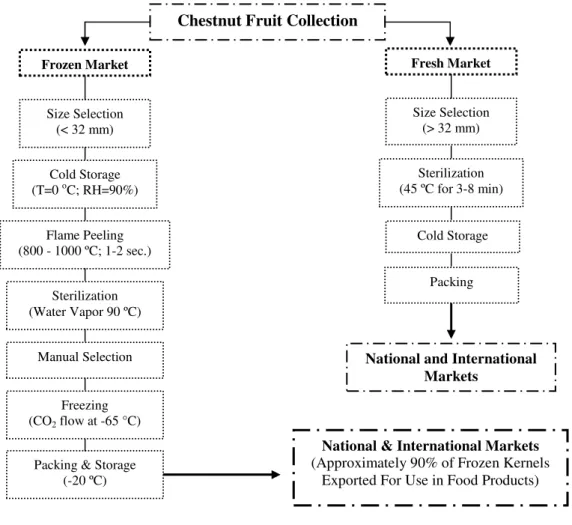
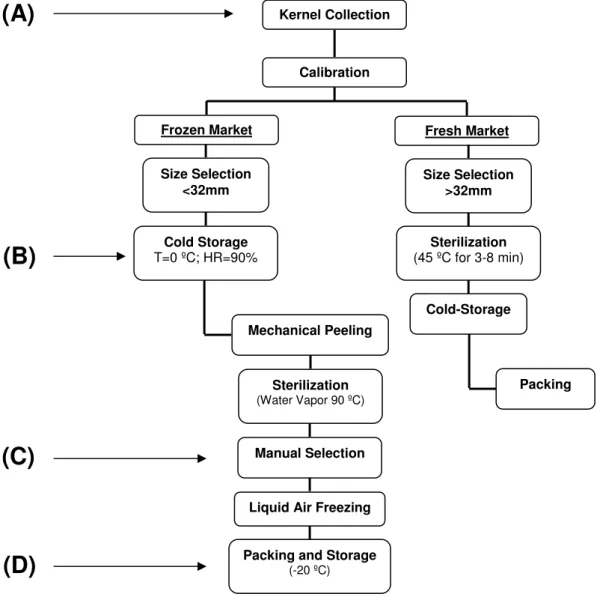
In order to perform the studies presented in the chapters 2 to 6 of this work, a collaboration was established with Sortegel, Produtos Congelados, S.A. (Sortes-Bragança), the main company in the chestnut fruit processing sector in Portugal. Thus, according to the processing line adopted by this company, the following stages were selected for the collection of the samples used for the various analytical determinations: A - after reception of the chestnut fruits at the company and at the moment of calibration (control stage); B - after 3 months storage at ±0 °C and relative humidity of 90%; C - after industrial flame peeling at 800-1000 ºC during 1 to 2 seconds; D - after freezing in a tunnel with a CO2 flow at -65 °C during 15 to 20 minutes.
In each harvest year, and for each one of the selected cultivars in these studies, a lot of 400 kg of chestnut fruits with the same origin (orchard of a medium or large producer) was gathered. From each lot three samples (repetitions) were randomly collected of each stage of the referred processing stages. Each one of the samples collected was subdivided into several sub-samples, according to the nature of the different analyses performed. The effect of the cultivar, processing stage and interaction between these two factors on the content of important nutrients and non-nutrients was evaluated, also calculating the contribution of each factor to the total variation of the different determined constituents.
In the first study (Chapter 2), analyzing samples from the 2005 harvest, a comparative analysis was performed on the chemical composition of the samples collected at reception/calibration (stage A) of the three main Portuguese chestnut cultivars (Judia, Longal and Martaínha). The values obtained showed significant differences among the three cultivars for
most of the studied parameters. From the analyses performed the studied cultivars had high starch contents (57.5-64.9g 100g-1 DM) and relevant levels of cell wall constituents (NDF - 12.6-16.89g 100g-1 DM), but also not inconsiderable contents of crude protein (3.9-5.2g 100g-1 DM), crude fat (1.6-2.6g 100g-1 DM) and total ash (1.8-2.3g 100g-1 DM). The cultivar factor significantly influenced the variation observed for the free amino acid contents, including various essential amino acids. These cultivars had a significant content of polyphenolics with gallic and ellagic acids (3.5-9.1 and 2.7-10.5mg g-1 FW, respectively) being predominant among the hydrolysable and condensed tannins that are known for their positive effects on health.
In the same study, an evaluation was made on the effects of the processing stages on the chemical composition of the cultivars Longal and Judia. The one-way analysis of variance showed that the cultivar factor (Judia and Longal at the four processing steps) significantly affected almost all the constituents. On the other hand, the two-way analysis of variance shows that the processing step and the interaction cultivar x processing step were the factors that had more of a contribution to the total variation observed.
In the next three studies the effects of the selected processing stages on the chemical composition of the chestnut cultivars from the 2006 and 2007 harvest years, were analysed. In 2006, the cultivars analyzed were: three Portuguese cultivars (Judia, Longal e Martaínha) already present in the 2005 harvest year, and two foreign known for their good transformation characteristics, one of Spanish origin from the region of Galicia named “Puga do Bolo” and the other from the region of Viterbo (Italy) known as “Marron Vero” or “Viterbes”. In the harvest year of 2007, of the cultivars selected for analysis the “Spanish” one was substituted by the Portuguese cultivar Lada. This option was based on the poor storage characteristics revealed by the “Spanish” cultivar, and on the other hand also related to the fact that Lada presented good technological characteristics in relation to the transformation process, which was of high interest for this study. Although the characteristics presented by the “Italian” cultivar justified the continuation in this study, Sortegel was unable to ensure the supply of this cultivar. Therefore, in this harvest year the selected cultivars for analysis were the three main Portuguese analyzed in the previous two harvest years with the addition of the cultivar Lada.
The results of the samples analyzed from the harvest years 2006 and 2007 are presented in Chapters 3 (dry matter, total ash, starch, fat and crude energy), 4 (crude protein, free amino acids and polyphenolics) and 5 (mineral, free sugars, carotenoids and vitamins C and E).
Considering all the cultivars and processing stages analyzed, the samples had high amounts of starch (48.7-54.9g 100g-1 DM) responsible for the significant contents of crude energy (410.1-427.8kcal 100g-1 DM) and low contents of crude protein (4.1-5.4g 100g-1 MS) and
especially fat (1.9-4.4g 100g-1 DM). For both harvest years, the interaction cultivar x processing stage had the greatest influence on the starch contents while the cultivar and processing stage factors had a much greater influence on the dry matter and fibre contents, respectively.
Of the group of the essential amino acids, Thr had the highest values (3.6-10.0mg 100g-1 FW), while Asn (14.9-36.4mg 100g-1 FW) had the highest value of the non-essential amino acids present in the samples.
The total phenolics (6.6-18.3mg g-1 FW) contents were more significantly affected by the processing stage factor. In the 2007 harvest year the gallic acid contents were more affected by the processing stage and by the interaction cultivar x processing stage, while the cultivar factor had more of an effect on the ellagic acid contents.
The minerals phosphorous (99.8-156.4mg 100g-1 DM) and mainly potassium (629.2-811.1mg 100g-1 DM) were predominant in all analysed samples and other health-related minerals such as calcium, magnesium, iron, zinc and manganese were also present.
The free sugar contents, which were more influenced by the processing stage in both harvests, showed that sucrose (8.8-14.9g 100g-1 DM) was predominant.
Significant levels of lutein (0.1-0.6µg g-1 FW), lutein esters (0.1-0.4µg g-1 FW), γ-tocopherol (4.1-27.3µg g-1 FW), vitamin C (4.2-7.2 and 3.1-6.8mg 100g-1FW for ascorbic and dehydroascorbic acids, respectively) were also found.
In the current studies the fruit composition was clearly influenced either by the cultivar or harvest year, as shown in previous studies. This work also revealed, for the first time, that this composition is affected by the industrial processing stages related to the chestnut frozen market line. It is a fact that this processing allows the extension of the shelf life (storage time) and commercialization of chestnut fruits, and therefore the consumption during all year. The results also show that the industrial processing of chestnut fruits leads to both quantitative “positive” and “negative” effects in the chemical and nutritional composition.
Thereby, comparing the values obtained from the fresh (stage A) and frozen (stage D) samples, there were significant increases in the contents of NDF (12.7-19.9 and 16.3-18.2g 100g -1
DM), total phenolics (6.6-12.0 and 10.6-16.9mg g-1 FW), Thr (4.9-6.8 and 3.6-7.9mg 100g-1 FW) and Ala (3.3-6.5 and 4.0-5.7mg 100g-1 FW) in 2006 and 2007, respectively, as well of δ-tocopherol (0.3-0.4µg g-1 FW in 2006) and γ-tocopherol (25.2-27.3µg g-1 FW in 2007), while the amounts of total starch (53.8-51.3 and 54.9-51.0g 100g-1 DM), Glu (14.7-9.2 and 13.9-10.9mg 100g-1 FW) and ascorbic acid (6.4-5.4 and 7.2-5.1mg 100g-1 FW) in 2006 e 2007, respectively, and also of fat (2.9-2.5g 100g-1 DM in 2007), showed a statistically significant decrease.
In a parallel study (Chapter 6) various analyses of the chestnut fruit processing residues resulting from the industrial peeling were done, which are the pericarp (outer shell) and integument (inner shell), representing in average between 8.9 to 13.5% and 6.3 to 10.1% of the total fruit weight, respectively. These waste materials are created in large amounts and have a great potential to become sources of valuable co-products. Therefore the pericarp and integument of four Portuguese chestnut cultivars (Judia, Longal, Martaínha and Lada) of the 2007 harvest year (stages A and B from the industrial processing) were analyzed for total phenolics, low molecular weight phenolics (gallic and ellagic acid), condensed tannins and ellagitannins including castalagin, vescalagin, acutissimin A and acutissimin B. The highest levels of total phenolics and condensed tannins were found in the integument tissues. Different extraction solvents were tested at two temperatures (20 ºC and 70 ºC). The extraction solvent 70:30 acetone:water at 20 ºC was the most efficient for the extraction of total phenolics (68.5-136.4mg g-1 FW), and in Longal of total condensed tannins (16.3-110.4mg g-1 FW) and low molecular weight phenolics. In the cultivar Longal the values obtained of ellagic acid, tannin T1, acutissimin B and an unidentified ellagic acid derivative in the pericarp were significantly different depending on the extraction solvent used. In Longal the shells (pericarp and integument) revealed higher amounts of gallic acid and castalagin.
The final study (Chapter 7) is a review of the current knowledge of the composition of health-related nutrients and non-nutrients (phytochemicals) in European chestnut (Castanea
sativa Mill.) fruits (seed or kernel), and an evaluation of how this composition is affected by
home and industrial processing, which provides different forms of utilization of this fruit and the subsequent consequences on the quality of the derived food products in relation to health effects.
Although the original research performed for this thesis constitutes an important contribution for a better understanding of the benefits provided from chestnut consumption for human and animal health, further studies need to be performed to optimize the production and quality of chestnut-derived materials (e.g. genetic selection and industrial processing). On the other hand it is crucial to: i) evaluate enzymatic activities in order to obtain a better knowledge of the changes that occur during the main processing stages; ii) perform research using human cell models and human intervention studies to prove the effective nutritional and health value of the chestnut fruits.
Key Words: Castanea sativa Mill.; chestnut fruits; industrial processing; compositional changes; nutrients; minerals; phytochemicals; co-products.
O
BJECTIVES
The main objectives of this work were i) to evaluate the quality of the major cultivars of Portuguese chestnut fruits, and compare with the fruits of two other European cultivars (one Spanish and one Italian), in relation to their nutrient and non-nutrient (phytochemical) composition and ii) to comprehensively study the effects of industrial processing stages on the chemical and nutritional composition within these cultivars in order to identify those cultivars with optimal processing qualities.
To achieve this goal specific studies, with defined objectives, were set as follows:
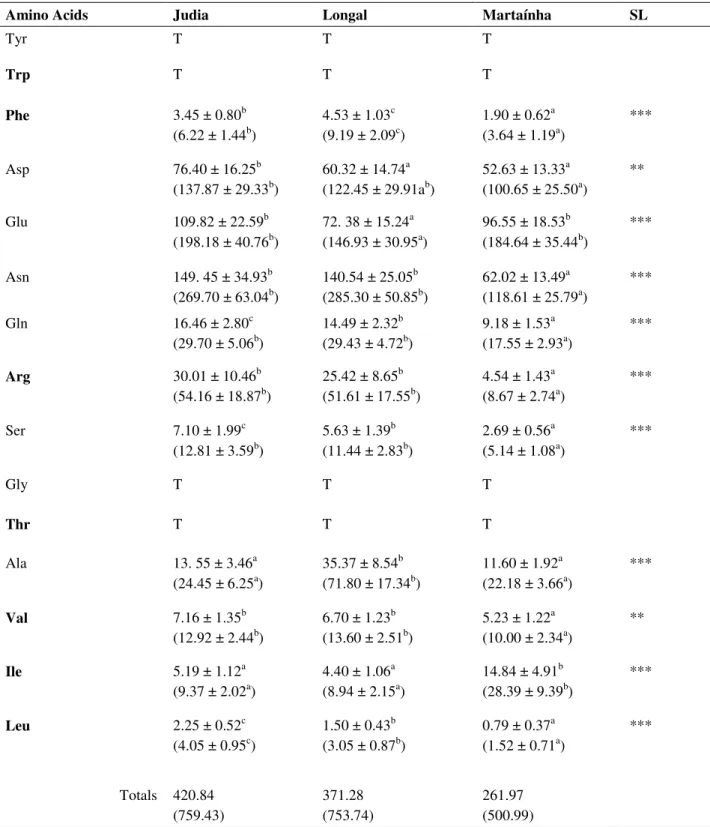
1. Determine the composition of nutrients (total starch, crude fat, crude protein, total fibre, and free amino acids) and phytochemicals (total and specific phenolics) in the fresh fruits of three main Portuguese chestnut cultivars (Judia, Longal and Martaínha) from the 2005 harvest. Determine the effects at each of the different stages of industrial processing on the nutrients and phytochemicals in the fruits of Judia and Longal in order to identify possible improvements for the processing methods and also for the selection of cultivars with optimal composition and processing characteristics and thus optimal health effects (Chapter 2).
2. Determine the effects of the industrial processing stages (storage, peeling and freezing) on the contents of total starch, crude fat, crude energy and total fibre in the fruits of four Portuguese cultivars (Judia, Longal, Martaínha and Lada) and two selected European cultivars (one Spanish - “Puga do Bolo” from Galiza region; one Italian - “Viterbes”/“Marron Vero” from Viterbo region) from two harvests (2006 and 2007). Therefore identifying the most suitable cultivars for processing that maintain high levels of nutrients and other biologically-active compounds for optimal composition and quality (Chapter 3).
3. Evaluate in detail, the changes in crude protein, free amino acids and phenolic phytochemicals during the industrial processing stages of the fruits of four previously defined Portuguese and two European cultivars from 2006 and 2007 harvest years (Chapter 4).
4. Evaluate in detail, the changes in minerals, free sugars, antioxidant vitamins and pigments during the industrial processing stages of the fruits of four previously defined Portuguese and two European cultivars from 2006 and 2007 harvest years (Chapter 5).
5. Determine the levels and profiles of tocopherols, pigments (carotenoids and chlorophylls) and specific phenolics (simple phenolics, ellagitannins and condensed tannins) in the pericarps and integuments of four Portuguese chestnut cultivars (pre- and post-storage from the 2007 harvest). Evaluate the extraction efficiencies for the phenolics using different low cost solvents, and thus determine the potential of these waste materials as sources of useful added-value phytochemical co-products (Chapter 6).
6. To complete a detailed review of the current knowledge on the composition of health-related nutrients and non-nutrients (phytochemicals) in chestnut fruits and how their composition can be affected by home and industrial processing and thus can affect the quality and health effects of the foods derived from chestnut (Chapter 7).
P
UBLICATIONS
This thesis consists of five scientific papers published in peer reviewed international journals, and one paper that is accepted/in press, as a result of the original research performed and are presented below:
De Vasconcelos, M.C.B.M., Bennett, R.N., Rosa, E.A.S., Ferreira-Cardoso, J.V., 2007. Primary and secondary metabolite composition of kernels from three cultivars of Portuguese chestnut (Castanea sativa Mill.) at different stages of industrial transformation. Journal of Agricultural
Food and Chemistry, 55:3508-3516.
De Vasconcelos, M.C.B.M., Bennett, R.N., Rosa, E.A.S., Ferreira-Cardoso, J.V., 2009a. Industrial processing effects on chestnut fruits (Castanea sativa Mill.) 1. Starch, fat, energy and fibre. International Journal of Food Science and Technology, 44:2606-2612.
De Vasconcelos, M.C.B.M., Bennett, R.N., Rosa, E.A.S., Ferreira-Cardoso, J.V., 2009b. Industrial processing effects on chestnut fruits (Castanea sativa Mill.) 2. Crude protein, free amino acids and phenolic phytochemicals. International Journal of Food Science and
Technology, 44:2613-2619.
De Vasconcelos, M.C.B.M., Nunes, F., García-Viguera, C., Bennett, R.N., Rosa, E.A.S., Ferreira-Cardoso, J.V., 2010. Industrial processing effects on chestnut fruits (Castanea sativa Mill.) 3. Minerals, free sugars, carotenoids and antioxidant vitamins in chestnut fruits (Castanea
sativa Mill.). International Journal of Food Science and Technology, 45: 496-505.
De Vasconcelos, M.C.B.M., Bennett, R.N., Quideau, S., Jacquet, R., Rosa, E.A.S. & Ferreira-Cardoso, J. V., 2010. Evaluating the potential of chestnut (Castanea sativa Mill.) fruit pericarp and integument as a source of tocopherols, pigments and polyphenols. Industrial Crops and
Products, 31:301-311.
De Vasconcelos, M.C.B.M., Bennett, R.N., Rosa, E.A.S. & Ferreira-Cardoso, J. V., 2010. Composition of European chestnut (Castanea sativa Mill.) and association with health effects: fresh and processed products. Journal of the Science of Food and Agriculture (Accepted/In Press).
L
IST OF
A
BBREVIATIONS
ADF………... Acid Detergent Fibre ADL………... Acid Detergent Lignin ALA………... Alpha-Linolenic Acid Asc…………. Ascorbic Acid
DHAsc……... Dehydroascorbic Acid CE………….. Crude Energy
DM.………… Dry Matter
DHA………... Docosahexaenoic Acid EA………….. Ellagic Acid
GA …………. Gallic Acid
EPA……….... Eicosapentaenoic Acid EXP………… Exportation
FW…………. Fresh Weight
GABA……… Gamma-Amino Butyric Acid HLA………... Human Leucocyte Antigen IMP………… Importation
INE…………. Instituto Nacional de Estatística LDL………... Low Density Lipoprotein MDHAsc…… Monodehydroascorbic Acid MS………….. Matéria Seca
MUFA……… Monounsaturated Fatty Acids NDF………... Neutral Detergent Fibre NDS………... Neutral Detergent Solubles PF…………... Peso Fresco
PUFA………. Polyunsaturated Fatty Acids RDI…………. Recommended Daily Intake RH………….. Relative Humidity
SCFA………. Short Chain Fatty Acids SFA………… Saturated Fatty Acids
L
IST OF
F
IGURES
Figure 1.1 - Feminine and Masculine Inflorescences (Left) and Mature Burr with Fruits (Right) 7 Figure 1.2 - Chestnut Fruit Half-Peeled and Shell - Pericarp and Integument (Left) and Peeled
Fruit with Deep Indentations (Right) 7
Figure 1.3 - World Geographic Distribution of Chestnut Species 7 Figure 1.4 - European Distribution of Castanea sativa Mill. 8 Figure 1.5 - Chestnut (Castanea sativa Mill.) Producing Areas in Portugal (Highlighted in Green) 8 Figure 1.6 - Chestnut Fruit Production in Portugal (1995-2008) 11 Figure 1.7 - Chestnut Products: Liquors (Left) and Whole Chestnuts in Tins and Jars (Right) 13
Figure 1.8 - “Marron Glacés” 13
Figure 1.9 - Diagram Representing Chestnut Fruit Processing 16
Figure 2.1 - Schematic Representation of the Industrial Processing Steps for Frozen and Fresh
Chestnut Kernels 37
Figure 2.2 - Chromatograms and UV-Visible Spectra of a Castanea Kernel Phenolic Extract and
Standards 46
Figure 3.1 - Flow Chart showing the Major Industrial Processing Stages for Chestnut Fruits 72
Figure 4.1 - Sortegel Processing Scheme with Sampling Stages (A, B, C and D) Indicated 89
Figure 5.1 - Example Chromatograms of Pigments (A and B) and Tocopherols (C and D) 105 Figure 5.2 - Sortegel Processing Scheme with Sampling Stages (A, B, C and D) Indicated 111
Figure 6.1 - Chemical Structures of Major Phenolics Previously Identified in Chestnut Tissues 119 Figure 6.2 - Example Chromatogram of Combined Standards (A) and a 70% Acetone Extract of
Longal Pericarp (B) 130
Figure 7.1 - Phytochemicals and Vitamins from Various Tissues of Castanea sativa Mill. 149
Figure 8.1 - Carbohydrate Metabolic Processes in the Human Body 170 Figure 8.2 - Shikimic Acid Pathway and Biosynthesis of Hydrolyzable Tannins 171
Figure 8.3 - Vitamin E Biosynthetic Pathway 172
L
IST OF
T
ABLES
Table 1.1 - World Production of Chestnut Fruits (10 Major Producers) 3 Table 1.2 - World Production of Chestnut Fruits (Minor Producers) 4 Table 1.3 - Geographic Distribution of the Different Portuguese Cultivars 9 Table 1.4 - Values of Importation, Exportation, and Commercial Value of Chestnut Fruits in
Portugal 11
Table 1.5 - Area, Production and Income of Chestnut Fruits in the Different Agrarian Regions of
Portugal in 2007 12
Table 1.6 - Chestnut Fruits Nutrient and Non-Nutrient Composition 18 Table 2.1 - Basic Chemical Composition and Phenolics of Fresh (Processing Step A) Raw Shelled
Chestnut Kernels from Three Cultivars 49
Table 2.2 - Basic Chemical Composition and Phenolics of Raw Shelled Chestnut Kernels from
Two Cultivars on the Four Processing Steps Analysed 50 Table 2.3 - Free Amino Acids Contents of Fresh (Processing Step A) Raw Shelled Chestnut
Kernels from Three Cultivars 51
Table 2.4 - Free Amino Acids of Raw Shelled Chestnut Kernels from Two Cultivars on the Four
Processing Steps Analysed 52
Table 2.5 - Effect of the Factors of Variation Considered (Cultivars and Processing Steps) and Respective Interaction of Basic Chemical Composition and Phenolics of Raw Shelled
Chestnut Kernels 53
Table 2.6 - Effect of the Factors of Variation Considered (Cultivars and Processing Steps) and Respective Interaction on Free Amino Acids Contents of Raw Shelled Chestnut
Kernels 54
Table 3.1 - Effect of Cultivar, Processing Step and Respective Interaction on Dry Matter Content, Starch, Crude Fat, Crude Energy, Fibre and Total Ashes Levels of Raw Shelled
Chestnut Kernel Samples of 2006 Harvest 70
Table 3.2 - Effect of Cultivar, Processing Step and Respective Interaction on Dry Matter Content, Starch, Crude Fat, Crude Energy, Fibre and Total Ashes Levels of Raw Shelled
Chestnut Kernel Samples of 2007 Harvest 71
Table 4.1 - Effect of Cultivar, Processing Step and Respective Interaction on Crude Protein and
Amino Acids Content of Raw Shelled Chestnut Kernel Samples of 2006 Harvest 85 Table 4.2 - Effect of Cultivar, Processing Step and Respective Interaction on Crude Protein and
Table 4.3 - Effect of Cultivar, Processing Step and Respective Interaction on Total and Specific Phenolics Content of Raw Shelled Chestnut Kernel Samples of 2006 and 2007
Harvests 87
Table 5.1 - Effect of Cultivar, Processing Step and Respective Interaction on Mineral
Composition of Raw Shelled Chestnut Kernel Samples of 2006 Harvest 106 Table 5.2 - Effect of Cultivar, Processing Step and Respective Interaction on Mineral
Composition of Raw Shelled Chestnut Kernel Samples of 2007 Harvest 107 Table 5.3 - Effect of Cultivar, Processing Step and Respective Interaction on Free Sugars and
Carotenoids Content of Raw Shelled Chestnut Kernel Samples of 2006 and 2007
Harvests 108
Table 5.4 - Effect of Cultivar, Processing Step and Respective Interaction on Vitamin E and C
Contents of Raw Shelled Chestnut Kernel Samples of 2006 and 2007 Harvests 109
Table 6.1 - Percentage of the Waste Material (Shells) in the Stages A and B of Chestnut Fruit
Industrial Processing 117
Table 6.2 - Initial Studies on Variation in Total Phenolics and Specific Phenolics in Extracts of Pericarp and Integument of the Four Cultivars Prepared using 70% Methanol at 70ºC,
from the Two Processing Stages (A and B) 133
Table 6.3 - Total Phenolics in Different Solvent Extracts of Pericarp and Integument of the Four
Chestnut Cultivars from the Two Processing Stages (A and B) 134 Table 6.4 - Total Condensed Tannins in Different Solvent Extracts of Pericarp and Integument of ………the Four Chestnut Cultivars from the Two Processing Stages (A and B) 135 Table 6.5 - Concentrations of Specific Phenolics Determined by HPLC in Different Extracts from Combined Stages A and B of Pericarp and Integument of the Cultivar Longal 136
Table 7.1 - Reference Daily Intake (RDI) Values for Macronutrients, Vitamins and Minerals 157 Table 7.2 - Proximate Analyses Previously Reported for Chestnut Fruits 158 Table 7.3 - Contents of Free Amino Acids Previously Reported in Chestnut Fruits 159 Table 7.4 - Contents of the Antioxidant Vitamins E and C Previously Reported for Chestnut Fruits 159 Table 7.5 - Contents of Minerals Previously Reported for Chestnut Fruits 160 Table 7.6 - Contents of Phenolics and Pigments Previously Reported for Chestnut Fruits and
I
NDEX
AGRADECIMENTOS vii RESUMO ix ABSTRACT xv OBJECTIVES xix PUBLICATIONS xxiLIST OF ABBREVIATIONS xxiii
LIST OF FIGURES xxv
LIST OF TABLES xxvii
CHAPTER 1
General Introduction
1.1. Introduction 3
1.2. Biology of the genus Castanea 5
1.2.1. Origin and Ecology 5
1.2.2. Chestnut Species and Cultivars 7
1.2.2.1. General Characterization 8
1.3. Production and Economic Importance 10
1.3.1. National and International Production of Chestnut 10
1.3.2. Percentage of Chestnut used in the Fresh and Frozen Markets 12
1.4. Commercial and Technological Characteristics 13
1.4.1. Calibre 13
1.4.2. Aspect (colour, shell splitting, fungal and pest infestation) 14
1.4.3. Polyspermy 14
1.4.4. Type of Fruit Indentations 14
1.4.5. Ease of Pealing 15
1.4.6. Maturation 15
1.4.7. Storage 15
1.4.8. Organoleptic Properties 15
1.5. Industrial Processing - Frozen Market 16
1.5.1. Processing Stages 16
1.6. Chestnut Fruit Nutrient and Non-Nutrient Composition and Health Benefits 17
1.6.1. Starch and Sugars 18
1.6.2. Fibre 20
1.6.3. Crude Fat and Fatty Acids 20
1.6.4. Crude Energy 21
1.6.5. Protein and Amino Acids 21
1.6.6. Minerals 23
1.6.7. Antioxidant and other Vitamins 23
1.6.8.1. Phenolics and Polyphenolics 25
1.6.8.2. Alkaloids 25
1.7 References 27
CHAPTER 2
Primary and Secondary Metabolite Composition of Kernels from Three Cultivars of Portuguese Chestnut (Castanea sativa Mill.) at Different Stages of Industrial Transformation
2.1 Introduction 35
2.2 Materials and Methods 36
2.2.1 Plant Material 36
2.2.2 Chemicals 36
2.2.3 Processing Samples for the Different Analyses 37
2.2.4 Dry Matter, Organic Matter and Ash Contents 38
2.2.5 Extraction and Quantification of Crude Fat 38
2.2.6 Extraction and Quantification of Crude Protein 38
2.2.7 Extraction and Quantification of Starch 38
2.2.8 Extraction and Quantification of Fiber (NDF, ADF, ADL) 39
2.2.9 Extraction and HPLC Analysis of Free Amino Acids 39
2.2.10 Extraction and Quantification of Total Phenolics 40
2.2.11 Extraction and HPLC Analysis and Quantification of Free Gallic and Ellagic Acids 40
2.2.12 Statistical Analysis 41
2.3 Results and Discussion 41
2.4 Supporting Information 53
2.5 References 55
CHAPTER 3
Industrial Processing Effects on Chestnut Fruits (Castanea sativa Mill.) 1. Starch, Fat, Energy and Fibre
3.1 Introduction 61
3.2 Materials and Methods 62
3.2.1 Plant Material and Processing 62
3.2.2 Chemicals 63
3.2.3 Determination of Dry Matter, Organic Matter and Ash Contents 63
3.2.4 Extraction and Quantification of Starch 63
3.2.5 Crude Fat Extraction and Measurements 63
3.2.6 Crude Energy Measurements 63
3.2.7 Extraction and Quantification of Neutral Detergent Fibre (NDF), Acid Detergent
Fibre (ADF) and Acid Detergent Lignin (ADL) 64
3.2.8 Statistical Analysis 64
3.3 Results and Discussion 64
3.3.2 Dry Matter Contents 64
3.3.3 Total Ashes Contents 65
3.3.4 Total Starch Contents 66
3.3.5 Crude Fat Contents 66
3.3.6 Crude Energy Values 67
3.3.7 Fibre Contents 68 3.3.7.1 NDF 68 3.3.7.2 ADF 68 3.3.7.3 ADL 68 3.3.7.4 Cellulose 68 3.4 Conclusions 69 3.5 Supporting Information 72 3.6 References 73 CHAPTER 4
Industrial Processing Effects on Chestnut Fruits (Castanea sativa Mill.) 2. Crude Protein, Free Amino Acids and Phenolic Phytochemicals
4.1 Introduction 77
4.2 Materials and Methods 78
4.2.1 Plant Samples and Processing 78
4.2.2 Chemicals 79
4.2.3 Crude Protein Extraction and Measurements 79
4.2.4 Free Amino Acids Extraction and Analysis 79
4.2.5 Extraction of Phenolics for Total Phenolics and HPLC Analysis 79
4.2.6 Statistical Analysis 80
4.3 Results and Discussion 80
4.3.1 Crude Protein 80
4.3.2 Free Amino Acids 81
4.3.3 Total Phenolics 82
4.3.4 Free Gallic and Ellagic Acids 83
4.4 Conclusions 83
4.5 Supporting Information 88
4.6 References 90
CHAPTER 5
Industrial Processing Effects on Chestnut Fruits (Castanea sativa Mill.) 3. Minerals, Free Sugars, Carotenoids and Antioxidant Vitamins in Chestnut Fruits (Castanea sativa Mill.)
5.1 Introduction 95
5.2 Materials and Methods 96
5.2.1 Plant Material and Processing 96
5.2.2 Chemicals 97
5.2.3 Macro- and Micro-Minerals Composition 97
Free Sugars
5.2.5 Carotenoids Extraction and Analysis 97
5.2.6 Vitamin E Extraction and Analysis 98
5.2.7 Vitamin C Extraction and Analysis 98
5.2.8 Statistical Analysis 99
5.3 Results and Discussion 99
5.3.1 Mineral Contents 99
5.3.2 Free Sugars Contents 100
5.3.3 Carotenoids Contents 101
5.3.4 Vitamin E Contents 101
5.3.5 Vitamin C (Ascorbic Acid and Dehydroascorbic Acid) Contents 102
5.4 Conclusions 103
5.5 Supporting Information 110
5.6 References 112
CHAPTER 6
Evaluating the Potential of Chestnut (Castanea sativa Mill.) Fruit Pericarp and Integument as a Source of Tocopherols, Pigments and Polyphenols
6.1 Introduction 117
6.2 Materials and Methods 120
6.2.1 Chemicals 120
6.2.2 Plant Material 121
6.2.3 Extraction and HPLC Analysis of Vitamin E (Tocopherols and Tocotrienols) 121 6.2.4 Extraction and HPLC Analysis of Pigments (Carotenoids and Chlorophylls) 122 6.2.5 Extraction and Quantification of Total Phenolics and Total Condensed Tannins 123 6.2.6 Preparation of Chestnut Integument Condensed Tannin Standard 123
6.2.7 Initial HPLC Analysis of Phenolics 124
6.2.8 Solvent Extraction Studies 124
6.2.9 Statistical Analysis 125
6.3 Results and Discussion 125
6.3.1 Vitamin E and Pigments Contents 125
6.3.2 Total Phenolics in 70% Methanol Extracts 125
6.3.3 Gallic Acid in 70% Methanol Extracts 126
6.3.4 Ellagic Acid in 70% Methanol Extracts 126
6.3.5 Vescalagin and Castalagin in 70% Methanol Extracts 127
6.3.6 Acutissimins, Unidentified Tannins and the Ellagic Acid Derivative in 70%
Methanol Extracts 127
6.3.7 Total Phenolics in Different Solvent Extracts 127
6.3.8 Total Condensed Tannins in Different Solvent Extracts 128 6.3.9 HPLC of Different Extracts of Longal Pericarp and Integument – Combined Stages
A and B 129
6.5 References 137
CHAPTER 7
Composition of European Chestnut (Castanea sativa Mill.) and Association with Health Effects: Fresh and Processed Products
7.1 Introduction 141
7.2 Chestnut Uses and Co-Products 142
7.2.1 Home Cooking 142
7.2.2 Industrial Processing 143
7.2.3 Other Chestnut Tissues Products 144
7.3 Proximate Composition of Chestnut Fruits 145
7.3.1 Recommended Daily Intake (RDI) Values 145
7.3.2 Basic Composition 146
7.3.3 Crude Protein and Free Amino Acids 147
7.3.4 Antioxidant and Other Vitamins 148
7.3.5 Minerals 150
7.4 Pigments and Secondary Metabolites 151
7.4.1 Pigments 151
7.4.2 Total Phenolics, Specific Phenolics and Tannins 152
7.4.3 Alkaloids 152
7.4.4 Flavour Compounds 153
7.5 Health Effects – Animals 153
7.6 Health Effects – Humans 154
7.6.1 Chestnut and Allergies 154
7.6.2 Beneficial Effects of Chestnut 154
7.6.3 Chestnut as a Functional Food 155
7.7 General Comments - The Future for Chestnut 155
7.8 References 161
CHAPTER 8
Concluding Remarks
8.1 General Conclusions and Discussion 169
8.2 The Future for Chestnuts 173
1.1 Introduction
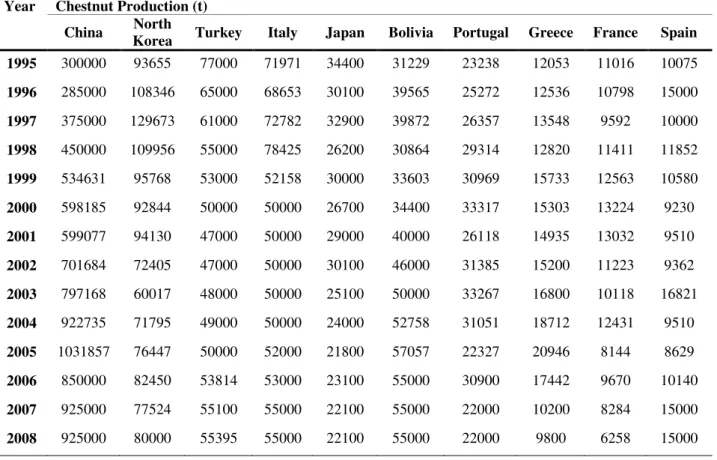
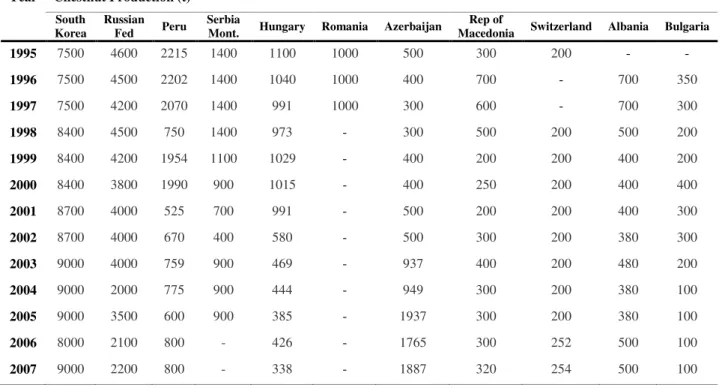
The chestnut tree (Castanea sativa Miller) is one of the most important agro-forestry species in the Northern and Central regions of Portugal and in many other European countries. Especially in Trás-os-Montes the optimum ecological and climatic conditions ensure the survival and development of this nut tree. Chestnut species are important sources of raw materials for various industrial applications (wood for furniture and wine barrels, tannins for leather processing), and the fruits are an important food in Europe (mainly Italy, Portugal, France and Spain), Turkey, North and South America and Asia (China, Japan and Korea) (Tables 1.1 and 1.2).
Table 1.1 - World production of chestnut fruits (10 major producers) (Source: FAO - FAOSTAT Statistics Division, 2009 and 2010).
Year Chestnut Production (t) China North
Korea Turkey Italy Japan Bolivia Portugal Greece France Spain 1995 300000 93655 77000 71971 34400 31229 23238 12053 11016 10075 1996 285000 108346 65000 68653 30100 39565 25272 12536 10798 15000 1997 375000 129673 61000 72782 32900 39872 26357 13548 9592 10000 1998 450000 109956 55000 78425 26200 30864 29314 12820 11411 11852 1999 534631 95768 53000 52158 30000 33603 30969 15733 12563 10580 2000 598185 92844 50000 50000 26700 34400 33317 15303 13224 9230 2001 599077 94130 47000 50000 29000 40000 26118 14935 13032 9510 2002 701684 72405 47000 50000 30100 46000 31385 15200 11223 9362 2003 797168 60017 48000 50000 25100 50000 33267 16800 10118 16821 2004 922735 71795 49000 50000 24000 52758 31051 18712 12431 9510 2005 1031857 76447 50000 52000 21800 57057 22327 20946 8144 8629 2006 850000 82450 53814 53000 23100 55000 30900 17442 9670 10140 2007 925000 77524 55100 55000 22100 55000 22000 10200 8284 15000 2008 925000 80000 55395 55000 22100 55000 22000 9800 6258 15000
Table 1.2 - World production of chestnut fruits (minor producers) (Source: FAO - FAOSTAT Statistics Division, 2009)*.
Year Chestnut Production (t) South
Korea
Russian Fed Peru
Serbia
Mont. Hungary Romania Azerbaijan
Rep of
Macedonia Switzerland Albania Bulgaria
1995 7500 4600 2215 1400 1100 1000 500 300 200 - - 1996 7500 4500 2202 1400 1040 1000 400 700 - 700 350 1997 7500 4200 2070 1400 991 1000 300 600 - 700 300 1998 8400 4500 750 1400 973 - 300 500 200 500 200 1999 8400 4200 1954 1100 1029 - 400 200 200 400 200 2000 8400 3800 1990 900 1015 - 400 250 200 400 400 2001 8700 4000 525 700 991 - 500 200 200 400 300 2002 8700 4000 670 400 580 - 500 300 200 380 300 2003 9000 4000 759 900 469 - 937 400 200 480 200 2004 9000 2000 775 900 444 - 949 300 200 380 100 2005 9000 3500 600 900 385 - 1937 300 200 380 100 2006 8000 2100 800 - 426 - 1765 300 252 500 100 2007 9000 2200 800 - 338 - 1887 320 254 500 100
* Data not available for 2008.
The decrease of chestnut production in Portugal was specially marked in the middle of the 19th century with the appearance of other food sources such as potatoes, maize and rye. Chestnut tree productivity was also affected by economic factors (expensive wood) and by the appearance of the “ink disease” associated with the soil-borne pathogens Phytophthora
cinnamomi Rands and Phytophthora cambivora (Petri) Buis. Later in the beginning of the 20th
century the appearance of the chestnut canker (caused by the fungus Cryphonectria parasitica (Murr.) Barr.) caused further significant decreases of this tree´s productivity (Adua, 1999).
According to Ferreira-Cardoso (2002) the development of adequate industrial units, will contribute to a better valorisation of this nut production. This evolution will certainly allow a significant increase in chestnut fruit exportations, either fresh or processed, as long this production is based on the utilisation of the best cultivars leading to an improvement of the actual production quality. The same author stated that the high economic value of chestnut trees is not only due to the fruit and wood productivity, but is also associated with other activities e.g. rural tourism and folk activities, which also play an important role in the management of synergistic resources as sources of food for several hunting species.
The main factors that limit the successful production and industrial processing of this nut are: (1) difficulties in the control of the ink and blight diseases in chestnut trees; (2) insufficient
industrial utilization of chestnut fruits and (3) the low industrial activity contributing to the absence of processed products, affecting the level of exportation from Portugal, while in other countries the consumption of products derived from this nut increases significantly (Ferreira-Cardoso, 2002). Chestnut fruit has been the subject of intensive research in the last decade, mainly because of the potential human health benefits that the intake of this nut might provide, assuming special importance as part of a balanced diet rich in antioxidant compounds, known for having positive health effects.
1.2 Biology of the Genus Castanea
The genus Castanea belongs to the sub-family Castaneoideae and family Fagaceae that
includes other ecologically and economically important tree species, such as Aesculus
hippocastanum (horsechestnut), Betula pendula (birch), Fagus sylvatica (beech) and Quercus
species (oaks) (Manos et al., 2001). According to Gomes-Laranjo and Crespí (2007) the European chestnut tree was included in the genus Castanea in 1768 by the botanist of Scottish descent Phillip Miller and then onwards designated as Castanea sativa Mill. The chestnut tree is geographically distributed in three main areas: Asia with Castanea crenata Sieb. and Zucc. (Japan) and Castanea mollissima Bl. (China and Korea), North America with Castanea dentata Borkh. and Europe with Castanea sativa Mill. (Bounous, 2005). In Portugal, as in the rest of Europe, Castanea sativa Mill. is the most cultivated species.
1.2.1 Origin and Ecology
The hybrid species of chestnut appeared as a result of genetic crossing of Castanea sativa Mill. with other species, specifically Castanea crenata Sieb. & Zucc. from Japan and Castanea
mollissima Blume from China. These hybrids offer benefits as rootstocks and provide resistant
genes to the ink disease in the chestnut tree (Martins and Abreu, 2007).
The European chestnut (Castanea sativa Mill.) probably had its origins in the Eastern Mediterranean region over 90 million years ago in the middle Cretaceous period, later spreading throughout Europe during the Cenozoic period (Adua, 1999; Ferreira-Cardoso, 2002). Later, between 900-700 BC, deliberate chestnut tree cultivation occurred in the Asian regions of the Caspian and Black sea. After this time chestnut cultivation quickly spread to Greece and later the Romans discovered the benefits of this nut tree (Adua, 1999). However, Van Den Brink and Janssen (1985) showed that fossilized chestnut pollen found in “Serra da Estrela” was at least 8000 years old (Palaeolithic period), and therefore these findings prove that the appearance of
chestnut trees in Portugal may have occurred much earlier than the Roman occupation of the Iberian Peninsula.
The chestnut tree is a deciduous species with hypogeal germination and when grown under optimal soil and climatic conditions this nut tree has a rapid growth rate up to 70 to 80 years old, with an average height of 10 to 20 meters (Pinto et al., 2007). The same authors described the leaves as simple with sub-coriaceous consistency and disposed alternately. These trees possess a strong and robust root system with little development in depth (50cm), being able to reach long distances horizontally (Pinto et al., 2007). They have very low tolerance to limestone, to deficient drainage and to compacted soils, needing low acidity, and deep soils rich in organic matter and minerals i.e. potassium, sodium and magnesium (Portela et al., 2007). According to Valdiviesso et al. (1993) chestnut is a monoecious species and has two different types of inflorescences: the unisexual staminate catkins in the lower parts of the shoot and the bisexual catkins in the terminal end of the shoots (Figure 1.1). The staminate flowers are disposed in a spiral along the axis of the catkin in clusters (three to seven), while the pistillate inflorescences are arranged individually or in clusters (two or three) at the base of the bisexual catkins. The same authors state that the flowers usually present seven to nine styles. The flowering is dependant on climatic conditions during the spring season, occurring usually between May and middle July, with the masculine inflorescences appearing first. After flowering, cross-pollination occurs by insects and wind. The chestnut fruit requires a long warm period of 75 to 120 days to develop (Pinto et al., 2007). This happens inside the burr which opens when the fruit is fully mature. There is very little previous information about chestnut production yields, which are affected by factors such as cultivar, region and edaphoclimatic conditions. Ferreira-Cardoso and Pimentel-Pereira (2007) reported values of 30 to 40 kg/tree, while Lüdders (2004) reported higher production yields ranging between 100 to 150 kg/tree, with mature trees producing up to 300 kg.
The burr usually possesses 1 to 3 fruits (Figure 1.1), but more rarely 7 to 8 fruits can also appear. The fruit is formed from the fertilized ovum containing only one fertile seed (monospermic) or if each feminine flower has several ova then polyspermic fruits can develop (Bergougnoux et al., 1978). According to the same authors in the first case the fruit is designated “marron”, while in the second case it is named “chestnut”. The shell of chestnut fruits consists of the pericarp (hard external shell) and the integument (soft internal shell or skin) (Figure 1.2).
C. dentata
and C. pumila
C. sativa
C. crenata C. mollissima
Figure 1.1 - Feminine and masculine inflorescences (left) and mature burr with fruits (right).
Figure 1.2 - Chestnut fruit half peeled and shell - pericarp and integument (left) and peeled fruit with deep indentations (right).
1.2.2 Chestnut Species and Cultivars
Chestnut is geographically distributed in three major areas: Europe, Asia (Turkey, Japan, China and Korea), and North America (Figure 1.3).
Figure 1.3 - World geographic distribution of chestnut species (Source: Lage, 2005).
The European chestnut tree (Castanea sativa Mill.) is spread predominantly over the Mediterranean countries and within major forest areas (Figure 1.4). The domesticated populations of this tree are formed into orchards (Lüdders, 2004).
In Portugal the chestnut trees are more intensely distributed in the regions of Trás-os-Montes and Beiras (Figure 1.5), but they are also found in some Northeastern areas of Alentejo - Marvão (mountain of S. Mamede), in the North of Algarve (mountain of Monchique) and in Minho Interior (mountain of Gerês), and also in several places of the Northern regions of Tejo. However, chestnut trees can also be found in more isolated regions such as the islands of Madeira (“Curral das Freiras” and “Serra de Água”) and Azores (Ferreira-Cardoso, 2002).
Figure 1.4 - European distribution of Castanea sativa Mill. (EUFORGEN, 2009).
Figure 1.5 - Chestnut (Castanea sativa Mill.) producing areas in Portugal (highlighted in green) (Lage, 2005).
1.2.2.1 General Characterization
Initially the naming of chestnut cultivars was based on phenotype alone and it is only more recently that genotype analyses have shown the specific relationships between regional and national cultivars. This has led to a certain degree of confusion with chestnut cultivars. There are several cultivars of chestnut in Portugal but sometimes different designations have been used for
the same cultivar in geographically close areas, or different cultivars from different/distant places have been given the same name. Further complexities have arisen when some cultivars, with apparently different origins and local designations, are derived from the same cultivar. This confusion occurs when they diverge morphologically due to environmental factors. A previous study with Portuguese chestnut cultivars detected the genetic variability of these cultivars by evaluating iso-enzyme polymorphisms (Pimentel-Pereira et al., 1999). This study was based on 7 different types of iso-enzyme profiles and it allowed the discrimination of 32 classes. To each class corresponded one or more distinct cultivars that were genetically very similar (synonymy), but in other cases genetically distinct cultivars had the same name (homonymy) (Pimentel-Pereira et al., 1999). A previous work of detection and inventory of the different Portuguese cultivars of chestnut and their geographic distribution is detailed in Table 1.3 (Ferreira-Cardoso and Pimentel-Pereira, 2007).
Table 1.3 - Geographic distribution of the different Portuguese cultivars (Ferreira-Cardoso and Pimentel-Pereira, 2007).
Districts County Cultivars
Braga Terras de Bouro Amarelal; Misericórdia; De Quarta
Bragança
Alfândega da Fé Enxerta
Bragança Enxerta; Judia
Carrazeda de Ansiães Longal; Enxerta Macedo de Cavaleiros Enxerta
Mogadouro Enxerta; Negra
Vinhais Judia (Carrazeda); Aveleira; Lamela;
Trigueira; Boaventura; Longal
Guarda Trancoso Martaínha; Longal
Portalegre Marvão Bária; Colarinha; Enxerta (Longal)
Vila Real
Boticas Pelada; Galizã; Longal
Chaves Vermelha; Longa
Montalegre Redonda; Nacional; Enxerta; Longal
Murça Cota; Longal
Valpaços Judia; Lada; Negral; Sousão; Lamela; Rebolão; Cota; Soutunha; Longal
Vila Pouca Cota; Longal; Bairral
Vila Real (Campeã) Benfeita; Bebim; Moreira; Longal
Viseu
Armamar Riscal; Longal; Serrano
Lamego Cancela; Longal; Rabodiça
Meda Verdeal; Longal
Moimenta da Beira Negra; Demanda; Carreiró; Longal
Penedono Passã; Martaínha; Longal