Universidade de Aveiro Departamento de Eletrónica, Telecomunicações e Informática 2016
Tiago Miguel
Vigário Novo
Arquitetura para Integração e Exploração de
Registos Eletrónicos de Saúde
Architecture for Integration and Exploration of
Eletronic Health Records
“And if anyone happens to ask whether I made any material dif-ference to the welfare of this planet, you can tell them I came and went like a summer cloud.”
— Fifth Doctor Universidade de Aveiro Departamento de Eletrónica, Telecomunicações e Informática 2016
Tiago Miguel
Vigário Novo
Arquitetura para Integração e Exploração de
Registos Eletrónicos de Saúde
Architecture for Integration and Exploration of
Eletronic Health Records
Universidade de Aveiro Departamento de Eletrónica, Telecomunicações e Informática 2016
Tiago Miguel
Vigário Novo
Arquitetura para Integração e Exploração de
Registos Eletrónicos de Saúde
Architecture for Integration and Exploration of
Eletronic Health Records
Dissertação apresentada à Universidade de Aveiro para cumprimento dos requisitos necessários à obtenção do grau de Mestre em Engenharia de Computadores e Telemática, realizada sob a orientação científica do Doutor José Luís Guimarães Oliveira, Professor associado do Departamento de Eletrónica, Telecomunicações e Informática da Universidade de Aveiro.
The final countdown begun And now its time for one last bow
Like all your other selves Elevens hour is over now The clock is striking twelves
o júri / the jury
presidente / president Prof. Dr. Joaquim Manuel Henriques de Sousa Pinto
Professor Auxiliar, Departamento de Eletrónica, Telecomunicações e Informática da Universidade de Aveiro
vogais / examiners committee Prof. Dr Joel Perdiz Arrais
Professor Auxiliar Convidado, Departamento de Engenharia Informática da Fac. de Ciências e Tecnologia da Universidade de Coimbra
Prof. Dr. José Luis Guimarães Oliveira
Professor Associado, Departamento de Eletrónica, Telecomunicações e Informática da Universi-dade de Aveiro
Palavras Chave arquitetura de software, estudos biomédicos, bases de dados da saúde.
Resumo A sucessiva digitalização da informação de saúde dos cidadãos tem poten-ciado o desenvolvimento de aplicações que permitem estudar e extrair infor-mação, facilitando a produção de conhecimento através de análise dos dados armazenados. A normalização de modelos de dados permite que as mesmas ferramentas possam ser usadas em diferentes bases de dados. O cresci-mento de comunidades que mantêm repositórios clínicos locais e isolados uns dos outros tem impedido que estudos epidemológicos, por exemplo, pas-sar a ser realizados sobre um conjunto alargado de pessoas. Existe assim uma necessidade de transparentemente estudar múltiplas populações distri-buidas globalmente. Esta dissertação propõe soluções para integrar distintos catálogos clínicos e ferramentas de software e permitir que possam ser utili-zadas de forma distribuida.
Keywords software architecture, biomedical studies, healthcare databases.
Abstract The increase of patient-level data available on digital format led to the de-velopment of aplications that can study and extract information and produce knowledge by analysing stored data. As data standardization is achieved, tools and studies can be shared in different databases. The growth of com-munities that maintain clinical repositories local and isolated has prevented epidemiological studies, for example, from being carried out on a wide range of people. There is a need for transparently study multiple globally-distributed populations. This dissertation proposes solutions to integrate software tools on distinct health catalogues, allowing them to be used distributely.
Contents
Contents i
List of Figures iii
Acronyms v
1 Introduction 1
1.1 Motivation . . . 1
1.2 Dissertation Outline . . . 2
2 State of The Art 3 2.1 The EMIF Project . . . 3
2.2 The OHDSI Ecosystem . . . 5
2.2.1 Common Data Model . . . 6
2.2.2 Vocabulary Resources . . . 8
2.2.3 WebAPI . . . 8
2.2.4 ACHILLES and ACHILLES Web . . . 8
2.2.5 CALYPSO . . . 9 2.2.6 ATLAS . . . 9 3 System Definition 11 3.1 Main Goal . . . 11 3.2 Study Organization . . . 12 3.3 Architecture Design . . . 12 3.4 Pull Architecture . . . 13 3.4.1 Database Study . . . 13 3.4.2 Community Studies . . . 14 3.4.3 Drawbacks . . . 16 3.5 Push Architecture . . . 17 3.5.1 Study Creation . . . 18 3.5.2 Getting Results . . . 18
3.6 Final Application – APOLLO . . . 19
3.6.1 Deployment . . . 20
3.6.2 Usage . . . 21 3.7 Summary . . . 25
4 Conclusions 27
4.1 Evaluation of the work . . . 27 4.2 Future Work . . . 28
References 29
List of Figures
2.1 The EMIF Platform . . . 4
2.2 OMOP and OHDSI evolution . . . 6
2.3 The importance of the CDM for data exploration. . . 7
2.4 Achilles Web . . . 8
2.5 CALYPSO - example of a cohort definition . . . 9
2.6 ATLAS main interface . . . 10
3.1 Pull Architecture . . . 13
3.2 Simple Interaction (redirect to only one database) . . . 14
3.3 Community Interaction, Synchronous Requests . . . 15
3.4 Community Interaction, Assynchronous Requests . . . 16
3.5 Push Architecture . . . 17
3.6 Phase 1 – Concept Set Creation and Phase 2 – Cohort Rule Definition execution sequence with the “push” architecture . . . 18
3.7 Phase 3 – Study Execution handling by the push architecture . . . 19
3.8 Result upload by the data owner . . . 19
3.9 APOLLO Deployment: Docker Containers (rounded rectangles), Images (normal rectangles) and Shared Volumes (circles) . . . 21
3.10 Concept set creation screen . . . 22
3.11 Cohort Definition Screen . . . 22
3.12 Cohort Generation Screen . . . 23
3.13 Cohort Importation Screen . . . 23
3.14 Results overview and exportation screen . . . 24
3.15 Results detailed screen . . . 24
Acronyms
ACHILLES Automated Characterization of Health Information at Large-scale Longitudinal Evidence Systems
ATHENA Process developed to build standardized vocabularies compatible with the Common Data Model
ATLAS Web tool for researchers to conduct scientific analysis on standardized observational data
CALYPSO Criteria Assessment Logic for Your Population Study in Observational data
CDM Common Data Model
CIRCE Cohort Inclusion and Restriction Criteria Expression
HERMES Health Entity Relationship and Metadata Exploration System
LAERTES Largescale Adverse Effects Related to Treatment Evidence Standardization OHDSI Observational Health Data Sciences and Informatics
OMOP Observational Medical Outcomes Partnership EMIF European Medical Information Framework JSON JavaScript Object Notation
REST Representational state transfer
APOLLO Augmenting Patient-level Observational Learning by Large-scaling OHDSI tools
1
Introduction
Et, avec un peu de mélancolie, peut-être, il ajouta : – Droit devant soi on ne peut pas aller bien loin. . .
Antoine de Saint-Exupéry
1.1 Motivation
Clinical trials for new treatments and drugs assessment, such as many other health related studies require a test population in order to be validated by medical regulations. That test population is not easily found, in particular for rare diseases and conditions, as clinical data from different, disperse population is not publicly available and access may be object of different regulations and policies, rendering it unwise, unworthy or rather costly to bypass, under the risk that population cannot be used for the trial.
The advance of information systems and the informatization of most public (and private) sectors and services boosted the development of many technologies and data sharing between many, otherwise unlinked, markets. Notably, the health care sector started having almost all their medical and clinical records in a digital format.
Some platforms being developed allow intuitive listing and centralized search across distinct databases. Search is conducted based on fingerprints (descriptive information), which are often subjetive, incomplete and not always automated.
To address this problem, some, more customizable, tools have been developed, to complete fingerprint data with more specific information, allowing easier assessment of feasibility (or praticallity) of certain studies in a certain population. Providing certain conditions, like a similar structure, these feasibility tests may be shared and reused
accross different databases, without the need for the test creator to know the data inside the database.
As patient databases are reaching a standardized model, studies can be designed for that model, shared with different potentially interesting database owners, reviewed (for privacy or political concerns), and then executed in a tool, with its results returned to the initial requester.
Although there are already tools that assess this kind of feasibility, there is currently no alternative to automate and share, efficiently, a feasibility test across distinct, related - or not, databases. This dissertation tries to address that necessity, by proposing and
implementing solutions, to solve the problem. 1.2 Dissertation Outline
This dissertation is organized in three more chapters.
• chapter 2 describe the state of art mostly related with the EMIF and OHDSI projects;
• chapter 3 describes the requirements, the proposed architecture and the final application
• chapter 4 provides an evaluation of the work made and suggests other implemen-tation and contributions to improve the project.
2
State of The Art
I seriously feel like the best days are ahead, and I like the idea of getting to do everything I did before but with more knowledge, experience, and street smarts. There’s a certain love,
appreciation, and gratitude . . . you don’t have when you’re younger, and it makes every accomplishment feel so much better.
J. Lo
Medical research has taken a great leap since the development of information systems, providing easier controlled access and sharing of health data. This chapter describes major contribution to this topic that have been done by the European Medical Information Framework (EMIF) and by Observational Health Data Sciences and Informatics (OHDSI) initiative.
2.1 The EMIF Project
The European Medical Information Framework (EMIF) project aims to develop a common information framework that will link up and facilitate access to diverse medical and research data sources, opening up new avenues of research for scientists. In this consortium there are initially leverage data on around 40 Million European adults and children by means of federation of healthcare databases and cohorts from 7 different countries (DK, DE, IT, NL, UK, ES, EE), designed to be representative of the different types of existing data sources (population-based registries, hospital-based databases, cohorts, national registries, biobanks, etc.).
This ongoing project culminated with the development of a web platform1
(through the colaboriteve github project - Montra) that gathers information of health data repositories. It allows the discovery of potentially suitable databases, by indexing and displaying descriptive information about each database (fingerprint) and organizing similar databases in communities.
The available information and features can be extended by means of plugins, which can be just external apps running parallel and external to the Catalogue, global widgets, or database specific specific plugins (e.g.: Achilles Web Visualization Tool)[1]
Figure 2.1: The EMIF Platform [2]
The EMIF community databases have been migrating their datasets to store obser-vational patient-level data in a standardized Common Data Model (CDM). This is a big oportunity for researchers as they can now start using tools developed by OMOP and OHDSI across multiple databases.
1
http://emif-catalogue.eu
2.2 The OHDSI Ecosystem
Observational Health Data Sciences and Informatics (OHDSI) is an international ini-tiative that aims to transform medical decision making by creating reliable scientific evidence about disease natural history, healthcare delivery, and the effects of med-ical interventions through large-scale analysis of observational health databases for population-level estimation and patient-level predictions[3].
Historically it started in 2007 when the Observational Medical Outcomes Partnership (OMOP) was launched, by the Foundation for the National Institutes of Health (FNIH), in partnership with Pharmaceutical Research and Manufacturers of America (PhRMA) and the Food and Drug Administration (FDA), with the objective to answer a critical challenge: “what can medical researchers learn from assessing these new health databases, could a single approach be applied to multiple diseases, and could their findings be proven?”.
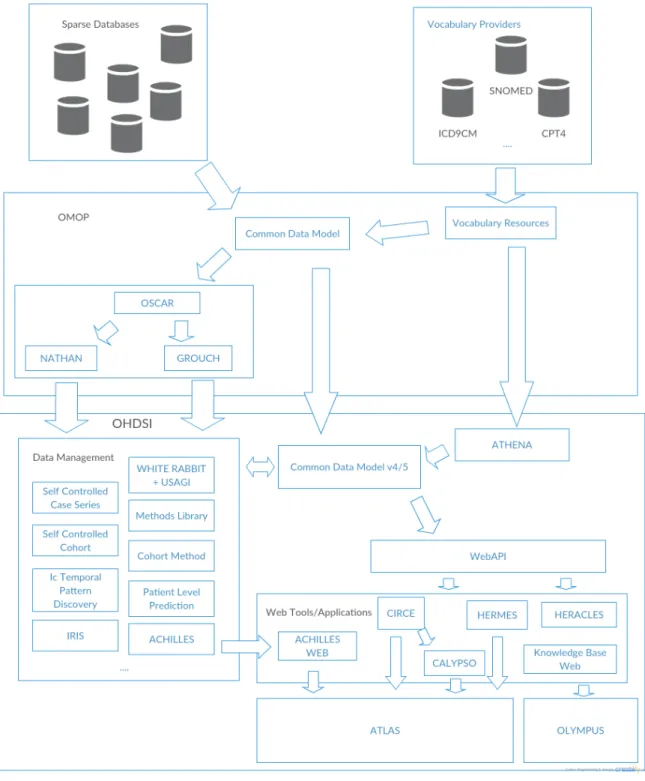
By the end of the partnership, in 2013, OMOP had developed, and open sourced, a framework for observational research, consisting of a unified, standardized, Data Model for Health Care Databases, and some tools to extract information from it (like NATHAN, GROUCH and OSCAR). As the objectives envisioned by the founding members was achieved, the partnership was concluded by the FNIH. To continue its mission of developing tools and evidence to support analysis of healthcare observational data, OMOP research investigators have created OHDSI.
Tools and applications developed by OHDSI revolve around databases that follow a Common Data Model (CDM), some were built to help in the construction of a new CDM ( WhiteRabbit, Athena, Usagi,. . . ), others to retrieve information from the CDM, either by extracting direct information from the database ( HERMES, Iris,ACHILLES,Heracles, . . . ), or by analysing the database further and deriving in-formation ( CALYPSO,LAERTES, (ATLAS), . . . ), and even others as resources to be used by other tools (WebAPI, CIRCE).
Figure 2.2: OMOP and OHDSI evolution 2.2.1 Common Data Model
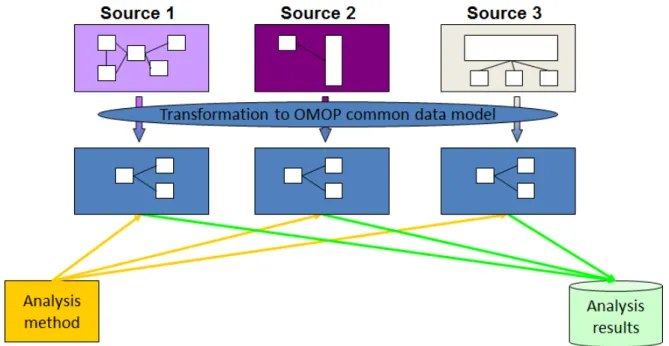
The Common Data Model (CDM) was firstly designed and created by OMOP and it is currently being maintained by OHDSI as the core of component of its architecture. This medical-related observational database structure developed with the purpose of standardizing medical-observational datasources, allowing for concurrent optimal analysis of multiple data sources. It is currently on v5, but v4 databases can be easily
updated to the newer version. Its design aims at identifying associations between interventions and outcomes (such as the patients exposed to a certain drug develop a certain condition).
Figure 2.3: The importance of the CDM for data exploration.
With design-level support for standardized content the CDM ensures that research methods can be systematically applied to produce meaningfully comparable and repro-ducible results.
The CDM groups data in six main standardized, interconnected groups:
• Vocabularies – centralized information about concepts used in fact tables. These tables are mantained centrally as a service to the comunity;
• Metadata – general metadata about the data. It does not intend to be complete as most metadata is derived from data during ETL;
• Clinical – information and relation about clinical events during observation periods and demographic information for each person (eg. death, procedures, . . . ); • Health System – data about the healthcare provider responsible for administering
the healthcare of the patient;
• Health Economics – data about costs, affordability, health plan and demography of patients, drugs, procedures;
• Derived Elements – data derived from other tables, such as agreggation in periods (eras) of exposure, dosage, and condition occurrence, as well as other data from
similar subjects (patients, providers, visits )
2.2.2 Vocabulary Resources
Initially developed at OMOP, standardized vocabularies are maintained by OHDSI, through the ATHENA application, to enable transparent and consistent content across disparated observational databases.
ATHENA compiles vocabularies and terminology from different sources and converts them to a format that can be easily included in a custom deploy of the CDM.
The HERMES tool provides a interface for search and explore vocabularies in a local deploy of the CDM.
2.2.3 WebAPI
A REST API, developed in Java Spring, serve as support for OHDSI applications by providing resources regarding the CDM. It provides the default layer of communication between all OHDSI Web Applications and a CDM database. Main functionalities include: vocabulary search, defining and listing cohorts and performing feasibility and evidence studies.
2.2.4 ACHILLES and ACHILLES Web
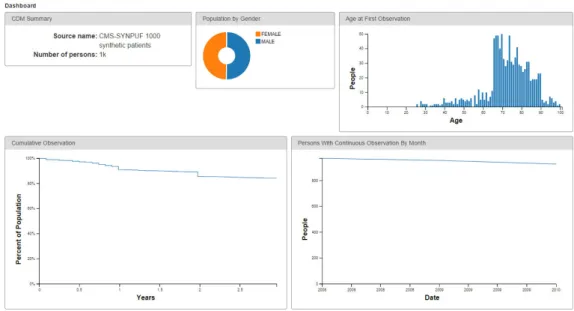
ACHILLES (Automated Characterization of Health Information at Large-scale Longi-tudinal Evidence Systems) is a data characterization tool for the CDM, written in R, generating JSON reports that can be viewed in Achilles Web (Figure 2.4).
It provides high level description of the database population, drug exposures, medical procedures, observation periods, diseases, deaths and other data extracted from CDM databases.
Figure 2.4: Achilles Web
2.2.5 CALYPSO
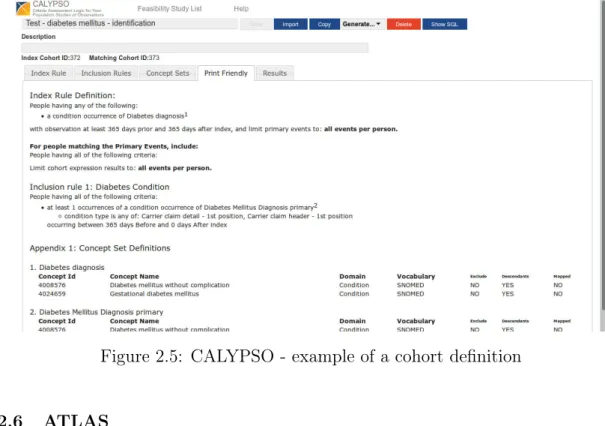
CALYPSO (Criteria Assessment Logic for Your Population Study in Observational data) is a web application that utilizes real world data (as provided by a WebAPI on top of a CDM) to simulate the availability of eligible patients for a study (feasibility study). It extends functionality to other OHDSI tools, by using Cohort Inclusion and Restriction Criteria Expression (CIRCE) cohort definitions to define inclusion and index rules.
With this tool, researchers can define an index rule (event they want to study) and inclusion rules (criteria to be analysed further). After the study is created, it can be exported, to a JSON format, or ran against the CDM database, showing, for each of the inclusion criteria, the impact on the availability of patients from the index population.
Figure 2.5: CALYPSO - example of a cohort definition
2.2.6 ATLAS
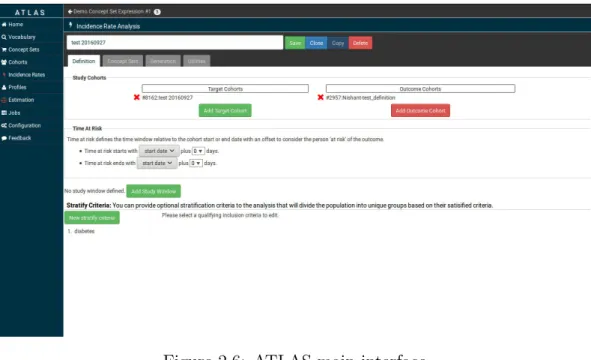
ATLAS is the most recent OHDSI application. It is an integrated platform combining the features from Automated Characterization of Health Information at Large-scale Longitudinal Evidence Systems (ACHILLES), Health Entity Relationship and Meta-data Exploration System (HERMES) and CIRCE, enhancing them with patient level estimation analyses, comparing different cohorts, and profiling users. As its development continues, older applications are being deprecated (HERMES is already superceded by ATLAS, and CIRCE features are available on both Criteria Assessment Logic for Your Population Study in Observational data (CALYPSO) and ATLAS ).
Figure 2.6: ATLAS main interface
3
System Definition
Sustainability can’t be like some sort of a moral sacrifice or political dilemma or a philanthropical cause. It has to be a design challenge.
Bjarke Ingels
The Catalogue provides a centralized dashboard for searching and detailing different healthcare database from different institutions (organized in communities). As many of those databases have been adopting the CDM (and subsequent WebAPI), there’s an opportunity for extending its features by providing out-of-the-box access to some OHDSI tools (notably CALYPSO and ATLAS ) and also allow these tools to be used on a complete community (instead of singular databases at a time).
In this chapter, the project developed is described, from its requirements, arquitec-ture, implementation and deployment.
3.1 Main Goal
This project aims to allow extraction of knowledge from patient-level data on databases that have joined the EMIF project.
Using the catalogue as platform to discover health observational databases, and taking advantage of the works produced by OHDSI of study creation, the basic scenario to be explored is to provide WebAPI based tools to each database complying with CDM. The second, main, scenario is to allow studies to be spread across entire communities. These scenarios will be refered, respectively, as Simple and Community.
3.2 Study Organization
Studies created by OHDSI tools like CALYPSO and ATLAS, can be divided in 4 main phases of execution. Each with its own set of requirements for both scenarios.
Phase 1 – Concept Set Creation : In this phase, there is need to group vocabulary concepts that are going to be used in the study definition. This is done through to HERMES and CIRCE tools, which are integrated on CALYPSO and ATLAS.
In community studies, these concept sets, must exist in each of the remote databases and must all have the same definition. Having that in consideration, concepts sets must only use vocabulary available to all databases in the community. Phase 2 – Cohort Rule Definition : After the concept sets are created for all
databases in a community, CIRCE provides an interface and methods to specify index and inclusion rules.
Rules define (and are defined by) cohorts, or population groups, which are used in a study to define population being subject to a study. In feasibility tests (constructed with CALYPSO), an Index Population is the set of all patients being subjected to a study, defined by an index rule (which are defined by cohort intersection and union operations). Analogous, inclusion rules define which of the index population patients, match given criteria.
This process should be synchronized between all databases in the study, and the same rules, applied to the same cohorts and concept sets, must be replicated in each CDM.
Phase 3 – Study Execution : During this step, study definitions are sent to the WebAPI, which creates an assynchronous job to execute it in a pre-defined CDM, matching cohorts defined in the previous phases.
Phase 4 – Results Collection and Display : Results should be displayed individ-ually for each database queried, and depending on the application/study made, can also display aggregated results (after each individual database is completed). 3.3 Architecture Design
The system design was guided by several non-functional requirements, namely:
Transparency for Researchers: All this process should be transparent to re-searchers: they should be able to create and execute a study in the same basic steps whether it is for a single database or a whole community.
Privacy Concerns: Healthcare databases very often contain sensitive data, and access to it must be regulated. There is, then, a requisite to implement, or, at least, take into consideration, a policy system, where database owners can approve or refuse study execution and/or limit the access to its results.
Integration Requirements: To ensure maintainabilty, eventual changes made to OHDSI tools, must not be specifc to this solution, being generic enough to exist on their own.
The fulfillment of these requirements led to the design and definition of two ar-chitectural solutions, with different approaches to the usage of OHDSI tools (namely WebAPI): pull and push models.
3.4 Pull Architecture
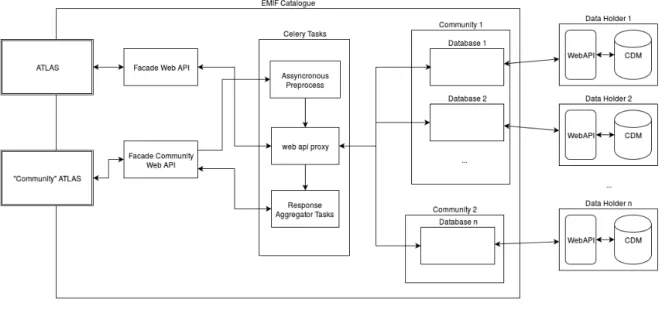
The first approach studied was named "pull architecture" due to its focus on running each application with a mediated connection to a remote WebAPI, configured by each database administrator (pulling data when needed), with almost no interaction with the owner, and with minimal data pre-processing.
Figure 3.1: Pull Architecture
In this section we discuss how studies can mapped into this pull model. 3.4.1 Database Study
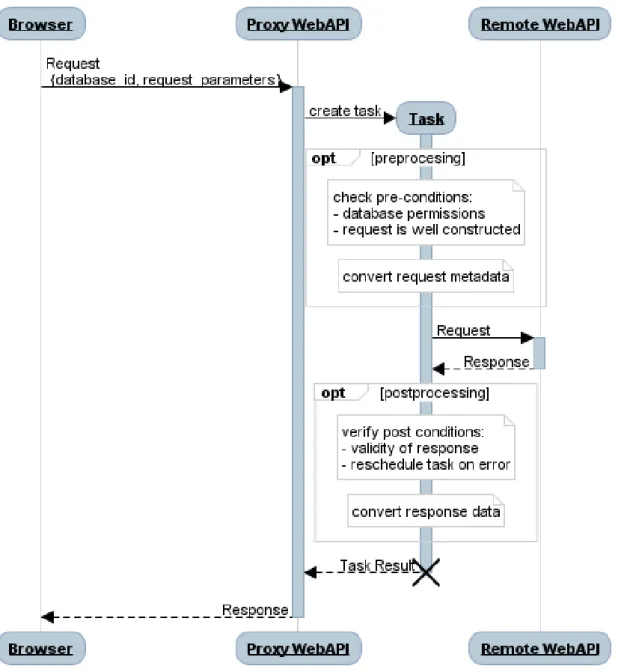
In the simple scenario (Figure 3.2), each OHDSI web application is connected to a proxy WebAPI endpoint (which only redirects requests to each database). Here, pre-and post-processing of requests pre-and responses are minimal because no data aggregation is needed.
By using this proxy, it is possible to monitor requests, adding a layer of security and privacy, and also cache and limit requests to each database.
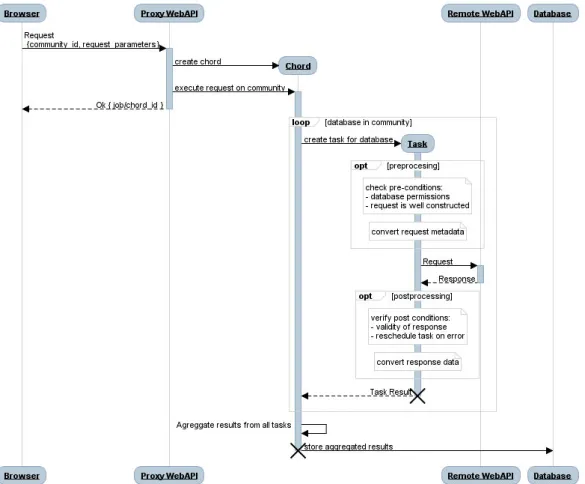
Figure 3.2: Simple Interaction (redirect to only one database) 3.4.2 Community Studies
With this pull-based approach, community wide studies require special handling of requests and a layer of external synchronization between the different, remote, databases. Below, it is described how each of the study phases refered in section 3.2 are handled: Phase 1 – Concept Set Creation In this phase, vocabulary concepts which are going to be used in the index or inclusion rules are grouped in concept sets, who must be created in each of the remote APIs and must all have the same definition. Having that in consideration, and knowing the WebAPI and the CDM specifications, when searching for a concept, results from each datasource must
be filtered and intersected, so as to only display concepts that are shared by all databases in the community. This phase also requires that a mapping of the concept IDs (and concept sets IDs) is mantained between databases, so as to further ease translation and distribution of requests.
Phase 2 – Cohort Rule Definition After the concept sets are created for all databases in a community, rules that specify cohorts can be created from them. These cohort rules, like the concept sets, must be shared with all the databases in the community, and IDs should be mapped for each database.
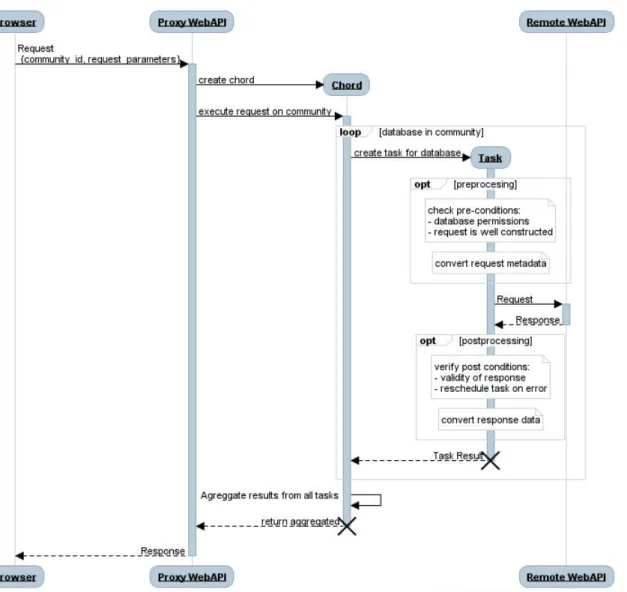
In this phase and the previous, latency is an important issue, and interaction cannot progress without results from previous requests are processed (Figure 3.3).
Figure 3.3: Community Interaction, Synchronous Requests
Phase 3 – Study Execution When the database is queried, cohorts are matched against each other in each database. Besides remapping of cohorts and concept set IDs, data holders permission may be requested to run the study. After permission
is granted, the study should be run in the remote database and the results should be stored locally until they’re needed for display.
Figure 3.4: Community Interaction, Assynchronous Requests
Phase 4 – Results Collection and Display Results should be displayed individu-ally for each database queried, and depending on the application/study made, can also display aggregated results (after each individual database is completed). As studies are run assynchronously in the WebAPI, latency is not an issue during the last two phases and follow the behaviour described in Figure 3.4. 3.4.3 Drawbacks
This process involves high latency between the time of the study design and the time the user gets the results. This is observed on simple database studies (which go through a proxy), but it is more noticeable on community studies which may need granted express authorization before being ran.
Synchronization between concept sets and cohorts across remote databases can also be an issue, as there is no control nor garantee changes won’t be made between first creation and its use. Alternatives to that involve creating a new cohort/concept set
whenever it is needed, which, despite minimizing the problem, also increases the data stored remotely.
This solution also decreases maintainability, as tools from OHDSI are open-source and under constant development. So, keeping a local version and an adaptation to support communities in sync with new releases would be an exhausting work.
3.5 Push Architecture
To address the problems and limitations of the first architectural design, an alternative was developed to simplify the study creation process. Here we remove the direct inter-action with remote databases by exploring study importation and exportation features available on most OHDSI webtools. This solution was named “Push” Architecture be-cause studies are sent to each remote database owner, to be run in a remote installation. Results can then be shared optionally by each data owner and displayed to researchers as they become available.
Figure 3.5: Push Architecture
This approach (see Figure 3.5) relies on 2 main components: a local WebAPI, backed by a CDM database with only vocabulary and a result schema for each remote database, and a REST API overriding most WebAPI resources, or redirecting them to a local WebAPI.
3.5.1 Study Creation
With a locally defined vocabulary database, concepts used for concept set creation and cohort definitions can be searched and created locally (Figure 3.6). Using this approach no change to OHDSI tools is needed, for both simple and community scenarios, and created concepts and cohorts may be reused for different studies, without the need to be recreated by researchers.
Figure 3.6: Phase 1 – Concept Set Creation and Phase 2 – Cohort Rule Definition execution sequence with the “push” architecture
3.5.2 Getting Results
During Phase 3 – Study Execution, studies must be exported, sent to each data owner, and imported in their side, to be reviewed and executed in the remote databases.
To ensure transparency for researchers, notably those already familiar with OHDSI tools, the resources normally provided/used by the WebAPI are “forged”, meaning meth-ods invoked are overridden to handle exportation on server side, without intervention of the researcher (Figure 3.7).
As Data Owners are notified, they can use their own deployment of the respec-tive tools, import and run the study, analyse its results and upload them to the application(Figure 3.8).
As results are uploaded, they are added to a database acessible by the Local WebAPI and researcher who created the study is notified.
Figure 3.7: Phase 3 – Study Execution handling by the push architecture
Figure 3.8: Result upload by the data owner 3.5.2.1 Drawbacks
This solution leaves cohort creation to be dealt and supervised by each data holder, thus increasing time between study creation and display of results. Besides that it is not mandatory for data owners to upload and share study results (or even execute it) as they can choose to abort the process in any step, namely because the study and its results may violate privacy policys (either by being too generic or too specific). It is also possible (but unlikely) for results to be forged during the upload results process. 3.6 Final Application – APOLLO
The Push Architecture resulted in a distributed application which we named APOLLO (Augmenting Patient-level Observational Learning by Large-scaling OHDSI tools).
Augmenting Patient-level Observational Learning by Large-scaling OHDSI tools (APOLLO) consists of a web server, developed in Python and Django1
, implementing a Proxy WebAPI and static serving OHDSI applications – ATLAS, CALYPSO – a database to support django functionalities, with contact information of database owners (used for notifications purposes), a Celery2
worker for assynchronous task execution -used to parallelize requests to remote databases, a RabbitMQ3
broker for communication between Django and Celery.
The Proxy WebAPI provides, for entire communities and single databases, resources similar to the ones returned by OHDSI WebAPI, as most of them are directly forwarded to our local WebAPI(for instance, vocabulary and results services, see Figure 3.6), by using python requests package4
. Others, like study generation services, use asynchronous celery tasks (or chords) for background exporting and notifying data owners (Figure 3.7).
To support this application, we also have an OHDSI Stack, consisting of a WebAPI deployed in a Tomcat server and a PostgreSQL database, containing schemas and tables necessary for the well functioning of an OHDSI application and its WebAPI:
CDM schema with only vocabulary tables filled with relevant concepts for a study creation;
WebAPI schema with tables regarding webapi functionality, such as job execution status, cohort definitions, study definitions;
Result schema for every remote database automatically created every time a new remote database is added, and is used to store imported results.
3.6.1 Deployment
As each component of the application is designed to be independent with well defined communication interfaces (eg: to interact with a database engine http messages following a specific protocol should be sent to a certain port; WebAPI only accepts http requests following REST norms; etc.), the deployment, orchestration and installation was made using lightweight Docker5
containers.
As seen in Figure 3.9, the application is composed of 6 containers from 5 images (postgresql image is shared by both OHDSI database and CDM tools). All images come from the official repositories, with the exception of APOLLO’s which is built from the Django. 1 http://www.djangoproject.com 2 http://www.celeryproject.org/ 3 http://www.celeryproject.org/ 4 http://docs.python-requests.org 5 www.docker.com 20
Figure 3.9: APOLLO Deployment: Docker Containers (rounded rectangles), Images (normal rectangles) and Shared Volumes (circles)
3.6.2 Usage
In this section we describe basic screenshots from the user interface, relating to the 4 phases described in 3.2.
During Phase 1 – Concept Set Creation (Figure 3.10) users can create and define concept sets, which are used during Phase 2 – Cohort Rule Definition (Figure 3.11) to define initial events rules and inclusion criteria.
When a researcher completes all cohort definitions, he can start Phase 3 – Study Execution (Figure 3.12). In this phase, APOLLO aggregates data from the Local WebAPI and sends them to each database owner participating in the study. The generated JSON can be imported and reviewed by each data owner to remote installation
Figure 3.10: Concept set creation screen
Figure 3.11: Cohort Definition Screen of ATLAS and generated as usual (Figure 3.13).
Ending this step, and as results become available, data owners can then begin Phase 4 – Results Collection and Display by exporting its results (Figure 3.14) and uploading them to APOLLO.
After the upload, researchers are notified and can check results in ATLAS (Fig-ure 3.15).
Figure 3.12: Cohort Generation Screen
Figure 3.13: Cohort Importation Screen
Figure 3.14: Results overview and exportation screen
Figure 3.15: Results detailed screen
3.7 Summary
The developed application addresses most requirements and goals of the project. For researchers ( notably those familiar with OHDSI tools) which usability issues could arise, distributed studies can be created and exported with no changes in the ATLAS interaction. The responsability of ensuring patient privacy and enforcing policies, as studies are exported, is passed down to data owners who can review them and decide not to share its results. From a development standpoint, OHDSI tools aren’t changed from the online-available versions and integration with new releases should not compromise the well functioning of the application, or involve a redesign of its architecture.
4
Conclusions
May I never be complete. May I never be content. May I never be perfect.
Chuck Palahniuk
In this chapter we evaluate the work done, and provide sugestions to the continuity of the project.
4.1 Evaluation of the work
This dissertation was developed with the intention of finding solutions to allow easy extraction of knowledge from patient-level data in a large number of databases. Since the very beginning, the adoption of OHDSI technologies and their integration with the catalogue was always the main concern. Having that said, requirements refered in chapter 3 were addressed during the design of the system, despite implementation limitations.
Also, when we try to combine different technologies and tools, most of them still under-development or community-maintained, with no clear, structured, documentation and with heterogeneous development pratices, we often have to spend a lot of time in learning and reinterpreting recently learned concepts or pratices. We had to deal with that since the beginning of this project, as tools like Calypso and Atlas, despite being quite intuitive to use by medical researchers and specialists, are rather complex in their interaction with the WebAPI and the study creation process. Designing, therefore, an infrastructure capable of, almost seamlessly, solve the problem without increasing technical complexity was the first and main issue found and addressed during the
production of this dissertation, and was one of the reasons for the delay and deficiencies in the implementation.
4.2 Future Work
Permissions and policy implementation, despite being defined on the requirements, were not taken into consideration or exhaustively defined, and should be covered before the system is moved and integrated with the production environment.
Solutions presented were projected for software versions that are constantly on-release, namely, the SHIRO branch of WebAPI, introducing role-based permissions, was not considered during this writing, however both solutions should be adaptable enough to fit with it, once it is released.
Finally, this work is not completely finished until its implementation is done, considering that, this dissertation provides a good standpoint to go from theory to pratice.
References
[1] L. A. Bastião Silva, “Federated architecture for biomedical data integration”, PhD thesis, Univer-sidade de Aveiro, Portugal, 2015. [Online]. Available:http://hdl.handle.net/10773/15759. [2] The emif platform, Nov. 2016. [Online]. Available: http : / / www . emif . eu / about / emif
-platform.
[3] G. Hripcsak, J. D. Duke, N. H. Shah, C. G. Reich, V. Huser, M. J. Schuemie, M. A. Suchard, R. W. Park, I. C. K. Wong, P. R. Rijnbeek, J. van der Lei, N. Pratt, G. N. Norén, Y.-C. Li, P. E. Stang, D. Madigan, and P. B. Ryan, “Observational health data sciences and informatics (ohdsi): Opportunities for observational researchers”, Stud Health Technol Inform, vol. 216, pp. 574–578, 2015.
[4] R. Murray, P. Ryan, and S. Reisinger, “Design and validation of a data simulation model for longitudinal healthcare data”, AMIA Annu Symp Proc., USA, pp. 1176–1185, 2011.
[5] J. Overhage, P. Ryan, C. Reich, A. Hartzema, and P. Stang, “Validation of a common data model for active safety surveillance research”, J Am Med Inform Assoc, vol. 19, no. 1, pp. 54–60, Jan. 2012.
[6] Ohdsi website, Oct. 2016. [Online]. Available:http://www.ohdsi.com.
[7] M. Mayer, L. Furlong, P. Torre, I. Planas, F. Cots, E. Izquierdo, J. Portabella, J. Rovira, A. Gutierrez-Sacristan, and F. Sanz, “Reuse of ehrs to support clinical research in a hospital of reference”, Studies in Health Technology and Informatics, vol. 210, pp. 224–6, 2015.
![Figure 2.1: The EMIF Platform [2]](https://thumb-eu.123doks.com/thumbv2/123dok_br/15800842.1079270/24.892.122.755.348.948/figure-the-emif-platform.webp)