Do aversive-based training
methods actually
compromise dog welfare?: A
literature review
Gulherme Fernandes J, I Anna S Olsson, Vieira de
Castro A C
Originally published in Applied Animal Behaviour Science (2017), 196, 1-12
ABSTRACT
The methods by which dogs are trained vary between methods involving mainly negative reinforcement and positive punishment (aversive-based methods) and methods based essentially in positive reinforcement and negative punishment (reward-based methods). However, the use of aversive-based methods is highly controversial. While some people defend their merits, others are concerned with their potential negative effect on dog welfare. To date, some studies have been performed aiming to assess the effects of aversive- and reward-based methods on the welfare and behaviour of dogs. In the present paper we perform a comprehensive review of those studies with the aim of characterizing the state of the art of scientific knowledge of the topic. Generally, the published studies suggest that the use of aversive-based methods is correlated with indicators of compromised welfare in dogs, namely stress‐related behaviours during training, elevated cortisol levels and problematic behaviours such as fear and aggression. However, there are a number of limitations that prevent any strong conclusion from being drawn. First, a considerable proportion of the studies relied upon surveys rather than on objective measures. Second, they focused on sub-populations of police and laboratory dogs and, thus, only represent a small portion of dogs undergoing training. Finally, the empirical studies have concentrated mainly on the effects of shock-collar training, which is only one of several tools used in aversive-based training, and, in some studies, the description of the training methodologies lacks details. Here we present a description of the published studies, discuss their limitations, debate other aspects that, in parallel with the nature of the training methods, may affect dog welfare, and point to future directions for research on the topic.
INTRODUCTION
Since domestication, dogs have been bred and selected for a variety of functions to support humans in their activities. Among many others, dogs are used for herding and guarding of livestock, for hunting, for search and rescue of people, for drug detection or as guide-dogs for blind people. In
Version: Postprint (identical content as published paper) This is a self-archived document from i3S – Instituto de Investigação e Inovação em Saúde in the University of Porto Open Repository For Open Access to more of our publications, please visit http://repositorio-aberto.up.pt/
A
0
1
/0
0
adopted for their companionship rather than for working support, they also require some sort of training (Reid, 2007).
For instance, dogs are trained for household rules (e.g., toilet training, not jumping to the couch/bed, not chewing furniture), for general obedience (e.g., to walk on leash without pulling, to come when called) or for more complex behaviours for hobby purposes (e.g., agility).
During training, the behaviour of dogs is modified through different learning processes. The most commonly used is operant conditioning, through which the probability of occurrence of a given behaviour is increased or decreased by arranging its consequences (Skinner, 1938). Depending on whether the consequence of the behaviour is the addition or removal of a stimulus and on whether the probability of occurrence of that same behaviour increases or decreases, operant conditioning is divided in four quadrants: (a) positive reinforcement (R+), where a behaviour results in a (pleasant) stimulus and the probability of its occurrence increases; (b) negative reinforcement (R−), where a behaviour removes an (unpleasant) stimulus and the probability of its occurrence increases; (c) positive punishment (P+), where a behaviour results in an (unpleasant) stimulus and the probability of its occurrence decreases; and (d) negative punishment (P-) where a behaviour removes a (pleasant) stimulus and the probability of its occurrence decreases. In general terms, in operant conditioning, animals learn to perform specific behaviours because these result in the avoidance of unpleasant stimuli and/or in the achievement of pleasant stimuli.
The way in which dogs are trained ranges widely from methods involving mainly negative reinforcement and positive punishment (aversive-based techniques) to methods based essentially in positive reinforcement and negative punishment (reward-based techniques). In dog training, pleasant stimuli normally comprise vocal praise, stroking, food, interactive play and social contact, whereas unpleasant stimuli involve vocal and physical reprimands or inflicted pain or discomfort through tools specially designed for that goal, as, for example, shock and choke collars.
Learning through negative reinforcement and positive punishment has an important adaptive value, in that these mechanisms help animals to avoid and escape from dangerous or harmful situations. However, the use of aversive-based techniques in dog training has been mainly backed by the traditional view that dogs, like wolves, are pack animals, whose social organization encompasses a linear hierarchy, and that their behaviour is driven by a desire to be “dominant” or the “alpha” in the pack. This view extends to the dog-human relationship, in the sense that dogs are believed to view humans as a member of their pack. It has been widespread in the popular view as well as in the literature that, in order to prevent disobedience and aggression, humans must be hierarchically dominant over dogs and that the way to exert such dominance is to train them using confrontational and coercive methods (e.g., Landsberg et al., 2003). However, the last decade or so saw the emergence of a heated discussion on the validity and relevance of the dominance model regarding dog and wolf social behaviour and also regarding the human-dog relationship. Whereas the merits of the dominance model are still defended by some authors (e.g., Schilder et al., 2014), it has been extensively questioned by others (e.g., Bradshaw et al., 2016, Coppinger and Coppinger, 2001, Yin, 2009). Importantly, the idea that dogs and even wolves form linear hierarchies has been challenged, as well as the notions that dogs view humans as members of their packs and that humans should adopt an “alpha dog” role (e.g., Bradshaw et al., 2016, Coppinger and Coppinger, 2001, Yin, 2009). As a consequence, the use of gentler techniques to train dogs, centered in the use
of positive reinforcement, has been gaining ground (e.g., Yin, 2009) and, in parallel, the use of aversive‐based techniques is becoming more and more controversial.
Besides the criticism of the validity of the dominance model, aversive‐based techniques have also been questioned for their potential negative effects on dog welfare. Several animal welfare, behaviour, training, canine and veterinary organisations all over the world have launched public statements discouraging the use of aversive-based methods on dog training (e.g., American Veterinary Society of Animal Behavior, 2007; Welfare in Dog Training, n.d.). Some aversive-based tools have indeed been legally banned in some countries. For example, shocks collars are not allowed in Austria, Denmark, Finland, Germany and Wales (Companion Animal Welfare Council, 2012). The major arguments are that aversive techniques can cause physical damage (e.g., the use of choke collars may cause injuries to the trachea or increase intraocular pressure) and lead to a number of undesirable behavioural consequences. There is some support for such consequences in early research into the undesirable side effects of using aversive methods for changing (human and non-human animal) behaviour. For example, punishment was shown to lead to negative emotional responses such as fear and anxiety and, consequently, to disturbances in learning and performance. Additionally, it was found that punishment can lead to the general suppression of all behaviours, including behaviours that can be of interest. A third major disadvantage is the fact that punishment can lead to aggressive responses either towards the person applying the aversive stimulus or whomever appears to be around (e.g., Azrin and Holz, 1966, Mazur, 2006). In the most extreme case, exposure to unpredictable and uncontrollable aversive stimuli can lead to a long-term, debilitating, depressive-like state in both human and non-human animals, referred to as learned helplessness (Maier and Seligman, 1976). On the other hand, advocates of aversive‐based methods assert that they are the most effective means to correct certain behaviours, such as poor recall or predatory behaviour and that, by giving dogs more freedom to explore the environment in safety, they indeed improve quality of life and welfare of dogs (e.g., Electronic Collar Manufacturers Association, n.d.; Gellman, 2012).
The claims of the opponents of aversive-based dog training methods appear then to have some support from these early data on the potential undesirable side effects of aversive methods. A recent review paper also argues that aversive-based methods compromise the mental and physical health of dogs (Ziv, 2017). Additionally, because in the view of author, this same literature shows that reward-based methods appear to be more effective than aversive‐based ones, he defends that the implementation of the latter should be avoided, and that some practices should even be made illegal. On the other hand, the Companion Animal Welfare Council, in a review of the arguments in favour and against the use of electronic pulse training aids in companion animal training concluded that there is a lack of scientific evidence on the matter (Companion Animal Welfare Council, 2012). In order to help solving the current controversy over the use of these training methods and to draw policy decisions on the matter, solid scientific evidence is needed. This evidence needs to come from research informed by expertise in animal behaviour and welfare and providing statistically valid results.
The goal of the present paper is to perform a comprehensive review of the scientific literature on the effects of different training methods in the welfare and behaviour of dogs. For the stronger level of evidence that statistically significant results provide, in the present paper only such findings are
Version: Postprint (identical content as published paper) This is a self-archived document from i3S – Instituto de Investigação e Inovação em Saúde in the University of Porto Open Repository For Open Access to more of our publications, please visit http://repositorio-aberto.up.pt/
A
0
1
/0
0
training and behaviour professionals and the policy makers with a comprehensive picture of the present scientific knowledge of the topic.
METHODS
An advanced search was conducted on the ISI Web of Science® database with the query TS = “dog*” AND “train*” AND (“behavio$r*” OR “stress” OR “perform*” OR “health”). Results were refined to include original research articles, reviews, case reports, and reports written in English and Portuguese, published in journals of veterinary sciences, zoology, behavioural sciences, psychology, and anthropology. From the 913 references resulting from the search and after a triage (Fig. 1), we selected the articles addressing the effects of training methods on the welfare and behavioural problems of dogs. A case report was excluded from the sample, because it reports an isolated incident, which clearly limits the strength of the conclusions that can be drawn. Another study was excluded, because it does not allow disentangling the effect of the training method from the effect of a socialization programme, which was applied together with reward-based training. During the course of the analysis, four additional relevant articles that did not result from our search were found and included, ending with a sample of 14 articles.
4 references related to effects of dog training methods on dog welfare and behavioural problems
1st triage
2nd triage 913 references and full
abstracts retrieved
14 articles reviewed 32 abstracts further
analysed
882 references not related to dog training and behaviour
20 references not related to effects of dog training methods on dog welfare and behavioural problems
1 case study
1 study with confounding Advanced search
on ISI Web of Science®
Figure 1. Triage process. The first triage step involved reading each of the 913 abstracts and excluding all papers that were not related to dog training and behaviour. The second triage step excluded all papers that were not related to the effects of dog training methods on dog welfare and behavioural problems, one case study, and one empirical study, and included four papers related to effects of dog training methods on dog welfare that did not result from the initial web search. Consequently, 14 articles were reviewed.
LITERATURE REVIEW: THE EFFECTS OF AVERSIVE-BASED AND
REWARD‐BASED TRAINING METHODS ON DOG WELFARE
Studies with direct observation of dog behaviour and welfare
parameters
Nine of the reviewed papers report studies in which behaviour and welfare parameters were directly measured by the researchers. These include both studies where data were collected in and around the training situation and studies of dogs which had previously been trained with different methods. The different studies are presented in detail in Table 1.
The effects of aversive-based methods
Different kinds of collars are used in aversive-based dog training. One is the electronic training collar (also known as shock collar or e‐collar), which consists of a collar-mounted device capable of delivering an electric shock to the neck (that can vary in intensity), causing discomfort and pain. Another one, the pinch collar, is a metal collar with prongs in its inner face, and it is used to implement P+ or R− by applying pressure on the neck through the prongs, which causes discomfort and/or pain. A third one is the lemon spray collar, which is used to apply P+ in the form of a spray of lemon juice to the dog’s face.
The behaviour of two groups of police dogs, previously trained for protection work either with shock collars or without this device, was analysed during free walking on leash, obedience work and protection work, in a study conducted by Schilder and van der Borg (2004). Dogs previously trained with shock collars exhibited more stress-related behaviours than the control group, both within and outside the training context, as well as in training (obedience and protection work) and non-training activities (free walking). In another study, Christiansen et al. (2001) evaluated the effects of exposure to electric shocks during training of hunting dogs to not attack sheep. Dogs underwent a test to evaluate their reaction to sudden encounters with different stimuli, in order to assess fear and anxiety. The test was performed twice: immediately before and one year after training. The authors found no general effect of the use of shock collars on fear and anxiety. To investigate the stress levels resulting from different ways of using the shock collar, Schalke et al. (2007) studied three groups of dogs. In the Aversion group, dogs received a shock if they touched a dummy prey,
Version: Postprint (identical content as published paper) This is a self-archived document from i3S – Instituto de Investigação e Inovação em Saúde in the University of Porto Open Repository For Open Access to more of our publications, please visit http://repositorio-aberto.up.pt/
A
0
1
/0
0
differences in the cortisol levels of the three groups, with the Random group displaying the highest levels, followed by the Here group and with the lowest cortisol levels for the Aversion group. The authors related these differences to the differences in predictability and controllability in how shocks were administered in the three situations, with shocks being most predictable and controllable for the dogs in the Aversion group and completely unpredictable and uncontrollable for dogs in the Random group. They stated that the lowest cortisol levels shown by dogs trained for aversion to prey could be explained by the predictability (i.e., the electric pulse was delivered every time the animal touched the prey) and controllability of the electric pulse (i.e., by avoiding touching the prey, dogs avoided the electric shock). In turn, the highest cortisol levels shown by dogs to whom electric shocks were delivered randomly could be explained by the fact that they could not predict nor control the stimulus. Finally, the intermediate levels of cortisol shown by dogs trained to respond to a recall cue were probably due to the fact that these dogs could predict but not control the electric shocks. As hypothesized by the authors, because for this group the recall cue had been previously trained but not in conjunction with the prey, dogs were able to predict the shocks because they associated punishment with non-compliance to return to the handler, but they were not able to control their initial reaction of chasing the prey. In one study, police dogs were trained with pinch and shock collars through P+ to maintain a “heel” position with distractions. If the dogs failed to maintain the position, P+ was applied. The results showed that dogs vocalized more often in response to the shock collar than to the pinch collar. There was no difference in cortisol levels between the two groups (Salgirli et al., 2012). Steiss et al. (2007) analysed the effect on physiological parameters of stress of using shock and lemon spray collars for reducing barking in dogs relinquished to shelters by their owners. Dogs were divided in three groups: shock collar group, lemon spray collar group, and control group (half of dogs wearing an inactivated shock collar, and the other half wearing an inactivated lemon spray collar). The results showed no significant differences in cortisol levels and in ACTH levels between the three groups.
Authors gender and Breed(s),
age Origin
Number
of animals Methods/Treatment Dependent variable(s) Summary of results
Christiansen et
al. (2001) Norwegian elkhound (grey) English setter Hare hunting dog (Finnish stoever, Hamilton stoever, Dunker, Drever) Gender and age not reported Not clear if companion or working (hunting) dogs
N=114 Sheep confrontation test:
Dog wearing a shock collar released in a fenced area with a sheep flock If dog came within a distance of 1-2 m from the sheep, an electric shock was applied
Some dogs were exposed to electric shocks, other were not (depending on whether they came within 1-2 m from the sheep or not)
Behaviour during the path test (dog walked along a 100-m path where it was exposed to sudden encounters with: rag, unfamiliar human, bundle of cans thrown upon stones, single tied sheep):
- Object contact latency - Object discovery latency - Human contact latency - Human discovery latency - Noise recovery time
- Degree of interest in lone sheep - Reaction latency towards sheep Test conducted twice (before exposure to the sheep confrontation test – year 1, and one year after exposure to the sheep confrontation test – year 2)
Difference between year 2 and year 1 in performance (distance or time) in the path test:
Dogs exposed to electric shocks showed a higher increase in object discovery distance than dogs not exposed to electric shocks (p=0.003)
Dogs exposed to electric shocks maintained the human contact latency, which was significantly different from dogs not exposed to electric shocks, which showed an increase in the latency
(p<0.001)
No significant differences were found between groups for the remaining measures
Cooper et al. (2014) Various breeds 29 M (8; 9; 12); 34 F (13; 12; 9) Average age: 46 months Companion N=63 n=21
Recall training in the presence of livestock and other dogs:
Group A – Training with shock collars performed by professional trainers referred by the Electronic Collar Manufacturers Association Group B - Training without shock collars performed by professional trainers referred by the Electronic
Behaviour during training (44 behaviours - e.g. panting, tail position and paw lift) Salivary cortisol (before, during and after training)
Urinary cortisol (periods of sampling not reported)
Time spent:
In a tense behavioural state A (24.6%) > C (3.96%) (p=0.007) Yawning
A (0.9%) > C (0.19%) (p<0.01)
Sniffing and interacting with the environment A (12.1%) < C (22.1%) (p<0.01)
B (14.3%) < C (22.1%) (p=0.01)
Version: Postprint (identical content as published paper) This is a self-archived document from i3S – Instituto de Investigação e Inovação em Saúde in the University of Porto Open Repository For Open Access to more of our publications, please visit http://repositorio-aberto.up.pt/
A
0
1
/0
0
Collar Manufacturers Association Group C - Training without shock collars performed by professional trainers from the Association of Pet Dog Trainers, UK (focus on reward-based training)
groups for other behaviours
Salivary cortisol for all sampling periods (before, during and after training):
C > B (p=0.001)
No significant differences were found between group A and B or C
Urinary cortisol: no significant differences were found
Deldalle and
Gaunet (2014) Various breeds School A: 11 M; 13 F 1 - 7 years old; average of 2.88 years old School B: 16 M; 10F 8 months - 6 years old; average of 2.41 years old Companion N=50 School A: n=24 School B: n=26
Obedience training with: Group A (School A) – R+ Group B (School B) – R-
Behaviour during training (6 behaviours related to stress - e.g. mouth licking and yawning, posture, gaze toward the owner, and body and gaze avoidance)
Percentage of dogs displaying the behaviour during: Sit command Mouth licking R+ (8%) < R- (38%) (p=0.019) Yawning R+ (0%) < R- (23%) (p=0.023) Low posture R+ (8%) <R- (46%) (p=0.0001) Gazing at owner R+ (88%) >R- (38%) (p<0.0001)
At least 1 out of 6 stress-related behaviours (mouth licking, yawning, scratching, sniffing, shivering, whining):
R+ (8%) < R-(65%) (p<0.0001) Walking on leash
Gazing at owner
R+ (63%) >R- (4%) (p<0.0001)
No significant differences were found between groups for other behaviours
Haverbeke et
al. (2008) Belgian shepherd German shepherd 26 M; 7F
Military N=33 Dogs trained for obedience and protection with:
Appetitive stimuli (R+) Aversive stimuli (P+ and R-) All dogs were trained with a mixture
Behaviour (body posture during training (from very low - scored with -3, to high - scored with 2); mouth-licking, tongue out, yawning, lifting front paw, replacement behaviour (shacking and replacement sniffing), jumping, and opening and
Body posture
Aversive stimuli (-0.22±0.19) < Appetitive stimuli (0.49±0.09; p<0.01)
No significant differences were found between groups for other behaviours
3.06 ± 0.21
years old of appetitive and aversive stimuli. closing mouth) Salgirli et al.
(2012) Belgian Malinois 33 M; 9 F 3 - 10 years old
Police N=42 Dogs trained to “heel” (walking in parallel next to the handler) with distractions using:
Shock collar (P+) Pinch collar (P+) Quitting signal (P-)
(Same dogs exposed to the three treatments)
During training, a decoy with a protection sleeve and a whip in his hand tried to provoke dogs to leave the position.
Stress-related behaviours during training (reactions of ear, tail, and joint parts and vocalizations)
Salivary cortisol
(before and after training)
(absolute and relative values- difference between maximum and resting cortisol values)
Percentage of dogs showing: Vocalizations
Pinch collar < shock collar (p<0.0001)
Only descriptive analysis is available regarding the behaviour of dogs trained with the quitting signal (only four dogs learned the behaviour)
No significant differences were found between groups for other stress-related behaviours Relative cortisol values
Quitting signal > pinch collar (p = 0.0294)
Schalke et al.
(2007) Beagle 9 M; 5 F 1.5 – 2 years old
Laboratory N=14 Dogs trained with shock collar (P+): Group A: aversion to prey (shocks delivered when dog touched the prey) Group H: recall on cue (shocks delivered when dogs disobeyed the recall cue during hunting)
Group R: shocks delivered arbitrarily
Physiological measures taken in the experimental environment 4 weeks after the end of the training sessions: Heart rate
Salivary cortisol
Heart rate: no differences between the 3 groups Salivary cortisol
- R > H > A (p<0.001)
Schilder and van der Borg (2004) Belgian Malinois crosses Pure bred Belgian Malinois German Police N=46 With shock collar (n=16) Without shock collar
Dogs previously trained for protection work:
Group A: With shock collar (Treatment group)
Group B: Without shock collar (Control group)
Behaviour (ears, tail and body positions, and other 31 behaviours (e.g. panting, yawning and crouch)) during:
- Free walking on leash (in a park and in the training grounds)
- Obedience work (in a park and in the training grounds)
Frequency of behaviours during: Free walking
Low ear position A > B (p=0.006) Obedience work Low ear position A>B (p=0.041) Tongue flicking
Version: Postprint (identical content as published paper) This is a self-archived document from i3S – Instituto de Investigação e Inovação em Saúde in the University of Porto Open Repository For Open Access to more of our publications, please visit http://repositorio-aberto.up.pt/
A 0 1 /0 0 Shepherd Rottweiler Gender and age not reported
(n=15) - Protection work (in the training
grounds) A>B (p=0.006) Paw lifting A>B (p=0.009) Protection work Low ear position A>B (p=0.004) Paw lifting A>B (p=0.007)
Walking with flexed limbs A>B (p<0.05)
No significant differences between groups were found for other behaviours
Steiss et al. (2007) Various breeds 11 M; 10F 10 - 64 months old; M=20 months; S.D.=14 months Shelter dogs (relinquished by their owners)
N=21 Dogs trained not to bark in the presence of barking stimulus (an unfamiliar dog on leash) with: Shock collar (P+): device activated when both sound and vibration of barking were detected
Lemon spray collar (P+): device activated when vibration of barking was detected
Another group of dogs used either turned off shock or lemon spray collars (control group)
Physiological measures taken (post-training) during 3 consecutive days in two different weeks:
Plasma cortisol ACTH
No significant differences were found between groups for cortisol or ACTH levels
Rooney and
Cowen (2011) Various breeds 18 M; 34 F 5 months to - 14 years old; median=4 years old
Companion N=52 Dogs previously trained for basic education (e.g., toilet training) and obedience (e.g., walk to heel) with: Punishment-based
Reward-based methods
(Same dogs could be exposed to both treatments)
Behaviour during: Non-object play
Owners played with their dog without any object
Relaxed social test
An experimenter was sat down on a chair in the presence of the owners. If the dog approached the experimenter, it was petted.
Dogs trained mainly with physical punishment: Were less interactive during play (p=0.015) Contacted and interacted less with the experimenter (p=0.007)
No significant correlations were found between other tests and type of training method
Table 1 - Description of the subjects, methodology and results of the observational and experimental studies that assessed the effect of different training methods in the behaviour and welfare of dogs.
Version: Postprint (identical content as published paper) This is a self-archived document from i3S – Instituto de Investigação e Inovação em Saúde in the University of Porto Open Repository For Open Access to more of our publications, please visit http://repositorio-aberto.up.pt/
A
0
1
/0
0
The effects of aversive-based versus reward-based methods
More recently, attention has been increasing at directly comparing the effects of aversive‐based techniques and reward-based techniques on dog welfare.
One study addressed the immediate reaction to aversive and appetitive stimuli. Haverbeke et al. (2008) studied pairs of military dogs and handlers, where the handlers used a mix of aversive (mainly pulling on the leash and hanging by the collar) and appetitive stimuli (mainly stroking and patting) during training. During performance of obedience and protection work exercises, the dogs exhibited a significantly lower body posture after aversive stimuli were presented than after the presentation of appetitive stimuli, suggesting that the former generated more stress than the latter.
Four studies compared the reaction of dogs systematically trained with aversive-based methods with dogs systematically trained with reward-based methods. In the study by Salgirli et al. (2012) reported in the previous section, the authors also compared the effects of aversive-based training methods (shock and pinch collars) with the effects of a reward-based method (a quitting signal). The quitting signal consisted of a conditioned signal for the withdrawal of a reward as a consequence of an undesirable behaviour (P−). The authors report that the quitting signal resulted in significantly higher cortisol levels than the pinch and the shock collar. However, this result is difficult to interpret, given that only four dogs learned the quitting signal. For this same reason the authors excluded the dogs that did not learn the quitting signal from the behavioural analysis, making it impossible to make a statistical comparison between the groups. It is not clear why and how they performed statistical analysis for the cortisol levels. Cooper et al. (2014) conducted an experimental study with companion dogs trained with aversive‐based or reward-based methods. The dogs were allocated to three groups which were all trained by professional trainers: training by certified shock collar trainers, with and without shock collars, and training by certified reward-based trainers. The results showed that dogs trained with shock collars spent significantly more time exhibiting stress-related behaviours than dogs trained using reward-based methods. Deldalle and Gaunet (2014) studied the behaviour of companion dogs as they were being trained by their owners at two different training schools, one using R+ methods and the other using R−. The authors found that dogs trained with R− showed more behaviours related with stress and also gazed less often to owners than dogs trained with R+. Finally, Rooney and Cowan (2011) assessed the influence of the training methods and owner behaviour on the behaviour of dogs by studying dog-owner pairs in standard situations. They found that dogs belonging to owners reporting the use of more physical punishment for basic education and obedience training were less interactive during play, and contacted and interacted less with the experimenter during a relaxed social test.
Studies using owner-reported data
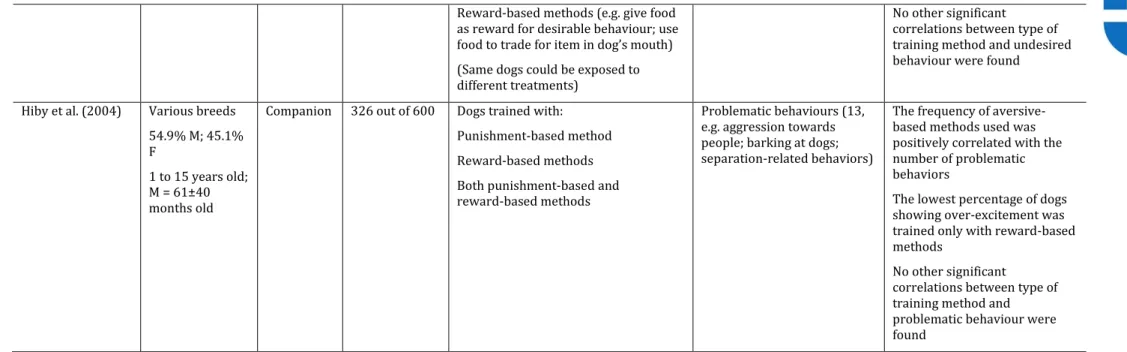
Another set of studies surveyed the relationship between the behaviour and attitudes of owners in educating and training and the behaviour of their dogs, mainly the occurrence of problematic behaviours such as aggression, fear and separation-related problems. In these studies, the researchers did not observe dog behaviour directly but instead based their data on owner reports. The different studies are presented in detail in Table 2.
Version: Postprint (identical content as published paper) This is a self-archived document from i3S – Instituto de Investigação e Inovação em Saúde in the University of Porto Open Repository For Open Access to more of our publications, please visit http://repositorio-aberto.up.pt/
A
0
1
/0
0
Authors gender and age Breed(s), Origin Number of responses Treatment Dependent variable(s) Summary of results
Arhant et al. (2010) Various breeds 47% M; 53% F 0.25 to 17.5 years old; M = 6.3 ± 3.9 years old Companion 1276 out of
5000 Dogs trained with:
Punishment (e.g. leash jerk; scruff shake/alpha roll)
Reward-based responses to unwanted behaviour (e.g. comfort with
petting/speaking; distract with food/play)
Rewards (e.g. praise verbally; food)
Problematic behaviours: Aggression Excitability Anxiety Fear Correlations between problematic behaviours and training techniques:
Higher aggression and excitability scores with higher frequency of punishment Higher anxiety and fear scores with higher frequency of punishment for small dogs (dogs weighing less than 20 Kg) Higher aggression and
excitability with higher frequency of reward-based methods to unwanted behaviour
Lower aggression, excitability, anxiety and fear scores with higher frequency of rewards No other significant
correlations between type of technique and dog behaviour were found Blackwell et al. (2008) Various breeds 52% M; 48% F 1 to 15 years old; median = 5 years old
Companion 192 out of 250 Dogs trained with: R+
R- P+
Combination of two or three
Problematic behaviours (36,
e.g. fear; aggression) Correlations between problematic behaviours and training techniques:
Lowest attention-seeking, fear and aggression scores with the use of R+ alone
techniques Highest attention-seeking scores with the use of both R+ and R-
Highest fear score with a combination of all training techniques
Highest aggression score with a combination of P+ and R+ Highest aggression and fear scores with P+ together with any other method
No other significant
correlations between type of technique and problematic behaviour were found Casey et al. (2014) Various breeds
48% M; 51% F 6 months to 17 years old; M = 4 years old
Companion 3897 out of
14566 Dogs trained with: R+ and/or P- R- and/or P+
Aggression towards people or hide and run away from people (5, e.g. aggression towards familiar people; hide or run away from unfamiliar people)
The use of R- or P+ was correlated with an increased risk of aggression towards members of family/household and towards unfamiliar people outside of the house
No other significant
correlations between type of technique and problematic behaviour were found Christiansen et al.
(2001) Norwegian elkhound (grey) English setter Hare hunting dog (Finnish stoever, Not clear if companion or working (hunting) dogs
112 Sheep confrontation test:
Dog wearing a shock collar released in a fenced area with a sheep flock If dog came within a distance of 1-2 m from the sheep, an electric shock was
Dog behaviour: Fear of gunshots
Fear of unfamiliar people and dogs
Statistical analysis of the data were not reported
Descriptive data reported: 2 dogs not exposed to electric shocks showed increased fear
Version: Postprint (identical content as published paper) This is a self-archived document from i3S – Instituto de Investigação e Inovação em Saúde in the University of Porto Open Repository For Open Access to more of our publications, please visit http://repositorio-aberto.up.pt/
A 0 1 /0 0 Hamilton stoever, Dunker, Drever) Gender and age not reported
applied
During the test, 13 dogs received electric shocks and 99 did not
Aggression towards people and dogs
Questionnaire conducted one year after the sheep
confrontation test
to unfamiliar people, whereas 1 dog exposed to electric shocks presented this behaviour 1 dog not exposed to electric shocks showed increased fear to unfamiliar dogs, whereas none of the dogs exposed to electric shocks presented this behaviour
2 dogs not exposed to electric shocks showed increased aggression towards dogs, whereas none of the dogs exposed to electric shocks presented this behaviour Data regarding fear of gunshots and aggression towards people were not reported
Herron et al. (2009) Various breeds 65% M; 35% F 0.25 to 14 years old; M = 4.1 ± 2.8 years old
Companion 140 out of 217 Dogs trained with:
Aversive-based methods with direct confrontation (e.g. roll dog onto back and hold down; hold dog down on side, legs extended)
Aversive-based methods with indirect confrontation (e.g. make abrupt sound to interrupt or correct undesirable behaviour; forcibly expose dog to stimulus that frightens it - i.e., tile floors, noise, people)
Undesired behaviours (5, e.g. aggression towards people; separation anxiety, and other less common behaviours, e.g. aggression to cats and barking)
Owners whose dogs were trained with aversive-based methods reported their dogs responded with aggression Few owners reported aggression as a response to reward-based training The lowest percentage of dogs showing over-excitement was trained only with reward-based methods
Reward-based methods (e.g. give food as reward for desirable behaviour; use food to trade for item in dog’s mouth) (Same dogs could be exposed to different treatments)
No other significant
correlations between type of training method and undesired behaviour were found
Hiby et al. (2004) Various breeds 54.9% M; 45.1% F
1 to 15 years old; M = 61±40 months old
Companion 326 out of 600 Dogs trained with: Punishment-based method Reward-based methods Both punishment-based and reward-based methods
Problematic behaviours (13, e.g. aggression towards people; barking at dogs; separation-related behaviors)
The frequency of aversive-based methods used was positively correlated with the number of problematic behaviors
The lowest percentage of dogs showing over-excitement was trained only with reward-based methods
No other significant
correlations between type of training method and problematic behaviour were found
Table 2 - Description of the subjects, methodology and results of the survey studies that assessed the relationship between different training methods and problematic or undesired behaviours in dogs.
Version: Postprint (identical content as published paper) This is a self-archived document from i3S – Instituto de Investigação e Inovação em Saúde in the University of Porto Open Repository For Open Access to more of our publications, please visit http://repositorio-aberto.up.pt/
A
0
1
/0
0
In a context of behavioural appointments Herron et al. (2009) found that many dog owners who used aversive-based methods reported that their dogs responded with aggression. Conversely, few owners reported aggression as a response to reward-based methods. Similarly, data collected from questionnaires to dog owners showed a correlation between the use of positive punishment or negative reinforcement and an increased risk of aggression towards members of family/household and towards unfamiliar people outside of the house (Casey et al., 2014). Furthermore, Arhant et al. (2010) found an association between a higher frequency of punishments and increased aggression and excitability scores in dogs. A similar correlation was also found between punishment frequency and anxiety and fear scores, but only for small dogs (less than 20 kg). Contrarily, a higher frequency of rewards was correlated with lower aggression, excitability, anxiety and fear scores. However, certain types of reward-based methods, namely reward-based responses to unwanted behaviour, such as comforting dogs with petting or speaking and distracting with food or play, were also correlated with increased aggression and excitability. Collecting data through a questionnaire to dog owners, Hiby et al. (2004) found a positive correlation between the frequency of aversive‐ based methods and the number of problematic behaviours reported by the owners. Also based on data from a questionnaire to dog owners, Blackwell et al. (2008) correlated scores of various problematic behaviours reported by the owners with different training techniques that owners reported to use (P+, R− and R+; alone or in a combination of two or three). Generally, it was found that the number of undesirable behaviours, namely attention-seeking behaviours, fear behaviours and aggressive behaviours, was positively correlated with the use of aversive-based methods. In contrast, in the aforementioned study by Christiansen et al. (2001), there was no increase in fear or aggression towards people or other dogs related to the exposure of electric shocks, as reported by owners. Although there are a few contradictory results among the reported studies, in general it was found that the frequency of problematic behaviours correlated positively with the use of aversive-based training methods.
DISCUSSION
In the present paper, we present a comprehensive review of the scientific literature on the effects of different training methods on dog welfare and behavioural problems. Generally, the existing research papers on the topic suggest a correlation between the use of aversive-based training methods and indicators of compromised welfare and behavioural problems in dogs, but the evidence at present is not as clear as some advocates in the contemporary dog training discussion claim.
In three of the studies comparing behaviour in dogs systematically trained with either aversive-based or reward-aversive-based methods, there was an association between aversive-aversive-based training methods and increased stress-related behaviours and/or reduced interactions with humans (Cooper et al., 2014, Deldalle and Gaunet, 2014, Rooney and Cowan, 2011). The results reported by Salgirli et al. (2012) are conflicting in that dogs presented higher cortisol levels when trained with the reward‐based method (quitting signal) as compared to when trained with shock or pinch collars. However, as reported above, it is not clear which dogs the authors included in this comparison, since only four were able to learn the quitting signal. If the authors included the cortisol data from
all dogs, it is likely that the higher levels shown with the application of the quitting signal were due to uncertainty and frustration resulting from dogs not understanding what was required from them, and that this was more adverse than the stress resulting from the use of a shock or pinch collar. In the studies investigating specifically the effect of shock collars, the existing literature is inconsistent. The two studies where training with shock collars was directly compared with training without these devices, Cooper et al. (2014) and Schilder and van der Borg (2004) found more stress-related behaviours with shock collar training, whereas the other two studies that compared welfare parameters between dogs exposed to electric shocks and dogs that were not exposed to electric shocks reported no differences (Christiansen et al., 2001; Steiss et al., 1997). In addition to the conflicting results, the widely disparate experimental designs of these studies make it speculative to draw general conclusions. There are also indications that the training method affects dog‐human relations beyond the training situation itself. Schilder and van der Borg (2004) found increased stress-related behaviours also outside the training situation, which they suggest implies an association between the presence of the handler and aversive events. Rooney and Cowan (2011) found that dogs belonging to owners reporting the use of more physical punishment in training interacted less with the owner during play, and contacted and interacted less with the unfamiliar experimenter.
Regarding the relationship between training method and problematic behaviours, the evidence is contradictory, yet stronger in the direction of a positive correlation between the use of aversive-based methods and the appearance of problematic behaviours in dogs. From the reviewed studies, four indicate an association between the use of aversive-based methods and problematic behaviours (Blackwell et al., 2008, Casey et al., 2014, Herron et al., 2009, Hiby et al., 2004), one shows no correlation (Christiansen et al., 2001) and another one shows positive correlations between both the use of aversive-based methods and certain reward-based methods and problematic behaviours (Arhant et al., 2010). As several of the authors suggest, a potential explanation for the correlations found between the use of aversive ‐based methods and problematic behaviours in dogs is that anxiety and conflict resulting from the use of such methods might lead to the behavioural problems. However, as discussed further below, with this study design it is not possible to draw conclusions about cause and effect from the correlational association. The association between reward-based methods and aggression and excitability found by Arhant et al. (2010) is more difficult to interpret. Nevertheless, and as was advanced by the authors, it is possible that these reported actions were responses of the owners to the dog’s aggression or excitability and not the other way around. In support of this view is the fact that such correlation was found only for reward-based responses to unwanted behaviour.
In summary, together, the results published so far as regards training methods and dog welfare seem to suggest that aversive‐based training might negatively influence dog welfare and dog-human interactions. However, and apart from the existence of some contradictory results, there are a number of important limitations in the existing literature, which prevent strong conclusions from being drawn. First, a considerable part of the studies, namely those which used surveys as the methodology for collecting data, relied upon reports of owners rather than on objective measures. Data collected through surveys reveals, at its best, the perceptions of owners. We cannot exclude the possibility that these reports do not match reality, both regarding the dog training techniques that were used and the behaviour of dogs. But perhaps the most important limitation for drawing
Version: Postprint (identical content as published paper) This is a self-archived document from i3S – Instituto de Investigação e Inovação em Saúde in the University of Porto Open Repository For Open Access to more of our publications, please visit http://repositorio-aberto.up.pt/
A
0
1
/0
0
training techniques adopted or the attitudes of owners (Arhant et al., 2010; Blackwell et al., 2008, Casey et al., 2014, Christiansen et al., 2001, Herron et al., 2009, Hiby et al., 2004). Yet, whether dogs started exhibiting behavioural problems after starting being trained with aversive ‐ based techniques, or whether owners adhered to this type of training techniques, or showed a more confrontational approach because dogs had already displayed a problematic behaviour cannot be revealed with this type of methodology, as was recognized by some authors (Blackwell et al., 2008, Hiby et al., 2004).
Secondly, most of the empirical studies focused on sub-populations of working and laboratory dogs, whose training regimes might not recapitulate those of companion dogs regarding frequency, intensity, duration, exigency and type of behaviours trained (Haverbeke et al., 2008, Salgirli et al., 2012, Schalke et al., 2007, Schilder and van der Borg, 2004). Additionally, the daily routines, living quarters and amount of contact with humans are probably also different from those of the typical companion dog. Whereas the greater potential for controlled and standardized conditions in working and laboratory dog populations is valuable, companion dogs make up a much larger proportion of the dogs undergoing training.
A third set of limitations has to do with the training methods. Firstly, the empirical studies conducted so far have concentrated on the effects of shock-collar training (Christiansen et al., 2001, Cooper et al., 2014, Salgirli et al., 2012, Schalke et al., 2007; Schilder and van der Borg, 2004; Steiss et al., 2007), which comprises only a small part of the existing aversive-based techniques. Secondly, in some studies, the description of the training methodologies lacks details regarding the tools and reinforcement or punishment strategies that were used, which makes it difficult to draw conclusions on some of the findings (Haverbeke et al., 2008, Cooper et al., 2014, Rooney and Cowan, 2011, Schilder and van der Borg, 2004).
Our conclusions differ from those drawn by Ziv (2017), in a recent review paper that encompassed more or less the same literature as the present paper. In our view, this difference can be explained by how inclusion criteria were defined and results interpreted. In the present paper we have only included studies with enough research subjects to allow statistical comparisons, thus excluding case reports. One case report that came up in our search and that was covered by Ziv (2017) is that of a dog with brain damage which was probably caused by strangulation during a training session (Grohmann et al., 2013). The strangulation was a consequence of the use of an aversive-based training technique called helicoptering or hanging, in which dogs are lifted from the ground and swung by the collar. This case, although unlikely to be representative of the majority of the aversive-based training techniques, highlights the danger of this particular technique. Furthermore, as we have shown, the results of the relatively few studies that exist do not allow strong conclusions to be drawn, especially not when considering the methodological limitations of the literature. Whereas some of these limitations are noted by Ziv (2017), neither those nor contradictory results seem to have been considered in formulating the conclusions. The importance of solid review papers in which only studies fulfilling certain quality criteria are included, and in which the results are reviewed in a systematic and unbiased manner is now widely recognized in medicine (Cochrane, n.d.) and are of course equally important for other fields of research informing practice. The articles reviewed in the present paper also shed some light on other aspects pertaining to training which may influence the behaviour and welfare of dogs both negatively and positively. Inconsistency and poor timing in the application of the reinforcers and/or punishers generate unpredictability and uncontrollability of stimulus delivery and may therefore lead to stress and, consequently, have a
negative influence on dog welfare (e.g. Dess et al., 1983, Destrez et al., 2013, Weiss, 1972). Additionally, a lower effectiveness of the training method may generate more unpredictability and uncontrollability, and, consequently, an increase in stress. The existing literature is however inconsistent, in that three studies suggest a higher efficacy of reward-based methods over aversive-based methods (Blackwell et al., 2012, Haverbeke et al., 2010, Hiby et al., 2004) whereas another points in the opposite direction (Salgirli et al., 2012), and a fifth shows no differences between the two types of methods (Cooper et al., 2014). Over and above not compromising dog welfare, reward-based methods may also influence dog welfare and dog-human interactions positively. Through classical conditioning, a positive association may develop between people that are present during training and the appetitive stimuli used, such as food, praise or play. In support of this view, some studies showed that dogs and horses trained with reward-based methods presented less stress-related behaviours and interacted more with familiar and unfamiliar people than those trained with aversive‐based methods (Sankey et al., 2010, Schilder and van der Borg, 2004).
CONCLUSIONS AND FUTURE RESEARCH
Based on this review we conclude that although currently there is limited scientific evidence of the effect of training method on dog welfare, the existing literature indicates that, at least at some level, aversive-based methods generate stress in dogs. However, further studies are needed to draw strong conclusions on the topic. In particular, empirical and experimental studies are needed. These should take into account the entire range of training tools and techniques used in aversive- and reward-based training methods, in order to appropriately represent the effects of the two methodologies. Furthermore, to get a comprehensive understanding of the effects of the different training methods on dogs in general, more studies are needed on companion dogs and they should include different breeds. Finally, because the effectiveness of the training methods and the consistency and timing of the stimuli delivery may also influence welfare, future studies should also take such aspects in account. Although the development of experimental studies on this topic may raise ethical issues as a consequence of the stress, pain and discomfort that could be intentionally inflicted to the research animals undergoing aversive-based training, empirical studies can be run in real-life situations that overcome these same ethical issues. Several dog training schools exist that work with aversive-based methods, where owners enrol in classes with their dogs. In this context, both trainers and owners comply with the use of such methods. Hence, studying dogs that are being trained at these schools is a good way of obtaining the data that is currently lacking without raising the concern of intentionally allocating random animals to situations that could cause them pain, stress and/or discomfort.
Finally, in addition to the effects on welfare, the efficacy of training methods is also relevant to consider in the choice of training method and, regardless of what science will have to say about the effects of different training methods on dog welfare, it is important to note that the choice of the training method should not be based only on its effects in animal welfare. Dog training is a purpose-built tool and, hence, its efficacy should also be considered in the equation. At present, there is also a lack of scientific evidence on the efficacy of different training methods and it would be relevant to combine this aspect with research on the effects of different training methods on dog welfare.
Version: Postprint (identical content as published paper) This is a self-archived document from i3S – Instituto de Investigação e Inovação em Saúde in the University of Porto Open Repository For Open Access to more of our publications, please visit http://repositorio-aberto.up.pt/
A 0 1 /0 0
ACKNOWLEDGMENTS
Ana Catarina Vieira de Castro was funded by Fundação para a Ciência e a Tecnologia with an individual post-doc grant (SFRH/BPD/111509/2015).
The work undergoing the present review paper did not receive any specific grant from funding agencies in the public, commercial, or not-for-profit sectors.
REFERENCES
1. American Veterinary Society of Animal Behavior , 2007. AVSAB Position Statement The Use of Punishment for Behavior Modification in Animals. http://www.vetmed.ucdavis.edu/vmth/local_resources/pdfs/behavior_pdfs/AVSAB_Punishme nt_Statements.pdf (accessed 17.02.02)
2. Arhant, C., Bubna-Littitz, H., Bartles, A., Futschik, A., troxler, J. 2010. Behaviour of smaller and larger dogs: effects of training methods, inconsistency of owner behaviour and level of engagement in activities with the dog. Appl. Anim. Behav. Sci. 123, 131-142. doi:http://dx.doi.org/10.1016/j.applanim.2010.01.003
3. Azrin, N.H., Holz, W.C., Hake, D. F., 1963. Fixed-ratio punishment. J Exp Anal Behav. 6(2), 141-148. doi:http://dx.doi.org/10.1901/jeab.1963.6-141
4. Azrin, N.H., Hake, D. F., Holz, W.C., Hutchison, R. R., 1965. Motivational aspects of escape from punishment. J Exp Anal Behav. 8(1), 31-44. doi:http://dx.doi.org/10.1901/jeab.1965.8-31
5. Azrin, N.H., Holz, W.C., 1966. Punishment, in: Honig, W.K. (Ed.), Operant Behavior: Areas of Research and Application. Upper Saddle River. NJ: Prentice Hall.
6. Blackwell, E.J., Twells, C., Seawright, A., Casey, R.A., 2008. The relationship between training methods and the occurrence of behavior problems, as reported by owners, in a population of domestic dogs. J. Vet. Behav. Clin. Appl. Res. 3, 207–217. doi: http://dx.doi.org/10.1016/j.jveb.2007.10.008
7. Blackwell, E.J., Bolster, C., Richards, G., Loftus, B. A., Casey, R.A., 2012. The use of electronic collars for training domestic dogs: estimated prevalence, reasons and risk factors for use, and owner perceived. BMC Veterinary Research. 8(1), 93. doi:http://dx.doi.org/10.1186/1746-6148-8-93
8. Bradshaw, J.W.S., Blackwell, E. J., Casey, R.A., 2016. Dominance in domestic dogs - A response to Schilder et al. (2014). J. Vet. Behav. Clin. Appl. Res. 11, 102–108. doi: http://dx.doi.org/10.1016/j.jveb.2015.11.008
9. Casey, R. A., Loftus, B., Bolster, C., Richards, G. J., Blackwell, E. J. 2014. Human direct aggression in domestic dogs (Canis familiaris): Occurrence in different context and risk factors. Appl. Anim. Behav. Sci. 152, 52-63. doi:http://dx.doi.org/10.1016/j.applanim.2013.12.003
Version: Postprint (identical content as published paper) This is a self-archived document from i3S – Instituto de Investigação e Inovação em Saúde in the University of Porto Open Repository For Open Access to more of our publications, please visit http://repositorio-aberto.up.pt/
A
0
1
/0
0
10. Christiansen, F. O., Bakken, M., Braastad, B. O. 2001. Behavioural changes and aversive conditioning in hunting dogs by the second-year confrontation with domestic sheep. Appl. Anim. Behav. Sci. 72, 131-143. doi: http://dx.doi.org/10.1016/S0168-1591(00)00203-3
11. Cochrane, n.d. http:// http://www.cochrane.org/ (accessed 17.03.27)
12. Cooper, J.J., Cracknell, N., Hardiman, J., Wright, H., Mills, D., 2014. The Welfare Consequences and Efficacy of Training Pet Dogs with Remote Electronic Training Collars in Comparison to Reward Based Training. PLoS One 9, e102722. doi:http://dx.doi.org/10.1371/journal.pone.0102722
13. Companion Animal Welfare Council, 2012. The Use of Electric Pulse Training Aids (EPTAs) in Companion Animals. http://eprints.lincoln.ac.uk/14640/1/CAWC%20ecollar%20report.pdf (accessed 17.02.22)
14. Coppinger, R., Coppinger, L., 2001. Dogs: A Startling New Understanding of Canine Origin, Behaviour & Evolution. New York, NY.
15. Deldalle, S., Gaunet, F., 2014. Effects of 2 training methods on stress-related behaviors of the dog (Canis familiaris) and on the dog-owner relantionship. J. Vet. Behav. Clin. Appl. Res. 9, 58-65. doi:http://dx.doi.org/10.1016/j.jveb.2013.11.004
16. Dess, N.K., Linwick, D., Patterson, J., Overmier, J.B., Levine, S., 1983. Immediate and proactive effects of controllability and predictability on plasma cortisol responses to shocks in dogs. Behav. Neurosci. 97, 1005–1016.
17. Destrez, A., Deiss, V., Leterrier, C., Boivin, X., Boissy, A., 2013. Long-term exposure to unpredictable and uncontrollable aversive events alters fearfulness in sheep. Animal. 7, 476– 484. doi:http://dx.doi.org/10.1017/S1751731112001796
18. Electronic Collar Manufacturers Association, n.d. http://ecma.eu.com/ (accessed 17.02.22)
19. Gellman, J., 2012. http://solidk9training.com/2012/06/14/prong-collars-are-lifesaving-and-humane-training-tools/ (accessed 17.06.19)
20. Grohmann, K., Dickomeit, M. J., Schmidt, M. J., Kramer, M. 2013. Severe brain damage after punitive training technique with a choke chain collar in a German shepherd dog. J. Vet. Behav. 8, 180-184. doi:https://doi.org/10.1016/j.jveb.2013.01.002
21. Haverbeke, A., Laporte, B., Depiereux, E., Giffroy, J.M., Diederich, C., 2008. Training methods of military dog handlers and their effects on the team’s performances. Appl. Anim. Behav. Sci. 113, 110–122. doi:http://dx.doi.org/10.1016/j.applanim.2007.11.010
22. Haverbeke, A., Messaoudi, F., Depiereux, E., Stevens, M., Giffroy, J.-M., Diederich, C., 2010. Efficiency of working dogs undergoing a new Human Familiarization and Training Program. J. Vet. Behav. Clin. Appl. Res. 5, 112–119. doi:http://dx.doi.org/10.1016/j.jveb.2009.08.008
23. Herron, M.E., Shofer, F.S., Reisner, I.R., 2009. Survey of the use and outcome of confrontational and non-confrontational training methods in client-owned dogs showing undesired behaviors. Appl. Anim. Behav. Sci. 117, 47–54. doi:http://dx.doi.org/10.1016/j.applanim.2008.12.011
24. Hiby, E.F., Rooney, N.J., Bradshaw, J.W.S., 2004. Dog training methods: their use, effectiveness and interaction with behaviour and welfare. Anim. Welf. 13, 63–69.
25. Landsberg, G., Hunthausen, W., Ackerman, L., 2003. Handbook of behavior problems in the dog and cat. W.B. Saunders, Philadelphia, PA., pp. 385–426
26. Maier, S. F., Seligman, M. E. P., 1976. Learned helplessness: Theory and evidence. Journal of Experimental Psychology: General, 105, 3-46.
27. Mazur, J., 2006. Learning and Behavior (6th ed). Upper Saddle River, N.J.: Pearson/Prentice Hall.
28. Reid, P., 2007. Learning in Dogs, in: Jensen, P. (Ed.), The Behavioural Biology of Dogs. CABI, pp. 120–144.
29. Rooney, N.J., Cowan, S., 2011. Training methods and owner–dog interactions: Links with dog behaviour and learning ability. Appl. Anim. Behav. Sci. 132, 169–177. doi:http://dx.doi.org/10.1016/j.applanim.2011.03.007
30. Salgirli, Y., Schalke, E., Hackbarth, H., 2012. Comparison of learning effects and stress between 3 different training methods (electronic training collar, pinch collar and quitting signal) in Belgian Malinois Police Dogs. Rev. Méd. Vét. 163, 530–535. doi:http://dx.doi.org/10.1016/j.jveb.2009.05.014
Version: Postprint (identical content as published paper) This is a self-archived document from i3S – Instituto de Investigação e Inovação em Saúde in the University of Porto Open Repository For Open Access to more of our publications, please visit http://repositorio-aberto.up.pt/
A
0
1
/0
0
31. Sankey, C., Richard-Yris, M.-A., Henry, S., Fureix, C., Nassur, F., Hausberger, M., 2010. Reinforcement as a mediator of the perception of humans by horses (Equus caballus). Anim. Cogn. 13, 753–764. doi:http://dx.doi.org/10.1007/s10071-010-0326-9
32. Schalke, E., Stichnoth, J., Ott, S., Jones-Baade, R., 2007. Clinical signs caused by the use of electric training collars on dogs in everyday life situations. Appl. Anim. Behav. Sci. 105, 369– 380. doi:http://dx.doi.org/10.1016/j.applanim.2006.11.002
33. Schilder, M.B.H., van der Borg, J.A.M., 2004. Training dogs with help of the shock collar: short and long term behavioural effects. Appl. Anim. Behav. Sci. 85, 319–334. doi:http://dx.doi.org/10.1016/j.applanim.2003.10.004
34. Schilder, M.B.H., Vinke, C.M., van der Borg, J.A.M., 2014. Dominance in domestic dogs revisited: Useful habit and useful construct? J. Vet. Behav. Clin. Appl. Res. 9, 184–191. doi:http://dx.doi.org/10.1016/j.jveb.2014.04.005
35. Skinner, B.F., 1938. The behavior of organisms: an experimental analysis. Appleton-Century, Oxford, England.
36. Steiss, J. E., Schaffer, C., Ahmad H. A., Voith, V. L. 2007. Evaluation of plasma cortisol levels and behavior in dogs wearing bark control collars. Appl. Anim. Behav. Sci. 106, 96-106. doi: http://dx.doi.org/10.1016/j.applanim.2006.06.018
37. Ulrich, R.E., Azrin, N.H., 1962. Reflexive fighting in response to aversive stimulation. J. Exp. Anal. Behav. 511–520. doi:http://dx.doi.org/10.1901/jeab.1962.5-511
38. Ulrich, R.E., Wolff, P.C., Azrin, N.H., 1964. Shock as an elicitor of intra- and inter-species fighting behaviour. Anim. Behav. 12, 14–15. doi:http://dx.doi.org/10.1016/0003-3472(64)90095-8
39. Weiss, J.M., 1972. Psychological factors in stress and disease. Sci. Am. 226, 104–113.
40. Welfare in Dog Training, n.d. What are the Implications of Using Training Techniques Which Induce Fear or Pain in Dogs? http://www.dogwelfarecampaign.org/implications-of-punishment.php (accessed 17.02.02)
41. Yin, S., 2009. Low Stress Handling, Restraint and Behaviour Modification of Dogs and Cats. Cattle Dog Publishing, Davis, CA.
42. Ziv, G. 2017. The effects of using aversive training methods in dogs- A review. J. Vet. Behav. Clin. Appl. Res. 19, 50-60 doi:http://dx.doi.org/10.1016/j.jveb.2017.02.004