Nowadays, information is one of the main resources of any company and plays an important role in decision making. For top management teams, obtaining important information as fast as possible is a priority, which can become challenging when there is a lot of data to process. Complex Event Processing (CEP) engines are able to process incoming data stream and extract important information while filtering non-relevant data. Thus, CEP engines are capable of analyzing thousands of data records very quickly, reducing the latency between receiving data and processing it, making it appropriate to be used for decision making. This operational capability, we consider, could benefit any data management system built today. But, there are diverse types of information systems, applied to a variety of enterprise areas, operating in different environments as well as requiring numerous methods to ensure their correct operability. One type of those systems are the Safety-critical systems, responsible for infrastructures with great impact and that could possibly cause high damage to people, society or environment. Safety-critical systems are responsible for performing operations in critical environments, such as, water storage, petroleum and atomic stations, vehicle systems, avionics, medical devices, etc. Since those systems are required to generate response and alerts in real-time, it is clear that CEP engines can be a solution for their performance goals. But, safety-critical systems have other, and more important, quality attributes such as security, dependability and safety. In this work, we investigate if CEP engines can be used for safety-critical applications and are able to cope with the inevitable quality attributes of these systems. After describing CEP engines, safety-critical systems and their quality attributes we focus on safety and security and provide a solution for data authenticity as mechanism added to one of the most popular CEP engines, ESPER. We conclude that proposed solution provides data authenticity but also has considerable performance impact.
Resumo
Nos dias de hoje, a informação é um dos principais recursos de qualquer empresa e desempenha um papel importante na tomada de decisão. Para as equipas de gestão, a obtenção de informações importantes o mais rápido possível é uma prioridade, que pode se tornar desafiadora quando existem muitos dados a serem processados. Os mecanismos complexos de processamento de eventos (CEP) são capazes de processar o contínuo fluxo de dados, separando a informação e filtrando os dados de pouca relevância. Assim, os sistemas da CEP são capazes de analisar milhares de registros de dados de forma muito rápida, reduzindo o atraso entre a receção e processamento de dados, tornando-se conveniente para a tomada de decisão. Acreditamos que esta capacidade operacional, poderia beneficiar qualquer sistema atual de gestão de dados. Mas, existem diversos tipos de sistemas de informação, aplicados a uma variedade de áreas empresariais, que operam em diferentes ambientes, além de exigir inúmeros métodos para garantir sua correta operacionalidade. Um tipo desses sistemas, são sistemas críticos, responsáveis por infraestruturas com grande impacto e que podem causar danos elevados às pessoas, à sociedade ou ao meio ambiente. Os sistemas críticos são responsáveis pela realização de operações em ambientes críticos, tais como armazenamento de água, estações de petróleo e atómicas, sistemas de veículos e aviários, dispositivos médicos, etc. Uma vez que esses sistemas são necessários para gerar resposta e alertas em tempo real, é possível que os motores CEP podem ser uma solução para melhorar o desempenho desses sistemas. Mas, os sistemas críticos possuem outros atributos de qualidade, como a proteção, a confiabilidade e a segurança. Neste trabalho, investigamos se os motores CEP podem ser usados em sistemas críticos e se são capazes de lidar com os atributos de qualidade desses sistemas. Depois de descrever os motores CEP, os sistemas críticos e seus atributos de qualidade, nos concentramos em segurança e proteção e fornecemos uma solução para a autenticidade de dados como mecanismo adicionado a um dos motores CEP mais populares, o ESPER. Concluímos que a solução proposta fornece autenticidade de dados, mas também tem um impacto considerável no desempenho.
1 Introduction ... 1
1.1 Problem statement ... 1
1.2 Methodology ... 3
1.3 Contributions ... 4
1.4 Outline ... 4
2 CEP Engines and Safety Critical Systems ... 5
2.1 CEP engines ... 5
2.2 Safety-critical systems... 7
3 CEP in Safety-critical systems ... 9
3.1 System monitoring ... 9
3.2 Critical infrastructures monitoring ... 10
3.3 Critical Systems management and predictions... 11
3.4 Cloud data management ... 12
3.5 Healthcare... 13
3.6 RFID ... 14
3.7 Controlling system events based on rules ... 15
4 Quality attributes ... 18
5 Security in CEP engines... 21
5.1 Apache Flink ... 24
5.2 Drools ... 25
5.3 ESPER ... 26
5.4 Oracle CEP ... 27
5.5 Sybase Aleri ... 28
6 An approach for handling security inside CEP engines ... 30
6.1 Security in WSN... 30
6.2.1 Methodology ... 34
6.2.2 Setup ... 35
6.2.3 Results ... 35
6.2.4 Discussion of results ... 38
7 Conclusions and future work ... 39
7.1 Main conclusions... 39
7.2 Limitations ... 41
7.3 Directions for future research ... 41
References ... 42
Appendix A – Test executions ... 51
2048 bytes p/sensor value ... 51
5120 bytes p/sensor value ... 52
32 bytes p/sensor value ... 53
Appendix B – Published paper – COMPLEXIS’17 ... 54
Figure 1 – Architecture example where data is collected from sensors and is received by CEP engine using input controllers. Then, the core of the system processes the received data and sends it to the end user. Parallelly, after being processed, data may be persisted. ... 2 Figure 2 - LiSEP data flow (Zappia, Paganelli & Parlanti, 2012) ... 10 Figure 3 – Proposed architecture. System modules are integrated and are necessary for managing, storing, correlating and aggregating events. Presented module receives micro events and processes those against stored rules. Event processing module is based on ESPER correlation engine (Itria, Daidone & Ceccarelli, 2014). ... 11 Figure 4 – Integration between system components allows understanding of the entire system at the same time. IF part of the system in compromised the rest of the system is affected and anomaly may be detected. PDC - Phasor Data Concentrator is responsible for collecting and measuring data from PMUs - Phasor Measurement Units that are devices that use signals to measure power quantity (Cerullo et al., 2014). ... 12 Figure 5 - JTangCMS architecture (Lu et al., 2016). Systems components may be considered configurable plugins which may be added or removed on demand. It is possible to use other available components or develop own modulus, depending on preferences and operational environments. ... 13 Figure 6 - System architecture. There are two components: Coordination Center and Ambulance module, deployed in each vehicle. Coordination center controls each vehicle state in the fleet. Based on the available information this component should assign vehicles. Vehicle component constantly analyzes and presents current vehicle state (Bruns et al., 2014). ... 14 Figure 7 - Designed Framework System data flow may be divided in two parts: Semantic and physical data flows. Collected data is processed and filtered, to remove noisy data, generating basic events. Basic events are then processed again, using aggregation, etc., and create other events. In the physical data flow, data is received from the sensors, is processed and posteriorly is delivered to the end-user (Yao, Chu & Li, 2011). ... 15 Figure 8 - Architecture of solution in CPS system (Ollesch, 2016). ... 16 Figure 9 - Common software quality attributes (Elzinga, 2017). ... 18 Figure 10 – Example of window that considers and analyzes 5 events which are considered the new events and other are old events (Oracle, 2017). ... 22 Figure 11 - Apache Flinx web console dashboard. Provides overview of the running and last completed jobs (Flink, 2017) ... 25
Figure 12 - Drools Web UI. Presents the project rules and events that are triggered when meaningful events are detected. Also in the bottom section, there is error and problems report, generated while running a specific project (Jboss, 2017). ... 26 Figure 13 - Esper web GUI. On the right side are defined EPL statements, one with data schema and other one with desired rule. In the center are presented events and on the right side are shown the results (Klendar, 2017). ... 27 Figure 14 - Oracle CEP rules tab. Allows adding system rules that will be used while analyzing incoming data. This statement defines that each time window will retain two events with metric value higher than 5000 (Oracle, 2017). ... 28 Figure 15 - Aleri Studio UI with source stream, responsible for receiving data which posteriorly is sent to other stream components (filter/aggregate/join/... streams). It is possible to identify data fields that are considered inside the stream: Id, Symbol, Price, Shared and Trade Time. (Sybase, 2010). ... 29 Figure 16 - Proposed solution for validation of data authenticity. Operational flow is represented using arrows. Orange boxes represent string values, such as, IDs. Blue ones represent numerical long value which is the sensor value. Green is the final message that is transferred from the sensor to the ESPER and it consists of hashed sensor ID and value. Decision component (dark red) compares the IDs and validates the sensor authenticity. ... 34 Figure 17 - Execution time, in seconds, with sensor value of 2KB. Each point represents different number of records, starting with 1000000, up to 10000000 and 100000000. Presented numbers are the average of 10 executions ... 36 Figure 18 - Execution time with 5KB per sensor value. Were performed 1000000, 10000000 and 100000000 operations. Each value is average from 10 executions. ... 37 Figure 19 - Throughput obtained during the execution of tests using 5KB of data per value and 100 million of operations ... 38
Table 1 - Quality attributes ... 20 Table 2 - CEP engines security attributes. ... 23
Acronyms and Definitions
AES - Advanced Encryption Standard – encryption method developed by U.S. government. Uses
symmetric key algorithm to encrypt transferred data and decrypt on the destination.
CEP – Complex Event Processing – standard executable language for specifying actions within
business processes with web services.
CoAP - Constrained Application Protocol – web application protocol used for communication
between constrained devices, network components with low processing and power capabilities, that are part of the same system.
CRM – Customer Relationship Management – enterprise tools and processes focused on the client
requirements, interaction and overall interaction between the corporate and client.
DTLS - Datagram Transport Layer Security – protocol used to provide communication security
in UDP protocol communication.
HDFS - Hadoop Distributed File System – file system used in complex and distributed
applications, providing fast and fault tolerance access to the data.
NASA - National Aeronautics and Space Administration – United States federal agency focused
on technological research and space exploration.
RFID - Radio-Frequency Identification – identification and tracking of hardware objects using
special tags that contain their id, using radio waves.
SH1 - Secure Hash Algorithm 1 – cryptographic hash function used to compute message, thus
making data secure, before it is transferred between network components.
SSL - Secure Socket Layer – standard for secure communication via TCP. The communication
data is transferred via secure channel, where all the data is encrypted.
TCP – Transmission Control Protocol – standard that defines how to establish and maintain a
network communication via which application programs can exchange data.
TLS - Transport Layer Security – protocol used for providing data security to communication
between two applications.
UDP - User Datagram Protocol – communication protocol which send data packages between
6LoWPAN – IPv6 over Low Power Wireless Personal Area Networks – network where each node
has its own IP address and system components can communicate and establish internet connection.
1
1 Introduction
In this chapter, we begin by describing the problem and the purpose of the realization of this work and then present our motivation as well as the main contributions of this project.
1.1 Problem statement
Complex Event Processing (CEP) can be defined as a set of tools and techniques for analyzing and controlling event streams consistent of data, gathered from different sources. While data is being collected and before it has been processed, this raw data is useless for management, decision making or performance analytics. CEP engines provide a fast processing and filtering of this data allowing understanding of what is happening within the system, business opportunity and problem identification, and more efficient usage of information for enhancing the operational performance and security (Luckham, 2008). Due to their popularity, CEP engines have been used in different systems, regardless of the enterprise area. Those systems can be considered a data processing solution to wide range of information systems in some of the following areas: business process automation, schedule and control processes, network monitoring and performance prediction, fraud and intrusion detection, risk management, military, power grid monitoring, etc. (Carvalho, 2008). Figure 1 presents the interaction of CEP engine with other system components, directly connected to it. While sensor values are constantly being streamed, CEP engine must process those and detect meaningful data, patterns, relations and provide this information to the end user as charts, data tables or alerts. Simultaneously, analyzed data is persisted so it could be used for historical analysis.
1.Introduction
2
Figure 1 – Architecture example where data is collected from sensors and is received by CEP engine using input controllers. Then, the core of the system processes the received data and sends it to the end user. Parallelly, after
being processed, data may be persisted.
Besides filtering data with simple queries, CEP can express rules that cannot be easily defined in other paradigms, such as, if-then paradigm, timestamp validation, timeouts, event patterns or even the absence of events (Adi, 2006). We still should notice that this data processing and filtering is not a totally disruptive technology, for many years’ data warehouses have been responsible for analyzing and correlating multiple dimensions of the data. Main difference between those approaches is the processing timing. Since a data warehouse does not process data instantly it may not be considered the best solution for many current applications since there would exist a delay between data reception, persistence and analysis. Instead, data should be processed and events fired in real-time environment (Oberoi, 2007). Besides financial interest from companies, CEP engines are constantly being studied and improved by researchers and developers. This enables constant advance and growth of many available open-source project, developed and tested by the community. Also, major companies, such as, Oracle, IBM, Microsoft, etc., have been showing interest in event processing and provide their own solutions (Oracle, 2017), (Ali et al., 2009). However, most of the available engines are seen just as filters and do not provide some of the quality attributes that are required in most of the systems, starting from relatively simple single-instance system and up to large processing distributed solution. With the increase of the system size and its operational impact, there is a need to provide necessary mechanisms to guarantee its operability. There are many different quality attributes and, sometimes, it may be necessary to sacrifice some of those to provide others. For example, it may be necessary to slightly reduce performance to guarantee safety, using data encryption or backup management to ensure system’s availability. Regardless, any computer system should be able to cover at least some of those quality attributes to be considered reliable. It is important to notice that some of the quality requirements may be considered indispensable by the industry standards and in this case, the final system should provide at least the required mechanisms. Those standards do vary from area to area but there are available basic guidelines, applicable to any system (NPES, 2005).
3 In this study, we focus on safety-critical systems, responsible for performing high impact operations and, therefore, those systems should be carefully designed since their incorrect operability may result in endangering human lives or property. Those systems should be able to function in different environments while providing fast response, high performance and availability, security, robustness, fault-tolerance and so on.
If we consider the performance, focusing on data processing, we believe that CEP engines would be highly beneficial for the safety-critical systems. Since they would reduce the required processing time as well as eliminate data noise, reducing the amount of data to be processed. This approach would allow faster transformation of data into information. But even while focusing on the performance, other quality attributes may not be neglected in critical systems and should covered either by the engine itself or by the remaining of the system. Our research question is: Can
CEP engines be used in safety-critical systems? To answer this question, we begin by studying
CEP engines and safety-critical systems, concentrating on their operational environments and required quality attributes. After identifying the attributes that some of the engines provide, we focus our attention on two attributes that have been neglected: safety and security. To better understand those attributes, we investigate what security mechanisms can be used and which ones are the most important in any system. Finally, we provide a solution for data authenticity, as mechanism added to a CEP engine. Besides our research question, by the end of our study we expect to also answer the following questions: What are the general and indispensable requirements of a safety-critical systems? What qualities current CEP systems offer? Do CEP engines provide any security mechanisms that are necessary in a safety-critical system? Which mechanism could be added to a CEP engine as a security measure? By answering these questions, we deliver information about security required in critical systems, specified by the industry standards versus security offered by existent CEP engines. In case those engines are not capable of covering the requirements that means that it will be necessary to either integrate other components or the system itself should validate the incoming data and guarantee privacy.
1.2 Methodology
We divided our study in three stages:
• Study of the applicability of CEP engines in critical systems while describing some of the existent solutions as well as the evaluation of their quality attributes. We describe some of the studies and quality attributes that were considered by the authors;
• Identify required quality attributes and consider two of the most neglected: safety and security. For that purpose, we study some of the most popular CEP engines and provide the list of the quality attributes that those engines offer;
1.Introduction
4
• While focusing on one engine, ESPER, we propose a security mechanism for validation of data authenticity. By adding that mechanism to the engine, we ensure that only reliable data is processed.
1.3 Contributions
In practice, the main contributions of this work are:
• Definition of the quality attributes in safety-critical systems. The knowledge of required quality attributes allows not only better understanding of those systems but also provides the operation requirements. Those quality attributes have also been discussed in our published paper, presented in appendix B;
• Evaluation of complex event processing engines considering required quality attributes. The comparison of those quality attributes allows understanding the applicability of complex event processing in safety-critical systems;
• Development of a security mechanism, focused on data authenticity, for validation of data before it is processed. Depending on the architecture some of the existent solutions may not be the most appropriate or even usable.
1.4 Outline
The remainder of this document is organized as follows: section 2 presents the background for our work, describing existent studies of CEP engines and safety-critical systems. Then, section 3 describes the application of CEP engines in safety-critical systems as well as quality attributes of those systems. Section 4 describes the quality attributes that are important in safety-critical systems and evaluates CEP engines in terms of those attributes. Section 5 discusses the security characteristics and requirements in safety-critical systems and complex event processing engines, while section 6 describes the proposed solution that focuses on adding security, data authenticity mechanism to ESPER. Finally, section 7 presents our conclusions and future directions.
5
2 CEP Engines and Safety Critical Systems
Complex event processing engines have been studied over the past years. Due to their popularity, there are available many studies that evaluate their performance, operational characteristics as well as the quality attributes. Also, has been increasing the number of safety-critical systems and studies that investigate failure detection mechanisms, design specifications, system’s quality and operability. Since besides CEP engines we study safety-critical systems, in this chapter we provide an overview of the existent solutions.
2.1 CEP engines
While providing a CEP overview, (Aidi, 2006) describes some of the most common areas where complex event processing systems are applied and environments where these engines can explore their full potential. Some of the examples are: bulk transaction monitoring and control, fraud detection, sales analysis, CRM, message tracking. The author presents some of the key benefits brought by those systems. Similarly, (Oracle, 2012) and (Aidi et al., 2006) emphasize their approach on financial area and propose solutions using CEP. All the authors state that CEP systems have a high potential for processing data when it arrives and can provide data of interest in a satisfactory amount of time. Since the main goal of CEP is to be agile and efficient in processing data so it can be delivered to the end user as soon as possible, (Cockburn, 2016), (Schmidt, Anicic & Stuhmer, 2012) and (Ammon et al., 2009) investigate the efficiency of those systems in alarm triggering and alert management. Were presented the advantages of the CEP systems and described how those can be tuned to provide all the required information. Those systems can be used for creating alarms in dangerous environments as well as noncritical businesses that completely rely on getting information on time. Therefore, (Daum, Götz & Domaschka, 2012) focused their study mainly on BPM - Business Process Management Systems and describe if CEP can satisfy all the requirements of those systems. The authors present other approaches that may be used to gather and filter data such as, message broadcasting, long, event management, etc. As conclusion was stated that CEP could be useful technology in supporting business processes in future when this technology evolves.
Concerned with performance, Oracle released a white paper with evaluation of their CEP engine (Oracle, 2008). In the study was used a single instance setup and evaluated the processing latency while constantly injecting data. Latency represents the time between sending event to the engine and receiving a response, while throughput was tested by loading more and more events into the system to be processed. Both number of connections as well as load where being scaled to provide
2. CEP Engines and Safety Critical Systems
6
better latency understanding. System latency is directly affected by the number of clients that generate and send stream and the system should be able to efficiently handle many connections. The authors concluded that this engine is capable of efficiently dealing with up to 1 million events per second with multiple incoming streams. Also, in (Oracle, 2010) is described the system availability and fault tolerance. Were performed latency tests while discussing system’s performance vs availability and concluded that there is a possibility of tradeoff configuration by the user, sacrificing one of those qualities. Data availability is also a requirement of sensor-based critical systems. Since the CEP engine itself can provide stream availability while ensuring that no data is lost or processed more than one time, the need of the rest of the system to handle those tasks is reduced. Also, CEP engines availability is discussed by (Saboor & Rengasamy, 2013). Were described the required CEP design factors, such as, scalability, availability, pattern matching and caching, and provided a set of guidelines for developing a CEP engine. Authors believe that their overview of the methods and mechanisms will help software developers while building their own solution. Wahl & Hollunder (2012) completed a performance evaluation of three CEP engines: Microsoft Stream Insight, Esper and Drools. Besides latency, researchers considered load tests and measured the consumed memory, CPU and latency/throughput. As the conclusion is stated that all those engines have very similar latency while system resources consumptions are different. CPU usage was similar for two of the systems while another one showed much higher processor usage. In contrast, the system that consumes more CPU requires much less RAM than other two engines. Baldoni, Montanari & Rizzuto (2015) proposed a solution that combines Complex Event Processing and Hidden Markov Models (HMM) to analyze system failures and their symptoms, using specifically defined metrics. The abnormal conditions are detected using the defined rules and alert events are fired. The CEP engine provides all the necessary data as well as the performance metrics while HMM are used for system state specification and recognition. The authors state that it is important to be able to detect failures in system components to be able to prevent the entire system to be compromised. Hence, this work proposes a failure prediction architecture, focused on the traffic control systems, named CASPER. In the study is stated that CASPER exhibits good accuracy and it can generate predictions with a margin of time that allows recovery actions to mitigate the upcoming failure occurrence. To ensure system’s security, the system was developed as black box and as non-intrusive as possible. Each isolated module communicates with other and validate if the other component shows any failures. Exchanged data is validated by the pre-processing module which confirms each package headers. Also, as part of the system, exists failure prediction module, which categorizes the system as safe or unsafe. Other study used ESPER and other two enterprise CEP engines to evaluate their performance (Mendes, Bizarro & Marques, 2009). The authors executed different types of queries, starting from simple operations, such as, selections and aggregations and up to join operations and multiple queries. It was possible to observe that CEP engines can achieve high throughput while performing basic operations while more complex operations require data to be mapped to memory to provide
7 higher throughput. In this study, while working with simple operations the bottleneck was not in the CEP system itself, rather the client API, that connected to the engine, was increasing the processing time. Also, it was observed that the window expiration mode (jumping/sliding window) had a significant performance impact. Benchmarking results, which show the latencies of a commercial CEP product, were presented in another study. The CEP engine was the WebLogic Event Server, an application server designed specifically for event processing applications that require high throughput and reduced latency, while handling large volumes of events (Alves & Rorke, 2008). Finally, performance tests, using Esper and StreamCruncher, were executed by other authors, who divided their evaluation in two parts: latency and throughput. It was concluded that both engines have their advantages and performance flaws but Esper is the most mature engine (Dekkers, 2007).
After considering described studies it is possible to understand that there are numerous CEP applications in different areas. While some of the authors describe available systems, others focus on performance evaluations and state that some of the engines may be more appropriate to use, depending on overall system purpose but, overall, complex event processing systems provide high operational throughput.
2.2 Safety-critical systems
While working with safety-critical systems, a study discussed that besides development design, documentation, testing and review that are necessary phases during the development of a critical system. System design must be carefully developed to guarantee that after the development the system will have the expected operability and that all of its components are correctly integrated. The authors state that testing may be challenging since to have a good average result it is always necessary to perform a lot of repeated executions. Thus, system trustworthiness can also be assured using rigorous mathematical techniques in the review process (Parnas, Schouwen & Kwan, 1990), (Collins, 2013). Similarly, Aftab & Nadeem (2013) address some techniques that should be used while developing a safety critical system. In the authors’ paper are described formal and informal analysis techniques, such as, Fault Hazard Assessment (FHA), Fault Tree Analysis (FTA), Failure Mode Effect Analysis (FMEA) and Deductive cause-consequence analysis (DCCA). Different techniques may be used to ensure system safety and, although DCCA has high success rate out of all safety analysis techniques, it has a major drawback which is the inability to consider unintended behaviour and, therefore, fails in providing fault tolerance. While considering the safety of safety-critical systems, researchers identified several challenges, such as, encryption and authentication mechanisms, malicious and unsafe commands, lack of knowledge of the system vulnerabilities, etc. To address those challenges are presented security principles that could be integrated into safety-critical systems. Authors state that if systems do not have security mechanisms even small error occurrences may end up compromising the entire system. By using the proposed guidelines,
2. CEP Engines and Safety Critical Systems
8
the system will be capable to recover from errors without having its performance affected. On the other hand, Axelsson, et al. (2016) describe an agile methodology while developing a safety-critical system. Due to the importance of safety-critical systems agile methodology should be adapted to integrate hardware and software components and provide necessary early validation, e.g. by automation, continuous integration, feedback, transparency and flow of the system. As the conclusion of their study, the authors state that agile development methodology cannot guarantee all the requirements and, therefore, other methods should also be adopted. Since safety-critical systems should follow some of the available standards during the entire lifecycle, Youn & Yi (2014) discuss some of the standards that are more applicable to avionic systems. The authors state that in current systems both software and hardware components are equally important and required to process large amounts of data necessary to control the avionic system. Moreover, besides mutual influence between hardware and software, software malfunction may be related to its communication with the hardware. After describing some of the standards that should be applied and similarities between those, is declared that the performed study provides a better understanding not only in terms of software component of the systems but, also, the hardware requirements. Any critical system, besides operability, requires bigger amount of security than any other system and Oedewald & Gotcheva (2015) state that those systems should be gifted with the ability to anticipate, monitor, respond and learn system’s activities. This approach would guarantee expected system resilience. In the study are described some of the challenges of introducing security in a complex dynamic network of subcontractors, involved in the construction of a new nuclear power plant in Finland, Olkiluoto. Was concluded that it may be challenging to introduce safety culture in studied systems since subcontractor companies should prepare the part of the system, that they developed, to operate with other system components. Related to security, Zio (2016) discusses risks and vulnerabilities in critical infrastructures. After describing main concerns and actions, the author concludes that what usually causes system to be open to hazards, failures, malicious attacks and errors is the systems’ high degree of inter- and intra-connectedness. Avila & Martínez (2015) describe safety-critical system monitoring and failure detection. Was provided a probabilistic approach for constant online monitoring of the system. Proposed solution may be used in diverse applications, such as, detection of unauthorized access, irregularities in vital signs and other variables in intensive care patients, fraud in financial services, and detection of path deviation in autonomous vehicles. Different fault types, activities, failures description and understanding are provided by Hamill & Goseva-Popstojanova (2014). The authors use NASA study as their base and describe possible system uncertainties, fault types and activities as well as possible relation in those. Was possible to detect fault associations and root causes of some of the failures.
Many studies of the safety-critical systems focus on the system’s monitoring and system’s failure detection (or even part of the system). Also, many authors discuss system security and importance of prevention while dealing not only with third-parties but, also, inside the system itself.
9
3 CEP in Safety-critical systems
There is a variety of quality attributes that should be provided by any information system. However, regardless of the system type and size, one of the main attributes is, of course, performance. In case of data processing it may be measured as the amount of data that engine processes per amount of time or by evaluating latency (necessary time to receive data, process stream and send the response). This is also applicable to safety-critical systems that require on-time alert generation. In this chapter, we describe some of the safety-critical systems that incorporate a CEP engine. This part of the study allows us to understand if there are already available safety-critical systems that use complex event processing and what system characteristics are considered.
3.1 System monitoring
CEP systems have been around for quite some time and have been constantly tested, improved and developed (Mendes, Bizarro & Marques, 2009). Due to the wide range of possible application domains, CEP capabilities have been constantly improving, over the past years. Currently they are used in a variety of software systems as a customizable tool for data processing and analysis. These engines can completely adapt to the desired system purpose and are able to process and present most important data, based on previously defined rules. Therefore, traditionally, CEP systems are part of more complex systems, inside which they are used to process incoming information, create alerts based on a collection of rules, and posteriorly provide filtered and summarized data to the final user (Eckert & Bry, 2009). Consequently, those systems are focused on information extraction and processing of the important data in real-time environments. Although our focus is on safety-critical applications, in this section, to correctly assess the state-of-the-art, we will also consider studies reporting on the application of complex event processing in other areas.
The design and the implementation of a lightweight and extensible Complex Event Processing engine, called LiSEP is described by Zappia, Paganelli & Parlanti (2012). Figure 2 shows the processing data flow in LiSEP. During the system design specification, the authors were driven by the principle of minimizing dependency on external software components and, therefore, LiSEP depends solely on the Java Standard Edition libraries, thus minimizing deployment requirements. Moreover, the LiSEP logic is strictly focused on core event processing, consequently resulting in a lightweight and minimal implementation.
3. CEP in Safety-critical systems
10
Figure 2 - LiSEP data flow (Zappia, Paganelli & Parlanti, 2012)
The proposed solution is complemented by the specification of the Event Processing Language, based on the SQL syntax. As a proof of the architecture, is proposed a case study on dangerous goods monitoring during maritime transport as a part of Italian Ministry for Economic Development research project, called SITMAR - Integrated system for goods maritime transport in multi-modal scenarios. More data-focused approach is presented by Evchina & Lastra (2016). This work aims aiding the end users of monitoring systems by delivering the selected information to each user, based on their role in the system. The described approach combines Semantic Web technologies and Complex Event Processing (CEP) for configuration purposes and run-time data processing and analyzing. The authors state that the final developed solution should be able to provide ways to deal with multiple devices and multiple users of the system; should be reconfigurable to reflect changes in the environment and/or user information needs; and finally, the device updates should be delivered to users within reasonable amount of time. Considering those requirements, the developed approach provides two major advantages. Firstly, the behavior of the system could be easily changed by only configuring the underlying ontology and, secondly, CEP usage at runtime makes system event-driven and reactive to frequent changes in the environment.
3.2 Critical infrastructures monitoring
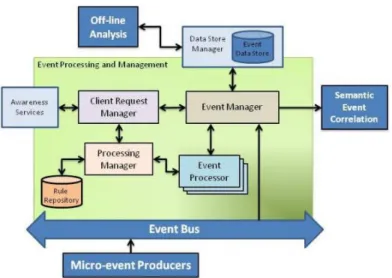
Itria, Daidone & Ceccarelli (2014) present an approach for critical situation detection that uses CEP architecture for real time event analysis as well as the event correlation. Event analysis consists of data processing and event correlation corresponds to establishing a relation between input events. Those events are gathered from various sources and are necessary for detecting patterns and situations of interest in the emergency management context. This solution describes the engine, developed in the context of the Secure! Project (Secure, 2016). Figure 3 presents the proposed architecture.
11 Figure 3 – Proposed architecture. System modules are integrated and are necessary for managing, storing, correlating and aggregating events. Presented module receives micro events and processes those against stored rules.
Event processing module is based on ESPER correlation engine (Itria, Daidone & Ceccarelli, 2014).
That solution has two main requirements: the correlation module should be adaptable to the possible changes of the source environment, and it must process the available historical data to evaluate the actual events considering what has happened before. After submitting the system for testing, the authors concluded that their approach can be easily used and maintained. It is also extensible to other scenarios where the application requires nearly real-time correlation, like intrusion detection system (Ficco & Romano, 2011) or monitoring of the critical infrastructures.
3.3 Critical Systems management and predictions
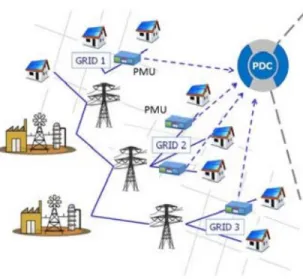
Solution for power grid monitoring, using complex event processing, is presented by Cerullo et al. (2014). The authors claim to be able to provide a detailed treatment of the security issues resulting from the adoption of Wireless Sensor Networks (WSN) and QoS-enabled IP connections. The proposed solution attempts enhancing current information security and event management technology by improving its capability of detecting and mitigating attacks targeting the heterogeneous network infrastructure. Figure 4 presents the grid monitoring infrastructure.
3. CEP in Safety-critical systems
12
Figure 4 – Integration between system components allows understanding of the entire system at the same time. IF part of the system in compromised the rest of the system is affected and anomaly may be detected. PDC - Phasor Data Concentrator is responsible for collecting and measuring data from PMUs - Phasor Measurement Units that are
devices that use signals to measure power quantity (Cerullo et al., 2014).
As an example, in power grid scenario, the attacker may prevent some of the nodes from sending events to the connected collector, thus hiding changes in the power grid conditions. The WSN security probe generates alarms based on the analysis of the network and periodically calculates the package generation rate at every node. The developed engine can correlate those alarms to protect the visualization server. Besides improving system performance, the authors introduced a mechanism that controls the number of exchanged data packages inside the system and attempts identifying malicious nodes. Also, communication monitoring allows detection of DDoS attacks and mitigate traffic attacks. Wang & Kuang (2015) propose a traffic prediction method based on Predictive Complex Event Processing (PreCEP) and Bayesian networks to improve the system’s prediction accuracy. The prediction model is trained with historical data and it is used to predict future events based on the recent output of basic CEP engine. Was addressed the prediction problem for moving objects that can be vehicles or even pedestrian and concluded that the performance of the PreCEP still needs to be improved. Currently the parallel method only works when is learning the structure of models in one context and training models for different context.
3.4 Cloud data management
Cloud platform monitoring system, JTangCMS - JTang Cloud Monitoring System, is proposed by Lu et al. (2016). The authors claim that proposed solution can deal with the flexibility, scalability, efficiency and performance challenges of cloud monitoring. Below (see Figure 5) we present the system architecture.
13 Figure 5 - JTangCMS architecture (Lu et al., 2016). Systems components may be considered configurable plugins
which may be added or removed on demand. It is possible to use other available components or develop own modulus, depending on preferences and operational environments.
The system gathers all the data using dissemination framework that allows transferring huge amount of runtime information with high throughput and low latency. For that purpose, is used DDS - Data Distribution Service which partitions the input into smaller parts. After transferring all the data, it must be analyzed and, therefore, was authors developed a support system using CEP, named JTangCMS. The performed evaluations of the implemented algorithm and DDS-based data delivery system state that JTangCMS is an efficient solution and does support intelligent decision making. In Li, Cao & Liu (2013), the authors propose the overall structure and workflow for a CEP-based monitoring system, which can be applied to a private cloud to alert system failures.
3.5 Healthcare
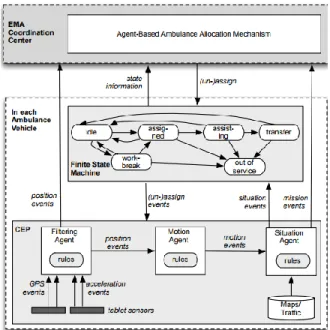
Healthcare is another highly important area that could potentially take advantages of CEP systems. Wang et al. (2010) describe real-time healthcare applications and state that CEP engines can efficiently monitor patient behavior and control medical regulations. Similarly, (Foley & Churcher, 2009) and (Naqishbandi, Sheriff & Qazi, 2015) propose architecture solutions and required characteristics of the systems using complex event processing in healthcare domain. The authors state that CEP engines are highly useful for large and critical data processing and can improve medical systems. Bruns et al. (2014) proposed an ambulance coordination architecture that provides real-time data processing and delivers comprehensive data to the end users. The developed architecture consists of two core components: CEP and FSM- Finite State Machines. Figure 6 presents the ambulance coordination architecture.
3. CEP in Safety-critical systems
14
Figure 6 - System architecture. There are two components: Coordination Center and Ambulance module, deployed in each vehicle. Coordination center controls each vehicle state in the fleet. Based on the available information this component should assign vehicles. Vehicle component constantly analyzes and presents current vehicle state (Bruns
et al., 2014).
CEP engine focuses on gathering and analysis of the sensor data streams, emitted by the ambulance, to automatically detect changes of the operational states defined in the FSM. The authors defend that efficient and fast patient care requires reliable and up to date information and, therefore, presented an approach that determines the actual state of all ambulances as well as possible relevant mission incidents. Described solution attempts completing research of (Brotcorne, Laporte & Semet, 2003), (Li et al., 2011), (Ciampolini, Mello & Storari, 2004).
3.6 RFID
Zappia et al. (2014) also present patient related data and usage of CEP systems in healthcare area. The goal is to use RFID technology to be able to support clinical management of the patients. The proposed solution is focused mainly on the following scenarios: patient identification and tracking as well as the drug administration. The proposed distributed system is based on event abstraction, event aggregation and event transformation, and uses those to offer a hierarchical and distributed data processing architecture where data is provided by different processing nodes. Overall, the projected solution, based on CEP and RFID technologies, is used to support clinical risk management by means of detecting possibly dangerous patient conditions as well as patient take care. A solution for critical situation detection in elderly daily life is proposed by Xu et al. (2014). The study emphases on the personal assistance as well as possible risks and identification of the required assistance situations. These situations are detected by analyzing the received data from the sensors. This study is focused on ALL – Ambient Assisted Living technologies and uses
15 sensors to monitor welfare parameters and environmental conditions as described by Wolf, Schmidt & Klein (2009).
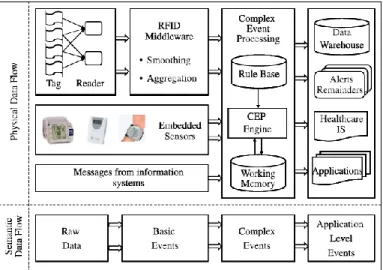
Another RFID solution is proposed by Yao, Chu & Li (2011). Is described an RFID framework, using CEP, for managing hospital data, gathered from different sources, and the system focused on detecting patterns and medically significant events. Therefore, the authors created prototypes that attempt showing that CEP has the ability of providing alerts to the healthcare professionals as well as increasing quality of healthcare and patient safety (see Figure 7). One of the main goals consists of identifying the patient and tracking all the necessary procedures since there may be mistakes from part of the hospital staff.
Figure 7 - Designed Framework System data flow may be divided in two parts: Semantic and physical data flows. Collected data is processed and filtered, to remove noisy data, generating basic events. Basic events are then processed again, using aggregation, etc., and create other events. In the physical data flow, data is received from the
sensors, is processed and posteriorly is delivered to the end-user (Yao, Chu & Li, 2011).
Also, the system provides all the necessary historical data for emergency handling as well as for health problems, medication identification and response. All those characteristics show that this approach may reduce errors as well as provide faster and more efficient risk management.
3.7 Controlling system events based on rules
CEP scaling solution for processing CPS - Cyber-Physical System data is showed on elevator scenario to describe the challenges of CEP technology in a CPS context (Ollesch, 2016). Figure 8 shows the proposed architecture using Kinect sensor.
3. CEP in Safety-critical systems
16
Figure 8 - Architecture of solution in CPS system (Ollesch, 2016).
One of the main challenges of this architecture is the calculation of the floor, since it may be calculated wrongly as well as the sensors themselves are subject to errors and can be disturbed since, for example, passengers could obstruct the Kinect sensor. CEP systems are based on rules and using this example was possible to proof that some parts of the system design should be adjusted. Those adjusts may not be easy to accomplish, depending on the engine that is used. For example, considering ESPER engine (Esper, 2016), its rules are embedded inside the program code and cannot be externalized. Consequently, each change affects the source code and it will require new system distribution. Wang et al. (2014) also study ESPER as an example and define the event process functions, like event attribution extraction and composition determination. The authors investigate the challenges in designing a CEP for Cyber-Physical System, and propose a semantic enhancement CPS event model. Balogh et al. (2016) propose a conceptual architecture for system monitoring that ensures the correct behavior of the system by using a set of different monitoring rules. It was developed a prototype using the VIATRA-CEP Event Processing Language (Viatra, 2016). Posteriorly monitoring rules are distributed over the nodes. The system evaluation was based on development and monitoring of safety-critical embedded systems in the railway domain.
Beer & Heindl (2007) overview the state of art in testing dependable event-based systems and identify the challenges that should be addressed in the future. Were considered two case studies: large-scale project for business-unit transportation systems and a small-scale telecommunications project for Airbus. The study was focused on testing and the authors state that it is an important topic and cost reduction of testing may be achieved by developing new and more efficient techniques of requirements tracing as well as test-case design and validation. Part of the study was on (Luckham, 2002) who proposed CEP usage for managing multiple events and event causality to elicit meaningful events in an event-based information system. This is because CEP can evaluate
17 incoming data and transform it into out coming events. Lang & Capík, (2014) present a procedure for performing predictive analysis of complex events occurrence in time critical complex event processing systems. Although the authors developed a system in publish-subscribe architecture, there were no considerations of safety nor security. But, it is possible tune the system to perform better or worth according to its data and environment. This system adaptability provides better operational characteristics and makes it more reliable. Similarly, in other study, was stated that using CEP it is possible to identify and apply business intelligence rules over the streams of events and this technology is critical in an environment where time plays an important role, such as, real time decision making (Tendick, Denby & Ju, 2016). In the study were investigated the possibilities and the use of the available methods and techniques for classification and prediction in complex event processing. For this purpose, it was designed and implemented an application CepPredictiveAnalysis, which uses defined methods for predictions and despite certain limitations, the system gives acceptable accuracy in financially-oriented applications.
4. Quality Attributes
18
4 Quality attributes
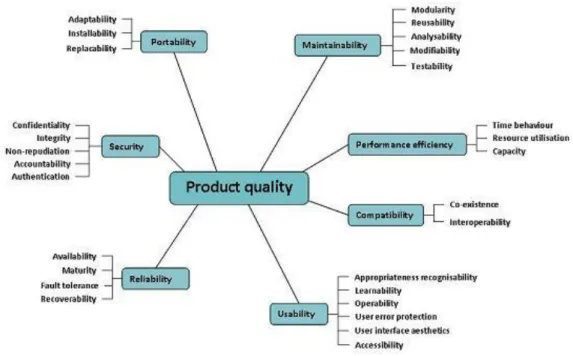
In the previous sections we described CEP engines and Safety-critical systems as well as different applicational areas of those. Quality attributes transcend system type and purpose and are necessary in any system to ensure its correct operability. There are different quality attributes that may be covered by the system design and implementation and, below, we describe some of those. Also, the software quality attributes determine the quality of the final product and define if the developed system is operating as expected. Different quality attributes may affect some specific layers of the software and it is important to find the most appropriate tradeoff between attributes, depending on the system purpose and operational environment (see Figure 9).
Figure 9 - Common software quality attributes (Elzinga, 2017).
While developing a safety-critical system there is a wide range of standards that must be followed and those standards define some of the system’s requirements (Bowen & Stavridou, 2002). Those requirements may also be translated into system quality attributes and define the system characteristics without getting deep inside into its functionalities. Currently software systems present, in most cases, a long list of quality attributes (Laranjeiro, Soydemir & Bernardino, 2015) and, therefore, we decided to consider in this work the most general ones, which are fundamental in safety-critical systems. Also, we should mention that different works and authors consider different number of attributes, some being encapsulated by others. Therefore, we studied quality
19 attributes described by (Barbacci et al., 1995), (Sommerville, 2004), (Atoum & Bong, 2015). Hence, the considered quality attributes are:
• Dependability: can be directly translated into trustworthiness of the developed system and represents the confidence in the correct functioning of its operations. One of the dimensions of dependability is the fault tolerance that states that failure of a part of the system cannot compromise the whole system. Also, should be considered the repair capability of the designed system, which describes if it can recover without any intervention, as expected. • Security: ensures that extracted, stored and processed by the system data is not easily
intersected or corrupted. There should not be any intentional disruption by the third parties. Authentication mechanism is also a requisite since it allows user identification and extends up to the possibility of the system to recognize the configured devices and treat them as trusted. The collected data will be recognized as viable. System vulnerability should be reduced as much as possible to prevent possible harm by the attackers and important data exposure.
• Reliability: describes the probability of the system of performing designed operations in expected time. This attribute is tightened with the availability of the system that states that the system should have the ability to work with limited amount of data when it cannot be collected. There should be available backup data collectors that would gather at least part of the necessary data. Therefore, reliability considers not only software but hardware and firmware modules that are required for correct system functioning.
• Safety: this is another quality attribute highly related to the reliability. Thus, safety reflects the system’s ability to operate, normally or abnormally, without danger of causing human injury or death and without damage to the system’s environment. Some of related safety terms are: hazard, damage and risk. All of those are considered by the standards and usually are described as a prevention list of measures instead of qualities.
We believe that, among others, those are some of the most important requirements of critical software since those ensure the correct system operability and robustness. Also, chosen attributes enclose other vital software system characteristics, for example, performance, resilience, availability, etc.
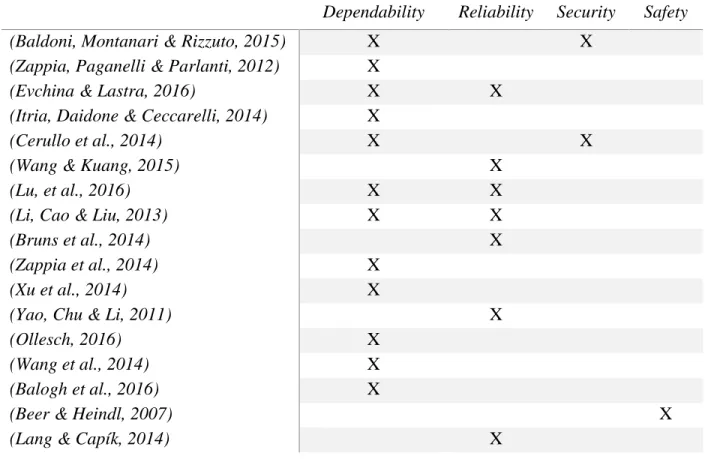
There are different systems and it is important to understand what quality attributes authors often consider and which ones are mostly not covered. In the previous section we have described the safety-critical systems that are presented below. The summary of quality attributes analysis is presented in Table 1. It is important to notice that some of the solutions may have partially addressed some of the quality attributes, but we just consider overall approach, the authors focus and goals in the designed architecture.
4. Quality Attributes
20
Table 1 - Quality attributes
Dependability and reliability are quality attributes that are studied and considered in most of the existent solutions. After analyzing the results, we concluded that most of the systems are focused on their performance and operability and do not consider safety neither security. Those quality attributes are often treated as less important than assuring system’s proper functioning or performance. Those are more functional characteristics and any designed and developed system is expected to work as intended. Some of the authors consider how their system is affected by security attributes and if their data is secure and only one study considers risk, hazardous situations management and system’s awareness of those. It is important to notice that we performed our analysis of quality attributes based on authors’ description and system specifications. Though, some of the described works may provide parts of considered by us as quality attributes, but those were not mentioned. Also, although we just have one level analysis, as previously stated, we investigated authors’ focus and what their work was trying to achieve.
Dependability Reliability Security Safety
(Baldoni, Montanari & Rizzuto, 2015) X X
(Zappia, Paganelli & Parlanti, 2012) X
(Evchina & Lastra, 2016) X X
(Itria, Daidone & Ceccarelli, 2014) X
(Cerullo et al., 2014) X X
(Wang & Kuang, 2015) X
(Lu, et al., 2016) X X
(Li, Cao & Liu, 2013) X X
(Bruns et al., 2014) X
(Zappia et al., 2014) X
(Xu et al., 2014) X
(Yao, Chu & Li, 2011) X
(Ollesch, 2016) X
(Wang et al., 2014) X
(Balogh et al., 2016) X
(Beer & Heindl, 2007) X
21
5 Security in CEP engines
We began the second part of our study by investigating some of the standards applied to safety-critical systems and, also, standards essential for basic data transferring and management. Since there are many available standards, our aim is to identify standards that apply to critical systems, such as powerplant management, and provide not only basic guidelines but specific mechanisms that should take part of any critical system. Therefore, we choose the following standards: NIST SP 800-53, SOC2 and IEEE 603-2009.
• NIST SP 800-53 standard is a standard for Security and Privacy Controls for Federal Information Systems and Organizations and it is based on other two standards: ISO/IEC 15408 and ISO/IEC 27001 (NIST, 2013). It is one of the obligatory standards for industrial systems as well as gasoline pipelines, water storage dams and other national security systems (NIST, 2010), (Stouffer & Katzke, 2008).
• IEEE 603-2009 is a specific standard for Safety Systems for Nuclear Power Generating Stations. It provides some of the operational criteria and minimum functional design principles for the power, instrumentation, and control portions of nuclear power generating station safety systems are established (IEEE,2009).
• SOC2 focuses on a business’s non-financial reporting controls as they relate to security, availability, processing integrity, confidentiality, and privacy of a system. It is mostly used for cloud services and datacenters as a standard for control and assurance of the confidentiality and privacy of information that may be stored or processed by datacenters (Microsoft, 2016).
Our evaluation parameters are represented by the necessary mechanisms which are described by the standards. Not only at least some of those mechanisms should be present in a safety-critical system but the CEP engines should provide at least basic security. Standards, described above, allowed us to identify specific security mechanisms that are necessary in any safety-critical system. Moreover, we believe that at least some of those mechanisms should be integrated in CEP engines. Since there are many available CEP systems, we chose some of the most popular, more referenced, that are large projects and provide enough official documentation. The considered CEP engines are, as follows:
• Apache Flink; • ESPER; • Drools; • Opacle CEP;
5. Security in CEP engines
22
• Sybase Aleri.
All those engines are available in both standard and enterprise versions. There is one specific characteristic that distinguish CEP engines, their operational language. There are two language specification possibilities: stream-oriented (transforming) languages and rule-oriented (detecting) languages (Vincent, 2016), (Won, 2016). The stream-oriented languages provide operations for processing the input streams such as filtering, joining or aggregating to obtain some other output streams. The rule-oriented languages use rules for processing streams, clearly separating the triggering conditions and the actions to be taken when the conditions are met. The main component of the stream-oriented systems is the sliding window (Figure 10). There are three types of sliding windows: a) time based windows that captures the last segment of an ordered stream for a given time interval. For example, showing the relation between current data record and records processed specified number of seconds ago; b) tuple based windows, which capture the last number (parameter) of elements of a stream; c) partitioned windows, which operate similarly to a tuple based window, with an additional constraint over the data attributes.
Figure 10 – Example of window that considers and analyzes 5 events which are considered the new events and other are old events (Oracle, 2017).
The received stream is partitioned into sub streams and only specific number of the records is processed per stream and their processing results are combined into the final output. Rule-oriented languages use Event-Condition-Action (ECA) rules as a formalism for defining the actions that should be executed when specific conditions are met (Flink, 2017). That means that a specific action is performed if the condition is satisfied. Therefore, a rule is evaluated only when triggered by a specific event, which can be a primitive event (database operations, temporal events or external notifications) or a combination of primitive events using logic operators (Moraru, 2012). Since all the considered systems are large projects, there is substantial amount of available information that is constantly being updated. Therefore, table data is based on the white papers, documentation provided by the companies, email lists and forums. As stated above, were chosen
23 the security mechanisms that we considered the most important (basic), required in any safety-critical system and were specified in standards:
• Access control – defines different levels of system access and operations usage; • Backups – data persistence;
• Encryption – may be encryption of the data itself, parts of the data or even communications; • Fail-safe procedures: represent the system recovery capabilities and the failure
management;
• Reporting information security events – security monitoring and reports;
• User identification and authentication – user management and authentication for system access;
• Wireless communication policy – methods that consider communication outside of the system.
Below we present the results of our study and describe what system’s characteristics are not available and which ones are present and how those operate. Table 2 presents the summary of security mechanisms, described in safety-critical standards, and their availability in the studied CEP engines (presented in alphabetic order and nothing else).
Table 2 - CEP engines security attributes.
Apache Flink
Drools Esper Oracle
CEP
Sybase Aleri
Access control NO YES NO YES YES
Backups YES5 NO NO YES4 YES
Encryption NO1 NO NO YES1 YES
Fail-safe procedures YES NO3 NO YES YES
Reporting information security events NO NO NO YES NO System status identification YES 2 NO NO YES2 YES
1 Encrypted connections and data streams between nodes will be available soon (Flink, 2017). We consider that communication requirement will also be covered by those mechanisms.
2 Requires usage of web client to monitor the system.
3 There is request for the implementation of a possibility to persist the state of the used by the system memory after each state change and related to that the possibility to system recovery and posterior state restore in case of a crash (Jboss, 2017).
4 Uses specific persistent event store.
5 Apache Kaffka is a messaging system that could be used with Flink and persists incoming data in logs. Output data, after being processed by Flink, can be stored in any database (ex. Cassandra, MongoDB, HBase, MySQL, etc.) (Ewen, 2016).
5. Security in CEP engines
24
User identification
and authentication YES YES YES YES YES
Wireless
communication policy NO
1 NO YES YES YES
Evaluated CEP engines are presented in the table by the alphabetic order, and below we describe our conclusions and study, starting with Apache Flink.
5.1 Apache Flink
Apache Flink is the engine that provides standard authentication mechanisms but there is no possibility for detailed data management access. Ideally, a Flink application may use a variety of different connectors (Kafka, HDFS, Cassandra, Flume, Kinesis etc.) by means of arbitrary authentication methods (Kerberos, SSL/TLS, username/password, etc.). Those connectors are responsible for managing the security requirements (identification and authentication). While satisfying the security requirements for all the connectors, Flink provides first-class support for Kerberos authentication only. Also, for example, it is possible to enable Hadoop security without providing security authentication for the ZooKeeper, or vice versa. Thus, each component (connection) may use separated authentication (Flink, 2017). While working in a cluster, it is necessary to setup public key authentication on the master node as the user who will later execute all the Flink operations. User credentials that are used by the master node should be also existent on each other node, for master to be able to manage available worker nodes (Flink, 2017). Encryption feature will be soon developed and will be available in the future versions. Apache Flink offers reliable execution with strict exactly-once-processing consistency guarantees and deals with failures via checkpointing and partial re-execution. The checkpointing mechanism constantly (at regular intervals) creates consistent snapshots of the state of operators, including the current position of the input streams and if it is necessary (in case of system failure) can replay parts of the job or the entire job. Job execution is managed by the JobManager and it is responsible for coordinating the distributed execution of the dataflow. It tracks the state and progress of each operator and stream, schedules new operators, and coordinates checkpoints for recovery. In a high-availability setup, the JobManager persists a minimal set of metadata at each checkpoint to a fault-tolerant storage and it is possible reconstruct the checkpoint and recover the dataflow execution (Carbone et al., 2015), (Carbone et al., 2015). However, there are no event mechanisms or logs regarding system security status. We can say that Flink itself does not necessary considers security, it is designed to always take part of a system where other components would be responsible for data protection. Therefore, excluding cluster management and component/node connection using user identification.