The 13th European Conference on Innovation and Entrepreneurship,
ECIE 2018, University of Aveiro, 20-21 September
FULL REFERENCE:
Fernandes, J., Martins, J., Teixeira, M.S., Branco, F., Gonçalves, R., Au-Yong-Oliveira, M.,
Moreira, F. (2018). Incorporating Innovative ICT in Children Oriented Marketing – A Retail
Sector Case Study. Proceedings of the 13th European Conference on Innovation and
Entrepreneurship, ECIE 2018, University of Aveiro, 20-21 September. Costa, C.,
Au-Yong-Oliveira, M., Amorim, M. (Editors), pp.1006-1014.
Incorporating Innovative ICT in Children Oriented Marketing – A Retail Sector Case Study
João Fernandes1, José Martins1,2, Mário Sérgio Teixeira1,3, Frederico Branco1,2, Ramiro Gonçalves1,2, Manuel Au-Yong-Oliveira4, Fernando Moreira5
1 University of Trás-os-Montes e Alto Douro, Vila Real, Portugal 2 INESC TEC and UTAD, Vila Real, Portugal
3 CETRAD - Centre for Transdisciplinary Development Studies, Vila Real, Portugal
4 GOVCOPP, Department of Economics, Management, Industrial Engineering and Tourism, University of Aveiro, Aveiro, Portugal
5 Portucalense University Infante D. Henrique, Porto, Portugal
[email protected] [email protected] [email protected] [email protected] [email protected] [email protected] [email protected]
Abstract: The retail sector, although being primary traditional is deconstructing and modernizing itself in order to keep up with the technological and digital enhancement. The Portuguese panorama is remarkably structured upon children marketing initiatives with the involvement of technological platforms, gamification and enrolment components.
The scrutiny of existing applications of innovative ICTs focused on children marketing, will serve as the basis for a new business campaign aimed at children and supported by digital marketing and innovative technological features which might trigger a future campaign’s success. In addition, we conducted a small survey to children parents and subsequent potential campaign customers to understand the indulgence of a children marketing action and a triumphant social media advertisement.
The in-store retail system has in the online configuration a huge competitor in some product categories in conjunction with the privilege of buying anywhere and anytime. In what concerns children-oriented there is an understanding that actions need to focus aspects such as interactivity, multimedia and personalized content where the survey displayed a 99% of approve in the creation and necessity of children-oriented marketing campaigns to retailers, and a 54% acclamation of a promotional social media action.
This reveals that the online channel is a valid channel, and the in-store retailers, even still being preponderant, needs to rethink the inclusion of an omnichannel solution to solve the in-store versus online shopping retail system. Additionally, is recommended the creation of children actions to convert customer loyalty since a younger age and influence family consumption.
Keywords: ICT, Children Marketing, Social Media, In-store Retail, Online Retail. 1.1 Introduction
As individuals and organizations emerge themselves in the most recent arguments behind the Information Society buzzword, the incorporation of information and communication technologies (ICT) in their daily lives is also becoming not a desire but a mandatory requirement (Gonçalves, Martins, & Rocha, 2016).
As younger publics become more relevant, mainly due to their technology savviness, organizations are altering the way they communicate with these new prospects and how they market their products or services (Xiang, Magnini, & Fesenmaier, 2015). Confos and Davis (2016) argue that to be successful, marketing initiatives aimed at children and/or youngsters must include (innovative) technologies and platforms, such as Facebook and YouTube, gamification and enrolment components, though this will be dependent on their age.
The retail sector is one of the most interested in reaching children and younger segments of prospects and, although being a typically traditional sector, the retail sector will have to modernize itself in order to keep up with the more digital requirements of its new customers (Stewart, Oliver, Cravens, & Oishi, 2017).
In what particularly concerns the retailing industry, the incorporation of ICT is changing the purchase experience process, where brick and mortar stores are progressively losing to their biggest competitor – the online stores (Galipoglu, Kotzab, Teller, Hüseyinoglu & Pöppelbuß, 2018).
The urgent transformation felt by technological growth, and it momentary status, reveals an extreme concern to pinpoint those with a longstanding stature, in serving marketing and business purposes. These ambitions are
inspired through the smooth use of technological devices experienced by Generation Y and Generation Z, and with the prominence of social media platforms. Therefore, it is necessary to take into consideration customers’ reactions to enhance customer service (Verhoef, Kannan & Inman, 2015).
Mobile technologies are empowering customers with more information about the products, providing them with the choice of finding information at their convenience and easily choosing between an online or physical store (Grewal, Motyka & Levy, 2018).
This paper pretends the inclusion of an extensive reference foundation as an agenda to further guide research in the retail area, with society and organizations renewal, alongside a straightforward analysis of recent children-aimed campaigns made by big retail organizations, hence allowing one to acknowledge that, despite being targeted at a younger public, those who tend to enforce and stimulate these dynamics are adults, either by interacting with others to exchange campaign related artefacts or by installing and using the campaign-related software applications. As argued by Ritch and Brownlie (2016) and Del Bucchia and Peñaloza (2016) this active parent participant is typically a consequence of social and familiar pressures that impel parents to avoid any type of negative or contrary action towards their children.
The first section includes an impact of the technological incorporation in consumers and organizations behaviour succeeded to an understanding that retailers are a huge part of the global economy, and to understand also what the consequences will be concerning online implementations and the possible fusion of the offline and online in an Omni-channel future. The third section aspiration is to study the premeditation of children and young consumers as the future clients and as a marketing and communication target prospecting new machinery tools to collapse the traditional marketing barrier built. Finally, spotlighting a new practice being driven by Portuguese retail giants to get customer fidelity with children-aimed campaigns – collectible kind campaigns – using smartphone and desktop applications and webpages in order to enact a posterior influence in family purchase decisions.
2. The incorporation of technology to consumers and organizations behaviour
According to Xiang, Magnini and Fesenmaier (2015), understanding how ICT impact consumer behaviour is crucial for organizations when developing marketing strategies. Most technologies are always in a transitory status, so there is a relevant importance in identifying those with the potential to serve long-term purposes. In association with information technologies, a global environment has erupted in recent years, and as a matter of fact, the development of the Internet (which can be defined as a platform that facilitates technological innovations, new business practices, and a change in the competitive landscape of industry sectors), has transformed the nature of communication and marketing (Gonçalves, Martins & Rocha, 2016).
The adoption of a technological environment requires a solid perception of the long-term trends in consumer market, rather than simply following a short-term soon-to-be obsolete technology. Capitalizing on the business environment changes is a requisite to sustained success denoting that these achievements enable opportunities for organizations to provide high quality customer service leading to unceasing competitive advantages (Xiang, Magnini, & Fesenmaier, 2015).
As reported by Gonçalves, Martins and Rocha (2016) another concept has emerged – that of Social Networks – firmly transforming how one conducts business and affirming itself as a meaningful communication and marketing channel for goods and services, forcing institutions to seek new competitive advantages in the market. The younger generations’ involvement triggered by the handling of information and communication devices across the Internet, and by the seeking of information from multiple sources – television, video and social media – makes them an online advertising responsive target. Social media and online communications are making such an impact due to photo and video tools and due to social networking. This meaningful tendency presents a great opportunity for marketing and management specialists to identify viable routes to value creation over the inclusion and combination of new revenue sources into their current business models (Xiang, Magnini, & Fesenmaier, 2015).
As for organizations, there is a necessity to merge their ongoing business models with technological innovations caused by Millennial market prospects, endorsed with technological competences. Business leaders must find a way not only to provide the best customer service, but also the motivation – for employees – to achieve maximum performance while fluctuating between online and offline retailing (Stewart, Oliver, Cravens & Oishi, 2017).
To understand the proliferation and behaviour change in then use of ICT’s a research conducted by ACEPI and IDC (2017) reports that 39% of the Portuguese businesses have an online presence, where 84% have their own
website and 67% social media pages, indicating a rising necessity of being permanently connected with prospecting online customers.
The interest in ICT is motivated by the urgency in achieving better integration of new technologies with business purposes, creating a dependency due to the direct impact in compartmental behaviours. However, Martínez, Vaszquez, Estrada, Santillan and Zavala (2016) admit that business models tend to not consider the technologies in organizational requirements, making difficult to discern how technologies are useful to their aspirations, even though productivity pressures are urging business-to-business (B2B) customers to consolidate their purchasing procedures and therefore encouraging them to entrust digital technologies, where a wide variety of tools – websites, social media, mobile applications – can assist the purchasing processes and making decision-making easier.
Thus, the peculiar development of the Internet and of e-commerce, made a huge impact on the way consumers live and settle their decision making, contrasting online and offline behaviours (Deka, 2017).
3. The modernization of the retail sector and the in-store versus online conflict
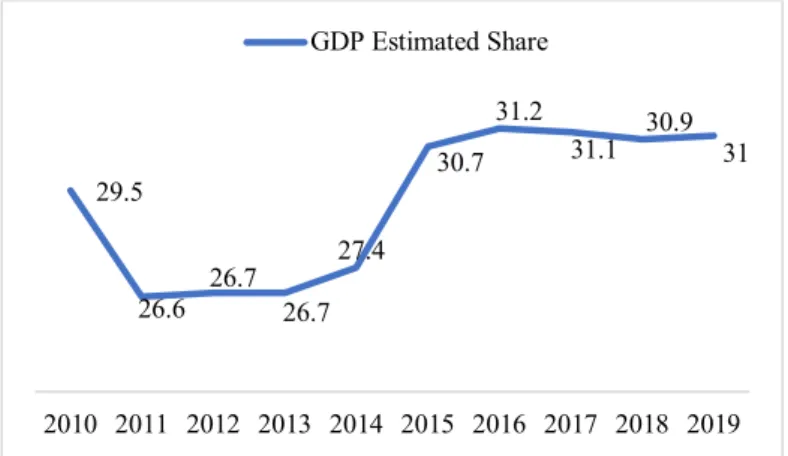
The retail industry, as exposed by van Briel (2018), is configured as one influential element of the global economy, with predictions of attaining thirty one percent of the global domestic product by the year 2019 (figure 1) with about twenty-eight trillion US dollars in revenues.
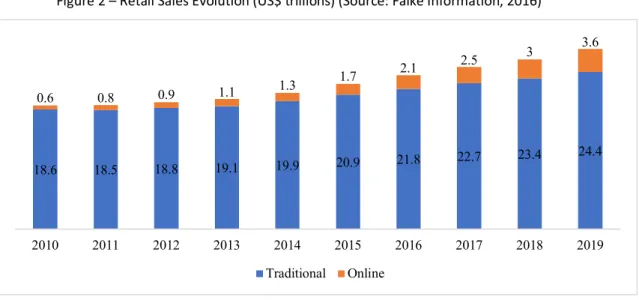
When analyzing the retail sales evolution between 2010 and 2019 the traditional system is shown as the prevailing one. However, when regarding online sales we see an uninterrupted flourish, representing 0.6 trillion dollars in 2010 and an expectation of 3.6 trillion dollars in 2019 (figure 2) (Falke Information, 2016).
Traditional retailers currently face a very significant upsurge of new online competitors to whom they are progressively losing customers due to the customer conversion behavior provided by digital technologies. In effect, when customers want to search for information about a new product, they conveniently use the gadgets they have – smartphones, laptops or tablets – remaining comfortably on their sofa without having to go to a brick-and-mortar store in the proximity (Grewal, Motyka & Levy, 2018).
Figure 1 - Gross Domestic Product Estimated Share (Source: Falke Information, 2016)
In recent years traditional marketing channels – sponsoring, print advertising or television commercials – have been supplemented by new digital options – social media, search engines or price comparison sites – leading to a change in the way business is done, as well as marketing, within the retail sector, and leading to the encountering of new forms of competition (Grewal, Motyka & Levy, 2018).
As reported by Johansson and Kask (2016), retailers are facing a labyrinthine question of the inclusion or non-inclusion of e-commerce as a part of the retail amalgamation, in which the understanding in judging the appropriate retail configuration on whether to have a virtual or a physical store is of an extreme strategic relevance for the competitive advantage of a firm. Apart from the decision of the retail format, another vital aspect is the organization of the market standing to engage and maintain customers, either by offering lower prices than competitors or by differentiating themselves and earning a premium compensation (Hoehle, Aloysius, Chan & Venkatesh, 2017).
29.5 26.6 26.7 26.7 27.4 30.7 31.2 31.1 30.9 31 2010 2011 2012 2013 2014 2015 2016 2017 2018 2019 GDP Estimated Share
Figure 2 – Retail Sales Evolution (US$ trillions) (Source: Falke Information, 2016)
The exponential increase of online shopping, like many other information technology activities, is bouncing in-store shopping rates, and making potential niches emerge for virtual and physical shopping-related travel (Lee, Sener, Mokhtarian & Handy, 2017). Johansson and Kask (2016) argue that the implementation of an e-commerce solution is a root condition to achieve agile growth in the retail sector, and the consolidation of different communication channels – incorporating online and offline measures – may lead to sympathetic odds of triumph.
Online or in-store shopping decisions as emphasized by Lee, Sener, Mokhtarian and Handy (2017) and later by Galipoglu, Kotzab, Teller, Hüseyinoglu and Pöppelbuß (2018), depend on different factors based for example on the momentum of the customer – the preference for shopping online instead of driving to get to a physical store – but also on the kind of product being purchased – the inclination to buy books online rather than food – where physical stores are still privileged crosswise multiple product categories. This authority is assumed due to the inability of inspecting online products in-person, and although online shopping is rising there are some disadvantages identifiable such as shipping costs and shipping wait times. Generally speaking, the periodically purchased products differ between: a) Online: purchase of non-daily products such as books, electronics or clothing; b) Offline: acquisitions of maintenance items such as gasoline or perishable goods (Statista, 2017). The previously referred modernization occurs in the decision of retailers to merge themselves with technological and digital tools to meet the customers’ requirements. Online shopping can influence customer shopping travel through three systems: a) Substitution: the reduction of the overall travel replacing a piece of in-store by online shopping; b) Complementarity: the online shoppers stimulation to an additional shopping-related travel to a physical store in order to inspect or acquire a product; c) Modification: the manifestation that some condition in the shopping travel has changed – time of the day or visited store – without affecting the decision to make the travel itself. These mechanisms do not act unilaterally, so as online shopping influences physical retailers, in-store shopping may impact virtual retailers – the customer can purchase the main item in-store and purchase the accessories online or vice versa (Lee, Sener, Mokhtarian & Handy, 2017).
Given the conjectured interdependencies between online and offline, Lee, Sener, Mokhatarian and Handy (2017) tried to understand which were the variables included in the shopping frequency decision. Customers bear dissimilar behaviors when debating about shopping decisions, since consumers with functional concerns – price, selection and convenience – tend to shop online, and although online shopping may substitute the act of acquiring a product, it is – in the meantime – incapable to provide social or psychological benefits that in-store shopping offers (Deka, 2017).
A broad solution is debated by Wang and Goldfarb (2016) pointing to the online channel not as an alternative or a substitute of the offline retailing, but rather they are second thought complementary processes, exerting that the in-store experience must find a balance between the two channels.
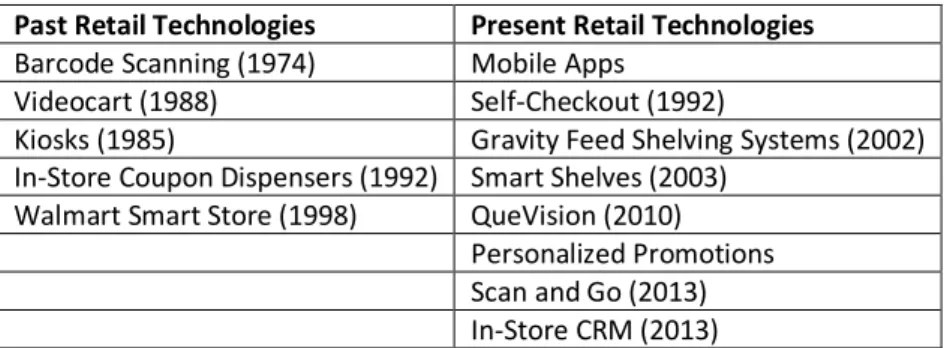
Inman and Nikolova (2017) described the most disruptive retail technologies across recent decades, identifying those with the most impact in the industry (table 1).
18.6 18.5 18.8 19.1 19.9 20.9 21.8 22.7 23.4 24.4 0.6 0.8 0.9 1.1 1.3 1.7 2.1 2.5 3 3.6 2010 2011 2012 2013 2014 2015 2016 2017 2018 2019 Traditional Online
Table 1 – The most disruptive retail technologies across recent decades Past Retail Technologies Present Retail Technologies Barcode Scanning (1974) Mobile Apps
Videocart (1988) Self-Checkout (1992)
Kiosks (1985) Gravity Feed Shelving Systems (2002) In-Store Coupon Dispensers (1992) Smart Shelves (2003)
Walmart Smart Store (1998) QueVision (2010) Personalized Promotions Scan and Go (2013) In-Store CRM (2013)
In addition, the appearance of a generation which exhaustively uses ICT contributes to the expeditious development of e-commerce (Knežević, Šipek & Jaković, 2017).
The consideration of children as a communication and marketing target is made in two different ways, equivalently with the channels used to get adults’ attention, with the modernization of the retail spectrum – in-store experience – in taking advantage of children’s creativity and straightforwardly turning to technology with the implementation of character-themed tech shops and fun-featured animated candy displays; or with the use of online media tools – online experience – with the retelling of social media incorporation in marketing campaigns for children, conceiving bi-directional channels between the brand and the young consumer (Confos & Davis, 2016)
4. Children as a relevant target and marketing techniques
Digital media is becoming an integrated part of children’s lives (though we do recognize different behaviours and differentiated access to technology, according to a child’s age, national culture, and social and economic status, as dictated also by their parents) and digital marketing which uses new and innovative strategies to target children – where the engaging and immersive nature of online content shapes the perfect environment within which commercial messages can be camouflaged – blurring traditional lines between content and commercial messages (Livingstone, Mascheroni & Staksrud, 2017).
Everyday social media acceptance contributed to the change of customers buying methods, providing buyers with a great pallet of options. To store managers, it is a representation of a challenge where they need to maintain their focus. With the addition of promotions and related marketing and brand activity, the complexity is multiplied (Anderson, Steen & Stavropoulos, 2016) (Ramanathan, Subramanian & Parrott, 2017). To speed up the online provenience options war marketers exploit the fact that innumerable social network users post vast amounts of personal information on their profile pages – age, hobbies, brands or music – using technological tools to use this “public” information and target them in their campaigns (Reijmersdal, Rozendaal, Smink, van Noort & Buijzen, 2017) (Livingstone, Mascheroni & Staksrud, 2017).
According to Confos and Davis (2016) children social media usage is relevant to advertisers – to take advantage of their technology affinity – to invite them for example to connect a specific application to their accounts or exposing them to advergames (advertising through games) – serving advertisers as another communication tool – engaging with customers through multiple digital platforms. Advergames are exceptionally difficult for children to understand – the persuasive intention – due to the fact that the first assignment is to play the game and the second one involves the distillation of the advertising message, where the second task becomes hidden behind the first one (Vanwesenbeeck, Walrave & Ponnet, 2016). As reported by Vandevijvere, Sagar, Kelly and Swinburn (2017) websites targeting children focus in the presence of brand logos, characters, music and sound effects and animation during the advergames.
The disjuncture between online media and traditional media is made by characteristics such as: a) ubiquitous connectivity; b) personalization; c) peer-to-peer networking; d) engagement; e) immersion; f) content creation. These components enable new digital opportunities for those who market to young consumers, addressing aspects like interactivity, multimedia content and personalized content to this target requirements (Confos & Davis, 2016). Websites are targeting children when they include fun, fantasy and adventure themes or games (Vandevijvere, Sagar, Kelly & Swinburn, 2017).
The younger ones created a “traditional marketing” barrier where in fact digital advertising – with the use of the above cited characteristics – proved to be strong to counter this inconstancy, impelling an immense number of organizations to use social media marketing to promote and engage Generation Z customers (Duffett, 2017).
Section IV – Social insertion in children-aimed campaigns
In 2018, the retail-aimed children campaigns are a powerful route to target not only children but also adults. In Portugal the retail giants are the most interested in segmenting these young consumers, working on customer loyalty since the beginning, confident of the technological incorporation with the introduction of tablet and mobile applications and also a desktop participation to children and their parents. Some of the technological campaigns conducted in the last years are:
• “Super Animais 1”, “Super Animais 2” and “Super Animais 3” by Pingo Doce: Both campaigns require the collection of cards – given after the acquisition of in-store products – where children can digitalize the cards using a mobile application, letting them play afterwards.
• “Super Gangue dos Frescos” by Lidl: Like the one above it inspires the customer to acquire products, where in change there are eight collectible dolls and also a dedicated campaign webpage with eight interactive games allusive to these dolls.
• “Stikeez” by Lidl: Likewise, the same purchasing typology it affiliates an android and iOS application. • “Super Dicas” by Continente: Continente used their webpage “Kasa” tab including some DIY hints, so
children may for example do their own personalized balloons or ice cream;
• “Turma das Sementinhas” by Jumbo: In a partnership with the Portuguese scientific toys producer, Science4you, created a children campaign where there is totally free downloadable application for iOS or android.
Another common point between these campaigns – other than the technologic embodiment – explained by Ritch and Brownlie (2016) and Del Bucchia and Peñaloza (2016) is the kid-friendly education, focusing in the fact that children need to learn something from them, in the education or social fields, where parents are another agent particularly interested in these kind of projects, and the ideal campaign to explain the propensity is the Super Animals from Pingo Doce.
The first edition was doubtless the one which made the biggest impact on Portuguese society. With the use of social media platforms such as Facebook people created totally dedicated groups to trading and selling the cards and, also selling advertising on pages like OLX (an online C2C/B2C e-commerce platform). The relevance of these social groups is that people looking and selling the cards where not children at all – adults, parents or grandparents – interacting to complete the collection.
Besides these groups, thanks to this campaign the prosperity of social interactions by people with the same objective prevails. Trying to finish the collection of all the cards is an easier task and at the same time they are satisfying their children, and themselves, and there are for sure also people trying to resell their repeated cards, and thus earning some money. From a customer point of view, it is an approbation of technological development of children, an acceptable practice in today’s society.
In order to inquiry prospects of a potential children-aimed campaign we conducted a survey (n= 71) to parents and subsequent and the results, according to the above cited campaigns convinced us of the retail need of importance of these projects to prospect children and their families.
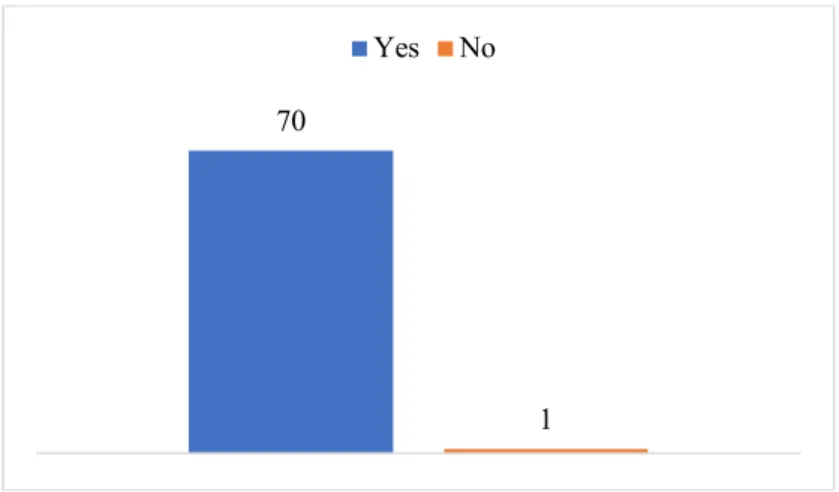
The first question highlights as expected the importance of these actions where seventy people answered “yes” and only one answered “no”, however pointing that that answer would easily become a “yes” depending on the construction of the campaign (figure 3).
Figure 3 – Recognizing the importance of a children-aimed campaign
70
1
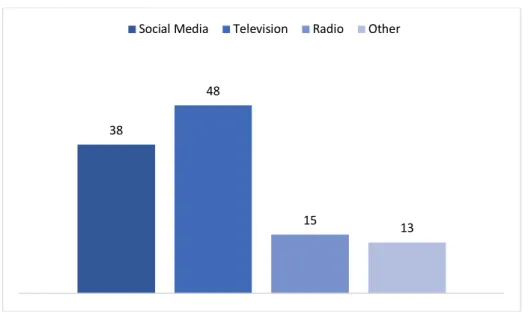
The second and most relevant question, tried to understand the social media relevance in advertising, and in a multiple answer question we asked where in preference should be created displayed the campaign promotional content. Even that forty-eight people answered “television” as a preferred way of communication, social media were chosen by thirty-eight, calling attention to the social media being imposing over the rest of the choices (figure 4).
Figure 4 – Advertising preference in a children-aimed campaign
The third question intend to understand the themes that children mainly until ten, or in some cases until twelve years old preference according to their parents.
As displayed below (figure 5) food, and mainly healthy eating is argument that parents think their children would enjoy the most in an action, followed by a physical toys campaign and an animal campaign (such as Pingo Doce, Super Animais action).
Figure 5 – Children preferences in children-aimed campaigns
The above question is of course the parents perspective of how a marketing campaign could be successful, however this is not an exact science, in some cases a child with the age of ten can be amazed by this kind of campaign and a twelve-year-old might prefer music related content and social media interactions, so a target segmentation is a major question that can predict a marketing action success or failure.
38
48
15 13
Social Media Television Radio Other
17 2 8 8 10 11 3 12 Food Sports Social Environment Animals Toys Educational Others
These inquiry, although represent only three questions shows that an action oriented to children is a valid option a social media is a communication channel praised by parents and children in advertising those contents. As argued by Ritch and Brownlie (2016) children have an influence on family consumption and this is increasing. Which in turn is making retailers and marketers focus on attitudinizing with these children-oriented projects, situating the child’s needs on top of parental decision making.
5. Conclusions and outlook
This paper explores the question of technological incorporation in retailing and more properly in children-oriented marketing campaigns and reunites a contextual vision analysis of an increasing number of articles demonstrating an outstanding interest in technological development. It also includes a generic picture of the technological sample in the retailing field, mentioning some of the old technologies, which were once innovative, and some others considered innovative in some countries, but outdated in the technological primal countries. Humankind is assisting to a dizzying technological growth speed, and long-term solutions are required to keep up this constant upgrade, not only in retailing but in all activity sectors.
Particularly in retailing all trends work in an all-speed acquisition method, since people have less shopping availability, where online is continuing to grow, yet a majority of people still prefer in-store shopping, so opportunities are still there for retailers to take advantage from. The best option remains as regarding the kind of business in operation and the product being sold (Galipoglu, Kotzab, Teller, Hüseyinoglu & Pöppelbuß, 2018). Choosing between online and offline is not a simple task, although online grants opportunities that offline stores cannot provide to customers. An Omni-channel is probably the forthcoming tendency where customers will be able to interact with retailers across a huge diversity of platforms and devices, with the implementation of an online and offline experience at the same time (Hoehle, Aloysius, Chan & Venkatesh, 2017).
Younger publics are revealing themselves as a relevant target in economic terms to organizations due to their technological appetences, forcing organizations to change communication and marketing strategies with the implementation of campaigns and projects – particularly in the Portuguese landscape – aimed at children, and approved by parents and grandparents (Xiang, Magnini, & Fesenmaier, 2015). Such actions as argued by Confos and Davis (2016) need to be interactive, have multimedia and personalized driven content in order to get a successful status, and using social media platforms and innovative advertisement processes like advergames. Finally, a children campaign action will prevail if its objective is the encouragement of social synergy, where education performs a major role in culturing the children with new information – technological and non-technological – at the same time as they delight themselves with some – persuasive – retailing content.
References
ACEPI & IDC (2017): Estudo anual da economia e da sociedade digital em Portugal: Principais conclusões da edição de 2017.
Anderson, E., Steen, E., & Stavropoulos, V. (2016): Internet use and problematic internet use: a systematic review of longitudinal research trends in adolescence and emergent adulthood. International Journal of Adolescence and Youth. doi:10.1080/02673843.2016.1227716
Confos, N., & Davis, T. (2016). Young consumer-brand relationship building potential using digital marketing. European Journal of Marketing, 50(11), 1993-2017. doi:10.1108/EJM-07-2015-0430
Deka, P. (2017): A conceptual model for determining factors influencing online purchasing behavior. Journal of Management in Practice, 2(1), 1-15.
Del Bucchia, C., & Peñaloza, L. (2016). “No, I won't eat that!” Parental self-transformation in clashes of role enactment and children's will. Journal of Business Research, 69(1), 145-154.
Duffett, R. (2017): Influence of social media marketing communications on young consumers attitudes. Young Consumers, 18(1), 19-39. doi:10.1108/YC-07-2016-00622
Falke Information (2016): Overview & evolution of the global retail industry.
Galipoglu, E., Kotzab, H., Teller, C., Hüseyinoglu, I., & Pöppelbuß, J. (2018): Omni-channel retailing research – state of the art and intellectual foundation. International Journal of Physical Distribution & Logistics Management. doi:10.1108/IJPDLM-10-2016-0292
Gonçalves, R., Martins, J., & Rocha, Á. (2016). Internet and social networks as enhancer's business instruments/Internet e redes sociais como instrumentos potenciadores de negocio. RISTI (Revista Iberica de Sistemas e Tecnologias de Informacao) (18), ix-ix.
Grewal, D., & Guha, A. (2017): Retailing and pricing cues: Special session proposal-2016 AMS annual conference. In: Stieler, M. (2017): creating marketing magic and innovative future marketing trends. Developments in Marketing Science: Proceedings of the Academy of Marketing Science. doi: 10.1007/978-3-319-45596-9_50 Grewal, D., Motyka, S., & Levy, M. (2018): The evolution and future of retailing and retailing education. SAGE. doi: 10.1177/0273475318755838
Hoehle, H., Aloysius, J., Chan, F., & Venkatesh, V. (2017): Customer’s tolerance for validation in omnichannel retail stores: enabling logistics and supply chain analytics. The International Journal of Logistics Management. doi: 10.1108/IJLM-08-2017-0219
Inman, J., & Nikolova, H. (2017): Shopper-facing retail technology: A retailer adoption decision framework incorporating shopper attitudes and privacy concerns. Journal of Retailing. doi: 10.1016/j.jretai.2016.12.006 Johansson, T., & Kask, J. (2016) Configurations of business strategy and marketing channels for e-commerce and traditional retail formats: A qualitative comparison analysis (QCA) in sporting goods retailing. Journal of Retailing and Consumer. doi: 10.1016/j.jretconser.2016.07.009
Knežević, B., Šipek, Z., & Jaković, B. (2017): Internet as a purchasing information source in children’s products retailing in Croatia. 40th International Convention on Information and Communication Technology, Electronics and Microelectronics. doi: 10.23919/MIPRO.2017.7973654
Lee, R., Sener, I., Mokhtarian, P., & Handy, S. (2017): Relationships between the online and in-store shopping frequency of Davis, California residents. Transportation Research Part A: Policy and Practice, 100, 40-52. doi:10.1016/j.tra.2017.03.001
Livingstone, S., Mascheroni, G., & Staksrud, E. (2017): European research on children’s internet use: Assessing the past and anticipating the future. SAGE. doi:10.1177/1461444816685930
Martinez, A., Vazquez, B., Estrada, H., Santillan, L., & Zavala, C. (2017): Incorporating technlogy in servisse-oriented i* business models: a case study. Information Systems and e-Business Management, 15(2), 461-487. doi: 10.1007/s10257-016-0316-9
Maruping, L., Bala, H., Venkatesh, V., & Brown, S. (2016): Going beyond intention: Integrating behavioral expectation into the unified theory of acceptance and use of technology. Journal of the Association for Information and Technology. doi: 10.1002/asi.23699
Ramanathan, U., Subramanian, N., & Parrott, G. (2017): Role of social media in retail network operations and marketing to enhance customer satisfaction. International Journal of Operations & Production Management, 37(1), 105-123. doi: 10.1108/IJOPM-03-2015-0153
Reijmersdal, E., Rozendaal, E., Smink, N., van Noort, G., & Buijzen, M. (2017): Processes and effects of targeted online advertising among children. International Journal of Advertising, 36(3), 396-414. doi: 10.1080/02650487.2016.1196904
Ritch, E., & Brownlie, D. (2016). Doing it for the kids: the role of sustainability in family consumption. International Journal of Retail & Distribution Management, 44(11), 1100-1117.
Statista (2017): Offline vs. online retail: Development – comparisons – consumer view.
Stewart, J., Oliver, E., Cravens, K., & Oishi, S. (2017). Managing millennials: Embracing generational differences. Business Horizons, 60(1), 45-54.
Vandevijere, S., Sagar, K., Kelly, B., & Swinburn, B. (2017); Unhealthy food marketing to New Zealand children and adolescents through the internet. New Zealand Medical Journal, 130(1450), 32-43.
Vanwesenbeeck, I., Walrave, M., & Ponnet, K. (2016) Children and advergames: the role of product involvement, prior brand attitude in purchase intentions and changing attitudes. International Journal of Advertising. doi: 10.1080/02650487.2016.1176637
Verhoef, P., Kannan, P., & Inman, J. (2015): From multi-channel retailing to omni-channel retailing: Introduction to the special issue on multi-channel retailing. Journal of Retailing, 91, 174-181.
Von Briel, F. (2018): The future of omnichannel retail: A four-stage Delphi study. Technological Forecasting & Social Change. doi: 10.1016/j.techfore.2018.02.004
Wang, K., & Goldfarb, A. (2016): Can offline stores drive online sales? Journal of Marketing Research. doi: 10.1509/jmr.14.0518
Xiang, Z., Magnini, V., & Fesenmaier, D. (2015). Information technology and consumer behavior in travel and tourism: Insights from travel planning using the internet. Journal of Retailing and Consumer Services, 22, 244-249.