Future Academy ISSN: 2357-1330
This is an Open Access article distributed under the terms of the Creative Commons Attribution-Noncommercial 4.0 Unported License, permitting all non-commercial use, distribution, and reproduction in any medium, provided the original work is properly cited.
https://dx.doi.org/10.15405/epsbs.2018.11.5
icH&Hpsy 2018
4
thInternational Conference on Health and Health
Psychology
PROPOSING A WORKPLACE MEDITATION MODEL BASED ON
EVIDENCE-BASED PROGRAMS: AN INTEGRATIVE REVIEW
Patrícia Araújo (a), Rosina Fernandes (b)*, Emília Martins (c) Francisco Mendes (d) * Corresponding author
(a) IPAM/Universidade Europeia- Laureate International Universities, Porto, Portugal, [email protected] (b) Instituto Politécnico de Viseu e CI&DETS, Viseu, Portugal, [email protected]
(c) Instituto Politécnico de Viseu e CI&DETS, Viseu, Portugal, [email protected] (d) Instituto Politécnico de Viseu e CI&DETS, Viseu, Portugal, [email protected]
Abstract
Workplace Meditation (WM) practices, focusing on ameliorating occupational-stress, are becoming increasingly popular in organizations. Nevertheless, scientific research is scarce and effective evidence-based programs (EBP) to replicate are hard to find. In this sense, the purpose of this study was to perform a systematic review on WM EBP and to propose a model for interventions using meditation in the workplace, based on the tested programs found in the databases explored and which have proven their efficacy. A systematic integrative review on WM EBP for occupational-stress was conducted using Ebsco, Scielo and Google Scholar databases. Journal articles and book chapters from all countries, years and languages (those understood by the authors) with WM EBP were included. Articles without EBP, books, thesis, repeated, paid, journalistic articles and conference papers were excluded. After applying specific criteria to the 86 publications retrieved, 9 were included for the review. From the 9 publications, 11 programs were extracted, analysed and included in the review. The programs covered before and after measures (4); randomized controlled trial (6); and mixed methods (1). EBP included meditation in workplace; audio self-guided meditations; vipassana meditation; yoga; mindfulness-based stress reduction program; flow meditation and other mixed techniques. Findings report improvements in sleep quality and duration, self-perception work engagement and resilience, and quality of life, as well as reduction of stress, anxiety, depression, fatigue, and respiration rates. Regardless of the types of programs, Workplace Meditation practices have proven their efficacy in several constructs related with occupational stress. We conclude by presenting an integrated WM model, easy to replicate by organizations focused on intervening in occupational stress.
© 2018 Published by Future Academy www.FutureAcademy.org.UK
46
1. Introduction
Professionals’ psychological lack of health has an impact in organizations and high long term costs, estimated recently to incur about €212 million per year in large companies (Mateus, 2018).One of the health risk factors is the workers’ stress levels.
“Work-related stress, depression or anxiety is defined as a harmful reaction people have to undue pressures and demands placed on them at work” (Health and Safety Executive, 2017, p. 3). Stress is a state “which is accompanied by physical, psychological or social complaints or dysfunctions and which results from individuals feeling unable to bridge a gap with the requirements or expectations placed on them” (Eurofound, 2010, p. 5). According to the Work Stress Report by the European Foundation for the Improvement of Living and Working Conditions (Eurofound, 2010), 22% of European workers reported suffering from stress, lower back ache, muscular pain and fatigue and about a quarter are exposed to job strain. On top of that, Eurofound states that work-related stress has been associated with a number of other ill-health outcomes, such as cardiovascular disease, musculoskeletal disorders, particularly back problems and neck-shoulder-arm-wrist-hand problems, repetitive strain injuries as well as absenteeism and presenteeism (the practice of attending work even when employees feel too ill to be able to work effectively). According to the National Epidemiological Study for Mental Health (Nova Medical School, 2013), a study done by the World Mental Health Surveys Initiative, in Portugal, in particular, it is estimated that in average 2 out of 10 workers have psychological issues and skip work. Furthermore, the same study shows that Portugal has the second highest prevalence on psychiatric disorders at the European level, with anxiety disorders present in 16.5% of the population.
Although legislation and classical stress programs and directives have their role, as Eurofound (2010) states, new approaches are needed.
The American Psychological Association (APA) presents coping strategies to overcome this stress at work: (i) track your stressors; (ii) develop healthy responses; (iii) establish boundaries; (iv) take time to recharge, (v) learn how to relax, (vi) talk to your supervisor (vii) get support (American Psychological Association, n.d.). In the context of ‘Learn to relax’, APA defends “techniques such as meditation, deep breathing exercises and mindfulness (a state in which you actively observe present experiences and thoughts without judging them) can help melt away stress”. (American Psychological Association, n.d., para.11)
When approaching workplace-meditation programs, there a number of schools, styles and approaches, several mindfulness techniques, including both formal and informal practices with Mind/Body focus and/or integration. Although, the concept of mindfulness has its origins in ancient Eastern spiritual traditions, meditation and yogic practices have only recently been adopted in several scientific interventions. Mindfulness entails paying attention to the present moment with awareness and without judgment (Kabat-Zinn, 2003).
One of the first and rigorously studied group applications of mindfulness is Kabat-Zinn’s Mindfulness-Based Stress Reduction (MBSR), in which MBSR groups meet for 8 weekly 1.5 to 2.5 hour sessions and members were encouraged to practice MBSR outside of group for 45 minutes 6 days per week (Newsome, Waldo, & Gruszka, 2012). MBSR for health care professionals showed that levels of stress decreased while quality of life and levels of self-compassion increased among the participants
47 (Shapiro, Astin, Bishop, & Cordova, 2005). Over the past decades, studies regarding Mindfulness Based Intervention (MBI) have found impressive reductions in psychological morbidity and pain, mitigation of stress and enhanced emotional well-being (Bishop Scott et al., 2006; Karasek, 1979). In general, “most studies found that MBI was effective for psychological distress, stress and burnout” (Huang, Li, Huang, & Tang, 2015, p. 3).
2. Problem Statement
Workplace Meditation (WM) practices, focusing on ameliorating occupational-stress, are becoming increasingly popular in organizations worldwide. Nevertheless, scientific research is scarce, effective evidence-based programs to replicate are hard to find, and a complete, eclectically, low-cost, effective WM model to present to organizations is non-existent.
3. Research Questions
The research questions (RQs) which oriented this research were:
3.1 RQ1: Which publications describes meditation or mindfulness evidence-based programs in the workplace?
3.2 RQ2: What benefits or consequences were found in these evidence-based programs?
3.3 RQ3: Which of the evidence-based programs might be an integrative and effective meditation approach to propose to organizations?
4. Purpose of the Study
The purpose of this study is to perform a systematic review on evidence-based programs of Workplace Meditation and to propose a model for interventions using meditation in the workplace, based on the tested programs which have proven their efficacy. This review covered any form of meditation (focusing on the present approaches), disregarding any religious variables.
5. Research Methods
Following methodological instructions by Callahan (2010) and Torraco (2005), an integrative literature review (ILR) was conducted. An ILR is “a form of research that reviews, critiques, and synthesizes representative literature on a topic in an integrated way such that new frameworks and perspectives on the topic are generated”(Torraco, 2005, p. 356).
5.1. Procedure
Research was conducted in two stages; the first was on 20 (First Phase) and the second was on 24 May 2017 (Second Phase) using three different databases. Keywords used for the search were “Meditation”, “Mindfulness”, “Workplace” and “Occupational Stress” in the title, abstract and keywords 1, from all countries and all languages.
1AB meditation programs OR AB meditação OR AB mindfulness AND AB (occupational stress OR workplace stress
48
5.1.1. First Phase
On 20 May 2017, researchers searched Ebsco and Scopus database with the keywords above for peer-reviewed journal articles. The search generated 40 peer-review papers, and the team began the analysis. Unfortunately, after applying inclusion and exclusion criteria (described in 5.2 below), no article was found to be suitable.
5.1.2. Second Phase
Due to the results of the first phase, a second phase was put in motion on 24 May 2017, using the same keywords. Using Scielo database and Google Schoolar, the research team no longer configured the search for indexed journals or peer-reviewed papers, in order to widen the search. 17 publications were retrieved from the Scielo database retrieved and 29 from Google Scholar.
5.2. Inclusion and exclusion criteria
The inclusion criteria were: (i) all publications, from all countries and all languages and (ii) Evidence-Based Research which showed data on meditation or mindfulness in the workplace to address stress at work.
The following were excluded from the retrieved publications: repeated references, books and thesis, payed articles, journalistic articles, conference papers and articles that did not present evidence-based programs of meditation in the workplace.
5.3. Data Analysis
Initially, 86 publications were retrieved from three different databases (Ebsco, Scielo and Google Scholar) but after applying exclusion and inclusion criteria, 9 publications were finally selected to be included in this review.
6. Findings
As mentioned earlier, 9 publications were included in this review: 6 from Google scholar and 3 from Scielo Database (Table 1.)
6.1. RQ1: Which publications describes meditation or mindfulness evidence-based programs in the workplace
Because an integrative review should synthesize the presentation of the literature (Callahan, 2010) findings are presented in Table 01. A summary of all publications pertinent to answering RQ 1 is presented. The 9 selected publications describe meditation or mindfulness evidence-based programs in the workplace, from all over the world, using diverse strategies related to meditative practices and research design.
49 Table 01. Nine Publications included in the integrative review
Article Date Country Type Meditation practice Participants Intervention design and instruments Findings 1 (Martín Asuero,
Rodríguez Blanco, Pujol-Ribera, Berenguera, & Moix Queraltó, 2013)
2013 Spain Before and after; repeated measures (3 moments)
Six different types of presence mediations (attention, breathing, body exploration, open consciousness love and compassion, walking, yoga)
87 participants working in primary care
1 year
28 intensive hours with 2 weekly sessions of 2.5 hours and monthly sessions of 2.5 hours • Better self-perception • More energy • Increased empathy • Higher consciousness • Decreased burnout 2 (Cheng, 2016) Integrative review (only 3 papers included in this review) 2 (Cheng, 2016) Integrative review (only 3 papers included in this review) 2 (Cheng, 2016) Integrative review (only 3 papers included in this review) 1 (Hülsheger et al., 2013) Netherlands Randomized controlled trial Pre- and post testing within 2 weeks of the final class
Self-training for mindfulness- based stress reduction, mindfulness-based cognitive therapy, loving-kindness meditation, and 3-minute breathing
space
10 working days (2 weeks)
Phase I: 219 employees Phase II: 64
Phase I: A 5-day (twice a day) observational diary
Phase II: A randomized controlled study (22
in intervention group and 42 control group) 10-day diary report
• Reduced emotional exhaustion
• Reduced stress • Enhanced emotional regulation
• Enhanced job satisfaction
2 (Wolever et al, 2012) USA Randomized controlled trial DVD for the
12-week program (12 hours) Mindfulness at Work focused on stress management+ Vini- yoga 239 employees 90 (yoga-based meditation); 96 (mindfulness group) 53 (control group)
Half of the participants in the Vini- yoga group received a handout and half received both a handout and a DVD for the 12-week program (12 hours) Mindfulness at Work focused on stress management for 14 hours, including 5–15 minutes of home practice over 12 weeks and 2 hours of intensive training at week 10.
• Reduced stress • Improved sleep quality • Improved physical health • Enhanced work productivity • Decreased in occupational risks 3 (Marzuq & Drach- Zahavy, 2012)
Israel Mixed Methods; qualitative study interviewing 10 nurses +Testing before, during and 2-day
after the periods of respite
Mindfulness Based 184 nurses in 27 units
in an Israel hospital (female = 128, male = 56)
Testing before, during and 2-day after the periods of respite
• Decreased exhaustion • Increased levels of vigour positively correlated with mindfulness (the more intense the mindfulness practice, the higher the vigour level and quick recovery)
3 (Doria, Irtelli, Sanlorenzo, & Durbano, 2015)
2015 Italy Before and after measures
5 mindfulness classes, 2 hours a week.
100 hospital workers (90 women and 10 men)
Five lessons, two hours weekly (every lesson contains: 30 minutes for relaxation, breathing, and full asanas; 60 minutes for asana specifications; and 30 minutes for meditation with mantra listening)
• Stress reduction • Fatigue reduction • Anxiety reduction (especially in individuals with low score of mindfulness at the beginning of the program)
50
4 (Grégoire & Lachance, 2015)
2014 Canada Randomized
controlled trial, before and after measures
Audio meditation at workstation
5weeks (10min. before work and 5m after work)
43 workers from a call center
Pre and post teste control Group switching replication
• Higher mindfulness • Lower distress • Less negative affect • Reduced fatigue • Reduced anxiety • Reduced depression
5 (Hülsheger, Feinholdt, & Nübold, 2015) 2015 Netherlands /Germany Randomized controlled trial three daily measurements over 10 workdays Self-training intervention + survey + diary
Daily guided meditation and informal guided mindfulness (body scan, breathing)
140 workers Self-training group + wait-list group control
• Higher sleep quality and duration
• Increased mindfulness in work
6 (Klatt, Steinberg, & Duchemin, 2015)
2015 USA Before and after measures
Mindfulness online delivered onsite during the workday
34 participants high stress work environment
Mindfulness online 8 weeks (1 hr weekly session, plus 2 hr “retreat” and 20 min of mindfulness meditation via CD/DVD, music in background)
• Increased work engagement • Increased resiliency • Decrease respiration rates
7 (Huang et al., 2015) 2015 Taiwan Randomized controlled trial measures in 5 moments Mindfulness and vipassana meditation 144 participants in industry
2 hours of mindfulness training weekly and 45 min.
of homework every day for 8 weeks at the workplace
• Decreased distress • Reduced fatigue • Low perceived stress • Increased relaxation • Lessen the mental illness risks for workers with poor mental health
8 (Mañas Mañas, Franco Justo, & Justo Martínez, 2011)
2011 Spain Randomized
controlled trial
Flowing meditation (mix of acceptance therapy and commitment, vipassana and Zen traditions)
Teacher training course “Stress Prevention”
15 hours (10 weeks, 90 min. per session)
• Stress reduction • Low sick leave days • Reduction of perceived pressure
• Lower demotivation • Reduction of scores in “coping poorly”
9 (Medeiros U & Pulido M, 2011)
2011 Chile before and after measures
Mindfulness-based Stress Reduction program
12 participants Educational and experiential program: 9 sessions (27 hours)
Change in psychotherapy (OQ-45), quality of life (WHOQOL) and in mindfulness skills (FFMQ).
• Low anxiety • Reduced depression • Less somatic distress; • Higher quality of life • Improved mindfulness skills
51 6.2. RQ2: What benefits or consequences were found in these evidence-based programs?
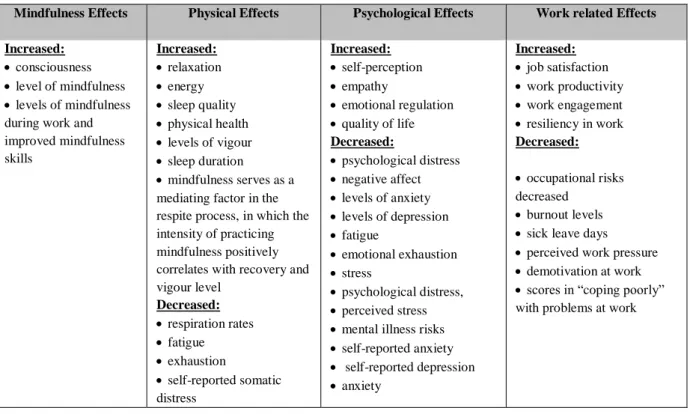
The benefits or consequences found in these evidence-based programs (presented previously in Table 01) were listed, analysed and categorized into 4 types (Table 02): (i) mindfulness; (ii) physical (iii) psychological and (iv) work related experience. Mindfulness effects refers to improvements in body sensations. Psychological effects refers to effect on psychological constructs and perception of reality and self. Finally, work related experience included factors that affect work performance.
Table 02. Categorization of Effects found in the 9 publications included in the review
Mindfulness Effects Physical Effects Psychological Effects Work related Effects Increased:
• consciousness • level of mindfulness • levels of mindfulness during work and improved mindfulness skills Increased: • relaxation • energy • sleep quality • physical health • levels of vigour • sleep duration • mindfulness serves as a mediating factor in the respite process, in which the intensity of practicing mindfulness positively correlates with recovery and vigour level Decreased: • respiration rates • fatigue • exhaustion • self-reported somatic distress Increased: • self-perception • empathy • emotional regulation • quality of life Decreased: • psychological distress • negative affect • levels of anxiety • levels of depression • fatigue • emotional exhaustion • stress • psychological distress, • perceived stress • mental illness risks • self-reported anxiety • self-reported depression • anxiety Increased: • job satisfaction • work productivity • work engagement • resiliency in work Decreased: • occupational risks decreased • burnout levels • sick leave days
• perceived work pressure • demotivation at work • scores in “coping poorly” with problems at work
6.3. RQ 3: Which of the evidence-based programs might be an integrative and effective meditation approach to propose to organizations?
An ILR should synthesize literature and offer something new, whether reframing an existing idea or constructing a new one, and should critically analyse existing literature (Callahan, 2010). Furthermore, the ILR should provide motivation for others to act on the work presented, whether through research or practice.
Organizations worldwide face diverse challenges: rapid advances in technology, increasing taxes, effects of globalization, all leading to high levels of occupational stress and so, to convince companies to implement meditation-based interventions, researchers and practitioners should provide irrefutable data and convincing arguments. In this regard, the main point of this work is to summarize and present, based on the literature review and, in our professional field experience, an effective, cost-friendly and diverse employee-friendly model, to organizations.
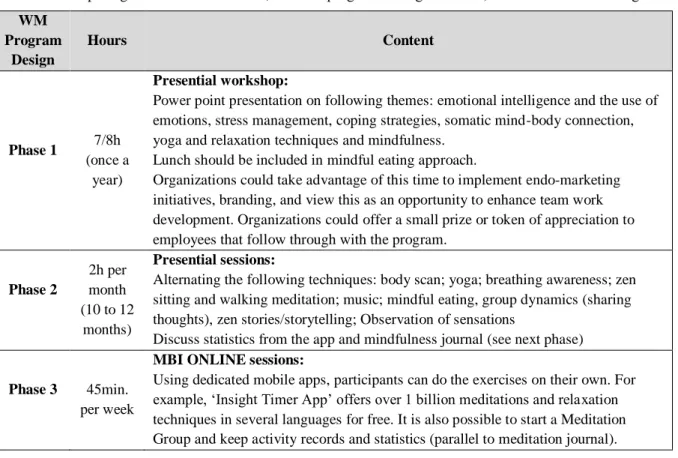
In Table 03 we present our model comprising several phases which we think are fundamental and are a merger of the literature review and good practices.
52
Table 03. Proposing a WM evidence-based, low cost program for organizations, the “Relax at Work Program” WM Program Design Hours Content Phase 1 7/8h (once a year) Presential workshop:
Power point presentation on following themes: emotional intelligence and the use of emotions, stress management, coping strategies, somatic mind-body connection, yoga and relaxation techniques and mindfulness.
Lunch should be included in mindful eating approach.
Organizations could take advantage of this time to implement endo-marketing initiatives, branding, and view this as an opportunity to enhance team work development. Organizations could offer a small prize or token of appreciation to employees that follow through with the program.
Phase 2 2h per month (10 to 12 months) Presential sessions:
Alternating the following techniques: body scan; yoga; breathing awareness; zen sitting and walking meditation; music; mindful eating, group dynamics (sharing thoughts), zen stories/storytelling; Observation of sensations
Discuss statistics from the app and mindfulness journal (see next phase)
Phase 3 45min.
per week
MBI ONLINE sessions:
Using dedicated mobile apps, participants can do the exercises on their own. For example, ‘Insight Timer App’ offers over 1 billion meditations and relaxation techniques in several languages for free. It is also possible to start a Meditation Group and keep activity records and statistics (parallel to meditation journal).
We were able to merge most of WM approaches existent in the literature in the model presented. Furthermore, one of the challenges of MBI at the moment is to extend the positive effect over a longer period (Huang et al., 2015), so we opted to use the online interventions has a way to achieve this goal, since several evidence-based programs found that there were no significant variations between online and in-person meditation settings.
Finally, we summarize several guidelines for good practices when implementing this model (all of which emerged from the review). Several principles must be met in order to implement this model with success: (i) engage workers form the beginning, executing a diagnostic of their physical and psychosocial needs, as effective programs should be tailored to job characteristics; (ii) use only voluntary workers; (iii) execute presential interventions within working and paid hours; (iv) when implementing the presential interventions, ensure that a ‘Please do not disturb room’ sign is outside the room; (v) eliminate all use of words like Buddhism and all spiritual references; (vi) choosing the facilitator is of most importance: the ideal profile comprises a psychologist with Mindfulness techniques experience, a meditation and yoga practitioner, since yoga has proven to be effective both in the publications in this review and others (Araújo, Fernandes, Mendes, Magalhães, & Martins, 2016). This professional should be updated with innovative teaching approaches, as discussed in other papers authored by us (Araújo & Fernandes, 2017) and a technological profile for app using; (vii) when poor mental health or psychopathological issues are detected in a participant, the facilitator should forward him/her to a professional psychologist (not the facilitator him/herself).
53
6. Conclusion
In this paper we presented an integrative workplace meditation program model with low cost investment, based on evidence-based programs from all over the world.
Limitations of this study include the languages authors were able to analyse. In this review, we only included papers in English, French, Portuguese and Spanish: certainly, there are many others from all Asiatic countries that report mindfulness and mediation programs at work but which could not be reviewed due to the language barrier. Furthermore, unfortunately, many scientific articles related to MBI and workplace stress can be accessed only for a fee, which posed a strong limitation, not only for review, but also for implementation for the simple reason that if people are not able to access these works, how can professionals implement successful interventions to reduce workplace stress worldwide? The whole effort to research and find effective interventions to eliminate workplace stress seems self-defeating if no one can access the work, unless they pay for it.
The ultimate goal for organisations, should be to reduce absence due to sickness related to stress and to increase the general well-being of the workforce, as this will guard against stress in the future and brings attendant benefits such as increased morale, reduced employee turnover and increased productivity (Eurofound, 2010). As also emphasised by Eurofound, maintaining the momentum in implementing stress reduction initiatives can also be problematic, as this requires dedication and continued financial commitment on the part of organisations. We hope our contribution of providing organizations with an effective, evidenced-based, integrative and low-cost model, publishing in an open access journal, will become sought after and implemented in order to overcome this ever-growing problem of occupational stress.
Acknowledgments
We would like to acknowledge the Centre for Studies in Education, Technologies and Health (CI&DETS) at the Polytechnic Institute of Viseu, Portugal for their support in conducting this research.
References
American Psychological Association. (n.d.). Coping with stress at work Retrieved from http://www.apa.org/helpcenter/work-stress.aspx
Araújo, P., & Fernandes, R. (2017). The M.O.D.E.L Profile: Proposing a Teacher’s Profile for Curricular Disciplines promoting Transferable Skills in Higher Education. In S. Vieira & J. M. Castro (Eds.), Ser
Jovem, Ser trabalhador: Incertezas, Desafios e Respostas. A importância da Educação, da Formação e do Emprego dos Jovens na Construção dos Projetos Pessoais e no Desenvolvimento Social e Humano
(pp. 365-372). Oporto: Instituto de Emprego e Formação Profissional.
Araújo, P., Fernandes, R., Mendes, F., Magalhães, C., & Martins, E. (2016). A systematic review of the effects of yoga on mental health [Proceedings of the 3rd IPLeiria’s International Health Congress, Leiria, Portugal] BMC Health Services Research, 16(3). doi:DOI: 10.1186/s12913-016-1423-5
Bishop Scott, R., Lau, M., Shapiro, S., Carlson, L., Anderson Nicole, D., Carmody, J., . . . Devins, G. (2006). Mindfulness: A Proposed Operational Definition. Clinical Psychology: Science and Practice, 11(3), 230-241. doi:10.1093/clipsy.bph077
Callahan, J. (2010). Constructing a Manuscript: Distinguishing Integrative Literature Reviews and Conceptual and Theory Articles. Human Resource Development Review, 9(3), 300-304.
54
Cheng, F. K. (2016). What does meditation contribute to workplace? An integrative review. Journal of
Psychological Issues in Organizational Culture, 6(4), 18-34.
Doria, S., Irtelli, F., Sanlorenzo, R., & Durbano, F. (2015). Yoga for Anxiety Management in the Workplace. Retrieved from https://www.intechopen.com/books/a-fresh-look-at-anxiety-disorders/yoga-for-anxiety-management-in-the-workplace
Eurofound. (2010). Work-related stress Report Retrieved from
https://www.eurofound.europa.eu/sites/default/files/ef_files/docs/ewco/tn1004059s/tn1004059s.pdf Grégoire, S., & Lachance, L. (2015). Evaluation of a brief mindfulness-based intervention to reduce
psychological distress in the workplace. Mindfulness, 6(4), 836-847.
Health and Safety Executive. (2017). Work-related Stress, Depression or Anxiety Statistics in Great Britain
2017. Retrieved from http://www.hse.gov.uk/statistics/causdis/stress/stress.pdf
Huang, S.-L., Li, R.-H., Huang, F.-Y., & Tang, F.-C. (2015). The potential for mindfulness-based intervention in workplace mental health promotion: results of a randomized controlled trial. PloS one, 10(9), e0138089.
Hülsheger, U. R., Feinholdt, A., & Nübold, A. (2015). A low‐dose mindfulness intervention and recovery from work: Effects on psychological detachment, sleep quality, and sleep duration. Journal of Occupational
and Organizational Psychology, 88(3), 464-489.
Kabat-Zinn, J. (2003). Mindfulness-based interventions in context: Past, present, and future. Clinical
Psychology(10), 144–156.
Karasek, J. (1979). Job demands, job decision latitude, and mental strain: Implications for job redesign.
Administrative Science Quarterly(16), 285–308.
Klatt, M., Steinberg, B., & Duchemin, A.-M. (2015). Mindfulness in motion (MIM): an onsite mindfulness based intervention (MBI) for chronically high stress work environments to increase resiliency and work engagement. JoVE (Journal of Visualized Experiments)(101), e52359-e52359.
Mañas Mañas, I., Franco Justo, C., & Justo Martínez, E. (2011). Reducción de los Niveles de Estrés Docente y los Días de Baja Laboral por Enfermedad en Profesores de Educación Secundaria Obligatoria a tra vés de un Programa de Entrenamiento en Mindfulness. [Reducing Levels of Teacher Stress and the Days of Sick Leave in Secondary School Teachers through a Mindfulness Training Programme]. Clínica y
Salud, 22(2), 121-137.
Martín Asuero, A., Rodríguez Blanco, T., Pujol-Ribera, E., Berenguera, A., & Moix Queraltó, J. (2013). Evaluación de la efectividad de un programa de mindfulness en profesionales de atención primaria. [Effectiveness of a mindfulness program in primary care professionals]. Gaceta Sanitaria, 27(6), 521-528. doi:10.1016/j.gaceta.2013.04.007
Mateus, C. (2018). Burnout custa €329 milhões por ano às empresas. Expresso. Retrieved from http://expresso.sapo.pt/economia/2018-05-12-Burnout-custa-329-milhoes-por-ano-as-empresas
Medeiros U, S., & Pulido M, R. (2011). Programa de Reducción de Estrés basado en Mindfulness para funcionarios de la salud: experiencia piloto en un hospital público de Santiago de Chile. [Mindfulness-based stress reduction for health care professionals: results from a pilot study in a public hospital in Santiago-Chile]. Revista chilena de neuro-psiquiatría, 49(3), 251-257. doi:10.4067/S0717-92272011000300005
Newsome, S., Waldo, M., & Gruszka, C. (2012). Mindfulness Group Work: Preventing Stress and Increasing Self-Compassion Among Helping Professionals in Training. Journal for Specialists in Group Work,
37(4), 297-311.
Nova Medical School. (2013). Estudo Epidemiológico Nacional de Saúde Mental: 1º Relatório J. M. C. d.
Almeida & M. Xavier (Eds.), Retrieved from
http://www.fcm.unl.pt/main/alldoc/galeria_imagens/Relatorio_Estudo_Saude-Mental_2.pdf
Shapiro, S., Astin, J., Bishop, S., & Cordova, M. (2005). Mindfulness-Based Stress Reduction for Health Care Professionals: Results From a Randomized Trial. International Journal of Stress Management, 12(2), 164-176.
Torraco, R. (2005). Writing Integrative Literature Reviews: Guidelines and Examples. Human Resource