Universidade de Aveiro Ano 2014
Departamento de Engenharia Mecânica
NARENDAR NASANI
ÂNODOS PARA PILHAS DE COMBUSTÍVEL DE
CERÂMICOS PROTÓNICOS
ANODES FOR PROTONIC CERAMIC FUEL CELLS
(PCFCs)
Universidade de Aveiro Ano 2014
Departamento de Engenharia Mecânica
NARENDAR NASANI
ÂNODOS PARA PILHAS DE COMBUSTÍVEL DE
CERÂMICOS PROTÓNICOS
ANODES FOR PROTONIC CERAMIC FUEL CELLS
(PCFCs)
Tese apresentada à Universidade de Aveiro para cumprimento dos requisitos necessários à obtenção do grau de Doutor em Nanociências e Nanotecnologia, realizada sob a orientação científica do Doutor Duncan Paul Fagg, Investigador Auxiliar do Departamento de Engenharia Mecânica da Universidade de Aveiro.
Apoio financeiro da FCT_Fundação para a Ciência e a Tecnologia, Ministério da Educação e Ciência_ através da Bolsa SFRH/BD/80949/2011 e do Projeto PTDC/CTM/100412/2008.
o júri
presidente Prof. Doutor Jorge Ribeiro Frade
Professor Catedrático, Universidade de Aveiro
Prof. Doutor Albano Augusto Cavaleiro Rodrigues de Carvalho
Professor Catedrático, Faculdade de Ciências e Tecnologia, Universidade de Coimbra
Doutora Carmen Mireya Rangel Archila
Investigadora Coordenadora, Laboratório Nacional de Energia e Geologia, Lisboa
Doutor Andrei Kavaleuski
Investigador Principal, Centro de Investigação em Materiais Cerâmicos e Compósitos- CICECO, Universidade de Aveiro
Doutor Glenn Christopher Mather
Investigador Principal Contratado, Instituto de Cerámica y Vidro-CSIC, Madrid, Espanha
Doutor Duncan Paul Fagg
agradecimentos I am sincerely indebted to my supervisor Dr. Duncan Paul Fagg for giving me the opportunity to pursue my PhD thesis work under his guidance. His constant endeavour for quality and incredible work ethic was a supreme source of motivation and excellence in research. With every conversation, the insight and perspectives I acquired were invaluable.
Special thanks to the late Professor Dr. José Grácio for his continuous inspiration and Professor Dr. Antonio Sousa for the incredible support, at TEMA, DEM.
I am also very grateful of Professor Jorge Ribeiro Frade for providing valuable and fruitful research discussions whenever needed throughout my PhD.
I wish to thank Dr. Aleksey A. Yaremchenko and Dr. Andrei Kavaleuski for providing the lab facilities and sharing the equipment on timely occasion during my PhD work.
Experimental work, design, and fabrication would have been infinitely harder without the expertise of Dr. Sergey Mikhalev in the laboratory fuel cell work setups.
I thank my co-workers Paulo A. N. Dias, Isabel Antunes, Dr. Jose Torre, Ana D. Brandao, Devaraj Ramasamy, Sofia Soares, Dr. Pukazh Selvan, Dr. Yang Tao and Dr. Aliaksandr L. Shaula for initial guidance and the establishment of our laboratory, special thanks to Dr. Jose Torre for his constant help regarding automatic LabVIEW program.
I am thankful to Dr. Marc G. Willinger, Department of Inorganic Chemistry, Fritz Haber Institute of the Max Planck Society, Berlin, Germany for performing redox cycling experiments in environmental scanning electron microscope (ESEM).
I would like to express my sincere gratitude to Dr. Budhendra Singh Post-doctoral fellow at NRD-TEMA, UA for sharing his wealth of knowledge during my PhD.
I wish to thank Ricardo Beja and Carla Lopes for their social conversations in the office. I would also like to thank all NRD, TEMA, DEM, UA members who has supported me during my PhD.
I feel a deep sense of gratitude to my family, especially my parents, Nirmala and Markendeya, whose many sacrifices and support allowed me to reach my educational goals. I must be grateful to my elder brother Ravi for his continuous support and persistent inspiration for my journey in life. Thanks to my sisters for keeping me well-grounded throughout my years at UA.
I am very grateful to all my friends in Aveiro whom I shared my happiness and sadness and their encouragement (when needed) during the Ph.D.
Finally, I would like to acknowledge the support of FCT, DEM, UA for providing the majority of the funding for this work.
Last but not the least I would like to express my gratitude to all those made the completion of this thesis possible.
palavras-chave Ânodos, pilhas protónicas cerâmicas de combustível, pilhas de combustível de óxido sólido, protões condutores, resistência de polarização, espectroscopia de impedância, cermetos.
resumo A pilha de combustível de cerâmicos protónicos (PCCP) é uma das mais
promissoras possibilidades para a produção de energia elétrica “verde”. As PCCPs oferecem uma tecnologia limpa para a produção eletroquímica de energia elétrica com elevada eficiência. De forma a reduzir os custos de fabricação e melhorar a longevidade destes equipamentos é necessário reduzir a temperatura de operação das pilhas de combustível de óxido sólido (PCOSs) para o intervalo 500-700 °C. Este objetivo pode ser alcançado recorrendo às pilhas de combustível de cerâmicos protónicos (PCCPs) devido à superior condutividade do eletrólito face às tradicionais membranas condutoras iónicas. Esta tese baseia-se em cermetos anódicos de Ni-BaZr0.85Y0.15O3-δ, que correspondem ao material do estado-da-arte para PCCPs. O estudo das PCCPs encontra-se ainda no seu estágio inicial e até ao momento apenas alguns métodos foram desenvolvidos para preparar ânodos adequados através da moagem de alta-energia dos precursores de óxidos cerâmicos ou da síntese por combustão de nitratos. Esta tese pretende destacar as desvantagens destes métodos tradicionais de preparação de ânodos e, em vez disso, oferecer um novo, mais eficiente, de mais baixo custo e sem recorrência ao uso de nitratos, método de preparação de cermetos anódicos de Ni-BaZr0.85Y0.15O3-δ para PCCPs.
No estudo dos cermetos anódicos foram utilizadas diversas técnicas experimentais, nomeadamente, difração de raios X (DRX), microscopia eletrónica de varrimento (MEV), microscopia eletrónica de varrimento ambiental (MEVA) e espetroscopia de impedância eletroquímica (EIE). Este trabalho inclui também uma análise fundamental dos aspetos relacionados com o efeito da porosidade, o comportamento redox, o papel da fase de óxido condutor protónico nos cermetos anódicos e ainda os últimos avanços do desempenho eletroquímico de um dos mais importantes materiais de ânodo para PCCPs.
O estudo do comportamento sob polarização destes materiais foi executado em função da temperatura (T), da pressão parcial de vapor de água (pH2O), da pressão parcial de hidrogénio (pH2) e também da pureza da fase, em elétrodos de microestrutura comparável. A 600 °C, o espetro de impedância apresenta em geral dois arcos: R2 nas altas frequências e R3 nas baixas frequências, que correspondem à resistência de polarização do elétrodo (Rp). Os resultados mostram que as respostas R2 e R3 correspondem, respetivamente, ao transporte de espécies condutoras protónicas e ao fenómeno de adsorção dissociativa do H2 na superfície do elétrodo. Também, foi demonstrado que o valor de Rp é fortemente afetado pela porosidade, pelo que este atingiu o valor mais baixo no cermeto com menor nível de porosidade, em condições de operação.
Resumo (cont.) Deste modo, este resultado descarta o uso de agentes porogéneos, muitas vezes utilizados na preparação dos materiais de ânodos quando estes são constituídos por condutores de iões óxido. Relativamente à avaliação da estabilidade em conduções oxidantes e redutoras, foi demonstrado que o comportamento sob polarização é extremamente comprometido pelo ciclo
redox utilizado. Medidas in-situ através de microscopia eletrónica de varrimento ambiental (MEVA) revelaram que a degradação continua devido à expansão em volume da fase de Ni durante o estágio de reoxidação. As células eletroquímicas testadas em condições reais de operação (pilha de combustível), constituídas por um suporte anódico otimizado de Ni-BaZr0.85Y0.15O3-δ, sem uso de porogéneos, e um filme fino de eletrólito de BCZY44 apresentam resultados promissores a temperaturas intermédias, assegurando uma boa durabilidade e um desempenho global que excede os dados encontrados na literatura até ao momento.
keywords Anodes, Protonic Ceramic Fuel Cells, Solid Oxide Fuel Cells, proton
conductors, polarization resistance, electrochemical impedance spectroscopy, cermets.
abstract One of the more promising possibilities for future “green” electrical energy generation is the protonic ceramic fuel cell (PCFC). PCFCs offer a low-pollution technology to generate electricity electrochemically with high efficiency. Reducing the operating temperature of solid oxide fuel cells (SOFCs) to the 500-700°C range is desirable to reduce fabrication costs and improve overall longevity. This aim can be achieved by using protonic ceramic fuel cells (PCFCs) due to their higher electrolyte conductivity at these temperatures than traditional ceramic oxide-ion conducting membranes. This thesis deals with the state of the art Ni-BaZr0.85Y0.15O3-δ cermet anodes for PCFCs. The study of PCFCs is in its initial stage and currently only a few methods have been developed to prepare suitable anodes via solid state mechanical mixing of the relevant oxides or by combustion routes using nitrate precursors. This thesis aims to highlight the disadvantages of these traditional methods of anode preparation and to, instead, offer a novel, efficient and low cost nitrate free combustion route to prepare Ni-BaZr0.85Y0.15O3-δ cermet anodes for PCFCs. A wide range of techniques mainly X-ray diffraction (XRD), scanning electron microscopy (SEM), environmental scanning electron microscopy, (ESEM) and electrochemical impedance spectroscopy (EIS) were employed in the cermet anode study. The work also offers a fundamental examination of the effect of porosity, redox cycling behaviour, involvement of proton conducting oxide phase in PCFC cermet anodes and finally progresses to study the electrochemical performance of a state of the art anode supported PCFC. The polarisation behaviour of anodes has been assessed as a function of temperature (T), water vapour (pH2O), hydrogen partial pressures (pH2) and phase purity for electrodes of comparable microstructure. The impedance spectra generally show two arcs at high frequency R2 and low frequency R3 at 600 °C, which correspond to the electrode polarisation resistance. Work shows that the R2 and R3 terms correspond to proton transport and dissociative H2 adsorption on electrode surface, respectively. The polarization resistance of the cermet anode (Rp) was shown to be significantly affected by porosity, with the PCFC cermet anode with the lowest porosity exhibiting the lowest Rp under standard operating conditions. This result highlights that porogens are not required for peak performance in PCFC anodes, a result contrary to that of their oxide-ion conducting anode counterparts. In-situ redox cycling studies demonstrate that polarisation behaviour was drastically impaired by redox cycling. In-situ measurements using an environmental scanning electron microscopy (ESEM) reveal that degradation proceeds due to volume expansion of the Ni-phase during the re-oxidation stage of redox cycling.
Abstract (cont.) The anode supported thin BCZY44 based protonic ceramic fuel cell, formed using a peak performing Ni-BaZr0.85Y0.15O3-δ cermet anode with no porogen, shows promising results in fuel cell testing conditions at intermediate temperatures with good durability and an overall performance that exceeds current literature data.
i
INDEX
List of Figures...(v)
List of Tables...(xi)
List of Abbreviations and Symbols...(xii)
Chapter 1: Introduction to Protonic Ceramic Fuel Cells...1
1.1. Introduction and Historical background...2
1.2. Fuel Cells...3
1.2.1. Fuel cell types and its characteristics...4
1.2.2. Efficiency of fuel cells...6
1.3. Protonic Ceramic Fuel Cells (PCFCs)...7
1.3.1. Working Principle...8
1.3.2. Choice of materials for PCFCs...9
1.3.2.1. Electrolytes...10
1.3.2.2. Cermet anodes...13
1.3.2.3. Cathodes...17
1.4. Scope of the thesis...18
1.5. References...20
Chapter 2:Experimental Methods...25
2.1. Materials synthesis...25
2.1.1. Synthesis of proton conducting electrolyte powders...25
2.1.1.1. Mechanosynthesis...25
2.1.1.2. Novel nitrate free acetate-H2O2 combustion method...26
2.1.2. Synthesis of nickel anode powders...26
2.1.2.1. Nitrate-free route (Ni-acetate/H2O2)...26
2.1.2.2. Classical nitrate-based route...27
2.1.2.3. Preparation of porous anode powders...28
2.1.3. Synthesis of cathode powder...28
2.2. Fabrication of bar shaped samples for electrical conductivity measurements...28
2.3. Fabrication of symmetrical anode/electrolyte/anode cell assemblies...29
ii
2.4. Materials Characterisation...30
2.4.1. Electrical and Electrochemical impedance measurements...31
2.4.2. Electrochemical impedance measurements for porous cermet anodes...31
2.5. Fabrication of anode supported single cell...32
2.6. Electrochemical Fuel cell testing...33
2.7. References...35
Chapter 3: The importance of phase purity in Ni-BaZr0.85Y0.15O3-δ cermet anodes – Novel nitrate-free combustion route and electrochemical study...37
3.1. Introduction...38
3.2. Results and Discussion...39
3.2.1. Phase formation...39 3.2.2. Microstructure...45 3.2.3. Electrical Behaviour...48 3.2.4. Polarisation Behaviour...49 3.3. Conclusions...55 3.4. References...56
Chapter 4: The impact of porosity, pH2 and pH2O on the polarisation resistance of Ni-BaZr0.85Y0.15O3-δ cermet anodes...59
4.1. Introduction...60
4.2. Results...62
4.2.1. Phase and microstructure analysis...62
4.2.2. Effect of porosity on the bulk conductivity of Ni-BZY anodes...66
4.2.3. Electrochemical behaviour of Ni-BZY anodes...66
4.2.3.1. Impedance Spectra...66
4.2.3.2. Effect of Porosity...68
4.2.3.3. Effect of pH2...69
4.2.3.4. Effect of pH2O...71
4.3. Discussion...73
4.3.1. Discussion of the porosity dependence on the electrochemical behaviour of Ni-BZY anodes...73
4.3.2. Discussion of the pH2 and pH2O dependence of the electrochemical behaviour...75
iii
4.3.2.1. High frequency electrode response, R2...75
4.3.2.2. Low frequency electrode response, R3...75
4.4. Conclusions...78
4.5. References...79
Chapter 5: In-situ redox cycling behavior of Ni-BaZr0.85Y0.15O3-δ cermet anodes...83
5.1. Introduction...84
5.2. Redox cycling experimental procedure...86
5.3. Results and Discussion...87
5.3.1. Phase analysis...86
5.3.2. Microstructural analysis...88
5.3.3. ESEM analysis...90
5.3.4. Effect of Redox cycling on polarization resistance of Ni-BZY anode...92
5.4. Conclusions...98
5.5. References...100
Chapter 6: Electrochemical behaviour of Ni-BZO and Ni-BZY cermet anodes - A comparative study...102
6.1. Introduction...103
6.2. Results and Discussion...104
6.2.1. Phase purity and microstructure...104
6.2.2. Electrochemical study of symmetrical cell assemblies...109
6.2.3. Effect of water-vapour partial pressure (pH2O)...112
6.2.4. Effect of hydrogen partial pressure (pH2)...117
6.2.5. Gas phase polarization resistance, R4...120
6.3. Conclusions...123
6.4. References...124
Chapter 7: Fabrication and electrochemical performance of a highly stable, anode supported thin BaCe0.4Zr0.4Y0.2O3-δ electrolyte Protonic Ceramic Fuel Cell (PCFC) ...127
7.1. Introduction...128
7.2. Results and Discussion...130
7.2.1. Phase and microstructure analysis...130
iv
7.3. Conclusions...140
7.4. References...142
Chapter 8:Conclusions and Future work...146
Appendix A:Synthesis and conductivity of Ba(Ce,Zr,Y)O3-δ electrolytes for PCFCs by new nitrate-free combustion method...150
A.1. Introduction...151
A.2. Experimental Section...153
A.2.1. Materials Synthesis...153
A.2.2. Materials Characterization...154
A.2.3. Electrical Measurements...155
A.3. Results and Discussion...155
A.3.1. Phase analysis...155
A.3.2. The multiple role of hydrogen peroxide (H2O2)...159
A.3.3. Microstructure and Morphology of the BCZY electrolytes...161
A.3.4. Conductivity behaviour...163
A.4. Conclusions...170
v
List of Figures
Figure 1.1 - Schematic of a fuel cell comprised of an electrolyte, anode and a cathode
[11]...4
Figure 1.2 - Cell voltage vs current density curve for a typical high temperature fuel cell
[4]………...6
Figure 1.3 - The illustration of operating principle of (a) O2--SOFCs and (b) PCFCs [19]..8
Figure 1.4 - Perovskite type crystal structure (ABO3), where the red and grey spheres are
the cations A and B respectively, and the blue spheres are the oxygen ions [2]………...11
Figure 1.5 - Bulk conductivity of BaZr0.8Y0.2O3-δ compared with the proton conductivity of
BaCe0.9Y0.1O3-δ and the oxide ion conductivity of the best oxide ion conductors [18]...….12
Figure 1.6 - The mechanism of hydrogen oxidation at anode site (a) nickel and (b) nickel
cermet-containing proton conducting oxide [21]………..…...15
Figure 2.1 - A schematic representation of symmetrical anode/electrolyte/anode cells….29 Figure 2.2 - The illustration of a symmetrical cell-testing holder for impedance
measurements……….……..32
Figure 2.3 - The fuel cell testing station and reactor in furnace…...………..34 Figure 3.1 - (a) XRD patterns of 40vol% Ni-BZY cermet anodes before and after
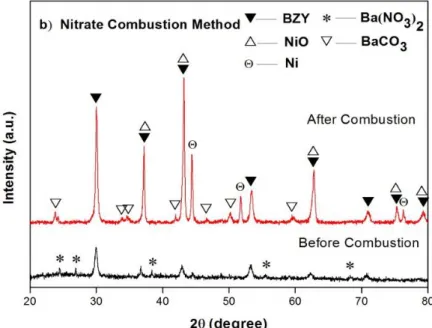
combustion by the novel acetate combustion method (b) XRD patterns of Ni-BZY cermet anodes before and after combustion by a typical nitrate/glycine combustion method...40-41
Figure 3.2 - XRD patterns for NiO-BZY composite powders (40 vol% Ni-BZY) calcined
at 1000-1200 °C for 5h (Novel acetate combustion method)………… ……….42
Figure 3.3 - XRD patterns for NiO-BZY composite powders (40 vol% Ni-BZY) calcined
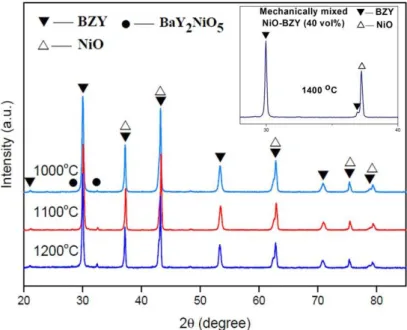
at 1000-1200 °C for 5h (Conventional nitrate combustion method). Inset: mechanically mixed BZY+NiO of the same composition fired at 1400 ºC, highlighting the absence of
BaY2NiO5 impurity…..………42
Figure 3.4 - XRD patterns for 40 vol% Ni-BZY composite powders (reduced at 700 °C for
6h under 10% H2/N2)…… ………..….44
Figure 3.5 - (a) SEM micrograph and (b) SEM-EDS elemental analysis of as-synthesized
40vol% Ni-BZY anode powder prepared by the novel acetate combustion route….…..…45
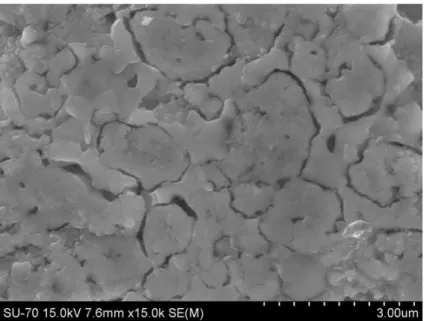
Figure 3.6 - SEM micrographs of 40 vol% Ni-BZY anode pellets formed by the novel
acetate combustion route (a) before and (b) after reduction compared to that of (c) the analogue prepared by the traditional nitrate method after reduction……….………….46-47
vi
Figure 3.7 - SEM-EDS elemental analysis of 40 vol% Ni-BZY anode pellets formed by
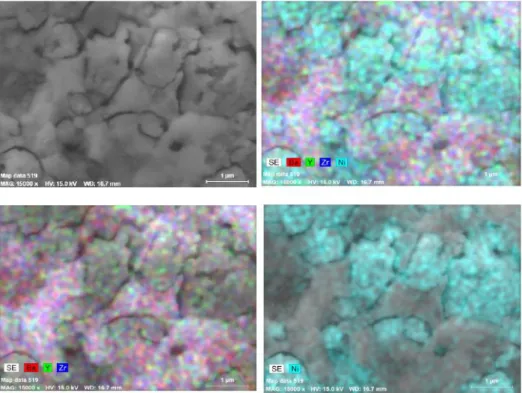
the novel acetate combustion route………..………48
Figure 3.8 - Arrhenius plots of Ni-BZY anodes formed by the acetate combustion method
under wet (empty symbols) and dry (filled symbols) 10% H2/N2………49
Figure 3.9 - SEM micrograph of anode/electrolyte interface formed by the novel acetate
combustion route………..49
Figure 3.10 - The electrochemical impedance spectra of a symmetrical cell with 40 vol%
Ni-BZY electrodes, measured in wet 10% H2/N2, as a function of temperature…….……50
Figure 3.11 - Comparison of polarization resistance (R2 and R3) with pH2 in wet reducing
atmosphereat 600 °C for both acetate- and nitrate-prepared cermets...52
Figure 3.12 - Comparison of total polarization resistance (Rp) with pH2 in wet reducing
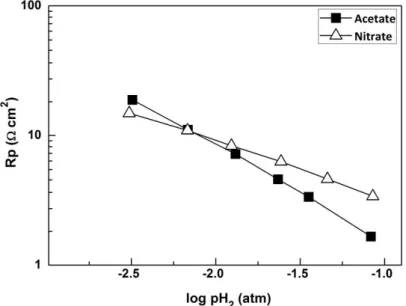
atmosphere at 600 °C for both acetate and nitrate...52
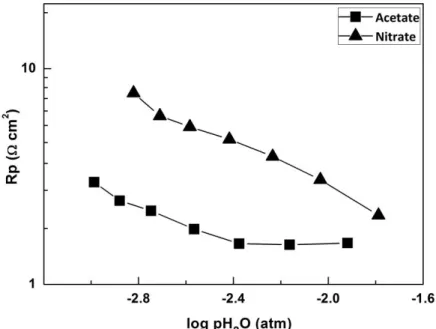
Figure 3.13 - Comparison of polarization resistance (R2 and R3) with pH2O in wet 10%
H2/N2 at 600 °C for acetate- and nitrate-prepared cermets...53
Figure 3.14 - Comparison of total polarization resistance (Rp) with pH2O in wet 10%
H2/N2 at 600 °C for acetate- and nitrate-prepared cermets...54
Figure 4.1 - XRD patterns of 40 vol% Ni-BZY cermet anode (a) as sintered and (b) after
reduction at 700 ºC for 8h in 10%H2/N2………..62
Figure 4.2 - SEM micrograph of 40 vol% Ni-BZY reduced cermet anode formed without
porogen………...………..64
Figure 4.3 - SEM micrographs of 40 vol% Ni-BZY reduced cermet anode formed with (a)
0 wt% starch, (b) 5 wt% starch, (c) 10 wt% starch and (d) 20 wt% starch….……….…....64
Figure 4.4 - SEM micrographs of (a) electrolyte/anode interface and (b) SEM-EDS line
scan at electrolyte/anode interface………..….65
Figure 4.5 - The total conductivity of 40 vol% Ni–BZY (differing starch content) cermet
and electrolyte, measured in wet 10% H2/N2 gas atmosphere……….66
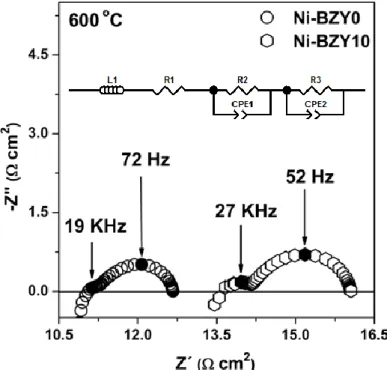
Figure 4.6 - The EIS spectrum of a symmetrical cell with 40 vol% Ni–BZY (0wt% and
10wt% starch) cermet anode, measured in wet 10% H2/N2 at 600 °C……….…………....68
Figure 4.7 - Temperature dependence of the total polarisation resistance, Rp, of Ni-BZY
cermet anodes (differing starch content) in wet 10% H2/N2………...………….69
Figure 4.8 - Variation of polarisation resistance (a) R2, (b) R3 and (c) total Rp with pH2
vii
Figure 4.9 - Variation of polarisation resistance (a) R2, (b) R3 and (c) total Rp with pH2O
in 10% H2/N2 at 600 °C for Ni-BZY cermet anode (with different starch content)…...72-73
Figure 4.10 - Inverse of polarisation resistance (1/R2, 1/R3 and 1/Rp) as a function of
porosity at 600 °C for Ni-BZY cermet anode……….……….74
Figure 5.1 - Redox cycling flow chart where one redox cycling consists of (a) the
re-oxidation step in air (b) N2 purging for 5 min and (c) the re-reduction step in 10% H2/N2
gas mixture...86
Figure 5.2 - XRD patterns for 40 vol% Ni-BZY cermet anode (a) as sintered (b) after
reduction for 6 h and (c) after re-oxidation for 4h……….……….….87
Figure 5.3 - SEM micrographs of cross-sectional anode/electrolyte interface (a) before
redox cycle, (b) after three redox cycles, (c) and (d) surface of the anode after 3rd redox cycling……….88-89
Figure 5.4 - ESEM micrographs of Ni-BZY anode (a) first reduced state, (b) re-oxidation
after 10 min, (c) re-oxidised anode after 120 mins (Ni volume expansion is clearly visible upon re-oxidation), (d) re-reduced after 10 min and (e) re-reduced anode after 180 mins..92
Figure 5.5 - The electrochemical impedance spectrum of a symmetrical cell with 40 vol%
Ni-BZY electrode, measured in wet 10% H2/N2 at 600 °C………..….….…..93
Figure 5.6 - The effect of redox cycling on impedance spectra for 40 vol% Ni-BZY cermet
anode measured in wet 10% H2/N2 at 600 ºC………..………….………94
Figure 5.7 - The effect of redox cycling on total polarization resistance (Rp) as a function
of temperature for 40 vol% Ni-BZY cermet anode measured in wet 10% H2/N2…………95
Figure 5.8 - The effect of redox cycling on (a) High frequency polarization resistance R2,
(b) low frequency polarization resistance R3 and (c) ohmic resistance Rohmic as a function of temperature for 40 vol% Ni-BZY cermet anode measured in wet 10% H2/N2 and
air………....96-97
Figure 5.9 - The percentage change in the high frequency polarization resistance, R2, the
low frequency polarization resistance, R3, and the ohmic resistance, Rohmic, as a function of redox cycling for 40 vol% Ni-BZY cermet anode measured at 600 ºC………...…98
Figure 6.1 - XRD patterns of (40 vol% Ni) (a) NiO-BZY and (b) NiO-BZO anodes…..105 Figure 6.2 - SEM micrographs and EDS chemical analyses of 40 vol% Ni-cermet anodes
(a) Ni-BZO, (b) Ni-BZY after complete reduction at 700 ºC in dry 10%H2/N2 gas mixtures
viii
Figure 6.3 - SEM micrographs of the electrode/electrolyte interface of reduced a)
Ni-BZO/BCZY and (b) Ni-BZY/BCZY assemblies………...………109
Figure 6.4 - The impedance spectra of (40 vol% Ni) Ni-BZO cermet anode, recorded at
600 °C in wet 10% H2/N2 gas mixture……….……….……….110
Figure 6.5 - Total polarisation resistance (Rp) for (40 vol% Ni) Ni-BZO and Ni-BZY
cermet anodes as a function of temperature in wet 10% H2/N2 gas mixture………….…112
Figure 6.6 - The impedance spectra of (40 vol% Ni) (a) Ni-BZO and (b) Ni-BZY cermet
anodes, recorded at 600 °C as a function of water vapour partial pressure (pH2O) measured
in reducing conditions………113
Figure 6.7 - Polarisation resistance (a) R2, R3 and (b) Rp of Ni-BZO & Ni-BZY as a
function of water vapour partial pressure (pH2O) in a reducing atmosphere at 600 °C....115
Figure 6.8 - Comparison of polarisation resistance (R2) of Ni-BZO and Ni-BZY anodes
and resistivity of BZO and BZY bulk samples with pH2O at 600 °C in reducing
atmospheres………....117
Figure 6.9 - The impedance spectra of (a) Ni-BZY and (b) Ni-BZO anodes, as a function
of pH2, measured in humid atmospheres at 600 °C respectively………...….117-118
Figure 6.10 - Polarisation resistance (a) R2, R3, R4 and (b) Rp of Ni-BZO and Ni-BZY as
a function of hydrogen partial pressure (pH2) in a humid atmosphere at 600 °C. In Figure
6.10(a), the thick line corresponds to fitting using equation 6.3 with stagnant layer thickness of 0.3mm, while the thin line corresponds to fitting using equation 6.5 with stagnant layer thickness of 1mm. Note stagnant layer thicknesses scale results vertically but do not have impact on gradient, eqs. 6.3 and 6.5……….119
Figure 6.11 - Impedance spectra recorded at 600 ºC in humidified 10% H2/N2 or He gas
mixtures (pH2O=0.032 atm) (inset-appearance of change in R4)………..121
Figure 7.1 - XRD patterns of anode, electrolyte and cathode powders……….130 Figure 7.2 - Scanning electron micrograph of (a) surface microstructure of electrolyte at
high magnification, (b) low magnification and (c) anode/electrolyte interface before fuel cell test……….………...131-132
Figure 7.3 - SEM-Energy dispersive X-ray spectroscopy (EDS) (a) elemental mapping and
(b) line scan of anode/electrolyte interface………..………..133
Figure 7.4 - Digital photos of (a) cathode and (b) anode view of the single cell before the
ix
Figure 7.5 - Scanning electron micrograph of Ni-BZY/BCZY44/Pr2NiO4+δ cell after
electrochemical fuel cell test………..134
Figure 7.6 - The I-V and power density curves of Ni-BZY/BCZY44/Pr2NiO4+δ single cell
at different temperatures under humid H2 (3%H2O)and dry air……….136
Figure 7.7 - Electrochemical Impedance Spectra (EIS) of Ni-BZY/BCZY44/Pr2NiO4+δ
single cell under open circuit conditions………..……….…….138
Figure 7.8 - The polarization resistance (Rp) and ohmic resistance (Rohmic) of the
Ni-BZY/BCZY44/Pr2NiO4+δ single cell at different temperatures under open circuit conditions
(determined from impedance measurements)………..…..139
Figure 7.9 - The total conductivity of thin BCZY44 electrolyte film measured as a
function of temperature under fuel cell testing conditions……….139
Figure 7.10 - The time dependent current density of a single cell under constant potential
of 0.7 V at 600 °C………...………140
Figure A.1 - A schematic representation of acetate-H2O2 combustion synthesis…….…154
Figure A.2 - XRD patterns of BaCe0.8-xZrxY0.2O3-δ (BCZY) (X = 0, 0.1, 0.4, 0.6 and 0.8
powders calcined at 1100 °C………..………156
Figure A.3 - XRD patterns of BaCe0.8-xZrxY0.2O3-δ (BCZY) (X = 0, 0.1, 0.4, 0.6 and 0.8)
powders calcined at 1350 °C………..157
Figure A.4 - XRD patterns of BCZY08 synthesized by both new acetate-H2O2 and
nitrate-glycine combustion powder calcined at 1400 °C……….……..158
Figure A.5 - FT-IR spectra of BCZY44 powder before and after combustion…….……161 Figure A.6 - Scanning electron micrographs of (a) as synthesized and (b) calcined at 1100
°C BCZY08 powder ( inset: as synthesized BCZY08 nanopowder)………....……162
Figure A.7 - Scanning electron micrographs of surface of BCZY pellets sintered at 1500
°C for 8h………...………...……...163
Figure A.8 - Example impedance spectra measured for BaCe0.8-xZrxY0.2O3-δ (x= 0.1, 0.4
and 0.6) materials under a wet N2 atmosphere at 180ºC, pH2O = 0.026 atm...….….165-166
Figure A.9 - The temperature dependence of the total conductivity for BaCe0.8-xZrxY0.2O3-δ
(x= 0.1, 0.4 and 0.6) materials under a wet N2 atmosphere, pH2O = 0.026 atm….……...167
Figure A.10a - The temperature dependence of the bulk conductivity for BaCe0.8-xZrx Y0.2
O3-δ (x= 0.1, 0.4 and 0.6) materials under a wet N2 atmosphere, pH2O = 0.026 atm…....169
x
BaCe0.8-xZrxY0.2O3-δ (x= 0.1, 0.4 and 0.6) materials under a wet N2 atmosphere, pH2O =
xi
List of Tables
Table 1.1 - Various types of fuel cells and its characteristics .……….…………5 Table 2.1 - Compositional porogen content corresponding to 40 vol% Ni-BZY cermet
anode…………..………...28
Table 4.1 - Total porosity of 40 vol% Ni-BZY cermet anodes with respect to porogen
content and solvent medium……….…63
Table 4.2 - The dependence of ohmic offset resistance, R1, on porosity………68 Table 6.1 - Activation energy of two cermet anodes in reducing atmospheres…...……..112 Table 7.1 - Electrochemical performance of anode supported PCFCs with different
electrolytes at 700 °C…..……….………..135
Table 7.2 - The representative data from I-V characteristic curves and power densities at
different temperatures……….……..…..138
Table A.1 - Lattice parameter and unit cell volume of BaCe8-xZrxY0.2O3-δ materials
synthesized by nitrate free acetate-H2O2 combustion method……….….………….159
Table A.2 - Grain size and relative density of BaCe8-xZrxY0.2O3-δ materials synthesized by
nitrate free acetate-H2O2 combustion method, isostatically pressed at 200MPa and sintered
at 1500 ºC for 8h……….….………..…………..…..164 Table A.3 - The activation energies and grain sizes of BaCe0.8-xZrxY0.2O3-δ (X = 0.1, 0.4, 0.6)
proton conductors. Activation energies are calculated for data in the low temperature range (<400 ºC)………...168
xii
List of Abbreviations and Symbols
ASR BaY2NiO5 Ba(NO3)2 BaCO3 BZO BZY CO2 EDS EIS H2O2 Ni OCV pO2 pH2 pH2O PCFCs Pr2NiO4 TPB R1 R2 R3 R4 Rp SOFCs SEM XRD YSZ
Area specific resistance Barium yttrium nickelate Barium nitrate
Barium carbonate Barium zirconate
Yttrium doped barium zirconate Carbon dioxide
Energy dispersive X-ray spectroscopy Electrochemical impedance spectroscopy Hydrogen peroxide
Nickel
Open circuit voltage Oxygen partial pressure Hydrogen partial pressure Water vapour partial pressure Protonic Ceramic Fuel Cells Praseodymium nickelate Three phase boundary length Ohmic resistance
High frequency polarization resistance Low frequency polarization resistance Lowest frequency polarization resistance Total polarization resistance
Solid Oxide Fuel Cells
Scanning electron microscopy X-ray diffraction
1
Chapter 1
Introduction to Protonic Ceramic Fuel Cells
Abstract
Fuel cells are promising green energy devices to directly convert chemical energy of a fuel to electrical energy, with high efficiency, and silently. This chapter describes an introduction to fuel cells, with predominant focus on Protonic Ceramic Fuel Cells (PCFCs). The types of fuel cells, their principle operation and the choice of materials for PCFCs are briefly presented.
2
1.1 Introduction and Historical background
There are growing concerns over the acceleration of global warming and the serious consequences of climate change that arise due to massive increases in carbon dioxide emissions from intensified production and consumption of fossil fuels. A diversified energy system with wider access to renewable energies as well as highly efficient clean technologies for the use of petrochemical resources must be developed to incrementally reduce our heavy reliance on fossil fuels [1]. So far, significant efforts have been devoted to the developments of sustainable energy harvesting technologies, such as wind energy, solar panels etc. Nonetheless, efficient solutions to store the energy produced by these sustainable sources are yet to be finalized. At present, hydrogen is one potential energy carrier that can be synthesized efficiently; however, technical barriers related to its storage and distribution have contributed to the resistance that hydrogen has encountered in becoming practically viable despite a high gravimetric energy density and zero carbon emission [2, 3]. However, it is widely recognized that the development and the widespread use of fuel cell (FC) technology will become a keystone in the near future in this type of chemical to electrical energy conversion.
Sir Humphrey Davy described the first fuel cell concept in the early18th century by observing the decomposition of water into hydrogen and oxygen with passage of current, a process now known as electrolysis. In 1839, Sir William Grove built the first hydrogen-oxygen fuel cell using liquid electrolytes based on the reverse electrolysis of water concept described by Davy. Grove’s “fuel cell” consisted of a zinc anode in sulphuric acid (liquid electrolyte) and a platinum cathode in nitric acid separated by a porous ceramic plate [4-6]. In 1899, Nernst investigated the electrical conduction of stabilized zirconia (ZrO2) (in this
case yttria (Y2O3) stabilized zirconia) showing it to be an insulator at room temperature but
to possess ionic conduction at higher temperatures (>600 °C) [4, 5]. After this discovery, yttria stabilized zirconia (YSZ) became the most widely used solid oxide electrolyte in fuel cell applications [5]. Since then, fuel cell technology received regular attention during the 19th century and this interest continues up to the present day. Recently the U.S department of energy (DOE) released a list documenting the main potential markets for fuel cell technology, these being stationary power (backup power or combined heat and
power-3
CHP), transportation power (Fuel cell electric vehicles and auxiliary power units) and portable power [4, 5, 7].
Several leading industrial companies (R&D investments) have successfully started commercializing the fuel cell technology. Some of the largest are, UTC Power (PureCell 400 system, based on phosphoric acid), Ballard power systems (FCgen, ClearGen), Hydrogenics corporation, Ceramic Fuel Cells, Australia., Siemens-Westinghouse, recently Bloom Energy, U.S., Panasonic, Japan and ENEOS CellTech, Japan [7].
A wide range of different fuel cells types have been developed that mainly differ from each other by the type of ionically conducting electrolyte and also their characteristic operation temperature range. On the other hand, common to all devices, are the major challenges of fabrication cost, efficiency and durability; factors that must be solved by choice of material and design engineering [8, 9].
1.2 Fuel Cells
Fuel cells are electrochemical devices that directly convert chemical energy into electrical energy with extremely high efficiencies. The basic structure of a fuel cell consists of an anode and a cathode separated by an electrolyte as shown in figure 1.1 [10]. The operating principle is similar to that of a battery, with the fundamental difference that in a fuel cell the chemical energy is provided by a fuel and an oxidant that are stored outside the cell, allowing fuel cell power generation as long as the reactants are supplied to the electrodes. Furthermore, compared with internal combustion engines, fuel cells produce lowered amounts of pollutants and allow large scalability, making the production of energy from mW to hundreds kW possible, while maintaining high efficiency; in other words, fuel cells can be used both for stationary and portable applications [3].
4
Figure 1.1 Schematic of a fuel cell comprised of an electrolyte, anode and a cathode [11]
1.2.1 Fuel cell types and its characteristics
The various types of fuel cells are generally classified on the basis of their electrolyte material, such as proton exchange membrane (PEMFC), molten carbonate (MCFC), solid oxide (SOFC) and phosphoric acid (PAFC) (table 1.1). Among them, SOFCs are very promising because they offer flexibility in terms of the type of fuel that can be used (e.g. hydrogen or hydrocarbons) and also do not contain corrosive liquids, as opposed to MCFCs for instance [11].
The majority of fuel cells being developed or used depends on the type of application. Generally, Proton Exchange Membrane Fuel Cells (PEMFC) are used for transportation power generation [12]; Direct Methanol Fuel Cells (DMFC) for portable power generation [13]; Alkaline fuel cells (AFC) for space program for producing electricity and drinking water for astronauts; Phosphoric Acid Fuel Cells (PAFC), Molten Carbonate Fuel Cells (MCFC) and Solid Oxide Fuel Cells (SOFC) [2, 14] for stationary power generation applications. Many other fuel cells are also being developed as some crossover of application for niche markets of the aforementioned fuel cells.
5
Table 1.1:Various types of fuel cells and its characteristics
Type Temperature °C Fuel Electrolyte Mobile Ion Efficiency polymer electrolyte membrane (PEM) & DMFC 70-110 H2, CH3OH Sulfonated polymers (H2O)nH+ 40% Alkali Fuel cell (AFC) 100-250 H2 Aqueous KOH OH -40% Phosphoric
acid fuel cell (PAFC) 150-250 H2 H3PO4 H+ 40% Molten carboante fuel cell (MCFC) 500-700 Hydrocarbons, CO (Na,K)2CO3 CO3 2-55-65% Solid oxide fuel cell (SOFC) 700-1000 Hydrocarbons, CO (Zr,Y)O2-δ O 2-55-65% Protonic ceramic fuel cell (PCFCs) 400-700 Hydrocarbons, methanol, ammonia, H2 BaCeO3 -BaZrO3 H + 55-65%
High power densities can be provided by alkali fuel cells but these are considered to be impractical for many applications because of the need to remove trace CO2 from both the
fuel and oxidant streams in order to prevent reaction of the electrolyte to form solid, non-conducting alkali carbonates [14]. The leading technologies in the early 1990s, phosphoric acid fuel cells, also have been largely abandoned due to their inability to reach high power densities, while molten carbonate fuel cells suffer from the difficulties of containing a corrosive liquid electrolyte [11]. In particular, dissolution of NiO at the cathode and its precipitation in the form of Ni at the anode can result in electrical shorts across the electrolyte in molten carbonate fuel cells and these can only be operated at higher temperatures and for stationary power generation. However, this short summary highlights that a wide range of fuel cells is being developed that each have their own merits and demerits [2, 3, 11].
6
1.2.2 Efficiency of fuel cells
Fuel cells are more efficient than combustion engines since these devices are not subject to the Carnot efficiency limit [4, 8, 9]. The efficiency of a fuel cell can be classified based on fuel cell type, temperature, fuel composition and its utilization. The overall cell efficiency can be defined as the ratio of electrical power produced divided by the Gibbs free energy change or the enthalpy change of electrochemical reaction [4]. In high temperature fuel cells (SOFCs), mainly ohmic, activation and concentration polarisation losses are important, detracting from overall efficiencies [4]. The theoretical Nernst voltage and cell voltage (V) to current density is shown in figure 1.2 [4].
Figure 1.2 Cell voltage vs current density curve for a typical high temperature fuel cell [4]
The actual voltage obtained during the cell operation with electronic load is slightly lower than the theoretical voltage (Nernst voltage) due to losses such as, ohmic (IR), activation Aln(i/i0), fuel crossover and internal current leakage Aln(in/i0), and mass transport or
concentration losses mexp(ni) [4]. The combination of all these losses can be written as
𝑉 = 𝐸 − 𝐼𝑅 − 𝐴 𝑙𝑛 (𝑖 + 𝑖𝑛
7
Where E- reversible OCV; I- the current density, A/cm2; R– area specific resistance (ASR), Ω/cm2, A– coefficient in natural logarithm form of Tafel equation, V; in– fuel
crossover current density, Ω/cm2; i0– exchange current density at an electrode/ electrolyte
interface, Ω/cm2
; m, n– constants in the mass-transfer overvoltage.
1.3 Protonic Ceramic Fuel Cells (PCFCs)
Solid oxide fuel cells (SOFCs) potentially offer a low-pollution technology to generate electricity electrochemically, with high efficiency, from alternative hydrogen or bio-derived fuel stocks [15]. Reducing the SOFC operating temperature to the 400-700°C range is desirable to reduce fabrication costs and improve longevity [11, 16]. This aim can be facilitated by the use of proton conducting oxides as the electrolyte membrane. SOFCs that contain a proton conducting ceramic electrolyte are called protonic ceramic fuel cells (PCFCs). These devices provide a further advantage in that they form water at the cathode, hence, the fuel does not become diluted during cell operation. PCFC is of substantial interest since it has considerably high system efficiency compared to other fuel cell systems with potential cogeneration because of high operating temperatures, the potential ability to work on both hydrogen and hydrocarbon fuels and negligible deterioration in performance over several years [2, 3, 15].
The major difference between the SOFC, and PCFC types of fuel cells is, therefore, the type of mobile species, either oxide-ions or protons, respectively, which in turn alter the side in which the steam is produced, the cathode in the PCFCs and at the anode in the O2--SOFCs [2, 3, 15, 17], Fig. 1.3. In PCFCs hydrogen is oxidized at the anode, to form protons that pass through the electrolyte while meeting at the three phase boundary (TPB). At the cathode, these protons react with oxygen to produce steam [18]. The formation of the steam in the cathode side of PCFCs avoids the dilution of fuel, fig. 1.3(b). Moreover, the use of proton conducting ceramic oxides as electrolyte materials may reduce the operating temperature of SOFCs since the activation energy for proton conduction is smaller than the typical activation energy for oxygen migration [2, 18]. However, the
8
formation of water in the cathode side of PCFCs has been documented to result in larger cathode polarization resistances [17].
Figure 1.3 The illustration of operating principle of (a) O2--SOFCs and (b) PCFCs [19]
1.3.1 Working Principle
A PCFC is an all solid-state system comprised of proton conducting solid electrolyte sandwiched between two porous electrodes (the anode and the cathode). The working principle of PCFC is illustrated in Figure 1.3(b). In PCFCs, the fuel (hydrogen or alternative hydrocarbons) is oxidised at anode side by creating protons and releasing electrons while oxygen (from air) is reduced at cathode side. The protons formed at anode side migrate through the electrolyte towards cathode side where the formation of water takes place by reacting with oxygen. The difference in the chemical potential of gases at the electrodes is responsible for the movement of the ionic species. However, the electrochemical reactions occur mainly at electrode/electrolyte interface, within a range of few micrometers into the electrodes from the electrolyte [8, 9]. This interfacial zone is termed as the functional layer while the remaining part of the electrode is primarily a current collector microstructure that should be porous to allow gas access to the functional layer [8, 9]. The electrolyte must be dense enough and gas tight to avoid the direct mixing of fuel and oxidant gases. In PCFCs, both the electrolyte and electrodes are composed
9
based on stable ceramic materials. The current density is obtained under cell operating conditions as long as the fuel and oxidant gases are provided to the cell. An open circuit voltage (OCV) of ~1 volt is attained when the cell is at unloaded state [4, 8, 9], defined by the Nernst potential [4], which is expressed as
𝐸 = 𝐸0 −𝑅𝑇
2𝐹ln [
𝑝𝐻2𝑂 𝑝𝐻2. √𝑝𝑂2
] (1.2)
Where, E = Nernst potential R = Universal gas constant T = Temperature
F = Faraday constant
pH2, hydrogen partial pressure
pH2O, water vapour partial pressure
pO2, oxygen partial pressure
As the maximum voltage of a single cell is close to 1V, in order several cells must be connected in series to form a so called fuel cell “stack” to obtain higher voltages for practical application purposes [5]. A stack can be defined as a set of cells; where each cell is separated by an interconnector, whereas, the fuel cell plant is designed based on the desired power in stacks, connected either in series or parallel [4, 8, 9].
1.3.2 Choice of materials for PCFCs
A PCFC is composed of two electrodes (the anode and the cathode) and a ceramic proton conducting solid electrolyte. Each and every component of the PCFC must be tailored to their specific function and, thus, must meet certain requirements [3, 5]. These are:
tolerable chemical and structural stability during the cell operation at high temperatures
suitable conductivity (ionic for the electrolyte and electronic or mixed electronic and ionic to function as an electrode).
10
proper percolation pathway between metallic and ceramic phase in anodes no inter-diffusion of elements between the cell component materials
should possess similar thermal expansion among the cell components, to avoid cracking during the fabrication and cell operation
gas tight and dense electrolyte to prevent gas mixing
porous electrodes to allow the gas transport near to the reaction sites good mechanical strength
In addition to the above criteria for PCFCs, the component materials must be of low cost, offer easy fabrication and should not affect the sequential fabrication processing upon addition of further cell components. The ceramic materials used for protonic ceramic fuel cells are described below.
1.3.2.1 Electrolytes
Proton conducting ceramic oxides are promising candidates as electrolytes for PCFCs at intermediate temperatures (400-700 °C) since in this temperature range they show larger ionic conductivities and smaller activation energies than conventional oxide-ion conducting electrolytes [18, 19]. The general formula of typical proton conducting perovskite oxides can be written as AB1-xRxO3-δ, where A and B represent the main
crystallographic cation sites, R represents an acceptor dopant and where δ is the oxygen deficiency per unit cell. The substitution of the acceptor R dopant in the B site serves to create oxygen vacancies, which are required for subsequent hydration and proton conduction. Fig. 1.4 shows the ABO3 perovskite structure. The cation B, which is usually a
transition metal or a rare earth, typically has a valency of +4 and forms a six-coordinated octahedron with its neighboring oxygen ions, being itself located in the centre. The cation, A which generally has a larger ionic radius than the cation B, presents a typical valency of +2, and possesses a coordination number of 12 [2].
11
Figure 1.4 Perovskite type crystal structure (ABO3), where the red and grey spheres are the cations
A and B respectively, and the blue spheres are the oxygen ions [2]
To date, acceptor doped barium cerate (BaCeO3) and barium zirconate (BaZrO3)
perovskite materials have dominated the research field of high temperature proton conductors. Although doped BaCeO3 materials exhibit the larger total conductivities, they
have been shown to be chemically unstable in H2O and CO2-containing atmospheres,
resulting in electrolyte degradation and difficult fuel cell deployment [3, 20, 21]. In contrast, acceptor doped BaZrO3 materials are regarded as potential candidates for
electrolytes in PCFCs as they show an excellent chemical stability against H2O and CO2,
as well as high bulk proton conductivity [2, 22, 23]. The bulk proton conductivity of BZY material is compared with other proton conducting and oxide-ion conducting materials, as shown in Fig. 1.5[18], highlighting its advantageous conductivity at intermediate temperatures. Owing to its high proton mobility and entropically stabilized protonic defects, even at high dopant concentrations (20% Y) and high solubility limit, this material is considered as a promising proton conductor for various applications including protonic ceramic fuel cells running on hydrogen, methane, ammonia and hydrazine [24, 25], and for hydrogen permeable separation membranes [15, 18].
12
Figure 1.5 Bulk conductivity of BaZr0.8Y0.2O3-δ compared with the proton conductivity of
BaCe0.9Y0.1O3-δ and the oxide ion conductivity of the best oxide ion conductors [18]
Nonetheless, the sinterability of BZY is notoriously poor, necessitating extremely high temperatures (~1600–1800 °C) to densify the BaZrO3-based electrolyte membranes.
Such high temperatures can lead to barium evaporation, which has been reported to reduce conductivity [23], while the difficult sintering also hinders grain growth causing a large grain boundary volume content to be present for BZY that limits total conductivity, due to the highly resistive nature of BZY grain boundaries to proton transport. Thus, improving the total conductivity of dense BZY membranes still remains a great challenge [2, 20]. Such elevated temperatures can also seriously complicate cell fabrication, by typical co-sintering techniques, due to elemental inter-diffusion between components [2, 17, 21-23, 26]. The most used strategy to overcome the BZY sintering problems is the use of transition metal oxides to promote densification [2, 20]. However, often it has been demonstrated that these sintering aids have a negative impact on the bulk BZY proton conductivity. Therefore, solving the BZY densification problem, without using sintering aids is still an ongoing goal for PCFC development and, thus, studies on high temperature
13
proton conducting electrolytes remain at the fundamental stage for use in PCFC applications.
The chemical stability of barium cerates can be increased by the introduction of zirconium (e.g. Ba(Ce,Zr)1-yYyO3-δ) [26, 27]. However, this advantage comes at the cost of
the level of total conductivity. Despite this limitation, it has been shown that upon adjustment of the Ce:Zr ratio, one can achieve a compromise between the achievement of chemical and mechanical stability, while still retaining adequate conductivity for practical application [26-28]. The introduction of 40% Ce into Zr site or vice versa improves the chemical stability of BaCeO3 and sinterability, while maintaining acceptable global proton
conductivity [28, 29]. In proton conducting oxides, conduction occurs by the formation of protonic defects. These defects form from the dissociation of water vapour into a hydroxide ion and proton [18], then this hydroxide ion occupies an available oxide ion vacancy in the crystal structure with the formation of a covalent bond between the proton and a lattice oxygen. In Kroger-Vink notation [18] this process can be expressed as
𝐻2𝑂 + 𝑉𝑂••+ 𝑂
𝑂𝑥 ↔ 2𝑂𝐻𝑂• (1.3)
The proton conducting perovskite oxides BaZr0.85Y0.15O3-δ (BZY15), BaCe0.7Zr0.1Y0.2O3-δ
(BCZY71) and BaCe0.4Zr0.4Y0.2O3-δ (BCZY44) are used as electrolytes in the present
thesis.
1.3.2.2 Cermet anodes
The state-of-the-art cermet anode for a PCFC currently mirrors that of anodes for oxide-ion conducting SOFC, being a composite material composed of nickel and a ceramic ionically conducting phase, patented by Spacil [30]. This type of cermet structure can successfully limit polarisation losses by maximising the three phase boundary length (TPB), by maximising the interface between the ionically-conducting, the electronically-conducting and the gaseous phases. For oxide-ion electronically-conducting SOFC anodes a large body of theoretical research exists to indicate that the electrode performance of such structures should increase as the microstructure becomes finer, as long as enough porosity is maintained to prevent gas phase limitations [31]. Thus, nanoscale control of SOFC cermet
14
anode microstructure has become a hot topic. Nonetheless, nanostructuration is often shown to be incompatible with the additional anode requirements of high mechanical strength, sufficient gas phase diffusion, high ionic conductivity, carbon and sulphur tolerance and longevity [32]. These problems still plague oxide-ion conducting SOFC design and continue to hinder their implementation in the marketplace
In the case of PCFCs, the cermet material is formed between Ni and a ceramic proton conducting phase, such as the highly stable material yttrium doped barium zirconate (BZY). This thesis mainly deals with Ni-BZY cermets containing 60vol% proton conducting ceramic oxide (BZY) and 40vol% nickel, as a minimum requirement to obtain percolation in the anode. The existence of pores in the anode allows gas diffusion, while the reduced nickel provides electronic percolation paths and catalytic properties. The reason behind the selection of a cermet anode is the possibility to increase the number of electrochemically active reaction sites per nominal electrode area, an important characteristic of SOFC anodes in terms of microstructure [33]. However, it remains a very important and open topic to attain basic knowledge on PCFC anodes due to their current infancy. Such work is especially interesting since both nickel and BZY are protonic carriers in PCFC anode cermets, which can extend the three phase boundary length (TPB) over that which would possible in oxide-ion conducting SOFC anodes where ionic mobility is limited to solely the ceramic phase. Due to this feature, it is interesting to study if the level of proton conductivity offered by the ceramic oxide matrix can influence the electrochemical performance of these PCFC anodes, and, thus, to know if performance is limited when protonic transport in the matrix is insufficient. The possible kinetic steps involved in fuel (hydrogen) oxidation on nickel particles and a nickel cermet anode with a proton conducting phase is illustrated in Fig. 1.6 [21]. Here, it can be noted that the proton conducting phase can enhance the three phase boundary length (TPB) active sites through the transfer of protons (H+) to electrolyte [21]. Here the overall hydrogen oxidation reaction taking place at the anode can be expressed as
15
Figure 1.6 The mechanism of hydrogen oxidation at anode site (a) nickel and (b) nickel cermet-containing proton conducting oxide [21]
Preliminary experiments have studied Ni-CaZr0.95Y0.05O2.975 (CZY) and
Ni-SrZr0.95Y0.05O2.975 (Ni-SZY) cermet anodes for PCFCs prepared by similar methods, and
have suggested that the overall polarization resistance is sensitive to the level of proton conductivity in the ceramic-oxide phase [34]. The Ni-CZY anode was shown to produce a higher polarisation resistance than Ni-SZY cermet anode and this was suggested to be related to the higher proton conductivity of SrZr0.95Y0.05O2.975 with respect to
CaZr0.95Y0.05O2.975 [34]. Based on this knowledge, the best choice for the matrix material
may be that of the Ba-based perovskite materials, due to their superior proton conductivities. Nevertheless, cermet anodes that contain BaCeO3-based matrices may be
unsuitable for practical operation in alternative carbonaceous fuels, due to the instability of BaCeO3 in H2O and CO2 containing atmospheres [21, 26]. On the contrary, acceptor doped
BaZrO3-based materials demonstrate higher chemical stability in H2O and CO2 containing
atmospheres and, thus, may be more promising for use as anode cermet matrixes in these devices [2, 21].
The following PCFC cermet anodes have been formed with perovskite, matrix compositions, up to the present time, Ni-Ca(Zr,Y)O3-and Ni-Sr(Zr,Y)O3- [34],
Ni-Ba(Zr,Y)O3- , Ni-Ba(Ce,Y)O3- , Ni-SrCe0.9Yb0.1O3-δ [39],
NiO-16
BaZr0.8Y0.2O3- anodes with varying weight ratios of nickel to BZY and they found that
(50:50wt%) NiO-BZY composite anode shows the lower polarization resistance [35]. They also proved that the composite anode BaCe0.7Zr0.1Y0.2O3-NiO (50:50 weight ratio,
BCZY71-NiO) was unstable in CO2 and H2O containing atmospheres, due to the
decomposition of BCZY71 into carbonates and hydroxides, thus, being an anode matrix composition that is unsuitable for PCFCs. Another PCFC composite anode Ni-BaCe0.9Y0.1O2.95 of 40, 50 and 60 wt% Ni (36, 45 and 55 vol% Ni, respectively) was
studied by Zunic et al., a clear percolation pathways between Ni and BCY was observed [38], providing a typical metallic behaviour upon reduction. These authors proposed that 40wt% nickel anode is suitable for PCFCs due to offering the lowest polarisation resistance. Coors et al. thoroughly examined the microstructure of a dense Ni-BaCe0.2Zr0.6Y0.2O3-δ cermet anode containing 68wt% (~40 vol%) Ni. Their studies stated
that the porosity ~26% formed by the reduction of NiO to Ni in reducing atmospheres may be enough for PCFC functionality, with no extra pore former being required [41]. Essoumhi et al. studied the conductivity and electrochemical behaviour of a Ni-BCY cermet anode containing 35 and 45 vol% Ni using symmetrical cells and their findings stated that cermet containing 45 vol% Ni showed a low ASR value of 0.4 Ωcm2 at 600 °C [42]. The same researchers later studied the microstructure and conductivity of a 40 vol% Ni-BaCe0.9Y0.1O2.95 cermet anode using a gelled starch as a pore former and observed that
conductivity slightly decreased with increasing the porosity level [43]. Recently, Rainwater et al. reported a decrease in PCFC cell performance on increasing the anode porosity level in Ni-BaZr0.1Ce0.7Y0.1Yb0.1O3-δ (Ni-BZCYYb) anode supported based BZCYYb electrolyte
cells with a La0.6Sr0.4Co0.2Fe0.8O3-δ (LSCF) cathode[40]. The available literature, therefore,
shows that both porosity and anode cermet matrix composition, for any fixed metal/ceramic ratio, are important factors to be further understood with respect to their impact on anode performance.
The nickel cermet anode material is unstable under redox conditions due to volume expansion of Ni upon re-oxidation [44]. To minimize or avoid the problems with nickel, and improve the performance of the anode, a number of alternative materials have therefore, also been tested as electrodes in oxide-ion conducting SOFCs [21, 45-47]. The main groups are nickel alloys of Cu and Co. However, these materials have been shown to
17
be less effective electrocatalysts than nickel and are also unstable [45, 46]. Another major problem with nickel cermet anodes is carbon mitigation and sulphur poisoning when the cell is operating on hydrocarbon fuels, such as methane or biogas [46, 48]. In oxide-ion conducting SOFC this effect has been shown to be able to be supressed by modifying the anode surface with basic or alkali oxides [49] and a few studies have also stated that nickel anodes that contain barium based mixed or proton conducting perovskite can also withstand in sulphur and carbon containing atmospheres [50, 51]. Nonetheless, even for SOFC this area of study is in a preliminary stage and a detailed study is needed before plant operation for long term in alternative hydrocarbon fuels. For PCFCs, research on suitable anodes is in its infancy, even for operation in basic hydrogen fuel. This thesis, therefore, aims to provide a deep fundamental knowledge of PCFC Ni-cermet anodes for the first time.
1.3.2.3 Cathodes
The cathodes employed in oxide-ion conducting SOFCs such as La1-xSrxMnO3
(LSM), Sm0.5Sr0.5CoO3 (SSC) etc may not be compatible with PCFCs due to limited
availability of active sites, La, Zr and Sr interaction and inter diffusion between electrolyte and cathode materials [52, 53]. The chemical interaction between the materials leads to secondary phases, such as Sm2Zr2O7, BaCoO3 and La2Zr2O7 [52, 54]. Moreover, water is
formed at the cathode side and, thus, it has been suggested that it may be beneficial for the cathode to also possess some protonic conductivity along with electronic and oxide-ion conductivity [21]. Nonetheless, according to the bulk of literature studies, the most commonly suggested requirements for a PCFC cathode material should be the availability of mixed electronic and protonic conductivity to prolong the three phase boundary (TPB) length at the electrode/electrolyte interface to the whole cathode area [17, 21]. This aim can be achieved either by making a composite cathode via introduction of proton conducting phase into phase offering high electronic conductivity or to intrinsically modify a proton conductor to become mixed protonically and electronically conducting by introducing a multivalent element into its basic structure [17, 21, 52].
18
The most widely studied cathode materials so far for PCFC applications are rare earth doped nickelates (R2NiO4, R = Pr, Nd, rare earth elements) [55], Ba(Pr1-xGdx)O3-δ,
PrBaCuFeO5+x and the composite cathodes La0.6Sr0.4Co0.2Fe0.8O3/Ba(Zr0.1Ce0.7Y0.2)O3,
Sm0.5Sr0.5CoO3/BaCe0.8Sm0.2O2.9, and Ba0.5Sr0.5Co0.8Fe0.2O3/BaCe0.8Sm0.2O2.9 [2, 17].
Among all the homogeneous materials, the nickelate, Pr2NiO4, cathode has shown the
lowest overpotential losses [55-57]. For the composite cathodes, more compositional flexibility is available and phases offering high electronic conductivity are generally mixed together with well-known proton conducting oxides from the zirconate and cerate perovskite families to increase the performance of the cell. The applicability of a cathode material for PCFC is dependent on its conductivity, thermal expansion coefficient and chemical compatibility with electrolyte material. Platinum has also been used as cathode but is shown to degrade upon long time operation, to exhibit large overpotential losses and is also too expensive. It has been stated that the cathode may play a key role in the overall performance of PCFCs, due to the formation of water in the cathode side that can result in larger cathode polarization resistances [17]. The cathode reaction of a PCFC involves the simultaneous reduction of oxygen and formation of water given as [2, 17]
4𝑂𝐻𝑂• + 𝑂
2+ 4𝑒− → 2𝐻2𝑂 + 4𝑂𝑂𝑥 (1.5)
However, to date, the peak criteria for suitable mixed electronic and ionic (oxide-ion or protonic) conducting cathode materials has not yet been concluded for PCFC applications [17].
1.4 Scope of the thesis
Protonic Ceramic fuel cells (PCFCs) offer the benefit of efficient and low-polluting electricity generation with high fuel conversion. Over the past decade, rapid progress has been made in the materials and the technology of PCFCs. However, the current scientific community is facing the problems viz. the synthesis of phase pure materials, sinterability, stability in CO2 and water containing atmospheres, fabrication methods of proton
conducting materials and the selection of suitable electrodes. Hence the PCFC-technology is still in a pre-commercial state. The main aim of this thesis is to gain a fundamental knowledge on electrochemical behaviour of PCFC cermet anodes and to better understand
19
the effect of composition, hydrogen and water vapour partial pressures (pH2 and pH2O)
and microstructure on anode performance. A large focus has also been made on the attainment of anode phase purity and the impact of purity on resultant polarisation resistance.
Chapter 1 describes the introduction to fuel cells especially PCFCs, types of fuel cells, operating principle and the materials design. In chapter 2, the synthesis of materials and experimental design for microstructure and electrochemical measurements are described. A novel combustion route for anode fabrication, with resultant phase purity, percolation behaviour and electrochemical behaviour is described in chapter 3. Here, the emphasis on anode phase purity is highlighted by comparison of results with those of impure anodes prepared by traditional nitrate-based combustion routes. In chapter 4, the relation between porosity, pH2, pH2O and polarisation resistance is elaborated. Here the
effect of porosity on PCFC anode performance is shown to be contradictory to that required in oxide-ion conducting anode solid oxide fuel cells (O2--SOFCs). A detailed study on redox cycling behaviour of anodes under hydrogen and air atmospheres is described in chapter 5 using impedance spectroscopy supported by information provided from environmental scanning electron microscopy (ESEM) under operating conditions. The results demonstrate that back-bone of the proton conducting phase is sensitive towards degree of nickel re-oxidation and re-reduction steps with time due to Ni volume expansion on re-oxidation. In chapter 6, the importance of the inclusion of a proton conducting phase in PCFC cermet anodes on electrochemical behaviour is addressed. Comparison is made by employing a non-proton conducting phase and comparing results to a proton conducting phase from the same chemical family in cermet anodes and observation of the resultant reaction dynamics. The most difficult task in protonic ceramic fuel cells is the fabrication step, because of its high sintering temperature requirement. Thus, chapter 7 pronounces the successful fabrication of anode supported PCFC cell, scalability and their performance at intermediate temperatures. A detailed description of the problems while fabricating the cell is presented. The future aspects and prospective of PCFCs are briefly elaborated in chapter 8. Appendix (A) outlines a new synthesis route and subsequent electrical characterisation of the electrolyte material Ba(Ce1-xZrx)0.8Y0.2O3-
![Figure 1.1 Schematic of a fuel cell comprised of an electrolyte, anode and a cathode [11]](https://thumb-eu.123doks.com/thumbv2/123dok_br/15777003.1076602/26.892.172.745.129.391/figure-schematic-fuel-cell-comprised-electrolyte-anode-cathode.webp)
![Figure 1.2 Cell voltage vs current density curve for a typical high temperature fuel cell [4]](https://thumb-eu.123doks.com/thumbv2/123dok_br/15777003.1076602/28.892.212.706.438.804/figure-cell-voltage-current-density-curve-typical-temperature.webp)