Collaborative knowledge representation
processes and techniques to support
domain experts in conceptual modeling
Cristóvão Dinis Polido Sousa
Supervisor: Professor Doutor Antonio Lucas Soares
Programa Doutoral em Engenharia Informática
Faculdade de Engenharia da Universidade do Porto
Collaborative knowledge representation processes and
techniques to support domain experts in conceptual
modeling
Cristóvão Dinis Polido Sousa
Dissertation submitted to Faculdade de Engenharia da Universidade do Porto to obtain the degree of
Doctor Philosophy in Informatics Engineering
President: Professor Doutor Eugénio de Oliveira Referee: Professor Doutor Nuno Silva
Referee: Professora Doutora Rute Costa Referee: Professora Doutora Cristina Ribeiro
Abstract
This thesis is focused in designing the appropriate means to help domain experts produce a well-defined account of a shared understanding (i.e., precise and accurate domain representations), in order to promote knowledge management and facilitate knowledge sharing in networked environ-ments. This challenge implies developing, reusing and maintaining common interpretations of domain relevant information in a systematic way. This encloses specific knowledge acquisition and model abstraction problems, here tackled in a twofold perspective, establishing theoretical and practical connections to both terminology and knowledge representations, underpinned by a socio-semantic approach based on semiotic principles.
In particular, here are discussed the challenges related to fostering and supporting the domain experts involvement in collaborative knowledge representation processes, driven by conceptualisa-tion activities. The inherent (inter) subjectivity of the conceptualisaconceptualisa-tion and its outcomes, together with its informality are the reasons for being an overlooked research topic in the literature.
Conceptualisation activities, from the perspective of domain experts, should provide the ap-propriate artefacts to address conceptual representations as pragmatic artefacts, whose validity and value are time, context and situation dependent. For that, a Design Science Research methodology was followed. It aims towards the design and evaluation of the IT artefacts that could enable this informal and domain specialist oriented approach to the development of conceptual representa-tions. Accordingly, particular attention was given to the following issues:
• How to support conceptual relations elicitation? Relations elicitation revealed to be the ma-jor concern when performing conceptualisation activities, in particular if an informal per-spective is followed. Moreover, the employed relations in the construction of a conceptual representation influence to which extent it can be reused.
• How to enable the domain experts to bypass the initial difficulties of starting a conceptuali-sation?
• How to find a tradeoff between the conceptual relations commitment with the real-world and the domain experts vision? This is crucial to endow conceptual representations with an highly reusability degree.
To cope with that, an holistic approach was designed and accommodated into a conceptual-isation framework as an abstract artefact supporting conceptual representations construction in a 3-layered formalisation approach. At the end, the goal is to achieve computational and well-formed conceptual representations (i.e., compliant with a well-defined representation schema), without the need for domain experts to commit to any other formalism than those from their own technical field.
The conceptualisation framework and its constructs were implemented in a technological plat-form mediating the cycle of development and evaluation of the artefacts, following qualitative
evaluation methods combined with quantitative measures, built in a comprehensive action-research approach.
Finally, the results showed that the specialists performance in concept and conceptual relations elicitation could be improved with the processes discussed in this thesis, which contributes to a refreshing view for the scientific body of knowledge in the field of ontology engineering and conceptual modeling.
Keywords: Collaborative Conceptualisation Process. Conceptual Graphs. Conceptual Rela-tion ElicitaRela-tion. Conceptual RepresentaRela-tions. Competency QuesRela-tions. Domain Experts. Knowl-edge Representation.
Resumo
Esta tese foca-se no desenho dos meios adequados para auxiliar os especialistas de um determi-nado domínio na definição precisa e rigorosa de representações de um entendimento comum, a fim de promover a gestão do conhecimento e facilitar a partilha de conhecimentos em ambientes de rede. Este desafio implica o desenvolvimento, reutilização e manutenção de interpretações co-muns do conteúdo relevante do domínio, numa perspectiva sistemática, o que inclui problemas concretos de aquisição de conhecimento e representação de modelos de abstração aqui abordadas numa dupla perspectiva, estabelecendo ligações teóricas e práticas tanto para a terminologia como para a representação de conhecimento, apoiadas por uma abordagem sócio-semântica baseada em princípios da semiótica.
Em particular, são discutidos desafios relacionados com a promoção a apoio à participação dos especialistas nos processos colaborativos de representação do conhecimento, impulsionados pelas atividades de concetualização. Este é um tópico pouco abordado na literatura, dada a (inter) subjetividade inerente da concetualização e dos seus resultados, juntamente com a abordagem informal na produção dos mesmos.
As atividades de concetualização, a partir da perspectiva de especialistas, devem fornecer os artefatos apropriados para abordar representações conceptuais como artefatos pragmáticos, cuja validade e valor são dependentes do tempo, do contexto e situação. Para isso, foi seguida uma metodologia baseada em Design Science Research.
Esta metodologia visa apoiar todo o processo de investigação desde o desenho dos artefatos que visam apoiar os especialistas na representação de representações conceptuais até à sua avali-ação. Assim, foi dada especial atenção às seguintes questões:
• Como apoiar a elicitação de relações conceptuais? A elicitação de relações revelou ser a maior preocupação na realização das atividades inerentes à concetualização, em partic-ular quando é seguida uma perspectiva informal. Além disso, as relações empregues na construção de uma representação conceptual influenciam até que ponto esta pode ser reuti-lizada.
• Como permitir que os especialistas de domínio contornem as dificuldades associadas ao arranque de um processo de concetualização?
• Como encontrar um equilíbrio entre o compromisso das relações conceituais com o mundo real e a visão dos especialistas? Isto é fundamental para dotar as representações conceptuais de um elevado grau de reutilização.
Para fazer face a estes problemas, foi concebida uma abordagem holística, integrada num framework de concetualização como um artefato abstrato de suporte à construção de represen-tações conceptuais em 3 camadas de formalização. No final, o objetivo é conseguir represenrepresen-tações
conceptuais computacionais bem formadas (ou seja, compatíveis com um esquema de represen-tação bem definido), sem a necessidade de os especialistas se comprometerem com quaisquer outros formalismos que não os do seu próprio domínio técnico.
Esta framework e os seus elementos (e.g., sub-artefactos) foram implementadas numa ferra-menta que serviu de plataforma de suporte o ciclo de impleferra-mentação e avaliação dos artefatos, seguindo métodos de avaliação qualitativa, combinados com medidas quantitativas, e foram con-struídas com base numa abordagem de "Investigação-Ação".
Por fim, os resultados mostraram que o desempenho dos especialistas na elicitação de con-ceitos e relações conceptuais pode, efetivamente, ser melhorado com os processos discutidos nesta tese, contribuindo para o incremento da base de conhecimento científica na área da engenharia de ontologias e modelação conceitual.
Keywords: Processo de Concetualização Colaborativo. Grafos concetuais. Elicitação de Relações Conceptuais. Representações Conceptuais. Questões de Competência. Especialistas de Domínio. Representação de Conhecimento.
Acknowledgments
At the end of this painful route, I saw the light ... and there You were: my beloved family, my son and my wife, my unconditional friend (Carla) and my sweet Angels. You were the fundamental pilar, sustaining my emotions giving me faith towards the completion of this thesis. Indeed, it was the most important support I got.
Additionally I would like to give a special tanks to my advisor for his scientific guidance and support.
I must also include in this so personal part of the thesis a word of appreciation to all those who pushed me forward at INESC TEC and ESTGF, Polytechnic Institute of Porto.
Thank You God!
Cristóvão
“Never cut a tree down in the wintertime. Never make a negative decision in the low time. Never make your most important decisions when you are in your worst moods. Wait. Be patient. The storm will pass. The spring will come."
Robert Schuller
Contents
List of Figures xvii
List of Tables xix
List of Abbreviations xxi
1 Introduction 1
1.1 Background and motivation . . . 1
1.2 Application context and research implications . . . 3
1.3 Thesis statement . . . 4 1.3.1 Research question . . . 4 1.3.2 Hypothesis . . . 4 1.3.3 Objectives . . . 5 1.3.4 Thesis organisation . . . 6 I Theoretical Background 9 2 Knowledge organization and collaboration 11 2.1 Collaboration in Knowledge Representation . . . 11
2.1.1 Conceptualisation and the conceptualisation process . . . 13
2.2 Representing a common conceptualisation: requirements and constraints . . . 21
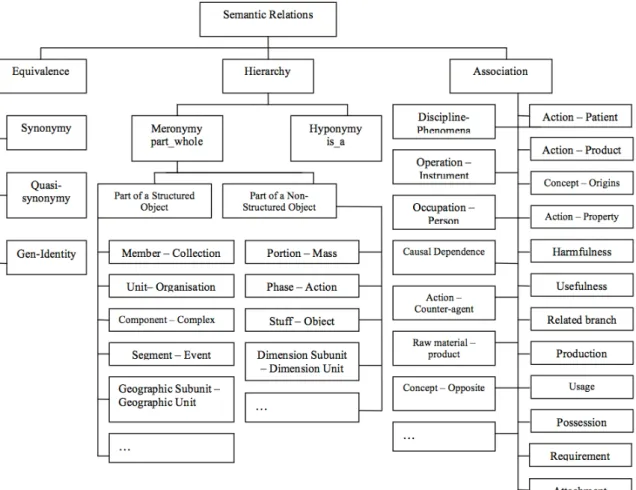
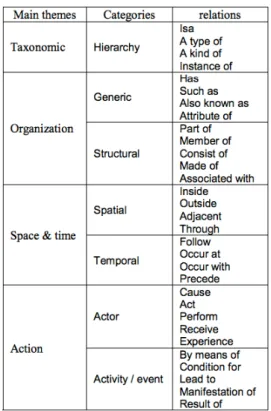
2.3 Approaches to conceptual relations definitions . . . 26
2.3.1 Artificial Intelligence perspective . . . 27
2.3.2 Information science perspective . . . 30
2.3.3 Semantic and lexical relations (linguistics perspective) . . . 35
2.3.4 Cognitive models (cognitive semantics perspective) . . . 42
2.3.5 Ontological perspective to conceptual relations elicitation . . . 47
3 Research design 55 3.1 Design science research overview . . . 55
3.2 Applying Design Science Research: overview . . . 57
3.2.1 Relevance and rigor . . . 59
3.3 Conclusion . . . 63
II Design and Implementation 65
4 Conceptual design of the research artefacts 67
4.1 ConceptME functional overview . . . 68
4.2 On supporting conceptual relations elicitation . . . 70
4.3 Conceptualisation framework (CF) . . . 78
4.4 Conceptual graph theory . . . 84
4.4.1 Conceptual graph model . . . 84
4.4.2 Conceptual graph formal definition . . . 88
4.4.3 CGs’ operations definitions . . . 90
4.5 Establishing the conceptualisation objectives . . . 98
4.5.1 Building conceptual representations based on competency questions . . . 99
4.6 Corpus-based elicitation of conceptual representations . . . 109
4.6.1 Illustrative Experiment . . . 111
4.7 Formalisation stack: Formalising semi-formal conceptual representations . . . . 113
4.7.1 Transforming semi-formal in formal knowledge representations . . . 114
4.8 Short Conclusion . . . 116
5 Build-to-reuse conceptual representations in ConceptME 119 5.1 Technological environment . . . 119
5.2 conceptME architecture . . . 120
5.2.1 Modeling conceptual graphs in conceptME . . . 125
5.2.2 Specifying Competency Questions . . . 126
III Evaluation and Case Studies 131 6 Research evaluation 133 6.1 Research evaluation approach . . . 133
6.2 Validation approach of the conceptual representations . . . 134
6.2.1 Utility Criterion . . . 134
6.2.2 Reusability criterion . . . 135
6.2.3 Illustrative example for measuring reusability . . . 138
6.3 Approach to the verification of the conceptual representations . . . 139
7 Case Studies 141 7.1 Case study I . . . 141
7.1.1 Description . . . 141
7.1.2 Method for the FORSYS KMS redesign . . . 142
7.1.3 Results and discussion . . . 149
7.1.4 Conclusions . . . 156
7.2 Case study II . . . 158
7.2.1 Description . . . 158
7.2.2 Research results . . . 159
7.3 Conclusion . . . 163
8 Conclusions and Future Work 165 8.1 Summary . . . 165
8.2 Research Findings and contributions . . . 165
8.3 Further research . . . 167
CONTENTS xiii
Index 179
A CRRM Ontology 179
B FORSYS Exploratory Survey 225
List of Figures
1.1 Thesis frame of concerns . . . 5
1.2 Thesis structure according to DSR . . . 6
2.1 Characterictics of KR artefacts according to different phases and levels . . . 12
2.2 Cognitive semantics model of meaning . . . 15
2.3 Analysis and synthesis for conceptualisation (Gomez et al., 2000) . . . 19
2.4 Colblend method (Pereira et al., 2013) . . . 21
2.5 CCP composition . . . 21
2.6 Conceptualisation dimensions . . . 25
2.7 Conceptual relations study context . . . 27
2.8 Classification of popular knowledge representation systems according to complex-ity in relational constructions (Peters and Weller, 2008) . . . 32
2.9 KOS and therapies they use (Stock, 2010) . . . 33
2.10 Semantic relations and specification (Petters and Weller, 2008) . . . 34
2.11 Classified Conceptual Relations (Elsayed,2009) . . . 35
2.12 Framework for semantic relations in the corpus (Shams et al., 2010) . . . 36
2.13 Semantic relations classification for KOS (Stock, 2010) . . . 37
2.14 Logical concept relations (Nuopponen, 2005) . . . 39
2.15 Ontological concept relations (Nuopponen, 2005) . . . 40
2.16 Concept relations of contiguity (Nuopponen, 2005) . . . 40
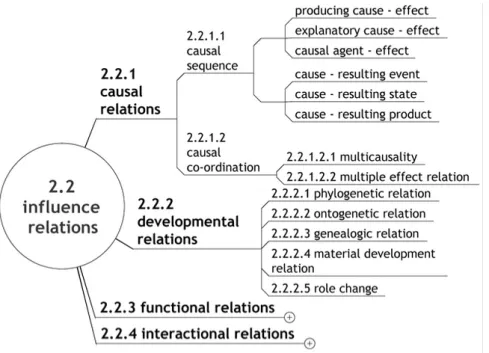
2.17 Influence relations (Nuopponen, 2005) . . . 41
2.18 Functional relations (Nuopponen, 2005) . . . 41
2.19 Inter actional relations (Nuopponen, 2005) . . . 42
2.20 Current relations in UML semantic network . . . 45
2.21 Ontological square sort of things. (Schneider, 2008) . . . 50
2.22 Fundamental Ontology Relations. (kless, 2011) . . . 51
2.23 Symbols for binary and ternary basic relations (Degen et al., 2001) . . . 52
3.1 Design Science Research cycles (Hevner et al. 2007) . . . 56
3.2 Followed design science research design . . . 57
3.3 Design evaluation framework (Helfert et al. 2012) . . . 58
3.4 Ensuring rigor through means-ends relations: overview . . . 59
3.5 Explicit shared conceptual representations . . . 60
3.6 Theoretical framework for design cycle: means-ends relations . . . 61
4.1 ConceptME functional overview . . . 68
4.2 CRRM conceptual view . . . 71
4.3 CRRM implementation in Protégé . . . 72
4.4 Conceptualisation framework (CF) . . . 78
4.5 Concept type hierarchy. An excerpt produced in H-KNOW1project . . . 85
4.6 Type of referent with examples, denoting the set of individual markers . . . 86
4.7 Relation type hierarchy (based on conceptual relations catalog) . . . 87
4.8 Typical conceptual graph (graphical representation) . . . 87
4.9 Typical conceptual graph (linear representation) . . . 88
4.10 Conceptual Graphs knowledge base . . . 89
4.11 Labelled bipartite directed graph . . . 90
4.12 CGs’ operations summary . . . 91
4.13 Simplify rule . . . 92
4.14 Typical concept restriction . . . 93
4.15 Concept restriction with referent . . . 93
4.16 Relation restriction (Note that H and H’ are equivalent . . . 93
4.17 Concept restriction (subsumption based on conceptual relations) . . . 94
4.18 Concept join (example) . . . 95
4.19 Derivation process of new graphs, from existing ones and supported by CG oper-ations . . . 96
4.20 Conceptual graph view of the CQ What/Which pattern . . . 101
4.21 CG representation of a CQ What/Which pattern considering the existence of a concept type hierarchy . . . 102
4.22 CG representation of a CQ What/Which pattern considering the absence of a con-cept type hierarchy . . . 102
4.23 CG representation of a second CQ What/Which pattern . . . 103
4.24 CG representation of CQ How pattern . . . 104
4.25 CG representation of Why CQ . . . 106
4.26 CG representation of CQ Where pattern 1 . . . 107
4.27 CG representation of a retrieved CQ Where query . . . 107
4.28 Ranking patterns . . . 111
4.29 Formalisation Stack . . . 113
4.30 Concept map as labelled direct graphs . . . 114
4.31 Labeled direct graph: edge definition . . . 115
5.1 Tehnical Environment . . . 120
5.2 ConceptME to Mediawiki metamodel . . . 121
5.3 ConceptME architecture . . . 122
5.4 ConceptME modeling layout . . . 124
5.5 conceptualisation project metamodel: the conceptME approach . . . 125
5.6 Property graph model (on the left) and CG DSL metamodel . . . 126
5.7 CQ prototype: query (claim) specification . . . 127
5.8 CQ prototype: semi-formal representation of a query (claim) . . . 128
6.1 Competency Question example . . . 134
6.2 Weight scale of uncategorized relations . . . 136
6.3 Weight scale of uncategorized term types . . . 138
6.4 SEON ontology example . . . 138
6.5 SEON ontology populated in CRRM . . . 139
7.1 Research method overview . . . 143
7.2 FORSYS property list . . . 145
LIST OF FIGURES xvii
7.4 conceptME to semantic mediawiki metamodel . . . 148
7.5 Extract of the final conceptual model after the second iteration . . . 155
7.6 Adopted action-research scheme . . . 158
7.7 Sub-set of CQ conceptual representations (concept map notation) . . . 160
7.8 Final conceptual representation . . . 161
7.9 Validating conceptual representation through competency questions . . . 162
List of Tables
2.1 The roles of the different conceptualisation dimensions . . . 24 2.2 Semantic relations catalog from (Khoo and Na, 2006) . . . 31 2.3 Common relation used in knowledge structures (Khoo and Na, 2006) . . . 32 2.4 Semantic relations in EuroWordNet (Madsen et al., 2001) . . . 43 2.5 Semantic relations in SIMPLE (Madsen et al., 2001) . . . 44 2.6 Cognitive models associated structure and relation type . . . 46
3.1 DSR: Evaluation processes and methods (Hevner et al., 2004) . . . 58 3.2 Contribution of semiotics to conceptual representations’s quality . . . 62
4.1 Load a conceptual representation in CRRM . . . 74 4.2 Inferred a conceptual representation with CRRM . . . 74 4.3 CRRM SRWL rules . . . 75 4.4 Transition criteria among the phases during the conceptualisation phases . . . 79 4.5 Collect and classify workflow . . . 80 4.6 Content-based Retrieval workflow . . . 81 4.7 Terminological extraction workflow . . . 81 4.8 Semantic Interlinking of domain terms workflow . . . 82 4.9 Identify and Select candidate terms workflow . . . 82 4.10 Conceptual Structures Representation workflow . . . 83 4.11 Conceptual Structures Consistency Check workflow . . . 83 4.12 CGs’ operations classifications . . . 96 4.13 Query type vs. query purpose vs. conceptual relation (CR) type . . . 100 4.14 Synthesis of CQ patterns and conceptual structure . . . 103
6.1 Example of the SPARQL result . . . 135 6.2 SEON ontology reusability metrics . . . 138
7.1 FORSYS - Reusability metrics of the final conceptual representation . . . 153 7.2 FORSYS - Reusability analysis of the initial conceptual representation . . . 153 7.3 FORSYS - Reusability analysis according to the domain experts answers . . . 154 7.4 Examples of the transformation of "has" conceptual relations . . . 155 7.5 Action and research goals and expected results . . . 157 7.6 Summary of the requirements (competency questions) validation . . . 161 7.7 Reusability metrics . . . 162
List of Abbreviations
BG Basic Conceptual Graphs CBT Conceptual Blending Theory
CCP Collaborative Conceptualisation Process CG Conceptual Graphs
CLC Conceptualisation Life Cycle CN Collaborative Network CP Conceptualisation Process CQ Competency Questions CR Conceptual Representation
CRRM Conceptual Relations Reference Model CS Conceptual Structure
DE Domain Experts DL Description Logic DSR Desig Science Research
FEUP Faculdade de Engenharia da Universidade do Porto FOL First Order Logic
KBS Knowledge-Based System
KOCS knowledge organisation and collaboration systems KOS Knowledge Organisation Systems
KR Knowledge Representation LO Lightweight Ontology OWL Ontology Web Language SG Simple Conceptual Graphs SWRL Semantic Web Rule Language UML Unified Modeling Language
Chapter 1
Introduction
1.1
Background and motivation
This thesis addresses the creation and reuse1of conceptual representations2, as mediator artefacts of a common domain understanding. The pragmatic nature and the heterogeneity of conceptual representations (models), as well as the social process of developing them are debated in this the-sis. Typically, conceptual representations can be used for information management and knowledge sharing purposes through the collaborative creation of knowledge organisation and collaboration systems (KOCS) (Pereira et al., 2013).
The process of developing such artefacts (conceptual representations) encloses semantic mod-eling activities. In fact, conceptual modelling, as a core activity of the information systems (IS) discipline (Frank, 1999) has been used to define what domain experts have in mind, in a twofold perspective: as a social function for understanding and communication purposes (Mylopoulos, 1992) and; as a content function, describing explicitly the structure of specific domain concepts. The development of high-quality conceptual modeling is of utmost importance (Wang and Weber, 2002) because it facilitates early detection of possible conceptual misalignment among all par-ties involved in what regards to the view of the domain. However and "despite the importance of conceptual modeling, (...) research evidence suggest that it is not done well. Practitioners report that conceptual modeling is difficult and that it often falls into disuse within their organi-zations" (Wand and Weber, 2002). Moreover, (Roussopoulos and Karagiannis, 2009) claimed that a number of problems remain to be solved (e.g., the real use and reutilisation of conceptual mod-els). Some research points to an ontology-based approach for conceptual modeling, arguing that it could improve the quality of information systems (Guarino and Guizzardi, 2006). Gulla (2007), argues that a conceptual model should meet the needs of the conflict between understanding and representation, in which understanding refers to the ability of the stakeholders to understand the
1To reuse encloses itself a semantic process, which implies the ability to find, select and adapt
2Conceptual representation is a semantic artefact, representing a semi-formal view, shared by a group of domain
experts, about the understanding of the relations between concepts and its resulting conceptual structures, within a particular context.
modeling language and the developed models, and representation refers to the capability of a modeling language to represent the most important aspects of a system.
The process of conceptual modeling often requires negotiation involving strong interaction between people and heavily mediated by representational artefacts. It is a complex and time-consuming process. Accordingly, in this thesis we put emphasis on knowledge acquisition and model abstraction in conceptual modeling, with particular focus on knowledge representation and organization, enhancing the development of knowledge representation artifacts for human under-standing. This is the understanding of conceptual knowledge representation followed in this thesis. In order to the domain experts (absent on knowledge representation skills) to be able to conceptu-alise their view about specific technical domains (for knowledge organization, domain modeling, etc.), they must be supported in the process of gathering and storing information about a specific reality - whose utility depends on how efficiently the knowledge could be retrieved and reused. Ad-ditionally, storing and retrieving information depends on the representation and organisation of the information. These knowledge-driven activities must be configured into collaborative conceptuali-sation processes with focus on human understanding and on informal representation schemas to be used in building semi-formal semantic artifacts (e.g., ontologies) - for information managements purposes. This semi-formal semantic artifacts, also called conceptual ontologies or lightweight on-tologies, beyond a means to organize information and promote knowledge management, it intends to support the management of knowledge-related activities (e.g. structuring, storing and retrieving information) more efficiently and effectively, allowing exchanging and sharing information se-mantics. Such artifacts (available as conceptual representations) provide organised interpretations of knowledge structures semantically enriched by means of collaborative activities, carried out according to a socio-semantic perspective in the development of tools for collaborative knowledge representation.
The construction of these modelling structures in a consistent way is a challenge, especially when it intends to follow an informal approach to represent conceptual structures (e.g, concept maps) and its later semi-automatic formalisation. As stated by (Kharatmal and Nagarjuna, 2010), an informal representation of conceptual structures is harder than it may look like and it is in this context that the importance of the conceptual relations arises.
The development of knowledge representation artefacts, such as conceptual representations, carries the challenge related to the proper definition, in short-term, of the concepts and relations, which are the basis of the information and knowledge architecture to be common to the collab-orative network (CN). In fact, the most difficult problem in a conceptualisation process is the elicitation of conceptual relations (Auger and Barriere, 2010; Elsayed, 2009). The problem has to be tackled from the double perspective of terminology and knowledge representation (with fo-cus on ontology development). However, knowledge representation and organisation activities enclose two main obstacles: (1) KR dynamicity - the represented knowledge structures are not static. A certain knowledge structure is only valid within a context and during a certain period of time; for these KRs should be easy to reuse, modify and update (Seufert and Seufert, 2000; Bhatt, 2000) and; (2) KR expressivity - typically, the more expressive a KR is, the easier and the more
1.2 Application context and research implications 3
compact it is to express a fact. However, more complex and ambiguous it could be (e.g. natural language). A tradeoff must be defined/achieved between KR expressiveness and the understanding about what it is intended to represent (Levesque and Brachman, 1987)
This research follows the vision that knowledge representation, while an applied discipline, has to address conceptual representations as designed, pragmatic and socially constructed artifacts whose validity and value are time, context and situation dependent. Yet, researching solutions (tools/processes) for these problems have been surprisingly scarce in the knowledge representation literature, more specifically in the ontology engineering area. This thesis, is based on collaborative conceptualisation tasks, focusing on a particular approach about the symbiosis between terminol-ogy and ontolterminol-ogy engineering to build shared conceptual knowledge representations, addressed at the conceptual level (understanding relations between terms) to foster a collective learning of the domain and reaching agreements about its representation.
1.2
Application context and research implications
Current research work applies to collaborative learning contexts, where groups of social actors (project teams, cross-functional teams, etc.), are structuring knowledge and information for creat-ing other semantic tools (thesaurus, taxonomies, ontologies, etc.) that can help the specification, maintenance and evolution of the structure of a knowledge management platform. This can be, for instance, a community of practice, a RDI project, etc. Additionally, it provides means to support the conceptual exploration and debate towards a common (shared) conceptualisation in collabora-tive networks.
The research results coming from this thesis, could streamline the process of achieving se-mantic agreements about different world-views, since it provides means to support the semi-automatically discovering of conceptual misalignments (e.g., match and merge operation) of the involved partners and aligning them to a common conceptual reference. The described ’build-to-reuse’ approach could be used during requirements elicitation and problem conceptualisation in the software engineering domain. This work may also contribute to assist domain experts to provide accurate inputs for the definition of formal constraints, during ontology development ac-tivities. Moreover, there can also be found applicability of the results of our research, in the joint conceptual modeling of enterprise architectures, allowing the generation and maintenance of updated organisational blueprints.
Beyond the scenarios where our research efforts could be welcome, with this work we intent to provide specific research contributions, namely:
1. to improve collaborative semantic processes (e.g. collaborative conceptualisations) intro-ducing new approaches to informally represent knowledge within groups of domain experts;
2. to provide inputs to improve storing and retrieval of graphical conceptual representations and, additionally;
3. to provide new approaches for the development of mechanisms to ease the negotiation phase, especially in the detection of conceptual misalignments and;
4. to provide means on how formal and informal representations could cohabit in IT artefacts, connecting the domain experts mental models to interoperable conceptual representations
1.3
Thesis statement
1.3.1 Research question
As mentioned earlier, this work is particularly focused on knowledge representation forms and activities grounded on conceptual modeling and tailored to collaborative environments, aiming at expressing the contents of the shared knowledge models (conceptual models). Those activities, compounded into semantic collaborative processes, are a key conceptualisation add-on for the collaborative construction of knowledge organisation systems. Given the focus of this work, the research question is posed as follows:
How to provide the adequate support for a group of actors collaboratively building conceptual representation (e.g. a semi-formal ontology) in terms of terminological and knowledge representation aids for identifying the relevant conceptual structures (concepts and conceptual relations) of the domains involved?
This research will also address the following research sub-questions:
(1) How to achieve a set of basic conceptual structures and identify its main com-ponents, in such a way that it can be used as a guideline (or schema) to represent and organise a domain knowledge? (2) And, how to systematize its reuse?
1.3.2 Hypothesis
With the current research work our intention is to prove that:
1. The use of semantic artifacts in (inter) organisational contexts follows some patterns3 that can be organized and structured towards its reusability, in order to support the creation of either individual or shared conceptualisation proposals.
2. Eliciting, interpreting and organizing expert knowledge (model conceptualisation) is an it-erative process of the conceptual structures under development requiring informal represen-tation schemas and mediated by the components specified in 1.
3. There is an identifiable tradeoff between informal and formal knowledge representation needs, which could be systematized in order to allow domain experts to efficiently store and retrieve basic structures of knowledge.
3This view of pattern encloses the successful approach and series of actions used for expressing basic structures of
1.3 Thesis statement 5
1.3.3 Objectives
Aiming at expressing the contents of the shared knowledge models (conceptual models), involving the identification of relevant domain conceptual structures (concepts and their relationships), the specific objective surrounding this work, is:
1. To define artefacts (semantic processes and tools) to foster the joint construction of explicit representations of common conceptualisations, expressing concepts and conceptual rela-tions using the appropriate terms, in an environment that brings together experts and users, and without a particular commitment to a specific KR formalism.
More specifically, we aim at developing "conceptualization assets library" (CAL), as a repos-itory of artefacts necessary to support the creation, re(use) and retrieval of shared conceptual rep-resentations. Domain experts could use such repository, hosted in a collaborative modeling tool under development, during their conceptualisation activities. Thus, the intention is to:
1. Define a catalog of basic conceptual relations and based on this, develop a set of templates to assist the conceptual relations elicitation during conceptualisation activities.
2. Provide methods and tools to help domain specialists to continuously align the knowledge models under construction and the texts on a certain domain. (Defining a set of terminolog-ically based mechanisms to assist users with the creation of conceptual representations in conceptual modeling tasks introduces some precision to informal knowledge representation approaches, such as concept maps.)
3. Develop a model of mapping informal conceptual representations and formal KR schemas.
4. Develop a process for systematic analysis of the conceptual relations well- formedness in order the evaluate a conceptual representation reusabilit
Figure 1.1: Thesis frame of concerns
Figure 1.1 synthesizes the aims (concerns) reported in this section and envisages how they could be accomplished. This "frame of concerns" will guide all this thesis development. So,
considering that the final conceptualisation result should be developed by domain experts and characterized as explicit, shared and reusable conceptual representations, a 3-layered knowledge representation approach should be considered. In the top layer, domain experts define the con-ceptualization scope in a semi-informal way using competency questions. The middle layer is concerned about the organization of the concepts and relations between concepts in a semi-formal manner. The bottom layer is concerned to the semi-automatic transformation of the developed models in formal conceptual graphs.
1.3.4 Thesis organisation
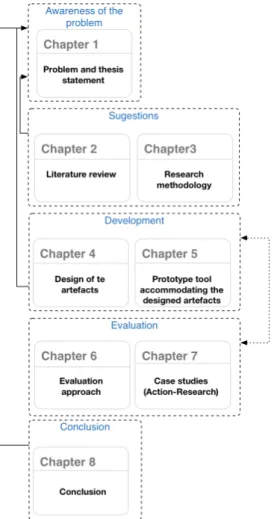
This thesis was structured according to Design Science Research (DSR) (Hevner et al., 2004). DSR is often presented as a relatively new approach within the Information Systems discipline, which offers a general process and specific guidelines for evaluation and iteration within research projects. The five steps outlined in the methodology from Takeda et al. (1990), adapted to DSR form a natural way of presenting the structure of the development of this research. Accordingly, Figure 1.2 depicts the structure os this thesis according to a DSR view.
1.3 Thesis statement 7
Chapter 1 Describes the context and the relevance of the research and the thesis statement. In the thesis statement the reader find the research question, the underlying hypothesis and the main research objectives.
Chapter 2 Encloses the literature review focused on the main knowledge areas evidenced by the research problem. The main discipline is "Collaborative Knowledge Representation", whereas the main concept is the "Conceptual Relations" concept. Thus, the mutidisciplinary challenge of collaborative conceptual representation is discussed as well as the conceptual relations elicitation phenomena.
Chapter 3 Presents the research design approach including the research process description, in particular, how the development of the research artefacts will be conducted and how to validate them (i.e., which cases, experiences and methods).
Chapter 4 Describes the designed artefacts as the means to address the challenges posed in chap-ter 1. A comprehensive framework is presented to carry out the conceptualisation process towards the representation of "explicit shared conceptual representations". The framework has a double theoretical perspective combining terminological and knowledge representa-tions methods in order to foster the commitment of domain experts as the main knowledge modelers. Still in this chapter, a functional overview of the prototype tool is given, expecting the reader to better inform the reader on how the design artefacts will be used in practice.
Chapter 5 Describes the conceptME architecture and main features. conceptME is a technologi-cal platform built to accomodate the designed artefacts.
Chapter 6 Defines the evaluation approach followed in this thesis. to evaluate the artefacts, as the means to address the challenges posed in research problem, a qualitative approach was followed carrying out action-research studies. In addition, qualitative measures were defined to asses the results of the case studies, i.e., the conceptual representations.
Chapter 7 Describes two case studies and discusses the results.
Chapter 8 Concludes this thesis with some final remarks. Additionally, further research is for the near future is presented.
Part I
Theoretical Background
Chapter 2
Knowledge organization and
collaboration
The current thesis proposal follows, by definition, a multidisciplinary approach and the theoreti-cal background focus the construction of conceptual representations in different scientific areas. Through this chapter it is intended to frame the research efforts in the field of collaborative and knowledge representation. Furthermore, and taking as assumption the fact that the activities under-lying the development of conceptual representations are tied to conceptualization processes, the notion of conceptualization is explored and the process decomposed into its basic components. Moreover, it is argued about the different dimensions inherent to a collaborative conceptualiza-tion process. By its turn, the result of a collaborative conceptualisaconceptualiza-tion process is semi-formal conceptual representations, whose major challenge is related to the way concepts are interlinked. Following this, a study about available approaches on conceptual relations definition was carried out. The study was elaborated considering several scientific areas. Again, the option on explor-ing different domains was important to understand the possibility of accommodatexplor-ing informal and formal approaches in the creation of shared conceptual representations, gathering clues on how to provide the best support to the reuse and retrieval of such artefacts.
2.1
Collaboration in Knowledge Representation
At its basis, knowledge representation, apart from its foundations - whether philosophical or com-putational - aims at explicitly represent (organise) the objects, its attributes and the relationships between objects from a specific domain, in a transparent, accessible and (some) computable way. The concerns about KR, independently from its foundation, have been occupied researchers from several areas, either from AI, cognitive science or information science. Despite of the purposes or employed methods, the issues related to expressing knowledge representations are similar. Within AI, the following characteristics of knowledge representation are commonly accepted: i) rep-resentational adequacy; ii) inferential adequacy; iii) inferential efficiency and; iv) acquisitional adequacy. Identically, cognitive science points out the following issues on KR artefacts (Siau and
Wang, 2007): i) ease of encoding; ii) expressive adequacy; iii) acquisitional adequacy; iv) inferen-tial adequacy and; v) the schema itself and the interpreter. Information science, by its turn, is more focused on how KR artefacts fit the purposes of information storing and retrieval and on how KR artefacts can reproduce commonly the real world concepts, allowing an easily connection/mapping between the user’s concept and its representation (Hodge, 2000).
However, it is not trivial to assure that the characteristics mentioned above are embraced when building knowledge representation artefacts. KR concerns are in two levels:
1. At the content level, and
2. At the level of the form.
The content (the knowledge itself) is: (1) dynamic, since it is created in social interactions amongst individuals and organisations; (2) context-specific, as it depends on a particular time and space; and (3) it depends on the epistemological framework of the individuals (Seufert and Seufert, 2000). The form, by its turn, is related to KR formalism, which determines, considerably, the KR expressiveness (Levesque and Brachman, 1987; Martin et al., 2002; Martin, 2003), and, consequently, the understanding about what is intended to represent.
Considering that, independently from the method used for knowledge representation, three main phases for knowledge representation could be identified, such as: (i) acquisition; (ii) organ-isation/structuring and; (iii) share and reuse; a cross check could be made regarding the phases, characteristics and the KR levels.
Figure 2.1: Characterictics of KR artefacts according to different phases and levels
As shown in the above figure 2.1, the characteristics inherent to KR artefacts relate to different phases and levels. Although this research work is particularly concerned about the possible meth-ods or models to support the creation of KR artefacts according to a collaborative KR approach, the way knowledge is organised, influences the extent to which it is reusable. It is, after all, an iterative process.
It is our view that Knowledge representation, while applied discipline, has to address concep-tual representations as designed, pragmatic artefacts whose validity and value is time, context and
2.1 Collaboration in Knowledge Representation 13
situation dependent. In fact, in several application areas (e.g., domain engineering or terminol-ogy work), conceptual representations (or conceptual modelling) need to be created and recreated, used and reused, decomposed and synthesised and eventually disposed of, according to specific needs.
As for FOLDOC1in which: "Choosing a conceptualisation is the first stage of knowledge rep-resentation." and following (Gomez-Perez, 2004) for whom conceptualisation is "the first stage of the knowledge engineering cycle", we consider conceptualisation as the cornerstone of knowledge representation. We follow the stance that conceptualisation phenomenon constitutes a collabora-tive instrument to support the knowledge representation by means of conceptual models.
2.1.1 Conceptualisation and the conceptualisation process
2.1.1.1 The notion of conceptualisation
The process of identification of a problem or an idea and its explanation or formulation is an old issue, which has gained a new outline mainly driven by the increased complexity of the system of human activities. Roughly, the decomposition of one or more ideas into its concepts to draw up a clarified user representation over a subject, is generically called conceptualisation. Currently, the new challenges related to the new work environments, increasingly complex and demanding, led to revisiting conceptualisation. The activities performed within organisations are knowledge-driven, seeking for better answers for problems and easy ways to identify new opportunities, enclosing “non-routine” problem solving tasks requiring convergent, divergent and creative thinking (Rein-hardt et al., 2011). In this context, conceptualisation assumes a new important role of supporting the knowledge-worker within collaborative organisations. Indeed, conceptualisation has been in-spiring several research studies in several disciplines (from information science to AI, knowledge engineering or cognitive science). In software engineering, conceptualisation is a software devel-opment life cycle phase from great importance. It tries to design a solution from all the information gathered in the analysis phase. "The conceptualisation phase includes the objects presumed or hy-pothesized to exist in the word and its relationships. Its goal is to structure the domain knowledge in a conceptual model that describes the problem and its solution in terms of the domain vocabu-lary." as it is summarized by (Gomez-Perez, 1996). Within the scope of knowledge engineering re-search, more specifically organisational knowledge creation models, summarized in (Waltz, 2003) and described by (Oinas-Kukkonen and Oinas, 2001), and which aim at conducting organizational learning, conceptualisation is viewed as a key central role. It is considered a "collective reflection process articulating tacit knowledge to form explicit concepts and systemizing the concepts into a knowledge system (Oinas-Kukkonen and Oinas, 2001); or in other words, it aims at “structuring meaningful relationships of entities and events in time and space" (Waltz, 2003).
Cognitive semantics - for example - view the construction of meaning in terms of conceptual-isation (Evans et al., 2007). Additionally, Kuhn (2004) states: "Probably the single most impor-tant idea from cognitive science to exploit for information modeling is that of conceptualization"
(Kuhn, 2004). He continues, referring Langacker position about conceptualization in which he states as being: "the cognitive activity constituting our apprehension of the world". Still, the re-lation between cognitive semantics and conceptualization is better understood by considering the four principles that collectively characterize a cognitive semantics approach (Evans and Green, 2006):
1. The conceptual structure is embodied: The nature of conceptual organization arises from bodily experience, in other words, cognitive semanticists set out to explore the nature of hu-man interaction with an awareness of the external world, and to build a theory of conceptual structure that is consonant with the ways in which we experience the world;
2. The semantic structure is equivalent to the conceptual structure: Semantic structure (the meanings conventionally associated with words and other linguistic units) is equated with concepts;
3. Meaning representation is encyclopedic: this means that words do not represent neatly pack-aged bundles of meaning (the dictionary view), but serve as ‘points of access’ to vast repos-itories of knowledge relating to a particular concept or conceptual domain;
4. Meaning construction is conceptualization: the language itself does not encode meaning. Instead, as we have seen, words (and other linguistic units) are only ‘prompts’ for the con-struction of meaning. According to this view, meaning is constructed at the conceptual level: meaning construction is equated with conceptualization, a dynamic process where linguistic units serve as prompts for an array of conceptual operations and the recruitment of background knowledge.
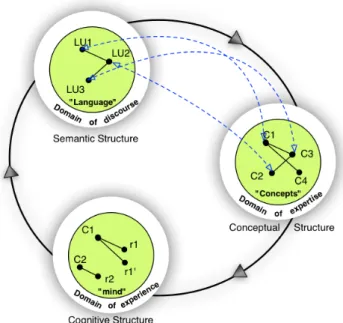
The figure (2.2) below depicts the model of meaning of cognitive semantics inspired by the previous principles.
To better understand the picture above read the labeling as follows:
• LU stands for Linguistic Unit;
• C stands for Concept and;
• r stands for rule;
Cognitive semantics studies language as a container and organiser of knowledge and comprises a model from three complementary domains:
1. Domain of discourse - the domain of discourse is created through discourse, which is con-sidered to include text, or more accurately, verbal expressions of a particular discussion between two or more parties, which are composed by linguistic units. The semantic repre-sentation associated with domain of discourse (language) give us the semantic structure of meaning or, by other words, the linguistic knowledge. This knowledge is highly schematic and provides a schematic structure necessary for conceptual representations as mentioned earlier.
2.1 Collaboration in Knowledge Representation 15
Figure 2.2: Cognitive semantics model of meaning
2. Domain of experience - It is related with the ever-changing mental models that both parties have of a particular discussion. The mental models are construed as modeling some object domain in the real word. They are directly dependent on or influenced by human experience and form the cognitive structure of meaning, which comprise the set of concepts and rules applied to explain and understand some phenomena
3. Domain of expertise - Here it is introduced the "know how" from very specific domains. It is about more rich conceptual structures. A rich conceptual structure is a representation of the structure of concepts, which belong to a specific subject field. It is related with rich aspects of perceptual and subjective experience.
Continuing on this approach to conceptualisation phenomenon grounded on cognition, (Barsa-lou, 2005) presents an interesting vision about conceptualisation and the way we think around concepts and represent them. For the author "conceptual representations are situated and contex-tualized dynamically to support courses of goal pursuit" (Barsalou, 2005). That means, concepts are not processed isolated “but are typically situated in background settings, events and introspec-tions” (Barsalou, 2009). These conceptual representations result from situated conceptualizations, made explicit through multi-modal simulations. This means we tend to think about a concept not only in what concerns to its properties but also regarding its functions, and so forth. In sum-mary, a “situated conceptualization is a pattern, namely, a complex configuration of multi-modal components that represent a familiar situation.” (Barsalou, 2009). Yet, the most common notion of conceptualisation is from Artificial Intelligence (AI) area, given by Genesereth and Nilsson (1987) as follows:
Conceptualisation contains the objects, concepts, and other entities that are as-sumed to exist in some area of interest and the relationships that hold among them. A conceptualisation is an abstract, simplified view of the world that we wish to represent for some purpose. Every knowledge base, based system, or knowledge-level agent is committed to some conceptualisation, explicitly or implicitly.
Still, the term conceptualisation appears frequently associated to ontologies. The notion above was in the base of Gruber’s ontology definition (Gruber, 1993):
"An ontology is an explicit specification of a conceptualisation." which was later redefined by Studer et al. (1998) as:
"An ontology is a formal and explicit specification of a shared conceptual-isation."
Yet, Guarino (1998) partially disagree to the previous definitions of ontology mainly due to the unclarity of the term conceptualisation. According to his view:
"An ontology is a logical theory accounting for the intended meaning of a for-mal vocabulary, i.e. its ontological commitment to a particular conceptualization of the world. The intended models of a logical language using such a vocabulary are constrained by its ontological commitment. An ontology indirectly reflects this commitment (and the underlying conceptualization) by approximating these intended models."
Whereas Guarino considers that an ontology refers to a restricted view of conceptualisation fo-cused on intended meaning, which depends on the types of relations between objects, (Genesereth and Nilsson, 1987) notion of conceptualisation refers to a particular state of affairs. But, none of the definitions addresses the dynamic aspects of conceptualisation (time and context). In this still current debate about ontology and conceptualisation notions, raises the issue of ontological commitment. Inspired on Gruber (1995) and Guarino (1998) an ontological commitment is the intentional agreement on the vocabulary used to describe a particular view of a domain ensuring its consistency/correctness but without aiming to its completeness. This ontological commitment could be seen as the ultimate expression of a conceptualization.
Conceptualisation is a broad and cross-disciplinary concept and our interest on exploiting this concept on the ontology engineering domain is due to the fact that, ontologies have been used as an approach for capturing the knowledge represented by information sources (from different sources and formats) widespread across a CN or even the Internet itself. However representing knowl-edge through ontologies usually requires domain experts to commit to some particular formalism, which could derail or at least delay the overall process of achieving a shared representation of con-cepts and relationships between concon-cepts. Unfortunately, is evident that "While different degrees of formalization have been well investigated and are now found in various ontology-based tech-nologies, the notion of a shared conceptualization is neither well-explored, nor well-understood,
2.1 Collaboration in Knowledge Representation 17
nor well-supported by most ontology engineering tools" (Staab, 2008). From this, this work refers to the term conceptualisation in a more pragmatic sense and not to its formal notion. Thus de-parting from Huang et al. (2010) view, which refers to conceptualisation as "the relevant informal knowledge one can extract and generalize from experience, observation, or introspection", and according to the literature review, it is considered the following conceptualisation definition: con-ceptualisation is built upon the concepts gathered from a particular area of interest, either from observation, experience, introspection or other information sources, and the relations established among them. The goal is to express, in a conceptual model, the structure of a knowledge domain "in terms of a specific vocabulary".
Continuing in an informal tone, we can say that a conceptualisation is the result of a "con-ceptualisation process" that leads to the extraction and generalization of relevant information from one’s experience (Huang et al., 2010). In fact, more than identifying the main constructs of a conceptualisation and the formal restrictions among them, current work is focused in conceptual-isation as a process for the collaborative construction of meaning through the discussion around concepts.
2.1.1.2 The conceptualisation process
In the literature, conceptualisation has been seen more as a phase or step than a process itself and even less from a collaborative perspective. Considering a typical knowledge management pro-cess - comprising knowledge acquisition, knowledge transformation, knowledge maintenance and knowledge transfer sub-processes - conceptualisation is within the process of knowledge transfor-mation (Waltz, 2003). SECI model, developed by Nonaka et al. (2000), describes an approach for creating and exchanging knowledge built upon a knowledge-conversion process, which contains four modes of conversion:
1. Tacit to knowledge - called socialization;
2. Tacit to explicit - called externalization;
3. Explicit to tacit - called internalization;
4. Explicit to explicit - called combination;
According to Waltz (2003), conceptualisation is the process that occurs for internal tacit knowledge, assisting its externalization by capturing human terms and explicit them as computable terms. Oinas-Kukkonen and Oinas (2001), inspired by the SECI model, goes a little further and advocates that conceptualization includes features both for externalization and combination.
Gómez et al. (2000), addresses conceptualisation as a process from a generic problem-solving point of view and framing it in the process of development of knowledge based systems (KBS). For the authors "human understanding of reality is determined by two interactive components":
a) The information gathered from the environment, either directly or indirectly - sensory com-ponent, and
b) The extraction from all the above information the relevant concepts for solving the problem at hand, their internal relations and the reasoning used to arrive at the right conclusions -conceptual component.
"So, conceptualisation is modeling by the problem solver. This modeling is represented by means of a conceptual model. This means that there are many ways of conceptualising, that is, many conceptual models for a problem." To the authors (Gómez et al., 2000), any conceptualiza-tion process must meet the following assumpconceptualiza-tions (rules):
1. Rule of evidence: Never accept anything as true which is not clearly and distinctly seen to be so. That is, take care not to act hastily or with prejudice, and admit only those judgements that appear to the mind so clearly and distinctly as not to aord the least doubt.
2. Rule of analysis: Divide each of the difficulties under examination into as many parts as possible.
3. Rule of synthesis: Order knowledge, beginning with the objects that are the simplest and easiest to know and so proceed, gradually, to knowledge of the more complex, also somehow ordering knowledge that is naturally devoid thereof.
4. Rule of proof: Always make lists and inspections that are exhaustive enough to assure that there are no omissions.
And is composed of a triplet: concepts, relations and functions respectively. Concepts are seen as the “mental building blocks used by human being to think. They are mental representation of things or experiences”. Relations by its turn, interlink concepts in an universe of discourse. Functions are “special cases of relations”. In other words, they are relationships that only exist between two specific concepts.
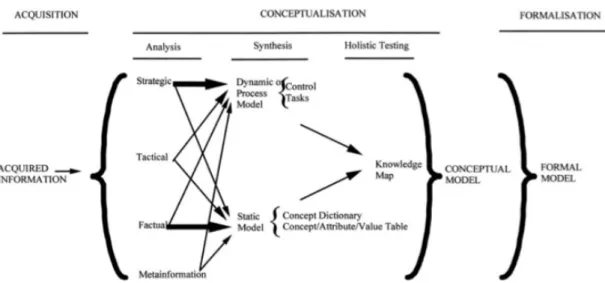
The conceptualisation process is then presented as follows:
Accordingly, "conceptualisation comes between knowledge-acquisition and formalisation [...]. Knowledge acquisition is the task of gathering the information required to build a KBS from any source [...]. This information is used during conceptualisation process to gain a clear under-standing of the structure and relationships within a particular system or problem. Formalisation expresses the conceptualised knowledge [...] as structures that can be used by the computer." (Gómez et al., 2000)
The depicted process (figure 2.3) contains three phases, each one generating intermediate rep-resentations of knowledge, either through organisation charts, petri nets, decision trees, term lists or others:
1. Analysis phase - Analysis phase - is an activity of searching, understanding and (problem) decomposition. It comprises three stages, for a knowledge engineer to understand all parts of the problem:
2.1 Collaboration in Knowledge Representation 19
Figure 2.3: Analysis and synthesis for conceptualisation (Gomez et al., 2000)
• Strategic information identification - "Identify the steps into which the task can be divided and the order thereof"
• Tactical information identification - "Identify what happens in each step identified in stage 1"
• Factual information identification - "Identify concepts, properties, relations and func-tions in the domain of the task performed by the expert"
2. Synthesis phase - activity for organising and inter-relate the knowledge gathered in a static and dynamic model.
• Static model - "Establish the domain structure and its components"
• Dynamic model - "Define the functions to be performed to solve the problem"
3. Holistic testing phase - it intends to globally "examinate the conceptualised knowledge in order to ensure its validity and completeness before it is implemented in a software sys-tem". This is addressed by building a knowledge map "which integrates the knowledge represented in the static and dynamic models. The objective is to be able to jointly validate the knowledge expressed in both models".
Within ontology engineering field, in all different methodologies for ontology design, widely summarized and discussed in Fernández-López and Gómez-Pérez (2002); Roussey (2005), the life cycle of an ontology development process is composed of several iterative steps or stages:
1. Ontology specification
2. Knowledge acquisition
4. Formalisation
5. Evaluation
6. Documentation
The goal of the conceptualisation stage is to detect, define and organise concepts (Roussey, 2005) or more generically to choose, define and structure the conceptual elements of the domain model (Omrane et al., 2011). It is considered the core task of ontology building. Across the pro-cess of building a semantic artefacts, such as an ontology, the focus of collaboration is at con-ceptualisation phase, this is where the discussion/negotiation activities are concentrated towards a common shared structure of a portion of a knowledge domain. Moreover, conceptualisation does not requires fully automated tasks (as it may happens when formalizing or gathering domain information) but, it asks for a continuous exercise of correlating the gathered information in earlier phases with the conceptual structure under construction, while interacting with the social network.
In this work, the central notion of "conceptualisation process" (CP) is adopted following Pereira et al. (2013). In relation to an individual, a conceptualisation process of a given piece of reality is a collection of ordered cognitive activities that has as inputs information and knowl-edge internally or externally accessible to the individual, and as the output an internal or external conceptual representation. Furthermore, a "collaborative conceptualisation process" (CCP) is a conceptualisation process that involves more than one individual producing an agreed conceptual representation. In addition to an individual CP, the CCP involves social activities that include the negotiation of meaning and practical management activities for the collaborative process. In this work "knowledge representation process" is also used to refer, in practical terms, to a CP.
On top of this conceptualisation notion runs the ColBlend method (Pereira et al., 2013). Col-Blend (see figure 2.4) was designed to support a collaborative conceptualisation process, based on conceptual blending theory (CBT) (Fauconnier and Turner, 1998). In practical terms ColBlend aims at supporting the co-construction of an agreed set of conceptual models, which could be translated into taxonomies, glossaries or ontologies. The method runs through a process involving explanation, discussion and negotiation.
In a synthesized way, the process comprises a set of virtual spaces: a) the input spaces -private to each party involved in the CP where the knowledge models proposals are built; b) the blend space - which contains the proposal resulting from the analysis of the input spaces and presented for discussion. Moreover it propose new concepts (originally not identified) from a global analysis of the current content of the spaces and; c) the generic space - which contains the common domain knowledge model composed by the all parts of the proposals that were accepted by all and "published" to this shared space.
2.2 Representing a common conceptualisation: requirements and constraints 21
Figure 2.4: Colblend method (Pereira et al., 2013)
2.2
Representing a common conceptualisation: requirements and
con-straints
The collaborative conceptualisation processes are at the basis of the approach discussed in this thesis, whose focus is on empowering the domain experts in the production of useful and reusable conceptual representations, from semi-informal representation schemas to its rigorous definition (in terms of well-defined computer-readable artifacts). Thus, it is important to uncover the col-laborative conceptualisation process and expose its main building blocks to better understand and define the needs for its effective utilisation.
The figure 2.5 depicts the composition of a collaborative conceptualisation process according to the notion provided earlier (see previous section).
Figure 2.5: CCP composition
The following elements compose the abstract representation of a typical CCP:
systematized according to its source: internally available ("tacit" and implicit knowledge), external available (explicit knowledge) and socially generated (see next item in the list).
2. Beyond individuals cognitive activities, CCP addresses social interactions that emerge from the collaborative nature of the overall process. Social interactions have here a twofold role, they might contribute to move a resource from an internal source to an external source or, on the other hand, to bring up new resources crucial for negotiation activities (Nonaka et al., 2000).
3. The negotiation ativities could be supported by means of different and external perspectives (argumentation-based strategies or decision support methods, etc.)(Pereira et al., 2012). Yet, CCP takes into account a negotiation baseline comprising discussions activities around con-cepts, by exchanging contextual-information (i.e., information considered as relevant to an understanding of the concepts) enriching developed conceptual structures2. Additionally, it comprises a process of calculating the similarity degree among conceptual structures, con-ducted by the users, enabling the merging of two or more conceptual structures.
4. The outcome, in this particular case, are conceptual models made explicit by means of enriched visual representations of conceptual structures.
From the disclosure of the CCP components, there is the need for mechanisms to deal with the inputs for the process (information and knowledge internally or externally accessible) once they are crucial to conduct the conceptualisation tasks (concept elicitation to concept discussion). The possibility of the existence of unreliable sources of knowledge together with the slowness of the process and complexity on building transferable knowledge representations, constitute the major knowledge acquisition “bottleneck” (Wagner, 2008). The knowledge representation based theories, cannot deal with the issue alone, terminology could play a key role in the shortening of these constraints, mainly as regards the analysis of the corpus domain. Globally, terminology is focused on terms and their use. Those terms, framed by a context, acquire a specific meaning (Pearson, 1998). In others words, terminology provides a set of mechanisms to analyse terms in contexts, enabling the conceptualisation activities of finding concepts designations more accu-rately, which could decrease the time-cycle of concept elicitation and increase the foundation of the concept. From this perspective, since a collaborative conceptualisation is developed around concepts, domain experts engaged in the collaborative process and terminologists focus on the same object. From the creation and organization of a domain corpus, through term extraction methods for concept elicitation, until specific approaches to disclose semantic similarities during the discussion of achieved conceptual structures, terminology is a promising add-on of the process of conceptualisation.
Considering the previous elements and inspired by the empirical studies conducted as part of ColBlend (Pereira et al., 2013), a small set containing the major building blocks or top-level
2Conceptual Structures are models (or artifacts) representing a perception of reality by means of diagrammatic
2.2 Representing a common conceptualisation: requirements and constraints 23
requirements are described. The following building blocks (B1 to B3 in the list below) are consid-ered fundamental for a collaborative elicitation of conceptual representations based on a corpus-based approach to be successful.
B1 - Terminological methods for corpus organisation : each organisation represents its con-ceptualisation proposal fed by a set of knowledge sources (such as URIs specifying docu-ments, webpages) shared by all parties. The use of textual resources should be preceded by a task where the aim is to organise the domain corpus. Having such a repository could enable a more efficient extraction of term candidates for the construction of the initial con-ceptualisation proposals (Aussenac-Gilles et al., 2000; McEnery and Wilson, 1996).
B2 - Basic top-level conceptual structures : it is taken as an assumption that the main concep-tualisation result is a less formal knowledge representation, which could be shaped into a shared conceptual model. One possible way of ensuring a common interpretation of the created conceptual models includes sharing a set of basic top-level conceptual structures and the meaning of their concepts and relations. Following a top- down approach on rep-resenting a domain knowledge, the process of creating conceptual structures could, among others, be based on patterns, which could be translated from text and from an ontological and synthesised perspective regarding its reuse potential. Gradually, these structures could be fine-tuned using term contexts and further negotiation activities.
B3 - Methods for analysing consistency in the conceptual structures : ensuring semantic con-sistency for conceptual structure interchange requires something more than just gathering conceptual structure patterns and defining a set of basic templates to be (re)used. If it is acceptable that templates could help create generic domain conceptual structures, inversely the specifics of a domain field enclose a set of particular details that typical top-level tem-plates may not consider. Some assistance should be given to the users in order to help them determine the meaning of each structure. This could be performed on one hand by attaching specific metadata to conceptual structures and, one the other hand, by implementing real-time mechanisms to validate the ontological compliance of the model under construction. Examples include suggestion mechanisms, either based on context analysis or on cross-checking the various models of the same domain.
In a synthesizing overview, the collaborative conceptualisation is a process of continuous con-struction of meaning, providing a framework (a common structure) on what are the main activities to support the development cycle of semantic artefacts that represent the shared knowledge of a specific domain context. Considering the literature, conceptualisation could be presented or framed within a three-dimensional view as depicted below (see figure 2.6).
Each of the three different axles in the figure, shows the roles associated to knowledge rep-resentation, socio-semantics and cognitive perspective, respectively, in the conceptualisation ac-tivities. The following table (table 2) provides the justification for the roles identified in figure 2.6.
Table 2.1: The roles of the different conceptualisation dimensions
Knowledge Socio Cognitive
Representation Semantics dimension
Ontological commitment rule
Conceptualisation in-tends to achieve an agreement on the vocab-ulary used to describe a particular view of a domain ensuring its consistency/correctness but without aiming its completeness
Interaction
and content
role
Conceptualisation is a process which involves social activities which leads to the development of semantically rich con-ceptual structures
Foundational role
The conceptual struc-tures emerge from bod-ily experience. Besides, its construction and in-terpretation depends on, or is influenced by life-time experiences and ac-quired expertise