Journal website: http://www.jfqhc.com
To cite: Carvalho M., Albano H., Teixeira P. (2018). In vitro antimicrobial activities of various essential oils against pathogenic and spoilage microorganisms. Journal of Food Quality and Hazards Control. 5: 41-48.
DOI: 10.29252/jfqhc.5.2.3
In Vitro Antimicrobial Activities of Various Essential Oils Against
Pathogenic and Spoilage Microorganisms
M. Carvalho, H. Albano, P. Teixeira
*Universidade Católica Portuguesa, CBQF - Centro de Biotecnologia e Química Fina – Laboratório Associado, Escola Superior de Biotec-nologia, Rua Arquiteto Lobão Vital 172, 4200-374 Porto, Portugal
HIGHLIGHTS
Gram-positive bacteria were more sensitive than Gram-negatives against our analyzed Essential Oils (EOs).
Yeasts were more sensitive than bacteria against our analyzed EOs.
Oregano and thyme EOs showed the highest antimicrobial activity. ABSTRACT
Background: Plant-derived Essential Oils (EOs) have shown remarkable antimicrobial
activity against spoilage and pathogenic microorganisms isolated from food products. The objective of the current study was to determine in vitro antimicrobial effects of selected EOs against these microorganisms.
Methods: Antimicrobial activity of EOs against food-borne and spoilage microorganisms
was screened by disk diffusion assay; then, the Minimum Inhibitory Concentration (MIC) and Minimal Bactericidal Concentration (MBC) were determined. Statistical analysis was done using SPSS 23.0 software for Windows.
Results: Oregano and thyme EOs showed the highest antimicrobial activity and the
low-est MICs, while anise, fennel, garlic, and ginger showed a lower activity with significant differences (p<0.05). It was demonstrated that Salmonella Typhimurium, Escherichia coli, Proteus mirabilis, and Yersinia enterocolitica were the most sensitive bacteria to all the EOs tested (p<0.05). Among Gram-positive bacteria, Listeria innocua was demon-strated to be the most sensitive to most of the EOs (p<0.05). Furthermore, Staphylococcus aureus and Listeria monocytogenes were shown to be more sensitive than Enterococcus spp. (p<0.05). Yeasts were significantly (p<0.05) more sensitive than bacteria and were inhibited by most of the EOs.
Conclusion: The use of the analyzed EOs may be interesting to food processors because
of their antimicrobial properties. However, it is necessary to test their use in food products and gauge their sensory implications.
© 2018, Shahid Sadoughi University of Medical Sciences. This is an open access article under the Creative Commons Attribution 4.0 International License.
Introduction
Plant-derived Essential Oils (EOs) are natural antimicrobials found in many plants and could be capable of decreasing growth as well as survival of some microorganisms (Calo et al., 2015). EOs in aromatic
*
Corresponding author. [email protected]
plants are among the most significant active compounds of herbs and spices (Krisch et al., 2010). Various biologi-cal characteristics, such as digestive, anti-inflammatory, sedative, antioxidant, antimicrobial, antiviral, and also cytotoxic activities have been attributed to the EOs (Bakkali et al., 2008; Burt, 2004). They are naturally occurring antimicrobials that have been shown to be Article type Original article Keywords Oils, Volatile Plants Anti-Bacterial Agents Food Microbiology Article history Received: 3 Mar 2018 Revised: 17 Apr 2018 Accepted: 29 Apr 2018
Acronyms and abbreviations
EO=Essential Oil
MIC=Minimum Inhibitory Con-centration
MBC=Minimal Bactericidal Con-centration
DDA=Disk Diffusion Assay
Journal website: http://www.jfqhc.com
42
effective against several microorganisms associated with several food products (Burt, 2004; Selim, 2010). EOs have been proposed as a viable alternative for application in food processing to avoid the use of traditional chemical additives (García-Diez et al., 2016; Ghabraie et al., 2016).
The differences in antimicrobial activity by different EOs are usually associated with their various chemical compositions that change according to seasons, geographical location of plants and/or the methodology used in EOs extraction (García-Diez et al., 2016; Kokkini et al., 1997). However, their antimicrobial activity may be attributed to their ability to penetrate through bacterial membranes and inhibit functional and lipophilic proper-ties of the cell (Burt, 2004; Calo et al., 2015; Trombetta et al., 2005).
In recent years, consumers demand minimally processed foods. The negative perception of consumers about chemical food additives makes natural methods of preservation and natural preservatives receiving in-creased attention by the food industry (García-Diez et al., 2016). Non-phytotoxic oils are safe as food additives and declared as “Generally Recognized As Safe” (GRAS), which increased consumer acceptability (Jayasen and Jo, 2013). However, application of EOs is limited by taste and odor impacts, especially when used at high concentrations (Ghabraie et al., 2016). In fact, the organoleptically acceptable concentration depends on individual EO, the specific food systems, the method of application, and food product cooking methods. Indeed, it would be changed when other compounds are added to the food, too. Therefore, it is necessary to determine their lowest concentration with acceptable sensorial level in order to use them in food without any changes in smell and taste (Turgis et al., 2012).
The aim of the current study was to determine in vitro antimicrobial activity of various EOs against selected pathogenic and spoilage microorganisms, aiming for a future utilization in the manufacture of some food products.
Materials and methods
EOs
Twenty-three plant EOs were used in this study, includ-ing anise (Pimpinella anisum), basil (Ocimum basilicum), bay (Laurus nobilis L.), cardamom (Elettaria cardamomum), and fennel (Foeniculum vulgare), kindly provided by FRULACT (Gemunde Maia, Portugal); car-rot (Daucus carcar-rot L.), cloves (Syzygium aromaticum), coriander (Coriandrum sativum), cumin (Cuminum cyminum), garlic (Allium sativum), juniper berry
(Juniperus communis), marjoram (Origanum majorana), nutmeg (Myristica fragrans), parsley (Petroselinum crispum), oregano (Origanum vulgare L.), rosemary (Rosmarinus officinalis), and sage (Salvia officinalis) kindly provided by Ventós Chemical (V., Barcelona, Spain); lemon (Citrus limon), garlic (Allium sativum), ginger (Zingiber officinale), oregano (Origanum vulgare) and thyme (Thymus vulgaris) by Casa das Essências (C.E., Oeiras, Portugal).
Microorganisms and growth conditions
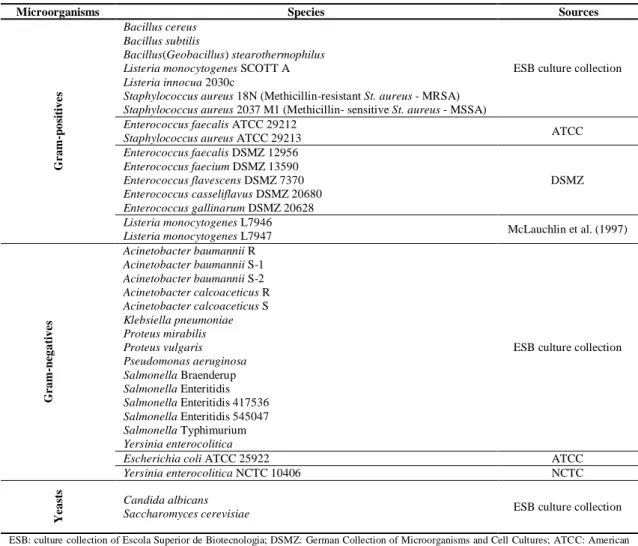
All strains used in this study (Table 1) were stored at -20 ºC in Tryptic Soy Broth (TSB; Pronadisa, Madrid, Spain) with 6 g/L of Yeast Extract (YE; Lab M, Bury, UK) containing 30% (v/v) glycerol (Sigma, Steinheim, Germany), and sub-cultured twice before use in assays. Each bacterial strain was grown on Tryptic Soy Agar (TSA, Pronadisa) with 6 g/L of YE (Lab M, Bury, UK) at 37 ºC for 24 h and yeasts in Yeast Malt Agar (YMA; Lab M, Bury, UK) at 25 ºC for 48 h.
Disk Diffusion Assay (DDA)
Each inoculum was prepared by resuspending isolated colonies of each strain, previously cultured on TSA+YE or YMA, in sterile Ringer solution (Lab M, Bury, UK) in order to obtain turbidity equivalent to 0.5 in McFarland scale (bioMérieux, Marcy-l'Etoile, France).
The antimicrobial impact of EOs was evaluated by the DDA as indicated by Zaika (1987), with some modifica-tions. Briefly, plates prepared with Mueller-Hinton Agar (MHA; Biokar, Beauvais, France), or YMA for yeasts were dried and 100 μl of standardized inoculum were uniformly spread. After that, sterilized filter paper disks (Whatman No. 5, 6 mm diameter) were applied to the surface of the seeded agar plates and 5 μl of each sterilized EO (0.22 m syringe filter) was applied to each disk. The plates were kept at 4 ºC for 2 h to allow disper-sion and incubated for 18 to 24 h at 37 ºC for all bacteria; also, the yeasts were incubated for 48 h at 25 ºC. The antimicrobial activity was visually evaluated as inhibition zone surrounding the disk and the disk diameter was measured in mm. Inhibition was only considered if the halos were greater than 10 mm, according to García-Díez et al. (2016). The DDA assay was carried out in triplicate.
Determination of Minimum Inhibitory Concentration (MIC) and Minimal Bactericidal Concentration (MBC) The MIC and MBC were studied only for all EOs that resulted in inhibition halos greater than 10 mm. The assay was based on the procedures described in CLSI (2012) using 96-wells microtiter plates. The dilutions of
Journal website: http://www.jfqhc.com
43 the EOs were provided according to the inhibitory profile
with the DDA (halos greater than 10 mm). EOs dilutions were prepared directly in the Mueller-Hinton Broth (MHB, Biokar, France) to achieve in the well each of the followings concentrations: 50, 25, 12.5, 6.25, 3.125, 1.56, 0.78, 0.39, 0.195, 0.0975, 0.0488, 0.0244, 0.0129, and 0.0060%. In each well, it was mixed 80 µl of MHB, 100 µl of each EO dilution, and 20 µl of standard suspension of each target microorganism (prepared in MHB to achieve a final cell density in each well of ca. 5 log colony forming unit/ml). Un-inoculated negative controls were included. The plates were covered, incubated for 24 h and then checked for visible growth (turbidity) in each well. The MIC was determined as the lowest concentra-tion of EO which prevented growth. To determine the MBC, 10 μl of each well, in which no microbial growth was seen, was spread into MHA and incubated for 24 h, as stated by García-Díez et al. (2016).
Statistical analysis
The comparison of the antimicrobial activity of EOs against each microorganism was carried out by one-way Analysis of Variance (ANOVA). The Tukey-Kramer test was used to determine the significant differences (p<0.05) among group means. Statistical analysis was done using SPSS 23.0 software for Windows.
Results
The data of the antimicrobial activity assessed by DDA showed that in general the antimicrobial activities of the different tested EOs were varied and dependent on the type of oil and type of microorganism (data not shown). In general, oregano from “Casa das Essências”: C.E. and oregano from “Ventós” Chemical: V. had the EOs that showed significantly (p<0.05) higher antimicrobial activity than the others. On the other hand, EOs of lemon, ginger, and anise were the ones that showed meaningfully (p<0.05) lower antimicrobial activity. It was demonstrated that S. Typhimurium, Escherichia coli, Proteus mirabilis, and Yersinia enterocolitica were the most sensitive bacteria to all the tested EOs (p<0.05). Among Gram-positive bacteria, L. innocua was demon-strated to be the most sensitive to most of the EOs (p<0.05). Furthermore, Staphylococcus aureus and also L. monocytogenes were shown to be more sensitive than Enterococcus spp. (p<0.05). Yeasts were significantly (p<0.05) more sensitive than bacteria and were inhibited by most of the EOs.
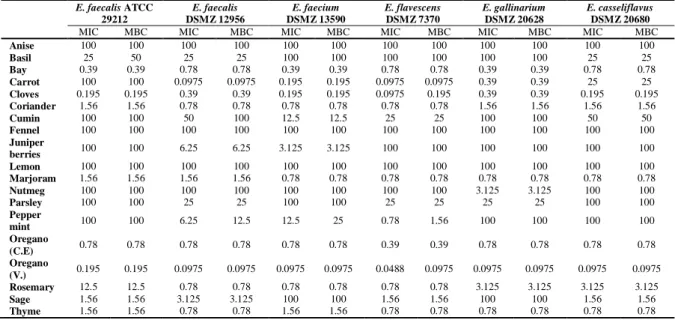
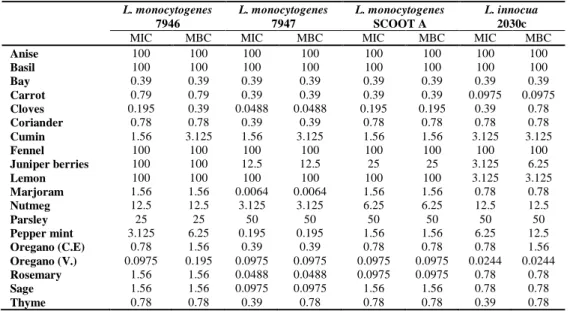
Results of MIC and MBC of the tested EOs are pre-sented in Tables 2 to 6. Through the results obtained in the DDA, all EOs with halos lower than 10 mm were
excluded and not tested for determination of MICs. Values of MIC and MBC were, on average, higher for Gram-negative microorganisms than for Gram-positives. EOs of bay, cloves, oregano (C.E.), oregano (V.), and thyme presented MICs between 0.0488% and 1.56% for Gram-negative bacteria (Tables 2 and 3). However, the EO that demonstrated the lowest inhibitory concentration against all the analyzed microorganisms was the oregano (V.) (0.0975-0.0488%). Hence, the most sensi-tive microorganisms were S. Typhimurium, E. coli, as well as Y. enterocolitica.
Regarding Gram-positive bacteria, there was a higher number of EOs demonstrating low inhibitory concentra-tions. For the non-spore forming bacteria, EOs of bay, cloves, coriander, cumin, marjoram, oregano (C.E.), ore-gano (V:), rosemary, and thyme presented MICs between 0.0244 and 3.125% (Tables 4 to 6). Strains of St. aureus, L. monocytogenes, and L. innocua were the most sensi-tive. Enterococcus spp. were the most resistant.
Bay, basil, cloves, coriander, oregano (C.E)., oregano (V.), rosemary, and thyme had the EOs with the lowest MICs (between 0.0488% and 3.125%) for the spore forming bacteria; B. cereus was the most sensitive (data not shown).
Regarding yeasts, these were extremely sensitive, demonstrating low MICs for most of the EOs, with the exception of anise, basil, fennel, juniper berries, nutmeg, and parsley that showed higher MICs (between 3.125% and 100%; data not shown).
Discussion
Through the analysis of the results obtained for DDA and MIC, it was possible to verify that Gram-positive bacteria are more sensitive than Gram-negative ones, which is in accordance with previous reports (Hyldgaard et al., 2012; Nazzaro et al., 2013). The cell wall of Gram-positive bacteria allows hydrophobic molecules to readily penetrate into cells and act on both cell wall and cytoplasm; but Gram-negative bacteria have an outer membrane that contains lipopolysaccharides that could act as a barrier against macromolecules and hydrophobic compounds, making them more resistant to these same compounds (Nikaido, 1994, 2003). The lowest inhibi-tions observed in the DDA for EOs were in accordance with the highest MIC and MBC values obtained. Conversely, the lowest MIC and MBC values of EOs of thyme and oregano (V.) were similar with their previous-ly observed high antimicrobial activity observed in the DDA. The values of MIC and MBC were similar, with small differences, being considered bactericidal in their mode of action.
Journal website: http://www.jfqhc.com
44
Regarding the used EOs, it was possible to state that oregano and thyme were the EOs with the greatest inhibi-tory capacity for all the bacteria tested in DDA. The MIC and MBC values that were observed in this study were similar to those previously reported in the literature (García-Diez et al., 2016; Sokovic et al., 2010). Oregano (V.) was the EO that presented the lowest MIC, with values between 0.195 and 0.0244%. The lowest MIC (0.0244%) was observed against L. innocua, nevertheless a MIC of 0.0975% was observed for the majority of the microorganisms under study. According to these concentrations, this EO could be considered with great inhibitory potential. These results are in agreement with previous studies, which also reported a high antimicrobi-al activity of oregano and thyme (Dobre et antimicrobi-al., 2011; Semeniuc et al., 2017). Although two different oregano
oils were used in our study, oregano (V.) has a greater inhibitory capacity, which may be due to their different origins. According to Kokkini et al. (1997), the type of extraction of EOs and the different seasons of the year could produce different amounts of compounds related to each EO. This antimicrobial activity is probably due to its main components, including carvacrol for oregano and thymol for thyme. Thymol as well as carvacrol are hydrophobic compounds, which induce structural and functional damages to cytoplasmic membrane (Sikkema et al., 1995). Hyldgaard et al. (2012) described that thymol could be involved in the rupture of the inner and outer membrane and the interaction with membrane proteins and intracellular targets, while carvacrol owes its mechanism of action to its ability to position into the membrane, which increases their permeability.
Table 1: Microbial strains and their sources used in this study
Microorganisms Species Sources
G r a m -p o si ti v e s Bacillus cereus Bacillus subtilis Bacillus(Geobacillus) stearothermophilus Listeria monocytogenes SCOTT A Listeria innocua 2030c
Staphylococcus aureus 18N (Methicillin-resistant St. aureus - MRSA) Staphylococcus aureus 2037 M1 (Methicillin- sensitive St. aureus - MSSA)
ESB culture collection
Enterococcus faecalis ATCC 29212
Staphylococcus aureus ATCC 29213 ATCC
Enterococcus faecalis DSMZ 12956 Enterococcus faecium DSMZ 13590 Enterococcus flavescens DSMZ 7370 Enterococcus casseliflavus DSMZ 20680 Enterococcus gallinarum DSMZ 20628 DSMZ Listeria monocytogenes L7946
Listeria monocytogenes L7947 McLauchlin et al. (1997)
G r a m -n e g a ti v e s Acinetobacter baumannii R Acinetobacter baumannii S-1 Acinetobacter baumannii S-2 Acinetobacter calcoaceticus R Acinetobacter calcoaceticus S Klebsiella pneumoniae Proteus mirabilis Proteus vulgaris Pseudomonas aeruginosa Salmonella Braenderup Salmonella Enteritidis Salmonella Enteritidis 417536 Salmonella Enteritidis 545047 Salmonella Typhimurium Yersinia enterocolitica
ESB culture collection
Escherichia coli ATCC 25922 ATCC
Yersinia enterocolitica NCTC 10406 NCTC
Y
e
a
sts Candida albicans
Saccharomyces cerevisiae ESB culture collection
ESB: culture collection of Escola Superior de Biotecnologia; DSMZ: German Collection of Microorganisms and Cell Cultures; ATCC: American Type Culture Collection; NCTC: National Collection of Types Cultures - Culture Collection of Public Health England. S - Sensitive to several tested antibiotics; R - Resistant to several antibiotics.
45
Journal website: http://www.jfqhc.com
Table 2: Minimal Inhibitory Concentration (MIC) and Minimal Bactericidal Concentration (MBC) of tested Essential Oils (EOs) in
Salmonella spp. and Escherichia coli (results are expressed in % of EO)
S. Braenderup S. Enteritidis * S. Typhimurium E. coli ATCC 25922
MIC MBC MIC MBC MIC MBC MIC MBC
Anise 100 100 100 100 100 100 100 100 Basil 100 100 100 100 100 100 100 100 Bay 0.39 0.39 0.195 0.195 0.195 0.195 0.39 0.78 Carrot 100 100 100 100 100 100 100 100 Cloves 0.195 0.195 0.195 0.195 0.195 0.195 0.195 0.195 Coriander 100 100 1.56 1.56 0.78 0.78 0.78 0.78 Cumin 100 100 100 100 1.56 1.56 1.56 3.125 Fennel 100 100 100 100 100 100 100 100 Juniper berries 100 100 100 100 100 100 100 100 Lemon 100 100 100 100 100 100 100 100 Marjoram 100 100 100 100 0.78 0.78 0.78 0.78 Nutmeg 100 100 100 100 12.5 12.5 12.5 12.5 Parsley 100 100 50 50 100 100 50 50 Pepper mint 100 100 0.78 0.78 0.39 0.39 0.39 0.39 Oregano (C.E) 0.78 1.56 1.56 1.56 0.78 1.56 0.78 0.78 Oregano (V.) 0.0975 0.0975 0.0975 0.0975 0.0488 0.0488 0.0488 0.0488 Rosemary 100 100 100 100 0,78 0.78 3.125 3.125 Sage 100 100 100 100 0.78 0.78 0.78 0.78 Thyme 0.78 0.78 1.56 1.56 0.78 0.78 0.78 0.78
*Three strains: S. Enteritidis; S. Enteritidis 417536; S. Enteritidis 545047.
Table 3: Minimal Inhibitory Concentration (MIC) and Minimal Bactericidal Concentration (MBC) of tested Essential Oils (EOs) in
Klebsiella pneumoniae, Proteus spp., and Yersinia spp. (results are expressed in % of EO)
K. pneumoniae P. vulgaris P. mirabilis Y. enterocolitica
NCTC 10406
Y. enterocolitica
MIC MBC MIC MBC MIC MBC MIC MBC MIC MBC
Anise 100 100 100 100 100 100 100 100 12.5 25 Basil 25 25 100 100 25 25 50 50 100 100 Bay 0.39 0.39 0.78 0.78 0.78 0.78 0.78 0.78 0.195 0.39 Carrot 100 100 100 100 100 100 100 100 100 100 Cloves 0.195 0.195 0.195 0.195 0.0975 0.0975 0.195 0.195 0.39 0.39 Coriander 0.78 0.78 100 100 0.78 0.78 1.56 1.56 0.39 0.39 Cumin 3.125 3.125 100 100 1.56 3.125 3.125 3.125 0.78 1.56 Fennel 100 100 100 100 100 100 100 100 50 50 Juniper berries 100 100 100 100 100 100 100 100 100 100 Lemon 100 100 100 100 100 100 100 100 100 100 Marjoram 1.56 1.56 100 100 3.125 3.125 1.56 1.56 1.56 1.56 Nutmeg 100 100 100 100 100 100 100 100 6.25 6.25 Parsley 100 100 100 100 50 50 25 25 50 50 Pepper mint 100 100 0.78 0.78 0.78 0.78 0.39 0.78 0.195 0.39 Oregano (C.E) 1.56 1.56 0.78 0.78 0.78 0.78 0.78 1.56 0.78 0.78 Oregano (V.) 0.0488 0.0488 0.0975 0.0975 0.0975 0.0975 0.0488 0.0488 0.0488 0.0975 Rosemary 50 50 100 100 12.5 12.5 6.25 6.25 0.78 0.78 Sage 100 100 100 100 1.56 1.56 1.56 1.56 0.78 0.78 Thyme 1.56 1.56 0.78 0.78 0.78 0.78 0.78 0.78 0.78 0.78
46 Journal website: http://www.jfqhc.com
Table 4: Minimal Inhibitory Concentration (MIC) and Minimal Bactericidal Concentration (MBC) of tested Essential Oils (EOs) in
Enterococcus spp. (results are expressed in % of EO)
Table 5: Minimal Inhibitory Concentration (MIC) and Minimal Bactericidal Concentration (MBC) of tested Essential Oils (EOs) in
Staphylococcus spp. (results are expressed in % of EO) E. faecalis ATCC 29212 E. faecalis DSMZ 12956 E. faecium DSMZ 13590 E. flavescens DSMZ 7370 E. gallinarium DSMZ 20628 E. casseliflavus DSMZ 20680
MIC MBC MIC MBC MIC MBC MIC MBC MIC MBC MIC MBC
Anise 100 100 100 100 100 100 100 100 100 100 100 100 Basil 25 50 25 25 100 100 100 100 100 100 25 25 Bay 0.39 0.39 0.78 0.78 0.39 0.39 0.78 0.78 0.39 0.39 0.78 0.78 Carrot 100 100 0.0975 0.0975 0.195 0.195 0.0975 0.0975 0.39 0.39 25 25 Cloves 0.195 0.195 0.39 0.39 0.195 0.195 0.0975 0.195 0.39 0.39 0.195 0.195 Coriander 1.56 1.56 0.78 0.78 0.78 0.78 0.78 0.78 1.56 1.56 1.56 1.56 Cumin 100 100 50 100 12.5 12.5 25 25 100 100 50 50 Fennel 100 100 100 100 100 100 100 100 100 100 100 100 Juniper berries 100 100 6.25 6.25 3.125 3.125 100 100 100 100 100 100 Lemon 100 100 100 100 100 100 100 100 100 100 100 100 Marjoram 1.56 1.56 1.56 1.56 0.78 0.78 0.78 0.78 0.78 0.78 0.78 0.78 Nutmeg 100 100 100 100 100 100 100 100 3.125 3.125 100 100 Parsley 100 100 25 25 100 100 25 25 25 25 100 100 Pepper mint 100 100 6.25 12.5 12.5 25 0.78 1.56 100 100 100 100 Oregano (C.E) 0.78 0.78 0.78 0.78 0.78 0.78 0.39 0.39 0.78 0.78 0.78 0.78 Oregano (V.) 0.195 0.195 0.0975 0.0975 0.0975 0.0975 0.0488 0.0975 0.0975 0.0975 0.0975 0.0975 Rosemary 12.5 12.5 0.78 0.78 0.78 0.78 0.78 0.78 3.125 3.125 3.125 3.125 Sage 1.56 1.56 3.125 3.125 100 100 1.56 1.56 100 100 1.56 1.56 Thyme 1.56 1.56 0.78 0.78 1.56 1.56 0.78 0.78 0.78 0.78 0.78 0.78
St. aureus ATCC 29213 St. aureus 18N (MRSA) St. aureus 2037 M1 (MSSA)
MIC MBC MIC MBC MIC MBC
Anise 100 100 100 100 100 100 Basil 50 50 100 100 100 100 Bay 0.39 0.39 0.39 0.39 0.39 0.39 Carrot 12.5 12.5 0.195 0.195 0.39 0.39 Cloves 0.195 0.195 0.195 0.195 0.0975 0.0975 Coriander 1.56 1.56 0.78 0.78 0.78 0.78 Cumin 3.125 6.25 3.125 3.125 3.125 3.125 Fennel 100 100 100 100 100 100 Juniper berries 100 100 100 100 100 100 Lemon 25 25 50 50 100 100 Marjoram 1.56 1.56 0.78 0.78 0.78 0.78 Nutmeg 100 100 100 100 100 100 Parsley 100 100 25 25 25 25 Pepper mint 0.78 1.56 1.56 1.56 0.195 0.195 Oregano (C.E) 0.78 0.78 0.78 1.56 0.78 0.78 Oregano (V.) 0.0975 0.0975 0.0975 0.0975 0.0975 0.195 Rosemary 1.56 1.56 1.56 1.56 1.56 1.56 Sage 3.125 3.125 100 100 0.78 0.78 Thyme 0.78 1.56 0.78 0.78 0.78 0.78
Journal website: http://www.jfqhc.com
47
Table 6: Minimal Inhibitory Concentration (MIC) and Minimal Bactericidal Concentration (MBC) of tested Essential Oils (EOs) in Listeria spp. (results are expressed in % of EO)
Sokovic et al. (2010) demonstrated that oregano EO, thyme EO, and their principal compounds were the most active against Bacillus subtilis, St. epidermidis, St. aureus, S. Enteritidis, S. Typhimurium, E. coli, P. mirabilis, Pseudomonas aeruginosa, as well as L. monocytogenes. In a study carried out by Silva et al. (2013), it was also demonstrated that among the evaluat-ed EOs, the greatest effectiveness was achievevaluat-ed when thyme and oregano were used, which showed activity against all the tested bacterial strains. Similarly, Gutierrez et al. (2008) showed that B. cereus, E. coli, L. monocytogenes, and Ps. aeruginosa were sensitive to the oregano EO. Burt (2004) also reviewed that EOs had antimicrobial effect against some microorganisms in different food products such as boiled rice, carrots, soft cheese, and fish. Regarding yeasts, the results obtained in the present study are in agreement with other studies showing that oregano EO exhibited a broad spectrum of activity against Candida spp. (Khosravi et al., 2011) and Saccharomyces cerevisiae was the most sensitive microorganism to all EOs tested (Çoskun et al., 2016).
Conclusion
The current study demonstrated that tested EOs had in vitro antimicrobial effect against food-borne pathogens such as Salmonella spp., L. monocytogenes, St. aureus, and E. coli and also against some spoilage bacteria. EOs of oregano and thyme showed the greatest inhibitory effect against the different microorganisms. These differences could be associated to several factors such as
chemical composition of the EOs or to the specific sensitivity of the target microorganism among others. Taking into account the large number of oils and the number of investigated microorganisms, this study is of great importance to their potential users, namely the food industry, since it covers several food-borne pathogenic microorganisms. However, it is necessary to test their use in each food matrix and gauge their sensory implications.
Author contributions
H.A., M.C., and P.T. designed the study and wrote the manuscript; M.C. conducted the experimental work; H.A. and M.C. analyzed the data. All authors revised and approved the final manuscript.
Conflicts of interest
No conflict of interest declared.
Acknowledgements
This work was financially supported by National Funds from FCT - Fundação para a Ciência e a Tecnologia through project UID/Multi/50016/2013 and by the project “Biological tools for adding and defending value in key agro-food chains (bio – n2 – value)”, nº NORTE-01-0145-FEDER-000030, funded by Fundo Europeu de Desenvolvimento Regional (FEDER), under Programa Operacional Regional do Norte - Norte2020.”
L. monocytogenes 7946 L. monocytogenes 7947 L. monocytogenes SCOOT A L. innocua 2030c
MIC MBC MIC MBC MIC MBC MIC MBC
Anise 100 100 100 100 100 100 100 100 Basil 100 100 100 100 100 100 100 100 Bay 0.39 0.39 0.39 0.39 0.39 0.39 0.39 0.39 Carrot 0.79 0.79 0.39 0.39 0.39 0.39 0.0975 0.0975 Cloves 0.195 0.39 0.0488 0.0488 0.195 0.195 0.39 0.78 Coriander 0.78 0.78 0.39 0.39 0.78 0.78 0.78 0.78 Cumin 1.56 3.125 1.56 3.125 1.56 1.56 3.125 3.125 Fennel 100 100 100 100 100 100 100 100 Juniper berries 100 100 12.5 12.5 25 25 3.125 6.25 Lemon 100 100 100 100 100 100 3.125 3.125 Marjoram 1.56 1.56 0.0064 0.0064 1.56 1.56 0.78 0.78 Nutmeg 12.5 12.5 3.125 3.125 6.25 6.25 12.5 12.5 Parsley 25 25 50 50 50 50 50 50 Pepper mint 3.125 6.25 0.195 0.195 1.56 1.56 6.25 12.5 Oregano (C.E) 0.78 1.56 0.39 0.39 0.78 0.78 0.78 1.56 Oregano (V.) 0.0975 0.195 0.0975 0.0975 0.0975 0.0975 0.0244 0.0244 Rosemary 1.56 1.56 0.0488 0.0488 0.0975 0.0975 0.78 0.78 Sage 1.56 1.56 0.0975 0.0975 1.56 1.56 0.78 0.78 Thyme 0.78 0.78 0.39 0.78 0.78 0.78 0.39 0.78
Journal website: http://www.jfqhc.com
48
Special thanks to Claudia Camila Dias (MEDCIDS-Department of Community Medicine, Information and Health Decision Sciences, Faculty of Medicine of the University of Porto, Porto, Portugal; CINTESIS-Centre for Health Technology and Services Research, Porto, Portugal) for the availability and great help in performing the statistical analysis.
References
Bakkali F., Averbeck S., Averbeck D., Idaomar M. (2008). Biologi-cal effects of essential oils - a review. Food and ChemiBiologi-cal
Toxicology. 46: 446-475.
Burt S. (2004). Essential oils: their antibacterial properties and potential applications in foods - a review. International
Journal of Food Microbiology. 94: 223-253.
Calo J., Crandal J.R., O’Bryan C.A., Ricke S.C. (2015). Essential oils as antimicrobials in food systems - a review. Food
Control. 54: 111-119.
Clinical and Laboratory Standard Institute (CLSI). (2012). Methods for dilution antimicrobial susceptibility tests for bacteria that grow aerobically. Approved Standard – 9th Edition. Clinical and Laboratory Standard Institute.
Çoskun F., Siuri G.T., Demirci A.S. (2016). Anti-yeast effects of some commercial essential oils against food-related yeasts.
IOSR Journal of Environmental Science, Toxicology and Food. 10: 83-88.
Dobre A.A., Gagiu V., Petru N. (2011). Antimicrobial activity of essential oils against food-borne bacteria evaluated by two preliminary methods. Romanian Biotechnological Letters. 16: 119-125.
García-Díez J., Alheiro J., Falco V., Fraqueza M.J., Patarata L. (2016). Chemical characterization and antimicrobial properties of herbs and spices essential oils against pathogens and spoilage bacteria associated to dry-cured meat products.
Journal of Essential Oil Research. 29: 117-125.
Ghabraie M., Vu D.K., Tata L., Salmieri S., Lacroix M. (2016). Antimicrobial effect of essential oils in combinations against five bacteria and their effect on sensorial quality of ground meat. LWT-Food Science Technology. 66: 332-339.
Gutierrez J., Barry-Ryan C., Bourke P. (2008). The antimicrobial efficacy of plant essential oil combinations and interactions with food ingredients. International Journal of Food
Microbi-ology. 124: 91-97.
Hyldgaard M., Mygind T., Meyer R.L. (2012). Essential oils in food preservation: mode of action, synergies, and interactions with food matrix components - review. Frontiers in Microbiology. 25: 12.
Jayasen D., Jo C. (2013). Essential oils as potential antimicrobial agents in meat and meat products: a review. Trends in Food
Science and Technology. 34: 96-108.
Khosravi A.R., Shokri H., Kermani S., Dakhili M., Madani M., Parsa S. (2011). Antifungal properties of Artemisia
sieberi and Origanum vulgare essential oils against Candida glabrata isolates obtained from patients with vulvovaginal
candidiasis. Journal of Medical Mycology. 21: 93-99. Kokkini S., Karausou R., Dardioti A., Keigas N., Lanaras T. (1997).
Autumn essential oils of Greek oregano. Phytochemistry. 44: 883-886.
Krisch J., Pardi Z., Tserennadmid R., Papp T., Vágvölgyi C. (2010). Antimicrobial effects of commercial herbs, spices and essential oils in minced pork. Acta Biologica Szegediensis. 54: 131-134.
McLauchlin J., Hampton M.D., Shah S., Threlfall E.J., Wieneke A.A., Curtis G.D.W. (1997). Subtyping of Listeria
monocytogenes on the basis of plasmid profiles and arsenic
and cadmium susceptibility. Journal of Applied Microbiology. 83: 381-388.
Nazzaro F., Fratianni F., De Martino L., Coppola R., De Feo V. (2013). Effect of essential oils on pathogenic bacteria - review.
Pharmaceuticals. 6: 1451-1474.
Nikaido H. (1994). Prevention of drug access to bacterial targets: permeability barriers and active efflux. Science. 264: 382- 388.
Nikaido H. (2003). Molecular basis of bacterial outer membrane permeability revisited. Microbiology and Molecular Biology
Reviews. 67: 593-656.
Selim S. (2010). Antimicrobial activity of essential oils against Vancomycin-Resistant Enterococci (VRE) and Escherichia
coli O157:H7 in Feta soft cheese and minced beef meat. Brazilian Journal of Microbiology. 42: 187-196.
Semeniuc C.A., Pop C.R., Rotar A.M. (2017). Antibacterial activity and interactions of plant essential oil combinations against Gram-positive and Gram-negative bacteria. Journal of Food
and Drug Analysis. 25: 403-408.
Sikkema J., De Bont J.A.M., Poolman B. (1995). Mechanisms of membrane toxicity of hydrocarbons. Microbiological Reviews. 59: 201-222.
Silva N., Alves S., Gonçalves A., Amaral J.S., Poeta P. (2013). Antimicrobial activity of essential oils from Mediterranean ar-omatic plants against several foodborne and spoilage bacteria.
Food Science and Technology International. 19: 503-510.
Sokovic M., Glamoclija J., Marin P.D., Brkie D., Van Griensven L.J.L.D. (2010). Antibacterial effects of the essential oils of commonly consumed medicinal herbs using an in vitro model.
Molecules. 15: 7532-7546.
Trombetta D., Castelli F., Sarpietro M.G., Venuti V., Cristani M., Daniele C., Saija A., Mazzanti G., Bisignano G. (2005). Mechanisms of antibacterial action of three monoterpenes.
Antimicrobial Agents and Chemotherapy. 49: 2474-2478.
Turgis M., Vu K.D., Dupont C., Lacroix M. (2012). Combined antimicrobial effect of essential oils and bacteriocins against foodborne pathogens and food spoilage bacteria. Food
Research International. 48: 696-702.
Zaika L.L. (1987). Spices and herbs: their antimicrobial activity and its determination. Journal of FoodSafety. 9: 97-118.