UNIVERSIDADE DE LISBOA
FACULDADE DE MOTRICIDADE HUMANA
TASK CONSTRAINTS OF LARGE-SIDED SOCCER GAMES:
EFFECTS OF MANIPULATING REWARDING RULES
Elaborada com vista à obtenção do Grau de Mestre em Treino de Alto
Rendimento
Orientador: Professor Doutor Ricardo Filipe Lima Duarte
Júri:
Presidente
Professor Doutor António Paulo Pereira Ferreira
Vogais
Professor Doutor Hugo Miguel Alexandre Cardinho Folgado
Professor Doutor António Paulo Pereira Ferreira
Professor Doutor Ricardo Filipe Lima Duarte
Martin Reier
2017
ACKNOWLEDGEMENTS
I would like to sincerely thank everyone who helped me throughout the course of this master thesis. The final product would not have been the same without you!
First, I would like to express my deep gratitude to my advisor, Professor Ricardo Duarte, who guided, questioned, supported and provided everything that I needed to succeed. You have also had a profound impact on how I approach football and coaching, and for this I am forever grateful.
I also wish to express a sincere thanks to Bruno Gonçalves. Thank you for all the hours you have spent helping me, especially with capturing, computing and visualising the data. I would not have been able to do it without your help. Here, I would also like to thank Professor Jorge Sampaio for letting me borrow the GPS units from Universidade de Trás-os-Montes e Alto Douro.
Next, I would like to thank Filipe Coelho for the possibility to conduct the study with his team. In this regard, I would also like to thank Jorge Cordeiro for helping me to get an approval from the club, and João Milho for helping me carry out the study on the pitch. And of course, my sincere thanks to all involved players for their professionalism and effort.
Further, I would like to thank Hugo Pereira for the idea of studying rewarding rules. I would also like to thank Rui Gonçalves, Rui Barroso, Anders Særvold, Bruno Pereira and Professor Duarte Araújo for their inputs and help.
Finally, I would like to thank my family for always supporting me. And Sandra, for always being there for me!
ABSTRACT
The aim of the study was to examine how rewarding rules affects team tactical behaviour, players’ technical, physical and physiological performance in large-sided football games. An elite youth team (age: 14.0±0.2 years) performed 8 vs. 8 large-sided games under three experimental conditions: i) rewarding passing rule (PASS); ii) rewarding compact defending rule (COM); iii) control condition (CNT), using a Latin squared design. Positional data were used to compute effective play-space, team width, length, length-width ratio and approximate
entropy, and capture distance covered and average speed displacement. Heart rate values were
recorded using short-range radio telemetry. All bouts were filmed, and technical variables based on the TSAP were assessed. Magnitude-based inference and precision estimation was employed. Results showed mainly trivial and small differences between conditions for almost all variables. Received balls (RB) was the single variable that very likely increased with a moderate effect for COM compared to CNT. The small overall effects might indicate that rewarding rules effectiveness depends on i) creating affordances for the desired behaviour instead of trying to directly reward the behaviour; ii) its accordance with team identity; iii) its suitability to players’ skill level iv) combining rules with other coaching tools v) the timescale of exposure.
Keywords: Rewarding rules, task constraints manipulation, representative design, task
representativeness, affordances, propensity, large-sided games (LSGs), TSAP, positional data, magnitude-based inference.
INTRODUCTION
The training process is the main way to prepare players and teams for competition (Garganta, 2004). To ensure a high transfer from training to match, there must be similarities between practice and competitive settings (Travassos, Duarte, Vilar, Davids & Araújo, 2012)). Therefore, practice settings must respect the intrinsic nature of the football game. Team sports of confrontational nature consist of a ‘rapport of strength’ between two opposing teams and its respective players, where a team can only succeed if gaining advantage over the opponent (Grehaigne, Bouthier & Godbout, 1999). To ensure that this intrinsic nature is sampled appropriately in practice settings, one should apply the scientific principle of representative design (Brunswick, 1955). Here, the experimental conditions (practice tasks) designed by the
coach should be arranged in a way that represents the information guiding players’ behaviours in the context to which the results are intended to be generalized or transferred (Araújo, Davids & Passos, 2007). Respecting the representative design principles ensures that practice environment represents task constraints enabling functional, adaptive behaviours as specific informational constraints reveal opportunities for action (affordances) (Davids, Araújo, Seifert & Orth, 2014).
Also central to this theoretical approach is the claim that the training process should be guided by how we seek to solve the problems posed by the game itself. Designing game-based scenarios creates plenty of variability within a certain range that can ‘force’ players to exploit functional behaviours without the need to stereotype solutions a priori. This means players’ performances might emerge under the notion of ‘repeat without repetition’ (Bernstein, 1967). Systematic and simple repeated interactions between individuals can produce complex adaptive patterns at group level (Sumpter, 2006; Grehaigne, Bouthier & David, 1997; McGarry, Anderson, Wallace, Hughes & Franks, 2002). But these interactions should be guided by intentions and team purposes. Building a football team identity based on principles of action (Grehaigne & Godbout, 1995) is a strategy to model behaviours and attitudes according to team purposes. The systematic use of representative practice tasks resembling the game’s intrinsic nature ensures propensity of the desired behaviours and attitudes (Serra‑ Olivares, Clemente & González‑ Víllora, 2016), turning them into habits, which tend to reduce response time and increase accuracy to stimuli in match situations (Teoldo, Guilherme & Garganta, 2017). Setting adequate propensity of desired behaviours also prevents randomness, which is key when designing practice tasks (Davids, Araújo, Correia and Vilar, 2013). As so, a coach should design training exercises with the aim of ensuring that the tasks chosen are representative for the game principles that make up team identity (Teoldo, Guilherme & Garganta, 2017). This will enable players to take full advantage of all the context-dependent synergies that exist in a global, match-play context (Bosch, 2015).
The majority of studies on task constraints manipulation have focused in the effects on physiological variables, and a few systematic reviews already exist (Hill-Haas, Dawson, Impellizzeri & Coutts, 2011; Aguiar, Botelho, Lago, Maçãs & Sampaio, 2012). One of the task constraints receiving considerable attention by researchers and coaches is rules manipulation. The rules investigated includes limiting the number of touches allowed (Sampaio, Garcia,
Maçãs, Ibañez, Abrantes & Caixinha, 2007), playing with and without goalkeepers (Sassi, Reilly & Impellizzeri, 2004; Mallo & Navarro, 2008), the use of man-to-man marking (Aroso, Rebelo & Gomes-Pereira, 2004), pressure half switch (Little & Williams, 2006)), and playing with neutral players outside the pitch, mandatory sprints outside the pitch and rules regarding what zones players must occupy when scoring (Hill-Haas, Coutts, Dawson & Rowsell, 2010); These studies have shown alterations in either the psychobiological and/or perceptual responses (RPE), as well as time-motion characteristics. Interestingly, after systematically reviewing rules manipulation studies Hill-Haas et al. (2011) stated that future studies should investigate the effect of rule manipulation on technical and tactical skills in football players.
However, in the last couple of years research on the effects of task constraints manipulation on tactical behaviour has been focusing more on pitch size (Silva et al., 2014; Vilar et al., 2014; Francine et al., 2013) or player number manipulation (Sampaio, Lago, Gonçalves, Maçãs & Leite, 2014; Silva, Garganta, Santos & Teoldo, 2014; Castelão, Garganta, Santos & Teoldo, 2014; Aguiar, Gonçalves, Botelho, Lemmink & Sampaio, 2015). The effects of manipulating the pace of the game (slow, normal and fast) through coach instruction have also been investigated, with a significant increase in the unpredictability of each player’s distance to team centroid position in the fast-paced games (Sampaio et al., 2014). A study investigating the effects of changing the defensive playing method has also been performed (Frias & Duarte, 2014), showing that teams playing zone defence tended to be more compact, especially in terms of width. Zone defense also led to a more structured spatial behaviour where teams extended the distance between each other.
The body of research on task constraints manipulation has some potential methodological limitations to generalize results to match-play contexts. One limitation is that studies on this topic typically used small-sided game (SSG) formats. Physical constraints of large-sided games (LSGs) such as available space, time and players are more representative of the space-time relations featuring match-play, yet still a surprisingly unpopular format in scientific literature (Castellano, Puente, Echeazarra & Casamichana 2015; Dellal et al., 2012; Owen, Wong, McKenna & Dellal, 2011). Investigating task constraints manipulation within LSGs can provide valid and complimentary information regarding tactical, technical, physical and physiological demands that can lead to improvement in the training process (Gonçalves et al., 2017). Another advantage of the use of LSGs would be also the possibility to compare directly with available match-play data.
The low overall number of studies, especially regarding tactical behaviour, makes it difficult to generalize the results, as sample size and sample composition might heavily influence the results. An important gap in literature is also the scarcity of the number of studies investigating multi-disciplinary variables (tactical, technical, physical and physiological). Focusing on results from categories in isolation impoverishes the results as we learn less about the whole and the possible mediation effects across different variables and dimensions.
Lastly, research on the use of rules to manipulate task constraints focus mostly on restricting affordances by imposing limitations (i.e., reducing the number of opportunities for action) rather than reinforcing affordances through rewards (i.e., maintain the number of available opportunities for action). Limiting the degree of freedom to promote desired behaviours has many upsides. However, a possible downside is the recurrence of situations where a limiting rule prevents the best solutions in respect of the internal logic of the game. For instance, Teoldo et al. (2017) provide an exemplar case of a game with 2-touch rule limitation to promote the principle of penetration. When the ball carrier beats the last defender using one touch with 30m to goal, and is now able to progress towards it, a 2-touch limitation force the ball carrier instead to choose between shooting from 30m or wait for support. This also leads to unnatural priorities for the defending team, and actually stabilizes them in a situation where they are likely to concede a goal. A possible outcome can be a negative transfer through the habituation of harmful behaviour (Bosch, 2010). How can we incentivize the behaviour we want while maintaining the same degree of freedom as match-play naturally provides? How can we respect a representative design while at the same time preventing randomness in behaviour? In this study we tested the influence of rewarding rules as positive reinforcements to modulate behaviour. Rewards have proved to enhance learning in human subjects performing implicit motor-learning tasks (Wächter, Lungu, Liu, Willingham & Ashe, 2009). Both reward and punishment is known to motivate human behaviour, although it is not clear exactly how they affect skill performance or to what extent effects will vary across skills (Steel, Silson, Stagg & Baker, 2016).
The aim of this study was to examine how passing and compact defending rewarding rules can affect team tactical behaviour, as well as players’ technical, physical and physiological performance in LSGs.
METHOD
Participants
Sixteen male football players, including 2 goalkeepers, (age: 14.0±0.2 years; height: 163.7±12.3 cm; body mass: 52.0±11 kg) participated in the cross-sectional study. The goalkeepers are included in the data analysis of technical variables, but excluded from the physical, physiological and tactical variables due to technologic restrictions. All participants were part of the same Portuguese elite team. When the study was conducted, the team practised 4 to 5 times a week for approximately 90 minutes and played a competitive match during the weekend. All players and their respective parents (or legal guardian) were informed about research procedures, requirements, benefits and risks. Informed consents were obtained before the study began. The study was in conformity with the recommendations of the local University Research Ethics Committee.
Experimental design
The experiment involved performing in situ large-sided football games in which rewarding rules were used as task constraints. Three different practice conditions were included: a control condition with free play (CNT), plus two experimental conditions. The first consisted of a rewarding passing rule (PASS), where the value of a goal equalled the number of passes building up to the goal. The shot counted as a pass. The intent was to promote the principle of
offensive unity by rewarding passing, which could lead to the team gradually moving as a
structured block, increasing their lines of action and penetration within the opposition (Costa, Garganta, Greco and Mesquita, 2009). A structured block should also promote a positional readiness when the ball is lost. However, rewarding one team equals punishing the other. Thus, high pressing to deny long strings of passes was likely, with the knock-on effect being that the ball is either won close to the opponent’s goal or the high press is beaten. Both situations creating opportunities to score that could outweigh the value of accumulating passes.
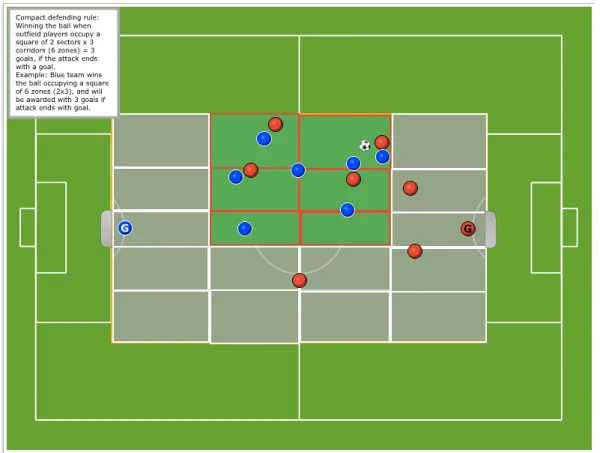
The second experimental condition consisted of a rewarding rule where a goal equalled 3 if the scoring team won the ball while occupying a compacted field area (COM). A compacted area was defined as all outfield players from a team being within 6 connected zones (2 sectors x 3 corridors) out of the total 20 zones (4 sectors x 5 corridors, see Figure 1). The intent was to
promote the defensive principle of concentration, where the idea is to reduce the opponent’s available space by increasing player density within an area located in the axis between the ball and the team own goal. This can be done in any zone of the field, and will facilitate both defensive protection and the probability of regaining possession (Costa et al., 2009).
FIGURE 1. Schematic representation of the compact defending rule, in which defending players were rewarded if they occupied no more than 3 channels and 3 sectors of the pitch.
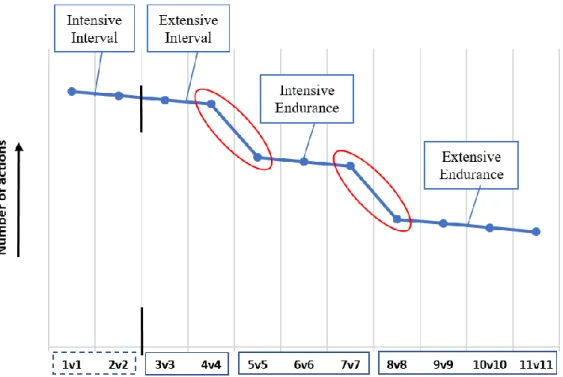
The 16 players were divided into two balanced teams by their coach, respecting their regular playing positions. An 8v8 (GK + 7 vs. 7 + GK) was chosen. In general, a lower number of players lead to more involvement in play, giving more high-intensity actions per minute per player (Little & Williams, 2006). However, the number of actions per minute per player in 8v8 is similar to 11v11 as reported by Verheijen (2014) (see Figure 2). This similarity increases the validity of a comparison between the results of the study and match data. Another possible benefit of using 8v8 compared to 11v11 can be that a game consisting of fewer players makes it easier to destabilize the opponent, thus hypothetically increasing the probability and magnitude of effects for the rewarding rules.
FIGURE 2. Measurement of actions per minute (adapted from Verheijen, 2014)
Both teams used a Gk-3-3-1 system of play, where the participants played in the same position for the same team throughout the study. The study was conducted over a 4-week period with one session a week, with the first session being a familiarization session to prevent bias from novelty-learning effects across practice. With conditions selected in random order, the participants performed a 3-minute bout per condition (in each session) interspersed by 2-minute passive intervals.
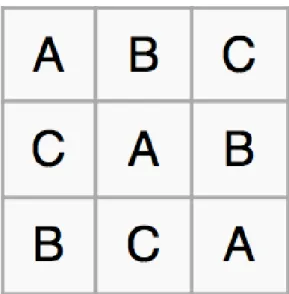
Each session started with 20 minutes of standardized warm-up led by the team coach, consisting of dynamic stretching and a possession game. In all 3 of the following sessions, one match for all three conditions were performed. To avoid bias from the sequence to which the conditions were performed, a Latin squared design was chosen to set the order after the first random selection (Figure 3).
FIGURE 3. Latin squared design showing systematic alternation of experimental conditions across different data collection sessions.
To prevent accumulation of fatigue and thereby a decrease in both quality and quantity of actions per minute, the work-to-rest ratio was carefully chosen. Previous studies on SSGs/LSGs show a large variety in both duration and number of work bouts and rest intervals (Hill-Haas et al., 2011). Regarding LSGs (8v8 to 11v11), bouts will range from 10-15 minutes when we want to create an overload (Verheijen, 2014). To ensure that the level of play can be maintained throughout the 3 exercise bouts, an underload strategy is chosen. By using the so-called 50 %
rule, the training load from an overload exercise is halved (Verheijen, 2014). An overload of 3
x 12 minutes is reduced to 3 x 6 minutes. Passive rest was chosen to optimize physiological recovery, including PCr re-synthesis (Hill-Haas, Coutts, Dawson & Rowsell, 2009). A work-to-rest ratio of 2:1 gives 3-minute rest intervals. Both the number of bouts, game duration, type of recovery and work-to-rest ratio are in line with Clemente, Martins and Mendes (2014) and Dellal et al. (2008).
Official recommendations to full-size pitch are 105m x 68m (FIFA, 2011), thus giving pitch dimensions of 73.5m x 47.6m for 8v8 if we multiply 10.5 (length) and 6.8 (width) with seven (number of outfield players). After seeing the players performing during the familiarization session, the pitch-size was adapted due to the fact that 14-year olds cover less space in a given period of time than adults. Hence, the pitch-dimensions were changed to 63m (length) x 41.3m (width), giving 9m x 5.9m per outfield player. This was in accordance with the opinion of the team’s head coach.
Since coach encouragement might influence training intensity, by increasing RPE, HR and blood lactate concentration (Rampini et al., 2007), coaches were therefore restricted from communicating with their athletes during the session. Exceptions to this were explaining rules before each exercise bout, counting the number of passes for the passing condition and signalling when the players won the ball while respecting the compact defending rule for the compact condition.
Data collection
Tactical, physiological and physical variables
A 5Hz non-differential global positioning system (SPI-Pro, GPSports, Canberra, ACT, Australia) was used to capture the players’ positional data over time. The GPS devices were placed in vests on the players’ upper back. The geodesic coordinates were then exported from the GPS units and computed using Matlab® dedicated routines (MathWorks, Inc., Massachusetts, USA), respecting previous data correction guidelines (Folgado, Duarte, Fernandes & Sampaio, 2014).
To detect possible differences in a team’s playing area, effective playing space (EPS) was used. The EPS is the polygonal area defined by the players at the periphery of play (Silva et al., 2014). To measure the regularity and unpredictability of the EPS fluctuations, approximate entropy (EPS ApEn) was also measured. Input values used for computation were 0.2 standard deviations to the tolerance factor (r) and 2.0 to the vector length (m) (Stergiou et al., 2004). To detect possible differences in the preferable shape of the team, team width, length and the length-width
ratio was used (Silva et al., 2014).
Distance covered and average speed displacement were measured as physical performance indicators. Heart rate values were recorded using short-range radio telemetry (1 Hz, Polar Team Sports System, Polar Electro Oy, Finland). The values were integrated in the GPS units across the games, with the analysed data using the average beats per minute for each LSG scenario.
For tactical, physiological and physical data, all stops in play surpassing 20 seconds were removed to avoid bias from differences in effective playing time between bouts and conditions.
Values for tactical variables are presented as team average per minute of adjusted playing time. Values for distance covered is presented as the average per player per minute of adjusted playing time. Speed displacement and heart rate values are presented as averages per player per minute of adjusted playing time.
Technical variables
Every bout of the three conditions was filmed. The frequency of technical variables was assessed based on the model (Grehaigne & Godbout, 1997). Definitions for each variable can be found in Table 1. A technical action is the execution of a decision. The frequency of defined technical actions is highly objective and can, in combination with other variables, tell us something about the performance tendencies of both individual and team (Grehaigne and Godbout, 1997).
TABLE 1. Definitions (adapted from Grehaigne and Godbout, 1997)
Firstly, two ways of gaining the ball were included: Conquering the ball (CB) and receiving
the ball (RB). CB encapsulates the offensive aspect of defence, while RB indicates a player’s
involvement in the team’s possession. Secondly, 4 ways to dispose the ball was included:
Offensive ball (OB), neutral ball (NB), lost ball (LB) and finishing. OB tells us something about
a player’s capacity to bypass opponents by passing to and assisting teammates. NB indicates a player’s risk tendency when passing, while a small number of LB can reflect the ability to help the team maintain possession. Finishing were divided into goal, shot on target, shot off target,
2 ways to gain possession of the ball:
Conquering the ball (CB) Actively intercepting, stealing or winning the ball from opponent.
Receiving the ball (RB) Receiving the ball from a partner and does not immediately lose control of it.
4 ways to dispose the ball:
Neutral ball (NB) A routine pass to a partner that doesn’t bypass any opponent or lead to a shot. Offensive ball (OB) A pass to a teammate that eliminates opponent(s) or assists a shot.
Losing the ball (LB) A player loses the ball to the other team without having scored a goal. Finishing:
- Goal
- On target Opponent goalkeeper preventing a shot directed towards goal from entering. - Off target
and blocked shot, which is different from Grehaigne and Godbout’s original inclusion of only
successful shot (SS). The rationale being that Grehaigne and Godbout suggest a number of
players (5v5) that naturally leads to more shots than in 8v8. Thus, we want to include all outcomes of finishing to get a picture of how often the teams reach the finalization phase.
Four more variables were included to provide additional information Grehaigne and Godbout, 1997): The volume of play (VP), number of attack balls (AB), the efficiency index (EI) and the
performance score (PS). VP is the total sum of RB and CB. AB is here defined as the sum of goals, shots on target and OB, and tells us something about a player’s ability to eliminate
opponents and create an end-product. EI is computed as follows: EI = (CB+AB) / (10+LB). Evaluating EI in relation to VP can help explain the values, as low VP makes EI less reliable because low involvement equals lower sample size. Low EI with high VP implies impairing the team’s offensive efficiency by losing the ball too often. PS gives us a ratio for the correlation between VP and EI, and is calculated by using the following formula: PS = (EI x 10) + (VP/2). Intra- and inter-observer reliability was tested with corresponding agreement values of 89% and 86 %.
For technical data, all stops in play were removed to avoid bias from differences in effective playing time between bouts and conditions. Technical values are presented as player average per minute of effective playing time.
Statistical analysis
To avoid the limitations of null-hypothesis significance testing, magnitude-based inferences and precision estimation was employed (Batterham & Hopkins, 2006). To reduce the non-uniformity of error, all processed variables were log-transformed before making comparisons between the LSG conditions (control vs. compact, control vs. passing and compact vs. passing). Descriptive analysis was done, using standard deviations and mean for each variable. The presented mean being the back-transformed mean of the log transform. Standardized mean differences were used to determine the comparisons between LSG conditions. It was computed with pooled variance and respective 90% confidence intervals (CI) (Hopkins, Marshall, Batterham & Hanin, 2009). For effect sizes statistics, the thresholds were 0.2, trivial; 0.6, small; 1.2, moderate; 2.0, large; and >2.0, very large (Hopkins et al., 2009). Mean differences for both pairs of conditions were additionally expressed and graphically represented in percentage units
with 90% confidence limits (CL). If the reported effect overlapped the threshold for smallest worthwhile changes, it was reported as unclear. This was computed from the standardized units multiplied by 0.2. The following scale was used to describe the magnitude of clear effects: 25-75%, possibly; 75-95%, likely; 95-99%, very likely; >99%, most likely(Hopkins et al., 2009).
RESULTS
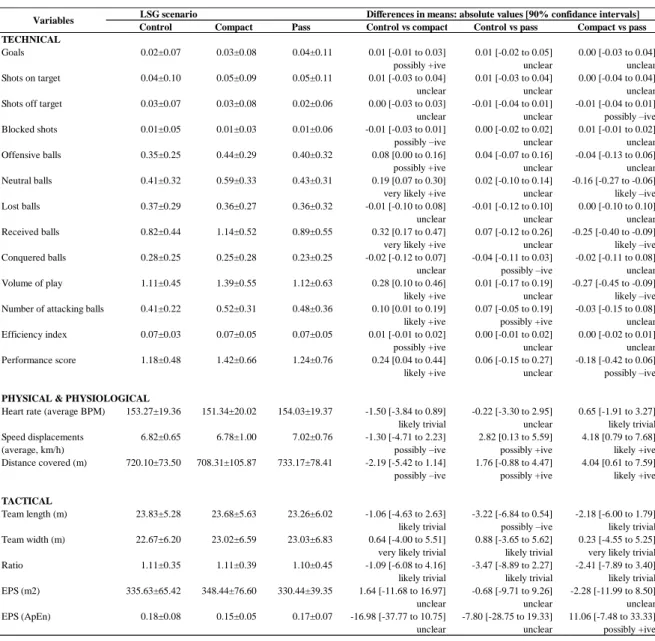
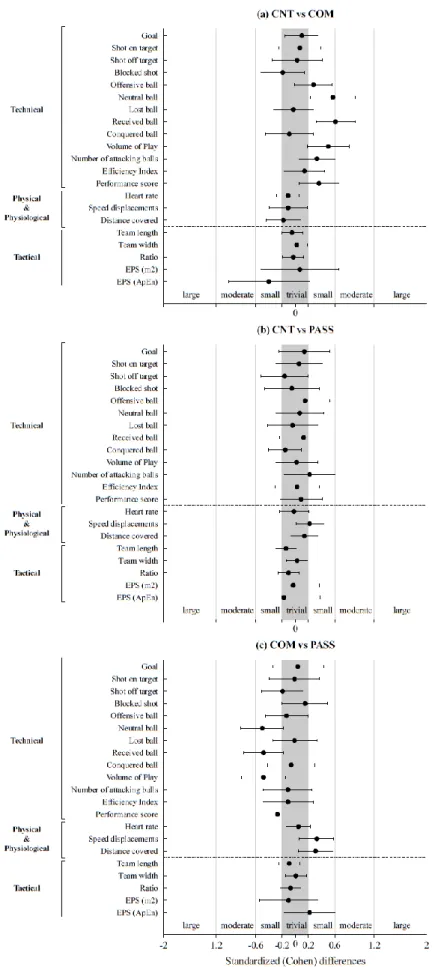
Descriptive and probabilistic results can be found in Table 2. Figure 4a (CNT vs COM), 4b (CNT vs PASS) and 4c (COM vs PASS) show comparisons between the conditions regarding effect sizes. Overall, the findings show mainly trivial or small differences between the conditions.
The compact condition (COM) demonstrated a very likely increases in neutral balls and received balls compared to the control condition (CNT) (NB:standardized (Cohen) differences [90% CI], 0.57 [0.23 to 0.91], small effect; RB: 0.61 [0.32 to 0.91], moderate effect). Furthermore, COM shows a likely increase compared to the passing condition (PASS) (NB: 0.50 [0.18 to 0.83], small effect; RB: 0.48 [0.18 to 0.78], small effect). A possibly increase in offensive balls for COM in comparison to the CNT (OB: 0.28 [-0.01 to 0.56], small effect) is also shown.
Volume of play likely increased with COM (0.50 [0.18 to 0.82], small effect compared to CNT; 0.48 [0.15 to 0.81], small effect compared to PASS). In comparison to CNT, the number of offensive balls likely increased with COM (0.33 [0.05 to 0.61], small effect) and possibly increased with the PASS (0.22 [-17 to 0.61], small effect). The performance score likely increased when using COM in comparison to CNT (0.36 [0.06 to 0.67], small effect). It possibly increased compared to PASS (0.27 [-0.09 to 0.63], small effect).
Speed displacement likely increased using PASS in comparison to CNT (0.33 [0.06 to 0.59], small effect), and possibly increased in comparison to COM (0.22 [0.01 to 0.44], small effect). Distance covered also likely increased with PASS compared to COM (0.31 [0.05 to 0.58]).
EPS ApEn possibly increased when using the PASS compared to COM (0.22 [-0.17 to 0.61], small effect).
Table 2. Descriptive analysis (mean±SD). Difference in means and uncertainty in the true differences comparisons among considered LSG conditions.
Control Compact Pass Control vs compact Control vs pass Compact vs pass TECHNICAL
Goals 0.02±0.07 0.03±0.08 0.04±0.11 0.01 [-0.01 to 0.03] 0.01 [-0.02 to 0.05] 0.00 [-0.03 to 0.04] possibly +ive unclear unclear Shots on target 0.04±0.10 0.05±0.09 0.05±0.11 0.01 [-0.03 to 0.04] 0.01 [-0.03 to 0.04] 0.00 [-0.04 to 0.04] unclear unclear unclear Shots off target 0.03±0.07 0.03±0.08 0.02±0.06 0.00 [-0.03 to 0.03] -0.01 [-0.04 to 0.01] -0.01 [-0.04 to 0.01] unclear unclear possibly –ive Blocked shots 0.01±0.05 0.01±0.03 0.01±0.06 -0.01 [-0.03 to 0.01] 0.00 [-0.02 to 0.02] 0.01 [-0.01 to 0.02] possibly –ive unclear unclear Offensive balls 0.35±0.25 0.44±0.29 0.40±0.32 0.08 [0.00 to 0.16] 0.04 [-0.07 to 0.16] -0.04 [-0.13 to 0.06] possibly +ive unclear unclear Neutral balls 0.41±0.32 0.59±0.33 0.43±0.31 0.19 [0.07 to 0.30] 0.02 [-0.10 to 0.14] -0.16 [-0.27 to -0.06] very likely +ive unclear likely –ive Lost balls 0.37±0.29 0.36±0.27 0.36±0.32 -0.01 [-0.10 to 0.08] -0.01 [-0.12 to 0.10] 0.00 [-0.10 to 0.10] unclear unclear unclear Received balls 0.82±0.44 1.14±0.52 0.89±0.55 0.32 [0.17 to 0.47] 0.07 [-0.12 to 0.26] -0.25 [-0.40 to -0.09] very likely +ive unclear likely –ive Conquered balls 0.28±0.25 0.25±0.28 0.23±0.25 -0.02 [-0.12 to 0.07] -0.04 [-0.11 to 0.03] -0.02 [-0.11 to 0.08] unclear possibly –ive unclear Volume of play 1.11±0.45 1.39±0.55 1.12±0.63 0.28 [0.10 to 0.46] 0.01 [-0.17 to 0.19] -0.27 [-0.45 to -0.09] likely +ive unclear likely –ive Number of attacking balls 0.41±0.22 0.52±0.31 0.48±0.36 0.10 [0.01 to 0.19] 0.07 [-0.05 to 0.19] -0.03 [-0.15 to 0.08] likely +ive possibly +ive unclear Efficiency index 0.07±0.03 0.07±0.05 0.07±0.05 0.01 [-0.01 to 0.02] 0.00 [-0.01 to 0.02] 0.00 [-0.02 to 0.01] possibly +ive unclear unclear Performance score 1.18±0.48 1.42±0.66 1.24±0.76 0.24 [0.04 to 0.44] 0.06 [-0.15 to 0.27] -0.18 [-0.42 to 0.06] likely +ive unclear possibly –ive
PHYSICAL & PHYSIOLOGICAL
Heart rate (average BPM) 153.27±19.36 151.34±20.02 154.03±19.37 -1.50 [-3.84 to 0.89] -0.22 [-3.30 to 2.95] 0.65 [-1.91 to 3.27] likely trivial unclear likely trivial 6.82±0.65 6.78±1.00 7.02±0.76 -1.30 [-4.71 to 2.23] 2.82 [0.13 to 5.59] 4.18 [0.79 to 7.68] possibly –ive possibly +ive likely +ive Distance covered (m) 720.10±73.50 708.31±105.87 733.17±78.41 -2.19 [-5.42 to 1.14] 1.76 [-0.88 to 4.47] 4.04 [0.61 to 7.59] possibly –ive possibly +ive likely +ive
TACTICAL
Team length (m) 23.83±5.28 23.68±5.63 23.26±6.02 -1.06 [-4.63 to 2.63] -3.22 [-6.84 to 0.54] -2.18 [-6.00 to 1.79] likely trivial possibly –ive likely trivial Team width (m) 22.67±6.20 23.02±6.59 23.03±6.83 0.64 [-4.00 to 5.51] 0.88 [-3.65 to 5.62] 0.23 [-4.55 to 5.25] very likely trivial likely trivial very likely trivial Ratio 1.11±0.35 1.11±0.39 1.10±0.45 -1.09 [-6.08 to 4.16] -3.47 [-8.89 to 2.27] -2.41 [-7.89 to 3.40] likely trivial likely trivial likely trivial EPS (m2) 335.63±65.42 348.44±76.60 330.44±39.35 1.64 [-11.68 to 16.97] -0.68 [-9.71 to 9.26] -2.28 [-11.99 to 8.50] unclear unclear unclear EPS (ApEn) 0.18±0.08 0.15±0.05 0.17±0.07 -16.98 [-37.77 to 10.75] -7.80 [-28.75 to 19.33] 11.06 [-7.48 to 33.33] unclear unclear possibly +ive Speed displacements
(average, km/h)
Figure 4. Standardized (Cohen) differences when comparing: a) Compact condition vs Passing condition; b) Control condition vs Passing condition; c) Compact condition vs Passing condition
DISCUSSION
The aim of this study was to examine how passing and compact defending rewarding rules can affect team tactical behaviour, players’ technical, physical and physiological performance in LSGs. Overall, there were mainly small and trivial differences between the conditions for nearly all of the tactical, technical, physiological and physical variables. Received balls (RB) were the only variable that very likely increased with a moderate effect for the compact condition (COM) compared to the control condition (CNT). Why did the rewarding rules have a small effect on several performance variables? Are rewarding rules an inefficient tool to incentivize the desired behaviours while maintaining the same degree of freedom as match-play provides? Or are the results a consequence of methodological characteristics and potential weaknesses?
Regarding the technical variables, the most interesting results were the increase in passes played (NB) and received (RB) for the compact condition in comparison to both the passing condition and the control condition. As these variables influence volume of play (VP) and performance score (PS), both VP and PS were positively influenced by COM compared to PASS and CNT. Comparing with other studies is difficult, as few studies look into how rules manipulation affect technical variables. Almeida, Ferreira and Volossovitch (2012) studied the effect of a rule where a team was obligated to play four passes before a goal could be scored. This rule positively affected number of passes, touches and the average duration of each ball possession in comparison to both a two-touch limitation and free play in a 3v3 SSG (goalkeepers excluded). The PASS condition rewards passing, but did not increase the number of passes played or received. Not even compared to free play. One reason might be the ‘rapport of strength’, which implies that rewarding one team equals punishing the other (Godbout et al., 1999). Since every reward hands out a proportional punishment, rewarding longer passing sequences leading up to a goal (PASS condition) can incentivize the opposing team to deny this by pressing aggressively in an attempt to quickly recover ball possession. This can be positive if the intention of the rule is to provoke pressing or challenge players to exploit rules in creative ways to gain a competitive advantage. However, it can be counterproductive if the aim of the rule is to model directly specific behaviours involved in passing game patterns (Teoldo, Guilherme & Garganta, 2017). Thus, one potential strategy could be the use of indirect rewards. In other words, one can reward a certain offensive behaviour with the intention to provoke adaptations in the opponent defensive behaviours. The key here might be to constrain the opponent instead of rewarding
directly the desired behaviour. This might also help explain why the COM condition resulted in more RB and NB than the PASS condition.
Theoretically one could assume that the number of RB and NB would be greater for the PASS condition than the other two conditions, as two players are rewarded by playing multiple passes at short distances to quickly increase the number of possible goals and/or provoke pressing from the opposition. The results suggest that this did not happen, which might help explain the small effects from the rewarding rules. Absence of coach encouragement meant that players could play without any interference from coaches. Players normally have to play according to specific intentions, and this freedom might have led players performing without caring for the rules. This would indicate that the rewarding rules failed to create propensity and thereby not preventing randomness, which is key when designing practice tasks (Davids, Araújo, Correia & Vilar, 2013). If so, the differences between the three conditions could largely be explained by variance. This possibility demonstrates that an exercise can be perfectly suited to enhance a given intention, however the absence of coaching interventions can make an exercise inappropriate for its intended purpose (Teoldo et al., 2017). One could claim the long-term effect of this freedom could lead to implicit learning through discovery not observable in a short-term timescale. However, coach encouragement could be vital for guiding this discovery, and thereby also making training more efficient. Regarding the current study, the rules were explained to the players in advance, and repeated before the multiple bouts. It is possible this explanation was insufficient to persist in time. Understanding the why behind the rule and not just the rule could be vital to optimize the outcome of training, and this is something that both coaches and researchers should consider when designing both practice and research settings. This also raises an important question regarding whether it is correct to assess a coaching tool (e.g., effects of manipulating rewarding rules) in isolation without considering the way the coach interact with players during the corresponding tool. It might be easier to measure its effects in isolation, just as it is easier to measure effects in a lab setting. However, a potential lack of ecological validity might limit researchers to have a clearer picture from their experiments. And if coaches do not use rewarding rules in isolation, then, hypothetically, they should not be studied in isolation. However, allowing coach encouragement would make it difficult to deduce meaningful information. A possible solution could be to allow questioning or standardized feedback. Investigating the difference between a condition with only a
rewarding rule, a rewarding rule combined with standardized questioning and/or feedback, only feedback and free play could be an interesting topic for future research.
Rewarding the desired behaviour instead of using rewards to create a propensity of affordances for the desired behaviour has hypothetically affected all variables. This includes the physical and physiological variables, which was not affected greatly by the different conditions. However, there was a small likely increase in distance covered and average speed displacement using PASS compared to COM. This complements the results for the technical variables, as the PASS condition might have led to both teams prioritizing to deny the opponent time and space to accumulate passes. Hence, the PASS condition might increase game-pace, and thereby also distance covered and the average speed displacement. If the defending team presses high up the pitch with many players, they also open a lot of space to exploit if the press can be beaten. This can lead to a match where the importance of pressing and surpassing the pressing to exploit numerically advantageous situations lead to a high-paced game. The choice of defensive strategy and its effects on physical and physiological variables has been addressed in scientific literature. Casamichana, Román-Quintana, Castellano and Calleja-González (2015) investigated the effect of man-to-man marking in a 6v6 in comparison to free play. They found that man-to-man marking led to an increase in distance covered compared to free play. When every player is obliged to follow an opponent, the average distance might increase in comparison to free play, where players can decide to defend smaller areas and switch responsibilities for opponents when entering and/or leaving their designated zone. The COM condition and man-to-man marking are tactical counterparts. However, a team’s strategy within these defensive approaches seemed more likely to decide distance covered and average speed displacement than the rule itself.
In line with the technical and physical variables, one might expect some impact also on tactical variables. However, the differences between all conditions were unclear and/or trivial, with the exception of effective playing space approximate entropy (EPS ApEn), which possibly increased (small effect) with PASS compared to COM. The studies on rules manipulation and their effect on tactical variables are scarce. Sampaio et al. (2014) investigated how the game pace (slow, normal and fast) was manipulated through coach instruction, resulting in a significant increase in the unpredictability of each player’s distance to team centroid position in the fast-paced game. The effects of changing the defensive playing method has also been investigated (Frias & Duarte, 2014), showing that teams playing zone defence tended to be
more compact, especially in terms of width. Zone defense also led to a more structured spatial behaviour where teams extended the distance between each other.
Another potential methodological weakness is that the rewarding rules were designed before knowing which team would participate in the study. Thus, designing the rewarding rules without knowing the team’s identity in mind might have influenced the results, as the rules might not have promoted desired behaviours in respect to the team identity (Teoldo et al., 2017). It can also have influenced the two rules differently, as their suitability for the participating team might differ. Thus, the design of rewarding rules for scientific research should be done together with the team’s coach to ensure that its intentions link to the team’s identity. Another potential confounding factor might be the players’ skill level. As prior studies have shown, there is an interaction effect between some task constraints and the skill level of the studied samples. For example, Silva et al. (2014) showed higher sensitivity of national level players to variations in pitch size when compared to regional level players. An interaction effect might be expected also between players’ skill level and the rewarding rules. Our sample was composed by U14 players from one of the best football academies in Portugal. It is arguable that both PASS and COM rules had not impacted in team performance because the rules target behaviours that were already acquired and stabilized in this team.
In light of this study, new questions and suggestions arise. Future research should: (i) look into the effects of rewarding rules that create affordances for the desired behaviour instead of trying to directly reward it; (ii) examine rules that have been designed in accordance with team identity; (iii) consider players’ level of skill; (iv) study the effects of rewarding rules in isolation and in combination with other coaching tools. Standardizing feedback and/or questioning in exercise bouts could be particularly interesting; (v) finally, research designs also need to consider learning and performance over longer timescales or longer periods of exposure to certain rewarding rules.
REFERENCES
Aguiar, M., Botelho, G., Lago C., Maças, V. & Sampaio, J. (2012). A review on the effects of
soccer small-sided games. J Hum Kinet, 33, 103–113.
Aguiar, M., Gonçalves, B., Botelho, G., Lemmink, K. & Sampaio, J. (2015). Footballers’ movement behaviour during 2-, 3-, 4- and 5-a-side small-sided games. Journal of Sports
Sciences, 33(12), 1259-1266.
Almeida, C. H., Ferreira, A. P. & Volossovitch, A. (2012). Manipulating task constraints in small-sided soccer games: Performance analysis and practical implications. The Open Sports
Sciences Journal, 5, 174–180.
Aroso, J., Rebelo, A. & Gomes-Pereira, J. (2004). Physiological impact of selected game-related exercises. J Sports Sci, 22(6), 522.
Araújo, D., Davids, K. & Passos, P. (2007). Ecological validity, representative design, and correspondence between experimental task constraints and behavioral setting: Comment on Rogers, Kadar, & Costall. (2005). Ecological Psychology, 19, 69–78.
Batterham, A. M. & Hopkins W. G. (2006). Making meaningful inferences about magnitudes.
Int J Sport Physiol, 1, 50-57.
Bosch, F. (2015). Strength Training and Coordination: An Integrative Approach. Rotterdam: 2010Publishers.
Brunswik, E. (1955). Representative design and probabilistic theory in a functional psychology. Psychological Review, 62, 193–217.
Casamichana, D., Román-Quintana, J. S., Castellano, J. & Calleja-González, J. (2015). Influence of the type of marking and the number of players on physiological and physical demands during sided games in soccer. Journal of Human Kinetics, 47(1).
Castellano J., Puente A., Echeazarra I. & Casamichana D. (2015). Influence of the number of players and the relative pitch area per player on heart rate and physical demands in youth
soccer. J Strength Cond Res, 29, 1683-1691.
Castelão, D., Garganta, J., Santos, R. & Teoldo, I. (2014). Comparison of tactical behaviour and performance of youth soccer players in 3v3 and 5v5 small-sided games. International
Journal of Performance Analysis in Sport, 14(3), 801-813.
Clemente, F. M., Martins, F. M. & Mendes, R. S. (2014). Developing aerobic and anaerobic fitness using small-sided soccer games: Methodological proposals. Strength and Conditioning
Journal, 36(3), 76-87.
Costa, I. T., Garganta, J., Greco, P. J. & Mesquita, I. (2009). Tactical Principles of Soccer: Concepts and Application (Princípios Táticos do Jogo de Futebol: conceitos e aplicação).
Revista Motriz, 15(3), 657-668.
Davids, K., Araújo, D., Correia, V. & Vilar, L. (2013). How small-sided and conditioned games enhance acquisition of movement and decision-making skills. Exerc Sport Sci Rev, 41(3), 154-61.
Davids, K., Araújo, D., Seifert, L. & Orth, D. (2014). Expert Performance. In J. Baker (Ed.) and D. Farrow (Ed.), Routledge Handbook of Sport Expertise (130-144). New York:
Routledge.
Dellal, A., Chamari, K., Pintus, A., Girard, O., Cotte, T. & Keller, D. (2008). Heart rate responses during small-sided games and short intermittent running training in elite soccer players: a comparative study. J Strength Cond Res, 22 (5), 1449-57.
Dellal A, Owen A, Wong DP, Krustrup P, van Exsel M, & Mallo J. (2012). Technical and physical demands of small vs. large sided games in relation to playing position in elite soccer.
Hum Movement Sci, 31, 957-969.
FIFA (2011). Football stadiums: Technical recommendations and requirements. Fifth edition.
Folgado H, Duarte R, Fernandes O, & Sampaio J. (2014). Competing with Lower Level Opponents Decreases Intra-Team Movement Synchronization and Time-Motion Demands during Pre-Season Soccer Matches. PLoS ONE 9.
Frias, T. & Duarte, R. (2014). Man-to-man or zone defense? Measuring team dispersion behaviors in small-sided soccer games. Trends in Sport Sciences, 21(3), 135.
Garganta, J. (2004). Atrás do palco, nas oficinas do Futebol. In J. Garganta, J. Oliveira & M. Murad (Eds.), Futebol de muitas cores esabores. Reflexões em torno do desporto mais
popular do mundo (227-234). Porto: Campo das Letras.
Gonçalves, B., Esteves, P., Folgado, H., Ric, A., Torrents, C. & Sampaio, J. (2017).Effects of Pitch Area-Restrictions on Tactical Behavior, Physical, and Physiological Performances in Soccer Large-Sided Games. Journal of Strength & Conditioning Research. Sep 31(9), 2398– 2408.
Grehaigne, J. F. and Godbout, P. (1995). Tactical knowledge in team sports from a constructivist and cognistivist perspective. Quest, 47, 490-505.
Grehaigne, J. F., Bouthier, D. & David, B. (1997). Dynamic-system analysis of opponent relationships in collective actions in soccer. Journal of Sports Sciences, 15(2), 137-149.
Grehaigne, J. F. and Godbout, P. (1997). Performance assessment in team sports. Journal of
Teaching in Physical Education, 16, 500-516.
Grehaigne, J. F., Bouthier, D. & Godbout, P. (1999). The foundations of tactics and strategy in team sports. Journal of Teaching in Physical Education. 18, 159-174.
Hill-Haas, S., Rowsell, G. J., Dawson, B. & Coutts, A. J. (2009). Acute physiological
responses and time-motion characteristics of two small-sided training regimes in youth soccer players. J Strength Cond Res, 22 (6), 1-5.
Hill-Haas, S., Coutts, A. J., Dawson, B., & Rowsell, G. J. (2010). Time-motion characteristics and physiological responses of small-sided games in elite youth players: the influence of player number and rule changes. J Strength Cond Res, 24(8), 2149-56.
Hill-Haas, S., Dawson, B., Impellizzeri, F. M. & Coutts A J. (2011). Physiology of small-sided games training in football. A systematic review. Sports Medicine, 41(3), 199–220.
Hopkins W.G., Marshall S.W., Batterham A.M. & Hanin J. ( 2009). Progressive Statistics for Studies in Sports Medicine and Exercise Science. Med Sci Sport Exer, 41, 3-12.
Little, T. & Williams, A. (2006). Suitability of soccer training drills for endurance training. J
Strength Cond Res, 20(2), 316-9.
Mallo, J. & Navarro, E. (2008). Physical load imposed on soccer players during small-sided training games. J Sports Med Phys Fit, 48(2), 166-72.
McGarry, T., Anderson, D. I., Wallace, S. A., Hughes, M. D. & Franks, I. M. (2002). Sport competition as a dynamical self-organizing system. Journal of Sports Sciences, 20(10), 771-781.
Newell, K. M. (1986). Constraints on the development of coordination. In M. G. Wade & H. T. A. Whiting (Eds.), Motor development in children. Aspects of coordination and control (341-360). Dordrecht, Netherlands: Martinus Nijhoff.
Owen A. L., Wong D. P., McKenna M. & Dellal A. (2011). Heart Rate Responses and
Technical Comparison between Small- Vs. Large-Sided Games in Elite Professional Soccer. J
Strength Cond Res, 25, 2104-2110.
Passos, P., Araújo, D. & Davids, K. (2015). Dyadic systems as dynamic systems in individual and team sports. In T. McGarry, P. O’Donoghue & J. Sampaio (Eds.), The Routledge
Handbook of Sports Performance Analysis (64-73). New York: Routledge.
Rampinini, E., Impellizzeri, F. M., Castagna, C., Abt, G. T., Chamari, K., Sassi, A. & Marcori, S, A. (2007). Factors influencing physiological responses to small-sided soccer games. J Sports Sci, 25(6), 659-66.
Sampaio, J., Garcia, G., Maças, V., Ibáñes, S. J., Abrantes, C. & Caixinha, P. (2007). Heart rate and perceptual responses to 2 x 2 and 3 x 3 small-sided youth soccer games. J Sports Sci
Med, 10, 121-122.
status and unbalance in time motion variables, heart rate and tactical behaviour when playing 5-a-side football small-sided games. J Sci Med Sport. 17(2), 229-33.
Sassi, R., Reilly, T. & Impellizzeri, F. M. (2004). A comparison of small-sided games and interval training in elite professional soccer players. J Sports Sci, 22, 562.
Serra‑Olivares, J., Clemente, F. M. & González‑Víllora, S. (2016). Tactical expertise assessment in youth football using representative tasks. SpringerPlus, 5, 1301.
Silva, P., Duarte, R., Sampaio, J., Aguiar, P., Davids, K., Araújo, D. & Garganta, J. (2014). Field dimension and skill level constrain team tactical behaviours in small-sided and conditioned games in football. J Sports Sci, 32(20),1888-1896.
Silva, B., Garganta, J., Santos, R. & Teoldo, I. (2014). Comparing Tactical Behaviour of Soccer Players in 3 vs. 3 and 6 vs. 6 Small-Sided Games. J Hum Kinet. 2014 Jul 8; 41:191-202.
Steel, A., Silson, E. H., Stagg, C. & Baker, C. I. (2016). The impact of reward and punishment on skill learning depends on task demands. Scientific Reports, 6 (1), 36056.
Stergiou N., Buzzi U., Kurz M. & Heidel J. (2004). Nonlinear tools in human movement. In N. Stergiou (ed), Innovative analyses of human movement (63-90). Champaign, IL: Human Kinetics.
Sumpter, D J. T. (2006). The principles of collective animal behavior. Philos. Trans. R. Soc.
Lond. B Biol. Sci, 361, 5–22.
Teoldo, I., Guilherme, J. & Garganta, J. (2017). Training football for smart playing. On
tactical performance of teams and players. Curitiba: Editora Appris Ltda.
Travassos, B., Duarte, R., Vilar, L., Davids, K. & Araújo, D. (2012). Practice task design in team sports: Representativeness enhanced by increasing opportunities for action. Journal of
Verheijen, R. (2014). The original guide to football periodization: Always play with your
strongest team. Part 1. Amsterdam: World Football Academy.
Wächter, T., Lungu, O. V., Liu, T., Willingham, D. T. & Ashe, J. (2009). Differential effect of reward and punishment on procedural learning. The Journal of neuroscience: the