Don´t do Land Reform: a simple theorem
Miguel Rocha de Sousa
*,#,&,1, Vanessa S. Duarte
&,2*Departamento de Economia, Universidade de Évora, 7000-803 Évora, Portugal
# CICP, Centre for Research in Political Science, Universidade de Évora, 7000-803 Évora, Portugal & CEFAGE, Centre for Advanced Studies in Management and Economics, Universidade de Évora, 7000-803 Évora,
Portugal
Abstract – We assess the general impact of land reforms on growth using human capital growth models due to Arrow (1962) - the main newness of the paper- after surveying the literature and building a typology. Thus, we conclude that land reform can yet been used as a modern tool to spur growth and development, but with our approach we can define the main limits and constraints that can block this growth.
We conclude that a raise in undifferentiated wages after land reform leads to an unrecoverable society welfare loss; thus, yielding a lesson to political agents’ decision-makers elected after land reforms – wage raise land reform should not be used as an electoral motto.
Keywords
–
Land Reform, Human Capital, Arrowian LBD, Don’t do land reform, Typology of land reforms1.
Introduction:
Motivation
and
object of study
Land reform is an ancestral political economic instrument that has been used by governments and political agents in different ways. In this section, we try to define our notion of land reform. The literature, especially in economics, regarding this issue is vast. Therefore, we must narrow our aim at defining this object of study. Our definition of land reform includes
only land redistribution from large estates (latifundia) to smaller ones (minifundia). Thus, we
exclude the reverse action of gathering minifundia into a larger latifundia. Branco and Rocha de Sousa (2006) have established a typology of land reforms, using a matrix between the economic component and the political component. Below we present this definition on Table 1. For the economic component, we tried to evaluate if a land reform was well succeeded, so that (total factor) productivity of the land increased. For the political assessment, we tried to distinguish between revolutionary land reforms, structural change, accompanied by a coup d’état or revolution; and reformist land reforms, so that there is not a sudden change but a gradual and swift sustained change in government (Zakarya, 2004).
2.
Typology of land reforms
Additionally, Kawagoe (1999) also has established his political economic typology of land reforms.
Table 1. Actual Land Reforms
Economic System VERS US Political System CENTRALIZED (C) [+ STATE] DECENTRALIZE D (D) [+ MARKET] REFORMI ST (R) WITHOUT SUDDEN POLITICA L CHANGE (WITHOU T REVOLUT ION OR COUP) (C,R) BRAZIL (MST 2000); VIETNAM (1988) MOZAMBIQU E (2004-5) (D,R) BRAZIL (CÉDULA 2000) JAPAN (1945); THAILAND (90’S) GUATEMALA (1952-1954) -Arbenz Regime CHINA (1978-present) STRUCTU RAL (S) WITH SUDDEN POLITICA L CHANGE (WITH REVOLUT ION OR COUP) (C,S) PORTUGAL (1975) GUATEMALA (1954-1990)- military junta ZIMBABWE (1990-2005) (D,S) Eastern Europe countries after the fall of the Berlin Wall,
e.g.. UCRAINE (1991)
Table 2. Feasible Land Reforms
Ex-Post Land Reform Market Economy (M) Socialist Peasant Commercial (S)
(p) (c)
Market Asian Model
Socialist Model Ex Econom y (1.1.) (1.2.) (1.4.) Ante Peasant (p) Mp--> Mp Mp-> Mc Mp-->S Latin American Model Land Half-feudal (3.1.) (3.2.) (3.4.) (F) F--> Mp F--> Mc F-->S Transition Eco. Model Reform Socialist (4.1.) (4.2.) (S) S--> Mp S--> Mc
Source: Kawagoe (1999: 44) based on De Janvry (1981a, b) [also Rocha de Sousa (2006: 70)]
This new table has become a kind of corner-stone in land reform literature.
Our focus is on Latin American Land reforms, that as Kawagoe shows, resulted essentially from changing the mode of production from a half-feudal society to a market economy, whether peasant one (Mp) or market economy commercial (Mc).
This is clearly a trade-off between the struggle movements of peasants (campesinos) and agri-business.
3.
Latin American Land Reforms
“Amor é latifúndio, sexo é invasão.”1 MPB’s, singer Rita Lee In this paper, we focus our analysis on Latin American land reforms2,3. Dorner (1991) and De Janvry (1981 a,b) have studied this issue at length. There are also several studies of peasant movements in Latin America, namely for MST – Movimento dos Sem Terra (Landless Workers) in Brazil (Masselli, 1998; Fernandes, 1999; Ricci, 1999). Forman (1974) presented the evolution of campesinos, and how the structure of the land defined power relations among different agents, also in Brazil. Wright and Wolford (2003) present an updated version of MST’s formation. Lapp (2004) scrutinizes voting power of campesinos for all Latin America.
1 Freely translated as: “Love is large estate, sex is invasion.” Brazilian popular singer, Rita Lee.
2 There are a lot of studies of land reform in Africa, for the general case (Juul and Lund, 2002; Lund, 2002; Peters; 2002; Manji, 2006), Ethiopia (Benin and Pender, 2001; Taddese; 2001), Ghana (Berry, 2002), Mozambique (Unruh, 1998; Virtannen; 2004), Nigeria (Omotayo, 2003), Kenya (McPeak, 2005), Sahel (Grigsby, 2002; Thébaud, 2002), Senegal (Juul, 2002), South Africa (Williams et al., 1996; Zyl et al., 2001; Cousins, 2002), Tanzania (Wanitzek and
Sippel, 1998) and Zimbabwe (Moyo, 2001; Hammar, 2002; Addison and Laakso, 2003).
3 For Asia, there are the following studies: Bangladesh (Devine, 2002), Phillipines (Borras, 2003), Japan (Dore, 1959; Hayami et al., 1991; Kawagoe, 1999), India (Banerjee and Iyer, 2002), Mongolia (Neupert, 1999; Fernandez-Gimenez, 2002), Thailand (Byamugisha ,1999a, 1999b) and Vietnam (Ravallion and Van de Valle, 2001, 2003).
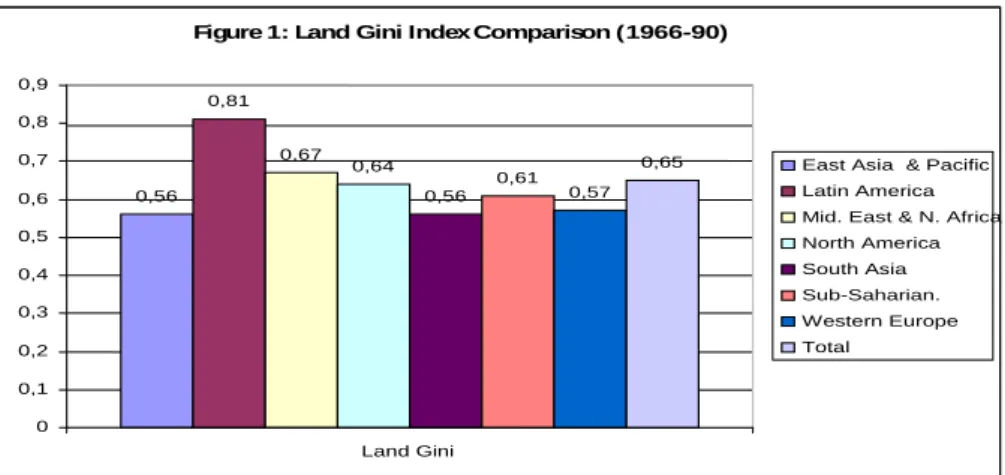
Figure 1. Land Gini index Comparison (1966-1990)
Figure 1 presents the grassroots for all the land political movements, and we can observe that in Latin America, the Gini for land inequality had, for the period 1966-90, the highest average of all continents, respectively 81% (of a maximum allowed of 100%). Thus, we can state that inequality in land distribution, which is particularly striking in Latin America, caused discontent and thus political struggle for these lands.
The crucial nexus of the landed power is that land occupation, later could yield a legal title for that land, if it would be legally recognised by the government. In Brazil we have clearly two types of land reform: i) occupation and invasion of lands by the MST (the dominant one), and ii) a market led land reform (land bill land reform, called “Cédula da Terra”) in which the landless might buy land from a farmers’ association, with bonus interest, with a waiting period4 of two years, and in which they choose the best land for their aims, and have access to technical support by qualified agronomists – see Buainain et al. (1998; 1999a,b; 2002, 2003).
More than defend itself one mode or the other we must perceive that reality is sufficiently enough complex in order to comply both systems.
Nevertheless, at the political economic level, the struggle of the farmers for better conditions has been for a long time in the economic literature (e.g. Kautsky (1898) in general, and for Portugal, Cunhal (1976), presented an updated version of Kautsky’s work.).
4 Or grace period, as is also usually referred in the financial literature, which means that the loan starts to be repaid only after this time has elapsed.
Binswanger et al. (1995) analyses the political landed elite relations and has become a classical corner-stone of this literature. Huizer’s (2001) work presents several recent political rooted campesinos movements.
For the case of Mexico, Bobrow-Strain (2007) presents the formation of Chiapas struggle, in which ladinos (indigenous who do not follow ancestral traditions) fight against traditional farmers. Additionally, Collier and Quaratiello (1999) abridge the same subject.
What kind of conclusion can we withdraw from all these studies?
The first point is that violence against the landed elite pays off for the offender, sooner or later, they will get a title for land that they eventually can negotiate and enter again in the political struggle for new lands. Of course, there is some risk in this struggle, some landless workers can eventually get killed or severally injured in the process. Buainain (2003) refers using CPT’s (Comissão Pastoral da Terra) data that in 2002, for Brazil, there were 743 land conflicts, of which 43 deaths, 425 780 people involved, and 3 million ha of land involved. Figure 2, , next page, illustrates recent MST workers land’s occupation in Brazil for 2002 [Fernandes based on CPT, 2003].
The second point, which led me further to study the subject, is: What are the aggregate gains or
losses of land reform? Figure 1: Land Gini Index Comparison (1966-90)
0,56 0,81 0,67 0,64 0,56 0,61 0,57 0,65 0 0,1 0,2 0,3 0,4 0,5 0,6 0,7 0,8 0,9 Land Gini
East Asia & Pacific Latin America Mid. East & N. Africa North America South Asia Sub-Saharian. Western Europe Total
Do the gains of some outreach the losses of others, in a sense that we can talk about a net welfare gain?
One of us addressed this issue of analysing the aggregate effect of land reform on growth, as defined on the first section (a redistribution of large estate to smaller productive estates) using Arrow’s learning by doing (LBD) growth model. The novelty of this approach is the use of human capital in the assessment of land reform.
4.
Some General theory about Land
Reforms
4.1. Arrowian Human Capital Loss
This section is based upon one of us unpublished work Rocha de Sousa (2008), and basically confirms theoretically what we have found empirically regarding human capital importance on land reforms.
We use Arrow’s (1962) economic growth model with “learning by doing” (LBD) to evaluate and assess the aggregate loss of welfare due to land reform. Besides, we use Arrow’s model adapted with human capital.
Main Hypothesis: During traditional land reform all the human capital is destroyed since we have the substitution of experienced managers (agronomists) by farmers (campesinos) with few or at all no experience.
This hypothesis will be further enlarged to partial human capital loss.
Main Question:
How many years does it take to recover human capital loss due to land reform?
We have the stream of future profits (S) with human capital:
. . 0.
( ) . 1
.
.
T t tS
e
H t
W e
dt
(1) In which is the inter-temporal discount rate (or the interest rate or opportunity cost of project’s evaluation),
H t( )
is a production function which results from human capital investment till moment t, and represents unitary profit derived from a wage cost W, with denoting wage growth rate.So we must now compare two profits streams: the discounted agronomist’s profit flow since the beginning till the time of land reform (SAGN), with the profits campesinos flow since the time of land reform till a period in which all the human capital is recovered (T**), and we name it (STB):
. . 0.
( ) . 1
.
.
RA T t t AGNS
e
H t
W e
dt
(2)
** . ..
(
) . 1
.
.
RA T t t TB RA TS
e
H t
T
W e
dt
(3)Hypothesis 2: we assume that the interest rate is the same (i.e. is not affected by land reform), that wage growth rate, , is the same and that the production
H t
( )
and the profit rate is also thesame: .
Do notice that these hypotheses can be changed without major changes in the quality of the model’s results.
Dynamic Recovery Threshold of Traditional Land Reform (DRTTLR)
In this analysis we aim to compare SAGN and STB to obtain T**. This is the time value from which after a land reform all human capital is totally recovered by the farmers/campesinos.
The following condition allows us to formalize DRTTLR:
(4)
Thus, replacing by the respective function discounted cash-flows values:
𝑆𝑇𝐵= ∫ 𝑒−𝜌.𝑡 𝑇∗∗ 𝑇𝑅𝐴 . 𝛾[𝐻(𝑡 − 𝑇𝑅𝐴)]. (1 − 𝑊. 𝑒𝜃.𝑡). 𝑑𝑡 ≥ ≥ ∫ 𝑒−𝜌.𝑡 𝑇𝑅𝐴 0 . 𝛾[𝐻(𝑡)]. (1 − 𝑊. 𝑒𝜃.𝑡). 𝑑𝑡 = 𝑆 𝐴𝐺𝑁 (5)
1
W e
.
t
1
W e
.
t TB AGNS
S
Like all variables and integrand functions (given all our restrictive initial hypotheses) are the same, the DRTTLR analysis is based upon the integration limits:
** 0
´(
).
´( ).
RA RA T T RA TZ t
T
dt
Z t dt
(6) Thus, solving for the gain function (Z(t)):**
(
RA)
(
RA RA)
(
RA)
(0)
Z T
T
Z T
T
Z T
Z
(7) Which will be equivalent, since
(
RA RA)
(0)
Z T
T
Z
can be eliminated by being common to both members, and if Z(t) monotonously increasing5: **
(
RA)
(
RA)
Z T
T
Z T
(8) **(
)
2. (
RA)
Z T
Z T
(9)From here we can derive that the dynamic profitability comes defined by the implicit function. By the injectivity of the gain function (Z(.)) we can state that the gains on the threshold T** have to exceed at least the double of accumulated gains till land reform.
Figure 2 presents the Possibility Set of Land Reform (PSLR), accordingly to the condition of recovery of human capital loss in the space of possible gains (Z(T**) vs Z(TRA)).
5 The initial hypothesis I used was the separability of the function, but this one is too restrictive. It is enough to state
Figure 2. Possibility Sets of Land Reform on ARROW’s model (1962)
For a simple case in which the gain function is linear (thus T**=2TRA), it is the inferior line which defines the Possibility Set of land Reform (PSLR)– see next figure 3.
Figure 3. Possibility Sets of Land Reform with linear gain in ARROW (1962)
Some interesting questions might arise in this model in which we proceed to land reform (even without formal land variable). Let us change the wage growth.
Hypothesis 3
If the growth wage rate increases due to a process of land reform, what happens to the dynamic recovery threshold of land reform (DRTTLR)?
that the function is increasingly monotonous to withdraw the conclusion in the text.
Z(T
1)
Z(T
RA)
Z(T
2)=2.Z(T
1)
Bissectrix
PSLR
Z(T
2)
FLR
Z(T
**)
T
1T
RAT
2=2.T
1Bissectrix
PSLR
T
2FLR
T
**Let’s analyse the cash-flow condition of an ex-post wage rate increase after the land reform, i.e. with
, we will have the following condition:
𝑆𝑇𝐵(. ; 𝜃2) = ∫ 𝑒−𝜌.𝑡 𝑇∗∗ 𝑇𝑅𝐴 . 𝛾[𝐻(𝑡 − 𝑇𝑅𝐴)]. (1 − 𝑊. 𝑒𝜃2.𝑡). 𝑑𝑡 ≥ ≥ ∫ 𝑒−𝜌.𝑡 𝑇𝑅𝐴 0 . 𝛾[𝐻(𝑡)]. (1 − 𝑊. 𝑒𝜃1.𝑡). 𝑑𝑡 = 𝑆𝐴𝐺𝑁(. ; 𝜃1) (10)
This condition will be the one which will allow in this context that land reform recovered all the lost human capital.
Results of the Arrowian model Proposition 1:
An increase in the growth rate of (unskilled6) wages ex-post land reform yields land reform unviable in terms of economic efficiency. Thus, in this context and under the referred hypotheses there will be an aggregate welfare loss which yields in dynamic terms land reform inefficient; i.e. the loss generated by the eviction of agronomists and by theirs human capital loss will never be recovered with wage increase.7
Demonstration: see Rocha de Sousa (2008: 224-5).
Proposition 2
If there is a decrease on wage growth rate after land reform, then it is possible to define a new possibility set of land reform accordingly to the Dynamic Recovery Threshold of Traditional Land Reform.
Demonstration: See Rocha de Sousa (2008: 225-6).
6 We refer to unskilled or undifferentiated wages, thus to non-specific functions and for those which do not demand human capital – thus for factor L and not H. This proposition becomes interesting because empirically tends to be checked as after land reform there tends to have an increase in these types of wages due to the greater lobbying union power – specially on those LR of the more interventionist type.
Proposition 3
If the inter-temporal discount rate increases ceteris paribus the Dynamic Recovery Threshold of Traditional Land Reform becomes unattainable, thus land reform is inefficient.
Demonstration: Rocha de Sousa (2008:226). Proposition 4
If the inter-temporal discount rate decreases ceteris paribus the Dynamic Recovery Threshold of Traditional Land Reform becomes more easily attainable.
Demonstration: Rocha de Sousa (2008: 227). Hypothesis 4 – New working hypothesis – partial human capital destruction
If the eviction of agronomists by campesinos, instead of being totally un-experienced and illiterate, they inherit some experience, thus human capital loss is only partial.
If we can measure it by a factor of literacy8 which we name , then part of them are not totally un-experienced in terms of farm management and agricultural techniques. These campesinos might possess some knowledge of phyto-sanitary and modern agronomy techniques. Nevertheless, even if we assume a decrease on the knowledge gap, we still assume certain uniformity on the literacy and numeracy differentials between agronomists and campesinos.
Question 2: What happens to Land Reform in this setting?
Human capital recovery will be faster. Demonstration:
Intuitively the human capital loss will be lower in the land reform moment, i.e. there is a kind of heritage from agronomists to campesinos – thus the Dynamic Recovery Threshold of Land Reform can be more easily attained than in the initial case.
Formally we must compare:
7 Notice we are considering T** fixed. This result might change with T** variable, but within Arrow’s model capital (in our case human capital) tends to have a finite life, and thus the plausibility of this hypothesis.
8 Illiteracy rate (%) will be obviously 0 ≤ (Illiteracy = 1 – η) ≤ 1.
2 1
2 1
1
TB AGN
S
S
(11)
Thus, the term
.
S
AGN is the bequest or heritagefrom agronomist to campesinos, and so the human capital recovery must occur only till:
1
S
AGN. Formally: 𝑆𝑇𝐵= ∫ 𝑒−𝜌.𝑡 𝑇∗∗ 𝑇𝑅𝐴 . 𝛾[𝐻(𝑡 − 𝑇𝑅𝐴)]. (1 − 𝑊. 𝑒𝜃.𝑡). 𝑑𝑡 ≥ ≥ (1 − 𝜂) ∫ 𝑒−𝜌.𝑡 𝑇𝑅𝐴 0 . 𝛾[𝐻(𝑡)]. (1 − 𝑊. 𝑒𝜃.𝑡). 𝑑𝑡 = (1 − 𝜂). 𝑆𝐴𝐺𝑁 (12) Thus, proceeding as in the initial case, we must take into account
.
S
AGN, and solving it for the gainfunction (Z(t)):
𝑍(𝑇∗∗− 𝑇𝑅𝐴) − 𝑍(𝑇
𝑅𝐴− 𝑇𝑅𝐴) ≥ ≥ (1 − 𝜂). [𝑍(𝑇𝑅𝐴) − 𝑍(0)]
(13) Which will lead equivalently, given
(
RA RA)
(0)
Z T
T
Z
might be eliminated as a common term, and if Z(t) is monotonously increasing and injective:
**(
)
(
RA)
1
. (
RA)
Z T
Z T
Z T
(14)
**(
)
2
. (
RA)
Z T
Z T
(15)From here we withdraw the dynamic profitability condition in which DRTTL (T**) comes define by the implicit function. Given the injectivity of the gain function, the gains on the threshold T** must exceed the double minus the literacy rate of the accumulated profits till the moment of land reform.
Notice that if the literacy rate is null, then we will be in the case of figure 2, if the literacy rate is 100%, then we will be in the case that the DRTTL will be the bissectrix.
For an intermediate case (namely for the case of developing countries), if the literacy rate is 50%, then
the frontier will be defined as: **
(
)
1,5. (
RA)
Z T
Z T
.
Figure 4. PSLR Expansion with Literacy increase ()
Proposition 5: An increase in the literacy rate leads to a campesinos’ DRTTL improvement and to an expansion of the PSLR.
As a conclusion of the previous section, the increase on the literacy rate leads to an improvement on the dynamic recovery threshold of land reform, i.e. the partial recovery of human capital leads to a more easily viable land reform for campesinos (and landless), which results itself on an expansion of the possibility set of land reforms.
Demonstration: see figure 5.1.3 and Rocha de Sousa (2008:228-9)
The learning effects induced in this Arrow (1962) context due to an increase in literacy, can be checked empirically as we check on the literature e.g. on Brazil. This further emphasizes the role of human capital, its transmission (bequest or heritage) and its’ further enabling viability of land reform.
5.
Conclusion
“Rocha de Sousa (2005) examines whether instituting land reform (an issue especially relevant in Latin America) will accelerate or decelerate growth. Land reform splits large properties run by well-educated owners into smaller properties run by uneducated farmers. Hence, a trade-off. Splitting up large properties increases competition and efficiency while at the
Bissectrix
PSLR
0 2 1Z(T )
(2- ).Z(T )
2 1Z(T )
Z(T )
2 1Z(T )
2.Z(T )
Z(T
RA)
Z(T**)
0(
0)
FLR
11
2
FLR
2(
1)
FLR
Z(T
1)
Z0(T2) Z1(T2) Z2(T2)same time entails the loss of human capital. The relative size of the two effects will determine the effect of land reform on growth.” in Roufagalas (2006:3).
We might conclude from section 1, as we defined land reform as redistribution operated by splitting large estates into smaller ones, that we can define in section 2 a typology of land reforms as in table 1, describing the degree of market intervention (whether it is centralized or decentralized (C,D)) versus the degree of political change (whether it is reformist or structural (R,S)), that is if we have a continuous and gradual swift change or instead a coup or political revolution. Table 2 realized actual processes of land reform, in which we classified MST movement as centralized in the economic sphere and reformist in the political one (C,R) as opposed to the market led land bill (Cédula da Terra) which we characterized as decentralized (pro-market) and reformist in the political domain, thus Cédula was on the (D,R) cell. We also presented another approach due to Kawagoe which further characterized land reforms in Latin America, stating that they operate a change from a half-feudal economic system to a market or peasant economy.
We also briefly characterized peasant or campesinos movements in Latin America, with more emphasis on Brazil, besides focusing on Latin America as the most unequal distribution of land, as measured by the Land Gini Index (81%) – see Fig.1.
The main conclusion is that as we might have inferred from section 1 that land was an economic asset, also on section 3, we can conclude that land is a political asset – to stress this more see Lapp (2004), where she scrutinizes relations between land tenancy and political power. The second point of section 3 is that violence against the landed elite pays-off for the offender, sooner or later, they will get a title for land, and eventually can negotiate it, and re-enter again in the struggle for new lands. Of course there is some risk involved, they can get killed or severally injured in the process.
Elsewhere, we estimated a stochastic Cobb-Douglas production frontier to assess the economic efficiency of “Cédula da Terra”. We concluded that there are five major variables which reduce technical inefficiency: human capital, in its general form, that is education or schooling and its specific form, technical assistance, besides access to credit, the value of social production and the value of self-consumption.
On section 4 we modeled the impact of land redistribution on growth, through human capital destruction. To our main question how many years would it take for campesinos to recover the loss of human capital due to the eviction of agronomists, we concluded that it would take about the double time it had passed till the date of land reform.
On section 4 we explored the results of the models: under certain hypotheses, constancy of interest rate, production function, wage growth rate, we conclude on Proposition 1, that if there was an increase of (unskilled) wages due to greater union power due to the land reform, then land reform would be totally inefficient- there would never be a recovery of these human capital losses by campesinos. Proposition 3 yields the same result for the increase of the inter-temporal discount or interest rate.
Besides we extended the model to comply partial destruction of human capital, allowing it to have a bequest from the eviction of the agronomist to the new campesino (it could be a former employee of the agronomist). This yielded that the recovery of (partial) human capital loss would be faster, which is natural due to accumulated learning by doing processes. Thus, literacy and numeracy increase the pace of recovery.
Our main conclusion: land is both a political and economic asset and our main policies for land reform should be market led if we want to keep up with economic efficiency, as we have shown theoretically and in an applied case for Brazil;
One should promote credit and technical
assistance as a first line priority and in the longer run try to foster education, as a last resort to withdraw
campesinos from the poverty equilibria they are trapped on. These kinds of policies will pay off in the long run by including poor people in society and promoting simultaneously more efficiency and equity.
We have also shown that this particular case of Brazil can be of special relevance in all Latin America, where the Gini index for land inequality stands out as the most striking one. Nevertheless, we built a theoretical model, that is more robust, a general model of Arrowian human capital loss that yields conditions for the viability of land reforms. For instance, a land reform that is followed by wage growth, after human capital destruction, will be mostly irrecoverable. Thus, the following motto, derived from a theorem
,
land reform cannot be followed by wage growth, becauseAcknowledgments
This paper new research was funded through FEDER-POCTI 2012, FCT, Portugal which granted funds to attend the 24thSASE Annual Meeting, at MIT, Cambridge, MA, USA, 28th -30th June 2012.
The authors are pleased to acknowledge financial support from Fundação para a Ciência e a Tecnologia and COMPETE (UID/ECO/04007/2013 - POCI-01-0145-FEDER-007659).
This is a sustained effort of research since 2003 which could have not have become possible without funding and support from the following institutions and persons:
Rocha de Sousa acknowledges financial support to his previous research, namely my PhD by Fundação Eugénio de Almeida, Évora, in Portugal which allowed me to be a visiting PhD Candidate at UNICAMP, Brazil. FCT- Fundação para a Ciência e Tecnologia, Portugal also supported previous work by funding NICPRI-UE, Portugal which allowed me to attend XXIst World Congress of Political Science organized by IPSA, at Santiago, Chile; and Stockholm ECPR meetings.
Rocha de Sousa acknowledges supports and criticisms for his PhD thesis committee, Abel Mateus (supervisor), Manuel Couret Branco (co-supervisor), António Pinheiro, João Ferreira do Amaral, Cesaltina Pires, in Portugal, and José Maria da Silveira from Brazil. Besides António Márcio Buainain, Marcelo Magalhães and Hildo Souza Filho in Brazil. Also, at University of Évora, Department of Economics and NICPRI-UE and granted me conditions and knowledge to sustain this research effort. Rocha de Sousa also thanks NOVA School of Business and Economics (NOVA SBE), Lisbon for his undergraduate and graduate education.
The usual caveat applies.
References
[1] Addison, T. and Laakso, L. (2003), The political economy of Zimbabwe’s descent into conflict, Journal of International Development, Vol 15, No. 4, pp. 457-470.
[2] Arrow, K. (1962), The economic implications of learning by doing, Review of Economic Studies, vol. 29, No. 3, pp. 155-173.
[3] Atuahene, B. (2011), South Africa’s Land Reform Crisis, Foreign Affairs, Vol 90, No. 4, pp. 121-129.
[4] Banerjee, A; Iyer, L. (2002), History and economic performance: The legacy of colonial land tenure systems in India, March, mimeo, MIT, retrieved on 27th April 2005 at: http://www.nyu.edu/gsas/dept/politics/seminars/ banerjee.pdf
[5] Battese, G. E. and Coelli, T. J. (1995), A model for technical inefficiency effects in a stochastic frontier production function for panel data, Empirical Economics, Vol 20, No. 2, pp. 325-332.
[6] Benin, S. and Pender, J. (2001), Impacts of Land redistribution on Land management and productivity in the Ethiopian highlands, Land Degradation and Development, Vol 12, No. 6, pp. 555-568.
[7] Berry, S. (2002), The Everyday Politics of Rent-Seeking: Land allocation on the outskirts of Kumase, Ghana in Juul, K. and Lund, C. (2002), Negotiating property in Africa, ed Heineman, Porthsmouth, NH, pp. 107-133.
[8] Binswanger, H. P. and Deininger, K. and Feder, G. (1995), Power, Distortions, Revolt and Reform in Agricultural Land Relations in Handbook of Development Economics, Vol 3, J. Behrman and T.N. Srinivasan (eds.), Elsevier Science B.V.
[9] Bobrow-Strain, A. (2007), Intimate enemies. Landowners, power and violence in Chiapas, Duke University Press, Durham and London. [10] Borras, S. (2003), Inclusion/exclusion in public
policies and policy analyses: The case of Philippine Land reform, Journal of International Development, Vol 15, No. 8, pp. 1049-1065. [11] Branco, M. C. and Rocha de Sousa, M. (2006),
Estado, Mercado, Reforma Agrária e Desenvolvimento no Brasil e em Portugal in Branco et al. (Coord.) (2006), Economia com Compromisso. Ensaios em Memória de José Dias Sena, Capítulo 3, pp. 139-158, Junho, edição da Universidade de Évora, Évora, Portugal. [12] Buainain, A. M.; Silveira, J. M. F. J.; Maletta, H.;
Pereira, P. L. V., Artes, R.; Zaroni, M. and Magalhães, M. M. (1998), Metodologia de Avaliação de Impactos Sócio-Econômicos.
Campinas, IE/Unicamp, NEAD-MDA, Banco Mundial. mimeo, 210p.
[13] Buainain, A.M.; Silveira, J. M. F. J. da; Artes, R; Magalhães, M. M; Bruno, R. (1999a). Avaliação Preliminar do Cédula da Terra. Convênio IE/Unicamp, NEAD-MDA e Banco Mundial. mimeo, 321p.
[14] Buainain, A. M.; Silveira, J. M. F. J., Souza Filho, H. M. e Magalhães, M. M. (1999b), Community-based land reform implementation in Brazil: a new way of reaching out the marginalized?, Paper presented in Bonn Seminar/Global Development Network, Bonn, November mimeo, 106p. http://www.gdnet.org [15] Buainain, A. M.; Silveira, J. M. F. ; Magalhães,
M. M; Artes, R.; Souza Filho, H. M.; Neder, H. D.; Leon, F. e Plata, L. A. (2002), Perfil dos Beneficiários PCT e INCRA-2001- Relatório de Pesquisa. Convênio FECAMP/NEAD-MDA. mimeo, 393p.
[16] Buainain, A. M.; Fonseca, R. B. (coords); Pedrosa, D.; Bazin, F.; Neder, H.; Souza Filho, H. M; Silveira, J. M.; Melo, M.; Magalhães, M.; Vital, M.; Rocha de Sousa, M. e Buainain, V. (2003), Estudo de Avaliação de impactos do programa Cédula da Terra. Relatório Final, Convênio FECAMP/NEAD-MDA- World Bank, mimeo, 213p.
[17] Buainain, A. M. (2003), Reflexões sobre Reforma Agrária e Questão Social no Brasil, oral presentation UNICAMP, mimeo, 10th June. [18] Byamugisha, F. K. (1999a), The effects of Land
registration on financial development and economic growth. A theoretical and conceptual framework, World Bank Policy Research Working Paper n. 2240, November, Washington DC, USA, retrieved on June 2002 at: http://wdsbeta.worldbank.org/external/default/ WDSContentServer/IW3P/IB/2000/01/06/00009 4946_99122006330167//PDF/multi_page.pdf [19] Byamugisha, F. K. (1999b). How land
registration affects financial development and economic growth on Thailand, World Bank Policy Research Working Paper No. 2241, November, Washington DC, USA, retrieved on
June 2002 at:
http://wdsbeta.worldbank.org/external/default/ WDSContentServer/IW3P/IB/2000/01/06/00009
4946_99122006330268/Rendered/PDF/multi_p age.pdf
[20] Collier, G. A. and Quarantiello, E. (1999), Basta! Land & The zapatista Rebellion in Chiappas, Food First Books, Oakland, Califórnia, USA, 2nd edition.
[21] Cousins, B. (2002), Legislating Negotiability: Tenure reform in Post-Apartheid South Africa, in Juul, K.; Lund, C. (2002), Negotiating property in Africa, ed Heineman, Porthsmouth, NH, pp. 67-106.
[22] Cunhal, A. (1976), Contribuição para o estudo da Questão Agrária, Avante, Lisboa, 2 vols., Portugal.
[23] De Janvry, A. (1981a), The role of Land Reform in Economic Development: Policies and Politics, American Journal of Agricultural Economics, Vol 63, No. 2, pp. 384-392.
[24] De Janvry, A. (1981b) [1985], The Agrarian Question and Reformism in Latin America, Johns Hopkins Press, 3rd edition, Baltimore and London.
[25] De Janvry, A.; Gordillo, G.; Platteau, J.-P. e Sadoulet, E. (editors) (2001), Access to Land Rural Poverty and Public Action, UNU WIDER Studies in Development Economics, Oxford University Press, Oxford: UK.
[26] Deininger, K.; Olinto, P. (1999), Asset distribution, inequality and growth, World Bank Policy Paper, retrieved on 30th May 2009:
http://www-wds.worldbank.org/external/default/WDSConte ntServer/IW3P/IB/2000/08/14/000094946_0007 280537414/additional/127527322_2004111715 4056.pdf
[27] Deininger, K. (2003), Land policies for growth and poverty reduction, Oxford University Press and World Bank, Washington DC, USA, e-book version.
[28] Devine, J. (2002), Ethnography of a policy process: a case study of land redistribution in Bangladesh, Public Administration and Development, Vol 22, No. 5, pp. 403-414. [29] Dore, R. P. (1959), Land reform in Japan, Oxford
University Press, London: UK.
[30] Dorner, P. (1991), Latin American Land Reforms in theory and practice. A Retrospective Analysis,
The University of Wisconsin Press, Wisconsin, USA.
[31] Fernandes, B.M. (1999), MST. Formação e territorialização., Editora HUCITEC, 2ª edição, São Paulo, Brasil, pp. 285.
[32] Fernandez-Gimenez, M. (2002), Spatial and social boundaries and the paradox of pastoral land tenure: A case study from Post-Socialist Mongolia, Human Ecology, Vol 30, No. 1, pp. 49-78.
[33] Forman, S. (1975), The Brazilian Peasantry, Columbia University Press, New York and London, USA and UK.
[34] Ghimire, K.B. (2001), Land reform & peasant livelihoods, ITDG, United Nations Institute for Social Development, Trowbridge, UK.
[35] Grigsby, W. J. (2002), Subsistence and land tenure in the Sahel, Agriculture and Human Values, Vol 19, No. 2, pp. 151-164.
[36] Hammar, A. (2002), The Articulation of Modes of Belonging: Competing Land Claims in Zimbabwe’s Northwest in Juul, K. and Lund, C.(2002), Negotiating property in Africa, ed Heineman, Porthsmouth, NH, pp. 211-246. [37] Hayami, Y.; Yamada, S.; Akino, M.; Ngiep, L.
T.; Kawagoe, T. e Honma, M. (1991), The Agricultural development of Japan: A Century´s Perspective, University of Tokyo Press: Tokyo. [38] Huizer, G. (2001), Peasant Mobilization for Land
reform: historical case studies and theoretical considerations, in Ghimire (2001, pp 164-198). [39] Juul, K. e Lund, C. (2002), Negotiating property
in Africa, ed Heineman, Porthsmouth, NH. [40] Juul, K. (2002), Post-Drought Migration and the
Quest for recognition: Asserting and Securing the claims among Fulani Pastoralists in Northern Senegal in Juul, K.; Lund, C. (2002), Negotiating property in Africa, ed Heineman, Porthsmouth, NH, pp. 185-210.
[41] Kautsky, K. (1898) [1972], A questão agrária, Portucalense editora, 2 vols, Oporto.
[42] Kawagoe, T. (1999), Agricultural land reform in post-war Japan: experience and issues, World Bank Policy Research Working Paper, No. 2111, Washington D.C, retrieved on Worldbank´s site in June 2002, available online at http://ssrn.com/abstract=636209
[43] Lapp, N. (2004), Landing votes, Representation and Land Reform in Latin America, ed. Palgrave-MacMillan, New York, USA.
[44] Lipton, M. (2009), Property rights and Wrongs, Routledge, Kindle electronic-edition.
[45] Lund, C. (2002), Negotiating Property Institutions: On the symbiosis of Property and authority in Africa in Juul, K. e Lund, C. (2002), Negotiating property in Africa, ed Heineman, Porthsmouth, NH, pp.11-43.
[46] Magalhães, Marcelo Marques; Souza Filho, Hildo Meirelles, Sousa, Miguel Rocha de; Silveira, José Maria F.J.; Buainain, António Márcio (2011), Land reform in Northeastern Brazil: a stochastic frontier efficiency evaluation, Review of Rural Sociology and Economics, Revista de Economia e Sociologia Rural (RESR), Piracicaba, Vol 49, No. 01, pp. 9-30, jan/mar 2011.
[47] Manji, A. (2006), The politics of Land Reform in Africa. From Communal tenure to free markets, Zed Books, London e New York, UK e USA. [48] Masselli, M. C. (1998), Extensão rural entre os
Sem-Terra, editora UNIMEP, Universidade Metodista de Piracicaba, Brasil, pp. 166. [49] McPeak, J. (2005), Individual and collective
rationality in Pastoral Production: Evidence from Northern Kenya, Human Ecology, Vol 33, No.1, pp. 171-197.
[50] Moyo, S. (2001), Building landscapes: village development in Zimbabwe, Land Degradation and Development, Vol 12, No. 3, pp. 217- 224. [51] Neupert, R. (1999), Population, Nomadic
Pastoralism and the Environment in the Mongolian Plateau, Population and the Environment: A Journal of Interdisciplinary Studies, Vol 20, No. 5, pp. 413-441.
[52] Omotayo, A. M. (2003), Ecological implications of fulbe pastoralism in Southwestern Nigeria, Land Degradation and Development, Vol 14, No. 5, pp. 445- 457.
[53] Peters, P. E. (2002), The limits of negotiability: security, equity and class formation in Africa´s land systems” in Juul, K. and Lund, C. (2002), Negotiating property in Africa, ed Heineman, Porthsmouth, NH, pp. 45-66.
[54] Ravallion, M. e Van de Valle, D. (2001), Breaking up the collective farm. Welfare outcomes of Vietnam´s massive land privatization, World Bank Policy Research Working Paper n. 2710, November, Washington DC, USA, available online at http://www-wds.worldbank.org/servlet/WDS_IBank_Servlet ?pcont=details&eid=000094946_011211051849 1.
[55] Ravallion, M. e Van de Valle, D. (2003), Land allocation´s in Vietnam´s Agrarian Transition, World Bank Policy Research Working Paper n. 2951, November, Washington DC, USA, retrieved at WB on 30 August 2005, available
online at
http://www-wds.worldbank.org/servlet/WDSContentServer/ WDSP/IB/2003/02/07/000094946_0301251120 4968/Rendered/PDF/multi0page.pdf
[56] Ricci, R. (1999), Terra de ninguém, Representação sindical rural no Brasil, editora UNICAMP, Campinas, Brasil, pp. 229.
[57] Rocha de Sousa, M.; Souza Filho, H. M.; Buainain, A. M.; Silveira, J. M. e Magalhães, M. M. (2004), Stochastic frontier production evaluation of market assisted land reform in NE Brazil, Proceedings from the 4th DEA Symposium at Aston University, Birmingham, 4th-5th September 2004, UK, pp. 361-368. [58] Rocha de Sousa, M. (2005), Land reform with
human capital: A new analysis using the theory of economic growth and the theory of the firm, presented on 3rd International Conference on European & International Political and Economic Affairs, 26-28 Maio 2005, organização ATINER, Athens, Greece, available as Working Paper n. 13 / 2005, Universidade de Évora, Departamento de
Economia, available online at
http://www.decon.uevora.pt/working_papers.ph
p?id=186 or in
REPEC:http://ideas.repec.org/p/evo/wpecon/13_ 2005.html, published in Roufagalas, J. (ed.) (2006) Resource Allocation and Institutions: Explorations in Economics, Finance and Law, ed. ATINER Institute, Greece, chap. 5, pp. 69-90.
[59] Rocha de Sousa, M. (2008), Análise económica de reforma agrária em contexto dinâmico, PhD
thesis unpublished, Universidade de Évora, Departamento de Economia, 18th July 2008, pp. 408.
[60] Roufagalas, J. (ed.) (2006), Resource Allocation and Institutions: Explorations in Economics, Finance and Law, ed. ATINER Institute, Greece: Athens.
[61] Taddese, G. (2001), Land degradation: A challenge to Ethiopia, Environmental Management, Vol 27, No. 6, pp. 815-824. [62] Thébaud, B (2002), The Management of Pastoral
Resources in the West African Sahel: Negotiating Water and Pastures in Eastern Niger and Northern Burkina Faso in Juul, K. e Lund, C. (2002), Negotiating property in Africa, ed Heineman, Porthsmouth, NH, pp. 157-184. [63] Unruh, J. D. (1998), Land tenure and identity
change in Postwar Mozambique, GeoJournal, Vol 46, No. 2, pp. 89-99.
[64] Virtannen, P. (2004), The politics of Law in Mozambique: Customary authority and changing premises of legal reform, International Journal for the Semiotics of Law, Vol 17, No. 1, pp. 53-75.
[65] Wanitzek, U. e Sippel, H. (1998), Land rights in conservation areas in Tanzania, GeoJournal, Vol 46, No. 2, pp. 113-128.
[66] Williams, G; Hamman, J. e Ewert, J. (1996), Land Reform in the Western Cape. What is it for? How will it happen?, Occasional Paper No. 1, Department of Sociology, August, Stellenbosch University, Western Cape, South Africa. [67] Wright, A; Wolford, W. (2003), To inherit the
earth. The landless movement and the struggle for a new Brazil, Food First Book, Oakland, California: USA.
[68] Zakarya, F. (2004), O futuro da liberdade. Democracia iliberal nos Estados Unidos e no Mundo, Gradiva, Lisboa: 1ª edição, Julho, English edition 2003.
[69] Zyl, J.; Vink, N.; Kirsten, J. e Puonyth, D. (2001), South African Agriculture in the transition: the 1990’s, Journal of International Development, Vol 13, No. 6, pp. 725-739.
![Table 1. Actual Land Reforms Economic System VERS US Political System CENTRALIZED (C) [+ STATE] DECENTRALIZED (D) [+ MARKET] REFORMI ST (R) WITHOUT SUDDEN POLITICA L CHANGE (WITHOU T REVOLUT ION OR COUP) (C,R) BRAZIL (MST 2000); VIETNAM (](https://thumb-eu.123doks.com/thumbv2/123dok_br/15456083.1029091/1.892.481.813.436.1106/reforms-economic-political-centralized-decentralized-reformi-politica-revolut.webp)