This is an Accepted Manuscript, which has been through the
Royal Society of Chemistry peer review process and has been
accepted for publication.
Accepted Manuscripts are published online shortly after
acceptance, before technical editing, formatting and proof reading.
Using this free service, authors can make their results available
to the community, in citable form, before we publish the edited
article. We will replace this Accepted Manuscript with the edited
and formatted Advance Article as soon as it is available.
You can find more information about Accepted Manuscripts in the
Information for Authors
.
Please note that technical editing may introduce minor changes
to the text and/or graphics, which may alter content. The journal’s
standard
Terms & Conditions
and the
Ethical guidelines
still
apply. In no event shall the Royal Society of Chemistry be held
responsible for any errors or omissions in this Accepted Manuscript
or any consequences arising from the use of any information it
contains.
Accepted Manuscript
Catalysis
Science &
Technology
This article can be cited before page numbers have been issued, to do this please use: M. M. Antunes, P. Neves, A. Fernandes, S. Lima, A. F. Silva, M. F. Ribeiro, C.M. Silva, M. Pillinger and A. A. Valente, Catal. Sci.
Catalysis Science & Technology
ARTICLE
Received 00th January 20xx, Accepted 00th January 20xx DOI: 10.1039/x0xx00000x www.rsc.org/Bulk and composite catalysts combining BEA topology and
mesoporosity for the valorisation of furfural
Margarida M. Antunes,
aPatrícia Neves,
aAuguste Fernandes,
bSérgio Lima,
aAndreia F. Silva,
aMaria
F. Ribeiro,
bCarlos M. Silva,
aMartyn Pillinger
*aand Anabela A. Valente
*aThe sustainable conversion of biomass and biomass-derived platform chemicals demands efficient catalytic processes for which modified versions of zeolites can be strategically important. The catalytic potential of bulk and composite catalysts which simultaneously feature zeolite crystallinity, mesoporosity and Zr- and Al-sites, were explored for the valorisation of furfural (Fur), industrially produced from hemicelluloses, via integrated reduction and acid reactions in alcohol media, to give useful bio-products (bioP), namely furanic ethers, levulinate esters and angelica lactones. Different synthetic strategies were used starting from zeolite microcrystals or nanocrystals. A composite consisting of nanocrystals of Zr,Al-Beta embedded in a mesoporous matrix is reported for the first time. In a different synthesis approach, a bulk mesoporous zeotype material was synthesized by post-synthesis alkaline/acid/impregnation treatments, and explored for the first time as a catalyst for a one-pot reduction/acid reaction system. Characterisation studies of morphology, structure, texture and nature of the Al- and Zr-sites (27Al MAS NMR spectroscopy, FT-IR of adsorbed pyridine or deuterated acetonitrile) helped understand the influence of material properties on catalytic performances. These types of materials are active and stable catalysts for the integrated conversion of Fur to bioP.
1. Introduction
The use of vegetable biomass as a renewable source of chemical energy demands the development of sustainable conversion processes in which a key principle is the use of catalysts, preferably heterogeneous ones.1-5 In the field of heterogeneous catalysis, zeolites and zeotypes are highly versatile crystalline microporous catalysts possessing various topologies, and can be furnished with different types of acid and/or metal active sites.6 Since the beginning of this century, extensive research has been performed to modify the textural and morphological properties of zeolites in order to operate under kinetic regime with improved catalytic performances in reactions involving relatively bulky molecules. This is particularly important for the chemical valorisation of non-edible lignocellulosic biomass (mainly composed of lignin and carbohydrate polymers) and derived platform chemicals.5,7-9 Synthetic strategies include the introduction of mesoporosity in pre-formed zeolites, and, on the other hand, the reduction of the
crystallite sizes down to the nanometer scale.
Mesoporosity can be introduced in zeolites via post-synthesis alkaline treatments, allowing enhanced active sites accessibility.10-17 The application of this approach for improving the catalytic performances of zeolites for lignocellulosic biomass conversion processes is quite recent, and mainly focused on three types of commercially available zeolites, namely, ZSM-5, faujasite Y and Beta. The catalytic applications include: pyrolysis of lignocellulosic biomass;18 hydrolytic hydrogenation of cellulose to sugar alcohols;19 hydrolysis of cellulose to 5-hydroxymethylfurfural (HMF);20 dehydration of fructose to HMF;21 conversion of xylose (derived from hemicelluloses) to levulinic acid (LA);22,23 conversion of furfuryl alcohol (FA) to levulinate esters (LEs),24 esterification of LA to LEs;
25,26
aqueous-phase isomerization of bio-based dihydroxyacetone to lactic acid;27 conversion of eugenol (model substrate for lignin monomers) to hydrocarbons.28 The mesoporous zeotypes can be further modified to meet specific requirements. For acid-catalysed reactions, the alkaline treatment is usually followed by conventional ion-exchange to introduce acid sites. Stefanidis et al.29 reported improved catalytic performance in biomass pyrolysis for a mordenite-type material prepared via sequential alkaline (to introduce mesoporosity) and strong acid (dealumination) treatments. Recently, Dapsens et al.30 reported superior catalytic performance in isomerisation reactions of bio-based chemicals, for a Sn-containing Beta type catalyst prepared via post-synthesis treatment in a Sn/alkaline solution, which simultaneously introduced Sn-sites and mesoporosity in the bulk of the zeolite
precursor.
Catalysis
Science
&
Technology
Accepted
Manuscript
In a different approach, the crystallite sizes of zeolites can be reduced down to the nanometer scale, which is accompanied by enhanced surface area/micropore volume ratios, leading to reduced intracrystalline diffusional pathways, avoiding mass transfer limitations and extensive coke formation.31-35 Nevertheless, concerns about the health and environmental effects of using nanoparticles36, and technical issues (e.g. high pressure drops, clogging of equipments), place demands on the development of effective nano-catalyst formulations. In this sense, nanocrystalline zeolites (powder form or in suspension) have been blended into the synthesis mixtures of inorganic mesoporous phases possessing different pore arrangements, relatively narrow pore size distributions and high specific surface areas.37-43 This approach is interesting for preparing catalyst formulations in which the mesoporous phase acts as an inorganic binder of nanocrystallites, provides a somewhat regular network of mesoporous channels for facilitated mass transport of reagents/products and active sites accessibility. This approach has been used to prepare composites of several zeolites (Beta,38,40,42,44-53 Y,54-56 L,57-59 A,60,61, ZSM-534,35,39,48,62-68, MCM-2269) or zeotypes (SAPO-5,70,71 silicalite-172) embedded in mesoporous siliceous phases. The structure of the mesoporous component depends partly on the type and concentration of the templating agent used: e.g. alkyl trimethyl ammonium bromide surfactants (CnTAB, n=10, 12, 14 and 16) for
MCM-41 type matrix possessing a one-dimensional (1D) hexagonal arrangement of cylindrical pores,70,71 or MCM-48 possessing a 3D cubic pore system39,43,51,52; the triblock co-polymer Pluronic 123 for SBA-15 type matrix with a hexagonal arrangement of cylindrical pores53,57; P123 plus n-butanol leads to 3D cubic mesoporous KIT-6.34,57 As an alternative to using surfactants or very large complex organic molecules as templating agents for preparing ordered mesoporous phases, Maschmeyer et al.37,42,45 developed a route with reduced environmental impact and relatively low cost, using simple non-surfactant templating molecules. Specifically, TUD-1 possessing a 3D foam/worm-like mesoporous structure was obtained, with pore widths in the range of 2.5–25 nm, surface areas of up to ca. 1000 m2 g-1, and relatively good (hydro)thermal stability. Nanocrystalline zeolites have been successfully embedded in the TUD-1 type matrix for different catalytic applications, generally performing better than the corresponding bulk zeolite catalysts: liquid phase alkylation of benzene to ethylbenzene (zeolite Beta),45 n-hexane cracking (Beta),38 aldol condensation of benzaldehyde with glycol (ZSM-5)73, acetalization of aldehydes (nano-ITQ-2),74 and benzylation reactions (H-Y).55 To the best of our knowledge, there are only two studies of zeolite/TUD-1 composite catalysts for reactions related to biomass valorisation; namely, H-Beta/TUD-1 promoted the acid-catalysed dehydration of D-xylose to furfural (Fur)44, and conversion of FA (industrially produced via Fur hydrogenation) to LEs.46
The valorisation of furfural (Fur) is particularly important for the bio-based economy. Fur is synthesised from the hemicellulose component of lignocellulosic biomass via acid-catalysed hydrolysis and dehydration reactions.75-77 Industrial production of Fur started in 1921 by the Quaker Oats company,76 and its importance as a renewable platform chemical for different sectors of the chemical industry is growing. Recent advances in Fur valorisation include integrated reduction and acid reactions of Fur in alcohol medium,
via non-H2 and non-noble metal catalyst approaches, leading to
useful bio-based products (furanic ethers (FEs), LA, LEs, angelica lactones (AnLs), γ-valerolactone (GVL)). There are very few catalytic studies on this important reaction system. Román-Bui et al.78 originally used a mechanical mixture of two solid catalysts, namely, Zr-containing (Al-free) Beta type material (for reduction steps) and Brönsted solid acid (for acid reactions); when the solid acid was nanosheets of Al-MFI (surfactant-mediated synthesis) catalytic results were better than when using microcrystalline Al-MFI, which was attributed to enhanced specific surface area and reduced diffusional path lengths in the former case.78 Recently, we reported nanocrystalline zeotype and TUD-1 type silicates as multifunctional catalysts with favourable textural/morphological characteristics for the integrated conversion of Fur.79 That study, and others which compared zeolites with amorphous silicate type materials as catalysts for biomass related conversion processes, suggested that metal sites in crystalline frameworks (zeotypes) tend to possess higher intrinsic activity than sites of the same metal located in amorphous frameworks (e.g. TUD-1 type silicates).78,79,80 Hence, the introduction of adequate active sites into crystalline zeolitic frameworks, and the enhancement of active site accessibility through morphological/textural modifications, may be advantageous in catalyst development for the integrated conversion of Fur.
Scheme 1 Catalytic reduction-acid reaction routes involved in the conversion of furfural in alcohol medium, leading to useful bio-products (adapted from refs 79 93).
In the present work, we explored bulk and composite catalysts which combine Zr,Al-sites, BEA topology and mesoporosity for Fur valorisation via integrated reduction-acid reactions using an alcohol as solvent and H-donor, at 120-150 C (Scheme 1). For the first time, a composite consisting of nanocrystals of Zr,Al-Beta embedded in a mesoporous matrix (ZrAl-Beta /TUD-1) is reported. On the other hand, a bulk mesoporous zeotype, namely MP-ZrAl-Beta-m, prepared via post-synthesis alkaline/acid/SSIE treatments, is investigated for the first time as a bulk catalyst for one-pot reduction/acid reaction systems. The different materials promoted the conversion Fur to useful bio-products (bioP), namely FEs, LEs and AnLs. FEs have applications as blend components of gasoline81 or aging flavours for beer storage.82 LEs are interesting as (bio)fuel additives to improve fuel properties and enhance octane or cetane numbers,83-,85 green solvents,86 polymers, perfumes, flavours,
coatings,87,88 intermediates for synthesising δ-aminolevulinic acid
Catalysis
Science
&
Technology
Accepted
(which has shown anticancer, pesticide and insecticide effects).89 ALs can be used as flavouring agents in the food and tobacco industries,90 as pheromones,91 and are interesting fuel blending agents.92
2. Experimental
2.1 Synthesis of the catalysts
Composite ZrAl-Beta/TUD-1 and nanocrystalline ZrAl-Beta-n. Bulk
nanocrystalline (n) ZrAl-Beta-n was prepared from commercially available nanocrystalline NH4-Beta (Si/Al=12.5, Zeolyst, CP814E) via
dealumination (deAl) and solid-state ion-exchange (SSIE), using protocols reported in the literature.79,93,94 Firstly, NH4-Beta was
converted to the protonic form by calcination at 550 C (heating rate of 1 C min-1) for 10 h in static air, giving H-Beta-n. Afterwards, H-Beta-n was subjected to HNO3 (70%, Sigma-Aldrich) treatment (20 cm3 of 13 M aq. HNO3 per gram of zeolite) at 100 C for 20 h,
under stirring; the solid was separated by filtration, thoroughly washed with deionized water until neutral pH, and dried overnight at 65 ºC, giving deAl-Beta-n. With the objective of converting vacant sites formed during the dealumination step, to framework Zr-sites, a solid mixture of deAl-Beta-n and zirconium(IV) acetylacetonate (98%, Sigma-Aldrich, 0.844 mmol Zr per gram of deAl-Beta-n) was gently ground in an agate pestle and mortar, followed by calcination at 550 C (1 C min-1) for 4 h under a flow of air (20 cm3 min-1), giving ZrAl-Beta-n.
Nanocrystallites of ZrAl-Beta-n were embedded in a mesoporous siliceous TUD-1 type matrix by adapting protocols reported in the literature.38,42,44,45 According to Hanefeld et al.95 tetraethylammonium hydroxide (TEAOH) is mainly used to refine the structure of TUD-1, but is not essential to the synthesis. Mesoporous TUD-1 type materials have been synthesized using TEAOH/SiO2 molar ratios in the range of 0.3-1.0.74,96-105 For
ZrAl-Beta/TUD-1, the molar composition of the synthesis mixture of the TUD-1 type matrix was TEOS:TEA:0.9TEAOH:6.6H2O. Specifically,
tetraethylorthosilicate (TEOS, 5.34 g, 25.6 mmol, 98%, Aldrich) was added dropwise to a suspension of ZrAl-Beta-n (1 g) in a mixture of triethanolamine (TEA, 3.85 g, 25.8 mmol, 97%, Fluka) and water (3 g, 0.17 mol), under stirring at room temperature. Then, TEAOH (35 wt.% in water, 9.85 g, 23.4 mmol; Aldrich) was added to the ZrAl-Beta-n-containing mixture, and stirring was continued for 2 h (with gentle heating to 40 ºC, inducing gelation). The gel was aged at room temperature for 24 h, followed by drying at 100 C for 24 h. The obtained solid was gently ground in an agate pestle and mortar, and transferred to a Teflon-lined autoclave and heated at 180 C for 8 h, under static conditions. The autoclave was cooled to room temperature and the solid was subjected to extraction with ethanol (analytical grade, 99.9%, Scharlau, ACS), under reflux for ca. 6 h (using a Soxhlet assembly), similar to a procedure described by Maschmeyer et al.74 The solid was dried overnight at 60 C, gently ground in an agate pestle and mortar, and finally calcined at 600 C (1 C min-1) for 10 h in static air.
Mesoporous silica TUD-1 was prepared in a similar fashion to the composite, but without ZrAl-Beta-n. The ZrO2 sample used for comparative studies corresponds to that reported in ref.79
Mesoporous zeotype MP-ZrAl-Beta-m. The partially dealuminated
Zr,Al-containing Beta type material possessing mesoporosity, namely MP-ZrAl-Beta-m (m=microcrystalline; MP=mesoporous), was prepared from a pre-synthesised microcrystalline zeolite H-Beta-m sample, following a similar protocol to that reported recently by Tang et al.106 Mesoporosity can be introduced (at boundaries or defect sites of the zeolite crystals) by silicon removal from the zeolite framework (desilication) via hydrolysis in the presence of OH-.15-17,107 Zeolite H-Beta-m was subjected to the following series of post-synthesis treatments: (i) oxalic acid (OxAc) treatment (introducing defect sites); (ii) alkaline treatment to introduce mesoporosity (MP); (iii) strong acid treatment for partial dealumination (deAl) and possible ion-exchange of sodium cations for protons; and (iv) impregnation (or SSIE) of a Zr-precursor and calcination in order to convert vacant sites formed during (iii) to framework Zr-sites, giving MP-ZrAl-Beta-m.
Microcrystalline H-Beta-m was synthesised using TEOS (99.9%, Sigma) as silicon source, and aluminium(III) isopropoxide (≥ 99%, Fluka) as Al-precursor, similar to procedures reported in the literature.108-110 The molar composition of the synthesis mixture was SiO2:0.05Al:0.6TEAOH:0.6HF:10H2O. Specifically, TEAOH (35
wt.% in water, 10.85 g, 25.8 mmol, Aldrich) was added to TEOS (17.69 g, 84.8 mmol) under stirring for 5 h, at room temperature. Afterwards, a solution containing aluminium(III) isopropoxide (0.11 g, 0.53 mmol) and TEAOH (35 wt.% in water, 10.17 g, 24.2 mmol) was added dropwise under vigorous stirring, and the mixture was stirred for a further 20 h. Ethanol formed in the hydrolysis reaction of TEOS was removed at room temperature, under vacuum, for 5 h. Then a solution of HF (50 wt.% in water, 1.74 g, 86.9 mmol, Aldrich) was added to give a gel, which was transferred to a Teflon-lined autoclave and heated at 140 C for 10 days, under static conditions. The obtained solid was washed thoroughly with deionised water, and finally calcined at 580 C (1 C min-1) for 3 h in static air. The pre-formed H-Beta-m was subjected to the post-synthesis treatments mentioned above. Firstly, a mixture consisting of 20 cm3 of 0.03 M aq. OxAc (≥99.9%, Aldrich) per gram of H-Beta-m was heated at 70 C for 3 h in a glass vessel equipped with a magnetic stirring bar and a condenser. Then the solid was separated by filtration, thoroughly washed with water until neutral pH, dried at 100 C overnight, and finally calcined at 550 C (1 C min-1) for 5 h in static air, giving OxAc-Beta-m. The solid OxAc-Beta-m was subjected to alkaline treatment by using NaOH (99.3%, JMGS pellets); 20 cm3 of 0.2 M aq. NaOH per g of zeolite was heated at 65 C for 30 min, in a glass vessel equipped with a magnetic stirring bar and a condenser. The solid was separated by filtration, thoroughly washed with water until neutral pH, and dried at 100 C overnight to give MP-Beta-m. The MP-Beta-m was subjected to acid treatment by using 13 M aq. HNO3 (70%, Sigma-Aldrich) at 100 C
for 20 h. The solid was separated by filtration, thoroughly washed with deionised water until neutral pH, and dried at 60 C overnight, giving deAl-MP-Beta-m. Finally, 0.17 mmol of Zr precursor (zirconium(IV) acetylacetonate) per gram of deAl-MP-Beta-m was gently ground using an agate pestle and mortar, followed by calcination at 550 C (1 C min-1) for 6 h under a flow of air (20 cm3
min-1), giving MP-ZrAl-Beta-m.
Catalysis
Science
&
Technology
Accepted
2.2 Characterisation of the catalysts
Powder X-ray diffraction (PXRD) data were collected on an Empyrean PAN analytical diffractometer (Cu-Kα X-radiation, λ = 1.54060 Å) in a Bragg−Brentano para-focusing optics configuration (45 kV, 40 mA). Samples were prepared in a spinning flat plate sample holder and step-scanned in the range from 3.5 to 70° (2θ) with steps of 0.026°. A PIXEL linear detector with an active area of 1.7462 was used with a counting time of 70 s per step. For the TUD-1 type materials, low angle (0.5 - 5° 2θ) PXRD data were collected using the transmission mode, and with the sample deposited between Mylar foils; the samples were step-scanned in 0.013° 2θ steps with a counting time of 80 s per linear detector active area of 2.0 . Scanning electron microscopy (SEM) images, energy dispersive X-ray spectroscopy (EDS) analysis and elemental mappings (Zr, Al, Si) were obtained on a Hitachi SU-70-SEM microscope with a Bruker Quantax 400 detector operating at 20 KV. Transmission electron microscopy (TEM) was carried out on a JEOL 2200FS instrument. Samples were prepared by depositing a drop of a suspension of the solid sample in ethanol onto holey amorphous carbon film-coated 400 mesh copper grids (Agar Scientific). Inductively coupled plasma atomic emission spectroscopy (ICP-AES) analyses were performed at the Central Analysis Laboratory (University of Aveiro); the measurements were carried out on a Horiba JobinYvon Activa W spectrometer (detection limit of ca. 20 µg dm-3; experimental range of error of ca. 5%). Prior to analyses, the solids (10 mg) were digested using 1 cm3 HF and 1 cm3 HNO3, and microwave heating at 180 °C. Nitrogen
adsorption-desorption isotherms were measured at -196 C using a Micromeritics ASAP 2010; the samples were pre-treated at 250 C for 3 h. The calculated textural parameters were: specific surface area (SBET) using the BET equation; total pore volume at relative
pressure (p/p0) of ca. 0.98 using the Gurvitsch rule; mesoporous
and/or external surface area (Smeso/ext) and microporous volume
(Vmicro) using the t-plot method. The mesopore size distribution
(MSD) curves were calculated from the desorption data using the BJH method.
The thermogravimetric analyses (TGA) and differential scanning calorimetry (DSC) analyses were carried out in air with a heating rate of 10 C min-1, using Shimadzu TGA-50 and DSC-50 instruments, respectively. Prior to analysis, the used solids (after at least 95% Fur conversion was reached) were washed/dried. The amount of carbonaceous matter (wt.% CM) in the used catalysts was based on the mass loss in the temperature range of 250-700 C (no mass loss occurred above ca. 650 C).
The 27Al MAS NMR spectra were recorded at 182.432 MHz using a Bruker Avance III HD 700 (16.4 T) spectrometer with a unique pulse, a recycle delay of 1 s, and a spinning rate of 14 kHz. Chemical shifts are quoted in ppm from Al(NO3)3.
Fourier transform infrared (FT-IR) spectra were recorded in transmission mode as KBr pellets using a Unican Mattson Mod 7000 spectrometer equipped with a DTGS CsI detector (400-4000 cm-1, 256 scans, 4 cm-1 resolution). Diffuse reflectance UV-vis spectra were recorded at room temperature using a dual beam Perkin Elmer 950 spectrometer with a 150 mm diameter Spectralon integrating sphere.
The FT-IR spectra of adsorbed deuterated acetonitrile (CD3CN) were
collected using a NexusThermo Nicolet apparatus (64 scans and resolution of 4 cm-1) equipped with a specially designed cell, using self-supported discs (5-10 mg cm-2). After in situ outgassing at 450 C for 3 h (10-6 mbar), the sample was contacted with increasing pressure (2-10 Torr) of CD3CN (99.80% D), at 30 C, until spectral
detection of physisorbed CD3CN.
The acid properties of the prepared catalysts were measured by FT-IR spectra of adsorbed pyridine, using the same apparatus and sample outgassing procedure as that for FT-IR spectra of adsorbed CD3CN. After in situ outgassing at 450 C for 3 h (10
-6
mbar), pyridine (99.99%) was contacted with the sample at 150 C for 10 min, and subsequently evacuated at 150 C and 350 C (30 min), under vacuum (10-6 mbar). The IR bands at ca. 1540 and 1455 cm-1 are related to pyridine adsorbed on Brönsted (B) and Lewis (L) acid sites, respectively.111 The evaluation of the acid strength was based on the molar ratios B350/B150 (for B acidity), and L350/L150 (for L
acidity), where LT and BT (T= 150 or 350 C) is the amount of L and B
acid sites, respectively, remaining in the materials after evacuation at temperature T. The sensitivity limit of the analysis is ca. 5 µmol g
-1
.
2.3 Catalytic tests
The catalytic experiments were performed in tubular borosilicate batch reactors with pear-shaped bottoms, and equipped with an appropriate PTFE-coated magnetic stirring bar (1000 rpm) and a valve. Each reactor containing 0.45 M furfural (Fur, 99%, Aldrich), 0.75 cm3 of 2-butanol (99%, Sigma-Aldrich) or 2-propanol (≥99.5%, Sigma-Aldrich), and powdered catalyst (12.9 or 25.7 gcat dm-3) was
heated at 120 C or 150 C with a thermostatically controlled oil bath. In some cases, levulinic acid (LA; 98%, Aldrich) and 1-butyl levulinate (1BL; 98%, Aldrich) were used as substrates. Zero time (the instant the reaction began) was taken to be the instant the reactor was immersed in the oil bath. Between batch runs, the reaction mixtures were cooled to room temperature, and the used catalysts were separated by centrifugation, thoroughly washed with 2-butanol and dried at 85 C overnight. The used catalysts were brownish in colour, suggesting the presence of carbonaceous matter (CM). The CM was removed from the solids by calcination at 550 C (1 C min-1) for 3 h, which led to white coloured solids. The evolution of the catalytic reactions was monitored by GC for quantification of the products formed, and by HPLC for quantification of Fur. The reactors were cooled to ambient temperature before opening and work-up procedures. The analyses were always carried out for freshly prepared samples. The GC analyses were carried out using a Varian 3800 equipped with a capillary column (Chrompack, CP-SIL 5 CB, 50 m x 0.32 mm x 0.5 mm) and a flame ionization detector, using H2 as carrier gas. The
HPLC analyses were carried out using a Knauer Smartline HPLC Pump 100 and a Shodex SH1011 H+ 300 mm x 8 mm (i.d.) ion exchange column (Showa Denko America, Inc. New York), coupled to a Knauer Smartline UV detector 2520 (254 nm). The mobile phase was 0.005 M aq. H2SO4 at a flow rate of 0.8 cm3 min-1, and
the column temperature was 50 C. Calibration curves were
measured for quantification. Individual experiments were
Catalysis
Science
&
Technology
Accepted
performed for a given reaction time and the presented results are the mean values of at least two replicates (error <4%).
The reaction products were identified by GC-MS using a trace GC 2000 Series (Thermo Quest CE Instruments)-DSQ II (Thermo Scientific), equipped with a capillary column (DB-1 MS, 30 m x 0.25 mm x 0.25 µm), using He as carrier gas. The quantified reaction products are furfuryl alcohol (FA), furanic ethers (FEs; 2-butyl furfuryl ether (2BFE) or 2-propyl furfuryl ether (2PFE)), levulinate esters (LEs; 2BL=2-butyl levulinate or 2PL= 2-propyl levulinate), angelica lactones (AnLs=α-angelic lactone plus β-angelic lactone), levulinic acid (LA), and γ-valerolactone (GVL). In general, FEs, LEs and AnLs were mainly formed (bioP refers to FEs, LEs and AnLs). The conversion (%) of substrate (Sub) at a reaction time t was calculated using the formula: 100 x [(initial concentration of Sub)-(concentration of Sub at time t)]/(initial concentration of Sub). The yield (%) of product (Pro) at a reaction time t was calculated using the formula: 100 x [(concentration of Pro at time t)/(initial concentration of Sub)].
3. Results and discussion
3.1 Characterisation of the catalysts
Composite ZrAl-Beta/TUD-1 and nanocrystalline ZrAl-Beta-n.
Dealumination of H-Beta-n (Si/Al=12) by HNO3 treatment gave
deAl-Beta-n possessing a Si/Al molar ratio of 591 (ICP-AES, Table 1). The introduction of Zr in deAl-Beta-n gave ZrAl-Beta-n possessing Si/Zr=15. The amount of zeotype component in ZrAl-Beta/TUD-1 is ca. 42 wt.% (based on ICP-AES), which is similar to the theoretical value of ca. 40 wt.% (based on the composition of the synthesis mixture). Hence, ZrAl-Beta-n seems to be completely incorporated in the final composite material. The Zr/Al molar ratio is similar for ZrAl-Beta/TUD-1 (30) and ZrAl-Beta-n (32), suggesting that the procedure to form the composite did not result in leaching of Al or Zr from ZrAl-Beta-n. For each material, the ICP-AES results are roughly comparable to those of EDS, suggesting fairly homogeneous metal dispersions.
Figure 1-a compares the PXRD patterns of ZrAl-Beta/TUD-1 with ZrAl-Beta-n and its synthetic precursors H-Beta-n and deAl-Beta-n. In general, the materials exhibit reflections characteristic of a BEA topology (main peaks at ca. 7.5–8 and 22.4 2θ).38,112 For all Zr,Al-containing materials prepared, no crystalline phases of zirconia were detected; bulk ZrO2 exhibited characteristic reflections of the
monoclinic phase (ICDD PDF4 + 2013 reference code no. 04-001-7279), with the most intense reflections appearing at 2θ = 28.13 and 31.57 (not observed for the silicates).113,114 These results suggest fairly homogeneous Zr-dispersion. The low-angle X-ray diffractogram of ZrAl-Beta/TUD-1 is similar to that of TUD-1, showing a broad peak centered at ca. 1.1 2θ (Figure S1 of ESI).96,115,116 The PXRD results for the composite are consistent with the coexistence of Beta and TUD-1 type phases.
Figure 2 compares the SEM images and elemental (Si, Al, Zr) mappings for ZrAl-Beta/TUD-1 composite, its individual components ZrAl-Beta-n and TUD-1, and mechanically mixed ZrAl-Beta-n+TUD-1. The SEM images and elemental mappings of the synthetic
precursors H-Beta-n and deAl-Beta-n are given in Figure S2 (ESI). The synthesis procedures which led to ZrAl-Beta-n did not result in a final morphology considerably different from that of the parent zeolite H-Beta-n. These results are in agreement with literature data for nanocrystalline M-Beta type materials (M=Sn,Al or Zr,Al) prepared in similar fashions.79,93 The Si, Al and Zr-mappings of Beta-n suggest homogeneous metal dispersions. The images of ZrAl-Beta/TUD-1 are consistent with the dominant morphology being TUD-1 type particles with ZrAl-Beta-n crystals embedded in the silica matrix (Figure 2c). Figure S3 (ESI) exemplifies the morphological differences between the composite and its individual components, i.e. bulk ZrAl-Beta-n (composed of aggregates of pseudospherical particles, in agreement with literature data79) and amorphous silica TUD-1 (composed of particles with irregular shapes and sizes, in agreement with literature data79,95,113). For mechanically mixed ZrAl-Beta-n+TUD-1, separate particles were observed that correspond to pure ZrAl-Beta-n (e.g., particle A in Figure 2d and e) and TUD-1 (e.g., particle B in Figure 2d and e). The Zr-mapping of the composite (Figure 2c) qualitatively points towards a lower Zr concentration than for bulk ZrAl-Beta-n (Figure 2a), which is consistent with the higher Si/Zr ratio of the former (Table 1).
Table 1 Compositions of the prepared materials
Samplea Molar compositions (ICP-AES) Molar compositions (EDS)
Si/Al Si/Zr Zr/Al Si/(Zr+Al) Si/Al Si/Zr Zr/Al Si/(Zr+Al)
Nanocrystalline/Composite materials H-Beta-n 12 - - - 10 - - - deAl-Beta-n 463 - - - 406 - - - ZrAl-Beta-n 474 15 32 15 459 19 24 18 ZrAl-Beta/TUD-1 1589 53 30 51 1607 50 32 49 ZrAl-Beta/TUD-1 usedb 1373 45 31 44 1337 40 33 39 Microcrystalline/Mesoporous materials H-Beta-m 20 - - - 19 - - - OxAc-Beta-m 50 - - - 46 - - - MP-Beta-m 33 - - - 32 - - - deAl-MP-Beta-m 285 - - - 257 - - - MP-ZrAl-Beta-m 320 86 4 68 284 88 4 67 MP-ZrAl-Beta-m-usedb 309 89 4 69 271 90 3 67 a
In the sample names, n stands for nanocrystalline, m for microcrystalline, deAl for partially dealuminated, and MP for mesoporous. b
Catalyst recovered from catalytic reaction of Fur/2BuOH, at 150 C.
Figure 1 PXRD patterns for: (a) composite ZrAl-Beta/TUD-1 (fresh and recovered after Fur conversion), nanocrystalline ZrAl-Beta-n and its synthetic precursors, and TUD-1; (b) MP-ZrAl-Beta-m and its synthetic precursors. Results for bulk zirconia (ZrO2) are
included for comparison.
Catalysis
Science
&
Technology
Accepted
The high-resolution (HR) TEM images of H-Beta-n show ca. 20-30 nm sized crystallites (and characteristic lattice fringes) which are clustered into larger particles (Figure 3b). These features are common to ZrAl-Beta-n (Figure 3c and 3d) suggesting that the crystalline structure was essentially preserved during the modification treatments. The TEM images of ZrAl-Beta/TUD-1 are consistent with a composite of ZrAl-Beta-n nanocrystals embedded within a mesoporous silica (amorphous) matrix of the type TUD-1 (Figures 3e and 3f). Regions containing clusters or aggregates of nanocrystals up to 200 nm in size within the TUD-1 type matrix were observed. Similar morphological features were reported previously for composites of the type H-Beta/TUD-1 possessing a similar zeolite loading (ca. 40 wt.%) to that for ZrAl-Beta/TUD-1).38,44
Figure 2 SEM and elemental (Si, Al, Zr) mapping for (a) Beta-n, (b) TUD-1, (c) ZrAl-Beta/TUD-1, (d) mechanically mixed ZrAl-Beta-n+TUD-1, and (e) enlargement of the SEM images of particles A and B.
Figure 3 TEM images of (a) TUD-1, (b) H-Beta-n, (c and d) ZrAl-Beta-n, and (e and f) ZrAl-Beta/TUD-1. The amorphous carbon support film used for H-Beta-n appears as the mottled background in the upper and lower right-hand parts of the micrograph; a holey carbon film was used for the other samples.
Figure 4-a compares the N2 adsorption-desorption isotherms of the
materials, and the corresponding textural parameters are given in Table 2. Zeolite H-Beta-n and its modified versions deAl-Beta-n and ZrAl-Beta-n, exhibited type I isotherms, characteristic of microporous materials (Figure 4-a). Significant N2 uptake at high
relative pressures (p/p0) was observed and is likely to be due to
multilayer adsorption on the external surface. The SBET of H-Beta-n
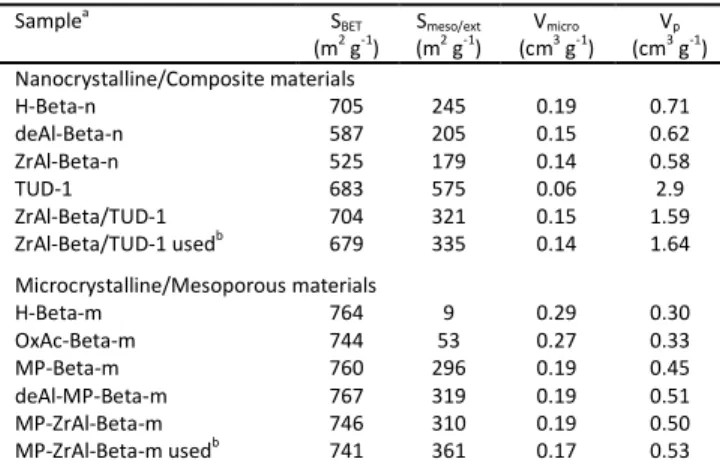
decreased after the modification treatments, particularly dealumination (from 705 m2 g-1 for H-Beta-n to 525-587 m2 g-1 for deAl-Beta-n and ZrAl-Beta-n). The three materials possessed considerable external surface area (179-245 m2 g-1), in agreement with literature data for similarly prepared nanocrystalline materials.79,93,94 For ZrAl-Beta/TUD-1 and TUD-1, the isotherms present features of the type IV, and a hysteresis loop, characteristic of mesoporous materials. Similar isotherms were reported in the literature for TUD-1 type materials,117,118 and composites of H-ZSM-573, Beta38 or ITQ-274 embedded in TUD-1 type matrix. Composite ZrAl-Beta/TUD-1 possessed enhanced SBET, Smeso and Vp in relation
to bulk ZrAl-Beta-n, which can be mainly attributed to the mesoporous component of the composite. On the other hand, Vmicro of ZrAl-Beta/TUD-1 is significantly higher than that of TUD-1 (0.14 and 0.06 cm3/g, respectively), and equal to that of ZrAl-Beta-n, suggesting that the microporosity in the composite is mainly associated with the zeotype component. The mesopore size distribution curves of ZrAl-Beta/TUD-1 and TUD were broad, with median at ca. 26 nm (inset of Figure 4-a). Comparable results have been described in a patent for these types of materials.42
Figure 4 N2 adsorption-desorption isotherms at -196 C for: (a) (□) H-Beta-n, (-)
deAl-Beta-n, (+) ZrAl-deAl-Beta-n, (x) ZrAl-Beta/TUD-1, (o) ZrAl-Beta/TUD-1 used, (∆) TUD-1 (the mesopore size distribution curves for ZrAl-Beta/TUD-1 (fresh and recovered after Fur conversion) and TUD-1 are given in the inset, with matching symbols); (b) (o) H-Beta-m, (×) OxAc-Beta-m, (Δ) Beta-m, (+) deAl-Beta-m, (-) ZrAl-Beta-m and (□) MP-ZrAl-Beta-m used (the mesopore size distribution curves for MP-Beta-m, deAl-MP-Beta-m, MP-ZrAl-Beta-m (fresh and recovered after Fur conversion) are given in the inset, with matching symbols). The lines are visual guides.
Catalysis
Science
&
Technology
Accepted
Manuscript
Table 2 Textural properties of the prepared materials. Samplea SBET (m2 g-1 ) Smeso/ext (m2 g-1 ) Vmicro (cm3 g-1 ) Vp (cm3 g-1 ) Nanocrystalline/Composite materials H-Beta-n 705 245 0.19 0.71 deAl-Beta-n 587 205 0.15 0.62 ZrAl-Beta-n 525 179 0.14 0.58 TUD-1 683 575 0.06 2.9 ZrAl-Beta/TUD-1 704 321 0.15 1.59 ZrAl-Beta/TUD-1 usedb 679 335 0.14 1.64 Microcrystalline/Mesoporous materials H-Beta-m 764 9 0.29 0.30 OxAc-Beta-m 744 53 0.27 0.33 MP-Beta-m 760 296 0.19 0.45 deAl-MP-Beta-m 767 319 0.19 0.51 MP-ZrAl-Beta-m 746 310 0.19 0.50 MP-ZrAl-Beta-m usedb 741 361 0.17 0.53 a
In the sample names, n stands for nanocrystalline, m for microcrystalline, deAl for partially dealuminated, and MP for mesoporous. b Catalyst recovered from catalytic reaction of Fur/2BuOH, at 150 C.
The materials ZrAl-Beta/TUD-1 and ZrAl-Beta-n exhibited very different FT-IR (Figure 5-a) and DR UV-vis (Figure S4-a) spectral features from bulk ZrO2, suggesting that the SSIE for Zr to give
ZrAl-Beta-n, and, on the other hand, the embedment of ZrAl-Beta-n in the mesoporous matrix did not lead to formation of zirconium oxide particles (consistent with PXRD). Figure 5-a compares the FT-IR spectra of ZrAl-Beta/TUD-1, ZrAl-Beta-n and its synthetic precursors. In general, the materials exhibit the main spectral features of Beta type zeolite, and small differences between the materials are associated with the modification treatments. H-Beta-n exhibits main bands at 1228 cm-1 attributed to internal asymmetric stretching vibrations of [TO4] tetrahedra (T=Si, Al), 1093 cm
-1
and 796 cm-1 attributed to external asymmetric and symmetric stretching vibrations, respectively, of [TO4] tetrahedra; 620 cm
-1
, 574 cm-1 and 522 cm-1 attributed to double ring external vibrations of [TO4] tetrahedra, and 464 cm-1 attributed to internal T-O bending vibrations of [TO4] tetrahedra).108,113,114,119-122 The band at 426 cm-1 is assigned to pore opening vibrations.114,122 For deAl-Beta-n, changes in relative intensities of the bands at 575 cm-1 and 525 cm-1 (characteristic of zeolite Beta) were observed, possibly associated with the removal of framework Al species.108,113,123 A band at 951 cm-1 is assigned to Si–O stretching vibrations of Si–OH groups present at connectivity defects formed during the dealumination process.79,108,113 For ZrAl-Beta-n, the relative intensity of the band at 951 cm-1 was lower than for deAl-Beta-n, suggesting a lower amount of connectivity defects in the former material, and the insertion of Zr at defect sites of deAl-Beta-n.79,93,108 The spectrum of Beta/TUD-1 is similar to that of ZrAl-Beta-n, suggesting that the chemical structure of ZrAl-Beta-n was essentially preserved under the conditions used to synthesise the composite. ZrAl-Beta/TUD-1 and ZrAl-Beta-n exhibited different spectral features from bulk ZrO2, suggesting the absence of
zirconium oxide particles in the prepared materials (consistent with PXRD and DR UV-vis).
Figure 5 FT-IR spectra of (a) composite ZrAl-Beta/TUD-1 (fresh and recovered after Fur conversion), ZrAl-Beta-n and its synthetic precursors, bulk ZrO2 and TUD-1; (b)
MP-ZrAl-Beta-m (fresh and recovered after Fur conversion), its synthetic precursors, and ZrO2.
The materials were characterised by FT-IR of adsorbed deuterated acetonitrile (CD3CN) to help gain insights into the chemical nature
of the Zr-sites (Figure 6). According to the literature, CD3CN may
interact with framework Zr-sites, and not with zirconium oxide particles.124 It was reported in the literature for Zr-containing beta type zeolites that the tetrahedral Zr-species may be closed-sites (Zr-(OSi)4) or open-sites (Zr-(OSi)3(OH), where the hydroxyl ligand may be formed via Zr-O-Si scissoring.124,134-137 Beta/TUD-1 and ZrAl-Beta-n exhibited bands at ca. 2303 and 2274 cm-1 (Figure 6-a). The band at ca. 2303 cm-1 is assigned to C≡N bond stretching vibrations of CD3CN coordinated with framework zirconium closed-sites.124
The band centred at ca. 2274 cm−1 is due to CD3CN interacting with
Si-OH groups.125,126 The relative intensity of the band at 2274 cm−1 was higher for the composite than ZrAl-Beta-n, possibly due to enhanced contribution of the siliceous matrix with silanol groups. Increasing the CD3CN coverage did not lead to significant shifts in
the band maxima, and a weak shoulder appears at ca. 2268 cm−1 due to physisorbed CD3CN (exemplified for ZrAl-Beta-n in Figure 6-b).
According to the literature, Sn-containing Beta zeotype prepared via hydrothermal synthesis125, or via post-synthesis treatments (dealumination and introduction of Sn-species)127, exhibit bands at ca. 2308 and ca. 2316 cm-1 due to CD3CN adsorbed on tin closed-
and open-sites, respectively. ZrAl-Beta/TUD-1 and ZrAl-Beta-n did not exhibit a spectral band at ca. 2316 cm-1. However, we cannot fully exclude the possibility of existing zirconium open-sites in the materials prepared, in agreement with detailed vibrational spectroscopic studies reported by Irina and coworkers, for (Al-free) Zr-Beta (synthesised via fluoride-based hydrothermal method).124
Figure 6 FT-IR spectra of CD3CN adsorbed on (a) ZrAl-Beta-n (thick line),
ZrAl-Beta/TUD-1 (thin line) and MP-ZrAl-Beta-m (dashed line), or (b) ZrAl-Beta-n with increasing
coverage.
Catalysis
Science
&
Technology
Accepted
Manuscript
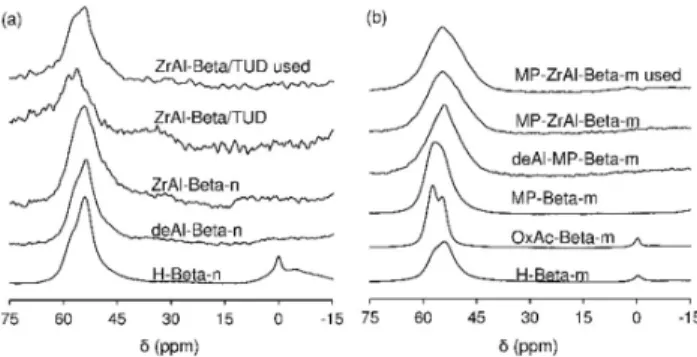
The nature of the Al species in the prepared materials was investigated by 27Al MAS NMR spectroscopy (Figure 7-a). Zeolite H-Beta-n exhibited a predominant resonance at ca. 54 ppm due to aluminium species in tetrahedral coordination (Altetra), and a weak resonance at ca. 0 ppm due to aluminium species in octahedral coordination (Alocta) which may be extra-framework species or species connected to the framework and formed from Altetra. 108,128-133. The spectrum of deAl-Beta-n displays an Al
tetra signal, but no
peak at 0 ppm could be distinguished. The spectrum of ZrAl-Beta-n is similar to that of deAl-Beta-n, suggesting that SSIE/calcination did not affect Altetra (Figure 7-a). The composite ZrAl-Beta/TUD-1
exhibited a broad signal in the region associated with Altetra; the
spectrum is poorly resolved due to the very low Al concentration (Table 1). In general, the signal assigned to Altetra is somewhat
broad, indicating chemical distributions of framework Al(OSi)4 groups with varying bond angles and lengths, possibly at different crystallographic positions of the zeolite framework.128,130,131 In summary, ZrAl-Beta/TUD-1 and ZrAl-Beta-n seem to possess essentially Altetra (responsible for Brönsted acidity).
Table 3 compares the acid properties of Beta/TUD-1 and ZrAl-Beta-n measured by FT-IR of adsorbed pyridine, at 150 C. The two materials possessed Brönsted acid sites (B), and mostly Lewis acid sites (L). The composite possessed lower total amount of acid sites (L+B) than the bulk zeotype, likely due to dilution effects; ZrAl-Beta/TUD-1 consists of a zeotype component dispersed in a siliceous matrix. For the two materials, evacuation at 350 C led to considerable decrease in the amount of adsorbed pyridine (L350/L150=0.1 and B350/B150=0), suggesting that most of the L and B acid sites are relatively weak. ZrAl-Beta/TUD-1 and ZrAl-Beta-n possess similar acid strengths (L350/L150 as well as B350/B150 were the same for the two materials).
Figure 7 27Al MAS NMR spectra of: (a) the composite ZrAl-Beta/TUD-1 (fresh and
recovered after Fur conversion), ZrAl-Beta-n and its synthetic precursors; (b) MP-ZrAl-Beta-m and its synthetic precursors.
Table 3 Acid properties of the Zr,Al-containing materials.a
Sample L (µmol g-1) B (µmol g-1) L+B (µmol g-1) L/B ZrAl-Beta-n 106 36 142 2.9 ZrAl-Beta/TUD-1 79 16 95 4.8 MP-ZrAl-Beta-m 73 10 83 7.5
a Determined by FT-IR of adsorbed pyridine, at 150 C; B=Brönsted acid sites, L=Lewis acid sites, B+L=total amount of acid sites.
The measured amounts of B and L acid sites of the composite were compared to the corresponding values (theoretical) calculated for
42 wt% loading of Beta-n (using the measured values for Beta-n, Table 3). The measured amount of B acid sites of ZrAl-Beta/TUD-1 (16 µmol g-1, Table 3) is similar to the calculated value (15 µmol g-1). These results suggest that the B acidity of ZrAl-Beta-n was not significantly affected by the in situ synthesis of the mesoporous matrix. The composite seems to possess enhanced L acidity, since the measured amount (79 µmol g-1) was higher than the calculated value (45 µmol g-1). Pristine silica TUD-1 and bulk zirconia were analysed for comparative studies, and possessed negligible acidity. Hence, the enhanced L acidity of ZrAl-Beta/TUD-1 is associated with framework species of the zeotype component. It was reported in the literature for Zr-containing beta type zeolites, that framework zirconium closed-sites and open-sites may act as L acid sites (open-sites may be stronger L sites), and the open-sites may also contribute with B acidity.124,134-136 Accordingly, conversion of closed-sites into open-sites may lead to enhanced amount of B sites without affecting considerably the amount of L acid sites, and the L acid strength may be enhanced. These trends in acid properties were not observed for the composite ZrAl-Beta/TUD-1 in relation to the bulk material ZrAl-Beta-n. Overall, the results suggest that the synthesis conditions of the TUD-1 type matrix did not significantly influence the surface chemistry of the zeotype component. The enhanced amount of L acid sites of the composite may be partly due to favourable nanocrystallites dispersion effects in comparison to bulk (aggregated) ZrAl-Beta-n.
Mesoporous zeotype MP-ZrAl-Beta-m. The synthesised zeolite
H-Beta-m possessed a Si/Al molar ratio of 20 (Table 1), which is in the range of values considered favourable for post-synthesis alkaline treatment without drastic loss of crystallinity.106,123,138,139 For example, Tian et al.122 reported that the crystallinity could be retained when treating Beta zeolites possessing Si/Al molar ratios in the range of 14.5-21 with 0.2 M NaOH (similar to that used in the present work). The oxalic acid treatment (step (i)) led to OxAc-Beta-m possessing higher Si/Al ratio (50), in agreeOxAc-Beta-ment with literature data for similarly modified zeolite Beta.106,123,140 The alkaline treatment (step (ii)) gave MP-Beta-m possessing a reduced Si/Al ratio of 33 due to desilication. Subsequent HNO3 treatment (step
(iii)) led to deAl-MP-Beta-m with an enhanced Si/Al ratio of 285 due to dealumination. The SSIE for Zr gave MP-ZrAl-Beta-m with Si/Zr = 86 (Zr/Al = 4), and a comparable Si/Al ratio to deAl-Beta-n. Figure1-b compares the PXRD patterns of MP-ZrAl-Beta-m and its synthetic precursors. The PXRD patterns of H-Beta-m and OxAc-Beta-m are similar, showing characteristic reflections of BEA topology; predominantly 7.7 and 22.4 2θ, and less intense peaks at 13.5 , 14.5 , 21.3 , 25.3 , 27.1 , 28.7 , 29.5 , 33.3 and 43.5 2θ.38,108,112,121,141 The stability of zeolite Beta towards the oxalic acid treatment is in agreement with that reported by Tang et al.106 and Tian et al.123 MP-Beta-m exhibited the two main reflections characteristic of zeolite Beta (7.7 and 22.7 2θ), while weaker reflections were hardly distinguished, suggesting partial loss of crystallinity during the alkaline treatment. Similar results were reported previously for similarly treated Beta materials.123,139,142,143 Subsequent dealumination and SSIE for Zr did not significantly affect the crystalline structure. No crystalline phases of zirconia,
alumina and/or silica were found in the PRXD patterns of the
Catalysis
Science
&
Technology
Accepted
prepared materials, suggesting fairly homogeneous metal dispersions.
Figure 8 shows the SEM images and elemental mappings of MP-ZrAl-Beta-m and its synthetic precursors. Zeolite H-Beta-m consists of ca. 2 µm size crystals, possessing a truncated square bypiramidal structure. Similar morphology has been reported in the literature for microcrystalline zeolite H-Beta.108,144-146 The morphological characteristics of H-Beta-m are comparable to those of the modified materials, excluding MP-ZrAl-Beta-m which had a less regular morphology. Elemental mappings of H-Beta-m, OxAc-Beta-m and MP-Beta-OxAc-Beta-m suggest hoOxAc-Beta-mogeneous dispersions of Si and Al. For deAl-MP-Beta-m and MP-ZrAl-Beta-m, the Al and (Zr,Al) dispersions, respectively, seem to be homogeneous; the poor level of colour contrast of these mappings is likely due to the low Al and Zr concentrations.
The N2 adsorption-desorption isotherms and textural properties of MP-ZrAl-Beta-m and its synthetic precursors are given in Figure 4-b and Table 2, respectively. Precursors H-Beta-m and OxAc-Beta-m exhibited type I isotherms, characteristic of microporous materials. MP-Beta-m exhibited type IV isotherm features, and a hysteresis loop, characteristic of mesoporous materials (Figure 4-b). In comparison to OxAc-Beta-m, MP-Beta-m possessed enhanced Smeso
(296 m2 g-1) and reduced Vmicro (0.19 cm3 g-1) (Table 2). The Smeso for
MP-Beta-m is in the range of values reported in the literature for alkaline treated microcrystalline H-Beta (increases from 20-128 m2/g for the parent zeolites to 336-510 m2 g-1 for the corresponding treated materials).12,123,138,139,147,148 From OxAc-Beta-m to MP-Beta-m, the decrease of Vmicro was equal to the increase of Vp. Hence, for MP-Beta-m, the difference between Vp and Vmicro likely corresponds to intracrystalline mesoporous volume. Further modification treatments leading to deAl-Beta-m (dealumination) and MP-ZrAl-Beta-m (SSIE for Zr) did not lead to considerable changes in textural properties. The mesopore size distribution curves of MP-Beta-m, deAl-MP-Beta-m and MP-ZrAl-Beta-m were comparable, and centred in the range of ca. 3-4 nm (inset of Figure 4-b). In general, these results parallel those reported by Tang et al.106 for similarly prepared materials.
Figure 8 SEM and elemental mapping of a) H-Beta-m, b) OxAc-Beta-m, c) MP-Beta-m, d) deAl-MP-Beta-m, e) MP-ZrAl-Beta-m and f) MP-ZrAl-Beta-m used.
MP-ZrAl-Beta-m exhibited very different FT-IR (Figure 5-b) and DR-UV-vis (Figure S4-b) spectral features from bulk ZrO2, suggesting
that the SSIE for Zr did not lead to the formation of zirconium oxide particles. In general, the materials exhibited the main FT-IR spectral
features characteristic of Beta type zeolite (the band assignments match those discussed above for nanocrystalline H-Beta-n and related materials) (Figure 5-b).108,113,121,149 The modification treatments led to small spectral differences. Enhanced relative intensities of the bands at 575 cm-1 and 525 cm-1 for OxAc-Beta-m may be associated with partial dealumination.108,113,123 For MP-Beta-m, the less resolved bands in the range of 460-620 cm-1 and the disappearance of the band at 426 cm-1 indicate that changes occurred in the framework during the desilication process. The SSIE for Zr (MP-ZrAl-Beta-m) led to a decrease in the relative intensity of the band at 952 cm-1 ascribed to silanol defect sites, suggesting the successful introduction of (tetrahedral) Zr in the zeolite framework.79,108,150 On the other hand, the enhanced relative intensity of the band at 578 cm-1 for MP-ZrAl-Beta-m may be due to enhanced framework vibrations after the SSIE process, in agreement with literature data.94,108
The type of framework Zr-sites of MP-ZrAl-Beta-m was investigated by FT-IR of adsorbed deuterated acetonitrile (CD3CN) (Figure 6). MP-ZrAl-Beta-m exhibited bands at ca. 2274 and 2303 cm-1 assignable to Si-OH groups and zirconium closed-sites, respectively.124-126 The IR spectra are similar for MP-ZrAl-Beta-m and the composite.
Figure 7-b compares the 27Al MAS NMR spectra for MP-ZrAl-Beta-m and its synthesis precursors. The spectrum of the parent zeolite H-Beta-m shows a strong resonance centred at ca. 54 ppm due to Altetra, and a weak resonance at 0 ppm attributed to Alocta. The latter
resonance disappears after desilication (MP-Beta-m), and does not reappear after dealumination (deAl-MP-Beta-m) or SSIE for Zr (MP-ZrAl-Beta-m); these materials exhibited a single broad peak associated with Altetra (responsible for Brönsted acidity). According to the literature, alkaline treatments may lead to reinsertion of extra-framework aluminum into the framework.151 The signals assigned to Altetra are broad and may comprise overlapping
resonances (e.g. two resolved resonances are observed for OxAc-Beta-m at ca. 54 and 57 ppm), indicating chemical distributions of framework [Al(OSi)4] groups with varying bond angles and
lengths.128,130,131
MP-ZrAl-Beta-m possesses B and mostly L acidity, ascertained by FT-IR spectroscopy of pyridine adsorbed on the material (Table 3). Evacuation at 350 C led to considerable decrease in the amount of adsorbed pyridine; L350/L150=0.1 and B350/B150=0, suggesting that the B acid sites and most of the L acid sites are relatively weak. MP-ZrAl-Beta-m is comparable to ZrAl-Beta/TUD-1 and ZrAl-Beta-n in terms of acid strength.
A comparative study for the three Zr-containing materials prepared indicated that the total amount of acid sites (L+B) tended to increase with the molar ratio (Zr+Al)/Si (Tables 1 and 3), consistent with surface acidity being associated with Zr- and Al-sites. On the other hand, the amount of L acid sites (Table 3) increased with the molar ratio Zr/Si (linear relationship, R2=0.998 (not shown)), suggesting that the L acidity is essentially associated with Zr-sites. This hypothesis is somewhat supported by the very low molar ratios Si/Al (Table 1), and the 27Al MAS NMR studies (the materials exhibited no clearly distinguishable peak at ca. 30 ppm due to L acid aluminium sites, Figure 7). Accordingly, the measured L acidity of the three Zr-containing materials prepared may be essentially
associated with framework Zr-sites, which are known to possess
Catalysis
Science
&
Technology
Accepted
intrinsic catalytic activity for Fur conversion.78,110 Based on the above considerations, tentative relationships between the catalytic results and Zr-sites were made using turnover frequencies calculated per amount of L acid sites.
3.2 Catalytic studies
Composite ZrAl-Beta/TUD-1. The reaction of Fur in the presence of
the composite ZrAl-Beta/TUD-1, using 2-butanol (2BuOH) with the dual function as solvent and H-donor, in the temperature range 120-150 C, gave mainly the bio-products (bioP) 2-butyl furfuryl ether (2BFE), 2-butyl levulinate (2BL) and angelica lactones (AnLs), which were formed with total yields of up to 93% at 96% Fur conversion (Figures 9 and S5). Other reaction products included furfuryl alcohol (FA), levulinic acid (LA) and γ-valerolactone (GVL) which were always formed in less than 2% yield each. The reaction of Fur without catalyst at 150 C was sluggish (20% conversion and negligible bioP yields at 24 h), affirming the catalytic role of ZrAl-Beta/TUD-1 in Fur conversion.
The composite ZrAl-Beta/TUD-1 led to a similar product spectrum to that reported in the literature (to the best of our knowledge, there are only two studies) for Zr-containing Beta type materials tested as catalysts under similar Fur reaction conditions, namely (Zr)SSIE-Beta sample of ref.
79
which was prepared in a similar fashion to ZrAl-Beta-n; and mechanically mixed (Al-free) Zr-Beta and (Zr-free) Al-MFI-ns of ref.78 in which Zr-Beta was synthesised via HF-based prolonged hydrothermal synthesis, and Al-MFI-ns consisted of nanosheets with MFI topology obtained via surfactant-mediated hydrothermal synthesis. The fact that the product spectrum was similar for the three catalytic systems suggests that a similar overall reaction mechanism is involved. The overall reaction of Fur may involve catalytic transfer hydrogenation (CTH) where the alcohol solvent simultaneously acts as H-donor, and acid-catalysed reactions indicated in Scheme 1.79,93 The CTH steps include Fur-to-FA conversion152-154 (initialising the cascade reaction process) and, further down the cascade process, 2BL-to-GVL conversion.78,79,93,137,155 The low FA yields (<2%) observed for ZrAl-Beta/TUD-1 is an indication of its high reactivity, undergoing acid-catalysed reactions.79,93 The acid-catalysed steps include an etherification reaction between FA and 2-butanol to give 2BFE, ring-opening of 2BFE to give 2BL, an esterification reaction between LA and 2-butanol to give 2BL, isomerisation of FA to AnLs, conversion of 2BFE to AnLs, and hydration of AnLs to give LA (Scheme 1). The effectiveness of ZrAl-Beta/TUD-1 for the Fur-to-bioP conversion is an indication that it possesses adequate active sites for the reduction and acid chemistry involved. The Zr-sites may promote the CTH steps, and, on the other hand, the Zr- and Al-sites may promote the acid-catalysed steps, with Al-sites enhancing the steps FA-to-AnLs, 2BFE-to-AnLs, ring-opening reaction of 2BFE-to-2BL, and esterification of LA-to-2BL.78,79,93 Accordingly, the high Zr/Al molar ratio (Table 1) of ZrAl-Beta/TUD-1 at least partly explains the fact that the predominant bioP is 2BFE.
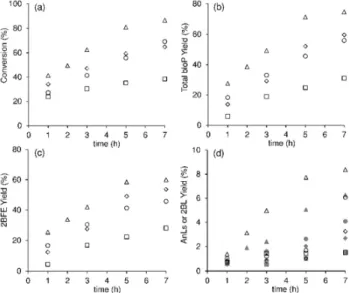
Figure 9. Influence of reaction temperature (T) and catalyst load (CatLoad) on (a) Fur conversion, (b) total bioP yield, (c) 2BFE yield, and (d) AnLs (unfilled symbols) and 2BL (grey symbols) yields, in the presence of ZrAl-Beta/TUD-1, using 2-butanol as solvent and H-donor: (squares) T=120 C, CatLoad=12 9 gcat dm
-3
; (circles) T=120 C, CatLoad=25.7 gcat dm-3; (diamonds) T=150 C, CatLoad=12.9 gcat dm-3; (triangles) T=150
C, CatLoad=25.7 gcat dm -3
.
It has been reported that bulk ZrO2 was ineffective for the reaction of Fur, and that the active Zr-sites of ZrAl-containing Beta type catalysts are framework species.78,110 The catalytic performance of ZrAl-Beta/TUD-1 was compared to that of (Zr-free) composite H-Beta/TUD-1; this sample was previously tested and effective for the acid-catalysed conversion of xylose to Fur, at 170 C.44 The reaction of Fur in the presence of H-Beta/TUD-1 was sluggish (5% total bioP yield at 44% conversion, 24 h; T=150 C, CatLoad=25.7 gcat dm
-3
) compared to ZrAl-Beta/TUD-1 (75% total yield at 97% conversion, 24 h). These results are consistent with the determinant role of Zr-sites in triggering the cascade reaction process via the CTH step Fur-to-FA (which leads to the bioP). Based on the characterisation studies and in agreement with the literature, tetrahedral (framework) Zr-sites are likely the active Lewis acid sites of the Fur-to-FA conversion.78,110
The alcohol solvent acts simultaneously as H-donor in the CTH steps. Besides 2BuOH, 2-propanol (2PrOH) has been identified as an effective H-donor solvent for the conversion of carbohydrate biomass-derived chemicals.93,155,156 The reaction of Fur with 2PrOH in the presence of ZrAl-Beta/TUD-1 gave furfuryl 2-propyl ether (2PFE), 2-propyl levulinate (2PL) and AnLs, which parallels the product spectrum of the Fur/2BuOH system (T=120 C, CatLoad=25.7 gcat dm-3, Figure S6). The dependence of total bioP yield on conversion was roughly coincident for the two alcohols (Figure S6-b), although the reaction of Fur was slower in 2PrOH than in 2BuOH (42% and 69% conversion at 7 h, respectively, Figure S7-a). These results somewhat parallel literature data reported by our group for a Sn,Al-containing Beta type catalyst tested under identical Fur reaction conditions93, suggesting that 2BuOH is a favourable H-donor solvent for this reaction system.
The influence of the catalyst load (CatLoad) and temperature (T) on the Fur/2BuOH reaction in the presence of ZrAl-Beta/TUD-1 is shown in Figure 9. For T=120 C and CatLoad=12.9 gcat dm
-3 the
Catalysis
Science
&
Technology
Accepted
Manuscript
reaction was relatively slow (39% conversion and 31% total bioP yield, at 7 h). Increasing the CatLoad from 12.9 to 25.7 gcat dm
-3
at 120 C was kinetically favourable (69% conversion and 56% total bioP yield, at 7 h). A similar trend in kinetics was observed when increasing T from 120 to 150 C, using a CatLoad of 12.9 or 25.7 gcat dm-3. The set of reaction conditions (T=150 C, CatLoad=12.9 gcat dm-3) and (T=120 C, CatLoad=25.7 gcat dm-3) led to comparable
catalytic results, with 2BFE as predominant bioP. For a reaction time of 7 h, the highest conversion and total bioP yield (87% and 75%, respectively) were obtained for CatLoad=25.7 gcat dm-3 and T=150
C.
As mentioned above, other products of the Fur/2BuOH reaction system included LA and GVL which were formed in low yields. LA and GVL are value-added chemicals reported by the US Department of Energy.157,158 From Scheme 1 it can be verified that these products are formed further down the cascade reactions of Fur, with GVL as an important end-product. According to the literature, GVL may be formed from LA155,159,160 or LEs87,155,156,161 in alcohol media via CTH reaction, in the presence of zirconium-containing catalysts. The catalytic potential of ZrAl-Beta/TUD-1 for GVL production was further investigated using LA and 1-butyl levulinate (1BL) as model substrates (CatLoad=25.7 gcat dm-3, T=150 C, Figures
10 and 11). With LA as substrate, 2BL and GVL were formed with very high total selectivity at high LA conversion, although the reaction was slow (91% total selectivity at 91% LA conversion reached at 72 h). With 1BL, ZrAl-Beta/TUD-1 led to high very GVL selectivity (Figure 11-b), but the reaction was slow (91% selectivity at 59% conversion, 72 h reaction, Figure 10). For the two substrates, a long induction period was observed in the formation of GVL. The kinetic profiles are consistent with a reaction mechanism involving esterification of LA to give the levulinate ester, followed by reduction and lactonization reactions leading to GVL, in agreement with the literature.87,156,159,161 Based on these results, the low GVL yield for Fur conversion may be partly due to slow conversion of the LA and levulinate ester intermediates. Nevertheless, ZrAl-Beta/TUD-1 with LA as substrate led to much higher 2BL and GVL yields (53% 2BL and 31% GVL yield at 91% LA conversion) than with Fur (14% 2BL and 1% GVL yield at 97% Fur conversion), suggesting that it is a more effective catalyst for carrying out the reaction systems Fur-to-FEs and LA-to-(LEs, GVL) separately.
Figure 10 Catalytic performance of ZrAl-Beta/TUD-1 in the reaction of Fur (−), LA (◊) or 1BL (•). Reaction conditions: 0.45 M substrate in 2BuOH, CatLoad=25.7 gcat dm-3, T=150
C.
Figure 11 Catalytic performance of ZrAl-Beta/TUD-1 in the reactions of LA and 1BL: (a) dependence of 2BL () and GVL (∆) selectivity on LA conversion; (b) dependence of GVL (∆) selectivity on 1BL conversion. Reaction conditions: 0.45 M substrate in 2BuOH, CatLoad=25.7 gcat dm
-3
, T=150 C.
ZrAl-Beta/TUD-1,its individual components, and MP-ZrAl-Beta-m.
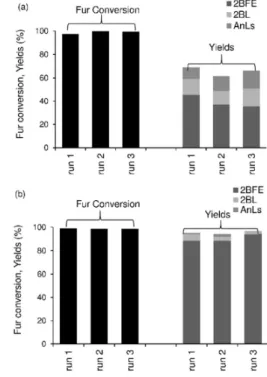
The catalytic performance of ZrAl-Beta/TUD-1 in the Fur conversion process was compared to those of: (i) bulk mesoporous silica TUD-1 used in an amount equivalent to the mass of the TUD-1 type component added in ZrAl-Beta/TUD-1; (ii) nanocrystalline ZrAl-Beta-n used iZrAl-Beta-n aZrAl-Beta-n amouZrAl-Beta-nt equivaleZrAl-Beta-nt to the mass of zeotype compoZrAl-Beta-neZrAl-Beta-nt added in ZrAl-Beta/TUD-1; and (iii) mechanically mixed TUD-1 and ZrAl-Beta-n (denoted ZrAl-Beta-n+TUD-1), used in amounts (total load of 25.7 g dm-3) equivalent to the respective masses added with ZrAl-Beta/TUD-1 (T=150 C, Figures 12 and 13). The mesoporous silica TUD-1 led to 27% Fur conversion and negligible total bioP yield at 24 h reaction, similar to that observed without catalyst (20% conversion). Hence, the active sites of the composite are located in its zeotype component, which is consistent with the acid properties measurements (silica TUD-1 possessed negligible acidity). For bulk ZrAl-Beta-n as catalyst, lower Fur conversion and total bioP yields were reached than for the composite. Hence, the performance of ZrAl-Beta/TUD-1 is superior to that of the individual components. The composite catalyst led to higher total bioP yields at high Fur conversions than the mechanical mixture ZrAl-Beta-n+TUD-1 (Figure 12-a), while the reaction rates were similar (69% and 59% total yield, respectively, at 97% conversion, Figure 11). The embedment of the nanocrystallites in the mesoporous siliceous matrix seems to avoid extensive side reactions at high Fur conversions. The presence of carbonaceous matter (CM) in the used solids was confirmed by thermal analyses. The DSC curves of the used ZrAl-containing catalysts show two exothermic peaks at ca. 370 and 470 C, which were not observed for the fresh catalysts. These exothermic processes were accompanied by mass loss attributed to the decomposition of CM (exemplified in Figure S7-a for ZrAl-Beta/TUD-1). The amount of CM in the used solids followed the order ZrAl-Beta-n (28.5 wt%) >> ZrAl-Beta-n+TUD-1 (16.3 wt%) > ZrAl-Beta/TUD-1 (15.7 wt%). The material balances (considering unconverted Fur, identified products (i.e., FA, 2BFE, 2BL, AnLs, LA, GVL) and the amount of CM) closed in ca. 77-79% for ZrAl-Beta-n and ZrAl-Beta-n+TUD-1, and ca. 86% for ZrAl-Beta/TUD-1; the remaining material likely corresponds to soluble byproducts (the liquid phases of the reaction mixtures were brownish in colour). The greater material balance for ZrAl-Beta/TUD-1 was mainly due to the
higher total bioP yield reached with this catalyst.