Why so serious? Gamification impact in the acceptance of
mobile banking services
Goncalo Baptista (NOVA IMS – Information Management School, New University of
Lisbon, Lisbon, Portugal)
Tiago Oliveira (NOVA IMS – Information Management School, New University of
Lisbon, Lisbon, Portugal)
This is the author accepted manuscript version of the article published by EMERALD
as:
Baptista, G., & Oliveira, T. (2017). Why so serious? Gamification impact in the
acceptance of mobile banking services. Internet Research, 27(1), 118-139.
https://doi.org/10.1108/IntR-10-2015-0295
This work is licensed under a
Creative Commons Attribution-NonCommercial 4.0 International License.
Why so serious? Gamification impact in the acceptance of
mobile banking services
Abstract
Purpose – This study intends to identify the potential impact of the utilization of game
mechanics and game design techniques in the acceptance of mobile banking services.
Design/methodology/approach - The theoretical model was tested in a quantitative study using
structural equation modelling (SEM), conducted in Brazil, with actual local banking customers.
Findings – The findings show that there is a direct and strong relationship between gamification
and intention to use mobile banking services, supporting that, when used and designed properly, gamification can help make banking activities more exciting, more interesting, and more enjoyable, and in turn increase customer acceptance, engagement and satisfaction.
Research limitations/implications – The research extends the unified theory of acceptance and
use of technology, UTAUT2, and prior research to include gamification impact. The result is a more descriptive model that better explains consumers’ decision to use mobile banking services.
Practical implications – For practitioners, understanding the key constructs is crucial to design,
refine, and implement mobile banking services that achieve high consumer acceptance and value, and with the right amount of game techniques in them.
Originality/value – The globalisation of business and systems is fuelling the need to acquire a
deeper understand on the impact of gamification in acceptance within the financial industry. This is the first time to our knowledge that UTAUT2 theory and a gamification construct are combined in a mobile banking acceptance work, supported by data from a South American country, enriching the existing literature on this subject and providing new insights into how game technics influences individual behaviour.
Keywords – Mobile, banking, gamification, UTAUT2, acceptance, Brazil Paper type – Research paper
1. Introduction
In recent years there has been explosive growth in the use of mobile devices. These devices have grown from simple voice and messaging platforms into highly flexible and multifunctional devices that can be used almost anytime and anywhere for a wide range of purposes, from utilitarian to fully hedonic (Negahban & Chung, 2014), with a full range of applications installed, tailored to the owner’s needs and wishes. During several years mobile banking has been considered a good example of an almost completely utilitarian service, related to functional, economic, rational, and practical functionalities (Martínez-López et al., 2014), providing a means to an end: pay bills, transfer money, manage savings, etc. Most of the mobile banking services were not fun at all, were about purely simple transactional services. Applying game mechanics to motivate and drive engagement in this nongame context might very well change mobile banking users’ behaviour, improving service acceptance and use.
In the last few years we have witness an accelerated and consistent grow of banks and financial institutions that decided to apply game mechanics and game design techniques to their
Page 2
systems and services. Successful examples such as Banco Bilbao Vizcaya Argentaria Game (allows customers to earn points by using the bank’s transactional site and redeem them for products and services), Saveup.com (allows users to perform financial activities, earn credits and money prizes), Punch the pig (allows users to transfer money to a growth account by punching a pig whenever it pops up), 56 sage street from Barclays (interactive virtual city, where players learn money management skills), or Mint.com (quest for money, game for earning and saving money) have encouraged others financial institution to do the same. Besides finance, game techniques are being used in a broad range of industries and domains, and subjects (Pedreira et al., 2015), such as retail, health, energy, utilities, military, government, and education, at individual and collective levels, to attract participation, encourage creativity, and to help establish a path to collaborative work and common objectives. Gamification is expected to more easily capture and sustain the interest of millennials (25 to 35 years old), the people who were raised on games (Zichermann & Linder, 2013), even though games enjoy unprecedented popularity among all generations. Providing a fun and enjoyable environment can favourably increase users’ perceptions toward acceptance of a technology (Venkatesh et al., 2012). So, why most of mobile banking services remains so serious? Why users can’t have an excellent costumer experience, fun and enjoyment in their interaction with banks?
This work provides several contributions for research, contributing to the advancement of knowledge, exploring and discussing direct implications for mobile banking managers, financial institutions, and users. The main contributions of this study are twofold. First, we investigate the direct effects of the mobile banking acceptance determinants using an integrated model, following Venkatesh et al. ’s (2012) suggestion to test their extended unified theory of acceptance and use of technology theory (UTAUT2) in different countries, age groups and technologies, identifying at the same time factors to extend it. Second, a gamification construct was included in the model in order to evaluate the impact of game mechanics and design technics on mobile banking intention to use. The globalisation of business and systems is fuelling the need to acquire a deeper understand on the impact of gamification in technology acceptance and use within the financial industry. Earlier research on mobile banking acceptance and potential gamification impact analysis is very limited, not following the accelerated and consistent grow of banks and financial institutions that decided to apply it on their systems and services, registered worldwide over the last few years; a gap that we try hereby to reduce. This is the first time to our knowledge that Venkatesh et al.’s (2012) UTAUT2 theory and a gamification construct are combined in a mobile banking acceptance work, supported by data from a South American country, Brazil. Assuming that service acceptance rate is still lower than it could be, lower than expected (Yu, 2012; Zhou et al., 2010), and that new constructs can reinforce results’ significance and predictability, gamification impact was added, aiming to further our understanding of individual and situational characteristics in mobile banking acceptance and use, providing new insights into how game technics influences individual behaviour.
The paper is organized as follows. The theoretical background overview is presented next, starting with Venkatesh et al. ’s (2012) UTAUT2 model description, followed by the gamification concept and antecedents. The work continues with the research model and hypotheses presentation, data collection methodology description, results, managerial implications, and limitations, ending with possible directions for future research.
Page 3
2. Theoretical background
Mobile banking can be defined as a type of execution of financial services in the course of which, within an electronic procedure, the customer uses mobile communication techniques in conjunction with mobile devices (Pousttchi & Schurig, 2004), or as the ability to bank virtually anytime and anywhere (Kiesnoski, 2000). Earlier research has sought to envision mobile banking acceptance as a technical innovation (Al-Jabri & Sohail, 2012), and several different acceptance models have been proposed in the academic literature. One of the most widely accepted is the unified theory of acceptance and use of technology (UTAUT), proposed by Venkatesh et al. (2003). Since its appearance, the UTAUT model has gradually drawn the attention of researchers who have recently applied it to explore user acceptance of mobile technologies (Yu, 2012). A brief summary of this model and gamification background are presented as follow.
2.1. UTAUT acceptance model
The unified theory of acceptance and use of technology (Venkatesh et al., 2003), commonly referred to as UTAUT, was built on eight prominent and preceding theories: the theory of reasoned action (Fishbein & Ajzen, 1975), the technology acceptance model (Davis, 1989), the motivational model (Davis et al., 1992), the theory of planned behaviour (Ajzen, 1991), the PC utilization model (Thompson et al., 1991), the innovation diffusion theory (Rogers, 1995), the social cognitive theory (Compeau & Higgins, 1995), and an integrated model of technology acceptance and planned behaviour (Taylor & Todd, 1995). The model evolved in 2012 to seven constructs, adding hedonic motivation, price value, and habit to the previous version of model and, more important, extending and adapting it to the individual context (Venkatesh et al., 2012). Performance expectancy is now seen by Venkatesh et al. (2012) as the degree to which a technology will provide benefits to consumers in performing certain activities, effort expectancy as the degree of ease associated with consumers’ use of technology, social influence as the extent to which a consumer perceives that friends and family believe they should use a particular technology, facilitating conditions as consumers’ perceptions of resources and support available to perform a behaviour, hedonic motivation as fun or pleasure derived from using a technology, price value as consumers’ cognitive trade-off between the perceived benefits and the monetary cost for using it. Habit is seen as the automatic behaviours performed due to learning (Limayem et al., 2007). A direct relationship between facilitating conditions and behavioural intention was added, and the moderating variables that influence the constructs are now age, gender, and experience, dropping voluntariness from the previous UTAUT.
2.2. Gamification
Gamification can be defined as the use of game mechanics and game design techniques in nongame contexts to design behaviours, develop skills, or to engage people in innovation (Burke, 2012a), or as a technique of influencing the motivation or engagement of people to solve complex problems, to perform certain actions, or to just have fun (Mishra, 2013). Some consider it as a new way of thinking, designing, and implementing solutions (Rodrigues et al., 2013b). Technology has historically been associated with business and work, helping to complete tasks faster, but it also has the potential to fulfil ludic purposes. The idea that people like fun in their
Page 4
lives inspired gamification. Game principles, processes, and systems normally used to influence, engage, and motivate individuals, groups, or communities are now being used to drive behaviours and produce desired effect and results (Rodrigues et al., 2014), transforming customers’ everyday interactions into meaningful and measurable business purposes (Zichermann & Linder, 2010), reducing at the same time perceived barriers to systems use such as low usability, security breaches, or difficulty of use (Yoon, 2009), and providing real positive business impact (Morschheuser et al., 2015).
Play is a universal language characterized by enjoyment, established rules, and tangible and clear goals (Boinodiris, 2012), or as a behaviour reflecting the basic desire for relaxation and entertainment (Kuo & Chuang, 2016). Either played by individual or by teams, gamification can be applied to generate a broad range of innovative or enhanced business applications; it can help visualize and explain complex tasks or functionalities, engaging participants through competition, teamwork, intrigue, curiosity, and problem-solving (Boinodiris, 2012), helping in infusing a feel of ownership of performance and results (Sarangi & Shah, 2015). Points for actions, badges for rewards and leader board for competition, cash prizes, discounts, and other free perks are introduced and used to encourage service engagement (Burke, 2012b), to give positive feedback and reinforce loyalty (Teng & Chen, 2014), to increase mutual cooperation (Al-Dhanhani et al., 2014), to promote specific user behaviours (Mekler et al., 2013) or financial education (DeCos, 2015), to increase financial involvement (Rodrigues et al., 2013b), fidelity (Marlow et al., 2016), and productivity (Hamari & Koivisto, 2015a). There are strongly divided opinions about gamification; some argue that points, badges, and levels are mere gestures that provide structure and measure progress within a system or game (Bogost, 2011), that gamification is ineffective (Montola et al., 2009), or that mixing a game into business like banking that should be taken very seriously just won´t be widely accepted by clients, or even that it might undermine banks reputation of being a thoughtful and earnest partner (Wilson, 2014). Other studies show that the results of the gamification may not be long-term, but just the result of a novelty effect (Hamari, 2013). Nevertheless, almost all scholars agree that gamification techniques may produce a variety of benefits (Hanus & Fox, 2015) with positive effects, but that these greatly depend on the context in which it is being implemented, as well as on the individuals using it (Hamari et al., 2014).
Most current mobile banking services were not designed to be fun or entertaining, just transactional, confirming the salience of the utilitarian values (Kim & Han, 2011) in the early stages of these services. It is expected that applying game techniques in a nongame context such as mobile banking may have a significant impact, perhaps even a transformational one, as it happens in some fields (Burke, 2012a). It can produce enjoyment, satisfaction (Hung et al., 2015), positive emotion, strong social relationship, a sense of accomplishment, and a chance to build a shared sense of purpose (McGonigal, 2011). At the same time helps to make the banking activities more exciting, more interesting, and more enjoyable, increasing customer engagement, satisfaction (Financialbrand.com, 2014), improving performance (Pedreira et al., 2015), and expectably generating more profit to banks (Graham, 2014). Gamification can be viewed as an attempt to convert utilitarian services into more hedonically oriented ones (Hamari, 2013).
Page 5
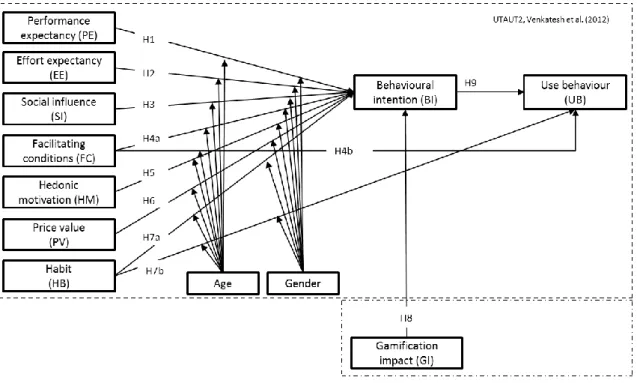
A combination of the unified theory of acceptance and use of technology (UTAUT2) constructs with a new gamification impact construct is used as the theoretical support model for the investigation, according to Figure 1. UTAUT has been empirically tested and proven to be superior to other prevailing models (Park et al., 2007), and is therefore used herein, in its latest version, UTAUT2. The inclusion of a gamification construct in the research model allows us to reach a better understanding of the impact of this factor, which we believe can became one of the most important enhancers or boosters of mobile banking levels of acceptance in the coming years. As gender and age may have a considerable influence on users’ acceptance of mobile banking, both are also considered (Wang et al., 2003).
Figure 1 – Research model
The definition of performance expectancy suggests that individuals will use mobile banking if they believe that it will have positive outcomes (Compeau & Higgins, 1995). In terms of effort expectancy, consumers who find mobile banking easier to use become more willing to conduct banking transactions (Lin, 2011). Social influence reflects the notion that individual behaviour is influenced by the way peers, friends, or family members value the use of mobile banking. It is common for gamification services to include strong social features (Hamari & Koivisto, 2015a). In terms of facilitating conditions, a favourable set of conditions such as on-line tutorials or demos, contribute to a greater likelihood to accept the mobile banking. Therefore, we hypothesize:
H1. Performance expectancy will positively affect behavioural intention moderated by age and
gender.
H2. Effort expectancy will positively affect behavioural intention moderated by age and gender. H3. Social influence will positively affect behavioural intention moderated by age and gender. H4a. Facilitating conditions will positively affect behavioural intention moderated by age and
gender.
Page 6
Hedonic motivation refers to the level of fun or pleasure derived from using mobile banking services (Venkatesh et al., 2012), historically have been linked to the classical motivation principles that people seek pleasure and avoid pain (Higgins, 2006). Price value is the consumers’ cognitive trade-off between the perceived benefits of mobile banking and the monetary cost for using it (Venkatesh et al., 2012); some factors are likely to inhibit acceptance, such as initial service setup costs, transaction fees, or mobile internet costs. Habit reflects the multiple results of previous experiences (Venkatesh et al., 2012) and the frequency of past behaviour is considered to be one of the principal determinants of present behaviour (Ajzen, 2002). If the users find their mobile devices useful, they tend to embed them into their tasks and routines (Negahban & Chung, 2014).Therefore, we hypothesize:
H5. Hedonic motivation will positively affect behavioural intention moderated by age and
gender.
H6. Price value will positively affect behavioural intention moderated by age and gender. H7a. Habit will positively affect behavioural intention moderated by age and gender. H7b. Habit will positively affect use behaviour moderated by age and gender.
Gamification uses social capital, self-esteem, and fun to overtake extrinsic rewards such as motivations for improved performance (Burke, 2012a), engaging by infusing vigor, making users dedicated and enabling them to be absorbed in their tasks (Sarangi & Shah, 2015). It is our believe that applying game techniques in a nongame context such as mobile banking will have a significant impact, increasing service acceptance rates; the greater entertainment the mobile service can provide, the greater will be the acceptance intention of customers (Zhang et al., 2012), even playing a pivotal role in increasing acceptance (Heijden, 2004). Therefore, we hypothesize:
H8. Gamification impact will positively affect behavioural intention.
Behavioural intention has a strong influence on technology use (Venkatesh et al., 2003), it is predictable and influenced by individual intention (Yu, 2012). Given that, the ultimate goal of businesses (i.e., banks) is to attract consumers to adopt their services rather than the intention to adopt services, we hypothesize:
H9. Behavioural intention will positively affect use behaviour.
4. Data collection research methodology
Based on the research model, an English-language questionnaire was created and reviewed for content validity by a group of information systems academics. The questionnaire contains three sections: (i) UTAUT2 data constructs, (ii) gamification questions, (iii) general information and demographic characteristics. The items and scales for the UTAUT2 constructs were adapted from Venkatesh et al. (2003) and Venkatesh et al. (2012), the use behaviour from Martins et al. (2014), and gamification impact from the authors. Each item was measured on a seven point Likert scale whose answer choice ranges from “strongly disagree” (1) to “strongly agree” (7) (Appendix A). The Martins et al. (2014) use behaviour was coded from 1 (never) to 11 (several times per day), according to effective mobile banking use. Age was measured in years, and gender was coded using a 0 (women) or 1 (men). As the data were collected in Brazil, the questionnaire was then translated to Portuguese, submitted to a local Brazilian academic in order to review it and correct whenever necessary according to local speech characteristics, and
Page 7
translated back again to English, by others, in order to validate the translation and ensure consistency (Brislin, 1970). An on-line survey instrument was designed with the revised Portuguese version of the questionnaire, hosted on a popular web service provider for collecting data, based on the fact that studies of technology acceptance have traditionally been successfully conducted using survey research (Venkatesh et al., 2003).
The study sample size needed was defined before delivering the survey instrument. The overall target number was defined according to the research theoretical model and based on a minimum expected rate of answers of 15%, and all the time and costs involved in the respondents’ follow up were initially included. The target population comprised individual adults that: (i) have one or more banking accounts on a local national bank that provide Internet and mobile banking services, (ii) own one or more mobile devices, such as mobile phone, smartphone or tablet, with mobile internet access, (iii) have one or more email addresses. For consumers the use of mobile banking services is a completely voluntary decision. According to target population, an email list of clients from a Brazilian local bank was collected, providing a solid base for the data collection.
The survey was pilot tested among a group of 50 Brazilian customers from the target population who were not included in the final sample. Preliminary evidence showed that scales were reliable and valid. A total of 1350 emails invitations to participate in the survey were then sent in September 2014 using hyperlinks that could be used only once. Second and third follow up reminders were sent over the following weeks inviting users to participate in the survey, according to some of the technics identified by Lynn (2008) for managing non-responses. From the total sample used, 314 users didn’t even open or read none of the emails invitations sent, 56 answered that didn’t want to participate in the study and 149 didn’t conclude the answers and therefore weren’t considered as valid. After the period of 12 weeks 326 valid answers were collected, above the recommended level of 200 (Bagozzi & Yi, 2012), achieving a final response rate of 24%; value considered adequate assuming that mail surveys have a tendency to produce low response rates (Fraenkel & Wallen, 2009). Non-response bias was assessed by comparing the early and the late respondents, respectively 215 and 111 customers, according to Armstrong & Overton (1977) recommendation, using the Kolmogorov–Smirnov (K–S) test. The sample distributions of the two groups did not differ statistically (p>0.10) indicating the absence of nonresponse bias (Ryans, 1974). Common method bias was examined using three different methods: (i) the Harman’s one-factor test (Podsakoff et al., 2003), confirming that none of factors individually explain the majority of the variance, (ii) a marker-variable technique (Lindell & Whitney, 2001), adding a theoretically irrelevant marker variable in the research model, obtaining 0.015 (1.5%) as the maximum shared variance with other variables; a value that can be considered as low (Johnson et al., 2011), and (iii) correlation matrix analysis, with all the variables below the maximum correlation threshold (r < 0.9) (Bagozzi et al., 1991).
More than 78% of respondents were men, more than 55% are aged between 35 and 55, and more than 41% have a master or higher degree. Detailed descriptive statistics on the respondents’ characteristics can be seen in Appendix B. All datasets used in the study are available from authors, on demand.
Page 8
Structural equation modelling (SEM) is a term that has been used to describe a range of statistical models used to evaluate the validity of substantive theories with empirical data (Ringle et al., 2005), for testing measurement, functional, predictive, and causal hypotheses (Bagozzi & Yi, 2012). This approach support that each explanatory and dependent variable is associated with measurement error in contrast to OLS regression, for example, that is based on the assumption that variables are measured perfectly (Bollen, 1989). The research model was tested using partial least square (PLS), a variance-based technique, with Smart PLS 2.0 M3 software (Ringle et al., 2005). This technique is known to have minimal restrictions in terms of residual distributions and sample sizes when compared to other SEM such as covariance-based techniques (Chin, 1998). PLS was considered convenient and appropriate for our research situation according to Henseler et al. (2009), because: (i) not all items in our data are distributed normally (p < 0.01 based on Kolmogorov–Smirnov’s test), (ii) the research model has not been tested in the literature (Hair et al., 2011), (iii) it is supported by a complex model with numerous constructs (Chin, 1998), and (iv) the dimension of our sample is 10 times larger than the maximum number of paths directed to a construct (Gefen & Straub, 2005). All constructs were modelled using reflective indicators. Following Anderson & Gerbing’s (1988) guidelines, our analysis was done in two different steps, (i) reliability and validity assessment of the measurement model and (ii) structural model assessment and hypotheses testing. These two steps are described next.
5.1. Measurement model
Our statistical analysis included the calculation of construct reliability, indicator reliability, convergence validity, and discriminant validity of the measurement model. All of these steps are described as follow.
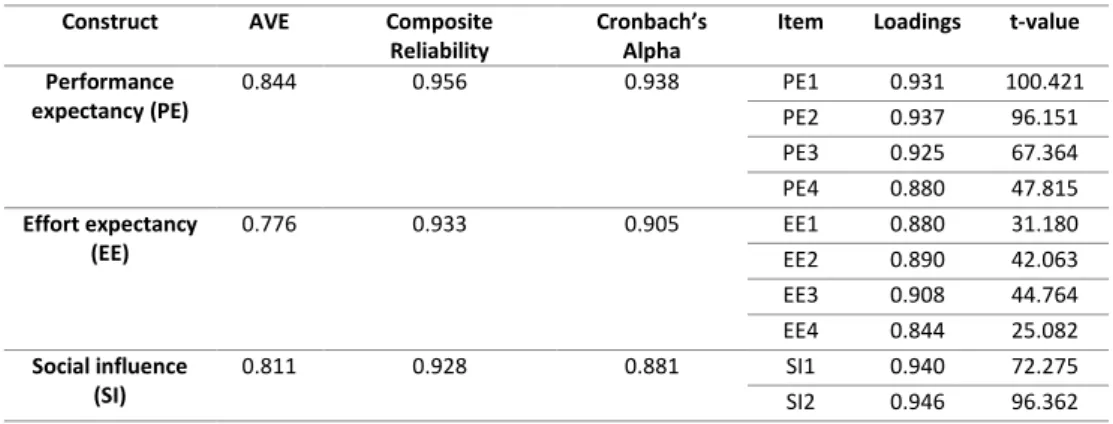
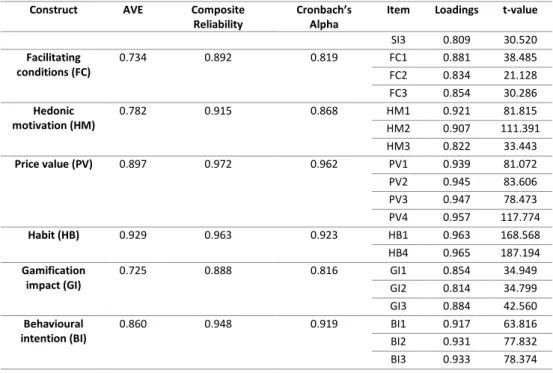
All the constructs have composite reliability and Cronbach’s alpha greater than 0.7, as seen in Table 1, confirming the constructs’ reliability (Straub, 1989). The indicator reliability was evaluated based on the criterion that loading should be higher than 0.7 and that every loading below 0.4 should be eliminated (Churchill, 1979). All of the loadings were higher than 0.7 and statistically significant at 0.01, confirming a good indicator reliability of the instrument. The convergence validity was then tested with average variance extracted (AVE), all constructs compared positively against the minimal acceptable value of 0.50 (Fornell & Larcker, 1981; Henseler et al., 2009).
Table 1 – Quality criteria and factor loadings Construct AVE Composite
Reliability
Cronbach’s Alpha
Item Loadings t-value Performance expectancy (PE) 0.844 0.956 0.938 PE1 0.931 100.421 PE2 0.937 96.151 PE3 0.925 67.364 PE4 0.880 47.815 Effort expectancy (EE) 0.776 0.933 0.905 EE1 0.880 31.180 EE2 0.890 42.063 EE3 0.908 44.764 EE4 0.844 25.082 Social influence (SI) 0.811 0.928 0.881 SI1 0.940 72.275 SI2 0.946 96.362
Page 9
Construct AVE Composite Reliability
Cronbach’s Alpha
Item Loadings t-value SI3 0.809 30.520 Facilitating conditions (FC) 0.734 0.892 0.819 FC1 0.881 38.485 FC2 0.834 21.128 FC3 0.854 30.286 Hedonic motivation (HM) 0.782 0.915 0.868 HM1 0.921 81.815 HM2 0.907 111.391 HM3 0.822 33.443 Price value (PV) 0.897 0.972 0.962 PV1 0.939 81.072 PV2 0.945 83.606 PV3 0.947 78.473 PV4 0.957 117.774 Habit (HB) 0.929 0.963 0.923 HB1 0.963 168.568 HB4 0.965 187.194 Gamification impact (GI) 0.725 0.888 0.816 GI1 0.854 34.949 GI2 0.814 34.799 GI3 0.884 42.560 Behavioural intention (BI) 0.860 0.948 0.919 BI1 0.917 63.816 BI2 0.931 77.832 BI3 0.933 78.374
Fornell-Larcker and cross-loadings criteria were used to analyse discriminant validity. As seen in Table 2, the condition of the square root of AVE being greater than the correlation between constructs (Fornell & Larcker, 1981) is verified. The next step taken was to ensure that each item presents a higher loading on its corresponding factor than the cross-loading on other factors (Chin, 1998). Three items (FC4, HB2, and HB3) failed the test and were excluded. At the end, both criteria were satisfied providing evidence of discriminant validity of the scales. Cross-loadings results are available from authors on request.
Table 2 – Correlation matrix with mean and standard deviation values
Mean SD PE EE SI FC HM PV HB GI BI UB Age Gender
Performance expectancy (PE) 5.472 1.910 0.918 Effort expectancy (EE) 6.053 1.456 0.597 0.881 Social influence (SI) 3.569 2.113 0.397 0.228 0.901 Facilitating conditions (FC) 5.826 1.808 0.530 0.679 0.149 0.856 Hedonic motivation (HM) 3.483 2.078 0.504 0.440 0.562 0.291 0.884 Price value (PV) 5.112 1.936 0.576 0.507 0.349 0.433 0.434 0.947 Habit (HB) 3.885 2.393 0.757 0.578 0.395 0.432 0.558 0.567 0.964 Gamification impact (GI) 4.075 2.379 0.308 0.223 0.417 0.103 0.528 0.228 0.333 0.851 Behavioural intention (BI) 5.387 2.025 0.691 0.551 0.401 0.389 0.499 0.527 0.788 0.453 0.927 Use behaviour (UB) 6.368 3.068 0.689 0.501 0.280 0.428 0.413 0.491 0.794 0.237 0.669 NA Age 46.534 12.227 -0.238 -0.208 -0.072 -0.180 -0.158 -0.256 -0.288 -0.284 -0.260 -0.176 NA Gender 0.785 0.411 -0.024 0.007 0.067 -0.028 0.032 0.038 0.056 -0.007 0.070 0.114 0.155 NA
Page 10
The measurement model results indicate that the model has good construct reliability, indicator reliability, convergence validity, and discriminant validity, ensuring that the constructs are statistically distinct and can be used to test the structural model.
5.2. Structural model and hypotheses testing
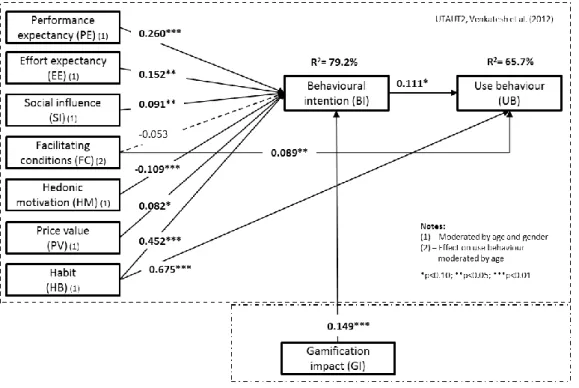
To further test for multicollinearity, normally considered as threat to experimental model design (Farrar & Glauber, 1967), we computed the variance inflation factor (VIF) confirming that it doesn’t exist; all variance inflation factors obtained were lower than 5 (Rogerson, 2001). The analysis of hypotheses and constructs’ relationships were based on the examination of standardized paths. The path significance levels were estimated using the bootstrap resampling method (Henseler et al., 2009), with 500 iterations of resampling (Chin, 1998). The results are summarized and presented in Figure 2.
Figure 2 – Structural model results
The model explains 79.2% of variation in behavioural intention and 65.7% in use behaviour. Performance expectancy (ˆ=0.260; p<0.01), effort expectancy (ˆ=0.152; p<0.05), social influence (ˆ=0.091; p<0.05), price value (ˆ=0.082; p<0.10), habit (ˆ=0.452; p<0.01), and gamification impact (ˆ=0.149; p<0.01) were found to be statistically significant in explaining behavioural intention. Hedonic motivation’s relationship with behavioural intention was also statistically significant (ˆ=-0.109; p<0.10), but the sign was negative, contrary to what was expected. In terms of use behaviour, the statistically significant constructs were facilitating conditions (ˆ=-0.089; p<0.05), habit (ˆ=-0.675; p<0.01), and behavioural intention (ˆ=0.111; p>0.10). The influence of facilitating conditions over behavioural intention was found not statistically significant.
Page 11
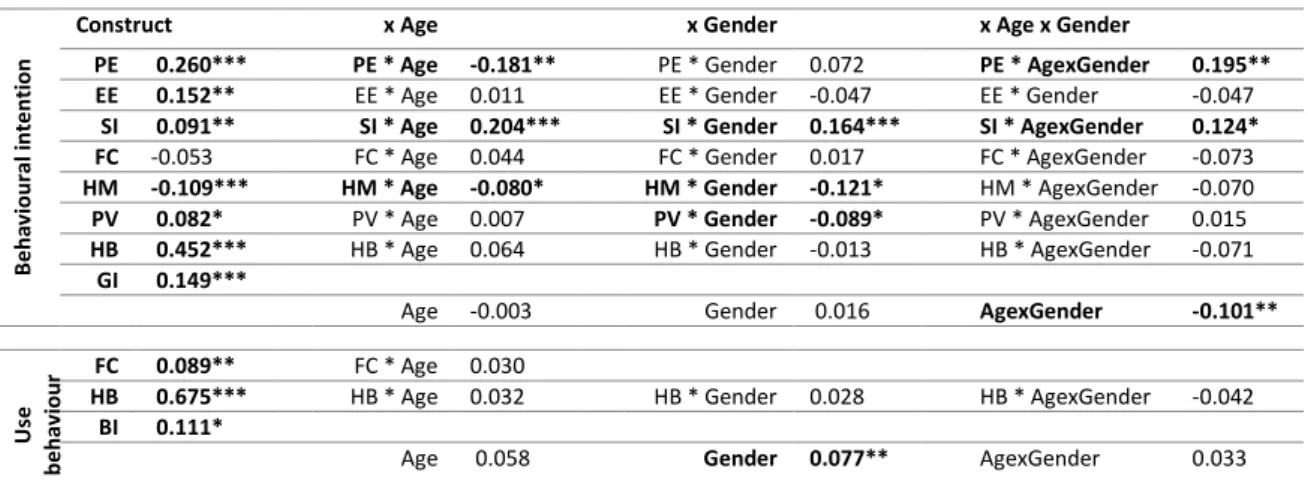
Some of the interaction path coefficients were statistically significant over behavioural intention, as seen in Table 3, namely PE*Age (ˆ=-0.181; p<0.05), PE*AgexGender (ˆ=0.195; p<0.05), SI*Age (ˆ=0.204; p<0.01), SI*Gender (ˆ=0.164; p<0.01), SI*AgexGender (ˆ=0.124; p<0.10), HM*Age (ˆ=-0.080; p<0.10), HM*Gender (ˆ=-0.121; p<0.10) , PV*Gender (ˆ=-0.089; p<0.10), and Age*Gender (ˆ=-0.101; p<0.05). The only interaction over use behaviour found to be significant was gender (ˆ=0.077; p<0.05).
Table 3 – Structural model with path coefficients with direct and interaction effects
B e ha vi oural int e nt ion
Construct x Age x Gender x Age x Gender
PE 0.260*** PE * Age -0.181** PE * Gender 0.072 PE * AgexGender 0.195** EE 0.152** EE * Age 0.011 EE * Gender -0.047 EE * Gender -0.047
SI 0.091** SI * Age 0.204*** SI * Gender 0.164*** SI * AgexGender 0.124* FC -0.053 FC * Age 0.044 FC * Gender 0.017 FC * AgexGender -0.073 HM -0.109*** HM * Age -0.080* HM * Gender -0.121* HM * AgexGender -0.070 PV 0.082* PV * Age 0.007 PV * Gender -0.089* PV * AgexGender 0.015 HB 0.452*** HB * Age 0.064 HB * Gender -0.013 HB * AgexGender -0.071
GI 0.149***
Age -0.003 Gender 0.016 AgexGender -0.101**
Use
be
hav
iou
r FC 0.089** FC * Age 0.030
HB 0.675*** HB * Age 0.032 HB * Gender 0.028 HB * AgexGender -0.042 BI 0.111*
Age 0.058 Gender 0.077** AgexGender 0.033
Note: *p<0.10; **p<0.05; ***p<0.01; PE: performance expectancy; EE: effort expectancy; SI: social influence; FC: Facilitating conditions; HM: hedonic
motivation; PV: price value; HB: Habit; GI: gamification impact; BI: behavioural intention.
6. Discussion
Our research model is unique, combining the extended unified theory of acceptance and use of technology (UTAUT2), from Venkatesh et al. (2012), with a new gamification construct, to explain mobile banking acceptance and the impact of gamification on intention to use this service. The research model explains 65.7% of variation in use behaviour of mobile banking.
Table 4 shows the outcomes of hypotheses tested. The effect of behaviour intention on use
behaviour was found to be significant, as well the influence of habit and facilitating conditions. Gamification impact positively and significantly influences behavioural intention, confirming the importance that the use of game mechanics and game design techniques can have on the intention to use mobile banking services. This a clear sign that banks and financial institutions should study, design and implement gamification technics in their mobile systems, services, and applications. The other factors influencing behavioural intention are performance expectation, effort expectancy, social influence, hedonic motivation, price value, and habit. Earlier research on mobile banking acceptance and potential gamification impact is very limited, not following the accelerated and consistence grow of banks and financial institutions that already decided to apply it, registered worldwide in the last few years; a gap we try hereby to reduce. This is the first time to our knowledge that UTAUT2 and a gamification construct are combined in a mobile banking acceptance work, supported by data from a South American country, Brazil, providing new insights, new implications for research and practice as presented in the following sections.
Page 12
Hyp Construct BI UB Age Gender Finding Conclusions H1 PE Positive and statistically significant (ˆ=0.260;
p<0.01). Effect significant with age moderator
Partially supported
H2 EE Positive and statistically significant (ˆ=0.152; p<0.05). Effect not significant with moderators
Partially supported
H3 SI Positive and statistically significant (ˆ=0.091; p<0.05). Effect significant with moderators, gender differs from expected
Partially supported
H4a FC Not statistically significant Not supported H4b FC Positive and statistically significant (ˆ=0.089;
p<0.05). Effect not significant with moderators
Partially supported
H5 HM Negative and statistically significant (ˆ=-0.109; p<0.01). Effect significant with moderators, gender differs from expected
Not supported
H6 PV Positive and statistically significant (ˆ=0.082; p<0.10). Effect significant with gender moderator
Partially supported
H7a HB Positive and statistically significant (ˆ=0.452; p<0.01). Effect not significant with moderators
Partially supported
H7b HB Positive and statistically significant (ˆ=0.675; p<0.01). Effect not significant with moderators
Partially supported
H8 GI Positive and statistically significant (ˆ=0.149; p<0.01) Supported H9 BI Positive and statistically significant (ˆ=0.111; p<0.10) Supported
Note: Hyp: Hypotheses; PE: performance expectancy; EE: effort expectancy; SI: social influence; FC: Facilitating conditions; HM: hedonic motivation;
PV: price value; HB: Habit; GI: gamification impact; BI: behavioural intention; UB: use behaviour.
6.1. Behavioural intention, hedonic motivation, gamification impact and habit
As expected, the path coefficient of behaviour intention on use behaviour was found to be significant, consistent with earlier research (Venkatesh et al., 2003, 2012), indicating that users are more likely to use mobile banking if they have the intention to use it. Men were found to use mobile banking more than women. The research model validates the statistical relationship between hedonic motivation and behavioural intention, but with a negative sign, contradicting earlier research (Raman & Don, 2013; Venkatesh et al., 2012). Assuming the accuracy of the classic motivation principle that people seek pleasure and avoid pain (Higgins, 2006), this finding can be considered as counterintuitive, and may be an artefact of the study or a direct result of the sample’s own characteristics. According to our respondents, current mobile banking services can be considered as unpleasant or boring, contributing negatively to intention, as a resistance factor. In line with the completely utilitarian orientation of most mobile banking services in Brazil, people intend to use the system whenever they have to some kind of money movement, such as paying bills or transferring money, but derive no pleasure, positive emotion, or personal satisfaction from the action. Nevertheless, when respondents are confronted with questions regarding the potential impact of gamification techniques such as points, rewards, or prizes (i.e. better interest rates, fees reductions, or credits for positive financial behaviour), they respond positively to possible future fun and enjoyment in a mobile banking environment, confirming the strong statistical relationship between gamification and behavioural intention. These findings are compatible with some earlier research (Graham, 2014; Kuo & Chuang, 2016; Yoon, 2009; Zichermann & Linder, 2010), but contradicts others (Bogost, 2011; Montola et al., 2009), where negative effects on the services provided were identified, at short and long term. Both moderators (age and gender) influenced hedonic motivation impact over intention, such that it was a stronger inhibitor for older individuals and, contrary to what was expected, also aPage 13
stronger inhibitor for men, which is another interesting peculiarity of the study, at odds with earlier research (Venkatesh et al., 2012).
The research model validates both habit relationships, between behavioural intention and use behaviour, consistent with earlier research (Luo et al., 2010; Zhou et al., 2010). Age and gender did not moderate habit, contradicting some earlier research (Venkatesh et al., 2012), but in line with others (Xu, 2014). Habit was seen by the respondents as the most important factor in mobile banking acceptance independently of the age and/or the gender.
6.2. Additional findings
In line with what has been suggested by earlier researchers (Luo et al., 2010; Oliveira et al., 2014; Zhou et al., 2010), our findings confirm that performance expectancy has a direct impact on the behavioural intention to use mobile banking and that these services deliver positive outcomes to users. The moderating influence of age on performance expectancy impact was confirmed and found to be stronger for younger individuals. Effort expectancy was also found to be significant over intention, confirming that users find mobile banking easy to use and to conduct banking transactions, in line with related research (Im et al., 2011; Venkatesh et al., 2012; Zhou et al., 2010). None of the moderator’s path coefficient were found significant over effort expectancy, in line with some earlier studies (Martins et al., 2014).
Similar to the findings reported in some earlier studies (Riquelme & Rios, 2010; Venkatesh et al., 2003), social influence was found to be significant over behavioural intention, showing that our respondents are concerned about environmental factors such as the opinion or feelings of friends and family members. Providing features such as sharing functions, badges, and likes affords users to communicate or make visible their behaviours in their social network (Hamari & Koivisto, 2015b). Age and gender were found to be significant over social influence, such that it was stronger for older individuals and, contrary to what was expected, also stronger for men, contradicting earlier research (Venkatesh et al., 2003) in which women emerged as the stronger gender.
Facilitating conditions were found to have a mixed effect; significant over use behaviour and not significant over intention. Several studies have confirmed the impactful role of facilitating conditions on both intention and use (Raman & Don, 2013; Venkatesh et al., 2012; Zhou et al., 2010). Some studies did not obtain significant results over intention (Hsieh et al., 2014), and others over use (Martins et al., 2014). We believe that this finding may be due to the fact that people in the region where the study was conducted do not expect to have strong institutional support to help them, but this feeling disappears when they start using the mobile banking service and discover a whole set of facilitating conditions such as mobile banking tutorials, on-line demos, and chat or support lines. In some cases even the bank branches’ employees encourage and teach customers how to use mobile services when they visit the bank branches. None of the moderator’s path coefficient were found to be significant over facilitating conditions.
Price value was found to be significant over behavioural intention, consistent with some earlier research (Luarn & Lin, 2005; Venkatesh et al., 2012), but contradicting others (Yang et al., 2012). Gender moderator influence on price value impact was confirmed and found to be weaker for men.
Page 14
7. Implications for research and practice
This study and its results have implications for researchers and practitioners. For researchers, it provides a basis for further refinement of individual models of acceptance, as a starting point for future research on acceptance and gamification. Being UTAUT2 one of the most important and complete theoretical model used in information systems research, identifying factors to extend it is always a noteworthy fact, even more if it help to reinforce the results significance and predictability. For practitioners, understanding the key constructs in the proposed research model is crucial to design, refine, and implement mobile banking services that yield high consumer acceptance. By understanding the main factors affecting user acceptance and use of mobile banking services, constraints, and particularities, namely those concerned with performance and effort expectancy, social influence, habit, hedonic motivation, and gamification impact, banks will be able to evolve, aligning functionalities with real customers’ needs, adapting marketing strategies, service development, and service design.
Successful gamification involves the repetition of desired outcomes (Robson, et al., 2015). What gamification does incredibly well is induce voluntary change in behaviour, mind-set, or attitude in the desired direction; in other words, it enables transformation (Mishra, 2013) when it is well used and designed properly. As with any fad, when it's used clumsily and hastily it begins to lose its value and gain criticism (Smith, 2012). When well applied, it is expected that the use of game mechanics may have a transformational impact on mobile services (Burke, 2012a), and in the banking sector. Gamification is not a universal remedy that can be applied to all cases; each situation is unique, changes should be tailored to the technology, system, service, and target customers that they intend to serve. From social psychology and behavioural economics, we know that the most likely gamification will motivate some people, will demotivate other people, and for a third group there’ll be no effect at all (Bergstein, 2011). Banks should gradually balance the right amount of utilitarian and hedonic dimensions in their systems, in order to leverage the most customer engagement possible and to reduce the risk or probability of side effects appearance such as lack of attention or over-trust, which should be avoided to maintain a safe, reliable and effective financial transactions environment. The mobile banking system must be designed in such a way that its effectiveness can be quantifiably measured (Boinodiris, 2012) and achievements tracked (Rodrigues et al., 2013a), allowing adjustments to outcomes until the desired level is reached. The application of gamification to mobile banking should be an interactive process, incorporating refinements responding to internal banking factors, i.e. stockholders, contents, goals, product campaigns, marketing, and user targets, and external factors, i.e. context, platform, barriers, and competition. Business managers must assess the impact of the longer-term changes that gamification will cause, positive and negative ones, and begin to position their organizations to capitalize on the trend. It is expected that over time gamification will gradually influence the evolution of actual users’ feelings toward hedonic motivation, transforming them into a positive and significant effect on behavioural intention, playing at the same time a pivotal role to increase acceptance (Heijden, 2004), capture new customers, and reinforce channel penetration and loyalty.
Banks should continue educating consumers about the usefulness, convenience, and advantages of the service. Gamification can also be used to spread awareness and financial education to customers from all ages, as a recent study proved, it starts with children (DeCos, 2015). Mobile banking acceptance and use will probably increase during the coming years,
Page 15
whether from a direct effect on mobile and devices use habit, from applying game mechanisms to improve user experience (Seaborn & Fels, 2015), or from any other movement. Banks and financial institutions should channel their time and money toward improving channel usability and user experience. Facilitating conditions and security awareness are other important features to pursue; if customers believe that banks, through their mobile banking service, are able to develop effective service delivery strategies, support and provide adequate protection from fraud and violation of privacy, then acceptance intention will increase (Lin, 2011). When people compare their gaming points, badges and rewards they are benchmarking themselves (Hamari, 2013). Mobile banking marketers can enhance peer and social influence through various channels (Chang et al., 2014). The importance of social influence is also expected to grow in direct proportion to the introduction of gamification into mobile banking, as customers receive recognition for their achievements and social interaction increases across social networking sites.
8. Limitations and future research
There are several limitations in this study that invite further examination and additional research. Starting with the sample used in this work, we can say it is biased toward users rather than non-users. The respondents were selected from only one Brazilian bank and it is therefore inadvisable to generalize findings to the entire banking industry. Research should be replicated to examine the work’s findings across different environments, technologies, and individuals. Progress in user acceptance models can be made by introducing new constructs such as risk or trust, as a key predictor of consumer attitudes (Al-Debei et al., 2015), or including age, gender and others moderators in the gamification impact path coefficient towards behavioural intention, further reinforcing results’ significance and predictability, as well as providing a better understanding of these two important factors for acceptance. Going a bit further, modifying the research model in order to include new moderators, such as experience, income, residence area (city vs. rural), education level, and religion could be interesting to explore. Online gaming was found to play a significant role in the development of internet addiction (Jiang, 2014). Understanding the impact of Internet addition in gamified mobile banking services usage could also be a fruitful direction for future research. Focusing on the nature of system use (whether utilitarian or hedonic), in a multi-channel environment as banking, is another suggestion that may provide new insights on acceptance, as understanding synergies between channels may help banks and financial institution to boost their business (Wu & Wu, 2015).
Culture can also influence the way hedonic and game techniques can be applied; it is necessary to understand what works in a particular culture and plan for the correct customer interactions (Plummer, 2012). Not everyone is motivated by the same techniques, each group will have its have own motivations, some more competitive, some more assertive, and others more passive (Olding, 2012). Given that beliefs and values are not necessarily static, longitudinal studies that examine how the mobile banking acceptance evolves aligned with the gamification implementation would provide additional insights. Some studies have showed that the results of the gamification may not be long lasting, as mentioned in the theoretical background section. It should therefore be interesting to understand the impact of continued use, confirming if this affirmation is true or not. Sporadic nature of usage may not be compatible with persistent game benefits, as the users might not spend enough time in the service to become interested in them, providing another interesting field of future research related with users’ involvement
Page 16
measurement and respective impact. Many features in mobile devices depend on Internet access and the quality of service provided by mobile service carriers. Future research can also study the impact of mobile carriers’ service quality on perceived behavioural intention and use.
9. Conclusions
The gamification in mobile banking services, when used and designed properly, can help make banking activities more exciting, more interesting, and more enjoyable, and in turn increase customer acceptance, engagement and satisfaction. Mobile banking for sure do not need to be so serious, in terms of user experience. Based on earlier mobile banking acceptance studies, this research conducted an analysis using an innovative model, extending UTAUT2 with a gamification impact construct. Findings reveal convergences and divergences with earlier findings, confirming the unique characteristics of the South American region where the study was conducted. A direct and strong relationship between gamification and intention was confirmed, and hedonic motivation and habit were found to be significant antecedents of behaviour intention. The results also confirmed the influence of habit and behavioural intention over use behaviour, and performance expectancy, effort expectancy, social influence, and price value over behavioural intention. Men were found to use mobile banking more than women. By including a new construct in the proposed research model we also added a stronger determinant to predict intention to use mobile banking, and thus provided more predictive power to existing UTAUT2. For researchers this study provides a basis for further refinement of individual models of acceptance and for future research on acceptance and gamification impact. For practitioners, understanding the key constructs is crucial to design, refine, and implement mobile banking services that achieve high consumer acceptance and value, and with the right amount of game techniques in them.
References
Ajzen, I. (1991). The theory of planned behavior. Organizational Behavior and Human Decision Processes, 211(50), 179–211.
Ajzen, I. (2002). Residual effects of past on later behavior: Habituation and reasoned action perspectives.
Personality and Social Psychology Review, 6(2), 107–122.
Al-Debei, M. M., Akroush, M. N., & Ashouri, M. I. (2015). Consumer attitudes towards online shopping: The effects of trust, perceived benefits, and perceived web quality. Internet Research, 25(5), 707–733.
Al-Dhanhani, A., Mizouni, R., Otrok, H., & Al-Rubaie, A. (2014). A game theoretical model for collaborative groups in social applications. Expert Systems with Applications, 41(11), 5056–5065. doi:10.1016/j.eswa.2014.02.050 Al-Jabri, I. M., & Sohail, M. S. (2012). Mobile banking adoption: Application of diffusion of innovation theory. Journal
of Electronic Commerce Research, 13(4), 379–391.
Anderson, J., & Gerbing, D. (1988). Structural equation modeling in practice: A review and recommended two-step approach. Psychological Bulletin, 103(3), 411–423. doi:10.1037/0033-2909.103.3.411
Armstrong, J. S., & Overton, T. S. (1977). Estimating nonresponse bias in mail surveys. Journal of Marketing, 14(3), 396–402.
Bagozzi, R. P., & Yi, Y. (2012). Specification, evaluation, and interpretation of structural equation models. Journal of
the Academy of Marketing Science, 40(1), 8–34. doi:10.1007/s11747-011-0278-x
Bagozzi, R. P., Yi, Y., & Phillips, L. W. (1991). Assessing construct validity in organizational research. Administrative
Science Quarterly, 36(3), 421–458. doi:10.2307/2393203
Bergstein, B. (2011). Avoiding the faddish side of gamification. Retrieved July 14, 2015, from
http://www.technologyreview.com/news/426115/avoiding-the-faddish-side-of-gamification/page/1/ Bogost, I. (2011). Persuasive games: Exploitationware. Retrieved January 5, 2015, from
http://www.gamasutra.com/view/feature/6366/persuasive_games_exploitationware.php
Page 17
34–39). National Academy of Sciences.
Bollen, K. A. (1989). Structural equations with latent variables. New York: Wiley-Interscience. doi:10.2307/2072165 Brislin, R. (1970). Back-translation for cross-cultural research. Journal of Cross-Cultural Psychology, (1:3), 185–216. Burke, B. (2012a). Gamification 2020: What is the future of gamification? Gartner. Retrieved from
https://www.gartner.com/doc/2226015/gamification--future-gamification
Burke, B. (2012b). Gamification: Engagement strategies for business and IT. Gartner. Retrieved from http://www.gartner.com/technology/research/gamification/
Chang, I.-C., Liu, C.-C., & Chen, K. (2014). The effects of hedonic/utilitarian expectations and social influence on continuance intention to play online games. Internet Research, 24(1), 21–45. doi:10.1108/IntR-02-2012-0025 Chin, W. W. (1998). Issues and opinion on structural equation modeling. MIS Quarterly, 22(1), 1.
Churchill, G. A. (1979). A paradigm for developing better measures of marketing constructs. Journal of Marketing
Research, 16(1), 64–73.
Compeau, D., & Higgins, C. (1995). Computer self-efficacy: Development of a measure and initial test. MIS
Quarterly.
Davis, F. D. (1989). Perceived usefulness , perceived ease of use, and user acceptance. MIS Quarterly, 13(3), 319– 340. doi:10.2307/249008
Davis, F. D., Bagozzi, R. P., & Warshaw, P. R. (1992). Extrinsic and intrinsic motivation to use computers in the workspace1. Journal of Applied Social Psychology, 22 (14), 1111 –1132.
DeCos, L. (2015). Opportunity for banks to utilize gamification as a tool to promote financial education to children. Turku University of Applied Sciences.
Exchangerates. (2014). Euro/Real exchange rate history. Retrieved September 25, 2014, from http://www.exchangerates.org.uk/EUR-BRL-25_09_2014-exchange-rate-history.html
Farrar, D. E., & Glauber, R. R. (1967). Multicollinearity in regression analysis: The problem revisited. Review of
Econometrics and Statistics, 49(1), 92–107.
Financialbrand.com. (2014). The gamification of retail banking services. Retrieved November 24, 2014, from http://thefinancialbrand.com/25728/gamification-in-retail-banking/
Fishbein, M., & Ajzen, I. (1975). Belief, attitud, intention and behavior: An introduction to theory and research. MA: Addison-Wesley. doi:10.4135/9781452276236.n498
Fornell, C., & Larcker, D. (1981). Evaluating structural equation models with unobservable variables and measurement error. Journal of Marketing Research, 18(1), 39–50.
Fraenkel, J. R., & Wallen, N. E. (2009). How to design and evaluate research in Education. Research methods in
Education. New York: McGraw-Hill.
Gefen, D., & Straub, D. (2005). A practical guide to factorial validity using PLS-Graph: Tutorial and annotated example. Communications of the Association for Information Systems, 16, 91–109.
Graham, B. (2014). Mobile banking trends for 2014. Banking Systems & Technology.
Hair, J. F., Ringle, C. M., & Sarstedt, M. (2011). PLS-SEM: Indeed a silver bullet. Journal of Marketing Theory and
Practice, 19(2), 139–152. doi:10.2753/MTP1069-6679190202
Hamari, J. (2013). Transforming homo economicus into homo ludens: A field experiment on gamification in a utilitarian peer-to-peer trading service. Electronic Commerce Research and Applications, 12(4), 236–245. doi:10.1016/j.elerap.2013.01.004
Hamari, J., & Koivisto, J. (2015a). Why do people use gamification services? International Journal of Information
Management, 35(4), 419–431. doi:10.1016/j.ijinfomgt.2015.04.006
Hamari, J., & Koivisto, J. (2015b). “Working out for likes”: An empirical study on social influence in exercise gamification. Computers in Human Behavior, 50, 333–347. doi:10.1016/j.chb.2015.04.018
Hamari, J., Koivisto, J., & Sarsa, H. (2014). Does gamification work? A literature review of empirical studies on gamification. In 2014 47th Hawaii International Conference on System Sciences (pp. 3025–3034). IEEE Conference Publications. doi:10.1109/HICSS.2014.377
Hanus, M. D., & Fox, J. (2015). Assessing the effects of gamification in the classroom: A longitudinal study on intrinsic motivation, social comparison, satisfaction, effort, and academic performance. Computers &
Education, 80, 152–161. doi:10.1016/j.compedu.2014.08.019
Heijden, H. Van der. (2004). User acceptance of hedonic information systems. MIS Quarterly, 28(4), 695–704. Henseler, J., Ringle, C. M., & Sinkovics, R. R. (2009). The use of partial least squares path modeling in international
marketing. Advances in International Marketing, 20(2009), 277–319. doi:10.1108/S1474-7979(2009)0000020014
Higgins, E. T. (2006). Value from hedonic experience and engagement. Psychological Review, 113(3), 439–60. doi:10.1037/0033-295X.113.3.439
Hsieh, C., Wu, C., & Hsu, C. (2014). Convergence or divergence? A comparison of acceptance and use of technology for smart phones and tablets. In PICMET’14: Infrastructure and Service Integration (pp. 3084–3090). IEEE Conference Publications.
Hung, C., Sun, J. C., & Yu, P. (2015). The benefits of a challenge: student motivation and flow experience in tablet-PC-game-based learning. Interactive Learning Environments, 23(2), 172–190.
Im, I., Hong, S., & Kang, M. S. (2011). An international comparison of technology adoption. Information &
Page 18
Jiang, Q. (2014). Internet addiction among young people in China: Internet connectedness, online gaming, and academic performance decrement. Internet Research, 24(1), 2–20.
Johnson, R. E., Rosen, C. C., & Djurdjevic, E. (2011). Assessing the impact of common method variance on higher order multidimensional constructs. The Journal of Applied Psychology, 96(4), 744–761. doi:10.1037/a0021504 Kiesnoski, K. (2000). Wireless banking. Bank Systems and Technology, 37.2, 40–44.
Kim, B., & Han, I. (2011). The role of utilitarian and hedonic values and their antecedents in a mobile data service environment. Expert Systems with Applications, 38(3), 2311–2318. doi:10.1016/j.eswa.2010.08.019 Kuo, M.-S., & Chuang, T.-Y. (2016). How gamification motivates visits and engagement for online academic
dissemination – An empirical study. Computers in Human Behavior, 55, 16–27. doi:10.1016/j.chb.2015.08.025 Limayem, M., Hirt, S., & Cheung, C. (2007). How habit limits the predictive power of intention: The case of
information systems continuance. MIS Quartely, 31(4), 705–737.
Lin, H.-F. (2011). An empirical investigation of mobile banking adoption: The effect of innovation attributes and knowledge-based trust. International Journal of Information Management, 31(3), 252–260.
doi:10.1016/j.ijinfomgt.2010.07.006
Lindell, M. K., & Whitney, D. J. (2001). Accounting for common method variance in cross-sectional research designs.
Journal of Applied Psychology, 86(1), 114–121. doi:10.1037/0021-9010.86.1.114
Luarn, P., & Lin, H.-H. (2005). Toward an understanding of the behavioral intention to use mobile banking.
Computers in Human Behavior, 21(6), 873–891. doi:10.1016/j.chb.2004.03.003
Luo, X., Li, H., Zhang, J., & Shim, J. P. (2010). Examining multi-dimensional trust and multi-faceted risk in initial acceptance of emerging technologies: An empirical study of mobile banking services. Decision Support
Systems, 49(2), 222–234. doi:10.1016/j.dss.2010.02.008
Lynn, P. (2008). The problem of nonresponse. Journal of Statistics, 42(2), 255–70. doi:10.4324/9780203843123.ch3 Marlow, S. L., Salas, E., Landon, L. B., & Presnell, B. (2016). Eliciting teamwork with game attributes: A systematic
review and research agenda. Computers in Human Behavior, 55, 413–423. doi:10.1016/j.chb.2015.09.028 Martínez-López, F. J., Pla-García, C., Gázquez-Abad, J. C., & Rodríguez-Ardura, I. (2014). Utilitarian motivations in online consumption: Dimensional structure and scales. Electronic Commerce Research and Applications, 13, 188–204. doi:10.1016/j.elerap.2014.02.002
Martins, C., Oliveira, T., & Popovič, A. (2014). Understanding the Internet banking adoption: A unified theory of acceptance and use of technology and perceived risk application. International Journal of Information
Management, 34(1), 1–13. doi:10.1016/j.ijinfomgt.2013.06.002
McGonigal, J. (2011). Reality is broken: Why games make us better and how they can change the world. New York: Penguin Press.
Mekler, E. D., Brühlmann, F., Opwis, K., & Tuch, A. N. (2013). Do points, levels and leaderboards harm intrinsic motivation? An empirical analysis of common gamification elements. In Proceedings of the First International
Conference on Gameful Design, Research, and Applications - Gamification ’13 (pp. 66–73).
doi:10.1145/2583008.2583017
Mishra, R. K. (2013). Infosys Labs briefings gamification: Rediscover the power of engagement. Infosys Labs
Briefings, 11(3).
Montola, M., Nummenmaa, T., Lucero, A., Boberg, M., & Korhonen, H. (2009). Applying game achievement systems to enhance user experience in a photo sharing service. MindTrek, 4(46), 1–4.
Morschheuser, B., Henzi, C., & Alt, R. (2015). Increasing intranet usage through gamification – insights from an experiment in the banking industry. In 48th Hawaii International Conference on System Sciences (pp. 635– 642). IEEE. doi:10.1109/HICSS.2015.83
Negahban, A., & Chung, C.-H. (2014). Discovering determinants of users perception of mobile device functionality fit. Computers in Human Behavior, 35, 75–84. doi:10.1016/j.chb.2014.02.020
Olding, E. (2012). “Engagification” of the enterprise. Retrieved April 3, 2013, from http://blogs.gartner.com/elise-olding/2012/11/14/engagificationof-the-enterprise-gamification-and-employee-engagement/
Oliveira, T., Faria, M., Thomas, M. A., & Popovič, A. (2014). Extending the understanding of mobile banking adoption: When UTAUT meets TTF and ITM. International Journal of Information Management, 34(5), 689– 703. doi:10.1016/j.ijinfomgt.2014.06.004
Park, J., Yang, S., & Lehto, X. (2007). Adoption of mobile technologies for chinese consumers. Journal of Electronic
Commerce Research, Vol 8, 196–206.
Pedreira, O., García, F., Brisaboa, N., & Piattini, M. (2015). Gamification in software engineering – A systematic mapping. Information and Software Technology, 57, 157–168. doi:10.1016/j.infsof.2014.08.007 Plummer, D. (2012). Top technology predictions for 2013 and beyond. Retrieved from http://www.gartner.com Podsakoff, P. M., MacKenzie, S. B., Lee, J.-Y., & Podsakoff, N. P. (2003). Common method biases in behavioral
research: A critical review of the literature and recommended remedies. The Journal of Applied Psychology,
88(5), 879–903. doi:10.1037/0021-9010.88.5.879
Pousttchi, K., & Schurig, M. (2004). Assessment of today ’s mobile banking applications from the view of customer requirements. In Proceeding of the 37th Hawaii International Conference on System Sciences (pp. 1–10). Raman, A., & Don, Y. (2013). Preservice teachers’ acceptance of learning management software: An application of
the UTAUT2 model. International Education Studies, 6(7), 157–164. doi:10.5539/ies.v6n7p157 Ringle, C. M., Wende, S., & Will, A. (2005). SmartPLS 2.0. Retrieved from http://www.smartpls.de