Effects of deforestation
and forest degradation
on the endemism rich
bird communities of
the Angolan Scarp
Forest
Aimy Cáceres Pinedo
Doutoramento em Biodiversidade, Genética e Evolução
Departamento de Biologia2016
Advisor
Martim Melo, Post-doctoral researcher
CIBIO, Universidade do Porto
Co-advisor
Jos Barlow, Professor
Lancaster University, UK
Na elaboração desta dissertação, e nos termos do número 2 do Artigo 4º do Regulamento Geral dos Terceiros Ciclos de Estudos da Universidade do Porto e do Artigo 31º do D.L. 74/2006, de 24 de Março, com a nova redação introduzida pelo D.L. 230/2009, de 14 de Setembro, foi efectuado o aproveitamento total de um conjunto coerente de trabalhos de investigação já publicados ou submetidos para publicação em revistas internacionais indexadas e com arbitragem científica, os quais integram alguns dos capítulos da presente tese. Tendo em conta que os referidos trabalhos foram realizados com a colaboração de outros autores, o candidato esclarece que, em todos eles, participou ativamente na sua concepção, na obtenção, análise e discussão de resultados, bem como na elaboração da sua forma publicada.
This research was supported by the ‘Programa Operacional Potencial Humano - Quadro de Referência Estratégico Nacional’ with funds from the European Social fund and the Portuguese Ministério de Educação e Ciência through a PhD fellowship (Fundação para a Ciência e a Tecnologia, FCT - SFRH/BD/78778/2011).
This work was developed at:
This thesis should be cited as:
Cáceres, A. 2016. Effects of deforestation and forest degradation on the endemism rich bird communities of the Angolan Scarp Forests. PhD Thesis, University of Porto, Porto, Portugal.
First, I want to thank my advisors, Martim Melo and Jos Barlow, for their constant support and guidance. I would like to thank you for encouraging my research and for being amazing mentors, allowing me to grow as a researcher and become a better human being. Thank you for teaching me that my welfare and my family will always be above anything. Thank you very much! Muito obrigada!
I am extremely grateful to Michael S. L. Mills, for the ideas, the support, the motivation and the infinite patience. Above all, I thank you for being a great inspiration, for showing me never to give up even when everything seems bad, and of course, for teaching me to play “spite and malice”.
I am also thankful to Nigel Collar and Phil Hall, for always encouraging this project and for being a great example for me. I want to thank you for believing in me and for giving me the confidence in myself that so many times I lacked.
I am also grateful to Brian Huntley, Fernanda Lages (ISCED-Huíla), Jorge Palmeirim (University of Lisbon), Paulo Cardoso, Ricardo Lima and Neftalí Sillerio for all their help and technical support.
Thank you to all the people who helped me with the fieldwork: Ana Leite, Francisco Maiato, Henrique Costa, Hugo Pereira, José Dala, Martim Melo, Michael Mills, Ricardo Lima and Ursula Franke. Furthermore, I also want to thank all my friends and colleagues in CIBIO (especialmente as pessoas nos “barracões”) and Lancaster University (you rock tropicals!).
I also want to thank all the organizations and persons that funded my fieldwork in Angola: the A.G. Leventis Foundation (especially to Mr. A.P. Leventis), the Chicago Zoological Society CBOT Endangered Species Fund, the British Ornithologists' Union Small Research Grants (BOU), the Birdfair/RSPB Research Fund for Endangered Birds, Club 300 Foundation for Bird Protection, Louise Peat and the International Turaco Society. I am also grateful to all my friends in Angola who helped me with the logistics of my trips: Ana Nunes, Bernardo Melo, Bruce Bennet, Cristovão Vieira, Henriette and Tako Koning, Herculano Antas, Katherine McHannon, Kelse Alexandre, Michael Rogerson, Raul Carvalho, Vicenta and Enrique Acevedo, and Zulmira Oliveira.
A special thanks to all the people in Conda and Kumbira for their support. Thank you to the Administrator of Conda (Sr. Fonseca), Sr. Luís Araújo, Sra. Teresinha Joca, Dona Kikinha and her daughter Paula, and especially to the amazing people of the community of Kumbira de Njelo.
I would also like to thank my amazing parents, Armando and Gilma, for letting me follow my own path and support my crazy decisions; and my siblings (Daniel, Brissy
nerds!!!
Last but not least, I want to thank my husband, Henrique Costa. Thank you for all your unconditional support, especially when everything seems impossible. Thank you for your calm and patience, especially when I was being difficult. Thank you for being with me and for definitely being the greatest joy in my life. Gracias tugo!!!
Resumo
A perda de habitat provocada por actividades humanas é a principal causa do declínio e extinção de espécies. Isto é particularmente evidente nos trópicos, onde se concentra a maior parte da biodiversidade do planeta e onde os impactos humanos estão a aumentar mais rapidamente. A biodiversidade tropical tende a diminuir com a redução da complexidade da vegetação. No entanto, as respostas às alterações de habitat podem diferir entre espécies e com o contexto da paisagem. Compreender os efeitos das actividades humanas na biodiversidade é crucial para propor medidas que assegurem a sua conservação. No entanto, essa informação não existe para muitas áreas tropicais. Este é o caso de Angola, um país com uma biodiversidade elevada mas muito pouco estudado. Após a guerra da independência, Angola viveu 30 anos de conflitos armados (1974 - 2002) durante os quais praticamente nenhuma investigação foi feita. Além disso, o desenvolvimento económico e o crescimento populacional actuais estão a criar grandes pressões nas áreas naturais. Uma das áreas mais importantes no país para a biodiversidade – e especialmente para as aves – são as florestas da escarpa angolana.
O objectivo principal desta tese foi o de compreender os efeitos da desflorestação e degradação das florestas nas comunidades de aves da floresta da escarpa angolana. Para tal: i) descreveram-se as mudanças históricas no uso de solo e determinou-se o seu efeito nas comunidades de aves; ii) identificaram-se as características do habitat que determinam a riqueza de espécies e a presença de aves endémicas e iii) utilizou-se rádio-telemetria para obter informação detalhada sobre as preferências de habitat e a área vital da ave endémica ameaçada com a área de distribuição mais restrita de Angola, o pisco da Gabela Sheppardia gabela. Finalmente, (iv) as taxas de deflorestação e as reservas de carbono foram estimadas para avaliar o potencial de uma iniciativa REDD+ como ferramenta para a conservação da Floresta de Escarpa Angolana.
Os resultados principais deste trabalho mostram que nas últimas duas décadas (1989-2010) a cobertura florestal total não sofreu alterações significativas em Kumbira. No entanto, isto foi conseguido através da substituição de floresta natural por floresta secundária. Esta última é capaz de manter uma comunidade de aves semelhante à da floresta natural. Não obstante, as aves endémicas ameaçadas parecem ser mais dependentes da floresta natural, com uma espécie – o picanço do Amboim Laniarius
amboimensis – apenas presente neste tipo de habitat.
As características do habitat que influenciaram a diversidade de aves foram a cobertura da copa e a densidade de lianas. A cobertura da copa afectou a riqueza de
espécies e a presença do pisco da Gabela, enquanto a densidade de lianas teve um efeito na presença do Turaco de Angola Tauraco erythrolophus. Nenhuma característica de habitat foi identificada como determinante na presença das outras espécies endémicas; isto pode estar relacionado com a baixa detecção de algumas espécies – como o bico-longo de Angola Macrosphenus pulitzeri e o picanço de Monteiro Malaconotus monteiri – ou com a incapacidade das medidas de vegetação utilizadas em identificar as variáveis que influenciam as espécies - possivelmente o caso para o picanço do Amboim.
O tamanho da área vital do pisco da Gabela foi ligeiramente maior do que para outras espécies do género Sheppardia e, curiosamente, o tamanho diminuiu nas áreas com maior perturbação humana. Esta espécie evita claramente o uso de áreas abertas e a floresta é o habitat preferido, embora seja capaz de usar áreas agrícolas e de vegetação secundária. No entanto, esta capacidade parece estar relacionada com o contexto da matriz da paisagem onde persistem fragmentos de floresta natural.
Na última década (2001-2014), com o regresso das populações às zonas rurais após o fim da guerra, a taxa de desflorestação da floresta pode ter atingindo os 4% ao ano – o que se traduziu na perda de mais de 1/3 da floresta neste breve intervalo de tempo. Perante esta situação, avaliou-se a aplicabilidade do programa REDD+ como instrumento para parar e inverter esta tendência. O potencial existe pois as reservas de carbono estimadas para Kumbira encontram-se entre os valores estimados para outras florestas de África. No entanto, para que as iniciativas REDD+ sejam uma ferramenta bem-sucedida na conservação da Floresta de Escarpa Angolana, é necessário que sejam dirigidas para programas de desenvolvimento da capacidade das populações locais em implementarem sistemas agro-florestais adequados.
A integração dos resultados desta tese oferece bases sólidas para propor linhas orientadoras para a conservação da floresta da escarpa central. Nomeadamente: i) a criação de uma reserva natural com urgência, e ii) a de minimização dos impactos da agricultura através: ii-a) da introdução de métodos mais amigos do ambiente, tais como a recuperação das plantações abandonadas de café de sombra, ii-b) o uso de práticas agrícolas mais eficientes a fim de evitar o abate e queima de mais floresta natural e ii-c) a recuperação de áreas degradadas através de um projecto de reflorestação com espécies arbóreas nativas.
Palavras-chave: Angola, deflorestação, aves endémicas, floresta da escarpa, perda
de floresta, preferências de habitat, perturbação humana, Kumbira, mudança no uso do solo, vegetação secundária.
Abstract
Habitat loss due to human activities is the leading cause of species decline and extinction. This is especially true in the tropics, where most of the earth’s biodiversity is concentrated and where human impacts are increasing faster. Tropical biodiversity usually declines following a gradient of decrease in vegetation complexity. However, the responses can be different and be very species-specific and landscape related. Understanding the effect of human activities on biodiversity is vital for implementing measures that will assure its conservation. Unfortunately, most information about species’ responses is restricted to well-studied areas while no information is available for many tropical areas. This is the case of Angola, a high biodiverse and under-studied country. After the war of independence, Angola endured almost 30 years of armed conflicts (1974-2002), which prevented any research to take place in the country. Furthermore, current economic development and population growth are producing high pressures in natural areas. One of the most important areas for biodiversity in the country – especially birds – is the Angolan Escarpment (“Scarp”) Forest.
The main goal of this thesis was to understand the effects of deforestation and forest degradation on the bird communities of the Angolan Escarpment Forest. To do this, (i) the historical land-use changes and their effect in the composition of bird communities were described; (ii) habitat characteristics driving current species richness and presence of endemics were assessed and (iii) radio-tracking was used to obtain detailed information about home-range size and habitat preferences of the most range- restricted threatened endemic bird of Angola, the Gabela Akalat Sheppardia gabela. Finally, (iv) deforestation rates and carbon stocks were estimated to assess if REDD+ could be used as a conservation tool for the Angolan Escarpment Forest.
The main results of this thesis show that in the past two decades (1989 – 2010) forest cover has been maintained. However, this was achieved by the replacement of old-growth forest by secondary growth. This secondary forest is capable of maintaining a similar bird community to old-growth forest. Nevertheless, the threatened endemic species seem to be more dependent on the old-growth forest, with the Gabela Bushshrike Laniarius amboimensis restricted to this habitat type.
The habitat characteristics that influenced bird diversity were canopy cover and liana density. Canopy cover affected species richness and presence of Gabela Akalat while liana density had an effect in the presence of Red-crested Turaco Tauraco
erythrolophus. No habitat characteristics were associated with the presence of the
other endemics; this can be related to the low detectability of some species – Pulitzer Longbill Macrosphenus pulitzeri and Monteiro Bushshrike Malaconotus monteiri – or
the failure of the vegetation surveys to record the variables that affect these species – as was possibly the case for the Gabela Bushshrike.
The home-range size of Gabela Akalat was slightly larger than other
Sheppardia species and it decreased with human disturbance. This species evidently
avoided clearings and preferred forest habitat, but it was also capable of using agricultural areas and secondary growth. However, this capacity is likely related with a landscape matrix where natural forest patches remain.
In the last decade (2001-2014) with the return of populations to the rural areas after the end of the war, the annual deforestation rate increased to as much as 4% - representing a loss of more than 1/3 of the forest in this short period of time. Faced with this situation, the applicability of a REDD+ programme as a tool to stop and reverse this trend was evaluated. The potential exists as total carbon reserves in Kumbira were within the estimated ranges for other African forests. However, in order for REDD+ to be a successful conservation tool for the Angolan Escarpment Forest it needs to focus more in capacity building programmes aiming focusing on implementing adequate agro-forestry practices.
The results of this study offer a solid base from where to derive conservation guidelines for the Central Escarpment Forest. Conservation actions must include i) the urgent creation of a natural reserve, and ii) the mitigation of the impact of agriculture by: ii-a) using more wildlife-friendly methods, such as recovering the abandoned shade coffee plantations in the area, ii-b) the use of more efficient agricultural practices moving away from slash-and-burn, and ii-c) the recovery of degraded areas through a reforestation project with native tree species.
Key-words: Angola, deforestation, endemic birds, escarpment forest, forest loss,
Table of Contents
Resumo ... i
Abstract ... iii
Table of Contents... v
List of Tables ... vii
List of Figures ... ix
Chapter 1: General Introduction ... 1
1.1. Effects of deforestation and forest degradation on biodiversity ... 2
1.2. Angola: a little known and high biodiverse country... 6
1.3. The Escarpment Forest and its biodiversity importance ... 9
1.4. Central Escarpment Forest and its conservation threats ... 12
1.5. Objectives and thesis structure ... 14
1.6. List of papers ... 15
1.7. References ... 16
Chapter 2:Historical land-use change and bird communities in Kumbira ... 22
Paper I Threatened birds of the Angolan Central Escarpment: distribution and response to habitat change at Kumbira Forest. ... 23
Chapter 3: Environmental drivers of bird diversity in Kumbira ... 48
Paper II Drivers of bird diversity in an understudied African centre of endemism: The Angolan Escarpment Forest. ... 49
Chapter 4: Home-range size and habitat preferences of the Endangered and range-restricted Gabela Akalat ... 76
Paper III Radio telemetry reveals key data for the conservation of Sheppardia gabela (Rand, 1957) in the Angolan Escarpment Forest ... 77
Chapter 5: The potential of REDD+ as a conservation tool for the Angolan Escarpment Forest ... 97
Paper IV The potential of REDD+ for ‘small centres of endemism’: A case study from the Angolan Escarpment Forest ... 98
Chapter 6: General Discussion ... 118
6.1. Land-use changes and bird diversity in Kumbira forest ... 119
6.2. Conservation Implications... 123
6.3. Future Work... 125
6.4. Improving research and the ecological knowledge base in Angola ... 126
6.5. References ... 128
List of Tables
CHAPTER 2
Table 1. Comparison of the bird community composition between different land-use
types……… 31
Table S1 Landsat scenes (1989–2010) used to assess changes in land-use and land cover in Kumbira Forest………... 39
Table S2. The 100 bird species recorded during surveys in Kumbira Forest in 2010...42
Table S3. The 73 bird species recorded during surveys in Kumbira Forest in 2012… 45 CHAPTER 3 Table 1. Environmental variables obtained through vegetation surveys (ground variables) and remote sensing………55
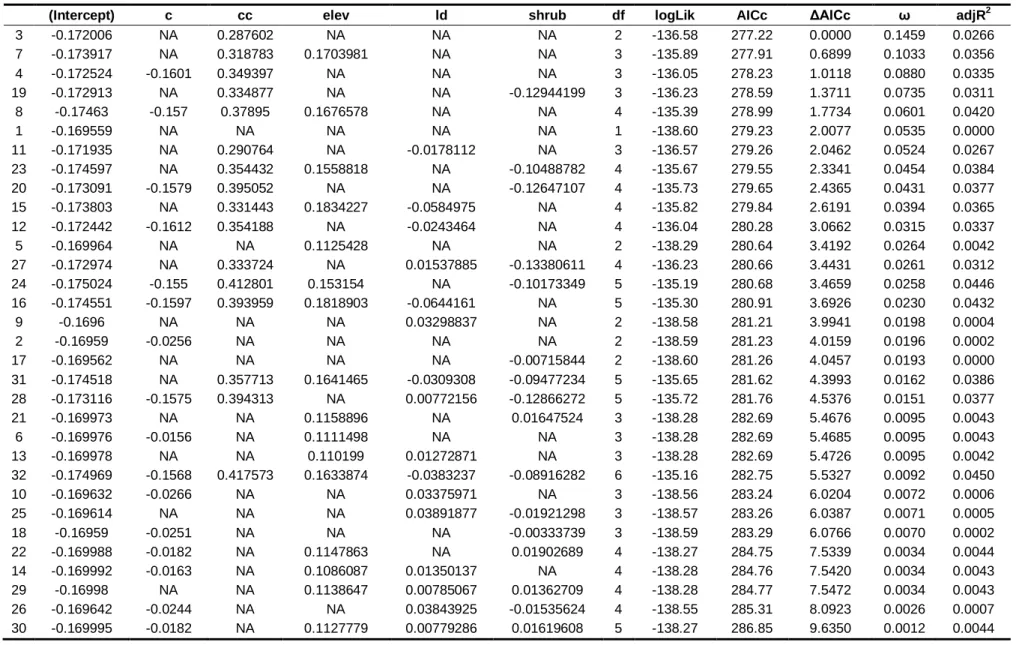
Table 2. Best models generated for each group of variables (N null, G ground, RS remote sensing, and G+RS ground+remote sensing) for species richness and the presence of Red-crested Turaco, Gabela Akalat and Gabela Bushshrike……….. 58
Table 3. Relative variables importance (RVI) and averaged coefficients estimates obtained from generalised linear models with ground variables for species richness and the presence of Red-crested Turaco, Gabela Akalat and Gabela Bushshrike………..59
Table S1. Set of models generated for species richness………...71
Table S2. Set of models generated for Red-crested Turaco presence………..….73
Table S3. Set of models generated for Gabela Akalat presence………..74
Table S4. Set of models generated for Gabela Bushshrike presence……….75
CHAPTER 4 Table 1 Radio-tracked birds in Kumbira Forest………...84
Table 2. Home-range size estimates (in hectares) for Gabela Akalats………86
Table 3. Habitat types percentages for all sampled Gabela Akalats……… 89
CHAPTER 5 Table 1. Forest cover changes in Kumbira for the 1991-2001 and 2001-2014……....105
Table S1. Satellite data used to analyse trends in forest cover across Kumbira Forest………116
Table S3. Number of trees (Nº trees), mean diameter-at-breast height (DBH), mean
tree height, aboveground biomass (AGB) and aboveground carbon (AGC) for each
sampling plot……… 117
APPENDIX Table 1. Bird point counts done in 2010……….133
Table 2. Bird point counts done in 2012……….137
Table 3. Bird abundance in point counts of 2010………..138
List of Figures
CHAPTER 1
Fig. 1 (a) Location of Angola (in yellow) within Africa and (b) map of Angola with its 18
provinces……….. 7
Fig. 2 (a) Geomorphological regions and (b) major biomes in Angola ………. 8
Fig. 3 The Angolan Escarpment Forest ………. 9
Fig. 4 Kumbira Forest ………. 13
Fig. 5 Endangered Gabela Akalat Sheppardia gabela, Gabela Bushshrike Laniarius amboimensis, Pulitzer’s Longbill Macrosphenus pulitzeri, and Near-Thratened Monteiro’s Bushshrike Malaconous monteiri……….... 13
CHAPTER 2 Fig. 1 The location of (a) Kumbira Forest in Angola and the study area in Kumbira Forest, (b) showing the land use for 2010 and the seven sectors where the changes of forest cover were analysed………. 26
Fig. 2 Distribution and number of individuals of (a) Red-crested Turaco; (b) Gabela Akalat; (c) Gabela Bushshrike; (d) Monteiro Bushshrike and (e) Pulitzer's Longbill registered in each sample point……….. 30
Fig. 3 Values for canopy cover (in %); canopy height (in meters); understorey vegetation (in %); tree density per plot (in number of trees per plot) and tree density index (value from 0 to 1) for the different land-use types………... 31
Fig. 4 Two axes of the non-metric multidimensional scaling (NMDS) ordination plot for bird communities in forest, secondary forest, mixed and slash-and-burn...32
Fig. S1 Changes in dense forest cover (%) from 1989-2010……….... 40
Fig. S2 Age of forest stands in Kumbira Forest (years) in 2010………..……. 41
CHAPTER 3 Fig.1 (a) Location of Kumbira Forest and (b) Study site……… 53
Fig. 2 Model averaging coefficients estimates for ground variables (N = 201) and models with delta < 10 for (a) species richness, (b) Red-crested Turaco, (c) Gabela Akalat and (d) Gabela Bushshrike presence………....60
Fig. S1 - Pair plots and correlation coefficients for explanatory variables………...70
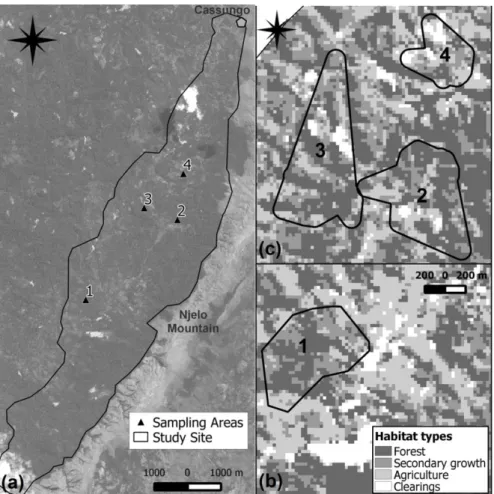
CHAPTER 4 Fig. 1 (a) Study site in Kumbira Forest with the four sampling areas (b) Sampling areas were defined according to the forest type: Invasive; (c) Natural; Mixed and Coffee...81
Fig. 2 Land-cover/habitat types map, locations of radio-tracked Gabela Akalats and
minimum convex polygons with 95% locations (MCP 95) in the different sampling areas………... 87
Fig. 3 Boxplot of home-range estimates of Gabela Akalats for the different sampling
areas: Coffee, Invasive, Mixed and Natural……….… 88
Fig. S1. Boxplot of home-range estimates for the Gabela Akalat obtained with different
methods……….………. 96
CHAPTER 5
Fig. 1 (a) Location of Kumbira Forest and (b) Sampling plots in the study site………103 Fig. 2 Forest cover and deforestation rates (%) for the years 1991, 2001 and 2014 in
Kumbira……… 105
CHAPTER 6
Fig. 1 (a) Abandoned hospital and (b) workers’ houses near Tchilumbo village,
Kumbira……… 119
Fig. 2 Coffee plantation shaded with Grevillea robusta trees………..119 Fig. 3 (a) Gabela Akalat Sheppardia gabela and (b) Gabela Bushshrike Laniarius
Chapter 1
1.1. Effects of deforestation and forest degradation on
biodiversity
Natural environments around the world are being rapidly transformed in order to fulfil the requirements of a growing human population. This is particularly worrying in the tropics, where most of the earth’s biodiversity is concentrated and where human impacts are advancing at a faster pace. Almost two thirds of the world´s biodiversity is concentrated in the tropics, a region that represents only 7% of the planet surface (Dirzo and Raven, 2003, Bradshaw et al., 2009, Gardner et al., 2009). Furthermore, almost 65% of the biodiversity hotspots are located in the tropics (Myers et al., 2000). Unfortunately, impacts in these areas are increasing rapidly because they present a high rate of human population growth (Cincotta et al., 2000) and are home to developing nations that often have limited options regarding their use of natural resources (Bradshaw et al., 2009).
Agriculture, logging and urbanization are the main causes of deforestation, forest fragmentation and intensification of land-use in tropical areas, all having a profound effect on their biodiversity (Norris et al., 2010, Gardner et al., 2009). Agriculture is responsible for 90% of the deforestation in the tropics, of which 55% come from the clearing of natural forests (Sodhi et al., 2011). It is predicted that tropical areas in South America and Sub-Saharan Africa will suffer major agricultural expansions to fulfil the need for food of a growing human population (Laurance et al., 2014). Africa has the least cropland than other regions. Nevertheless, in the last two decades (1980-2000) the percentage of agricultural land has increased in 25% and 50% in Western and Eastern Africa respectively. Furthermore, 60% of this agricultural land came from the clearing of natural forests and 35% from disturbed forests (Gibbs et al., 2010).
Logging is also a major threat for tropical areas, as selective logging is a common practice in many tropical countries. For instance, most of the forest in Western Africa had been logged to some degree (Norris et al., 2010). The effect of logging in tropical biodiversity depends on the different management techniques and the landscape context. Selective logging events with time gaps between them allow the forest to regenerate and produce a forest structure with different tree sizes and ages, similar to a natural stand, allowing some forest species to survive on these logged forests. Logging activities also produce a change in the community composition, benefiting generalist species over forest specialists (Sodhi et al., 2008). However, intense logging negatively impacts biodiversity due to the loss of natural canopy and the increase of invasive species (Norris et al., 2010). Furthermore, the roads
constructed for logging enable access to the forests, leading to an increase in other activities such as hunting and forest clearance for agriculture, all having major impacts on biodiversity (Laurance et al., 2009, Norris et al., 2010).
Finally, despite urbanization being responsible for the lower rate of deforestation in Africa (Norris et al., 2010), it causes major disturbance to native species because infrastructures displace these species and benefit urban adapted species (Sodhi et al., 2011). Moreover, urbanization has the most lasting disturbance effects because the infrastructures remain, contrary to other human land-uses, such as agriculture and plantations, where regeneration processes take place (McKinney, 2002). Furthermore, in the case of tropical areas urbanization is expected to increase and produce a major pressure in forested areas.
The impacts of human activities in the tropics are predicted to continue and increase. Therefore, biodiversity conservation in human-modified landscapes is needed (Sodhi et al., 2011). It will be of vital importance to understand how biodiversity is affected by land-use changes in order to propose measures to assure the conservation not only of the species but also of their ecological functions and services.
The effects that human activities have on biodiversity have been studied in different groups. Biodiversity usually declines following a gradient that reflects the decrease of vegetation structure complexity (Harvey et al., 2006, Schulze et al., 2004, Bobo et al., 2006). Full-grown and late-stage forest, such as primary forests, is expected to present a higher biodiversity than simpler human modified-landscapes, such as pastures. Additionally, species that depend exclusively on the forests will be more susceptible to the transformation of these habitats than species partly-dependant on forest habitats (Gardner et al., 2009). Nevertheless, it has been shown that some of these human-modified landscapes, such as secondary forests and agroforestry systems, can conserve part of the biodiversity of the original forests and act as useful corridors linking core areas of natural forests (Gove et al., 2008, Schulze et al., 2004, Sodhi et al., 2005). However, all these responses can be very species-specific and dependent on the local context.
Impacts on birds
Birds have been shown to be a particularly good indicator of ecological conditions in habitats under varying degrees of human exploitation (Sekercioglu et al., 2004, Barlow et al., 2007b, Gardner et al., 2008, Sodhi et al., 2008). As with other taxa, forest avian diversity usually declines with a decrease in the structural complexity of vegetation (Scales and Marsden, 2008, Barlow et al., 2007a). However, their response to different land-use changes can be very variable and dependent on different factors,
such as the intensity of the impact, the landscape matrix context, the species ecological traits and even the temporal scale of the study (Newbold et al., 2013, Watson et al., 2004, Newmark, 2006).
Bird diversity decreases more drastically in the higher impact human-modified habitats (Newbold et al., 2013). Therefore, intensive agricultural landscapes – such as pastures, monocultures and sun-loving crops – have considerably lower bird species and share less species with natural forests. Generalists, and especially open area species, dominate these habitats as forest specialists are unable to cope with the conditions created by intensive agriculture (Waltert et al., 2004). Specialised species such as insectivores and ant-followers are replaced by granivores and nectarivores (Norris et al., 2010).
On the other extreme, shade plantations – such as coffee and cacao – can support forest species, especially if the natural canopy is maintained (Waltert et al., 2004). This type of plantations maintains a structural complexity similar to a natural forest, with high canopy trees and understorey strata. In the specific case of shade coffee, its ability to support forest bird diversity can depend on the regional context. In Latin America, shade coffee plantations have high bird species richness and abundance. However, they present a different community composition that benefits generalists – including migrants – over forest specialists (Tejeda-Cruz and Sutherland, 2004, Harvey and Gonzales Villalobos, 2007). On the contrary, in Africa and specifically in Ethiopia, forest-specialists diversity did not differ between shade coffee plantations and natural forests. These plantations had twice as much bird species including all that were present in the natural forests. Additionally, these plantations were used as a breeding ground for the forest species. These results may be related with the fact that coffee Coffea spp. originated in Ethiopia. It is possible that the bird diversity evolved together with the coffee plant and therefore tolerates it better (Buechley et al., 2015). The local landscape context also affects the capacity of shade coffee to support biodiversity. Proximity to natural forest increases the capacity to support bird diversity (Tejeda-Cruz and Sutherland, 2004, Norris et al., 2010). Furthermore, in open areas, shade coffee plantations also promote bird diversity because of the maintenance of high canopy trees. However when surrounded by forests this diversity can considerably decrease (Dallimer and King, 2007, Gove et al., 2008, Dallimer et al., 2012, de Lima et al., 2013).
Shade coffee plantations can be important for bird conservation because they support more bird species than any other agricultural use (Komar, 2006). Transformation of sun loving crops or monocultures into shade coffee plantations can increase bird diversity and promote connectivity between forest remnants (Tejeda-Cruz
and Sutherland, 2004). Furthermore, the economic value of coffee can favour the maintenance of forest remnants rather than their destruction towards more open agricultural uses (Gove et al., 2008). Nevertheless, despite the apparently benefits of shade coffee over other land-uses, the conservation of natural forests continues to be of vital importance to protect the species that are more susceptible to habitat disturbance (Dallimer and King, 2007, Dallimer et al., 2009, Buechley et al., 2015).
Selective logged forests when properly managed can support forest specialists. When these areas are allowed to recover they can receive species from surrounding natural forest (Sodhi et al., 2011). Nevertheless, bird species richness in logged forests increases up to a threshold of tree removal and is always related with the increase of generalist species (Norris et al., 2010).
Similarly to both shade plantations and selective logged forests, bird species richness in secondary forests can be similar or even higher than in natural forests. However, the community composition here can be quite different, with the decrease of insectivores, understorey and floor forest specialist species (Norris et al., 2010, Barlow et al., 2007b) and also the loss of range-restricted species that usually have a high conservation value (Fjeldså, 1999, Waltert et al., 2005). Some forest species are capable of using secondary forests as long as natural forest patches are in the vicinity. The disappearance of these patches can increase these bird species vulnerability to extinction (Harris and Primm, 2004). This is also true for other human-modified habitats. Native forest cover can determine the presence of forest bird species (Sodhi et al., 2005) which may use these disturbed habitats but continue to depend on the natural forests in their surroundings (Norris et al., 2010). Despite the capacity of secondary forests to have similar bird species and act as natural corridors between primary forest remnants, primary forests continue to be irreplaceable for conserving tropical biodiversity (Barlow et al., 2007a, Barlow et al., 2010, Gibson et al., 2011).
Ecological traits also affect the response of tropical birds to habitat disturbance. Life-history traits that make species more vulnerable to habitat disturbance include: large body size, large home-ranges, slow breeding, non-migratory behaviour (Sodhi et al., 2011, Newbold et al., 2013).In relation to feeding guilds, frugivores and insectivores are more vulnerable to habitat disturbance. Usually these species decline with deforestation because of the reduction in food availability (Gray et al., 2007, Sodhi et al., 2011). Conversely, granivores increase because they benefit from the appearance of certain plants in disturbed habitats (Fjeldså, 1999).
In the particular case of endemic species, they tend to be especially sensitive to land-use changes (Scales and Marsden, 2008). Being species with small ranges, they are commonly at elevated risk of extinction because of the relatively large effects of
habitat change on their relatively small populations. For this reason they are of great conservation significance. Their response to habitat disturbance can vary: in some cases populations decrease drastically (Norris et al., 2010) and in others endemics adapt well to altered habitats (Reif et al., 2007, Dallimer et al., 2012).
Knowing the effects of human activities on biodiversity is vital to establish adequate conservation measures. Unfortunately, the areas holding the most biodiversity of the planet are also the least studied. This is the case of the tropics which holds the highest amount of data deficient species (Sodhi et al., 2011). Furthermore, most of the knowledge regarding tropical biodiversity in human-modified landscapes is restricted to very well-known study sites. Therefore, the impacts of human activities on tropical biodiversity are based in a specific ecological and human context (Gardner et al., 2010).
Africa presents the lowest deforestation rate when compared to Asia and to Central and South America (Bradshaw et al., 2009), and has the second largest continuous tropical forest in the world (Gardner et al., 2009). Despite the importance of this forest, African biodiversity – especially in the Western part – is the least studied and understood (Gardner et al., 2010, Norris et al., 2010, Gibson et al., 2011). Therefore, filling the knowledge gap about biodiversity on human-modified landscapes in tropical Africa is of vital importance for conservation, especially in extremely poor studied countries such as Angola.
1.2. Angola: a little known and high biodiverse country
Angola is located on the western coast of Africa, between latitudes 4° and 18°S, and longitudes 12° and 24°E (Fig. 1a). The country borders with Namibia in the south, the Democratic Republic of Congo in the north, Zambia in the east and the Atlantic Ocean in the west. It also has an enclave, Cabinda, surrounded by the Democratic Republic of Congo and the Republic of Congo (Brazaville). The country has a land surface area of 1 246 700 km2 and is divided in 18 provinces: Bengo, Benguela, Bié, Cabinda, Cuando Cubango, Cuanza Norte, Cuanza Sul, Cunene, Huambo, Huila, Luanda, Lunda Norte, Lunda Sul, Malanje, Moxico, Namibe, Uíge and Zaire (Fig. 1b).
Fig. 1 (a) Location of Angola (in yellow) within Africa and (b) map of Angola with its 18 provinces
Angola is a very biodiverse country because of its location and particular geographical features. It holds six geomorphological regions: the Coast Belt, the Transition Zone, the Marginal Mountain Chain, the Old (Highland) Plateau, the Congo Basin and the Cubango-Zambezi Basin (Huntley, 1974b) (Fig. 2a). The Coast Belt is an arid and semi-arid area that extends from 12 to 200 km from the coast with a maximum elevation of 300 m. Next, is the Transition Zone where the elevation rises as you go inland. Then, the Marginal Mountain Chain with the highest point in the country: Mount Moco (2620 m). The Old Plateau includes the central highlands of Huíla, Huambo and Bié provinces. The Congo Basin has plains that range from 1000 to 1500 m. Finally, the Cubango-Zambezi Basin is a very extensive area with hills and river systems (Dean, 2001, Huntley, 1974b).
From an ecological perspective, the diversity of conditions in Angola is spectacular as they range from the extreme desert in the south, to rainforests in the north. This is caused because of the country’s location in the confluence of five major biomes: Guinea-Congo Forest, Afrotropical Highlands, Zambezian Biome, Kalahari-Highveld and Namib-Karoo Biome (Dean, 2001, Huntley, 1974b) (Fig. 2b). The Guinea-Congo Forest is formed by evergreen semi-deciduous forest with canopy height of ~50 m. This biome also includes savannahs both surrounding and within these forests. The Afrotropical Highlands – Afromontane Forests – are forest patches in the slope of mountains in the provinces of Huambo, Cuanza Sul, Benguela and Huila; at altitudes between 2000 to 2500 m and with a canopy height of 10 to 15 m. The Zambezian Biome, also known as Brachystegia woodland, is the miombo woodland in the interior plateau of Angola and occupies up to 47% of the country's territory. Dominant species are from the genus Brachystegia and Julbernardia, with canopy height of 4-12 m
(Huntley and Matos, 1994). The Kalahari-Highveld is in the eastern edge of the Namib dessert and it is composed by sublittoral shrub lands and open woodlands, with species from the genus Acacia, Commiphora, Colophospermum and Aristida. Finally, the Namib-Karoo biome – western edge of the Namib dessert – has perennial grassland, shrub lands and thickets; with Welwitschia mirabilis as a characteristic species and thickets rarely exceeding 4 m of height (Huntley, 1974b, Dean, 2000). The Kalahari-Highveld and the Namib-Karoo are considered part of the Southwest Arid biome in Angola.
Fig. 2 (a) Geomorphological regions and (b) major biomes in Angola - adapted from Dean (2000)
The geographical characteristics and variety of biomes make Angola a country with a wide range of ecosystems (Huntley, 1974b) which translate into a high biodiversity, especially of birds (Rosa Pinto, 1983) – and probably other taxa. As a result, Angola is considered a high biodiversity country and one of the most biodiverse countries of Africa (USAID, 2008, Huntley, 1974a). Unfortunately, since its independence in 1975, Angola was submerged in a long lasting civil war that ended in 2002. The almost 30 years of armed conflict not only left the country destroyed but also full of mines, to the point “that one brigadier is quoted saying in December 1995 that the whole of Angola
should be considered a mined area” (Dean, 2000).
During the war no scientific research was done in Angola. Therefore, most of the biodiversity information available was collected during the colonial time and due the large extension of the country, considerable areas were not surveyed for most taxa (Crawford-Cabral and Mesquitela, 1989). Birds are the better studied group in the country, thanks to the early work of Rosa Pinto (Rosa Pinto, 1983), the skin collection in the Museum of the ISCED-Huila in Lubango and the museum in Dondo. After the war, updated information came mostly from an expedition done during the 1992 cease
fire (Hawkins, 1993), but most of the information available nowadays has been collected during recent sporadic expeditions and research projects (Ryan et al., 2004, Mills and Dean, 2007). No bird species in Angola has been studied in detail and information about their distribution and status remains inexistent or extremely limited (Dean, 2000). Therefore, Angola is a high biodiverse – little known country, where conservation initiatives lack the information needed to be implemented and where a major race is beginning to recover the lost time.
1.3. The Escarpment Forest and its biodiversity importance
The Angolan Escarpment Forest (or “Scarp”) is a semi-deciduous moist forest band that stretches discontinuously from the Guinea-Congo Forest in the north, going from Camabatela through Ndala Tando and Dondo, as far as 15º S in Capangombe (Huila province) in the south of the country (Hall, 1960) (Fig. 3). The width of this forest band varies between 1-15 km and its altitude goes from 350 to 1200 m. Common trees species of this forest are Pterocarpus, Piptadeniastrum, Morus, Celtis and Albizia. (Grandvaux-Barbosa, 1970). It is considered an impoverished outlier of the Guinea-Congo Forest, with smaller trees and lower canopy cover and understorey (Hall, 1960).Fig. 3 The Angolan Escarpment Forest stretches from north to south of the country - adapted from Hall (1960)
These forests are profoundly influenced by precipitation, humidity and temperature variation. Precipitation and mist are produced by clouds formed by the meeting of the cold Benguela current with the warmer tropical current of the Central Coast of Angola. These clouds travel eastward in direction to the High Plateau but are not capable of passing the mountains and condensate in mist and rain (Hawkins, 1993, Hall, 1960). The forests benefit from this “hidden condensation” especially in the night and dawn when moist coastal winds contact the cold surface of the escarpment and condensate
into the mist that fills the mountains ravines. The foliage of high canopy trees serve as condensation areas from where precipitation is released to the lower vegetation and ground. This happens especially in the dry season (known as “cacimbo” in Angola), when daily temperature variation is greater (9-12ºC), so that dense fog is frequent when vegetation needs water the most (Grandvaux-Barbosa, 1970).
The average annual precipitation for the Escarpment has been calculated between to be between 1000 and 1500 mm but this value is probably vastly underestimated because it does not consider the rain produced by mist condensation (Hawkins, 1993). These forests are more dependent in this mist and therefore more affected by the topographic characteristics of exposure to the moist coastal winds rather than to rainfall. For example, even though the Highland Plateau has more annual precipitation (1600-1800 mm) and deep soils, the predominant vegetation is
Brachystegia – Jubernardia open forest and woodland, with a canopy height of 6-15 m
against a canopy height of 25-40 m for the Escarpment Forests (Grandvaux-Barbosa, 1970). Additionally, the vegetation of the Escarpment also depends in the deep ferrralsols of medium and fine texture with superficial horizons rich in organic matter and humus (Castanheira Diniz, 1973). Another important geographical characteristic influencing this area is the rapid change in altitude in a small distance from the coast, especially in the area south of the Cuanza River where the scarp is steeper and well defined (Hall, 1960, Mills, 2010).
The Escarpment Forest is one of Angola’s most interesting regions in terms of biodiversity. It is located between three major biomes: the Southwest Arid of the Coastal Belt, the Brachystegia woodland of the Highland Plateau and the Guinea-Congo Forest. It presents affinities with all three adjacent biomes but also acts as a barrier between the drier biomes (Huntley, 1974b). This area is particularly important for the bird communities it holds because it is a centre of speciation and acts as a barrier allowing subspecies to develop on either side (Hall, 1960).
As a centre of speciation, it presents an endemic and near-endemic avifauna. This happens because the Escarpment developed in isolation during alternate wet and dry periods when the forest expanded and retracted. During the dry periods, the Escarpment was a refuge for species needing more moist conditions, species that disappeared in other areas under more extreme conditions (Hall, 1960). An example of this is the Red-crested Turaco Tauraco erythrolophus, an endemic species closely related to Bannerman's Turaco Tauraco bannermani (Njabo and Sorenson, 2009). The Escarpment also acts as a natural barrier between the Southwest Arid and the
Brachystegia woodland biomes, allowing subspecies to evolve in each of these drier
The Escarpment can be divided into three areas according to the vegetation characteristics and avifauna: Northern, Central and Southern Escarpment Forest. This classification follows approximately the vegetation subtypes division done by Gossweiller and Mendoça (1939) and Grandvaux-Barbosa (1970).
The Northern Escarpment includes the Cazengo Forest subtype and goes from Canda all the way south to Dondo, north of the Cuanza river. It includes the western escarpments of Uíge, Bengo and Cuanza Norte provinces (Grandvaux-Barbosa, 1970). In this area the coastal plain is extensive and the escarpment slope is gradual. The Escarpment lacks geographical barriers and adjoins the Guinea-Congo Forest with which it shares several characteristics. The forest is formed by two or three arboreal strata, with the highest one at 30-50 m. The shrub vegetation is dense and includes many epiphytes. The most predominant tree species are from the genera Albizia,
Celtis, Ficus, and Sterculia. The tree and shrub diversity decreases going southwards
as the climatic conditions become drier. The bird diversity is rich in Guinea-Congo Forest species and presents a similar bird community with this biome. However, it is poor in endemic species, with Braun’s Bushshrike Laniarius brauni being the only endemic restricted to this area (Mills, 2010).
The Central Escarpment is located from the south of the Cuanza river (9º 30’S) passing through the entire Cuanza Sul province all the way to Benguela province (11º 50’ S) (Mills, 2010). It includes the Amboim and Seles Forest subtypes described by Grandvaux-Barbosa (1970). Forest altitude goes from 400 to 1200 m, it is foggy and most of it has been transformed into shade coffee plantations (Gossweiller and Mendoça, 1939). It presents high canopy trees that do not achieve the size and development of the Northern Escarpment Forest. The most common tree species are those that provide good shade for coffee plants, such as those from the genera Albizia,
Ficus, Maesopsis and Piptadeniastrum (Castanheira Diniz, 1973). The bird community
is poor in Guinea-Congo Forest species but rich in range restricted endemics (Mills, 2010). This is caused by the location of the Central Escarpment, isolated from the influence of other biomes and the Guineo-Congo Forest in particular, creating conditions favourable to speciation to take place (Hall, 1960).
The Southern Escarpment goes all the way to Capangombe. It is very narrow and fragmented, with forest patches smaller and rarer along the escarpment. This area has been described as “undifferentiated relatively moist types of woodlands and savannahs” where Isoberlina, Brachystegia and Jubernardia are absent or rare (Hall, 1960). The forest presents drier conditions, shorter trees and drier vegetation because of its proximity to the Southwest Arid Biome.
The Escarpment Forest is considered one of the most important areas in Angola in terms of biodiversity. Together with the Afromontane Forests of the Bailundu Highlands, it forms the Western Angola Endemic Bird Area (EBA), the only centre of bird endemism in the country. Consequently, this EBA is home to 12 of the 17 endemic species of Angola, including six Endangered and two Near-Threatened species (Dean, 2001, BirdLife International, 2015a). Despite its great biodiversity and importance it is the least known EBA in Africa (Ryan et al., 2004) and is considered a “critical” priority for bird conservation (Stattersfield et al., 1998).
Recently, major efforts have been done to overcome logistical and safety issues in order to perform bird research in the Escarpment Forest (Ryan et al., 2004, Sekercioglu and Riley, 2005, Mills, 2010, Mills et al., 2011, Mills et al., 2004, Mills and Dean, 2007, Mills et al., 2013, Cáceres et al., 2015). However, it would be expected that the Escarpment is also important for other non-studied and overlooked taxa, such as insects, reptiles and amphibians. Myers et al. (2000) proposed that the Angolan Escarpment should be considered a biodiversity hotspot, because of its exceptional endemism and threat, however he lacked the information to declare it as such.
1.4. Central Escarpment Forest and its conservation threats
The Central Escarpment Forest is considered the most important area for bird diversity in the Escarpment (Ryan et al., 2004). Within the Central Escarpment, the forests around Gabela are considered by BirdLife International (2015b) as an Important Bird Area (IBA). It is the most important of the 23 IBAs in the country, presenting the highest richness of endemic species, eight range restricted and six threatened species (Sekercioglu and Riley, 2005). The most important forests in this area are Kumbira and Bango because they hold all the threatened endemic species (except Gabela Helmetshrike) (Mills et al., 2010). In particular, Kumbira Forest has been identified as the most important site for the conservation of threatened Central Escarpment endemics, because it is the largest and most representative forest of the Central Escarpment (Fig. 4). Furthermore, it holds significant populations of four of the five threatened endemic birds (Gabela Bushshrike Laniarius amboimensis, Gabela AkalatSheppardia gabela, Pulitzer’s Longbill Macrosphenus pulitzeri, and Monteiro’s
Fig. 4 Kumbira Forest – photos taken by A. Cáceres and H. Costa.
Fig. 5 Endangered Gabela Akalat Sheppardia gabela, Gabela Bushshrike Laniarius amboimensis, Pulitzer’s Longbill Macrosphenus pulitzeri, and Near-Thratened Monteiro’s Bushshrike Malaconous monteiri – photos taken by A.Cáceres,
M.Mills, F.Olmos and T. Leventis respectively.
Most of the Escarpment Forest has ideal conditions for coffee cultivation especially in the Northern and Central Escarpment. For this reason most of the forest was transformed to shade coffee plantations during colonial times (Gossweiller and Mendoça, 1939). Understorey vegetation was cleared and only the coffee plants were maintained. High canopy trees were preserved as long as they did not produce too much shade for the coffee, otherwise they were replaced by exotic species. The Central Escarpment was identified as especially important for coffee farming during this time, producing a very appreciated variety known as “Amboim coffee” (Grandvaux-Barbosa, 1970). It is estimated that by 1970’s almost 95% of the original forest was transformed to coffee plantations, or disturbed to some degree as with the planting of oil palm (Elaeis guineensis). Therefore, the original forest was only present in very few inaccessible areas (Castanheira Diniz, 1973, Hawkins, 1993).
During the civil war, the coffee plantations were abandoned and the understorey vegetation recovered, probably benefiting the birds (Sekercioglu and Riley, 2005, Dean, 2000, Ryan et al., 2004). During a visit to the area in the 1990s, Hawkins (1993) identified slash-and-burn agriculture for subsistence as a major threat for these forests. He estimated that around 30% of old coffee plantations had been transformed to agriculture. Abandoned coffee plantations were replaced by sun loving crops such as
sweet-potatoes, bananas, maize and cassava, eliminating completely the understorey vegetation and about 20 to 95% of the canopy cover.
Nowadays, with the end of the war, the human pressure to the forest has increased considerably. Most of the area is being slashed and burned for agriculture and the remaining high canopy trees are being logged for timber. All this deforestation is happening at a very fast pace (Mills, 2010, Cáceres et al., 2015). Despite a 50 km2 protected area having been proposed for the area since the 1970’s (Huntley, 1974a, Huntley and Matos, 1994), no formal protection exists for any part of the Escarpment Forest. Any conservation area should ensure the protection of the different bird communities present in the Escarpment and therefore include a network of representative sites (Mills, 2010). Furthermore, other conservation measures should be focused in the effects of human-modified landscapes on the threatened and endemic avifauna.
1.5. Objectives and thesis structure
The main aim of this thesis is to understand the effects of deforestation and forest degradation on the bird communities of the Central Angolan Escarpment Forest, especially the threatened endemic species. In order to achieve this, the thesis has the following specific objectives:
(i) Assess the historical changes in land-use in Kumbira Forest and their effect in the composition of bird communities.
(ii) Evaluate the habitat characteristics driving bird diversity, and especially the presence of endemic species.
(iii) Investigate the habitat use of the most range-restricted threatened endemic bird in Angola: the Gabela Akalat Sheppardia gabela.
(iv) Assess the potential of REDD+ as a conservation tool for the Angolan Escarpment Forest.
By achieving these objectives, solid scientific information will be generated for an area of global conservation significance and about an understudied endemism-rich avifauna, contributing to fill part of the knowledge gap present in Angola. Furthermore, this information will allow establishing strategic guidelines for the conservation of biodiversity while attending the developmental needs of the local population.
The research contained in this thesis is presented in four scientific papers already published or in the final phase for publication in international journals. These papers are organized in chapters, each chapter answers one of the specific objectives
established for this thesis. Therefore, following this introduction, the chapters of this thesis are:
Chapter 2: This chapter assesses the land-use changes of the last 20 years of the Central Escarpment Forest, by using Kumbira Forest as the study site. Remote sensing techniques were used to account the loss of forested habitats. Additionally, this chapter also compare the bird communities present in different land-uses.
Chapter 3: This chapter investigates the environmental characteristics driving bird diversity. First, the chapter analyses the best set of variables - between remote sensing and ground vegetation surveys - to model bird diversity. Then, it indicates the environmental variables affecting species richness and the presence of three endemic species Red- crested Turaco, Gabela Bushshrike and Gabela Akalat.
Chapter 4: In this chapter the home-range size and habitat preferences of Gabela Akalat are assessed using radio-tracking techniques. This chapter provides the first data on the territory size and habitat use of an Endangered and little-known endemic bird species.
Chapter 5: In this chapter, forest cover changes and deforestation rates from 1991-2001 and from 2001-2014 were assessed and aboveground carbon stocks were calculated through biomass estimation. Recommendations for the implementation of a REDD+ initiative to ensure the conservation of the forests are given.
Chapter 6: This chapter presents a general discussion of the results obtained in this thesis. Bird diversity responses to human impacts are discussed and conservation measures based in the results are proposed.
1.6. List of papers
The papers published or to be published in different scientific international journals that composed this thesis have very different formats. For this reason, the text, tables and figures of these papers have been formatted in a uniform way, without any modification on their content. The list of papers composing this thesis is presented below:
Paper I Cáceres, A., M. Melo, J. Barlow, P. Cardoso, F. Maiato, and M.S.L. Mills. 2015. Threatened birds of the Angolan Central Escarpment: distribution and response to habitat change at Kumbira Forest. Oryx 49: 727 - 734.
Paper II Cáceres, A., M. Melo, J. Barlow, R. de Lima and M. S. L. Mills. (Manuscript) Drivers of bird diversity in an understudied African centre of endemism: The Angolan Escarpment Forest. Submitted to Bird Conservation International.
Paper III Cáceres, A., M. Melo, J. Barlow, and M.S.L. Mills. 2016. Radio telemetry reveals key data for the conservation of Sheppardia gabela (Rand, 1957) in the Angolan Escarpment Forest. African Journal of Ecology. DOI: 10.1111/aje.12283.
Paper IV Leite, A., A. Cáceres, M. Melo, M.S.L. Mills and A. T. Monteiro. (Manuscript) The potential of REDD+ for ‘small centres of endemism’: A case study from the Angolan Escarpment Forest. Submitted to Biological Conservation.
1.7. References
Barlow, J., Gardner, T., Araujo, I., Ávila-Pires, T. C., Bonaldo, A., Costa, J., Esposito, M. C., Ferreira, L., Hawes, J., Hernandez, M., Hoogmoed, M., Leite, R., Lo-Man-Hung, N., Malcolm, J., Martins, M., Mestre, L., Miranda-Santos, R., Nunes-Gutjahr, A. L., Overal, W., Parry, L., Peters, S., Ribeiro-Junior, M. A., da Silva, M., da Silva Motta, C. & Peres, C. 2007a. Quantifying the biodiversity value of tropical primary, secondary, and plantation forests. Proceedings of the National
Academy of Sciences, 104: 18555-18560.
Barlow, J., Gardner, T. A., Louzada, J. & Peres, C. A. 2010. Measuring theconservation value of tropical primary forests: the effect of occacional species on estimates of biodiversity uniqueness. PLoS ONE, 5: e9609.
Barlow, J., Mestre, L., Gardner, T. & Peres, C. 2007b. The value of primary, secondary and plantation forests for Amazonian birds. Biological Conservation, 136: 212-231.
BirdLife International. 2015a. Endemic Bird Area factsheet: Western Angola. http://www.birdlife.org. Accessed on 01/09/2015
BirdLife International. 2015b. Inportant Bird Areas factsheets: Gabela. http://www.birdlife.org. Accessed on 04/09/2015
Bobo, S. K., Waltert, M., Sainge, N. M., Njokagbor, J., Fermon, H. & Muhlenberg. 2006. From forest to farmland: species richness patterns of trees and understorey plants along a gradient of forest conversion in Southwestern Cameroon.
Biodiversity and Conservation, 15: 4097-4117.
Bradshaw, C. J. A., Sodhi, N. S. & Brook, B. W. 2009. Tropical turmoil: a biodiversity tragedy in progress. Frontiers in Ecology and the Environment, 7: 79-87.
Buechley, E. R., Sekercioglu, Ç., Atickem, A., Gebremichael, G., Ndungu, J. K., Mahamued, B. A., Beyene, T., Mekonnen, T. & Lens, L. 2015. Importance of Ethiopian shade coffee farms for forest bird conservation. Biological
Conservation, 188: 50-60.
Cáceres, A., Melo, M., Barlow, J., Cardoso, P., Maiato, F. & Mills, M. 2015. Threatened birds of the Angolan Central Escarpment: distribution and response to habitat change at Kumbira Forest. Oryx, 49: 727 - 734.
Castanheira Diniz, A. 1973. Características Mesológicas de Angola. 546pp. Intituto Portugués de Apoio ao Desenvolvimento - Ministerio dos Negocios Estrangeiros.Lisboa.
Cincotta, R., Wisnewski, J. & Engelman, R. 2000. Human population in the biodiversity hotspots. Nature, 404: 990-992.
Crawford-Cabral, J. & Mesquitela, L. M. 1989. Ìndice Toponímico de colheitas Zoológicas em Angola. 192pp. Instituto de Investigação Científica Tropical. Lisboa
Dallimer, M. & King, T. 2007. Habitat preferences of the forest birds on the island of Príncipe, Gulf of Guinea. African Journal of Ecology, 46: 258-266.
Dallimer, M., King, T. & Atkinson, R. J. 2009. Pervasive threats within a protected area: conserving the endemic birds of São Tomé, West Africa. Animal Conservation, 12: 209-219.
Dallimer, M., Parnell, M., Bicknell, J. E. & Melo, M. 2012. The importance of novel and agricultural habitats for the avifauna of an oceanic island. Journal for Nature
Conservation, 20: 191-199.
de Lima, R., Dallimer, M., Atkinson, P. W. & Barlow, J. 2013. Biodiversity and land-use change: understanding the complex responses of an endemic-rich bird assemblage. Diversity and Distributions, 19: 411-422.
Dean, W. R. J. 2000. The Birds of Angola: an annotated checklist. 433 pp. British Ornithologists' Union. Alcedo Publishing. Colorado Springs.
Dean, W. R. J. 2001. Angola. In Important Birds Areas in Africa and associated islands:
Priority sites for conservation. (eds. L. D. C. Fishpool & M. I. Evans), pp. 71-91.
Pisces Publications and BirdLife International. Newbury and Cambridge, UK. Dirzo, R. & Raven, P. H. 2003. Global state of biodiversity and loss. Annual Reviews of
Environmental Resources, 28: 137-167.
Fjeldså, J. 1999. The impact of human forest disturbance on the endemic avifauna of the Udzungwa Mountains, Tanzania. Bird Conservation International, 9: 47-62. Gardner, T., Barlow, J., Araujo, I., Ávila-Pires, T. C., Bonaldo, A., Costa, J., Esposito,
Lo-Man-Hung, N., Malcolm, J., Martins, M., Mestre, L., Miranda-Santos, R., Overal, W., Parry, L., Peters, S., Ribeiro-Junior, M. A., da Silva, M., da Silva Mota, C. & Peres, C. 2008. The cost-effectiveness of biodiversity surveys in tropical forests. Ecology Letters, 11: 139-150.
Gardner, T., Barlow, J., Chazdon, R., Ewers, R., Harvey, C., Peres, C. & Sodhi, N. 2009. Prospects for tropical forest biodiversity in a human-modified world.
Ecology Letters, 12: 561-582.
Gardner, T., Barlow, J., Sodhi, N. & Peres, C. 2010. A multi-region assessment of tropical forest biodiversity in a human-modified world. Biological Conservation, 143: 2293-2300.
Gibbs, H. K., Ruesch, A. S., Achard, F., Clayton, M. K., Holmgren, P., Ramankutty, N. & Foley, J. A. 2010. Tropical forests were the primary sources of new agricultural land in the 1980s and 1990s. Proceedings of the National Academy
of Sciences, 107: 16732-16737.
Gibson, L., Ming Lee, T., Pin Koh, L., Brook, B. W., Gardner, T. A., Barlow, J., Peres, C. A., Bradshaw, C. J. A., Laurance, W. F., Lovejoy, T. E. & Sodhi, N. S. 2011. Primary forests are irreplaceable for sustaining tropical biodiversity. Nature, 478: 378-381.
Gossweiller, J. & Mendoça, F. A. 1939. Carta Fitogeográfica de Angola. 242 pp. Governo Geral de Angola. Luanda
Gove, A., Hylander, K., Nemomisa, S. & Shimelis, A. 2008. Ethiopian coffee cultivation—Implications for bird conservation and environmental certification.
Conservation Letters, 1: 208-216.
Grandvaux-Barbosa, L. A. 1970. Carta fitogeografica de Angola. 323 pp. Governo Geral de Angola. Luanda
Gray, M. A., Baldauf, S. L., J., M. P. & Hill, J. K. 2007. The response of avian feeding guilds to Tropical forest disturbance. Conservation Biology, 21: 133-141.
Hall, B. P. 1960. The faunistic importance of the scarp in Angola. Ibis, 102: 420-442. Harris, G. M. & Primm, S. L. 2004. Bird species' tolerance of secondary forest habitats
and its effects on extiction. Conservation Biology, 18: 1607-1616.
Harvey, C. & Gonzales Villalobos, J. 2007. Agroforestry systems conserve species-rich but modified assemblages of tropical birds and bats. Biodiversity and
Conservation, 16: 2257-2292.
Harvey, C., Medina, A., Merlo Sánchez, D., Vilchez, S., Hernandez, B., Saenz, J., Maes, J. M., Casanoves, F. & Sinclair, F. 2006. Patterns of animal diversity in different forms of tree cover in agricultural landscapes. Ecological Applications, 16: 1986-1999.
Hawkins, F. 1993. An integrated biodiversity conservation project under development: the ICBP Angola scarp project. In Proceedings of the 8th Pan-African
Ornithological Congress. (ed. R. Wilson), pp. 279-284. Tervuren: Annales
Musée Royal de l'Afrique Centrale (Zoologie).
Huntley, B. J. 1974a. Ecosystems conservation priorities in Angola. (Report Nº28). 21 pp. Repatriação Técnica de Fauna. Serviços de Veterinaria. Luanda
Huntley, B. J. 1974b. Outlines of wildlife conservation in Angola. Journal of the South
African Wildlife Management Association, 4: 157-166.
Huntley, B. J. & Matos, E. M. 1994. Botanical diversity and its conservation in Angola.
Strelitzia, 1: 53-74.
Komar, O. 2006. Ecology and conservation of birds in coffee plantations: a critical review. Bird Conservation International, 16: 1-23.
Laurance, W. F., Goosem, M. & Laurance, S. G. W. 2009. Impacts of roads and linear clearings on tropical forests. Trends in Ecology and Evolution, 24: 659-669. Laurance, W. F., Sayer, J. & Cassman, K. G. 2014. Agricultural expansion and its
impacts on tropical nature. Trends in Ecology and Evolution, 29: 107-116. McKinney, M. L. 2002. Urbanization, biodiversity and conservation. BioScience, 52:
883-890.
Mills, M. 2010. Angola’s central scarp forests: patterns of bird diversity and conservation threats. Biodiversity and Conservation, 19: 1883-1903.
Mills, M., Cohen, C. & Spottiswoode, C. 2004. Little-known African bird: Gabela Akalat, Angola's long neglected Gabelatrix. Bulletin of the African Bird Club, 11: 149-151.
Mills, M. & Dean, R. J. 2007. Notes on Angolan birds: new country records, range extensions and taxonomic questions. Ostrich, 78: 55-63.
Mills, M., Franke, U., Joseph, G., Maiato, F., Milton, S., Monadjem, A., Oschadleus, D. & Dean, R. J. 2010. Cataloguing the Lubango bird skin collection:towards an atlas of Angolan bird distributions. Bulletin of the African Bird Club, 17: 43-53. Mills, M., Melo, M. & Vaz, A. 2013. The Namba mountains: new hope for Afromontane
forest birds in Angola. Bird Conservation International, 23: 159-167.
Mills, M., Olmos, F., Melo, M. & Dean, R. J. 2011. Mount Moco: its importance to the conservation of Swierstra’s Francolin Pternistis swierstrai and the Afromontane avifauna of Angola. Bird Conservation International, 21: 119-133.
Myers, N., Mittermeier, R. A., Mittermeier, C. G., da Fonseca, G. A. B. & Kent, J. 2000. Biodiversity hotspots for conservation priorities. Nature, 403: 853-858.
Newbold, T., Schalermann, J. P. W., Butchart, S. H. M., Sekercioglu, Ç. H., Alkemade, R., Booth, H. & Purves, D. W. 2013. Ecological traits affect the responde of