ACTAS DE
HORTICULTURA
XIV CONGRESO
NACIONAL DE
CIENCIAS
HORTÍCOLAS
71
Retos de la Nueva
Agricultura
Mediterránea
Editores:
María Serrano
Daniel Valero
ACTAS DE
HORTICULTURA
XIV CONGRESO
NACIONAL DE
CIENCIAS
HORTÍCOLAS
71
Retos de la Nueva
Agricultura
Mediterránea
Editores:
María Serrano
Daniel Valero
ORIHUELA 3 5 Junio de
2015
Comité Organizador
PRESIDENTE
Daniel Valero Garrido
Dept. Tecnología Agroalimentaria UMH
SECRETARÍA
María Serrano Mula
Dept. Biología Aplicada UMH
VOCALES
Domingo Martinez Romero, Dept. Tecnología Agroalimentaria UMH Salvador Castillo García, Dept. Tecnología Agroalimentaria UMH Fabián Guillén Arco, Dept. Tecnología Agroalimentaria UMH Pedro J. Zapata Coll, Dept. Tecnología Agroalimentaria UMH Huertas M. Díaz Mula, Dept. Tecnología Agroalimentaria UMH
Juan Miguel Valverde Veracruz, Dept. Tecnología Agroalimentaria UMH Ricardo Abadía Sánchez, Dept. Ingeniería Agroforestal UMH
Carmen Rocamora Osorio, Dept. Ingeniería Agroforestal UMH
COLABORADORES
Alejandra Martínez Esplá Diego Paladines Quezada Mª José Giménez Torres
Comité Científico
PRESIDENTE
Dra. María Serrano
Dept. Biología Aplicada UMH
Dr. Manuel Agustí UPV Valencia Dr. Jesús Alonso ICTAN CSIC Madrid Dr. Francisco Artés ETSIA UPCT Cartagena Dr. Ángel Carbonell EPSO UMH Orihuela
Dr. Santiago García Martínez EPSO UMH Orihuela Dra. Teresa García EPSO UMH Orihuela
Dra. Cristina García Viguera CEBAS CSIC Murcia Dra. Mª Isabel Gil CEBAS CSIC Murcia
Dr. Luis Gonzaga Santesteban ETSIA UPN Navarra Dr. Manuel Jamilena EPS UAL Almería
Dra. Inmaculada Lahoz ITGA Navarra Dr. Juan Ignacio Macua ITGA Navarra Dr. Juan Jesús Medina IFAPA Huelva
Dr. Pablo Melgarejo Moreno EPSO UMH Orihuela Dr. José Miguel Molina ETSIA UPCT Cartagena Dra. Ana Mª Morales ETSIA US Sevilla
Dra. Rosa Oria UNIZAR Zaragoza Dr. Lluis Palou IVIA Valencia
Dra. Mª Bernardita Pérez IVIA Valencia Dra. Mª Teresa Pretel EPSO UMH Orihuela Dr. Jaime Prohens UPV Valencia
Dra. Mª Dolores Raigón UPV Valencia Dr. Francisco Javier Ribal UPV Valencia Dr. Juan José Ruiz EPSO UMH Orihuela Dra. Mª José Rubio CITA Zaragoza
Dr. Manuel Serradilla CICYTEX Extremadura Dra. Elisa María Suárez IFAPA Granada Dr. Francisco A. Tomás CEBAS CSIC Murcia Dra. Esperanza Torija UCM Madrid
Dr. Jesús Val EEAD CSIC Zaragoza
Dr. Juan Luis Valenzuela EPS UAL Almería Dr. Daniel Valero Garrido EPSO UMH Orihuela Dr. Lorenzo Zacarías IATA CSIC Valencia
Actas del XIV Congreso Nacional de Ciencias Hortícolas. SECH 2015. Retos de la Nueva Agricultura Mediterránea, celebrado en Orihuela del 3 al 5 de Junio de 2015.
Primera Edición: Mayo 2015 Tirada: 180
© Texto, de los Autores ISBN 978 84 606 8547 0
Ninguna parte de esta publicación, incluyendo el diseño general y el de la cubierta, puede ser copiado, reproducido, almacenado o transmitido de ninguna manera ni por ningún medio, sin la autorización previa por escrito de los titulares del copyright.
Sociedad Española de Ciencias Hortícolas.
XIV Congreso Nacional de Ciencias Hortícolas. SECH 2015. Retos de la Nueva Agricultura Mediterránea. Comunicaciones.
580 pp. (Actas de Horticultura/Sociedad Española de Ciencias Hortícolas; 71) ISBN 978 84 606 8547 0
PREFACIO
En este volumen de Actas de Horticultura (Nº 71) se recogen las comunicaciones presentadas en el XIV Congreso Nacional de Ciencias Hortícolas celebrado en Orihuela durante los días 3 5 de Junio de 2015.
En total se recogen 134 comunicaciones distribuidas en 15 Sesiones Científicas de acuerdo con el programa científico. Todos los trabajos han sido revisados por pares por parte de los miembros del comité científico y por evaluadores externos.
Los retos de la nueva agricultura mediterránea son conseguir productos de calidad y garantizar un futuro rentable y sostenible para el sector hortofrutícola español, aprovechando las ventajas geográficas y climáticas que han llevado al éxito de nuestra agricultura en los mercados nacionales e internacionales. En este sentido, en las comunicaciones presentadas se reflejan las últimas investigaciones realizadas en España y Portugal sobre diferentes aspectos fisiológicos, genéticos, técnicas agronómicas y de conservación encaminadas a incrementar la producción de frutas y hortalizas, así como sus atributos de calidad y propiedades nutritivas, con especial énfasis en sus propiedades antioxidantes con beneficios para la salud de los consumidores. Para conseguir estos retos es necesario realizar estudios genéticos enfocados a la obtención de variedades mejor adaptadas a las condiciones edafoclimáticas y más resistentes a plagas y enfermedades, estudios fisiológicos para conocer los factores que determinan el crecimiento óptimo de las plantas y desarrollar tecnologías agrarias que permitan obtener altos rendimientos y productos de calidad a precios competitivos. Finalmente, aplicar tecnologías de conservación posrrecolección y de industrialización apropiadas para mantener la calidad de los productos vegetales. Finalmente queremos agradecer el esfuerzo de los autores en la redacción y revisión de los trabajos de acuerdo con las normas de la SECH.
María Serrano Daniel Valero Editores
302
Non-destructive Measurement of Mandarin Orange Quality Parameters
with Visible -Near Infrared Spectroscopy
L. Paulo, M. Resende, A. Nunes, C. Miguel Pintado and P Antunes
CATAA - Associação Centro de Apoio Tecnológico Agro-Alimentar de Castelo Branco, Zona Industrial de Castelo Branco, Rua A, 6000-459 Castelo Branco, Portugal.
Keywords: maturation, Vis/NIRS, chemometrics ABSTRACT
The development of sensors to measure fruit internal quality variables is one of the challenges of post-harvest technology. Visible-near infrared spectroscopy (Vis/NIRS) has been a promise technique for nondestructive fruit quality assessment. This study was focused to evaluate the use of Vis/NIRS in measuring the quality parameters of intact mandarin orange fruit (Citrus clementina). The parameters studied were: firmness, color (CIEL*a*b*), peel thickness, soluble solids content (SSC), pH and total acidity (TA). A total of 120 mandarin fruit with different maturation were sampled. Reflectance NIR spectra were collected in four points of each fruit and the fruits were posteriorly analyzed for the physico-chemical parameters. Prediction models were selected based on the highest r2, lowest standard error of calibration
(RMSEC) and lower number of factors used in the calculation. For color parameters (L*, a*, and b*) model had a mean square error of calibration (RMSEC) of 0.877, 1.780 and 1.589 and coef cient determination (r2) of 0.923, 0.963 and 0.852, respectively. The proposed model for
the SSC had a RMSEC of 0.314 and r2 of 0.749. The results indicate that Vis/NIRS technique could provide an accurate, reliable and nondestructive method for assessing the internal quality indices.
RESUMEN
El desarrollo de sensores para medir las variables internas de la calidad la de fruta es uno de los retos de la tecnología post-cosecha. La espectroscopía de infrarrojo cercano / visible (Vis/NIRS) ha mostrado ser una técnica no destructiva mui prometedora. Este estudio se centró en evaluar el uso de Vis/NIRS en la medición de los parámetros de calidad de mandarina (Citrus clementina) intacta. Los parámetros estudiados fueron: firmeza, color (CIEL*a*b*), espesor de la cáscara, contenido de sólidos solubles (SSC), el pH y la acidez total (TA). Un total de 120 mandarinas con diferente maduración fueron muestreados. Se recogieron espectros de reflectancia Vis/NIR en cuatro puntos de cada fruta con una sonda de contacto (ASD Labspec 4.0 NIR) y los frutos se analizaron posteriormente para los parámetros físico-químicos. Se seleccionaron los modelos de predicción basado en el más alto determinación coeficiente (r2), más bajo error estándar
de calibración (RMSEC) y menor número de factores utilizados en el cálculo. Para los parámetros de color (L*, a*, b*) el modelo tiene un error cuadrado medio de la calibración (RMSEC) de 0,877, 1,780 y 1,589 y r2 de 0,923, 0,963 y 0,852,
respectivamente. El modelo propuesto para SSC tenía una RMSEC de 0,314, y r2 de
0,749. Los resultados indican que la técnica Vis / NIRS podría proporcionar un método preciso, fiable y no destructiva para evaluar los índices de calidad internos.
303
INTRODUCTION
Nondestructive NIR technics are applied in agricultural applications since 1964 (Nicolaï et al., 2007). Since then the importance of Vis/NIR spectroscopy in postharvest technology increased significantly, including the fact that many manufacturers of on-line grading lines have now implemented VIS/NIR systems to measure various quality attributes. Still, this technology has a great potential of new applications in horticultural production. This work intended to evaluate the application of Vis/NIR to quantify quality parameters of intact mandarin orange fruit (Citrus clementina).
MATERIAL AND METHODS
Samples were collected from the tree the same day of analysis, in two orchards. Fruits were collected randomly in order to obtain the greater variability of maturation parameters.
Vis/NIRS - Spectra were collected with a contact probe (ASD Labspec 4.0 NIR) from 350 to 2500 nm in four point of mandarin. Color was measured using a Minolta Chroma Meter CR-400, in the CIE L*a*b* space, and it was expressed as L*, a*, b*. A white reference plate, a D65 illuminant, a viewing angle of 2° and a measurement area of 8 mm were used. Firmness was measured using a Texture Analyzer TA.XT Plus (Stable Microsystems). Fruits were individually compressed with a flat steel probe to a 5 % deformation, at a rate of 1 mm s-1.
Maximum force (N) was recorded by Exponent 5.1.1.0 software. SSC was determined with an Atago PR32 refractometer. TA was measured by titration of 2 g of juice with 0.1 N NaOH to a pH of 8.1, with a Titromatic 2S (Crison). Prediction models were developed (Unscrambler X software) using the average spectra of each fruit, five selected preprocessing, and external calibration with 30% of samples.
RESULTS AND DISCUSSION
The samples used in this study presented a considerable variability of the analyzed parameters (Table 1), with exception of pH, this allowed to perform valid calibrations. Most of the fruits presented SSC and pH values corresponding to commercial fruits (Gómez, et al., 2006). However not all the fruits were of commercial interest in order to get a higher range of results, and allowing classification of the fruits by maturation stage.
The main challenge for developing this methodology was the color variability of mandarin fruits. Spectra were collected in four points rotating the fruit 90º and moving the probe from the top to the bottom of the fruit. Correlating the spectra with quality parameters measured in the juice, naturally, resulted in disperse values during component analysis and consequently in bad prediction models. For this the average spectra of each fruit were used to compute prediction models. The collection of one spectra in equatorial region was used for some authors with good results (Cayuela and Weiland, 2010). The collection of one equatorial spectra can produce good results, but it requires a selection of the point by the operator, and may produce erroneous results. Acquisition of multiple spectra reduces this error and it is simply performed by any operator.
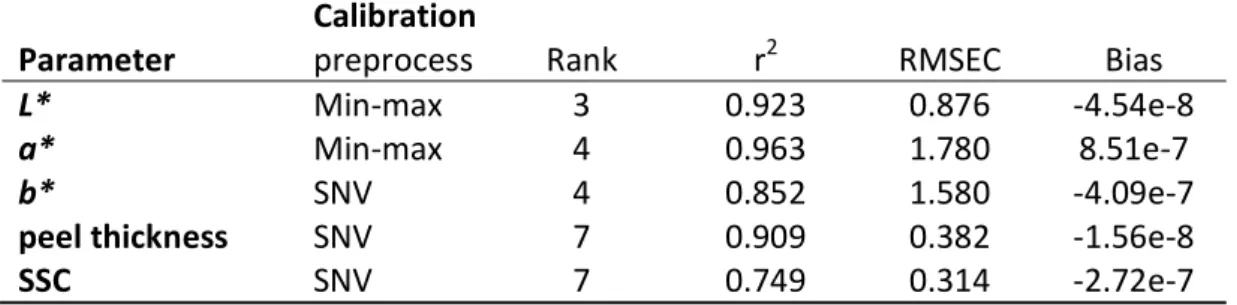
Table 2 presents the results obtained for calibration models of the analyzed parameters and the pretreatments that better fitted the results. Prediction models were selected based on the highest r2, lowest standard error of calibration (RMSEC) and lower number of factors used in
the calculation. In general normalization produced be best results (Minimum- maximum normalization, for L*, a*, pH, and SNV normalization, for b*, peel thickness and SSC). Derivatives produced better results for TA and firmness. Other authors also presented good correlations for this parameters using spectra normalization (Cayuela and Weiland, 2010;
304
Gómez et al., 2006; Liu, et al., 2010) most of the cases MSC normalization. Selected models presented root mean square error of prediction (RMSEP) in the same order of previous studies with Mandarin orange (Cayuela and Weiland, 2010; Gómez et al., 2006; Liu, et al., 2010) The parameters more directly related with fruit peel presented better results, and SSC, firmness and TA also presented good correlations. pH presented lower RMSEP due to the low variability in calibration samples.
The models presented a good prediction for color parameters, peel thickness, and SSC. pH and acidity showed low variability in the samples reducing the correlation and accuracy of the model.
ACKNOWLEDGEMENT
This research was supported by MITTIC. The MITTIC Project, Technological Modernisation and Innovation based on ICT in strategic and traditional sectors, is financed jointly by the European Regional Development Fund (ERDF), through the Operational Programme of Cross-border Cooperation Spain - Portugal (POCTEP) 2007-2013
LITERATURE CITED
Cayuela, J. A., and Weiland, C. 2010.Intact orange quality prediction with two portable NIR spectrometers.Postharvest Biol. Tec. 58:113–120.
Gómez, H., He, Y., and Pereira, A. G. 2006. Non-destructive measurement of acidity, soluble solids and firmness of Satsuma mandarin using Vis/NIR-spectroscopy techniques. J. Food Eng. 77:313–319.
Liu, Y., Sun, X., and Ouyang, A. 2010.Nondestructive measurement of soluble solid content of navel orange fruit by visible-NIR spectrometric technique with PLSR and PCA-BPNN. LWT - Food Sci. Technol. 43(4):602–607.
Nicolaï, B. M., Beullens, K., Bobelyn, E., Peirs, A., Saeys, W., Theron, K. I., and Lammertyn, J. 2007. Nondestructive measurement of fruit and vegetable quality by means of NIR spectroscopy: A review. Postharvest Biol. Tec. 46:99–118.
Table 1. Range of calibrated quality parameters, of the Mandarin used in this study. Parameter L* a* b* peel thickness (mm) SSC (%) pH TA(mEq.100 g1) Firmness(N) Minimum 45.77 10.24 33.62 1.6 8.20 3.2 9.47 4.84 Maximum 71.82 41.99 69.74 5.8 11.6 3.9 17.5 14.29 Table 2. Results from calibration and validation set obtained during the prediction of sample quality parameters.
Calibration
Parameter preprocess Rank r2 RMSEC Bias L* Min max 3 0.923 0.876 4.54e 8 a* Min max 4 0.963 1.780 8.51e 7 b* SNV 4 0.852 1.580 4.09e 7 peel thickness SNV 7 0.909 0.382 1.56e 8 SSC SNV 7 0.749 0.314 2.72e 7
305
pH Min max 7 0.535 0.095 7.95e 8 TA 1der+SNV 7 0.629 1.101 4.77e 7 Firmness 2der 5 0.650 1.030 1.14e 7
Validation
preprocess rank r2 RMSEP Bias
L* Min max 3 0.939 0.871 0.066 a* Min max 4 0.971 1.803 0.192 b* SNV 4 0.893 1.536 0.218 peel thickness SNV 7 0.791 0.625 0.082 SSC SNV 7 0.747 0.312 0.019 TA 1der+SNV 7 0.648 1.073 0.044 pH Min max 7 0.517 0.094 0.016 Firmness 2der 5 0.516 1.536 0.136
Rank, number of factors used in prediction models; r2, coefficient of determination; RMSEC, root mean
square error of calibration; RMSEP, root mean square error of prediction; Bias, estimate of the test error at that same value of the tuning parameter; 1der, first derivative; 2der, second derivative; SNV, vector normalization; Min-max, minimum-maximum normalization.