1 A Work Project presented as part of the requirements for the Award of a Master Degree in
Management from the NOVA – School of Business and Economics.
ZERO DESPERDÍCIO - MEASURING PERFORMANCE WITH A BALANCED SCORECARD
CARLOS MIGUEL RIBEIRO DE SOUSA RODRIGUES #2801
A project carried out on the Master in Management Program, under the supervision of: Miguel Alves Martins
2 ZERO DESPERDÍCIO – MEASURING PERFORMANCE WITH A BALANCED
SCORECARD
Abstract
The present Work Project addressed the managerial challenge of developing a performance measurement tool capable of taking the Non-Profit Organization (NPO) Zero Desperdício to the next level. The choice of the Balanced Scorecard (BCSD) – due to its comprehensive simplicity and efficacy – revealed to be fit for the challenge by allowing to identify relevant gaps in the organization’s performance but also in the registration data processes themselves. Thus, this measurement tool demonstrated to be widely useful in an organization since it was possible to develop productive recommendations both for its application and for Zero
Desperdício as a whole.
3 Table of Contents
1. Introduction 2. Literature Review
2.1. Definition of Social Impact
2.2. The Importance of Measuring Performance in Non-Profit Organizations 2.3. Balanced Scorecard
2.4. Balanced Scorecard in Non-Profit Organizations 2.5. Conclusion of the Literature Review
3. Methodology
4. Creating a Balanced Scorecard for Zero Desperdício 4.1. Zero Desperdício
4.2. Understanding the Organization First: Building the Logic Model 4.3. From the Logic Model to the Balanced Scorecard
4.4. Constraints in the Incorporation of Indicators
5. Testing the Balanced Scorecard – Limitations and Recommendations 6. Conclusion
7. References 8. Glossary
4 1. Introduction
The present Work Project consists of a Directed Research aimed at tackling a particular managerial challenge in a Non-Profit Organization (NPO) through the application of a performance measurement tool. The organization at which this project is aimed at is called Zero Desperdício, which addresses the social issue of food waste by managing a whole network of donating, receiving and managing entities. This network guarantees that the food surplus produced at the first party is then reutilized by the second with the coordination of the third. Preferably, the reutilization of the food is made through its distribution among
populations in need. All the work is also complemented by an effort in building awareness on the social issue.
Hence, the managerial challenge this project aims to tackle is the need for strategic tools to measure social impact. Zero Desperdício needs to have this in order to reach the next level, since it is already widely disseminated in Portugal but at the same time it still has a
considerable room for growth and improvement. This is a particularly relevant challenge to address since measuring and evaluating performance and impact allows not only to “assess
program implementation and results but also identify ways to improve the program
evaluated” (Wholey et al, 2010:6). Furthermore, the Balanced Scorecard (BCSD) will be the
management tool used to address this challenge due to the simplicity and efficacy with which it captures five important dimensions of a NPO (Financials, Innovation & Growth, Internal Processes, Customer and Social Impact).
2. Literature Review
2.1. Definition of Social Impact
Social impact is a key aspect of this work since everything converges to it: the ultimate goal of the NPO is to achieve social impact and the ultimate goal of this paper is to find a way to
5 measure it simply but very effectively. Moreover, social impact can be defined as the
“significant or lasting changes in people’s lives, brought about by a given action or series of
actions” (Roche, 1999:21).
In the paper «Policy Brief on social impact measurement for social enterprises», the OECD (Organization for Economic Co-operation and Development) and the European Union define social impact in reference to four key elements: “the value created as a consequence of
someone’s activity; the value experienced by beneficiaries and all others affected; an impact that includes both positive and negative effects; an impact that is judged against a benchmark of what the situation would have been without the proposed activity” (European Union and
OECD, 2015:3). Social impact – in the positive case - is typically a result of a social intervention that found an innovative way to address and solve a social problem that is important, that is either neglected or hasn’t met the most effective solution and that generates positive externalities – meaning the type of social problems which resolution creates more value to society than the one considered by conventional market mechanisms.
2.2. The Importance of Measuring Performance in Non-Profit Organizations
Furthermore, there are many types of investors interested in generating positive social impact, these investors want their money to produce a specific and significant change in society for the better. Hence, there is a need for organizations to give evidence that they are the best destiny for those financial resources, which leads the discussion to: social impact
measurement. Having said this, Social Impact Measurement refers to the way by which processes and tools are designed and used to measure how well an organization is achieving its social goals and, additionally, as Epstein and Yuthas state (2014), social impact
measurement can also help any organization to identify methods to increase impact and maximize it that otherwise they would have overlooked.
6 As mentioned by OECD (2015), there are four main phases of the impact measurement
process established by the Working Group on Impact Measurement: “firstly, planning
requires agreeing upon impact goals (including a priori selection of indicators) and the strategy to achieve them; secondly, building the evidence base includes collecting, storing and validating data; third, the quality, level and efficacy of the impact are assessed based on the analysis of the data gathered; and fourth, the impact and the measurement process are reviewed, providing input for future improvements in impact measurement” (OECD,
2015:70). The Social Impact Investment Taskforce summarizes the challenge of social impact measurement as follows: “impact measurement requires the integration of social and
environmental considerations into deeply-rooted market dynamics and investment management processes” (Social Impact Investment Taskforce, 2014: 5).
2.3. Balanced Scorecard
After deepening the understanding of what is Social Impact and the importance of Social Impact Measurement, it is now time to comprehend the tool through which the performance of Zero Desperdício will be measured. Furthermore, Kaplan and Norton (1996) affirm that today’s organizations face an extremely competitive environment where an accurate understanding of their goals and respective methods to achieve them is crucial. The BCSD reflects its extreme utility in the fact that it “retains an emphasis on achieving financial
objectives, but also includes the performance drivers of these financial objectives” and “measures organizational performance across four balanced perspectives: financial, customers, internal business process, and learning and growth” (Kaplan and Norton,
1996:2). This tool can assist an organization in terms of “effective organizational
performance measurement, the rise of intangible assets, and the challenge of implementing strategy” (Niven, 2006:1).
7 Nonetheless, the BCSD, like any other strategic management tool, has its downsides or
limitations. One can mention, for instance, the excessive use of indicators by some managers which leads to difficulties in discerning the most important ones; or, also, the problem of focusing on the easiest to achieve, making it crucial to reduce them to the essential ones (McWatters and Zimmerman, 2016). Plus - and considered by McWatters and Zimmerman (2016) as one of the main challenges -, there is a difficulty to optimize performance across the four sectors while doing the appropriate trade-offs, as it is difficult to select which indicators have more value or which organizational choices will affect all perspectives of the BCSD in a balanced way, especially when opportunity costs are neglected and benefits are intangible.
2.4. Balanced Scorecard in Non-Profit Organizations
Until now, the literary review about the BCSD focused on its generic conception, nonetheless, it is crucial to adapt it to the reality of a non-profit organization context. In that sense, the first adaptation is made by giving priority to the organization’s mission rather than the profit-seeking method of constructing the BCSD mainly around the financial indicators (Niven, 2008). The focus of the Non-Profit BCSD is on customers and in satisfying their needs so as to accomplish the mission (Niven, 2008), which, in turn, means generating social impact. Again, the need to have a focus point is also crucial in the non-profit case since there have been cases of organizations that “have created workplaces in which they attempt to serve
several masters simultaneously, thereby satisfying no one and leaving a trail of frustrated and confused employees in their wake”. (Niven, 2008:34).
Moreover, Chai (2009) mentions very pertinently the need to integrate a social and environmental component into the BCSD in what it calls the Sustainability Balanced Scorecard where Society is integrated as the fifth perspective on which to develop measurement.
8
2.5. Conclusion of the Literature Review
Following the theoretical deepening of the key elements for the development of this work project, one can verify how important it is for organizations to know how they should measure their performance and how that can be crucial to improve itself in the five
perspectives discussed in the literature review on the BCSD: financials, internal processes, customers, innovation and growth, and social impact. Throughout this review, this fifth and last perspective was understood as essential to be incorporated into the conventional BCSD, since otherwise it wouldn’t reflect the nature and purpose of NPOs. Hence, the main aspects that motivated the choice of constructing a BCSD instead of any other measurement tool is the way it captures the performance of an organization across these five perspectives which, in turn, are capable of recognizing all the stakeholders associated with the NPO’s activity. Therefore, it can be simple to construct and understand but very effective when it comes to measuring performance, although it requires a proper development of indicators.
Finally, the literature review pointed out the problematic of measuring social impact,
especially taking into consideration its intangible component and the multitude of internal (to the organization) and external factors that affect it. It is also suggested that it is important to have a focus on customers (the main beneficiaries of the organization’s social intervention) when developing all the indicators – which means, for example, asking ‘which processes help me serve better my costumers?’ or ‘what kind of innovation and growth will enhance the way I serve my costumers?’.
3. Methodology
After clarifying the key theoretical issues, it is time to explain the methodology that supported the construction of the BCSD. Firstly, in order to understand the reality of the organization, a couple of interviews were developed next to the Board of Directors and with a full-time
9 employee with extended knowledge of Zero Desperdício. Based on the answers and other documents provided, a Logic Model was developed from information about the Social Problem that the NPO tackles, the respective Transformation Theory and the Solution proposed. This process intended to use the Logic Model as a way to understand the existent reality and desired future (Azevedo et al, 2015).
Moreover, the next step implied taking the Logic Model as basis to develop a Strategy Map contemplating the five perspectives of the BCSD for NPOs and with the most important objectives of the organization. Thus, those objectives were unfolded into more specific
objectives in the BCSD and Sub-BCSDs – which were developed to capture the complexity of Zero Desperdicio’s network of activities. Finally, the indicators were developed and tested in a pilot with Zero Desperdício, Câmara Municipal de Lisboa (Sub-BCSD for Managing Entities), Associação Melhoramentos de Eixo (Sub-BCSD for Receiving Entities) and Jumbo (Sub-BCSD for Donating Entities) to test its validity – these entities were chosen due to their data availability. The whole methodology, from the beginning to the end, incorporated continued feedback from Zero Desperdício.
4. Creating a Balanced Scorecard for Zero Desperdício
4.1. Zero Desperdício
Zero Desperdício is an NPO which creation was motivated by the need to eliminate food waste within the Portuguese society. Zero Desperdício has already extended its project throughout several districts of Portugal (10 districts out of 18 and in the Autonomous Region of Açores, although only 20 councils out of 308), built a considerable network of entities and served as inspiration for similar projects outside Portuguese boundaries. Nonetheless, it needs the adequate strategic tools that can inform how well it is performing, what expectations are being met and what are not, as well as which dimensions of its activity should receive
10 particular attention, so as to achieve the social goals desired. This, in turn, will allow to reach the next level desired and expand as well as improve its operations and social impact goals. It is by applying the BCSD that it is expected to give further steps in this direction.
4.2. Understanding the Organization First: Building the Logic Model
In order to develop the BCSD it is crucial to understand the many aspects that involve the organization’s activity. To do so, it will be necessary to develop a Logic Model which implies describing the Social Problem that the organization addresses; the Value Proposition that characterizes it; the Theory of Change; and the Solution.
Social Problem
In the report developed for Calouste Gulbenkian Foundation, Zero Desperdício informs about the social problem of food waste by presenting its national, international and worldwide implications. Hence, it states that: “According to FAO and UNEP, one third of the world’s
daily food production ends up in the garbage, which means 1.3 billion tons per year, enough quantity to feed three billion people per day” (Zero Desperdício, 2016:4). In what comes to
the European Union, it affirms that more than 100 billion tons of food are sent to the garbage and, if nothing is done, by 2020 this number will raise to 126 billion tons. Furthermore, the report deepens the issue to the food waste and cites many studies to detail the process of food wasting: 25% to 50% of the food is wasted within the supply chain (Mena et al, 2011, apud Zero Desperdício, 2016), 26% of the food is wasted in the distribution and final consumption phases of the supply chain (Kantor et al, 1997, apud Zero Desperdício, 2016) and that
families account for 14% of the waste (Jones, 2004, apud Zero Desperdício, 2016). In environmental terms, a study by FAO indicates that the world’s average emission of CO2 derived from food waste is 500kg per capita and per year (FAO, 2013, apud Zero
11 The same report affirms that in Portugal the situation is not less alarming. A 2012 study points to a food waste of around a billion tons per year, of which 60% occurs in the distribution and consumption phases (Baptista et al, 2012, apud Zero Desperdício, 2016). Finally, the report adds the worldwide context of financial and economic crisis – especially aggravated in Portugal – to explain how this context puts some people in a situation of food scarcity (19,5% of the Portuguese are in a situation of poverty risk or social exclusion (INE, 2016, apud Zero Desperdício, 2016)). Within this context, Zero Desperdício has the mission of promoting and contributing to the recovery of waste by looking to capture the surplus and competences still able to be reutilized while promoting and dynamizing its consequent distribution, reutilization and optimization. Thus, its vision is to reach a state where society has its food surplus eliminated and reutilized to extinguish food scarcity among populations in need, a society where no food ends up in the garbage and no food is missing in the table where it is needed.
Value Proposition
In trying to pursue a new and innovative way of addressing this social issue and solving it, Zero Desperdício built itself as a network of donating entities, receiving entities, managing entities, partners and volunteers for which it is responsible to coordinate. Within this network, each involved part has its own responsibilities:
Donating entities are responsible for: providing the food surplus to receiving entities. In this case, the coordination of the network allows to identify the receiving entity which is more adequate for a specific donating entity taking into consideration location, dimension and periodicity of donations and the type of products donated. Producing food surplus is condition enough for any entity to be considered a potential donating entity.
12 Receiving entities are responsible for: guaranteeing that the HSA (Higiene e Segurança
Alimentar) procedures for which they are capacitated are respected when collecting the food; distributing the food among their final beneficiaries – which should be people in a situation of food scarcity; perform monthly reports of the quantity of food received through online
surveys.
Resorting to receptors already installed allows to maximize the capacity installed and in the majority of cases it becomes only necessary to perform a minimal investment to initiate operations and guarantee compliance with other social aid solutions.
Managing entities are responsible for: supporting and coordinate the project at a local level by guaranteeing its operability through the divulgation and acquisition of donating and receiving entities as well as other partners. All the Portuguese councils are considered as potential managing entities.
Finally, Zero Desperdício is responsible for: expanding the project to new national and international territories; coordinate the relationship between donating, receiving and
managing entities, partners and volunteers; capacitate the receiving entities for the compliance with the HSA procedures by providing training with the help of its partners or individually; monitor the functioning of the network through periodic reporting tools and visits to partner entities; nominate, coordinate and evaluate filial entities that may come to manage the relationship between donating, receiving and managing entities, partners and volunteers. Besides all these activities, Zero Desperdício also takes responsibility for increasing the awareness around the theme of food waste which is made through the distribution of didactic material (hard copy and electronic format).
13 Theory of Change
The Theory of Change describes the established strategy by which the initiative or project can achieve the desired change and for that purpose it identifies the pre-existent conditions, the paths and the interventions needed to attain success, which implies explaining how the first immediate changes relate to the intermediate ones and with the long-term ones (Azevedo et
al, 2015).
Furthermore, bearing in mind that there are populations which, due to economic reasons, do not have access to food in enough quantity or quality and that, on the other hand, that food exists abundantly but ends up wasted along the supply chain with no value produced for any part involved, Zero Desperdício proposes to create a new link in the supply chain. This link allows to convert the waste produced into social value by making the before useless food surplus get to a destination where it can be recovered in favor of those who need it. Hence, the mentioned link is established through the creation, coordination and expansion of an immense network of donating entities, receiving entities and managing entities. The link created by these networks is one which puts them in permanent contact so as to never waste a single opportunity for food reutilization by receiving entities when food surplus is generated at the donating entities. The added value comes from this communication bridge established which tries to guarantee a destination to the food surplus.
Therefore, the change logic is that, by collecting all the food surplus produced at the donating entities and giving it a destination in the receiving entities which distribute it among the population in need, the initiative is able to decrease the food waste and reduce the food scarcity among the population in need. It is a responsibility of managing entities to coordinate this whole process at a local level and guarantee its functioning and growth. Moreover, with a successful expansion and replication of the project so as to cover more and more entities and more and more people in need, food surplus will seize from being wasted and the needs of
14 socioeconomically sensitive populations will be fully met in terms of food scarcity. All this effort will be complemented by initiatives oriented for the increase in awareness about the theme of food waste so as to reduce it.
Solution
As inputs to develop its activities and eradicate the previously exposed social problem, Zero Desperdício requires financial resources that come, at the moment, from donations made by entities such as Philip Morris, REN, Fundação Calouste Gulbenkian and REPERCE. In turn, it is the human and technological capital that develop activities such as establishing contacts for acquisition of new entities, coordinating and managing the network of entities, partners and volunteers as well as to make efforts to expand or replicate the project. Hence, at the moment, there is one full-time worker which, along with two volunteers, resort to
technological resources such as a printer, cellphones, computers and a workspace which is provided by Câmara Municipal de Lisboa to execute the above mentioned activities.
Therefore, by establishing contacts and successfully expanding the network of entities, Zero Desperdício expects to guarantee there is always a receiving entity available to receive food surplus from a donating entity and to, in turn, distribute this surplus through the population with which the receiving entity works. This means that increasing the number of entities will allow to reduce the food waste by creating a constant reutilization option that, in turn, implies increasing the food distributed among the population in need. The increased distribution will, hence, reduce food scarcity among this population. Moreover, the human, technological and financial resources should also guarantee a successful coordination of the network so as to make replication possible in order to disseminate this social impact throughout Portugal and, in the long term, internationally. All this work will be complemented by the distribution of didactic material to raise awareness around the theme of food waste.
15 Logic Model
4.3. From the Logic Model to the Balanced Scorecard
The BCSD is composed by four perspectives: Financials; Internal Processes; Innovation and Growth; and Customer. However, in this case it will be essential to develop indicators for a fifth one: Social Impact.
The Strategy Map
In order to develop the Balanced Scorecard, it is first needed to draw the Strategy Map (see annex 1) that allows to succinctly “tell the story of the organization’s strategy through a
relatively small number of objectives and measures woven together through the perspectives”
(Niven, 2006:103). This map will be important since it will serve as groundwork for the construction of the Balanced Scorecard.
16 The Balanced Scorecard
Furthermore, the BCSD (see annex 2) itself will unfold the objectives of the Strategy Map into other more specific objectives. Additionally, due to the complexity of the NPO’s activity, the BCSD will also be unfolded into three extra Sub-Balanced Scorecards (see annex 3) specifically designed for the receiving entities, donating entities and managing entities, which will allow to better track the contribution of the performance demonstrated by each of these constituents of the value chain and to better capture the complexity of the organization’s operations. Moreover, the process of defining the indicators (divided into lag and lead indicators), their respective targets and the initiatives that could be taken to improve results was developed in close touch with Zero Desperdício and rearranged according to feedback provided. Such method allowed to develop indicators, targets and initiatives adapted to the reality of the organization.
Having constructed the BCSD, it is important to present some relevant aspects related to the presence and absence of certain indicators such as the «Percentage of Entities Out of the Ideal
Ratio Zone for Kg of Food Surplus Recovered Per Individual In Need». Hence, it is relevant
to note that the ideal ratio zone was elaborated to detect extreme cases in relation to the food received and people supported so that then it can be understood why it is happening. The ideal ratio zone captures the receiving entities that serve 0,28 meals per week to 2 meals per week. Additionally, the choice of using the moving average for the calculation of several indicators was due to the nature of the data subjected to analysis, since the numbers were very fluctuant throughout time, which demanded for a method that could attenuate this instability and make the data reading really useful.
17 4.4. Constraints in the Incorporation of Indicators
All the elaborated indicators developed for the BCSD were presented and discussed with Zero Desperdício, but not all of them were identified as available to feature in the pilot due to several limitations. These limitations were related to the inexistence of data registration processes that would allow to implement the measurement methods. Thus, the international replication did not feature the BCSD because it is a goal for further in the future, when Project Force1 and other necessary processes are already in place. Nonetheless, it is more concerning that there are limitations with indicators (or even their absence) that were aimed to measure the accomplishment of the organization’s key social impact objectives: reduce food waste; increase food surplus recovered; and eliminate food scarcity in the population in need. The indicators that were developed and suffered restraints and the indicators that could not feature in the final version of the BCSD contemplated the measurement of waste in the process of sending food to receiving entities, in the process of distributing it among the population in need and, more ambitiously, in the household of those people. Also, the food recovered was considered to be the food sent by donating entities, since the food received by receiving entities and the food distributed by them among the population is not weighed. The fact that the food distributed among the population is not measured also restrains the possibility of measuring the extent to which food scarcity is being eliminated.
5. Testing the Balanced Scorecard – Limitations and Recommendations
Having finalized the construction of the BCSD and the Sub-BCSD, it became necessary to develop a test to assess the validity and utility of the tool. The pilot was developed with Zero Desperdício for the general BCSD; with Jumbo for the Sub-BCSD for Donating Entities; with
1 Project Force is a project co-financed by the European Comission to implement a new technological platform
18
Associação Melhoramentos de Eixo for the Sub-BCSD for Receiving Entities; and with the
Lisbon council for the Sub-BCSD for Managing Entities. Along the process, certain
limitations were discovered and some recommendations were developed to improve the utility of the tool in the future.
Limitations and Recommendations
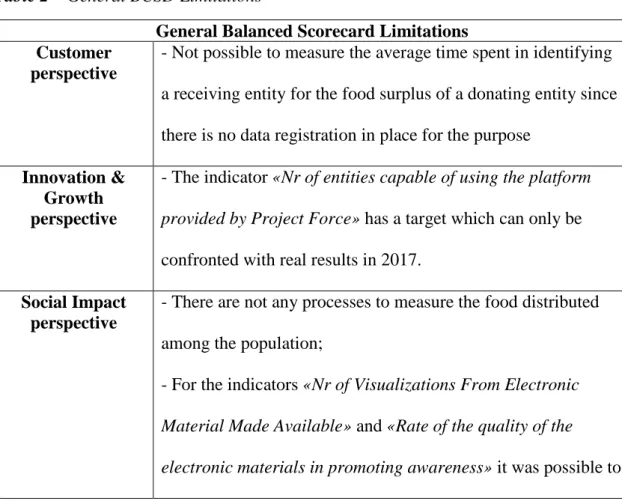
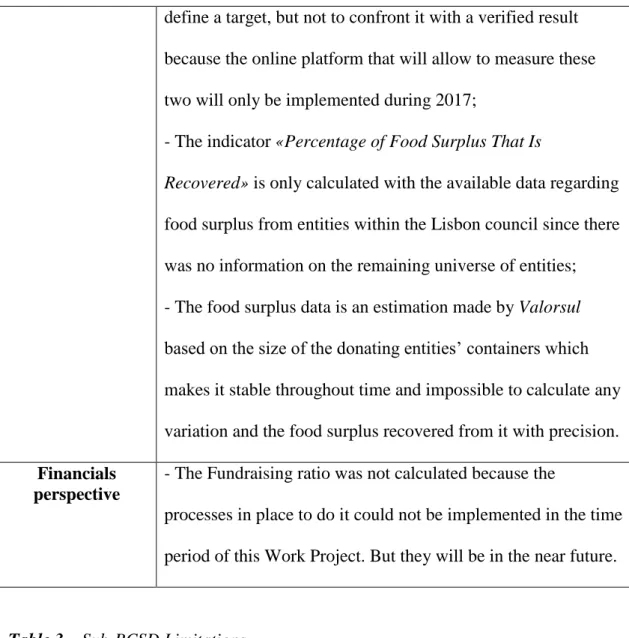
Most of the limitations were related to the fact that the proper processes for measuring certain indicators were not in place and could not be put in place during the time period of the work project. For instance, the Sub-BCSD was produced and applied without feedback from the entities that featured in the pilot because Zero Desperdício indicated it would not be possible within the lifetime of the Work Project, although it will happen in the future. Nonetheless, some objectives and indicators were preserved due to the importance they will have in the near future.
Table 2 – General BCSD Limitations
General Balanced Scorecard Limitations Customer
perspective
- Not possible to measure the average time spent in identifying a receiving entity for the food surplus of a donating entity since there is no data registration in place for the purpose
Innovation & Growth perspective
- The indicator «Nr of entities capable of using the platform
provided by Project Force» has a target which can only be
confronted with real results in 2017. Social Impact
perspective
- There are not any processes to measure the food distributed among the population;
- For the indicators «Nr of Visualizations From Electronic
Material Made Available» and «Rate of the quality of the electronic materials in promoting awareness» it was possible to
19 define a target, but not to confront it with a verified result
because the online platform that will allow to measure these two will only be implemented during 2017;
- The indicator «Percentage of Food Surplus That Is
Recovered» is only calculated with the available data regarding
food surplus from entities within the Lisbon council since there was no information on the remaining universe of entities; - The food surplus data is an estimation made by Valorsul based on the size of the donating entities’ containers which makes it stable throughout time and impossible to calculate any variation and the food surplus recovered from it with precision. Financials
perspective
- The Fundraising ratio was not calculated because the
processes in place to do it could not be implemented in the time period of this Work Project. But they will be in the near future.
Sub-Balanced Scorecard Limitations Sub-Balanced
Scorecard for Donating Entities
(Pilot with Jumbo)
- It presented the limitation concerning the nature of the estimated values provided by Valorsul which made it
impossible to develop a target and have a verified result for the evolution of food surplus.
Sub-Balanced Scorecard for Receiving Entities (Pilot with Associação Melhoramentos de Eixo)
- In the Customer perspective it was not possible to measure the satisfaction with the quality of the food received because the surveys performed next to the entities are anonymous; Table 3 – Sub-BCSD Limitations
20 Table 4 – Recommendations
Recommendations
Recommendation 1: The Sub-BCSD must be used to show each entity, in a more tangible and direct way, their respective contribution to the project and individual performance so as to motivate them and so as to motivate them align individual,
- In the Social Impact perspective it was not possible to activate any measure with food distributed due to the same constraints as in the general Balanced Scorecard.
- In the Innovation & Growth perspective it is was not possible to have information in time to collect the «Rate of Collecting Capacity» as the collecting capacity of the entity was not disclosed. Sub-Balanced Scorecard for Managing Entities (Pilot with Câmara Municipal de Lisboa)
- In the Customer perspective the limitation, as in the general BCSD, is the inexistence of data registration to measure the average of the time spent in identifying a receiving entity for the food surplus of the donating entity;
- In the Innovation & Growth it will only be possible to measure the success of Project Force by 2017;
- In the Internal Processes when it was noted that this managing entity was not fulfilling its duty of contacting entities to join the local network so no verified result was available;
- In the Social Impact perspective, the limitations with
providing a real target for food surplus produced derived from the estimation constraints in the data provided by Valorsul.
21 organizational and cross-departmental initiatives to achieve a common goal (Kaplan
and Norton, 1996). Such can alert managing entities about their responsibilities. Recommendations 2: When faced with non-fulfillment of responsibilities it may be relevant to review contractual clauses with the entities or find ways, if possible, to contractually bind them to their responsibilities.
Recommendation 3: develop a simple way to make each respective entity weigh the food surplus received and the food surplus distributed so as to make it possible to develop measures capable of measuring the performance around the key social objectives of food waste reduction and food scarcity elimination. Magpi could be a useful and simple mobile software to gather, coordinate and sync all the data. Recommendation 4: develop a methodology capable of accounting for losses along the value chain, such as food wasted in the process of delivering it, in the process of distributing it and in the households of the population helped. It can be useful to take big retailers like Continente or Pingo Doce as an example and contact them in order to discover what structure they have in place to measure their waste and losses along the value chain.
Recommendation 5: Develop indicators to measure the economic cost of food wasted due to failure in identifying a receiving entity for a food donation request and develop contingency plans to avoid this. For example, a partnership with Banco Alimentar or Refood to deliver them ‘emergency’ food surplus.
6. Conclusion
Having concluded the present Work Project, it was possible to verify along the construction and testing processes the extreme utility a BCSD can have for a NPO as it unveils important information about the organization’s activity in a simple but effective way. Besides, the very
22 construction process has revealed its utility when it comes to identify existent errors or gaps in data registering processes or even in the organization’s operational processes and activity. It gave evidence that with the BCSD comes a change not only in the measurement system but also in the fundamental management processes guiding the organization (Niven, 2006). This means it was successful in presenting Zero Desperdício with a view on which aspects it needs to improve to reach the next level. However, it should be noted that the Social Impact
perspective may reveal itself as the most challenging perspective to measure due to a strong component of intangibility, but it is clearly the most important one since it measures if the organization is or is not achieving its mission and vision.
Moreover, the structure of the BCSD made complete sense in terms of its application to this NPO reality as the five perspectives were capable of capturing the complexity of the
organization’s entire activity in clear objectives and indicators. Nonetheless, the fact that the BCSD had to be unfolded into Sub-BCSDs made it clear that the simplicity of this tool may need to be complemented with other resources in certain cases. However, this should be already expected since, as useful as the BCSD may be, it will not be capable of giving all the answers for the organization’s success – even when unfolded. Instead, such answers can only come with the BCSD in complementary interaction with other strategic management tools. Thus, one can conclude that the managerial challenge that triggered this Work Project was correctly responded with a tool capable of capturing and simplifying the complexity of the organization’s activity while, at the same time, capable of spotting extremely relevant gaps or errors in measurement processes and in its very activity. Having said this, Zero Desperdício needs to adopt the recommendations provided in order to maximize the utility of the tool and really reach a performance that corresponds to its name - Zero Waste.
23 7. References
Azevedo, Carlos., Filipa Carlos and Miguel Alves Martins. 2015. Avaliação de
Desempenho e Medição de Impacto – Leitura Prévia. Cascais: IES-SBS.
Azevedo, Carlos., Carlos, Filipa., Miguel Alves Martins and Paulo Teixeira. 2015.
Avaliação de Desempenho e Medição de Impacto – Notas de Apoio. Cascais: IES-SBS.
Baptista, Pedro., Campos, Inês., Iva Pires and Sofia Vaz. 2012. Do Campo ao Garfo.
Desperdício Alimentar em Portugal. Lisboa: CESTRAS.
Chai, Nan. 2009. Sustainability Performance Evaluation System in Government: A Balanced
Scorecard Approach Towards Sustainable Development. Berlin: Springer.
Epstein, Marc and Kristi Yuthas. 2014. Measuring and Improving Social Impacts: A Guide
for Nonprofits, Companies, and Impact Investors. San Francisco: Berret-Koehier Publishers.
European Union and OECD. 2015. Policy Brief on social impact measurement for social
enterprises. Luxembourg: Publications Office of the European Union.
FAO. 2013. Food Wastage Footprint: Impacts on Natural Resources. Rome: FAO.
INE. 2016. Instituto Nacional de Estatísitca. http://observatorio-lisboa.eapn.pt/ficheiro/Taxa-de-Pobreza-2014_ICOR.pdf (accessed December 5, 2016).
Jones, Timothy. 2004. “Using Contemporary Archaeology and Applied Anthropology to Understand Food Loss in the American Food System”. PhD diss. University of Arizona.
Kantor, Linda., Lipton, K., Alden Manchester and Victor Oliveira. 1997. “Estimating and Addressing America’s Food Losses”. Food Review, 20: 2-11.
Kaplan, Robert S. and David P. Norton. 1996. The Balanced Scorecard: Translating
24 McWatters, S. Cheryl and Jerol L. Zimmerman. 2016. “Managing Organizations” in
Management Accounting in a Dynamic Environment, 167-204. New York: Routledge.
Mena, Carlos., B. Adenso-Diaz and Yurt, Oznur. 2011. “The causes of food waste in the supplier-retailer interface: Evidences from the UK and Spain”. Resources, Conservation and
Recycling, 55(6): 648-658.
Niven, Paul. 2008. Balanced Scorecard: Step-by-Step for Government and Nonprofit
Agencies. New Jersey: John Wiley & Sons, Inc.
Niven, Paul. 2006. Balanced Scorecard Step-by-Step: Maximizing Performance and
Maintaining Results. New Jersey: John Wiley & Sons.
OECD. 2015. “Definitions and characteristics of Social Impact Investment” in Social Impact
Investment: Building the Evidence Base, 57-79. Paris: OECD Publishing.
Roche, Chris. 1999. Impact Assessment for Developing Agencies: Learning to Value Change. Oxford: Oxfam.
Social Impact Investment Taskforce. 2014. “The State of Impact Measurement” in
Measuring Impact, 5-6. London: Social Impact Investment Taskforce.
Wholey, Joseph., Harry Hatry and Kathryn Newcomer. 2010. “Planning and Designing Useful Evaluations”. In Handbook of Pratical Program Evaluation. 3rd Edition. 5–29. San Francisco: Josey-Bass.
Zero Desperdíco. 2016. Reporte Orientado para os Impactos e Resultados. Lisbon: Fundação Calouste Gulbenkian.
25 8. Glossary
Social Impact – significant or lasting changes in people’s lives or in society, brought about by a given action or series of actions.
Social Impact Measurement - the way by which processes and tools are designed and used to measure the extent to which a given action or series of actions is affecting society’s ecosystem.
Social Problem – an undesirable condition that affects a segment of society or the entire society.
Theory of Change – comprehensive description and illustration of how and why a desired change is expected to happen in a particular context.
Lag Indicator – a measurable factor that changes only after the occurrence of a particular pattern or trend.
Lead Indicator – a measurable factor that changes before the start of a particular pattern or trend. It can be used to predict changes.
Internal Processes – processes, decisions and actions that occur throughout the organization in a coordinated fashion.
Food surplus – The amount of food produced aboved the consuming capacity of the entity responsible for its production.
Mission – a written declaration of an organization's core purpose and focus that normally remains unchanged over time.
Vision - an aspirational description of what an organization would like to achieve or accomplish in the mid-term or long-term future.
Non-Profit Organization – any organization which has a social mission rather than profit as the desired outcome of its activity.