Programa de Doutoramento em Inform´
atica
Tese de Doutoramento
Promoting Understandability in Consumer Health
Information Seach
Hua Yang
Orientador(es) | Teresa Gon¸calves
´
Programa de Doutoramento em Inform´
atica
Tese de Doutoramento
Promoting Understandability in Consumer Health
Information Seach
Hua Yang
Orientador(es) | Teresa Gon¸calves
´
• Presidente | Paulo Quaresma (Universidade de ´Evora)
• Vogal | Fernando Manuel Marques Batista (ISCTE - Instituto Universit´ario de Lisboa) • Vogal | Carla Alexandra Teixeira Lopes (Universidade do Porto - Faculdade de Engenharia) • Vogal | Paulo Quaresma (Universidade de ´Evora)
• Vogal | M´ario Jorge Costa Gaspar da Silva (Instituto Superior T´ecnico) • Vogal-orientador | Teresa Gon¸calves (Universidade de ´Evora)
´
My deep gratitude goes first to my supervisor Teresa Gonçalves, for her guidance, enthusiasm, encouragement and patience. In the past few years, she has supported me in every way that she could to facilitate my Ph.D study; she believes in my research ability to achieve something great; she has given me the space to pursue my own research ideas; she has offered me her time and friendship generously whenever I needed them. She is not only my supervisor, but also friend.
I would like to give my thanks to Professor Paulo Quaresma, Salvodor Abreu, Irene Rodrigues, and Luís Rato, who advised me a lot in the early stages of my Ph.D. study. And my particular thanks go to Professor Paulo Quaresma who contributed greatly to the clarification of my research ideas and provided many valuable suggestions. My thanks also goes to Professor Pedro Salgueiro and Vasco Pedro who sought every opportunity to allocate clusters resources for me. Without their help, I was not able to carry out my experiments. My thanks also goes to Professor José Saias who gave help in allocating resources to facilitate my study. I would like to thank all the teachers working in the libraries of Colégio do Espírito Santo, University of Évora. My special thanks are to teacher Catarina Costa, her kindness and warmness make me feel at home.
I would like to thank my peers and colleagues at VISTA lab in the De-partment of Informatics. Their nice comments, wonderful suggestions and valuable tips filled in the gaps of my knowledge. Of my colleagues, my par-ticular thanks go to Roy Bayot and Prakash Poudyal, who gave me great advice at the beginning of my Ph.D. study. My thanks also go to Madhu Agrawal, who made my life as a Ph.D. student enjoyable. I am also thankful to all the friends I’ve made in Évora.
Finally, I would not have made it through without the deep love and support from my whole family. Without the accompany of my husband and my son, I could not continue and finish my Ph.D. study. To my dear mum and dad, they have offered me great encouragements and these keeps me going on the way.
Contents ix
List of Figures xiii
List of Tables xv Acronyms xvii Abstract xix Sumário xxi 1 Introduction 1 1.1 Motivation . . . 2 1.2 Research Goals . . . 4
1.2.1 Bridging the Language Gap . . . 5
1.2.2 Learning Understandability from Experience . . . 5
1.3 Proposed Approach . . . 6
1.4 Main Contributions . . . 7
1.5 Dissertation Overview . . . 8
2 Information Retrieval 11 2.1 A Classic Information Retrieval System . . . 11
2.2 Relevance Judgments . . . 14 2.2.1 Topical Relevance . . . 14 2.2.2 Understandability Relevance . . . 14 2.3 Techniques . . . 16 2.3.1 Retrieval Models . . . 16 ix
2.3.2 Query Expansion . . . 21
2.3.3 Learning to Rank . . . 25
2.3.4 Rank Aggregation . . . 29
2.4 Resources . . . 31
2.4.1 Resources for Query Expansion . . . 31
2.4.2 Open-source IR Platforms . . . 33
2.5 Evaluation . . . 34
2.5.1 Evaluation Metrics . . . 34
2.5.2 Evaluation Tools . . . 37
2.6 Related Work Review . . . 37
3 Health Information Retrieval 41 3.1 Medical Resources for Query Expansion . . . 41
3.1.1 Medical Subject Headings . . . 41
3.1.2 Consumer Health Vocabulary . . . 45
3.1.3 Unified Medical Language System . . . 46
3.1.4 Word Embedding Models Trained with Health Data . 50 3.2 Techniques and Tools . . . 51
3.2.1 Query Expansion with Medical Thesaurus . . . 52
3.2.2 Query Expansion with Word Embeddings . . . 52
3.2.3 Medical Concepts Identification . . . 53
3.3 Related Work Review . . . 58
3.4 HIR Campaigns . . . 64
4 A Compound System for CHIR 67 4.1 System Architecture . . . 67
4.2 Bridging the Language Gap . . . 68
4.2.1 A Medical Concept Model . . . 70
4.2.2 Word Embeddings as the Query Expansion Resource . 75 4.2.3 Improved IR Model for Bridging the Language Gap . . 78
4.3 Learning Understandability from Experience . . . 78
4.3.1 Field-based LETOR models . . . 80
4.4 Summary . . . 84
5 Bridging the Language Gap 87 5.1 Experimental Setup . . . 87
5.1.1 Data Collections . . . 87
5.1.2 Evaluation Metrics and Tools . . . 96
5.1.3 Experimental Platform . . . 97
5.1.4 Summary . . . 98
5.2 Medical Concept Model . . . 98
5.2.1 CLEF’2016-2017 Data Experiments . . . 99
5.2.2 CLEF’2018 Data Experiments . . . 105
5.2.3 Conclusions . . . 108
5.3 Word Embeddings in QE . . . 108
5.3.1 Word Embedding Models . . . 109
5.3.2 FIRE’2016 Data Experiments . . . 110
5.3.3 CLEF’2016-2017 Data Experiments . . . 114
5.3.4 CLEF2018 Data Experiments . . . 118
5.3.5 Conclusions . . . 121 6 Learning Understandability 123 6.1 Preliminary Experiments . . . 124 6.1.1 Features . . . 124 6.1.2 Experiments . . . 125 6.1.3 Results . . . 126 6.1.4 Conclusions . . . 127
6.2 RA on Field-based LETOR Models . . . 128
6.2.1 Features . . . 128
6.2.2 Experiments . . . 130
6.2.3 Topical Relevance Results . . . 131
6.2.4 Understandability Results . . . 135
6.2.5 Conclusions . . . 140
7.1 Bridge the Language Gap . . . 143
7.2 Learn Understandability from Experience . . . 145
7.3 Main Contributions . . . 147
7.4 Future Work . . . 149
A Publications 151
B Campaign Participation 153
2.1 The basic flow of an IR system. . . 12
2.2 The essential elements of a classic IR system. . . 12
2.3 Fields information of an example Web document. . . 21
2.4 Query expansion approach. . . 23
2.5 Applying relevance feedback techniques in query expansion. . 23
2.6 Pseudo relevance feedback. . . 24
2.7 Learning to rank model. . . 25
2.8 An example of format LETOR feature file. . . 29
3.1 Term Asthma organized in MeSH hierarchy. . . . 43
3.2 Example of medical concept identification with cTAKES. . . . 58
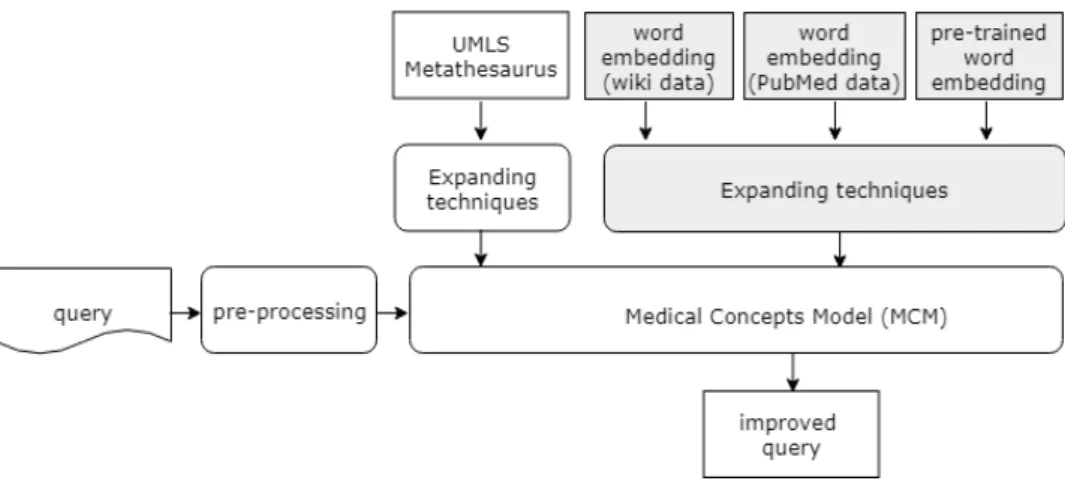
4.1 Overall system architecture. . . 68
4.2 Medical Concept Model: medical concepts classification. . . . 72
4.3 A concrete example of Medical Concept Model. . . 74
4.4 Improved techniques using UMLS as a query expansion resource. 75 4.5 An example using improved UMLS query expansion techniques. 75 4.6 Word embedding model as the query expansion resource. . . . 77
4.7 An improved system model for bridging the language gap. . . 79
4.8 Rank aggregation on field-based LETOR models. . . 81
4.9 Train a field-based LETOR model with single-field features. . 83
4.10 Aggregation over field-based LETOR models. . . 84
5.1 An example in the FIRE’2016 CHIS task. . . 90
5.2 CLEF’2016-2017 eHealth IR data: original post No.147 . . . . 92
5.3 CLEF’2016-2017 eHealth IR data: queries from post No.147. . 93
5.4 CLEF’2018 eHealth IR data: a set of queries. . . 95
5.5 Query processing using the Medical Concept Model. . . 101
6.1 Rank aggregation performance on topicality assessment. . . . 133
6.2 Performance of field features on topicality assessment. . . 134
6.3 Rank aggregation performance on understandability assessment.138
2.1 An example of how an inverted index is structured. . . 13
2.2 Retrieval models. . . 17
2.3 Synonyms for heart attack. . . . 22
2.4 LETOR algorithms classification. . . 26
2.5 Features in LETOR 4.0 benchmark dataset. . . 28
2.6 Aggregation methods. . . 31
2.7 The contingency table for the evaluation of an IR system. . . 36
3.1 MeSH term types. . . 42
3.2 Main branches of MeSH Headings. . . 44
3.3 MeSH Subheadings Categorization. . . 45
3.4 Concepts Relationship in MeSH. . . 46
3.5 The semantic types in OAC CHV. . . 47
3.6 Associating the concept Hypertensive disease with a CUI code. 49 3.7 The semantic type in UMLS. . . 50
3.8 Pre-trained word embedding models using biomedical data. . 51
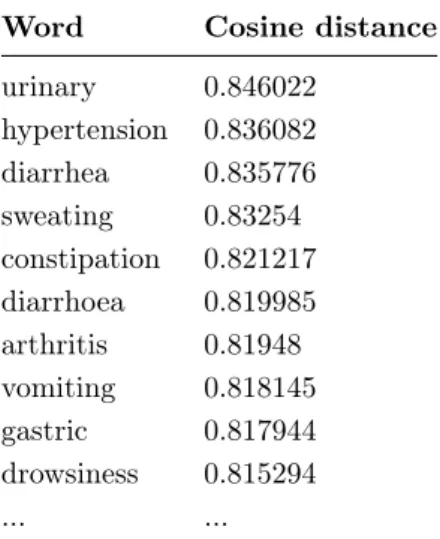
3.9 Words related to headaches in a trained word embedding model. 53 3.10 Example of MetaMap biomedical text processing. . . 56
3.11 Example of MetaMap output for high blood pressure. . . . 57
3.12 One candidate of phrase high blood pressure. . . . 58
3.13 Medical concepts identification. . . 59
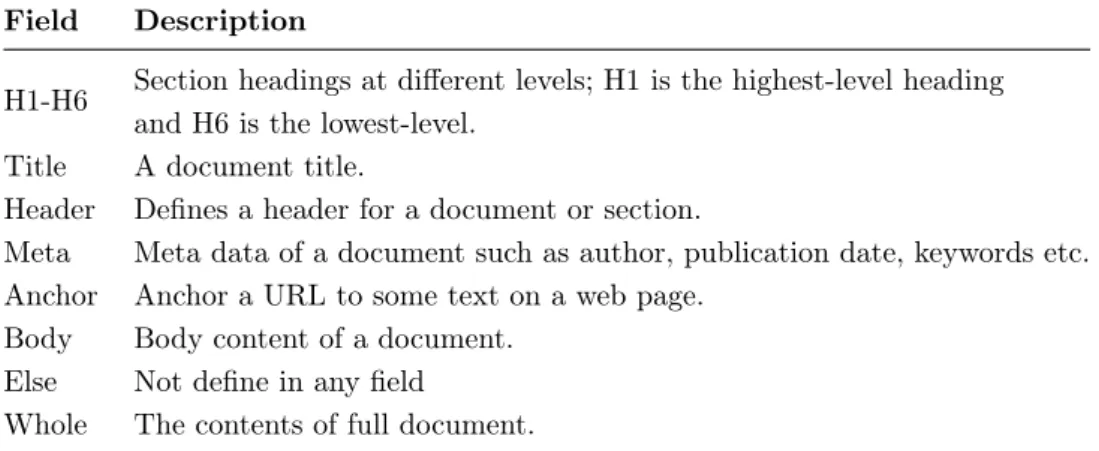
4.1 Fields of a HTML document used to extract LETOR features. 82 5.1 Statistics of experimental data collections. . . 89
5.2 FIRE’2016 CHIS data collection. . . 90
5.3 MCM: rankers built on CLEF’2016-2017 data. . . 99
5.4 MCM: rankers’ topical relevance on CLEF’2016-2017 data. . . 102
5.5 MCM: rankers’ understandability on CLEF’2016-2017 data. . 104
5.6 MCM: rankers built on CLEF’2018 data. . . 105
5.7 MCM: rankers’ topical relevance on CLEF’2018 data. . . 106
5.8 MCM: rankers’ understandability on CLEF’2018 data. . . 107
5.9 Locally trained word embedding models. . . 110
5.10 WE in QE: rankers built on FIRE’2016 data. . . 110
5.11 WE in QE: rankers’ precision on FIRE’2016 data. . . 112
5.12 WE in QE: rankers’ recall on FIRE’2016 data. . . 112
5.13 WE in QE: rankers’ F1 score on FIRE’2016 data. . . 113
5.14 WE in QE: rankers’ accuracy on FIRE2016 data. . . 113
5.15 WE in QE: rankers built on CLEF’2016-2017 data. . . 114
5.16 WE in QE: rankers’ topical relevance on CLEF’2016-2017 data.115 5.17 WE in QE: rankers’ understandability on CLEF’2016-2017 data.117 5.18 WE in QE: rankers built on CLEF’2018 data. . . 118
5.19 WE in QE: rankers’ topical relevance on CLEF’2018 data. . . 119
5.20 WE in QE: rankers’ understandability on CLEF’2018 data. . 120
6.1 LETOR model: features defined on CLEF’2016-2017 data. . . 124
6.2 LETOR model: rankers trained on CLEF’2016-2017 data. . . 125
6.3 LETOR model: rankers tested on CLEF’2016-2017 data. . . . 127
6.4 LETOR model: features explored on CLEF’2016-2018 data . 129 6.5 LETOR model: rankers trained on CLEF’2016-2017 data . . 130
6.6 LETOR model: rankers’ topical relevance on CLEF’2018 data.132
CHIR Consumer Health Information Retrieval CHIS Consumer Health Information Search CHV Consumer Health Vocabulary
CUI Concept Unique Identifier CLI ColemanLiau index
CBOW Continuous bag-of-words model
cTAKES clinical Text Analysis and Knowledge Extraction System CLEF Conference and Labs of the Evaluation Forum
FIRE Forum for Information Retrieval Evaluation GFI Gunning fog index
HIR Health Information Retrieval HIS Health Information Search IR Information Retrieval LETOR Learning to Rank LSA Latent Semantic analysis LT LETOR, Learning to Rank MCM Medical Concept Model MeSH Medical Subject Headings MCI Medical Concepts Identification MAP Mean Average Precision
NDCG Normalized Discounted Cumulative Gain NIH National Institute of Health
NLP Natural Language Processing PRF Pseudo Relevance Feedback P@n Precision at position n
QE Query Expansion QI Query Independent QD Query Dependent RBP Rank Biased Precision SGM Continuous Skip-gram Model SMOG Simple Measure of Gobbledygook TREC Text REtrieval Conference
UMLS Unified Medical Language System uRBP understandability Rank Biased Precision
uRBPgr understandability Rank Biased Precision in graded gain WE Word Embedding
Nowadays, in the area of Consumer Health Information Retrieval, techniques and methodologies are still far from being effective in answering complex health queries. One main challenge comes from the varying and limited medical knowledge background of consumers; the existing language gap be-tween non-expert consumers and the complex medical resources confuses them. So, returning not only topically relevant but also understandable health information to the user is a significant and practical challenge in this area.
In this work, the main research goal is to study ways to promote under-standability in Consumer Health Information Retrieval. To help reaching this goal, two research questions are issued: (i) how to bridge the existing language gap; (ii) how to return more understandable documents. Two mod-ules are designed, each answering one research question. In the first module, a Medical Concept Model is proposed for use in health query processing; this model integrates Natural Language Processing techniques into state-of-the-art Information Retrieval. Moreover, aiming to integrate syntactic and semantic information, word embedding models are explored as query expan-sion resources. The second module is designed to learn understandability from past data; a two-stage learning to rank model is proposed with rank aggregation methods applied on single field-based ranking models.
These proposed modules are assessed on FIRE’2016 CHIS track data and CLEF’2016-2018 eHealth IR data collections. Extensive experimental com-parisons with the state-of-the-art baselines on the considered data collec-tions confirmed the effectiveness of the proposed approaches: regarding un-derstandability relevance, the improvement is 11.5%, 9.3% and 16.3% in RBP, uRBP and uRBPgr evaluation metrics, respectively; in what concerns to topical relevance, the improvement is 7.8%, 16.4% and 7.6% in P@10, NDCG@10 and MAP evaluation metrics, respectively.
Keywords: Information Retrieval, Health, Consumer, Understandability, Query expansion, Learning to Rank.
Promoção da Compreensibilidade na Pesquisa de
Informação de Saúde pelo Consumidor
Atualmente as técnicas e metodologias utilizadas na área da Recuperação de Informação em Saúde estão ainda longe de serem efetivas na resposta às interrogações colocadas pelo consumidor. Um dos principais desafios é o variado e limitado conhecimento médico dos consumidores; a lacuna lin-guística entre os consumidores e os complexos recursos médicos confundem os consumidores não especializados. Assim, a disponibilização, não apenas de informação de saúde relevante, mas também compreensível, é um desafio significativo e prático nesta área.
Neste trabalho, o objetivo é estudar formas de promover a compreensibili-dade na Recuperação de Informação em Saúde. Para tal, são são levantadas duas questões de investigação: (i) como diminuir as diferenças de linguagem existente entre consumidores e recursos médicos; (ii) como recuperar textos mais compreensíveis. São propostos dois módulos, cada um para respon-der a uma das questões. No primeiro módulo é proposto um Modelo de Conceitos Médicos para inclusão no processo da consulta de informação que integra técnicas de Processamento de Linguagem Natural na Recuperação de Informação. Mais ainda, com o objetivo de incorporar informação sin-tática e semântica, são também explorados modelos de word embedding na expansão de consultas. O segundo módulo é desenhado para aprender a com-preensibilidade a partir de informação do passado; é proposto um modelo de learning to rank de duas etapas, com métodos de agregação aplicados sobre os modelos de ordenação criados com informação de campos específicos dos documentos.
Os módulos propostos são avaliados nas coleções CHIS do FIRE’2016 e eHealth do CLEF’2016-2018. Comparações experimentais extensivas real-izadas com modelos atuais (baselines) confirmam a eficácia das abordagens propostas: relativamente à relevância da compreensibilidade, obtiveram-se
melhorias de 11.5%, 9.3% e 16.3 % nas medidas de avaliação RBP, uRBP e uRBPgr, respectivamente; no que respeita à relevância dos tópicos recupera-dos, obtiveram-se melhorias de 7.8%, 16.4% e 7.6% nas medidas de avaliação P@10, NDCG@10 e MAP, respectivamente.
Palavras chave: Recuperação de Informação, Saúde, Consumidor, Com-preensibilidade, Expansão de Interrogações, Learning to Rank.
Introduction
Generally speaking, in the Computer Science research domain, Information Retrieval (IR) refers to the methodologies and technologies that seek for relevant information from a data collection regarding a user’s information need.
Health Information Search (HIS) is a domain specific IR activity concern-ing the health area, which is usually known as Health Information Retrieval (HIR). Health information is of interest to different kinds of users. According to their varying medical knowledge background, these users can be catego-rized into two types (Goeuriot et al.,2016):
• Non-expert users: laypeople without strong medical knowledge back-ground including patients and their families.
• Expert users: medical professionals including clinicians, physicians, medical examiners, general practitioners and expert practitioners such as surgeons and radiologists.
Consumer Health Information Retrieval (CHIR) is one specific research area in HIR which aims to search health information specifically for non-expert users.
The Health Online 2013, by Pew Internet Project, shows that 73% of US people use Internet, and 71% of them use Internet to search health informa-tion (Fox and Duggan, 2013). Consumers commonly use the World Wide Web as a source for health information, with general search engines being popularly employed for this goal. Some dedicated services are also available to meet consumers’ need such as the Health on the Net1 system.
1
Available athttps://www.hon.ch/en/.
Despite the popularity of consumer health search in daily activity and its topic interest in the IR research community, the development of search tech-nologies remains challenging in the area of CHIR (Goeuriot et al., 2016). For example, access mechanisms for factual health information search have developed greatly and it is easy to get an answer to “what is gout?” or “what are the symptoms of gout?”.
Nevertheless, for complex health searches which do not have a single defini-tive answer like “does daily aspirin therapy prevent heart attack?”, it still re-mains indefinable. For this kind of searches, not a single answer, but answers from different viewpoints should be presented, since a common user should get a balanced view of the different perspectives. Moreover, non-expert con-sumers have difficulty in understanding the answers to a complex query and the methodologies and techniques applied are still far from being effective in addressing such queries (Goeuriot et al.,2016;Yang and Gonçalves,2017).
1.1
Motivation
Currently, the main measure considered when assessing an IR system is top-icality relevance or, in other words, to what extent the searched information is topically relevant to a user’s need. Typically, in modern IR systems, topically relevant contents are retrieved and ranked after issuing a query. Nonetheless, if the user that issued the query thinks the retrieved document is difficult to comprehend, even if this document is highly relevant, he tends to give up and move on to another one (Yilmaz et al.,2014).
Theoretically, a user regards the returned information as relevant if the infor-mation can, to some extend, satisfy the user’s need. Relevance is a multiple-dimension concept: numerous factors may affect the user’s judgment in his decision and the criteria can be a complex one (Cuadra and Katter, 1967;
Saracevic,1996,2016). Topical relevance is only one of these factors which is typically and historically taken as the key measure in modern IR systems. Beyond topicality, the relevance of information is affected by other factors such as understandability, reliability, novelty and scope, for example. From those, understandability is an essential and significant factor which can be defined as “...the extent to which the content of a retrieved document is per-ceived by the user as easy to read and understand.” (Xu and Chen,2006). The goal of a written text is to serve as a communication line between the writer and the reader. What if the readability is beyond the reader’s under-standability? A hard to read text for a user means no joy and can’t reach the goal of communication. In the area of CHIR, although all consumers are categorized as non-expert users, the individual’s medical knowledge or, in
other words, the individual’s understandability regarding the same informa-tion, can differ greatly. Consumers with the same information need may have different choices when reading the retrieved content (Yang and Gonçalves,
2017).
Since consumers vary in their medical knowledge, their comprehension of the retrieved contents differ: an easy to read document for one consumer can be hard for another one. More specifically, in health related area, readability of written texts regarding appointments, medication and medication doses is very important for a reader; poor understandability of these texts is associ-ated with poor health outcomes and may include increased mortality (Oliffe et al.,2017). Summarizing, a topically relevant document may help nothing to a consumer if the document is beyond his understandability level. Zuccon
(2016) enumerated these ideas as:
1. A document is of no use to a user if it cannot be understood by a consumer, even if a document is topically relevant.
2. In a specific IR domain such as consumer health search, understand-ability is a main factor when assessing relevance beyond topic.
Similarly, Yang and Gonçalves (2017) elaborated that understandability of health documents means the relevant contents should be both comprehen-sive and useful to users. They discussed that topically relevant information may or may not be valuable to users and explained understandability within two dimensions: (i) comprehension, meaning that the relevant content is comprehended, and (ii) usefulness, meaning that the relevant content is useful.
In order to increase the access and utility of health-related information to general public, some organizations recommended a specific readability level for health information. The United Kingdom’s Patient Information Forum (PIF) recommends that the readability of patient information material could be no higher than grade eight equivalent (Narwani et al., 2016) and the United States National Institute of Health (NIH) recommends that print materials for the public should use plain language with a target readability equivalent to the sixth grade level and no greater than eighth grade (Eltorai et al.,2014).
However, it is found that the public has health literacy skills lower than an eighth grade or equivalent (Kutner et al.,2006) and, on the other hand, the on-line medical websites provide information far from this level. A study that examined what 70 websites returned when performing the health query “congestive heart failure” on a popular search engine concluded that only 7.1% of the documents were at the recommended sixth-grade reading level
when using one assessment tool and no website was at or under the sixth-grade reading level when using all five assessment tools (Kher et al.,2017). Another work found that no article abstract met the NIH readability target of sixth grade or below and only one was below the recommended ceiling of eighth grade equivalent (Hollada et al.,2017).
Given that the understandability of a medical document depends on both the readability of the document and the medical knowledge background of the consumer, we can not ask a user to comprehend all the relevant content, but we could try to provide understandable content according to the user’s knowledge background. People with certain medical knowledge may prefer to read technical or professional content retrieved from professional websites or journal articles and people with limited medical knowledge may enjoy reading more popular content coming from blogs and forums. To the best of our knowledge, hardly no search system takes this into account; the ranking results are the same for the same information need independent of the user background. This means that for a user, the needed information can appear at the first one or two pages, while for other the needed content may be ranked at the tenth page.
This important need constitutes the motivation of this work. Returning not only topically relevant but also understandable health information to an individual is, in fact, a significant and practical challenge in the area of CHIR.
1.2
Research Goals
As retrieving understandable information beyond topically relevant one is a challenging task, the research goal of this work is to promote under-standability in Consumer Health Information Retrieval. This goal could be further detailed as improving state-of-the-art methodologies and techniques used in IR, HIR and CHIR to retrieve both topically relevant and understandable health information to non-expert consumers. In order to achieve it, two factors of relevance will be taken into account: one is the traditional and classic topicality; another, and new one, is understandability. To achieve this main goal, the research work is divided into two phases:
1. The first phase aims at bridging the medical language gap of the common user;
2. Based on the improved expressions of original queries (obtained from the first phase), the second phase aims at learning understandabil-ity from experience.
Next we’ll detail each phase.
1.2.1 Bridging the Language Gap
One challenging issue related to the retrieval of relevant and understand-able information comes from the varied medical background knowledge of consumers. Related research work has shown that the language gap between the consumers and the complex medical resources confuses non-experts (Kher et al.,2017;Hollada et al.,2017). If we want an IR system to retrieve under-standable health documents to a consumer (or, from the user point of view, the consumer is able to interpret the retrieved health documents) what are the essential determining factors? Two obvious and significant ones are:
• The language vocabulary used in a document should be within the knowledge of the consumer.
• Certain medical knowledge background is needed.
Defining book reading levels and recommending corresponding books is an available amenity in education. Following this idea, one straightforward solution to solve this language gap issue could be to measure the reading level of a user and define the reading level of the documents; then, corresponding reading level documents are recommended to the user. However, defining the reading level of an on-line document and assessing the reading level of a consumer is not feasible nowadays, because: (i) the consumer personal information is usually private and is not available; (ii) defining the reading level of large medical documents, especially the on-line ones, is not practical with existing methodologies and techniques.
Another possible solution is finding a way to bridge the language gap between users and experts. So, the first research question for this work can be stated as:
How can the consumer’s information need be expressed in more professional words and terms?
Finding a way to solve this question will bridge the language gap between non-expert consumers and medical professionals.
1.2.2 Learning Understandability from Experience
Learning through experience is an important way for human learning. Al-though being a young research community, CHIR has grown fast and is
at-tracting more focus. This increased interest generated an increasing number of available useful and valuable data either from related scientific research work but also from task campaigns. This leads to the second research ques-tion, that can be stated as:
Can we learn users’ medical knowledge from past data?
Finding a way to solve this question will enable the promotion of more un-derstandable documents and improve retrieval performance.
1.3
Proposed Approach
As presented in the previous sub-section, this research aims at promoting understandability in CHIR. To reach it, two sub-problems were defined, and related to each one, two research questions were raised. The proposed ap-proach to answer each question follows.
How to bridge the language gap? The solution requires that the char-acteristics of the medical language should be fully taken into account when using an universal IR search engine to process health or medical queries. Since in the area of health information retrieval there’s a language gap between non-expert consumers and professionals, one feasible approach to bridge this gap is to add new words to the queries proposed by consumers. These new words can be synonyms or related words to the original query terms, but will have the characteristic of being more professional and typi-cally used by medical professionals. Also, it is natural that different terms and phrases contribute differently to a query and, as such, they will be pro-cessed differently and assigned different weights in query processing.
How to learn understandability from experience? Past data assessed by CHIR experts are valuable resources that can be used to promote under-standability. Using the improved query expressions obtained from the first sub-task and past data, models for promoting understandability during re-trieval will be trained; these models that will rank higher more understand-able documents can then be applied to new data. Morevover, exploring potential features and their combination is a necessary and significant step for learning the best models.
1.4
Main Contributions
The main contribution in this research work can be stated as:
• Propose a Medical Concept Model (MCM). Typically, general-purpose query expansion techniques are used for processing health queries. However, these techniques don’t fully take into account the specificity of the medical language and, as such, health queries won’t be well pro-cessed. This issue is studied in this research and the MCM model is proposed to solve the problem. This model improves the state-of-art query expansion techniques for HIR and CHIR. Being useful to health queries, it can also be applied to other related tasks.
• Construct loose phrases. Considering the lack of medical knowledge, consumers may use only some words of a medical phrase. Based on modern IR weighing techniques, using exact matching will not enable the retrieval of some useful information, so loose phrases, aiming at building flexible expressions, are introduced and constructed. This processing is useful in bridging the language gap between consumers and medical experts and it is general enough to be applied to other IR research with similar language gap issues.
• Group explored features. An important step in any traditional machine learning application is feature engineering that aims at exploring the most useful features for the problem and using them to characterize the examples. Adding these new features to the original list leads to more time consuming learning phases take. In this work, rather than blindly mixing all the potential features into one feature list, features are grouped on the fields they derive from and a set of models are trained with each group. This approach can be easily generalized to other works, using different groupings besides the field-based one used in this work.
• Propose a two-stage LETOR model. Rank aggregation has shown to be effective in combining results obtained from different rankers. In this work, this method is combined with a Learning to Rank (LETOR) approach and a two-stage LETOR model is proposed: during the first stage, a set of LETOR models are learned each emphasizing in in-formation taken from one specific field; then an aggregated model is constructed applying rank aggregation over the learned models. This two-stage model is not only useful in CHIR research, but can be easily generalized to other IR research areas.
1.5
Dissertation Overview
This dissertation can be divided in five parts. The first part is the introduc-tion. The second part, that includes Chapter 2 and Chapter 3, introduces the background information, the state-of-the-art and related work in IR and HIR (including CHIR); then, the third part (Chapter 4) introduces the proposals for reaching the thesis goal and solve the research questions and the fourth part describes the experiments carried out and results obtained (Chapter 5 and Chapter 6). Finally, the fifth part presents the conclusions and the future work (Chapter 7). The chapter breakdown is as follows:
• In Chapter 2, the general idea of IR and the essential elements of an IR system are presented and then the understandability relevance is discussed. Next, state-of-the-art IR techniques are discussed, includ-ing IR weightinclud-ing models, query expansion approach, learninclud-ing to rank approach, rank aggregation methods and evaluation measures of an IR system. Then, significant resources and tools used in IR are introduced. Finally, related and significant literature is reviewed.
• Chapter 3 specifically reviews the literature in the area of HIR and CHIR. First, medical resources used in HIR and CHIR are discussed thoroughly; then, state-of-the-art techniques specially applied in these two areas are discussed, including query expansion using medical the-saurus and word embedding model. Finally, related literature in HIR and CHIR are reviewed.
• Chapter 4 presents the proposal. First, the system framework is pre-sented; then, the following two sections present the proposal to answer the two research questions presented in Chapter 1, respectively. Re-ferring to the first question, "How to bridge the language gap between a consumer and an expert?", a Medical Concept Model is proposed to further process queries and word embedding models are technically used as the query expansion resources. To answer the second question, "How to learn understandability from experience?", a two-stage learn-ing to rank model is proposed. Methods and techniques used for each research question are thoroughly discussed.
• Chapter 5 and Chapter 6 present the experiments designed and car-ried out. In Chapter 5, the experimental setup for all the experiments is presented, including data collections, evaluation measures, experi-mental platform and general parameter settings. Then, the proposed models, methods and techniques for answering the first research ques-tion are tested on the corresponding data collecques-tions, the results are
evaluated with the corresponding metrics, the observations are dis-cussed and the conclusions are made based on the results obtained. Chapter 6 presents the experiments designed to assess the methods for answering the second research question, evaluates the results, discusses observations and elaborates conclusions.
• Chapter 7 concludes the dissertation, presenting conclusions along with the contributions of this research work and the discussion of future work.
Information Retrieval
Information retrieval is the science of searching for information in the for-mat of texts, images or sounds. Text inforfor-mation retrieval is one basic and important research area and there have been quite an abundant number of studies on it. This chapter reviews the state-of-the-art in text IR, includ-ing the basic and important IR concepts, state-of-the-art techniques, useful resources and related work.
2.1
A Classic Information Retrieval System
In the area of computer science, text information retrieval1 can be defined as: “...finding material (usually documents) of an unstructured nature (usually text) that satisfies an information need from within large collections (usually stored on computers).” (Christopher et al.,2008).
Figure2.1basically presents how an IR system works. Briefly, the process of an IR activity can be explained as: first, an information need proposed by a user is issued to an IR system and the documents collection is provided; second, this IR system uses weighting algorithms to score the documents in the data collection according to its relevance to the query. The retrieved documents are typically ranked and returned to the user as a ranked list where the more relevant documents are ranker higher.
Next, we discuss the essential elements that an classic IR system is composed of. These elements and their connections are presented in Figure2.2:
1
We scope our discussion to text IR; and for easy to use, we omit text and use IR only in the latter parts.
Figure 2.1: The basic flow of an IR system.
Figure 2.2: The essential elements of a classic IR system.
Input of an IR system. Typically, for an IR system, the input includes a query and a dataset. The query is the human user information need and is usually expressed in simple and short text. The dataset will be the source of information and usually contains a huge amount of documents.
Pre-processing. Usually, the documents included in the dataset and the original queries proposed by the users are pre-processed with various kinds of techniques. Two typical pre-processing approaches are tokenization and normalization (Christopher et al.,2008):
• Tokenization. The process of chopping a character sequence into pieces which are referred as tokens. Stop words can be identified and removed during this process.
• Normalization. The linguistic process of the tokens so that matches occur despite superficial differences in the character sequences of the tokens. Typical processing such as lower-casing characters and stem-ming words take place in this process.
Index Building. In modern IR, typically an inverted index is built over the dataset and serve as input to the IR system. An inverted index is an index data structure which consists of a list of all the unique words that appear in any document in the data collection; moreover, for each word, its location in each document or the frequency of appearance can also be stored (Christopher et al.,2008).
position 11 and 101, in d2 at 1 and 22, and in d3 at 7 and 37. Table 2.1: An example of how an inverted index is structured.
Terms Doc1 Doc2 Doc3 ... t1 11,101 1,22 7,37 ...
t2 35,76 - - ...
t3 - 2,200 10,217 ... ... ... ... ... ...
When building an index, different indexing algorithms can be used, depend-ing on the size of the data collection, if the collection is static or dynamic, direct and inverted index, hardware constraints and other factors.
Retrieval Model. A retrieval model takes the built index and the pro-cessed query as the input. It employs matching algorithms to measure how much a document is relevant to the given query: usually, the documents with higher scores are the ones more relevant to the query.
An IR system is often able to implement many different kinds of retrieval models. Each retrieval model adopts its own algorithm in calculating the similarity between a document and a query.
Output of an IR system. The output is a ranking list which contains a group of documents retrieved from the dataset and ranked according to the score each document achieves. It can be deemed that a retrieval process finishes at this stage.
Qrels file. Qrels file is usually a text formatted file and contains the rele-vance judgments of the query-document pairs. This file is used to evaluate the effectiveness of an IR system.
Evaluation of an IR system. To evaluate the effectiveness of an IR system in a standard way, these two items are used to perform the testing: (i) the input of an IR system which includes a data corpus and a group of queries; (ii) the output of an IR system which is the returned ranking list; (iii) qrels file. Different kinds of evaluation metrics can be adopted to measure the effectiveness of an IR system.
2.2
Relevance Judgments
An IR system can be evaluated in different dimensions, such as topicality, utility, usefulness, user satisfaction, understandability or reliability, etc. ( Miz-zaro,1998). Usually, an traditional IR systems mainly takes into account the topically relevant. And in turn, relevant research work are mainly concen-trating on improving an IR system performance with retrieving more relevant documents. Compared with improving topical relevance, understandability in IR and especially in CHIR attracts little attention.
2.2.1 Topical Relevance
Topicality relevance can be described as “... how well the topic of the infor-mation retrieved matches the topic of the request.” (Harter,1992).
Nowadays, the dominant evaluation model in IR evaluation area is a Cran-field paradigm. One of the major assumptions of the Cranfied paradigm is: the relevance can be approximated by topical similarity. This assumption assumes the relevance is only depending on topicality similarity between the queries proposed by users and the retrieved documents; and not taking into account the user proficiency (Voorhees,2001).
Typically, the topicality relevance between the documents and the proposed queries are assessed by human experts or assessors. In the area of IR, rele-vance is equal to topicality relerele-vance if not specified in literature.
2.2.2 Understandability Relevance
Given a document, its readability is related with the easiness that readers can understand the document. The Oxford dictionary explains readability as the quality of being easy or enjoyable to read.
Assessing the reading level of a written text is a prior and important work to provide or recommend a user texts equivalent to its reading level. Providing texts equivalent to a users’ reading level can make the users enjoy the reading and the communication goal can be achieved in the end.
Computational readability assessment uses computer techniques to auto-matically assess the reading level of a given text, which is useful in various applications such as readability for second-Language learners, international language support, supporting readers with disabilities, computer-assisted educational learning systems, readability prediction for the Web, and so on (Collins-Thompson,2014).
The popular used computational readability assessments include: Flesch reading ease, Flesch-Kincaid grade level, Gunning Fog index, SMOG and Coleman-Liau index (Kher et al.,2017;Badarudeen and Sabharwal,2010). These measures are based on surface characteristics of a text such as sentence length and words length of syllables.
Flesch reading ease. The Flesch reading ease readability is used to dicate how difficult a passage in English is to understand: higher score in-dicates the document is easier to read; lower score is more difficult to read. The Flesch reading ease readability scores can be calculated with:
206.835 - 1.015× total words
total sentence - 84.6×
total syllables total words
Flesch-Kincaid grade level. Different from Flesch reading ease, Flesch-Kincaid grade level presents a score as a U.S. grade level. It is calculated with the following formula:
0.39× total words
total sentence + 11.8×
total syllables
total words - 15.59
Gunning fog index. Gunning fog index (GFI) be used to estimate the education year a person needs to understand the text. For example, an universal understanding needs an gunning fog index less than 8 (equal to 8th grade education level). The complete calculation is:
0.4× ( words
sentences+ 100×
complex words total words )
SMOG. The SMOG (Simple Measure of Gobbledygook) measure is widely used to estimate the years of education needed to understand a piece of writing and particularly for checking health information (Hedman, 2008). SMOG score can be calculated with:
1.0430× √
number of polysyllables× 30
number of sentences+3.1291
Fitzsimmons et al. (Fitzsimmons et al., 2010) recommended that SMOG should be the preferred measure of readability when evaluating consumer-orientated health care material.
ColemanLiau index. ColemanLiau index (CLI) outputs approximates the U.S. grade level that is necessary to comprehend a document. It is calculated as:
CLI = 0.0588× L - 0.296 × S - 15.8
where L is the average number of letters per 100 words and S is the average number of sentences per 100 words.
2.3
Techniques
To improve the retrieval performance of an IR system, various kinds of tech-niques have been researched and applied over a classic IR system.
Among these techniques, retrieval model, which is an essential and core part of an IR system, has always been an research focus in IR area; many different kinds of retrieval models have been proposed and applied. Besides retrieval model, another two important state-of-the-art techniques are query expansion and learning to rank. These state-of-the-art techniques have been widely used and shown their effectiveness in improving the performance in the area of information retrieval.
Next, we discuss these three kinds of state-of-the-art techniques applied in IR area in details.
2.3.1 Retrieval Models
Retrieval models are essential in IR and designed to realize these two func-tions (Christopher et al.,2008):
• Representation. A retrieval model defines how to represent a query and a document.
• Scoring. A retrieval models defines how to score or rank a document when matching a document to a query.
Classically, retrieval models are classified into four categories: Boolean Model, Vector Space Model, Probabilistic Model an Statistical Language Model. Besides these four classic ones, Field-based retrieval Model which uses field information of a document is also widely used nowadays. In Table2.2, we list some example models for each category.
Table 2.2: Retrieval models.
Retrieval model Examples Boolean Model Boolean model Vector Space Model TFIDF
Probabilistic Model BM25, Binary Independence Model Statistical Language Model LM_Dirichlet, LM_Hiemstra Field Based Retrieval Model BM25F, PL2F
Among these different kinds of IR models, Boolean Model is usually used in a specialized area: the users are expert who have precise understanding of their needs. This model is not suitable for common users who normally are not capable of writing Boolean queries.
The other four kinds of models are widely and classically used in modern IR area. Next. we discuss these four models in details in the following sections.
Vector Space Model
Vector Space Model is a classic IR model which represents the contents of a query or a document in a vector space. Vector Space Model has proved to be robust and able to achieve good experimental results in practice.
TFIDF is the most popularly used Vector Space Model. Now we look at the calculation of TFIDF and we discuss how a TFIDF model is used to perform retrieval in an IR system.
TFIDF is the abbreviation for Term Frequency and Inverse Document Fre-quency.
Term frequency tf is the number of times a term t occurs in a document d and often denoted as tft,d. The value of tf can simply take use of the raw
frequency of a term or other complicated calculations such as Boolean fre-quencies, logarithmic scaled frequency, or augmented frequency (Christopher et al.,2008).
Inverse document frequency idf is a factor to specify whether a term is common or rare across all documents, which aids to adjust if a term appears too frequently in a data corpus. Idf decreases the weight of terms that occur very frequently in the data corpus D while increases the weight of terms that occur rarely. Thus, the specialty of a term can be calculated as an inverse function of the number of documents in which the term occurs and often denoted as idft,D. Simply, the value of idf is calculated as: dividing the total
then taking the logarithm of this division. The formula can be expressed as:
idft,D = log
N df
where N is the total number of documents in a data corpus D, and dftis the
number of documents containing term t.
TFIDF model takes into account the number of times a term appears in one document; and at the same time is offset by the frequency of the term in the data corpus. Basically, with TFIDF model, the weight of a term wt,d is
calculated using the combined scores of tf and idf :
wt,d= tft,d× idft,D
As we can see from the formula, a term which has high term frequency in a document and low frequency in the whole data corpus can obtain a high weight. For example, if a term appears in too many documents of a data corpus, the ratio of the logarithm approaches 1, then idf is close to 0, and so wt,d is closer to 0.
Here we only present the basic calculation of wt,d, TFIDF family contains
a number of algorithms and weighting schemes which differ in their term weighting method and similarity measure.
Now we look at TFIDF retrieval model in IR. First, all documents in a data corpus and all queries are represented as vectors in a vector space. And typically, the vectors are generated like this: the value of each element inside these vectors represents the normalized term weight, which is the wt,dvalues
of this term.
Next, given a query, the score of a document score(q,d) is measured by the similarity between a query vector ⃗v(q) and the document vector ⃗v(d). A simple measure is to calculate the cosine similarity between the query vector and a document vector:
score(q,d) = ⃗v(q)· ⃗v(d)
Then, this resulting score(q,d) is used to rank a document for a query ( Christo-pher et al.,2008).
Although simple, TFIDF has been an effective retrieval model in IR and plays an important role nowadays (Christopher et al.,2008).
Probabilistic Model
Probabilistic Model takes different principles from Boolean Model or Vector Space Model: if a document is relevant to a query, the similarity among the document and the query is computed as a probability. This model is widely used in Web search nowadays and a typical representative is BM25.
BM25 is based on probabilistic theory and probability ranking principle: if the retrieved documents are ranked decreasingly on their probability of relevance to a query, then the effectiveness of the system will be the best that is obtainable on the basis of those data (Manning et al.,2009).
Compared to TFIDF model, which mainly takes into account term frequency and inverse document frequency, BM25 model includes more factors in its weighting scheme, such as: document length, query length, term frequency in a query, term frequency in a document, relevance feedback and inverse docu-ment frequency (Christopher et al.,2008). BM25 also uses tuning parameters set up to ideally optimize performance on a development test collection. Sev-eral tuning parameters are available for this IR model. One parameter k1
is used for adjusting the document term frequency scaling. Term frequency has a light weight if k1 takes a larger value. Another parameter b is used for
determining the normalization by document length, where b=1 means fully normalizing the term weight by the document length, and b=0 means no length normalization. Parameter k3 is for scaling of the query. The tuning
parameters should ideally be set to optimize performance on a development test collection. Experimental common values set k1 and k3 to 1.2 and b to
0.75 respectively.
BM25 retrieval model has been successfully used in IR area, shown its effec-tiveness in many search tasks like TREC2, and been used to build baseline system by many groups as well (Voorhees et al.,2005).
Statistical Language Models
Different from TFIDF which is based on a Vector Space Model and similar to the Probabilistic Model, Statistical Language Models is based on proba-bilistic theory.
Statistical Language Model assumes that a document is relevant to a query if the document model is able likely to generate the query. When using a language model to retrieve relevant documents to a query, each document is regarded as a language model and the query as the output generated from the model. The retrieved documents are ranked based on the generation
2
probabilities of the sample that produce the query. Higher probability means document is more relevant to the query (Manning et al.,1999).
An important issue concerning language models is smoothing, which is used for compensating data sparseness (Zhai and Lafferty, 2004). If some word included in the query does not appear in any documents, then a zero prob-ability will be given. Smoothing is used to solve the problem and give some probability to words not appearing in the documents. From another point of view, we can say that smoothing adjusts the words weighting ( Man-ning et al., 1999). Two common used methods are interpolation-based and Bayesian updating process. And a group of smoothing ways are available, for example, Dirichlet smoothing and Hiemstra smoothing are two widely used ones (D.,2009). Zhai and Lafferty(2017,2004) studied the problem of language model smoothing in the context of information retrieval; they exam-ined and evaluated several popular interpolation-based smoothing methods on several TREC task collections. Detailed empirical comparisons of dif-ferent smoothing methods were presented in their work. Usually, language models differ from each based on the different smoothing methods adopted. Statistical language models have been successfully used in IR area and have a long history. Ponte and Croft(1998) first experimented Language Modeling to information retrieval;Song and Croft(1999) proposed a general language model for information retrieval which was based on a range of data smoothing techniques and proved the effectiveness of these methods. Based on the statistics of 12 years’ TREC experiments (Voorhees et al.,2005), language modelling techniques were usually found to be popular and effective in IR circles as they provide a theoretical justification for the weights assigned to terms in the weighting schemes.
Field Based Retrieval Models
Some new retrieval models are developed based on the classic IR models and the field based retrieval model is one of them.
Field based retrieval model is usually an derivative of a classic IR model and takes into account the several fields of a document, where both the occurrence of a term in a field and the occurrence frequency in that field are considered.
Fields refer to different parts of a document and are considered to be of different degrees of importance and length normalization. For example, Fig-ure2.3presents that a web document can include title, body, H13 and other fields (Macdonald et al.,2013).
3
<HTML> <HEAD>
<TITLE>Consumer Health Information Search</TITLE> </HEAD>
<BODY>
<H1>What is health information search?</H1>
<P>Queries can be proposed by a layperson or a professional.</P> </BODY>
</HTML>
Figure 2.3: Fields information of an example Web document.
A document has a large chance of being related to a query term, if this term occurs in the title. On the other way, if a query term occurs with low frequency in the body of a document, this document has a small chance of being related to the query. A document has a small chance of being related to a query term, if this query term occurs in the body with low frequency. Query terms occurs in the body of a document with low frequency (Macdonald et al.,2013).
One popularly used field based retrieval models is BM25F (Robertson et al.,
2009) which is extended from BM25 retrieval model. Other field based re-trieval model include PL2F (Lioma et al.,2006) which is from PL2 retrieval model (Amati,2003).
2.3.2 Query Expansion
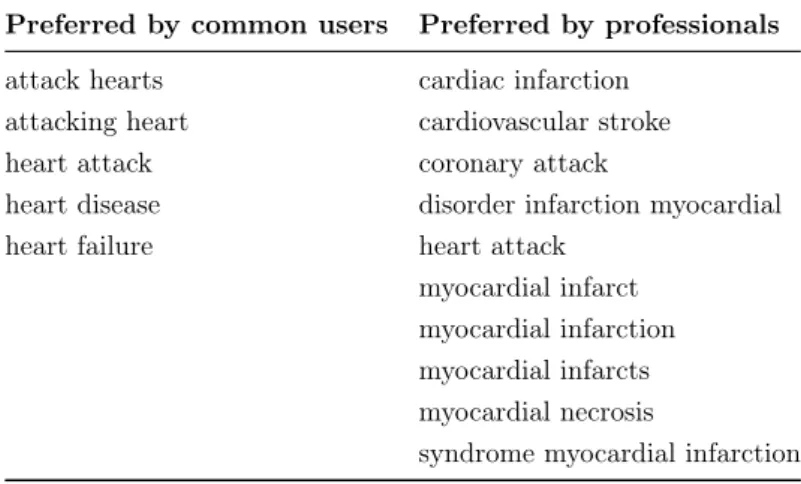
When conducting a search, users may use different words, which are known as synonyms, to refer to the same meaning. For example, Table2.3presents a group of words which share the same meaning of heart attack4: “A heart attack happens when blood flow to the heart suddenly becomes blocked.” Supposing a user issues a simple query “what is heart attack” to the searching system. Based on the theory of modern retrieval models, documents that only include the query term heart or attack or both terms can be retrieved as relevant to the issued query. However, the documents that do not include either of the query terms can also be related to this query. For example, these documents may use other words like cardiac infarction which is preferred by professionals (see the second column presented in Table2.3).
This language gap between the common users and professionals can be solved using query expansion (QE) techniques.
Query expansion can be described as: “a method for improving retrieval per-formance by supplementing an original query with additional terms.
Expan-4
Table 2.3: Synonyms for heart attack.
Preferred by common users Preferred by professionals attack hearts cardiac infarction
attacking heart cardiovascular stroke heart attack coronary attack
heart disease disorder infarction myocardial heart failure heart attack
myocardial infarct myocardial infarction myocardial infarcts myocardial necrosis
syndrome myocardial infarction
sion can take place in the initial query formulation, the query reformulation stage of the online search, or both and can be performed manually, automat-ically, or interactively.” (Efthimiadis,1996).
Conceptually, the expanded query (Qe) is obtained after the query expansion
phase by adding the new words (Qa) to the original query (Qo). This can
be written as
Qe= Qo∪ Qa
The general process of using query expansion approach is presented in Fig-ure 2.4: first, query terms are identified after pre-processing (tokenization and normalization); then, an expanding resource is used to find new words and the expanding techniques are applied; finally, an expanded query is built by adding these new words to the original one.
Different kinds of techniques and resources can be used to find words which are similar or related to a query term. And generally, QE techniques can be classified into two major classes depending on where the added words are derived from (Christopher et al.,2008):
• QE with relevance feedback. This method takes use of the retrieved results from the initially retrieval to refine the original query. This method is also known as the local method.
• QE with thesaurus. Synonymous words are expanded from a thesaurus. This method is also known as the global method.
Figure 2.4: Query expansion approach.
Query Expansion with Relevance Feedback
As shown in Figure2.5, the basic and general procedure of applying relevance feedback techniques in query expansion method can be summarized in five steps (Christopher et al.,2008).
Step 1. A user issues a query to a search system.
Step 2. This search system returns a set of retrieval results with an initial retrieval.
Step 3. The retrieved documents from the previous step are identified as relevant or irrelevant by human assessors or by IR weighing models.
Step 4. Based on the feedback obtained in the previous step, the search system proposed a refined query which is deemed as a better representation of the information need.
Step 5. This refined query is then issued to the search system to perform another retrieval which is assumed to be an improved result compared to the initial retrieval.
Figure 2.5: Applying relevance feedback techniques in query expansion.
Step 1 and step 2 perform the initial retrieval with the original query. Dur-ing step 3 and step 4, various relevance feedback techniques such as Rocchio algorithm (Rocchio,1971), probabilistic relevance feedback and Pseudo Rel-evance Feedback (Christopher et al.,2008) have been proposed to determine
what kind of words should be added to refine the original query. And finally with step 5, a new ranking list which is obtained using the expanded query is returned to the user.
Next we take the widely used Pseudo Relevance Feedback as an example and discuss its usage in refining the original query.
Pseudo Relevance Feedback. Pseudo relevance feedback (a.k.a. blind relevance feedback) is a way to improve retrieval performance without the user interaction. This method performs the initial retrieval and assumes that the top ranked documents are relevant.
Figure 2.6 presents how pseudo relevance feedback technique can be used in an IR model to satisfy the user more. Given a query q and the dataset, the retrieval system retrieved the dataset and returned an initial ranked list. Newly added terms are extracted from the top n documents in the initial list. An expanded query q’ is generated, which includes the original query and the expanded terms. The search system retrieves the same dataset with the new generated query q’ and an expansion-based list is produced.
Figure 2.6: Pseudo relevance feedback.
Query Expansion with Thesaurus
Different from QE with relevance feedback, given a query term, its synonyms or related words can be automatically identified from the thesaurus. Many different ways have been explored to built a thesaurus and they can be summarized as (Christopher et al.,2008):
• Manually controlling and maintaining a thesaurus.
• Automatically building a thesaurus by analyzing a collection of docu-ments such as using word co-occurrence statistics or shallow grammat-ical analysis.
2.3.3 Learning to Rank
In IR research area, machine learning techniques can be applied to improving ranking performance and this is known as Learning to Rank (LETOR) (Liu et al.,2009).
LETOR approach typically uses traditional supervised machine learning methods and trains a model with features extracted from documents and queries. Liu et al.(2009) presented a typical framework of learning to rank approach, as Figure 2.7demonstrates5.
Figure 2.7: Learning to rank model.
LETOR Framework
Typically, the training data consists of three elements: training queries Q, the associated documents D, and the corresponding relevance judgments qrel for query and document pairs. Certain specific learning algorithms are then used to generate a learning to rank model. The creation of a testing data for evaluation is very similar to the creation of the training data which includes testing queries and the associated documents. To these testing queries, the learning to rank model is jointly used with a retrieval model and to sort the documents according to their relevance to the query, and return a corresponding ranked list of the documents as the response to the query.
5
Training Data. Usually, with an enormous data set, not all the retrieved documents, but only the top documents from the ranking list are selected to be evaluated by human beings. The qrel file is the evaluation results containing the top documents and its judgement by humans, which can be used as training data when apply learning to rank techniques to learn a model.
Learning to Rank Algorithms. Various kinds of LETOR approaches have been proposed in learning a model. Typically, these approaches are classified into three categories: pointwise, pairwise and listwise approaches. The pointwise approach takes into account a single document and train a classifier on this document. The classifier is then used to predict the relevance degree between the document and the query. The pairwise approach is used on a pair of documents and to find the optimal ordering for this document pair or the pairwise preference between each pair of documents. The listwise approach considers the entire list of documents and aims to find the optimal ordering for the whole list.
For each of these approaches, they can be further divided into sub-categories according to different machine learning technologies used. Table 2.4 lists some of the widely used algorithms according to each LETOR approach (Burges,
2010;Xu and Li,2007;Cao et al.,2007).
Table 2.4: LETOR algorithms classification.
LETOR approach Example algorithm
the pointwise approach Random Forest,PRank,McRank the pairwise approach RankNet,RankBoost,RankSVM,MART
the listwise approach LambdaRank,LambdaMART,ListMLE,AdaRank, ListNet
Testing Data. According to if the training and testing data are from the same collection or not, the testing process is categorized into two kinds. The first is when training and testing data are from the same collection. The provided queries are divided into training, validation and testing; the training queries together with the evaluated documents for the queries are used to train a learning to rank model, following the process mentioned in learning to rank module; the validation part is used for adjusting the learned model; and finally the testing queries are used for evaluating the model. The second kind of is when training and testing data are from different collection: the testing process is tested on a new collection different from the one that training or validation based on. The testing data includes new queries as
well. Both these two kinds were researched in our work.
Features in Learning to Rank
Creating a feature list is an important task in applying LETOR approach. Traditionally, explored potential features are defined and blindly combined all together to create a feature list which is used to train a LETOR model af-terwards. Vast amount of work has been researched into digging new features which is a costly job in Learning to Rank.
Depending on different application, various kinds of features can be extracted and used with machine learning techniques to obtain a learning to rank model.
Usually, depending on its dependency to the query, features are classified into two groups (Macdonald et al.,2013):
• Query independent (QI) features. Query independent features are in-dependent of a query and are extracted from the documents only; for example, document length and document PageRank (Page et al.,1999) are categorized as QI features.
• Query dependent (QD) features. Query dependent features are typi-cally extracted from query and document pairs; for example, the score obtained through a retrieval model can be used as the QD features.
In addition, depending on where a feature is extracted from, features can be classified according to the field of a document that it is originated from, such as the feature of Title, H1, Else, body or the whole document.
LETOR Benchmark Dataset. Microsoft LETOR Benchmark Dataset developed by Qin et al. (2010) and Qin and Liu (2013) contains a group of standard features which can be used for research on LETOR. Table 2.5
presents the 46 features available from LETOR 4.0 benchmark dataset (Qin and Liu,2013).
Most of features (feature 1-40) can be extracted locally using different algo-rithms or retrieval models which include: tf, idf, document length, TFIDF retrieval model, document length, BM25 retrieval model, three language models LMIR.ABS, LMIR.DIR and LMIR.JM (Zhai and Lafferty, 2017). Also, six statistics of web-related features (feature 41-46) are also included.
Table 2.5: Features in LETOR 4.0 benchmark dataset.
Category Nr. Feature name Feature type
term frequency 1 TF of Title QD
2 TF of anchor QD
3 TF of body QD
4 TF of URL QD
5 TF of whole document QD inverse document frequency 6 IDF of Title QD
7 IDF of anchor QD
8 IDF of body QD
9 IDF of URL QD
10 IDF of whole document QD TFIDF retrieval model 11 TFIDF of Title QD
12 TFIDF of anchor QD
13 TFIDF of body QD
14 TFIDF of URL QD
15 TFIDF of whole document QD
Document length 16 Dl of Title QI
17 Dl of anchor QI
18 Dl of body QI
19 Dl of URL QI
20 Dl of whole document QI
BM25 retrieval model 21 BM25 of Title QD
22 BM25 of anchor QD
23 BM25 of body QD
24 BM25 of URL QD
25 BM25 of whole document QD Language model with 26 LMIR.ABS of Title QD absolute discounting smoothing 27 LMIR.ABS of anchor QD
28 LMIR.ABS of body QD
29 LMIR.ABS of URL QD
30 LMIR.ABS of whole document QD Language model with 31 LMIR.DIR of Title QD Bayesian smoothing 32 LMIR.DIR of anchor QD using Dirichlet prior 33 LMIR.DIR of body QD
34 LMIR.DIR of URL QD
35 LMIR.DIR of whole document QD Language model with 36 LMIR.JM of Title QD Jelinek-Mercer smoothing 37 LMIR.JM of anchor QD
38 LMIR.JM of body QD
39 LMIR.JM of URL QD
40 LMIR.JM of whole document QD
web-related statistics 41 PageRank QI
42 Inlink number QI
43 Outlink number QI
44 Number of slash in URL QI
45 Length of URL QI
Format LETOR Feature File.
Prior to applying machine learning algorithms, features are extracted and detailed in a LETOR feature file (Liu et al.,2009), as shown in Figure 2.8.
LETOR feature file #1: feature1 #2: feature2 #3: feature3 2 qid:001 1:0.279 2:0.067 3:0.056 #docid=001 1 qid:007 1:0.591 2:0.732 3:1.000 #docid=002 ... ...
Figure 2.8: An example of format LETOR feature file.
The header part of a LETOR feature file is composed of features names. Then, every single line represents a retrieved document for a query: the first entry is the evaluation label from the qrel file, then the feature value, and finally the document ID. Also, when building a LETOR feature file, different features combinations were explored.
With a LETOR feature file built, LETOR algorithms can then be applied.
2.3.4 Rank Aggregation
Rank aggregation means combining the results available from multiple re-trieval models and produces a single ranking list. Rank aggregation is also referred as data fusion (Vogt and Cottrell, 1998, 1999) or rank combina-tion (Dwork et al.,2001) in some literature6.
Vogt and Cottrell (1998,1999) pointed out that aggregation allowed a sig-nificant reduction in the number of features and enumerated three beneficial effects of combining multiple models:
• The Skimming Effect. Skim means only top-ranked items are selected. Documents are represented by different retrieval methods and thus retrieve different relevant items. A combination model taking the top-ranked items from each of the retrieval approaches can increase recall as well as precision.
• The Chorus Effect. A number of retrieval approaches suggesting that an item is relevant to a query provide stronger evidence for relevance than that of a single approach. A combination model can explore this
6