Using Visual Arts in the Young Learner Classroom:
Exploring the Effect on Engagement
Ekaterina Aleksandrovna Litvinova
Relatório de Estágio de Mestrado em Ensino de Inglês
no 1º Ciclo do Ensino Básico
i Relatório de Estágio apresentado para cumprimento dos requisitos necessários à
obtenção do grau de Mestre em Mestrado em ensino de inglês no 1º ciclo do ensino básico, realizado sob a orientação científica de
ii Dedication: To my mother, a visionary and a role model. To Nuno, for seeing the best in people.
iii ACKNOWLEDGEMENTS
I am very grateful to Prof. Dr. Ana Matos for welcoming me to the New University of Lisbon back in 2014. My MA has become possible thanks to her.
I thank Prof. Cátia Ferrão for all her help, support and positive attitude during my practicum.
My thanks to the schools where I carried out my practicum and the young learners who participated in my study – I taught them; they taught me.
My deepest thanks to Prof. Dr. Carolyn E. Leslie, who helped me gather ideas, guided me and believed that my final report was going to be all right.
iv USING VISUAL ARTS IN THE YOUNG LEARNER CLASSROOM:
EXPLORING THE EFFECT ON ENGAGEMENT
EKATERINA ALEKSANDROVNA LITVINOVA
ABSTRACT
KEYWORDS: visual arts, visual arts incorporation, young learners, engagement, emotional engagement, cognitive engagement, behavioural engagement
This report is based on action research carried out in a first cycle English classroom of a Portuguese school. Two types of visual arts: paintings and drawings were taken as a basis for PowerPoint presentations that were incorporated into the lessons. The effect on student engagement was compared to that from lessons based on visual arts contained in the coursebook: photographs and illustrations. Multidimensional point of view on engagement was considered in the paper, where the construct of engagement is constituted by emotional, cognitive, and behavioural components. The level of engagement in terms of the three dimensions was evaluated with the help of four tools, two direct: questionnaires and interviews with the students, and two indirect: observation grids and a teaching journal. Selection of visual arts to be used in the young learner classroom was described and the most engaging materials and activities based on visual arts are outlined. The outcomes showed that student engagement was stimulated to a greater degree by paintings and drawings than by photographs and illustrations.
v A UTILIZAÇÃO DE ARTES VISUAIS EM ALUNOS DO ENSINO BÁSICO:
EXPLORANDO O EFEITO SOBRE O ENVOLVIMENTO
EKATERINA ALEKSANDROVNA LITVINOVA
RESUMO
PALAVRAS-CHAVE: artes visuais, incorporação de artes visuais, alunos do ensino básico, envolvimento, envolvimento emocional, envolvimento cognitivo, envolvimento comportamental.
Este relatório é baseado num trabalho de investigação efectuado numa sala de aula de Inglês do primeiro ciclo de uma escola Portuguesa. Dois tipos de artes visuais: pinturas e desenhos foram a base para apresentações em PowerPoint que foram introduzidas durante as aulas. O efeito sobre o envolvimento dos alunos foi comparado com o das aulas baseadas no conteúdo visual do manual: fotografias e ilustrações. O ponto de vista multidimensional sobre o envolvimento foi tido em conta no relatório, no qual era constituído por componentes emocionais, cognitivos e comportamentais. O nível de envolvimento tridimensional foi avaliado com o auxílio de quatro ferramentas, duas diretas: questionários e entrevistas com os alunos, e duas indiretas: tabelas de observação e diário do professor. O conteúdo de arte visual selecionado e usado na sala de aula foi descrito e os materiais e atividades mais envolventes baseados em artes visuais foram delineados. Os resultados mostraram que o envolvimento dos alunos sofria uma maior estimulação através de pinturas e desenhos do que por fotografias e ilustrações.
vi
Table of Contents
List of Tables ... viii
List of Appendices ... ix
List of Abbreviations ... x
Introduction ... 1
1. Background information on the area of interest ... 1
2. Origins of the study ... 1
3. The purpose of the research ... 1
4. Research questions ... 2
Chapter I. Literature Review. ... 3
I. 1. The term and the meaning of engagement in current research. ... 3
I. 2. Significance of engagement... 4
I. 3. Dimensions of engagement. ... 5
I. 3. 1. Emotional engagement... 5
I. 3. 2. Behavioural engagement. ... 6
I. 3. 3. Cognitive engagement. ... 7
I. 4. Incorporating visual arts in the classroom. ... 8
I. 5. Summary. ... 8
Chapter II. The Action Research ... 9
II. 1. Context of the action research ... 9
II. 2. Methodology. ... 10
II. 2. 1. Introduction ... 10
II. 2. 2. Collecting consent ... 10
II. 2. 3. Selection of visual arts to be used in lessons. ... 11
II. 2. 4. Questionnaires ... 12
II. 2. 5. Interviews with students. ... 13
II. 2. 6. Observation grids. ... 13
II. 2. 7. Teaching journal ... 14
II. 3. Results ... 15
II. 3. 1. What is the best choice of visual arts to be used in lessons? ... 15
II. 3. 2. Questionnaires. ... 16
vii
II. 3. 4. Interviews. ... 23
II. 3. 5. The teaching journal. ... 25
II. 4. Discussion and Conclusion ... 26
II. 4. 1. The importance of the action research. ... 28
II. 4. 2. Future research. ... 28
II. 4. 3. Final conclusion. ... 29
Reference list ... 30
viii
List of Tables
Table 1. Questionnaires ... 13
Table 2. Observation grids ... 14
Table 3. Results of the first questionnaire ... 17
Table 4. Results of the second questionnaire ... 19
Table 5. Results of the third (final) questionnaire ... 21
Table 6. Observation grid for Lesson 3 (VA-based lesson) ... 22
Table 7. Observation grid for Lesson 4 (CB-based lesson) ... 22
Table 8. Observation grid for Lesson 5 (VA-based lesson) ... 22
Table 9. Observation grid for Lesson 16 (CB-based lesson) ... 22
ix
List of Appendices
Appendix A: Letter of consent for students. ... 33
Appendix B: Letter of consent for parents. ... 34
Appendix C: Letter of consent for the school director. ... 36
Appendix D: A VA-based hand-out for the topic “Furniture” ... 37
Appendix E: A VA-based sheet for colouring in for the topic “Recycling” ... 37
Appendix F: PPT presentation of Lesson 1. ... 39
Appendix G. Questionnaire 1. ... 44
Appendix H: Questionnaire 2. ... 45
Appendix I: Questionnaire 3... 46
Appendix J: Interview questions. ... 49
Appendix K: Cooperating teacher observation grid ... 50
Appendix L: Drawing of a house (on which the most engaging lesson during the study was based). ... 51
x
List of Abbreviations
EFL - English as a foreign language YL - young learner
PPT - PowerPoint
VA – visual arts CB – coursebook
1
Introduction
1. Background information on the area of interest
The main topic of the present report is student engagement, which has been called “the holy grail of learning” (Sinatra, Heddy & Lombardi, 2015, p. 1). Dornyei stated that it could become one of the key terms in language methodology, and considered engagement a typical 21st century topic (Cambridge University Press ELT, 2018). Authors give different definitions of engagement and attribute to it various characteristics, but all of them agree that a higher level of engagement leads to effective classroom management and better learning outcomes. Inspired by these approaches to engagement, I embarked on action research about engagement in the primary EFL classroom.
2. Origins of the study
The idea for the present action research originated from observation of first cycle lessons in a Portuguese public school. The lesson that prompted the idea of this report was dedicated to the topic “Feelings and Emotions”. The teacher showed third-graders several photographs and paintings from the Internet to illustrate emotions. This presentation caused a considerable upsurge in engagement, the effect of which was easily observable, since the learners demonstrated increased attention, focus on the learning process and eagerness to participate. It was obvious that they enjoyed the instances of visual art presented: “Mona Lisa” by Leonardo Da Vinci, “Marilyn Monroe” by Andy Warhol, “The Scream” by Edvard Munch and photographs of the faces of Salvador Dali and Andy Warhol. The visual arts and consecutive activities based on them had a noteworthy effect on classroom management and, given that the class was not easy to control, the effect seemed remarkable. About eight months later, I interviewed the learners and some of them still remembered both the demonstration and the vocabulary presented, which testified to the fact that they memorized it very well, which could be due to the engagement that the visual arts (VA) had caused.
2 After witnessing the aforementioned inspiring effect of the incorporation of visual arts into the young learner (YL) English classroom, I decided that the relationship between visual arts and student engagement needed further investigation, and during the following teaching practicum, I had a chance to introduce visual arts into the primary EFL classroom on a larger scale.
The main aim of my action research was to try to observe and describe the effect that visual arts have on learners’ engagement in the primary English classroom. As many authors have done (Klem and Connell, 2004, Philp and Duchesne, 2016, Reeve and Tseng, 2011, Yang, 2011), I subdivided student engagement into three dimensions: emotional, behavioural and cognitive. Guided by characteristics outlined in the literature, I made an attempt to expose a possible effect that the incorporation of visual arts could have on the three dimensions on the basis of evidence collected with several observation tools. I hoped to be able to trace common patterns in triangulated evidence and draw conclusions as to whether and how VA-based materials and activities have the capacity to engage young learners.
4. Research questions
My starting point was to select instances of visual arts, which were appropriate and potentially engaging for children aged 9-11 years old, weaving visual arts into lessons and building activities around them to see if I could help to stimulate a higher level of student engagement by doing so. Hence, my first concern was to prepare materials. Second, I had to operationalize engagement and its manifestations to be able to observe them in the classroom. Finally, when introducing materials and activities, I had to monitor student engagement to assess its level and try to understand its association with visual arts. Therefore, I came up with three research questions that laid the foundations for my action research and, consequently, the present report:
1. What is the best choice of visual arts to use in lessons?
2. How does the use of visual arts influence the three dimensions of engagement?
3
Chapter I. Literature Review.
This chapter aims to define the theoretical background of the action research presented in the report. First, an attempt is made to outline researchers’ general views on student engagement in language education. The construct of engagement is defined and the choice of engagement over motivation is justified. Then, findings are discussed pertaining to key indicators and dimensions of engagement in current research, especially in research related to the young learner classroom, teaching English as a foreign language and incorporating visual arts into the curriculum. It appears that research linking engagement to the three aforementioned areas is scarce. Therefore, the present action research seems to be well-timed in trying to bridge this gap.
I. 1. The term and the meaning of engagement in current research.
Research on the construct ‘engagement’ was initiated in 1985 by Mosher and McGowan. Since then, this construct has gone by different names. For instance, Platt and Brooks (2002) provide an insight into EFL-related ‘task engagement’. They define the construct as the moment where learner’s transformation of interpsychological into intrapsychological functioning starts. Their point of view is supported by Svalberg (2009). She chooses to use the term ‘engagement with language’ and considers construction of one’s own knowledge as one of its most prominent features. Reeve’s (2011) outlook on engagement does not seem to contradict the aforementioned two, while defining engagement as a student’s active involvement in a learning activity. Smithrim and Upitis (2005) define engagement as “being wholly involved” (p. 124). Therefore, in comparison with the first two definitions, which deal with a result (‘transformation’ and ‘construction’), the others two are concerned with the process (‘involvement’), as well as definitions given by Helme and Clarke (2001) and Philp and Duchesne (2016), which similarly focus on engagement as involvement in the learning process.
For the purposes of the present paper, I define engagement as focused participation in a learning activity accompanied by enjoyment. I consider student engagement to be a process rather than the outcome of classroom activities. I also believe that I should draw the line between engagement and motivation, a construct that often goes side by side with that of student engagement. In the literature, the constructs of
4 engagement and motivation are involved in an interplay in an attempt to define which of the two is the cause and which is the consequence. For instance, Oga-Baldwin and Nakata (2017), in an investigation into primary school foreign language learning, come to the conclusion that student engagement “during class dynamically influences their future motivation” (p. 162). For the purpose of the present action research, I adopt this point of view and accept engagement as being a precursor of motivation. This point of view justifies the choice of the construct under investigation as a foundation for developing motivation. It is equally important for the present paper that most authors agree on engagement being more easily observable than motivation in the context of a lesson. Since the present action research was carried out over a period of three months, it seems important to have it built around a construct with manifestations which are observable over a relatively short time span.
I. 2. Significance of engagement.
Drawing on the literature, it was easy to demonstrate the importance of engagement research in the context of the classroom. It appeared more difficult to establish a convincing body of evidence at the intersection of engagement, the young learner classroom research and investigation into teaching English as a foreign language. In addition, the task of analysing current research became more challenging when adding visual arts to the list of keywords. Therefore, literature for the present review originated from different areas of research (applied linguistics, educational psychology and sociocultural research). Thus, assessing student engagement in secondary schools, Mosher and MacGowan (1985) thought of engagement as having an impact on “many student and school outcomes including achievement, academic knowledge, and social behaviour” (p. 1). In an article about a school-wide arts education approach, Smithrim and Upitis (2005) suggested that engagement “might explain any gains in academic achievement” (p. 124). Helme and Clark (2001) confirmed the aforementioned opinion by generalizing that the quality or level of engagement “is generally believed to have a profound effect on learning outcomes” (p. 133). Exploring engagement in EFL tasks, Philp and Duchesne (2016) also spoke about the significance of the concept in a general sense: “there is a shared intuitive recognition of engagement as optimal for learning (p. 50)”. This is further stressed by Klem and Connell (2004): “research links higher levels of engagement in school with improved performance” (p. 262). Finally, in a study carried
5 out with primary learners of English as second language, Waring and Hruska (2011) claimed the important role of engagement in the classroom: “gaining and maintaining engagement is of primary concern for teachers” (p. 442). Consequently, the choice of engagement as the main construct for the action research stemmed from the present-day relevance of the topic and the gap that still existed in investigating the construct in the young learner EFL classroom. Furthermore, in the present paper I take a step further, introducing visual arts into my research and testing their effect on engagement.
I. 3. Dimensions of engagement.
Most researchers agree that engagement is a multidimensional construct. The number of dimensions of engagement (also called components, facets or types) ranges from two to four. The two types most often mentioned in research are emotional (also called affective or motivational) and behavioural (also called academic) and the other two are cognitive and social.
As do many researchers, I also endorse the multidimensional three-type model of engagement constructed by emotional, cognitive, and behavioural dimensions of engagement. I believe that this model of engagement is reflected in the definition I have adopted (focused participation in a learning activity accompanied by enjoyment) since ‘enjoyment’ is characteristic of emotional engagement, ‘focused’ reveals presence of behavioural engagement and ‘participation in a learning activity’ has to do with cognitive engagement. I echo the idea of interdependence of the three dimensions of the construct and discuss them in more detail below.
I. 3. 1. Emotional engagement.
This type of student engagement involves attitude towards English language learning, embracing aspects of language learning, ranging from fun and enjoyment to relationships between peers and with the English teacher. For instance, in a study carried out with Japanese young language learners, Oga-Baldwin and Nakata (2017) established that a favourable atmosphere in the English classroom might help to build and sustain young children's engagement with learning a new language. With the help of questionnaires and observation, the researcher established a link between positive emotions during English lessons and achievement and learning success. By a favourable
6 classroom environment, the author means opportunities for everyone to actively participate and activities based on students’ interests, which help to create positive affect in the English classroom.
Lo and Hyland (2007) reported an upsurge of engagement with writing in English due to emotional attachment to the theme. In an interview and a diary, a low-achieving primary student from Hong Kong expressed sympathy to the subject of the writing. As a result of increased engagement with writing (which was the object of the study), the student wrote a longer text, making “an increase of 50%” (in terms of size) “from her previous writing task” (p. 230). The authors thus established a connection between primary students’ “deep personal involvement with the topic”, engagement and making steps towards learning success.
Investigating learner-generated attention to form in communication tasks face-to-face and online, Baralt, Gurzynski-Weiss and Kim (2016) reported greater emotional engagement in face-to-face communication in groups of adult learners, as compared to online. The positive attitudes registered by the authors were shown towards working with a partner to complete a task, “for which there was more willingness to participate and a shared focus on performing the task together” (p. 233). On the contrary, learners who carried out the task online, reported anxiety and tension “due to their unfamiliarity with their partners” (p. 233), thus demonstrating low emotional engagement. The authors were thus led to the conclusion that “learners’ emotional engagement, e.g., their attitudes […] affected their cognitive engagement with form” (p. 233). The authors also testify that unlike other types of student engagement, emotional engagement is “more difficult to uncover from the interaction data” (p. 227). That is why this dimension of engagement is commonly measured with the use of questionnaires, learner’s diaries and interviews. These are analysed through a qualitative analysis of emotions expressed by students. The behaviours used to measure this aspect of engagement are active participation (both verbal and expressed through body language), and such manifestations as enjoyment, frustration, interest and boredom (Philp and Duchesne, 2016).
I. 3. 2. Behavioural engagement.
Language learning studies that investigate solely this type of engagement are rare. It is usually regarded together with other dimensions, as in Yang (2011), and Philp and
7 Duchesne (2016). To obtain a wider outlook on this dimension, I reviewed the articles by Klem and Connell (2004) and Reeve and Tseng (2011) that feature a multi-discipline approach. In a study exploring agency as a fourth aspect of students’ engagement, Reeve and Tseng (2011) regarded behavioural engagement of high school students as featuring on-task attention, effort, persistence, and lack of behaviour problems (p. 257). The authors reported that they did not find a significant connection between behavioural engagement and achievement. Studying an out-of-classroom online situated language learning environment, meant to support college students, Yang (2011) found out that a shift in role relationships between the teacher and students led to more active participation by the students, which increased behavioural engagement. In questionnaires, the students indicated that the system provided learning activities, feedback, and learning records to increase their participation, which runs counter to the research done by Baralt, Gurzynski-Weiss and Kim (2016) about emotional engagement. In addition, the students were encouraged to share their learning records online, which “helped the students to notice the learning activities or tasks they had ignored, thereby increasing their behavioural engagement” (p. 187). Finally, examining links between teacher support, student engagement, and academic success in groups of elementary and secondary students, Klem and Connell (2004) discovered cases when students demonstrated behavioural engagement but still did the work without being emotionally or cognitively engaged. Thus, the authors were led to believe that “while these three components of engagement correlated positively, they were not close to perfectly correlated” (p. 270).
I. 3. 3. Cognitive engagement.
A study by Helme and Clarke (2001) carried out in a secondary mathematics classroom, supported the point of view that cognitive engagement is a valued learning facilitator. With the help of video and audio recordings, field notes and post-lesson interviews, the authors established some linguistic and behavioural indicators of cognitive engagement. Among those were gestures (interpreted as externalising thought processes), self-monitoring, exchanging and contributing ideas, giving directions (as well as explanations or information), justifying arguments, reflective self-questioning, seeking information and feedback, completing peer/teacher utterances, concentration (revealed as resisting distractions or interruptions), and making evaluative comments. Thus, the
8 authors concluded that cognitive engagement was observable in the classroom and could be recognized by the aforementioned indicators.
In her analysis of cognitive engagement, Svalberg (2014) singled out its components: alertness, focused attention and action knowledge (making knowledge one’s own). Therefore, cognitively engaged students were defined as focused, reflective, and critical/analytical. The researcher concluded that the teacher has a key role in creating classroom conditions that stimulate cognitive engagement with language.
I. 4. Incorporating visual arts in the classroom.
Reporting the impact of arts education programmes on learning in U.S. primary and secondary schools, Fiske (1999) concluded that the arts have the capacity to engage students, even “problem” ones, in activities, while making learning experiences real and meaningful, in a unique way. “The arts have shown links to student (…) engagement in school, attitudes that contribute to academic achievement” (p. 19). Speaking about secondary language classrooms, Jordan and DiCicco (2012) outlined three main reasons for the integration of visual arts: (1) the visual arts engage students; (2) the visual arts provide teachers with a new set of tools and materials in a language classroom; and (3) they encourage critical thinking. In a school-wide study, Catterall and Peppler (2007) compared survey results of third grade students: those who had visual arts lessons and those who did not. Analysis showed that the former were more engaged in the rest of subjects (other than arts) and were able to sustain periods of high focus for longer periods of time than students who did not have arts lessons.
I. 5. Summary.
According to mainstream research, engagement is a vital condition of students’ success in the language classroom. Related to motivation, engagement is regarded as having ‘action’ properties while motivation is connected to learner’s intentions. Comprising up to four dimensions with their respective indicators, student engagement is a current topic which still needs research in many areas. The literature analysed reflected this point, since the attempt at finding relevant studies brought papers scattered through school ages, disciplines and scientific areas. Therefore, in this paper I present my own
9 definition of engagement and make an attempt to fill a lacuna in engagement research at the intersection of teaching English as a foreign language to young learners and incorporating visual arts into the curriculum.
Chapter II. The Action Research
II. 1. Context of the action research
The participants of the study were 20 learners of English as a foreign language from a fourth-year class in a Portuguese public school. Aged between 9 and 11 years old, all of them had English in the third year. Therefore, they were in their second year of studying English. All of them spoke Portuguese as the first language, though one student had a Romanian background. There were 9 boys and 11 girls, three of whom had received educational help the previous year that was discontinued the year the action research took place. There were three very bright students. The group was normally enthusiastic, the enthusiasm, however, verging on misbehaviour. The school was situated in a satellite city of Lisbon, in the most densely populated municipality in Portugal.
The class had two 60-minute English lessons per week, English always being the last lesson of the day. The action research was performed during one semester, over 22 lessons. This was the first term in the school year. There were three topics covered during the semester: “Countries and Nationalities”, “At School” and “My Community”. This is important since the action research dealt with preparation of materials and those had to be connected with the topics outlined for learning in this period of the year.
The coursebook adopted for the 4th year was “Seesaw” (Albuquerque and Marques, 2016), which covered all the topics outlined in the curricular objectives. Parts of the coursebook pertaining to the three topics covered contained images: illustrations, photographs, comics, maps, two small drawings. All of them were evidently selected or created especially for the book in question. In terms of authentic materials, the coursebook included images of characters from films and cartoons (e.g., Harry Potter and Mickey Mouse) in the contents of the first topic, “Countries and Nationalities”. For the purpose of the current research, it is important to add that the coursebook did not include reproductions of paintings or drawings.
10 II. 2. Methodology.
II. 2. 1. Introduction
The present chapter discusses the process, tools and procedures of the action research performed. Carried out by a student teacher in her cooperating teacher’s classroom, the action research involved a small-scale investigative project (Richards & Lockhart, 1994) comprising several stages: planning, action, observation and reflection. During the action research, the original idea was revised and the plan was altered accordingly, in an attempt to obtain more accurate results. The modifications will be discussed in further detail in part 3 of this section.
In the framework of the action research, several data collection tools were used: interviews with students, a teaching journal, questionnaires and observation grids. The observation grids were filled in by the cooperating teacher during lessons. In an attempt to triangulate research information, I used two quantitative and two qualitative observation tools. Interviews and questionnaires brought information directly from the learners, and observation grids and the teaching journal helped gather information about learners’ engagement indirectly. However, to start using these tools and to embark on the action research, consent was collected from the school cluster director, students and their parents.
II. 2. 2. Collecting consent
The first official step of the action research consisted of presenting the idea to students, answering questions, clarifying doubts and asking for the students’ verbal consent. Then consent forms were distributed to the students (Appendix A), further explaining the purpose and procedures of the study. Both the verbal and written consent was in the students’ L1, helping to make sure that the students understood what could be implied by their participation in the study. The students were enthusiastic about their role and eager to confirm their participation. At the same time, letters of consent were distributed asking the students’ parents for permission (Appendix B). A letter of consent was presented to the school cluster director (Appendix C). All of the aforementioned were signed and collected, except for one student and his parents.
11 II. 2. 3. Selection of visual arts to be used in lessons.
The initial idea of my action research consisted of alternating lessons based on visual arts and those without visual arts, and comparing the effect of both on the YLs’ engagement. Preparation for Lesson 2 proved that it was impossible not to use any VA in the YL classroom. Therefore, I started to alternate lessons based on PowerPoint (PPT) presentations using visual arts images selected by myself, with lessons based on images from the coursebook. Finally, starting from Lesson 7 (out of 22), the idea was reshaped from alternating lessons to alternating topics, introducing some topics with images from the coursebook (illustrations, photographs and comics) and others based on images from PPT presentations (paintings and drawings). This was done to obtain more accurate results. VA-based topics were “Rooms and Furniture” and “Recycling”. CB-based topics included “School and School activities”, “Time” and “My community”. The two first topics introduced during the first seven lessons were taught in a mixed way: using both the coursebook and PPT presentations. These were “Countries and Nationalities” and “Days, Months and Ordinals”.
For the PPT presentations, I tried to select well-known pieces of visual art to enrich the learners’ cultural background. While selecting images I wanted to project on the screen, I took into account their good visibility (absence of small details) and their capacity to be easily understood by a 9-year-old child (e.g. I avoided cubism). Apart from PPT presentations, I also used VA in a handout (Appendix D) and in a worksheet for colouring in (Appendix E).
To prepare PPT presentations for the lessons, I had to keep the topic of the lesson in mind, for example, “Countries and Nationalities” (Lesson 1, Appendix F). For that lesson, I selected pieces of visual art that were created by local artists (e.g., Catrin Williams’ “Harbwr glas - Blu harbour” for Wales, Roque Gameiro’s “Rua de São Miguel, Alfama” for Portugal) or that depicted characteristic features of the country (e.g., a platypus for Australia). To introduce the names of countries, I asked the students to guess the country from its image. To teach nationalities, I showed photographs of a famous person from every country and made the students guess the nationality and then first listen and then repeat a sentence about the person’s nationality. As for the other VA-based lessons, to introduce the names of pieces of furniture, I used “Bedroom in Arles” by Vincent van Gogh, “Living Room” by Andy Warhol and “Room” by Vadim Suslov (Appendix D). I later used these in a hand-out for a pairwork activity for the students to
12 speak about the furniture. For the topic “Recycling” I compiled a VA-based sheet of vector drawings for colouring in (Appendix E).
As for CB-based lessons, I used illustrations of parts of the school and photographs from the coursebook to introduce the topic “School and School activities”. I used illustrations and photographs of clocks from the CB to introduce the topic “Time”. To teach the topic “My Community” I used cartoons and illustrations of places around town. For the topic “Days, Months and Ordinals”, I made a PPT presentation with illustrations and a worksheet that did not use any visual arts.
II. 2. 4. Questionnaires
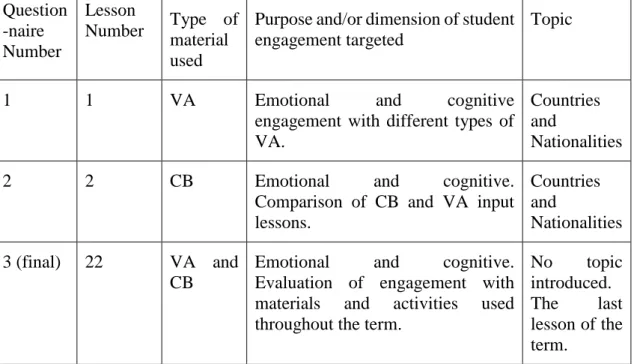
In the first lesson of the study, I probed the students’ attitude towards different types of visual arts. I was teaching “Countries and Nationalities”, and I demonstrated a PPT presentation including photographs, sculpture, paintings, drawings and a cartoon (Appendix F). At the end of the lesson, the students filled in the first questionnaire (Appendix G) where they indicated their favourite image and activity, and explained the reason why they preferred them. The idea underlying the first questionnaire was to evaluate how emotionally engaged the students were with different types of VA and activities based on them.
In the second lesson, I continued to teach the topic “Countries and Nationalities” but this lesson was coursebook-based. The second questionnaire (Appendix H) administered at the end of the lesson was to compare the students’ emotional engagement during this and the previous, VA-based lesson. Thus, the first two questionnaires (Table 1) were mainly targeted at assessing emotional engagement. The students’ responses to closed-ended and ended questions were analysed quantitatively. From the open-ended questions, I also gained information about students’ cognitive engagement (reasoning and self-reflection).
The third and final questionnaire (Appendix I) gave the students an opportunity to reflect on their engagement with the materials and activities used throughout the term. This questionnaire contained five-point numerical Likert scale questions, yes/no questions, multiple choice items and a guided open-ended item. All the questions, except for an open-ended one, were analysed quantitatively. The open-ended item was analysed
13 qualitatively to understand the students’ reasoning: common tendencies were identified and their frequency was evaluated.
Table 1. Questionnaires Question -naire Number Lesson Number Type of material used
Purpose and/or dimension of student engagement targeted
Topic
1 1 VA Emotional and cognitive
engagement with different types of VA.
Countries and
Nationalities
2 2 CB Emotional and cognitive.
Comparison of CB and VA input lessons. Countries and Nationalities 3 (final) 22 VA and CB
Emotional and cognitive. Evaluation of engagement with materials and activities used throughout the term.
No topic introduced. The last lesson of the term.
II. 2. 5. Interviews with students.
Four interviews were performed in order to understand how VA contributed to the students’ learning (Appendix J). They were held on various days closer to the end of the action research, all of them immediately before English lessons. They were conducted in L1 and usually lasted about 15 minutes. The initial plan included single interviews but after the first one, it became clear that an interview with 2-3 students better stimulates their reflection. Thus, two consecutive interviews were held with two students, and the last one with three, embracing a total number of 8 students, 40% of the class. Selection criteria was the ability for reflection and self-reflection. The interviews were partly transcribed to understand the most popular student opinions about VA integration into English lessons.
II. 2. 6. Observation grids.
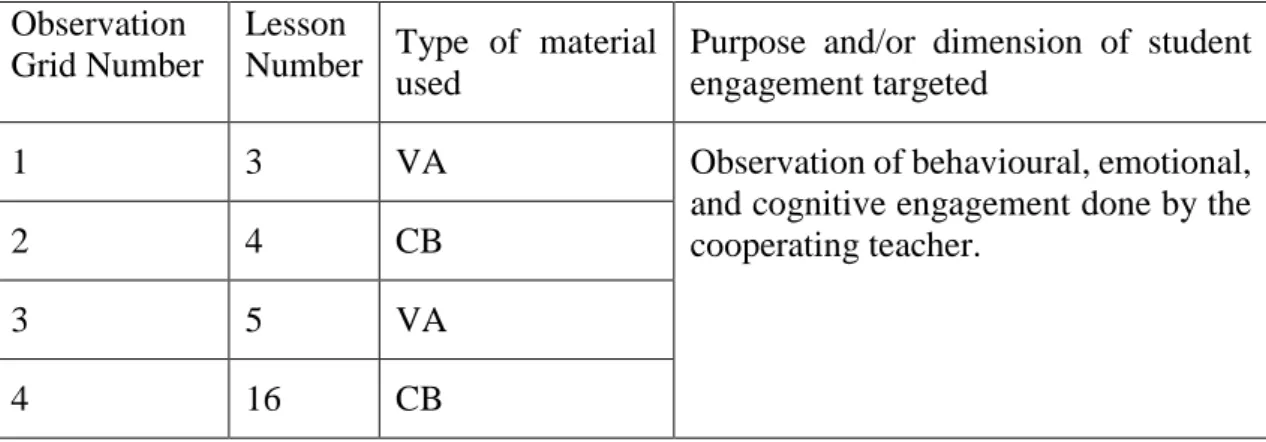
Observation grids were aimed at assessing the three dimensions of the students’ engagement indirectly, through the cooperating teacher’s observation. Each observation grid included five columns for assessing students’ engagement during activities
14 (Appendix K). The observation grids were mostly aimed at evaluating students’ behavioural engagement (columns “Body Language”, “Verbal Participation”, “Consistent focus” and “Student Confidence”) but also contributed to obtaining information on cognitive (“Consistent focus” and “Verbal Participation”) and emotional engagement (“Fun and excitement”). ‘Body Language’ observation included signs of attention and interest or behavioural problems, ‘Verbal Participation’ – active participation in English, ‘Consistent Focus’ – concentration and involvement, ‘Student Confidence’ – eagerness, ‘Fun and Excitement’ – enjoyment.
Observation grids were filled in during four lessons (Table 2). The cooperating teacher had a grid for the most important activities (2-4 activities per lesson). She noted individual features as very low/low/medium/high/very high. The objective of the observation was to have every student observed during the targeted activity, but due to lack of time because of the short duration of each activity (10-15 min.), it was rarely achieved. In most cases, the cooperating teacher made notes about just some of the students, always leaving a note about the engagement of the group in general. The grids were analysed quantitatively.
Table 2. Observation grids
Observation Grid Number
Lesson
Number Type of material used
Purpose and/or dimension of student engagement targeted
1 3 VA Observation of behavioural, emotional,
and cognitive engagement done by the cooperating teacher.
2 4 CB
3 5 VA
4 16 CB
II. 2. 7. Teaching journal
At the beginning of the action research, I started a teaching journal, first online and then in paper format, which proved to be more practical for making field notes. When keeping the journal, I was mostly interested in documenting and reflecting about the students’ reactions to materials and activities during the lessons. The journal appeared to be a valuable resource for reflection and self-reflection. I used it to write down my
15 thoughts when preparing for the lessons and insights after the lessons. The evidence that found its way into the teaching journal was then analysed by rereading and by seeking common themes and tendencies with the results of the other observation tools. The results were analysed qualitatively.
II. 3. Results
The main aim of the study was to explore the connection between student engagement and visual arts incorporation into the young learner classroom, in the case of the present study, using paintings and drawings. To reach this aim, three research questions were formulated:
1 What is the best choice of visual arts to be used in lessons?
2 How does the use of visual arts influence the three types of student engagement (emotional, behavioural and cognitive) in the young learner classroom?
3 Which activities and materials based on visual arts do students find most engaging?
To analyse preparation of materials and help answer the first research question, data from the interviews, the final questionnaire and the teaching journal were used. To answer research questions 2 and 3, four observation tools were used: questionnaires, observation grids, interviews and the teaching journal, which were meant to triangulate each other.
II. 3. 1. What is the best choice of visual arts to be used in lessons?
The main criteria that I took into account while preparing the materials were their relevance for topics at hand and potential interest and novelty for young learners. At the outset of the study, I assumed that the best image meant a real life image, so I left out cubism and surrealism images. Those could have been used in guessing activities, to guess what was depicted and to spur the students’ imagination. However, I decided that I might try to use them in future research.
Moving on with the study, I saw my guess about real life images proved correct by the students’ answers to the final questionnaire and in interviews. For example, in the questionnaire, half of the students preferred the real life images option over fantasy and
16 “guess what it is” images (here I meant cubist and surrealist images that I left out). All eight interviewed students agreed that they were more engaged by images depicting real life. However, some answers about VA seemed ambiguous: the YLs indicated they felt engaged by new, diverse images. At the same time, the most engaging lesson during the term (by my observation and that of the cooperating teacher), Lesson 11, was entirely based on a simple black and white drawing (Appendix L). I presumed that the young learners were always curious and ready to see new images, and hence were engaged by novelty. However, if I showed them many new images, the students could gradually become tired and disengaged. In an attempt to avoid that, I assumed that if the students were presented with a well-chosen VA image fitting particular content, they could not only be engaged by it, but maintain their engagement. This was exactly what I observed during Lesson 11, which I described in the teaching journal: “The students are “mine”: they are with me, and absorb and process the material.” (Teaching journal, 04.11.2018)
The aforementioned Lesson 11, dedicated to the topic “Parts of the house” also triggered the idea of combining arts. Namely, by introducing some theatre into the lesson, I staged new vocabulary introduction while “travelling” through the house drawing (Appendix L). The students later compared it to “a field trip” (Interview, 28.11.2018). The comparison revealed that in that lesson, the drawing not only aroused the YLs’ curiosity, but also triggered their imagination, and turned the classroom into that very house projected on the screen, which helped maintain the students’ engagement and make the lesson productive. This result echoes the idea of ‘engaging classroom environment’ discussed by Oga-Baldwin and Nakata (2017). As we see, a simple drawing, well-chosen and well-introduced, became a source of student engagement during the lesson and helped to stimulate the YLs’ imagination.
II. 3. 2. Questionnaires.
During the study, the students filled in three questionnaires. The first two served to evaluate emotional engagement with materials and activities, and the third covered all the three types of student engagement: emotional, behavioural and cognitive.
II. 3. 2. 1. The first questionnaire.
The first lesson, covering the topic “Countries and Nationalities”, was based on a PPT presentation demonstrating different types of visual arts: photographs, sculpture,
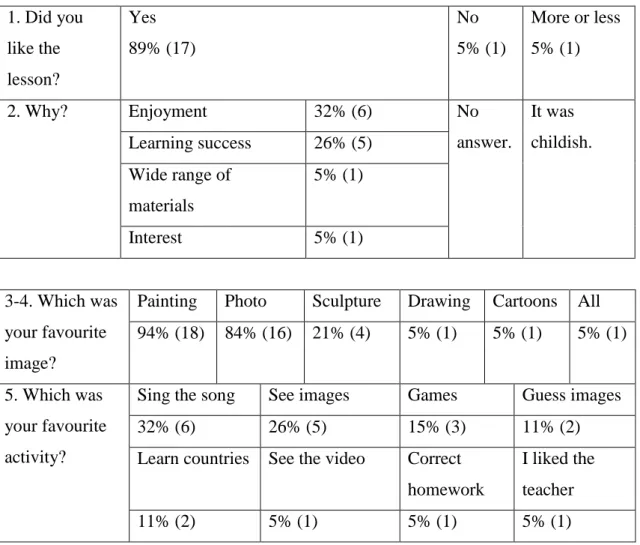
17 paintings, drawings and cartoons (Appendix D). At the end of the lesson, the students filled in a questionnaire to assess their emotional engagement with the five aforementioned types of VA (Appendix G). The results of the first questionnaire are shown in a table (Table 3) below. The total number of students who filled in the questionnaire was 19.
Table 3. Results of the first questionnaire
1. Did you like the lesson? Yes 89% (17) No 5% (1) More or less 5% (1) 2. Why? Enjoyment 32% (6) No answer. It was childish. Learning success 26% (5) Wide range of materials 5% (1) Interest 5% (1) 3-4. Which was your favourite image?
Painting Photo Sculpture Drawing Cartoons All 94% (18) 84% (16) 21% (4) 5% (1) 5% (1) 5% (1)
5. Which was your favourite activity?
Sing the song See images Games Guess images
32% (6) 26% (5) 15% (3) 11% (2)
Learn countries See the video Correct homework
I liked the teacher
11% (2) 5% (1) 5% (1) 5% (1)
Note: the number in brackets is the total number of students. However, some students did not answer some of the open-ended questions, whereas others put two answers.
Answers to the first question revealed that the majority of the learners liked the VA-based lesson, and the second question asked why they did. This question undoubtedly pertained to the domain of emotional engagement (enjoyment) and one of the two main reasons was that they “had fun”. The other came as a surprise: the students indicated that they had learnt a lot. This was clearly outside the emotional domain and within the domain
18 of cognitive engagement, thus hinting at the connection of emotional and cognitive engagement in the YLs’ reasoning.
The students named the images they preferred, paintings being the most popular choice (95%), even more so than photographs (84%) by one answer. The number of photographs and paintings included into the presentation was even. The results showed that in spite of the leading role which photographs play in language learning resources, paintings might have a great potential for increasing YLs’ emotional engagement.
In the open part of the questionnaire, the YLs named the activities that stimulated their emotional engagement. The musical activity was the most popular choice; however, seeing and guessing images came next in the list. In this questionnaire, the students provided me with the first indication not only about types of VA, but also about types of VA-based activities which they were engaged by.
II. 3. 2. 2. The second questionnaire.
In contrast to the first lesson, based on a PPT presentation with visual arts images selected by myself, the second lesson was based on the coursebook images. The visual arts images from the coursebook included illustrations of the world map, flags of English-speaking countries and photographs of English-English-speaking celebrities. In the questionnaire (Appendix H) filled in at the end of the lesson, the YLs were invited to compare the first and the second lessons and to share their opinion: if they preferred the CB-based lesson or the VA-based lesson and why. The results of the second questionnaire are presented in Table 4. The total number of students who filled in the questionnaire was 19.
When comparing the VA-based lesson (the first lesson) and the CB-based one (the second), the majority of the students (9 out of 19) preferred the VA-based lesson, as compared to five students who preferred the CB-based one. However, if we look at the first question of the first two questionnaires (Did you like the lesson?) the ratio is different: a higher percentage (95% or 18 students) say they liked the second lesson more than the first lesson (89% or 17 students).
19 Table 4. Results of the second questionnaire
1. Did you like the lesson?
Yes 95% (18)
No 5% (1) 2. Why? I enjoyed the lesson 21% (4) No answer.
I liked the topic 21% (4) I learnt new things 21% (4) The lesson was “cool” 15% (3) I like games 5% (1) 3. Did you prefer
this lesson or the previous lesson?
The previous lesson 47% (9)
This lesson 26% (5)
Both 26% (5)
4. Why? Learning success (e.g., I learnt a lot) 26% (5); Fun 11% (2); Interest 11% (2); Effort 11% (2); Enjoyment 5% (1). Enjoyment caused by: Music 15% (3); The topic 11% (2); Games 5% (1); Pairwork 5% (1). Enjoyment 11% (2); Fun 5% (1); Learning success 5% (1). 5. In this lesson, did you like any of the images? Yes 53% (10) No 47% (9) 6. If yes, which one/ones Flags Cristiano Ronaldo Justin Bieber Images of Europe 21% (4) 15% (3) 5% (1) 5% (1) 7. Which was your favourite activity?
Song Find countries on the map Game Dialogue
15% (3) 15% (3) 11%
(2)
11% (2)
Note: Some students did not answer some of the open-ended questions, whereas others put two answers.
II. 3. 2. 5. The third questionnaire.
In order to obtain data about YLs’ engagement with different types of VA-based materials and activities throughout the term, a number of questions were formulated in
20
the third (final) questionnaire (Appendix I). 20 students took part in it. The results are presented in Table 5. The total number of students who filled in the questionnaire was 20.
The results showed that pairwork was the most popular activity, followed by a ‘find and colour’ activity, new vocabulary introduction, and guessing activity. While asking this question, I wanted to understand if VA engaged the YLs when used in these types of activities. In the next five questions, I asked the YLs to choose one option of the two that stimulated their interest during the lessons. Interest is one of characteristics of student engagement, usually connected with its emotional or behavioural dimensions. The results showed that students were more engaged by drawings and paintings than photographs and illustration by 20%. The students indicated that they were more interested in seeing new images than familiar ones by 40%. The students preferred images of other countries over images of Portugal (their country) by 60%. When choosing among real life, fantasy images and the ones that one had to guess what they were, half of the students preferred the real life images over others by 10% and fantasy images were the least popular by 20%. Three students (15%) said that they were more interested in the images from the coursebook while 17 students (85%) were more interested throughout the school period in VA images shown in the PPT presentations.
Question 7 of the final questionnaire had a multiple choice and an open-ended question. The multiple choice showed that almost all the students thought that integrating VA into the lessons made them learn better, none thought otherwise, and one student found no difference between the learning outcome of this period and the previous ones. In the qualitative (open-ended) part of the question, all students named different reasons. However, similarly to the first two questionnaires, there were signs of cognitive engagement in the answers, for example: “paintings made me learn more”, “images improved my English language learning”, “I learnt many new things that raised my intelligence”. Behavioural engagement was also manifested: “the way we learnt was easier and more interesting” and “these are images that stimulated my interest and I would like to continue with PPT presentations in English lessons”. Emotional engagement was best expressed in the following: “I enjoyed these lessons very much and when I enjoy learning, I remember things better”.
21 Table 5. Results of the third (final) questionnaire
Question 1 Guessing game Pairwork Introduction of new words Find and colour
To what extent did the following activities make you more involved in English lessons? (on a 1–5 scale, where 1 – not involved, and 5 – totally involved)
3.9 4.2 3.9 4.1
Question 2-6: During English lessons I am more interested in seeing:
Photos and illustrations 40% (8)
Drawings and paintings 60% (12)
Images never seen before 70% (14)
Images I know 30% (6) Images of Portugal
15% (3)
Images of other countries 75% (15)
Real life images 50% (10)
Fantasy images 20% (4)
“Guess what” images 30% (6) Images from the CB
15% (3)
Images from the PPT presentations 85% (17)
Question 7. Do you think that the paintings and drawings that the teacher showed in PPT presentations made a difference for your learning English? Why?
Yes, I learnt more with them than without them.
95% (19)
No, I learnt less with them.
0%
I did not feel difference between English lessons with PPT presentations and without them
5% (1) Learning success 45% (9) No answer
Enjoyment 25% (5) Interest 20% (4)
Note: Some students did not answer the open-ended part of Question 7, whereas others put two answers.
II. 3. 3. Observation grids.
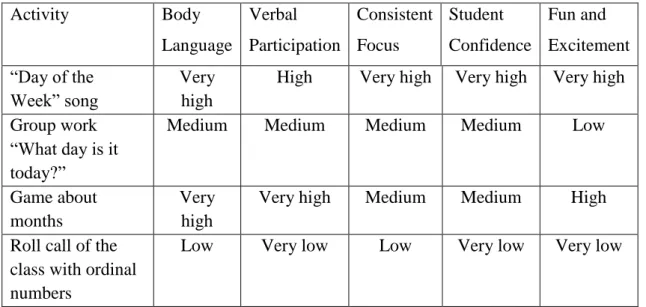
Due to the absence of considerable learner variation in the grids, the results (presented in Tables 6-9) look at the group of learners as a whole.
22 Table 6. Observation grid for Lesson 3 (VA-based lesson)
Activity Body Language Verbal Participation Consistent Focus Student Confidence Fun and Excitement “Day of the Week” song Very high
High Very high Very high Very high
Group work “What day is it today?”
Medium Medium Medium Medium Low
Game about months
Very high
Very high Medium Medium High
Roll call of the class with ordinal numbers
Low Very low Low Very low Very low
Table 7. Observation grid for Lesson 4 (CB-based lesson) Activity Body Language Verbal Participation Consistent Focus Student Confidence Fun and Excitement Cardinals revision
Very high Very high Very high Very high Very high
Ordinals worksheet
Medium Medium High Medium High
Table 8. Observation grid for Lesson 5 (VA-based lesson) Activity Body Language Verbal Participation Consistent Focus Student Confidence Fun and Excitement Checking homework
High High High Medium Low
Pairwork High High High Very high High
Table 9. Observation grid for Lesson 16 (CB-based lesson) Activity Body Language Verbal Participation Consistent Focus Student Confidence Fun and Excitement “To be” revision
High High High Low Medium
23 It seems that the results depend heavily on the type of activity and familiarity with the material. When the students knew what to do and felt confident, they seemed to be more behaviourally engaged and vice versa. It also seemed that the coursebook-based lessons produced a more stable level of student engagement due to being routine; that is because the coursebook was the usual resource in their classroom. During the VA-based lessons, the most engaging types of activities were pairwork, a song and a game based on PPT slides and homework correction. During CB-based lessons they were a miming game and revision of something they knew. It did not seem as if VA had any noteworthy effect on student engagement. The lowest levels of behavioural engagement were registered for activities that were new for the learners: roll call of the class (students calling out ordinal numbers in order) and the ordinals worksheet (Appendix M).
II. 3. 4. Interviews.
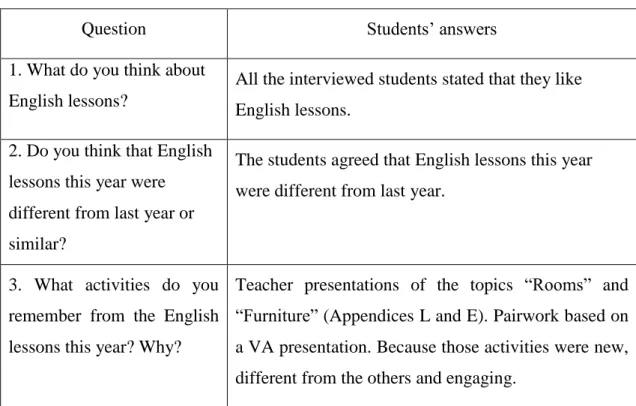
The interviews were held with 8 students (40% of the class), all of whom demonstrated enthusiasm about the English lessons (question 1) and thought that the lessons that term were different from the previous year’s lessons (question 2). The students named the PPT presentations as a reason. The rest of the results of the interviews are presented in Table 10.
Table 10. Results of the interviews
Question Students’ answers
1. What do you think about English lessons?
All the interviewed students stated that they like English lessons.
2. Do you think that English lessons this year were different from last year or similar?
The students agreed that English lessons this year were different from last year.
3. What activities do you remember from the English lessons this year? Why?
Teacher presentations of the topics “Rooms” and “Furniture” (Appendices L and E). Pairwork based on a VA presentation. Because those activities were new, different from the others and engaging.
24 4. Are there images that you
remember well from the English lessons this year?
Images of countries (Appendix D) and furniture (Appendix E).
5. Which are your favourite types of visual arts and why?
About half of the students preferred photographs (because they depict real life) and the other half paintings (because they are imaginative, show new things, the artist’s point of view and real life, as well).
6. Which VA images engaged you more than others? Why?
The house drawing (Appendix L) because it stimulated the students’ imagination.
7. Did photographs or paintings engage you more? Why?
Paintings. Because they demonstrated other cultures and interesting images in a new way and differently depending on the artist.
8. What do you think about learning English with VA-based PPT presentations?
This is the first time the lessons were based on VA. This is a new way of giving lessons; it is an enjoyable and an easier way to learn.
9. Do you think you remember the words introduced with the VA?
While looking at VA, words introduced with their help come to mind. (The students named the majority of the words from the images).
10. Do you think paintings and drawings had any effect on your memorization?
The students have never seen the presented paintings and drawings before. The VA were interesting, beautiful, creative and stay in the memory.
11. Did paintings and drawings have any effect on your engagement this year?
VA incorporation stimulated the students’ interest and made them more enthusiastic towards English language learning.
12. Did they have any effect on your English learning this year?
The students said they had learnt a lot, in a better and easier way.
25 13. What kind of activities
would be the most engaging to do with paintings and drawings?
The students even came up with their own ideas of English activities.
The interviews demonstrated that the most engaging images and activities were from VA-based lessons, despite the results of the observation grids. The learners said that those images showed real life, were “more imaginative” (Interview, 23 November, 2018). In tune with the results of the first and second questionnaire, interviews revealed a connection between emotional and cognitive types of engagement in the students’ answers, evidenced in better memorization of vocabulary contained in VA-based lessons (question 9). The students stated that the paintings and drawings helped them remember the new material better and they were able to name most of the items that had been introduced by looking at the images. They commented that “VA images helped me to remember better” (Interview, 28 November, 2018) and that “when I look at the painting and drawings that were introduced, the words just appear and come to my mind” (Interview, 30 November, 2018).
Finally, some students commented that not everyone likes books and there are people who like to learn with digital means. Others said that there were some things in the coursebook, but there were many more online, a comment which calls attention to the issue of the use of technology in the classroom due to the expansion of technology outside it.
II. 3. 5. The teaching journal.
In the middle of my teaching practice, I had a lesson during which I believe I managed to create and maintain deep student engagement for the whole duration (which was later confirmed by the cooperating teacher). The lesson dedicated to the topic “At home: Rooms and furniture” was based on a drawing (Appendix L) projected on the screen. I introduced names of rooms by “walking” through the house and made an information-gap pairwork based on naming rooms on printouts of the same drawing. An entry from the teaching journal after the lesson describes my observations during the lesson: “The students were following my every word, trying to foresee what comes next,
26 not interrupting but tuned in with me. They were absorbed and focused while processing the material. There was no need for maintaining discipline: it self-maintained” (Teaching journal, 04 November, 2018).
The drawing played a crucial role in engaging the YLs; however, it was not the only ingredient for creating conditions for student engagement. It was necessary not only to select a potentially engaging VA image, but also to frame it the within the topic, in that case, “At home: Rooms and furniture” and within an activity, introducing new vocabulary, in that case. In addition, some theatre was needed to arouse the students’ interest. As a result, I managed to stimulate and maintain the students’ engagement with English classroom activities (as evidenced in the teaching journal) and helped them move a step closer to learning success, as implied by the results of the final questionnaire.
II. 4. Discussion and Conclusion
The main aim of my action research was to introduce paintings and drawings into the young learner classroom and to observe the possible effect on student engagement. Student engagement was measured in comparison between lessons with paintings and drawings incorporated into PPT presentations and lessons based on the coursebook with VA being exclusively photographs, illustrations and cartoons. Both direct and indirect observation tools were used in order to collect data about student engagement. The results of the questionnaires and interviews showed that paintings and drawings had an observable effect on student engagement, moreover, they increased the young learners’ engagement. However, the results of the observation grids did not show considerable difference in engagement between VA-based and CB-based activities (Tables 6-9). Moreover, they demonstrated stable student engagement during coursebook-based activities that might indicate a result of an established classroom routine, namely, wide use of the coursebook as the main classroom resource.
The questionnaires and interviews revealed that two dimensions of student engagement, emotional and cognitive, were very closely related (Tables 3 and 10), showing the connection between affect and learning. For the YLs, emotional engagement led to better language learning results. When the students were engaged by materials and activities, they testified in the interviews that they learnt better and they remembered the material better. They also stated that the VA-based lessons were different from other
27 English lessons they ever had and that VA integration was a new way of presenting information and an enjoyable way to learn. The students exemplified that point by saying that that paintings and drawings showed other cultures, which might show that the students were engaged by the intercultural aspect of the VA. Another reason was that the presented VA were varied, artistic and “imaginative”, which led me to believe that student engagement was also stimulated by the creative aspect of the VA.
The students were asked on different occasions (in questionnaires and interviews) to comment on the types of VA-based materials and activities that engaged them the most. The results (Table 3) showed that they were more engaged by paintings than photographs. This seemed unusual, since photographs were one of the most widespread types of VA used in the students’ coursebook. However, this can serve to open a discussion about including more paintings in YLs resources. Otherwise, the students were engaged by such properties as novelty, diversity and authenticity (VA depicting real life).
In spite of evidence from observation grids that did not show difference in student engagement between VA-based and CB-based activities, the students testified that they were more engaged during activities based on the VA incorporated in the teacher’s presentations (mostly paintings and a few drawings) than by those appearing in the CB. These comments call attention to the 21st century reality and raise a question about using more digital means while preparing and giving lessons as a possible way of stimulating YLs’ engagement.
As for activities incorporating VA, the students gave their preference to pairwork, colouring in (find and colour) and games, but they also named introduction of new material or teacher presentation (Table 5). Colouring in, games and pairwork are long-standing YL favourites. However, teacher presentation was an unexpected choice but this choice matched an entry in the teaching journal about the lesson that aroused the most student engagement during the school period (Lesson 11, topic “Rooms”). During that lesson, I combined a drawing with some theatre performance for introducing names of the rooms. As a result, the students maintained attention and focus throughout the lesson, listened to and followed the teacher and avoided distraction. They were engaged by the drawing and activities built around it and were progressively stimulated by novelty of the tasks. During this lesson, my cooperating teacher and I observed student engagement not only being stimulated, but also maintained. Maintaining engagement seems to be an important issue in the YL classroom due to the students’ difficulty in maintaining focus
28 on learning activities. As we can see, VA can help achieve consistent focus, mainly by stimulating YLs’ imagination.
However, the observation grids demonstrated high levels of engagement with activities, which did not require any imagination and did not include VA, like revision and correcting homework (Tables 7-9). These results could indicate the importance of familiarity with the material for the YLs’ confidence, and hence, engagement. While trying to introduce VA-based materials and activities, it is important to keep this factor of routine and familiarity in mind.
II. 4. 1. The importance of the action research.
In the process of the action research, the students were presented with some well-known paintings (by Vincent van Gogh, Andy Warhol and Roque Gameiro) and many others, which might have enriched their aesthetic experience and widened their cultural knowledge. Some students realized that they enjoyed paintings and drawings, just like they had enjoyed cartoons, illustrations and photographs. The majority of the students stated that they liked activities based on paintings and drawings and that those types of VA demonstrated in the PPT presentations prompted them to remember the English material better when introduced through the presentations, handouts and sheets. In the interviews and the final questionnaire, almost all the students agreed that the VA-based lessons during the term made their studies more varied and interesting and paved the way to better English learning. Some students stated that they would like to have more VA-based lessons in their English classroom.
I enjoyed the action research, however challenging it was to select the materials and prepare the activities. I believe that it gave me much practical knowledge and let me test my ideas, connected to visual arts. The research definitely taught me that even if goal is hazy and distant, by moving to it, the goal and the means to reach it gradually gain shape. I had to change the initial idea of the research twice; but in the end I received results that were worth demonstrating.
II. 4. 2. Future research.
The first most important topic for future research is deemed to be taking the current study further by widening the scope of visual arts types. For instance, sculpture
29 turned out to receive a comparatively high reported level of student engagement (Table 3). The second topic is connected to cognitive engagement, and entails deeper measurement of memorization rates of words and structured introduced and trained during lessons with VA incorporated. The third important direction of study is research into maintaining YL engagement during lessons with VA incorporated.
II. 4. 3. Final conclusion.
Visual arts that were the subject of the present study – paintings and drawings – were proved to stimulate student engagement when incorporated into the young learner English classroom. The effect of visual arts on student engagement was observed in terms of three dimensions: emotional, cognitive and behavioural. The study reveals activities and materials based on visual arts that the students found most engaging. The action research traces guidelines for selection of visual arts to be used in the young learner English classroom.