i
Gebru Welay Gerezigiher
Utilising gamification approaches to derive crowd
February 23, 2018
Dissertation Supervised by
Dr. Thomas Bartoschek
Institute for Geoinformatics - Universität Münster
Dr. Florian Hillen
Product Manager Web & Team Management WebGIS at IP SYSCON GmbH
Dr. Roberto Henriques
Declaration
I, Gebru Welay Gerezigiher master student of the Geospatial Technology Erasmus Mundus program, aware of my responsibility of the penal law, declare and certify with my signature that my thesis entitled
Utilising gamification approaches to drive crowd pattern/crowd context from aerial images of major events
is entirely the result of my own work I have faithfully and accurately cited all my sources, including books, journals, handouts and unpublished manuscripts, as well as any other media, such as the Internet, letters or significant personal communication.
I understand that
- literal citing without using quotation marks and marking the references
- citing the contents of a work without marking the references
- using the thoughts of somebody else whose work was published, as of our own thoughts are counted as plagiarism. I declare that I understood the concept of plagiarism and I acknowledge that my thesis will be rejected in case of plagiarism.
Münster, 23rd February 2018
Gebru welay Gerzigiher
Acknowledgments
I thankful to all people who support me the thesis from the beginning to the ending. Here waving many thanks to my supervisor Dr. Thomas Bartoscheck, for the entire guidance in my every activity like supervising me how to present, how to write, and generating ideas which are ingredients to the thesis. Next, I have great ack to my co-supervisor Dr. Florian Hillen, for providing me the idea, data for the experiment and in reviewing the thesis paper. I thank you, Dr. Roberto Henriques, for his constructive comment in reviewing the thesis. I thank, Dr. Max Florian Pfeiffer, who assists me every two weeks for the whole duration like how to deal with the challenges, how to keep the progress and visualizing results. I appreciate Dr. Christoph Brox and all my teachers, for their commitment to pursue the master program with knowledge and happiness. Also, I would like to thank you for my good friends Fana Gebremeskel and Pramit Ghosh, they help me as the reviewer from the beginning plus for their support and encouragement.
Finally, I have the great appreciation for all IFGI professors, students, collegues,and participants who play my geo-game and help me to shape the whole thesis with different questions and comments. I have also warm acknowledgment for my family and friends back home for their wishes.
Abstract
A large number of casualties occur during emergencies in highly-crowded public spaces of major events like annual anniversaries, religious festivals, big parties and football matches due to stampedes. It has been often observed that poor resource management is one of the key areas that could be improved to solve this problem. In this study,a geo-game-based approach has been adopted to alert responsible authorities of highly crowded regions as an early warning system and also provide them with optimal dispersal routes. In the Android-based game that was developed for this study, the players could draw polygons on real-time imageries of the area under study obtained from unmanned aerial vehicles and classify them into categories based on how crowded the region is. This data is submitted to a web server which is processed to find suitable least-cost routes by which the people in the crowded regions can be brought to safety in case of an emergency. The spatial distribution of people could be forwarded to appropriate authorities in-charge of the administration highlighting extremely crowded regions which need their attention thereby prompting redirection of security personnel. Additionally, the calculated dispersal routes could be used by them as suggestions to avoid a stampede and ensure safety in case the situation turns worse.
Keywords
Geo-game, crowdsourcing, stampede, least cost path, crowd density map, aerial crowd imagery and major events.
Acronyms
OS Operating System DEM Data Elevation Model VGI Volunteer Geographic
Information System GPS Geographic Positioning
System
BoW Bog of Words
JS JavaScript
CSS Cascading Style Sheet
HTML5 Hypertext Markup Language 5
RGB Red Green Blue
JSON JavaScript Object Notation
Index
Acknowledgments ... iv
Abstract ... v
Keywords... vi
Acronyms ... vi
List of Tables ... viii
List of Figures ... ix
1. Introduction ... 1
2. Related works ... 3
2.1. Crowd Context ... 3
2.1.1. Pysical observarion... 4
2.1.1.1. local crowd density ... 4
2.1.1.2. Crowd pressure ... 4
2.1.1.3. Video Recording Systems ... 4
2.1.1.4. Participatory Sensing System ... 5
2.1.1.5. Analysis crowds aerial imagery ... 6
2.2 Gamification Approach ... 7
3. Methodology ... 8
3.1 Mobile applications development platforms ... 9
3.2 Geo-game development architecture... 11
4. Results ... 13
4.1. Geo-game system result ... 14
4.2. Participants’ questionnaire results ... 22
5. Discussion and Future work ... 27
References ... 29
List of Tables
Table 1. first and second round players crowd status polygons data ... 15 Table 2. second round players’ demographic data ... 23
List of Figures
Figure 1. Borussia Mönchengladbach stadium from left to right includes car parking,
stadium and public transport parking... 9
Figure 2. fans after the football match around the Borussia stadium. ... 9
Figure 3. asynchronously JavaScript code to load the aerial images... 10
Figure 4. communication channel in the game development architecture. ... 11
Figure 5. geo-game instruction section ... 13
Figure 6. geo-game board section ... 13
Figure 7. navigation route roadmap followed in the user study experment ... 14
Figure 8. first round players’ number of polygons for each crowd status as one,two,three represent high, medium and low crowd density respectively ... 16
Figure 9. second round players’ number of polygons for each crowd status as one,two,three represent high, medium and low crowd density respectively. ... 16
Figure 10. sixteen first round players’ crowd heat map ... 17
Figure 11. thirty-two second round players’ crowd heat map ... 18
Figure 12. least cost path preparation processes ... 19
Figure 13. sixteen first round players’ least cost path from source to destination .... 20
Figure 14. thirty-two first round players’ least cost path from source to destination 21 Figure 15. large scale least cost version of highest dense area of figure 13. ... 22
Figure 16. study relevance estimation. ... 24
Figure 17. questions to keep the players’ motivation ... 25
Figure 18. the players’ response on the bonus point question. ... 25
Figure 19. challenge survey questions ... 26
Figure 20. players’ response on the allowed time for single image. ... 27
Figure 21. NRW’s DEM ... 31
Figure 22. Borussia-park - Borussia Mönchengladbach stadium ... 32
Figure 23. Borussia-park - Borussia Mönchengladbach cost back link ... 32
1. Introduction
Dangerous situations like mass panic and stampede can occur, when people gather to celebrate the major events such as annual anniversaries, religious festivals, big parties and football matches. For example, in 2015 overcrowding incident during the Hajj pilgrimage in Mina, Saudi Arabia ends with 2262 peoples dead. In 2016 the Ethiopia Oromo's thanksgiving festival left 300 peoples dead.Stampede in Uíge's Estádio ahead of the Angola football match opening 17 people were killed in 2017 1.Furthermore, physical conditions, hydration level, and desire to reach someone inside or outside of the masses are reasons to many participants to navigate the crowd [1].At this time, participants can follow the random path to the denser area of the crowd as they were thinking the less dense place to reach the destination.
There are several crowd context characteristics,but this study explains methods that help to understand density and movement direction of the crowd based on the previous articles [2]. The related works include physical and camera observation,participatory sensing method, and crowd aerial image analysis.To control the crowd physical observation practices human eye view with additional behaviors similar to movement speed and direction of peoples in the crowd. Though, with eyesight inference, it is difficult to obtain accurate crowd context results [2].In crowd analysis, camera observation is the popular method but still has the lack of identifying individuals from the mass because of the stage light occultations [1]. Moreover, the participatory sensing system which tracks volunteer crowd participants' resource like GPS to drive the crowd characteristics.This method has limitations.The data obtained from the volunteers depends more on luck since this method become functional if only if the participants allow their resource to track voluntarily.There is an issue of volunteers' privacy information to share their private resources like GPS with the system [2]. In gamification method, volunteer participants do not need to share their private information, which overcomes the participatory sensing system privacy issue. However, The gamification approach has the shortcoming, the same as aerial image
analysis methods, the drone can't fly for events happen under tunnel like The 2010 Duisburg love parade[3], [4].
This research follows the same process as aerial crowd images analysis and fusion of GPS track with the images except for exercising different approach.To create density map both these methods implement texture classification on the aerial crowd images to generate real-time crowd density map.Fusion of GPS track with aerial images enhances the crowd density map and produces near real-time navigation route by observing the movement speed of the volunteers who provide their GPS location [2]. If the volunteers are walking slowly, manifest high crowd location and vice versa [1]. In this thesis, gamification approach is the alternative approach to these methods.
Here, the gamification approach is implemented as crowdsourcing strategy mean when the number of players increases the quality of the data become better [5], [6].The security forces and the event participants receive benefits from the gamification method results.The security forces get ready to intervene the crowd at the early stage before stampede happening by looking at real-time density map in the geo-game system.The density map shows relatively highest, medium and less crowded areas on the map. The security forces can follow the map plus the navigation from sparse point A to dense point B.The geo-game system displays direction, which guides them in the fastest time but doesn't mean the shortest distance.Moreover, the participants get the advantage real-time navigation in the crowd from the geo-game system.
The game app is available for players to install on their mobile phones.The geo-game web system is connected to the drone or long tower RGB camera from the ground and can display the current aerial crowd image of the specific event every seventy-six seconds.Next, the system submits polygons data to the online database from the players indicate highly, moderately and less crowded.Instantly, generates the density map and navigation route using heat map and least cost path respectively.The heat map counts the polygons intersection and takes the points of intersection as input to produce the combined density map represents highly, moderately and less crowded area [7], [8].The least cost path takes the crowd density map as the surface cost of the path distance to generate the direction from source to destination.The next sections concentrate on related works, methodology, results, discussion, and future work.
2. Related works
Review previous articles are very helpful for providing deep knowledge and skills. Accordingly, the content, limitations and future scopes of these related articles play a good role to shape the gamification approach thesis.Many articles propose various methods to drive crowd context: density and movement speed.These methods are listed below in each section, but none of them have not applied gamification approach as means of crowd analysis.In fact, many other fields like disaster management apply gamification approach in crowdsourcing activities.This paper tries to map the concept of gamification from these other fields to crowd analysis domain.Therefore, crowd context and gamification approach are the two topics this study explains in the following sections.
2.1. Crowd Context
Annual anniversaries, religious festivals, big parties and football matches are typical reasons for celebration.Here, hundreds of thousands of people can be available to attend the celebration.For example,In 1994 around 20 million people were gathered in India to celebrate their belief called Kumbh. 85,512 fans made themselves available to support Tottenham football match with Bayer Leverkusen in 20092.In Ethiopia,
Around 4 million people were found to celebrate Erecha (Oromos’ thanksgiving ceremony) in 2016.Similarly, in 2017 ten thousands of peoples, gathered to celebrate the religious festivity of Ashenda in Ethiopia, which mostly known to be the festivity of unmarried females3.
The participants of these ceremonies may face narrowness , movement difficulties and scramble or pressure to have one's own seat.Space narrowness happens at 3.57 people per meter2(p/m2), which leads to unwanted body contact among the participants.They can’t make necessary movements or start overlapping each other at 5.55 p/m2 [1].Most of the time scrambling happens at the beginning of the ceremony while people race to get a suitable place to watch the content of the celebration easily.As a result, the stampede could happen on the participants of the ceremony, when many participants
2 https://en.wikipedia.org/wiki/List_of_record_home_attendances_of_English_football_clubs 3 https://en.wikipedia.org/wiki/List_of_human_stampedes
overlapped on each other [2].Movement difficulties can also happen in such ceremonies. When participants are unable to move above 1.34 meter per second, this indicates over crowdedness [1].
Police officers are using different mechanisms to avoid stampede and over crowdedness at an early stages such as physical observation (local density and crowd pressure), video recording, the participatory sensing system ( e.g., tracking GPS of participants), and analysis crowds aerial imagery [1], [2], [9], [10].
2.1.1. Pysical observarion
2.1.1.1. local crowd density
Local crowd density underwent to identify over crowdedness in celebrations by observing the behavior of the participants. It is difficult to identify the area , which is relatively denser and prone to the accident using eye observation, but applying additional characteristics enable to understand the density of the crowd[2]. The additional behaviors include speed and direction of the crowd.
2.1.1.2. Crowd pressure
Crowd pressure is formulated as:
Local velocity variance *Local crowd density
Crowd pressure is an indicator of an available accident and mainly helps to take precaution before the participants step on one another[2].Overlapping increases in the place where the highest density of people appeared.Crowd turbulence and crowd densities, which are good accident indicator and common way of understanding the status of the crowd respectively.However, it is hard to decide physical observation methods to give complete support and to understand the status of the crowd perfectly [2].
2.1.1.3. Video Recording Systems
Nowadays, many different major events widely use a video camera to control the crowd characteristics.Video recording has a shortage of coverage to all participants and needs series of training to control the real-time streaming videos [2], [10]. To
overcome this problem multi-camera network and computer screen observation system come up with a solution and methods to control the crowd automatically.
The object-based approach is the first method which detects individuals and calculates the crowd density automatically.The second one is a holistic methodology that considers the whole crowd as a single entity and then estimates the crowd density.As articles show, the object-based approach is better than holistic methodology.However, due to the stage light occultations, the object-based approach does not mean completely suitable method to recognize individuals from the crowd[2], [10].
2.1.1.4. Participatory Sensing System
Today, due to the abrupt development of mobile technology, many crowd researchers interest is attracted to use this technology as the best option in the analysis.The science of mobile technology is highly related to sharing participants’ resource and requires the contribution of many participants. Sharing their GPS, Bluetooth and Wi-Fi fingerprint enable to visualize the crowd density of the ceremony.Additionally, essential to know the ceremony participants' proximity, how far or near to each other[2].
GPS or other resources (e.g. Bluetooth) of participants from their mobile [1], [2].From the telecommunication tower, detection of exact place of participants done by getting call and text transaction of the individual from the network operator without the awareness of the individual. However, tracking GPS or location place, Bluetooth of the participant to collect the necessary data (e.g. GPS) is done through the awareness of the participant.Tracking resources of participants from their mobile getting better than telecommunication tower[2].The main reason that makes it preferable is not the only GPS of the participant but also other resources like Bluetooth, sensors camera, and microphone can be tracked. additionally, it is important to check the availability of the participant in the crowd lively.In tracking resources of the participants, the information needed can be captured or recorded without any interruption compared to the telecommunication tower when capturing and recording started after the participant begins calling or texting.Another reason tracking resource of participants has better location tracking accuracy than telecommunication tower.The telecommunication
tower location recording accuracy is 50 meters, where tracking GPS and WIFI fingerprint have deviance of location accuracy of 5 and 20 meters respectively[2].
Besides, linking acceleration sensors to festival participants is also another important domain to collect data from individuals.Acceleration sensors detect individual movements in the festival to identify groups who move together in the crowd.By identifying the direction of these groups, it is possible to detect other similar group movements to calculate the crowd density [2].
The participatory sensing system has got several deficiencies.To brief out some of the deficiencies the data collection process depends more on luck mean if the participants voluntarily installed the required application and freely made their privacy information accessible. Secondly, the result and successfulness of the work depend on the number of participants.As there are several participants, a relatively better result is accomplished [2].Furthermore, the meaningful result will be obtained, if the information collected from participants is accurate.
2.1.1.5. Analysis crowds aerial imagery
Aerial crowd imagery Analysis is the convenient method to drive crowd density automatically for images taken by drone or tall tower RGB cameras.Long tower RGB cameras are more suitable aerial image sources than the drone since the sound of the drone can disturb the crowd while filming the images.Aerial crowd images analysis follow many techniques like texture classification( Gabor filter, Bog of Words(BoW)) and the combination of Gabor filter technique with participants' GPS track[5], [6], [10].
Texture classification uses two techniques the Gabor filter and Bag of Words to detect the crowd density automatically from aerial images.The BoW doesn’t follow the regular grammar rather like counting the redundancy of single word in the sentence[9]. Likewise, in computer vision word is the center of aerial images feature cluster.So, BoW generates the crowd density by counting the word frequency in the whole aerial imagery. Gabor filter method, which follows the explanation of crowd patch patterns or directions to produce the crowd density.The Bow is 51-52 % accurate than Gabor filter.Furthermore, the crowd density accuracy of both methods is 97% [10].
On top of the texture classification method, it is possible to merge the Participants' GPS track with the crowd density obtained from the Gabor filter method. This merging enhances the crowd density accuracy since the GPS track has its own crowd status information mean as the participants get slower indicates high crowd density and vice versa.This fusion technique assists participants to have navigation route in the crowd.Hence, there are several reasons to navigate the crowd such as thirst for water, tiredness, or due to unpleasant environmental conditions, and people may want to go off the crowd quickly.Moreover, by presenting the merged crowd density helps the security forces to avoid the stampede or mass panic at early stages before happening [1].
2.2 Gamification Approach
Gamification approach has become popular method of education, health and crowdsourcing strategies.Gamification happens while participants playing the geo-game, and the game conveys their result into a meaningful way for further analysis.
With minimum cost, crowdsourcing strategy uses gamification approach to carry out activities by playing a game.Business analysts also report 50% of organizations gamified their work related to manage innvoation processes by 20154. For
Example, OpenStreetMap, WikiMapia, DigitalGlobe-tomnod, GeoWiki, and
Zooniverse use crowdsourcing to accomplish their task.These organizations use citizens as sensors to generate “volunteer geographic information”[11], [12].Geowiki is the exemplary organization which gamified its project to capture the world croplands.Crowdsourcing play critical role in collecting community information for tasks needed creating, solving, processing and rating purpose.Applying gamification method to each crowdsourcing purpose shows different results [13].Crowdsourcing approaches which focus on monotonous activities, better to use points otherwise preferable to use more diverse gamification mechanics.So,designing gamification approach in crowdsourcing should consider either monotonous or diverse activity of gamification design[13], [14].
Gamification approach plays a great role for students hence situated learning and the simulated world is included in the game.For example, the Savanah location-based game encourages students to understand lions’ behavior. [15], [16]. NavApps designed by Geotech, Universitat Jaume I (UJI) under enabling project for the high school student enable them to aware their surrounding location.Furthermore, smart beetles designed to educate citizens to notify services (e.g. traffic condition) existing in the smart cities[17].
Students who play the games reflect engagement, immersion, challenge and skilled behaviors.These who engaged or challenged by the game have a positive result on learning, but immersed or skilled students have not direct learning effect. However, skilled students can have a positive outcome on learning via high engagement. Moreover, participants who are skilled and challenged by the game have positive effect engagement and immersion. Accordingly, designing educational geo games should involve challenges growing with a learning curve of the students [13].
3. Methodology
The prototype implementation includes data collection, the selection of mobile application development platform, geo-game development architecture and players expermental study.The data for testing and development available after the football match Borussia Mönchengladbach(Germany) in 2013.There are thirteen series of images (nine cm resolution) as seen the stadium in figure 1 and 2, which are recorded approximately every 2 seconds for each image from three different cameras: one for each color.
Figure 1. Borussia Mönchengladbach stadium from left to right includes car parking, stadium and public transport parking.
Figure 2. fans after the football match around the Borussia stadium.
3.1 Mobile applications development platforms
Nowadays, Android, iOS, windows, PhoneGap and Apache Cordova are the main platforms available to develop mobile applications.Android, iOS, and Windows platforms use to develop Android, iOS, and windows mobile operating systems(OS) respectively.However, PhoneGap and Apache Cordova platforms implement multiplatform apps for Android, iOS, Windows and Prada mobile OSs. PhoneGap and
Apache Cordova are a good choice to develop a mix application runs on different mobiles' OS and browsers.In fact, the native way of mobile application development platforms is faster in performance but less platform interoperability than PhoneGap and Apache Cordova platforms.The native way development technique defines that if the mobile application developed with specific mobile operating system the result application only runs in the respective OS[18], [19].
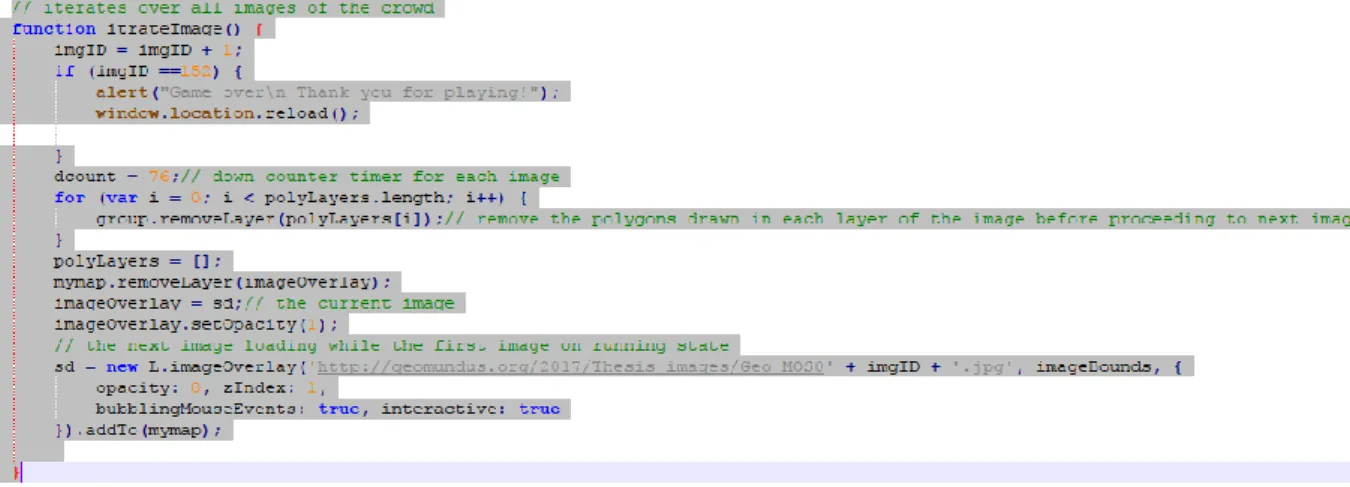
Out of these mobile platforms, the experimental study proposes to focus on PhoneGap and Apache Cordova platforms because of their source code interoperability with different mobile OSs.The interoperability has big value to involve heterogeneous players with different mobile brands.The selected platforms' source code is possible to compile into multiple mobiles OS and saves too much time.As seen the Apache Cordova source code in figure 3 helps to iterate the aerial imagery asynchronously.The source code is written in javascript for Android(.apk format), but also possible to compile the same code to iOS(.ipa format) and Window mobiles' OS(.xap).In comparison PhoneGap to Apache Cordova, better to use Apache Cordova since it is open source version of PhoneGap.The game full version source code is written in javascript(Angularjs), HTML5 and CSS or less and available at GitHub.
3.2 Geo-game development architecture
The geo-game in this study works as a vehicle to carry out the user study experiment. The players play the game after getting ready as shown in figure 4.They draw polygons which shows the dense, medium and sparse crowd areas in the aerial images. The game submits the polygons data to the web server automatically to use as input to the crowd heatmap.Moreover, the game can display the results like crowd heat map and navigation route to the crowd participants.
The architecture of the geo-game to accomplish the task as seen the game development architecture in Figure 4 has four components: Client (geo-game system), Middleware (REST API), Web Server(Express) and Spatial Database(MongoDB).All the necessary the components' network packages or libraries like angularJS, express, apache cordova, gulp, leaflet handled by NodeJS[20], [21].Here, the geo-game system sends players' and polygons' data to the web server via REST API.The web server through REST API saves the data on MongoDB[21].Based on the automatic every seventy-six seconds game request, the web server sends the respective image cumulative data from the database using REST API to the geo-game system to produce each aerial crowd image heat map and navigation direction.
Figure 4. communication channel in the game development architecture.
The MongoDB stores the polygons’ data received from the web server as seen the game architecture in figure 4.The principal reason to use this database is since it
supports JSON format which is easily implementable with Javascript and leaflet. Authenticated users can have a direct modification and download the data with different formats like CSV and JSON[20], [22].
The middleware as its name facilitates the communication among the client, web and database servers. Typically, the REST API represents the middleware. The Polygons' and players' data collected from client pass through REST API with HTTP protocol to the web server Express as seen the experiment architecture in figure 4, both client and database server receives a message from the web server via HTTP protocol in the JSON format[20], [21]. The web server receives the data request from the client then it requests the database and sends back results to a client. The server hosted under
Heroku (free to host web applications up to 500 up hours and 500 MB free space) from its GitHub source code.Figure 4 shows the MongoDB's schema defines the players and the polygons data attributes, which are managed by Mongoose[22].The Mongoose is embedded in the web server too.
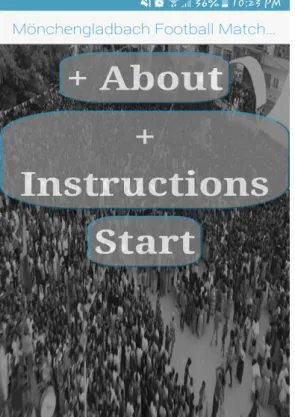
Normally, the client(geo-game system) is an actor to request, send players message to the web server in return display the results crowd density map and navigation direction. Here, the geo-game is client-side to do all these activities by running from players' mobile as seen the geo-game user interfaces in figure 5 and 6, the client has three sections: goal, instruction, resource and game board sections.The instruction section guides the player how to play the geo-game.Besides, the resource section shows the best scorer in green color, background audio, current player’s score in red color and allowed time(blue color) to draw polygons of each single aerial image.The mainboard section includes the geometry features to draw polygons, leaflet base map functionalities, and aerial crowd imagery overlay capabilities.Here, only the Polygon geometry feature activated to draw irregular shapes over the aerial crowd imagery.
The leafletjs interactive base map allows mouse events and image overlay features to draw the polygon from the players.While the previous image has the running state, loading the next image takes place asynchronously.The asynchronous technique supports to load 44 up to 45 MB size image infraction of 2 seconds.Furthermore, convenient base map to display the results the crowd heat map and navigation route.
Figure 5. geo-game instruction section Figure 6. geo-game board section
Following to working environment setup, the geo-game prototype released as seen figure 6, which is ready for the players to draw the polygons with three crowd density status: high, medium and low. Players can play the game by installing the app on their mobile phones.The images are available online for testing and user study purpose.The study going offline mean not on real-time festivals.Later on, in real-time celebrations loading the image occurs instantly from the drone or RGB camera, in another term, feasible to communicate from the game based on the ground to the airborne camera and vice versa [1].Subsequently, the raw data of the polygons and feedback about the game had collected after that the players invited to play the game.
4. Results
To generate the results of the geo-game system prototype, the game followed the roadmap connected with links between modules represented with the eclipses in the whole study as shown the block diagram in figure 7.The players play the geo-game and produce polygons' data that shows the status of the crowd (i.e, high, medium and low crowd density).While the players draw the polygons, the score in red color increases as seen in figure 6.The score counter depends on the vertices number of the
polygon.The bonus point added, if the current players draw minimum seven polygons in seventy-six seconds, the bonus point(2000) added to the player current score.The gold medal award comes after the current player broke the best score. In the figure, the crowd density map is obtained from the polygons' data.Then The navigation route acquires the crowd density map as input to help crowd participants to find direction from source to destination in the mass.Moreover, after the players did the geo-game, they fill the geo-game survey questionnaire.
Figure 7. navigation route roadmap followed in the user study experment
4.1. Geo-game system result
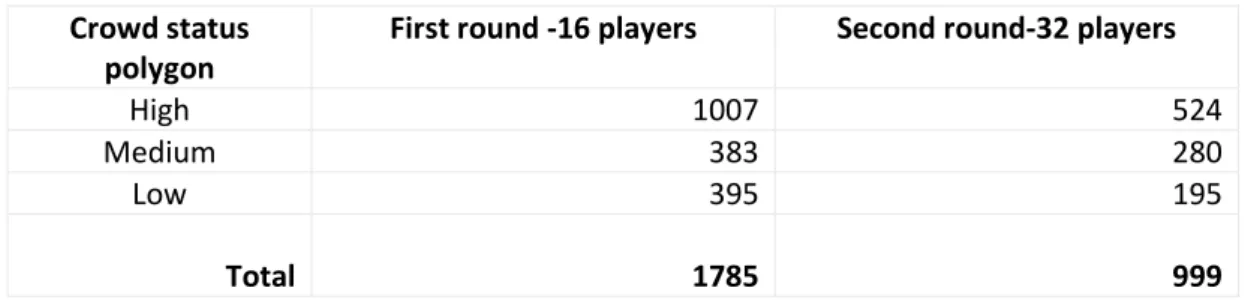
The players start the geo-game by reading the goal and instructions presented on their mobile screen.Then the geo-game system allows them to draw three crowd status (i.e, highly, moderately and less crowded areas) polygons on the participants of the majority events displayed on the aerial crowd image as seen the game board section in figure 6.The players play the game in two rounds, the first-round players are sixteen and responsible to give the first feedback about the study survey questions and game design including how much the game is user-friendly.They generate one thousand seven hundred eighty-five polygons record with different crowd status as displayed the crowd status polygons in table 1 for thirteen images.Thirty-two second-round players are invited to play according to the first round player's comments and responses.As seen in figure 9 and table 1, they create nine hundred ninety-nine
polygons record for thirteen series aerial images, which are showing low, moderately and highly crowded areas.
Table 1. first and second round players crowd status polygons data
Crowd status polygon
First round -16 players Second round-32 players
High 1007 524
Medium 383 280
Low 395 195
Total 1785 999
In both rounds, the players draw many high-density polygons than low and medium density polygons.They also digitalize a fewer number of polygons which indicate low crowd status than the medium and high-density polygons.This number implies the participants are more interested to draw the highest density crowd areas, or maybe they don't get confused to identify highly crowded aerial image areas.Drawing many polygons showing high crowd density is more important than the medium and low crowd density polygons since they have the dual advantage to show the dangerous areas on the crowd, and support to get navigation direction from highest to lowest crowd density location.Combining medium and low crowd density polygons with high crowd density polygons improves the quality of the navigation direction because the low and medium density polygons have smaller surface cost than the highest-density polygons, and the route prefers to use the least cost polygons.Despite their number, the sixteen first round players generate more data than the thirty-two second round players hence the first round players were playing one up to two minutes for each image at the initial release of the game.But, the second round players did seventy-six seconds according to the first round players' feedback concerning to the time survey question.
Figure 8. first round players’ number of polygons for each crowd status as one,two,three represent high, medium and low crowd density respectively
When the participants draw polygons, each polygon has the value of one, two or three each number represent low, medium or high crowd density sequentially.2.37 and 2.33 are the mean values of the first and second round players’ respectively as seen in figure 8 and 9.The mean value has an impact on the heat map when several different crowd staus polygons intersect each other.The intersected polygons have the mean value of the common overlapped diverse crowd status polygons area.Moreover, In both rounds, three is the Median value as seen the histograms in figure 8 and 9, which designates availability of greater number high-density crowd polygons.
Figure 9. second round players’ number of polygons for each crowd status as one,two,three represent high, medium and low crowd density respectively.
Counting the intersected polygons of the crowd produces the heat map of the mass as seen the output heat map in figure 10 [7].The yellow color surrounding with purple color plus the dark purple colors indicate the densest crowd location of the football match around the stadium.The sky color shows the low-density regions of the crowd.The legend labeled with 3-dense, three indicates the maximum value of the kernel density derived from the status of the crowd polygons.The heat map is the output of the sixteen first round players.Here, some of the polygons are drawn on the stadium, on the forest, and in the field of the roads and as a result, these outliers have density map in the figure.The outliers appear due to the wrong players' data, they drew on areas, which could have less probability of crowd.More outliers happen because of
the spatial reference system and misalignment of bounding boxes of the original aerial crowd image on the leaflet basemap.During overlay of the images on the interactive maps, it is highly recommendable to cross check with the base map, if it is not overly perfectly a single dot digit mistake produce significant shift error as shown at the right top location in the figure.This location's heat map shifted a little bit to the right, out of the bounding box of the aerial crowd image.
Figure 10. sixteen first round players’ crowd heat map
The second round players’ heat map as seen the crowd density map in figure 11, The purple color represents high crowded areas, and the yellow color indicates the extremely high-density crowd.The security forces should keep their eyes on these colors. The less crowded areas are rendered by sky or light blue color, surrounded the purple color.Here, the accuracy of the density map is better than the sixteen players hence the outliers listed in the first round are almost solved.In the second round players’ density map, there is no more purple color dots or sky waves of the heat map
on the forest, fields of the road and stadium.The reason could be the players either draw the polygons correctly or because of the behavior of the heat map as the number of players increase the outliers from few players get rid of.The second round players digitalize the bus stop station queue in figure 10 as low dense region, but the first round players draw it as highly dense area.The reasons could be the first round players have the long time to pan all areas of the aerial image or most second round players may think the bus stop reflects the low crowd density.
Figure 11. thirty-two second round players’ crowd heat map
The least cost path in the crowd created by considering multiple criteria as seen the path block diagram in figure 12 like North Rhine-Westphalia data elevation model (DEM) as noticed in appendix figure 21.The slope produced by the DEM as linked in appendix figure 22.The path takes the cost backlink attached in appendix figure 23, which stores the next least cost cell helps to get better direction patterns.The path distance attached in appendix figure 24 uses the heat map and slope as surface cost and cost layer respectively.The path distance saves the cost value of each cell from the source to the destination as seen the navigation route in figure 13.
Figure 12. least cost path preparation processes
The first and second round players' navigation direction or least cost path are depicted with blue and dark-red lines or paths respectively as shown the navigation route in figure 13 and 14.In both figures, the lines follow the same direction from the source(purple dot color) to the destination((light green dot color)) point.Around the source point, The paths pass through the high-density crowd, but the zoomed in version heat map of this location as shown the scaled up heat map in figure 15 has low dense areas inside.The experiment of the paths done without considering the building and fence models of the major events.Consequently, the routes can pass through these building and fence obstacles.To make the paths' experiment reliable, this study recommends considering these obstacle models.Originally, The paths representation was raster then converted to vector.During conversion, the vector paths shifted a little bit to the forest because they cross the centroid of the raster cells.Accordingly, they transformed half height of cell to one side in this case to the forest side, for example, the paths' middle section.
Figure 13. sixteen first round players’ least cost path from source to destination
During the experiment varying the inputs of the least cost path, the cost backlink and cost distance produce inconsistent least cost paths, which pass through the forest and the stadium.The factor here is the forest, building or fence models are not applied as criteria in the experimental study.Accordingly, The best scenario practiced in this study is considering the DEM's slope and crowd heat map as cost layer and surface cost sequentially, and ends with the better single path as displayed the least cost path in figure 13 and 14.This least cost path is selected since it passes through the possible and expectable roads and human pavement.Therefore, In this paper, the generated least cost paths found as helpful for crowd participants or security forces who want to navigate the crowd and can follow the path directions from source to destination.The navigation directions work in any location of the event only the crowd participants require to define the source and destination.
Figure 14. thirty-two first round players’ least cost path from source to destination
The least cost path enables the security forces to penetrate the overcrowded regions. As seen the navigation route in figure 13 and 14, they can follow the path from the low to high crowd density locations depicted with light green(source) and purple(destination) dot colors respectively.Moreover, the participants can take the path in reverse to the security forces to get out of the crowd from the source( highly crowded area) to the destination (less crowded area).Here, the source and destination depicted with purple and light green dot colors respectively.
Figure 15. large scale least cost version of highest dense area of figure 13.
4.2. Participants’ questionnaire results
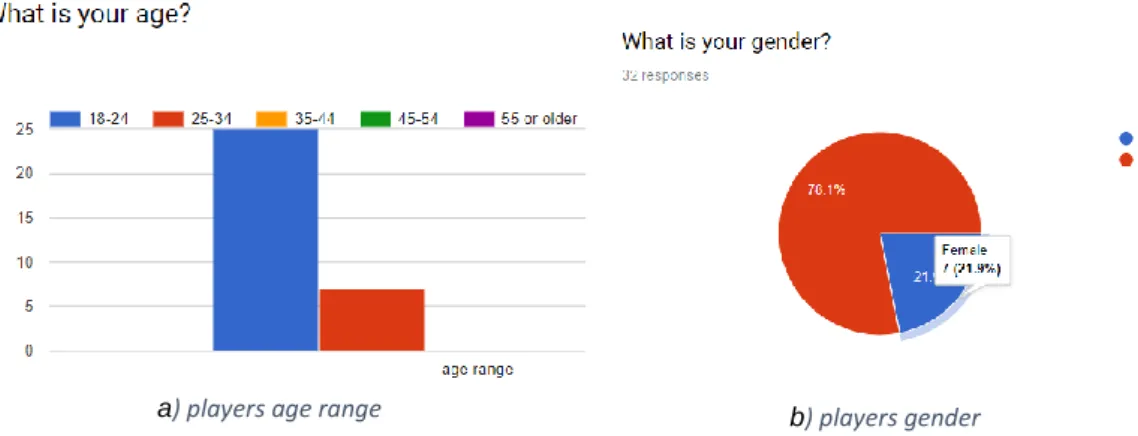
The first round participants were sixteen with age range from twenty-five up to thirty-five, three females and thirteen males and asked to fill the nineteen survey questionnaires about the game.The survey filled after they play the geo-game with two different durations, the first duration, lasting with thirteen minutes, one minute for each image and twenty-six minutes long, two minutes for each image for the second one. The questions prepared for these players were more for comments and to restructure the game again for the second round players, and their survey feedback is skipped to attach here.The second round random participants were thirty-two with age range from eighteen up to thirty-four, seven females and twenty-five males and asked them to fill the nine survey questionnaires about the game as displayed the players' demographic in table 2.The survey filled after they had played the whole or few of the thirteen series aerial images loaded by the geo-game.Furthermore, they signed the university of Münster ethics paper agreement not to use the data for any other purpose out of the study.
Table 2. second round players’ demographic data
a) players age range b) players gender
The survey questions are prepared by considering thesis relevance estimation, players' motivation, the time requires to play the single image in the geo-game and the possible challenges that can reflect during playing.The survey's questions were nineteen, but based on the sixteen participants comment and response, reduced to nine questions. Likert scale evaluation method which starts rating from strongly disagree to strongly agree applied to each question.In this survey, based on Likert context, four and five levels of the players' response considered as agree.Moreover, all the questions feedback are visualized with bidirectional stack bar chart because it is the convenient way to represent Likert scale evaluation method [23].
The thirty-two players fill two questions regarding the study relevance estimation. Before starting the geo-game, they read its goal written in the game about section and having this in their minds encourage them to start the geo-game.Accordingly, they give feedback on questions about goal5 and role of the study for the security forces as seen
the study relevance chart in figure 16.In both cases, twenty-seven (84%) out of thirty-two players agree.The response indicates positive feedback and eighty-four percent of the players understood the goal of the game.Accordingly, eighty-four percent of them thought it could help the security forces as well.
5 The aim of the game is to collect many crowd status polygons from players in return helps them to
navigate in the crowd plus to help the security force to keep their eye open on the highly crowded areas of the major events, and preventing any dangerous situation like mass panic at the early stage.
Figure 16. study relevance estimation.
Two survey questions are prepared to keep the players' motivation longer during playing the geo-game. As seen the motivation bidirectional chart in figure 17, the first score question focuses on each player emotion to own the best score. Twenty-one(65.6%) out of thirty-two players are motivated and agree on the question. Here, calculate players' score is one way to inspire the players [hamari]. Another question is about the classical music of the major events, which is running in the game background. This audio invites them to enjoy while they are playing, and twenty(62.5 %) out of thirty-two respondents agree.
Figure 17. questions to keep the players’ motivation
Moreover, twenty(62.5 %) out of thirty-one players enjoyed the bonus point of the game as seen the bonus chart in figure 18. This question is optional, but surprisingly, except one player, all are responded and indicated as it was good motivation to play the game plus helped them to hit up the best scorer.Furthermore, the highest score always displayed on the screen of all players, and if they broke up the record, gold medal appeared on the game board section.The medal performs in motivating the best scorer player to keep the score much higher by playing the game for a long time and quickly.
Figure 18. the players’ response on the bonus point question.
0 2 4 6 8 10 12 14 1-disagree 2 3 4 5-agree Count Lik ert Scale
The players' response two questions regarding the game challenges that reflect during playing, the first one is about satisfaction with the game graphical user interface. If they have some trouble with the interface, it can affect the accuracy of the data. Seventeen (53%) out of thirty-two players are happy with the interface of the game as seen the challenges chart in figure 19.But still, fifteen (47%) players keep neutral indicates the interface needs more improvement.The second challenge question asks players' feeling corresponds to the similarity of the aerial crowd images, which recorded in two seconds interval.Hence, if there is images similarity, the players may get confused and stop playing the game. In the figure, seven (21.8%) out of thirty-two layers agree as it was demotivating, the number is not big, but, very critical to determine the drone's camera recording interval during flight planning.
Figure 19. challenge survey questions
Another important question is regarding the allotted time to play a single aerial crowd image since if the allowed time is long, the dynamics of the crowd could change. For example, the crowd image part, which had high dense before fifty seconds can be less dense after fifty-one seconds.If the players' took one minute long to play this image part, their result after fifty-one seconds became valueless.Hence, the crowd status before nine seconds changed.However, live streaming is possible, when the players finish digitalizing the first polygon the geo-system generate corresponding heatmap and navigation route. So, polygons digitalized before fifty-one seconds were reflecting the correct crowd status.The allotted time to play single aerial image is crucial since
the communication to load the next series image from the drone to the ground game depends on this time [1].
Generally, the shorter time, the better to reflect the current major events' crowd status. In figure 20, twenty (62.5%) out of thirty-two players disagree as they have not the shortage of time.Therefore, from both round players' feedback, The allowed time range, sixty up to seventy-six seconds produce meaningful results like crowd heat map and navigation route. It is the proper way to think the aerial crowd image size and visualizing method because this can help to reduce the allowed time to play single image less than sixty seconds.
Figure 20 . players’ response on the allowed time for single image.
5. Discussion and Future work
This thesis implements gamification approach based on point method to estimate the crowd density map and the navigation route in the crowd. For this purpose, the prototype geo-game installed on the players' mobile phones.Then they digitalize the aerial crowd images which show highly, moderately or less crowd status.The polygons intersection data collected from the players produce crowd density map.The navigation route is developed using ArcGIS least cost path with consideration of the Monchengladbach data elevation model(DEM) and the generated crowd density map as surface cost.
The accuracy of crowd density map and navigation route depends on the number of each aerial image players.To attract many players from the crowd or somewhere else, the geo-game includes point as score method and background classical music.Invite new players to agree on the many previous players' polygons work is another technique to enhance the accuracy of the work.Furthermore, to improve the least cost path accuracy, it is crucial to consider the major events' building and fence models not done in this study.
60 up to 76 seconds are the allowed time for each aerial crowd image.In this time range, each player can produce meaningful crowd status polygons, but the time is more dependant on the aerial crowd image size and way of visualization.Here, the allotted time is another factor influence the results accuracy, as the playing time of each aerial crowd image increases, the crowd dynamics changes.This implies the generated data reflects not the current crowd status.However, live streaming is possible while participants playing, the geo-game produce crowd heat map and navigation route. Waiting the whole allowed time to display the results is not appropriate way since in the middle the crowd could change.So, the shorter time, the better to reflect the current major events' crowd status.
To apply the benefit of this thesis in real major events like football matches and annual anniversaries, the web application with tiled map service(TMS) performs all the steps start from collecting the crowd status polygons till displaying the density map and navigation route on the participants' phone.The security forces and participants have the advantage of this work since the density map enhances the information necessary to security forces to intervene the crowd at the early stage before any dangerous situations happen.Also, the participants and the security forces have the directions to navigate the crowd for a different purpose.For example, the participants may want to off the crowd fast may not imply short distance, and enables the security forces to get in following the least cost path to control the highly crowded areas quickly.
The future work will be drawing polygons showing crowd status and display navigation route using augmented reality.Comparing with other crowd analysis methods particularly with aerial images analysis using texture classification techniques. Moreover, deploying this offline experiment in real major events.
References
[1] F. Hillen, O. Meynberg, and B. Höfle, “Routing in Dense Human
Crowds Using Smartphone Movement Data and Optical Aerial Imagery,” ISPRS Int. J. Geo-Information, vol. 4, no. 2, pp. 974–988, 2015.
[2] E. T. H. Zurich, “Crowd context recognition with wearable sensors,” no.
20950, 2013.
[3] A. Schwarz, “How publics use social media to respond to blame games
in crisis communication: The Love Parade tragedy in Duisburg 2010,”
Public Relat. Rev., vol. 38, no. 3, pp. 430–437, 2012.
[4] J. Lindholm, A. Brink, and M. Hupa, “Cone calorimeter – a tool for
measuring heat release rate,” Finnish-Swedish Flame Days 2009, no. August 2008, p. 4B, 2009.
[5] F. Hillen and B. Höfle, “Geo-reCAPTCHA: Crowdsourcing large
amounts of geographic information from earth observation data,” Int. J.
Appl. Earth Obs. Geoinf., vol. 40, pp. 29–38, 2015.
[6] H. Kong, “Spatial Crowdsourcing : Challenges and Opportunities
Overview of Spatial Crowdsouring Platform,” pp. 14–25.
[7] M. I. Humayun, “No Title,” 2017.
[8] A. U. F. Eds, I. Conference, and D. Hutchison, LNCS 8728 -
Geographic Information Science. 2014.
[9] J. Yang, J. Li, and Y. He, “Crowd Density and Counting Estimation
Based on Image Textural Feature,” J. Multimed., vol. 9, no. 10, pp. 1152–1159, 2014.
[10] O. Meynberg, S. Cui, and P. Reinartz, “Detection of high-density
crowds in aerial images using texture classification,” Remote Sens., vol. 8, no. 6, 2016.
[11] M. F. Goodchild and L. Li, “Assuring the quality of volunteered geographic information,” Spat. Stat., vol. 1, pp. 110–120, 2012. [12] R. Esmaili, F. Naseri, and A. Esmaili, “Quality Assessment of
Volunteered Geographic Information,” Am. J. Geogr. Inf. Syst., vol. 2, no. 2, pp. 19–26, 2013.
[13] B. Morschheuser, K. Werder, J. Hamari, and J. Abe, “How to gamify? A method for designing gamification,” Proc. 50th Annu. Hawaii Int. Conf.
Syst. Sci. (HICSS), Hawaii, USA, January 4-7, 2017, no. January, pp. 1–
10, 2017.
[14] B. Morschheuser, J. Hamari, J. Koivisto, and A. Maedche, “Gamified crowdsourcing: Conceptualization, literature review, and future
agenda,” Int. J. Hum. Comput. Stud., vol. 106, no. March 2016, pp. 26– 43, 2017.
[15] O. Yanenko, K. Stein, and C. Klug, “Challenges in Geogame Design for Biodiversity Education,” Agil. 2017, 2017.
location-based games and teaching,” Work. Geogames Geoplay, p. 6, 2015. [17] F. Ramos, “Smart Beetles : towards a Geogame for Smart Citizens.” [18] “Apache Cordova in Action.” [Online]. Available:
https://dl.acm.org/citation.cfm?id=2838853. [Accessed: 07-Feb-2018]. [19] M. Shehab and A. AlJarrah, “Reducing Attack Surface on
Cordova-based Hybrid Mobile Apps,” in Proceedings of the 2nd International
Workshop on Mobile Development Lifecycle - MobileDeLi ’14, 2014,
pp. 1–8.
[20] B. Dayley, Node.js, MongoDB and AngularJS web development. . [21] A. J. Poulter, S. J. Johnston, and S. J. Cox, “Using the MEAN stack to
implement a RESTful service for an Internet of Things application,”
IEEE World Forum Internet Things, WF-IoT 2015 - Proc., pp. 280–285,
2015.
[22] K. Chodorow, MongoDB : the definitive guide. .
[23] N. B. Robbins and R. M. Heiberger, “Plotting Likert and Other Rating Scales,” Jt. Stat. Meet., no. October 2005, pp. 1058–1066, 2011.
Appendix
Figure 21. NRW’s DEM
Figure 22. Borussia-park - Borussia Mönchengladbach stadium