CERN-PH-EP/2011-221 2013/01/23
CMS-HIN-11-002
Measurement of isolated photon production in pp and
PbPb collisions at
√
s
NN= 2.76 TeV
The CMS Collaboration
∗Abstract
Isolated photon production is measured in proton-proton and lead-lead collisions at nucleon-nucleon centre-of-mass energies of 2.76 TeV in the pseudorapidity range |η| <1.44 and transverse energies ETbetween 20 and 80 GeV with the CMS detector
at the LHC. The measured ETspectra are found to be in good agreement with
next-to-leading-order perturbative QCD predictions. The ratio of PbPb to pp isolated photon ET-differential yields, scaled by the number of incoherent nucleon-nucleon collisions,
is consistent with unity for all PbPb reaction centralities.
Submitted to Physics Letters B
∗See Appendix A for the list of collaboration members
1
Introduction
Prompt photons with high transverse energy (ET) in hadronic collisions are produced directly
from the hard scattering of two partons. At lowest order in perturbative QCD calculations, three partonic mechanisms produce prompt photons in hadronic collisions: (i) quark-gluon
Compton scattering qg → γq, (ii) quark-antiquark annihilation qq → γg, and (iii) collinear
fragmentation of a final-state parton into a photon. Prompt photons from (i) and (ii) are called “direct”; those from (iii) are called “fragmentation”. Measured photon production cross sec-tions provide a direct test of perturbative quantum chromodynamics (pQCD) [1], and constrain the proton [2] and nuclear [3] parton distribution functions (PDFs). In the case of nuclear colli-sions, jets are significantly suppressed [4, 5] but direct photons as well as W and Z bosons [6, 7] are unaffected by the strongly interacting medium produced in the reaction. Thus, these elec-troweak particles constitute particularly “clean” probes of the initial state of the collision. In particular, the direct comparison of production cross sections of such probes in pp and nuclear collisions allows one to estimate possible modifications of the nuclear parton densities with respect to a simple incoherent superposition of nucleon PDFs.
However, the measurement of prompt photon production is complicated by the presence of a
large background coming from the electromagnetic decays of neutral mesons (mostly π0, η→
γ γ) produced in the fragmentation of hard-scattered partons. Since high-transverse-momentum (pT) neutral mesons are produced inside a jet, they are surrounded by significant hadronic
activity from other parton fragments. Thus, γ backgrounds from these decays are typically suppressed by imposing isolation requirements on the reconstructed photon candidates. The isolation requirements also significantly suppress the fragmentation photon component, while removing very few of the photons arising from direct processes. Since the annihilation contri-bution is relatively small at the Large Hadron Collider (LHC), the result is an isolated photon sample dominated by quark-gluon Compton photons [2]. In heavy-ion collisions, the hard scattering that produces an isolated photon is superimposed on the considerable activity aris-ing from multiple parton-parton scatteraris-ings (underlyaris-ing event) occurraris-ing simultaneously. A subtraction of the underlying event is therefore necessary before applying isolation criteria. In this paper, a measurement of the isolated photon production in pp and PbPb collisions at
nucleon-nucleon centre-of-mass energies √sNN = 2.76 TeV with the Compact Muon Solenoid
(CMS) detector [8] is reported. This constitutes the first measurement of isolated photon pro-duction in heavy-ion collisions (though inclusive single photon propro-duction has been measured previously at RHIC [9] and SPS [10] energies). Sections 2 and 3 describe the detector and trig-gers used in the analysis, while the Monte Carlo (MC) simulation and the PbPb reaction cen-trality determination are discussed in Sections 4 and 5. The photon reconstruction and iden-tification methods used in pp collisions follow very closely those described in the studies at √
s = 7 TeV [11]. The improvements introduced in order to adapt the photon reconstruction
and isolation to the high-multiplicity PbPb environment are discussed in Section 6. The photon signal extraction and corrections are discussed in Section 7. The theoretical pQCD calculations from theJETPHOXprogram [1] are presented in Section 8. Finally, the measured isolated photon ETspectra in pp and PbPb collisions are compared to the theory and to each other in Section 9.
2
The CMS detector
Final-state particles produced in the pp and PbPb collisions are measured and reconstructed in the CMS detector, consisting of several sub-detector systems [8]. The central tracking system comprises silicon pixel and strip detectors that allow for the reconstruction of the trajectories
2 3 Data samples, triggers and event selection
of charged particles in the pseudorapidity range |η| < 2.5, where η = −ln[tan(θ/2)] and θ is the polar angle relative to the counterclockwise beam direction. CMS uses a right-handed coordinate system, in which the z axis runs along the beam, the y axis is directed upwards, and the x axis lies in the accelerator plane and points towards the center of the LHC ring. Electro-magnetic (ECAL) and hadron (HCAL) calorimeters are located outside the tracking system and provide coverage for|η| <3. In the central (“barrel”) pseudorapidity range|η| < 1.44 consid-ered in this analysis, the ECAL and HCAL calorimeters are finely segmented with a granularity of 0.0174×0.0174 and 0.087×0.087, respectively, in η and azimuthal angle φ (in radians). The calorimeters and tracking systems are located within the 3.8 T magnetic field of the super-conducting solenoid. In addition to the barrel and endcap detectors, CMS includes a hadron forward (HF) steel/quartz-fibre Cherenkov calorimeter, which covers the forward rapidities 3< |η| <5.2 and is used to determine the degree of overlap (“centrality”) of the two colliding Pb nuclei. A set of scintillator tiles, the beam scintillator counters (BSC), is mounted on the inner side of the HF for triggering and beam-halo rejection for both pp and PbPb collisions.
3
Data samples, triggers and event selection
The results presented here are based on inclusive photon samples collected in pp and PbPb col-lisions at 2.76 TeV with minimum-bias and photon triggers. The total data sample corresponds to an integrated luminosity of 231 nb−1and 6.8 µb−1for pp and PbPb, respectively. Note that the pp-equivalent luminosity of the PbPb measurement, Lpp-equiv = A2× LPbPb = 294 nb−1
(where A=208 is the nuclear mass number for Pb), is close to that of the pp data. For online event selection, CMS uses a two-level trigger system: a level-1 (L1) and a high level trigger (HLT). The trigger and event selection used for the pp analysis are described elsewhere [11]. PbPb events used in this analysis are selected by requiring a L1 electromagnetic cluster with ET > 5 GeV and an HLT photon with ET > 15 GeV, where ET values do not include offline
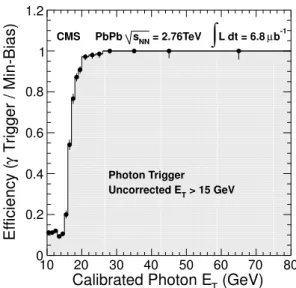
corrections for the calorimeter energy response. The efficiency of the photon trigger in PbPb collisions is shown in Fig. 1 for photon candidates with|ηγ| < 1.44. The efficiency is greater than 98% for photon candidates with corrected transverse energy EγT >20 GeV in both pp and PbPb collisions.
In addition to the photon-triggered data sample, a minimum-bias (MB) PbPb event sample is collected using coincidences between trigger signals from the +z and −z sides of either the BSC or the HF. The minimum-bias trigger and event selection efficiency in PbPb collisions is (97±3)% [4].
To select a pure sample of inelastic hadronic PbPb collisions, the contamination from electro-magnetic (“ultra-peripheral”) collisions and non-collision beam background are removed fol-lowing the prescriptions in Ref. [4]. Events are preselected if they contain a reconstructed vertex made of at least two tracks with vertex z position|z| <15 cm and an offline HF coincidence of at least three towers with energy greater than 3 GeV on each side of the interaction point. To further suppress the beam-gas and beam-scraping events, the length of pixel clusters along the beam direction is required to be compatible with particles originating from the event vertex. Offline selection of pp and PbPb events for further analysis requires a photon candidate, de-fined as described in Section 6, in the pseudorapidity range |ηγ| < 1.44 and with a corrected transverse energy Eγ
(GeV) T Calibrated Photon E 10 20 30 40 50 60 70 80 T ri g g e r / M in -B ia s ) γ E ff ic ie n c y ( 0 0.2 0.4 0.6 0.8 1 1.2 -1 b µ L dt = 6.8
∫
= 2.76TeV NN s CMS PbPb Photon Trigger > 15 GeV T Uncorrected EFigure 1: Efficiency for the photon trigger as a function of the corrected photon transverse energy in PbPb collisions at 2.76 TeV, measured with the minimum-bias sample. Error bars represent the statistical uncertainty.
4
Monte Carlo simulation
In order to study the photon selection efficiency and electron rejection in PbPb collisions, γ+jet,
dijet, and W → eν events are simulated using the PYTHIAMonte Carlo (MC) generator
(ver-sion 6.422, tune D6T) [12], modified to take into account the isospin of the colliding nuclei [13].
These simulated PYTHIA events, propagated through the CMS detector using the GEANT4
package [14] to simulate the detector response, are embedded in actual MB PbPb events in order to study the effect of the underlying event on the photon reconstruction and isolation. The embedding is done by mixing the simulated digital information with the recorded MB PbPb data. These mixed samples (denoted “PYTHIA+DATA”) are used for signal shape studies, and for energy and efficiency corrections.
In order to determine whether a given photon is isolated at the generator level, an isolation cone of radius∆R = p(∆η)2+ (∆φ)2 <0.4 around its direction in pseudorapidity and azimuth
is defined. A photon is considered to be isolated if the sum of the ET of all the other final
state particles produced from the same hard scattering inside the isolation cone is smaller than 5 GeV. The GEANT4 simulation is used to determine the isolated photon energy and efficiency corrections.
5
PbPb centrality determination
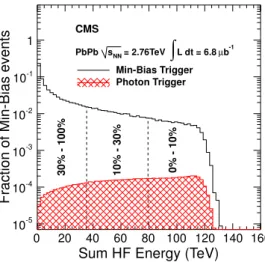
For the analysis of PbPb events, it is important to determine the overlap or impact parameter of the two colliding nuclei, usually called the reaction “centrality”. Centrality is determined with the minimum-bias sample using the total sum of energy signals from the HF. The PbPb MB data sample is divided into three percentile ranges of the total inelastic cross section: 0–10% (most central, small impact parameter), 10–30% (mid-central), and 30–100% (peripheral, large impact parameter). The distribution of the HF energy, along with the intervals defining the three event classes, are shown in Fig. 2. Details of the centrality determination are described in Ref. [4]. The intervals can be correlated with geometrical properties of the collision using a Glauber model simulation [15]. The two most commonly used quantities are Npart, the total
4 6 Photon reconstruction and identification
Sum HF Energy (TeV)
0 20 40 60 80 100 120 140 160
Fraction of Min-Bias events
-5 10 -4 10 -3 10 -2 10 -1 10 1 Min-Bias Trigger Photon Trigger 30% - 100% 10% - 30% 0% - 10% CMS -1 b µ L dt = 6.8
∫
= 2.76TeV NN s PbPbFigure 2: Probability distribution of the total HF energy for minimum-bias PbPb collisions (black open histogram). The three regions separated by the vertical dotted lines correspond to the centrality ranges used in this analysis. Also shown is the HF energy distribution for the subset of events passing the HLT photon trigger (cross-hatched histogram), which is about 3.3% of all minimum-bias events.
number of nucleons in the two Pb nuclei that experience at least one collision, and Ncoll, the
to-tal number of inelastic nucleon-nucleon collisions. The variable Npartis often used to quantify
the reaction centrality, with Npart= 2 corresponding to a single nucleon-nucleon interaction and
Npart= 2×208 corresponding to a head-on PbPb collision where all nucleons participate. The
variable Ncoll quantifies the total number of incoherent nucleon-nucleon collisions at a given centrality, and since this is directly proportional to the high-pTparticle production yields, Ncoll
is used to normalize the PbPb yields for comparison with the same observables for hard pro-cesses measured in pp collisions. As can be seen in Fig. 2, the centrality distribution associated with hard processes, such as high-ETphoton production (cross-hatched histogram), has a more
pronounced contribution from central collisions than for minimum-bias events (solid line)
6
Photon reconstruction and identification
The photon reconstruction algorithm and isolation requirements in pp collisions are detailed in Ref. [16]. The reconstruction in PbPb collisions is very similar, although some modifications are introduced in order to deal with the large background of particles produced in the collision. ECAL “superclusters” are reconstructed in the barrel region of the electromagnetic calorimeter using the “island” energy-clustering algorithm [17]. The first step of the algorithm is a search around the seeds, which are defined as cells (reconstructed hits) with a transverse energy above a threshold of 0.5 GeV. Starting from a seed position, adjacent cells are examined, scanning first in the φ and then in the η direction. Cells are added to the cluster until the cell under consideration satisfies one of three conditions; the corrected energy deposit in the cell is zero, the energy in the cell is larger than in the adjacent cell which was already added to the cluster, or the cell is already part of a different island cluster. In the second step, the island clusters are merged into superclusters. The procedure is seeded by searching for the most energetic cluster above a transverse energy threshold (ET > 1 GeV) and then collecting all the other nearby
clusters that have not yet been used in a narrow η-window (∆η = 0.07), and a much wider
of energy deposits) with uncalibrated ET > 8 GeV, and its energy is corrected to account for
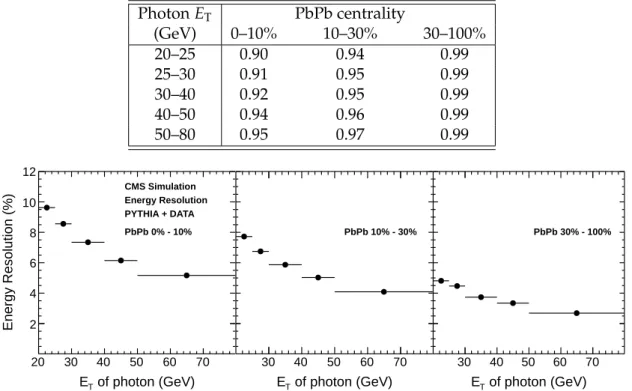
the material in front of the ECAL and for electromagnetic shower containment. The direction of the photon is also recalculated with respect to the primary vertex. An additional energy correction is applied to remove the background contribution from the underlying PbPb event. This correction is obtained from the γ+jetPYTHIA+DATAsample and listed in Table 1 for the 3 centrality intervals. The underlying PbPb activity also worsens the photon energy resolution to a maximum of 9% for the lowest ETbin in the 0–10% central events, as shown in Fig. 3.
Table 1: Energy correction factors for the background energy contribution found using the γ+jet PYTHIA+DATA sample for each centrality interval and photon ET. The reconstructed ET
of photon candidates with|ηγ| <1.44 is multiplied by this factor to get the corrected transverse energy Eγ T. Photon ET PbPb centrality (GeV) 0–10% 10–30% 30–100% 20–25 0.90 0.94 0.99 25–30 0.91 0.95 0.99 30–40 0.92 0.95 0.99 40–50 0.94 0.96 0.99 50–80 0.95 0.97 0.99 of photon (GeV) T E 20 30 40 50 60 70 Energy Resolution (%) 2 4 6 8 10 12 CMS Simulation Energy Resolution PYTHIA + DATA PbPb 0% - 10% of photon (GeV) T E 30 40 50 60 70 Energy Resolution (%) 2 4 6 8 10 12 PbPb 10% - 30% of photon (GeV) T E 30 40 50 60 70 Energy Resolution (%) 2 4 6 8 10 12 PbPb 30% - 100%
Figure 3: Relative energy resolution of reconstructed photons as a function of photon trans-verse energy, determined using γ+jetPYTHIA+DATAsample for three centrality intervals. The horizontal bars indicate the bin width.
Anomalous signals caused by the interaction of heavily ionizing particles directly with the silicon avalanche photodiodes used for the ECAL barrel readout are removed by the following requirements: (i) the signal should be consistent in time (within 3 ns) with a photon from the collision; (ii) the sum of the energy in the four adjacent cells surrounding the central cell should be at least 10% of the central cell energy. These two selections are satisfied by 99.7% of the photon signal candidates.
The selected photon candidates are required to be in the ECAL barrel within the pseudorapidity interval |ηγ| < 1.44, to not match with any electron candidates in a search window of|ηγ− ηTrack| < 0.02 and|φγ−φTrack| < 0.15 with respect to the associated electron candidate track, and to have Eγ
T > 20 GeV. A first rejection of neutral mesons mimicking a high-ET photon
candidate in the ECAL is done using the H/E ratio defined as the ratio of hadronic energy to
electromagnetic energy inside a cone of∆R = 0.15, computed from the energy depositions in
6 7 Signal extraction, corrections, and systematic uncertainties
To measure the isolation of a given photon candidate in a PbPb event, the detector activity in a cone of radius∆R = 0.4 with respect to the centroid of the cluster is used.
Calorimeter-based isolation variables IsoECAL and IsoHCALare calculated by summing over the ECAL and
HCAL transverse energy, respectively, measured inside the cone, while a track-based isolation
variable IsoTrack is measured by summing over the transverse momentum of all tracks with
pT > 2 GeV/c inside the cone. The total ECAL energy associated with the photon candidate is
excluded in the IsoECAL calculation. In order to remove the contribution of hadronic activity
from the underlying PbPb event background falling inside the isolation cone for each centrality, the average value of the energy deposited per unit area in the η−φ phase space (hUEi) is estimated within a rectangular region 2∆R-wide and centered on ηγin the η-direction and 2π
wide in the φ-direction, excluding the isolation cone. The UE-subtracted isolation variables IsoUE−sub = Iso−π(∆R)2hUEiare used to further reject photon candidates originating from
jets. The sum of the isolation variables(SumIsoUE−sub=IsoUE−sub
ECAL +IsoUE
−sub
HCAL +IsoUE
−sub Track )is
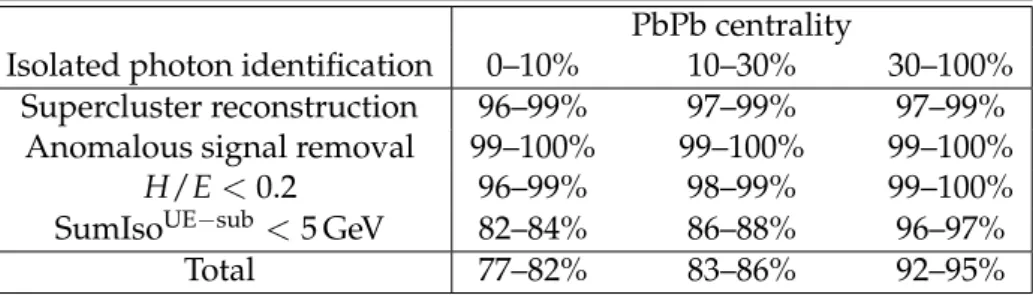
required to be smaller than 5 GeV. The efficiency of the isolated photon identification criteria in PbPb collisions, which is obtained from thePYTHIA+DATAsample, is summarized in Table 2. Table 2: Efficiencies of the isolated photon identification at each step: clustering, anomalous signal removal, H/E selection, and isolation requirement. Numbers in each row are the effi-ciencies relative to the previous step. The selections are more efficient for high EγT photons and for more peripheral events. The intervals given indicate the EγT-dependent variations of the efficiencies.
PbPb centrality
Isolated photon identification 0–10% 10–30% 30–100%
Supercluster reconstruction 96–99% 97–99% 97–99%
Anomalous signal removal 99–100% 99–100% 99–100%
H/E<0.2 96–99% 98–99% 99–100%
SumIsoUE−sub <5 GeV 82–84% 86–88% 96–97%
Total 77–82% 83–86% 92–95%
7
Signal extraction, corrections, and systematic uncertainties
The selection criteria described above yield a relatively pure sample of isolated photons. How-ever, there are still non-prompt photons, such as those from isolated π0s that are carrying a large fraction of the parent fragmenting parton energy, which can pass the isolation cuts. Those remaining backgrounds are estimated using a two-component fit of the shape of the electro-magnetic shower in the ECAL and separated from the signal on a statistical basis, as described below.
The topology of the energy deposits can be used as a powerful tool to distinguish the signal from the background by making use of the fine η segmentation of the electromagnetic calor-imeter. The shower shape is characterized by a transverse shape variable σηη, defined as a
modified second moment of the electromagnetic energy cluster distribution around its mean η position: σηη2 = ∑iwi(ηi− ¯η) 2 ∑iwi , wi =max(0, 4.7+ln Ei E), (1)
where Eiand ηiare the energy and position of the ithcrystal in a group of 5×5 crystals centered
¯η is the average η weighted by wi in the same group [11, 18]. Isolated photons tend to have a
smaller mean value of σηηand a narrow distribution, while photons produced in hadron decays
tend to have larger σηη mean and a wider σηη distribution.
The isolated prompt photon yield is estimated with a binned maximum likelihood fit to the σηη
distribution with the expected signal and background components for each EγT interval. The signal and background component shapes used in the pp analysis are described in [11]. In the PbPb analysis, the signal component shape for each Eγ
Tand centrality bin is obtained from γ+jet
PYTHIA+DATAsamples, and the background component shape is extracted from data using a
background-enriched SumIso sideband (6 < SumIsoUE−sub < 11 GeV) sample while keeping all other selection criteria unchanged.
) η η σ shower shape ( 0 0.01 0.02 fraction of candidates 0 0.1 0.2 0.3 0.4 0.5 Data Signal Background CMS =2.76TeV NN s Data Signal Background -1 L dt = 231 nb
∫
pp 20 - 25 GeV s γ 2613 ) η η σ shower shape ( 0 0.01 0.02 fraction of candidates 0 0.1 0.2 0.3 0.4 0.5 pp 40 - 50 GeV s γ 235 ) η η σ shower shape ( 0 0.01 0.02 fraction of candidates 0 0.1 0.2 0.3 0.4 0.5 -1 b µ L dt = 6.8∫
PbPb 30 - 100% 20 - 25 GeV s γ 852 ) η η σ shower shape ( 0 0.01 0.02 fraction of candidates 0 0.1 0.2 0.3 0.4 0.5 PbPb 30 - 100% 40 - 50 GeV s γ 85 ) η η σ shower shape ( 0 0.01 0.02 fraction of candidates 0 0.1 0.2 0.3 0.4 0.5 PbPb 10 - 30% 20 - 25 GeV s γ 1399 ) η η σ shower shape ( 0 0.01 0.02 fraction of candidates 0 0.1 0.2 0.3 0.4 0.5 PbPb 10 - 30% 40 - 50 GeV s γ 157 ) η η σ shower shape ( 0 0.01 0.02 fraction of candidates 0 0.1 0.2 0.3 0.4 0.5 PbPb 0 - 10% 20 - 25 GeV s γ 1265 ) η η σ shower shape ( 0 0.01 0.02 fraction of candidates 0 0.1 0.2 0.3 0.4 0.5 PbPb 0 - 10% 40 - 50 GeV s γ 106Figure 4: Measured shower-shape σηηdistribution for photon candidates with E γ
T =20–25 GeV
and 40–50 GeV in pp (2 left plots) and PbPb collisions for 3 different centrality ranges. The extracted numbers of isolated photons are shown in the figure. The fit result (red line), signal (red-hatched histogram) and background components (blue shaded histogram) are also shown.
Figure 4 illustrates the results of the two-component fit of the shower-shape distribution mea-sured in pp and PbPb collisions. The remaining background contribution from electrons pass-ing all the photon selection criteria, estimated from a sample enriched in isolated electrons found by reversing the electron-veto requirement described in Section 6, is also subtracted to extract the raw signal yields(Nrawγ ). Typically, the contribution due to electron contamination
in PbPb collisions is 3–6% for different ET intervals. A bin-by-bin correction for the energy
smearing (U), which amounts to 1.00–1.08 for different Eγ
T and centrality bins, is also applied
to the raw signal yields to obtain the number of isolated photons. The ET-differential photon
yield per event is defined as dNγ PbPb dEγ T = N γ raw U×e× fcent×NMB×∆EγT , (2)
where NMBis the number of sampled minimum-bias PbPb events, fcentis the fraction of PbPb
events in each centrality bin, and e is the efficiency of the isolated photon identification (Ta-ble 2). For pp collisions we normalize the yields by the integrated luminosity (Lpp) to obtain
8 7 Signal extraction, corrections, and systematic uncertainties
the ET-differential cross section dσppγ /dEγT:
dσγ pp dEγ T = N γ raw U×e× Lpp×∆ETγ . (3)
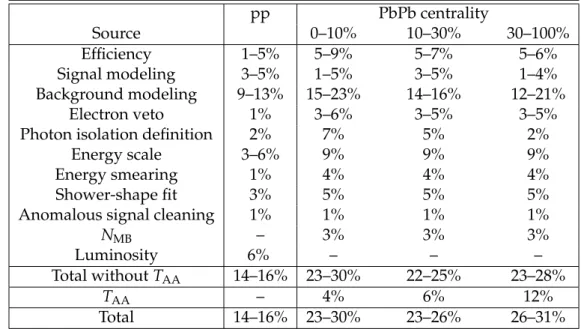
Table 3: Summary of the contributions to the estimated systematic uncertainties on the iso-lated photon spectra measured in pp and PbPb collisions and their total. The nuclear overlap function TAAis defined in Section 9. The intervals indicate the EγT-dependent variations of the
uncertainties. pp PbPb centrality Source 0–10% 10–30% 30–100% Efficiency 1–5% 5–9% 5–7% 5–6% Signal modeling 3–5% 1–5% 3–5% 1–4% Background modeling 9–13% 15–23% 14–16% 12–21% Electron veto 1% 3–6% 3–5% 3–5%
Photon isolation definition 2% 7% 5% 2%
Energy scale 3–6% 9% 9% 9%
Energy smearing 1% 4% 4% 4%
Shower-shape fit 3% 5% 5% 5%
Anomalous signal cleaning 1% 1% 1% 1%
NMB – 3% 3% 3%
Luminosity 6% – – –
Total without TAA 14–16% 23–30% 22–25% 23–28%
TAA – 4% 6% 12%
Total 14–16% 23–30% 23–26% 26–31%
The systematic uncertainties of the measured photon spectra are summarized in Table 3. The total systematic uncertainties are 22–30% for PbPb and 14–16% for pp collisions. The systematic uncertainty of the photon yield dNPbPbγ /dEγTin PbPb collisions is dominated by the uncertainty
on the background modeling. Since the transverse shape variable σηη may be correlated with
the number of particles in the isolation cone (characterized by SumIsoUE−sub), non-prompt pho-tons fromPYTHIA+DATAsamples are used to examine the possible difference between the σηη
distribution in the SumIsoUE−subsignal and in the sideband regions. Systematic checks are per-formed using the differences in the mean and width seen in the MC to vary the background component shape in the fit. The estimated uncertainty is in the range of 12–23%, where the given interval indicates the Eγ
T and centrality-dependent variations of the uncertainty. The
uncertainty due to the σηη distribution of isolated photons is estimated by comparing the
dis-tributions of electrons from MC and data. Given the small number of Z → e+e− events in
the PbPb data sample, Z → e+e−events from the 2010 pp run at√s = 7 TeV are mixed with
MB PbPb data. The differences in the measured mean and width from those obtained in the MC(Z→e+e−)+PbPb data are used to vary the σηηdistributions of isolated photons. Such
sys-tematic changes result in a final propagated uncertainty of 1–5% in the isolated photon yield. The uncertainty due to the energy scale propagates to an uncertainty of 9% in the final spectra. The uncertainty due to the energy smearing correction is obtained by varying the assumed iso-lated photon differential cross section at low photon ET(used to obtain the unfolding correction
factors) by±50%, and is found to be 4%. The uncertainty of the two-component fit is checked by using different binning widths in the fit, and is found to be 5%. A 3–6% uncertainty is asso-ciated with the electron contamination subtraction. The difference between experimental and theoretical photon isolation definitions as described in Section 8 due to the detector response
and underlying event is estimated to be 2–7%. The uncertainty of NMBdue to the MB selection
efficiency is 3% in PbPb collisions, and a 6% uncertainty is quoted for the integrated luminosity in pp collisions.
8
Theoretical calculations
The isolated photon spectra measured in pp and PbPb collisions at√sNN = 2.76 TeV are
com-pared with next-to-leading-order (NLO) pQCD predictions obtained usingJETPHOX1.2.2, which
reproduces well the measured pp data at√s = 7 TeV [11, 16]. The inclusive photon spectrum
in pp collisions is computed using the CT10 [19] parton distribution functions. The same spec-trum in PbPb collisions is computed using the NLO EPS09 [20] PDFs, which include nuclear modifications of the proton PDFs. The reduction of photon emission due to isospin effects in nuclear compared to proton collisions (the relative population of u and d quarks is not identical in a single proton and in a lead nucleus, with 126 neutrons and 82 protons) is accounted for in the calculations. For both systems the BFG-II set [21] of parton-to-photon fragmentation func-tions is used, and the default renormalization, factorization, and fragmentation scales (µR, µF,
and µf) are all set to the photon ET. The parton-level isolation, summing over the transverse
energy of all partons inside a cone of radius∆R = 0.4, is required to be smaller than 5 GeV. In order to estimate the dependence of the predictions on the choice of theoretical scales, the µi scales are varied by a factor of 2 below and above their default values, keeping the ratio
between any two scales less than or equal to 2. The uncertainty linked to the choice of the pro-ton PDF is±(7–5)% and it is smaller than the theoretical scale uncertainty which varies within ±(15–10)% in the measured pTrange, as found in [11]. The uncertainty on the predictions due
to nuclear PDFs is estimated using the 30 eigenvalues of the EPS09 PDF set. In addition, the PbPb spectrum is computed using two alternative nuclear PDF sets: nDS [22] and HKN07 [23]. When data are compared to pp NLO predictions, the proton PDF and the scale uncertainties are added in quadrature.
9
Results
In order to compare the cross sections for any high-pT particle produced in PbPb and pp
colli-sions, a scaling factor, the nuclear overlap function TAA, is needed to provide proper
normal-ization. This factor, equal to the number of nucleon-nucleon (NN) collisions, Ncoll, normalized
by the pp inelastic cross section, can be interpreted as the NN-equivalent integrated luminosity at any given PbPb centrality. The LHC collaborations use a common nucleon-nucleon inelas-tic cross section of σ = 64 ± 5 mb at 2.76 TeV, based on a fit of the existing data for total and elastic cross sections in proton-proton and proton-antiproton collisions [24]. In units of mb−1, the average values of TAAare 23.2±1.0, 11.6±0.7, 1.45±0.18, and 5.66±0.35 for the
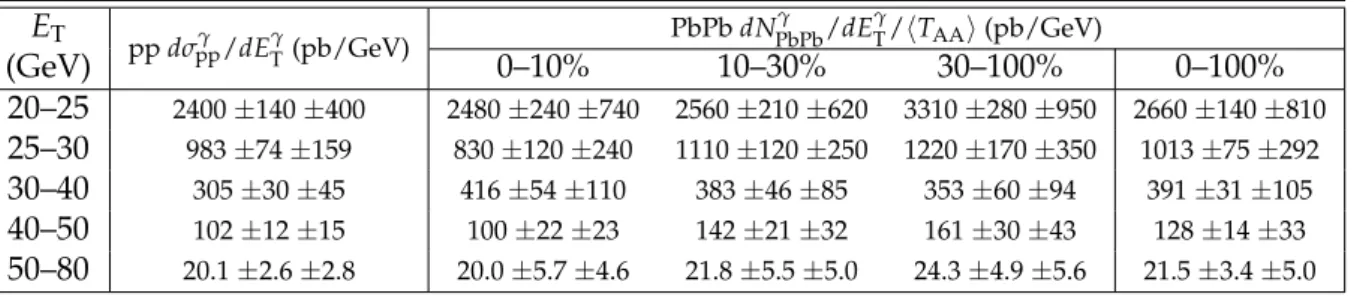
central-ity ranges 0–10%, 10–30%, 30–100%, and 0–100%, respectively. These numbers are computed with a Glauber model [15] using the same parameters as in [4]. The quoted uncertainties are derived by varying the Glauber model parameters and the MB trigger and event selection effi-ciency within their uncertainties. The measured EγT-differential isolated photon cross sections in pp and the TAA-scaled yields in PbPb collisions, including both statistical and systematic
uncertainties, are listed in Table 4.
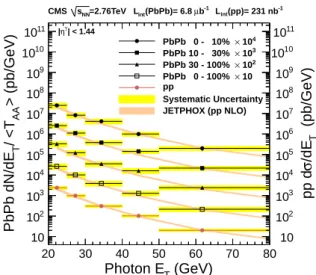
Figure 5 shows the pp cross sections and the PbPb TAA-scaled yields compared to theJETPHOX
predictions obtained with the CT10 PDF, described in Section 8. The data are plotted at the true centre of the EγT distributions in each bin [25]. The pp and PbPb data are consistent with the NLO calculation at all transverse energies within the quoted statistical and systematic
uncer-10 10 Summary
Table 4: Isolated photon cross sections for |ηγ| < 1.44 in bins of EγT for pp collisions and PbPb collisions (for 3 centrality intervals and for the full range) at√sNN = 2.76 TeV. The first uncertainty is statistical and the second one is systematic (including TAAuncertainties in the
PbPb case). ET pp dσγ pp/dEγT(pb/GeV) PbPb dNγ PbPb/dE γ T/hTAAi(pb/GeV) (GeV) 0–10% 10–30% 30–100% 0–100% 20–25 2400±140±400 2480±240±740 2560±210±620 3310±280±950 2660±140±810 25–30 983±74±159 830±120±240 1110±120±250 1220±170±350 1013±75±292 30–40 305±30±45 416±54±110 383±46±85 353±60±94 391±31±105 40–50 102±12±15 100±22±23 142±21±32 161±30±43 128±14±33 50–80 20.1±2.6±2.8 20.0±5.7±4.6 21.8±5.5±5.0 24.3±4.9±5.6 21.5±3.4±5.0 tainties.
The nuclear modification factor (RAA) for isolated photon production in PbPb collisions,
RAA=dNPbPbγ /dETγ/(TAA×dσppγ /dET), (4)
is computed from the measured PbPb scaled yield for each centrality and the pp differential cross section. Figure 6 displays RAAas a function of the isolated photon ETfor the 0–10% most
central PbPb collisions. The ratio is compatible with unity within the experimental uncertain-ties for all ETvalues. This confirms the validity of the TAAscaling expectation for perturbative
cross sections in nucleus-nucleus collisions at the LHC, as found previously for Z-boson pro-duction [6]. Changes in the isolated photon yields in PbPb collisions compared to pp due to modifications of the nuclear parton densities are relatively small in this high-ETrange,
accord-ing to theJETPHOXcalculations. Figure 6 shows that the calculated NLO ratios of the PbPb to pp isolated photon spectra obtained with the central values of the EPS09, nDS and HKN07
nu-clear PDFs differ at most by±10%. The band of uncertainty obtained from the 68% confidence
level variation of the EPS09 nuclear parton distribution parameters (red dashed lines) is fully consistent with the measured nuclear modification factor at all transverse energies.
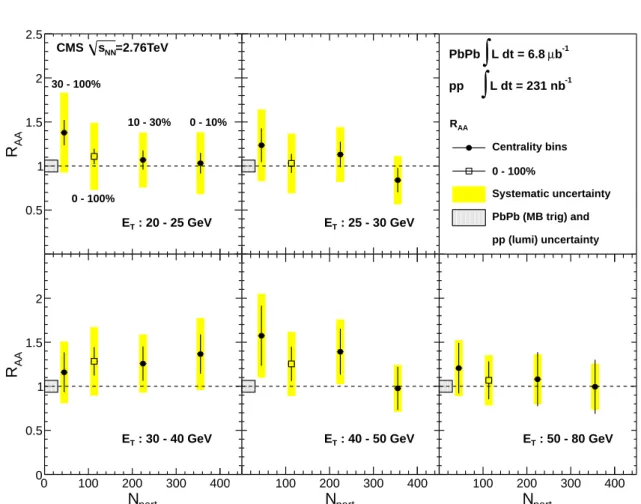
In order to investigate the centrality dependence of the isolated photon production yields in PbPb compared to pp collisions, Fig. 7 plots the RAAas a function of Npartfor various ETbins.
Within the uncertainties, the measured nuclear modification ratio is consistent with unity, not only for minimum-bias PbPb collisions, but also for central collisions and all photon transverse energies. With improved statistical accuracy and/or reduced systematic uncertainties, isolated photon production yields in PbPb collisions at the LHC could be used to better constrain the nuclear PDFs by including the measurement in standard global fits of parton densities [20, 22, 23], as discussed in [3].
10
Summary
In summary, the isolated photon spectra at midrapidity (|ηγ| < 1.44) have been measured as a function of transverse energy in pp and PbPb collisions at nucleon-nucleon centre-of-mass energies of 2.76 TeV. The measured spectra are well reproduced by NLO perturbative QCD calculations with recent parton distribution functions for the proton and nucleus. No modi-fication is observed in the EγT spectra measured in PbPb collisions at various centralities with respect to the pp differential cross sections scaled by the corresponding nuclear overlap func-tion. The result confirms the TAAscaling of perturbative cross sections in PbPb compared to pp
(GeV) T Photon E 20 30 40 50 60 70 80 > (pb/GeV) AA / <TT PbPb dN/dE 10 2 10 3 10 4 10 5 10 6 10 7 10 8 10 9 10 10 10 11 10 -1 (pp)= 231 nb int L -1 b µ (PbPb)= 6.8 int =2.76TeV L NN s CMS | < 1.44 γ η | 4 10 × PbPb 0 - 10% 3 10 × PbPb 10 - 30% 2 10 × PbPb 30 - 100% 10 × PbPb 0 - 100% pp Systematic Uncertainty JETPHOX (pp NLO) (pb/GeV)T /dE σ pp d 10 2 10 3 10 4 10 5 10 6 10 7 10 8 10 9 10 10 10 11 10
Figure 5: Isolated photon spectra measured as a function of Eγ
T for 0–10%, 10–30%, 30–100%,
0–100% PbPb collisions (scaled by TAA) and pp collisions at 2.76 TeV, scaled by the factors
shown in the figure for easier viewing. The horizontal bars indicate the bin width. The total systematic uncertainty (bottom row of Table 3) is shown as a yellow box at each ET bin. The
results are compared to the NLO JETPHOX calculation (see text) with its associated scale and PDF uncertainties (added in quadrature) shown as a pink band.
(GeV) T Photon E 10 20 30 40 50 60 70 80 AA R 0 0.5 1 1.5 2 PbPb(EPS09)/pp(CT10) PbPb(nDS)/pp(CT10) PbPb(HKN07)/pp(CT10) EPS09 PDF uncertainties -1 (pp)= 231 nb int L -1 b µ (PbPb)= 6.8 int =2.76TeV L NN s CMS (0-10%) AA R Systematic Uncertainty scale uncertainty AA T
Figure 6: Nuclear modification factor RAA as a function of the photon ET measured in the
0–10% most central PbPb collisions at 2.76 TeV. The vertical error bars indicate the statistical uncertainty and the horizontal bars reflect the bin width. The total systematic uncertainties without the TAA uncertainty (see Table 3) are shown as yellow filled boxes. The TAA
uncer-tainty, common to all points, is indicated by the left box centered at unity. The curves show the theoretical predictions, obtained withJETPHOXfor various nuclear PDFs described in the text. The uncertainty from the EPS09 PDF parameters is shown as the red dashed lines.
12 10 Summary part N 0 100 200 300 400 AA R 0 0.5 1 1.5 2 2.5 : 20 - 25 GeV T E =2.76TeV NN s CMS 30 - 100% 0 - 100% 10 - 30% 0 - 10% part N 0 100 200 300 400 AA R 0 0.5 1 1.5 2 2.5 : 30 - 40 GeV T E part N 0 100 200 300 400 AA R 0 0.5 1 1.5 2 2.5 : 25 - 30 GeV T E part N 0 100 200 300 400 AA R 0 0.5 1 1.5 2 2.5 : 40 - 50 GeV T E -1 b µ L dt = 6.8
∫
PbPb -1 L dt = 231 nb∫
pp AA R Centrality bins 0 - 100% Systematic uncertainty PbPb (MB trig) and pp (lumi) uncertainty part N 0 100 200 300 400 AA R 0 0.5 1 1.5 2 2.5 : 50 - 80 GeV T EFigure 7: The measured nuclear modification factor RAAas a function of PbPb centrality (given
by the number of participating nucleons, Npart) for five different photon transverse energy
in-tervals. The error bars on each point indicate the statistical uncertainty. The systematic
uncer-tainties are shown as yellow boxes, including the centrality dependent TAA uncertainty. The
common uncertainties related to event selection efficiency and pp integrated luminosity are shown as grey hatched boxes around unity.
modified compared to the proton PDF in the explored kinematic range, dominated by high-pT
photons produced in parton-parton scatterings in the large-Q2and moderate parton fractional momentum x region of the nuclear PDFs [20]. Isolated photons are found to be unaffected by the produced strongly interacting medium, in sharp contrast to the large quenching effects ob-served for jets [4]. The measurement presented here establishes isolated photon production as a valuable perturbative probe of the initial state in heavy-ion collisions and provides a baseline for the study of in-medium parton energy loss in γ+jet events.
Acknowledgements
We wish to congratulate our colleagues in the CERN accelerator departments for the excellent performance of the LHC machine. We thank the technical and administrative staff at CERN and other CMS institutes. This work was supported by the Austrian Federal Ministry of Science and Research; the Belgium Fonds de la Recherche Scientifique, and Fonds voor Wetenschappelijk Onderzoek; the Brazilian Funding Agencies (CNPq, CAPES, FAPERJ, and FAPESP); the Bul-garian Ministry of Education and Science; CERN; the Chinese Academy of Sciences, Ministry of Science and Technology, and National Natural Science Foundation of China; the Colom-bian Funding Agency (COLCIENCIAS); the Croatian Ministry of Science, Education and Sport; the Research Promotion Foundation, Cyprus; the Estonian Academy of Sciences and NICPB; the Academy of Finland, Finnish Ministry of Education and Culture, and Helsinki Institute of Physics; the Institut National de Physique Nucl´eaire et de Physique des Particules / CNRS, and Commissariat `a l’ ´Energie Atomique et aux ´Energies Alternatives / CEA, France; the Bundes-ministerium f ¨ur Bildung und Forschung, Deutsche Forschungsgemeinschaft, and Helmholtz-Gemeinschaft Deutscher Forschungszentren, Germany; the General Secretariat for Research and Technology, Greece; the National Scientific Research Foundation, and National Office for Research and Technology, Hungary; the Department of Atomic Energy and the Department of Science and Technology, India; the Institute for Studies in Theoretical Physics and Mathe-matics, Iran; the Science Foundation, Ireland; the Istituto Nazionale di Fisica Nucleare, Italy; the Korean Ministry of Education, Science and Technology and the World Class University program of NRF, Korea; the Lithuanian Academy of Sciences; the Mexican Funding Agencies (CINVESTAV, CONACYT, SEP, and UASLP-FAI); the Ministry of Science and Innovation, New Zealand; the Pakistan Atomic Energy Commission; the State Commission for Scientific Re-search, Poland; the Fundac¸˜ao para a Ciˆencia e a Tecnologia, Portugal; JINR (Armenia, Belarus, Georgia, Ukraine, Uzbekistan); the Ministry of Science and Technologies of the Russian Feder-ation, the Russian Ministry of Atomic Energy and the Russian Foundation for Basic Research; the Ministry of Science and Technological Development of Serbia; the Ministerio de Ciencia e Innovaci ´on, and Programa Consolider-Ingenio 2010, Spain; the Swiss Funding Agencies (ETH Board, ETH Zurich, PSI, SNF, UniZH, Canton Zurich, and SER); the National Science Council, Taipei; the Scientific and Technical Research Council of Turkey, and Turkish Atomic Energy Authority; the Science and Technology Facilities Council, UK; the US Department of Energy, and the US National Science Foundation.
Individuals have received support from the Marie-Curie programme and the European Re-search Council (European Union); the Leventis Foundation; the A. P. Sloan Foundation; the Alexander von Humboldt Foundation; the Belgian Federal Science Policy Office; the Fonds pour la Formation `a la Recherche dans l’Industrie et dans l’Agriculture (FRIA-Belgium); the Agentschap voor Innovatie door Wetenschap en Technologie (IWT-Belgium); and the Council of Science and Industrial Research, India.
14 References
References
[1] S. Catani, M. Fontannaz, and J. Guillet, “Cross section of isolated prompt photons in hadron-hadron collisions”, JHEP 05 (2002) 028,
doi:10.1088/1126-6708/2002/05/028, arXiv:hep-ph/0204023.
[2] R. Ichou and D. d’Enterria, “Sensitivity of isolated photon production at TeV hadron colliders to the gluon distribution in the proton”, Phys. Rev. D 82 (2010) 014015,
doi:10.1103/PhysRevD.82.014015, arXiv:1005.4529.
[3] F. Arleo et al., “Inclusive prompt photon production in nuclear collisions at RHIC and LHC”, JHEP 04 (2011) 055, doi:10.1007/JHEP04(2011)055, arXiv:1103.1471. [4] CMS Collaboration, “Observation and studies of jet quenching in PbPb collisions at
nucleon-nucleon center-of-mass energy = 2.76 TeV”, Phys. Rev. C 84 (2011) 024906,
doi:10.1103/PhysRevC.84.024906, arXiv:1102.1957.
[5] ATLAS Collaboration, “Observation of a Centrality-Dependent Dijet Asymmetry in Lead-Lead Collisions at sqrt(SNN)= 2.76 TeV with the ATLAS Detector at the LHC”, Phys.
Rev. Lett. 105 (2010) 252303, doi:10.1103/PhysRevLett.105.252303, arXiv:1011.6182.
[6] CMS Collaboration, “Study of Z boson production in PbPb collisions at nucleon-nucleon centre of mass energy = 2.76 TeV”, Phys. Rev. Lett. 106 (2011) 212301,
doi:10.1103/PhysRevLett.106.212301, arXiv:1102.5435.
[7] ATLAS Collaboration, “Measurement of the centrality dependence of J/ψ yields and observation of Z production in lead-lead collisions with the ATLAS detector at the LHC”, Phys. Lett. B697 (2011) 294–312, doi:10.1016/j.physletb.2011.02.006,
arXiv:1012.5419.
[8] CMS Collaboration, “The CMS experiment at the CERN LHC”, JINST 03 (2008) S08004, doi:10.1088/1748-0221/3/08/S08004.
[9] PHENIX Collaboration, “Centrality dependence of direct photon production in sqrt(sNN)
= 200-GeV Au + Au collisions”, Phys. Rev. Lett. 94 (2005) 232301,
doi:10.1103/PhysRevLett.94.232301, arXiv:nucl-ex/0503003.
[10] WA98 Collaboration, “Observation of direct photons in central 158-A-GeV Pb-208 + Pb-208 collisions”, Phys. Rev. Lett. 85 (2000) 3595–3599,
doi:10.1103/PhysRevLett.85.3595, arXiv:nucl-ex/0006008.
[11] CMS Collaboration, “Measurement of the Isolated Prompt Photon Production Cross Section in pp Collisions at sqrt(s) = 7 TeV”, Phys. Rev. Lett. 106 (2011) 082001,
doi:10.1103/PhysRevLett.106.082001, arXiv:1012.0799.
[12] T. Sj ¨ostrand, S. Mrenna, and P. Z. Skands, “PYTHIA 6.4 physics and manual”, JHEP 05 (2006) 026, doi:10.1088/1126-6708/2006/05/026, arXiv:hep-ph/0603175. [13] I. P. Lokhtin and A. M. Snigirev, “A model of jet quenching in ultrarelativistic heavy ion
collisions and high-pT hadron spectra at RHIC”, Eur. Phys. J. C 45 (2006) 211,
doi:10.1140/epjc/s2005-02426-3, arXiv:hep-ph/0506189.
[14] GEANT4 Collaboration, “GEANT4– a simulation toolkit”, Nucl. Instrum. Meth. A 506 (2003) 250–303, doi:10.1016/S0168-9002(03)01368-8.
[15] M. L. Miller et al., “Glauber modeling in high energy nuclear collisions”, Ann. Rev. Nucl. Part. Sci. 57 (2007) 205, doi:10.1146/annurev.nucl.57.090506.123020,
arXiv:nucl-ex/0701025.
[16] CMS Collaboration, “Measurement of the differential cross section for isolated prompt photon production in pp collisions at 7 TeV”, Phys. Rev. D 84 (2011) 052011,
doi:10.1103/PhysRevD.84.052011, arXiv:1108.2044.
[17] CMS Collaboration, “CMS technical design report, volume II: Physics performance, Section 10.1”, J. Phys. G 34 (2007) 995–1579, doi:10.1088/0954-3899/34/6/S01. [18] T. Awes et al., “A simple method of shower localization and identification in laterally
segmented calorimeters”, Nucl. Instrum. Meth. A 311 (1992) 130,
doi:10.1016/0168-9002(92)90858-2.
[19] H.-L. Lai et al., “New parton distributions for collider physics”, Phys. Rev. D 82 (2010) 074024, doi:10.1103/PhysRevD.82.074024, arXiv:1007.2241.
[20] K. J. Eskola, H. Paukkunen, and C. A. Salgado, “EPS09 - a new generation of NLO and LO nuclear parton distribution functions”, JHEP 04 (2009) 065,
doi:10.1088/1126-6708/2009/04/065, arXiv:0902.4154.
[21] L. Bourhis, M. Fontannaz, and J. Guillet, “Quark and gluon fragmentation functions into photons”, Eur. Phys. J. C 2 (1998) 529, doi:10.1007/s100520050158,
arXiv:hep-ph/9704447.
[22] D. de Florian and R. Sassot, “Nuclear parton distributions at next to leading order”, Phys. Rev. D 69 (2004) 074028, doi:10.1103/PhysRevD.69.074028,
arXiv:hep-ph/0311227.
[23] M. Hirai, S. Kumano, and T.-H. Nagai, “Determination of nuclear parton distribution functions and their uncertainties at next-to-leading order”, Phys. Rev. C 76 (2007) 065207,
doi:10.1103/PhysRevC.76.065207, arXiv:0709.3038.
[24] Particle Data Group Collaboration, “Review of particle physics”, J. Phys. G 37 (2010) 075021, doi:10.1088/0954-3899/37/7A/075021.
[25] G. Lafferty and T. Wyatt, “Where to stick your data points: The treatment of measurements within wide bins”, Nucl. Instrum. Meth. A355 (1995) 541–547,
A
The CMS Collaboration
Yerevan Physics Institute, Yerevan, Armenia
S. Chatrchyan, V. Khachatryan, A.M. Sirunyan, A. Tumasyan
Institut f ¨ur Hochenergiephysik der OeAW, Wien, Austria
W. Adam, T. Bergauer, M. Dragicevic, J. Er ¨o, C. Fabjan, M. Friedl, R. Fr ¨uhwirth, V.M. Ghete,
J. Hammer1, M. Hoch, N. H ¨ormann, J. Hrubec, M. Jeitler, W. Kiesenhofer, A. Knapitsch,
M. Krammer, D. Liko, I. Mikulec, M. Pernicka†, B. Rahbaran, C. Rohringer, H. Rohringer,
R. Sch ¨ofbeck, J. Strauss, A. Taurok, F. Teischinger, P. Wagner, W. Waltenberger, G. Walzel, E. Widl, C.-E. Wulz
National Centre for Particle and High Energy Physics, Minsk, Belarus
V. Mossolov, N. Shumeiko, J. Suarez Gonzalez
Universiteit Antwerpen, Antwerpen, Belgium
S. Bansal, L. Benucci, T. Cornelis, E.A. De Wolf, X. Janssen, S. Luyckx, T. Maes, L. Mucibello, S. Ochesanu, B. Roland, R. Rougny, M. Selvaggi, H. Van Haevermaet, P. Van Mechelen, N. Van Remortel, A. Van Spilbeeck
Vrije Universiteit Brussel, Brussel, Belgium
F. Blekman, S. Blyweert, J. D’Hondt, R. Gonzalez Suarez, A. Kalogeropoulos, M. Maes, A. Olbrechts, W. Van Doninck, P. Van Mulders, G.P. Van Onsem, I. Villella
Universit´e Libre de Bruxelles, Bruxelles, Belgium
O. Charaf, B. Clerbaux, G. De Lentdecker, V. Dero, A.P.R. Gay, G.H. Hammad, T. Hreus, A. L´eonard, P.E. Marage, L. Thomas, C. Vander Velde, P. Vanlaer, J. Wickens
Ghent University, Ghent, Belgium
V. Adler, K. Beernaert, A. Cimmino, S. Costantini, M. Grunewald, B. Klein, J. Lellouch, A. Marinov, J. Mccartin, A.A. Ocampo Rios, D. Ryckbosch, N. Strobbe, F. Thyssen, M. Tytgat, L. Vanelderen, P. Verwilligen, S. Walsh, N. Zaganidis
Universit´e Catholique de Louvain, Louvain-la-Neuve, Belgium
S. Basegmez, G. Bruno, J. Caudron, L. Ceard, J. De Favereau De Jeneret, C. Delaere, D. Favart,
L. Forthomme, A. Giammanco2, G. Gr´egoire, J. Hollar, V. Lemaitre, J. Liao, O. Militaru,
C. Nuttens, D. Pagano, A. Pin, K. Piotrzkowski, N. Schul
Universit´e de Mons, Mons, Belgium
N. Beliy, T. Caebergs, E. Daubie
Centro Brasileiro de Pesquisas Fisicas, Rio de Janeiro, Brazil
G.A. Alves, D. De Jesus Damiao, M.E. Pol, M.H.G. Souza
Universidade do Estado do Rio de Janeiro, Rio de Janeiro, Brazil
W.L. Ald´a J ´unior, W. Carvalho, A. Cust ´odio, E.M. Da Costa, C. De Oliveira Martins, S. Fonseca De Souza, D. Matos Figueiredo, L. Mundim, H. Nogima, V. Oguri, W.L. Prado Da Silva, A. Santoro, S.M. Silva Do Amaral, A. Sznajder
Instituto de Fisica Teorica, Universidade Estadual Paulista, Sao Paulo, Brazil
T.S. Anjos3, C.A. Bernardes3, F.A. Dias4, T.R. Fernandez Perez Tomei, E. M. Gregores3, C. Lagana, F. Marinho, P.G. Mercadante3, S.F. Novaes, Sandra S. Padula
Institute for Nuclear Research and Nuclear Energy, Sofia, Bulgaria
N. Darmenov1, V. Genchev1, P. Iaydjiev1, S. Piperov, M. Rodozov, S. Stoykova, G. Sultanov,
18 A The CMS Collaboration
University of Sofia, Sofia, Bulgaria
A. Dimitrov, R. Hadjiiska, A. Karadzhinova, V. Kozhuharov, L. Litov, B. Pavlov, P. Petkov
Institute of High Energy Physics, Beijing, China
J.G. Bian, G.M. Chen, H.S. Chen, C.H. Jiang, D. Liang, S. Liang, X. Meng, J. Tao, J. Wang, J. Wang, X. Wang, Z. Wang, H. Xiao, M. Xu, J. Zang, Z. Zhang
State Key Lab. of Nucl. Phys. and Tech., Peking University, Beijing, China
Y. Ban, S. Guo, Y. Guo, W. Li, S. Liu, Y. Mao, S.J. Qian, H. Teng, S. Wang, B. Zhu, W. Zou
Universidad de Los Andes, Bogota, Colombia
A. Cabrera, B. Gomez Moreno, A.F. Osorio Oliveros, J.C. Sanabria
Technical University of Split, Split, Croatia
N. Godinovic, D. Lelas, R. Plestina5, D. Polic, I. Puljak1
University of Split, Split, Croatia
Z. Antunovic, M. Dzelalija, M. Kovac
Institute Rudjer Boskovic, Zagreb, Croatia
V. Brigljevic, S. Duric, K. Kadija, J. Luetic, S. Morovic
University of Cyprus, Nicosia, Cyprus
A. Attikis, M. Galanti, J. Mousa, C. Nicolaou, F. Ptochos, P.A. Razis
Charles University, Prague, Czech Republic
M. Finger, M. Finger Jr.
Academy of Scientific Research and Technology of the Arab Republic of Egypt, Egyptian Network of High Energy Physics, Cairo, Egypt
Y. Assran6, A. Ellithi Kamel7, S. Khalil8, M.A. Mahmoud9, A. Radi10
National Institute of Chemical Physics and Biophysics, Tallinn, Estonia
A. Hektor, M. Kadastik, M. M ¨untel, M. Raidal, L. Rebane, A. Tiko
Department of Physics, University of Helsinki, Helsinki, Finland
V. Azzolini, P. Eerola, G. Fedi, M. Voutilainen
Helsinki Institute of Physics, Helsinki, Finland
S. Czellar, J. H¨ark ¨onen, A. Heikkinen, V. Karim¨aki, R. Kinnunen, M.J. Kortelainen, T. Lamp´en, K. Lassila-Perini, S. Lehti, T. Lind´en, P. Luukka, T. M¨aenp¨a¨a, E. Tuominen, J. Tuominiemi, E. Tuovinen, D. Ungaro, L. Wendland
Lappeenranta University of Technology, Lappeenranta, Finland
K. Banzuzi, A. Korpela, T. Tuuva
Laboratoire d’Annecy-le-Vieux de Physique des Particules, IN2P3-CNRS, Annecy-le-Vieux, France
D. Sillou
DSM/IRFU, CEA/Saclay, Gif-sur-Yvette, France
M. Besancon, S. Choudhury, M. Dejardin, D. Denegri, B. Fabbro, J.L. Faure, F. Ferri, S. Ganjour, A. Givernaud, P. Gras, G. Hamel de Monchenault, P. Jarry, E. Locci, J. Malcles, M. Marionneau, L. Millischer, J. Rander, A. Rosowsky, I. Shreyber, M. Titov
Laboratoire Leprince-Ringuet, Ecole Polytechnique, IN2P3-CNRS, Palaiseau, France
N. Daci, T. Dahms, L. Dobrzynski, S. Elgammal, R. Granier de Cassagnac, M. Haguenauer, P. Min´e, C. Mironov, C. Ochando, P. Paganini, D. Sabes, R. Salerno, Y. Sirois, C. Thiebaux, C. Veelken, A. Zabi
Institut Pluridisciplinaire Hubert Curien, Universit´e de Strasbourg, Universit´e de Haute Alsace Mulhouse, CNRS/IN2P3, Strasbourg, France
J.-L. Agram12, J. Andrea, D. Bloch, D. Bodin, J.-M. Brom, M. Cardaci, E.C. Chabert, C. Collard, E. Conte12, F. Drouhin12, C. Ferro, J.-C. Fontaine12, D. Gel´e, U. Goerlach, S. Greder, P. Juillot, M. Karim12, A.-C. Le Bihan, P. Van Hove
Centre de Calcul de l’Institut National de Physique Nucleaire et de Physique des Particules (IN2P3), Villeurbanne, France
F. Fassi, D. Mercier
Universit´e de Lyon, Universit´e Claude Bernard Lyon 1, CNRS-IN2P3, Institut de Physique Nucl´eaire de Lyon, Villeurbanne, France
C. Baty, S. Beauceron, N. Beaupere, M. Bedjidian, O. Bondu, G. Boudoul, D. Boumediene, H. Brun, J. Chasserat, R. Chierici1, D. Contardo, P. Depasse, H. El Mamouni, A. Falkiewicz, J. Fay, S. Gascon, M. Gouzevitch, B. Ille, T. Kurca, T. Le Grand, M. Lethuillier, L. Mirabito, S. Perries, V. Sordini, S. Tosi, Y. Tschudi, P. Verdier, S. Viret
Institute of High Energy Physics and Informatization, Tbilisi State University, Tbilisi, Georgia
D. Lomidze
RWTH Aachen University, I. Physikalisches Institut, Aachen, Germany
G. Anagnostou, S. Beranek, M. Edelhoff, L. Feld, N. Heracleous, O. Hindrichs, R. Jussen, K. Klein, J. Merz, A. Ostapchuk, A. Perieanu, F. Raupach, J. Sammet, S. Schael, D. Sprenger, H. Weber, B. Wittmer, V. Zhukov13
RWTH Aachen University, III. Physikalisches Institut A, Aachen, Germany
M. Ata, E. Dietz-Laursonn, M. Erdmann, T. Hebbeker, C. Heidemann, K. Hoepfner,
T. Klimkovich, D. Klingebiel, P. Kreuzer, D. Lanske†, J. Lingemann, C. Magass, M.
Mer-schmeyer, A. Meyer, P. Papacz, H. Pieta, H. Reithler, S.A. Schmitz, L. Sonnenschein, J. Steggemann, D. Teyssier, M. Weber
RWTH Aachen University, III. Physikalisches Institut B, Aachen, Germany
M. Bontenackels, V. Cherepanov, M. Davids, G. Fl ¨ugge, H. Geenen, M. Geisler, W. Haj Ahmad, F. Hoehle, B. Kargoll, T. Kress, Y. Kuessel, A. Linn, A. Nowack, L. Perchalla, O. Pooth, J. Rennefeld, P. Sauerland, A. Stahl, D. Tornier, M.H. Zoeller
Deutsches Elektronen-Synchrotron, Hamburg, Germany
M. Aldaya Martin, W. Behrenhoff, U. Behrens, M. Bergholz14, A. Bethani, K. Borras, A. Cakir,
A. Campbell, E. Castro, D. Dammann, G. Eckerlin, D. Eckstein, A. Flossdorf, G. Flucke, A. Geiser, J. Hauk, H. Jung1, M. Kasemann, P. Katsas, C. Kleinwort, H. Kluge, A. Knutsson, M. Kr¨amer, D. Kr ¨ucker, E. Kuznetsova, W. Lange, W. Lohmann14, B. Lutz, R. Mankel, I. Marfin, M. Marienfeld, I.-A. Melzer-Pellmann, A.B. Meyer, J. Mnich, A. Mussgiller, S. Naumann-Emme, J. Olzem, A. Petrukhin, D. Pitzl, A. Raspereza, P.M. Ribeiro Cipriano, M. Rosin, J. Salfeld-Nebgen, R. Schmidt14, T. Schoerner-Sadenius, N. Sen, A. Spiridonov, M. Stein, J. Tomaszewska, R. Walsh, C. Wissing
University of Hamburg, Hamburg, Germany
C. Autermann, V. Blobel, S. Bobrovskyi, J. Draeger, H. Enderle, U. Gebbert, M. G ¨orner, T. Hermanns, K. Kaschube, G. Kaussen, H. Kirschenmann, R. Klanner, J. Lange, B. Mura,
20 A The CMS Collaboration
F. Nowak, N. Pietsch, C. Sander, H. Schettler, P. Schleper, E. Schlieckau, M. Schr ¨oder, T. Schum, H. Stadie, G. Steinbr ¨uck, J. Thomsen
Institut f ¨ur Experimentelle Kernphysik, Karlsruhe, Germany
C. Barth, J. Berger, T. Chwalek, W. De Boer, A. Dierlamm, G. Dirkes, M. Feindt, J. Gruschke,
M. Guthoff1, C. Hackstein, F. Hartmann, M. Heinrich, H. Held, K.H. Hoffmann, S. Honc,
I. Katkov13, J.R. Komaragiri, T. Kuhr, D. Martschei, S. Mueller, Th. M ¨uller, M. Niegel, O. Oberst, A. Oehler, J. Ott, T. Peiffer, G. Quast, K. Rabbertz, F. Ratnikov, N. Ratnikova, M. Renz, S. R ¨ocker, C. Saout, A. Scheurer, P. Schieferdecker, F.-P. Schilling, M. Schmanau, G. Schott, H.J. Simonis, F.M. Stober, D. Troendle, J. Wagner-Kuhr, T. Weiler, M. Zeise, E.B. Ziebarth
Institute of Nuclear Physics ”Demokritos”, Aghia Paraskevi, Greece
G. Daskalakis, T. Geralis, S. Kesisoglou, A. Kyriakis, D. Loukas, I. Manolakos, A. Markou, C. Markou, C. Mavrommatis, E. Ntomari, E. Petrakou
University of Athens, Athens, Greece
L. Gouskos, T.J. Mertzimekis, A. Panagiotou, N. Saoulidou, E. Stiliaris
University of Io´annina, Io´annina, Greece
I. Evangelou, C. Foudas1, P. Kokkas, N. Manthos, I. Papadopoulos, V. Patras, F.A. Triantis
KFKI Research Institute for Particle and Nuclear Physics, Budapest, Hungary
A. Aranyi, G. Bencze, L. Boldizsar, C. Hajdu1, P. Hidas, D. Horvath15, A. Kapusi, K. Krajczar16, F. Sikler1, G. Vesztergombi16
Institute of Nuclear Research ATOMKI, Debrecen, Hungary
N. Beni, J. Molnar, J. Palinkas, Z. Szillasi, V. Veszpremi
University of Debrecen, Debrecen, Hungary
J. Karancsi, P. Raics, Z.L. Trocsanyi, B. Ujvari
Panjab University, Chandigarh, India
S.B. Beri, V. Bhatnagar, N. Dhingra, R. Gupta, M. Jindal, M. Kaur, J.M. Kohli, M.Z. Mehta, N. Nishu, L.K. Saini, A. Sharma, A.P. Singh, J. Singh, S.P. Singh
University of Delhi, Delhi, India
S. Ahuja, B.C. Choudhary, A. Kumar, A. Kumar, S. Malhotra, M. Naimuddin, K. Ranjan, V. Sharma, R.K. Shivpuri
Saha Institute of Nuclear Physics, Kolkata, India
S. Banerjee, S. Bhattacharya, S. Dutta, B. Gomber, S. Jain, S. Jain, R. Khurana, S. Sarkar
Bhabha Atomic Research Centre, Mumbai, India
R.K. Choudhury, D. Dutta, S. Kailas, V. Kumar, A.K. Mohanty1, L.M. Pant, P. Shukla
Tata Institute of Fundamental Research - EHEP, Mumbai, India
T. Aziz, S. Ganguly, M. Guchait17, A. Gurtu18, M. Maity19, D. Majumder, G. Majumder,
K. Mazumdar, G.B. Mohanty, B. Parida, A. Saha, K. Sudhakar, N. Wickramage
Tata Institute of Fundamental Research - HECR, Mumbai, India
S. Banerjee, S. Dugad, N.K. Mondal
Institute for Research in Fundamental Sciences (IPM), Tehran, Iran
H. Arfaei, H. Bakhshiansohi20, S.M. Etesami21, A. Fahim20, M. Hashemi, H. Hesari, A. Jafari20,
M. Khakzad, A. Mohammadi22, M. Mohammadi Najafabadi, S. Paktinat Mehdiabadi,
INFN Sezione di Baria, Universit`a di Barib, Politecnico di Baric, Bari, Italy
M. Abbresciaa,b, L. Barbonea,b, C. Calabriaa,b, A. Colaleoa, D. Creanzaa,c, N. De Filippisa,c,1, M. De Palmaa,b, L. Fiorea, G. Iasellia,c, L. Lusitoa,b, G. Maggia,c, M. Maggia, N. Mannaa,b, B. Marangellia,b, S. Mya,c, S. Nuzzoa,b, N. Pacificoa,b, A. Pompilia,b, G. Pugliesea,c, F. Romanoa,c,
G. Selvaggia,b, L. Silvestrisa, S. Tupputia,b, G. Zitoa
INFN Sezione di Bolognaa, Universit`a di Bolognab, Bologna, Italy
G. Abbiendia, A.C. Benvenutia, D. Bonacorsia, S. Braibant-Giacomellia,b, L. Brigliadoria, P. Capiluppia,b, A. Castroa,b, F.R. Cavalloa, M. Cuffiania,b, G.M. Dallavallea, F. Fabbria, A. Fanfania,b, D. Fasanellaa,1, P. Giacomellia, C. Grandia, S. Marcellinia, G. Masettia, M. Meneghellia,b, A. Montanaria, F.L. Navarriaa,b, F. Odoricia, A. Perrottaa, F. Primaveraa, A.M. Rossia,b, T. Rovellia,b, G. Sirolia,b, R. Travaglinia,b
INFN Sezione di Cataniaa, Universit`a di Cataniab, Catania, Italy
S. Albergoa,b, G. Cappelloa,b, M. Chiorbolia,b, S. Costaa,b, R. Potenzaa,b, A. Tricomia,b, C. Tuvea,b
INFN Sezione di Firenzea, Universit`a di Firenzeb, Firenze, Italy
G. Barbaglia, V. Ciullia,b, C. Civininia, R. D’Alessandroa,b, E. Focardia,b, S. Frosalia,b, E. Galloa, S. Gonzia,b, M. Meschinia, S. Paolettia, G. Sguazzonia, A. Tropianoa,1
INFN Laboratori Nazionali di Frascati, Frascati, Italy
L. Benussi, S. Bianco, S. Colafranceschi24, F. Fabbri, D. Piccolo
INFN Sezione di Genova, Genova, Italy
P. Fabbricatore, R. Musenich
INFN Sezione di Milano-Bicoccaa, Universit`a di Milano-Bicoccab, Milano, Italy
A. Benagliaa,b,1, F. De Guioa,b, L. Di Matteoa,b, S. Gennaia,1, A. Ghezzia,b, S. Malvezzia, A. Martellia,b, A. Massironia,b,1, D. Menascea, L. Moronia, M. Paganonia,b, D. Pedrinia, S. Ragazzia,b, N. Redaellia, S. Salaa, T. Tabarelli de Fatisa,b
INFN Sezione di Napolia, Universit`a di Napoli ”Federico II”b, Napoli, Italy
S. Buontempoa, C.A. Carrillo Montoyaa,1, N. Cavalloa,25, A. De Cosaa,b, O. Doganguna,b, F. Fabozzia,25, A.O.M. Iorioa,1, L. Listaa, M. Merolaa,b, P. Paoluccia
INFN Sezione di Padovaa, Universit`a di Padovab, Universit`a di Trento (Trento)c, Padova, Italy
P. Azzia, N. Bacchettaa,1, P. Bellana,b, D. Biselloa,b, A. Brancaa, R. Carlina,b, P. Checchiaa, T. Dorigoa, U. Dossellia, F. Fanzagoa, F. Gasparinia,b, U. Gasparinia,b, A. Gozzelinoa, S. Lacapraraa,26, I. Lazzizzeraa,c, M. Margonia,b, M. Mazzucatoa, A.T. Meneguzzoa,b, M. Nespoloa,1, L. Perrozzia, N. Pozzobona,b, P. Ronchesea,b, F. Simonettoa,b, E. Torassaa, M. Tosia,b,1, S. Vaninia,b, P. Zottoa,b, G. Zumerlea,b
INFN Sezione di Paviaa, Universit`a di Paviab, Pavia, Italy
P. Baessoa,b, U. Berzanoa, S.P. Rattia,b, C. Riccardia,b, P. Torrea,b, P. Vituloa,b, C. Viviania,b
INFN Sezione di Perugiaa, Universit`a di Perugiab, Perugia, Italy
M. Biasinia,b, G.M. Bileia, B. Caponeria,b, L. Fan `oa,b, P. Laricciaa,b, A. Lucaronia,b,1, G. Mantovania,b, M. Menichellia, A. Nappia,b, F. Romeoa,b, A. Santocchiaa,b, S. Taronia,b,1, M. Valdataa,b
INFN Sezione di Pisaa, Universit`a di Pisab, Scuola Normale Superiore di Pisac, Pisa, Italy
P. Azzurria,c, G. Bagliesia, T. Boccalia, G. Broccoloa,c, R. Castaldia, R.T. D’Agnoloa,c, R. Dell’Orsoa, F. Fioria,b, L. Fo`aa,c, A. Giassia, A. Kraana, F. Ligabuea,c, T. Lomtadzea,
22 A The CMS Collaboration
L. Martinia,27, A. Messineoa,b, F. Pallaa, F. Palmonaria, A. Rizzi, G. Segneria, A.T. Serbana, P. Spagnoloa, R. Tenchinia, G. Tonellia,b,1, A. Venturia,1, P.G. Verdinia
INFN Sezione di Romaa, Universit`a di Roma ”La Sapienza”b, Roma, Italy
L. Baronea,b, F. Cavallaria, D. Del Rea,b,1, M. Diemoza, C. Fanelli, D. Francia,b, M. Grassia,1, E. Longoa,b, P. Meridiania, F. Micheli, S. Nourbakhsha, G. Organtinia,b, F. Pandolfia,b, R. Paramattia, S. Rahatloua,b, M. Sigamania, L. Soffi
INFN Sezione di Torino a, Universit`a di Torino b, Universit`a del Piemonte Orientale (No-vara)c, Torino, Italy
N. Amapanea,b, R. Arcidiaconoa,c, S. Argiroa,b, M. Arneodoa,c, C. Biinoa, C. Bottaa,b, N. Cartigliaa, R. Castelloa,b, M. Costaa,b, N. Demariaa, A. Grazianoa,b, C. Mariottia,1, S. Masellia,
E. Migliorea,b, V. Monacoa,b, M. Musicha, M.M. Obertinoa,c, N. Pastronea, M. Pelliccionia, A. Potenzaa,b, A. Romeroa,b, M. Ruspaa,c, R. Sacchia,b, V. Solaa,b, A. Solanoa,b, A. Staianoa, A. Vilela Pereiraa
INFN Sezione di Triestea, Universit`a di Triesteb, Trieste, Italy
S. Belfortea, F. Cossuttia, G. Della Riccaa,b, B. Gobboa, M. Maronea,b, D. Montaninoa,b,1, A. Penzoa
Kangwon National University, Chunchon, Korea
S.G. Heo, S.K. Nam
Kyungpook National University, Daegu, Korea
S. Chang, J. Chung, D.H. Kim, G.N. Kim, J.E. Kim, D.J. Kong, H. Park, S.R. Ro, D.C. Son, T. Son
Chonnam National University, Institute for Universe and Elementary Particles, Kwangju, Korea
J.Y. Kim, Zero J. Kim, S. Song
Konkuk University, Seoul, Korea
H.Y. Jo
Korea University, Seoul, Korea
S. Choi, D. Gyun, B. Hong, M. Jo, H. Kim, T.J. Kim, K.S. Lee, D.H. Moon, S.K. Park, E. Seo, K.S. Sim
University of Seoul, Seoul, Korea
M. Choi, S. Kang, H. Kim, J.H. Kim, C. Park, I.C. Park, S. Park, G. Ryu
Sungkyunkwan University, Suwon, Korea
Y. Cho, Y. Choi, Y.K. Choi, J. Goh, M.S. Kim, B. Lee, J. Lee, S. Lee, H. Seo, I. Yu
Vilnius University, Vilnius, Lithuania
M.J. Bilinskas, I. Grigelionis, M. Janulis, D. Martisiute, P. Petrov, M. Polujanskas, T. Sabonis
Centro de Investigacion y de Estudios Avanzados del IPN, Mexico City, Mexico
H. Castilla-Valdez, E. De La Cruz-Burelo, I. Heredia-de La Cruz, R. Lopez-Fernandez, R. Maga ˜na Villalba, J. Mart´ınez-Ortega, A. S´anchez-Hern´andez, L.M. Villasenor-Cendejas
Universidad Iberoamericana, Mexico City, Mexico
S. Carrillo Moreno, F. Vazquez Valencia
Benemerita Universidad Autonoma de Puebla, Puebla, Mexico
Universidad Aut ´onoma de San Luis Potos´ı, San Luis Potos´ı, Mexico
E. Casimiro Linares, A. Morelos Pineda, M.A. Reyes-Santos
University of Auckland, Auckland, New Zealand
D. Krofcheck
University of Canterbury, Christchurch, New Zealand
A.J. Bell, P.H. Butler, R. Doesburg, S. Reucroft, H. Silverwood
National Centre for Physics, Quaid-I-Azam University, Islamabad, Pakistan
M. Ahmad, M.I. Asghar, H.R. Hoorani, S. Khalid, W.A. Khan, T. Khurshid, S. Qazi, M.A. Shah, M. Shoaib
Institute of Experimental Physics, Faculty of Physics, University of Warsaw, Warsaw, Poland
G. Brona, M. Cwiok, W. Dominik, K. Doroba, A. Kalinowski, M. Konecki, J. Krolikowski
Soltan Institute for Nuclear Studies, Warsaw, Poland
H. Bialkowska, B. Boimska, T. Frueboes, R. Gokieli, M. G ´orski, M. Kazana, K. Nawrocki, K. Romanowska-Rybinska, M. Szleper, G. Wrochna, P. Zalewski
Laborat ´orio de Instrumenta¸c˜ao e F´ısica Experimental de Part´ıculas, Lisboa, Portugal
N. Almeida, P. Bargassa, A. David, P. Faccioli, P.G. Ferreira Parracho, M. Gallinaro, P. Musella, A. Nayak, J. Pela1, P.Q. Ribeiro, J. Seixas, J. Varela, P. Vischia
Joint Institute for Nuclear Research, Dubna, Russia
S. Afanasiev, I. Belotelov, P. Bunin, M. Gavrilenko, I. Golutvin, I. Gorbunov, A. Kamenev, V. Karjavin, G. Kozlov, A. Lanev, P. Moisenz, V. Palichik, V. Perelygin, S. Shmatov, V. Smirnov, A. Volodko, A. Zarubin
Petersburg Nuclear Physics Institute, Gatchina (St Petersburg), Russia
S. Evstyukhin, V. Golovtsov, Y. Ivanov, V. Kim, P. Levchenko, V. Murzin, V. Oreshkin, I. Smirnov, V. Sulimov, L. Uvarov, S. Vavilov, A. Vorobyev, An. Vorobyev
Institute for Nuclear Research, Moscow, Russia
Yu. Andreev, A. Dermenev, S. Gninenko, N. Golubev, M. Kirsanov, N. Krasnikov, V. Matveev, A. Pashenkov, A. Toropin, S. Troitsky
Institute for Theoretical and Experimental Physics, Moscow, Russia
V. Epshteyn, M. Erofeeva, V. Gavrilov, M. Kossov1, A. Krokhotin, N. Lychkovskaya, V. Popov, G. Safronov, S. Semenov, V. Stolin, E. Vlasov, A. Zhokin
Moscow State University, Moscow, Russia
A. Belyaev, E. Boos, A. Ershov, A. Gribushin, O. Kodolova, V. Korotkikh, I. Lokhtin, A. Markina, S. Obraztsov, M. Perfilov, S. Petrushanko, L. Sarycheva, V. Savrin, A. Snigirev, I. Vardanyan
P.N. Lebedev Physical Institute, Moscow, Russia
V. Andreev, M. Azarkin, I. Dremin, M. Kirakosyan, A. Leonidov, G. Mesyats, S.V. Rusakov, A. Vinogradov
State Research Center of Russian Federation, Institute for High Energy Physics, Protvino, Russia
I. Azhgirey, I. Bayshev, S. Bitioukov, V. Grishin1, V. Kachanov, D. Konstantinov, A. Korablev, V. Krychkine, V. Petrov, R. Ryutin, A. Sobol, L. Tourtchanovitch, S. Troshin, N. Tyurin, A. Uzunian, A. Volkov