Development of a model to predict the mechanical
properties of adhesives based on the formulation
by
Rosa Maria Moreira de Paiva
Supervisor:
Lucas Filipe Martins da Silva
DEMec, Faculdade de Engenharia da Universidade do Porto, Rua Dr. Roberto Frias, 4200-465 Porto, Portugal
Co-Supervisor:
Carlos Alberto Conceição António
DEMec, Faculdade de Engenharia da Universidade do Porto, Rua Dr. Roberto Frias, 4200-465 Porto, Portugal
© Rosa Maria Moreira de Paiva
Departamento de Engenharia Mecânica
Faculdade de Engenharia da Universidade do Porto
Rua Dr. Roberto Frias 4200-465 Porto
ABSTRACT
In order to contribute to the development of research in the field of adhesives for the footwear industry, this study aimed to develop mixed numerical-experimental models aiming to predict and optimize the mechanical properties of adhesives using their weight compositions as design variables.
In this work polyurethane solvent based adhesives were considered. The characteristics and properties that polyurethane polymers, resins and additives confer to the adhesive were determined. For evaluation and control of the resultant mechanical properties, the most common tests used by the footwear industry were performed. These are the peel strength and the creep rate.
In the literature, it’s possible to find several works based on adhesives, specifically about their composition. However, there are no studies regarding the mathematical models to optimize polyurethane solvent based adhesive formulations.
In this type of adhesives, it is necessary to take into consideration that there are factors which determine the efficiency of the adhesive joints, such as the type of substrates that are to be bonded and the surface treatment. Thus, for the implementation of this work, the following materials were considered: natural leather for the upper, polyurethane (PU) and thermoplastic rubber (TR) for the soles. Chemical and physical treatments were applied, such as halogenation and mechanical carding, respectively.
Therefore, the design variables were the constituent materials of the formulation of the polyurethane solvent based adhesive. The single-objective or the multi-objective optimization techniques were applied aiming to determine optimal adhesive formulations, improving in these ways the efficiency of the adhesive joints. The models were built using Genetic Algorithms supported by Artificial Neural Networks and Global Sensitivity Analysis concepts.
of adhesive joints. The models show robustness and capability to solve a wide variety of problems in footwear industry.
RESUMO
No sentido de contribuir para o desenvolvimento da investigação na área dos adesivos para a indústria do calçado, este trabalho teve como objectivo a determinação de modelos híbridos numéricos e experimentais capazes de prever e optimizar as propriedades mecânicas das juntas adesivas usando as composições dos constituintes como variáveis de projecto.
Neste trabalho foram considerados adesivos de poliuretano de base solvente, sendo determinadas experimentalmente as características e influências que os polímeros de poliuretano, resinas e aditivos conferem ao produto adesivo. Na indústria do calçado, as propriedades mecânicas controladas são a resistência ao arrancamento e a resistência à temperatura. Deste modo, foram aplicadas como técnicas a força de arrancamento e a taxa de fluência.
Na literatura, é possível encontrar vários trabalhos sobre adesivos, mais concretamente sobre a sua composição. No entanto, não existem pesquisas no que se refere a modelos matemáticos capazes de optimizar formulações de adesivos de poliuretano à base de solvente.
Neste tipo de adesivos, há que ter em conta a existência de factores que determinam a eficiência das juntas adesivas, como é o caso do tipo de substratos que se pretendem colar e os tratamentos de superfície necessários para a obtenção da junta adesiva ideal. Assim sendo, para a execução deste trabalho, foram considerados os materiais seguintes: pele natural, solas de poliuretano (PU) e solas de borracha termoplástica (TR). Foram aplicados tratamentos químicos e físicos, nomeadamente a halogenação e a cardagem mecânica.
Deste modo, as variáveis de projecto foram as matérias-primas constituintes da formulação do adesivo de poliuretano à base de solvente. As técnicas de optimização com um único objectivo ou com multi-objectivos foram aplicadas com o intuito de determinar formulações óptimas, melhorando desta forma a eficiência das juntas adesivas. Os modelos foram construídos usando
A partir desta investigação concluiu-se que é possível construir modelos híbridos numéricos e experimentais com o objectivo de prever e optimizar as propriedades mecânicas de juntas adesivas. Os modelos mostram robustez e capacidade para resolver uma ampla variedade de problemas na indústria do calçado.
ACKNOWLEDGEMENTS
I would like to express my sincere gratitude to my supervisor Prof. Lucas FM. da Silva for his intellectual and academic support, for believing in my project and for giving me the opportunity to work under his supervision, which made my idea a reality.
A special thanks to my co-supervisor Prof. Carlos A.C. António for the involvement in my work and for sharing his knowledge with me about the optimization using Artificial Neuronal Network (ANN) and Genetic Algorithm (GA) in Fortran.
I would like to thank to all my colleagues at ADFEUP group, Ricardo Carbas, Mariana Banea, Ana Queirós, Filipe Chaves for the friendship and for interesting discussions about adhesives. A special thanks to Eduardo Marques for the contributions made to this work.
During my work in FEUP, I had the support of the company CIPADE –
Indústria e Investigação e Desenvolvimento de Produtos Adesivos, S.A.
where I work since 2003; I want to acknowledge them because they understood my efforts and choices in these three years.
I would like to thank to my friends and colleagues for their friendship and moral support.
Finally, I would like to thank to my family, especially my daughter that was born during this project, for their unconditional love, patience and support, that made possible the realization of this work.
CONTENTS
LIST OF PUBLICATIONS ……….………. ix GLOSSARY ……….xi SUMMARY OF THESIS ………...………….. 1 1. INTRODUCTION ………..…….… 1 1.1. Motivation ……….…. 1 1.2. Problem Definition………. 1 1.3. Objective ……….... 2 1.4. Research methodology ………... 21.5. Outline of the thesis ………. 5
2. ADHESIVES TESTED ……….……….. 11
3. EXPERIMENTAL TESTS ……….……….………... 13
3.1. Peel strength ……….….……… 13
3.2. Creep rate ……….….………. 14
4. NUMERICAL MODELING ……….…….……… 15
4.1. Artificial Neuronal Network (ANN) .…….………. 16
4.2. Sensitivity Analysis (SA) ………….…….………. 17
5. OPTIMIZATION FRAMEWORK ……….……….………….….... 18 5.1. Single-objective Optimization …..………….……… 20 5.2. Multi-objective Optimization …..………... 23 6. CONCLUSIONS ………..……… 25 7. FUTURE WORK ………..……… 26 REFERENCES ………... 27 APPENDED PAPERS ………... 31 PAPER 1 ………... 33
PAPER 3 ………... 107
PAPER 4 ………... 137
PAPER 5 ………... 165
PAPER 6 ………... 199
LIST OF PUBLICATIONS
[1] Paiva, R.M.M.P, Marques, A.S.E., da Silva, L.F.M., Antonio, C.A.C, Arán-Ais
F., Adhesives in the footwear industry, Journal of Materials: Design and
Applications, 0(0), 1-18 (2015).
[2] Paiva, R.M.M., Marques, E.A.S, da Silva, L.F.M., Vaz, M.A.P., Importance of the surface treatment in the peeling strength of joints for the shoes industry, Applied Adhesion Science, 1(5), 1-15 (2013).
[3] Paiva, R.M.M.P, Marques, A.S.E., da Silva, L.F.M., Antonio, C.A.C., Surface Treatment effect in Thermoplastic Rubber and Natural Leather for the footwear industry, Materials Science and Engineering Technology, 46(6),
632-643 (2015).
[4] Paiva, R.M.M.P, Marques, A.S.E., da Silva, L.F.M., Antonio, C.A.C., Effect Of The Surface Treatment In Polyurethane And Natural Leather For The Footwear Industry, Materials Science and Engineering Technology, 46(1),
47-58 (2015).
[5] Paiva, R.M.M., Antonio, C.A.C., da Silva, L.F.M., Sensitivity and optimization of peel strength based on composition of adhesives for footwear, The Journal of Adhesion, 91(10-11): 801-822 (2014).
[6] Paiva, R.M.M., Antonio, C.A.C., da Silva, L.F.M., Optimal design of adhesive composition in footwear industry based on creep rate minimization, The International Journal Advanced Manufacturing Technology,
adhesives, International Journal of Mechanics and Materials in Design,
GLOSSARY
ABS – Acrylonitrile Butadiene Styrene ANN – Artificial Neural Networks CR – Creep Rate
EVA – Vinyl Acetate Ethylenic
FTIR – Fourier Transform Infrared Spectroscopy GA – Genetic Algorithm
GSA – Global Sensitivity Analysis
MDO – Multi-objective Design Optimization PA – Polyamide
PS – Peel Strength PU – Polyurethane PVC – Polyvinyl Chloride
SEM – Scanning Electron Microscope SA – Sensitivity Analysis
SBR – Styrene Butadiene Rubber TPU – thermoplastic polyurethane TR – Thermoplastic Rubber
SUMMARY OF THESIS
1. INTRODUCTION 1.1. Motivation
Adhesives have a performance which varies with their composition [1-2]. In the footwear industry there is a high requirement on adhesives, which must be adjusted to the materials used by manufacturers in different collections for each season [3-4]. A large variety of materials is usually employed in the construction of the shoe [3]. For each new adhesive there is also a huge pressure to achieve good results in short-term. However the development process can require hours of research in search for scientific knowledge which does not always result in obtaining, in a short-term, formulations with good results. Therefore, the determination of the right adhesive must increasingly be a more effective process, concluded in the shortest time as possible.
1.2. Problem definition
This project goal is to determine a mathematical model capable of predicting the mechanical properties of a particular formulation, thereby allowing the minimization of the response time to identify needs in the footwear industry, also minimizing the resources necessary for such development. The design variables are the weight percentages of the solid raw material constituents of the adhesive, such as polyurethanes (PUs), resins and additives. The PUs are resins thermoplastics and resins are thermorigid types [5-7]. In the selection of the adhesive, several factors must be taken into account such as the type of substrates to be bonded and the surface treatments necessary to obtain the optimum adhesive joint [8-12]. For the implementation of this work, the following
materials were considered: natural leather, soles of polyurethane (PU) and thermoplastic rubber soles (TR). Chemical and physical treatments were applied, such as halogenation and mechanical carding, respectively [13-14]. To optimize the adhesive formulation, the Genetic Algorithm (GA) was considered [15-16].
1.3. Objective
The objective is to develop a methodology capable of innovating the process of research and development of adhesives in footwear industry. In other words, the main task of this work is the definition of optimization strategies to develop new products, seeking to optimize response times and thereby increasing the effectiveness of the adhesive formulations. This is reflected in an increase in competitiveness of the adhesive producer.
Specific objectives are:
- Constrained minimization of the creep rate, - Constrained maximization of the peel strength.
- Multi-objective optimization for constrained maximum peel strength and minimum creep rate
1.4. Research methodology
The following methodology was adopted to achieve the goals of this PhD research, as shows the Figure 1.
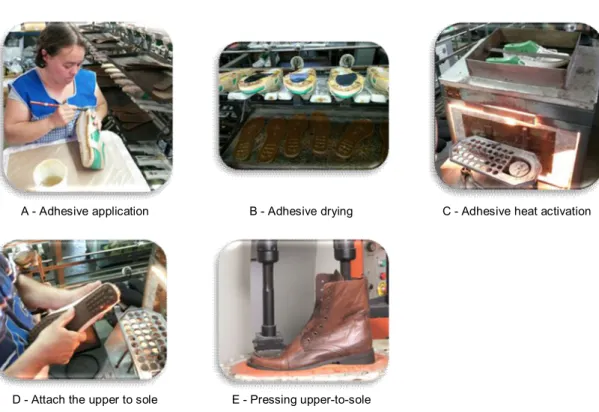
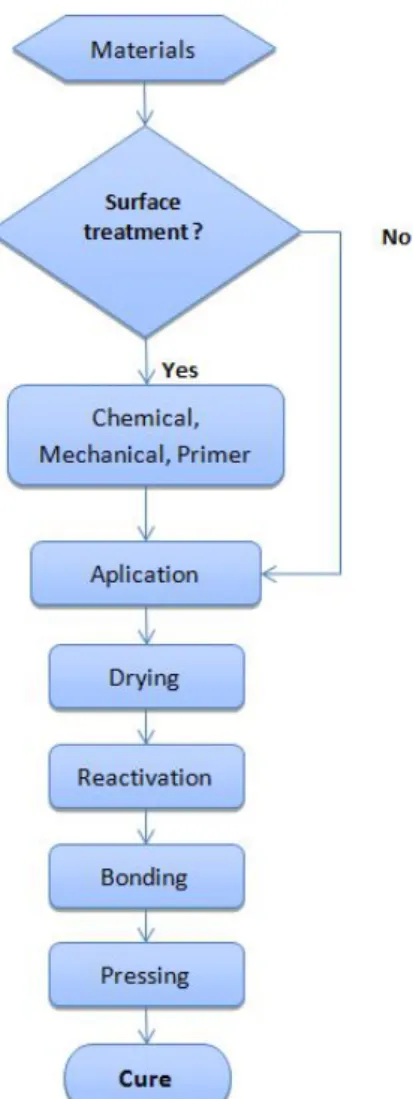
To understand the importance of the adhesive in the footwear industry, a review was carried out, describing the process steps for the shoes manufacturer, with the adhesives involved defined in Paper 1 [1-4].
verify the impact on the relevant mechanical properties for the shoe industry, in particular on the peel strength [9-12], [17]. The standard EN ISO 20344:2004, EN 1392:1998 and EN 15307:2007 was taken into account whenever possible [18].
According to the information gathered during the literature review, the most demanding adhesive joint in the manufacturing process of the shoe is the bonding of the upper to the sole [3-4].
In Paper 5 and Paper 6 the Taguchi method, Artificial Neural Networks (ANN) and Genetic Algorithms (GA) was applied to each of the studied mechanical properties (peel strength and creep rate) [15-21]. A mono-objective method was applied to obtain an optimal solution [15]. A FORTRAN programming language was used in Artificial Neural Networks (ANN) and Genetic Algorithms (GA). When considering the two properties simultaneously, peel strength and creep rate, the numerical model was developed as multi-objective, this improved model being presented in Paper 7 [16].
1.5. Outline of the thesis
This thesis consists of seven appended papers:
P A P E R 1
Paiva, R.M.M.P, Marques, A.S.E., da Silva, L.F.M., Antonio, C.A.C., Arán-Ais F., Adhesives in the footwear industry, Journal of Materials: Design
and Applications, 0(0), 1-18 (2015). DOI:10.1177/1464420715602441 A B S T R A C T
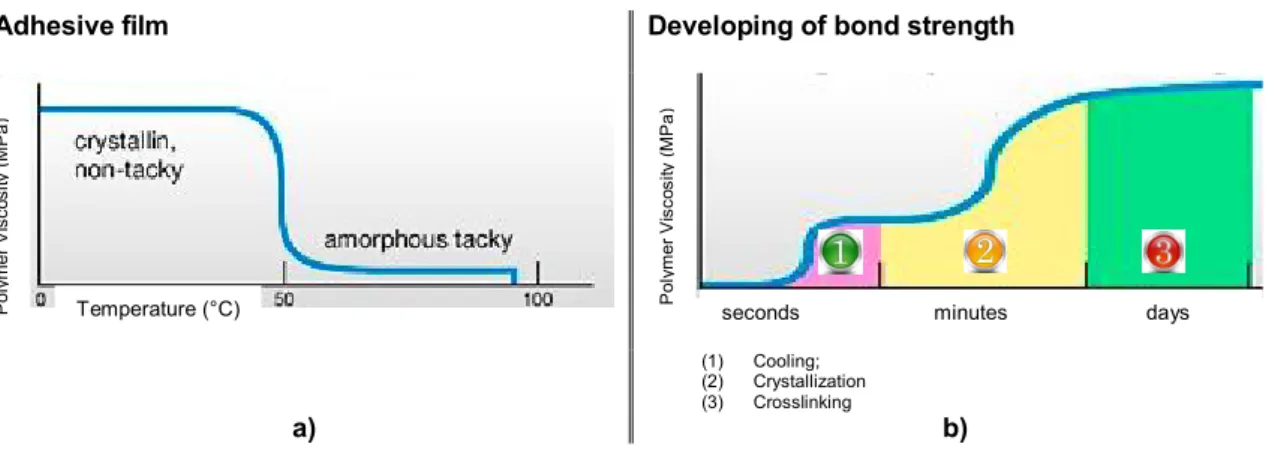
Footwear manufacturing is basically a process of transformation and assembly of various components made up of several materials where different adhesives play a key role, because without them, the shoe would lack of shape and structure. This paper aims to understand the importance of adhesives in the footwear industry. It is necessary to identify the different processes in a shoemaking where adhesives are involved and the different adhesive joints produced, as well as their technical requirements. The adhesive joint performance will depend on the different adherends nature used as footwear materials, the joint design, the surface treatments, the adhesive properties which depend on their formulation, etc.
Adhesive joints in a shoe acts under different stress types (peel, shear, tensile, etc). The most desfavourable are the peel stress. For that reason the peel strength test is one of the most common to evaluate adhesive joints performance. When heat resistance is an important adhesive requirements, a creep test is carried out. Furthermore, aging tests are undertaken in order to evaluate durability. This methodology is described in this paper.
In the literature, one can find several papers on adhesives, specifically on their mechanical properties. However, there is little research related to footwear applications, including not only the mechanical properties that this industry demands but also the composition of the adhesives.
A B S T R A C
T Therefore, this paper aims to connect the important mechanical properties
for the footwear industry with the constituents of the adhesives. However, other properties are also important, such as viscosity, wettability, compatibility, etc, depending on the materials and the adhesive joint type.
P A P E R 2
Paiva, R.M.M., Marques, E.A.S, Silva, L.F.M., Vaz, M.A.P., Importance
of the surface treatment in the peeling strength of joints for the shoes industry, Applied Adhesion Science 1(5), 1-15 (2013).
DOI:10.1186/2196-4351-1-5 A B S T R A C T
In order to contribute to the research and development of adhesives for the shoe industry, this paper aims to analyze the peel strength of an adhesive joint with various types of surface treatments. In the shoe industry, the adhesive properties are very important to ensure the quality of manufacture of the shoe, thus, to better understand the behaviour of the adhesive joint, it is important to analyze the peel resistance in order to adjust the manufacturing process. For the execution of this work, we considered the following materials: natural leather, thermoplastic rubber (TR), polyurethane (PU) and a polyurethane non structural adhesive solvent based. This paper analyzes the influences of the application of chemical and / or physical surface treatments on substrates in the peel strength of a T joint. It was found that certain surface treatments, depending on the substrate, are required to obtain an adhesive joint capable of satisfying the minimum required by the shoes sector.
P A P E R 3
Paiva, R.M.M.P, Marques, A.S.E., da Silva, L.F.M., Antonio, C.A.C.,
Surface Treatment effect in Thermoplastic Rubber and Natural Leather for the footwear industry, Materials Science and Engineering
Technology, 46(6), 632-643 (2015).
A B S T R A C T
This paper aims to analyze the peel strength of an adhesive joint with various types of surface treatments. In the shoe industry, the adhesive properties are very important to ensure the quality of manufacture of the shoe, thus, to better understand the behaviour of the adhesive joint, it is important to analyze the peel resistance in order to adjust the manufacturing process. In this work, natural leather, thermoplastic rubber (TR) and a non-structural, solvent based, polyurethane adhesive were considered. The influence of the application of chemical and / or mechanical surface treatments on substrates in the peel strength of a T joint were analysed. To characterize the surfaces, several test were considered, including Fourier Transform Infrared Spectroscopy (FTIR), Scanning Electron Microscope (SEM) and contact angle measurements. It was found that certain surface treatments are required to obtain an adhesive joint capable of satisfying the minimum strength requirements of the shoes sector.
P A P E R 4
Paiva, R.M.M.P, Marques, A.S.E., da Silva, L.F.M., Antonio, C.A.C., Effect
Of The Surface Treatment In Polyurethane And Natural Leather For The Footwear Industry, Materials Science and Engineering Technology, 46(1), 47-58 (2015).
A B S T R A C T
The aim of this paper is to analyze the peel strength of an adhesive joint with various types of surface treatments in order to contribute to the research and development of adhesives for the footwear industry. In the shoe industry, the adhesive properties are very important to ensure the quality of manufacture of the shoe. To better understand the behavior of the adhesive joint, it is important to measure the peel resistance of the adhesive and use it to adjust the manufacturing process. For this work, joints were manufactured using natural leather, polyurethane (PU) and a solvent based polyurethane non structural adhesive. The influences of the application of physical surface treatments and/or primer on substrates in the peel strength of a T joint were analyzed. Several tests were used to characterize the surfaces of the substrates, including Fourier Transform Infrared Spectroscopy (FTIR), Scanning Electron Microscope (SEM) and contact angle measurements. It was found that certain surface treatments are required to obtain an adhesive joint capable of satisfying the minimum requirements of the shoes manufacturing sector.
P A P E R 5
Paiva, R.M.M., Antonio, C.A.C., da Silva, L.F.M., Sensitivity and
optimization of peel strength based on composition of adhesives for footwear, The Journal of Adhesion, 91(10-11): 801-822 (2014).
A B S T R A C T
In order to contribute to the research and development of adhesives for the footwear industry, this paper aims to develop a model capable to predict and optimize the peel strength from the composition of adhesives. The proposed approach is based on three stages: experimental planning of measurements, global sensitivity analysis for uncertainty propagation and optimization procedure. The design variables are the weight percentages of the solid raw material constituents such as polyurethane, resins and additives of the adhesive joint.
Considering the experimental results obtained for Taguchi design points as input/output patterns, an Artificial Neural Network (ANN) is developed based on supervised evolutionary learning. Using the developed ANN a global sensitivity analysis procedure is implemented and the variability of the structural response of adhesive joint is studied. The optimal solution for adhesives composition for maximum peel strength is investigated based on ANN model and using a Genetic Algorithm. The proposed approach is able to predict the optimal peel strength including its sensitivity to uncertainties. The results show that the sensitivities of design variables belonging to polyurethane and additive groups are important for optimal adhesive joint. The optimal peel strength based on proposed approach is consistent with the experimental testing data.
P A P E R 6
Paiva, R.M.M., Antonio, C.A.C., da Silva, L.F.M., Optimal design of
adhesive composition in footwear industry based on creep rate minimization, The International Journal Advanced Manufacturing
A B S T R A C T
On the footwear industry the composition of adhesives have a high contribute for the product quality. This paper aims to develop a model capable to predict and optimize the creep rate using the composition of the adhesive joints. The proposed mixed numerical and experimental approach is based on following stages: the planned experimental measurements; the learning procedure aiming to obtain the optimal artificial neural network (ANN) configuration; and the optimal design procedure for adhesive joint composition. The design variables are the weight percentages of the solid raw material constituents of the adhesive, such as polyurethanes (PUs), resins and additives.
Considering the experimental results obtained for Taguchi design points as input/output patterns, the ANN is developed based on supervised evolutionary learning. In the last stage the optimal solution for adhesives composition considering minimum creep rate is investigated based on ANN and genetic algorithm. The optimal results for creep rate minimization based on proposed approach are reached when large quantities for PUs and for some additives are considered, and when colophony and vinyl resin aren’t considered on the formulation.
The sensitivity of the structural response of footwear adhesives to composition constituents is also studied based on Sobol indices obtained from ANN-Monte Carlo simulation procedure. The performance measured by creep rate of the adhesive joint is very sensitive to the influence of some polyurethanes and a particular sensitivity to caprolactone types with extremely high crystallization is observed. The sensitivities of the creep rate to the resins Colophony and Coumarone-Indene are also important.
P A P E R 7
Paiva, R.M.M., Antonio, C.A.C., Silva, L.F.M., Multiobjective
optimization of mechanical properties based on the composition of adhesives, International Journal of Mechanics and Materials in Design,
accepted (2015).
A B S T R A C T
A mixed numerical-experimental approach capable to predict and optimize the performance of the footwear adhesive joints, based on the weight composition of used raw materials was presented. The approach based on the optimal design of adhesive composition to achieve the targets of minimum creep rate (CR) and maximum peel strength (PS) under manufacturing. Two stages are considered in the proposed approach. In the first stage, an approximation model is built based on planned experimental measurements and artificial neural network (ANN) developments. The ANN learning procedure uses a genetic algorithm. In the second stage an optimal design procedure is developed based on multi-objective design optimization (MDO) concepts. The MDO algorithm based on dominance concepts and evolutionary search is proposed aiming to build the optimal Pareto front. The model uses the optimal ANN to evaluate the fitness functions of the optimization problem. Furthermore, a ANN-based Monte Carlo simulation procedure is implemented and the sensitivity of the creep rate and peel strength relatively to weight compositions of raw materials is determined.
The approach shown robustness to establish the trade-off between minimum creep rate properties and minimum inverse peel strength (maximum peel strength) using the weight composition of used raw materials. The optimal results for both CR and PS based on proposed approach are reached when large quantities for polyurethanes (PUs) and for some additives are considered. The performances of adhesive joints measured by CR and PS are very sensitive to the influence of some PUs and in some way are moderately sensitive to additives. The proposed MDO approach supported by experimental tests shows improved explorative properties of raw materials and can be a powerfully tool for the designers of adhesive joints in footwear industry.
2. ADHESIVES TESTED
This thesis studied one type of adhesive: Solvent based PU adhesives.
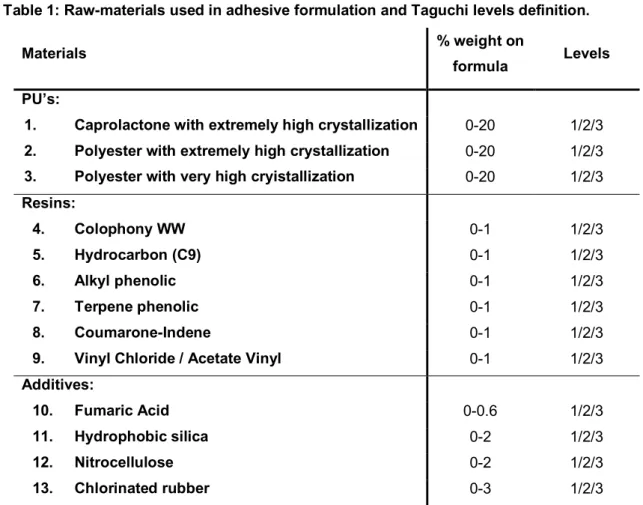
However, the formulation of this type of adhesive varies depending on the raw materials considered in Table 1, and the constraints as shown in Table 2.
Table 1: Raw-materials used in adhesive formulation and Taguchi levels definition.
Materials % weight on
formula Levels PU’s:
1. Caprolactone with extremely high crystallization 0-20 1/2/3 2. Polyester with extremely high crystallization 0-20 1/2/3 3. Polyester with very high cryistallization 0-20 1/2/3 Resins: 4. Colophony WW 0-1 1/2/3 5. Hydrocarbon (C9) 0-1 1/2/3 6. Alkyl phenolic 0-1 1/2/3 7. Terpene phenolic 0-1 1/2/3 8. Coumarone-Indene 0-1 1/2/3
9. Vinyl Chloride / Acetate Vinyl 0-1 1/2/3 Additives:
10. Fumaric Acid 0-0.6 1/2/3
11. Hydrophobic silica 0-2 1/2/3
12. Nitrocellulose 0-2 1/2/3
13. Chlorinated rubber 0-3 1/2/3
Table 2: Constraints used in adhesive joint optimization definition.
Constraints % weight on formula
Total % PU 10-20
Total % Resins 0-1
The Taguchi design points were used to plan the adhesive experiments. 27 experimental data sets were selected inside the interval domain of each design (random) variable and levels defined in Table 1. Each one of these 27 design points corresponds to an adhesive formulation.
The Taguchi values were selected according to the approach proposed by Taguchi and Konishi [15]. By the selected Taguchi table L27(313) the actual composition for each Taguchi design point is obtained, as shown in Table 3.
Table 3: Taguchi design points: % weight on formulation (design variables values). Design
point
Design variables (raw-materials)
1 2 3 4 5 6 7 8 9 10 11 12 13 1 2.5 2.5 2.5 0 0 0 0 0 0 0 0 0 0 2 2.5 2.5 2.5 0 0.2 0.2 0.2 0.2 0.2 0.3 1 1 1.5 3 2.5 2.5 2.5 0 0.5 0.5 0.5 0.5 0.5 0.6 2 2 3 4 2.5 5 5 0.2 0 0 0 0.2 0.2 0.3 2 2 3 5 2.5 5 5 0.2 0.2 0.2 0.2 0.5 0.5 0.6 0 0 0 6 2.5 5 5 0.2 0.5 0.5 0.5 0 0 0 1 1 1.5 7 2.5 10 10 0.5 0 0 0 0.5 0.5 0.6 1 1 1.5 8 2.5 10 10 0.5 0.2 0.2 0.2 0 0 0 2 2 3 9 2.5 10 10 0.5 0.5 0.5 0.5 0.2 0.2 0.3 0 0 0 10 5 2.5 5 0.5 0 0.2 0.5 0 0.2 0.6 0 1 3 11 5 2.5 5 0.5 0.2 0.5 0 0.2 0.5 0 1 2 0 12 5 2.5 5 0.5 0.5 0 0.2 0.5 0 0.3 2 0 1.5 13 5 5 10 0 0 0.2 0.5 0.2 0.5 0 2 0 1.5 14 5 5 10 0 0.2 0.5 0 0.5 0 0.3 0 1 3 15 5 5 10 0 0.5 0 0.2 0 0.2 0.6 1 2 0 16 5 10 2.5 0.2 0 0.2 0.5 0.5 0 0.3 1 2 0 17 5 10 2.5 0.2 0.2 0.5 0 0 0.2 0.6 2 0 1.5 18 5 10 2.5 0.2 0.5 0 0.2 0.2 0.5 0 0 1 3 19 10 2.5 10 0.2 0 0.5 0.2 0 0.5 0.3 0 2 1.5 20 10 2.5 10 0.2 0.2 0 0.5 0.2 0 0.6 1 0 3 21 10 2.5 10 0.2 0.5 0.2 0 0.5 0.2 0 2 1 0 22 10 5 2.5 0.5 0 0.5 0.2 0.2 0 0.6 2 1 0 23 10 5 2.5 0.5 0.2 0 0.5 0.5 0.2 0 0 2 1.5 24 10 5 2.5 0.5 0.5 0.2 0 0 0.5 0.3 1 0 3 25 10 10 5 0 0 0.5 0.2 0.5 0.2 0 1 0 3 26 10 10 5 0 0.2 0 0.5 0 0.5 0.3 2 1 0 27 10 10 5 0 0.5 0.2 0 0.2 0 0.6 1 2 1.5
The numerical model was determined considering the 27 different adhesives and the mechanical properties peel strength and creep rate, experimentally obtained.
3. EXPERIMENTAL TESTS
The most common tests used by the footwear industry are the peel strength and the creep rate. These standard properties are described on the EN 1392:1998.
3.1. Peel Strength
In this thesis, for the manufacture of the joint, smaller peel specimens were used.
The adhesive joint studied was composed of two substrates (150mm x 30mm) bonded together in an area of 100mm x 30mm, as shown in Figure 2.
Figure 2 – Test piece geometry
To guarantee the cure, 24 hours after the manufacture of the adhesive joint, the peel test was performed in the testing machine at a speed of 50 mm/min. The results are expressed as load versus displacement (N/mm).
3.2. Creep Rate
The creep rate is a property which determines the temperature resistance of the single lap joint. Creep rate is a variation of displacement per unit of time, under a constant load in a constant high temperature.
The adhesive joints, were stored in standard conditions (23 °C and 50% RH) during 72h, in order to ensure the complete cure of the adhesive [17-18].
In this thesis smaller creep specimens were considered to manufacture the adhesive joint, composed of two substrates (150mm x 30mm) bonded together in an area of 100mm x 30mm, as shown in Figure 2.
Figure 3. Test piece geometry and adhesive joint for creep test.
The creep test was performed in the heat activator at 60 °C. The specimen was loaded with the specified constant weight (1,5 kg).
The cabinet of the heat activator was opened periodically and the separations (in mm) of the bonds substrates were marked while still loaded. The time (in min) to complete separation [21] is recorded. A “creep failure envelope” was obtained with the creep experiments that can be divided into three phases: primary, secondary and tertiary. The primary phase corresponds to an instantaneous elastic strain, the secondary phase corresponds to a constant
creep rate and the tertiary phase happens with the failure of the specimen [4, 17-18].
In calculating the mean of the separation lengths of the bond the primary and the tertiary phases were ignored [4]. The results are expressed as displacement (millimetres, mm) versus time (minutes, min).
This test was used in Papers 6 and 7.
4. NUMERICAL MODELING
The first column of the proposed optimization strategy is the definition and construction of the physical model representing the adhesive joint of footwear product and the relationship between the design variables – the weight composition of raw materials, and the inherent structural response measured by creep rate and peel strength. The proposed approach for this first column is based on planned experimental measurements and using these testing results to develop the approximation model. First of all, the set of experiments are planned using the Taguchi method aiming to obtain a good coverage of the design space for the composition of the adhesive joint. Secondly, considering the experimental results obtained for Taguchi design points as input/output patterns, an Artificial Neural Network (ANN) is developed based on supervised evolutionary learning [21-23]. This ANN learning procedure is equivalent to solve an optimization problem where the difference between the experimental results and the ones obtained from the ANN is minimized controlling the ANN parameters.
At the end of each ANN optimal configurations search, three ANN-based Monte Carlo simulation procedures are implemented aiming to study the sensitivity of the structural response of adhesive joint relatively to input parameters/design variables. In particular the Sobol indices for global sensitivity analysis are used to establish the relative importance of the input parameters/design variables on the structural response measures [23-24]
4.1. Artificial Neuronal Network (ANN)
The Artificial Neural Network (ANN) is a nonlinear dynamic modeling system inspired by our understanding and abstraction on the biological structure of the human brain. Its architecture and operating procedures are based on a large number of highly interconnected processing units denoted by neurons and the linkages are similar to the brain synapses as in biological sense. The operating procedures include attributes such as learning, thinking, memorizing, remembering, rationalizing and problem solving [24].
In the ANN developments a weight value is associated with each synaptic connection between processing units that is defined as the connection importance. The weight value acts as a multiplicative filter together with the activation procedure performed by an appropriated function. The ANN architecture is formed by several layers of neurons and different matrices with synaptic weights can be identified as linkage elements between layers.
Learning of ANN occurs while modification of connection weight matrix is undertaken at the learning process. From examples of a phenomenon with particular behavior and following an appropriate learning rule the ANN acquires knowledge or relationship embedded in the input/output data. The ANNs are robust models having properties of universal approximation, parallel distributed processing, learning, adaptive behaviour and can be applied to multivariate systems [24, 21].
In this work three ANN numerical models are formulated from mathematical point of view. The three implementations are based on FORTRAN programming language followed by testing and validation as well. All ANN models consider the weight composition of raw materials of the adhesive joint, such as PU’s, resins and additives as input parameters/design variables. However, the three ANN models have different output parameters/ response variables that imply diverse topological structures. The first ANN model has the peel strength as
output variable, the second has the creep rate as output variable and the third has both creep rate and peel strength as output response variable.
All the proposed ANN models are organized into three layers of nodes (neurons): input, hidden and output layers. The synapses between input and hidden nodes and between hidden and output nodes are associated with weighted connections that establish the relationship between input data and output data. Deviations on neurons belonging to hidden and output layers are also considered in the proposed ANN models.
In the developed ANN models, the input data vector is defined by a set of experimental values for design/input variables, which are the weight composition of raw materials of the adhesive joint, such as PU’s, resins and additives as referred. The procedures to build the ANN approximation models begin defining the set of planned experiments based on Taguchi method. Then, the experimental input/output patterns are used in learning procedures aiming to obtain the optimal ANN configurations [21, 24].
The ANN learning procedure is equivalent to solve an optimization problem based on minimization of the differences between the experimental results and the simulation values obtained from the ANN. In this optimization process the weights of synapses and the biases in neurons are used as design variables. So, detailing the process the optimal configuration of ANN is obtained minimizing the error between the simulated network outputs and the experimental data for creep rate (CR) or / and the peel strength (PS). The minimization of ANN learning procedure is performed using single Genetic Algorithms with appropriated genetic parameters.
4.2. Sensitivity Analysis (SA)
The study of the influence of the weight composition of raw materials on the structural response of adhesive joint is performed based on the Global Sensitivity Analysis (GSA) supported by variance-based methods [20, 22-26].
structural response of the adhesive joint. On other words, the objective is to measure and to rank the importance of the variability of design variables - the weight percentages of PUs, resins and additives in the adhesive composition, on the structural response of adhesive joint measured by creep rate, CR and the peel strength, PS.
Lets consider j the response functional, denoting the creep rate or the peel strength. Assuming that the variables are independent, the variance of the conditional expectation var
Ej|xi
is used as an indicator of the importance of the design variable xi on the variance of j. This indicator is directly proportional to the importance of xi. In particular, the first-order global sensitivity index of Sobol [18-19, 29-31] is used in normalized format.In this work, the first-order global sensitivity index of Sobol is calculated using the Monte Carlo simulations method together Artificial Neural Network (ANN). So, the GSA is implemented using the optimal network configuration obtained at the end of each ANN learning procedure. Thus, is possible to avoid the exhaustive and costly experimental tests to obtain the variability of the input variables structural on response. The methodology to obtain the first-order global sensitivity index of Sobol is based on the algorithm proposed by António and Hofbauer [20, 23].
5. OPTIMIZATION FRAMEWORK
In this thesis the optimization problem was treated using the concept of the three pillars ("three-columns-concept") integrated into the optimization process and defined as follows:
First column: The physical model of the structure or phenomena; Second column: The optimization algorithm;
Third column: The optimization model.
The physical model of the structure or phenomena is a physical model of the problem, which is the mathematical representation of the physical behavior of the structure/phenomena. To make such characterization, the state variables were identified, obtaining the objective functions and constraints, allowing the creation of the representative model, for that were used as procedure the Artificial Neural Networks (ANN). Here, the first column of the proposed optimization strategy is the definition and construction of the physical model representing the adhesive joint of footwear product and the relationship between the design variables – the weight composition of raw materials, and the inherent structural response measured by creep rate and peel strength. The proposed approach for this first column is based on planned experimental measurements and using these testing results to develop the ANN approximation model.
The optimization algorithm operates as a search facility to obtain the optimal solution. There are several methods for this optimization. In this study the global optimal search technique and the method of evolutionary research were considered. This last technique made use of a Genetic Algorithm (GA), based on the law of survival of the species ("Darwin's theory").
The optimization model is the operational bridge between the physical model and the optimization algorithm. Here it is defined the architecture of optimization model connecting the different modulus collecting data necessary for optimization algorithm which comes from the optimization problem formulation. So, it allows determining the values of the objective functions and constraints from the state variables. For this purpose, any strategy of decomposition or the application of dominance concepts in multi-objective optimization for example, are defined this third column.
Generally it can be said that the structure of the model that follows the concept of the three pillars to optimize a problem started by determining the parameters that vary during the optimization process, followed by the creation of an optimal
and the design variables, ending up with the model validation that determined the values of the objective function and constraints from the state variables. The single-objective or the multi-objective optimization techniques are applied aiming to determine an optimal adhesive formulation, improving in these ways the efficiency of the adhesive joints manufactured in the footwear industry.
5.1. Single-Objective Optimization
In the first single-objective design optimization procedure the optimal solution for adhesives composition for maximum peel strength is searched. The structural response of adhesive joint is measured by peel strength PS, calculated using the optimal ANN configuration. The design variables is denoted by vector x, which components are the weight percentages of PUs, resins and additives in the adhesive composition. The mathematical formulation of the optimization problem of adhesive joint is defined as peel strength maximization subject to technological constraints as follows,
x x) , over PS( Maximize , (1) subject to: 20 10 1
n k k x (2) 1 1
r k k n x (3) 7 1
a k k r x (4) a r n , , k , x x xlk k uk 1 (5)where n, r and a are the number of materials of each group of PUs, resins and additives considered for the adhesive joint, respectively. Those numbers will be defined in design process. The constants x and lk x are the lower and upper ku
bounds of design variable xk, respectively.
The proposed optimization algorithm is based on two stages using two different populations evolving by a Genetic Algorithm (GA). In the first stage using the Taguchi design points the ANN-based on GA is developed. In this stage the GSA is implemented using the optimal configuration of ANN. During the second stage the peel strength, PS is maximized under the constraints of the optimization problem The fitness evaluation is based on optimal configuration of the ANN obtained at the first stage. The model is described in Paper 5.
In Paper 5, a Taguchi-ANN-GA approach predicting the sensitivity of the peel strength as function of the composition of formulation used in adhesive joints was presented. The results show the robustness of the model to measure the influence of the raw material constituents on peel strength, which plays an important role on the optimal design of the adhesive joints.
The numerical results presented in Paper 5 show that the sensitivities of the design variables belonging to polyurethane and additives groups are important for optimal design of the adhesive joint. The optimal results obtained for peel strength based on proposed approach is consistent with the experimental testing data used to implement the model. The proposed two-stage ANN-GA optimization approach supported by experimental tests shows improved explorative properties of design space and can be a powerfully tool for the designers of adhesive joints in footwear industry. It can be concluded that the sensitivities of the design variables belonging to the resins’ group are not important for the optimization process. On contrary, the sensitivities of the other groups are important.
In second single-objective optimization model described in Paper 6, the structural response of footwear adhesive joint is measured by creep rate (CR), which represents the objective function of the problem to be minimized.
Therefore, it is intended to develop a model capable to predict and minimize the creep rate depending on the raw materials used in the composition of the adhesive joint. These design variables are the weight percentages of PUs, resins and additives in the adhesive composition. The mathematical formulation of the optimization problem of adhesive joint is defined as creep rate constrained minimization as follows,
x x) , over (
Minimize CR , (6) subject to technological and size constraints defined from Equation (2) to Equation (5).
The proposed approach is based on mixed experimental-numerical procedures. The experimental data obtained in previous described procedure is fundamental to perform the optimization search. Two stages are identified in numerical part of the proposed approach. These two stages are: 1) the learning procedure aiming to obtain the optimal ANN configuration, which supports the relationship between raw materials and creep rate; and 2) the optimal design procedure based on the search for optimal adhesive joint composition. In these two stages of numerical part of the proposed approach two optimization sub-problems are solved using independent evolutionary searches such as Genetic Algorithms (GA).
The optimal results obtained for creep rate minimization based on proposed approach is consistent with the experimental testing data used to implement the model. Indeed, the creep rate is minimized when large quantities for PUs and for some additives are considered, and when colophony and vinyl resin aren’t considered on the formulation.
The performance measured by creep rate of the adhesive joint is very sensitive to the influence of some polyurethanes and a particular sensitivity to caprolactone type with extremely high crystallization is observed. The sensitivities of the creep rate to the resins Colophony and Coumarone-Indene are also important as shown in Paper 6. Although the contribution of the additives is related with the improvement of mechanical behavior of PUs and
resins, their influence on creep rate is shown through the sensitivity of Fumaric Acid. On contrary, the influence of Chlorinated rubber is not explained directly attempting to low creep rate sensitivity relatively to this material.
5.2. Multi-Objective Optimization
The multi-objective design optimization (MDO) is based on constrained minimization of objective functions. However, in the proposed approach the performance of structural response of the footwear adhesive joints is measured by creep rate (CR) and the peel strength (PS). Furthermore, the optimal design of adhesive joint is performed based on minimization of creep rate and maximization of peel strength. So, this design procedure must be formatted according the constrained minimization formulation. The minimization of inverse of peel strength (1/PS) is adopted as second objective function to overcome this apparent difficulty.
Therefore, it is intended to develop a model capable to predict and simultaneously minimize the creep rate and the inverse of peel strength depending on the weight percentage of raw materials used in the composition of the adhesive joint. These design variables denoted by vector x with components xk, are the weight percentages of PUs, resins and additives in the adhesive composition. The mathematical formulation of the bi-objective optimization problem of adhesive joint is defined as creep rate and inverse of peel strength minimizations subject to technological constraints as follows,
(x), (x)
, over x Minimize f1 f2 (7) with f1(x)CR(x) and ) ( 1 ) ( 2 x PS x f A MDO problem, when considering conflicting objectives, in general, cannot find an optimal solution for all purposes. So a decrease of an objective function involves increasing the other. Thus, the evaluation of possible solutions passes through the concept of Pareto Dominance.
In this work, the MDO process evolution is based on a short population of solutions updated during the evolutionary search driven by the genetic algorithm. An elitist strategy is adopted at evolution of short population. Each solution in short population is ranked according its fitness value, which is related with the objective functions and the constraints of the problem. The trade-off between minimum creep rate and minimum inverse peel strength, depending on given size and technological constraints imposed on the weight composition of raw materials used in adhesive joint, is searched.
It can be established that designs with good fitness and satisfying the constraints have priority in the rank process. Although this is necessary for bi-objective optimization problem it is not essential to build the optimal Pareto front. Indeed, the Pareto front depends on the dominance concept, which is applied at enlarged population. Here, the short population is used as a nest where the good solutions are generated through the genetic algorithm based on an elitist strategy. At each generation the best solutions of short population are stored into an enlarged population based on dominance concepts. The global Pareto-optimal front is built at this enlarged population using the concept of Pareto dominance [27].
Paper 7 describes the proposed approach to solve MDO problem. At the end of
the optimization process, the Pareto front representing the frontier of the trade-off between the minimum creep rate and minimum inverse peel strength (maximum peel strength) for footwear adhesive joints is obtained. The global dominance measured in enlarged population at end of optimal design procedure is used to trace the associated Pareto front. The performance of the proposed approach to search for Pareto front’s solutions considering the MDO problem can be observed.
6. CONCLUSIONS
The objective of this research was to develop a model capable to predict mechanical properties (peel strength and creep rate) based on the formulation of the adhesives. Paper 1 shows that adhesives have an important impact in the show industry.
To define the best surface treatment in same materials, it was concluded in
Paper 2 and Paper 3 that to maximize the peel strength of the leather/TR joints
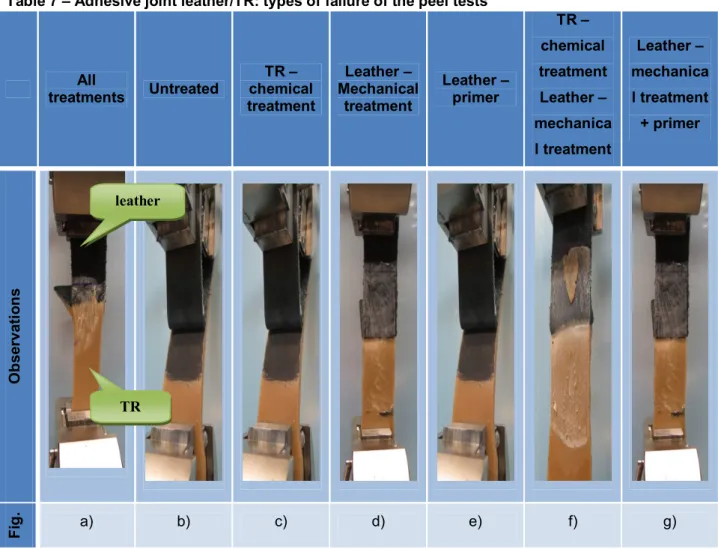
it is necessary to apply chemical treatment on TR and mechanical treatment and primer on leather. However, if it wasn’t applied primer, it was possible to minimize the number of operations in the manufacture of shoes, while still being capable of satisfying the minimum requirements for the sector.
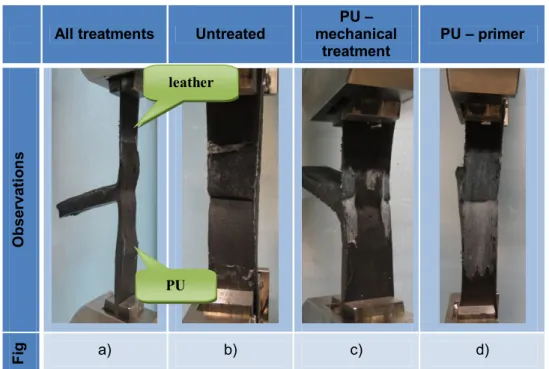
With Paper 2 and Paper 4 it was concluded that to maximize the peel strength of the leather/PU joints it is necessary to apply mechanical treatment and primer on PU and on leather. However, if it wasn’t applied primer on both materials, it was possible to minimize the number of operations in the manufacture of shoes, while still being capable of satisfying the minimum requirements for the sector. Several adhesive formulations based on PU’s, resins and additives were tested taking into consideration the Taguchi method allowing to obtain experimentally the mechanical properties.
Applying GA as optimization methods, mono-objective and multi-objective models were obtained.
In conclusion it was possible to obtain good results with this thesis, since the developed models exhibit low errors, less than 4%. Furthermore, it is clear that with this work the optimal creep rate and peel strength based on proposed approach is consistent with the experimental testing data.
In Paper 5, the Taguchi-ANN-GA approach predicts the sensitivity of the peel strength as function of the composition of adhesive formulation show the robustness of the model, which plays an important role on the optimal design of the adhesive joints.
The numerical results developed on Paper 5 show that the sensitivities of the design variables belongs to PU’s and additives groups.
In Paper 6 the set of experiments, defined by the Taguchi method, allow to obtain a good representation of the physical phenomenon. And the optimal results for the creep rate minimization based on proposed approach are reached when large quantities for Pus, Coumarone-Indene and for some additives are considered, and when colophony isn’t considered on the formulation.
The optimal design of adhesive composition to achieve the targets of minimum creep rate and minimum inverse peel strength (maximum peel strength) under manufacturing constraints is obtained on Paper 7. The numerical results developed on show that the performances of adhesive joints measured by creep rate and peel strength are very sensitive to the influence of some PUs and in some way are moderately sensitive to additives.
The optimal results corresponding to the two best trade-off solutions of the constrained bi-objective optimization problem solved using the proposed approach is consistent with the experimental testing data used to implement the model. Indeed, the creep rate and the inverse of peel strength are minimized when large quantities for PUs and for some quantities of additives are considered. In this case the resins` group is not important except the weight percentage of Vinyl. The best trade-off Pareto front solution corresponding to numerical values CR=0.011198 [mm/min], PS=7.985 [N/mm] is used for experimental validation. The values of the considered best trade-off solution are consistent with the experimental validation results as shown in Paper 7.
7. FUTURE WORK
This thesis proposed a numerical model capable to predict mechanical properties, the creep rate and the peel strength, with the best formulation of an adhesive obtained.
The next step should be to use different materials for the adherend materials used in soles and uppers.
The application of this model using water based adhesives would be an interesting future improvement, taking into account the legal industry obligations.
Create a tool that allows the prediction of the joint's mechanical properties, peel strength and creep rate, using only as input the adhesive formulation and composition.
REFERENCES
[1] Wake, W.C., Adhesion and the formulation of adhesives, Applied
Science Publishers Limited, London (1976).
[2] Sultan Nasar, A., Srinivasan, G., Mohan, R. and Radhakrishnan, G.,
Polyurethane Solvent-Based Adhesives for Footwear Applications, The
Journal of Adhesion 68(1-2), 21-29 (1998).
[3] O. Mayan, A. Pires, P. Neves, Shoe Manufacturing and Solvent Exposure
in Northern Portugal, J. Occupational Environm. Hyg., 14(11), 785–790
[4] L.F.M. Silva, A. Öchsner, R.D. Adams, Handbook of Adhesion
Technology, Springer, Heidelberg (2011).
[5] A. Pizzi, K.L. Mittal, Handbook of Adhesives Technology, Marcel Dekker,
Inc. (2003).
[6] Skeist, I., Handbook of Adhesives, 2ª edition, Van Nostrand Reinhold
Company, USA (1976).
[7] Siri, B., Hand Book of Adhesives – The technology of Adhesives, Small
Industry Research Institute (1984).
[8] R.F. Wegman, Surface Preparation Techniques for Adhesives bonding,
Noyes Publications (1989).
[9] M.M. Pastor-Blas, J.M.M. Martínez , F.J. Boerio, Influence of Chlorinating
Solution Concentration on the Interactions Produced Between Chlorinated Thermoplastic Rubber and Polyurethane Adhesive at the Interface, The
Journal of Adhesion, 78(1): 39-77 (2002).
[10] C.M.C. Jiménez, M.M.P. Blas, J.M.M. Martínez, P. Gottschalk, Treatment
of thermoplastic rubber with chlorine bleach as an alternative halogenation treatment in the footwear industry, The Journal of Adhesion,
79(3): 207-237, (2003).
[11] M.D.R. Sánchez, M.M.P. Blas, J.M.M. Martínez, Improved peel strength
in vulcanized SBR rubber roughened before chlorination with trichloroisocyanuric acid, The Journal of Adhesion, 78(1):15-38 (2002).
[12] C.M. Cepeda-Jiménez, M.M. Pastor-Blas, T.P. Ferrándiz-Goméz, J.M.M. Martínez, J.G. Dillard, Influence of the styrene content of thermoplastic
styrene-butadiene rubbers in the effectiveness of the treatment with sulfuric acid, International Journal of Adhesion & Adhesives, 21(2):161-172
[13] M.S. Sánchez-Adsuar, M.M. Pastor-Blas, J.M. Martín-Martínez, Properties
of Polyurethane Elastomers with Different Hard/Soft Segment Ratio, J.
Adhesion, 67: 327-345 (1998).
[14] Houwink, R., Salomon, G., Adhesion and Adhesives – Applications, 2ª edition, 2º volume, Elsevier Publishing Company, London (1967).
[15] António, C.A., A hierarchical genetic algorithm for reliability based
design of geometrically non-linear composite structures, Composite
Structures, 54: 37-47 (2001).
[16] António, C.A., A multilevel genetic algorithm for optimization of
geometrically nonlinear stiffened composite structures, Structural and
Multidisciplinary Optimization, 24: 372-386 (2002).
[17] EN 1392:1998, Adhesives for leather and footwear materials –
Solvent-based and dispersion adhesives – Test methods for measuring the bonds under specified conditions (1998).
[18] ISO 20344:2004, Personal protective equipment – Test methods for
footwear (2004).
[19] Taguchi, G., Konishi, S., Taguchi Methods - Orthogonal Arrays and
Linear Graphs, American Supplier Institute Inc., USA (1987).
[20] António, C.A.C. and Hoffbauer, L.N., From local to global importance
measures of uncertainty propagation in composite structures, Composite
Structures, 85: 213-225 (2008).
[21] Cheng, J., Li, Q.-S., Xiao, R.-C., A new artificial neural network-based
response surface method for structural reliability analysis, Probabilistic
Engineering Mechanics 23, 51-63, 2008.
[22] António, C.A.C. and Hoffbauer, L.N., Uncertainty propagation in inverse
reliability-based design of composite structures, International Journal of
[23] António, C.A.C. and Hoffbauer, L.N., Uncertainty assessment approach
for composite structures based on global sensitivity indices. Composite
Structures 99, 202-212, 2013.
[24] Gupta, M.M., Jin, L. and Homma, N., Static and Dynamic Neural
Networks, John Wiley & Sons. Inc., Hoboken, New Jersey, USA (2003).
[25] Borgonovo, E., Apostolakis, G.E., Tarantola, S., Saltelli, A., Comparison of
global sensitivity analysis techniques and importance measures in PSA,
Reliability Engineering Systems & Safety 79, 175–85, 2003.
[26] Saltelli, A., Ratto, M., Tarantola, S. and Campolongo, F., Sensitivity
analysis practices: strategies for model-based inference, Reliability
Engineering Systems & Safety 91, 1109-1125, 2006.
[27] António, C.A.C., Local and global Pareto dominance applied to optimal
design and material selection of composite structures, Structural and
PAPER 1
A
DHESIVES IN THE
F
OOTWEAR
I
NDUSTRY
Rosa M.M. Paiva1*, Eduardo A.S. Marques2, Lucas F.M. da Silva3, Carlos A.C. António3, Francisca Arán-Ais4
1 CIPADE – Indústria e Investigação de Produtos Adesivos, S.A., Avenida 1º de Maio, 518,
3701-909 São João da Madeira, Portugal
2 INEGI (Instituto de Ciência e Inovação em Engenharia Mecânica e Engenharia Industrial) ,
Rua Dr. Roberto Frias, 4200-465 Porto, Portugal
3 Departamento de Engenharia Mecânica, Faculdade de Engenharia, Universidade do Porto,
Rua Dr. Roberto Frias, 4200-465 Porto, Portugal
4 INESCOP, Spanish Footwear Technology Institute, Polígono Industrial Campo Alto. C/
Alemania, 102. 03600 Elda (Alicante), Spain
Abstract
Footwear manufacturing is basically a process of transformation and assembly of various components made up of several materials where different adhesives play a key role, because without them, the shoe would lack of shape and structure. This paper aims to understand the importance of adhesives in the footwear industry. It is necessary to identify the different processes in a shoemaking where adhesives are involved and the different adhesive joints produced, as well as their technical requirements. The adhesive joint performance will depend on the different adherends nature used as footwear materials, the joint design, the surface treatments, the adhesive properties which depend on their formulation, etc.
Adhesive joints in a shoe acts under different stress types (peel, shear, tensile, etc). The most desfavourable are the peel stress. For that reason the peel strength test is one of the most common to evaluate adhesive joints performance. When heat resistance is an important
adhesive requirements, a creep test is carried out. Furthermore, aging tests are undertaken in order to evaluate durability. This methodology is described in this paper.
In the literature, one can find several papers on adhesives, specifically on their mechanical properties. However, there is little research related to footwear applications, including not only the mechanical properties that this industry demands but also the composition of the adhesives.
Therefore, this paper aims to connect the important mechanical properties for the footwear industry with the constituents of the adhesives. However, other properties are also important, such as viscosity, wettability, compatibility, etc, depending on the materials and the adhesive joint type.
Key-words
Footwear, adhesives, raw materials, surface treatments, single lap joint, mechanical properties, contact adhesives.
1. INTRODUCTION
Nowadays, the footwear industry has a close association to the adhesives industry, using bonding techniques to join the variety of materials employed in the manufacture of shoes [1-2]. To better understand the importance of adhesives in the footwear industry in respect to the manufacture process of the shoe, it is very important to consider the operations that make up the process and the selection of the materials [1-2]. In the shoes manufacturing industry there are several operations that use manual processing steps [1-2]. The shoes manufacture is divided in eight main operating processes: storaging, modeling, cutting, sewing, lasting, assembling, finishing and packaging [1].
A wide range of materials is used in shoe manufacturing, including natural and synthetic leather, plastics materials, rubber and synthetic fibres, and adhesives [2]. The adhesives used in this industry are varied and their producers are always developing new products, following closely the market demands mainly due to the introduction of new materials according to fashion trends [1]. During the course of this work the importance of adhesives in the shoe industry will be analysed and the properties and performance of different types of adhesives explained.