153
Variation in the use of space through time at Abrigo de la Quebrada (Chelva,
Valencia): the case of Middle Paleolithic levels IV and VII
Aleix Eixea1
Valentín Villaverde1
João Zilhão2
Mercè Bergadà3
Alfred Sanchis4
Juan Vicente Morales1
Cristina Real1
José Ángel Martínez1
1 Departament de Prehistòria i Arqueologia, Universitat de València.
2 ICREA - Departament de Prehistòria, Història Antiga i Arqueologia. Universitat de
Barcelona.
3 Departament de Prehistòria, Història Antiga i Arqueologia. Universitat de Barcelona 4 Museu de Prehistòria de València. Servei d’Investigació Prehistòrica (SIP). Diputació de
València.
Abstract
This paper compares levels IV and VII of Abrigo de la Quebrada (Chelva, Valencia). Firstly, the levels are described. Then, by means of the analysis of the distribution of elements related to lithic reduction methods, faunal remains, and combustion features, similarities and differences in the management of space are discussed. Level IV is a cumulative palimpsest where find densities are high and discriminating between successive episodes of occupation is fraught with serious difficulties. In level VII, carnivore bones and carnivore marks on herbivore remains suggest periodic human abandonment of the site, lithic and bone remains are less abundant, and they are for the most part associated with combustion remains located in the middle of a stratigraphic unit that is significantly thicker. Ongoing taphonomic and geoarcheological work aims at elucidating the role played in the explanation of these differences by changing patterns of sediment accumulation versus changing patterns of human and carnivore use of the site.
Keywords
: Microspace, Diachrony, Middle Paleolithic, Valencian Country, Iberian Peninsula.154
1. Introduction
The Abrigo de la Quebrada is located near Chelva (Los Serranos, Valencia), 65 km NW of the city of Valencia (Fig. 1).
Figure 1. Geographical location of the site.
The site is located on the left side of the Rambla de Ahillas canyon and corresponds to a sheltered, quite even horizontal platform 38 m long and 2 to 9 m wide that slopes slightly from North to South. Given its position (NW-facing, and at the bottom of a narrow, steep gorge), direct exposure to sunlight is limited. The Rambla de Ahillas opens onto a wide plain known as Plano de Arquela, which, combined with the characteristics of the canyon—which terminates in a dead end, forming a sort of natural trap—clearly hint at the reasons underpinning human use of the shelter.
The extant stratigraphy of the Abrigo de la Quebrada consists of eight units spanning a thickness of about 4 m. The base of the sequence has not yet been reached. Level I, at the top, is disturbed as a result of the use of the shelter for penning. Human occupation is recorded in levels II to V, VII, and VIII, all of which contain Middle Paleolithic stone tool assemblages. Anthropogenic inputs are especially significant in units III, IV and V. The pattern of occupation reflected in the lithic and faunal remains found in levels VII and VIII is distinct (Eixea et al.,
155 2011-2012). In this paper, we elaborate on this distinction through a comparison between levels IV and VII.
2. Methodology
The reliability of spatial analysis at Abrigo de la Quebrada is warranted by the high density of finds, the high percentage of ones that were three-dimensionally plotted, and the good control over the provenience of those that were not.
The excavation was carried out in one square meter grid units. As a rule, lithics longer than 2 cm and bone fragments longer than 3 cm were three-dimensionally plotted using a total station. However, some smaller, yet identifiable finds (flake fragments, broken retouched pieces, epiphysis, tooth fragments, microfauna, etc.) were also positioned during the excavation. In order to achieve greater control over the spatial scatter of non-plotted and sieve finds, each square meter was subdivided into sixteen 25x25 cm subunits (Fig. 2.)
156 The deposits were excavated in 5 cm artificial spits; when necessary, their thickness was adjusted to account for and respect natural stratigraphic boundaries. Sediments from each 1/16 m² subunit of the grid were sieved separately; the corresponding finds, mostly lithic and bone splinters, were also stored separately in order to be counted and added to the site database in the laboratory. Due to the lack of water at the site, dry rather than wet sieving, with a double mesh of 4 and 2 mm, was used. In order to measure the features, both their perimeter and top and bottom elevations were recorded. With the data gathered from the excavation, we generated a GIS system with x-y-z data for both finds and features (stones, hearths, large areas of stained sediment).
The find scatters were represented as density maps, the readability of which, when density is high, is better than that of scatterplots. Density maps are generated from point data by defining a search radius for each output raster cell. The radius determines point search distance or the output values around the points. Density can be calculated by simple functions or by Kernel functions. Here, we used Kernel functions because they yield a smoother output. Using a web of frequencies, finds that were not plotted during excavation (splinters, small fragments, etc.) could also be three-dimensionally positioned, making it possible to include in distribution maps all of the excavation finds. We also produced frequency maps, generated by counting finds per both square meter units and 1/16 m² subunits.
During excavation, each exposed decapage surface was recorded via orthophotographically corrected digital panoramic photography, whereby all the features can be seen at the same scale, free of error and deformations. The first step is the production of a panoramic image of the excavated surface from a series of photographs taken from a particular point of the site. Once corrected by means of georeferencing, such images can then be edited to add elements recorded by drawing (e.g., the outlines of stones, burrows, hearths or ash stains).
The size of excavated areas in each level is different, which must be borne in mind in the comparisons, as this factor limits their reach. The data for level IV come from the 21 m2
excavated in the 2009 field season, while the data obtained for level VII come from the 8 m2
excavated in 2011 and 2012; where level IV is concerned, the analyzed area represents over 40% of the total surface of the shelter, while a much smaller percentage is involved in the level VII analyses. Moreover, (a) the data for level IV correspond to only a part (albeit a substantial one) of the total sedimentary unit (the spit in direct contact with underlying level V, whose analysis is still pending, has not been considered), while the data for level VII come from the total thickness of the deposit (although, for the faunal remains, only 4 m2, or half of the area
157 m3 of excavated sediment, and those from level VII from 1.92 m3. Despite these limitations, the
data suffice to establish the existence of distinct site occupation patterns.
3. Stratigraphy and Dating
Level IV is 13-18 cm-thick and made up of a clayish lime matrix containing medium and fine brown sand (7.5YR 5/3) and 1-4 cm limestone pebbles of sub-angular morphology whose size tends to increase toward the top. The boundary with overlying level III is diffuse. Quartz, feldspar and calcite are the main minerals. The microstructure is generally massive, but cavitary and granular in places. Anthropic components are important, as manifested in the extensive combustion features. Regarding post-depositional processes, CaCO3 deposits of micritic type
and coating of bone remains are significant; the latter provokes fragmentation. Biological activity causes porosity, microstructure modification and the incorporation of fecal pellets. Finally, there are carbonate accumulations around detritus material, especially in combustion areas. The accumulation of sediments results from the low intensity action of rain water combined with minor cryoclastic processes, the latter having become more intense towards the upper part of the level. After the period of human occupation, carbonated water percolation suffused the base and formed a carbonated crust in some sections, indicating a rapid crystallization process. The biological activity indicates stability and a slow sedimentation rate (Eixea et al., 2011-2012).
The abundance of combustion features documented in this level—ten in situ hearths with different degrees of preservation—bears witness to the importance of the human occupation. Hearths are small, simple and shallow, with round or elongated shapes. They present no previous preparation of the space; their perimeter is not marked by blocks, and they are just a few centimeters deep, with no prior excavation of a cuvette. Several large black, ashy and orangey stains, which result from the burning of the sediment and the dispersing of the ash, have also been identified. The hearth-induced rubefaction shows that the poor preservation of charcoal and ash is caused by post-depositional alteration processes relating to a repetitive use of the site and/or a low sedimentation rate, both of which foster a prolonged exposition of combustion features to weathering and trampling agents.
Level V is 13-20 cm-thick. Its lower boundary is erosive but the lower boundary is diffuse. It features a dark (7,5 YR 5/2) sandy silt matrix and contains subangular limestone clasts 1-5 cm-long, increasing in abundance towards the base. Anthropogenic inputs are significant.
158 Level VI is subdivided in two. Sublevel VIa consists of angular limestone blocks in a sandy matrix (7,5 YR 6/4) and is 10-18 cm-thick across most of the excavated area, reaching 70 cm in the J-3 profile, where it coarsens upwardly. Sublevel VIb is 90-100 cm-thick on average and consists of sands (7,5 YR 6/6) that, towards the base, present laminations of finer material and, upward, contain scattered cobbles and CaCO3 nodules. Its geometry is tabular.
Level VII is 25-80 cm-thick. It mostly consists of autochthonous detrtitical material. The upper part includes roof-fall blocks as well as cobbles and small slabs with slight traces of carbonatation. The matrix is a reddish (7.5 YR 6/4) sandy clay. It features a wedge-like geometry. Half-way through its thickness, a few hearths have been documented in the eastern third of the excavated surface.
For level IV, we have an AMS date obtained on a sample of Pinus pinaster charcoal recovered within a combustion feature excavated in spit 7. The sample was ABA-pretreated and yielded an age of 43,930±750 BP (Beta-244002). Another date from the same level obtained on an ABOx- pretreated sample of Pinus nigra yielded an age >50.8 ka BP (OxA-24855). Level VII remains undated.
4. Assemblage Composition
A quick comparison of the two levels of concern here shows significant differences in their respective occupation patterns. The density index for the lithics, very high in level IV (28.3), is of only 0.43 in level VII. The same applies to the bone remains, whose density index is 239.1 in level IV and only 20.1 in level VII. This latter difference is drastically reduced, however, if we consider the density index for identifiable bone, which is 2.8 in level IV and 1.2 in level VII. This is significant because it shows that fragmentation processes are less intense in level VII. Explanations for this can be sought in a pattern of less intensive occupation of the site in level VII, where the anthropic component would represent shorter occupations, or in that the contribution of carnivores to the faunal assemblage represents the activity of species other than the hyena, ones that break the bones of the animals consumed to a much lesser extent.
In level IV, the high level of post-depositional fragmentation, which we relate to the action of both heat and trampling, explains why no more than 1.18% of the bone remains are identifiable to species (in level VII, the corresponding percentage is 13.47). Bone breakage in level VII is also high (88% of the faunal remains, teeth excluded, are broken), but the fragments are bigger and, therefore, more amenable to taxonomic identification (Table 1).
159 Level m3 Total lithics Density of lithics Total bone Density of bone Identified bone Density of identified bone IV 3.15 8915 28.3 75296 239.1 892 2.8 VII 1.92 83 0.43 3866 20.1 238 1.2
Table 1. Number of finds and find densities in levels IV and VII.
In level VII, remains of Leporidae are present but, because of the calcium carbonate coating of bone surfaces, few carnivore and/or human processing and consumption marks could be identified. Another important difference between the two levels is that in level VII thermally altered bones are very scarce, a mere 1.4%, in marked contrast with level IV, where thermal alteration affects 60.67% of the bone remains for an area of the same size as that considered in the level VII analyses.
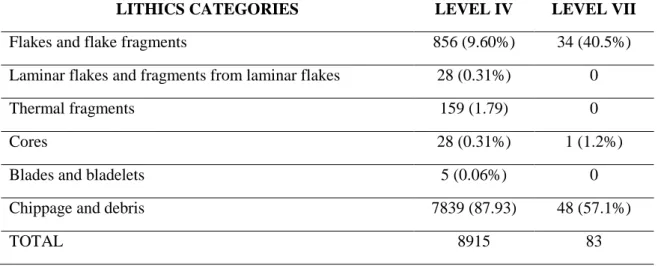
Concerning the lithics (Table 2), the two levels differ in assemblage composition, raw-material selection and technological preference. In level VII, the percentage of chippage and other debris is 57.1, markedly lower than in level IV (87.9); the percentage of retouched pieces is, however, similar in both levels. In level VII, edge-sharpened blanks of considerable size and thickness, infrequent in level IV, have been documented (Villaverde et al., 2012). The differences between the two levels in the size and relative abundance of chippage and debris are not easy to explain. It is possible that the area studied in level VII was more structured than the area studied in level IV, or that the former coincides with a knapping spot. The less intensive post-depositional thermal fragmentation apparent in level IV is likely to be one of the main causes of the scarcity of chippage in this level.
Whether the blanks of those level VII retouched pieces that were intensively sharpened and resharpened were originally flaked prior to or during the occupation of the site cannot be established at present. Importation of ready-made blanks or of finished tools would be consistent with the notion that the level documents short occupations separated by long periods of abandonment, but testing this hypothesis requires further investigation. Where local raw-materials are concerned, it is in any case clear that the level VII lithic assemblages feature complete chaînes opératoires, ones whereby procurement ranged widely and the duration of cutting edges was short (Villaverde et al., 2012).
160
LITHICS CATEGORIES LEVEL IV LEVEL VII
Flakes and flake fragments 856 (9.60%) 34 (40.5%)
Laminar flakes and fragments from laminar flakes 28 (0.31%) 0
Thermal fragments 159 (1.79) 0
Cores 28 (0.31%) 1 (1.2%)
Blades and bladelets 5 (0.06%) 0
Chippage and debris 7839 (87.93) 48 (57.1%)
TOTAL 8915 83
Table 2. Lithics counts for levels IV and VII.
In level VII, flint is by far the preferred raw material, accounting for 94.4% of the assemblage. Raw-materials are more diverse in level IV, where quartzite and limestone are 39.8% (Table 3). These differences are suggestive of two different systems of raw-material procurement, with that represented in level VII being less interested in the local rocks, abundant in the site surroundings (Eixea et al., 2011).
RAW-MATERIALS Flint Quartzite Limestone Quartz TOTAL
LEVEL IV 655 (60.0%) 244 (22.4%) 190 (17.4%) 2 (0.2%) 1091
LEVEL VII 34 (94.4%) 0 2 (5.6%) 0 36
Table 3. Raw-materials used in levels IV and VII.
Finally, Levallois reduction methods are clearly less important in level VII, where they always are of the recurrent modality, than in level IV (Table 4).
REDUCTION METHOD Discoidal Centripetal Recurrent Levallois Preferential Levallois Unipolar Recurrent Levallois Bipolar Recurrent Levallois
Laminar Kombewa Indet. TOTAL
LEVEL IV 306 (54%) 197 (34.8%) 54 (9.5%) 1 (0.2%) 5 (0.9%) 1 (0.2%) 2 (0.4%) 525 1091 LEVEL VII 19 (67.9%) 9 (32.1%) 0 0 0 0 0 5 33
161 To these differences in lithic assemblage composition we must add those concerning the faunal remains. It is possible that such differences reflect changes through time in the configuration of the site and its inhabitable space, in climate, and/or in environmental parameters (where the latter are concerned, this could be so especially in the case of the Testudinidae remains recovered in level IV). Moreover, difficulties in the observation of the cortical surfaces of bones prevent us from assessing the role of humans in the accumulation of the remains of Leporidae; in the former, both non-humans (leporids bones from level VII) (pits, bite-marks, scrapes and digested bones) and human (percussion fractures) alterations have been observed. Where medium and large size animals are concerned, the two faunal assemblages are rather similar in species composition, with Bovidae prevailing and both Equidae and Cervidae being represented. The Canidae remains from level VII are of special interest because they point to the possibility of a carnivore use of the shelter during periods of human abandonment (Table 5).
TAXA Lepo. Birds Bovidae Equidae Canidae Cervidae Testu. Rhino. TOTAL LEVEL IV 100 (11.2%) 0 289 (32.4%) 193 (21.6%) 0 147 (16.5%) 163 (18.3%) 0 892 LEVEL VII 190 (83.2%) 12 (5.3%) 10 (4.4%) 7 (3.1%) 5 (2.2) 2 (0.9%) 0 2 (0.9%) 228
Table 5. Animal taxa identified in levels IV and VII.
5. Spatial Analysis
Given the intra-level connections, both horizontal and vertical, revealed by stone tool refits (Table 6), the spatial analysis of level IV was carried out for the stratigraphic unit as a whole, subsuming the different spits into which it was subdivided at the time of excavation (Eixea et al., 2011-2012). The analysis revealed a typical cumulative palimpsest structure, with abundant superimposed hearths mostly located in the central and western parts of the excavated area. The hearths provided the focus for the spatial organization of activities, namely stone tool knapping and the processing and consumption of prey (Fig. 3). Despite the high density of finds, the pattern of hearth superimposition is suggestive of a repetitive use of the shelter for the same kinds of hunting tasks focused on the acquisition of Bovidae, Equidae and Cervidae (as well as, where small prey are concerned, tortoise).
162 The level VII deposits are thicker, but, as in other Middle Paleolithic sites in the region, find density is much lower (Villaverde, 2001). Bearing in mind the smaller size of the excavated area, it is clear that, here, hearths were not being continuously altered and dismantled, as opposed to the pattern observed in level IV and all other levels above. The morphology of the hearths, however, is the same: they are simple, shallow (forming 2-3 cm-deep basins), small (30-35 cm in diameter) and elongated, with rubefaction affecting 0.5-1 cm of the underlying deposits. This suggests that they are likely to have been short duration hearths with no continuous maintenance and reconditioning processes. Their emplacement is also identical to that observed in level IV. This is probably a consequence of the spatial restrictions imposed by the dimensions of the shelter and the area protected by its overhang.
Additional data confirm the structural distinction between levels IV and VII. For instance, level VII is thicker and, although the hearths therein were all located in the middle of the level, finds have a more complex vertical distribution and are present throughout the entire sedimentary body (even if its upper third is rather poor in lithic and bone remains, especially those of medium and large animals); the finds relating to human occupation were for the most part recovered in the lower third of the level, at elevations largely coinciding with the presence of hearths. The refitting lines for the two lowermost spits suggest that we may have here a palimpsest where different occupation events are subsumed. Confirmation of this hypothesis requires additional work, namely where refitting is concerned.
The area of level VII with a particularly high density of finds in squares E-3 and E-4 coincides, horizontally and vertically, with the excavated hearths. It remains possible, however, that the stone tools and faunal remains recovered at higher elevations within the level may correspond to low density scatters in the periphery of hearths located elsewhere, outside the small-sized area of this level that has so far been excavated.
In level VII times, local carnivores alternated with humans in the use of the shelter, as shown by the carnivore marks observed on some of the level’s faunal remains. It is also possible that the smaller degree of bone breakage and the larger size of the fragments reflect an important role for carnivores in the accumulation of those remains. Alternatively, this difference between the two levels may be due to taphonomic factors, e.g., less trampling due either to the shorter duration of the human occupations and the longer intervals separating each, or to the prevalence of higher sedimentation rates.
163
Table 6. Refitting lines for levels IV and VII.
Line Level Spit Raw
Material
Composition and Elevation
bellow Z Type Distance Length
1 IV 6 Quartzite Flakes (a:1428/ b:1466/
c:1478) Exploitation Horizontal
Short (<0.5 m)
2 IV 7 Quartzite Flakes (a:1407/ b:1394/
c:1420)
Exploitation
Horizontal
Short (<0.5 m)
3 IV 6 Quartzite Flakes (a:1258/ b:1146)
Exploitation Horizontal Medium (0.5 a 2.10 m) 4 IV 6 & 7 Limestone
Edge and flakes (a:1182/ b:1185/ c:1159/ d:1146/ e:1232/ f:1157) Exploitation Vertical Medium (0.5 a 2.10 m) 5 IV 6 & 7 Limestone
Core and flakes (a:1423/ b:1396/ c:1357/ d:1340/ e:1273) Exploitation Vertical Long (2.10 a 4 m)
6 IV 7 Limestone Flakes (a:1340/ b:1424)
Exploitation
Horizontal
Long (2.10 a 4 m)
7 IV 7 Limestone
Core and flakes (a:1242/ b:1106/ c:1348/ d:1123) Exploitation Horizontal Long (2.10 a 4 m)
8 IV 7 Limestone Core and flakes (a:1357/
b:1423/ c:1484)
Exploitation
Horizontal
Long (2.10 a 4 m)
9 IV 6 & 7 Limestone Core and flakes (a:1454/
b:1455/ c:1337)
Exploitation
Vertical
Long (2.10 a 4 m)
10 VII 47 Flint Flake and flake fragment
(a:3321/ b:3329) Fracture Horizontal
Short (<0.5 m)
11 VII 47 &
48 Flint
Flake and flake fragment
(a:3315/ b:3393) Fracture Vertical
Medium (0.5 a 2.10
m)
12 VII 48 Flint Flake and flake fragment
(a:3581/ b:3532) Fracture Horizontal
Medium (0.5 a 2.10
m)
13 VII 47 &
48 Flint
Core and flakes (a:3275/ b:3308/ c:3326/ d:3328/ e:3403) Fracture Vertical Medium (0.5 a 2.10 m)
164
Figure 3. Combustion areas and refitting lines for levels IV (A) and VII (B) plotted over lithics density
165
6. Conclusion
As they are separated by sterile level VI, the two levels dealt with in this paper, IV and VII, must correspond to two different periods of occupation. The distributions of their respective archeological contents show a clear difference in the density of finds. Level IV has a typical palimpsest structure characterized by the abundance of combustion features, knapping debris and bone fragments. The analysis of the distribution of the least common elements yields a repetitive pattern of occupation characterized by high density scatters around the hearths. In level VII, the density of finds is much lower and the spatial structure is, therefore, better defined. Combustion areas, however, are restricted to the middle and lower spits of the level, opening up the possibility that the lower density find scatters in the upper spits of this level relate to hearths located elsewhere at the site. The role played by natural and anthropogenic factors in the generation of these differences is the subject of ongoing research.
Acknowledgements
The authors would like to thank Alejandro García, Jesús García, Alfredo Maximiano y Joseba Rios for the invitation to the workshop Debating spatial archaeology: International workshop on landscape and spatial analysis in archaeology that took place on June 8th and 9th 2012.
Research for the present paper has been supported by the following projects: “El final del Paleolítico medio y el Paleolítico superior en la región central del Mediterráneo ibérico” (FFI 2008-01200/FISO), “La conducta de los neandertales: una aproximación a partir del registro arqueológico del Abrigo de la Quebrada (Chelva, Valencia)” (HAR 2008-04273-E/HIST), "Paleolítico medio final y Paleolítico superior inicial en la región central mediterránea (Valencia y Murcia)" (HAR2011-24878) and “Más allá de la Historia. Inicio y consolidación del poblamiento Paleolítico valenciano” (PROMETEO 2013/II/016).
References
Eixea, A., V. Villaverde and J. Zilhão. 2011."Aproximación al aprovisionamiento de materias primas líticas en el yacimiento del Paleolítico medio del Abrigo de la Quebrada (Chelva, Valencia)." Trabajos de Prehistoria 68: 65-78.
Eixea, A., V. Villaverde, J. Zilhão, A. Sanchis, J.V. Morales, C. Real and M. Bergadá. 2011-2012. "El nivel IV del Abrigo de la Quebrada (Chelva, Valencia). Análisis
166 microespacial y valoración del uso del espacio en los yacimientos del Paleolítico medio valenciano." Mainaké XXXIII: 131-162.
Villaverde, V. 2001. De Neandertales a Cromañones: el inicio del poblamiento humano en las tierras valencianas. Valencia: Universitat de València: Servei de Publicacions.
Villaverde, V., A. Eixea, J. Rios and J. Zilhão. 2012. “Importancia y valoración de la producción microlevallois en los niveles II y II del Abrigo de la Quebrada (Chelva, Valencia)." Zephyrus LXX: 13-32.
View publication stats View publication stats