EUROPEAN ORGANISATION FOR NUCLEAR RESEARCH (CERN)
J. High Energ. Phys. (2017) 2017: 132 DOI:10.1007/JHEP10(2017)132
CERN-EP-2017-139 21st February 2018
Measurement of inclusive and di
fferential cross
sections in the H → Z Z
∗
→ 4` decay channel in pp
collisions at
√
s
= 13 TeV with the ATLAS detector
The ATLAS Collaboration
Inclusive and differential fiducial cross sections of Higgs boson production in proton–proton
collisions are measured in the H → ZZ∗ → 4` decay channel. The proton–proton collision
data were produced at the Large Hadron Collider at a centre-of-mass energy of 13 TeV and recorded by the ATLAS detector in 2015 and 2016, corresponding to an integrated
luminos-ity of 36.1 fb−1. The inclusive fiducial cross section in the H → ZZ∗ → 4` decay channel
is measured to be 3.62 ± 0.50 (stat) +0.25−0.20(sys) fb, in agreement with the Standard Model
prediction of 2.91 ± 0.13 fb. The cross section is also extrapolated to the total phase space
including all Standard Model Higgs boson decays. Several differential fiducial cross sections
are measured for observables sensitive to the Higgs boson production and decay, including kinematic distributions of jets produced in association with the Higgs boson. Good agree-ment is found between data and Standard Model predictions. The results are used to put constraints on anomalous Higgs boson interactions with Standard Model particles, using the pseudo-observable extension to the kappa-framework.
c
2018 CERN for the benefit of the ATLAS Collaboration.
Reproduction of this article or parts of it is allowed as specified in the CC-BY-4.0 license.
Contents
1 Introduction 2
2 ATLAS detector 3
3 Theoretical predictions and event simulation 4
4 Event selection 6
5 Fiducial phase space 7
6 Background estimates 8
7 Measured data yields 10
8 Signal extraction and correction for detector effects 13
9 Systematic uncertainties 15
10 Results 16
11 Conclusion 23
1 Introduction
The ATLAS and CMS Collaborations at the Large Hadron Collider (LHC) have performed extensive studies of the Higgs boson properties in the past few years. The Higgs boson mass has been measured
to be mH = 125.09 ± 0.24 GeV [1] and no significant deviations from Standard Model (SM) predictions
have been found in the cross sections measured per production mode, the branching ratios [2], or spin and
parity quantum numbers [3–6]. Furthermore, inclusive and differential fiducial cross sections of Higgs
boson production, defined as background-subtracted event yields corrected for the detector response, have
been measured in proton–proton (pp) collisions at a centre-of-mass energy of √s= 8 TeV, using the 4`
(` = e, µ), γγ, and eνµν final states [7–12]. The measured differential cross sections are also in good
agreement with the SM predictions.
This paper presents a measurement of inclusive and differential fiducial cross sections in the H → ZZ∗→ 4`
decay channel using pp collisions at √s= 13 TeV recorded with the ATLAS detector. The combined
ef-fect of a higher centre-of-mass energy and an integrated luminosity of 36.1 fb−1is expected to increase the
number of Higgs boson events by a factor of almost four compared to the previous analysis at √s= 8 TeV.
Significantly larger gains are expected in the regions of the differential distributions that probe higher mo-mentum scales due to increased parton–parton luminosities. The differential cross sections presented in this paper are measured in a fiducial phase space to avoid model-dependent extrapolations. The observed distributions are corrected for detector inefficiency and resolution.
Fiducial cross sections are presented both inclusively and separately for each of the final states of the
H → ZZ∗ → 4` decay (4µ, 2e2µ, 2µ2e, 4e). Differential fiducial cross sections are presented for
the different final states and Higgs boson production mechanisms, such as gluon–gluon fusion (ggF) or
vector-boson fusion (VBF). The Higgs boson transverse momentum1 pT,4` can be used to test
perturb-ative QCD calculations, especially when separated into exclusive jet multiplicities. This variable is also
sensitive to the Lagrangian structure of the Higgs boson interactions [13]. The Higgs boson rapidity
dis-tribution |y4`| is sensitive to the parton distribution functions (PDFs) of the colliding protons. The decay
variables |cos θ∗| and m34 test the spin and parity of the Higgs boson. The variable |cos θ∗| is defined as
the magnitude of the cosine of the decay angle of the leading lepton pair in the four-lepton rest frame
with respect to the beam axis. The variables m12 and m34 refer to the invariant masses of the leading
and subleading lepton pairs and correspond to the invariant masses of the on-shell and off-shell Z bosons
produced in the Higgs boson decay. The number of jets Njets produced in association with the Higgs
boson and the transverse momentum plead.jetT of the leading jet both provide sensitivity to the theoretical
modelling of high-pT quark and gluon emission. The invariant mass mjj of the two leading jets in the
event is sensitive to different production mechanisms. The signed angle between the two leading jets in
the transverse plane2∆φjjis another observable that tests the spin and parity of the Higgs boson [14].
Providing fiducial cross sections simplifies the testing of theoretical models with H → ZZ∗ → 4` final
states since the response of the detector has been corrected for. As an example, the cross section in the m12
vs m34 observable plane is interpreted in the framework of pseudo-observables [15], which are derived
from on-shell decay amplitudes and provide a generalization of the kappa-framework [16]. Limits are set
on parameters describing anomalous Higgs boson interactions with leptons and Z bosons.
2 ATLAS detector
The ATLAS detector [17] is a multi-purpose detector with a forward-backward symmetric cylindrical
geometry. At small radii, the inner detector (ID), immersed in a 2 T magnetic field produced by a thin superconducting solenoid located in front of the calorimeter, is made up of a fine-granularity pixel
de-tector, including the newly installed insertable B-layer [18], a microstrip detector, as well as a straw-tube
tracking detector. The silicon-based detectors cover the pseudorapidity range |η| < 2.5. The gas-filled straw-tube transition radiation tracker complements the silicon tracker at larger radii up to |η| < 2 and also provides electron identification capabilities based on transition radiation. The electromagnetic (EM) calorimeter is a lead/liquid-argon sampling calorimeter with accordion geometry. The calorimeter is di-vided into a barrel section covering |η| < 1.475 and two end-cap sections covering 1.375 < |η| < 3.2. For |η| < 2.5 it is divided into three layers in depth, which are finely segmented in η and φ. A thin presampler layer, covering |η| < 1.8, is used to correct for fluctuations in upstream energy losses. A hadronic calori-meter in the region |η| < 1.7 uses steel absorbers and scintillator tiles as the active medium. A liquid-argon calorimeter with copper absorbers is used in the hadronic end-cap calorimeters, which covers the region 1.5 < |η| < 3.2. A forward calorimeter using copper or tungsten absorbers with liquid argon completes the
calorimeter coverage up to |η|= 4.9. The muon spectrometer (MS) measures the deflection of muon
tra-jectories within |η| < 2.7, using three layers of precision drift tube chambers, with cathode strip chambers in the innermost layer for |η| > 2.0. The deflection is provided by a toroidal magnetic field from air-core superconducting magnets. The field integral of the toroids ranges between 2.0 and 6.0 T·m across most
1ATLAS uses a right-handed coordinate system with its origin at the nominal interaction point (IP) in the centre of the detector and the z-axis along the beam pipe. The x-axis points from the IP to the centre of the LHC ring, and the y-axis points upward. Cylindrical coordinates (r, φ) are used in the transverse plane, φ being the azimuthal angle around the z-axis. The pseudorapidity is defined in terms of the polar angle θ as η= − ln tan(θ/2).
2∆φ
of the detector. The muon spectrometer is instrumented with trigger chambers covering |η| < 2.4. Events are selected using a first-level trigger implemented in custom electronics, which reduces the event rate to a maximum of 100 kHz using a subset of detector information. Software algorithms with access to the full detector information are then used in the high-level trigger to yield a recorded event rate of about 1 kHz [19].
3 Theoretical predictions and event simulation
The Higgs boson production cross sections and decay branching ratios, as well as their uncertainties,
are taken from Refs. [16,20–22], and are referred to as LHCXSWG. The cross section for Higgs boson
production via ggF is available at to-to-to-leading order (N3LO) in QCD and has
next-to-leading-order (NLO) electroweak (EW) corrections applied [23–36]. The cross section for the VBF
process is calculated with full NLO QCD and EW corrections [37–39], and approximate
next-to-next-to-leading-order (NNLO) QCD corrections are applied [40]. The cross sections for the production of an
electroweak boson in association with a Higgs boson, V H (V= W, Z), are calculated at NNLO accuracy
in QCD [41,42] and NLO EW radiative corrections [43] are applied. The cross section for the associated
production of a Higgs boson with a t¯t pair, t¯tH, is calculated at NLO accuracy in QCD [44–47]. The cross
section for the b¯bH process is calculated by the Santander matching of the five-flavour scheme (NNLO in
QCD) and four-flavour scheme (NLO in QCD) [48]. The composition of the different production modes
in the SM is 87.3% (ggF), 6.8% (VBF), 4.1% (V H), 0.9% (t¯tH), 0.9% (b¯bH).
The Higgs boson decay branching ratio to the four-lepton final state (` = e, µ) for mH = 125 GeV is
predicted to be 0.0124% [49] in the SM using PROPHECY4F [50, 51], which includes the complete
NLO QCD and EW corrections, and the interference effects between identical final-state fermions. Due to the latter, the expected branching ratios of the 4e and 4µ final states are about 10% higher than the branching ratios to 2e2µ and 2µ2e final states.
The Powheg-Box v2 Monte Carlo (MC) event generator [52–54] is used to simulate ggF [55], VBF [56]
and V H [57] processes, using the PDF4LHC NLO PDF set [58]. The ggF Higgs boson production is
accurate to NNLO in QCD, using the Powheg method for merging the NLO Higgs boson plus jet cross
section with the parton shower, and the MiNLO method [59,60] to simultaneously achieve NLO accuracy
for inclusive Higgs boson production. Furthermore, a reweighting procedure is performed using the
HNNLO program [61–63] to achieve full NNLO accuracy [64]. This sample is referred to as NNLOPS.
The VBF and V H samples are produced at NLO accuracy in QCD. For V H, the MiNLO method is used to merge zero- and one-jet events. For Higgs boson production in association with a heavy quark pair, events
are simulated at NLO with MadGraph5_aMC@NLO (v.2.2.3 for t¯tH and v.2.3.3 for b¯bH [65]) [66], using
the CT10nlo PDF set [67] for t¯tH and the NNPDF23 PDF set [68] for b¯bH. For the ggF, VBF, V H, and
b¯bHproduction mechanisms, Pythia 8 [69,70] is used for the H → ZZ∗→ 4` decay as well as for parton
showering, hadronization, and multiple partonic interactions using the AZNLO parameter set [71]. For
the t¯tH production mechanism, Herwig++ [72,73] is used with the UEEE5 parameter set [74].
The measured event yields and the differential fiducial cross-section measurements are compared to a SM
prediction constructed from the MC predictions presented above, after normalizing each sample using the
corresponding LHCXSWG prediction. All samples are generated with mH= 125 GeV.
An alternative prediction for ggF SM Higgs boson production is generated using MadGraph5_aMC@NLO
75], using the NNPDF30_nlo_as_0118 PDF set [76]. This MG5_aMC@NLO_FxFx sample is interfaced to Pythia 8 for Higgs boson decay, parton showering, hadronization and multiple partonic interactions
using the A14 parameter set [77]. The data are also compared to ggF SM Higgs boson production in the
4` decay channel simulated with HRes v2.3 [63, 78], using the MSTW2008 NNLO PDF set [79]. The
HRes program computes fixed-order cross sections for ggF SM Higgs boson production up to NNLO in
QCD and describes the pT,4` distribution at NLO. All-order resummation of soft-gluon effects at small
transverse momenta is consistently included up to next-to-next-to-leading logarithmic order (NNLL) in
QCD, using dynamic factorization and resummation scales (the central scales are chosen to be mH/2).
The program implements top quark and bottom quark mass dependence up to next-to-leading logarithmic
order (NNL)+ NLO in QCD. At NNLL + NNLO accuracy only the top quark contribution is considered.
HRes does not perform parton showering and QED final-state radiation effects are not included. Both the MG5_aMC@NLO_FxFx and the HRes predictions are normalized using the LHCXSWG cross sec-tion.
A ggF sample used to study deviations from the SM predictions within the pseudo-observable
frame-work [15,80] is generated with MadGraph5 at LO using FeynRules 2 [81] and the NN23PDF PDF set.
The sample is interfaced to Pythia 8 using the A14 parameter set. It is normalized using the LHCXSWG cross section.
The ZZ(∗)continuum background from quark–antiquark annihilation is simulated with Sherpa 2.2 [82–
84], using the NNPDF3.0 NNLO PDF set. NLO accuracy is achieved in the matrix element calculation for
zero- and one-jet final states and LO accuracy for two- and three-jet final states. The merging is performed
with the Sherpa parton shower [85] using the MePs@NLO prescription [86]. NLO EW corrections are
applied as a function of the invariant mass of the ZZ∗ system mZZ∗ [87, 88]. The gluon-induced ZZ∗
production is modelled with gg2VV [89] at leading order in QCD. The K-factor accounting for missing
higher-order QCD effects in the calculation of the gg → ZZ∗continuum is taken to be 1.7 ± 1.0 [90–
95].
Sherpa 2.2 is also used to generate samples of the Z + jets background at NLO accuracy for zero-, one-and two-jet final states one-and LO accuracy for three- one-and four-jet final states. In this measurement, the
Z+ jets background is normalized using control samples from data. For comparisons with simulation,
the QCD NNLO Fewz [96,97] and Mcfm cross-section calculations are used for inclusive Z boson and
Z+ b¯b production, respectively. Samples for the t¯tbackground are produced with Powheg-Box interfaced
to Pythia 6 [69] for parton showering and hadronization, to Photos [98] for QED radiative corrections, to
Tauola [99,100] for the simulation of τ lepton decays and to EvtGen v.1.2.0 [101] for the simulation of
b-hadron decays. For this sample, the Perugia 2012 parameter set [102] is used. The WZ background is
modelled using Powheg-Box+Pythia 8 and the AZNLO parameter set. The triboson backgrounds ZZZ,
WZZ, and WWZ with four or more leptons originating from the hard scatter are produced with Sherpa
2.1. MadGraph, interfaced to Pythia 8 with the A14 parameter set is used to simulate the all-leptonic t¯t+ Z as well as the t¯t+ W processes.
The particle-level events produced by each event generator are passed through the Geant4 [103]
sim-ulation of the ATLAS detector [104] and reconstructed in the same way as the data. Additional pp
interactions in the same and nearby bunch crossings (pile-up) are simulated using inelastic pp collisions generated using Pythia 8 (with the A2 MSTW2008LO parameter set) and overlaid on the simulated events discussed above. The MC events are weighted to reproduce the distribution of the average number of interactions per bunch crossing observed in the data.
4 Event selection
Events with at least four leptons are selected with single-lepton, dilepton and trilepton triggers. The
trigger selection requirements, e.g. the minimum transverse energy ET/transverse momentum pT, the
identification and the isolation requirements, were tightened periodically during the data-taking to
main-tain a maximum overall trigger rate as the instantaneous luminosity increased. For example, the ET
threshold changed from 24 to 26 GeV for the single-electron trigger. The multilepton triggers have lower
ET or pT requirements and more relaxed identification requirements. The combined trigger efficiency
in this analysis is about 98%. The data are subjected to quality requirements to reject events in which detector components were not operating correctly. Events are required to have at least one vertex with
two associated tracks with pT> 400 MeV, and the primary vertex is chosen to be the reconstructed vertex
with the largestP p2
Tof reconstructed tracks.
Electrons are reconstructed using tracks in the ID and energy clusters in the EM calorimeter [105]. They
are required to satisfy loose identification criteria based on tracking and calorimeter information. Muons are reconstructed as tracks in the ID and the MS [106] if they lie in the region 0.1 < |η| < 2.5. In the region |η| < 0.1, the MS has reduced coverage, and muons are reconstructed from ID tracks and iden-tified by either a minimal energy deposit in the calorimeter or hits in the MS. For 2.5 < |η| < 2.7, only the MS can be used. For events with four muons, at least three muons are required to be re-constructed by combining ID and MS tracks. Each muon (electron) must have transverse momentum
pT > 5 GeV (ET > 7 GeV), within the pseudorapidity range |η| < 2.7 (2.47) and with a longitudinal
impact parameter |z0sin(θ)| < 0.5 mm. Muons originating from cosmic rays are removed with the
trans-verse impact parameter requirement |d0| < 1 mm. Jets are reconstructed from topological clusters of
calorimeter cells using the anti-kt algorithm [107,108] with the radius parameter R = 0.4. Jets are
cor-rected for detector response and pile-up contamination [109,110] and required to have pT > 30 GeV,
and |η| < 4.5. In order to avoid double counting of electrons also reconstructed as jets, jets are removed if
∆R(jet, e) = p∆φ(jet, e)2+ ∆η(jet, e)2 < 0.2. This overlap removal is also applied to jets close to muons
if the jet has fewer than three tracks and the energy and momentum differences between the muon and the jet are small (pT,µ> 0.5 pT,jet and pT,µ> 0.7 pT,jet,tracks), or if∆R(jet, µ) < 0.1.
Higgs boson candidates are formed by selecting two same-flavour opposite-sign (SFOS) lepton pairs, called a lepton quadruplet. The analysis selection proceeds in parallel for the four final states (4µ, 2e2µ, 2µ2e, 4e, where the first two leptons refer to the leading lepton pair). The leading pair is defined as the
SFOS pair with the mass m12closest to the Z boson mass and the subleading pair is defined as the SFOS
pair with the mass m34 second closest to the Z boson mass. Mispairing within a quadruplet occurs for
about 1% of the selected events for the 4µ or 4e final states. Furthermore, a quadruplet can be formed
with an extra lepton originating from the W/Z for V H or t¯tH production, moving m4` away from mH.
The expected rate for V H or t¯tH with leptonic decays is about 0.3% of all Higgs events in the full m4`
range after the event selection. For each final state, a quadruplet is chosen in which the three leading
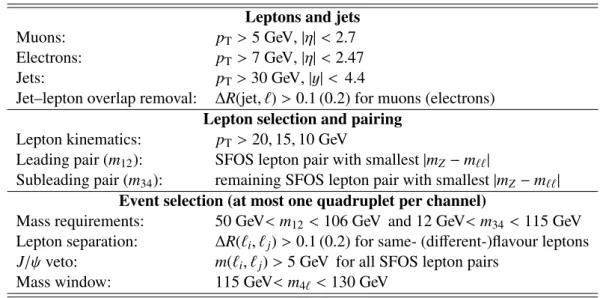
leptons pass pT (ET) > 20, 15, 10 GeV. In addition to the dilepton mass, lepton separation and J/ψ veto
requirements (given in Table1), loose calorimeter- and track-based isolation as well as impact parameter
requirements are imposed on the leptons. For the track-based isolation, the sum of the pT of the tracks
lying within a cone of size∆R = min[0.3, 10 GeV/pT] (min[0.2, 10 GeV/ET]) around the muon (electron)
is required to be smaller than 15% of the lepton pT(ET). Similarly, the sum of the calorimeter ETdeposits
in a cone of size∆R = 0.2 around the muon (electron) is required to be smaller than 30% (20%) of the
lepton pT(ET). As the four leptons should originate from a common vertex, a requirement on the χ2value
If more than one quadruplet passes all requirements, e.g. for V H or t¯tH, the channel with the highest expected signal rate after reconstruction and event selection is selected, in the order: 4µ, 2e2µ, 2µ2e and 4e. In order to improve the four-lepton mass reconstruction, the reconstructed final-state radiation (FSR)
photons in Z boson decays are accounted for using the same strategy as in the Run-1 data analysis [111].
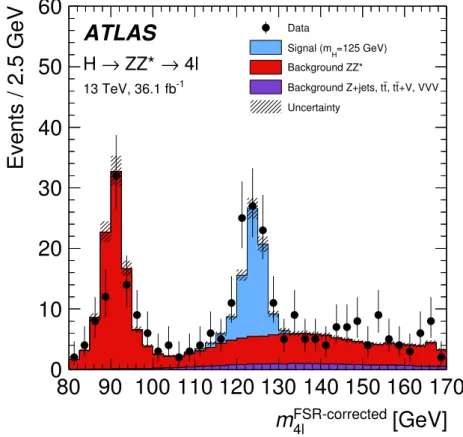
The invariant mass distribution of the four leptons of the selected events is shown in Figure1. Only events
with a four-lepton invariant mass in the range 115−130 GeV are used in the extraction of the signal.
[GeV]
FSR-corrected 4lm
80 90 100 110 120 130 140 150 160 170
Events / 2.5 GeV
0
10
20
30
40
50
60
Data =125 GeV) H Signal (m Background ZZ* +V, VVV t , t t Background Z+jets, t UncertaintyATLAS
4l
→
ZZ*
→
H
-1 13 TeV, 36.1 fbFigure 1: Four-lepton invariant mass distribution of the selected events before the m4` requirement, corrected for
final-state radiation (FSR). The error bars on the data points indicate the statistical uncertainty. The SM Higgs boson signal prediction is obtained from the samples discussed in Section3. The backgrounds are determined following the description in Section6. The uncertainty in the prediction is shown by the hatched band, calculated as described in Section9.
The selected events are divided into bins of the variables of interest. The bin boundaries are chosen such that each bin has an expected signal significance greater than 2σ (where the significance is calculated
from the number of signal events S and the number of background events B as S /√S + B) and that
there are minimal migrations between bins, which reduces the model dependence of the correction for the detector response.
5 Fiducial phase space
The fiducial cross sections are defined at particle level using the selection requirements outlined in
Table 1: List of event selection requirements which define the fiducial phase space of the cross-section measure-ment. SFOS lepton pairs are same-flavour opposite-sign lepton pairs.
Leptons and jets
Muons: pT> 5 GeV, |η| < 2.7
Electrons: pT> 7 GeV, |η| < 2.47
Jets: pT> 30 GeV, |y| < 4.4
Jet–lepton overlap removal: ∆R(jet, `) > 0.1 (0.2) for muons (electrons)
Lepton selection and pairing
Lepton kinematics: pT> 20, 15, 10 GeV
Leading pair (m12): SFOS lepton pair with smallest |mZ− m``|
Subleading pair (m34): remaining SFOS lepton pair with smallest |mZ− m``|
Event selection (at most one quadruplet per channel)
Mass requirements: 50 GeV< m12< 106 GeV and 12 GeV< m34< 115 GeV
Lepton separation: ∆R(`i, `j) > 0.1 (0.2) for same- (different-)flavour leptons
J/ψ veto: m(`i, `j) > 5 GeV for all SFOS lepton pairs
Mass window: 115 GeV< m4`< 130 GeV
model-dependent acceptance extrapolations.
The fiducial selection is applied to final-state3electrons and muons that do not originate from hadrons or
τ decays. The leptons are “dressed”, i.e. the four-momenta of photons within a cone of size ∆R = 0.1 are added to the lepton four-momentum, requiring the photons to not originate from hadron decays.
Particle-level jets are reconstructed from final-state particles using the anti-kt algorithm with radius parameter
R= 0.4. Electrons, muons, neutrinos (if they are not from hadron decays) and photons used to dress
leptons, are excluded from the jet clustering. Jets are removed if they are within a cone of size∆R = 0.1
(0.2) around a selected muon (electron).
Quadruplets are formed with the selected dressed leptons. Using the same procedure as for reconstructed events reproduces the mispairing of the leptons from Higgs boson decays when assigning them to the leading and subleading Z bosons and the inclusion of leptons originating from vector bosons produced in
association with the Higgs boson. The variables used in the differential cross-section measurement are
calculated using the dressed leptons in the quadruplets.
The acceptance of the fiducial selection (with respect to the full phase space of H → ZZ∗ → 2`2`0,
where `, `0 = e or µ) is 42% for a SM Higgs boson with mH = 125 GeV. The ratio of the number of
events passing the detector-level event selection to those passing the particle-level selection is 53%. Due to resolution effects, about 2% of the events which pass the detector-level selection fail the particle-level selection.
6 Background estimates
Non-resonant SM ZZ∗production via q ¯q annihilation and gluon–gluon fusion can result in four prompt
leptons in the final state and constitutes the largest background for this analysis. It is estimated using the
3Final-state particles are defined as particles with a lifetime cτ > 10 mm. For electrons and muons, this corresponds to leptons after final state radiation.
Sherpa and gg2VV simulated samples presented in Section3. To cross-check the theoretical modelling
of this background, a ZZ∗-enriched control region is formed using almost the full event selection, but
requiring that the four-lepton invariant mass not lie within the region 115 GeV < m4` <130 GeV. In this
control region, good agreement is observed between the simulation and the data for all distributions, as demonstrated for pT,4` and Njetsin Figure2.
[GeV] T,4l p Events / GeV 0.01 0.1 1 10 Data Background ZZ* +V, VVV t , WZ, t t Background Z+jets, t Uncertainty ATLAS -1 13 TeV, 36.1 fb < 115 GeV 4l m < 170 GeV 4l m or 130 GeV < [GeV] T,4l p 0 50 100 150 200 250 300 350 Data / MC 0.5 1 1.5 2 (a) jets N Events 0 20 40 60 80 100 120 140 160 180 200 Data Background ZZ* +V, VVV t , WZ, t t Background Z+jets, t Uncertainty ATLAS -1 13 TeV, 36.1 fb < 115 GeV 4l m < 170 GeV 4l m or 130 GeV < jets N 0 1 2 ≥3 Data / MC 0.5 1 1.5 2 (b)
Figure 2: Reconstructed event yields in bins of (a) the transverse momentum of the four leptons pT,4`and (b) the
number of jets Njets, in a non-resonant ZZ∗-enriched control region, obtained by applying the full event selection
except for the m4`window, i.e. m4` < 115 GeV or 130 GeV< m4` < 170 GeV. The error bars on the data points
indicate the statistical uncertainty. The uncertainty in the prediction is shown by the dashed band. The bottom part of the figures shows the ratio of data to the MC expectation.
Other processes that contribute to the background, such as Z+ jets, t¯t, and WZ, contain at least one jet,
photon or lepton candidate that is misidentified as a prompt lepton. These backgrounds are significantly
smaller than the non-resonant ZZ∗background and are estimated using data where possible, following
slightly different approaches for the ``µµ and ``ee final states [111].
In the ``µµ final states, the normalizations for the Z+ jets and t¯t backgrounds are determined using fits
to the invariant mass of the leading lepton pair in dedicated data control regions. The control regions
are formed by relaxing the χ2requirement on the vertex fit, and by inverting or relaxing isolation and/or
impact-parameter requirements on the subleading muon pair. An additional control region (eµµµ) is used to improve the t¯t background estimate. Transfer factors to extrapolate from the control regions to the
signal region are obtained separately for t¯t and Z + jets using simulation. The shapes of the Z + jets
and t¯t backgrounds for the differential observables are taken from simulation and normalized using the inclusive data-driven estimate. Comparisons in the control regions show good agreement between data
and the simulation for the different observables.
The ``ee control-region selection requires the electrons in the subleading lepton pair to have the same charge, and relaxes the identification and isolation requirements on the electron candidate with the lowest transverse energy. This electron candidate, denoted as X, can be a light-flavour jet, a photon conversion
or an electron from heavy-flavour hadron decay. The heavy-flavour background is completely determ-ined from simulation, whereas the light-flavour and photon conversion background is obtadeterm-ined with the
sPlot [112] method, based on a fit to the number of hits in the innermost ID layer in the data control
re-gion. Transfer factors for the light-flavour jets and converted photons, obtained from simulated samples,
are corrected using Z+ X control regions and then used to extrapolate the extracted yields to the signal
region. Both the extraction of the yield in the control region and the extrapolation are performed in bins of the transverse momentum of the electron candidate and the jet multiplicity. In order to extract the shape of the backgrounds from light-flavour jets and photon conversions in bins of the differential distributions, a similar method is used, except that the extraction and extrapolation is now performed as a function of the transverse momentum of the electron candidate in each bin of the variable of interest.
The m4` shapes are extracted from simulation for most background components except for the
light-flavour jet+ conversion contribution in the ``ee final state, which is not well described by the simulation
and therefore taken from the control region and extrapolated using the data-corrected efficiencies. It was
observed that the m4` shape of the Z+ jets and t¯t backgrounds does not change significantly across the
differential distributions, and so the same shape, obtained using all available events, is used for all bins. The background from WZ production is included in the data-driven estimates for the ``ee final states,
while it is added from simulation for the ``µµ final states. The contributions from t¯t+ Z and triboson
processes are very small and taken from simulated samples.
7 Measured data yields
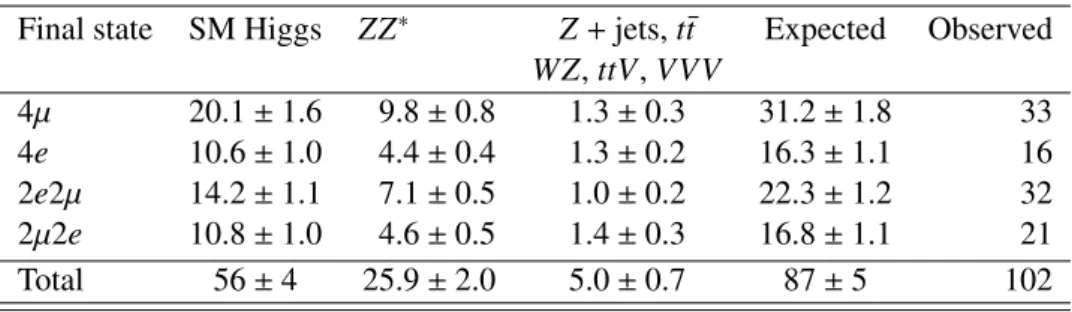
The observed number of events in the four decay channels after the event selection, as well as the expected
signal and background yields, is presented in Table2. Figure3 shows the expected and observed event
yields for four of the measured differential spectra. The total observed and predicted event counts agree
within 1.3 standard deviations.
Table 2: Number of expected and observed events in the four decay channels after the event selection, in the mass range 115 GeV< m4`< 130 GeV. The sum of the expected number of SM Higgs boson events and the estimated
background yields is compared to the data. Combined statistical and systematic uncertainties are included for the predictions (see Section9).
Final state SM Higgs ZZ∗ Z+ jets, t¯t Expected Observed
WZ, ttV, VVV 4µ 20.1 ± 1.6 9.8 ± 0.8 1.3 ± 0.3 31.2 ± 1.8 33 4e 10.6 ± 1.0 4.4 ± 0.4 1.3 ± 0.2 16.3 ± 1.1 16 2e2µ 14.2 ± 1.1 7.1 ± 0.5 1.0 ± 0.2 22.3 ± 1.2 32 2µ2e 10.8 ± 1.0 4.6 ± 0.5 1.4 ± 0.3 16.8 ± 1.1 21 Total 56 ± 4 25.9 ± 2.0 5.0 ± 0.7 87 ± 5 102
[GeV] l T,4 p 0 50 100 150 200 250 300 350 Events / GeV 0 0.5 1 1.5 2 2.5 3 3.5 -1 13 TeV, 36.1 fb ATLAS 4l → ZZ* → H Data =125 GeV) H Signal (m Background ZZ* +V, VVV t , t t Background Z+jets, t Uncertainty (a) jets N 0 1 2 ≥3 Events 0 10 20 30 40 50 60 70 80 -1 13 TeV, 36.1 fb ATLAS 4l → ZZ* → H Data =125 GeV) H Signal (m Background ZZ* +V, VVV t , t t Background Z+jets, t Uncertainty (b) [GeV] 34 m 20 30 40 50 60 Events / GeV 0 1 2 3 4 5 6 7 8 -1 13 TeV, 36.1 fb ATLAS 4l → ZZ* → H Data =125 GeV) H Signal (m Background ZZ* +V, VVV t , t t Background Z+jets, t Uncertainty (c) bins 34 m vs 12 m
bin 0 bin 1 bin 2 bin 3 bin 4
Events 0 10 20 30 40 50 60 70 80 90 -1 13 TeV, 36.1 fb ATLAS 4l → ZZ* → H Data =125 GeV) H Signal (m Background ZZ* +V, VVV t , t t Background Z+jets, t Uncertainty [GeV] 12 m 50 60 70 80 90 100 110 [GeV] 34 m 10 20 30 40 50 60 bin 0 bin 1 bin 2 bin 3 bin 4 Data Signal Background (d)
Figure 3: Measured data yields compared to SM Higgs boson signal and background processes for (a) the transverse momentum of the four leptons pT,4`, (b) the number of jets Njets, (c) the invariant mass of the subleading lepton
pair m34, and (d) the invariant mass of the leading vs the subleading pair m12 vs m34. Figure (d) also includes an
illustration of the chosen bins, as well as the two-dimensional distributions of data and prediction. The error bars on the data points indicate the statistical uncertainty. The uncertainty in the prediction is shown by the dashed band.
[GeV] µ 4 m 116 118 120 122 124 126 128 130 Events / GeV 0 2 4 6 8 10 -1 13 TeV, 36.1 fb ATLAS µ 4 → ZZ* → H Data =125 GeV) H Signal (m Background ZZ* +V, VVV t , t t Background Z+jets, t fitted 4l m Uncertainty (a) [GeV] 4e m 116 118 120 122 124 126 128 130 Events / GeV 0 1 2 3 4 5 6 7 8 -1 13 TeV, 36.1 fb ATLAS 4e → ZZ* → H Data =125 GeV) H Signal (m Background ZZ* +V, VVV t , t t Background Z+jets, t fitted 4l m Uncertainty (b) [GeV] 2e µ 2 m 116 118 120 122 124 126 128 130 Events / GeV 0 2 4 6 8 10 -1 13 TeV, 36.1 fb ATLAS 2e µ 2 → ZZ* → H Data =125 GeV) H Signal (m Background ZZ* +V, VVV t , t t Background Z+jets, t fitted 4l m Uncertainty (c) [GeV] µ 2e2 m 116 118 120 122 124 126 128 130 Events / GeV 0 2 4 6 8 10 12 14 -1 13 TeV, 36.1 fb ATLAS µ 2e2 → ZZ* → H Data =125 GeV) H Signal (m Background ZZ* +V, VVV t , t t Background Z+jets, t fitted 4l m Uncertainty (d)
Figure 4: Template fit of SM Higgs boson signal and background to the data for the inclusive distributions for the different decay channels (a) 4µ, (b) 4e, (c) 2µ2e, (d) 2e2µ. The error bars on the data points indicate the statistical uncertainty. The SM Higgs boson predictions are normalized to the cross sections discussed in Section3, while the backgrounds are normalized to the estimates described in Section6. The uncertainty in the prediction is shown by the dashed band. The dotted green line illustrates the best fit.
[GeV] 4l m 116 118 120 122 124 126 128 130 Events / GeV 0 1 2 3 4 5 6 7 8 9 < 10 GeV T,4l p 0 GeV < -1 13 TeV, 36.1 fb ATLAS 4l → ZZ* → H Data =125 GeV) H Signal (m Background ZZ* +V, VVV t , t t Background Z+jets, t fitted 4l m Uncertainty (a) [GeV] 4l m 116 118 120 122 124 126 128 130 Events / GeV 0 0.5 1 1.5 2 2.5 3 < 350 GeV T,4l p 200 GeV < -1 13 TeV, 36.1 fb ATLAS 4l → ZZ* → H Data =125 GeV) H Signal (m Background ZZ* +V, VVV t , t t Background Z+jets, t fitted 4l m Uncertainty (b)
Figure 5: Template fit of SM Higgs boson signal and background to the data for the (a) first and (b) last bins of the distribution of the transverse momentum of the four leptons pT,4`. The error bars on the data points indicate the
statistical uncertainty. The SM Higgs boson predictions are normalized to the cross sections discussed in Section3, while the backgrounds are normalized to the estimates described in Section6. The uncertainty in the prediction is shown by the dashed band. The dotted green line illustrates the best fit.
8 Signal extraction and correction for detector e
ffects
To extract the number of signal events in each bin of a differential distribution (or for each decay channel for the inclusive fiducial cross section), invariant mass templates for the Higgs boson signal and the
back-ground processes are fit to the m4` distribution in data. The signal shape is obtained from the simulated
samples described in Section3assuming a Higgs boson mass of 125 GeV. Most of the background shapes
are also obtained from the simulated samples described in Section3, while some of the backgrounds in
the ``ee channel are derived from control regions in data, as discussed in Section6. The normalization
of the backgrounds is fixed in this fit. Figures4and5show the data, templates and best fits for the m4`
distributions in the four decay channels for the extraction of the inclusive fiducial cross section, and two
bins of the transverse momentum of the four leptons. For the differential distributions, no split into decay
channels is performed, and the SM ZZ∗→ 4` decay fractions are assumed.
The fiducial cross section σi,fidfor a given final state or bin of the differential distribution is defined as:
σi,fid= σi× Ai× B= Ni,fit L × Ci , Ci= Ni,reco Ni,part, (1)
where Ai is the acceptance in the fiducial phase space, B is the branching ratio and σi is the total cross
section in bin i. The term Ni,fit is the number of extracted signal events in data, L is the integrated
Ni,recois the number of reconstructed signal events and Ni,partis the number of events at the particle level
in the fiducial phase-space. The correction factor is calculated from simulated Higgs boson samples,
assuming SM production mode fractions and ZZ∗ → 4` decay fractions as discussed in Section3. The
systematic uncertainties in this assumption are described in Section 9. The correction factors for the
different Higgs boson production modes agree within 15%, except for the t¯tH mode, which differs by up to 40%, due to the fact that t¯tH events have more hadronic jets and that no isolation requirements are applied to the leptons at the particle level. The correction factors for the four final states are 0.64
± 0.04 (4µ), 0.55 ± 0.03 (2e2µ), 0.48 ± 0.05 (2µ2e), and 0.43 ± 0.06 (4e). Figure6shows the
bin-by-bin correction factors for all decay channels combin-by-bined including systematic uncertainties for the pT,4`
and Njets distributions. The large uncertainty for Njets≥ 3 is due to the experimental jet reconstruction
uncertainties and the variations of the fractions of Higgs boson production modes (see Section9). The
same figure also shows the bin purity, defined as the fraction of events in a bin of the reconstructed distribution that are found in the same bin at particle level. The bin purity is greater than 0.75 for the Higgs boson kinematic and decay observables, and typically greater than 0.6 for the jet variables. It can be seen that the narrower bins at low pT,4`have a slightly reduced bin purity, as detector resolution effects
result in larger bin migration effects, which is enhanced by the presence of a steep slope.
[GeV] T,4l p 0 50 100 150 200 250 300 350 0 0.2 0.4 0.6 0.8 1 1.2 1.4 Simulation ATLAS 4l → ZZ* → H -1 13 TeV, 36.1 fb Correction factor Bin purity (a) jets N 0 1 2 ≥ 3 0 0.2 0.4 0.6 0.8 1 1.2 1.4 Simulation ATLAS 4l → ZZ* → H -1 13 TeV, 36.1 fb Correction factor Bin purity (b)
Figure 6: Bin-by-bin correction factors and bin purities for (a) the transverse momentum of the four leptons pT,4`
and (b) the number of jets Njets. The bands show the systematic uncertainties in the correction factors, which are
discussed in Section9. The uncertainties in the bin purity include the detector response and pile-up uncertainties.
The signal, background, and data m4` distributions, as well as the correction factors, are used as input to
a profile-likelihood-ratio fit [113], taking into account all bins of a given distribution and all final states for the inclusive measurement. The likelihood includes the shape and normalization uncertainties of the backgrounds and correction factors as nuisance parameters. This allows for correlation of systematic uncertainties between the background estimates and the correction factors, as well as between bins or decay channels. The cross sections are extracted for each bin, or final state, by minimizing twice the
negative logarithm of the profile likelihood ratio, −2 lnΛ. In the asymptotic assumption, i.e. the large
measured cross section and a theoretical prediction is evaluated by computing a p-value based on the difference between the value of −2 ln Λ at the best-fit value and the value obtained by fixing the cross sections in all bins to the ones predicted by the theory. These p-values do not include the uncertainties in the theoretical predictions, which are significantly smaller than the total data uncertainties. Therefore, they are slightly smaller than they would be with all uncertainties included. For all measured observables the asymptotic assumption is verified with pseudo-experiments, and if necessary, the uncertainties are corrected to the values obtained with the pseudo-experiments. In the case of zero observed events, 95%
confidence level (CL) limits on the fiducial cross sections are set using the CLs modified frequentist
formalism [113,114].
The inclusive fiducial cross section for each channel is calculated from the fit results following Eq. (1).
The fiducial cross sections of the four final states can either be summed together to obtain an inclusive
fiducial cross section, or they can be combined assuming the SM ZZ∗ → 4` branching ratios. The latter
combination is more model dependent, but benefits from a smaller statistical uncertainty.
9 Systematic uncertainties
Experimental systematic uncertainties affecting both the simulated background and correction factors arise from uncertainties in the efficiencies, resolutions and energy scales of leptons and jets [105,106,109,
115], as well as pile-up modelling. These uncertainties can affect both the shape and the normalization of
the distributions. For the background estimate and the conversion of the corrected signal yields to cross sections, the luminosity uncertainty needs to be taken into account. The uncertainty in the combined
2015+2016 integrated luminosity is 3.2%, which affects the signal and simulated background estimates.
It is derived, following a methodology similar to that detailed in Ref. [116], from a preliminary calibration
of the luminosity scale using x–y beam-separation scans performed in August 2015 and May 2016.
Uncertainties in the estimation of Z+ jets, t¯t, and WZ backgrounds are also considered. The dominant
systematic uncertainties here arise from difficulties in modelling the extrapolation from the control
re-gions to the signal region, which can affect not only the overall normalization but also the background
composition estimates and hence the yields in the bins of the differential distributions.
For the simulated backgrounds and the extrapolation of the inclusive fiducial cross section to the total cross section, theoretical modelling uncertainties associated with PDF, missing higher-order QCD cor-rections (via variations of the factorization and renormalization scales), as well as underlying event and parton showering uncertainties are considered. For the extrapolation to the total cross section,
uncertain-ties in the H → ZZ∗→ 4` branching ratios are also included [20].
The effect on the fitted event yields of shifting the m4` template according to the uncertainties in the
measured Higgs boson mass, 0.24 GeV [1], is smaller than 0.5% and therefore neglected.
The dependence of the correction for detector effects on the theoretical modelling is assessed in a number of ways. For ggF, VBF and V H, the PDF4LHC NLO PDF set is varied according to its eigenvectors, and the envelope of the variations is used as the systematic uncertainty. The renormalization and factorization
scales are varied by factors of 2.0 and 0.5. Furthermore, mH is varied within the uncertainties in the
measured Higgs mass. The relative contribution of each Higgs boson production mechanism is varied by an amount consistent with the uncertainties obtained from the combined ATLAS and CMS measurement
of the Higgs boson production cross sections [2], except for t¯tH where the allowed variation is inflated
Table 3: Fractional uncertainties for the inclusive fiducial cross section σcomb, obtained by combining all decay
channels, and ranges of systematic uncertainties for the differential observables. The columns e, µ, jets represent the experimental uncertainties in lepton and jet reconstruction and identification. The ZZ∗ theory uncertainties
include the PDF and scale variations. The model uncertainties are dominated by the production mode composition variations in the extraction of the correction factors.
Observable Stat Systematic Dominant systematic components [%]
unc. [%] unc. [%] e µ jets ZZ∗theo Model Z+ jets+ t¯t Lumi
σcomb 14 7 3 3 < 0.5 2 0.8 0.8 4 dσ/ dpT,4` 30–150 3–11 1–4 1–3 < 0.5 < 7 < 6 1–6 3–5 dσ/ dpT,4`(0j) 31–52 10–18 2–5 1–4 3–16 3–8 1 2–3 3–5 dσ/ dpT,4`(1j) 35–15 6–30 1–4 1–3 2–29 1–4 1–11 1–2 3–5 dσ/ dpT,4`(2j) 30–41 5–21 1–3 1–3 2–19 1–5 1–7 1–2 3–5 dσ/ d|y4`| 29–120 5–8 2–4 2–3 < 0.5 1–2 < 1 1 3–5 dσ/ d|cos θ∗| 31–100 5–8 2–4 2–3 < 0.5 1–2 < 2 1–4 3–5 dσ/ dm34 26–53 4–13 2–5 1–5 < 0.5 1–6 < 1 1–3 3–5 d2σ / dm 12dm34 21–40 4–12 2–4 1–4 < 0.5 1–6 < 1 1–4 3–5 dσ/ dNjets 22–44 6–31 1–4 1–3 4–22 2–4 1–22 1–2 3–5 dσ/ dplead.jetT 30–53 5–18 1–4 1–3 3–16 2–3 1–8 1–2 3–5 dσ/ d∆φjj 29–43 9–17 1–3 1–3 8–14 3–4 1–7 1 3–5 dσ/ dmjj 23–100 9–27 1–4 1–4 8–24 3–8 1–7 < 3 3–5
The correction factors are cross-checked using the alternative Madgraph5 ggF samples (for SM and
modified couplings) and the differences with respect to nominal values are found to be well within the
statistical uncertainties of the samples. Bias studies and cross-checks with other unfolding methods, such
as matrix inversion and Bayesian iterative unfolding [117] show results that agree very well with the
bin-by-bin correction factor results. Observed differences are generally much smaller than the statistical
uncertainties.
The uncertainties in this analysis are dominated by the limited number of data events. The statistical uncertainty in the fiducial inclusive cross section obtained by combining all decay channels is 14%, while the systematic uncertainty is 7%, dominated by the lepton uncertainties and the uncertainty in the lumin-osity. For the differential cross sections, the size of the statistical and systematic uncertainties depends on
the variable and is shown in Table3. The breakdown of the dominant systematic uncertainties is obtained
by performing the fits while fixing groups of nuisance parameters to their best-fit value. The statistical un-certainties are mostly in the range 20−50%, and can be as high as 150%. For the Higgs boson kinematic properties, the most important systematic uncertainties are the experimental lepton uncertainties, 1−5%. The signal composition uncertainty grows with the increase of the fraction of t¯tH in some regions of phase space. Therefore, for observables defined by the jet activity produced in association with the Higgs boson, not only the jet energy scale but also the signal composition uncertainties become increasingly important, especially at high Njetsand plead.jetT (∼20% each for Njets≥ 3).
10 Results
The inclusive fiducial cross sections of H → ZZ∗ → 4` are presented in Table 4 and Figure 7. The
left panel in Figure7 shows the fiducial cross sections for the four individual decay channels (4µ, 4e,
Table 4: The fiducial and total cross sections of Higgs boson production measured in the 4` final state. The fiducial cross sections are given separately for each decay channel, and for same- and opposite-flavour decays. The inclusive fiducial cross section is measured as the sum of all channels, as well as by combining the per-channel measurements assuming SM ZZ∗ → 4` branching ratios. The LHCXSWG prediction is accurate to N3LO in QCD for the ggF
process. For the fiducial cross-section predictions, the LHCXSWG cross sections are multiplied by the acceptances determined using the NNLOPS sample for ggF and the samples discussed in Section3for the other production modes. The p-values indicating the compatibility of the measurement and the SM prediction are shown as well. They do not include the systematic uncertainty in the theoretical predictions.
Cross section [fb] Data (± (stat) ± (sys) ) LHCXSWG prediction p-value [%]
σ4µ 0.92 +0.25−0.23 +0.07−0.05 0.880 ± 0.039 88 σ4e 0.67 +0.28−0.23 +0.08−0.06 0.688 ± 0.031 96 σ2µ2e 0.84 +0.28−0.24 +0.09−0.06 0.625 ± 0.028 39 σ2e2µ 1.18 +0.30−0.26 +0.07−0.05 0.717 ± 0.032 7 σ4µ+4e 1.59 +0.37−0.33 +0.12−0.10 1.57 ± 0.07 65 σ2µ2e+2e2µ 2.02 +0.40−0.36 +0.14−0.11 1.34 ± 0.06 6 σsum 3.61 ± 0.50 +0.26−0.21 2.91 ± 0.13 19 σcomb 3.62 ± 0.50 +0.25−0.20 2.91 ± 0.13 18 σtot[pb] 69 +10−9 ±5 55.6 ± 2.5 19
can provide a handle on same-flavour interference effects, as well as the fiducial cross sections obtained
by either summing all 4` decay channels or combining them assuming SM branching ratios. The data are compared to the LHCXSWG prediction after accounting for the fiducial acceptance as determined
from the SM Higgs boson simulated samples (see Section3). The fiducial cross section is extrapolated
to the total phase space, as shown in the right panel, using the same fiducial acceptance as well as the
branching ratios, with the additional uncertainties described in Section9. The total cross section is also
compared to the cross sections predicted by NNLOPS, HRes, and MG5_aMC@NLO_FxFx (see Section
3). It can be seen that the MG5_aMC@NLO_FxFx cross section is lower than the other predictions, as it
is only accurate to NLO in QCD for inclusive ggF production. All generators predict cross sections that are lower than the LHCXSWG calculation. The observed fiducial cross sections in the 2e2µ and 2µ2e final states are higher than the prediction, which leads to an overall larger observed cross section. The combined fiducial cross section and the LHCXSWG prediction agree well, only differing by 1.3 standard
deviations. The p-values, calculated as described in Section8, are also shown in Table4. They indicate
good compatibility with the LHCXSWG predictions.
The measured differential cross sections and their comparisons to SM predictions are presented in
Fig-ures8−10. The data are compared to SM predictions constructed from the ggF predictions provided by
NNLOPS, MG5_aMC@NLO_FxFx, and, for pT,4` and |y4`|, by HRes. All ggF samples are normalized
using the LHCXSWG cross section. Predictions for all other Higgs boson production modes are
normal-ized as discussed in Section3. The shaded bands on the expected cross sections indicate the PDF and
scale uncertainties. The PDF inputs used for each prediction are varied according to the eigenvectors of each PDF set. The renormalization and factorization scales are varied by factors of 2.0 and 0.5. The figures include the p-values quantifying the compatibility of the measurement and the SM predictions. The observed small excess in the measured inclusive cross section cannot be traced to a particular phase
fid µ 4 σ fid 4e σ fid 2e µ 2 σ fid µ 2e2 σ fid +4e µ 4 σ fid µ 2e+2e2 µ 2 σ fid (sum) l 4 σ fid (comb) l 4 σ σH Cross section [fb] 0.2 0.4 0.6 0.8 1 1.2 1.4 1.6 1.8 [fb] 0.5 1 1.5 2 2.5 3 3.5 4 4.5 [pb] 10 20 30 40 50 60 70 80 90 ATLAS -1 13 TeV, 36.1 fb l 4 → ZZ* → H Data Syst. uncertainties LHCXSWG ggH @N3LO + XH MG5 FxFx + XH NNLOPS + XH HRes 2.3, NNLO+NNLL + XH
Figure 7: The fiducial cross sections (left two panels) and total cross section (right panel) of Higgs boson production measured in the 4` final state. The fiducial cross sections are shown separately for each decay channel, and for same-and opposite-flavour decays. The inclusive fiducial cross section is measured as the sum of all channels, as well as by combining the per-channel measurements assuming SM ZZ∗→ 4` branching ratios. The LHCXSWG prediction is accurate to N3LO in QCD for the ggF process. For the fiducial cross-section predictions, the LHCXSWG cross sections are multiplied by the acceptances determined using the NNLOPS sample for ggF and the samples discussed in Section3for the other production modes. For the total cross section, the cross-section predictions by the generators NNLOPS, HRes, and MG5_aMC@NLO_FxFx are also shown. The cross sections for all other Higgs boson production modes XH are added. The error bars on the data points show the total uncertainties, while the systematic uncertainties are indicated by the boxes. The shaded bands around the theoretical predictions indicate the PDF and scale uncertainties.
[GeV] l T,4 p [fb/GeV] l T,4 p /d σ d 0 0.02 0.04 0.06 0.08 0.1 0.12 0.14 ATLAS -1 13 TeV, 36.1 fb l 4 → ZZ* → H Data Syst. uncertainties = 1.47, +XH K MG5 FxFx = 1.1, +XH K NNLOPS = 1.1, +XH K HRes 2.3 XH = VBF+WH+ZH+ttH+bbH -value NNLOPS = 25% p -value MG5 FxFx = 42% p -value HRes = 21% p [GeV] l T,4 p 0 10 15 20 30 45 60 80 120 200 350 Data/Theory 0.5 1 1.5 2 2.5 (a) l 4 y [fb] l 4 y /d σ d 0 1 2 3 4 5 ATLAS -1 13 TeV, 36.1 fb l 4 → ZZ* → H Data Syst. uncertainties = 1.47, +XH K MG5 FxFx = 1.1, +XH K NNLOPS = 1.1, +XH K HRes 2.3 XH = VBF+WH+ZH+ttH+bbH -value NNLOPS = 65% p -value MG5 FxFx = 66% p -value HRes = 64% p l 4 y 0 0.5 1 1.5 2 2.5 Data/Theory 0.5 1 1.5 2 2.5 (b) [GeV] 34 m [fb/GeV] 34 m /d σ d 0 0.05 0.1 0.15 0.2 0.25 0.3 0.35 ATLAS -1 13 TeV, 36.1 fb l 4 → ZZ* → H Data Syst. uncertainties = 1.47, +XH K MG5 FxFx = 1.1, +XH K NNLOPS XH = VBF+WH+ZH+ttH+bbH -value NNLOPS = 42% p -value MG5 FxFx = 44% p upper limit s @95% CL [GeV] 34 m 20 30 40 50 60 Data/Theory 0.5 1 1.5 2 2.5 (c) *| θ |cos *|) [fb] θ /d(|cos σ d 0 2 4 6 8 10 ATLAS -1 13 TeV, 36.1 fb l 4 → ZZ* → H Data Syst. uncertainties = 1.47, +XH K MG5 FxFx = 1.1, +XH K NNLOPS XH = VBF+WH+ZH+ttH+bbH -value NNLOPS = 55% p -value MG5 FxFx = 60% p *| θ |cos 0 0.1 0.2 0.3 0.4 0.5 0.6 0.7 0.8 0.9 1 Data/Theory 0.5 1 1.5 2 2.5 (d)
Figure 8: Differential fiducial cross sections, for (a) the transverse momentum pT,4` of the Higgs boson, (b) the
absolute value of the rapidity |y4`| of the Higgs boson, (c) the invariant mass of the subleading lepton pair m34,
(d) the magnitude of the cosine of the decay angle of the leading lepton pair in the four-lepton rest frame with respect to the beam axis |cos θ∗|. The measured cross sections are compared to ggF predictions by NNLOPS,
MG5_aMC@NLO_FxFx, and, for pT,4`and |y4`|, by HRes, all normalized to the N3LO cross section with the listed
K-factors. Predictions for all other Higgs boson production modes XH are added. The error bars on the data points show the total uncertainties, while the systematic uncertainties are indicated by the boxes. The shaded bands on the expected cross sections indicate the PDF and scale uncertainties. The p-values indicating the compatibility of the measurement and the SM prediction are shown as well. They do not include the systematic uncertainty in the theoretical predictions.
jets N [fb] σ 0 0.5 1 1.5 2 2.5 3 ATLAS -1 13 TeV, 36.1 fb l 4 → ZZ* → H Data Syst. uncertainties = 1.47, +XH K MG5 FxFx = 1.1, +XH K NNLOPS XH = VBF+WH+ZH+ttH+bbH jets N 0 1 2 ≥1 ≥2 ≥3 Data/Theory 0.5 1 1.5 2 2.5 (a) [GeV] lead. jet T p [fb/GeV] lead. jet T p /d σ d 0 0.01 0.02 0.03 0.04 0.05 0.06 0.07 ATLAS -1 13 TeV, 36.1 fb l 4 → ZZ* → H Data Syst. uncertainties = 1.47, +XH K MG5 FxFx = 1.1, +XH K NNLOPS XH = VBF+WH+ZH+ttH+bbH -value NNLOPS = 18% p -value MG5 FxFx = 37% p [GeV] lead. jet T p 30 40 55 75 120 350 Data/Theory 0.5 1 1.5 2 2.5 (b) [GeV] jj m [fb/GeV]jj m /d σ d 0 0.0005 0.001 0.0015 0.002 0.0025 ATLAS -1 13 TeV, 36.1 fb l 4 → ZZ* → H Data Syst. uncertainties = 1.47, +XH K MG5 FxFx = 1.1, +XH K NNLOPS XH = VBF+WH+ZH+ttH+bbH -value NNLOPS = 1.9% p -value MG5 FxFx = 3.6% p [GeV] jj m 0 120 3000 Data/Theory 0.5 1 1.5 2 2.5 (c) [rad] jj φ ∆ ) [fb/rad] jj φ∆ /d( σ d 0 0.05 0.1 0.15 0.2 0.25 0.3 0.35 ATLAS -1 13 TeV, 36.1 fb l 4 → ZZ* → H Data Syst. uncertainties = 1.47, +XH K MG5 FxFx = 1.1, +XH K NNLOPS XH = VBF+WH+ZH+ttH+bbH -value NNLOPS = 11% p -value MG5 FxFx = 20% p [rad] jj φ ∆ 0 1 2 3 4 5 6 Data/Theory 0.5 1 1.5 2 2.5 (d)
Figure 9: Differential fiducial cross sections, for (a) the number of jets Njets, (b) the transverse momentum p lead.jet T
of the leading jet, (c) the invariant mass of the two leading jets mjj, (d) the angle between the two leading jets
in the transverse plane∆φjj. The measured cross sections are compared to ggF predictions by NNLOPS and
MG5_aMC@NLO_FxFx, all normalized to the N3LO cross section with the listed K-factors. Predictions for all other Higgs boson production modes XH are added. The error bars on the data points show the total uncertainties, while the systematic uncertainties are indicated by the boxes. The shaded bands on the expected cross sections indicate the PDF and scale uncertainties. The p-values indicating the compatibility of the measurement and the SM prediction are shown as well. They do not include the systematic uncertainty in the theoretical predictions.
[GeV] =0 jets N l T,4 p [fb/GeV] =0 jets N l T,4 p /d σ d 0 0.01 0.02 0.03 0.04 0.05 0.06 0.07 0.08 ATLAS -1 13 TeV, 36.1 fb l 4 → ZZ* → H Data Syst. uncertainties = 1.47, +XH K MG5 FxFx = 1.1, +XH K NNLOPS XH = VBF+WH+ZH+ttH+bbH -value NNLOPS = 17% p -value MG5 FxFx = 23% p upper limit s @95% CL [GeV] =0 jets N l T,4 p 0 15 30 120 350 Data/Theory 0.5 1 1.5 2 2.5 (a) [GeV] =1 jets N l T,4 p [fb/GeV] =1 jets N l T,4 p /d σ d 0 0.005 0.01 0.015 0.02 0.025 ATLAS -1 13 TeV, 36.1 fb l 4 → ZZ* → H Data Syst. uncertainties = 1.47, +XH K MG5 FxFx = 1.1, +XH K NNLOPS XH = VBF+WH+ZH+ttH+bbH -value NNLOPS = 17% p -value MG5 FxFx = 23% p [GeV] =1 jets N l T,4 p 0 30 60 80 120 350 Data/Theory 0.5 1 1.5 2 2.5 (b) [GeV] 2 ≥ jets N l T,4 p [fb/GeV] 2 ≥ jets N l T,4 p /d σ d 0 0.001 0.002 0.003 0.004 0.005 0.006 0.007 0.008 ATLAS -1 13 TeV, 36.1 fb l 4 → ZZ* → H Data Syst. uncertainties = 1.47, +XH K MG5 FxFx = 1.1, +XH K NNLOPS XH = VBF+WH+ZH+ttH+bbH -value NNLOPS = 17% p -value MG5 FxFx = 23% p [GeV] 2 ≥ jets N l T,4 p 0 120 350 Data/Theory 0.5 1 1.5 2 2.5 (c) 34 m vs 12 m [fb] σ 0 0.5 1 1.5 2 2.5 ATLAS -1 13 TeV, 36.1 fb l 4 → ZZ* → H Data Syst. uncertainties = 1.47, +XH K MG5 FxFx = 1.1, +XH K NNLOPS XH = VBF+WH+ZH+ttH+bbH -value NNLOPS = 41% p -value MG5 FxFx = 54% p 34 m vs 12 m
bin 0 bin 1 bin 2 bin 3 bin 4
Data/Theory 0.5 1 1.5 2 2.5 (d)
Figure 10: Figures (a)–(c) show differential fiducial cross sections of the transverse momentum pT,4`of the Higgs
boson for different jet multiplicities Njets, and (d) shows the invariant mass of the leading lepton pair vs that of the
subleading pair, m12vs m34. The binning of m12vs m34is the same as presented in Figure3(d). The measured cross
sections are compared to ggF predictions by NNLOPS and MG5_aMC@NLO_FxFx, all normalized to the N3LO cross section with the listed K-factors. Predictions for all other Higgs boson production modes XH are added. The error bars on the data points show the total uncertainties, while the systematic uncertainties are indicated by the boxes. The shaded bands on the expected cross sections indicate the PDF and scale uncertainties. For the cross sections as a function of pT,4`, the p-values reflect the level of agreement for the three jet bins together, treating
space region. Figure 8 shows differential fiducial cross sections as a function of pT,4`, |y4`|, m34, and
|cos θ∗|. The measured cross sections at high pT,4` are slightly higher than the predictions, but the
distri-bution is consistent with the SM predictions within the uncertainties. The observation of good agreement
between data and SM prediction of the cross sections as a function of m34and |cos θ∗| is consistent with
dedicated measurements that have shown the Higgs boson to be a scalar particle with even parity [3,4].
In Figure9, the differential fiducial cross sections as a function of Njets, plead.jetT , mjj, and∆φjjare shown.
Agreement between data and theory is still good, but becomes a bit worse for higher jet
multiplicit-ies and higher plead.jetT , similarly to what was observed in the ATLAS analyses at √s = 8 TeV [7–9].
MG5_aMC@NLO_FxFx describes the jet multiplicities slightly better than NNLOPS. For large values
of mjjand the left bin of the∆φjjdistribution, the measured cross section is more than twice the predicted
value (∼2 and ∼1.5 standard deviations respectively).
Figure10presents the differential fiducial cross sections as a function of pT,4` for different jet
multipli-cities as well as the cross sections measured in regions of the m12vs m34distribution. For the latter, the
m12 vs m34 kinematic plane is divided into five regions and projected onto a one-dimensional
distribu-tion, as shown in Figure3(d). The split into different jet multiplicities allows one to probe perturbative
QCD calculations for different production modes. The 0-jet bin is dominated by Higgs boson events produced through ggF, while the ≥ 2-jet bin is enriched with VBF events. No significant deviation from the predictions is seen, as indicated by the p-values which reflect the level of agreement for the three jet bins together, treating them as a two-dimensional distribution. The higher values of the measured cross
sections in the ≥ 2-jet bin reflect the observations in Figure9(a). The data and the predictions also agree
well for the m12vs m34distribution.
L ε 0.4 − −0.2 0 0.2 R ε 0.2 − 0 0.2 0.4 0.6 0.8 Λ -2ln 0 1 2 3 4 5 6 7 8 95% CL Obs SM 95% CL Exp ATLAS 4l → ZZ* → H -1 13 TeV, 36.1 fb (a) L ε 0.4 − −0.2 0 0.2 0.4 κ 1.5 − 1 − 0.5 − 0 0.5 1 1.5 2 Λ -2ln 0 1 2 3 4 5 6 7 8 95% CL Obs SM 95% CL Exp ATLAS 4l → ZZ* → H -1 13 TeV, 36.1 fb (b)
Figure 11: Limits on modified Higgs boson decays within the framework of pseudo-observables [15,80]. In (a), the limits are extracted in the plane of εLand εR, which modify the contact terms between the Higgs boson and
left-and right-hleft-anded leptons, assuming lepton-flavour universality. In (b), the tested parameters are εLand κ. The latter
modifies the coupling of the Higgs boson to Z bosons. The allowed observed area at the 95% CL is surrounded by the red solid line. This can be compared to the SM prediction, which is indicated by the black star and the black dotted line. The coloured scale indicates the values of −2 lnΛ.
The differential fiducial cross sections can be interpreted in the context of searches for physics beyond the SM. In the absence of significant deviations from the SM predictions, limits are set on modified Higgs
boson interactions within the framework of pseudo-observables [15, 80]. In this paper, the couplings
related to the contact interaction of the Higgs boson decay are considered, εLand εR, which modify, in a
flavour-universal way, the contact terms between the Higgs boson, the Z boson, and left- or right-handed
leptons. Since the contact terms have the same Lorentz structure as the SM term, they only affect the
dilepton invariant mass spectra, while the lepton angular distributions are not modified. The difference in
χ2between the measured and predicted cross sections in the m
12vs m34observable plane is therefore used
to constrain the possible contributions from contact interactions. It was checked with pseudo experiments
that the χ2distribution agrees with the hypothesis of two degrees of freedom. Assuming the SM values
for all but the tested parameters, limits are set on the contact-interaction coupling strength as shown in
Figure11. Two parameter planes are considered: εLvs εR, as well as εLvs κ, where κ is the coupling of
the Higgs boson to the Z bosons and εR= 0.48 · εL[80]. Since the addition of the contact terms changes
the Higgs boson production rate, in principle limits could be set based on the inclusive Higgs boson cross
sections alone. In this case, the obtained allowed area in Figure11(a)would be circular, but the addition
of the invariant mass spectra improves the sensitivity, especially for negative εL and positive εR. The
addition of the shape information also improves the limit in the εL vs κ parameter plane. It can be seen
that the expected and observed limits are slightly shifted with respect to each other, but no significant deviation is observed.
11 Conclusion
Measurements of the inclusive and differential fiducial cross sections of Higgs boson production in
the H → ZZ∗ → 4` decay channel are presented. They are based on data extracted from 36.1 fb−1
of √s = 13 TeV proton–proton collisions recorded by the ATLAS detector at the LHC in 2015 and
2016. The inclusive fiducial cross section in the H → ZZ∗ → 4` decay channel is measured to be
3.62 ± 0.50 (stat)+0.25−0.20(sys) fb, in agreement with the Standard Model prediction of 2.91 ± 0.13 fb. The
inclusive fiducial cross section is also extrapolated to the total phase space which includes all Stand-ard Model Higgs boson decays. Several differential fiducial cross sections are measured for observables sensitive to the Higgs boson production and decay, including kinematic distributions of the jets produced together with the Higgs boson. Good agreement is found between the data and the predictions of the Standard Model. The extracted cross-section distributions are used to constrain anomalous Higgs boson interactions with Standard Model particles using the pseudo-observable framework.
Acknowledgements
We thank CERN for the very successful operation of the LHC, as well as the support staff from our
institutions without whom ATLAS could not be operated efficiently.
We acknowledge the support of ANPCyT, Argentina; YerPhI, Armenia; ARC, Australia; BMWFW and FWF, Austria; ANAS, Azerbaijan; SSTC, Belarus; CNPq and FAPESP, Brazil; NSERC, NRC and CFI, Canada; CERN; CONICYT, Chile; CAS, MOST and NSFC, China; COLCIENCIAS, Colombia; MSMT CR, MPO CR and VSC CR, Czech Republic; DNRF and DNSRC, Denmark; IN2P3-CNRS,
Hong Kong SAR, China; ISF, I-CORE and Benoziyo Center, Israel; INFN, Italy; MEXT and JSPS, Ja-pan; CNRST, Morocco; NWO, Netherlands; RCN, Norway; MNiSW and NCN, Poland; FCT, Portugal;
MNE/IFA, Romania; MES of Russia and NRC KI, Russian Federation; JINR; MESTD, Serbia; MSSR,
Slovakia; ARRS and MIZŠ, Slovenia; DST/NRF, South Africa; MINECO, Spain; SRC and
Wallen-berg Foundation, Sweden; SERI, SNSF and Cantons of Bern and Geneva, Switzerland; MOST, Taiwan; TAEK, Turkey; STFC, United Kingdom; DOE and NSF, United States of America. In addition, indi-vidual groups and members have received support from BCKDF, the Canada Council, CANARIE, CRC, Compute Canada, FQRNT, and the Ontario Innovation Trust, Canada; EPLANET, ERC, ERDF, FP7, Horizon 2020 and Marie Skłodowska-Curie Actions, European Union; Investissements d’Avenir Labex and Idex, ANR, Région Auvergne and Fondation Partager le Savoir, France; DFG and AvH Foundation, Germany; Herakleitos, Thales and Aristeia programmes co-financed by EU-ESF and the Greek NSRF; BSF, GIF and Minerva, Israel; BRF, Norway; CERCA Programme Generalitat de Catalunya, Generalitat Valenciana, Spain; the Royal Society and Leverhulme Trust, United Kingdom.
The crucial computing support from all WLCG partners is acknowledged gratefully, in particular from CERN, the ATLAS Tier-1 facilities at TRIUMF (Canada), NDGF (Denmark, Norway, Sweden), CC-IN2P3 (France), KIT/GridKA (Germany), INFN-CNAF (Italy), NL-T1 (Netherlands), PIC (Spain), ASGC (Taiwan), RAL (UK) and BNL (USA), the Tier-2 facilities worldwide and large non-WLCG resource
References
[1] ATLAS and CMS Collaborations, Combined Measurement of the Higgs Boson Mass in pp
Collisions at √s=7 and 8 TeV with the ATLAS and CMS Experiments,
Phys. Rev. Lett. 114 (2015) 191803, arXiv:1503.07589 [hep-ex].
[2] ATLAS and CMS Collaborations,
Measurements of the Higgs boson production and decay rates and constraints on its couplings
from a combined ATLAS and CMS analysis of the LHC pp collision data at √s=7 and 8 TeV,
JHEP 08 (2016) 045, arXiv:1606.02266 [hep-ex].
[3] ATLAS Collaboration, Evidence for the spin-0 nature of the Higgs boson using ATLAS data,
Physics Letters B 726 (2013) 120, arXiv:1307.1432 [hep-ex].
[4] ATLAS Collaboration,
Study of the spin and parity of the Higgs boson in diboson decays with the ATLAS detector, Eur. Phys. J. C 75 (2015) 476, arXiv:1506.05669 [hep-ex],
Erratum:Eur. Phys. J. C 76 (2016) 152.
[5] CMS Collaboration, Constraints on the spin-parity and anomalous HVV couplings of the Higgs
boson in proton collisions at 7 and 8 TeV,Phys. Rev. D 92 (2015) 012004,
arXiv:1411.3441 [hep-ex].
[6] CMS Collaboration, Combined search for anomalous pseudoscalar HVV couplings in VH(H
→ b¯b) production and H → VV decay,Phys. Lett. B 759 (2016) 672,
arXiv:1602.04305 [hep-ex].
[7] ATLAS Collaboration,
Fiducial and differential cross sections of Higgs boson production measured in the four-lepton
decay channel in pp collisions at √s=8 TeV with the ATLAS detector,
Phys. Lett. B 738 (2014) 234, arXiv:1408.3226 [hep-ex].
[8] ATLAS Collaboration, Measurements of fiducial and differential cross sections for Higgs boson
production in the diphoton decay channel at √s=8 TeV with ATLAS,JHEP 09 (2014) 112,
arXiv:1407.4222 [hep-ex].
[9] ATLAS Collaboration,
Measurements of the Total and Differential Higgs Boson Production Cross Sections Combining
the H →γγ and H → ZZ∗→ 4` Decay Channels at √s=8 TeV with the ATLAS Detector,
Phys. Rev. Lett. 115 (2015) 091801, arXiv:1504.05833 [hep-ex].
[10] ATLAS Collaboration, Measurement of fiducial differential cross sections of gluon-fusion
production of Higgs bosons decaying to WW∗→ eνµν with the ATLAS detector at √s=8 TeV,
JHEP 08 (2016) 104, arXiv:1604.02997 [hep-ex].
[11] CMS Collaboration, Measurement of differential and integrated fiducial cross sections for Higgs
boson production in the four-lepton decay channel in pp collisions at √s=7 and 8 TeV,
JHEP 04 (2016) 005, arXiv:1512.08377 [hep-ex].
[12] CMS Collaboration, Measurement of differential cross sections for Higgs boson production in
the diphoton decay channel in pp collisions at √s= 8 TeV,Eur. Phys. J. C 76 (2016) 13,