A Blended Mobile Learning Model-Context Oriented (BML-CO)
Fernando
Moreira
1, Maria João Ferreira
1, Sónia Rolland Sobral
11
Universidade Portucalense, DICT, Porto, Portugal
Key words
:
collaborative learning, context, m-learning, mLMS
Abstract
:
The steady increase in the number of mobile devices nowadays, particularly among younger people, leads to the emergence of new paradigms in several areas of activity including education. As an example of a new paradigm in the teaching / learning we could refer the m-learning (mobile learning) that, just as technology, has continued and evolved into the Blended Mobile Learning (BML) model. In this paper we propose a BML context oriented model that relies on the use of open source software for the LMS, mLMS and a tool related to the programming environment. The learning context is a relevant aspect of the proposed model by the technical and economic constraints that BML involves.
1 Introduction
The Information and Communication Technology (ICT) and higher education have suffered large (r)evolution. Regarding ICT, every six months whether there are new solutions in the computing, whether in the communications area, where you can highlight the growing number of devices connected to the Internet.
Internet use increased between 2000 and 2009, nearly 342% in the world, 274.3% in Europe and nearly 79% in Portugal. As for the growth of mobile customers in the world, the ITU (International Telecommunication Union) indicates that at the end of 2008 there were 4.1 billion, while in 2002 there were only 1.2 billion. In Portugal1, the broadband mobile internet evolution over broadband is 10% per year2.
Higher education has undergone a (r)evolution with the adoption of the Bologna Process where the use of new approaches to teaching and learning are now a reality [1].
Combining teaching with ICT in general, and in particularly with mobile technologies, new spaces are opening for training, extending the ability to achieve greater success in the teaching/learning, where the positive impact of their use by students is increasing [2, 3]. Education has been a natural evolution, ranging from traditional classroom attendance, distance learning in their various forms, until the combination of the two initial forms. In this context and taking into account past experiences, according to F. Khaddage [4] the evolution of education, and more specifically the teaching/learning process in higher education
institutions, is moving from a traditional Blended Learning Model (b-learning) (combination of classroom learning with distance learning) for a Blended Mobile Learning (BML) model [4]. The BML shows in its conception that the Leaning Mobile (m-learning) cannot be used in teaching independently due to, among other things, the set of constraints that are found in equipment as well as costs arising from the use thereof through telecom operators.
1
Internet usage statistics, http://www.internetworldstats.com/stats.html 2
The referred education evolution is mandatory to observe and analyze not only the solutions to specific areas of knowledge, but more widely, that is, how best to integrate those solutions into specific teaching/learning strategies and, bringing together the forms face and distance learning, including how they should be set in a BML model. Thus, it is necessary on one hand to examine whether the solutions are consistent with the needed pedagogical aspects to be taken into consideration in a particular education [5, 6] and, on the other hand, determine what type and how content must be available to students, that is, what the learning environment [7].
If we look at the market offer we can verify a wide range of applications to mobile devices, that support the teaching/learning process, available in many knowledge fields like
mathematics, chemistry, foreign languages, etc.., [8 -9]. However, there are many other areas like computer science, in general, and programming in particular where the existence of mobile applications is still not very common. In this context, and as the most students which attend today's higher education institutions have mobile devices (PDAs, Smartphones, mobile phones), we propose a model of learning-oriented context using mobile devices to
programming subjects.
The proposed model will enable students to make more flexible use of learning tools, since they can be used in desktops, laptops and mobile devices.
The paper is organized as follows, in Section 2 is made a revision of the state of art related to education support tools for mobile devices and definition of learning context, in Section 3 is presented and described the proposed model. Section 4 describes the support tools to model and finally in Section 5 the concluding remarks are presented.
2 Related Work
The teaching / learning process based on a template BML, regardless of area of knowledge leads to the necessity of the existence of applications for mobile and fixed devices, as well as the study of context learning, ie, when? where? and why? the student intends to study with the support of a mobile device. In this paper we study the subject area of computing, by the scarcity of models and tools and the specificity of the area.
2.1 Tools
The Curriculum Units (CUs) of “introduction to programming” from the first years in Computer Science are often a future cause of abandonment and lack of motivation. Its appearance in the beginning makes them key curriculum units, which are crucial in the student’s formation. The student performance decisively influences the success of the reminder of their studies of graduation [10]. Can be found in the literature studies about the difficulty of teaching programming and algorithms and how they should deal with these problems. Some authors suggest that the most important activity for learning to program is to create their own programs [11], other that the student's motivation should be seen as a key factor [11]. Areias [12] suggests that to alleviate the difficulties in students diagnosed is necessary to make an individualized follow-up, providing additional or alternative means for the transmission of knowledge. Thus, over time have developed several tools for teaching programming with different approaches; simple programming languages or small-languages, MiniJava [13]; controlled environments for development, BlueJ [14]; Micro-worlds, Karel the Robot [15]; test of solutions, ELP [16]; animation / algorithms simulation or programs,
JELIOT [17] e H-SICAS [18]. In this context, Mendes [11] states that a tool, to be more than an academic work and become usable, should be simple, obvious and intuitive, portable and affordable.
We highlight, in the approaches proposed, the H-SICAS [18] by the proximity to the proposed model and the common goal, ie improving the teaching / learning process. However, the H-SICAS presents three specific problems: (i) is not web-based, (ii) serves only the first steps of learning programming, and (iii) does not provide the context for learning.
2.2 Learning context
Learning context [19] can be defined as any information that can be used to characterize the situation of learning entities that are considered relevant to the interaction between a learner and an application.”
The adequacy of learning activities varies with the characteristics of students, particularly when it is using an m-learning system. Uday Bhaskar e Govindarajulu [7] say that the distribution of content is related with physical activities for students, with the place and the time of the day regarding the type of content. In their study the authors [7] show that students who use m-learning prefer audio content when they are moving, prefer video and images when they are stationary and prefer audio and video when they're traveling. Regarding the location where they are in relation to the type of content they prefer to receive, they prefer video and picture when they're in class, image and text when they are in the lab, text and images when they are in the library, text, audio and video when are on campus and text and audio when in public places. It was further demonstrated that the preference of the type of content is different throughout the day, ie, in the early and mid-morning prefer text, audio and images in the late morning prefer text, video and images, in the afternoon prefer video and images evening and the trend is text, audio and video. Uday Bhaskar e Govindarajulu [7] proposed a system in which students can monitor individual or collective activities in different contexts. In this system the students use mobile devices with all their skills of communication, navigation and use of tools for audio and video, files pdf readers, etc... Thus, it is possible to define the type of content and when they should be delivered in a unit.
3 Proposed Model
As discussed in previous sections the use of a BML model by itself is insufficient, since it does not take into account the problem of context. For problem minimization an integrated model is proposed, which allows the use of mobile devices according to the constraints that the context may require, including technical conditions (access via Wi-Fi -Wireless Fidelity- is different from 3G access, on the available bandwidth) and associated costs (downloading materials using the institution's network is very different from doing the same operation using the network of telecommunications operator).
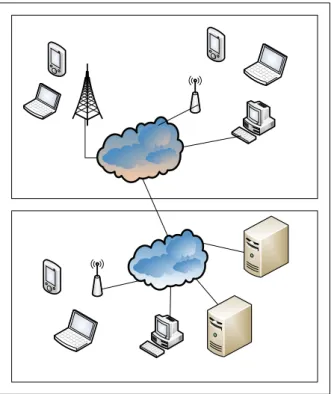
The model, as shown in Figure 1, is a Web-based architecture and provides the necessary learning across multiple platforms, such as PCs, laptop and mobile devices by providing appropriate content for each platform, in the proper context and using only open-source software. The explicit division into two parts (Outside and Inside) is due to the two conditions listed above - technical and economic - associated to the learning context.
The model will allow the student to get a great efficiency in his learning process, since the factors presented and described in Section II.B are considered an integral part of the proposed model. Thus, it is ensured that the student has the conditions to access to relevant content at a given time and with cost control.
Figure 1 - Proposed Model. 3.1 Learning content types
The content for the classes should be adequately prepared by the responsible professors. The learning contents are shaped so that when read (text) or perceived (image/video) or heard (audio), the student does not spend more than 5 minutes with the learning activity, especially with audio and video content.
The text form dominates all other forms of study, since it is in this format that tasks are required to be achieved by students, for example studying theoretical concepts and practical examples, and solving a set of challenges.
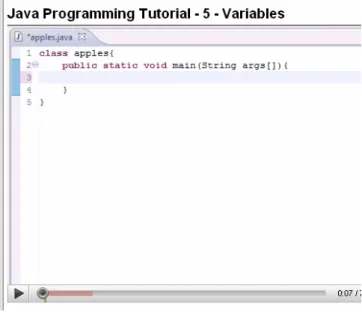
The vision form (image / video) is produced by a set of video tutorials, lasting less than 5 minutes (for example, in a class program that uses the Java language it is possible to have tutorials like the one shown in Figure 2), which allows students to review the classes contents anywhere and using any platform.
The audio contents are used with small pod casts explanation of the most important concepts taught in a given class.
However, we must emphasize that the most widely contents used are text due to limitations of mobile devices, with special emphasis on communications and their costs.
At the end of learning activity, there will be a knowledge assessment about the distributed content. This allows students to assess their level of understanding, and teachers to perceive the occurrence and evolution of eventual student’s detours in the process of goals
Figure 2 - Tutorial video Java example.
The assessment is undertaken in two different ways: theoretical questions about the concepts through quizzes that will always be different for each students and practical issues, that is, the system proposes a set of exercises on learning activity, the student submits the solution to the tool associated with UC, identified in Figure 2 as "Application Server". In both cases the student gets an immediate response, allowing the assessment of his performance.
3.2 Learning content according to context
As the student who uses the m-learning is not stationary but mobile, it is possible to perform different learning activities at any time and in different places, so the context plays an important role in the learning activity.
The learning content should be distributed according to the context in which the student is in that moment. Thus, they can be defined as contextual elements, the time of the day (morning, afternoon, evening), the type of the day (week, weekend, weekends, holidays, vacation), the mobile device communication mode (Wi-Fi, 3G, etc.), students physical activity (stationary or moving) and the place where learning activity is being conducted. With these elements, it is possible to distribute contents and type of contents according to context.
3.3 Learning activities log
Information on learning activities is collected in the Learning Management System (LMS) associated to the model and in the tool used specifically for each UC. When a student receives or performs a learning activity, regardless of the platform that is using, a set of information is stored which will enable the verification of when, where and how long the activity was performed.
Since the learning activity can be performed on a mobile device it is necessary to take into consideration the environment, i.e., where the activity is being held – stationary (in the cafeteria, bar, home), walking (traveling between buildings on campus), traveling (home / institution, institution / home) or in group (study rooms, casual meetings, etc.)... This information is necessary since it is directly related to the type of resources that the student
may have, for example, he may be on campus and have Wi-Fi access, or be at home and have access only by 3G, so the communications features as well as costs may be very different.
3.4 Content delivery schedules
The content delivery should be performed according to the moments in which the student is. These moments can be divided into: (i) at home, (ii) in the institution during the classes and (iii) breaks. This separation in moments is directly related to the contexts in which the student is in each moment.
4 Proposed tools
The proposed model uses two types of tools: a LMS and a specific tool for one or more classes. The LMS MOODLE is used due to its characteristics and higher education
penetration rate in institutions [20]. However, it only makes sense to use this LMS if it could be integrated into an m-learning model. This condition occurs through MOODLE-MLE (Mobile Learning Engine - MOODLE). The tool used for the programming classes is the Mooshak.
4.1 MOODLE
The platform MOODLE is used to make the whole control of the UC, in particular, its
description, necessary bibliography, PDF documents supporting presence classes and distance learning, use of diagnostic tests, and demonstration videos of the various stages of what is taught.
The use of LMS in this model would only make sense if it could be also used in mobile devices. So, it is proposed an integration of the MLE-Moodle, also open-source, completely free and adaptable, in the Virtual Learning Environment (AVA) MOODLE. Any changes made in Moodle are automatically converted to mobile devices [21].
Access to the MLE-Moodle via mobile devices is performed in the device browser. The tools that can be accessed via mobile devices are: (i) Lesson (ii) Quizzes (iii) Questionnaire (iv) Board, (v) Wikis (vi) Resources (access to a variety of Moodle resources via mobile device, such as text, HTML text, images, video, audio, links and manage files), (vii) Instant
Messaging (viii) Specific resources to m-Learning: Flashcard Trainer, Mobile Learning Objects (off-line learning objects), Mobile Tags (location based services) and Mobile Community [22].
4.2 Programming tool
The programming tools presented in Section II, have weaknesses and none, with the exception of that presented in [18], is available for mobile devices.
In order to solve this issue two directions may be chosen: to develop a tool from scratch or to integrate an existing one, adapting it to the needs of the system that will be proposed. The chosen option was the second due to the features of the tool found, the Mooshak [23]
“Mooshak is a system for managing programming contests on the Web. Mooshak's basic
features include automatic judging of submitted programs, answering to clarification questions about problem descriptions, reevaluation of programs, tracking printouts, among many others.
Mooshak supports different kinds of contest, specially those based on ICPC rules. It has also support for IOI and "shortest program" contests, and can be easily extended for new types of contests.
The system was originally intended for contests, but it is increasingly being used in
programming courses: to give instant feedback on practical classes, to receive and validate assignments submissions, to pre-evaluate and mark assignments, etc.” [23]
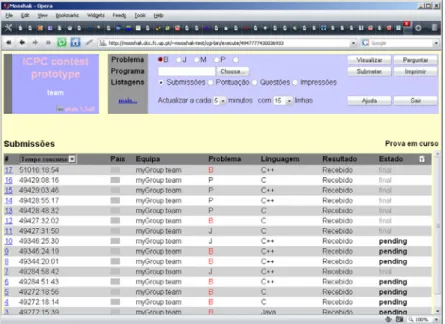
As it can be seen from the description above it is possible to make real-time programs submission and receive their answers, keep track of progress in resolving the exercise proposed, thereby enabling an improvement of teaching and student learning programming. The tool is not ready to be used in mobile devices due to the amount of information that is available on the page (see Figure 3). However, since the tool is designed for the web it is possible to adapt it to mobile devices.
Figure 3 - Results presentation screen obtained with the Mooshak
Thus, the tool will be properly adapted to mobile devices taking into account the features of existing devices, such as cost, security, battery life, screen size, data entry, storage, processing power and communication options.
5 Conclusion
The BML is now reported by some authors as an alternative to teaching/learning process ranging from the traditional classroom to e-learning.
In this context we propose a model that follows the principles of BML with the use of mobile technologies, with four components: (1) Types of learning context, (2) learning content according to context, (3) learning activities log and (4) time to content delivery.
The proposed approach has the costs as a determining factor in its design, using for this, open source software and content delivery according to context (e.g. home or university).
Mobile technologies are implemented in society and are familiar to students, allowing them to extend the learning process beyond the "walls of the classroom" in a targeted manner and according to the context.
In future the model will be implemented and tested in a given teaching/learning context.
References
:
[1] Oliveira, Fernando. Moreira, “Teaching and Learning with Social Software in Higher Education - Content Management Systems integrated with Web-based applications as a key factor for
success”. Proceedings of International Conference of Education, Research and Innovation (ICERI 2008) [CD-ROM]. Madrid, Espanha, 17 a 19 de November 2008
[2] S. Mary Jacob and B. Issac, “Mobile Technologies and its Impact – An Analysis in Higher Education Context”, iJIM – Volume 2, Issue 1, January 2008
[3] R. Queirós, M. Paulo Pinto, “EDUMCA: An Approach to Educational Mobile Content Adaptation”, CISTI 2009, vol. 1, pp 485-488, June 2009.
[4] F. Khaddge, E. Lenham, and W. Zhou, “A Mobile Learning Model for Universities: Re-Blending the Current Learning Environement”, iJIM – Volume 3, Special Issue 1:”ICML2009”, July 2009
[5] A. Mostakhdemin-Hosseini, “Analysis of Pedagogical Considerations of M-Learning in Smart Devices”, iJIM – Volume 3, Issue 4, pp. 33-34, October 2009
[6] C. Paes, Fernando Moreira, "Aprendizagem com Dispositivos Móveis: Aspectos Técnicos e Pedagógicos a Serem Considerados Num Sistema de Educação", Challenges 2007, pp. 23-32, Maio de 2007, Braga, Portugal
[7] N. Uday Bahaskar, P. Govindarajulu, “Advanced and Effective Learning in Context Aware anda Adaptative Mobile Learning Scenarios”, ”, iJIM – Volume 4, Issue 1, pp. 9-13, January 2010 [8] C. Paes, Fernando Moreira, "Dispositivos móveis: estratégia de gestão dos dispositivos na sala
de aula e o toolkit do professor ", Revista da Faculdade de Ciência e Tecnologia da Universidade Fernando Pessoa, Julho de 2007, Porto, Portugal
[9] C. Menezes, Fernando Moreira, “M-English – Podcast: a Tool for Mobile Devices”, Handbook of Research on Mobility and Computing: Evolving Technologies and Ubiquitous Impacts, Hershey: Information Science Reference (IGI), will be edited in 2010.
[10] Sobral, S. R.; Pimenta, P. C..” As mudanças no ensino superior e a oportunidade do e-learning”, Challanges VI Conferência Internacional de TIC na Educação, In Proceeding Challanges 2009, Braga, Portugal.
[11] Mendes, António J.. “Software Educativo para Apoio à Aprendizagem de Programação”. 2002. http://www.c5.cl/ieinvestiga/actas/tise01/pags/charlas/charla_mendes.htm.
[12] Areias, Cristiana e Mendes, António. “A tool to help students to develop programming skills”. [ed.] the 2007 international conference on Computer systems and technologies. New Yotk : ACM, 2007.
[13] E. Roberts, “An overview of MiniJava.” In SIGCSE’01, Proceedings of 32nd SIGCSE Technical Symposium on Computer Science Education, Charlotte, USA, pp. 1-5, February 2001
[14] M. Kolling, B. Quig, A. Petterson, and J. Rosenberg, “The BlueJ system and its pedagogy”, Journal of Computing Science Education, Special Issue of Learning and Teaching Object Technology, Vol 12, pp. 249-268, 2003
[15] R. Pattis, “Karel the Robot: A Gentle Introduction the Art of Programming”, John Wiley & Sons. [16] N. Truong, P. Bancroft, and P. Roe, “A web based environment for learning to program”,
Proceedings of the 26th Australasian Computer Science Conference, ACSC’03,Adelaide, Australia, pp. 255-264, 2003
[17] M. Ben-Ari, N. Myller, E. Sutinen, and J. Tarhio, “Perspectives on Program Animation with Jeliot”, Lecture Notes in Computer Science, Spring-Verlag, Vol. 2269, pp. 31-45, 2001.
[18] M. Marcelino, T. Mihaylov, and A. Mendes, “H-SICAS, a Handheld Algorithm Animation and Simulation Tool to Support Initial Programming Learning”, 38th ASEE/IEEE Frontiers in Education Conference, Saratoga Springs, NY, EUA, October 2008.
[19] Y.-Kai Wang, “Context Awareness and Adaptation in Mobile Learning”, In the Proceeedings of 2nd IEEE International Workshop on Wireless and Mobile Technologies in Education (WMTE’04), 2004.
[20] Sobral, S. R., Pimenta, P. C.. "Estratégias na aprendizagem da programação: como o LMS se pode tornar útil", Conferência Ibero-Americana WWW/Internet 2008, In Proceeding CIAWI 2008, Lisboa, Portugal.
[21] M. Yingling, “Mobile Moodle”, Muhlenberg College. Disponível em: <http://portal.acm.org/ citation.cfm?id=1127487>. Acedido em: 28 Janeiro 2010.
[22] MLE-MOODLE – END USERS. MLE-Moodle. 2009. Disponível em: <http://mle.sourceforge.net/ mlemoodle/index.php?lang=en>. Acedido em: 28 Janeiro 2009.
[23] Mooshak, 2009, Disponível em: <http://mooshak.dcc.fc.up.pt/> Acedido em 28 Janeiro de 2009.
Author(s)
:
Fernando Moreira, PhD
Universidade Portucalense, Departamento de Inovação, Ciência e Tecnologia Rua Dr. António Bernardino de Almeida, 541, 4200 Porto, Portugal
Maria João Ferreira, PhD
Universidade Portucalense, Departamento de Inovação, Ciência e Tecnologia Rua Dr. António Bernardino de Almeida, 541, 4200 Porto, Portugal
Sónia Rolland Sobral, PhD
Universidade Portucalense, Departamento de Inovação, Ciência e Tecnologia Rua Dr. António Bernardino de Almeida, 541, 4200 Porto, Portugal