EUROPEAN ORGANIZATION FOR NUCLEAR RESEARCH (CERN)
CERN-PH-EP/2012-116 2013/03/03
CMS-HIN-11-003
Measurement of the pseudorapidity and centrality
dependence of the transverse energy density in PbPb
collisions at
√
s
NN=
2.76 TeV
The CMS Collaboration
∗Abstract
The transverse energy (ET) in PbPb collisions at 2.76 TeV nucleon-nucleon
center-of-mass energy (√sNN) has been measured over a broad range of pseudorapidity (η) and collision centrality using the CMS detector at the LHC. The transverse energy den-sity per unit pseudorapidity (dET/dη) increases faster with collision energy than the
charged particle multiplicity. This implies that the mean energy per particle is in-creasing with collision energy. At all pseudorapidities the transverse energy per par-ticipating nucleon increases with the centrality of the collision. The ratio of transverse energy per unit pseudorapidity in peripheral to central collisions varies significantly as the pseudorapidity increases from η = 0 to |η| = 5.0. For the 5% most central
collisions the energy density per unit volume is estimated to be about 14 GeV/fm3at a time of 1 fm/c after the collision. This is about 100 times larger than normal nuclear matter density and a factor of 2.6 times higher than the energy density reported at
√
sNN =200 GeV at RHIC.
Submitted to Physical Review Letters
∗See Appendix A for the list of collaboration members
1
The goal of relativistic heavy-ion collisions is to study the behavior of quarks and gluons under extreme conditions of pressure, density, and temperature, such as those that existed shortly af-ter the Big Bang. Similar conditions can be reproduced in the laboratory by colliding heavy nu-clei at the highest possible energies. Experiments at the Relativistic Heavy Ion Collider (RHIC) have shown that at nucleon-nucleon center-of-mass energy of√sNN = 200 GeV a strongly in-teracting medium is produced. This system behaves as an almost perfect quantum fluid [1–4]. There are also indications from the RHIC experiments that at these energies the initial state of the colliding nuclei may be a color glass condensate [1, 5, 6]. The presence of such a state may affect the spatial distribution of partons within the nucleus, particularly at high pseudorapid-ity [7, 8]. Measuring the distribution of transverse energy over a wide pseudorapidpseudorapid-ity range sheds light also on the longitudinal expansion of the system. In 2010, the Large Hadron Collider (LHC) accelerated heavy ions to energies 14 times higher than RHIC in order to produce matter at energy densities never achieved before. One of the basic measurements in this new regime is that of the energy distribution of all the produced particles, which is connected to the initial energy and entropy densities of the produced matter. At lower energies, the measured rapidity distributions of particles are generally well described by Gaussians. The widths of these distri-butions are consistent with the predictions of Landau hydrodynamics, i.e. σy = pln γ, where
γis the Lorentz factor of the colliding beams [9–13]. The rapidity variable, y ≡ tanh−1(vz/c),
where vzis the velocity of the particle along the beam direction z, provides a way to describe
the longitudinal distribution of matter created in these collisions. Calorimeters measure only the energy deposited at various angles and therefore the data are presented in terms of the dis-tribution of energy in pseudorapidity, η. Pseudorapidity is defined as η≡ −ln[tan(θ/2)], with θthe polar angle with respect to the z axis. When the momentum of a particle is larger than its
mass, its η≈y.
The Compact Muon Solenoid (CMS) experiment is a general-purpose detector designed to study hadron collisions at the TeV scale [14]. In particular, it has almost hermetic calorime-try that is sensitive to the distribution of energy over nearly the complete angular range. The transverse energy is defined by ET= ∑iEisin θi, where Eiis the energy seen by the calorimeter
for the ith particle, θi is the polar angle of particle i, and the sum is over all particles emitted
into a fixed solid angle in an event. The quantity dET/dη is an approximately Lorentz
invari-ant measure of the energy distribution. The transverse energy is studied as a function of the geometry of the collision, i.e. the centrality, of the heavy-ion interaction. Finally, comparisons are made with lower energy data and theoretical models.
The central feature of the CMS apparatus is a superconducting solenoid, of 6 m internal diam-eter, providing a magnetic field of 3.8 T. Within the central field volume are the silicon pixel and strip trackers, lead-tungstate crystal electromagnetic calorimeter (ECAL) and the brass-scintillator hadron calorimeter (HCAL). These calorimeters are physically divided into the bar-rel and endcap regions covering together the region of|η| <3.0. The Hadronic Forward (HF)
calorimeters cover|η|from 2.9 to 5.2. The HF calorimeters use quartz fibers embedded within
a steel absorber. The CMS tracking system, located inside the calorimeter, consists of pixel and silicon-strip layers covering|η| < 2.5. A set of scintillator tiles, the Beam Scintillator Counters
(BSC), are mounted on the inner side of the HF calorimeters to trigger on heavy-ion collisions and reject beam-halo interactions. In addition, two Zero Degree Calorimeters (ZDC) are used for systematic checks. For more details on CMS see [14].
In 2010, CMS recorded PbPb collision data corresponding to an integrated luminosity of 7.36 µb−1 of which 0.31 µb−1 were included in this analysis. This luminosity selection provided a data sample with negligible statistical uncertainties. Minimum bias inelastic PbPb collisions were selected by requiring that either the HF or BSC counters detected a signal on both sides of the
interaction point. In the analysis at least two reconstructed tracks were required to form a ver-tex within ±25 cm of the nominal interaction point along the beam line and within a radius of 2 cm measured perpendicular to the beam relative to the average vertex position. Large-multiplicity beam-background events were removed by requiring the compatibility of the ob-served pixel-cluster lengths with the hypothesis of a PbPb interaction at the estimated vertex. Finally, events containing beam-halo muons were eliminated by a timing requirement on the BSC counters on opposite sides of the interaction point. The total event selection efficiency of the minimum bias trigger for hadronic PbPb interactions was found to be(97±3)% [15]. Events were sorted into different centrality classes. The centrality of heavy-ion interactions is related to the number of participating nucleons and hence to the energy released in the colli-sions. In CMS, the centrality is defined as percentiles of the energy deposited in the HF. The most central/peripheral event class, i.e. (0–2.5)%/(70–80)% in this analysis, has a large/small number of participants and a large/small energy deposit in HF. In order to estimate the mean number of participating nucleons (hNparti) and its systematic uncertainty for each centrality
class, a Glauber model of the nuclear collision was used [16–18].
The data were corrected for detector acceptance and inefficiencies using correction factors C(|η|) estimated from the HYDJET 1.8 [19] Monte Carlo (MC) event generator coupled to a
GEANT4 [20] CMS detector simulation. These correction factors were calculated as the ratio of
MC predictions at the particle level and the detector level for each centrality class. The correc-tion factor C(|η|) ≈1.6 for|η| <2, falls to≈1.1 by|η|= 4 and then rises to 2 at|η| ≈ 5. The
non-linearity of the calorimeter response and the effect of the magnetic field cause the C(|η|)
to depend upon the pT spectra, the ratio of charged and neutral particles, and the mixture of
mesons and baryons. The value of C(|η|)increases if the assumed spectra shifts to lower pT
or if the ratio of charged to neutral particles is larger. To estimate the systematic uncertainties in C(|η|), two tunes ofHYDJET(1.6 and 1.8) were used. HYDJET1.8,hpTich = 0.66 GeV/c, was
tuned to LHC spectra and particle yields as measured by the ALICE collaboration [21] and successfully tested against a wide range of RHIC data. HYDJET 1.6,hpTich = 0.57 GeV/c, was
only tuned to RHIC data [19]. At central pseudorapidity the fraction of ETcarried by charged
pions, kaons, protons and antiprotons is 0.60 forHYDJET 1.6 and 0.62 forHYDJET1.8. The re-sults were cross checked using data taken with no magnetic field and in addition, for B = 3.8 T, data from tracks with pT >900 MeV/c were combined with energy clusters in the calorimeters
to identify different types of particles and measure their energy. Since muons and neutrinos carry a negligible fraction of the total transverse energy and deposit almost no signal in the calorimeters they are not considered in this analysis and no correction factors are applied to account for them. The corrected transverse energy for N analyzed events is obtained as
dET
dη (|η|) =C(|η|) ·
∑jET,j(|η|)
N× (2×∆η) (1)
where the sum over j covers all calorimeters cells located within the η range∆η and ET,jis the
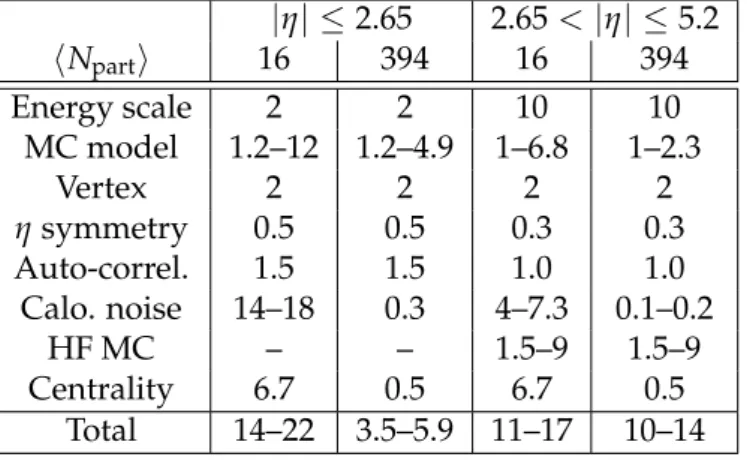
transverse energy measured in a particular cell j. Note that for this summation no threshold is applied to the individual calorimeters cells. Several sources of systematic uncertainties were studied and their effects are summarized in Table 1 and described below. Energy Scale: all of the calorimeters were initially calibrated with test beam data and radioactive sources. For the barrel and inner endcap calorimeters these calibrations were refined using isolated charged hadrons whose momentum was reconstructed in the tracker. For the HF calorimeter the en-ergy scale was cross-checked by reconstructing Z → e+e− in pp collisions where either the positron or the electron was recorded in the ECAL and tracker. Symmetry about η: for PbPb collisions the corrected dET/dη should be symmetric about η = 0. The values of dET/dη for
3
positive and negative η were found to differ by at most 0.5%. This close agreement implies that one can use the average of the two results as a best estimate of dET/dη. Vertex
distri-bution: the z distribution of the vertices is Gaussian with σz ≈ 6.1 cm. To test the sensitivity
of ET to the position of the interaction vertex along the beam line, z, the dataset was divided
into two samples with |z| < 10 cm and 10 cm < |z| < 25 cm, respectively. The ET
distribu-tions of the two samples differ by less than 2%. Auto-correladistribu-tions: since HF is used both to calculate centrality and to measure ET for each centrality class, there is an auto-correlation in
the measurement. This effect was estimated to be less than 1.5% by using a combination of the ZDC and pixel detectors to measure centrality. Calorimeter noise: the GEANT4 simulation of the calorimeters included electronic noise. This noise was measured by studying a sample of events where the trigger only required the presence of clockwise and anticlockwise bunches of lead ions simultaneously in CMS. The simulation of the noise was checked by comparing the data to the simulated signal from a GEANT4 simulation of the most peripheral events in the
data set. Any discrepancy in the simulation of the noise corresponds to a corrected average ET per event of less than 5.8 GeV for|η| ≤ 2.65 and 1.2 GeV for 2.65 < |η| ≤ 5.2. This is only
significant compared to the signal for hNparti ≤ 30. HF MC description: takes into account
different ways of describing the dead areas of the HF detector. Centrality determination: the systematic uncertainty related to the centrality determination is only applied to the results that are normalized byhNparti.
Table 1: Systematic uncertainties for two |η| regions in % for the most central (0–2.5)%
(hNparti= 394) and most peripheral (70–80)% (hNparti =16) collisions. |η| ≤2.65 2.65< |η| ≤5.2 hNparti 16 394 16 394 Energy scale 2 2 10 10 MC model 1.2–12 1.2–4.9 1–6.8 1–2.3 Vertex 2 2 2 2 ηsymmetry 0.5 0.5 0.3 0.3 Auto-correl. 1.5 1.5 1.0 1.0 Calo. noise 14–18 0.3 4–7.3 0.1–0.2 HF MC – – 1.5–9 1.5–9 Centrality 6.7 0.5 6.7 0.5 Total 14–22 3.5–5.9 11–17 10–14
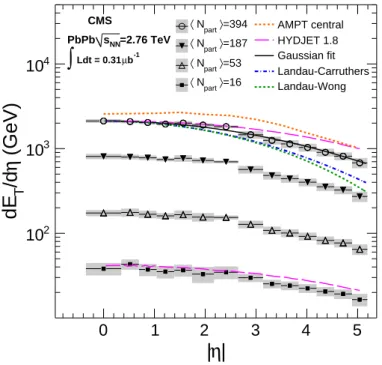
Figure 1 shows the |η| dependence of the transverse energy density for four selected ranges
of centrality. For the most central collisions (hNparti = 394) dET/dη reaches 2.1 TeV at η = 0.
This is much larger than the value of 0.61 TeV measured at √sNN = 200 GeV [22]. At lower center-of-mass energies the pion multiplicity distributions are reasonably well described by Gaussians in rapidity with widths that are consistent with Landau-Carruthers hydrodynam-ics [23, 24]. Since the mean pT of all particle species depends only weakly on rapidity, this
implies that dET/dy is roughly Gaussian in rapidity at √
sNN = 200 GeV. Recently, Wong has improved the formulation of Landau hydrodynamics [25]. This new formulation gives a better description of the 200 GeV RHIC data. At √sNN = 2.76 TeV and for |η| < 5.2 the dET/dη is
consistent with a Gaussian (black solid line) with ση =3.4±0.1 for the most central collisions.
The Gaussian and Landau curves in Fig. 1 are normalized to the CMS data at η =0. Both the Landau-Carruthers (blue dashed), and Landau-Wong (green dotted) formulations have distri-butions that are narrower than the data. Therefore the longitudinal expansion of the system is stronger than that predicted from either model. HYDJET1.8, shown by the purple dashed line, has been tuned to LHC data in the small|η|region. It gives a good description of dET/dη at
Transport) model [26, 27] (orange dashed line) overestimates dET/dη for central collisions but
is in rough agreement with the shape of dET/dη. Integrating (dET/dη)/(hNparti/2) over η
between−5.2 and 5.2 gives a total measured ETper participant pair of 80±4 GeV for the most
central events. This serves as a lower limit for the total transverse energy per nucleon pair. Extrapolating to the full phase space gives a total transverse energy per pair of participating nucleons of 91±5 GeV for the most central events. It is clear from Fig. 1 that the magnitude of dET/dη increases rapidly with the number of nucleons participating in the collision.
|
η
|
0 1 2 3 4 5(GeV)
η
/d
TdE
2 10 3 10 4 10 =394 〉 part N 〈 =187 〉 part N 〈 =53 〉 part N 〈 =16 〉 part N 〈 AMPT central HYDJET 1.8 Gaussian fit Landau-Carruthers Landau-Wong CMS =2.76 TeV NN s PbPb -1 b µ Ldt = 0.31∫
Figure 1: Transverse energy density versus |η|distribution for a range of centralities of (0–
2.5)%, (20–30)%, (50–60)% and (70–80)%. The boxes show the total systematic uncertainties. The statistical uncertainties are negligible. Also shown are a Gaussian fit and the predictions of various models (see text). The AMPT events are for perfectly central collisions.
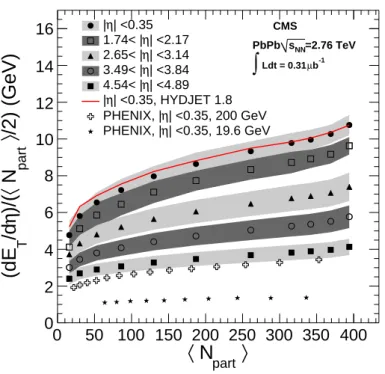
Figure 2 shows the evolution of(dET/dη)/(hNparti/2)withhNpartifor several|η|regions. At
all|η|values(dET/dη)/(hNparti/2)increases withhNparti. This figure shows that thehNparti
dependence of transverse energy density changes as a function of pseudorapidity. This effect can be quantified by comparing peripheral (60–70)% (hNparti = 30) to central (0–2.5)%
colli-sions (hNparti =394) at various pseudorapidities. The ratio of peripheral to central(dET/dη)/(hNparti/2)
changes from 54±2% at η =0 to 68±2% at|η| =5.0. The PHENIX collaboration at RHIC has
studied transverse energy density in AuAu collisions for|η| < 0.35 over a wide range of
cen-tralities and for√sNNfrom 19.6 GeV to 200 GeV [22]. At√sNN =19.6 GeV(dET/dη)/(hNparti/2)
at η = 0 increases by a factor of 1.25±0.17 as hNpartiincreases from 63.8 to 336. At √
sNN =
2.76 TeV this factor is found to be 1.47±0.13 for a similar range ofhNparti. At √
sNN =2.76 TeV, theHYDJET1.8 code gives a good description of the centrality dependence of dET/dη at η =0.
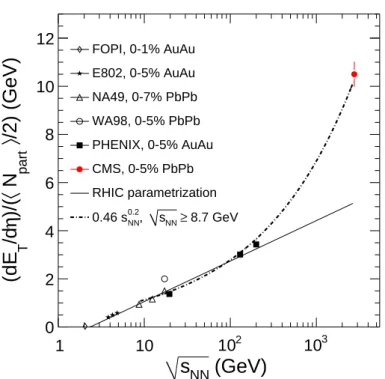
Figure 3 shows the energy dependence of(dET/dη)/(hNparti/2)for central collisions at η=0.
For the top 5% most central events (dET/dη)/(hNparti/2)reaches 10.5±0.5 GeV at √
sNN = 2.76 TeV. The ET rises more quickly with the center-of-mass energy than the logarithmic
de-pendence used to describe data up to √sNN = 200 GeV [22]. For energies between 8.7 GeV and 2.76 TeV, dET/dη at η = 0 can be reproduced by a power-law dependence of the type
5
〉
partN
〈
0 50 100 150 200 250 300 350 400/2) (GeV)
〉
partN
〈
)/(
η
/d
T(dE
0 2 4 6 8 10 12 14 16 |η| <0.35 | <2.17 η 1.74< | | <3.14 η 2.65< | | <3.84 η 3.49< | | <4.89 η 4.54< | | <0.35, HYDJET 1.8 η | | <0.35, 200 GeV η PHENIX, | | <0.35, 19.6 GeV η PHENIX, | CMS =2.76 TeV NN s PbPb -1 b µ Ldt = 0.31∫
Figure 2: Transverse energy density normalized by (hNparti/2) versushNpartifor PbPb
colli-sions at √sNN = 2.76 TeV at several values of|η|. The bands show the total systematic
uncer-tainties. The statistical uncertainties are negligible. For η =0 lower-energy PHENIX data and results from theHYDJET1.8 model are also shown.
snNN with n ≈ 0.2. A similar effect has been seen in the measurement of the√sNN evolution of the charged particle multiplicity [18, 28]. The(dET/dη)/(hNparti/2)increases by a factor of
3.07±0.24 from√sNN = 200 GeV to 2.76 TeV. This is to be compared to a factor of 2.17±0.15 for the pseudorapidity density, (dNch/dη)/(hNparti/2)[18, 21, 22]. For the 5% most central
collisions CMS has measured dET/dη = 2007±100 GeV and dNch/dη = 1612±55 [18].
Divid-ing the measured transverse energy by the observed charged particle multiplicity for the same centrality gives a transverse energy per charged particle of 1.25±0.08 GeV at√sNN = 2.76 TeV. This compares to 0.88±0.07 GeV at√sNN = 200 GeV [22].
The sum of the transverse energies of all particles produced in the event depends upon both the entropy and temperature of the system. Using geometrical considerations, Bjorken [37] suggested that the energy density per unit volume in nuclear collisions could be estimated from the energy density per unit rapidity. A commonly used estimate of energy density is given by [22]
e= 1
Acτ0
J(y, η)dET
dη . (2)
where A is the overlap area of the two nuclei and τ0is the formation time of the produced
sys-tem. The Jacobian J(y, η)depends on the momentum distributions of the produced particles. In the limit that the rest mass of the particles are much smaller than their momenta J(y, η) =1. The average Jacobian was calculated usingHYDJET 1.8 for|η| <0.35. For central collisions at
√
sNN = 2.76 TeV, J(y, η) = 1.09. This compares to 1.25 at√sNN = 200 GeV [22]. For the top 5% most central collisions this formula gives e = 14 GeV/fm3at a time τ0 = 1 fm/c and for a
transverse surface of A = π× (7 fm)2 [22]. This is a factor of 2.6 times larger than the energy
density calculated at√sNN =200 GeV [22].
(GeV)
NNs
1 10 102 103/2) (GeV)
〉
partN
〈
)/(
η
/d
T(dE
0 2 4 6 8 10 12 FOPI, 0-1% AuAu E802, 0-5% AuAu NA49, 0-7% PbPb WA98, 0-5% PbPb PHENIX, 0-5% AuAu CMS, 0-5% PbPb RHIC parametrization 8.7 GeV ≥ NN s , 0.2 NN 0.46 sFigure 3: Transverse energy density normalized by (hNparti/2) for central collisions at η = 0
versus√sNN. The vertical bar on the CMS point is the full systematic uncertainty. The statistical uncertainty is negligible. The solid line is a parametrization of lower-energy data compiled by the PHENIX Collaboration, see [22, 29–36]. The dashed line corresponds to a power law fit snNN for√sNN ≥8.7 GeV.
transverse energy distribution has been found to be 2.1 TeV at η = 0. Even at a very forward pseudorapidity of|η| = 5.0, dET/dη and hence the energy density of the produced system at
the LHC is larger than that measured for η = 0 at RHIC. At 2.76 TeV, the shape of dET/dη is
consistent with a Gaussian function of width ση = 3.4±0.1 for central collisions. This
distri-bution is wider than the prediction of Landau hydrodynamics but narrower than that given by theHYDJET1.8 simulation. The(dET/dη)/(hNparti/2)increases withhNpartiat all
pseudora-pidities. The ratio of transverse energy in peripheral compared to central collisions increases by a factor of 1.26±0.06 from η =0 to|η| = 5. The transverse energy density at η = 0 grows
more rapidly with the center-of-mass energy than the logarithmic scaling with√sNN that de-scribes lower-energy data. It also grows faster with energy than the multiplicity, implying a significant increase of the mean transverse energy per particle compared to lower energy data.
Acknowledgments
We wish to congratulate our colleagues in the CERN accelerator departments for the excellent performance of the LHC machine. We thank the technical and administrative staff at CERN and other CMS institutes, and acknowledge support from: FMSR (Austria); FNRS and FWO (Bel-gium); CNPq, CAPES, FAPERJ, and FAPESP (Brazil); MES (Bulgaria); CERN; CAS, MoST, and NSFC (China); COLCIENCIAS (Colombia); MSES (Croatia); RPF (Cyprus); Academy of Sci-ences and NICPB (Estonia); Academy of Finland, MEC, and HIP (Finland); CEA and CNRS/IN2P3 (France); BMBF, DFG, and HGF (Germany); GSRT (Greece); OTKA and NKTH (Hungary); DAE and DST (India); IPM (Iran); SFI (Ireland); INFN (Italy); NRF and WCU (Korea); LAS (Lithua-nia); CINVESTAV, CONACYT, SEP, and UASLP-FAI (Mexico); MSI (New Zealand); PAEC (Pak-istan); SCSR (Poland); FCT (Portugal); JINR (Armenia, Belarus, Georgia, Ukraine, Uzbek(Pak-istan);
References 7
MST and MAE (Russia); MSTD (Serbia); MICINN and CPAN (Spain); Swiss Funding Agencies (Switzerland); NSC (Taipei); TUBITAK and TAEK (Turkey); STFC (United Kingdom); DOE and NSF (USA). Individuals have received support from the Marie-Curie programme and the Euro-pean Research Council (EuroEuro-pean Union); the Leventis Foundation; the A. P. Sloan Foundation; the Alexander von Humboldt Foundation; the Associazione per lo Sviluppo Scientifico e Tec-nologico del Piemonte (Italy); the Belgian Federal Science Policy Office; the Fonds pour la For-mation `a la Recherche dans l’Industrie et dans l’Agriculture (FRIA-Belgium); the Agentschap voor Innovatie door Wetenschap en Technologie (IWT-Belgium); and the Council of Science and Industrial Research, India.
References
[1] BRAHMS Collaboration, “Quark–gluon plasma and color glass condensate at RHIC? The perspective from the BRAHMS experiment”, Nucl. Phys. A 757 (2005) 1,
doi:10.1016/j.nuclphysa.2005.02.130, arXiv:nucl-ex/0410020. [2] PHENIX Collaboration, “Formation of dense partonic matter in relativistic
nucleus-nucleus collisions at RHIC: Experimental evaluation by the PHENIX collaboration”, Nucl. Phys. A 757 (2005) 184,
doi:10.1016/j.nuclphysa.2005.03.086, arXiv:nucl-ex/0410003.
[3] PHOBOS Collaboration, “The PHOBOS perspective on discoveries at RHIC”, Nucl. Phys. A 757 (2005) 28, doi:10.1016/j.nuclphysa.2005.03.084,
arXiv:nucl-ex/0410022.
[4] STAR Collaboration, “Experimental and theoretical challenges in the search for the quark–gluon plasma: The STAR Collaboration’s critical assessment of the evidence from RHIC collisions”, Nucl. Phys. A 757 (2005) 102,
doi:10.1016/j.nuclphysa.2005.03.085, arXiv:nucl-ex/0501009. [5] E. Iancu, A. Leonidiv, and L. McLerran, “Nonlinear gluon evolution in the color glass
condensate: I”, Nucl. Phys. A 692 (2001) 583,
doi:10.1016/S0375-9474(01)00642-X, arXiv:hep-ph/0011241.
[6] STAR Collaboration, “Forward neutral pion production in p+p and d+Au collisions at√ sNN= 200 GeV”, Phys. Rev. Lett. 97 (2006) 152302,
doi:10.1103/PhysRevLett.97.152302, arXiv:nucl-ex/0602011.
[7] A. Adil et al., “Eccentricity in heavy-ion collisions from color glass condensate initial conditions”, Phys. Rev. C 74 (2006) 044905, doi:10.1103/PhysRevC.74.044905. [8] T. Hirano et al., “Hadronic dissipative effects on elliptic flow in ultrarelativistic heavy-ion
collisions”, Phys. Lett. B 636 (2006) 299, doi:10.1016/j.physletb.2006.03.060, arXiv:nucl-th/0511046.
[9] L. D. Landau, “On the multiparticle production in high-energy collisions”, Izv. Akad. Nauk Ser. Fiz. 17 (1953) 51.
[10] BRAHMS Collaboration, “Charged meson rapidity distributions in central Au+Au collisions at√sNN= 200 GeV”, Phys. Rev. Lett. 94 (2005) 162301,
[11] BRAHMS Collaboration, “Kaon and pion production in central Au+Au collisions at√ sNN= 62.4 GeV”, Phys. Lett. B 687 (2010) 36,
doi:10.1016/j.physletb.2010.02.078, arXiv:0911.2586.
[12] BRAHMS Collaboration, “Rapidity dependence of the proton-to-pion ratio in Au+Au and p+p collisions at√sNN= 62.4 GeV and 200 GeV”, Phys. Lett. B 684 (2010) 22,
doi:10.1016/j.physletb.2009.12.055, arXiv:0910.3328.
[13] S. Z. Belen’kij and L. D. Landau, “Hydrodynamic theory of multiple production of particles”, Nuovo Cim. Suppl. 3S1 (1956) 15, doi:10.1007/BF02745507.
[14] CMS Collaboration, “The CMS experiment at the CERN LHC”, JINST 3 (2008) S08004, doi:10.1088/1748-0221/3/08/S08004.
[15] CMS Collaboration, “Observation and studies of jet quenching in PbPb collisions at nucleon-nucleon center-of-mass energy = 2.76 TeV”, Phys. Rev. C 84 (2011) 024906, doi:10.1103/PhysRevC.84.024906, arXiv:1102.1957.
[16] M. L. Miller et al., “Glauber modeling in high energy nuclear collisions”, Ann. Rev. Nucl. Part. Sci. 57 (2007) 205, doi:10.1146/annurev.nucl.57.090506.123020,
arXiv:nucl-ex/0701025.
[17] B. Alver et al., “The PHOBOS Glauber Monte Carlo”, (2008). arXiv:0805.4411. [18] CMS Collaboration, “Dependence on pseudorapidity and centrality of charged hadron
production in PbPb collisions at a nucleon-nucleon centre-of-mass energy of 2.76 TeV”, JHEP 8 (2011) 141, doi:10.1007/JHEP08(2011)141, arXiv:1107.4800.
[19] I. P. Lokhtin and A. M. Snigirev, “A Model of jet quenching in ultrarelativistic heavy ion collisions and high-pT hadron spectra at RHIC”, Eur. Phys. J. C 45 (2006) 211,
doi:10.1140/epjc/s2005-02426-3, arXiv:hep-ph/0506189.
[20] GEANT4 Collaboration, “GEANT4: A Simulation toolkit”, Nucl. Instrum. Meth. A 506 (2003) 250, doi:10.1016/S0168-9002(03)01368-8.
[21] ALICE Collaboration, “Centrality dependence of the charged-particle multiplicity density at mid-rapidity in Pb-Pb collisions at√sNN= 2.76 TeV”, Phys. Rev. Lett. 106
(2011) 032301, doi:10.1103/PhysRevLett.106.032301, arXiv:1012.1657. [22] PHENIX Collaboration, “Systematic studies of the centrality and√sNNdependence of
dET/dη and dNch/dη in heavy ion collisions at mid-rapidity”, Phys. Rev. C 71 (2005)
034908, doi:10.1103/PhysRevC.71.034908, arXiv:nucl-ex/0409015.
[23] P. Carruthers and M. Duong-Van, “New scaling law based on the hydrodynamical model of particle production”, Phys. Lett. B 41 (1972) 597,
doi:10.1016/0370-2693(72)90643-0.
[24] P. Carruthers and M. Duong-Van, “Rapidity and Angular Distributions of Charged Secondaries According to the Hydrodynamical Model of Particle Production”, Phys. Rev. D 8 (1973) 859, doi:10.1103/PhysRevD.8.859.
[25] C.-Y. Wong, “Landau hydrodynamics revisited”, Phys. Rev. C 78 (2008) 054902, doi:10.1103/PhysRevC.78.054902, arXiv:0808.1294.
References 9
[26] B. Zhang et al., “A multi-phase transport model for nuclear collisions at RHIC”, Phys. Rev. C 61 (2000) 067901, doi:10.1103/PhysRevC.61.067901,
arXiv:nucl-th/9907017.
[27] Z.-W. Lin et al., “A multi-phase transport model for relativistic heavy ion collisions”, Phys. Rev. C 72 (2005) 064901, doi:10.1103/PhysRevC.72.064901,
arXiv:nucl-th/0411110.
[28] ALICE Collaboration, “Charged-particle multiplicity density at mid-rapidity in central Pb-Pb collisions at√sNN= 2.76 TeV”, Phys. Rev. Lett. 105 (2010) 252301,
doi:10.1103/PhysRevLett.105.252301.
[29] E-802 Collaboration, “Systematics of midrapidity transverse energy distributions in limited apertures from p+Be to Au+Au collisions at relativistic energies”, Phys. Rev. C 63 (2001) 064602, doi:10.1103/PhysRevC.63.064602.
[30] WA98 Collaboration, “Scaling of particle and transverse energy production in 208Pb + 208Pb collisions at 158 A GeV”, Eur. Phys. J. C 18 (2001) 651,
doi:10.1007/s100520100578, arXiv:nucl-ex/0008004.
[31] NA49 Collaboration, “Hadron production in nuclear collisions from the NA49 experiment at 158 GeV/c/A”, Nucl. Phys. A 661 (1999) 45,
doi:10.1016/S0375-9474(99)85007-6.
[32] NA49 Collaboration, “Recent results on spectra and yields from NA49”, Nucl. Phys. A
715(2003) 161, doi:10.1016/S0375-9474(02)01424-0, arXiv:nucl-ex/0208014.
[33] NA49 Collaboration, “Energy dependence of pion and kaon production in central Pb + Pb collisions”, Phys. Rev. C 66 (2002) 054902, doi:10.1103/PhysRevC.66.054902, arXiv:nucl-ex/0205002.
[34] FOPI Collaboration, “Central collisions of Au on Au at 150, 250 and 400 MeV/nucleon”, Nucl. Phys. A 612 (1997) 493, doi:10.1016/S0375-9474(96)00388-0,
arXiv:nucl-ex/9610009.
[35] FOPI Collaboration, “Charged pion production in Au on Au collisions at 1 A GeV”, Z. Phys. A 357 (1997) 215, doi:10.1007/s002180050236.
[36] FOPI Collaboration, “Proton and pion distributions in heavy-ion collisions at SIS energies”, Phys. Rev. C 66 (2002) 034901, doi:10.1103/PhysRevC.66.034901. [37] J. D. Bjorken, “Highly relativistic nucleus-nucleus collisions: The central rapidity region”,
11
A
The CMS Collaboration
Yerevan Physics Institute, Yerevan, Armenia
S. Chatrchyan, V. Khachatryan, A.M. Sirunyan, A. Tumasyan
Institut f ¨ur Hochenergiephysik der OeAW, Wien, Austria
W. Adam, T. Bergauer, M. Dragicevic, J. Er ¨o, C. Fabjan1, M. Friedl, R. Fr ¨uhwirth1, V.M. Ghete, J. Hammer, N. H ¨ormann, J. Hrubec, M. Jeitler1, W. Kiesenhofer, V. Kn ¨unz, M. Krammer1, D. Liko, I. Mikulec, M. Pernicka†, B. Rahbaran, C. Rohringer, H. Rohringer, R. Sch ¨ofbeck, J. Strauss, A. Taurok, P. Wagner, W. Waltenberger, G. Walzel, E. Widl, C.-E. Wulz1
National Centre for Particle and High Energy Physics, Minsk, Belarus
V. Mossolov, N. Shumeiko, J. Suarez Gonzalez
Universiteit Antwerpen, Antwerpen, Belgium
S. Bansal, T. Cornelis, E.A. De Wolf, X. Janssen, S. Luyckx, T. Maes, L. Mucibello, S. Ochesanu, B. Roland, R. Rougny, M. Selvaggi, Z. Staykova, H. Van Haevermaet, P. Van Mechelen, N. Van Remortel, A. Van Spilbeeck
Vrije Universiteit Brussel, Brussel, Belgium
F. Blekman, S. Blyweert, J. D’Hondt, R. Gonzalez Suarez, A. Kalogeropoulos, M. Maes, A. Olbrechts, W. Van Doninck, P. Van Mulders, G.P. Van Onsem, I. Villella
Universit´e Libre de Bruxelles, Bruxelles, Belgium
B. Clerbaux, G. De Lentdecker, V. Dero, A.P.R. Gay, T. Hreus, A. L´eonard, P.E. Marage, T. Reis, L. Thomas, C. Vander Velde, P. Vanlaer, J. Wang
Ghent University, Ghent, Belgium
V. Adler, K. Beernaert, A. Cimmino, S. Costantini, G. Garcia, M. Grunewald, B. Klein, J. Lellouch, A. Marinov, J. Mccartin, A.A. Ocampo Rios, D. Ryckbosch, N. Strobbe, F. Thyssen, M. Tytgat, P. Verwilligen, S. Walsh, E. Yazgan, N. Zaganidis
Universit´e Catholique de Louvain, Louvain-la-Neuve, Belgium
S. Basegmez, G. Bruno, R. Castello, L. Ceard, C. Delaere, T. du Pree, D. Favart, L. Forthomme, A. Giammanco2, J. Hollar, V. Lemaitre, J. Liao, O. Militaru, C. Nuttens, D. Pagano, A. Pin, K. Piotrzkowski, N. Schul, J.M. Vizan Garcia
Universit´e de Mons, Mons, Belgium
N. Beliy, T. Caebergs, E. Daubie, G.H. Hammad
Centro Brasileiro de Pesquisas Fisicas, Rio de Janeiro, Brazil
G.A. Alves, M. Correa Martins Junior, D. De Jesus Damiao, T. Martins, M.E. Pol, M.H.G. Souza
Universidade do Estado do Rio de Janeiro, Rio de Janeiro, Brazil
W.L. Ald´a J ´unior, W. Carvalho, A. Cust ´odio, E.M. Da Costa, C. De Oliveira Martins, S. Fonseca De Souza, D. Matos Figueiredo, L. Mundim, H. Nogima, V. Oguri, W.L. Prado Da Silva, A. Santoro, L. Soares Jorge, A. Sznajder
Instituto de Fisica Teorica, Universidade Estadual Paulista, Sao Paulo, Brazil
C.A. Bernardes3, F.A. Dias4, T.R. Fernandez Perez Tomei, E. M. Gregores3, C. Lagana, F. Marinho, P.G. Mercadante3, S.F. Novaes, Sandra S. Padula
Institute for Nuclear Research and Nuclear Energy, Sofia, Bulgaria
V. Genchev5, P. Iaydjiev5, S. Piperov, M. Rodozov, S. Stoykova, G. Sultanov, V. Tcholakov, R. Trayanov, M. Vutova
University of Sofia, Sofia, Bulgaria
A. Dimitrov, R. Hadjiiska, V. Kozhuharov, L. Litov, B. Pavlov, P. Petkov
Institute of High Energy Physics, Beijing, China
J.G. Bian, G.M. Chen, H.S. Chen, C.H. Jiang, D. Liang, S. Liang, X. Meng, J. Tao, J. Wang, X. Wang, Z. Wang, H. Xiao, M. Xu, J. Zang, Z. Zhang
State Key Lab. of Nucl. Phys. and Tech., Peking University, Beijing, China
C. Asawatangtrakuldee, Y. Ban, S. Guo, Y. Guo, W. Li, S. Liu, Y. Mao, S.J. Qian, H. Teng, S. Wang, B. Zhu, W. Zou
Universidad de Los Andes, Bogota, Colombia
C. Avila, J.P. Gomez, B. Gomez Moreno, A.F. Osorio Oliveros, J.C. Sanabria
Technical University of Split, Split, Croatia
N. Godinovic, D. Lelas, R. Plestina6, D. Polic, I. Puljak5
University of Split, Split, Croatia
Z. Antunovic, M. Kovac
Institute Rudjer Boskovic, Zagreb, Croatia
V. Brigljevic, S. Duric, K. Kadija, J. Luetic, S. Morovic
University of Cyprus, Nicosia, Cyprus
A. Attikis, M. Galanti, G. Mavromanolakis, J. Mousa, C. Nicolaou, F. Ptochos, P.A. Razis
Charles University, Prague, Czech Republic
M. Finger, M. Finger Jr.
Academy of Scientific Research and Technology of the Arab Republic of Egypt, Egyptian Network of High Energy Physics, Cairo, Egypt
Y. Assran7, S. Elgammal8, A. Ellithi Kamel9, S. Khalil8, M.A. Mahmoud10, A. Radi11,12
National Institute of Chemical Physics and Biophysics, Tallinn, Estonia
M. Kadastik, M. M ¨untel, M. Raidal, L. Rebane, A. Tiko
Department of Physics, University of Helsinki, Helsinki, Finland
V. Azzolini, P. Eerola, G. Fedi, M. Voutilainen
Helsinki Institute of Physics, Helsinki, Finland
J. H¨ark ¨onen, A. Heikkinen, V. Karim¨aki, R. Kinnunen, M.J. Kortelainen, T. Lamp´en, K. Lassila-Perini, S. Lehti, T. Lind´en, P. Luukka, T. M¨aenp¨a¨a, T. Peltola, E. Tuominen, J. Tuominiemi, E. Tuovinen, D. Ungaro, L. Wendland
Lappeenranta University of Technology, Lappeenranta, Finland
K. Banzuzi, A. Karjalainen, A. Korpela, T. Tuuva
DSM/IRFU, CEA/Saclay, Gif-sur-Yvette, France
M. Besancon, S. Choudhury, M. Dejardin, D. Denegri, B. Fabbro, J.L. Faure, F. Ferri, S. Ganjour, A. Givernaud, P. Gras, G. Hamel de Monchenault, P. Jarry, E. Locci, J. Malcles, L. Millischer, A. Nayak, J. Rander, A. Rosowsky, I. Shreyber, M. Titov
Laboratoire Leprince-Ringuet, Ecole Polytechnique, IN2P3-CNRS, Palaiseau, France
S. Baffioni, F. Beaudette, L. Benhabib, L. Bianchini, M. Bluj13, C. Broutin, P. Busson, C. Charlot, N. Daci, T. Dahms, L. Dobrzynski, R. Granier de Cassagnac, M. Haguenauer, P. Min´e, C. Mironov, M. Nguyen, C. Ochando, P. Paganini, D. Sabes, R. Salerno, Y. Sirois, C. Veelken, A. Zabi
13
Institut Pluridisciplinaire Hubert Curien, Universit´e de Strasbourg, Universit´e de Haute Alsace Mulhouse, CNRS/IN2P3, Strasbourg, France
J.-L. Agram14, J. Andrea, D. Bloch, D. Bodin, J.-M. Brom, M. Cardaci, E.C. Chabert, C. Collard, E. Conte14, F. Drouhin14, C. Ferro, J.-C. Fontaine14, D. Gel´e, U. Goerlach, P. Juillot, A.-C. Le
Bihan, P. Van Hove
Centre de Calcul de l’Institut National de Physique Nucleaire et de Physique des Particules, CNRS/IN2P3, Villeurbanne, France, Villeurbanne, France
F. Fassi, D. Mercier
Universit´e de Lyon, Universit´e Claude Bernard Lyon 1, CNRS-IN2P3, Institut de Physique Nucl´eaire de Lyon, Villeurbanne, France
S. Beauceron, N. Beaupere, O. Bondu, G. Boudoul, J. Chasserat, R. Chierici5, D. Contardo, P. Depasse, H. El Mamouni, J. Fay, S. Gascon, M. Gouzevitch, B. Ille, T. Kurca, M. Lethuillier, L. Mirabito, S. Perries, V. Sordini, S. Tosi, Y. Tschudi, P. Verdier, S. Viret
Institute of High Energy Physics and Informatization, Tbilisi State University, Tbilisi, Georgia
Z. Tsamalaidze15
RWTH Aachen University, I. Physikalisches Institut, Aachen, Germany
G. Anagnostou, S. Beranek, M. Edelhoff, L. Feld, N. Heracleous, O. Hindrichs, R. Jussen, K. Klein, J. Merz, A. Ostapchuk, A. Perieanu, F. Raupach, J. Sammet, S. Schael, D. Sprenger, H. Weber, B. Wittmer, V. Zhukov16
RWTH Aachen University, III. Physikalisches Institut A, Aachen, Germany
M. Ata, J. Caudron, E. Dietz-Laursonn, M. Erdmann, A. G ¨uth, T. Hebbeker, C. Heidemann, K. Hoepfner, D. Klingebiel, P. Kreuzer, J. Lingemann, C. Magass, M. Merschmeyer, A. Meyer, M. Olschewski, P. Papacz, H. Pieta, H. Reithler, S.A. Schmitz, L. Sonnenschein, J. Steggemann, D. Teyssier, M. Weber
RWTH Aachen University, III. Physikalisches Institut B, Aachen, Germany
M. Bontenackels, V. Cherepanov, G. Fl ¨ugge, H. Geenen, M. Geisler, W. Haj Ahmad, F. Hoehle, B. Kargoll, T. Kress, Y. Kuessel, A. Nowack, L. Perchalla, O. Pooth, J. Rennefeld, P. Sauerland, A. Stahl
Deutsches Elektronen-Synchrotron, Hamburg, Germany
M. Aldaya Martin, J. Behr, W. Behrenhoff, U. Behrens, M. Bergholz17, A. Bethani, K. Borras, A. Burgmeier, A. Cakir, L. Calligaris, A. Campbell, E. Castro, F. Costanza, D. Dammann, C. Diez Pardos, G. Eckerlin, D. Eckstein, G. Flucke, A. Geiser, I. Glushkov, P. Gunnellini, S. Habib, J. Hauk, H. Jung, M. Kasemann, P. Katsas, C. Kleinwort, H. Kluge, A. Knutsson, M. Kr¨amer, D. Kr ¨ucker, E. Kuznetsova, W. Lange, W. Lohmann17, B. Lutz, R. Mankel, I. Marfin, M. Marienfeld, I.-A. Melzer-Pellmann, A.B. Meyer, J. Mnich, A. Mussgiller, S. Naumann-Emme, J. Olzem, H. Perrey, A. Petrukhin, D. Pitzl, A. Raspereza, P.M. Ribeiro Cipriano, C. Riedl, E. Ron, M. Rosin, J. Salfeld-Nebgen, R. Schmidt17, T. Schoerner-Sadenius, N. Sen, A. Spiridonov, M. Stein, R. Walsh, C. Wissing
University of Hamburg, Hamburg, Germany
C. Autermann, V. Blobel, J. Draeger, H. Enderle, J. Erfle, U. Gebbert, M. G ¨orner, T. Hermanns, R.S. H ¨oing, K. Kaschube, G. Kaussen, H. Kirschenmann, R. Klanner, J. Lange, B. Mura, F. Nowak, T. Peiffer, N. Pietsch, C. Sander, H. Schettler, P. Schleper, E. Schlieckau, A. Schmidt, M. Schr ¨oder, T. Schum, V. Sola, H. Stadie, G. Steinbr ¨uck, J. Thomsen, L. Vanelderen
Institut f ¨ur Experimentelle Kernphysik, Karlsruhe, Germany
C. Barth, J. Berger, T. Chwalek, W. De Boer, A. Dierlamm, M. Feindt, M. Guthoff5, C. Hackstein, F. Hartmann, M. Heinrich, H. Held, K.H. Hoffmann, S. Honc, I. Katkov16, J.R. Komaragiri, P. Lobelle Pardo, D. Martschei, S. Mueller, Th. M ¨uller, M. Niegel, A. N ¨urnberg, O. Oberst, A. Oehler, J. Ott, G. Quast, K. Rabbertz, F. Ratnikov, N. Ratnikova, S. R ¨ocker, A. Scheurer, F.-P. Schilling, G. Schott, H.J. Simonis, F.M. Stober, D. Troendle, R. Ulrich, J. Wagner-Kuhr, T. Weiler, M. Zeise
Institute of Nuclear Physics ”Demokritos”, Aghia Paraskevi, Greece
G. Daskalakis, T. Geralis, S. Kesisoglou, A. Kyriakis, D. Loukas, I. Manolakos, A. Markou, C. Markou, C. Mavrommatis, E. Ntomari
University of Athens, Athens, Greece
L. Gouskos, T.J. Mertzimekis, A. Panagiotou, N. Saoulidou
University of Io´annina, Io´annina, Greece
I. Evangelou, C. Foudas5, P. Kokkas, N. Manthos, I. Papadopoulos, V. Patras
KFKI Research Institute for Particle and Nuclear Physics, Budapest, Hungary
G. Bencze, C. Hajdu5, P. Hidas, D. Horvath18, F. Sikler, V. Veszpremi, G. Vesztergombi19
Institute of Nuclear Research ATOMKI, Debrecen, Hungary
N. Beni, S. Czellar, J. Molnar, J. Palinkas, Z. Szillasi
University of Debrecen, Debrecen, Hungary
J. Karancsi, P. Raics, Z.L. Trocsanyi, B. Ujvari
Panjab University, Chandigarh, India
S.B. Beri, V. Bhatnagar, N. Dhingra, R. Gupta, M. Jindal, M. Kaur, M.Z. Mehta, N. Nishu, L.K. Saini, A. Sharma, J. Singh
University of Delhi, Delhi, India
S. Ahuja, A. Bhardwaj, B.C. Choudhary, A. Kumar, A. Kumar, S. Malhotra, M. Naimuddin, K. Ranjan, V. Sharma, R.K. Shivpuri
Saha Institute of Nuclear Physics, Kolkata, India
S. Banerjee, S. Bhattacharya, S. Dutta, B. Gomber, Sa. Jain, Sh. Jain, R. Khurana, S. Sarkar, M. Sharan
Bhabha Atomic Research Centre, Mumbai, India
A. Abdulsalam, R.K. Choudhury, D. Dutta, S. Kailas, V. Kumar, P. Mehta, A.K. Mohanty5, L.M. Pant, P. Shukla
Tata Institute of Fundamental Research - EHEP, Mumbai, India
T. Aziz, S. Ganguly, M. Guchait20, M. Maity21, G. Majumder, K. Mazumdar, G.B. Mohanty, B. Parida, K. Sudhakar, N. Wickramage
Tata Institute of Fundamental Research - HECR, Mumbai, India
S. Banerjee, S. Dugad
Institute for Research in Fundamental Sciences (IPM), Tehran, Iran
H. Arfaei, H. Bakhshiansohi22, S.M. Etesami23, A. Fahim22, M. Hashemi, H. Hesari, A. Jafari22, M. Khakzad, M. Mohammadi Najafabadi, S. Paktinat Mehdiabadi, B. Safarzadeh24, M. Zeinali23
INFN Sezione di Baria, Universit`a di Barib, Politecnico di Baric, Bari, Italy
15
N. De Filippisa,c,5, M. De Palmaa,b, L. Fiorea, G. Iasellia,c, L. Lusitoa,b, G. Maggia,c, M. Maggia, B. Marangellia,b, S. Mya,c, S. Nuzzoa,b, N. Pacificoa,b, A. Pompilia,b, G. Pugliesea,c, G. Selvaggia,b, L. Silvestrisa, G. Singha,b, G. Zitoa
INFN Sezione di Bolognaa, Universit`a di Bolognab, Bologna, Italy
G. Abbiendia, A.C. Benvenutia, D. Bonacorsia,b, S. Braibant-Giacomellia,b, L. Brigliadoria,b, P. Capiluppia,b, A. Castroa,b, F.R. Cavalloa, M. Cuffiania,b, G.M. Dallavallea, F. Fabbria, A. Fanfania,b, D. Fasanellaa,b,5, P. Giacomellia, C. Grandia, L. Guiduccia,b, S. Marcellinia, G. Masettia, M. Meneghellia,b,5, A. Montanaria, F.L. Navarriaa,b, F. Odoricia, A. Perrottaa, F. Primaveraa,b, A.M. Rossia,b, T. Rovellia,b, G. Sirolia,b, R. Travaglinia,b
INFN Sezione di Cataniaa, Universit`a di Cataniab, Catania, Italy
S. Albergoa,b, G. Cappelloa,b, M. Chiorbolia,b, S. Costaa,b, R. Potenzaa,b, A. Tricomia,b, C. Tuvea,b
INFN Sezione di Firenzea, Universit`a di Firenzeb, Firenze, Italy
G. Barbaglia, V. Ciullia,b, C. Civininia, R. D’Alessandroa,b, E. Focardia,b, S. Frosalia,b, E. Galloa, S. Gonzia,b, M. Meschinia, S. Paolettia, G. Sguazzonia, A. Tropianoa,5
INFN Laboratori Nazionali di Frascati, Frascati, Italy
L. Benussi, S. Bianco, S. Colafranceschi25, F. Fabbri, D. Piccolo
INFN Sezione di Genovaa, Universit`a di Genovab, Genova, Italy
P. Fabbricatorea, R. Musenicha
INFN Sezione di Milano-Bicoccaa, Universit`a di Milano-Bicoccab, Milano, Italy
A. Benagliaa,b,5, F. De Guioa,b, L. Di Matteoa,b,5, S. Fiorendia,b, S. Gennaia,5, A. Ghezzia,b, S. Malvezzia, R.A. Manzonia,b, A. Martellia,b, A. Massironia,b,5, D. Menascea, L. Moronia,
M. Paganonia,b, D. Pedrinia, S. Ragazzia,b, N. Redaellia, S. Salaa, T. Tabarelli de Fatisa,b
INFN Sezione di Napolia, Universit`a di Napoli ”Federico II”b, Napoli, Italy
S. Buontempoa, C.A. Carrillo Montoyaa,5, N. Cavalloa,26, A. De Cosaa,b,5, O. Doganguna,b, F. Fabozzia,26, A.O.M. Iorioa, L. Listaa, S. Meolaa,27, M. Merolaa,b, P. Paoluccia,5
INFN Sezione di Padovaa, Universit`a di Padovab, Universit`a di Trento (Trento)c, Padova, Italy
P. Azzia, N. Bacchettaa,5, P. Bellana,b, D. Biselloa,b, A. Brancaa,b,5, R. Carlina,b, P. Checchiaa, T. Dorigoa, U. Dossellia, F. Gasparinia,b, U. Gasparinia,b, A. Gozzelinoa, K. Kanishcheva,c, S. Lacapraraa, I. Lazzizzeraa,c, M. Margonia,b, A.T. Meneguzzoa,b, M. Nespoloa,5, P. Ronchesea,b, F. Simonettoa,b, E. Torassaa, S. Vaninia,b, P. Zottoa,b, G. Zumerlea,b
INFN Sezione di Paviaa, Universit`a di Paviab, Pavia, Italy
M. Gabusia,b, S.P. Rattia,b, C. Riccardia,b, P. Torrea,b, P. Vituloa,b
INFN Sezione di Perugiaa, Universit`a di Perugiab, Perugia, Italy
M. Biasinia,b, G.M. Bileia, L. Fan `oa,b, P. Laricciaa,b, A. Lucaronia,b,5, G. Mantovania,b, M. Menichellia, A. Nappia,b, F. Romeoa,b, A. Sahaa, A. Santocchiaa,b, S. Taronia,b,5
INFN Sezione di Pisaa, Universit`a di Pisab, Scuola Normale Superiore di Pisac, Pisa, Italy
P. Azzurria,c, G. Bagliesia, T. Boccalia, G. Broccoloa,c, R. Castaldia, R.T. D’Agnoloa,c, R. Dell’Orsoa, F. Fioria,b,5, L. Fo`aa,c, A. Giassia, A. Kraana, F. Ligabuea,c, T. Lomtadzea,
L. Martinia,28, A. Messineoa,b, F. Pallaa, A. Rizzia,b, A.T. Serbana,29, P. Spagnoloa, P. Squillaciotia,5, R. Tenchinia, G. Tonellia,b,5, A. Venturia,5, P.G. Verdinia
INFN Sezione di Romaa, Universit`a di Romab, Roma, Italy
P. Meridiania,5, F. Michelia,b, S. Nourbakhsha,b, G. Organtinia,b, R. Paramattia, S. Rahatloua,b, M. Sigamania, L. Soffia,b
INFN Sezione di Torino a, Universit`a di Torino b, Universit`a del Piemonte Orientale (No-vara)c, Torino, Italy
N. Amapanea,b, R. Arcidiaconoa,c, S. Argiroa,b, M. Arneodoa,c, C. Biinoa, N. Cartigliaa, M. Costaa,b, N. Demariaa, A. Grazianoa,b, C. Mariottia,5, S. Masellia, E. Migliorea,b, V. Monacoa,b, M. Musicha,5, M.M. Obertinoa,c, N. Pastronea, M. Pelliccionia, A. Potenzaa,b, A. Romeroa,b, M. Ruspaa,c, R. Sacchia,b, A. Solanoa,b, A. Staianoa, A. Vilela Pereiraa
INFN Sezione di Triestea, Universit`a di Triesteb, Trieste, Italy
S. Belfortea, V. Candelisea,b, F. Cossuttia, G. Della Riccaa,b, B. Gobboa, M. Maronea,b,5,
D. Montaninoa,b,5, A. Penzoa, A. Schizzia,b
Kangwon National University, Chunchon, Korea
S.G. Heo, T.Y. Kim, S.K. Nam
Kyungpook National University, Daegu, Korea
S. Chang, D.H. Kim, G.N. Kim, D.J. Kong, H. Park, S.R. Ro, D.C. Son, T. Son
Chonnam National University, Institute for Universe and Elementary Particles, Kwangju, Korea
J.Y. Kim, Zero J. Kim, S. Song
Korea University, Seoul, Korea
S. Choi, D. Gyun, B. Hong, M. Jo, H. Kim, T.J. Kim, K.S. Lee, D.H. Moon, S.K. Park
University of Seoul, Seoul, Korea
M. Choi, J.H. Kim, C. Park, I.C. Park, S. Park, G. Ryu
Sungkyunkwan University, Suwon, Korea
Y. Cho, Y. Choi, Y.K. Choi, J. Goh, M.S. Kim, E. Kwon, B. Lee, J. Lee, S. Lee, H. Seo, I. Yu
Vilnius University, Vilnius, Lithuania
M.J. Bilinskas, I. Grigelionis, M. Janulis, A. Juodagalvis
Centro de Investigacion y de Estudios Avanzados del IPN, Mexico City, Mexico
H. Castilla-Valdez, E. De La Cruz-Burelo, I. Heredia-de La Cruz, R. Lopez-Fernandez, R. Maga ˜na Villalba, J. Mart´ınez-Ortega, A. S´anchez-Hern´andez, L.M. Villasenor-Cendejas
Universidad Iberoamericana, Mexico City, Mexico
S. Carrillo Moreno, F. Vazquez Valencia
Benemerita Universidad Autonoma de Puebla, Puebla, Mexico
H.A. Salazar Ibarguen
Universidad Aut ´onoma de San Luis Potos´ı, San Luis Potos´ı, Mexico
E. Casimiro Linares, A. Morelos Pineda, M.A. Reyes-Santos
University of Auckland, Auckland, New Zealand
D. Krofcheck
University of Canterbury, Christchurch, New Zealand
17
National Centre for Physics, Quaid-I-Azam University, Islamabad, Pakistan
M. Ahmad, M.I. Asghar, H.R. Hoorani, S. Khalid, W.A. Khan, T. Khurshid, S. Qazi, M.A. Shah, M. Shoaib
National Centre for Nuclear Research, Swierk, Poland
H. Bialkowska, B. Boimska, T. Frueboes, R. Gokieli, M. G ´orski, M. Kazana, K. Nawrocki, K. Romanowska-Rybinska, M. Szleper, G. Wrochna, P. Zalewski
Institute of Experimental Physics, Faculty of Physics, University of Warsaw, Warsaw, Poland
G. Brona, K. Bunkowski, M. Cwiok, W. Dominik, K. Doroba, A. Kalinowski, M. Konecki, J. Krolikowski
Laborat ´orio de Instrumenta¸c˜ao e F´ısica Experimental de Part´ıculas, Lisboa, Portugal
N. Almeida, P. Bargassa, A. David, P. Faccioli, P.G. Ferreira Parracho, M. Gallinaro, J. Seixas, J. Varela, P. Vischia
Joint Institute for Nuclear Research, Dubna, Russia
I. Belotelov, P. Bunin, M. Gavrilenko, I. Golutvin, I. Gorbunov, A. Kamenev, V. Karjavin, G. Kozlov, A. Lanev, A. Malakhov, P. Moisenz, V. Palichik, V. Perelygin, S. Shmatov, V. Smirnov, A. Volodko, A. Zarubin
Petersburg Nuclear Physics Institute, Gatchina (St. Petersburg), Russia
S. Evstyukhin, V. Golovtsov, Y. Ivanov, V. Kim, P. Levchenko, V. Murzin, V. Oreshkin, I. Smirnov, V. Sulimov, L. Uvarov, S. Vavilov, A. Vorobyev, An. Vorobyev
Institute for Nuclear Research, Moscow, Russia
Yu. Andreev, A. Dermenev, S. Gninenko, N. Golubev, M. Kirsanov, N. Krasnikov, V. Matveev, A. Pashenkov, D. Tlisov, A. Toropin
Institute for Theoretical and Experimental Physics, Moscow, Russia
V. Epshteyn, M. Erofeeva, V. Gavrilov, M. Kossov5, N. Lychkovskaya, V. Popov, G. Safronov, S. Semenov, V. Stolin, E. Vlasov, A. Zhokin
Moscow State University, Moscow, Russia
A. Belyaev, E. Boos, A. Ershov, A. Gribushin, V. Klyukhin, O. Kodolova, V. Korotkikh, I. Lokhtin, A. Markina, S. Obraztsov, M. Perfilov, S. Petrushanko, A. Popov, L. Sarycheva†, V. Savrin, A. Snigirev, I. Vardanyan
P.N. Lebedev Physical Institute, Moscow, Russia
V. Andreev, M. Azarkin, I. Dremin, M. Kirakosyan, A. Leonidov, G. Mesyats, S.V. Rusakov, A. Vinogradov
State Research Center of Russian Federation, Institute for High Energy Physics, Protvino, Russia
I. Azhgirey, I. Bayshev, S. Bitioukov, V. Grishin5, V. Kachanov, D. Konstantinov, A. Korablev, V. Krychkine, V. Petrov, R. Ryutin, A. Sobol, L. Tourtchanovitch, S. Troshin, N. Tyurin, A. Uzunian, A. Volkov
University of Belgrade, Faculty of Physics and Vinca Institute of Nuclear Sciences, Belgrade, Serbia
P. Adzic30, M. Djordjevic, M. Ekmedzic, D. Krpic30, J. Milosevic
Centro de Investigaciones Energ´eticas Medioambientales y Tecnol ´ogicas (CIEMAT), Madrid, Spain
Llatas, N. Colino, B. De La Cruz, A. Delgado Peris, D. Dom´ınguez V´azquez, C. Fernandez Bedoya, J.P. Fern´andez Ramos, A. Ferrando, J. Flix, M.C. Fouz, P. Garcia-Abia, O. Gonzalez Lopez, S. Goy Lopez, J.M. Hernandez, M.I. Josa, G. Merino, J. Puerta Pelayo, A. Quintario Olmeda, I. Redondo, L. Romero, J. Santaolalla, M.S. Soares, C. Willmott
Universidad Aut ´onoma de Madrid, Madrid, Spain
C. Albajar, G. Codispoti, J.F. de Troc ´oniz
Universidad de Oviedo, Oviedo, Spain
H. Brun, J. Cuevas, J. Fernandez Menendez, S. Folgueras, I. Gonzalez Caballero, L. Lloret Iglesias, J. Piedra Gomez
Instituto de F´ısica de Cantabria (IFCA), CSIC-Universidad de Cantabria, Santander, Spain
J.A. Brochero Cifuentes, I.J. Cabrillo, A. Calderon, S.H. Chuang, J. Duarte Campderros, M. Felcini31, M. Fernandez, G. Gomez, J. Gonzalez Sanchez, C. Jorda, A. Lopez Virto, J. Marco, R. Marco, C. Martinez Rivero, F. Matorras, F.J. Munoz Sanchez, T. Rodrigo, A.Y. Rodr´ıguez-Marrero, A. Ruiz-Jimeno, L. Scodellaro, M. Sobron Sanudo, I. Vila, R. Vilar Cortabitarte
CERN, European Organization for Nuclear Research, Geneva, Switzerland
D. Abbaneo, E. Auffray, G. Auzinger, P. Baillon, A.H. Ball, D. Barney, J.F. Benitez, C. Bernet6,
G. Bianchi, P. Bloch, A. Bocci, A. Bonato, C. Botta, H. Breuker, T. Camporesi, G. Cerminara, T. Christiansen, J.A. Coarasa Perez, D. D’Enterria, A. Dabrowski, A. De Roeck, S. Di Guida, M. Dobson, N. Dupont-Sagorin, A. Elliott-Peisert, B. Frisch, W. Funk, G. Georgiou, M. Giffels, D. Gigi, K. Gill, D. Giordano, M. Giunta, F. Glege, R. Gomez-Reino Garrido, P. Govoni, S. Gowdy, R. Guida, M. Hansen, P. Harris, C. Hartl, J. Harvey, B. Hegner, A. Hinzmann, V. Innocente, P. Janot, K. Kaadze, E. Karavakis, K. Kousouris, P. Lecoq, Y.-J. Lee, P. Lenzi, C. Lourenc¸o, T. M¨aki, M. Malberti, L. Malgeri, M. Mannelli, L. Masetti, F. Meijers, S. Mersi, E. Meschi, R. Moser, M.U. Mozer, M. Mulders, P. Musella, E. Nesvold, T. Orimoto, L. Orsini, E. Palencia Cortezon, E. Perez, L. Perrozzi, A. Petrilli, A. Pfeiffer, M. Pierini, M. Pimi¨a, D. Piparo, G. Polese, L. Quertenmont, A. Racz, W. Reece, J. Rodrigues Antunes, G. Rolandi32, T. Rommerskirchen, C. Rovelli33, M. Rovere, H. Sakulin, F. Santanastasio, C. Sch¨afer, C. Schwick, I. Segoni, S. Sekmen, A. Sharma, P. Siegrist, P. Silva, M. Simon, P. Sphicas34, D. Spiga, M. Spiropulu4, A. Tsirou, G.I. Veres19, J.R. Vlimant, H.K. W ¨ohri, S.D. Worm35, W.D. Zeuner
Paul Scherrer Institut, Villigen, Switzerland
W. Bertl, K. Deiters, W. Erdmann, K. Gabathuler, R. Horisberger, Q. Ingram, H.C. Kaestli, S. K ¨onig, D. Kotlinski, U. Langenegger, F. Meier, D. Renker, T. Rohe, J. Sibille36
Institute for Particle Physics, ETH Zurich, Zurich, Switzerland
L. B¨ani, P. Bortignon, M.A. Buchmann, B. Casal, N. Chanon, A. Deisher, G. Dissertori, M. Dittmar, M. D ¨unser, J. Eugster, K. Freudenreich, C. Grab, D. Hits, P. Lecomte, W. Lustermann, P. Martinez Ruiz del Arbol, N. Mohr, F. Moortgat, C. N¨ageli37, P. Nef, F.
Nessi-Tedaldi, F. Pandolfi, L. Pape, F. Pauss, M. Peruzzi, F.J. Ronga, M. Rossini, L. Sala, A.K. Sanchez, A. Starodumov38, B. Stieger, M. Takahashi, L. Tauscher†, A. Thea, K. Theofilatos, D. Treille, C. Urscheler, R. Wallny, H.A. Weber, L. Wehrli
Universit¨at Z ¨urich, Zurich, Switzerland
E. Aguilo, C. Amsler, V. Chiochia, S. De Visscher, C. Favaro, M. Ivova Rikova, B. Millan Mejias, P. Otiougova, P. Robmann, H. Snoek, S. Tupputi, M. Verzetti
19
Y.H. Chang, K.H. Chen, C.M. Kuo, S.W. Li, W. Lin, Z.K. Liu, Y.J. Lu, D. Mekterovic, A.P. Singh, R. Volpe, S.S. Yu
National Taiwan University (NTU), Taipei, Taiwan
P. Bartalini, P. Chang, Y.H. Chang, Y.W. Chang, Y. Chao, K.F. Chen, C. Dietz, U. Grundler, W.-S. Hou, Y. Hsiung, K.Y. Kao, Y.J. Lei, R.-W.-S. Lu, D. Majumder, E. Petrakou, X. Shi, J.G. Shiu, Y.M. Tzeng, X. Wan, M. Wang
Cukurova University, Adana, Turkey
A. Adiguzel, M.N. Bakirci39, S. Cerci40, C. Dozen, I. Dumanoglu, E. Eskut, S. Girgis, G. Gokbulut, E. Gurpinar, I. Hos, E.E. Kangal, G. Karapinar41, A. Kayis Topaksu, G. Onengut,
K. Ozdemir, S. Ozturk42, A. Polatoz, K. Sogut43, D. Sunar Cerci40, B. Tali40, H. Topakli39,
L.N. Vergili, M. Vergili
Middle East Technical University, Physics Department, Ankara, Turkey
I.V. Akin, T. Aliev, B. Bilin, S. Bilmis, M. Deniz, H. Gamsizkan, A.M. Guler, K. Ocalan, A. Ozpineci, M. Serin, R. Sever, U.E. Surat, M. Yalvac, E. Yildirim, M. Zeyrek
Bogazici University, Istanbul, Turkey
E. G ¨ulmez, B. Isildak44, M. Kaya45, O. Kaya45, S. Ozkorucuklu46, N. Sonmez47
Istanbul Technical University, Istanbul, Turkey
K. Cankocak
National Scientific Center, Kharkov Institute of Physics and Technology, Kharkov, Ukraine
L. Levchuk
University of Bristol, Bristol, United Kingdom
F. Bostock, J.J. Brooke, E. Clement, D. Cussans, H. Flacher, R. Frazier, J. Goldstein, M. Grimes, G.P. Heath, H.F. Heath, L. Kreczko, S. Metson, D.M. Newbold35, K. Nirunpong, A. Poll, S. Senkin, V.J. Smith, T. Williams
Rutherford Appleton Laboratory, Didcot, United Kingdom
L. Basso48, K.W. Bell, A. Belyaev48, C. Brew, R.M. Brown, D.J.A. Cockerill, J.A. Coughlan,
K. Harder, S. Harper, J. Jackson, B.W. Kennedy, E. Olaiya, D. Petyt, B.C. Radburn-Smith, C.H. Shepherd-Themistocleous, I.R. Tomalin, W.J. Womersley
Imperial College, London, United Kingdom
R. Bainbridge, G. Ball, R. Beuselinck, O. Buchmuller, D. Colling, N. Cripps, M. Cutajar, P. Dauncey, G. Davies, M. Della Negra, W. Ferguson, J. Fulcher, D. Futyan, A. Gilbert, A. Guneratne Bryer, G. Hall, Z. Hatherell, J. Hays, G. Iles, M. Jarvis, G. Karapostoli, L. Lyons, A.-M. Magnan, J. Marrouche, B. Mathias, R. Nandi, J. Nash, A. Nikitenko38, A. Papageorgiou,
J. Pela5, M. Pesaresi, K. Petridis, M. Pioppi49, D.M. Raymond, S. Rogerson, A. Rose, M.J. Ryan,
C. Seez, P. Sharp†, A. Sparrow, M. Stoye, A. Tapper, M. Vazquez Acosta, T. Virdee, S. Wakefield, N. Wardle, T. Whyntie
Brunel University, Uxbridge, United Kingdom
M. Chadwick, J.E. Cole, P.R. Hobson, A. Khan, P. Kyberd, D. Leslie, W. Martin, I.D. Reid, P. Symonds, L. Teodorescu, M. Turner
Baylor University, Waco, USA
K. Hatakeyama, H. Liu, T. Scarborough
The University of Alabama, Tuscaloosa, USA
Boston University, Boston, USA
A. Avetisyan, T. Bose, C. Fantasia, A. Heister, J. St. John, P. Lawson, D. Lazic, J. Rohlf, D. Sperka, L. Sulak
Brown University, Providence, USA
J. Alimena, S. Bhattacharya, D. Cutts, A. Ferapontov, U. Heintz, S. Jabeen, G. Kukartsev, E. Laird, G. Landsberg, M. Luk, M. Narain, D. Nguyen, M. Segala, T. Sinthuprasith, T. Speer, K.V. Tsang
University of California, Davis, Davis, USA
R. Breedon, G. Breto, M. Calderon De La Barca Sanchez, S. Chauhan, M. Chertok, J. Conway, R. Conway, P.T. Cox, J. Dolen, R. Erbacher, M. Gardner, R. Houtz, W. Ko, A. Kopecky, R. Lander, T. Miceli, D. Pellett, B. Rutherford, M. Searle, J. Smith, M. Squires, M. Tripathi, R. Vasquez Sierra
University of California, Los Angeles, Los Angeles, USA
V. Andreev, D. Cline, R. Cousins, J. Duris, S. Erhan, P. Everaerts, C. Farrell, J. Hauser, M. Ignatenko, C. Plager, G. Rakness, P. Schlein†, J. Tucker, V. Valuev, M. Weber
University of California, Riverside, Riverside, USA
J. Babb, R. Clare, M.E. Dinardo, J. Ellison, J.W. Gary, F. Giordano, G. Hanson, G.Y. Jeng50, H. Liu,
O.R. Long, A. Luthra, H. Nguyen, S. Paramesvaran, J. Sturdy, S. Sumowidagdo, R. Wilken, S. Wimpenny
University of California, San Diego, La Jolla, USA
W. Andrews, J.G. Branson, G.B. Cerati, S. Cittolin, D. Evans, F. Golf, A. Holzner, R. Kelley, M. Lebourgeois, J. Letts, I. Macneill, B. Mangano, S. Padhi, C. Palmer, G. Petrucciani, M. Pieri, M. Sani, V. Sharma, S. Simon, E. Sudano, M. Tadel, Y. Tu, A. Vartak, S. Wasserbaech51,
F. W ¨urthwein, A. Yagil, J. Yoo
University of California, Santa Barbara, Santa Barbara, USA
D. Barge, R. Bellan, C. Campagnari, M. D’Alfonso, T. Danielson, K. Flowers, P. Geffert, J. Incandela, C. Justus, P. Kalavase, S.A. Koay, D. Kovalskyi, V. Krutelyov, S. Lowette, N. Mccoll, V. Pavlunin, F. Rebassoo, J. Ribnik, J. Richman, R. Rossin, D. Stuart, W. To, C. West
California Institute of Technology, Pasadena, USA
A. Apresyan, A. Bornheim, Y. Chen, E. Di Marco, J. Duarte, M. Gataullin, Y. Ma, A. Mott, H.B. Newman, C. Rogan, V. Timciuc, P. Traczyk, J. Veverka, R. Wilkinson, Y. Yang, R.Y. Zhu
Carnegie Mellon University, Pittsburgh, USA
B. Akgun, R. Carroll, T. Ferguson, Y. Iiyama, D.W. Jang, Y.F. Liu, M. Paulini, H. Vogel, I. Vorobiev
University of Colorado at Boulder, Boulder, USA
J.P. Cumalat, B.R. Drell, C.J. Edelmaier, W.T. Ford, A. Gaz, B. Heyburn, E. Luiggi Lopez, J.G. Smith, K. Stenson, K.A. Ulmer, S.R. Wagner
Cornell University, Ithaca, USA
J. Alexander, A. Chatterjee, N. Eggert, L.K. Gibbons, B. Heltsley, A. Khukhunaishvili, B. Kreis, N. Mirman, G. Nicolas Kaufman, J.R. Patterson, A. Ryd, E. Salvati, W. Sun, W.D. Teo, J. Thom, J. Thompson, J. Vaughan, Y. Weng, L. Winstrom, P. Wittich
Fairfield University, Fairfield, USA
21
Fermi National Accelerator Laboratory, Batavia, USA
S. Abdullin, M. Albrow, J. Anderson, L.A.T. Bauerdick, A. Beretvas, J. Berryhill, P.C. Bhat, I. Bloch, K. Burkett, J.N. Butler, V. Chetluru, H.W.K. Cheung, F. Chlebana, V.D. Elvira, I. Fisk, J. Freeman, Y. Gao, D. Green, O. Gutsche, J. Hanlon, R.M. Harris, J. Hirschauer, B. Hooberman, S. Jindariani, M. Johnson, U. Joshi, B. Kilminster, B. Klima, S. Kunori, S. Kwan, C. Leonidopoulos, D. Lincoln, R. Lipton, J. Lykken, K. Maeshima, J.M. Marraffino, S. Maruyama, D. Mason, P. McBride, K. Mishra, S. Mrenna, Y. Musienko52, C. Newman-Holmes, V. O’Dell, O. Prokofyev, E. Sexton-Kennedy, S. Sharma, W.J. Spalding, L. Spiegel, P. Tan, L. Taylor, S. Tkaczyk, N.V. Tran, L. Uplegger, E.W. Vaandering, R. Vidal, J. Whitmore, W. Wu, F. Yang, F. Yumiceva, J.C. Yun
University of Florida, Gainesville, USA
D. Acosta, P. Avery, D. Bourilkov, M. Chen, S. Das, M. De Gruttola, G.P. Di Giovanni, D. Dobur, A. Drozdetskiy, R.D. Field, M. Fisher, Y. Fu, I.K. Furic, J. Gartner, J. Hugon, B. Kim, J. Konigsberg, A. Korytov, A. Kropivnitskaya, T. Kypreos, J.F. Low, K. Matchev, P. Milenovic53, G. Mitselmakher, L. Muniz, R. Remington, A. Rinkevicius, P. Sellers, N. Skhirtladze, M. Snowball, J. Yelton, M. Zakaria
Florida International University, Miami, USA
V. Gaultney, L.M. Lebolo, S. Linn, P. Markowitz, G. Martinez, J.L. Rodriguez
Florida State University, Tallahassee, USA
T. Adams, A. Askew, J. Bochenek, J. Chen, B. Diamond, S.V. Gleyzer, J. Haas, S. Hagopian, V. Hagopian, M. Jenkins, K.F. Johnson, H. Prosper, V. Veeraraghavan, M. Weinberg
Florida Institute of Technology, Melbourne, USA
M.M. Baarmand, B. Dorney, M. Hohlmann, H. Kalakhety, I. Vodopiyanov
University of Illinois at Chicago (UIC), Chicago, USA
M.R. Adams, I.M. Anghel, L. Apanasevich, Y. Bai, V.E. Bazterra, R.R. Betts, I. Bucinskaite, J. Callner, R. Cavanaugh, C. Dragoiu, O. Evdokimov, L. Gauthier, C.E. Gerber, D.J. Hofman, S. Khalatyan, F. Lacroix, M. Malek, C. O’Brien, C. Silkworth, D. Strom, N. Varelas
The University of Iowa, Iowa City, USA
U. Akgun, E.A. Albayrak, B. Bilki54, W. Clarida, F. Duru, S. Griffiths, J.-P. Merlo,
H. Mermerkaya55, A. Mestvirishvili, A. Moeller, J. Nachtman, C.R. Newsom, E. Norbeck, Y. Onel, F. Ozok, S. Sen, E. Tiras, J. Wetzel, T. Yetkin, K. Yi
Johns Hopkins University, Baltimore, USA
B.A. Barnett, B. Blumenfeld, S. Bolognesi, D. Fehling, G. Giurgiu, A.V. Gritsan, Z.J. Guo, G. Hu, P. Maksimovic, S. Rappoccio, M. Swartz, A. Whitbeck
The University of Kansas, Lawrence, USA
P. Baringer, A. Bean, G. Benelli, O. Grachov, R.P. Kenny Iii, M. Murray, D. Noonan, S. Sanders, R. Stringer, G. Tinti, J.S. Wood, V. Zhukova
Kansas State University, Manhattan, USA
A.F. Barfuss, T. Bolton, I. Chakaberia, A. Ivanov, S. Khalil, M. Makouski, Y. Maravin, S. Shrestha, I. Svintradze
Lawrence Livermore National Laboratory, Livermore, USA
J. Gronberg, D. Lange, D. Wright
University of Maryland, College Park, USA
T. Kolberg, Y. Lu, M. Marionneau, A.C. Mignerey, A. Peterman, A. Skuja, J. Temple, M.B. Tonjes, S.C. Tonwar, E. Twedt
Massachusetts Institute of Technology, Cambridge, USA
G. Bauer, J. Bendavid, W. Busza, E. Butz, I.A. Cali, M. Chan, V. Dutta, G. Gomez Ceballos, M. Goncharov, K.A. Hahn, Y. Kim, M. Klute, K. Krajczar56, W. Li, P.D. Luckey, T. Ma, S. Nahn, C. Paus, D. Ralph, C. Roland, G. Roland, M. Rudolph, G.S.F. Stephans, F. St ¨ockli, K. Sumorok, K. Sung, D. Velicanu, E.A. Wenger, R. Wolf, B. Wyslouch, S. Xie, M. Yang, Y. Yilmaz, A.S. Yoon, M. Zanetti
University of Minnesota, Minneapolis, USA
S.I. Cooper, B. Dahmes, A. De Benedetti, G. Franzoni, A. Gude, S.C. Kao, K. Klapoetke, Y. Kubota, J. Mans, N. Pastika, R. Rusack, M. Sasseville, A. Singovsky, N. Tambe, J. Turkewitz
University of Mississippi, Oxford, USA
L.M. Cremaldi, R. Kroeger, L. Perera, R. Rahmat, D.A. Sanders
University of Nebraska-Lincoln, Lincoln, USA
E. Avdeeva, K. Bloom, S. Bose, J. Butt, D.R. Claes, A. Dominguez, M. Eads, J. Keller, I. Kravchenko, J. Lazo-Flores, H. Malbouisson, S. Malik, G.R. Snow
State University of New York at Buffalo, Buffalo, USA
U. Baur, A. Godshalk, I. Iashvili, S. Jain, A. Kharchilava, A. Kumar, S.P. Shipkowski, K. Smith
Northeastern University, Boston, USA
G. Alverson, E. Barberis, D. Baumgartel, M. Chasco, J. Haley, D. Nash, D. Trocino, D. Wood, J. Zhang
Northwestern University, Evanston, USA
A. Anastassov, A. Kubik, N. Mucia, N. Odell, R.A. Ofierzynski, B. Pollack, A. Pozdnyakov, M. Schmitt, S. Stoynev, M. Velasco, S. Won
University of Notre Dame, Notre Dame, USA
L. Antonelli, D. Berry, A. Brinkerhoff, M. Hildreth, C. Jessop, D.J. Karmgard, J. Kolb, K. Lannon, W. Luo, S. Lynch, N. Marinelli, D.M. Morse, T. Pearson, R. Ruchti, J. Slaunwhite, N. Valls, M. Wayne, M. Wolf
The Ohio State University, Columbus, USA
B. Bylsma, L.S. Durkin, C. Hill, R. Hughes, K. Kotov, T.Y. Ling, D. Puigh, M. Rodenburg, C. Vuosalo, G. Williams, B.L. Winer
Princeton University, Princeton, USA
N. Adam, E. Berry, P. Elmer, D. Gerbaudo, V. Halyo, P. Hebda, J. Hegeman, A. Hunt, P. Jindal, D. Lopes Pegna, P. Lujan, D. Marlow, T. Medvedeva, M. Mooney, J. Olsen, P. Pirou´e, X. Quan, A. Raval, B. Safdi, H. Saka, D. Stickland, C. Tully, J.S. Werner, A. Zuranski
University of Puerto Rico, Mayaguez, USA
J.G. Acosta, E. Brownson, X.T. Huang, A. Lopez, H. Mendez, S. Oliveros, J.E. Ramirez Vargas, A. Zatserklyaniy
Purdue University, West Lafayette, USA
E. Alagoz, V.E. Barnes, D. Benedetti, G. Bolla, D. Bortoletto, M. De Mattia, A. Everett, Z. Hu, M. Jones, O. Koybasi, M. Kress, A.T. Laasanen, N. Leonardo, V. Maroussov, P. Merkel, D.H. Miller, N. Neumeister, I. Shipsey, D. Silvers, A. Svyatkovskiy, M. Vidal Marono, H.D. Yoo, J. Zablocki, Y. Zheng
23
Purdue University Calumet, Hammond, USA
S. Guragain, N. Parashar
Rice University, Houston, USA
A. Adair, C. Boulahouache, K.M. Ecklund, F.J.M. Geurts, B.P. Padley, R. Redjimi, J. Roberts, J. Zabel
University of Rochester, Rochester, USA
B. Betchart, A. Bodek, Y.S. Chung, R. Covarelli, P. de Barbaro, R. Demina, Y. Eshaq, A. Garcia-Bellido, P. Goldenzweig, J. Han, A. Harel, D.C. Miner, D. Vishnevskiy, M. Zielinski
The Rockefeller University, New York, USA
A. Bhatti, R. Ciesielski, L. Demortier, K. Goulianos, G. Lungu, S. Malik, C. Mesropian
Rutgers, the State University of New Jersey, Piscataway, USA
S. Arora, A. Barker, J.P. Chou, C. Contreras-Campana, E. Contreras-Campana, D. Duggan, D. Ferencek, Y. Gershtein, R. Gray, E. Halkiadakis, D. Hidas, A. Lath, S. Panwalkar, M. Park, R. Patel, V. Rekovic, J. Robles, K. Rose, S. Salur, S. Schnetzer, C. Seitz, S. Somalwar, R. Stone, S. Thomas
University of Tennessee, Knoxville, USA
G. Cerizza, M. Hollingsworth, S. Spanier, Z.C. Yang, A. York
Texas A&M University, College Station, USA
R. Eusebi, W. Flanagan, J. Gilmore, T. Kamon57, V. Khotilovich, R. Montalvo, I. Osipenkov, Y. Pakhotin, A. Perloff, J. Roe, A. Safonov, T. Sakuma, S. Sengupta, I. Suarez, A. Tatarinov, D. Toback
Texas Tech University, Lubbock, USA
N. Akchurin, J. Damgov, P.R. Dudero, C. Jeong, K. Kovitanggoon, S.W. Lee, T. Libeiro, Y. Roh, I. Volobouev
Vanderbilt University, Nashville, USA
E. Appelt, C. Florez, S. Greene, A. Gurrola, W. Johns, C. Johnston, P. Kurt, C. Maguire, A. Melo, P. Sheldon, B. Snook, S. Tuo, J. Velkovska
University of Virginia, Charlottesville, USA
M.W. Arenton, M. Balazs, S. Boutle, B. Cox, B. Francis, J. Goodell, R. Hirosky, A. Ledovskoy, C. Lin, C. Neu, J. Wood, R. Yohay
Wayne State University, Detroit, USA
S. Gollapinni, R. Harr, P.E. Karchin, C. Kottachchi Kankanamge Don, P. Lamichhane, A. Sakharov
University of Wisconsin, Madison, USA
M. Anderson, M. Bachtis, D. Belknap, L. Borrello, D. Carlsmith, M. Cepeda, S. Dasu, L. Gray, K.S. Grogg, M. Grothe, R. Hall-Wilton, M. Herndon, A. Herv´e, P. Klabbers, J. Klukas, A. Lanaro, C. Lazaridis, J. Leonard, R. Loveless, A. Mohapatra, I. Ojalvo, F. Palmonari, G.A. Pierro, I. Ross, A. Savin, W.H. Smith, J. Swanson
†: Deceased
1: Also at Vienna University of Technology, Vienna, Austria
2: Also at National Institute of Chemical Physics and Biophysics, Tallinn, Estonia 3: Also at Universidade Federal do ABC, Santo Andre, Brazil
5: Also at CERN, European Organization for Nuclear Research, Geneva, Switzerland
6: Also at Laboratoire Leprince-Ringuet, Ecole Polytechnique, IN2P3-CNRS, Palaiseau, France 7: Also at Suez Canal University, Suez, Egypt
8: Also at Zewail City of Science and Technology, Zewail, Egypt 9: Also at Cairo University, Cairo, Egypt
10: Also at Fayoum University, El-Fayoum, Egypt 11: Also at Ain Shams University, Cairo, Egypt 12: Now at British University, Cairo, Egypt
13: Also at National Centre for Nuclear Research, Swierk, Poland 14: Also at Universit´e de Haute-Alsace, Mulhouse, France
15: Now at Joint Institute for Nuclear Research, Dubna, Russia 16: Also at Moscow State University, Moscow, Russia
17: Also at Brandenburg University of Technology, Cottbus, Germany 18: Also at Institute of Nuclear Research ATOMKI, Debrecen, Hungary 19: Also at E ¨otv ¨os Lor´and University, Budapest, Hungary
20: Also at Tata Institute of Fundamental Research - HECR, Mumbai, India 21: Also at University of Visva-Bharati, Santiniketan, India
22: Also at Sharif University of Technology, Tehran, Iran 23: Also at Isfahan University of Technology, Isfahan, Iran
24: Also at Plasma Physics Research Center, Science and Research Branch, Islamic Azad University, Tehran, Iran
25: Also at Facolt`a Ingegneria Universit`a di Roma, Roma, Italy 26: Also at Universit`a della Basilicata, Potenza, Italy
27: Also at Universit`a degli Studi Guglielmo Marconi, Roma, Italy 28: Also at Universit`a degli Studi di Siena, Siena, Italy
29: Also at University of Bucharest, Faculty of Physics, Bucuresti-Magurele, Romania 30: Also at Faculty of Physics of University of Belgrade, Belgrade, Serbia
31: Also at University of California, Los Angeles, Los Angeles, USA 32: Also at Scuola Normale e Sezione dell’ INFN, Pisa, Italy
33: Also at INFN Sezione di Roma; Universit`a di Roma, Roma, Italy 34: Also at University of Athens, Athens, Greece
35: Also at Rutherford Appleton Laboratory, Didcot, United Kingdom 36: Also at The University of Kansas, Lawrence, USA
37: Also at Paul Scherrer Institut, Villigen, Switzerland
38: Also at Institute for Theoretical and Experimental Physics, Moscow, Russia 39: Also at Gaziosmanpasa University, Tokat, Turkey
40: Also at Adiyaman University, Adiyaman, Turkey 41: Also at Izmir Institute of Technology, Izmir, Turkey 42: Also at The University of Iowa, Iowa City, USA 43: Also at Mersin University, Mersin, Turkey 44: Also at Ozyegin University, Istanbul, Turkey 45: Also at Kafkas University, Kars, Turkey
46: Also at Suleyman Demirel University, Isparta, Turkey 47: Also at Ege University, Izmir, Turkey
48: Also at School of Physics and Astronomy, University of Southampton, Southampton, United Kingdom
49: Also at INFN Sezione di Perugia; Universit`a di Perugia, Perugia, Italy 50: Also at University of Sydney, Sydney, Australia
25
52: Also at Institute for Nuclear Research, Moscow, Russia
53: Also at University of Belgrade, Faculty of Physics and Vinca Institute of Nuclear Sciences, Belgrade, Serbia
54: Also at Argonne National Laboratory, Argonne, USA 55: Also at Erzincan University, Erzincan, Turkey
56: Also at KFKI Research Institute for Particle and Nuclear Physics, Budapest, Hungary 57: Also at Kyungpook National University, Daegu, Korea