Integrated Master in Chemical
Engineering
Department of Chemical Engineering
Development and Application of Barrier
Coating on PET
by
Luísa Reis Gonçalves
Developed in course unit of Dissertation in
GOVI NV
Supervisor at GOVI NV: An Creyns/Dirk Verlinde Supervisor at FEUP: Prof. Fernão Magalhães
CONFIDENTIAL
To my Family and Friends,
“A day without laughter is a day wasted.”
Charles Chaplin
CONFIDENTIAL
Confidentiality Notice – important – read first
This document may contain confidential information proprietary to GOVI NV. It is therefore strictly forbidden to publish, cite or make public in any way this document or any part thereof without the express written permission by GOVI NV. Under no circumstance this document may be communicated to or put at the disposal of third parties; photocopying or duplicating it in any the other way is strictly prohibited. Disregarding the confidential nature of this document may cause irremediable damage to GOVI NV.
NOTA CONFIDENCIAL – IMPORTANTE – POR FAVOR LER PRIMEIRO
Este documento pode conter informação confidencial propriedade da GOVI NV. Portanto é estritamente proibido publicar, citar ou tornar público de qualquer forma este documento ou qualquer parte dele sem a expressa permissão escrita pela GOVI NV. Sob nenhuma circunstância este documento pode ser comunicado a ou posto à disposição de uma terceira parte; fotocopiar ou duplicar este de qualquer forma é estritamente proibido. Desconsiderando a natureza confidencial deste documento pode causar danos irremediáveis para a GOVI NV.
CONFIDENTIAL
Acknowledgments
My first words are for Professor Luís Miguel Madeira and Jan Cocquyt for the cooperation between FEUP and Govi, making this experience possible.
To Professor Fernão Magalhães for accepting being my supervisor.
To Dirk Verlinde for answering my questions and for being so nice to us since the first day. To An Creyns, my supervisor at GOVI, for all the time that she had for me, for all the explanations and for all the smiles. I wish for the best for your career and for your personal life.
To all the people in GOVI for always having a word or a smile, especially Ilse Hostens. To Tom, for his contribution that made my work more complete.
To Ana Silva my colleague at FEUP that started the same work as me in the last semester at GOVI.
To my colleagues, Sara Rodrigues and Catarina Sousa, for these fun and unforgettable years at FEUP and for all study nights in my house. To Catarina and Mafalda for being part of this experience and for all the moments.
To my Big Friends, Daniel Rebelo, Cláudia Monteiro, Carolina Ribeiro, Ana Lia Gonçalo, Mónica Pereira, Michel Mendes and I would like to have more space to write all the names… Thank you for your support, for all the smiles and for all happiness during these years and for your visits that gave me a lot of power to go on.
To my Best Friend, my flatmate and my best colleague Micael Morais for all the company during these years and for your visit this semester and company given on Skype. With his experience and support everything was much easier. For you I just can say: “Friends are family you chose”.
To my Family, my brother, my grandmother and my father … My mum, my best support, your strength is and will always be a source of inspiration to me. Thank you Mum!
CONFIDENTIAL
Abstract
Polyethylene, currently the most widely plastic used, was invented in 1933. In the early of 1970, PET was stretched by blow molding techniques which that make the exploitation of the uses of PET possible.
The use of PET for packaging has increased because of its clarity, strength, moisture resistance, gas retention and barrier properties, however this use has some limitations. In order to improve the limitations of the PET coatings are used.
The principal objective of this work was to develop a coating to improve the packaging in PET because its limitations are mainly related with the barrier properties. In this project, the adhesion test is the most important: if the adhesion the coating can be used for other tests, if it is not, the product is not used. In order to know the adhesion on PET, tape test was done.
The water vapor permeability was measured as the loss of water in the bottles in an oven at 40˚C.
The gas barrier properties were tested by a sensor Oxygen Meter Fibox 3 to see the ingress of oxygen inside the bottle. This test was done in two ways: with bottles filled with deionized water and empty bottles, both at 30˚C. PVOH2 and natural polymers had some good results.
VAC had one of the best results during this project: it showed good adhesion on PET and, because of that, it was used as the first layer in a multilayer system and the last layer to protect some bottle against the moisture.
Over the course of the tests it was possible to see that the introduction of water had a negative impact on the coating and because of that was tested a solvent based coating which ad good results.
CONFIDENTIAL
Declaração
Declaro sob compromisso de honra que este documento é original e que todas as contribuições não originais foram referenciadas com identificação da fonte.
CONFIDENTIAL
Table of contents
1. INTRODUCTION ... 1 1.1 GOVI...1 1.2 Project Presentation ...1 1.3 Thesis outline ...21.4 Polyethylene Therephthalate: An Introduction ...2
Polyethylene therephthalate (PET) ... 2
Production of PET ... 3
2. STATE OF ART ... 5
2.1 Barrier Properties ...5
Factors Affecting Diffusivity and Solubility ... 5
2.2 Barrier coatings ...8 What is a coating? ... 8 2.3 Barrier Polymers ... 10 Synthetic Polymers ... 10 Natural Polymers ... 13 2.4 Active Packaging ... 14 Oxygen Scavengers ... 14
2.5 Proteins for food packaging: whey protein ... 15
3. EXPERIMENTAL WORK ... 17
3.1 Adhesion ... 17
Adhesion Test description ... 17
3.2 Water vapor test ... 17
Water vapor test description ... 18
3.3 Gas Barrier Test ... 18
Gas Barrier Test description... 18
CONFIDENTIAL
Adhesion Test - Results ... 20
Water vapor test - Results ... 20
Gas barrier test - Results ... 25
5. CONCLUSION ... 29
6. REFERENCES ... 30
7. APPENDIX ... 31
CONFIDENTIAL
List of Figures
Figure 1: Location of GOVI NV in the world [1]. ... 1
Figure 2: Poly (ethylene terephthalate) chemical structure. [3] ... 2
Figure 3: PET bottles. [4] ... 3
Figure 4: Injection Blow molding Process. ... 3
Figure 5: Preform being heated. ... 3
Figure 6: PET preforms. ... 4
Figure 7: Stretch blow molding. ... 4
Figure 8: Permeation mecanism. [8] ... 5
Figure 9: Effect of cohesive energy density (CED) on oxygen permeability. [9] ... 6
Figure 10: Effect of temperature on oxygen permeability at 75% of relative humidity. [10] ... 7
Figure 11: Effect of relative humidity on oxygen permeability of hydrophilic barrier polymers. [10] ... 8
Figure 12: Bottles with coating. [11] ... 8
Figure 13: Ethylene vinyl alcohol chemical structure. ... 10
Figure 14: Oxygen permeability of some polymers at 23˚C and 0% RH. ... 11
Figure 15: Effect of ethylene content on oxygen permeability (20-23˚C, 65% RH) and WVTR (40˚C) of EVOH... 11
Figure 16: Polyvinyl alcohol chemical structure. ... 12
Figure 17: Polyethylene chemical structure. ... 12
Figure 18: Polypropylene chemical structure. ... 12
Figure 19: PVCD Chemical Structure... 13
Figure 20: Chitosan chemical formula. ... 13
Figure 21: Pectin chemical formula. ... 14
Figure 22: Pullulan chemical formula. ... 14
CONFIDENTIAL
Figure 24: Oxygen consumption during 25 hours. [16] ... 15
Figure 25: Microscopic images of Bacillus amyloliquefaciens. [16] ... 15
Figure 26: Barrier properties of whey-based layer versus other plastics commonly used in the packaging industry. [18] ... 16
Figure 27: Bottles in a support to dry. ... 17
Figure 28: Results of WVT for VAC 1, 6 and 8 layers. ... 21
Figure 29: Results of WVT for STY1 8 and 6 layers. ... 21
Figure 30: Water vapor permeability for PP bottle and PET bottle. ... 22
Figure 31: Results of WVT for VAC+PE2, VAC+PE3 and a blank. ... 22
Figure 32: Results of PVB1_1, emulsified carbon and a blank. ... 23
Figure 33: Results for STY2, Alkyd1, MW3 and MW4. ... 23
Figure 34: Comparison between products with water and no water with the blank. ... 24
Figure 35: Results for products without water. ... 24
Figure 36: Flushing the bottle with nitrogen... 19
Figure 37: Materials needed to perform oxygen ingress measurement. [19] ... 19
Figure 38: Increase of oxygen during the days for VAC+Active Barriers. ... 25
Figure 39: Increase of oxygen during the days for PVB+Active Barriers. ... 26
Figure 40: Increase of oxygen for empty bottles. ... 26
Figure 41: WVP for different products. ... 32
Figure 42: WVP for VAC bottles fill up with water and for VAC bottles with 150 ml of water. ... 32
Figure 43: WVP for PVB bottles fill up with water and for PVB bottles with 150 ml of water. ... 33
Figure 44: WVP for MW1 and MW2. ... 33
CONFIDENTIAL
List of tables
Table 1: OTR and WVTR of some polymers. [12] ... 10
Table 2: Results of the adhesion test 1. ... 20
Table 3: Results of the adhesion test 2. ... 20
Table 4: Area and Thickness of PET bottle. ... 31
Table 5: Area and thickness of PP bottle. ... 31
Table 6: Results for evolution of the weight during the days for VAC2 and STY1. ... 35
Table 7: Results for evolution of the weight during the days for bottles with 1 gram of product. ... 35
Table 8: Results for evolution of the weight during the days for bottles for bottles completely fill with 150 g of water. ... 35
CONFIDENTIAL
Glossary
L
IST OF UNITSA – Area, cm2;
CED – Cohesive Energy Density, cal·cm-3;
D – Diffusivity, cm2·s-1;
ED – Activation energy for diffusivity, J·mol-1;
EP – Activation energy for permability, J·mol-1;
– Initial mass, g;
– Mass over the time, g;
OTR – Oxygen Transmission Rate, nmol·m-1·s-1;
P – Permeability, g·cm-1·s-1;
P0 and D0 – Pre-exponential factors, s-1;
R – Constant of ideal gases, J·mol-1·K-1;
S – Solubility, g·cm-3;
T – Temperature, K; t – Time, days;
Tg - Glass transition temperature, K;
WVP – Water vapor permability, g·cm-1;
WVTR - Water Vapor Transmission Rate, nmol·m-1·s-1;
x – Thickness, cm;
ΔHs - Heat of Adsorption of Penetrant in the Polymer, J·mol-1;
L
IST OFA
BBREVIATIONS AB - Active Barriers; AmNY - Amorphous Nylon; AN - Acrylonitrile-styrene; BON - Biaxially oriented nylon; EVOH - Ethylene vinyl alcohol; HB - Hybrid;HPDE - High Density Polyethylene; MXD-6 - Nylon;
LPDE - Low Density Polyethylene; PA - Polyacrylonitrile;
PE - Polyethylene;
PET- Poly(ethylene terephthalate); PP- Polypropylene;
CONFIDENTIAL PS - Polystyrene;
PVA, PVAc - Polyvinyl acetate; PVB - Polyvinyl butyral; PVC - Polyvinyl chloride; PVDC - Polyvinylidene chloride; PVOH - Polyvinyl alcohol; PT1 - Protein;
O2 - Oxygen;
Barrier Coating: Development and Application on PET
1. I
NTRODUCTION1.1
GOVI
GOVI Engineered Chemical was incorporated in 1910 and has been dedicated to manufacture engineered process-chemicals. The main goal of the company is the development, manufacturing and commercialization of chemical products mostly waterborne dispersions and emulsions. The company supplies the process-chemicals to various industrial customers.
GOVI is located in Ghent, but has several production units located in different points of Europe like Italy and Serbia, as is possible to see in Figure 1. [1]
Figure 1: Location of GOVI NV in the world [1].
1.2
P
ROJECTP
RESENTATIONModern packaging materials such as polyethylene terephthalate offer various advantages over glass or metal containers and are gaining in importance for food and beverage packaging.
With the increase of production, the companies, more and more, are interested in the best quality of their products and the demand for packaging material is increasing.
There are lots of advantages of using a polymer like Poly(ethylene terephthalate) in
packaging but the principal is the weight reduction when compared with glass. Also it does not don’t break which makes them safer and easier to transport but PET bottles do not have the same barrier properties towards some gases and moisture as for example glass. The permeability of plastic films to moisture vapor and common gases such as oxygen, carbon dioxide and nitrogen has been measured by standardized test methods. Oxygen, for example, can cause oxidative rancidity in oil or fat containing food products.
Water vapor permeation into a product may cause a loss of texture, and, on the other hand, the escape of water, in the vapor phase, from a product through the packaging which may cause dehydration, textural changes and loss of weight.
Therefore coatings can be a solution to improve the barrier properties of the plastic bottles.
Barrier Coatings: Development and Application on PET
CONFIDENTIAL
2 So the most important objective in this work is to obtain a good adhesion. The coating should also be compatible with the substrate. Besides it has to avoid the diffusion of the gases through the bottle. Polymers were chosen based on literature study and on the experience already present in the company.
All the research has a purpose: improve the shelf life of the product and the barrier properties of the package.
1.3
T
HESIS OUTLINEThis thesis is divided in five main chapters.
- Chapter 1 is an introduction about the company and the project even as some history about PET and his production.
- Chapter 2 is the state of art where the principal properties of the barrier polymers and a brief description of some barrier coatings are given.
- Chapter 3 is about technical description of the three methods used and the presentation of the results and its discussion.
- Chapter 4 are the conclusions that summarizes the results and presents some suggestions for the future.
1.4
P
OLYETHYLENET
HEREPHTHALATE:
A
NI
NTRODUCTIONPOLYETHYLENE THEREPHTHALATE (PET)
Polyethylene therephthalate (PET) is a thermoplastic polyester produced by reacting ethylene glycol with terephthalic acid. It has a melting point of 267˚C and a glass transition temperature 1 between 67-80 ˚C [2]. PET is a strong, stiff, ductile and though material with
an excellent tensile strength and chemical resistance which makes it an extensively used polymer for food packaging application in the form of bottles, films or trays. [3]
Figure 2: Poly (ethylene terephthalate) chemical structure. [3]
PET films are also used in a broad range of flexible packaging applications because of their high strength, good barrier, high clarity and heat resistance. There are more than fifty specific application areas for PET films.
Barrier Coatings: Development and Application on PET
CONFIDENTIAL
3
Figure 3: PET bottles. [4]
For example, in the food and beverage packaging industries, many types of PET films have been developed, including metallized PET films for packaging of coffee, wine and meats; poly(vinylidene chloride)-coated PET films for meat and cheese packaging and coextruded multilayer PET films for heat-sealable packaging. [5]
PRODUCTION OF PET
PET bottles are produced by a stretch blow molding process. The figure bellow shows an injection molding machine.
Figure 4: Injection Blow molding Process.
PET granules are first dried and the molten PET is injected into the injection chamber (2), by the rotation of screw barrel (1) within the machine, until the chamber is full. Once the chamber is full, the screw pushed forward (3) to fill the injection cavity with molten plastic.
Subsequently, the molten plastic within the mold - preform - should be cooled. The cooling water used to cool the perform should be in the temperature range between 15-20°C. The pressure also has to be controlled around 5 bar, therefore a water chiller is used.
Barrier Coatings: Development and Application on PET
CONFIDENTIAL
4 Finally, the PET preform is ejected (4) from the mold. Now the preform is reheated to the temperature needed for the blowing process.
Figure 6: PET preforms.
The following process in the production of PET is a type of blow molding called Stretch Blow Molding. The preheated PET preform is simultaneously stretched and blown into a bottle, as shown in figure 7. [6]
Barrier Coatings: Development and Application on PET
CONFIDENTIAL
5
2. S
TATE OFA
RTIn order to have a good quality of product, there are many aspects to be considered to improve the shelf life of the final product. This chapter discusses the barrier properties of the polymers and the influence of some factors in permeability.
2.1
B
ARRIERP
ROPERTIESThe definition of the barrier polymers depends on the end use requirements. A material that provides sufficient barrier for a particular application can be considered as a barrier polymer for that purpose.
The concept of barrier polymer is influenced by some conditions like permeability.[7]
Permeability involves the exchange of gas or vapor through a plastic film or plastic wall and can be defined as the product of diffusivity and solubility[8]:
(1) - P is the permeability of a material through a polymer, g·cm-1·s-1;
- D is the diffusivity of a material through a polymer, cm2·s-1;
- S is the solubility coefficient of a material in a polymer, g·cm-3.
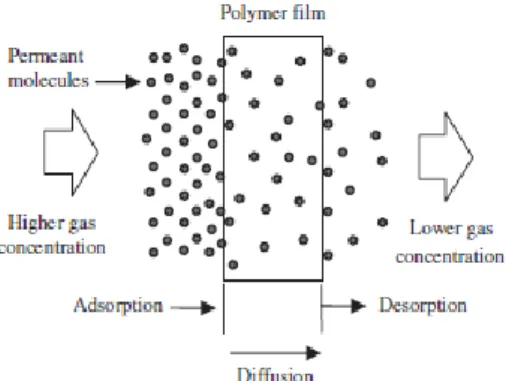
Figure 8 shows that the permeation of a permeant through a polymer film is driven by the gradient concentration from high to low. [9]
-
Figure 8: Permeation mecanism. [8]
Permeability consists of three sequential steps: - absorption of the permeating species on the surface; - diffusion through the polymer;
- desorption of the permeating species from the polymer. FACTORS AFFECTING DIFFUSIVITY AND SOLUBILITY
In order to choose the best barrier polymer, it becomes necessary to have an idea of the requirements of the final product. So it is important to study the factors that can influence the permeability, diffusion and solubility.
Barrier Coatings: Development and Application on PET
CONFIDENTIAL
6 Polymer Chemistry
The chemical composition of the polymer has a strong influence on the solubility and diffusion of small molecules in the polymer matrix. Polymers with chemical groups, like epoxies or nylons, have a strong affinity for polar molecules, including water. In polar polymers, the diffusion coefficients of polar organic molecules can increase with the absorbed concentration of molecules due to strong interactions between the molecules and polymer chains that induce structural changes.
The presence of polar groups on or in polymer chains often increases chain rigidity, glass transition temperature and packaging density. Polymer chain interactions can be quantified in terms of cohesive energy density CED - characterizes the strength of attraction (or interactions) between the polymer chains - and has a strong influence on penetrant diffusion. [9]
Figure 9: Effect of cohesive energy density (CED) on oxygen permeability. [9]
PVOH is a good barrier polymer since it has low gas permeability because of the polar groups that decrease the chain mobility.
Temperature
Temperature has an effect on the permeability and diffusion properties of small molecules in polymers: as the temperature increases, the mobility of the molecular chains increases and thermal expansion leads to a reduced density. Therefore, the free volume in the system will increase, leading to an increased solubility.
The temperature dependence of permeability and diffusivity are usually modeled using Arrhenius equations:
(
Barrier Coatings: Development and Application on PET
CONFIDENTIAL
7 (
) (3)
Where ED and Ep are the activation energies for diffusion and permeation, and P0 and D0
are pre-exponential factors. The effect of solubility is usually expressed by a van’t Hoff relationship:
(
) (4)
Where S0 is a pre-exponential factor, is the heat of sorption of penetrant in the
polymer and R is the constant of ideal gases.
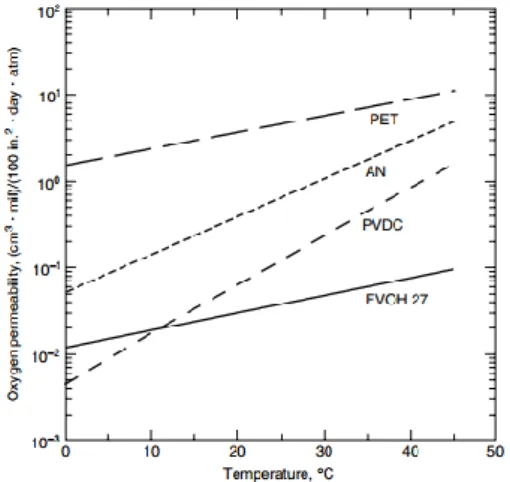
Figure 10 shows the effect of temperature on oxygen permeability of four widely used barrier polymers.
Figure 10: Effect of temperature on oxygen permeability at 75% of relative humidity. [10]
According to the figure, permeability increases with increasing temperature for all known cases.
Humidity
The absorption of water can increase, decrease or have no effect on gas permeability of barrier polymers.
When a polymer equilibrates with a humid environment, it absorbs water. The water concentration in the polymer might be very low as in polyolefins or it might be several weight percent as in ethylene–vinyl alcohol copolymers. A few polymers show a slight decrease in the oxygen permeability with increasing humidity.
Barrier Coatings: Development and Application on PET
CONFIDENTIAL
8 At low to moderate RH, amorphous polyamides and PET show slightly improved barrier properties with increasing RH.This behavior can be explained by the fact that the water molecules are not swelling the polymer, but are occupying some of the polymer free-volume sites instead, resulting in reduction in permeability of other gases. [10]
Crystallinity
Increasing the crystallinity in a polymer generally decreases gas permeability. Crystalline regions in polymers are more ordered than amorphous regions and the free volume will be lower in these regions.
The properties of crystalline materials are known to be a fundamental characteristic of the polymers. Polymers being semi-crystalline are affected by the extent of crystallinity present in the polymer. In the crystalline part of the material the mobility of a permeant is very limited. [9]
2.2
B
ARRIER COATINGSWHAT IS A COATING?
A coating is a covering that is applied to the surface of an object - substrate. The purpose of applying the coating may be decorative, functional or both.
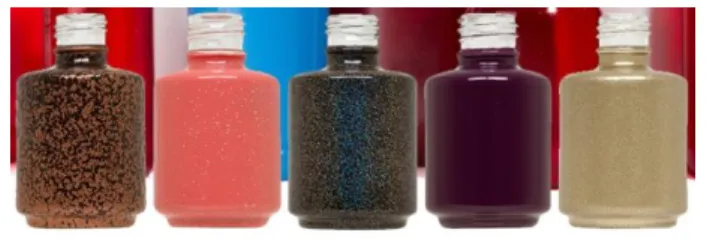
Figure 12: Bottles with coating. [11]
Figure 11: Effect of relative humidity on oxygen permeability of hydrophilic barrier polymers. [10]
Barrier Coatings: Development and Application on PET
CONFIDENTIAL
9 Coatings are applied to the surfaces of plastic films to improve heat-sealing and barrier properties. They are also applied to rigid plastics to improve the barrier. Traditionally, the most common method of application to film has been by using an etched roll.
There are three general processes for coating applications: - Surface preparation;
- Application of the coating; - Drying of the coating.
It is important for food packaging to provide good protection against crucial factors for product quality to ensure product shelf life. Depending on product sensitivity, the conditions of the barrier components are different, it depends if some products are susceptible to moisture, oxygen or both, or to other gases.
Gas such as oxygen, carbon chloride and nitrogen together with water vapor and organic solvents permeate through plastics. The permeation depends on [3]:
- Type of plastic;
- Thickness and surface area;
- Concentration of the permeant molecule; - Storage temperature.
Barrier films often consist of multilayers or coated films designed to be impervious to gas and moisture migration, as single-layer films are in general quite permeable to most gases. The multilayer system consists of several layers where at least one layer is a high barrier material, such as ethylene vinyl alcohol (EVOH). This is very sensitive to moisture so it is used in the form of multilayer structures where the film is protected by water resistant polymers.
Some examples of oxygen transmission rate (OTR- measurement of the amount of O2 gas
that passes through a substance) and water vapor transmission rate (WVTR – measure of the passage of water vapor through a substance) are shown in the table below. In both cases, the measurements are done at specified conditions of temperature and relative humidity.
Barrier Coatings: Development and Application on PET
CONFIDENTIAL
10
Table 1: OTR and WVTR of some polymers. [12]
Polymers OTR, nmol·m-1·s-1a WVTR, nmol·m-1·s-1b
Polyethylene (PE) Low density 500-700 0,35
High density 200-400 0,095
Vinylidene chloride (PVCD ) copolymers 0,02-0,30 0,005-0,05
Polyethylene terephthalate (PET) 6-8 0,45
Polyvinyl alcohol (PVOH) 0,12c
Ethylene-vinyl alcohol (EVOH) 32%mol ethylene 0,03 0,96d 44%mol ethylene 0,12 0,36d a At 23˚C and 0% RH b At 38˚C and 90% RH c Measured at 24 ˚C d Measured at 40 ˚C and 90% RH
2.3
B
ARRIERP
OLYMERS SYNTHETIC POLYMERSSynthetic Polymers are manufactured from monomers; normally petroleum based materials. There are several synthetic polymers that are known to provide a good barrier to oxygen.
Ethylene vinyl alcohol
Ethylene vinyl alcohol (EVOH) is one of the best known flexible thermoplastic oxygen barrier materials in use today. It is a semi-crystalline copolymer of ethylene and vinyl alcohol monomer units.
Figure 13: Ethylene vinyl alcohol chemical structure.
The most significant issue concerning EVOH is its moisture sensitivity. It is hydrophilic, absorbing a significant amount of moisture when directly exposed to humid conditions, which leads to an increase in oxygen permeability. Despite the problems of moisture sensitivity, EVOH is still a preferred barrier for various packaging application.
Barrier Coatings: Development and Application on PET
CONFIDENTIAL
11
Figure 14: Oxygen permeability of some polymers at 23˚C and 0% RH.
Figure 14 compares oxygen permeability of EVOH with other polymers. Only PVOH has O2
permeability lower than EVOH because it is soluble in water and the melting point is close to its heat degradation temperature. Non polar polymers such as PE and oriented PP have the highest permeability.
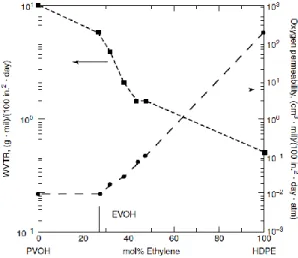
Figure 15 shows the effect of the ethylene concentration on oxygen and WVP of EVOH.
Figure 15: Effect of ethylene content on oxygen permeability (20-23˚C, 65% RH) and WVTR (40˚C) of EVOH.
For low ethylene contents, EVOH acts like PVOH: less flexible and better O2 barrier. For
high ethylene contents, EVOH acts more like HDPE: less moisture sensitive but reduced O2
barrier. [13]
Polyvinyl alcohol
Polyvinyl alcohol (PVOH), made by the hydrolysis of polyvinyl acetate (PVAc), provides increasing oxygen barrier with the percentage conversion of PVAc, but this is accompanied by increasing water sensitivity. PVOH is an excellent gas barrier provided it is dry. In the presence of the moisture, it absorbs water and in this conditions the gas barrier properties are reduced.
Barrier Coatings: Development and Application on PET
CONFIDENTIAL
12 In order to provide greater polymer stability for commercial use, PVOH is copolymerized with EVOH.
Figure 16: Polyvinyl alcohol chemical structure.
Polyethylene
Polyethylene (PE) is made by addiction polymerization of ethylene gas in a high temperature and pressure reactor. PE is not a good barrier to oil and fat or gases such CO2
or O2 but they can be made into strong, though films with a good barrier to moisture and
water vapor. [3]
Figure 17: Polyethylene chemical structure.
Polypropylene
Polypropylene (PP) is a common polymeric material frequently used in diverse industrial applications because of its excellent mechanical properties, lightweight, low cost and easy recyclability. Because of its non-polar nature and low surface energy the PP exhibits hydrophobic characteristics, which results in poor wettability, adhesion and printability. [3]
Figure 18: Polypropylene chemical structure.
Polyvinyldene Chloridre
Polyvinyl Chloride (PVDC) was created in 1932–1939 and was initially commercialized under the trade name of ‘‘Saran’’ in 1939.
While PVDC is available as an oriented film and a discrete layer in coextruded films, it is more commonly used as a barrier coating: it has good oxygen and moisture barrier properties and provides an excellent aroma and flavor barrier. The barrier level of PVDC coatings is dependent upon the coating thickness. Much lower transmission rates can be
Barrier Coatings: Development and Application on PET
CONFIDENTIAL
13 achieved by applying significantly more coating than is common in the pharmaceutical industry. [3]
Figure 19: PVDC Chemical Structure.
NATURAL POLYMERS
There are a large amount of polysaccharides and proteins that are directly isolated from agricultural, marine plants and animals and they can be used in packaging applications. Examples of bio-based materials include starch, cellulose, pectin, alginate, collagen, chitosan and others. Most of these materials exhibit useful gas barrier properties; but they are hydrophilic and unstable at higher temperature, causing problems in processing. Chitosan
Chitosan is an edible and biodegradable polymer derived from chitin, the major organic skeletal substance from crustacean shells. This is the second most abundant natural and non-toxic polymer in nature after cellulose. Some desirable properties of chitosan are that it forms films without the addition of additives and it exhibits good oxygen barrier.
Chitosan products are highly viscous, resembling natural gums. It can form transparent films to enhance the quality and extend the storage life of food products. [15]
Figure 20: Chitosan chemical formula.
Pectin
Pectin is a complex group of polysaccharides. They are structural components of plant cells walls and also act as intercellular cementing substances. Several studies have been performed on pectin films and coatings.
Pectins with low levels of methyl esterification are commonly used for edible coating. Pectin gels have high water vapor permeability, but are a good oxygen barrier. [15]
Barrier Coatings: Development and Application on PET
CONFIDENTIAL
14
Figure 21: Pectin chemical formula.
Pullulan
Pullulan is a water-soluble polysaccharide produced by fungi Aureobasidium pullulans. It forms transparent, water soluble and fat resistant films of low oxygen permeability. Because pullulan based films have a low permeability to oxygen, it may also be used for the coating of foods in tablet form (dietary supplements). In this application, it protects susceptible ingredients (nutrients, colours and flavours) from deterioration and thus preserves the nutritional quality of the products. [14]
Figure 22: Pullulan chemical formula.
2.4
A
CTIVEP
ACKAGINGActive packaging consists in a manipulation of the environment in the package to better improve microbiological or biochemical quality. Examples of active packaging are purge absorbers, moisture absorbers and oxygen scavengers.
In this project oxygen scavangers were used because the incorporation of active scavengers in the polymeric matrix can improve the gas barrier properties and simultaneously remove residual oxygen.
OXYGEN SCAVENGERS
When products are extremely sensible to oxygen presence, oxygen scavengers give a way to prolong the shelf life of the product. They reduce the level of the oxygen in the headspace of the package and ensure that any oxygen permeating through the package is consumed. Because oxygen scavengers have a finite absorption capacity, they must be used with a passive barrier. The appropriate passive barrier material will be dependent upon the percent oxygen permissible in the headspace and the shelf-life of the product. It is possible to see in the figure 23 that additives (oxygen scavengers) are directly introduced to the PET resin during the injection process. O2 scavengers absorb oxygen
Barrier Coatings: Development and Application on PET
CONFIDENTIAL
15
Figure 23: Oxygen scavengers added to the PET bottle. [16]
Oxygen scavengers are very effective in reducing the oxygen level in a package as illustrated in Figure 24.
Figure 24: Oxygen consumption during 25 hours. [16]
Another possible solution is the use of aerobic bacterial endospores as an oxygen scavenger. The structure of dormant spores makes them resistant to temperature and pressures, an important factor for vegetative microorganisms that make possible incorporation in a packaging structure. During the aerobic metabolism reactions, oxygen is consumed together with nutrients, making germinated spores an active oxygen scavenger. Bacillus amyloliquefaciens is a facultative aerobic and endospore forming bacterium. It was discovered by Fukamoto in 1943. [17]
Figure 25: Microscopic images of Bacillus amyloliquefaciens. [16]
Barrier Coatings: Development and Application on PET
CONFIDENTIAL
16 Proteins could be used for packaging especially for food sensitive to water and gas permeation. Whey protein is one of the most promising; it is a byproduct of cheese manufacturing that contains approximately 7% dry matter.
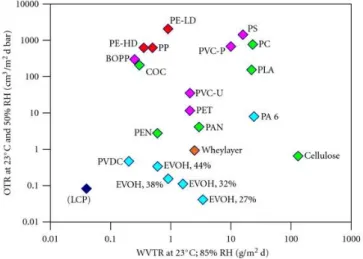
As shown in Figure 26, whey-coated films achieved much superior barrier properties compared to other bio plastics. Results also indicate that the OTR values of whey-based coating approach those of EVOH with high ethylene content and are better than PA which is further used for food storage validation. These observations show the potential of the whey-protein-based coatings to substitute other synthetic barrier layers used for food packaging in terms of barrier properties. [17]
Figure 26: Barrier properties of whey-based layer versus other plastics commonly used in the packaging industry. [18]
Barrier Coatings: Development and Application on PET
CONFIDENTIAL
17
3. E
XPERIMENTALW
ORKThe main goal of this project is to find a coating that gives a good adhesion on PET and protect the bottle in order to improve its shelf life. Therefore, tests were set up to measure the adhesion and the barrier properties. In the following paragraphs the test methods are explained.
Figure 27: Bottles in a support to dry.
3.1
A
DHESIONIn general, the adhesion can be defined as the mutual attraction between different molecules without chemical bonds. It is important that the coating does not come off during the shelf life. The adhesion of the coatings was tested using the tape method. ADHESION TEST DESCRIPTION
1. Use a PET bottle and cut the bottom and the top, then open the middle part to obtain a rectangular;
2. Clean the PET with ethanol;
3. Put the coating with a coater of 50 µm on the surface and let dry at room temperature;
4. With a cutter do six horizontal and vertical lines with an intermediate space of about 2mm in order to get 25 little squares;
5. Place a tape on the square, press it and then rip it off;
6. Count the squares that are still OK (the squares that doesn’t come off) and multiply by 4 to get a percentage of adhesion;
7. Repeat the cut tests on the same coating after 24 hours, 72 hours, one week and two weeks;
Barrier Coatings: Development and Application on PET
CONFIDENTIAL
18 Water vapor permeability is a measure of the passage of water vapor through a membrane. It is the rate of water vapor transmission per unit area. It is possible to see how the water vapor permeability was calculated in Appendix.
The next part describes the water vapor test and its results. WATER VAPOR TEST DESCRIPTION
Coat the bottles by dipping. Let them dry at room temperature until “finger dry” and put them in the oven at 40˚C. After complete drying (they have a constant weight) put another coating if necessary.
1. Measure the weight of the bottles with the cap (coated bottles and a blank bottle); 2. Fill the bottles with water (150 g) and close the bottles tightly;
3. Put them in the oven by 40˚C;
4. Measure the weight of the bottle 2 times a week (analytical balance) and calculate the loss of water or water vapor permeability.
3.3
G
ASB
ARRIERT
ESTOxygen is often unwanted because it promotes food deterioration, alteration of colour and flavor. Because of this, packaging of oxygen-sensitive products is done with oxygen barrier materials.
GAS BARRIER TEST DESCRIPTION
For this test a lot of different coatings were used and the oxygen permeation was measured by the ingress of oxygen inside the bottle by a sensor Oxygen Meter Fibox 3. For the empty bottles the ingress of oxygen was measured by increase of the percentage of air saturation; other bottles were filled up with water and the permeation was measured by the increase in concentration (ppm) of oxygen in water.
Test 1: For bottles filled up with deionized water 1. Coat a bottle with a product for gas barrier;
2. Let dry first at a room temperature and afterwards in the oven;
3. Fill the bottle with deionized water and flush the bottle with nitrogen for 40 minutes to take out the oxygen and close the bottle with a cap containing a sensor compatible with the equipment;
Barrier Coatings: Development and Application on PET
CONFIDENTIAL
19
Figure 28: Flushing the bottle with nitrogen.
4. Put the bottle in the oven at 30˚C for 9 or 10 hours and take the first measurement;
5. For the measurement, maintain the sensor for at least 30 seconds in order to have 10 values to take the average of the oxygen content in the water;
6. The content of oxygen in the water has to be measured two times per week.
Test 2: For empty bottles
1. Coat a bottle with a product for gas barrier as described above; 2. Let dry first at a room temperature and afterwards in the oven;
3. Put the bottle and the cap in a PE bag and flush the bottle with nitrogen letting the bag inflate and squeeze afterwards to take out all the oxygen;
4. Close the bottle inside the bag;
5. Put the bottle in the oven at 30˚C for 9 or 10 hours;
6. Make the measurement with the oxygen meter fiberbox 3 as described in the previous method;
7. Follow the measurement two times per week.
The picture below illustrates the technique for the measurement of the ingress of oxygen inside of the bottle by a sensor Oxygen Meter Fibox 3.
Barrier Coatings: Development and Application on PET
CONFIDENTIAL
20
4. R
ESULTSD
ISCUSSIONADHESION TEST - RESULTS
In the next table some results of adhesion tests are present performed on different coatings that were used for water vapor test.
Table 2: Results of the adhesion test 1.
The result shows that VAC has a good adhesion on PET. On other hand, PVB1 has not a good adhesion all product came off with the tape.
In order to improve adhesion, some of the coatings were tested in a multilayer system because previous studies proved that some coatings like PE2 and PE3 do not have a good adhesion on PET as it is possible to see in Table 2. In this case, VAC was used as adhesion layer.
VAC2 and STY1 show a good adhesion on PET, like emuslfied carbon but VAC was chosen because of its clarity and, in the past, gave good results too.
Also the products used for gas barrier do not have a good adhesion and were therefore tested in a multilayer system.
Table 3: Results of the adhesion test 2.
Product 24h 72h 1 week after 2 weeks after
VAC+EVOH+VAC 0 80 80 80
VAC+PVOH2+VAC 0 52 52 52
VAC+PT1+VAC 100 100 100 100
EVOH and PT1 are products used for gas barrier test and gave a good adhesion on PET. Most of the gas barrier coatings are sensitive to moisture. In order to protect the coating, a final extra layer of VAC was applied.
WATER VAPOR TEST -RESULTS
In the past, the company tried to apply one layer of product on the bottle but the results were not conclusive: no improvement could be seen compared to a blank.
So, the first step in this project was to apply more than one layer to see if this makes any difference.
Product 24h (%) 72h (%) 1 week after (%) 2 weeks after (%)
PVB1 0 0 0 0 VAC 100 100 100 100 PE2 0 0 0 0 PE3 12 12 12 12 Emulsified Carbon 100 100 100 100 VAC2 100 100 100 100 STY1 80 100 100 100
Barrier Coatings: Development and Application on PET
CONFIDENTIAL
21
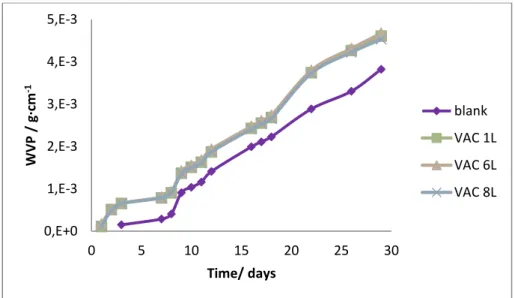
Figure 30: Results of WVT for VAC 1, 6 and 8 layers.
In the first case, 1L, 6L and 8L of VAC (first chart) were applied. No difference in amount of layers could be seen and when compared with the blank the results are the same.
Figure 31: Results of WVT for STY1 8 and 6 layers.
In the second chart, the same results were described for another product.
It was expected that these products would give good water vapor barrier properties mainly because they were applied in a considerable quantity. So these results created a lot of doubts about the testing method used.
Therefore a bottle of polypropylene was used to see if the results are better compared to a blank PET bottle. The thickness of the PP bottle is higher than a PET bottle and the calculations for the WVP are in Appendix.
0,E+0 1,E-3 2,E-3 3,E-3 4,E-3 5,E-3 0 5 10 15 20 25 30 WV P / g ·cm -1 Time/ days blank VAC 1L VAC 6L VAC 8L 0,0E+0 1,0E-3 2,0E-3 3,0E-3 4,0E-3 5,0E-3 0 5 10 15 20 25 30 WV P / g ·cm -1 Time / days STY1 8L STY1 6L blank
Barrier Coatings: Development and Application on PET
CONFIDENTIAL
22
Figure 32: Water vapor permeability for PP bottle and PET bottle.
As expected, the PP bottle has a lower permeation compared to PET bottle.
In the second test, the operation conditions changed. Regardless the number of layers, 1 gram of product was applied on the bottles.
Figure 33: Results of WVT for VAC+PE2, VAC+PE3 and a blank.
In this case, one layer of VAC was applied as adhesion layer for PE2 or PE3. Then PE2 and PE3 were applied until 1 gram was obtained on the bottle.
0,0E+0 1,0E-3 2,0E-3 3,0E-3 0 5 10 15 20 25 WV P / g· cm -1 Time / days PP bottle PET bottle 0,0E+0 1,0E-3 2,0E-3 3,0E-3 4,0E-3 5,0E-3 0 5 10 15 20 25 30 WV P / g ·cm -1 Time / days VAC+PE2 VAC+PE3 blank
Barrier Coatings: Development and Application on PET
CONFIDENTIAL
23
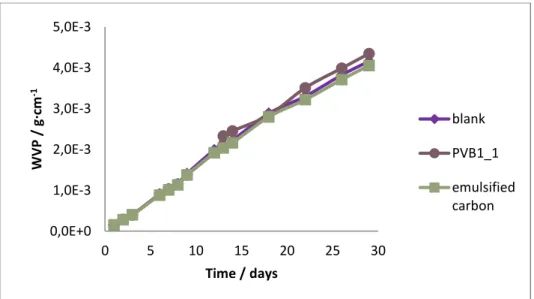
Figure 34: Results of PVB1_1, emulsified carbon and a blank.
In the second case, the procedure was the same but no adhesion layer was necessary. In both cases, by analyzing the charts, it is possible to see that the results are the same as the blank.
Another test was done with different products. The following chart shows the results of the STY 2, Alkyd1, MW3 and MW4 in comparison with the uncoated bottle.
Figure 35: Results for STY2, Alkdy1, STY and VAC4.
By analyzing the chart it is possible to see that the products have the same results as a blank, except for Alkdy1 that has a better result although not good enough to conclude that is a good option.
No improvement could be seen when compared to a blank. A possible reason could be the drying of the coating. As the surface dries first there could still be some water left in the coating underneath the surface which creates “holes” while drying.
0,0E+0 1,0E-3 2,0E-3 3,0E-3 4,0E-3 5,0E-3 0 5 10 15 20 25 30 WV P / g ·cm -1 Time / days blank PVB1_1 emulsified carbon 0,0E+0 1,0E-3 2,0E-3 3,0E-3 4,0E-3 5,0E-3 6,0E-3 7,0E-3 0 10 20 30 40 WV P / g ·cm -1 Time / days blank STY2 Alkdy1 STY VAC4
Barrier Coatings: Development and Application on PET
CONFIDENTIAL
24 During the test, water can easily pass through these “holes”, resulting in a bad water vapor barrier.
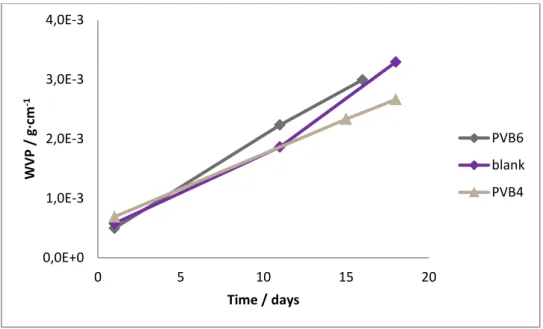
To confirm this, a new test was done where no water was involved in the coating (PVB4). This was compared with a similar based coating (PVB6).
Figure 36: Comparison between products with water and no water with the blank.
It is possible to conclude that the solution based on water has a higher loss compared to the solution without water.
Because of the results were not so conclusive a test with more products without water was done.
Figure 37: Results for products without water.
In the first 10 days all the PVB’s show water vapor permeability which is the same as the blank. After this time, the WVP of these products is directly proportional with the time. On the other hand, the blank after 10 days loses more water.
0,0E+0 1,0E-3 2,0E-3 3,0E-3 4,0E-3 0 5 10 15 20 WV P / g ·cm -1 Time / days PVB6 blank PVB4 0,0E+0 1,0E-3 2,0E-3 3,0E-3 4,0E-3 5,0E-3 0 5 10 15 20 25 WV P / g ·cm -1 Time / days blank PVB2 PVB3 PVB4 PVB5
Barrier Coatings: Development and Application on PET
CONFIDENTIAL
25 So, the theory that the products based on water showed a higher loss because of the “holes” in the substract, could be possible.
To see if the quantity of the product used make any influence on the results, another test can be done with more layers.
GAS BARRIER TEST -RESULTS
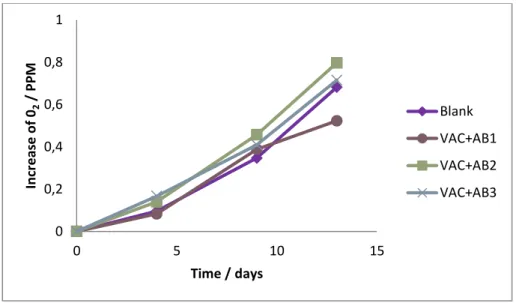
In previous studies, done by the company, active barriers showed good results when they were incorporated in the PET and the results showed that the active barriers take about 10 days to be active and start to consume oxygen.
So, in this test, for AB1, AB2 and AB3 2 bottles were done: one with VAC+AB1/AB2/AB3 and another with PVB+AB1/AB2/AB3.
For test 1, several coatings were tested and the results are presented, in terms of oxygen increase, in the following charts.
Figure 38: Increase of oxygen during the days for VAC+Active Barriers.
0 0,2 0,4 0,6 0,8 1 0 5 10 15 In cr e ase o f 0 2 / PP M Time / days Blank VAC+AB1 VAC+AB2 VAC+AB3
Barrier Coatings: Development and Application on PET
CONFIDENTIAL
26
Figure 39: Increase of oxygen during the days for PVB+Active Barriers.
In both cases, active barriers were used so it was expected that the increase of O2 was not
so pronounced because its function of the AB is to consume the O2 preventing the ingress
of it inside the bottle.
One test was done with VAC+AB and other test with PVB+AB but there’s no consuming of oxygen by all of AB so no improvement in the barrier.
In test 2 3 bottles were done as a multilayer system: VAC+PVOH/PT1+VAC. The first layer is because of the adhesion, PVOH and PT1 do not have a good adhesion on PET, and the last layer is because of the moisture sensitivity of the products.
Figure 40: Increase of oxygen for empty bottles.
0 0,2 0,4 0,6 0,8 1 0 5 10 15 In cr e ase o f 0 2 / PP M Time / days Blank PVB+AB1 PVB+AB2 PVB+AB3 0 0,2 0,4 0,6 0,8 1 1,2 1,4 1,6 0 5 10 15 20 In cr e ase o f O 2 / % as Time / days Blank PVOH2 PT1 PVOH1
Barrier Coatings: Development and Application on PET
CONFIDENTIAL
27 The results for the empty bottles are more or less the same comparing with the blank except for PVOH2. This product shows a very good barrier for oxygen. The uncoated bottle presents an increase of oxygen of 1,36% in 16 days and the PVOH2 an increase of 0,45%. In order to confirm the results, a new test with PVOH2 was done with filled bottles to see if moisture has an influence on the gas barrier (Appendix) and two bottles from a preform of 5 layers (figure 41).
Figure 41: Results for the blown bottles of PVOH2.
The results of the blown bottles are worse than a blank and the coated bottle (figure 40). A possible cause of this could be the stretching of the preform because it causes a no homogenous distribution of the coating.
A test with natural polymers, polysaccharides, was done with VAC as a first and last layer. They are attractive coatings because can be extracted from the nature.
Figure 42: Results for natural polymers.
0,0 0,4 0,8 1,2 1,6 2,0 2,4 0 5 10 15 in cr e ase o f O 2 / % as Time / days blank PVOH2 blown1 PVOH2 blown 2 0 0,2 0,4 0,6 0,8 1 0 5 10 15 in cr e ase o f O 2 / % as Time / days blank NP2 NP1
Barrier Coatings: Development and Application on PET
CONFIDENTIAL
28 These products are known for having a good barrier property for oxygen, as is possible to see for NP1 but are also sensitive to humidity changes. For NP2 the results were not the same and a probable cause could be the fact that NP1 had dry during 15 days and NP2 during 4 days.
The last test done was VAC+EVOH+VAC, like PVOH is used to improve gas barrier properties but very sensitive to moisture so it is used in a multilayer system. The results are shown in next figure.
Figure 43: Results for EVOH.
During the first days, EVOH had the same increase of the blank, but after 5 days, showed very good results.
0 0,2 0,4 0,6 0,8 1 0 5 10 15 in cr e se o f O 2 / % as Time / days EVOH blank
Barrier Coatings: Development and Application on PET
CONFIDENTIAL
29
5. C
ONCLUSIONDuring these months many coatings were tested with a lot of purposes: protect the bottle of the ingress of oxygen, the loss of water and protection against the moisture. Unfortunately, no products had good results. Confirming previous studies done by the company, VAC was the best coating because of its good adhesion and can therefore be used as first layer in a multilayer system.
It was possible to conclude that the number of layers does not have an effect on the water vapor permeability because the results are very similar with the blank.
Although many products have a good adhesion on PET (crucial factor to this project), when other properties were tested (loss of water and ingress of oxygen in the bottle) they lose its utility because the results were not good compared with the uncoated bottle. In order to confirm the influence of the water in the coating a solvent based coating was tested. From this test it can be concluded that solvent based coatings give better results than the blank. Probably, this type of products does not feel the effect of the moisture because there is no water in its composition and more time is needed to confirm the results over time.
About the ingress of oxygen in the bottles, products were tested without success but PVOH2 and natural polymers had an improvement. PVOH2 gave good results and was therefore tested on a blown bottle from a coated preform. The results of the blown bottles were not as good as the coated bottle probably because of the stretching that created in the bottle an irregular distribution of the product, which proves that PVOH2 is not a flexible coating. Also the amount of the coating is much less due to stretching.
For future work, it is needed to understand the effect of the water on coatings, repeat tests with solvent based coatings and study the effect of a coating on a preform which will be blown to a bottle. From the results in this work it could be seen that the barrier properties are not the same from a standard bottle or a blown one.
Barrier Coatings: Development and Application on PET
CONFIDENTIAL
30
6. R
EFERENCES[1] GOVI NV, http://www.govi.com/en/;
[2] The Glass Transition, http://pslc.ws/mactest/tg.htm;
[3] Yam, K. L. The Wiley Encyclopedia of Packaging Materials, 3st edition; [4] Damsir, H. and Rachidi, S. Brussels. Plastic barrier material in packaging; [5] E. Werner, S. M. (1992). Encyclopedia of Polymer Science Techonoly;
[6] Mechanical Engineering. New engineering in practice:
http://newengineeringpractice.blogspot.pt/2011/08/manufacturing-of-plastic-bottles.html;
[7] Kumar, P. Effect of Package Configuration on Barrier Propeties and Sensory
Perception of Flavor;
[8] John R. Wagner Jr., Multilayer flexible packaging technology and application for the
food;
[9] Dhoot, S.N. Sorption and Transport of Gases and Organic Vapors in Poly(ethylene
terephthalate). May 2004;
[10] Brown, W. E., Plastics in Food Packaging, Marcel Dekker, Inc.; [11] BC Bottle Coatings: http://www.bottlecoatings.com;
[12] Siracusa, V. (2012). Food Packaging Permeability Behaviour: A Report. Internatonal
Journal Of Polymer Science;
[13] Mokwena, K. Khanah and Tang, Juming. Washington State University. Ethylene
Vinyl Alcohol: A review of barrier properties for packaging shelf stable foods;
[14] Aruna Dhanapal, Sasikala.P, Lavanya Rajamani, Kavitha.V, Yazhini.G, M.Shakila Banu, Edible films from Polysaccharides;
[15] Olga Martin-Belloso,Robert Soliva Fortuny, Advances in Fresh-Cut Fruits and
Vegetables Processing;
[16] Sience Photo Library, http://www.sciencephoto.com;
[17] Anthierens, T. 2011. The use of endospore-forming bacteria as an active oxygen
scavenger in plastic packaging materials;
[18] International Journal of Polymer Science, http://www.hindawi.com/journals; [19] Daniela Timineri, Gernot T. John, Kajetan Müller and Christian Huber, Oxygen
Barrier Coatings: Development and Application on PET
CONFIDENTIAL
31
7. A
PPENDIXW
ATERV
APORT
ESTSCalculation of the Water Vapor Permeability
The calculation of the water vapor permeability (WVP) was made following the equation:
(5)
- is the initial mass of the bottle, g; - is the mass all over the time, g;
- is the area of permeation of the bottle, cm2;
- is the time, days;
- is the thickness of the wall, cm.
To calculate the water vapor permeability three factors are considered: - Weight;
- Area of the bottle; - Thickness.
The area of the PET bottle was calculated assuming that the bottle has the shape of a cylinder in the bottom part and on the top part the shape of a cone figure. The thickness was measured also in different parts of the bottle and an average was considered.
Table 4: Area and Thickness of PET bottle.
A (cm2) 308,47
Thickness (cm) 0,0377
The PP bottle was considered a rectangle to calculate the area of the bottle and its thickness was measured the same way as the PET bottle.
Table 5: Area and thickness of PP bottle.
A (cm2) 268,95
Barrier Coatings: Development and Application on PET
CONFIDENTIAL
32 Water Vapor Tests
In this part some results will be presented for water vapor test for different products.
Figure 44: WVP for different products.
Figure 45: WVP for VAC bottles fill up with water and for VAC bottles with 150 ml of water.
0,0E+0 1,0E-3 2,0E-3 3,0E-3 4,0E-3 5,0E-3 6,0E-3 0 10 20 30 WV P / g ·cm -1 Time / days VAC - fill up VAC Blank
Barrier Coatings: Development and Application on PET
CONFIDENTIAL
33
Figure 46: WVP for emulsified carbon bottles fill up with water and for emulsified bottles with 150 ml of water.
Figure 47: WVP for MW1 and MW2.
0,0E+0 1,0E-3 2,0E-3 3,0E-3 4,0E-3 5,0E-3 6,0E-3 0 10 20 30 WV P / g ·cm -1 Time / days Blank Emulsified Carbon - fill up Emulsified Carbon
Barrier Coatings: Development and Application on PET
CONFIDENTIAL
34
Figure 48: WVP for bottles tested with a VAC inside, outside and inside and outside.
0,0E+0 1,0E-3 2,0E-3 3,0E-3 4,0E-3 5,0E-3 6,0E-3 7,0E-3 0 10 20 30 40 WV P / g ·cm -1 Time / days blank inside outside out and inside
Barrier Coating: Development and Application on PET
Table 6: Results for evolution of the weight during the days for VAC2 and STY1.
bottle+water+cap 1 2 3 7 8 9 10 11 12 16 17 18 22 26 29 VAC2 1L 170,6063 170,5165 170,1904 170,0727 169,9638 169,8681 169,487 169,3722 169,2745 169,0754 168,6193 168,5199 168,4115 167,5444 167,118 166,8398 VAC2 6L 167,6418 167,5022 167,2196 167,1052 166,9873 166,8867 166,4811 166,3726 166,273 166,0588 165,6185 165,5113 165,4059 164,5356 164,1141 163,8193 VAC2 8L 173,9216 173,8249 173,5146 173,3874 173,2772 173,1778 172,8057 172,6938 172,6012 172,3891 171,9503 171,846 171,7487 170,8742 170,469 170,214 STY1 6L 174,8032 174,7035 174,3847 174,2632 174,1554 174,0642 173,6757 173,5623 173,4822 173,272 172,8374 172,7473 172,7487 171,8118 171,4546 171,1636 STY1 8L 169,0966 168,963 168,6535 168,5378 168,4287 168,3383 167,9448 167,8356 167,7414 167,5479 167,0946 167,0019 166,8946 166,023 165,5831 165,322
Table 7: Results for evolution of the weight during the days for bottles with 1 gram of product.
Table 8: Results for evolution of the weight during the days for bottles for bottles completely fill with 150 g of water.
bottle+water+cap 1 2 3 4 8 12 16 19 23 26 33
Emulsified Carbon 220,37 219,83 219,72 219,65 219,52 219,11 218,78 218,31 218,03 217,59 217,26 216,1
Emulsified Carbon - fill up 539,84 538,84 538,73 538,61 538,5 538,08 537,7 537,3 537 536,62 536,36 535,14
VAC 222,23 221,59 221,48 221,38 221,28 220,85 220,5 220,107 219,79 219,41 219,08 217,9 VAC - fill up 536,09 535,57 535,48 535,37 535,21 534,81 534,41 534 533,68 533,29 532,94 531,72 bottle+water+cap 1 2 3 6 7 8 9 12 13 14 18 22 26 29 Blank 160,5852 160,4633 160,3522 160,2547 159,8435 159,7388 159,6361 159,4332 158,956 158,8593 158,7641 158,2257 157,884 157,4567 157,1836 PVB1 164,272 164,1504 164,0392 163,9463 163,5385 163,4300 163,3329 163,1444 162,6884 162,3666 162,2642 161,9472 161,4006 161,0088 160,7156 VAC+PE2 171,4706 171,2843 171,1734 171,0767 170,6577 170,5892 170,4846 170,2947 169,8404 169,7356 169,6383 169,1393 168,8023 168,3542 168,0639 VAC+PE3 174,7922 174,6655 174,5556 174,4569 174,0696 173,9584 173,8562 173,6652 173,2082 173,1031 172,9992 172,4834 172,1406 171,701 171,4326 Emulsified Carbon 174,2142 174,0895 173,9831 173,8873 173,4928 173,3875 173,2871 173,0873 172,6439 172,5478 172,4468 171,9249 171,5808 171,178 170,8968
Barrier Coating: Development and Application on PET
Table 9: Results for evolution of the weight during the days for bottles.
bottle+water+cap 1 2 3 4 7 10 emulsified carbon 1L 165,60 165,51 165,41 165,31 165,22 164,95 164,69 emulsified carbon 4L 166,99 166,68 166,60 166,49 166,40 166,13 165,90 PVB1 6L 171,94 171,83 171,72 171,63 171,53 171,24 170,97 PVB1 11L 172,52 172,40 172,30 172,21 172,11 171,83 171,58 VAC+PE2 6L 174,29 174,04 173,90 173,72 173,63 173,33 173,05 VAC+PE3 6L 169,63 169,53 169,44 169,34 169,25 168,96 168,70 PE1 175,99 175,89 175,76 175,66 175,57 175,32 175,06