Introduction
Effect of β-alanine supplementation
on 20 km cycling time trial performance
Ruth Margaret JAMES* Simon Brian COOPER* Jacques ROBERTSON* Daniel MARTIN* Roger Charles HARRIS** Craig SALE*
Carnosine (β-alanyl-L-histidine) has been shown to have an important role in the maintenance of homeostasis in the muscle cell due to the pH buff ering capabilities of the imidazole ring. As such, the expansion of the imidazole ring content in human skeletal muscle through an increase in the muscle carnosine concentration off ers a means to increase muscle buff ering capacity and high intensity exercise performance and capacity1-2. Other potential physiological roles of carnosine, such as increased calcium sensitivity3-4 and antioxidant capacity5-6 might also contribute to a positive eff ect on exercise capacity and performance, although literature is inconclusive7. Carnosine is synthesised from the amino acids β-alanine and histidine, with β-alanine availability being rate limiting to the synthesis of the dipeptide within human skeletal muscle8. As a result, the dietary intake of β-alanine through supplementation is critical for the elevation in
muscle carnosine content. Most studies have used doses of between 3.2 and 6.4 g•d-1 of β-alanine, with this resulting in increases of 40 to 80% in the muscle carnosine concentration, depending upon the duration of supplementation and the method of determining the muscle carnosine content.
Several reviews have concluded that there are signifi cant eff ects of β-alanine supplementation on high-intensity exercise performance9-10. In particular, several studies have focussed on the effects of β-alanine supplementation on high intensity cycling capacity and have shown significant increases following supplementation11-13. The effects of
β-alanine supplementation on cycling performance are more equivocal, with some showing no eff ect14 and others a signifi cant improvement15.
Whilst there is general consensus in the literature for a benefi cial eff ect of β-alanine supplementation on high intensity exercise performance9-10,16-17 fewer
*School of Science a n d Te c h n o l o g y, N o t t i n g h a m Tr e n t University - Nottingham - United Kingdom. * * J u n i p a L t d - Newmarket - United Kingdom.
CDD. 20.ed. 796.027
http://dx.doi.org/10.1590/1807-55092014000300395
Abstract
The effects of β-alanine supplementation on high-intensity cycling performance and capacity have been evaluated, although the effects on longer duration cycling performance are unclear. Nineteen UK category 1 male cyclists completed four 20 km cycling time trials, two before and two after
supple-mentation with either 6.4 g•d-1β-alanine (n = 10; BA) or a matched placebo (n = 9; P). Performance
time for the 20 km time trial and 1 km split times were recorded. There was no signifi cant effect of
β-alanine supplementation on 20 km time trial performance (BA-pre 1943 ± 129 s; BA-post 1950 ±
147 s; P-pre 1989 ± 106 s; P-post 1986 ± 115 s) or on the performance of each 1 km split. The effect
of β-alanine on 20 km time trial performance was deemed unclear as determined by magnitude based
inferences. Supplementation with 6.4 g•d-1 of β-alanine for 4 weeks did not affect 20 km cycling time
trial performance in well trained male cyclists.
studies have examined the eff ects on longer duration exercise performance. However, a recent study examined the eff ects of β-alanine supplementation on cycling performance in a time trial lasting ~ 1 hr18. Th e fi ndings suggest that despite marked increases in muscle carnosine concentration, β-alanine supplementation did not improve cycling performance18.
However, Stout et al.19 supplemented untrained males with β-alanine and showed a 14.5% increase in physical working capacity at fatigue threshold post supplementation, while those supplementing with placebo decreased their physical working capacity at fatigue threshold by 1.8%. Furthermore, in a graded exercise test lasting ~19 minutes using untrained female participants, Stout et al.20 reported no eff ects of β-alanine on maximal oxygen consumption but did report an increase in the time to exhaustion, as well as a delay in the onset of neuromuscular fatigue and an increase in the ventilatory threshold at submaximal workloads. Th ese fi ndings indicate the potential for β-alanine supplementation to increase performance during endurance based exercise. It is important to note, however, that increases in power output at ventilatory threshold with β-alanine supplementation could also be caused by increased buff ering capacity, rather than other purported mechanisms, since higher buff ering capacity via
Method
Participants
carnosine could reduce the need for H+ buff ering through hyperventilation and CO2 elimination.
Interestingly, some evidence also exists to suggest that an increase in muscle carnosine concentration could infl uence muscle fi bre function in humans3. Dutka et al.3 mechanically skinned single muscle fi bres taken from the “m. vastus lateralis” by muscle biopsy and subsequently characterised their calcium release and contractile properties. Th ey showed that an increase in muscle carnosine content increased calcium sensitivity in slow and fast twitch muscle fi bres and enhanced calcium release in slow twitch fi bres. In addition Everaert et al.4 showed that providing mice with water containing 1.2% β-alanine for 8 weeks resulted in a higher carnosine concentration in the “extensor digitorum longus” and the “tibialis anterior”, and an increase in fatigue resistance in the soleus.
Taken together, the results of these investigations provide a potential mechanism by which an increase in the muscle carnosine content could confer benefi ts to exercise performances lasting longer than the 60-240 s mostly studied to date, for which increased muscle buff ering capacity would seem the most likely mechanistic explanation. Th erefore, we aimed to examine the eff ects of 4 weeks of β-alanine supplementation at 6.4 g•d-1 on 20 km cycling time trial performance in trained cyclists.
Twenty-six UK category 1 male cyclists, completing at least 7 hours of cycle training per week, volunteered to participate in the study that was conducted from April 2012 to June 2013, meaning participants were recruited throughout all phases of an annual training cycle. Th ey were randomly assigned to either
Participants were fully informed of any risks and discomforts associated with the study before
a placebo (P) or β-alanine (BA) supplementation group; however, seven participants (4 from P and 3 from BA) withdrew, citing various reasons not associated with the study. As such, 19 participants completed all trials; participant characteristics are presented in TABLE 1. Th e study was approved by the Institution’s Ethical Advisory Committee and conformed to the Declaration of Helsinki.
TABLE 1 - Participant characteristics.
N Age (y) Height (m) Body mass (kg) Familiarisation(s) β-alanine 10 37 ± 8 1.82 ± 0.06 78.7 ± 8.8 1975 ± 173 Placebo 9 32 ± 6 1.81 ± 0.04 80.4 ± 8.3 1993 ± 95
P value 0.211 0.902 0.671 0.786
Th is was a randomised, double-blind, placebo-controlled, parallel groups design experiment. Subsequent to preliminary testing, participants completed two baseline trials (separated by 48 h) and two follow-up trials (separated by 48 h), separated by four weeks of supplementation with either placebo or β-alanine. Participants in BA ingested two sustained-release tablets (CarnoSynSR, Natural Alternatives International, USA) each containing 800 mg of β-alanine (total dose per serving was 1.6 g) four times per day, separated by 3-4 h intervals, for a total daily dose of 6.4 g. Th e total amount of β-alanine ingested over the 4 week period was 179.2 g. Participants in P ingested a matched placebo containing maltodextrin. Double blinding was ensured as both beta-alanine and placebo tablets were given to participants in identical white tubs. An experimenter not directly involved in participant testing noted the lot number of each bottle and then removed the lot number prior to administration to participants. Once data collection was complete, the supplement corresponding to each lot number was revealed.
Th e sustained-release formulation of β-alanine used in the present study has been shown to reduce the symptoms of paraesthesia often associated with individual doses of β-alanine administered as free powder22. In this study, none of the participants reported any feelings of paraesthesia, and we are confi dent that the integrity of the double blinding was maintained. β-alanine tablets were tested by the manufacturer prior to release for the study and conformed to the label claim for β-alanine content. All supplements were independently tested by HFL Sports Science, UK, prior to use to ensure no contamination with steroids or stimulants according to ISO 17025 accredited tests.
Experimental design
Experimental protocol
Height (Seca, UK) and body mass (Seca, UK) were recorded before participants completed a full habituation test of the 20 km cycling time trial as described below. Following preliminary assessment, participants completed four identical main trials. All trials were completed at least 2 h postprandial following 24 h dietary standardisation, and participants had not completed vigorous exercise in the 24 h prior to each trial.
Upon arrival at the laboratory, a capillary fi nger prick blood sample was taken for the determination of baseline blood lactate concentration (2300 STAT Plus, YSI Ltd, UK). Participants then completed a self-paced fi ve minute warm up on their bike followed by a three minute period of self-selected stretching before starting the 20 km time trial. Th e time trial was completed on a Cyclus2 (RBM Electronic, Germany) ergometer on which the participants mounted their own bike frames. Th e settings on the Cyclus2 were adjusted for each individual bike by entering the size of the front and back cog, bike weight and the crank length, ensuring an accurate measurement of distance and performance. During the exercise trial, the participant was deprived of any information regarding performance (e.g., time, speed, cadence) other than distance covered and gear selection and no feedback or encouragement was provided by experimenters. Participants were allowed to consume water ad libitum during exercise. Heart rate (T31 system, Polar, Finland) was recorded after every 1 km interval and RPE (using the Borg 6-20 scale23) after every 5 km interval. Cycling performance data (e.g., time, distance, speed and cadence) was recorded by the Cyclus2 every 0.5 seconds. Immediately upon completion of the 20 km time trial and then again following a self-paced cool down, capillary fi nger prick blood samples were taken for the determination of blood lactate concentration. Participants also performed three cognitive function tests (Stroop test, Sternberg paradigm and Rapid Visual information Processing (RVIP) task) before and after each 20 km time trial to assess selective attention, working memory, and sustained attention. However, these data are presented elsewhere and only the exercise performance aspects of the study are presented here.
In order to determine the reliability of the 20 km time trial, we used the data from trials 1 and 2 on 21 participants (age 35 ± 8 y, height 1.82 ± 0.05 prior to the study due to the long washout period
Results
Statistical methods
m, body mass 80.7 ± 9.0 kg) who completed the 20 km time trial as described above. Th ere was no signifi cant diff erence in the time taken to complete the 20 km between trials 1 and 2 (trial 1: 1969 ± 112 s; trial 2: 1975 ± 119 s; p = 0.222). Th e intra-class correlation between trials 1 and 2 was r = 0.99, with the coeffi cient of variation being 0.7%.
All data were checked for normality of distribution using the Shapiro-Wilk test. Data were analysed using unpaired t-tests between groups where there was only one time point. Mixed model ANOVA was employed in SPSS v20 to examine diff erences in 20 km time trial performance, 1 km split times, blood lactate, heart rate and rating of perceived exertion between groups and across time and trials. Diff erences between trials 1 and 2 and trials 3 and 4 within groups were examined using paired t-tests. Where no differences were shown, the data from trials 1 and 2 were combined and the mean used as the pre-supplementation value and the data from trials 3 and 4 were combined and
Th ere was no main eff ect of trial across the four trials (p = 0.649) or of supplementation between the BA and P groups (p = 0.484) for 20 km time trial performance. Th ere was also no interaction eff ect (p = 0.624).
Using paired t-tests and magnitude based inferences there were no diff erences between trials 1 and 2 and trials 3 and 4 in BA (p = 0.463, unclear; p = 0.130, unclear) or P (p=0.537, unclear; p = 0.967, unclear). Th erefore, the data from trials 1 and 2 were combined and the mean used as the pre-supplementation value and trials 3 and 4 were combined and the mean used as the post-supplementation value.
Th ere was no main eff ect of trial across the pre- and post- supplementation trials (p = 0.795) or of supplementation between the BA and P groups (p = 0.484) for 20 km time trial performance. Th e
the mean used as the post-supplementation value. Statistical signifi cance was set at p ≤ 0.05 and data are presented as mean ± 1SD unless otherwise stated.
Time trial performance data were also analysed using a contemporary magnitude-based inferences approach24 in order to detect small effects of
practical importance in an applied setting, a technique which is becoming increasingly common in exercise performance research. Th is technique establishes the likelihood of an intervention having a positive/ trivial/ negative eff ect. A Cohen’s unit of 0.2 was employed as the smallest meaningful change in performance. Where the chance of both a positive and negative eff ect is > 5%, the eff ect is deemed unclear. Qualitative descriptors were assigned to the quantitative percentile scores as follows: 25-75% possible; 75-95% likely; > 99% almost certain25-26.
For determination of the magnitude based eff ects, we chose to average trials 1 and 2 and trials 3 and 4 within each group. We then calculated the diff erence between pre- and post- supplementation in each group, with the magnitude of the eff ect of β-alanine supplementation being determined as the diff erence between the two groups.
Performance data mean performance time for the BA group was 1943
± 129 s pre-supplementation and 1950 ± 147 s post-supplementation, while for the P group this was 1989 ± 106 s pre-supplementation and 1986 ± 115 s post supplementation. Th ere was also no interaction eff ect (p = 0.575).
Th e magnitude of the eff ect of supplementation in the BA group was unclear (p = 0.556), as was the eff ect of supplementation in the P group (p = 0.847). Finally, the diff erence between the two groups, and therefore the magnitude of the eff ect of β-alanine supplementation, was also deemed unclear (p = 0.575).
TABLE 2 - Heart rate (beats•min-1) and rating of perceived exertion (6-20) at 5 km intervals during the 20 km
time trial and lactate concentration before and after the 20 km time trial (mmol•L-1).
Supporting data
Th ere was a signifi cant eff ect of exercise on heart rate (p < 0.001) and rating of perceived exertion (p < 0.001),
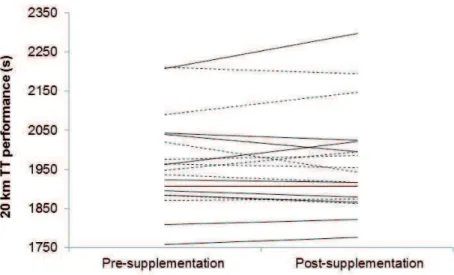
β - a l a n i n e ( B A ) (▬▬▬);
Placebo (P) (▬ ▬).
Individual 20 km time trial performances pre- and post- supplementation in β-alanine (BA) and Placebo (P).
FIGURE 1
-which both increased over the 20 km time trial. However, there was no eff ect of trial and no diff erence between the groups for either heart rate (p = 0.520; p = 0.958) or rating of perceived exertion (p = 0.240; p = 0.396; TABLE 2).
Distance (km)
Pre-supplementation Post-supplementation
5 10 15 20 5 10 15 20
Heart rate
β-alanine 154 ± 8 157 ± 10 160 ± 11 171 ± 8 155 ± 6 159 ± 8 163 ± 10 173 ± 10
Placebo 153 ± 10 159 ± 7 162 ± 8 175 ± 7 156 ± 12 161 ± 9 162 ± 10 177 ± 8
RPE β-alanine 15 ± 2 16 ± 1 17 ± 1 19 ± 1 15 ± 2 16 ± 1 17 ± 1 18 ± 1
Placebo 14 ± 1 16 ± 1 17 ± 1 19 ± 1 14 ± 1 16 ± 1 17 ± 1 19 ± 1
Pre-supplementation Post-supplementation
Pre-TT Post-TT Pre-TT Post-TT
Lactate β-alanine 1.32 ± 0.49 10.04 ± 1.90 1.55 ± 0.56 9.49 ± 2.32
Placebo 1.26 ± 0.60 9.81 ± 2.24 1.39 ± 0.67 9.64 ± 1.80
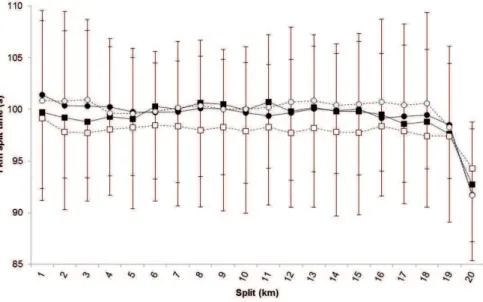
Due to diffi culties with the Cyclus2 saving split data in some trials, 1 km splits are given for n = 7 in BA and n = 7 in P. Th ere was a signifi cant eff ect of time on 1 km splits, with split times becoming faster towards the end of the 20 km time trial. Th ere was no diff erence
Discussion
This is the first study to examine the effects of β-alanine supplementation on 20 km time trial performance in well trained male cyclists,
demonstrating no signifi cant eff ect of β-alanine supplementation on this model of exercise performance. Th e individual data is also supportive of a lack of β-alanine supplementation on time trial performance, with equal numbers of participants showing increased and decreased performance; with all changes being relatively marginal in any case. In an attempt to detect small eff ects of practical importance we also determined the magnitude based inferences. In line with the fi nding of no signifi cant eff ect, the magnitude of the eff ect of
β-alanine supplementation on 20 km time trial performance was unclear. As such, and given
the high degree of reliability of the performance test used in this study (test-retest data having a CV of 0.7%), we can be confi dent in the lack of an eff ect of β-alanine on this performance test. Th ese fi ndings are also in accordance with those of Chung et al.18, demonstrating no eff ect of β-alanine supplementation on ~ 1 hour cycling time trial performance. Th us, these fi ndings suggest that despite the benefi cial eff ects of β-alanine supplementation on high intensity exercise capacity9-10, β-alanine supplementation does not infl uence longer duration
An inherent problem of time trial tests in well trained participants who are familiar with the exercise protocol is that they are infl uenced by pacing strategies27 and sometimes these pacing strategies do not produce optimal performance28. Th ere is also a variety, possibly an infi nite number, of pacing strategies available to an individual29. However, if pacing strategies were employed by the athletes in the present study variables such as heart rate, blood lactate and particularly the RPE responses to exercise would have been lower in the group supplemented with β-alanine. Although, as expected, exercise increased heart rate, lactate and RPE, β-alanine supplementation exerted no eff ect on any parameter during exercise, indicating that this is unlikely to have been the case.
We hypothesised that β-alanine supplementation would improve time trial performance given the previously reported infl uence of β-alanine on the ventilatory threshold20 and the potential for an increase in muscle carnosine to increase the calcium sensitivity of slow and fast twitch muscle fi bres and enhance calcium release in slow twitch fi bres3. However, the strength of the currently available evidence to support the eff ects of carnosine on calcium handling is limited2,9, with only one study3 being conducted on human muscle fi bres. If calcium
FIGURE 2 - 1 km split times for the mean pre- ( ) and post- (□) supplementation trials in β-alanine (BA) and mean pre- (●) and post- (□) supplementation trials in Placebo (P).
The effects of β-alanine supplementation on hi-gh-intensity cycling per-formance and capacity have been evaluated, although the effects on longer duration cycling performance are un-clear. Nineteen UK ca-tegory 1 male cyclists completed four 20 km cycling time trials, two before and two after supplementation with either 6.4 g•d-1 β-alanine
elevated muscle carnosine on exercise performance,
signifi cant eff ects of β-alanine supplementation would be expected across a wider range of exercise performance tests than have currently been shown2,9. Whilst the present study was not designed to examine the mechanisms related to increased exercise performance as a result of elevated muscle carnosine levels, the lack of an eff ect of β-alanine would be consistent with the lack of an eff ect of carnosine on calcium handling. Either that or alterations to calcium sensitivity or release do not infl uence 20 km time trial performance.
Taking the existing evidence as a whole, the most likely mechanism for an eff ect of increased muscle carnosine on exercise performance and capacity remains the eff ect it has on intracellular pH buff ering. Lending support to this assertion, studies have examined the eff ects of β-alanine on exercise capacity, using tests designed to induce large increases in intramuscular hydrogen cation levels and reductions in pH11-12,30, and have shown signifi cant increases in exercise capacity. In relation to cycling, studies have shown signifi cant eff ects of β-alanine supplementation on high-intensity cycling capacity, as determined by increases in total work done11-12. Th e cycling capacity test at 110% of powermax used by both of these studies is one of the few tests to be independently repeated with β-alanine supplementation. Th e increase in cycling capacity reported following 4 weeks of supplementation was similar in both studies; Hill et al.11 reported an increase of 13% and Sale et al.12 an increase of 15% using a slightly higher total intake of β-alanine. Th e fact that reductions in intracellular pH are unlikely to be limiting to 20 km time trial performance might thus help to explain the lack of a signifi cant eff ect in the present study. However, during competitive cycling inclines in the road surface will frequently be encountered, with trials typically ending in a sprint, both of which might be expected to reduce intramuscular pH. It is therefore possible that increased muscle carnosine levels brought about by
β-alanine supplementation may improve endurance cycling performance in real-life competitive races.
Th at said, not all studies with regards to high-intensity cycling performance tests have shown signifi cant eff ects of β-alanine supplementation. Bellinger et al.14 reported no eff ect of β-alanine supplementation on maximal 4 minute cycling performance, although van Thienen et al.15 reported a signifi cant eff ect of β-alanine on 30 s isokinetic sprint cycling, performed at the end of
a 110 min simulated endurance cycle race. Due to the fi ndings of van Thienen et al.15, we also determined the 1 km split times in the current study to ascertain whether there was any eff ect of β-alanine supplementation on exercise performance towards the end of the 20 km time trial. Split times were relatively consistent throughout but did become faster towards the end of the 20 km time trial in both groups, particularly in the fi nal kilometre. However, there was no eff ect of β-alanine on the performance of any 1 km split.
Th e present study is not without its limitations; it should be noted that we did not determine the infl uence of β-alanine supplementation on muscle carnosine concentrations. Th is was primarily due to the lack of availability of a non-invasive method of determining muscle carnosine content in these well-trained participants. As such, we cannot confi rm in the present study that muscle carnosine contents were signifi cantly increased and, if so, what the magnitude of this increase was. However, supplementation with
β-alanine at this level has consistently been shown to increase muscle carnosine concentrations by over 60%8,11, with others reporting no non-responders to
β-alanine supplementation11,21,31. Indeed, only one participant from the series of muscle studies to-date has failed to respond to β-alanine supplementation with an increase in muscle carnosine8. Overall increases have been shown to be between 40 and 80% depending upon dose (between 3.2 and 6.4 g•d-1) and duration of administration (between 4 and 10 weeks). Furthermore, based on the dose-response relationship shown by Stellingwerff et al.32, our supplementation regimen would be expected to result in a 3.6 mmol•kgww-1 increase in muscle carnosine concentration.
Practical applications
Th ese data suggest that endurance cyclists competing in events lasting around 30 minutes will not benefi t from β-alanine supplementation. However, it may be that when the intensity of the cycling is increased, for example during a hill climb or a sprint fi nish, enhanced intramuscular H+ buffering, through β-alanine supplementation, may be benefi cial to performance. Future research should investigate this possibility.
In conclusion, supplementation with 6.4 g•d-1 of
References
1. Hobson RM, Saunders B, Ball G, Harris RC, Sale C. Eff ects of β-alanine supplementation on exercise performance: a meta-analysis. Amino Acids. 2012;43:25-37.
2. Sale C, Artioli GG, Gualano B, Saunders B, Hobson RM, Harris RC. Carnosine: from exercise performance to health. Amino Acids. 2013;44:1477-91.
3. Dutka TL, Lamboley CR, McKenna MJ, Murphy RM, Lamb GD. Eff ects of carnosine on contractile apparatus Ca2+ sensitivity and sarcoplasmic reticulum Ca2+ release in human skeletal muscle fi bres. J Appl Physiol. 2012;112:728-36. 4. Everaert I, Stegen S, Venheel B, Taes Y, Derave W. Eff ect of β-alanine and carnosine supplementation on muscle
contractility in mice. Med Sci Sports Exerc. 2013;45:43-51.
5. Boldyrev AA. Does carnosine possess direct antioxidant activity. Int J Biochem. 1993;25:1101-7.
6. Hipkiss AR, Michaelis J, Syrris P. Non-enzymatic glycosylation of the dipeptide L-carnosine, a potential anti-protein-cross-linking agent. FEBS Lett. 1995;371:81-5.
7. Smith AE, Stout JR, Kendall KL, Fukuda DH, Cramer JT. Exercise-induced oxidative stress: the eff ects of β-alanine supplementation in women. Amino Acids. 2012;43:77-90.
8. Harris RC, Tallon MJ, Dunnett M, et al. Th e absorption of orally supplied β-alanine and its eff ect on muscle carnosine synthesis in human vastus lateralis. Amino Acids. 2006;30:279-89.
9. Sale C, Saunders B, Harris RC. Eff ect of β-alanine supplementation on muscle carnosine concentrations and exercise performance. Amino Acids. 2010;39:321-33.
10. Harris RC, Sale C. Beta-alanine supplementation in high-intensity exercise. In: Lamprecht M, editor. Acute topics in sport nutrition. Basel: Karger; 2012. p.1-17.
11. Hill CA, Harris RC, Kim HJ, et al. Infl uence of β-alanine supplementation on skeletal muscle carnosine concentrations
and high intensity cycling capacity. Amino Acids. 2007;32:225-33.
12. Sale C, Saunders B, Hudson S, Wise JA, Harris RC, Sunderland CD. Eff ect of β-alanine plus sodium bicarbonate on high-intensity cycling capacity. Med Sci Sports Exerc. 2011;43:1972-8.
13. Smith AE, Walter AA, Graef JL, et al. Eff ects of β-alanine supplementation and high intensity interval training on endurance performance and body composition in men; a double blind trial. J Int Soc Sports Nutr. 2009;6:5. 14. Bellinger PM, Howe ST, Shing CM, Fell JW. Eff ect of combined β-alanine and sodium bicarbonate supplementation
on cycling performance. Med Sci Sports Exerc. 2012;44:1545-51.
15. Van Th ienen R, Van Proeyen K, Vanden Eynde B, Puype J, Lefere T, Hespel P. β-alanine improves sprint performance in endurance cycling. Med Sci Sports Exerc. 2009;41:898-903.
16. Artioli GG, Gualano B, Smith A, Stout J, Lancha Junior AH. Role of β-alanine supplementation on muscle carnosine and exercise performance. Med Sci Sports Exerc. 2010;42:1162-73
17. Derave W, Everaert I, Beeckman S, Baguet A. Muscle carnosine metabolism and beta-alanine supplementation in relation to exercise and training. Sports Med. 2010;40:247-63.
18. Chung W, Baguet A, Bex T, Bishop DJ, Derave W. Doubling of muscle carnosine loading does not improve endurance cycling performance. Int J Sports Nut Exerc Metab. 2014;24:315-24.
19. Stout JR, Cramer JT, Mielke M, et al. Eff ects of twenty-eight days of beta-alanine and creatine monohydrate supplementation on the physical working capacity at neuromuscular fatigue threshold. J Strength Cond Res.
2006;20:928-31.
20. Stout JR, Cramer JT, Zoeller RF, et al. Eff ects of β-alanine supplementation on the onset of neuromuscular fatigue and ventilatory threshold in women. Amino Acids. 2007;32:381-6.
21. Baguet A, Reyngoudt H, Pottier A, et al. Carnosine loading and washout in human skeletal muscles. J Appl Physiol. 2009;106:837-42.
22. Decombaz J, Beaumont M, Vuichoud J, Bouisset F, Stellingwerff T. Eff ect of slow-release β-alanine tablets on absorption
duration exercise does not exist and that the most
likely eff ects are to be seen with short duration
23. Borg GAV. Psychophysical bases of perceived exertion. Med Sci Sport Exerc. 1982;14:377-81.
24. Hopkins WG. A spreadsheet for deriving a confi dence interval, mechanistic inference and clinical inference from a p value. Sportscience. 2007;11:16-20.
25. Hopkins WG. Probabilities of clinical or practical signifi cance. Sportscience. 2002;6 Available from: http://www. sportsci.org/jour/0201/wghprob.htm.
26. Batterham AM, Hopkins WG. Making meaningful inferences about magnitudes. Sportscience. 2005;9:6-13. 27. Baron B, Moullan F, Deruelle F, Noakes TD. Th e role of emotions on pacing strategies and performance in middle
and long duration sport events. Br J Sports Med. 2011;45:511-7.
28. Hinckson EA, Hopkins WG. Reliability of time to exhaustion analysed with critical-power and log-log modelling. Med Sci Sports Exerc. 2005;37:696-701.
29. St Clair Gibson A, Lambert EV, Rauch LHG, et al. Th e role of information processing between the brain and peripheral physiological systems in pacing and perception of eff ort. Sports Med. 2006;36:705-22.
30. Sale C, Hill CA, Ponte J, Harris RC. β-alanine supplementation improves isometric endurance of the knee extensor muscles. J Int Soc Sports Nutr. 2012;9:26.
31. Derave W, Ozdemir MS, Harris RC, et al. β-alanine supplementation augments muscle carnosine content and attenuates fatigue during repeated isokinetic contraction bouts in trained sprinters. J Appl Physiol. 2007;103:1736-43. 32. Stellingwerff T, Anwander H, Egger A, et al. Eff ect of two β-alanine dosing protocols on muscle carnosine synthesis
and washout. Amino Acids. 2012;42:2461-72.
Acknowledgements
Th e authors would like to thank National Alternatives International (NAI), San Marcos, California for providing the
β-alanine (Carnosyn SR™) and Placebo supplements.
Th e results of this current study do not constitute endorsement of the product by the authors or the journal.
ENDEREÇO
Craig Sale Sport, Health and Performance Enhancement (SHAPE)
Research Group School of Science and Technology Nottingham Trent University Clifton Lane Clifton - Nottingham - NG11 8NS - UK e-mail: @ntu.ac.uk
Recebido para publicação: 29/04/2014 Revisado: 22/05/2014