Quim. Nova, Vol. 33, No. 2, 245-248, 2010
Ar
ti
go
*e-mail: [email protected]
PRELIMINARY STUDY OF INSECT ATTRACTION BY A MIXTURE OF SEMIOCHEMICALS CONTAINING 1,2,4-TRIMETHOXYBENZENE IN DOMESTIC CITRIC-CULTURE
Ana Paula L. Alves, José Augusto B. de C. Júnior, Glaucia B. A. Slana, Jari N. Cardoso, Rosangela S. C. Lopes e Claudio C. Lopes*
Departamento de Química Analítica, Instituto de Química, Universidade Federal do Rio de Janeiro, CT, Bl. A, 21949-900 Rio de Janeiro - RJ, Brasil
Recebido em 17/6/08; aceito em 12/8/09; publicado na web em 11/1/10
In this work we describe a new eficient strategy for the preparation of 1,2,4-trimethoxybenzene (3) in 56% overall yield. The compound 3 was used in a preliminary study of insect attraction by a mixture of semiochemicals called TIV, composed of indol (1), vanillin (2)and 1,2,4-trimethoxybenzene (3), in eight Mc Phail style traps installed at a domestic orchard of citric-culture, containing 120 trees not infected by plagues in Bom Jesus Farm, located next to a patch of the Atlantic Forest, at Silva Jardim, Rio de Janeiro, Brazil.
Keywords: Euglossini bees, 1,2,4-trimethoxybenzene, semiochemicals.
INTRODUCTION
One of the most known application of insect semiochemicals is in the undesirable effects of pest on agriculture. Much of the behavior of insect pests is associated with the search for food, sexual partners and egg-laying sites, together with defensive activities to protect them from adverse environmental conditions and natural enemies.1
The study of semiochemicals that inluence insect behavior is a promising method for pest control as alternative to the exclusive use of broad-spectrum toxicants.2 Those compounds, called pesticides,
have detrimental effects of on health, environment and organisms. Employing insect attractants in agricultural crops represent an important alternative strategy for insect control, because pest can be attracted and be mass trapped. In this way it is possible to improve not only food quality but also life quality.
Last but not least, insect attractants have a potential application in lower pollinization. Many lowers have naturally bad pollinization due to unfavorable sexual structures anatomy. That is the case of Passilora alata. The semiochemical, in these cases, may attract the pollinators, increasing the population of those insects where they are required.
On previous work, Ventura and coworkers studied the relative responses of Diabroticaspeciosa (Ger.) and Cerotoma arcuata tingomariana on ields of common bean and soybean using traps baited with 1,4-dimethoxybenzene and also containing mixtures of semiochemicals such as VIP (veratrole+indol+phenylacetaldehyde) and TIC (1,2,4-trimethoxybenzene+indol+trans-cinnamaldehyde).3
The aim of this work is to evaluate the ability of a mixture of semio-chemicals, called TIV (1,2,4-trimethoxybenzene, indol and vanillin), in attract insects of a productive citrous orchard, in Silva Jardim, at Rio de Janeiro, Brazil. For the preparation of TIV mixture, we have proposed a new low cost synthesis route of 1,2,4-trimethoxybenzene.
EXPERIMENTAL
General methods
All solvents and reagents were purchased from Vetec, Aldrich, Merck, Grupo Química, Isotec Inc. and Acros Organics. All solvents
were dried and puriied prior to use.4 All reactions were performed under
anhydrous conditions. They were conducted in oven-dried glassware under an argon atmosphere. Air-sensitive solutions were transferred via oven-dried syringe needles under positive pressure of argon.
IR spectra were recorded on Magma IR-760-Nicolet spec-trometer. FT IR spectra were taken in KBr and absorptions are reported in cm-l.
Proton (1H) and carbon (13C) nuclear magnetic resonance spectra
were recorded on Varian Gemini 200 MHz or Brucker 300 MHz spectrometers. FT NMR spectra were taken in CDCl3 or DMSO-d6. Chemical shifts (δ) are reported relative to tetramethylsilane TMS (δTMS=0) in parts per million and the coupling constants (J) are re-ported in Hz. Regarding the multiplicity the following abbreviations were employed: s (singlet); d (dublet); dd (double dublet), dt (double triplet), q (quartet) and m (multiplet).
High-resolution mass spectra were taken on an Atlas MS-12, Consolidated 12-110 B, and Finnegan 400 mass spectrometers at 70 eV at the University of California (Berkeley). Where mass spectral data are given, the peak value is immediately followed by its relative abundance in parentheses.
Melting points were recorded on a Mel-TempII capillary melting point apparatus and the temperatures were reported in o C.
Chromatography
All reactions were followed by thin layer chromatography (TLC), under 0.2 mm silica gel 60 F254 plates (Merck). Plates were visuali-zed with 2,4-dinitrophenylhydrazine, p-anisaldehyde, iron chrloride solutions stain5 or UV light.
In cases where a product was puriied by silica gel column chro-matography, packing material for lash chromatography6 was Merck
silica gel 60 (230-400 mesh ASTM Merck).
The volatiles adsorbed at Tenax® resin (Aldrich), in the
prelimi-nary study of the volatilization of TIV mixture in laboratory, were analyzed on a Varian CP 3380 GC-FID and on a HP6890/5973N (Mass Selective Detector) - Agilent Tecnologies GC-MS.
Alves et al.
246 Quim. Nova
low, 1.0 mL/min; oven temperature program: 100 oC (3 min), 4 oC/
min until 170 oC; FID detector temperature: 300 oC; total analysis
time: 20.5 min.
The following conditions were performed on the GC-MS analy-sis: the TIV mixture was dissolved in EtOAc and subjected to a 28.6 m/0.25 mm I.D. and 0.3 µm ilm (column); split injection volume, 1 µL; injection temperature, 200 oC; carrier gas - helium; carrier low,
1.0 mL/min; oven temperature program: 80 oC (3 min), 4 oC/min until
170 oC; FID detector temperature: 230 oC; total analysis time: 25.5 min.
Field experiments
Field experiments were carried out at Bom Jesus Farm, at BR 101, km 235, Silva Jardim, in the state of Rio de Janeiro in Brazil. The baited traps were placed in the ield containing 120 of orange trees from the 1st February 2004 until the 7th February 2004, being
removed after 7 days.
1,2,4-Trimethoxybenzene (3) used in this work was synthesized in our laboratory from vanillin (2). This compound and indol (1) were purchased from Vetec.
Eight traps with 300 mg of TIV were ixed at 1.5 m height in orange trees. The mixture was used at a dosage of 100 mg of each single chemical per trap. The same amount of control traps received no TIV. Distance between traps was at least 5 m. The average tem-perature was 35 oC.
Volatilization test in laboratory of TIV mixture
TIV mixture was subjected to a volatile capture system where the carrier gas nitrogen cross a pre-drying tube before reaching the mixture in a three-neck round bottom lask. The volatiles are lowed towards Tenax® resin, where they are adsorbed.
A preliminary study of volatilization of TIV mixture in laboratory was carried out during 7 days. A blank was made without TIV mixture.
The sample resins were extracted with EtOAc and concentrated under low pression to be analyzed by GC-DIC and GC-MS apparatus.
Synthesis of 1,2,4-Trimethoxybenzene (3) from Vanilin (2). Preparation of 3,4-Dimethoxybenzaldehyde (4)
In a three-neck round bottom lask with a relux condenser, a suspension of vanilin (500 mg; 3.29 mmol) and K2CO3 (500 mg; 3.62 mmol) in anhydrous CH3COCH3 (40 mL) was stirred at 40-45 oC,
under argonium atmosphere. After 1 h, CH3I (716 mg; 0.32 mL; 4.94 mmol) was added dropwise and the resulting mixture was reluxed for 7 h. The solvent was then removed under reduced pressure and the resulting solid was poured into HCl 5% (10 mL), and extracted with EtOAc (3 x 20 mL). The organic layer was then washed with brine, dried over Na2SO4, evaporated to dryness, and puriied by silica gel chromatography (5-20% EtOAc/hexanes) to yield 3,4-di-methoxybenzaldehyde (4)as a pale-yellow solid (518,75 mg; 95%), mp 43-45 oC; IR (KBr, cm-1): 3077, 3019, 2999, 2920, 2849, 2765
(O=C-H), 1686 (C=O), 1275(C-O-C), 1018 (C-O-C), 802; 1H NMR
(CDCl3, 200 MHz) δ: 9.84 (s, 1H, COH), 7.48-7.39 (m, 2H, H-Ar), 6.97 (d, J= 8 Hz, 1H, H-Ar), 3.96 (s, 3H, OCH3), 3.93 (s, 3H, OCH3);
13C NMR (CDCl
3, 50 MHz) δ: 191.0 (C=O), 154.6 (C-OCH3), 149.7
(C-OCH3), 130.2 (C-CHO), 127.0 (H-Car), 110.5 (H-Car), 109.0 (H-Car), 56.3 (OCH3), 56.1 (OCH3).
Preparation of 3,4-Dimethoxyphenol (6)
In a three-neck round bottom lask with a relux condenser, m- CBPA 70% (3.61 g; 20.0 mmol) and NaHCO3 (0.58 g; 7.0 mmol)
were added to a stirring solution of 3,4-dimethoxybenzaldehyde (4) (1.66 g; 10.0 mmol) in anhydrous CH2Cl2 (50 mL). The mixture was allowed to relux for about 10-15 h. Most CH2Cl2 was separated by distillation, and the resulting material was dissolved in EtOAc (50 mL). The organic layer was poured into NaHSO3 10% (3 x 15 mL), washed with brine, dried over Na2SO4, evaporated to dryness, to yield 3,4-dimethoxyphenyl formate (5) as a pale-red oil (83.5%); IR (KBr, cm-1): 3087, 3074, 3.006, 2959, 2939, 2913, 2875, 2838
(O=C-H), 1738(C=O), 1266(C-O-C), 1026 (C-O-C), 867; 1H NMR
(CDCl3, 200 MHz) δ: 8.29 (s, 1H, OOC-H), 6.86 (d, 1H, H-Ar), 6.67 (s, 2H, broad, H-Ar), 3.87 (s, 3H, OCH3), 3.83 (s, 3H, OCH3); 13C
NMR (CDCl3, 50 MHz) δ: 159.7 (OCOH), 149.6 (C-OCH3), 147.3 (C-OCHO), 143.6 (C-OCH3), 112.4 (H-Car), 111.3 (H-Car), 105.3 (H-Car), 56.2 (OCH3), 56.1 (OCH3).
Afterwards, the crude product (5) was dissolved in MeOH (5 mL), under N2 atmosphere. Then, a solution of KOH 10% (10 mL) was added dropwise, allowing basic hydrolysis of (5). The mixture was poured into HCl 5% (5-15 mL) and extracted with EtOAc (3 x 15 mL), being washed with brine (3 x 10 mL), dried over Na2SO4, evaporated to dryness, to yield 3,4-dimethoxyphenol (6)as a red oil (61%, from 15); IR (KBr, cm-1): 3396 (O-H), 3087, 3044, 3003, 2959,
2938, 2835, 1224 (C-O-C), 1025 (C-O-C), 835; 1H NMR (CDCl 3,
200 MHz) δ: 6.73 (d, J= 8 Hz, 1H, H-Ar), 6.47 (s, 1H, H-Ar), 6.36 (d, J=8 Hz, 1H, H-Ar), 3.81 (s, 3 H, OCH3), 3.81 (s, 3 H, OCH3); 13C
NMR (CDCl3, 50 MHz) δ: 150.4 (C-OCH3), 150.0 (C-OCH3), 143.2 (C-OH), 112.7 (H-Car), 106.0 (H-Car), 100.8 (H-Car), 56.7 (OCH3), 55.9 (OCH3).
Preparation of 1,2,4-Trimethoxybenzene (3)
In a three-neck round bottom lask with a relux condenser, a suspension of crude 3,4-dimethoxyphenol (6) (500 mg; 3.29 mmol) and K2CO3 (987 mg; 7.14 mmol) in anhydrous CH3COCH3 (30 mL) was stirred at 40-45 oC, under argonium atmosphere. After 1 h, CH
3I
(1.41 g; 0.62 mL; 9.74 mmol) was added dropwise and the resulting mixture was reluxed for 7 h.
The solvent was then removed under reduced pressure and the resulting oil was poured into HCl 5% (10 mL), and extracted with EtOAc (3 x 20 mL). The organic layer was then washed with brine, dried over Na2SO4, evaporated to dryness, and puriied by silica gel chromatography (5% EtOAc/hexanes) to yield 1,2,4-trimethoxyben-zene (3)asan oil (97%); IR (KBr, cm-1): 3081, 2998, 2938, 2908,
2834, 1230 (C-O-C), 1027 (C-O-C), 834; 1H NMR (CDCl 3, 200
MHz) δ: 6,79 (d, J= 8Hz, 1H, H-Ar); 6,52 (d, J=3 Hz, 1H, H-Ar); 6.39 (dd, J= 3 Hz, J= 8 Hz, 1 H, H-Ar), 3.86 (s, 3H, OCH3), 3.83 (s, 3H, OCH3), 3.77 (s, 3H,OCH3); 13C NMR (CDCl
3, 50 MHz)
δ: 154.4 (C-OCH3), 150.0 (C-OCH3), 143.6 (C-OCH3), 112.0 (H-Car), 103.0 (H-Car), 100.5 (H-Car), 56.6 (OCH3), 55.9 (OCH3), 55.8 (OCH3); HRMS m/z (%): 168.078550 (68.4). Calc. for C10H14O3: 168.078644.
RESULTS AND DISCUSSION
Indol (1) and 1,2,4-trimethoxybenzene (3) are volatile substances, known as lower semiochemicals.3 The mixture of these substances
with vanillin (2), named TIV mixture, was tested in a citrous orchard (of about 120 x 15 m), in a preliminary study for evaluating the insect reponses to traps (Mc Phail type one from Biocontrole®) baited with it.
Preliminary study of insect attraction 247 Vol. 33, No. 2
TIV mixture
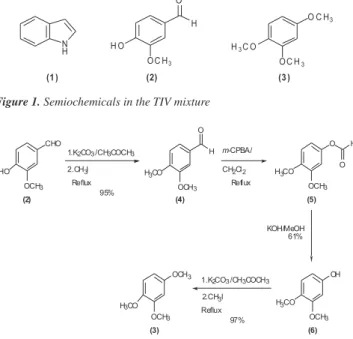
The mixture called TIV (Figure 1) is formed by the semiochemi-cals indol (1), vanillin (2), both were purchased, and 1,2,4-trimetho-xybenzene (3), which has been synthetized in our laboratory from 2 in a low cost and fast route (Figure 2).
Our synthetic approach for the preparation of 3 started with the methylation of vanillin (2), by treatment with methyl iodide (CH3I) in the presence of K2CO3, in CH3COCH3 under relux, to obtain the 3,4-dimethoxybenzene (4) in 95% yield.
The next step was the oxidation of the carbonylic carbon of the 3,4-dimethoxybenzaldehyde (4). For this purpose, in our hands di-fferent reactional oxidation conditions, employing H2O2 or m-CPBA, as the oxidant agents were carried out without a synthetic success. However, the best result was obtained when 3,4-dimethoxybenzal-dehyde (4) was treated with m-CPBA in CH2Cl2, in a buffered reaction mixture with NaHCO3, to form 3,4-dimethoxyphenyl formate (5). The synthetic approach described herein is more practical and versatile than others from literature.9-14 Afterwards, 5 was treated under basic
hydrolysis conditions in KOH/MeOH, to obtain 3,4-dimethoxyphenol (6)in 61% yield from 4.
Phenol derivative 6 was methylated by CH3I in K2CO3 / CH3 CO-CH3, to yield 3 in 97%. Therefore, the global yield of the synthesis of 3 was 56%, which was satisfying to our aim.
All compounds were characterized through IR, 1H NMR, 13C
NMR analysis.
Insects attracted by TIV mixture in citrous orchard – preliminary ield experiments
Mc Phail traps containing TIV mixture were installed in a domes-tic citrous orchard in Bom Jesus Farm, at Silva Jardim, in the state of Rio de Janeiro, Brazil. In this type of trap, the insects are attracted not only by the odour stimulus (semiochemical mixture) but also by a visual sign, by the inferior yellow piece of the trap. Once inside the trap, the insects are not able to escape because they ly towards the superior colorless piece. Therefore, without food and energy, they die being collected in the Mc Phail traps.
After 7 days of exposition, 4 species of insects were captured and sent to identiication at University of Sao Paulo (Departamento de Biologia, Faculdade de Filosoia, Ciências e Letras de Ribeirão Preto). None insect captured was observed in the blank traps. In Table 1, we list the 4 species attracted by TIV mixture in the citrous orchard preliminary test.
All insects attracted by the TIV mixture belong to the most important genus of Euglossini tribe: Eulaema sp and Euglossa sp.
Euglossine bees (Apidae: Euglossini) are an important exclusively neotropical pollinator group that are most closely related with certain angiosperm families. Without speciically trying to collect pollen, they are able to secure pollination of species of Caesalpiniaceae, Maranthaceae, Euphorbiaceae, Araceae, Gesneriaceae, Bignoniaceae, Orchidaceae and others.15 They are known as orchid bees.
Male euglossine bees are the only pollinators of some orchids, e.g. Gongora, Castasctum, and Coryanthes. They are attracted to the essences produced by these orchids’ lowers. The use of these essences is not so well understood, but they may be used as a sexual attractant.15
Euglossine bees are described as a group of brightly colored tropical insects. Many species are green, blue, purple, gold, or red. However, in the Eulaema genus, the insects are bigger with less metallic bright bodies. They have tongues that, in some species, may be twice as long as the body. The long tongue allows them to reach nectar in deep-throated tropical lowers. Many species of orchid bees collect nectar, pollen, and other substances from orchids.16
Our mixture of semiochemicals (TIV) captured 4 species of eu-glossine bees (Table 2): Eulaema nigrita Lepeletier (1841), Euglossa pleosticta Dressler (1982), Euglossa securigera Dressler (1982), sensu Moure and Euglossa sp. aff. Sapphirina Moure (1968).
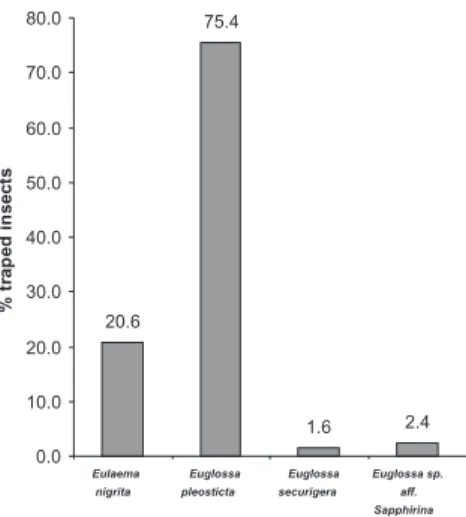
Eulaema nigrita and Euglossa pleostictawere the most attrac-ted species in the tesattrac-ted conditions, with 21 and 75%, respectively (Figure 3).
Eulaema nigrita is an important natural pollinator of Passilora sp. The natural fertilization of its lowers is rare due to the autoin-compatibility, yielding small fruits with few seeds. The pollinization in the commercial crops of Passilora sp. is naturally done by insects of Eulaema and Xylocopa species or artiicially, by men.
Euglossa sp.are important in the orchid pollinization. Those lowers are cultivated due to their fragrances and exotic beauty. Thus, all insects captured may have commercial importance. We propose TIV mixture application in orchid cultivation and Passilora sp. crops in aim to increase the population of pollinizators in these areas, and therefore improve the production of lowers and fruits. Of course, traps would not be allowed for these purposes in order to avoid insect death.
Volatilization test in laboratory of TIV mixture – preliminary test
A preliminary volatilization test was carried out in our laboratory in order to establish the optimum conditions to evaluate de kinetics of libera-tion of the semiochemicals from the traps. Seven days samples adsorbed in the Tenax® resin were subjected to CG-DIC (Figure 4) and GC-MS
Figure 1. Semiochemicals in the TIV mixture
Figure 2. Synthetic approach for the preparation of 1,2,4-trimethoxybenzene
(3) from vanillin (2)
Table 1. Field experiment results
SPECIES TRAPS
Average Total Blanks
Eulaema nigrita Lepeletier, 1841 4.33 26
-Euglossa pleosticta Dressler, 1982 15.83 95
-Euglossa securigera Dressler, 1982 (sensu
Moure) 0.33 2
-Alves et al.
248 Quim. Nova
analysis (data not shown). This preliminary study indicated the presence of indol (49%), 1,2,4-trimethoxybenzene (49%) and vanillin (2%).
CONCLUSIONS
Employing a low cost approach, we synthesized 1,2,4-trimetho-xybenzene (3) in 56% overall yield, after a long study to determine the optimum conditions to prepare 6 from 4.
The preliminary ield study in citrous orchard, located at Bom Jesus Farm in Silva Jardim, in the state of Rio de Janeiro, in Brazil, showed promising results in attracting insects by TIV mixture. Pollinators (orchid bees) were captured, specially Eulaema nigrita Lepeletier, 1841 e Euglossa pleosticta Dressler, 1982, both of them are
Figure 4. GC-FID chromatogram of TIV mixture volatiles
Figure 3. Euglossine bees attracted in ield experiments
important in the Passilora sp. crops and orchid cultivars, respectively. In this way, TIV mixture may be used in those crops or cultivars to increase the population of pollinators in those areas.
The preliminary study of the volatilization of TIV indicated the presence of indol (about 49%), 1,2,4-trimethoxybenzene (49%) and vanillin (2%).
A ield study of the substituted derivatives at the 3-position of 1,2,4-trimethoxybenzene (3), which will be done by directed meta-lation strategy17 to be evaluated their potential as insect attractants
as well as the contribution of each TIV mixture constituent to attract insects will be a future work. We also intend to determine the optimum mixture proportions to each of one these compounds.
ACKNOWLEDGEMENTS
Wethank CAPES, CNPQ, FAPERJ and FUJB for the inancial support.
REFERENCES
1. Cox, P. D.; Collins, L. E.; J. Stor. Prod. Res.2002, 8, 95.
2. Pickett, J. A.; Wadhams, L. J.; Woodcock, C. M.; Agr. Ecosyst. Environ. 1997, 64, 149.
3. Ventura, M. U.; Martins, M. C.; Pasini, A.; Florida Entomol. 2000, 83, 403.
4. Perrin, D. D.; Armarego, W. L.; Puriication of Laboratory Chemicals, 3rd ed., Butterworth-Heinemann Ltd.: London, 1988.
5. Williamson, K. L.; Macroscale and Microscale Organic Experiments, 3rd ed., Houghton Miflin Company: Boston, 1999.
6. Still, W. C.; Kahn, M.; Mitra, A.; J. Org. Chem. 1978, 43, 2923. 7. Nogueira, P. C. L.; Bittrich, V.; Shepherd, G. J.; Lopes, A., V.; Marsaioli,
A. J.; Phytochemistry2001, 56, 443.
8. Makhoela, T.; Manning, J. C.; South Afr. J. Bot. 2006, 72, 597. 9. Wriede, U.; Fernandez, M.; West, K. F.; Harcourt, D.; Moore, H. W.; J.
Org. Chem. 1987, 52, 4485.
10. Hardegger, E.; Steiner, K.; Corrodi, W. E.; Schmidt, Th.; Knoepfel, H. P.; Rieder, W.; Kugler, F.; Gempeler, H.; Helv. Chim. Acta 1964, 47, 1996.
11. Dickstein, J. S.; Mulrooney, C. A.; O’Brien, E. M.; Morgan, B. J.; Ko-zlowski, M. C.; Org. Lett. 2007, 9, 2441.
12. Guzman, J. A.; Mendoza, V.; Garcia, E.; Garibay, C. F.; Olivares, L. Z.; Maldonado, L. A.; Synth. Commun.1995, 25, 2121.
13. Spyer, L.; Kloc, K.; Mlochowski, J.; J. Prakt. Chem. 1985, 327, 808. 14. Belleau, B.; Weinberg, N. L.; J. Am. Chem. Soc. 1963, 85, 2525. 15. Brito, C. M. S.; Rêgo, M. M. C.; Braz. J. Biol. 2001, 61, 631. 16. Roubik, D. W.; Hanson, P. E.; Abejas de orquídeas de la América
tropical: Biología y Guía de Campo, 1a ed., Instituto Nacional de
Biodiversidade: Santo Domingo de Heredia, 2004.