Oxacillinase (OXA)-producing Acinetobacter
baumannii in Brazil: clinical and environmental
impact and therapeutic options
Acinetobacter baumannii produtor de oxacilinases (OXA) no Brasil:
impacto clínico, epidemiológico e opções terapêuticas
Micheli Medeiros1; Nilton Lincopan2
First submission on 23/05/13; last submission on 01/06/13; accepted for publication on 17/06/13; published on 20/12/13 1. MSc by the Clinical Analysis Department - Faculty of Pharmaceutical Sciences - Universidade de São Paulo (USP).
2. Post-doctorate in Sciences by Instituto de Química da USP; professor at the Microbiology Department - Biomedical Sciences Institute- USP and at the Clinical Analysis Department – Faculty of Pharmaceutical Sciences - USP.
ABSTRACT
Following a worldwide trend, infections caused by MDR OXA-type (Ambler class D) carbapenemase-producing Acinetobacter baumannii
are currently regarded as a clinical and epidemiological emergency in Brazil. OXA-producing A. baumannii strains have been identiied in the states of Alagoas, Amazonas, Bahia, Distrito Federal, Espírito Santo, Goiás, Mato Grosso, Mato Grosso do Sul, Minas Gerais, Paraná, Pernambuco, Rio de Janeiro, Rio Grande do Norte, Rio Grande do Sul, Santa Catarina and São Paulo. In some settings, the presence of OXA-23- and/or OXA-143 -producing A. baumannii (so far restricted to Brazil) has been endemic and A. baumannii strains carrying
blaOXA-23 genes have been detected in hospital wastewater efluents, hence a potential risk to the community and the environment. Although molecular typing by multilocus sequence typing (MLST - Bartual scheme, University of Oxford, http://pubmlst.org/abaumannii/) has revealed the international spread of a clonal complex (CC) denominated CC92, in Brazil most OXA-23-producing A. baumannii belong to CC113, CC109 or CC104 clonal complexes. Finally, from a clinical point of view, the main problem of A. baumannii infections is the limited
use of antibacterial agents with in vitro activity, often restricted to ampicillin/sulbactam, polymyxin B and/or colistin (polymyxin E)..
Key words: huHAIs; multidrug-resistant; carbapenems; oxacilinases; OXA-23; OXA-143; MLST.
INTRODUCTION
Acinetobacter baumannii is a non-fermentative
Gram-negative bacillus widely recognized as an opportunistic nosocomial pathogen. It has assumed high clinical importance in the last two decades due to its frequent association with healthcare infections (healthcare- associated infections -HAI ), most of which with unfavorable prognosis and expression of comprehensive antimicrobial resistance mechanisms to antibiotics (ATBs)(11, 25, 101, 116, 118, 121).
In Latin America, A. baumannii has accounted for 6.6% of
the cases of HAI(36). The main sites reported by multicenter studies
are lower respiratory tract (17.7%), bloodstream ( 7.2% ) , skin and soft tissues - including burns and surgical sites - ( 9.9% ) and urinary tract ( 1.6 %)(36, 117).
The risk factors comprise invasive procedures such as mechanical ventilation, central venous catheter or urinary catheter as well as the prior use of broad-spectrum ATBs(14, 29, 42, 76, 85, 101, 117, 118).
at hospital environment(8, 25, 53, 85). Furthermore, the epidemiology
of the infection by A. baumannii is often complex and the
coexistence of epidemic and endemic infections in a given unit promotes the widespread use of broad-spectrum antibiotics for prolonged periods, hence promoting selective pressure on hospital microbiota and selecting resistant bacterial strains(10, 29, 82, 86, 90, 98, 118).
One of the most striking features of Acinetobacter species is its
extraordinary ability to develop multiple resistance mechanisms against major classes of commercially available antibiotics. In fact,
A. baumannii can easily express resistance to the broad spectrum beta-lactam (third generation cephalosporins, carboxypenicillins and carbapenems) and to aminoglycosides by the production of a variety of hydrolytic enzymes, namely beta-lactamases and transferases, which inactivate this class of antibacterial agents. Additionally, most strains can express high levels of resistance to luoroquinolones(29, 118) ( Figure 1).
In general, the expression of multiple resistance mechanisms provides phenotypes categorized as multidrug -resistant (MDR- resistance to ≥ 1 antibacterial agent in ≥ 3 categories), extensively drug resistant (XDR- resistance to ≥ 1 antibacterial agent in all except to ≤ 2 categories) and pan -resistant (resistant to all tested antibiotics)(75).
Among the ATB categories used in this deinition, the following ones are recommended for A. baumannii: aminoglycosides (gentamicin,
tobramycin , amikacin and netilmicin), carbapenems (imipenem, meropenem and doripenem), luoroquinolones ( ciproloxacin and levoloxacin), antipseudomonal penicillin / beta-lactamase inhibitor (piperacillin/tazobactam and ticarcillin/clavulanate), extended-spectrum cephalosporins (cefotaxime, ceftriaxone, ceftazidime and cefepime), inhibitors of folic acid synthesis (trimethoprim-sulfamethoxazole), penicillin / beta-lactamase inhibitor (ampicillin/ sulbactam), polymyxins (polymyxin B and colistin) and tetracyclines (tetracycline, doxycycline and minocycline)(75).
The widespread use of ATBs has contributed to the emergence of multi-resistant bacteria which are associated with nosocomial infections and high morbidity and mortality rates(82, 98). This problem
is exacerbated by the failure to develop new antibiotics(7, 148).
The multiple resistance mechanisms in A. baumannii may have
an intrinsic and/or acquired origin, including the following: i) loss of membrane permeability; ii) ATB eflux; iii ) change in the target binding site; iv ) production of enzymes (beta-lactamases, methylases and transferases); vi) alternative metabolic routes(39, 86, 101).
Currently, in Brazil, the main problem in the treatment of infections caused by MR bacteria, including A. baumannii, is the expression of beta-lactamases that hydrolyze carbapenems (imipenem , meropenem, ertapenem and doripenem) and third
FIGURE – Antibiogram (Kirby-Bauer ) of MR Acinetobacter baumannii strain
A) OXA -23 – producing Acinetobacter baumannii , sensitive only to TOB, ASB and FOS; B ) OXA -143 – producing Acinetobacter baumannii sensitive only to GEN, AMI and TOB.
The tested antibiotics correspond to TIG - 15 µg; MER - 10 µg; IPM - 10 µg; PPT -10 µg; AMI - 30 µg; SUT - 25 µg; ASB - 20 µg; CPM - 30 µg; GEN - 10 µg; FOS - 200 µg; TOB - 10 µg; CAZ : 30 µg; CT - 10 µg; CIP - 5 µg, CTX - 30 µg; LVX - 5 µg.
TABLE – Antimicrobial resistance indexes in A. baumannii isolates reported by SENTRY, MYSTIC and SCOPE
% resistance/ year of study /total number of isolates
Antimicrobial
Brazil Latin America Global
SENTRY
1997-1999(134) n = 252
SENTRY
2001(135) n= 90
SENTRY
2008-2010(36) n = 355
MYSTIC
2009(59) n= 137
SCOPE 2007-2010(83)
n = 282
SENTRY
1997-2001(149) n = 826
SENTRY
2008-2010(36) n = 845
MYSTIC
1998-2004(150) n = 452
MYSTIC
2002-2004(150) n n = 2.253
SENTRY
2008-2010(36) n = 4.686
Imipenem 11.9% 2.2% 73.0% 2.9% 55.9% 13.1% 67.8% 28.1% 25.3% 40.3%
ceftazidime 73.4% 71.1% 87.0% 59.1% 70.0% 71.5% 81.7% 72.1% 61.9% 57.6%
Gentamicin 50.4% 61.1% 52.4% 27.7% 51.8% 67.1% 53.3% 52.0% 48.1% NR
Ciproloxacin 64.7% 66.7% 86.5% 65.7% 73.4% 69.5% 87.2% 64.6% 59.5% 66.9%
Amikacin 68.3% 64.4% 59.1% 57.7% NR 66.0% 62.6% NR NR 51.4%
SENTRY: Antimicrobial Surveillance Program; MYSTIC: Meropenem Yearly Susceptibility Test Information Collection; SCOPE: Surveillance and Control of Pathogens of Epidemiological Importance;
NR: no resistance
generation (ceftazidime) and fourth generation (cefepime) cephalosporins, which are considered the latest therapeutic choices(59, 95, 134).
Carbapenems have been regarded as drugs of choice for the treatment of infection by MR A. baumannii. In this regard ,
the Antimicrobial Surveillance Program (SENTRY), Meropenem Yearly Susceptibility Test Information Collection (MYSTIC) and Surveillance and Control of Pathogens of Epidemiological Importance (SCOPE) have reported that carbapenem resistance in A. baumannii has increased considerably in Latin America, mainly in Brazil, Argentina and Chile (Table) .
Acinetobacter baumannii and production of
oxacilinase type carbapenemase: clinical and
environmental significance
Oxacillinase type carbapenemases (OXA) belonging to Class D (Ambler classiication) have been reported in Acinetobacter
species worldwide, particularly in hospital environment. In Brazil, OXA-producing strains have been associated with outbreaks of nosocomial infection(4, 22, 24, 86).
Class D differs from other classes of enzymes due to the fact that it contains serine in the active site. Initially, the main species belonging to the Pseudomonadaceae family, particularly the
Pseudomonas aeruginosa species, showed resistance to some types of non-carbapenem beta-lactams, mediated by the action of these enzymes. However, the irst OXA-type carbapenemase was characterized from a clinical strain of MR A. baumannii isolated from a patient in Edinburgh, Scotland, in 1985(126, 138).
In A. baumannii , oxacilinases (class D) are subdivided into 6 groups: OXA-23 -like (OXA-23, OXA-27 and OXA-49),
OXA-24/40-like (OXA- 24, OXA-25, OXA-26, OXA-40, OXA-72 and OXA-160), OXA-58-like (OXA-96 and OXA-97), OXA-51-like(28, 147) and OXA
-182, which is restricted to South Korea(61). A new variant has been
recently identiied in Brazil (OXA-143), which is restricted to the country with rapid spread in major urban centers(6, 51, 52, 88, 97, 156).
Unfortunately, OXA-23-producing A. baumannii isolates have been detected in hospital sewage in large cities such as Porto Alegre(27) and in urban rivers from the state of São Paulo(109),
which entails the possibility of spread of hospital strains to the environment, hence a serious public health problem.
Acinetobacter baumannii and production of
OXA-23-type carbapenemase
The irst description of OXA-23 – producing A. baumannii
was reported in Scotland in 1985(138). Since the last decade this
enzyme has been detected in several countries such as Tunisia(78),
the United Arab Emirates(99), Bulgaria(143), Afghanistan and Iraq(16),
Turkey(48),Thailand(104), South Korea(54, 151), Italy(3),France(37),
China(31, 55), Portugal(77), Poland(106), Greece(69) and Brazil(4, 5, 18, 19, 24, 84, 85, 97).
In Brazil, the emergence and spread of OXA-23 seemingly began in Curitiba, state of Paraná, in 2003. After 2003, this enzyme has been found in other states such as São Paulo(4, 5, 97), Rio de
Janeiro(18, 19), Rio Grande do Sul(84-86), Espírito Santo, Alagoas,
Amazonas, Bahia, Distrito Federal, Goiás, Minas Gerais, Rio Grande do Norte, Santa Catarina, Mato Grosso do Sul(19) and Mato
Grosso (research in progress) (Figure 2).
In Brazil, the high rate of resistance to imipenem in
metallo-beta-lactamase (imipenemase type - IMP -1)(33, 131).
However, following a global trend , the production of OXA -23 began to be reported in several medical centers, contributing to the endemicity of multiple clones(85, 139), which are commonly
associated with outbreaks of nosocomial infection(4, 18, 24, 84, 85, 96, 139).
The hydrolysis of carbapenems by OXA-23 enzyme contributes greatly to the emergence of resistant strains(63). The contamination
is associated with risk factors such as previous antibiotic treatment, ICU admission, immunosuppression and severe underlying diseases(14, 15, 29, 42, 76, 117, 118).
The treatment of infection by carbapenem resistant A. baumannii is hampered by the lack of therapeutic options. An
additional feature of OXA-23 positive strains has been the resistance expression to other classes of antibiotics such as aminoglycosides and luoroquinolones(153) (Figure 1).
ATB agents exhibiting activity against OXA-23 producing
A. baumannii are restricted to the use of polymyxin and
ampicillin/sulbactam(67, 107, 161). Nevertheless, strains resistant to
both antibiotics have already been identiied(129), corroborating the
emergence of MDR phenotypes and/or XDR(75).
Acinetobacter baumannii and production of
OXA-58 carbapenemase
The production of OXA-58 carbapenemase has been reported sporadically in comparison with OXA-23 and OXA-24. Moreover, its hydrolytic spectrum is wider(23, 49, 50).
The irst case of OXA-58- producing A. baumannii occurred in France in 2003, where it spread rapidly(50, 80, 122). Subsequently,
OXA -58 positive strains were described in Australia(116), United
Kingdom(23), Argentina(91), Greece(69, 113, 124), China(73, 160), Italy(3, 12, 20),
Turkey(48, 64), Brazil(5, 28, 86).
OXA-58 enzyme confers resistance to carbapenems, cephalosporins and monobactams of third and fourth generations. OXA-58 producing isolates have shown a MR proile for aminoglycosides, luoroquinolones and sulfonamides as well as intermediate resistance to tigecycline. Moreover, they are only sensitive to rifampicin, tetracycline, colistin, polymyxin B and , in some cases, ampicillin/sulbactam(12, 20, 49, 122).
The irst cases of infection by OXA-58- producing A. baumannii have been recently identiied in the states of São
Paulo and Rio de Janeiro, Brazil(5, 28, 87).
Acinetobacter baumannii and production of
OXA-72 carbapenemase
OXA-72 enzyme belongs to OXA-24/40-like family together with OXA-24, OXA-25, OXA-26 and OXA-40(73, 116).
The irst report of OXA-72 occurred in Thailand in 2004 (GenBank Accession no. AY739646 ). In 2004, it was subsequently identiied in Taiwan(72, 73) and other Asian countries such as
China(153) and Korea South(65). In Europe, OXA-72 isolates have
been found in France(8), Spain(17) and Croatia(30). In Brazil, this type
of isolate has been recently reported in sporadic cases in the states of São Paulo and Rio de Janeiro(5, 86, 155) and more recently in Recife
(personal communication , Professor Marcia Maria Camargo de Morais, Instituto de Ciências Biológicas, Universidade de
Pernambuco) .
This OXA confers resistance to third and fourth generation cephalosporins as well as carbapenems. Nonetheless, OXA-72 isolates have shown a MR proile to luoroquinolones and aminoglycosides. In most cases, they are only sensitive to polymyxin B and colistin(17, 73, 155).
Acinetobacter baumannii and production of
OXA-143 and 231: new genetic event emerging in Brazil
A new OXA denominated OXA-143 was announced by Higgins
et al. in 2009. The blaOXA-143 gene was identiied in a clinical isolate of MR A. baumannii recovered in Brazil and collected in an
unspeciied hospital during a multicenter study(51). The bla OXA-143
gene relates to other OXA enzymes from the group OXA-24/40-like and OXA-182, accounting for over 80% similarity(61, 117, 123).
This new genetic event so far has referred exclusively to
A. baumannii in Brazil. As there are no studies assessing the
FIGURE 2 – Current overview of the spread of OXA -type carbapenemase producing A. baumannii isolates in Brazilian states (4-6, 18, 19, 24, 28, 40, 41, 52, 84-87, 96, 97, 139, 155, 156)
States filled in gray indicate the occurrence of OXA- producing strains.
impact of this new genetic resistance determinant, our group has conducted a multicenter study in public hospitals from the state of São Paulo and Minas Gerais, describing a high prevalence of OXA -143 producing A. baumannii isolates, which could relect a new phenomenon with endemic features (6, 87, 88). These data
were corroborated in another study by Mostachio et al.(97). During
the year 2011, a case of OXA-143 producing A. baumannii
appeared in the state of Rio de Janeiro and a new allelic variant of the blaOXA-143 gene was found in the state of Paraná(40, 41, 156). In
the 51st Interscience Conference on Antimicrobial Agents and Chemotherapy ( ICAAC ), held in Chicago, USA , in September 2011, Cayo et al. claimed that the presence of OXA-143 producing
A. baumannii in Brazil dates from 1995(21). Recently, OXA-143
producing A. baumannii strains have been isolated in Juiz de
Fora, Minas Gerais(108).
Identification of bla
OXAgenotypes and molecular
epidemiology
Unlike other carbapenemases identiied in Gram-negative bacteria, which can be screened by phenotypic methods using enzyme inhibitors such as ethylenediaminetetraacetic acid ( EDTA), phenyl boronic acid and thiol derivatives , the detection of OXA-type carbapenemase in A. baumannii samples is made by molecular biology. Initially, Woodford et al. developed a
polymerase chain reaction (PCR ) multiplex for the identiication of genes encoding the major OXAs (blaOXA-51-, blaOXA-23-, blaOXA-40- eblaOXA-58-like)(158). Subsequently, Higgins et al. published a
paper in which the inclusion of primers for the identiication of new variant blaOXA-143 was standardized in the multiplex PCR
reaction(52). More recently, Mostachio et al. published a multiplex
PCR method for the screening of genotypes associated with the production of OXA type carbapenemase and metallo-beta-lactamases in A. baumannii(96).
To facilitate the epidemiological study of OXA-producing A. baumannii, there is a consensus for the identiication of endemic
clones spread internationally, which is given by the MLST typing. There are two MLST schemes available for A. baumannii, which
contain information about primers, PCR conditions, sequencing and a sequence database (SD) for comparative analysis and identiication of SDs and CCs. One of the schemes was described by Bartual(9), whose software was developed by Keith Jolley and
is hosted at the University of Oxford, UK (http://pubmlst.org/ abaumannii/) . This scheme includes alleles gltA, gyrB, gdhB,
recA, cpn60, gpi e rpoD(56). A second scheme has a database hosted
at the Pasteur Institute (www.pasteur.fr / mlst) and includes alleles
cpn60, fusA, gltA, pyrG, recA, rplB e rpoB(45).
Using the software eburst (http://eburst.mlst.net/), the current database comprises 38 different STs of A. baumannii
isolates in Brazil, which relects the genetic diversity of strains with blaOXA genes(45).
The worldwide spread of blaOXA-23 gene has been linked with
speciic clones, mainly clonal complex CC92, currently the largest clonal complex at the University of Oxford multilocus sequence typing scheme (MLST-UO) (http://pubmlst.org/abaumannii/), which to date comprises 207 strains and 46 different STs. OXA-23 producing strains belonging to CC92 have been identiied in different countries, including Australia, USA, China, Italy, France, Tahiti, Vietnam, South Korea, Thailand and South Africa(1, 3, 31, 66, 100, 103, 133). Additionally, bla
OXA-58 A. baumannii
strains belonging to CC92 -58 have been found in Italy(3).
Interestingly, in Latin America, MLST allelic proiles for OXA-producing A. baumannii has been linked to CC92(45, 86, 142). Conversely, most OXA-23 producing strains belong to CC113
from MLST-UO(45, 86, 127, 142). Less frequently, in Brazil, strains of
OXA-23 positive A. baumannii have been identiied as belonging to another international clonal complex denominated CC109(85).
Finally , another CC identiied in Argentina and Brazil is CC104 (MLST-UO)(86, 127), which has been sparse in European countries
such as Norway, Portugal, Czech Republic, Netherlands, Turkey, Spain and Greece(58, 86, 127).
Therapeutic options for the treatment of
infections caused by Acinetobacter baumannii
ampicillin – sulbactam
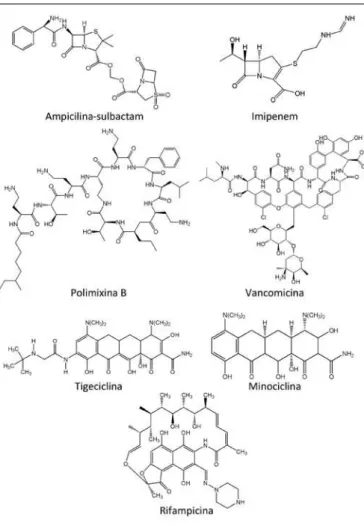
This compound is a combination of a beta-lactam and a beta-lactamase inhibitor (Figure 3). Betalactamase inhibitors are beta-lactam analogues with limited antibacterial activity and act competitively inhibiting the activity of the beta-lactamase enzyme(68). Generally, these inhibitors are used in association with
beta-lactams, promoting the restoration of their activity(44). The
ampicillin sulbactam is associated with ampicillin in a ixed ratio 1:2, optimizing its activity spectrum.
Currently, some studies have demonstrated synergistic activity of ampicillin - sulbactam with tigecycline(119), amikacin(81, 89, 137),
tobramycin(146) and imipenem(114, 140) for treating MDR A.
baumannii.
Imipenem
drug inhibits cell wall synthesis by binding beta-lactam with penicillin-binding proteins( PBPs ), which catalyze the synthesis of peptidoglycan present in the bacterial cell wall by means of a transglycosylation and transpeptidation reaction(74, 136).
Carbapenems, conversely, are more eficient and stable to degradation by a broad spectrum of beta-lactamases, exhibiting high antimicrobial activity against almost all Gram-negative bacteria, including MR fermenters(44).
Studies on the synergistic effect against MR A. baumannii
have been conducted with the use of imipenem in combination with lipopeptides, glycylcyclines , aminoglycosides, aztreonam, rifampicin, and even beta-lactams such as ampicillin - sulbactam(62, 81, 89, 114, 119, 125, 132, 140, 141, 152, 154).
Polymyxin B
Polymyxin B (PB) is an ATB belonging to the class of lipopeptides (Figure 3), which act primarily on the cell wall
of Gram-negative bacteria, leading to a rapid change in the permeability of the cytoplasmic membrane, which may ultimate cause cell death(32). This drug has demonstrated signiicant in
vitro antimicrobial activity against Gram-negative bacteria such as Escherichia coli, Klebsiella pneumoniae, Enterobacter spp., Acinetobacter spp. and Pseudomonas aeruginosa(34, 35, 92). Currently, it is an important ATB option against MR
microorganisms(34, 35, 159), including OXA producing A. baumannii.
In recent years, a few studies have conirmed that polymyxin B has a synergistic potential when used in combination with carbapenems(89, 112, 152, 154) and vancomycin(89) as well as partially
synergistic potential with rifampicin(89, 154).
Vancomycin
Vancomycin belongs to the glycopeptide class (Figure 3), whose action mechanism is the inhibition of peptidoglycan synthesis in the bacteria cell wall in the late phase, preventing the incorporation of peptidoglycans into the growing cell wall by binding the end portion of D-Alanyl-D-Alanine with the pentapeptide side chain(57, 130).
This drug is widely applied in the treatment of infections caused by methicillin resistant Staphylococcus aureus (MRSA) and serious infections by Gram-positive microorganisms in patients who are hypersensitive to penicillin(44, 57, 93, 120).
Gordon and Wareham tested a combination of antimicrobials that are not conventionally applied in the treatment of infections by Acinetobacter baumannii, a glycopeptide (vancomycin), which is used for the treatment of Gram-positive, and one lipopeptide (colistin), used to treat Gram – negative infections. Therefore, this combination showed synergism when tested in MR A. baumannii strains(42, 89), which is clinically remarkable
insofar as many nosocomial patients suffer from polymicrobial infections by Gram-positive bacteria such as Enterococcus spp. and coagulase-negative staphylococcus (157 ) as well as Gram-negative bacteria such as A. baumannii, Klebsiella pneumoniae
and Escherichia coli(47, 101).
Tigecycline
Tigecycline is a broad-spectrum antimicrobial drug from the Glycylcycline class, semisynthetic derivative of minocycline (Figure 3), representing the irst ATB from this class available for clinical use(105, 111). It inhibits the bacterial protein synthesis by
binding to the 30s subunit of the ribosome(26). Due to its broad
spectrum, it has good performance for both Gram - positive and gram- negative (S. aureus, Enterococcus spp., S. pneumoniae,
Haemophilus influenzae, Moraxella catarrhalis, Neisseria gonorrhoeae, Peptostreptococcus and Clostridium spp.),
including enterobacteria and Bacteroides spp.(105, 111). Some
studies have assessed the use of tigecycline in vitro against MR A. baumannii, thus revealing a bacteriostatic activity(79, 110).
Other studies have described a synergistic effect on the clinical use against A. baumannii, which is due to the combination of tigecycline with other ATBs such as carbapenems, aminoglycosides, minocycline, lipopeptides, quinolones and beta-lactamase inhibitors(71, 94, 119, 125, 140, 141, 145).
Rifampicin
Rifampicin is an ATB belonging to the ansamycin class that was introduced in clinical practice in the 1970s(2) (Figure 3).
The action mechanism of this drug consists in the inhibition of ribonucleic acid (RNA) synthesis by attacking the β subunit of RNA polymerase. This drug has a broad spectrum and is applied in the treatment for tuberculosis, which is caused by M. tuberculosis
microorganism(2, 74, 128).
Some studies indicate a synergistic effect against A. baumannii by associating colistin and rifampicin(132) as well as
a partially synergistic effect by combining PB(89, 154), tigecycline(26, 119, 123) or colistin(70).
Minocycline
Minocycline belongs to the tetracycline class (Figure 3), broad-spectrum bacteriostatic ATBS, including anaerobic, Gram- positive and Gram -negative bacteria as well as other microorganisms such as Rickettsia, Chlamydia, Plasmodium spp. and Mycoplasma pneumoniae(39, 102).
The action mechanism of this drug is associated with the inhibition of protein synthesis by binding to the 30S subunit of the bacterial ribosome preventing aminoacyl -tRNA binding(13, 39).
The drug minocycline has not been closely related to the study of the synergistic effect on the treatment of A. baumannii. Tan et al. demonstrated that the association of deminocycline and colistin offers synergistic potential(144) as well as minocycline/
meropenem(70) and minocycline/ cefoperazone -sulbactam(115).
Assessment of synergistic effect in Brazil
Few studies have evaluated the synergistic potential of antibiotic combinations against endemic A. baumannii
strains in Brazil. A study carried out by Kiffer et al. and another investigation by Gueli et al. indicated that approximately 50%
of the isolates tested in vitro responded partially to the synergistic effect obtained by the combined use of meropenem/polymyxin B and meropenem/sulbactam. It is particularly worth noting that these investigations did not identify carbapenemase producing strains(47, 61).
A study developed by Medeiros et al . successfully assessed the
synergistic effect of in vitro associations of polymyxin B/imipenem, amikacin/ampicillin-sulbactam, polymyxin B/vancomycin, polymyxin B/rifampicine against 23, 58, 72 , OXA-143 producing strains. Furthermore, the combination polymyxin B/imipenem conirmed both in vitro and in vivo results(89).
CONCLUSION
The spread of MR OXA producing Acinetobacter baumannii
in Brazil is a serious public health problem. The emergence of these strains is associated with high rates of resistance to ATBs commonly used in clinical practice, which increasingly hinders the choice of drugs with in vitro activity employed in the treatment of HAIs. The identiication of OXA phenotype and genotype is of utmost importance for a suitable patient management, preventing the introduction and spread of outbreaks and establishing a differential therapeutic approach that preferably includes the combined use of antibacterial agents.
ACKNOWLEDGMENTS
This study was funded by the Research Foundation of the State of São Paulo ( [Fundação de Amparo à Pesquisa do Estado de São Paulo- FAPESP] 2011-04025-2) and the National Research
Council (Conselho Nacional de Pesquisa-CNPq ). We also thank
CEFAR Diagnóstica for providing antimicrobial discs.
RESUMO
REFERENCES
1. ADAMS-HADUCH, J. M. et al. Molecular epidemiology of carbapenem-nonsusceptible Acinetobacter baumannii in the United States. J Clin Microbiol, v. 49, n. 11, p. 3849-54, 2011.
2. ALMEIDA DA SILVA P. E. et al. Molecular basis and
mechanisms of drug resistance in Mycobacterium tuberculosis: classical and new drugs. J Antimicrob Chemother, v. 66, n. 7, p. 1417-30, 2011.
3. ANSALDI, F. et al. Sequential outbreaks of
multidrug-resistant Acinetobacter baumannii in intensive care units of a tertiary referral hospital in Italy: combined molecular approach for epidemiological investigation. J Hosp Infect, v. 79, n. 2, p. 134-40, 2011.
4. ANTONIO, C. S. et al.Outbreak of multidrug-resistant Acinetobacter baumannii: Characterization of bla-OXA-23-like genes.1º Simpósio Internacional de Microbiologia Clínica (SIMC), Gramado, Rio Grande do Sul, Brasil, 2008.
5. ANTONIO, C. S. et al. Disseminação e emergência de genes blaOXA-23, blaOXA-58, blaOXA-72 e sequências de inserção (IS) em isolados de Acinetobacter baumannii resistentes aos carbapenêmicos. In: 25º Congresso Brasileiro de Microbiologia (CBM), Porto de Galinhas, Pernambuco, Brasil, 2009, n. 1508-1.
6. ANTONIO, C. S. et al. High prevalence of carbapenem-resistant Acinetobacter baumannii carrying the bla OXA-143 gene in Brazilian hospitals. Antimicrob Agents Chemother, v. 55, n. 3, p. 1322-3, 2011.
7. APPELBAUM, P. C. 2012 and beyond: potential for the start of a second pre-antibiotic era? J Antimicrob Chemother, v. 67, n. 9, p. 2062-8, 2012.
8. BARNAUD, G. et al. Two sequential outbreaks caused by
multidrug-resistant Acinetobacter baumannii isolates producing
OXA-58 or OXA-72 oxacillinase in an intensive care unit in France.
J Hosp Infect, v. 76, n. 4, p. 358-60, 2010.
9. BARTUAL, S.G. et al. Development of a multilocus
sequence typing scheme for characterization of clinical isolates of Acinetobacter baumannii. J Clin Microbiol, v. 43, n. 9, p. 4382-90, 2005. Erratum in: J Clin Microbiol, v. 45, n. 6,
p. 2101, 2007.
10. BERGOGNE-BÉRÉZIN, E.; TOWNER, K. J. Acinetobacter spp. as nosocomial pathogens: microbiological, clinical, and
epidemiological features. Clin Microbiol Rev, v. 9, n. 2, p.148-65,
1996.
11. BERGOGNE-BÉRÉZIN, E. Treatment of Acinetobacter
infections. Expert Opin Investig Drugs, v. 6, n. 2, p. 119-27, 1997. 12. BERTINI, A. et al. First report of the
carbapenem-hydrolyzing oxacillinase OXA-58 in Acinetobacter baumannii
isolates in Italy. Antimicrob Agents Chemother, v. 50, n. 6, p. 2268-9, 2006.
13. BISHBURG, E.; BISHBURG, K. Minocycline-an old drug for a new century: emphasis on methicillin-resistant Staphylococcus aureus (MRSA) and Acinetobacter baumannii. Int J Antimicrob Agents, v. 34, n. 5, p. 395-401, 2009.
14. BOO, T. W. et al. First report of OXA-23 carbapenemase in clinical isolates of Acinetobacter species in the Irish Republic. J Antimicrob Chemother, v. 58, n. 5, p. 1101-2, 2006.
15. BOYD, N.;NAILOR, M. D. Combination antibiotic therapy for empiric and deinitive treatment of gram-negative infections: insights from the Society of Infectious Diseases Pharmacists.
Pharmacotherapy, v. 31, n. 11, p.1073-84, 2011.
epidemiológica. Cepas de A. baumannii produtoras de OXA têm sido reportadas nos estados de Alagoas, Amazonas, Bahia, Distrito Federal, Espírito Santo, Goiás, Mato Grosso, Mato Grosso do Sul, Minas Gerais, Paraná, Pernambuco, Rio de Janeiro, Rio Grande do Norte, Rio Grande do Sul, Santa Catarina e São Paulo. Em algumas unidades, a presença de A. baumannii produtor de OXA-23 e/ou OXA-143 (até agora restrita ao Brasil) tem adquirido um caráter de endemicidade, sendo as cepas de A. baumannii carregando genes blaOXA-23 identificadas em efluentes hospitalares, constituindo um risco potencial para a comunidade e o meio ambiente. Embora, a tipagem molecular por multilocus sequence typing (MLST) (esquema proposto por Bartual, Universidade de Oxford, http://pubmlst.org/abaumannii/) tem caracterizado a disseminação internacional de um complexo clonal (CC) denominado CC92, no Brasil, a maioria das cepas produtoras de OXA-23 pertencem ao complexo clonal CC113, CC109 ou CC104. Finalmente, do ponto de vista clínico, o principal problema das infecções por A. baumannii é o uso limitado de antibacterianos com atividade in vitro, muitas vezes restrito ao uso de ampicilina/sulbactam, polimixina B e/ou colistina (polimixina E).
16. CALHOUN, J. H. et al. Multidrug-resistant organisms in military wounds from Iraq and Afghanistan. Clin Orthop Relat Res, v. 466, n. 6, p.1356-62, 2008.
17. CANDEL, F. J. et al. A combination of tigecycline, colistin,
and meropenem against multidrug-resistant Acinetobacter baumannii bacteremia in a renal transplant recipient: pharmacodynamic and microbiological aspects. Rev Esp Quimioter, v. 23, n. 2, p.103-8, 2010.
18. CARVALHO, K. R. et al. Dissemination of
multidrug-resistant Acinetobacter baumannii genotypes carrying bla
(OXA-23) collected from hospitals in Rio de Janeiro, Brazil. Int J Antimicrob Agents, v. 34, n. 1, p. 25-8, 2009.
19. CARVALHO, K. R. et al. Disseminação de genótipos multirresistentes de Acinetobacter baumannii produtores de carbapenemase OXA-23 em diferentes estados do Brasil. In:
26º Congresso Brasileiro de Microbiologia (CBM), Foz do Iguaçu, Paraná, Brasil, 2011, n. 962-1
20. CARRETTO, E. et al. Widespread carbapenem resistant Acinetobacter baumannii clones in Italian hospitals revealed by
a multicenter study. Infect Genet Evol, v. 11, n. 6, p. 1319-26, 2011. 21. CAYÔ, R. et al. Temporal dynamic of carbapenemase-producing Acinetobacter baumannii (Acb) in a Brazilian teaching hospital through an 18-year period: earlier dissemination of bla OXA-143 in Brazil. 51th Interscience
Conference on Antimicrobial Agents & Chemotherapy (ICAAC), Chicago, IL, USA, 2011. n. C2-645.
22. CLEMENTE, W. T. et al. Fatal outbreak of OXA-143-producing Acinetobacter baumannii in Belo Horizonte, Brazil. 51th Interscience Conference on Antimicrobial Agents &
Chemotherapy (ICAAC), Chicago, IL, USA, 2011. n. C2-644. 23. COELHO, J. et al. Occurrence of OXA-58-like carbapenemases in Acinetobacter spp. collected over 10 years in three continents. Antimicrob Agents Chemother, v. 50, n. 2, p.
756-8, 2006.
24. DALLA-COSTA, L. M. et al. Outbreak of
carbapenem-resistant Acinetobacter baumannii producing the OXA-23 enzyme in Curitiba, Brazil. J Clin Microbiol, v. 41, n. 7, p. 3403-6, 2003.
25. DIJKSHOORN, L. An increasing threat in hospitals: multidrug-resistant Acinetobacter baumannii. Nat Rev Microbiol, v. 5, n. 12, p. 939-51, Review, 2007.
26. ENTENZA, J. M.; MOREILLON, P. Tigecycline in combination with other antimicrobials: a review of in vitro, animal and case report studies. Int J Antimicrob Agents, v. 34, n. 1, p. 8 e1-9, 2009.
27. FERREIRA, A. E. et al. Presence of OXA-23-producing isolates of Acinetobacter baumannii in wastewater from hospitals in southern Brazil. Microb Drug Resist, v. 17, n. 2, p. 221-7, 2011.
28. FIGUEIREDO, D. Q. et al. First report of the bla (OXA-58) gene in a clinical isolate of Acinetobacter baumannii in Rio de Janeiro, Brazil. Mem Inst Oswaldo Cruz, v.106, n. 3, p. 368-70,
2011.
29. FOURNIER, P. E.; RICHET, H. The epidemiology and control of Acinetobacter baumannii in health care facilities. Clin Infect Dis, v. 42, n. 5, p. 692-9, 2006.
30. FRANOLI-KUKINA, I. et al. Clonal spread of
carbapenem-resistant OXA-72-positive Acinetobacter baumannii in a Croatian university hospital. Int J Infect Dis, v. 15, n. 10, p. e706-9, 2011.
31. FU, Y. et al. Wide dissemination of OXA-23-producing
carbapenem-resistant Acinetobacter baumannii clonal complex 22 in multiple cities of China. J Antimicrob Chemother, v. 65, n. 4, p. 644-50, 2010.
32. GALES, A. C. et al. Contemporary assessment of antimicrobial susceptibility testing methods for polymyxin B and colistin: review of available interpretative criteria and quality control guidelines. J Clin Microbiol, v. 39, n. 1, p. 183-90, 2001.
33. GALES, A. C. et al. Emergence of an IMP-like
metallo-enzyme in an Acinetobacter baumannii clinical strain from a
Brazilian teaching hospital. Diagn Microbiol Infect Dis, v. 45, n. 1, p. 77-9, 2003.
34. GALES, A. C. et al. Global assessment of the antimicrobial
activity of polymyxin B against 54 731 clinical isolates of Gram-negative bacilli: report from the SENTRY antimicrobial surveillance programme (2001-2004). Clin Microbiol Infect, v. 12, n. 4, p. 315-21, 2006.
35. GALES, A. C.et al. Contemporary activity of colistin and
polymyxin B against a worldwide collection of Gram-negative pathogens: results from the SENTRY Antimicrobial Surveillance Program (2006-09). J Antimicrob Chemother, v. 66, n. 9, p. 2070-4, 2011.
36. GALES, A. C. et al. Antimicrobial resistance among Gram-negative bacilli isolated from Latin America: results from SENTRY Antimicrobial Surveillance Program (Latin America, 2008-2010).
Diagn Microbiol Infect Dis, v. 73, n. 4, p. 354-60, 2012.
37. GARLANTÉZEC, R. et al. Investigation and management of an imipenem-resistant oxa-23 Acinetobacter baumannii
outbreak in an intensive care unit. Med Mal Infect, v. 41, n. 8, p.
38. GARRIDO-MESA, N. et al. Minocycline: far beyond an antibiotic. Br J Pharmacol, v. 169, n. 2, p. 337-52, 2013.
39. GIAMARELLOU, H. et al.Acinetobacter baumannii: a universal threat to public health? Int J Antimicrob Agents, v. 32, n. 2, p. 106-19, 2008.
40. GIONCO, B. et al.Emergência de uma nova variante de OXA-143 em um isolado clínico de Acinetobacter baumannii resistente aos carbapenêmicos no Hospital Universitário de Londrina. 26º Congresso Brasileiro de Microbiologia (CBM), Foz
do Iguaçu, 2011, n.1790-2.
41. GIONCO, B. et al. Detection of OXA-231, a new variant of blaOXA-143, in Acinetobacter baumannii from Brazil: a case report.
J Antimicrob Chemother, v. 67, n. 10, p. 2531-2, 2012.
42. GORDON, N. C.; WAREHAM, D. W. Multidrug-resistant
Acinetobacter baumannii: mechanisms of virulence and resistance. Int J Antimicrob Agents, v. 35, n. 3, p. 219-26, 2010.
43. GORDON, N. C.et al. Potent synergy and sustained bactericidal activity of a vancomycin-colistin combination versus multidrug-resistant strains of Acinetobacter baumannii. Antimicrob Agents Chemother, v. 54, n. 12, p. 5316-22, 2010b.
44. GREENWOOD, D. Antimicrobial Chemotherapy. 4. ed.
Oxford: Oxford University Press, 2000. p. 12-28.
45. GROSSO, F. et al. OXA-23-producing Acinetobacter baumannii: a new hotspot of diversity in Rio de Janeiro? J Antimicrob Chemother, v. 66, n. 1, p. 62-5, 2011.
46. GUELFI, K. C. et al. In vitro evaluation of the
antimicrobial activity of meropenem in combination with polymyxin B and gatiloxacin against Pseudomonas aeruginosa
and Acinetobacter baumannii. J Chemother, v. 20, n. 2, p. 180-5,
2008.
47. GUERRERO, D. M. et al. Acinetobacter baumannii -associated skin and soft tissue infections: recognizing a broadening spectrum of disease. Surg Infect (Larchmt), v. 11, n. 1, p. 49-57,
2010.
48. GUR, D. et al. Increasing carbapenem resistance due to the clonal dissemination of oxacillinase (OXA-23 and OXA-58)-producing Acinetobacter baumannii: report from the Turkish SENTRY Program sites. J Med Microbiol, v. 57, n. 12, p. 1529-32,
2008.
49. HÉRITIER, C. et al. A nosocomial outbreak of Acinetobacter baumannii isolates expressing the carbapenem-hydrolysing oxacillinase OXA-58. J Antimicrob Chemother, v. 55,
n. 1, p. 115-8, 2005a.
50. HÉRITIER, C. et al. Contribution of acquired carbapenem-hydrolyzing oxacillinases to carbapenem resistance in
Acinetobacter baumannii. Antimicrob Agents Chemother, v. 49, n. 8, p. 3198-202, 2005b.
51. HIGGINS, P. G. et al. OXA-143, a novel
carbapenem-hydrolyzing class D beta-lactamase in Acinetobacter baumannii. Antimicrob Agents Chemother, v. 53, n. 12, p. 5035-8, 2009.
52. HIGGINS, P. G. et al. Inclusion of OXA-143 primers in a multiplex polymerase chain reaction (PCR) for genes encoding prevalent OXA carbapenemases in Acinetobacter spp. Int J Antimicrob Agents, v. 35, n. 3, p. 305, 2010.
53. JAWAD, A. et al. Survival of Acinetobacter baumannii on dry surfaces: comparison of outbreak and sporadic isolates. J Clin Microbiol, v. 36, n. 7, p. 1938-41, 1998.
54. JEON, B. C. et al. Investigation of a nosocomial outbreak of imipenem-resistant Acinetobacter baumannii producing the
OXA-23 beta-lactamase in Korea. J Clin Microbiol, v. 43, n. 5, p. 2241-5, 2005.
55. JIANG, W. et al. Study on the resistant genes to carbapenems and epidemiological characterization of multidrug-resistant
Acinetobacter baumannii isolates. Microb Drug Resist, v. 19, n. 2, p. 117-23, 2013.
56. JOLLEY, K. A.; MAIDEN, M. C. BIGSdb: scalable analysis of bacterial genome variation at the population level. BMC Bioinformatics, v. 10, n. 11, p. 595, 2010.
57. JONES, R. N. Microbiological features of vancomycin in the 21st century: minimum inhibitory concentration creep, bactericidal/static activity, and applied breakpoints to predict clinical outcomes or detect resistant strains. Clin Infect Dis, v. 1, n.
42, Suppl. 1, p. S13-24, 2006.
58. KARAH, N. et al. Insights into the global molecular
epidemiology of carbapenem non-susceptible clones of
Acinetobacter baumannii. Drug Resist Updat, v. 15 n. 4, p.
237-47, 2012.
59. KIFFER, C. et al. MYSTIC Brazil Group. Antimicrobial susceptibility of Gram-negative bacteria in Brazilian hospitals: the MYSTIC Program Brazil 2003. Braz J Infect Dis, v. 9, n. 3, p.
216-24, 2005a.
60. KIFFER, C. R. et al. In vitro synergy test of meropenem and sulbactam against clinical isolates of Acinetobacter baumannii.
Diagn Microbiol Infect Dis, v. 52, n. 4, p. 317-22, 2005b.
61. KIM, C. K. et al. Prevalence and diversity of carbapenemases
emergence of a novel OXA-182. Diagn Microbiol Infect Dis,v. 68, n. 4, p. 432-8, 2010.
62. KIRATISIN, P. et al. Synergistic activities between carbapenems and other antimicrobial agents against
Acinetobacter baumannii including multidrug-resistant and extensively drug-resistant isolates. Int J Antimicrob Agents, v. 36,
n. 3, p. 243-6, 2010.
63. KOH, T. H. et al. IMP-4 and OXA beta-lactamases in Acinetobacter baumannii from Singapore. J Antimicrob Chemother, v. 59, n. 4, p. 627-32, 2007.
64. KULAH, C. et al. Characterization of carbapenem-resistant Acinetobacter baumannii outbreak strains producing OXA-58 in Turkey. Int J Antimicrob Agents, v. 36, n. 2, p. 114-8, 2010.
65. LEE, K. et al. Wide dissemination of OXA-type carbapenemases in clinical Acinetobacter spp. isolates from South
Korea. Int J Antimicrob Agents, v. 33, n. 6, p. 520-4, 2009. 66. LEE, Y. et al. Dissemination of ceftazidime-resistant Acinetobacter baumannii clonal complex 92 in Korea. J Appl Microbiol, v.112, n. 6, p. 1207-11, 2012.
67. LEVIN, A. S. et al. Intravenous colistin as therapy
for nosocomial infections caused by multidrug-resistant
Pseudomonas aeruginosa and Acinetobacter baumannii. Clin Infect Dis, v. 28, n. 5, p. 1008-11, 1999.
68. LEVIN, A. S. et al. Severe nosocomial with
imipenem-resistant Acinetobacter baumannii treated with ampicillin/ sulbactam. Int J Antimicrob Agents, v. 21, n. 1, p. 58-62, 2003.
69. LIAKOPOULOS, A. et al. Identiication of OXA-23-producing Acinetobacter baumannii in Greece, 2010 to 2011. Euro Surveill,v. 15, n. 17, p. 11, 2012.
70. LIANG, W. et al. Activities of colistin- and minocycline-based combinations against extensive drug resistant Acinetobacter baumannii isolates from intensive care unit patients. BMC Infect Dis, v. 27, n. 11, p. 109, 2011.
71. LIM, T. P. et al. In vitro activity of polymyxin B, rifampicin, tigecycline alone and in combination against carbapenem-resistant Acinetobacter baumannii in Singapore. PLoS One, v. 6,
n. 4, e18485, p.1-7, 2011.
72. LIN, W. R. et al. Rapid control of a hospital-wide outbreak caused by extensively drug-resistant OXA-72-producing
Acinetobacter baumannii. Kaohsiung J Med Sci, v. 27, n. 6, p. 207-14, 2011.
73. LU, P. L. et al. Diversity of carbapenem resistance mechanisms in Acinetobacter baumannii from a Taiwan
hospital: spread of plasmid-borne OXA-72 carbapenemase. J Antimicrob Chemother, v. 63, n. 4, p. 641-7, 2009.
74. MADIGAN, M. T.; MARTINKO, J. M.; PARKER, J.
Microbiologia de Brock. 12. ed. Porto Alegre: ArtMed, 2010. p.
535-43.
75. MAGIORAKOS, A. P. et al. Multidrug-resistant, extensively drug-resistant and pandrug-resistant bacteria: an international expert proposal for interim standard deinitions for acquired resistance. Clin Microbiol Infect, v.18, n. 3, p. 268-81, 2012.
76. MAHGOUB, S. et al. Underlying characteristics of patients harboring highly resistant Acinetobacter baumannii. Am J Infect Control, v. 30, n. 7, p. 386-90, 2002.
77. MANAGEIRO, V. et al. Genetic diversity and clonal evolution of carbapenem-resistant Acinetobacter baumannii isolates from Portugal and the dissemination of ST118. Int J Antimicrob Agents,
v. 40, n. 5, p. 398-403, 2012.
78. MANSOUR, W. et al. Dissemination of OXA-23-producing and carbapenem-resistant Acinetobacter baumannii in a University Hospital in Tunisia. Microb Drug Resist, v. 14, n. 4, p. 289-92, 2008.
79. MARAGAKIS, L. L.; PERL, T. M. Acinetobacter baumannii: epidemiology, antimicrobial resistance, and treatment options.
Clin Infect Dis, v. 46, n. 8, p.1254-63, Review, 2008.
80. MARQUÉ, S. et al. Regional occurrence of plasmid-mediated carbapenem-hydrolyzing oxacillinase OXA-58 in
Acinetobacter spp. in Europe. J Clin Microbiol, v. 43, n. 9, p.
4885-8, 2005.
81. MARQUES, M. B. et al. Comparative in vitro antimicrobial susceptibilities of nosocomial isolates of Acinetobacter baumannii and synergistic activities of nine antimicrobial combinations. Antimicrob Agents Chemother, v. 41, n. 5, p. 881-5,
1997.
82. MARRA, A. R. et al. Bloodstream infections with
metallo-beta-lactamase-producing Pseudomonas aeruginosa: epidemiology, microbiology, and clinical outcomes. Antimicrob Agents Chemother, v. 50, n. 1, p. 388-90, 2006.
83. MARRA, A. R. et al. Nosocomial bloodstream infections in Brazilian hospitals: analysis of 2,563 cases from a prospective nationwide surveillance study. J Clin Microbiol, v. 49, n. 5, p.
1866-71, 2011.
84. MARTINS, A. F. et al. Carbapenem-resistant Acinetobacter baumannii producing the OXA-23 enzyme: dissemination in
85. MARTINS, A. F. et al. High endemic levels of multidrug-resistant Acinetobacter baumannii among hospitals in southern
Brazil. Am J Infect Control, v. 40, n. 2, p.108-12, 2012.
86. MARTINS, A. F.; BARTH, A. L. Acinetobacter multirresistente – um desaio para a saúde pública. Sci Med, v. 23, n. 1, p. 56-62, 2013.
87. MEDEIROS, M. et al. Carbapenem-resistant Acinetobacter baumannii strains carrying blaOXA-72, blaOXA-58,
blaOXA-23 andblaOXA-143 oxacillinase genes in southeastern Brazil.
2º Simpósio Internacional de Microbiologia Clínica (SIMC), Florianópolis, Santa Catarina, Brasil, 2010, n.102-2.
88. MEDEIROS, M. et al. Fatal outbreak of OXA-143-producing Acinetobacter baumannii, Belo Horizonte, Brazil. 26º Congresso Brasileiro de Microbiologia (CBM), Foz do Iguaçu, Paraná, Brasil, 2011, n.1751-1.
89. MEDEIROS, M. Avaliação in vitro e in vivo de efeitos sinérgicos de antibacterianos para o tratamento de infecções por Acinetobacter baumannii multirresistentes produtoras de carbapenemases tipo OXA endêmicas no Brasil. 2012.
Dissertação (mestrado) – Faculdade de Ciências Farmacêuticas, Universidade de São Paulo, São Paulo. 2012.
90. MENDES, R. E. et al. Metallo-ß-lactamase. J Bras Patol Med Lab, v. 42, n. 2, p. 103-13, 2006.
91. MERKIER A. K. et al. Polyclonal spread of bla(OXA-23)
and bla(OXA-58) in Acinetobacter baumannii isolates from Argentina. J Infect Dev Ctries, v. 2, n. 3, p. 235-40, 2008.
92. MICHALOPOULOS, A.; FALAGAS, M. E. Colistin and polymyxin B in critical care. Crit Care Clin, v. 24, n. 2, p. 377-91, 2008.
93. MOHR, J. F. et al. Point: vancomycin is not obsolete
for the treatment of infection caused by methicillin-resistant
Staphylococcus aureus. Clin Infect Dis, v. 44, n. 12, p.1536-42,
2007.
94. MOLAND, E. S. et al. In vitro activity of tigecycline against
multidrug-resistant Acinetobacter baumannii and selection of tigecycline-amikacin synergy. Antimicrob Agents Chemother, v.
52, n. 8, p. 2940-2, 2008.
95. MOREIRA, L. B. Princípios para o uso racional de antimicrobianos. Revista da AMRIGS, n. 2, p.73-152, 2004.
96. MOSTACHIO, A. K. et al. Multiplex PCR for rapid detection of genes encoding oxacillinases and metallo-beta-lactamases in carbapenem-resistant Acinetobacter spp. J Med Microbiol, v. 58, n. 11, p. 1522-4, 2009.
97. MOSTACHIO, A. K. et al. High prevalence of OXA-143 and alteration of outer membrane proteins in carbapenem-resistant
Acinetobacter spp. isolates in Brazil. Int J Antimicrob Agents, v. 39, n. 5, p. 396-401, 2012.
98. MOURA, J. P.; GIR, E. Conhecimento dos proissionais de enfermagem referente à resistência bacteriana a múltiplas drogas.
Acta Paul Enferm, v. 20, n. 3, p. 351-6, 2007.
99. MUGNIER, P. et al. Carbapenem-resistant and
OXA-23-producing Acinetobacter baumannii isolates in the United Arab
Emirates. Clin Microbiol Infect, v. 14, n. 9, p. 879-82, 2008.
100. MUGNIER, P. D. et al. Worldwide dissemination of the
blaOXA-23 carbapenemase gene of Acinetobacter baumannii. Emerg Infect Dis, v. 16, n. 1, p. 35-40, 2010.
101. MUNOZ-PRICE, L. S.; WEINSTEIN, R. A. Acinetobacter
infection. N Engl J Med, v. 358, n. 12, p. 1271-81, 2008.
102. NELSON, M. L. Chemical and biological dynamics of tetracyclines. Adv Dent Res, v. 12, n. 2, p. 5-11, Review, 1998.
103. NIGRO, S.J.; HALL, R. M. Tn6167, an antibiotic resistance island in an Australian carbapenem-resistant Acinetobacter baumannii GC2, ST92 isolate. J Antimicrob Chemother, v. 67, n. 6, p.1342-6, 2012.
104. NIUMSUP, P. R.et al. Carbapenem-resistant Acinetobacter baumannii producing OXA-23 in Thailand. Jpn J Infect Dis, v. 62,
n. 2, p. 152-4, 2009.
105. NOSKIN, G. A. Tigecycline: a new glycylcycline for treatment of serious infections. Clin Infect Dis, v. 41, Suppl 5, p.
S303-14, Review, 2005.
106. NOWAK, P. et al. Distribution of blaOXA genes among
carbapenem-resistant Acinetobacter baumannii nosocomial
strains in Poland. New Microbiol, v. 35, n. 3, p. 317-25, 2012.
107. OLIVEIRA, M. S.et al. Ampicillin/sulbactam compared with polymyxins for the treatment of infections caused by carbapenem-resistant Acinetobacter spp. J Antimicrob Chemother, v. 61, n. 6, p.1369-75, 2008.
108. OLIVEIRA, M. L. et al. Dissemination of oxa carbapenemases genes in carbapenem resistant Acinetobacter baumannii in University Hospital of Juiz de Fora, MG. In:
8th International Congress of Pharmaceutical Sciences, Ribeirão
Preto, São Paulo, Brasil, 2011, n. PI 024.
109. OLIVEIRA, S. et al. Dissemination of KPC-2-producing
Klebsiella pneumoniae and OXA-23-positive Acinetobacter
baumannii in urban rivers, São Paulo, Brazil. In: 26º Congresso
110. PACHÓN-IBÁÑEZ, M. E. et al. Activity of tigecycline (GAR-936) against Acinetobacter baumannii strains, including those
resistant to imipenem. Antimicrob Agents Chemother, v. 48, n. 11,
p. 4479-81, 2004.
111. PANKEY, G. A. Tigecycline. J Antimicrob Chemother, v. 56, n. 3, p. 470-80, 2005.
112. PANKEY, G. A.;ASHCRAFT, D. S. The detection of synergy between meropenem and polymyxin B against meropenem-resistant Acinetobacter baumannii using Etest and time-kill assay. Diagn Microbiol Infect Dis, v. 63, n. 2, p. 228-32, 2009.
113. PAPA, A. et al. Molecular epidemiology of
carbapenem-resistant Acinetobacter baumannii in a newly established Greek hospital. Microb Drug Resist, v. 15, n. 4, p. 257-60, 2009.
114. PECK, K. R. et al. In vitro time-kill studies of antimicrobial agents against blood isolates of imipenem-resistant Acinetobacter baumannii, including colistin- or tigecycline-resistant isolates. J Med Microbiol, v. 61, n. 3, p. 353-60, 2012.
115. PEI, G. et al.In vitro activity of minocycline alone and in combination with cefoperazone-sulbactam against carbapenem-resistant Acinetobacter baumannii. Microb Drug Resist, v. 18, n. 6, p. 574-7, 2012.
116. PELEG, A. Y. et al. OXA-58 and IMP-4 carbapenem-hydrolyzing beta-lactamases in an Acinetobacter junii blood culture isolate from Australia. Antimicrob Agents Chemother, v. 50, n. 1, p. 399-400, 2006.
117. PELEG, A. Y. et al.Acinetobacter baumannii: Emergence of
a successful pathogen. Clin Microbiol Rev, v. 21, n. 3, p. 538-82, 2008.
118. PEREZ, F. et al. Global challenge of multidrug-resistant Acinetobacter baumannii. Antimicrob Agents Chemother, v. 51, n. 10, p. 3471-84, 2007.
119. PETERSEN, P. J. et al. In vitro antibacterial activities
of tigecycline in combination with other antimicrobial agents determined by chequerboard and time-kill kinetic analysis. J Antimicrob Chemother, v. 57, n. 3, p.573-6, 2006.
120. PETROSILLO, N. et al. Some current issues in the
pharmacokinetics/pharmacodynamics of antimicrobials in intensive care. Minerva Anestesiol,v. 76, n. 7, p. 509-24, Review, 2010.
121. POGUE, J. M. et al. Carbapenem-resistant Acinetobacter baumannii: epidemiology, surveillance and management. Expert Rev Anti Infect Ther, v. 11, n. 4, p. 383-93, 2013.
122. POIREL, L. et al. OXA-58, a novel class D {beta}-lactamase
involved in resistance to carbapenems in Acinetobacter baumannii. Antimicrob Agents Chemother, v. 49, n. 1, p. 202-8, 2005.
123. POIREL, L. et al. Diversity, epidemiology, and genetics of class D beta-lactamases. Antimicrob Agents Chemother,v. 54, n.
1, p. 24-38, Review, 2010.
124. POURNARAS, S. et al. Outbreak of multiple clones of imipenem-resistant Acinetobacter baumannii isolates expressing OXA-58 carbapenemase in an intensive care unit. J Antimicrob Chemother, v. 57, n. 3, p. 557-61, 2006.
125. PRINCIPE, L. et al. In vitro activity of tigecycline in combination with various antimicrobials against multidrug resistant Acinetobacter baumannii. Ann Clin Microbiol Antimicrob, v. 21, n. 8, p.18, 2009.
126. QUEENAN, A. M.; BUSH, K. Carbapenemases: the versatile beta-lactamases. Clin Microbiol Rev, v. 20, n. 3, p. 440-58, Review, 2007.
127. RAMÍREZ, M. S. et al. Spreading of AbaR-type genomic islands in multidrug resistance Acinetobacter baumannii strains belonging to different clonal complexes. Curr Microbiol, DOI 10.1007/s00284-013-0326-5, 2013.
128. RATTAN, A. et al. Multidrug-resistant Mycobacterium tuberculosis: molecular perspectives. Emerg Infect Dis,v. 4, n. 2,
p.195-209, Review, 1998.
129. REIS, A. O. et al. Polymyxin-resistant Acinetobacter spp.
isolates: what is next? Emerg Infect Dis, v. 9, n. 8, p. 1025-7, 2003.
130. REYNOLDS, P. E. Structure, biochemistry and mechanism of action of glycopeptides antibiotics. Eur J Clin Microbiol Infect Dis, v. 8, n. 11, p. 943-50, Review, 1989.
131. RIBEIRO, J. et al. Microbiological and epidemiological characterization of imipenem-resistant Pseudomonas aeruginosa strains from a Brazilian tertiary hospital: report from
the SENTRY Antimicrobial Surveillance Program. J Chemother,v. 18, n. 5, p. 461-7, 2006.
132. RODRIGUEZ, C. H. et al. In vitro antimicrobials activity
against endemic Acinetobacter baumannii multiresistant clones. J Infect Dev Ctries, v. 4, n. 3, p. 164-7, 2010.
133. RUNNEGAR, N. et al. Molecular epidemiology of multidrug-resistant Acinetobacter baumannii in a single institution over a 10-year period. J Clin Microbiol, v. 48, n. 11, p. 4051-6, 2010.
134. SADER, H. S. et al. Pathogen frequency and resistance patterns in Brazilian hospitals: summary of results from three years of the SENTRY Antimicrobial Surveillance Program. Braz J Infect Dis, v. 5, n. 4, p. 200-14, 2001.
SENTRY Antimicrobial Surveillance Program International Int J Antimicrob Agents, v. 25, p. 57-61, 2005.
136. SAUVAGE, E. et al. The penicillin-binding proteins:
structure and role in peptidoglycan biosynthesis. FEMS Microbiol Rev, v. 32, n. 2, p. 234-58, 2008.
137. SAVOV, E. et al.In vitro investigation of the susceptibility of Acinetobacter baumannii strains isolated from clinical
specimens to ampicillin/sulbactam alone and in combination with amikacin. Int J Antimicrob Agents, v. 20, n. 5, p. 390-2, 2002.
138. SCAIFE, W. et al. Transferable imipenem-resistance
in Acinetobacter species from a clinical source. J Antimicrob Chemother, v. 36, n. 3, p. 585-6, 1995.
139. SCHIMITH BIER, K. E. et al. Temporal evolution of carbapenem-resistant Acinetobacter baumannii in Curitiba,
southern Brazil. Am J Infect Control, v. 38, n. 4, p. 308-14, 2010. 140. SHENG, W. H. et al. Comparative in vitro antimicrobial
susceptibilities and synergistic activities of antimicrobial combinations against carbapenem-resistant Acinetobacter species:
Acinetobacter baumannii versus Acinetobacter genospecies 3 and 13TU. Diagn Microbiol Infect Dis, v. 70, n. 3, p. 380-6, 2011.
141. SOPIRALA, M. M. et al. Synergy testing by Etest,
microdilution checkerboard, and time-kill methods for pan-drug-resistant Acinetobacter baumannii. Antimicrob Agents Chemother, v. 54, n. 11, p. 4678-83, 2010.
142. STIETZ, M. S. et al. Acinetobacter baumannii
extensively drug resistant lineages in Buenos Aires hospitals differ from the international clones I-III. Infect Genet Evol, v. 14, p.
294-301, 2013.
143. STOEVA, T. et al. Clonal spread of carbapenem-resistant
OXA-23-positive Acinetobacter baumannii in a Bulgarian university hospital. Clin Microbiol Infect, v. 14, n. 7, p. 723-7, 2008.
144. TAN, T.Y. et al.In vitro effect of minocycline and colistin
combinations on imipenem-resistant Acinetobacter baumannii
clinical isolates. J Antimicrob Chemother, v. 60, n. 2, p. 421-3, 2007.
145. TAN, T. Y. et al. In vitro antibiotic synergy in extensively
drug-resistant Acinetobacter baumannii: the effect of testing by time-kill, checkerboard, and Etest methods. Antimicrob Agents Chemother, v. 55, n. 1, p. 436-8, 2011.
146. TATMAN-OTKUN, M. et al. Annual trends in antibiotic
resistance of nosocomial Acinetobacter baumannii strains and the effect of synergistic antibiotic combinations. New Microbiol,
v. 27, n. 1, p. 21-8, 2004.
147. TIAN, G. B. et al. Identiication of diverse OXA-40 group
carbapenemases, including a novel variant, OXA-160, from
Acinetobacter baumannii in Pennsylvania. Antimicrob Agents Chemother, v. 55, n. 1, p. 429-32, 2011.
148. TILLOTSON, G. S. Where does novel antibiotics R&D stand among other pharmaceutical products: an industrial perspective?
Expert Rev Anti Infect Ther, v. 6, n. 5 p. 551-2, 2008.
149. TOGNIM, M. C. et al. Resistance trends of Acinetobacter spp. in Latin America and characterization of international dissemination of multi-drug resistant strains: ive-year report of the SENTRY Antimicrobial Surveillance Program. Int J Infect Dis, v. 8, n. 5, p. 284-91, 2004.
150. UNAL, S.; GARCIA-RODRIGUEZ, J. A. Activity of meropenem and comparators against Pseudomonas aeruginosa
and Acinetobacter spp. isolated in the MYSTIC Program,
2002-2004. Diagn Microbiol Infect Dis, v.53, n. 4, p. 265-71, 2005. 151. YANG, H. Y. et al. Outbreaks of imipenem resistant Acinetobacter baumannii producing OXA-23 beta-lactamase in a tertiary care hospital in Korea. Yonsei Med J,v. 50, n. 6, p.
764-70, 2009.
152. YOON, J. et al. In vitro double and triple synergistic
activities of Polymyxin B, imipenem, and rifampin against multidrug-resistant Acinetobacter baumannii. Antimicrob Agents Chemother, v. 48, n. 3, p. 753-7, 2004.
153. WANG, H. et al. Molecular epidemiology of clinical
isolates of carbapenem-resistant Acinetobacter spp. from Chinese
hospitals. Antimicrob Agents Chemother,v. 51, n. 11, p. 4022-8, 2007.
154. WAREHAM, D. W.; BEAN, D. C. In vitro activity of polymyxin B in combination with imipenem, rifampicin and azithromycin versus multidrug resistant strains of Acinetobacter baumannii producing OXA-23 carbapenemases. Ann Clin Microbiol Antimicrob, v. 21, n. 5, p. 10, 2006.
155. WERNECK, J. S. et al. OXA-72-producing Acinetobacter baumannii in Brazil: a case report. J Antimicrob Chemother, v.
66, n. 2, p. 452-4, 2011.
156. WERNECK, J. S. et al. Low prevalence of blaOXA-143 in
private hospitals in Brazil. Antimicrob Agents Chemother, v. 55, n. 9, p. 4494-5, 2011.
157. WISPLINGHOFF, H. et al. Nosocomial bloodstream infections caused by Acinetobacter species in United States
158. WOODFORD, N. et al. Multiplex PCR for genes encoding prevalent OXA carbapenemases in Acinetobacter spp. Int J Antimicrob Agents, v. 27, n. 4, p. 351-3, 2006.
159. ZAVASCKI, A. P. et al. Polymyxin B for the treatment of multidrug-resistant pathogens: a critical review. J Antimicrob Chemother, v. 60, n. 6, p.1206-15, 2007.
160. ZHANG, J. P. et al. Molecular characteristics and resistant mechanisms of imipenem-resistant Acinetobacter baumannii
isolates in Shenyang, China. J Microbiol, v. 48, n. 5, p. 689-94, 2010.
161. ZHOU, H. et al. Dissemination of imipenem-resistant Acinetobacter baumannii strains carrying the ISAba1 blaOXA-23 genes in a Chinese hospital. J Med Microbiol, v. 56, n. 8, p.1076-80, 2007.
MAILING ADDRESS
Micheli Medeiros