DOI: 10.1590/1518-8345.1643.2855 www.eerp.usp.br/rlae
Attitude and knowledge about foot health: a spanish view
Daniel López-López
1Ricardo García-Mira
2Patricia Palomo-López
3Rubén Sánchez-Gómez
4José Ramos-Galván
5Natalia Tovaruela-Carrión
6Matilde García-Sánchez
7Objective: to explore attitudes towards patients’ self-reported data about foot health-related
beliefs from a behavioural and attitudinal perspective. Methods: a sample of 282 participants of
a mean age of 39.46 ± 16.026 came to a health centre where self-reported demographic, clinical
characteristics and beliefs relating to foot health data were registered, informants’ completed
all the stages of the research process. Results: the results of the analysis revealed an 8-factor
factorial structure based on (1) podiatric behaviours, (2) the intention to carry out protective
behaviour, (3) attitudinal beliefs, (4) normative beliefs, (5) needs, (6) apathy, (7) self-care, and
(8) the general perception of foot health. They all explained 62.78% of the variance, and were
considered as independent variables in a regression analysis to determine which provided the
best explanations for the importance attributed to foot health. Conclusions: the participants in
the study revealed a positive attitude in relation to foot health care and responsible behaviour.
Descriptors: Foot; Perception; Podiatry.
1 PhD, Assistant Professor, Facultade de Enfarmaría e Podoloxía, Universidade da Coruña, Ferrol, Spain. 2 PhD, Full Professor, Facultad de Ciencias da Educación, Universidade da Coruña, A Coruña, Spain. 3 PhD, Assistant Professor, Centro Universitario de Plasencia, Universidad de Extermadura, Plasencia, Spain. 4 PhD, Assistant Professor, Facultad de Ciencias de la Salud, Universidad Europea de Madrid, Madrid, Spain. 5 PhD, Full Professor, Facultad de Enfermería Fisioterapia y Podología, Universidad de Sevilla, Sevilla, Spain. 6 PhD, Assistant Professor, Facultad de Enfermería Fisioterapia y Podología, Universidad de Sevilla, Sevilla, Spain. 7 PhD, Full Professor, Facultade de Enfarmaría e Podoloxía, Universidade da Coruña, Ferrol, Spain.
How to cite this article
López-López D, García-Mira R, Palomo-López P, Sánchez-Gómez R, Ramos-Galván J, Tovaruela-Carrión N, et al. Attitude and knowledge about foot health: a spanish view. Rev. Latino-Am. Enfermagem. 2017;25:e2855. [Access ___ __ ____]; Available in: ____________________. DOI: http://dx.doi.org/10.1590/1518-8345.1643.2855. month day year
Introduction
The increase in life expectancy and the high prevalence of foot pathologies related to obesity, diabetes, the practice of sport, vascular alterations, physical injury and a sedentary lifestyle(1) for which there
is no total cure and where the therapeutic goal is to relieve or eliminate symptoms, avoid complications and improve the patient’s wellbeing, means that classical medical measurements of outcome (mortality, morbidity,
life expectancy) are insuficient to provide a thorough
assessment of whether patients receive appropriate and effective treatment for foot diseases.
Also, such problems currently affect between 71 and 93% of general population and are a frequent cause of medical and foot care(2) since they have been shown to
be neither minor nor banal and have a negative inluence
on functional capacity and quality of life(3-5). These
conditions are multifactorial in their origin and their high
incidence was related with dificulty in putting shoes,
pain, gait disturbance, reduced walking speed, variation in plantar pressures, risk of falls(6-8). The pathologies and
alterations more frequently found were claw toes, hallux valgus, hammer toes, overlapping toes, hallux extensus, pes planus, morton’s neuroma, tailor’s bunions, plantar fascitis and pes cavus(2,9).
The research questions addressed therefore concern the following aspects: what attitudes and
factors inluence people’s perception of foot diseases
and the health professional who treat them? What are the most suitable methods we can use to increase our knowledge of these attitudinal aspects?
In order to attempt to provide an answer to these
questions the overall research objective was deined
as being to evaluate the social representations of foot health and the podiatric and psychological aspects involved in the analysis of human behavior.
We will thus be able to perceive whether the main motive is related to the negative impact of foot diseases on functional capacity and quality of life(10) and in this
regard the main tool for the analysis of health research
is the construction of questionnaires on a scientiic
basis(11) as a reliable method of measuring results and
generating clinical evidence,
The importance of a study of this kind lies in the possibility of analyzing particular behaviors and our knowledge of the psychosocial context, since they can potentially generate a risk of suffering from foot pathologies.
This will have a positive inluence on patients’
response and adherence to treatment characterized by the introduction of a variety of activities that people carry out in their everyday lives and the importance attributed to disease in general, which people will also apply to its causes(12). All of this has an effect on the type of preventive
behaviors that accompany a treatment or lessen the possibility of being affected by a foot or ankle pathology(13).
In this regard, the present study analyzes beliefs relating to foot health, from a behavioral and attitudinal standpoint, due to the lack of knowledge of the criteria people take into account when evaluating the seriousness of everything that affects foot health.
Method
Design and sample
The overall study was completed in 12 months from January 2014 to January 2015. The study was carried out among people at Clinic of Podiatric Medicine and Surgery that provides treatment of diseases and disorders of the foot at University of A Coruña in the city of Ferrol (Spain).
It was a cross sectional study. A consecutive sampling method was used to select study participants. The inclusion criterion being aged 65 or less and provided informed consent to participate. The exclusion criterion was a history of major, psychiatric disease, dementia, neurological disorders, immunocompromised patients, trauma and a history of foot surgery and refusal to sign the consent form or incapable of understanding the instructions necessary to carry out the present study.
Procedure
At enrolment, patients were interviewed about general health, demographic characteristics (age, gender, marital status, income, education). A single trained examiner performed a standardized clinical
exam on all participants who irst measured height,
weight with the subject barefoot and wearing light clothing and the body mass index (BMI) was calculated from the height (m) and weight (kg2), applying following
Quetelet’s equation BMI=weight / height²(14).
In the second place, to determine the attitudes towards patients’ self-reported data about foot health-related beliefs from a behavioral and attitudinal perspective using a ad hoc questionnaire was designed
in order to collect precise data about the subject’s proile in general, together with a series of speciic features deining it. Data were also gathered regarding
lifestyle-related attitudes and behaviors, everyday habits, the assessment of subjective relevance, preventive behaviors and the social perception of podiatry, these being an important factor in maintaining foot health and
of relevance when determining which speciic aspects are
Likert-type scales, to measure the degree of importance attached by subjects to foot health in general, as well as to podiatrists and their situation within the health care system in particular are shown in Figure 1.
This research was reviewed by the Research and Ethics Committee of the University of a Corunna, Spain, which was approved with CE 06/2014 registration number.
Figure 1 - Ad hoc questionnaire. A Coruña, Spain, 2014
Statistical analysis
Sample size
The sample size was calculated with the software
from Clinical Epidemiology and Biostatistics Unit.or the
University of A Corunna(15). By the sample target size
for a bilateral hypothesis, an alpha risk of 5% and a
statistical power of 80%, and a beta error of 20%, at least 282 cases must be studied
dimensions that characterize people’s perceptive model of podiatry and foot health from the point of view of attitudinal, normative, intentional and behavioral beliefs, from a theoretical planned action perspective.
The inal stage was to carry out a multiple linear
regression analysis, using the Stepwise method, taking the various factors as independent variables and the ‘importance attributed to foot health’ as the dependent variable. The purpose of this was to determine which factors contributed most to the assessment of attributed importance, and the tool used was the SPSS package (version 16), for descriptive and statistical analysis, with
signiicance level lower than 5%.
Results
A total of 282 people completed all the stages of the research process, 80 of them were men (28.4%) and 202 women (71.6%). Their ages ranged from 12 to 90, the mean age being 39.46 ± 16.026 years, 66.28 ± 12.126 in weight, 166.4 ± 7.846 cm in height, BMI = 23.94 ± 4.51 kg/m2, who have completed a three-year diploma
course, married and currently working.
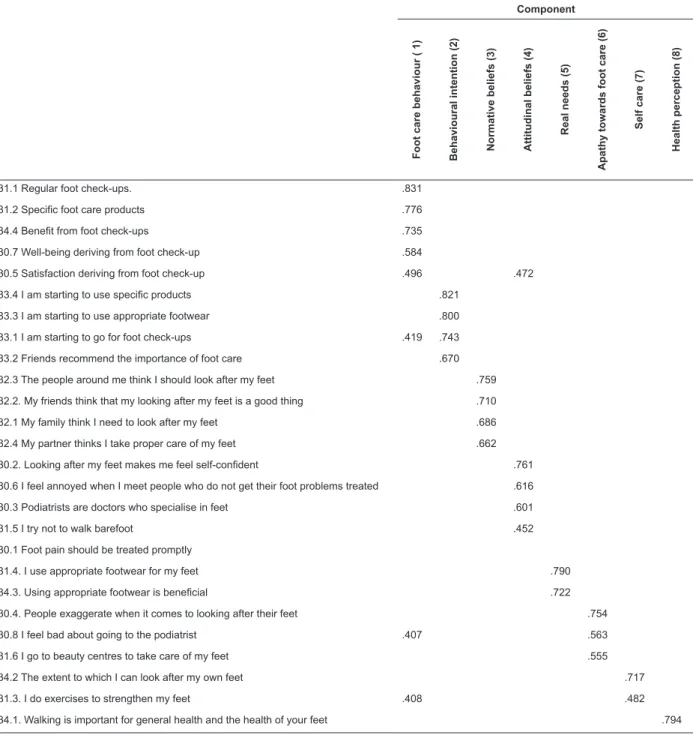
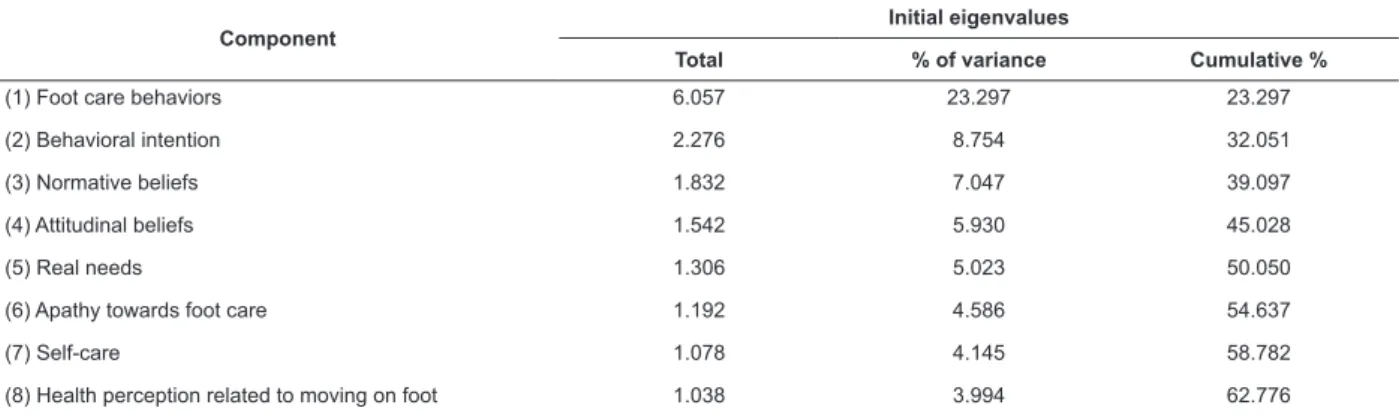
Factorial analysis generated by the method of principal components with Varimax rotation, based on the 26 items and obtained from the sample revealed the existence of 8 factors that explain 62.8% of the variance (Table 1).
Table 1 - Matrix of rotated components concerning the perception of foot care. A Coruña, Spain, 2014
Component F o o t c a re b e h a v io u r ( 1 ) B e h a v io u ra l in te n ti o n (2 ) N o rm a ti v e b e li e fs (3 ) A tti tu d in a l b e li e fs (4 ) R e a l n e e d s (5 ) A p a th y to w a rd s fo o t c a re (6 ) Se lf c a re (7 ) H e a lth p e rc e p ti o n (8 )
31.1 Regular foot check-ups. .831
31.2 Speciic foot care products .776
34.4 Beneit from foot check-ups .735
30.7 Well-being deriving from foot check-up .584
30.5 Satisfaction deriving from foot check-up .496 .472
33.4 I am starting to use speciic products .821
33.3 I am starting to use appropriate footwear .800
33.1 I am starting to go for foot check-ups .419 .743
33.2 Friends recommend the importance of foot care .670
32.3 The people around me think I should look after my feet .759
32.2. My friends think that my looking after my feet is a good thing .710
32.1 My family think I need to look after my feet .686
32.4 My partner thinks I take proper care of my feet .662
30.2. Looking after my feet makes me feel self-conident .761
30.6 I feel annoyed when I meet people who do not get their foot problems treated .616
30.3 Podiatrists are doctors who specialise in feet .601
31.5 I try not to walk barefoot .452
30.1 Foot pain should be treated promptly
31.4. I use appropriate footwear for my feet .790
34.3. Using appropriate footwear is beneicial .722
30.4. People exaggerate when it comes to looking after their feet .754
30.8 I feel bad about going to the podiatrist .407 .563
31.6 I go to beauty centres to take care of my feet .555
34.2 The extent to which I can look after my own feet .717
31.3. I do exercises to strengthen my feet .408 .482
We will now take a more detailed look at the
signiicance of the outcome of this factorial analysis.
The criterion used to extract factors was to retain all factors with an eigenvalue higher than 1. The outcome
could have been simpliied had we increased this value,
but we opted for the traditional criterion in order to maintain maximum variance and to obtain a more
signiicant and easier to use set of 8 aspects related to
the perception of foot care from the original instrument (Table 2).
Table 2 - Breakdown of total variance. Extraction method: Principal component analysis. A Coruña, Spain, 2014
Component
Initial eigenvalues
Total % of variance Cumulative %
(1) Foot care behaviors 6.057 23.297 23.297
(2) Behavioral intention 2.276 8.754 32.051
(3) Normative beliefs 1.832 7.047 39.097
(4) Attitudinal beliefs 1.542 5.930 45.028
(5) Real needs 1.306 5.023 50.050
(6) Apathy towards foot care 1.192 4.586 54.637
(7) Self-care 1.078 4.145 58.782
(8) Health perception related to moving on foot 1.038 3.994 62.776
Bearing in mind the high communality values (i.e. the proportion of variance explained by the factors) we will consider each of the 8 items in turn in the following analyses.
1) Foot care behaviors: the irst factor (23.3% of
total variance) brings together those items linked to preventive foot care and well-being, both in general and of the foot in particular. Both are of major relevance for the acquisition of knowledge and the development
of the necessary conidence and competence for this
to take place. We thus refer to this factor as ‘foot care
behaviors’.
2) Behavioral intention: the second factor (8.75% of total variance) includes those variables that have to do with people’s knowledge and perceptions of foot health, and whether or not they coincide with the characteristics of the disease, which play a key role in the patient’s participation in foot self-care.
3) Normative beliefs: the third factor (7.05% of total variance) brings together the items related to the psychosocial context, this generates a positive response to the therapeutic intervention. Hence the need to study the individual context, because the consideration of the disease, and the personal consideration, in general, of
its causes inluences the type of preventive behaviors
that accompany a treatment or reduce the possibility of suffering a foot pathology.
4) Attitudinal beliefs: the fourth factor (5.93% of total variance) reveals how much people know about foot health and the self-imposed limitations on their lifestyle. Patients who think they are healthy hide their real behavior to avoid a negative response from their doctor, thus enabling them to do as they wish. Those patients
that follow the established guidelines are satisied with their health and have a more luent communication with
health professionals.
5) Real needs: The ifth factor (5.02% of total
variance) explicitly seeks to make changes in the
modiication of our behavior and to enhance it. The use
of footwear has acquired a protective dimension and makes it easier to move on foot in Western culture, although sometimes poor praxis is directly linked to falls, alterations to gait and the appearance or worsening of foot pathologies.
6) Apathy towards foot care: The sixth factor (4.59% of total variance) represents the importance that people give to foot care in particular, and healthcare in general, acting as an early means of selective diagnosis. Thus, patients who think they are healthy hide their real behavior to avoid a negative response from their doctor, thereby enabling them to do as they wish.
7) Self care: the seventh factor (4.15% of total variance) reveals whether the patient’s knowledge and perceptions coincide or not with the disease’s characteristics, playing a key role in the patient’s participation in looking after his or her own feet.
Furthermore, self-care ensures the acquisition of
conidence and enables greater involvement in the risk
management of foot health and a quest for changes to individual health-promoting behaviors allowing certain population groups, such as children, diabetics and the
elderly, to obtain a greater beneit.
part of work and recreational activities result in beneits for health, improving or maintaining physical itness.
This factor can thus help to prevent cardiovascular pathologies and contribute to a decrease in mortality.
Analysis of the importance attributed to foot health as determined by multiple regression analysis, provided information regarding the factors that most contributed to this determination of importance by the subjects in the study.
Thus, taking as variables the 8 factors extracted by means of factorial analysis, and as dependent variable the importance attributed to foot care by those interviewed, the following results were obtained (Table 3).
The factors that contributed to the attribution of importance to foot health were those that entered the regression equation, namely factors 1, 2, 4, 5 and 8, which between them explained 16.1 % of the variance.
Factor 1, “Foot care behaviors”, contributed to the explanation of the importance attached to foot health
with 7.9% of the variance. This was followed by Factor 4, “Attitudinal beliefs” (increasing the variance to 12.4%), Factor 8, “Health perception related to moving around
on foot” (which raised the variance to 13.8%), Factor 5, “Real needs” (15.1%), and inally Factor 2, “Behavioral
intention”, which established the variance at 16.1% to explain the importance attributed to foot health (see Figure 2).
The most signiicant inding derived from these
results is that the attribution of importance to foot health is determined by the strength of the following factors:
the inluence of behavior on subjects’ assessment;
attitudinal beliefs; the perception of the linkage between moving around on foot and health; and the existence of real needs to visit a health professional that will help to improve health in general, and foot health in particular. These all provide a wealth of information related to preventive or therapeutic behaviors that lead to better health and an improved quality of life.
Table 3 - The importance attributed to foot health. A Coruña, Spain, 2014
Model
R Cambio en R
cuadrado
R Square Cambio en F
Adjusted R Square
gl1
Std. Error of the Estimate
gl2
Change Statistics
Sig.F Change
R Square
Change F Change df1 df2
F1_Foot care behav’rs .287(a) .082 .079 .824 .082 25.151 1 280 .000
F4_Attitudinal beliefs .362(b) .131 .124 .803 .048 15.505 1 279 .000
F8_Hlth. perc. Walking .383(c) .147 .138 .797 .016 5.266 1 278 .022
F5_Real needs .403(d) .163 .151 .791 .016 5.223 1 277 .023
F2_Behav’rl intention .420(e) .176 .161 .786 .013 4.475 1 276 .035
Foot care behaviours
Attitudinal beliefs
Real needs
Behavioural intention Health perception related to moving around on foot
Importance attributed
to foot health
Discussion
The response of subjects to disease depends
on their previously held image of it, and the persons providing treatments act in a socio-cultural system that legitimizes their behaviors, and also assume a series of socially accepted roles and responsibilities.
In this regard, the response given by subjects
to the attribution of the importance of foot health
is determined not only by the inluence exerted by
behavior on the subjects’ assessment, but also by that of attitudinal beliefs, health perception associated with moving around on foot, real needs and the intention to
carry out self-care behaviors(16-18).
The perception of disease in relation to foot health
thus builds conidence and self-assurance that contribute
to achieving a healthy lifestyle and avoiding situations of
dependency, with moving around on foot being a vitally
important habit in order to maintain itness and prevent
both physical and cognitive deterioration(19-21).
In this regard, the attitudinal and normative
dimensions play a signiicant role in the interpretation
of human behavior vis-à-vis foot health(22). The
participants in this study reveal the existence of real needs to visit a podiatrist and a demand for foot check-ups by a foot health professional, since it enables people
to acquire the conidence and self-assurance needed to
maintain their individual foot health and contribute to an improvement in underlying diseases and their general state of health, thereby helping them to lead a healthy life and avoid situations of dependency. Regular check-ups are therefore seen as the preventive behavior that
generates the highest degree of self-conidence and
with which participants show the greatest agreement, revealing a positive attitude to foot health care and responsible behavior(23).
This positive attitude is inluenced by the increase
in life expectancy, the increase in chronic diseases of multifactorial origin and the commitment of podiatry and podiatrists to the management of foot health risk(24).
We were therefore able to see that there is growing
acceptance of podiatry and podiatrists in people’s lives and personal activities, integrated into and conceptualized as part of a healthier lifestyle.
Conclusions
The present study revealed that people’s attitudes
and beliefs concerning foot health are related to the existence of real needs to visit a podiatrist and the demand for this kind of foot health professional to monitor foot health. This is the result of the existence of a positive social attitude in relation to podiatry and
podiatric behaviors that increases the self-assurance
and conidence needed to maintain their individual foot
health and contribute to an improvement in underlying diseases and their general state of health, thereby
helping them to lead a healthy life and avoid situations of dependency.
Acknowledgements
To all patients who had participate in the research.
References
1. Perruccio AV, Gandhi R, Rampersaud YR. Heterogeneity
in health status and the inluence of patient characteristics
across patients seeking musculoskeletal orthopaedic care - a cross-sectional study. BMC Musculoskelet
Disord. 2013;14:83.
2. Pita-Fernandez S, González-Martín C, Seoane-Pillado T, Pertega-Diaz S, Perez-Garcia S, López-Calviño B.
Podiatric medical abnormalities in a random population sample 40 years or older in Spain. J Am Podiatr Med Assoc. 2014;104:574-82.
3. Munro BJ, Steele JR. Foot-care awareness: a survey of persons aged 65 years and older. J Am Podiatr Med Assoc. 1998;88(5):242–8.
4. Menz HB, Stephen RL. Foot pain impairs balance and functional ability in community-dwelling older people. J. Am. Podiatr Med Assoc. 2001;91(5):222–9.
5. López López D, Callejo González L, Losa Iglesias ME, Saleta Canosa JL, Rodríguez Sanz D, Calvo Lobo C, Becerro de Bengoa Vallejo R. Quality of Life Impact
Related to Foot Health in a Sample of Older People with Hallux Valgus. Aging Dis. 2016 Jan 2;7(1):45-52. 6. Benvenuti F, Ferrucci L, Guralnik JM, Gangemi S,
Baroni A. Foot pain and disability in older persons: an epidemiologic survey. J Am Geriatr Soc. 1995;43:479–84. 7. Martínez-Nova A, Sánchez-Rodríguez R, Pérez-Soriano
P, Llana-Belloch S, Leal-Muro A, Pedrera-Zamorano JD. Plantar pressures determinants in mild Hallux Valgus. Gait Posture. 2010;32(3):425-7.
8. Bascarević ZLj, Vukasinović ZS, Bascarević VD, Stevanović VB, Spasovski, DV, Janicić RR. Hallux
valgus. Acta Chir Iugoslavica. 2011;58(3):107-11.
9. Golightly YM, Hannan MT, Dufour AB, Jordan JM. Racial differences in foot disorders and foot type. Arthritis Care Res. (Hoboken) 2012; 64(11):1756-9.
10. Farrugia P, Goldstein C, Petrisor BA. Measuring foot and ankle injury outcomes: common scales and checklists. Injury. 2011;42(3):276-80.
Received: May 18th 2016
Accepted: Nov. 15th 2016
Copyright © 2017 Revista Latino-Americana de Enfermagem This is an Open Access article distributed under the terms of the Creative Commons (CC BY).
This license lets others distribute, remix, tweak, and build upon your work, even commercially, as long as they credit you for the original creation. This is the most accommodating of licenses offered. Recommended for maximum dissemination and use of licensed materials.
Corresponding Author: Daniel López López
Universidade da Coruña. Faculty of Nursing and Podiatry Department of Health Sciences.
Campus Universitario de Esteiro s/n 15403, Ferrol, A Coruña, España E-mail: [email protected]
Assessment: Foot and Ankle Module (AAOS-FAM), Bristol Foot Score (BFS), Revised Foot Function Index (FFI-R), Foot Health Status Questionnaire (FHSQ), Manchester Foot Pain and Disability Index (MFPDI), Podiatric Health Questionnaire (PHQ), and Rowan Foot Pain Assessment (ROFPAQ). Arthritis Care Res. (Hoboken) 2011;63(11): 229-39.
12. Ribu L, Hanestad BR, Moum T, Birkeland K, Rustoen T. A comparison of the health-related quality of life in patients with diabetic foot ulcers, with a diabetes group and a non diabetes group from the general population. Qual Life Res. 2007;16(2):179-89.
13. Pensri P, Janwantanakul P, Chaikumarn M. Biopsychosocial factors and musculoskeletal symptoms of the lower extremities of sales women in department stores in Thailand. J Occup Health. 2010;52(2):132-41. 14. Department of Health and Human Services, Centers for Disease Control and Prevention. Body mass index: considerations for practitioners. [Internet] Atlanta (GA): Centers for Disease Control and Prevention; [Access 2015 Sep 19]. Available from: www.cdc.gov/obesity/ downloads/bmiforpactitioners.pdf.
15. Pita Fernández S. Determinación del tamaño muestral. Cad Aten Primaria 1996; 3: 138-141.
16. Vedhara K, Dawe K, Wetherell MA, Miles JN, Cullum N, Dayan C, et al. Illness beliefs predict self-care behaviours in patients with diabetic foot ulcers: A prospective study. Diabetes Res Clin Pract. 2014;106(1):67-72.
17. Eccles MP, Hrisos S, Francis JJ, Steen N, Bosch M, Johnston M. Can the collective intentions of individual professionals within healthcare teams predict the team’s performance: developing methods and theory. Implement Sci. 2009;5(4):24.
18. Lancioni GE, Singh NN, O’Reilly MF, Sigafoos J, Alberti G, Oliva D, et al. Three non-ambulatory adults with multiple disabilities exercise foot-leg movements through microswitch-aided programs. Res Dev Disabil. 2013;34(9):2838-44.
19. Cabell L, Pienkowski D, Shapiro R, Janura M. Effect of age and activity level on lower extremity gait dynamics: an introductory study. J Strength Cond Res. 2013;27(6):1503-10.
20. Rowe M. Long shifts are a factor in apathy, compassion fatigue and poor care. Nurs Stand. 2013;27(51):32. 21. Kirch H, Gabel M. Increased awareness of the feet. MMW Fortschr Med. 2013;21; 155(3):36.
22. Farndon L, Barnes A, Littlewood K, Harle J, Beecroft C, Burnside J, et al. Clinical audit of core podiatry treatment in the NHS. J Foot Ankle Res. 2009;13:2:7. 23. Williams AE, Graham AS, Davies S, Bowen CJ. Guidelines for the management of people with foot health problems related to rheumatoid arthritis: a survey of their use in podiatry practice. J Foot Ankle Res. 2013;6(1):23.