www.reumatologia.com.br
REVISTA BRASILEIRA DE
REUMATOLOGIA
Review article
Rituximab for rheumatoid arthrits treatment:
a systematic review
Lívia Lovato Pires de Lemos
a,*, Juliana de Oliveira Costa
b, Marina Amaral de Ávila Machado
b,
Alessandra Maciel Almeida
b, Mariana Michel Barbosa
c, Adriana Maria Kakehasi
d,
Vânia Eloísa de Araújo
a, Augusto Afonso Guerra Júnior
a, Francisco de Assis Acurcio
aa Department of Social Pharmaceutics, Pharmacy Faculty, Universidade Federal de Minas Gerais, Belo Horizonte, MG, Brazil
b Department of Preventive and Social Medicine, Medicine Faculty, Universidade Federal de Minas Gerais, Belo Horizonte, MG, Brazil
c Center of Research René Rachou, Fundação Oswaldo Cruz, Belo Horizonte, MG, Brazil
d Department of Locomotor Apparatus, Medicine Faculty, Universidade Federal de Minas Gerais, Belo Horizonte, MG, Brazil
a r t i c l e i n f o
Article history:
Received on 22 March 2013 Accepted on 23 August 2013
Keywords:
Rheumatoid arthritis Rituximab
Systematic review Safety
Eficacy
a b s t r a c t
Introduction: Rheumatoid arthritis (RA) is a chronic autoimmune disease characterized by systemic joint inlammation that often leads to signiicant disability. Several effective anti-TNF agents have been used, but some patients have shown an inadequate response. Ritux-imab is a therapeutic monoclonal antibody indicated in such cases.
Methods: We conducted a systematic review to access eficacy and safety of rituximab in patients with active RA which have or have not been treated with anti-TNF agents before, and to relate outcome with RF and anti-CCP serology. We searched major electronics data-bases, grey literature and searched for references manually. We used Review Manager®5.1 for meta-analysis.
Results: We included six RCTs comparing rituximab 1000 mg with placebo. Methotrexate was used by both groups. Treatment with rituximab was more effective in naïve and in anti-TNF treatment failure patients - ACR20/50/70 and EULAR response. We observed lower changes in Total Genant-modiied Sharp score, erosion score and joint narrowing scores in the rituximab group, and SF-36, FACIT-T and HAQ-DI scores were also better in this group. There were no differences between groups regarding safety outcomes, with exception of acute injection reactions, which were more common on rituximab group. More RF/anti-CCP seropositive patients achieved ACR20 than RF/anti-CP negative patients in rituximab group.
Conclusion: Available data support the use of rituximab for the treatment of RA, as it is an effective and safe option for naïve and anti-TNF treatment failure patients. RF and anti-CCP seam to inluence treatment results, but this inference needs further research.
© 2014 Sociedade Brasileira de Reumatologia. Published by Elsevier Editora Ltda. All rights reserved.
* Corresponding author.
E-mail: [email protected] (L.L.P. Lemos).
Rituximabe para o tratamento da artrite reumatoide: revisão sistemática
Palavras-chave:
Artrite reumatoide Rituximabe Revisão sistemática Segurança
Eicácia
r e s u m o
Introdução: A artrite reumatoide (AR) é uma doença autoimune crônica caracterizada por inlamação articular sistêmica que, com frequência, leva a signiicativa incapacitação. Vá-rios agentes anti-TNF têm sido usados efetivamente, mas alguns pacientes demonstraram resposta inadequada. Rituximabe é um anticorpo monoclonal terapêutico indicado em tais casos.
Métodos: Realizou-se uma revisão sistemática para avaliar a eicácia e a segurança de ritu-ximabe em pacientes com AR ativa previamente tratados ou não com agentes anti-TNF e para relacionar o desfecho com a sorologia para FR e anti-CCP. Pesquisaram-se importantes bancos de dados eletrônicos e a literatura não convencional, além de se fazer uma busca manual de referências. Para a meta-análise, utilizou-se o programa Review Manager® 5.1.
Resultados: Consideramos seis ERCs comparando rituximabe 1000 mg com placebo. Em am-bos os grupos usou-se Metotrexato. O tratamento com rituximabe foi mais efetivo em pa-cientes jamais tratados e nos que não obtiveram sucesso com a terapia anti-TNF – critérios ACR 20/50/70 e EULAR. No grupo de rituximabe, observaram-se mudanças menos expressi-vas nos escores de Sharp/Genant, de erosão e de estreitamento do espaço articular; nesse grupo, os escores SF-36, FACIT-T e HAQ-DI também foram melhores. Não foram notadas diferenças entre grupos com relação aos desfechos de segurança, com exceção das reações agudas à infusão, que foram mais comuns no grupo de rituximabe. Ainda no grupo de ri-tuximabe, um número maior de pacientes soropositivos para FR/anti-CCP alcançou ACR20, em comparação com pacientes negativos para RF/anti-CCP.
Conclusão: Os dados disponíveis falam em favor do uso de rituximabe para o tratamento da AR, como opção efetiva e segura para pacientes jamais tratados ou que não obtiveram sucesso com o tratamento anti-TNF. FR e anti-CCP parecem inluenciar os resultados do tratamento, mas essa inferência ainda está à espera de futuras pesquisas.
© 2014 Sociedade Brasileira de Reumatologia. Publicado por Elsevier Editora Ltda. Todos os direitos reservados.
Introduction
Rheumatoid arthritis (RA) is a systemic autoimmune dis-ease characterized by symmetrical joint inlammation that
often evolves into erosive joint damage.1-3 Its prevalence
and incidence vary among countries, affecting 2% of
Argen-tina’s population and over 10% of the U.S. population.4 In
addition to the articular manifestations, which can lead to damage and functional disability, the disease is related to systemic manifestations and an increase in cardiovascular mortality.5
The development of anti-TNF monoclonal antibodies shed light on the treatment of those patients who have failed the irst-line therapy, in which synthetic disease modifying drugs (DMD) such as methotrexate (MTX), sulfasalazine and lelu-nomide are used.6-8 However, after one year of treatment,
ap-proximately 20% of patients abandoned treatment with anti-TNF due to its ineffectiveness.9 To work around this situation,
the use of a different therapeutic target is an interesting al-ternative.
Rituximab is a monoclonal antibody that selectively de-pletes peripheral CD20+ B cells. Evidence supports its use in combination with MTX in patients who have failed anti-TNF therapy and in those naïve to treatment with these agents.10-13
However, the patients’ response may be incomplete, indicat-ing the necessity to investigate biomarkers that have
predic-tive or prognostic value, to assist in choosing the best treat-ment strategy. Rheumatoid factor (RF) is an IgM antibody targeted to the constant region of IgG. The anti-cyclic citrul-linated peptide (anti-CCP) antibody has more speciicity for RA, relating to a more aggressive disease. Both markers are used for the diagnosis of RA and its titration corresponds to the disease activity.14
The objectives of this review were to evaluate the safety and eficacy data of rituximab, as well as to illustrate the in-luence of RF and anti-CCP in the outcome of treatment of patients with active RA.
Methods
This systematic review (SR) is part of a larger trial that also includes inliximab, adalimumab and etanercept, designed to evaluate the eficacy and safety of these agents in the treat-ment of RA. We conducted this trial according to the Cochrane
handbook15 and prepared the manuscript using PRISMA
State-ment as reporting guidance.16
Eligibility criteria
trials with less than a total of 30 participants, pilot trials and dosage comparison.
Search for trials
We investigated the databases EMBASE (until April 2012), Co-chrane Register of Controlled Trials (CENTRAL; until June 2012), MEDLINE (via PubMed; until July 2012) and LILACS (until Octo-ber 2012) in order to to identify potentially eligible articles in English, Spanish or Portuguese languages. For manual search we investigated meetings’ annals (American College of Rheu-matology, 2010 and 2011; European League Against Rheuma-tism, 2010, 2011 and 2012) dissertations and theses’ banks (OpenThesis, National Library of Australia – Trove, Biblioteca Digital Brasileira de Teses e Dissertações from USP, Theses Da-tabase of Capes, Pro Quest Dissertation & Theses DaDa-tabase) and reference lists of articles included in other SRs. We searched ongoing trials and unpublished trials in the databases of Clini-calTrials.gov and EUClinical Trials Register records.
Outcome measurements
We considered as primary outcome measures: ACR20, ACR50
and ACR70.17 The secondary outcome measures were EULAR
responses,18 individual components of ACR, disease activity
measured by baseline DAS28-ESR change, SF-36 scores,19,20
fa-tigue assessed by FACIT-F21 and adverse events (AE) .
Study selection and data extraction
We performed the assessment of the eligibility of the trial and data collection, in a standard form, in duplicate and, when necessary, a third reviewer solved disagreements. Authors of the papers were contacted when there was any dificulty in extracting data. We organized the trials according to the pre-vious use of DMD.
Quality assessment and risk of bias of included trials
We assessed the methodological quality using the modiied
Jadad scale22 and the risk of bias by Cochrane Collaboration
tool.23 The trial was considered high risk if presented a
pos-sibility of high risk of bias in at least one of the criteria evalu-ated. We calculated the interobserver agreement using Kappa
statistics24 using SPSS® 17 software, which we considered
excellent for Jadad scale; Kappa = 0.83 ± 0.60 (SD), and sub-stantial for assessing risk bias; Kappa = 0.71 ± 0.69. We also checked conlicts of interest declared by authors of the in-cluded articles.
Statistical analysis
We used the Review Manager® 5.1 software to conduct the
meta-analyses using the random effects model and consid-ered those analyses with I2 > 40% and P value of chi-squared
test < 0.10 with substantial heterogeneity.25 The causes of
het-erogeneity were investigated by the exclusion of one trial at a time and subsequent veriication of the change in the values
of I2 and P. For dichotomous outcomes, we used the relative
risk (RR) with conidence interval (CI) of 95% and standard
deviation as a measure of association. Continuous outcomes were qualitatively evaluated and presented as mean ± SD. We planned subgroup analyses considering seropositivity for RF and anti-CCP and developed a sensitivity analysis using participant type for primary outcomes. We assessed meta-analyses’ publication bias by funnel chart.
Results
Results of the Search
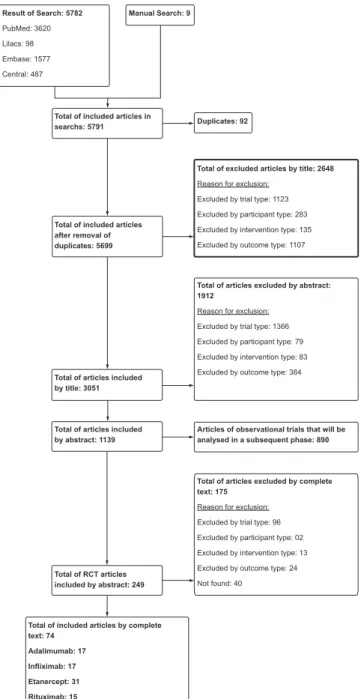
After review by title and abstract, 249 references for ritux-imab, inlixritux-imab, adalimumab and etanercept were consid-ered eligible. Six RCTs were enrolled on rituximab, comprising 15 published articles (Fig. 1).
Result of Search: 5782
PubMed: 3620
Lilacs: 98
Embase: 1577
Central: 487
Total of excluded articles by title: 2648
Reason for exclusion:
Excluded by trial type: 1123
Excluded by participant type: 283
Excluded by intervention type: 135
Excluded by outcome type: 1107
Total of articles excluded by abstract: 1912
Reason for exclusion:
Excluded by trial type: 1366
Excluded by participant type: 79
Excluded by intervention type: 83
Excluded by outcome type: 384
Total of articles excluded by complete text: 175
Reason for exclusion:
Excluded by trial type: 96
Excluded by participant type: 02
Excluded by intervention type: 13
Excluded by outcome type: 24
Not found: 40
Total of included articles by complete text: 74
Adalimumab: 17
Infliximab: 17
Etanercept: 31
Rituximab: 15
Manual Search: 9
Duplicates: 92
Total of included articles after removal of duplicates: 5699
Total of articles included by title: 3051
Total of articles included by abstract: 1139
Total of RCT articles included by abstract: 249
Articles of observational trials that will be analysed in a subsequent phase: 890 Total of included articles in
searchs: 5791
We included 15 trials in progress, and one of them was ter-minated prematurely in some research centres without stated justiication (2008-002381-55). A trial was completed, but we could not ind the publication of the results (NCT01117129). We did not include any dissertation or thesis.
Trial characteristics
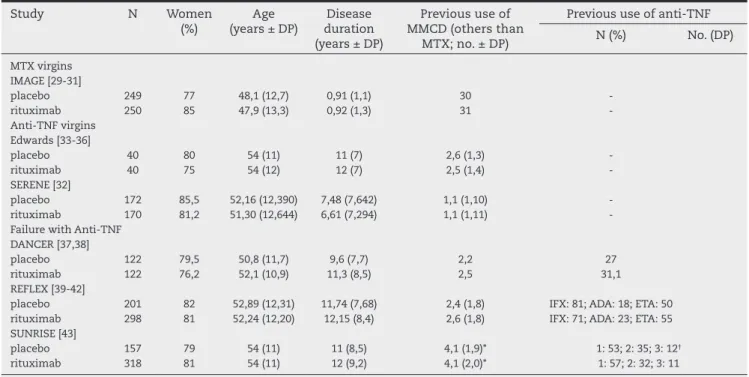
The characteristics of RCTs included are shown in Table 1. We evaluated a total of 2,139 patients with active disease, of which 1,198 used rituximab 1,000 mg twice with an interval of 15 days. MTX was used as co-treatment for all patients. The participants averaged 50 years of age, and 80% were female. The inclusion criteria of the trials were similar in terms of the diagnostic criteria – all followed the classiication criteria of
the American College of Rheumatology (ACR).26
One trial evaluated outcomes in 52 and 104 weeks of MTX naïve participants who had, on average, less than one year of diagnosis.27-29 The baseline data of participants in this trial
were similar to those in the other trials, with the exception of the radiographic score, much lower in those newly diagnosed patients. In the other ive trials, the participants had active dis-ease despite MTX use and averaged more than seven years of disease evolution. In two trials, the participants were naïve for
anti-TNF, while the outcomes were presented for 24,30 48 and
104 weeks.31-34 In the other three trials, the participants
exhib-ited treatment failure with anti-TNF agent, while the outcomes were presented after 24 weeks of follow-up (Table 1).35-41
One trial evaluated the effectiveness of the second admin-istration of rituximab in patients in whom the irst applica-tion cycle was not suficient to achieve remission, i.e., DAS28-ESR < 2.6.41 In this trial, all participants received rituximab in
an open phase. After 24 weeks of follow-up, those patients who did not achieve remission were randomized to receive re-treatment with rituximab or placebo and were followed for another 24 weeks. We considered the results of this part of the trial in the meta-analyses.
Assessment of methodological quality and risk of bias
All included trials had high methodological quality (Jadad score, modiied = 5). The risk of bias assessment showed that the methods of generation of allocation sequence and of en-suring allocation conidentiality were considered adequate in only one RCT.27-29 For the remaining domains, all trials had low
risk of bias (Fig. 2).
Conlicts of interest and publication bias
All included trials were funded by the pharmaceutical indus-try and only one report36 did not declare a conlict of interests.
The funnel plot suggested publication bias, but this analysis could not be considered robust, considering that the number of included trials was small.
Primary outcomes
The meta-analyses that evaluated ACR measures after 24 weeks of treatment included studies whose participants were naïve or had failed with anti-TNF treatment (n = 1,640). In gen-eral, more patients in rituximab group achieved ACR20, ACR50 and ACR70 compared to placebo. However, these analyses showed substantial heterogeneity, and the subset of patients naïve to anti-TNF displayed a robust result. But it is
notewor-Table 1 – Summary of characteristics of included trials
Study N Women
(%)
Age (years ± DP)
Disease duration (years ± DP)
Previous use of MMCD (others than
MTX; no. ± DP)
Previous use of anti-TNF
N (%) No. (DP)
MTX virgins IMAGE [29-31]
placebo 249 77 48,1 (12,7) 0,91 (1,1) 30 -rituximab 250 85 47,9 (13,3) 0,92 (1,3) 31 -Anti-TNF virgins
Edwards [33-36]
placebo 40 80 54 (11) 11 (7) 2,6 (1,3) -rituximab 40 75 54 (12) 12 (7) 2,5 (1,4) -SERENE [32]
placebo 172 85,5 52,16 (12,390) 7,48 (7,642) 1,1 (1,10) -rituximab 170 81,2 51,30 (12,644) 6,61 (7,294) 1,1 (1,11) -Failure with Anti-TNF
DANCER [37,38]
placebo 122 79,5 50,8 (11,7) 9,6 (7,7) 2,2 27 rituximab 122 76,2 52,1 (10,9) 11,3 (8,5) 2,5 31,1 REFLEX [39-42]
placebo 201 82 52,89 (12,31) 11,74 (7,68) 2,4 (1,8) IFX: 81; ADA: 18; ETA: 50 rituximab 298 81 52,24 (12,20) 12,15 (8,4) 2,6 (1,8) IFX: 71; ADA: 23; ETA: 55 SUNRISE [43]
placebo 157 79 54 (11) 11 (8,5) 4,1 (1,9)* 1: 53; 2: 35; 3: 12†
rituximab 318 81 54 (11) 12 (9,2) 4,1 (2,0)* 1: 57; 2: 32; 3: 11
ADA adalimumab, ETA etanercepte, IFX inliximab
thy that this subgroup is small, n = 22; then, more studies are needed to conirm the result (Fig. 3). In the analyses of hetero-geneity, it was noted that one trial reported favourable results with the use of rituximab, a statistically signiicant result, but less expressive than the other RCTs.41 After its exclusion of
the meta-analyses, the results favouring the use of rituximab persisted, and the heterogeneity decreased to ACR20, ACR50 and ACR70, respectively RR (95% IC) = 2.24 (1.86-2.69; I2 = 15 %;
P = 0.32) , RR = 2.86 ( 2.07-3.94; I2 = 0%; P = 0.90) and RR = 3.91
(1.84-8.31; I2 = 50%; P = 0.11).
In the pooled analysis of two trials (n = 579), we did not perceive any beneits from the use of the biological agent compared to placebo for ACR20 until 48-52 weeks and 104 weeks of follow-up.27-29,31-34 The ACR50 and ACR70 results did
not favour the use of rituximab until 48-52 weeks, although they have favoured its use till 104 weeks. This luctuation of the presence or absence of beneit may be related to the small number of participants. Furthermore, the type of patients in these two trials was different: one trial evaluated MTX-naïve patients with less than one year of disease evolution,29-31 and
the other evaluated patients naïve to anti-TNF with more than ten years of diagnosis.31-34
Secondary outcomes
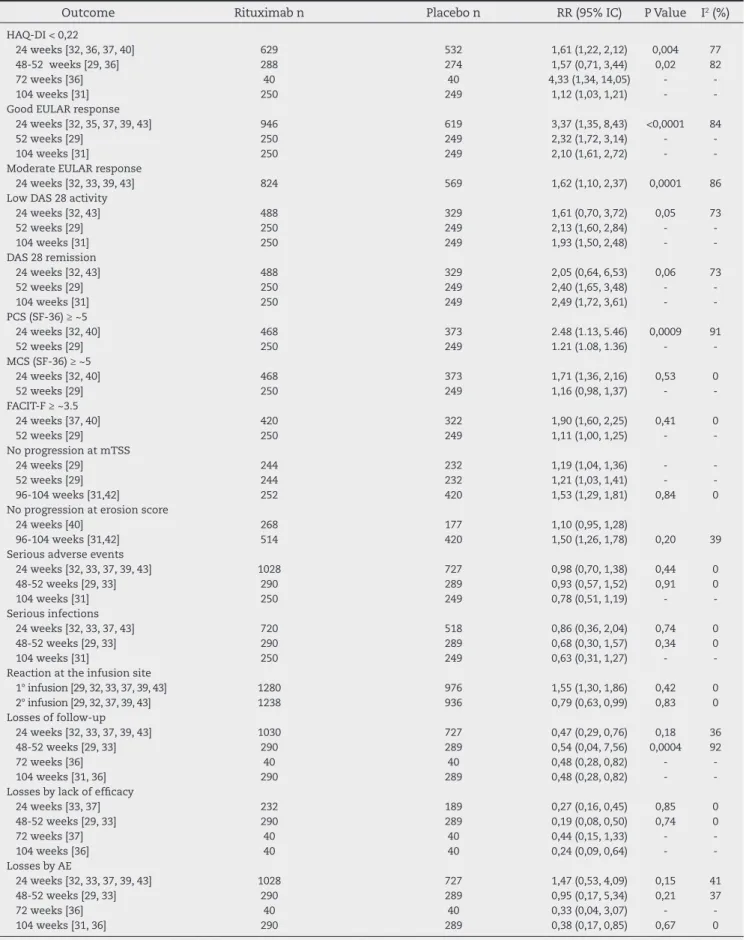
In general, the group of patients who used rituximab achieved a statistically signiicant improvement compared to placebo in all individual components of the ACR, including in relation to the average change in HAQ-DI score. The meta-analysis of the number of participants who showed a change in HAQ-DI
score ≥ 0.22 after 24 weeks from baseline (n = 1,161) pointed to the beneit of rituximab use with substantial heterogene-ity, probably due to the SERENE trial.30 The joint analysis of
two trials (n = 562) showed no statistically signiicant differ-ence between groups after 48-52 weeks. After 72 weeks, there was no difference between intervention and control groups of patients with more than ten years of diagnosis.31 But after
104 weeks there was a difference which beneited the use of rituximab in patients with less than one year of disease pro-gression (Table 2).27-29
After 24 weeks of follow-up, more patients in rituximab group compared to placebo achieved good (n = 1,637) and mod-erate (n = 1,393) EULAR responses, but with substantial hetero-geneity (data not shown). Regarding good EULAR response, in the analysis of heterogeneity (and after removal of the SERENE trial)30 the outcome continued favouring rituximab. The analysis
of the trial that evaluated recently diagnosed patients showed that the beneit of rituximab remained after 52 and 104 weeks of follow up.27-29 The heterogeneity of good and moderate
EU-LAR responses diminished with the exclusion of those partici-pants with therapeutic failure with anti-TNF,35,39 and with the
exclusion of participants naïve to anti-TNF, respectively.30-34 The
change of baseline DAS28-ESR was generally higher in ritux-imab group compared to placebo after 24, 52 and 104 weeks of follow-up. A pooled analysis of two trials showed no difference between groups in relation to the outcomes of low activity of the disease and remission till 24 weeks of follow-up;30,41
how-ever, more patients in rituximab group compared to placebo achieved these targets after 52 and 104 weeks in the trial that evaluated patients with less diagnosis time (Table 2).27-29
The summarized physical component (SPC) change of SF-36 was superior and statistically signiicant in rituximab group compared to placebo after 24 and 52 weeks of follow-up. On the other hand, the results of the summarized mental component (SMC) change were divergent: two trials showed no difference between groups and other two showed a sta-tistically signiicant difference. In joint analyses, the chances of achieving a mean change of SPC > approx. 5 and SMC > approx. 5 after 24 weeks of treatment were higher and sta-tistically signiicant in participants who used rituximab. The heterogeneity of the irst analysis was substantial, but the in-dividual reports favoured rituximab (Table 2).
The group using rituximab had beneits with respect to the fatigue measured by FACIT-F, as compared to placebo after 24 and 52 weeks of treatment. Likewise, the chance of achieving a clinically signiicant lower change after 24 weeks of treat-ment, i.e., a mean change in FACIT-F score ≥ approx. 3.5, was higher in participants who used the biological agent (Table 2). Two trials reported that the participants using rituximab achieved better results in radiological outcomes than those in placebo.35-40 A joint analysis (n = 934) showed that the
partici-pants treated with the biological agent had lower probability of progression by the Sharp score (modiied) compared to pla-cebo + MTX after 104 weeks of treatment (Table 2).
Regarding safety, there was no difference between inter-vention and control groups regarding the incidence of severe AEs, malignancies and death. Infection was the most common AE in the trials. In any case, the rate of occurrence of serious infections was low, about 2% after 24 months of treatment in both groups, increasing to approximately 6% after this
Total events 115 55
Heterogeneity: Tau2 = 0.00; Chi2 = 0.19, df = 1 (P = 0.67); I2 = 0%
Test for overall effect Z = 5.70 (P < 0.00001)
Total events 390 141
Heterogeneity: Tau2 = 0.22; Chi2 = 23.54, df = 2 (P = 0.00001); I2 = 92%
Test for overall effect Z = 2.20 (P = 0.03)
Total (95% CI) 948 692 100.0% 1.92 [1.36, 2.73]
Total events 505 196 Heterogeneity: Tau2
= 0.13; Chi2
= 26.49, df = 4 (P = 0.00001); I2
= 85% Test for overall effect Z = 3.66 (P = 0.0003)
Teste for subgroup differences: Chi2 = 0.15, de = 1 (P = 0.70). I2 = 0%
Total (95% CI) 948 692 100.0% 2.33 [1.35, 4.01]
Total events 221 83
Heterogeneity: Tau2 = 0.28; Chi2 = 17.97, df = 4 (P = 0.001); I2 = 78%
Test for overall effect Z = 3.05 (P = 0.002)
Test for subgroup differences: Chi2 = 0.70, de = 1 (P = 0.40). I2 = 0%
Total (95% CI) 948 692 100.0% 2.94 [1.30, 6.66]
Total events 131 39
Heterogeneity: Tau2 = 0.61; Chi2 = 16.70, df = 4 (P = 0.002); I2 = 76%
Test for overall effect Z = 2.58 (P < 0.010)
Test for subgroup differences: Chi2 = 0.22, de = 1 (P = 0.64). I2 = 0%
29 86 40 170 210 40 172 212 17.4% 20.3% 37.7% 2004 2010 1.93 [1.24, 3.01] 2.18 [1.60, 2.96] 2.09 [1.62, 2.70] 15
40
Study or subgroup
A.
Anti-TNF virgins
DANCER [37] REFLEX [39] SUNRISE [43]
Subtotal (95% CI)
Edwards [33] SERENE [32]
Subtotal (95% CI)
66 152 172 122 298 318 738 122 201 157 480 19.9% 20.1% 22.3% 62.3% 2006 2006 2010 1.94 [1.40, 2.70] 2.85 [2.08, 3.91] 1.20 [0.98, 1.46]
1.86 [1.07, 3.22]
34 36 71
Failure with Anti-TNF
Total events 160 62 Heterogeneity: Tau2
= 0.34; Chi2
= 11.39, df = 2 (P = 0.003); I2
= 82% Test for overall effect Z = 1.83 (P = 0.07)
Total events 26 11
Heterogeneitye: Tau2 = 0.01; Chi2 = 1.03, df = 1 (P = 0.31); I2 = 3%
Test for overall effect Z = 2.34 (P = 0.02) REFLEX [39]
DANCER [37] SUNRISE [43]
Subtotal (95% CI)
27 41 92 298 122 318 738 201 122 157 480 15.1% 22.0% 25.3% 62.4% 2006 2006 2010 2006 2006 2010 3.64 [1.43, 9.30] 2.56 [1.52, 4.31] 1.11 [0.81, 1.52]
2.01 [0.95, 4.26]
5 16 41
Anti-TNF failure
Total events 105 28
Heterogeneity: Tau2 = 1.27; Chi2= 15.63, df = 2 (P = 0.003); I2 = 82%
Test for overall effect Z = 1.72 (P = 0.09) DANCER [37]
REFLEX [39] SUNRISE [43]
Subtotal (95% CI)
24 36 45 122 298 318 738 122 201 157 480 21.6% 15.4% 25.7% 62.7%
4.00 [1.69, 9.44] 12.14 [2.96, 49.86] 1.11 [0.68, 1.81]
3.37 [0.84, 13.52]
6 2 20
Anti-TNF failure
Events Total Events Total Weight M-H, Random, 95% Cl Year M-H, Random, 95% Cl Risk Ratio Risk Ratio Placebo Rituximabe Edwards [33] SERENE [32]
Subtotal (95% CI)
Edwards [33] SERENE [32]
Subtotal (95% CI)
Total events 61 21
Heterogeneity: Tau2 = 0.00; Chi2 = 0.14, df = 1 (P = 0.71); I2 = 0%
Test for overall effect Z = 4.61 (P < 0.00001) 17 44 40 170 210 40 172 212 15,8% 21,8% 37,6% 2004 2010 3.40 [1.39, 8.33] 2.78 [1.64, 4.73] 2.93 [1.86, 4.63] 5 16 9 17 40 170 210 40 172 212 14.8% 22.5% 37.3% 2004 2010 4.50 [1.04, 19.54]
1.91 [0.88, 4.17] 2.32 [1.15, 4.71] 2
9
Study or subgroup
B.
Anti-TNF virgins
Events Total Events Total Weight M-H, Random, 95% Cl Year M-H, Random, 95% Cl Risk Ratio Risk Ratio
Placebo Rituximabe
Study or subgroup
C.
Anti-TNF virgins
Events Total Events Total Weight M-H, Random, 95% Cl Year M-H, Random, 95% Cl Risk Ratio Risk Ratio
Placebo Rituximabe
0.1
Favours placebo Favours Rituximab 0.2 0.5 1 2 5 10
0.1
Favours placebo Favours Rituximab 0.2 0.5 1 2 5 10
0.1
Favours placebo Favours Rituximab 0.2 0.5 1 2 5 10
Fig. 3 – Forest plot depicting the statistically signiicant difference between rituximab and placebo in response criteria of the American College of Rheumatology (ACR) after 24 weeks of treatment. A. ACR20 (20% of improvement). B. ACR50. C. ACR70.
riod. Acute reaction to the irst infusion was more common in rituximab group compared to placebo. In the second infusion, we could observe an opposite association; more patients in placebo group exhibited a reaction. There were no deaths re-lated to this outcome in the RCTs included (Table 2).
The loss for total follow-up was higher in placebo group compared to rituximab. Individually, the trials were differ-ent as the magnitude of the loss, ranging from 2.5% to 14% in rituximab group and from 5% to 35% in placebo group. The losses due to lack of eficacy were more frequent in placebo group and the rates of loss due to AEs were not different be-tween groups (Table 2).
Subgroup analysis – RF and anti-CCP
With the exception of one trial that included only rheuma-toid factor-positive (RF+) participants, the groups of other tri-als were balanced with regard to the inclusion of positive and negative participants.31-34 These latter were always minority
and were not included in the overall analysis of a trial.35,36 The
distribution of patients in relation to anti-CCP was reported by a trial, with homogeneity between groups.41
Table 2 – Joint analysis of the secondary outcomes of eficacy, adverse events e loss of follow-up
Outcome Rituximab n Placebo n RR (95% IC) P Value I2 (%)
HAQ-DI < 0,22
24 weeks [32, 36, 37, 40] 629 532 1,61 (1,22, 2,12) 0,004 77 48-52 weeks [29, 36] 288 274 1,57 (0,71, 3,44) 0,02 82 72 weeks [36] 40 40 4,33 (1,34, 14,05) - -104 weeks [31] 250 249 1,12 (1,03, 1,21) - -Good EULAR response
24 weeks [32, 35, 37, 39, 43] 946 619 3,37 (1,35, 8,43) <0,0001 84 52 weeks [29] 250 249 2,32 (1,72, 3,14) - -104 weeks [31] 250 249 2,10 (1,61, 2,72) - -Moderate EULAR response
24 weeks [32, 33, 39, 43] 824 569 1,62 (1,10, 2,37) 0,0001 86 Low DAS 28 activity
24 weeks [32, 43] 488 329 1,61 (0,70, 3,72) 0,05 73 52 weeks [29] 250 249 2,13 (1,60, 2,84) - -104 weeks [31] 250 249 1,93 (1,50, 2,48) - -DAS 28 remission
24 weeks [32, 43] 488 329 2,05 (0,64, 6,53) 0,06 73 52 weeks [29] 250 249 2,40 (1,65, 3,48) - -104 weeks [31] 250 249 2,49 (1,72, 3,61) - -PCS (SF-36) ≥ ~5
24 weeks [32, 40] 468 373 2.48 (1.13, 5.46) 0,0009 91 52 weeks [29] 250 249 1.21 (1.08, 1.36) - -MCS (SF-36) ≥ ~5
24 weeks [32, 40] 468 373 1,71 (1,36, 2,16) 0,53 0 52 weeks [29] 250 249 1,16 (0,98, 1,37) - -FACIT-F ≥ ~3.5
24 weeks [37, 40] 420 322 1,90 (1,60, 2,25) 0,41 0 52 weeks [29] 250 249 1,11 (1,00, 1,25) - -No progression at mTSS
24 weeks [29] 244 232 1,19 (1,04, 1,36) - -52 weeks [29] 244 232 1,21 (1,03, 1,41) - -96-104 weeks [31,42] 252 420 1,53 (1,29, 1,81) 0,84 0 No progression at erosion score
24 weeks [40] 268 177 1,10 (0,95, 1,28)
96-104 weeks [31,42] 514 420 1,50 (1,26, 1,78) 0,20 39 Serious adverse events
24 weeks [32, 33, 37, 39, 43] 1028 727 0,98 (0,70, 1,38) 0,44 0 48-52 weeks [29, 33] 290 289 0,93 (0,57, 1,52) 0,91 0 104 weeks [31] 250 249 0,78 (0,51, 1,19) - -Serious infections
24 weeks [32, 33, 37, 43] 720 518 0,86 (0,36, 2,04) 0,74 0 48-52 weeks [29, 33] 290 289 0,68 (0,30, 1,57) 0,34 0 104 weeks [31] 250 249 0,63 (0,31, 1,27) - -Reaction at the infusion site
1° infusion [29, 32, 33, 37, 39, 43] 1280 976 1,55 (1,30, 1,86) 0,42 0 2° infusion [29, 32, 37, 39, 43] 1238 936 0,79 (0,63, 0,99) 0,83 0 Losses of follow-up
24 weeks [32, 33, 37, 39, 43] 1030 727 0,47 (0,29, 0,76) 0,18 36 48-52 weeks [29, 33] 290 289 0,54 (0,04, 7,56) 0,0004 92 72 weeks [36] 40 40 0,48 (0,28, 0,82) - -104 weeks [31, 36] 290 289 0,48 (0,28, 0,82) - -Losses by lack of eficacy
24 weeks [33, 37] 232 189 0,27 (0,16, 0,45) 0,85 0 48-52 weeks [29, 33] 290 289 0,19 (0,08, 0,50) 0,74 0 72 weeks [37] 40 40 0,44 (0,15, 1,33) - -104 weeks [36] 40 40 0,24 (0,09, 0,64) - -Losses by AE
versus intervention group; however, these analyses were not statistically signiicant.
In SERENE trial,30 after 24 weeks of treatment (the
con-trolled trial phase) there was no difference in relation to the change in DAS28-ESR among patients FR+ and FR- who used rituximab. In the open phase of the trial (24 to 48 weeks of treatment), the patients who had not achieved remission were re-treated with the biological agent; more patients FR+ achieved ACR50 and ACR70, compared to patients FR-.
Discussion
The results of eficacy and safety of this RS point to the ben-eit of rituximab 1000 mg applied twice at 15-day intervals as-sociated with weekly MTX for the treatment of RA. Regarding the primary outcomes, greater number of patients achieved ACR20, ACR50 and ACR70 in rituximab group versus placebo. This result was obtained for up to 24 weeks of follow-up in pa-tients naïve and in those papa-tients who have failed with anti-TNF and with more than seven years of the disease; and for up to 52 weeks for patients naïve to MTX and anti-TNF and newly diagnosed. These results can also be applied to good and moderate EULAR responses.
In comparison to individual components of ACR response criteria, summarized physical and mental components of SF-36, fatigue measured by FACIT-F and in relation to the change in baseline DAS28-ESR, we noted better results with
ritux-Total events 404 116
Heterogeneity: Tau2 = 0.14; Chi2 = 15.21, df = 2 (P = 0.0005); I2 = 87% Test for overall effect Z = 2.78 (P < 0.005)
134 131 139 245 242 244 731 122 165 118 405 23.8% 23.0% 25.6% 72.3%
1.96 [1.44, 2.67] 2.88 [2.08, 4.04] 1.32 [0.98, 1.67] 1.93 [1.07, 3.07] 34
31 51
Study or subgroup
A.
24 weeks
DANCER [37] REFLEX [39] SUNRISE [43]
Subtotal (95% CI)
Total events 181 145 Heterogeneity: does not apply
Test for overall effect Z = 3.94 (P < 0.0001)
Total (95% CI) 955 632 100.0% 1.71 (1.19, 2.48]
Total events 585 261
Heterogeneity: Tau2 = 0.12; Chi2 = 30.69, df = 3 (P = 0.00001); I2 = 90% Test for overall effect Z = 2.86 (P < 0.004)
Test for subgroup differences: Ch2 = 3.00, df = 1 (P = 0.08), I2 = 66.7% IMAGE [29]
Subtotal (95% CI)
181 224 224 227 227 27.7% 27.7%
1.26 [1.13, 1.42] 1.26 [1.13, 1.42] 145
52 weeks
Events Total Events Total Weight M-H, Random, 95% Cl Year M-H, Random, 95% Cl
Risk Ratio Risk Ratio
Placebo Rituximabe
Total events 89 36
Heterogeneity: Tau2 = 0.32; Chi2 = 10.61, df = 2 (P = 0.005); I2 = 81% Test for overall effect Z = 0.61 (P < 0.54)
30 27 32 63 66 74 203 21 44 39 104 27.2% 15.9% 28.4% 71.4%
0.83 [0.53, 1.31] 3.60 [1.50, 8.63] 0.89 [0.59, 1.34] 1.25 [0.61, 2.57]
2006 2006 2010 2010 12 5 19
Study or subgroup
B.
24 weeks
DANCER [37] REFLEX [39] SUNRISE [43]
Subtotal (95% CI)
Total events 17 14 Heterogeneity: does not apply
Test for overall effect Z = 0.52 (P = 0.061)
Total (95% CI) 227 126 100.0% 1.16 [0.73, 1.85]
Total events 106 50
Heterogeneity: Tau2 = 0.15; Chi2 = 10.42, df = 3 (P = 0.02); I2 = 71% Test for overall effect Z = 0.64 (P < 0.52)
Test for subgroup differences: Ch2 = 0.08, df = 1 (P = 0.78), I2 = 0% IMAGE [29]
Subtotal (95% CI)
17 24 24 22 22 28.6% 28.6%
1.11 [0.71, 1.67] 1.11 [0.71, 1.67] 14
52 weeks
Events Total Events Total Weight M-H, Random, 95% Cl Year M-H, Random, 95% Cl
Risk Ratio Risk Ratio
Placebo Rituximabe
0.1
Favours placebo+MTX Favours rituximab+MTX
0.2 0.5 1 2 5 10
0.1
Favours placebo+MTX Favours rituximab+MTX 0.2 0.5 1 2 5 10
Fig. 4 – Forest-plot depicting the responses of the American College of Rheumatology ACR20 (20% improvement) of rituximab versus placebo. A. RF-positive patients. B. RF-negative patients.
of participants treated with rituximab achieved ACR20 that was statistically signiicant compared to placebo, but with substantial heterogeneity; RR = 1.71 (1.19-2.48; I2 = 90%; P <
0.00001), and this was explained by the exclusion of any trial. In FR- group, there was no difference between experimental and control groups; however, the analysis also showed sub-stantial heterogeneity; RR = 1.16 (0.73-1.85; I2 = 71%; P = 0.02),
with no explanation (Fig. 4).
The IMAGE trial also assessed ACR50, ACR70, good EULAR response, low activity, and remission of disease according to DAS28-ESR, percentage of participants without radiological progression and mean change in modiied Sharp score in re-lation to seropositivity for RF and anti-CCP.27 After 52 weeks
of follow-up, only the mean change in modiied Sharp score was statistically different between rituximab and placebo in the analysis of participants FR+. In this trial, all participants FR- were anti-CCP-.
According to Tak et al.,29 after 104 weeks of follow-up the
participants FR+ and/or anti-CCP+ in rituximab group had a higher probability of not showing radiological progression compared to placebo; odds ratio (OR, 95% CI) = 2.228 (1.513-3.281).29 In the analyses of the participants FR- and anti-CCP-,
imab. Remission and low disease activity were reported by three trials, despite all other trials also measured disease ac-tivity by DAS28-ESR.27,30,41 These measures were achieved after
52 weeks of treatment for newly diagnosed patients.27
The prevention or minimization of the progression of joint
damage is a mainstay RA treatment; however, only IMAGE27
and REFLEX39 performed an analysis of radiographic
progres-sion, and in both trials the participants who used rituximab achieved better results versus placebo after 104 weeks. We need more trials to strengthen the results of radiographic progression.
In this review we observed that the favourable results with rituximab according to ACR were more expressive in the trial
that studied patients with less than one year of diagnosis,27
which conirms the recommendations of ACR7 and EULAR8
current guidelines, pointing to the fact that the treatment of RA will be more effective if started early.
SUNRISE41 was responsible for high heterogeneity in
vari-ous analyses. In this trial, patients who did not achieve re-mission with an application of rituximab were randomized to re-treatment from 24th week. This trial showed beneits of rituximab versus placebo in all parameters measured, but the results were less signiicant than those shown by the other included trials. The authors reported that patients who achieved ACR20, ACR50 and ACR70 after the irst application of rituximab were more likely to maintain its gains or improve with re-treatment with rituximab. On the other hand, pa-tients who did not achieve such measures were not beneited with the second drug application.
Emery et al.42 conducted a joint analysis of three RCTs and
its extensions – SERENE30 and MIRROR,43 with 43 participants
re-treated to achieve clinical remission (Treat to Target – TT)
(n = 236), and DANCER,35 and patients re-treated when
nec-essary (RWN) (n = 257). The groups were homogeneous with respect to basal data, with the exception of disease duration, that was 3.6 and 8.5 years, respectively. Both groups have evolved to improve at every application of rituximab; how-ever, patients in TT group achieved better results than partici-pants RWN, regarding HAQ-DI and DAS-28. In addition, during the irst four applications of rituximab, more patients discon-tinued the trial in RWN group compared to TT group, mainly due to an insuficient therapeutic response.
In general, rituximab in association with MTX proved to be as safe as MTX. Acute infusion reaction was the most common event and was more frequent in rituximab group compared to placebo, but only in the irst infusion. Van Vollenhoven et al.44
conducted a joint analysis of six RCTs (SERENE,30 DANCER,35
REFLEX,37 SUNRISE,41 MIRROR43 and SIERRA45), including
exten-sions of open phase DANCER and REFLEX trials, and demon-strated that the overall incidence was 359.6 adverse events per 100 patients-year (95% CI 354.4-364.9). The AE rate was higher after the irst application, falling to 329.44 events per 100 patient-years (320.59-338.53) after the second application, remaining stable until the subsequent ive years of monitor-ing. The most common event detected was an acute infusion reaction, occurring in 25% of participants. Other AEs occur-ring in ≥ 10 % of the assessed population were infections, not including RA exacerbations. In this review, the mortality rate was 0.6 per 100 patient-years, and there were no deaths due to infusion reactions.
Loss of participants is critical in epidemiological trials, since the analysis, even if done by intention to treat, may be compromised. In the included RCTs, generally the losses did not exceed 20% and total loss and loss due to lack of eficacy were higher in placebo group compared to rituximab. The loss rates for EA were not different between groups.
Finckh et al.46 conducted a prospective cohort trial to
as-sess which subset of patients with RA and with anti-TNF failure obtain beneit with the exchange for rituximab versus exchange for another anti-TNF agent. Blom et al.47 evaluated a
retrospective cohort of patients who had failed with two anti-TNF agents and who were treated with a third anti-anti-TNF drug (n = 64), or with rituximab (n = 90). These authors concluded that patients using rituximab obtained better results with respect to disease activity versus patients using anti-TNF agent.46,47 Both trials concluded that in case of failure with
an anti-TNF treatment, the introduction of a biological agent with different mechanism of action, such as rituximab, would be the best conduct, increasing the eficacy of rituximab as third-line treatment.
Current guidelines from ACR for RA have established, as an alternative, the use of rituximab if the patient exhibits low activity associated with a poor prognosis, or moderate/
high activity.7 Current guidelines from EULAR recommend the
use of rituximab only after a failure with anti-TNF, despite reiterating that the approval of rituximab for use as a second line option has been discussed in Europe.8 The results of this
trial point to a possible beneit of rituximab for patients na-ïve to anti-TNF. However, these indings should be evaluated with caution, since we could not ind any RCT to evaluate the exchange by an anti-TNF, after failure of rituximab. The pos-sibility of use of rituximab as a second line drug and of an anti-TNF as a third drug needs to be more deeply evaluated.
Data from IMAGE,27 DANCER,35 REFLEX,37 and SUNRISE41
were used in subgroup analysis for seropositivity; we observed a trend towards greater eficacy of rituximab, compared to placebo, in the subgroup FR+ and/or anti-CCP+; however, the observed heterogeneity was high. In any case, we used the method of random effects, which may have underestimated differences between groups. The predictive value of assess-ment of seropositivity needs to be further explored in future clinical trials, as well as the role of other biomarkers that may be useful for deciding on the best treatment to be used for each speciic type of patient.
This RS has some limitations. The possibility of selection bias could not be excluded from most trials. Moreover, all in-cluded trials were funded by pharmaceutical industry, which may have led to an overestimation of the results. Systematic reviews showed that industry-funded trials tend to show fa-vourable results for its products, compared to not funded tri-als.48,49
Moreover, the analysis of which type of participant would be more beneited with the use of rituximab is not conclusive, since few trials within each group (MTX-naïve and anti-NPT-naïve) were included. In general, the eficacy analyses were heterogeneous. Nevertheless, it was possible to assess the di-rection of the effect that showed beneit with the use of ritux-imab in all outcomes assessed.
Conclusion
The trials included in this RS showed that rituximab is effec-tive and safe compared to placebo for the treatment of RA, particularly in patients with a recent diagnosis. The effective-ness was also observed both in naïve patients to anti-TNF as in those whose treatment with these agents had failed. The use of rituximab was well tolerated by all patient subtypes. More trials are needed to evaluate the role of RF and anti-CCP antibody in predicting success in the treatment of RA with rituximab, but there is indication that RF+ and anti-CCP+ pa-tients exhibit a better response to this biological agent.
Conlicts of Interest
Coauthor Adriana Maria Kakehasi declares conlict of inter-est, as she received education grant from Abbott.
R E F E R E N C E S
1. McInnes IB and Schett G. The pathogenesis of rheumatoid arthritis. N Engl J Med. 2011;365:2205-2219.
2. Minaur NJ, Jacoby RK, Cosh JA, Taylor G, Rasker JJ. Outcome after 40 years with rheumatoid arthritis: A prospective study of function, disease activity, and mortality. J Rheumatol. 2004;31; Suppl 69:3-8.
3. Scott DL, Pugner K, Kaarela K, Doyle DV, Woolf A, Holmes J, Hiek K. The links between joint damage and disability in rheumatoid arthritis. Rheumatology. 2000;39:122-132. 4. Alamanos Y, Voulgari PV, Drosos AA. Incidence and
Prevalence of Rheumatoid Arthritis, Based on the 1987 American College of Rheumatology Criteria: A Systematic Review. Semin Arthritis Rheum. 2006;36:182-188.
5. Gonzalez A, Kremers HM, Crowson CS, Nicola PJ, Davis JM, Therneau TM, Roger VL, Gabriel SE. The widening mortality gap between rheumatoid arthritis patients and the general population. Arthritis Rheum. 2007;56:3583-3587.
6. Aaltonen KJ, Virkki LM, Malmivaara A, Konttinen YT, Nordstro DC, Blom M. Systematic review and meta-analysis of the eficacy and safety of existing tnf blocking agents in treatment of rheumatoid arthritis. PLoS ONE. 2012; : e30275. doi:10.1371/journal.pone.0030275.
7. Singh JA, Furst DE, Bharat A, Curtis JR, Kavanaugh AF, Kremer JM et al. 2012 update of the 2008 American College of Rheumatology recommendations for the use of disease-modifying antirheumatic drugs and biologic agents in the treatment of rheumatoid arthritis. Arthritis Rheum. 2012;64:625-639.
8. Smolen JS, Landewé R, Breedveld FC, Dougados M, Emery P, Gaujoux-Viala C et al. EULAR recommendations for the management of rheumatoid arthritis with synthetic and biological disease-modifying antirheumatic drugs. Ann Rheum Dis.2010;69:964-975.
9. Gómez-Reino JJ, Rodríguez-Lozano C, Campos-Fernández C, Montoro M, Descalzo MA, Carmona L, on behalf of the BIOBADASER 2.0 Study Group Change in the discontinuation pattern of tumour necrosis factor antagonists in rheumatoid arthritis over 10 years: data from the Spanish registry BIOBADASER 2.0 Ann Rheum Dis. 2012;71:382-385. 10. Volkmann ER, Agrawal H, Maranian P and Furst DE.
Rituximab for rheumatoid arthritis: A meta-analysis and systematic review. Clinical Medicine Insights: Therapeutics. 2010;749-760.
11. Hernández-Cruz B, García-Arias M, Ariza RA, Molab EM. Rituximab in rheumatoid arthritis: A systematic review of eficacy and safety. Reumatol Clin. 2011;7:314-322. 12. Lee YH, Bae S-C, Song GG. The eficacy and safety of
rituximab for the treatment of active rheumatoid arthritis: a systematic review and meta-analysis of randomized controlled trials. Rheumatol Int. 2011;31:1493-1499. 13. Malottki K, Barton P, Tsourapas A, Uthman AO, Liu Z, Routh
K et al. Adalimumab, etanercept, inliximab, rituximab and abatacept for the treatment of rheumatoid arthritis after the failure of a tumour necrosis factor inhibitor: a systematic review and economic evaluation. Health Technology Assessment. 2011;15:1-278.
14. Aletaha D, Neogi T, Silman AJ, Funovits J, Felson DT, Bingham CO et al. Rheumatoid Arthritis Classiication Criteria. Arthritis Rheum. 2010;62:2569-2581.
15. Higgins JPT, Green S (editors). Cochrane Handbook for Systematic Reviews of Interventions Version 5.1.0 [updatet in mar. 2011]. The Cochrane Collaboration, 2011. Available from: www. cochrane-handbook.org.
16. Liberati A, Altman DG, Tetzlaff J, Mulrow C, Gøtzsche PC, Ioannidis JP et al. The PRISMA statement for reporting systematic reviews and meta-analyses of studies that evaluate healthcare interventions: explanation and elaboration. Brit Med J. 2009;339:b2700.
17. Felson DT, Anderson JJ, Boers M, Bombardier C, Furst D, Goldsmith C et al. American-College-of-Rheumatology preliminary deinition of improvement in rheumatoid-arthritis. Arthritis Rheum. 1995;38:727-735.
18. Fransen J, van Riel PL. The Disease Activity Score and the EULAR response criteria. Clin Exp Rheumatol. 2005;23(5 Suppl 39):S93-99.
19. Ware JE, Sherbourne CD. The MOS 36-item short-form health survey: I. Conceptual framework and item selection. Med Care. 1992;30:473-483.
20. McHorney CA, Ware JE Jr, Raczek AE. The MOS 36-Item Short-Form Health Survey (SF-36): II. Psychometric and clinical tests of validity in measuring physical and mental health constructs. Med Care. 1993;31:247-263.
21. Cella D, Yount S, Sorensen M, Chartash E, Sengupta N, Grober J. Validation of the Functional Assessment of Chronic Illness Therapy Fatigue Scale relative to other instrumentation in patients with rheumatoid arthritis.
J Rheumatol. 2005;32:811-819.
22. Woodroffe R, Yao GL, Meads C, Bayliss S, Ready A, Raftery J et al. Clinical and cost-effectiveness of newer immunosuppressive regimens in renal transplantation: a systematic review and modelling study. Health Technology Assessment. 2005; 9:1-+. PubMed PMID: WOS:000229604400001.
23. Higgins JPT, Altman AD, Sterne JAC. Chapter 8: assessing risk of bias in included studies. In: Higgins JPT, Altman DG, Sterne JAC, eds. Cochrane handbook for systematic reviews of interventions. Version 5.1.0 [updated in mar. 2011]. Disponível em: www.cochrane-handbook.org, 2012.
24. Landis JR, Koch GG. The measurement of observer agreement for categorical data. Biometrics. 1997;33:159-174.
Cochrane Handbook for Systematic Reviews of Interventions. Version 5.1.0 [updated in mar. 2011]. Disponível em: www. cochrane-handbook.org; 2012.
26. Arnett FC, Edworthy SM, Bloch DA, Mcshane DJ, Mcshane JF, Cooper NS et al. The American Rheumatism Association 1987 revised criteria for the classiication of rheumatoid arthritis. Arthritis Rheum. 1988;31:315-324
27. Tak PP, Rigby WF, Rubbert-Roth A, Peterfy CG, van Vollenhoven RF, Stohl W et al for the IMAGE Investigators. Inhibition of joint damage and improved clinical outcomes with rituximab plus methotrexate in early active rheumatoid arthritis: the IMAGE trial. Ann Rheum Dis. 2010;7:39-46. 28. Rigby W, Ferraccioli G, Greenwald M, Zazueta-Montiel
B, Fleischmann R, Wassenberg S, Ogale S et al. Effect of rituximab on physical function and quality of life in patients with rheumatoid arthritis previously untreated with methotrexate. Arthritis Rheum. 2011;63:711-720.
29. Tak PP, Rigby W, Rubbert-Roth A, Peterfy C, van Vollenhoven RF, Stohl W et al. Sustained inhibition of progressive joint damage with rituximab plus methotrexate in early active rheumatoid arthritis: 2-year results from the randomised controlled trial IMAGE. Ann Rheum Dis. 2012;71:351-357. 30. Emery P, Deodhar A, Rigby WF, Isaacs JD, CombeB,
Racewicz AJ et al. Eficacy and safety of different doses and retreatment of rituximab: a randomised, placebo-controlled trialin patients who are biological naïve with active rheumatoid arthritis and an inadequate response to methotrexate (Study Evaluating Rituximab’s Eficacy in MTX iNadequater Esponders (SERENE)). Ann Rheum Dis. 2010;69:1629-1635.
31. Edwards JCW, Szczepan´ski L, Szechin´ski J, Filipowicz-Sosnowska A, Emery P, Close DR et al. Eficacy of B-cell-targeted therapy with rituximab in patients with rheumatoid arthiritis. N Engl J Med. 2004;350:2578-2581.
32. Emery P, Sheeran T, Lehane PB, Saiedabadi N, Shaw TM. Eficacy and safety of rituximab at 2 years following a single treatment in patients with active rheumatoid arthritis. Arthritis Rheum. 2004;50:1344-50.
33. Keystone EC. B cells in rheumatoid arthritis: from hypothesis to the clinic. Rheumatology. 2005; 44(Suppl. 2):ii8-ii12. 34. Strand V, Balbir-Gurman A, Pavelka K, Emery P, Li N, Yin M et
al. Sustained beneit in rheumatoid arthritis following one course of rituximab: improvements in physical function over 2 years. Rheumatology. 2006;45:1505-1513.
35. Emery P, Fleischmann R, Filipowicz-Sosnowska A, Schechetman J, Szczepanski L, Kavanaugh A et al for the DANCER Study Group. The eficacy and safety of rituximab in patients with active rheumatoid arthritis despite methotrexate treatment. Arthritis Rheum. 2006;54:1390-1400. 36. Mease PJ, Revicki DA, Szczepanski J, Greenwald M, KIvitz
A, Barile-Fabris L et al. Improved health-related quality of life for patients with active rheumatoid arthritis receiving rituximab – results of the dose-ranging assessment: international clinical evaluation of rituximab in rheumatoid arthritis (DANCER) trial. J Rheumatol. 2008;35:20-30.
37. Cohen SB, Emery P, Greenwald MW, Dougados M, Furie RA, Genovese MC et al for the REFLEX Trial Group. Rituximab for rheumatoid arthritis refractory to anti-tumor necrosis factor therapy. Arthritis Rheum. 2006;54:2793-2806.
38. Keystone E, Burmester GR, Furie R, Loveless JE, Emery P, Kremer J et al. Improvement in patient-reposted outcomes in a rituximab trial in patients with severe rheumatoid arthritis
refractory to anti-tumor necrosis factor therapy. Arthritis Rheum. 2008;59:785-93.
39. Keystone E, Emery P, Peterfy CG, Tak PP, Cohen S, Genovese MC et al. Rituximab inhibits structural joint damage in rheumatoid arthritis patients with an inadequate response to tumor necrosis factor inhibitor therapies. Ann Rheum Dis. 2009;68:216-221.
40. Cohen SB, Keystone E, Genovese MC, Emery P, Peterfy C, Tak PP et al. Continued inhibition of structural damage over 2 years in patients with rheumatoid arthritis treated with rituximabin combination with methotrexate. Ann Rheum Dis. 2010;59:1158-1161.
41. Mease PJ, Cohen S, Gaylis NB, Chubick A, Kaell AT, Greenwald M et al. Eficacy and safety of retreatment in patients with rheumatoid arthritis with previous inadequate response to tumor necrosis factor inhibitors: results from the SUNRISE trial. J Rheumatol. 2010; 37:917-927.
42. Emery P, Mease PJ, Rubbert-Roth A, Curtis JR, Muller-Ladner U, Gaylis NB et al. Retreatment with rituximab based on a treatment-to-target approach provides better disease control than treatment as needed in patients with rheumatoid arthritis: a retrospective pooled analysis. Rheumatology. 2011;50:2223-2232.
43. Rubbert-Roth A, Tak PP, Zerbini C, Tremblay J-L, Carreno L, Armstrong G et al. Shaw TM on behalf of the MIRROR Trial Investigators. Eficacy and safety of various repeat treatment dosing regimens of rituximab in patients with active rheumatoid arthritis: results of a Phase III randomized study (MIRROR). Rheumatology. 2010;49:1683-1693.
44. Van Vollenhoven RF, Emery P, Bingham III CO, Keystone EC, Fleischmann R, Furst DE et al. Longterm safety of patients receiving rituximab in rheumatoid arthritis clinical trials. J Rheumatol. 2010;37:558-567.
45. Bingham C, Looney R, Deodhar A, Halsey N, Greenwald M, Codding C et al. Results from a controlled clinical trial (SIERRA) to evaluate primary and recall responses to immunizations in RA patients treated with rituximab [abstract]. Arthritis Rheum Suppl. 2008;58:S900.
46. Finckh A, Ciurea A, Brulhart L, Moller B, Walker UA, Courvoisier D, Kyburz D, Dudler J, Gabay C, on the behalf of the doctors of the Swiss Clinical Management Programme for Rheumatoid Arthritis. Which subgroup of patients with rheumatoid arthritis beneits from switching to rituximab versus alternative anti-tumor necrosis factor (TNF) agents after previous failure of an anti-TNF agent? Ann Rheum Dis. 2010;69;387-393.
47. Blom M, Kievit W, Donders AR, den Broeder AA, Straten VH, Kuper I et al. Effectiveness of a third tumor necrosis factor-α-blocking agent compared with rituximab after failure of 2 TNF-blocking agents in rheumatoid arthritis. J Rheumatol. 2011;38:2355-2361.
48. Bero L, Oostvogel F, Bacchetti P, Lee K (2007) Factors associated with indings of published trials of drug–drug comparisons: why some statins appear more eficacious than others. PLoS Med. 2007; 4:e184. doi:10.1371/journal. pmed.0040184.
49. Lexchin J, Bero LA, Djulbegovic B, Clark O (2003) Pharmaceutical industry sponsorship and research outcome and quality: systematic review. BMJ. 2003;326:1167. doi:10.1136/bmj.326.7400.1167.