MODERN SINGING HANDICAP INDEX IN SINGERS
OF TRADITIONAL AND PENTECOSTAL CHURCHES
Índice de desvantagem para o canto moderno em cantores
evangélicos de igrejas tradicionais e pentecostais
Joel Pinheiro(1), Perla do Nascimento Martins Muniz(1), Janine Santos Ramos(1),
Alcione Ghedini Brasolotto(2), Kelly Cristina Alves Silverio(2)
(1) Faculdade de Odontologia de Bauru da Universidade de
São Paulo, FOB-USP, Bauru, SP, Brasil.
(2) Departamento de Fonoaudiologia da Faculdade de
Odon-tologia de Bauru da Universidade de São Paulo, FOB-USP, Bauru, SP, Brasil.
Conlict of interest: non-existent
to tithes dispensation, beginning and ending of
services, reunions and meetings2. Through music,
gospel people express their way of living and their relationship with God3.
Gospel church has two basic denominations:
traditional and Pentecostal churches4. The
denomi-nations are different based in a set of doctrines and principles that govern the church style. In this context, it is possible to observe differences between styles: a way of service is more liturgical, objective, and
rational, present in historic or traditional churches,
while the other has a more emotional approach, found in Pentecostal and neo-pentecostal churches. Traditional gospel music is followed by human voices technically built, using melodies and lyrics of classic or erudite composers, usually under the
INTRODUCTION
Music has a vital role in gospel churches and
this is pointed out by the fact of every community
practice to go along music1.
Recently it is possible to observe the power of gospel music. Authors report that the function of music is to prepare the congregation to speciic
activities, as bible reading, understanding preaching,
ABSTRACT
Purpose: to assess complaints, laryngopharyngeal and vocal symptoms and voice handicap of gospel
singers, comparing singers of traditional churches with singers of Pentecostal churches. Methods: one
hundred gospel singers of both genders were evaluated, divided in Traditional group and Pentecostal group. A questionnaire about occupation, voice perception, complaints vocal/laryngeal symptoms and the Modern Singing Handicap Index were applied. The data obtained were statistically analyzed by calculating the average percentage, and compared between groups (Mann-Whitney test with a signiicance level of 5%). Results: most gospel singers do not use their voices professionally, and 2%
have knowledge of techniques and vocal preparation. The time in singing activities ranged from 6 to 8 hours per week and more than half of the analyzed group reported having good voices. There were no signiicant differences concerning the vocal and laryngopharyngeal complaints, when comparing both groups. Traditional gospel singers had a higher frequency of vocal symptoms “strong voice”
in comparison to Pentecostal singers, considering the male gender (p=0.002). Female Pentecostal
singers reported worst result for disability (p=0.008), handicap (p > 0.000) and defect (p=0.004) when compared to traditional female singers. Conclusion: with the exception of the symptom “strong voice”,
which was most reported by the males of the Traditional Group, there were no signiicant differences regarding vocal abuse and vocal symptoms between the groups. Women of the Pentecostal Group presented worst result in the three subscales, revealing greater voice handicap than women of the Traditional Group.
research is to verify complaints and vocal and laryngeal symptoms, and the voice handicap of gospel singers, comparing traditional and
Pentecostal church singers.
METHODS
This is an observational, cross-cut, and
prospective study.
The present study was approved by the Ethic Committee of the institution (CEP 302.062/2013), and all participants signed the informed consent.
Sample
Were participants 100 gospel singers from both sexes, aging between 18 and 78 years (mean of 38 years), divided in two groups, according to denomi
-nation (style) of churches: Traditional Group (TG) and Pentecostal Group (PG).
Traditional Group subjects attended to the following churches: Baptist, Presbyterian, and Lutheran. Pentecostal Group subjects attended to the following churches: Assembly of God, Nazarene Church, Grace Church, Christ Congregational Church, United Missionary Church, and God’s Universal Kingdom.
In order to preserve the homogeneity of sample it was selected the same number of subjects
accounting gender: 50 male singers (25 traditional
and 25 Pentecostal), and 50 female singers (25
traditional and 25 Pentecostal).
It was included in both groups singers that practice gospel singing with a minimum of one year experience even not exercising other profession at the same time. It was excluded from both groups gospel singers that might be at the moment of data collection as visitors to the praise ministry that did not belong to church. Similarly it was excluded subjects that declared to receive medical or voice therapy treatment due to voice problems.
Procedures
Following, the subjects answered to the adapted
questionnaire15 about age, profession, number
of hours singing and rehearsing per week, vocal image, vocal complaint, and vocal and laryngeal symptoms.
To investigate the vocal handicap it was addressed the Modern Singing Handicap Index (MSHI) 13. It is composed by 30 items distributed in
three subscales: disability, handicap and impairment which correspond to functional, emotional, and conduction of a conductor5. In Pentecostal church,
the service is performed in a festive and joyful way, moment in which the congregation is prepared to receive spiritual gifts6. The emotional and involving
atmosphere is raised using popular music of a variety of styles. The religious movement requires own music production, in order to expressively incor
-porate the new type of religious that it presupposes; the religious music expression is always connected to the type of religiosity which represents7.
Vocal groups and singers soloists are present in
major part of gospel churches. In general, they are amateurs that develop singing by calling, talent, or personal satisfaction8. These singers may join the
congregational singing, groups9 or chorals2, in one
or more churches during years throughout life time. Usually they are subjects without prepare or speciic following, proper to singing voice. For this reason, it is frequently observed vocal complaints in this
population. The main complaints related to singing,
reported by gospel singers are: dificulty to reach high or low notes, lack of air to inish music phrases, squeeze or lump sensation in the throat, weak or too
loud voice sensation, and untune10.
Amateurs’ gospel singers reported vocal
complaints as hoarseness and constant phlegm,
voice breaks, loosing voice, dry throat, weak voice,
and pain in the neck and nape region11. During
singing, the most reported complaints were dificulty
to reach high notes, hoarseness and voice breaks11.
Theses deviations may be the consequence of lack of knowledge about vocal anatomy and physiology, mistaken voice classiication, improper voice usage, as well as not knowing the techniques and voice training speciic to singing voice. These factor easier the development of dysphonia in singers that despite being amateurs may compromise their quality of life. Recently some quality of life instruments addressed to singers were translated and valid to Brazilian Portuguese: Classic Singing Handicap Index (CSHI) 12 and the Modern Singing Handicap
Index (MSHI) 13.
The MSHI was created from an adaptation to singers done by the phoniatry Franco Fussi, using the Voice Handicap Index (VHI) questions. The VHI mainly evaluated three aspects: voice disability,
handicap, and impairment13. It is addressed in adult
subjects having vocal complaints and, despite being a tool of proved validation; it does not have proper sensitivity to evaluate singers14. The MSHI
composed by singers with mean of 6 to 8 hours of singing per week.
Regarding vocal image (Table 3), from the singers reporting positive vocal image 57.1% also reported a good voice. It is possible to observe in the Traditional group that 52% of women had negative
vocal image. From the ones reporting a negative
self-perception, 18.2% reported the perception of weak voice.
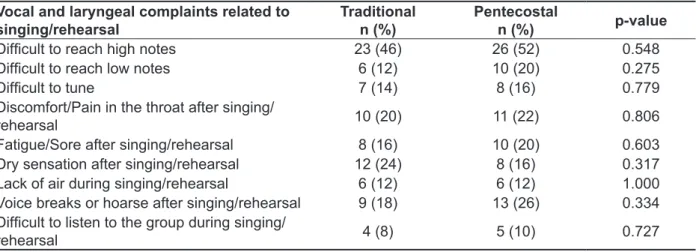
Table 4 shows the main complaints reported by the gospel singers. There was no difference between the studied groups. The majority of subjects from both groups reported “dificulty to reach high notes”. The vocal and laryngeal symptoms occurrences are in tables 5 and 6, respectively. It is observed signiicant result in the comparison of traditional
and Pentecostal groups, in male gender, about
loud voice symptom. There was no other signiicant result regarding vocal and laryngeal symptoms.
Regarding MSHI, in the traditional and Pentecostal group comparison, it was observed signiicant differences in the mean scores of the subscales: disability (p=0.008), handicap (p=0.000), and impairment (p=0.004) in female gender. It was not observed signiicant results in male gender
(Table 7).
possibility of 40 points as maximum score and the total, composed by summation of the three domains, of 120 points. As higher the number of points, higher was the perceived handicap.
Data analysis
The obtained data were organized and statisti
-cally treated with the Statistica for Windows software, 11.0 version, StatSoft Inc. It was performed the mean calculus and the percentage of number of subjects to characterize the traditional and Pentecostal
groups. To compare the groups, in ordinal variables,
it was performed the Mann-Whitney Test. To all statistic tests it was adopted the signiicance level of 5% (p<0.05).
RESULTS
Table 1 data shows 82% of gospel singers do not use voice professionally. Singers that are voice professionals act as salespersons (8%), teachers (6%), musicians (2%) human resources director (1%), and public attendant (1%).
Regarding the number of hours singing and rehearsing by week (Table 2) the sample was
Table 1 – Traditional and Pentecostal Church subjects distribution in numbers and percentage according to the professional voice usage
Profession
Traditional Group Pentecostal Group
female n (%)
male n (%)
female n (%)
male n (%)
Subjects not using voice
professionally 20 (80) 24 (96) 21 (84) 17 (68) Subjects using voice professionally 5 (20) 1 (4) 4 (16) 8 (32)
TOTAL 25 (100) 25 (100) 25 (100) 25 (100)
Table 2 – Traditional and Pentecostal Church subjects distribution according to the amount of hours per week of singing activities
Vocal activities
Traditional Group Pentecostal Group
Female Mean (h/week)
Male mean (h/week)
Female mean (h/week)
Male mean (h/week)
Singing (presentation) 3.25 4.22 5.00 5.38
Rehearsal 2.43 3.09 2.40 2.36
Table 3 – Traditional and Pentecostal Church subjects distribution according to vocal complaint
Vocal image
Traditional Group Pentecostal Group
Total n (%) Female
n (%)
Male n (%)
Female n (%)
Male n (%)
Positive self-perception 12 (48) 16 (64) 14 (56) 14 (56) 56 (56)
Negative Self-perception 13 (52) 9 (36) 11 (44) 11 (44) 44 (44)
Table 4 – Comparison of number and percentage of complaints occurrence related to singing and/ or rehearsal, reported by the Traditional and Pentecostal Church group subjects in the last 6 months
Vocal and laryngeal complaints related to singing/rehearsal
Traditional n (%)
Pentecostal
n (%) p-value
Dificult to reach high notes 23 (46) 26 (52) 0.548
Dificult to reach low notes 6 (12) 10 (20) 0.275
Dificult to tune 7 (14) 8 (16) 0.779
Discomfort/Pain in the throat after singing/
rehearsal 10 (20) 11 (22) 0.806
Fatigue/Sore after singing/rehearsal 8 (16) 10 (20) 0.603
Dry sensation after singing/rehearsal 12 (24) 8 (16) 0.317
Lack of air during singing/rehearsal 6 (12) 6 (12) 1.000
Voice breaks or hoarse after singing/rehearsal 9 (18) 13 (26) 0.334
Dificult to listen to the group during singing/
rehearsal 4 (8) 5 (10) 0.727
Mann-Whitney Test *p<0.05
Table 5 – Mean of occurrence of vocal symptoms reported by Traditional and Pentecostal Church Group subjects in the last 6 months (0=never; 1=rarely; 2=sometimes; 3=often; 4=always)
Vocal Symptoms
Female (occurrence mean)
Male
(occurrence mean)
Traditional Pentecostal p-value Traditional Pentecostal p-value
Hoarseness 1.04 1.36 0.433 0.92 1.04 0.742
Voice loss 0.80 0.48 0.242 0.72 0.36 0.063
Voice breaks 0.88 0.96 0.749 0.60 0.56 0.674
Lack of air 0.60 0.92 0.309 0.56 0.32 0.623
High pitched voice 0.36 0.44 0.713 0.36 0.72 0.756
Low pitched voice 0.68 0.52 0.653 0.60 0.64 0.961 Unstable pitch voice
(high/low) 0.60 0.44 0.405 0.56 0.84 0.933 Weak voice 0.84 0.56 0.526 0.52 0.80 0.425
Loud voice 0.84 0.72 0.620 0.88 0.04 0.002*
Effort to talk 0.84 0.88 0.889 0.48 0.40 0.384
Table 6 – Mean of laryngeal symptoms occurrence reported by the subjects of Traditional and Pentecostal Church in the last 6 months (0=never; 1=rarely; 2=sometimes; 3=often; 4=always)
Laryngeal Symptoms
Female (occurrence mean)
Male
(occurrence mean)
Traditional Pentecostal p-value Traditional Pentecostal p-value
Vocal fatigue 0.64 0.52 0.755 0.48 0.60 0.866 Pricking sensation in
throat 0.76 0.36 0.191 0.56 0.68 0.629
Lump in the throat 0.60 0.32 0.520 0.44 0.36 0.390
Phlegm 0.88 1.04 0.764 0.60 0.48 0.548
Dry cough 0.96 0.88 0.719 0.64 0.40 0.473
Wet cough 0.64 0.72 0.670 0.88 0.76 0.610
Pain to talk 0.36 0.40 0.931 0.52 0.44 0.772
Pain to swallow 0.48 0.52 0.580 0.32 0.24 0.531
Trouble to swallow 0.48 0.44 0.971 0.44 0.36 0.470
Sore throat 0.96 0.72 0.393 0.64 0.56 0.723
Phlegm Throat 0.76 1.12 0.227 0.56 0.76 0.591
Dry throat 0.92 1.00 0.757 0.68 0.56 0.991
Itchy Throat 0.80 0.88 0.842 0.68 0.40 0.298
Burning feeling 0.56 0.48 0.888 0.56 0.36 0.367
* Mann-Whitney Test (p<0.05)
Table 7 – Comparison of means and standard deviation (SD) of MSHI scores from both Traditional and Pentecostal Church Groups subjects
MSHI domains
Female Mean (± SD)
Male (Mean SD)
Traditional Pentecostal p-value Traditional Pentecostal p-value
Disability 6.20 (±6.78) (±10.82)14.48 0.008* 5.64 (±7.85) 6.08 (±7.61) 0.824
Handicap 4.72 (±6.96) 15 (±10.25) 0.000* 3.60 (±5.11) 5.32 (±9.76) 0.390
Impairment 9.32 (±11.00) 17.12 (±9.11) 0.004* 6.24 (±9.34) 6.64 (±7.96) 0.919
Total 20.24
(+23.41)
46.6
(+25.94) 0.003*
16.12
(+19.21)
18.04
(+22.44) 0.495
it was not observed signiicant differences in the comparison of traditional and Pentecostal groups. However, it is observed a high level in both groups of people having dificulty to reach high notes (46% of TG and 52% of PG), which may be related to the lack of proper voice technique. Symptoms reported by the singers after singing/rehearsing, as pain/ discomfort and fatigue/sore in the throat are usually related to vocal fatigue, due to excessive usage of singing voice25,26. The dry throat may be related
mainly to insuficient hydration. The present study allows to observe that the gospel singers reported
complaints are common in this population10,11.
These data reinforce the importance of proper voice prepare and speech-language following regarding voice care guidance, hydration, and voice exercises practice that may be used before and after singing as warm up and cooling down in order to ease these
complaints9,10,17,27. Besides, the lack of information
about vocal health may contribute to developing laryngeal disturbances and dysphonia through
time11.
Regarding voice and laryngeal symptoms, male gender of traditional group reported loud voice signiicantly more often than Pentecostal group. In a way, this data may be related to the social behavior that the traditional denomination requires from the subject due to its strong European inluence1. So,
talking or singing loudly in a more conservative environment may seem a improper posture.
About voice handicap in singing, the study showed that gospel singers of female gender in Pentecostal group had signiicant higher voice
handicap than traditional group, in the subscales
of disability, handicap, and impairment. It was not found in literature researches comparing MSHI in different gospel denominations. However, a study28
searching the voice handicap index in gospel singers found higher values to females than males. In the present research it was not performed comparisons between genders, but is was observed from the presented data that the values are quite close when comparing the male and females singer of tradi
-tional group, which did not happened to Pentecostal singers, in which women had higher values than
men.
Ordering the higher to smaller deviation, in this
study, the female gender of Pentecostal group had in irst place the impairment (organic domain), followed by handicap (emotional domain) and disability (functional domain). In male gender there was no signiicant difference between studied
DISCUSSION
The present paper searched to verify complaints and vocal/laryngeal symptoms, and the voice handicap to modern singing of gospel singers,
comparing the traditional and Pentecostal church singers.
The majority of participants reported not to be voice professional and, among those stating to use their voices professionally, only 2% declared to have voice prepare. This lack of technique observed in the gospel singers joining this research is also perceived in many popular singers whom base exclusively in their gift to sing16. This leads to the observation that
all the found data related to vocal complaints and symptoms, as well as the MSHI values, are related
to the voice use during gospel singers. According to
literature, there is a high index of gospel singers that
do not have prepare or proper training9,17.
About the number of hours singing and rehearsing per week, the mean time of rehearsal reported was approximately of 2 hours and 50 minutes, which is close from suggested by the literature18. On the other hand, other authors pointed out that rehearsal
should not be longer than 50 minutes19. About the
time of presentation, in this study it was observed the mean of 4 hours and 15 minutes per week.
The week schedule of rehearsals and presenta
-tions observed in this study, associated to the lack of proper technique to singing, may affect the vocal quality of singers. Authors comment that factors as high vocal demand and lack of technique, place the
singers in a high vocal risk situation20,21.
Despite 56% of analyzed singers reported positive self-perception, results similar to the ones described in a research performed with singers from a professional choral22, this research have 52% of
women in traditional group reporting negative vocal self-image. This fact may report that this group may have a better self-perception of vocal deviations, due to requests observed in the style of singing
in traditional churches that is similar to classic or
erudite. In this style, there is a higher requirement in vocal quality, perception, tuning, timbre, and vocal extension23, which is not observed in Pentecostal
denomination in general. It is valid to highlight that the experience in singing have direct inluence in self-perception as well as vocal performance24.
questions in which was possible to observe women form the Pentecostal group to have higher handicap index when compared to the ones of traditional group, while other questions about complaint and symptoms were not possible to distinguish. In this context, similar results as described in literature
are observed8,13,29,33, in which MSHI shows to be
a sensitive and eficient tool to evaluate singers in different styles. This fact point out to the need of addressing MSHI as complementary to gospel singers’ assessment.
CONCLUSION
Except from loud voice often reported by male singers from Traditional Group, there were no signiicant differences regarding vocal complaints and symptoms between the studied groups.
Women in Pentecostal group had higher MSHI
scores in the three subscales revealing higher
handicap than Traditional group women. MSHI values, in the three subscales, were relatively low to both groups, showing so low perception in questions regarding voice, especially in male gender, independent from the church style. However MSHI was capable to investigate questions related to self-perception of gospel singers, distinguishing
the groups regarding denomination and gender.
denomination, considering the singing and God’s praise style. In opposition to the traditional service, identiied by rigor and solemnity, the Pentecostal service is characterized by informality and freedom to emotion expressions, being possible to observe a big approximation between religion and spectacle29.
The service in spectacle way, many times considered as a praise show, is independent in its liturgical
possibilities30. The congregation reactions are from
crying, contrition, and introspection up to enthu
-siastic shouts, dancing, jumping, and collective
choreographies30.
According to the World Health Organization31,
disability is related to any decrease or restriction in the ability to usually perform an activity. Impairment is considered any loss or abnormality anatomic-physiologic or psychological, temporary or permanent. Yet handicap is the result of disability or impairment, characterized by limitation or restriction in performing a role expected by the subject, and may cause social, cultural, and economic conse
-quences. Therefore, singers are capable to perceive something wrong with their vocal production, and may evaluate the sensation as limitation or
handicap32.
In this study, MSHI was capable to investigate questions related to self-perception of gospel
singers, distinguishing groups regarding
denomi-nation and gender, since it point out speciic
RESUMO
Objetivo: veriicar queixas, sintomas vocais e laringofaríngeos e desvantagem vocal de cantores
evangélicos, comparando cantores de igrejas tradicionais com cantores de igrejas pentecostais.
Métodos:foram analisados 100 cantores evangélicos, de ambos os sexos, divididos em grupos tra
-dicional e pentecostal. Aplicou-se um questionário sobre proissão, autoimagem vocal, queixa, sinto
-mas vocais/laríngeos e o protocolo Índice de Desvantagem Vocal para o Canto Moderno. Os dados obtidos foram analisados estatisticamente por meio do cálculo da média, porcentagem e comparação entre os grupos (Teste de Mann-Whitney com nível de signiicância 5%). Resultados: a maioria dos
cantores evangélicos não utiliza a voz proissionalmente, e 2% têm conhecimentos sobre técnicas e
preparação vocal. O tempo em atividades de canto/ensaio varia de 6 a 8 horas semanais e mais da
metade do grupo analisado referiu possuir boa voz. Não houve diferenças signiicantes quanto às queixas vocais e laringofaríngeas, na comparação entre os grupos. Cantores evangélicos tradicionais
apresentaram maior frequência do sintoma vocal “voz forte” quando comparados aos cantores pen
-tecostais, considerando o gênero masculino (p=0,002). Cantores pentecostais do gênero feminino
referiram pior resultado para incapacidade (p=0,008), desvantagem (p>0,000) e defeito (p=0,004), quando comparados aos cantores tradicionais do gênero feminino. Conclusão: Com exceção do sin
-toma “voz forte” mais relatado pelos cantores masculinos do Grupo Tradicional, não houve diferenças signiicantes em relação à queixa vocal e sintomas vocais entre os grupos estudados. Mulheres do
grupo Pentecostal apresentaram pior resultado nas três subescalas, revelando maior desvantagem vocal do que mulheres do grupo Tradicional.
REFERENCES
1. Costa HG. Características do Aprendizado Musical e Função dos Ministérios de Louvor nas Igrejas Evangélicas Brasileiras [monograia]. Rio de
Janeiro (RJ): Universidade do Rio de Janeiro; 2008.
2. Costa PJBM, Ferreira KL, Camargo ZA, Pinho SMR. Extensão Vocal de Cantores de
Coros Evangélicos Amadores. Rev CEFAC.
2006;8(1):96-106.
3. Macedo JCS. Comportamento de Consumo dos
Jovens Evangélicos no Segmento da Música: Um Estudo no Interior do Estado do Rio de Janeiro [dissertação]. Seropédica (RJ): Instituto de Ciências
Humanas e Sociais, Universidade Federal Rural do
Rio de Janeiro; 2006.
4. Muniz PNM. Pastores evangélicos: sintomas vocais e laringofaríngeos, qualidade vocal e peril de participação em atividades vocais [dissertação].
Bauru (SP): Faculdade de Odontologia de Bauru, Universidade de São Paulo; 2013.
5. Bentley I. A música sacra em duas igrejas evangélicas do DF: estudo analítico sobre a retração da música cristã tradicional ante o avanço da música cristã contemporânea [dissertação]. Brasília (DF): Universidade de Brasília, Instituto de Artes, Departamento de Música; 2009.
6. Dorneles W. Transe místico: o fator de aproximação entre culto primitivo, pós-modernismo e pentecostalismo [dissertação]. Engenheiro Coelho (SP): Imprensa Universitária Adventista; 2002. 7.Dolghie JZ. Um estudo sobre a formação da hinódia protestante brasileira. Âncora – Rev Digital em Estudos da Religião. 2006;1:83-106.
8. Prestes T, Pereira EC, Bail DI, Dassie-Leite AP. Desvantagem vocal em cantores de igreja. Rev
CEFAC. 2012;14(5):901-9.
9. Penteado RZ, Silva CB, Pereira PFA. Aspectos de religiosidade na saúde vocal de cantores de grupos de louvor. Rev CEFAC. 2008;10(3):359-68.
10. Ribeiro VV, Santos AB, Bonki E, Prestes T,
Dassie-Leite AP. Identiicação de problemas vocais enfrentados por cantores de igreja. Rev CEFAC. 2012;14(1):90-6.
11. Barreto TMM, Amorim GO, Trindade-Filho EM, Kanashiro CA. Peril da saúde vocal de cantores amadores de igreja evangélica. Rev soc bras Fonoaudiol. 2011;16(2):140-5.
12. Ávila MEB, Oliveira G, Behlau M. Índice de desvantagem vocal no canto clássico (IDCC) em cantores eruditos. Pró-Fono R Atual Cient. 2010;22(3):221-6.
14. Cohen SM, Noordzij JP, Garrett CG, Ossoff RH. Factors associated with perception of singing voice handicap. Otolaryngol Head Neck Surg.
2008;138(4):430-4.
15. Ferreira LP, Giannini SPP, Latorre MRDO, Zenari MS. Distúrbio de voz relacionado ao trabalho: proposta de um instrumento para avaliação de professores. Disturb Comun. 2007;19(1):127-36. 16. Dassie-Leite AP, Duprat AC, Busch R. Comparação de hábitos de bem estar vocal entre cantores líricos e populares. Rev CEFAC.
2011;13(1):123-31.
17. Leite GCA, Assumpção R, Campiotto AR, Silva MAA. O canto nas igrejas: o estudo do uso vocal dos coralistas e não-coralistas. Distúrb Comun. 2004;16(2):229-39.
18. Lopes Junior CR, Perez KAS, Urtado MP, Patriota MV, Nogueira NA. Dinâmica de ensaio de coral [monograia]. São Carlos (SP): Universidade
Federal de São Carlos; 2007.
19. Costa HO, Andrada e Silva MA. Voz cantada: evolução, avaliação e terapia fonoaudiológica. São Paulo: Lovise; 1998.
20. Cohen SM, Noordzij JP, Garrett CG, Ossoff RH. Factors associated with perception of singing voice handicap. Otolaryngol Head Neck Surg.
2008;138(4):430-4.
21. Cohen SM, Jacobson BH, Garrett CG, Noordzij JP, Stewart MG, Attia A et al. Creation and validation of the Singing Voice Handicap Index. Ann Oto Rhino Laryngol. 2007;116(6):402-6.
22. Aquino FS, Teles LCS. Autopercepção vocal de coristas proissionais. Rev CEFAC. 2013;15(4):986-93.
23. Behlau M, Hogikyan ND, Gasparini G. Quality of life and voice: study of a Brazilian population using the voice-related quality of life measure. Folia Phoniatr Logop. 2007;59(6):286-96.
24. Fuchs M, Meuret S, Thiel S, Täschner R, Dietz A, Gelbrich G. Inluence of singing activity, age, and sex on voice performance parameters, on subjects’ perception and use of their voice in childhood and
adolescence. J Voice. 2009;23(2):182-9.
25. Emerich K, Sataloff RT. Chronic fatigue syndrom singers. In: Sataloff RT. Professional voice: the science and art of clinical care. San Diego: Singular;
1997. p. 447-51.
26. Zimmer V, Cielo CA, Ferreira FM.
Comportamento vocal de cantores populares. Rev CEFAC. 2012;14(2):298-307.
31. Organização Mundial da Saúde. Classiicação Internacional de Funcionalidade, Incapacidade e Saúde. Lisboa: 2004. p.238.
32. Paoliello K, Oliveira G, Behlau M. Desvantagem vocal no canto mapeado por diferentes protocolos de autoavaliação. CoDAS. 2013;25(5):463-8.
33. Moreti F, Ávila MEB, Rocha C, Borrego MCM,
Oliveira G, Behlau M. Inluência da queixa e do
estilo de canto na desvantagem vocal de cantores.
J Soc Bras Fonoaudiol. 2012;24(3):296-300. Horizonte (MG): Faculdade de Medicina da
Universidade Federal de Minas Gerais; 2013. 29. Mendonça, JDS. Canção Gospel: interações entre religião, música e cultura pós-moderna. Acta Cientíica. 2011;13(2):87-94.
30. Dolghie JZ, Campos BM. Sacerdócio, mercadoria e espetáculo: uma perspectiva teórica do consumo de música evangélica no Brasil. Rev Pandora Brasil. 2010 [acesso em 2013 ago 22];(25):1-21. Disponível em: http://revistapandorabrasil.com/
revista_pandora/edicao25.htm
Received on: February 02, 2014
Accepted on: June 19, 2014
Mailing address: Janine Santos Ramos
Departamento de Fonoaudiologia da Faculdade de Odontologia de Bauru da Universidade de São Paulo
Al. Octávio Pinheiro Brisolla, 9-75
Bauru – São Paulo – Brasil
CEP: 17012-901