Child and adolescent mental health services
in Brazil: structure, use and challenges
Serviços de saúde mental para crianças e
adolescentes no Brasil: estrutura, uso e
desafios
Vagner dos Santos 1
Anna Fernández 2
1University of Brasilia. Faculty of Ceilandia. QNN 14 Area Especial.
Ceilândia Sul. Brasília, DF, Brazil. CEP: 72.220-140. E-mail: [email protected]
2Fundació Sant Joan de Déu. Research and Development Unit, Sant Joan de Déu - SSM. Barcelona, Spain.
Abstract
Objectives: to examine the state of Child and Adolescent Mental Health (CAMH) services and to compare the availability and use of CAMH services across the five regions of Brazil.
Methods: the Mental Health Matrix Model was used as a framework to describe the state of CAMH services. Documents and administrative datasets were consulted, covering the whole country and the five Brazilian regions as separate levels. This enabled cross-region comparisons and combination with the three temporal dimensions (Input, Process and Outcome).
Results: although there are national policies regulating CAMH, along with an integral protection doctrine, scarcity of services was unequally distri-buted across the regions. A number of trends relating to social development and mental health (e.g. intel-lectual disability treated prevalence) were also identi-fied.
Conclusions: substantial advances in CAMH policy characterize the contemporary Brazilian CAMH system, especially regarding the implementa-tion of community based mental health services for children and adolescents. However, the data reveals great inequalities and geographic variation regarding social indicators, service structure and use.
Key words Child, Adolescent, Mental health, Mental health services
Resumo
Objetivos: analisar a situação dos serviços de saúde mental para crianças e adolescentes e comparar a disponibilidade e uso dos mesmos entre as cinco macrorregiões do Brasil.
Métodos: utilizou-se o The Mental Health Matrix Model como marco referencial para descrever a si-tuação dos serviços de saúde mental para crianças e adolescentes. Analisaram-se documentos e dados originais de bases administrativas do governo federal. Isso permitiu a comparação entre as regiões e em relação ao tempo (investimentos, processos e resultados).
Resultados: embora existam políticas e regula-mentos nacionais sobre a saúde mental de crianças e adolescentes, alinhadas com a doutrina da proteção integral, verificou-se um insuficiente número de serviços com uma distribuição desigual entre as macrorregiões. Adicionalmente, foi possível identi-ficar tendências relacionadas ao desenvolvimento social e a saúde mental (ex. prevalência de atendi-mentos em deficiência intelectual)
Conclusões: avanços substanciais nas políticas caracterizam o sistema brasileiro de saúde mental para crianças e adolescentes principalmente no que se refere à implementação de serviços de base comu-nitária. No entanto, os dados mostram desigualdade e variações regionais dos indicadores sociais, de estru-tura e uso dos serviços.
Rev. Bras. Saúde Matern. Infant., Recife, 14 (4): 319-329 out. / dez., 2014
320
Introduction
There is a lack of services for children and adoles-cents (CAs) with mental health problems, especially in low- and middle-income countries.1,2In fact, the
World Health Report indicates that one of the five priorities in mental health is to develop specific research in Policies and Services in the field.3The
need for Child and Adolescent Mental Health (CAMH) services has been a subject of debate among Brazilian academics in recent decades, but with few practical consequences. One of the major challenges for adequate planning CA mental health-care is the lack of information. In order to develop an evidence-based policy, it is crucial to know the prevalence and distribution of mental health pro-blems in this population and what resources are already available.4In Brazil, local studies indicate
that the prevalence of CA mental health problems (not just specific disorders) oscillates between 7% and 12.7%. This range may be even wider if risk factors are included.5–7Unfortunately, to the best of
our knowledge, there is no data on the prevalence of CA mental health problems produced using stan-dardized instruments for diagnosis of mental disor-ders and conducted in a representative Brazilian sample.
Other factors also influence the development and organization of mental health services. These include a) financial controls or political strategies; b) poli-tics and consumer organizations and opinions; and c) the value of healthcare organizations.8The need
for adequate care for those CAs suffering mental problems has been widely recognized, but it remains a public health challenge in Brazil. The first step to improve the care of CAs with mental health pro-blems is to perform a comprehensive analysis of the situation. Cross-regional comparisons are thus useful for detecting shortcomings and inequities in access to treatment. This is crucial for ensuring equity in access and treatment, especially for CAs with mental illness.9
The Mental Health Matrix Model developed by Tansella and Thornicroft was used as a conceptual framework for analysis of the provision of CAMH in Brazil.10,11This descriptive model is the one
recom-mended by the World Health Organization. It moni-tors the mental health system in space and time, identifying priorities for improving the system. The aim of the present study is thus to examine the state of Child and Adolescent Mental Health (CAMH) services and to compare the availability and use of CAMH services across the five regions of Brazil.
Methods
The Mental Health Matrix Model was used as a framework for analysis of the CAMH system in Brazil. This model was developed for the assessment of mental healthcare services. It is organized into two dimensions: geographical and temporal. The geographical dimension is divided into three levels: ‘Country/Regional’, ‘Local’ and ‘Patient’. The levels of the temporal dimension are Inputs, Process and Outcomes.11
The Geographical dimension
The country as a whole and the five Brazilian regions were considered as separate levels. This enabled cross-region comparisons and combination with the three temporal dimensions (Input, Process and Outcome). Information relating to the local and patient level was not included, since the aim was to explore the national structure and to compare the implementation of CAMH services within regions (Table 1).
The Temporal Dimension
I) Inputs: The ‘Inputs Dimension’ is divided into two categories: invisible and visible. The ‘invisible inputs’ are those elements that increase the effective functioning of the service network. They refer specifically to policies and regulations. A number of documents were consulted to identify current legal rights regarding CAs. The ‘visible inputs’ considered mainly concerned expenditure (outpatient care and hospital admission costs).
II) Process: The ‘Process Dimension’ is defined as those activities that are needed to deliver mental health services. This therefore refers to a wide range of clinical-related procedures that occur in a mental health service system, such as treatment guidelines, protocols, definition of target groups and data on service activity. A review of cross-sector documents was also included and prevalence was used as a proxy for the most significant mental problems.
Table 1
Geographical and Temporal dimension to analyze child and adolescent mental health services. Brazil, 2009.
Temporal dimension
Inputs Process Outcomes
Adapted version of The Mental Health Matrix Model; CAPS= Community Psychosocial Centers.
G
e
o
g
ra
p
h
ic
a
l
d
im
e
n
si
o
n
Policies and regulations
CAPS-II icoverage rate
Expenditure
Non-hospital
Hospital
Targeting of special groups
Data from the system use
Hospital use
Out-Care use
Street children and adolescents
Socio-educational measures
School dropout and failure
Inappropriate Age/Grade
Suicide rate Violent death alcohol & tobacco -lifetime use/dependence
C
o
u
n
tr
y
/
R
e
g
io
n
s
Table 2
Sources used to collect information. Analysis of the child and adolescent mental health services. Brazil, 2009.
Information collected Source Year
continous
In
p
u
ts
Policies and regulations
CAPS-II icoverage rate
Expenditure
Non-hospital
Hospital
Targeting of special groups
Hospital use information
Out-Care use information
The Brazilian official legislation browser (www4.planalto.gov.br/legislacao)
CAPS-II i: ‘Mental Health on Data’ (Saúde Mental em
Dados)
Population under 18 years: brazilian institute of geography and statistics (Censo, 2009)
(rate: 1:100.000- total of CAPS-II i/pop under 18 years old)
DATASUS: Ministry of Health's department responsible for gathering data provided by health services
DATASUS: Out-care Information System (SIA/SUS)
DATASUS: Hospital Information System (SIH/SUS)
Final Reports of the National Forum on Child and Adolescent and Official Documents
DATASUS: Hospital Information System (SIH/SUS)
DATASUS: Out-care Information System (SIA/SUS)
1989 - 2009
2009
2009
2009
2009
2004 - 2009
2009
2009
P
ro
ce
Rev. Bras. Saúde Matern. Infant., Recife, 14 (4): 319-329 out. / dez., 2014
322
proxy for outcomes for CAs: a) the prevalence of children and adolescents living on the street; rate of young offenders (i.e. CAs in the justice/correctional system, rate of suicide; rate of violent death; and lifetime prevalence of alcohol and tobacco use and dependence.
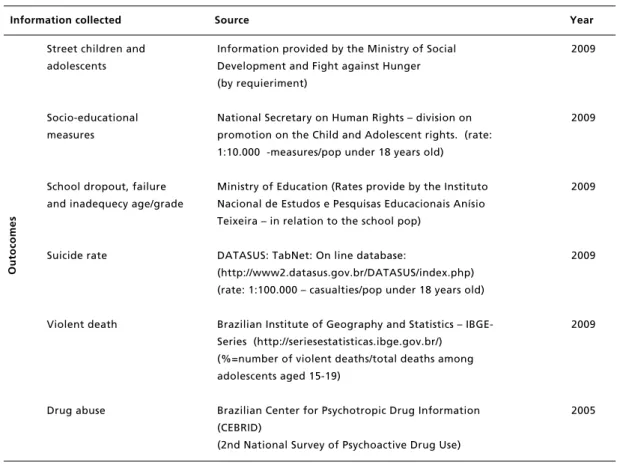
Official documents and original data from national sources were used to provide an overview of CAMH input (i.e. structure), process (i.e. use) and outcomes (i.e. health and social indicators). Sources from the Ministry of Health, the Ministry of Education and the Ministry of Social Development and Fight against Hunger (MDS) were consulted to find information relating to the inputs and the process. The structure and use of outpatient and inpatient (i.e. hospital) care was also examined by consulting the National Health Database (DATASUS). The Ministry of Health department is responsible for gathering this data from the health services. Data from January to December 2009 were selected. Data from the Outpatient care Information System (SIA/SUS) and the Hospital Information
System (SIH/SUS) were also collected. The International Statistical Classification of Diseases and Related Health Problems was used to restrict the study to codes related to mental health (i.e. from F-00 to F-99). Data was restricted to Children and Adolescents (i.e. those aged up to 18 years). The data was collected at the DATASUS Department in Porto Alegre. Local staff were consulted in case of doubts. Data from the Brazilian Institute of Geography and Statistics (IBGE) and the Brazilian Center for Psychotropic Drug Information (CEBRID) was also analyzed (Table 2). The year 2009 was taken as the year of reference for the whole analysis. However, the study that provided data on lifetime prevalence of alcohol and tobacco use and dependence was developed in 2005. The CEBRID defines as a “dependent” someone who has experienced at least three of the following six criteria: loss of control; reduced social/family involvement; tolerance; continued use of drug despite harm; attempts to cut down; or salience, for at least one month during the past year.12
Table 2 conclusion
Sources used to collect information. Analysis of the child and adolescent mental health services. Brazil, 2009.
Information collected Source Year
O
u
to
co
m
e
s
Street children and adolescents
Socio-educational measures
School dropout, failure and inadequecy age/grade
Suicide rate
Violent death
Drug abuse
Information provided by the Ministry of Social Development and Fight against Hunger (by requieriment)
National Secretary on Human Rights – division on promotion on the Child and Adolescent rights. (rate: 1:10.000 -measures/pop under 18 years old)
Ministry of Education (Rates provide by the Instituto Nacional de Estudos e Pesquisas Educacionais Anísio Teixeira – in relation to the school pop)
DATASUS: TabNet: On line database:
(http://www2.datasus.gov.br/DATASUS/index.php) (rate: 1:100.000 – casualties/pop under 18 years old)
Brazilian Institute of Geography and Statistics – IBGE-Series (http://seriesestatisticas.ibge.gov.br/) (%=number of violent deaths/total deaths among adolescents aged 15-19)
Brazilian Center for Psychotropic Drug Information (CEBRID)
(2nd National Survey of Psychoactive Drug Use)
2009
2009
2009
2009
2009
Results
Common elements at the National level: Invisible Inputs (Policies and regulations) and Process (National Forum on CA Mental Health)
The reform of the Brazilian health sector began in the late 1980’s, coinciding with the restoration of democracy. Health professionals, social movements and civil organizations participated in this process. Since 1988, a dynamic and complex health system, the Unified Health System –SUS (Law 8.080/90 and 8.142/90) has been built up based on the principles of health as a citizen’s right and as a duty of the State. The rights of CAs were guaranteed by the ‘Children and Adolescents Statute’ (ECA), in 1990 (Law 8.069/90), the first law specifically designed for this sector of the population, introducing the doctrine of integral protection. According to this law, the family, the community, society and the public authorities must ensure, by all means, the effective implementation of the rights to life, health, nutrition, education, sports, leisure, vocational training, culture, dignity, respect, freedom and family and community living. Specific reference is made to the health of children and adolescents. It also stipulates that all children and adolescents with disabilities must receive special treatment. However, it was a general statement and did not establish clear guide-lines.
In the field of mental health, in 1989 a bill (PL 3.657/89) proposing the elimination of asylums and the introduction of a community model for mental healthcare was sent to the chamber of deputies. This bill would remain stalled for 12 years. In 2001, the senate approved another proposal containing a similar approach. The Psychiatric Reform Law (Law 10.216/01) stipulated the need for integrated care, as well as equitable and universal mental healthcare, in accordance with the ‘Caracas Declaration’.13
However, the Psychiatric Reform Law did not address the specific category of CA mental health. The former was recognized in 2002, in the final report of the 3rd National Conference of Mental Health. This document presented 18 proposals regarding CAMH, which were aligned with the SUS, the psychiatric reform law and the ECA. It stated that children and adolescents with mental health problems should be exclusively admitted to the pe-diatric ward of general hospitals (not psychiatric hospitals). It also emphasized the need for specia-lized community-based CAMH services.
The Brazilian Ministry of Health supported the Psychiatric Reform Law project and initiated the
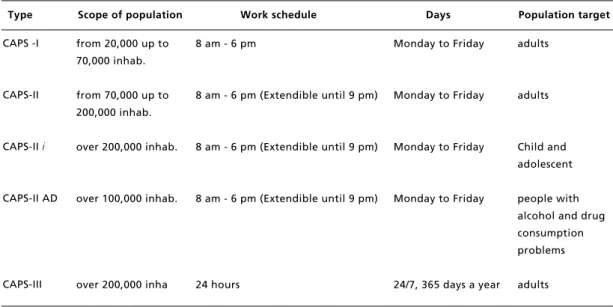
progressive replacement of psychiatric beds with community care. The substitute services, called Community Psychosocial Centers (CAPS) were classified according to three degrees of complexity. The implementation process started in 2002. Technical information regarding the functioning and financing of the CAPS and their classifications was established by Congress (GM/MS 336/02 and SAS/MS 189/02). The CAPS were classified as I, II and III, based on size, complexity and scope of the population. A multidisciplinary staff was established for each service (Table 3).
CAPS-II i (CAPS Infant) aims specifically to provide mental healthcare for CAs, as well as for young people (aged up to 24 years old). The CAPS-II imultidisciplinary staff includes at least one Child and Adolescent psychiatrist (or a Pediatrician or Neurologist with formal education in mental health); one nurse; four other university graduate professionals (psychologist, occupational therapist, social workers) according to local needs; and five other professionals (high school level) to provide therapeutic and administrative support services. The CAPS-II iis also responsible for organizing the CA mental healthcare network in its territory (a population of no more than 200,000).
In 2005, the Ministry of Health published “Ways Forward for Child and Adolescent Mental Health Policy” (Caminhos para uma política de saúde mental infanto-juvenil).14This document recognized
responsible for CAs. The third document acknowledged the lack of scientific knowledge regarding CAMH and the need for this information to establish specific target groups. This document also presented an experimental proposal program for CAs in partnership with a social-movement, conducted in Rio de Janeiro (in the southeast region of Brazil). Finally, it suggested the creation of a workgroup to assess the implementation of CAPS-II i. The ‘Brasilia Declaration’ highlighted several factors that need be taken into account at national level, such as the need for implementation of CAPS-II i in cities with more than 100,000 inhabitants, thereby broadening the scope of community-based CAMH services.
Visible Inputs - Comparisons between regions
In 2009, the total number of CAPS-II iavailable in Brazil was 105. However, these were unequally distributed, ranging from two services in the north to 46 in the southeast. The difference in this absolute number remained when the coverage rate was calculated. The national coverage rate of CAPS-II i was 0.17. The Southern region presented the best results, around 0.30, whilst the northern region presenting the lowest coverage rate, ten times lower. This region, comprising seven states, was covered by only two CAPS-II i. Annual expenditure on CA outpatient and inpatient care in 2009 was around 46 million Brazilian reais (approximately 21 million USD). The northeast region accounted for 40.5% of
the entire budget, followed by the southeast (32.3%); and the southern (19.04%) regions. Nevertheless, the southern region spent more resources than the northern region, which ranked lower for all categories, in absolute and relative numbers. All regions devoted more resources to outpatient than to inpatient care. The northeast region concentrated most resources on outpatient care. The mid-west followed by the southern region spent less on outpatient care, 67.6% and 73.7% respectively.
Process
Data relating to service use reveals the patterns of care. Treatment prevalence can be regarded as a proxy for the most significant problems in each region. The total number of inpatient admissions in 2009 was 13,510. The southeast region accounted for almost 40% of the whole number, and the southern region had the highest relative number of admissions: 0.46. The main reasons for these admissions at national level were 1) disorders associated with alcohol and substance abuse (F10-19), and 2) acute cases of schizophrenia and other psychotic conditions (F20-29). These two groups together accounted for more that seventy per cent of the total. This profile was strongly influenced by the southern and mid-west regions, where a large number of admissions were attributed to drug abuse. By contrast, in outpatient care services, drug abuse had relative low presence, with schizophrenia and other acute psychotic conditions (F20-29) being the
Rev. Bras. Saúde Matern. Infant., Recife, 14 (4): xxx-xxx out. / dez., 2014
324
Table 3
Types of Community Psychosocial Centers. Brazil, 2009.
Type Scope of population Work schedule Days Population target
CAPS -I
CAPS-II
CAPS-II i
CAPS-II AD
CAPS-III
8 am - 6 pm
8 am - 6 pm (Extendible until 9 pm)
8 am - 6 pm (Extendible until 9 pm)
8 am - 6 pm (Extendible until 9 pm)
24 hours
Monday to Friday
Monday to Friday
Monday to Friday
Monday to Friday
24/7, 365 days a year from 20,000 up to
70,000 inhab.
from 70,000 up to 200,000 inhab.
over 200,000 inhab.
over 100,000 inhab.
over 200,000 inha
adults
adults
Child and adolescent
people with alcohol and drug consumption problems
Table 4
Distribution of inputs, process and outcome indicators for child and adolescent mental health services. Brazil, 2009.
Regions Brazil
North Northeast Southeast South Central-West
Population under 18 years 62,494 (32.%)* 6,209 (9.9%)** 19,368 (31%)** 24,067 (38.5%)** 8,241 (13.2%)** 4,613(7.4%)**
INPUTS
Policies and Regulations Integral Protection Doctrine; Universal Healthcare System; Psychiatric Reform and the Forum Recommendation
PROCESS
Targeted groups CA living under some process of institutionalization, such as shelter, reformatory, psychiatric institutions, and so forth
continous
CAPS-II i (n)
CAPS-II icoverage ratea
Total Expenditureb
%
$/Pop under 18 years Outpatients
% Hospital
%
105 0.17 45,798,836.4
-0.73 37,502,501.38
81.9 8,296,334.59
18.1
2 0.03 1,080,137.66
2.36 0.17 895,989.97
82.9 184,147.69
17.1
27 0.14 18,513,861.01
40.42 0.96 16,779,682.37
90 1,734,178.64
10
46 0.19 14,791,661.55
32.30 0.61 11,571,273.08
78.2 3,220,388.47
21.8
25 0.30 8,720,239.9
19.04 1.06 6,434,844.86
73.7 2,285,395.04
26.3
5 0.11 2,692,936.26
5.88 0.58 1,820,711.51
67.6 872,224.75
32.4
Hospital Use (SIH)∞ Admissions (n)
Relative number admission Diagnosis registered (%)
Organic mental disorders Substance Abuse
Schizophrenia. Acute psycho, Mood [affective] disorders Neurotic. somatoform disorders
Behavioral syndromes Disorders of adult personality Intellectual disability Dis, of psychological development
CA Behavioral and emotion disor,
Unspecified mental disorder
13,510 0,21
6.0 40.91 29.41 11.13 1.6
1.2 1.74
6.5 0.67
0.24
0.52
361 (2.7%) 0.06
11.8 9.97 46.81 17.73 3.32
. 1.11 8.59 0.83
0.28
0.28
2,531(18.7%) 0.13
4.94 27.02 51.80 6.40 0.79
0.79 1.15 6.80 0.24
0.04
0.04
5,402 (39.9%) 0.22
7.90 34.19 27.45 11.18 1.83
1.87 2.94 10.44
0.94
0.46
0.78
3,813 (28.2%) 0.46
3.96 59.98 15.71 13.64 1.55
1.0 1.05 2.12 0.42
0.05
0.52
1,403 (10.4%) 0.30
5.63 47.97 29.29 10.91 1.85
0.21 0.21 2.14 1.07
0.29
Rev. Bras. Saúde Matern. Infant., Recife, 14 (4): 319-329 out. / dez., 2014
326
Table 4 conclusion
Distribution of inputs, process and outcome indicators for child and adolescent mental health services. Brazil, 2009.
Regions Brazil
North Northeast Southeast South Central-West
Population under 18 years 62,494 (32.%)* 6,209 (9.9%)** 19,368 (31%)** 24,067 (38.5%)** 8,241 (13.2%)** 4,613(7.4%)**
PROCESS
Targeted groups CA living under some process of institutionalization, such as shelter, reformatory, psychiatric institutions, and so forth
OUTCOMES
Source: Own elaboration with data from a variety of sources: see Table 03; *%relative to the total population-in million; **%relative to the
total populate under 18 years old-in millon; aCalculated based on the availability of CAPS II –i and the population under 18 years old;
bTotal expenditure in Brazilian Real, in 2009; Number of admission/Pop. Under 18years*1.000; ∞Relative to the attribute cause of attention
in the year of 2009 according with ICD-10; (E)Elementary School; (H)High School; ∑Rates provided by the Ministry of Education; ≈
Rate-1:100.000; ‡%based on the total death of the population aged 15-19 years; ***Based on the population aged 12-17 years.
Outpatients Use (SIA)∞
Outpatients (n) Diagnosis registered (%)
Organic mental disorders Substance Abuse
Schizophrenia. Acute psycho, Mood [affective] disorders Neurotic. somatoform disorders Behavioral syndromes
Disorders of adult personality Intellectual disability Dis, of psychological development
CA Behavioral and emotion disorders
Unspecified mental disorder
6,556,003 0.39 2.15 80.43 2.29 2.36 0.30 0.12 3.35 4.13 3.86 0.61 137,235 (2.1%) 1.88 2.55 79.48 7.86 2.51 0.16 0.22 3.42 0.30 1.63 0 1,691,814 (25.8%) 0.91 2.29 64.24 3.10 4.32 0.78 0.22 9.60 6.19 7.32 1.02 3,409,944 (52.1%) 0.11 1.07 90.81 0.80 0.96 0.05 0.04 0.83 3.44 1.55 0,35 1,028,087 (15.6%) 0.23 5.36 72.04 5.24 3.89 0.30 0.22 1.86 4.04 5.89 1.03 288,953 (4.41%) 0.53 2.57 83.13 2.14 2.12 0.44 0.11 1.88 2.30 4.79 0 Socio-Educational Measure≈ Admission Provisional admission Conditional parole School∑
Dropout rate (E) Dropout rate (H) School failure (E) School failure (H)
Inappropriate Grade/Age (E) Inappropriate Grade/Age (H)
Suicide rate≈
Violent death (%)‡
Alcohol & Tobacco ***
Lifetime prevalence of alcohol use
main reason for care (80.43%). These conditions 90.81% of the treatment prevalence in outpatient care settings in the southeast region, whilst only 64.24% of the northeast patients consulted health services for this problem. The second most frequent condition in the northeast region (9.60%) was Intellectual Disabilities (F70-79). This dramatically differed from the southern region, where only 0.83% of the cases were diagnosed as falling into this category (Table 4).
Outcomes
Unfortunately, no national data is available on the prevalence of CAs living on the streets. The southeast and south regions had higher rates of young offenders in contact with the juvenile justice/correctional system than the national average, contrasting with the low rate in the north region. In all regions, incarceration at juvenile institutions was the judicial measure most often utilized.
Data from the Ministry of Education also highlighted differences between regions. The north and northeast regions had the worst indicators in almost all categories regarding school activities. The dropout rate at the elementary school level in these regions was three times higher than in the southeast and south. School failure had more unequal rates, distributed among regions and level of education. Furthermore, the inappropriate age for grade in high school level in the north and northeast regions was almost twice that of other regions.
Information regarding violent death among CAs showed this was a common problem. In fact, it represented the main cause of mortality in this group. The southeast region had the highest prevalence in this category. There was no substantial difference is suicide rate, although the mid-west region showed a slightly higher rate than the others.
The lifetime prevalence of alcohol use among adolescents aged 12-17 years was higher in the south and southeast regions. In spite of this, the central-west region presented more cases of alcohol dependence among this population. In relation to lifetime prevalence of tobacco use, the southern region had the highest use-related indicator, whilst the northern region ranked first for tobacco dependence (Table 4).
Discussion
As has been shown elsewhere, we found that CA mental healthcare has been recently included in the Brazilian public health agenda.10,14,15Although this
new mental health system has gained legal and poli-tical support, the country still lacks a clear strategy for implementing policies regarding CA mental healthcare, with priorities and targets set at all levels. The challenge concerns how to implement the national policies while taking into account the different needs of the regions. This includes a change in the treatment of young people with alcohol and substance use problems, who are currently mainly treated in hospital.
As shown by other studies,1,16we found that the
provision of services for CAs with mental problems was poor. The availability of CAPS-II iwas clearly insufficient and unequally distributed. A previous study, which mapped the Brazilian resources for CA mental healthcare in 2007, found a much higher coverage rate of CAMH services (1.08/100,000) than the present study.15 However, this study
included all categories of CAPS, even those that did not attend CAs. Although we recognize that there has been a great improvement in the provision of outpatient mental healthcare, we have only included those services specially designed for CAMH care. Not to take this into account and to merge services providing care for CAs with services for adults would lead to inaccurate data analysis. We therefore decided to include only the CAPS-II icategory to calculate the coverage rate.
The coverage rate has grown since 2009. According to the National Coordination of Mental Health report published in 2012,17 the national
number of CAMH services has risen to 149 (from 105) . The south has achieved a coverage rate of 0.38, while, in the northern region, ten years after the psychiatric reform, CAPS-II icoverage (0.05) was a lowest and remained unchanged. Poor areas face a double disadvantage in relation to mental health provision, since they spend a smaller proportion of their already scarce resources on mental health.18 Other studies addressing health issues in Brazil have also found an unequal distribution of services among Brazilian regions.19,20In recent decades, political
and social changes have tried to reduce these inequalities between wealthy (south and southeast) and poor (north and northeast) regions.21 This is
important because socioeconomic deprivation has been shown to be both a cause (i.e. social causation hypothesis) and a result (i.e. social selection hypoth-esis) of mental illness.22Nevertheless, we have
iden-tified some trends relating to social development and mental health.
Rev. Bras. Saúde Matern. Infant., Recife, 14 (4): 319-329 out. / dez., 2014
328
health; women’s education; or child nutrition).20,21
These assumptions are also supported by school data, as this region has the lowest indicators. By contrast, school data in the south showed a different profile. As indicated in the literature on education, non-attendance, failure and dropping-out of school may be a marker for childhood adversity, increasing the risk of mental illness.23The data collected by the
present study thus highlights the different needs of different regions.
The main challenge that faces Brazil concerns the provision of mental health resources, including CAPS-II i. The task of scaling up the number of facilities and other resources to provide adequate CA mental healthcare remains undone. This is a complex challenge that requires inter-sector collaboration to fully comply with the principle of holistic and inte-grated care. The implementation of CAPS-II imay be considered the key element missing in this process. CAPS-II iare responsible for integrating the different sectors and providing consultation and supervision in the territory they cover. They also act as liaison services. The use of non-clinical settings, such as schools and community services are suggested as accessible ways to promote mental health.1,24 The lack of CAPS-II i may thus be
regarded as a proxy for a fragmented system, which also neglects the importance of having specific and integrated CAMH services. There is good evidence that it is preferable to treat children and adolescents in the least restrictive environment and as close to their communities as possible.1,10In fact, admission
to psychiatric hospitals and ‘reformatories’ is asso-ciated with a lack of ability to respond to mental heath related problems.
Stigma and discrimination are important factors in the reluctance of many people to seek help or even accept mental problems.25 One study regarding
CAMH in Italy found a significant reduction in access to treatment when CAs received care in the same facilities as adults, since was associated with stigma.26Thus, placing CAPS-II iat the center of
CAMH care, could help remove the stigma and reduce the institutionalization of children and adolescents, representing a step forward in the care of children and adolescents with mental health
pro-blems.
We should acknowledge a number of limitations of the present study. First, it does not consider some important inputs such as other services that also treat CAs with mental health problems (i.e. primary care, social and educational services) or the availability and skills of staff (i.e. distribution of Full-Time Equivalent Staff). Second, it was not possible to link the different inputs and processes with the outputs, owing to the limited quality of available data. Third, the analyses of coverage rate should be adjusted by two factors: a) accessibility and b) the population-based prevalence of mental health problems. This will allow us to assess the adequacy of resources. Fourth, the present study excluded analysis of local and patient dimensions from the Mental Health Matrix Model because of limited access to this data.
In spite of these limitations, this is the first time that Brazilian CAMH care has been analyzed using a validated tool, such as the Mental Health Matrix Model. This is an innovative study that sheds new light on the debate. The results found in this study and future analysis using the Mental Health Matrix Model will be crucial for monitoring the impact of national polices and actions regarding child and adolescent mental healthcare.
In conclusion, the contemporary Brazilian CAMH system is characterized by advances in CAMH policy, but also by large geographical varia-tions in service use and social indicators. Inter-sector action is imperative if integrated care is to be ensured. Education and poverty are two critical aspects to be considered in CAMH planning both at regional and national level. Adequate implementa-tion of CAPS-II iis a key element of this process.
Acknowledgements
We would like to thank the DATASUS staff in Porto Alegre city for their assistance with data collection; Professor Sam Willner (Linköping Unviversity) for his insights and supervision; Sara Leon Spesny and Carolina Chassot for their comments on the final draft of this paper. VS would also like to acknow-ledge financial support from the IFP-Ford Foundation.
References
1. Patel V, Flisher AJ, Hetrick S, McGorry P. Mental health of young people: a global public-health challenge. Lancet. 2007; 369 (9569): 1302-13.
3. WHO (World Health Organization). The World Health Report 2001. Mental Health: New Understanding, New Hope. Geneva; 2001.
4. Rohde LA. The need of epidemiological data on child mental disorders from low-middle income countries. Eur Child Adolesc Psychiatry. 2011; 20 (10): 497-8.
5. Goodman R, Neves dos Santos D, Robatto Nunes AP, Pereira de Miranda D, Fleitlich-Bilyk B, Almeida Filho N. The Ilha de Maré study: a survey of child mental health problems in a predominantly African-Brazilian rural community. Soc Psychiatry Psychiatr Epidemiol. 2005; 40 (1): 11-7.
6. Fleitlich-Bilyk B, Goodman R. Prevalence of child and adolescent psychiatric disorders in southeast Brazil. J Am Acad Child Adolesc Psychiatry. 2004; 43 (6): 727-34. 7. Anselmi L, Fleitlich-Bilyk B, Menezes AMB, Araújo CL,
Rohde LA. Prevalence of psychiatric disorders in a Brazilian birth cohort of 11-year-olds. Soc Psychiatry Psychiatr Epidemiol. 2009; 45 (1): 135-42.
8. Fernández A, Pinto-Meza A, Serrano-Blanco A, Alonso J, Haro JM. An Introduction to Mental Health Services Research. In: Tsuang MT, Tohen M, Jones PB, editors. Textbook in Psychiatric Epidemiology. 3 ed. Chichester, UK: John Wiley & Sons, Ltd; 2011. p. 133-54.
9. Sturm R, Ringel JS, Andreyeva T. Geographic disparities in children’s mental health care. Pediatrics. 2003; 112 (4): e308.
10. WHO (World Health Organization). Child and Adolescent Mental Health Policies and Plans. Geneva; 2005.
11. Thornicroft G, Tansella M. The Mental Health Matrix: A Manual to Improve Services. 1 ed. Cambridge, UK: Cambridge University Press; 2006.
12. CEBRID. II Levantamento Domiciliar sobre o Uso de Drogas Psicotrópicas no Brasil: 2005. Secretaria Nacional Antidrogas. Brasília, DF; 2007.
13. WHO (World Health Organization). Report on Mental Health System in Brazil, World Health Organization & Brazilian Ministry of Health, BrasiXlia, DF, Brazil; 2007. 14. Brasil. Ministério da Saúde. Caminhos para uma Política de
Saúde Mental Infanto-Juvenil. Brasília, DF; 2005. 15. Couto MCV, Duarte CS, Delgado PGG. Child mental health
and Public Health in Brazil: current situation and chal-lenges. Rev Bras Psiquiatr. 2008; 30: 384-9.
16. Lund C, Boyce G, Flisher AJ, Kafaar Z, Dawes A. Scaling up child and adolescent mental health services in South Africa: human resource requirements and costs. J Child Psychol Psychiatry. 2009; 50 (9): 1121-30.
17. Brasil. Ministério da Saúde. Saúde Mental em Dados 10. Coordenação Geral de SauXde Mental, AXlcool e Outras Drogas; Brasília, DF; 2012.
18. Saxena S, Thornicroft G, Knapp M, Whiteford H. Resources for mental health: scarcity, inequity, and ineffi-ciency. Lancet. 2007; 370 (9590): 878-89.
19. Travassos C, Viacava F, Fernandes C, Almeida CM. Social and geographical inequalities in health services utilization in Brazil. Ciênc Saúde Coletiva. 2000; 5 (1): 133-49. 20. Paim J, Travassos C, Almeida C, Bahia L, Macinko J. The
Brazilian health system: history, advances, and challenges. Lancet. 2011; 377 (9779): 1778-97.
21. Victora CG, Aquino EML, Leal MC, Monteiro CA, Barros FC, Szwarcwald CL. Maternal and child health in Brazil: progress and challenges. Lancet. 2011; 377 (9780): 1863-76.
22. Reiss F. Socioeconomic inequalities and mental health problems in children and adolescents: A systematic review. Soc Sci Med. 2013; 90: 24-31.
23. Goodman A, Fleitlich-Bilyk B, Patel V, Goodman R. Child, Family, School and community risk factors for poor mental health in Brazilian schoolchildren. J Am Acad Child Adolesc Psychiatry. 2007; 46 (4): 448-56.
24. Kleintjes S, Lund C, Flisher AJ. A situational analysis of child and adolescent mental health services in Ghana, Uganda, South Africa and Zambia. Afr J Psychiatry. 2010; 13 (2): 132-9.
25. Heflinger CA, Hinshaw SP. Stigma in child and adolescent mental health services research: understanding professional and institutional stigmatization of youth with mental health problems and their families. Adm Policy Ment Health. 2010; 37 (1-2): 61-70.
26. Pedrini L, Colasurdo G, Costa S, Fabiani M, Ferraresi L, Franzoni E, Masina F, Moschen R, Neviani V, Palazzi S, Parisi R, Parmeggiani A, Preti A, Ricciutello C, Rocchi MBL, Sisti D, Squarcia A, Trebbi S, Turchetti D, Visconti P, Tullini A, Girolamo G, PREMIA Group. The characteris-tics and activities of child and adolescent mental health services in Italy: a regional survey. BMC Psychiatry. 2012; 12 (1): 7.
______________
Recebido em 11 de fevereiro de 2014