137
Rev Bras Psiquiatr 2002;24(3):137-40
Age and gender as risk factors for the transmission of
HIV in a sample of drug users of Porto Alegre, Brazil
Idade e gênero como fatores de risco para a transmissão do HIV em
uma amostra de usuários de drogas, Porto Alegre, Brasil
Raquel De Boni and Flavio Pechansky
Research Group on Drug Dependence of the Clinical Hospital of Porto Alegre. Porto Alegre, RS, Brazil. Department of Psychiatry, Federal University of Rio Grande do Sul. Porto Alegre, RS, Brazil. Undergraduate Fellowship of the CNPq (National Council of Research and Development) – HCPA (Clinical Hospital of Porto Alegre). Porto Alegre, RS, Brazil
The support for the project that originated this article was obtained through the research project “Assessment of behaviors for HIV transmission among high risk individuals in Porto Alegre”, of the University of Delaware, US.
None conflict of interests.
Recieved on 26/7/2001. Reviewed on 8/1/2002 and on 3/4/2002. Approved on 5/4/2002.
Objective: To verify the association between age and gender regarding HIV seropositivity in drug users who seek public health centers in Porto Alegre, Brazil.
Methods: The authors designed a cross-sectional study with a convenience sampling of 695 men and women aged above 15, who reported recent drug use and risk behaviors to HIV exposure. We used a standard questionnaire (CRA, Brazilian version of the RAB, Risk Assessment Battery) to assess risk behaviors and we collected blood for HIV testing.
Results: Most individuals were males (75,8%), with a mean age of 29.4 years, less than seven years of schooling (42,4%), and family income equal or superior to four minimum wages (46%). There was no significant association between gender and seropositivity. Multivariate analyses showed that individuals aged above 30 had a three-fold increased odds of being seropositive over subjects aged 20 or less. Intravenous drug users who had been using drugs since 1980 had five-fold odds of seropositivity and those who had been using them in the month prior to the interview had four-fold odds.
Discussion: Subjects aged more than 30 showed higher odds of seropositivity than the younger group. This is possibly due to a higher use of intravenous cocaine and to having more risk behaviors along their lifetime. There was no difference in seropositivity between genders, what differs from current data of other studies, if we take into consideration that rates of populational seropositivity among women have increased, mostly among drug users, who are, therefore, at ‘double risk’. The development of further studies is mandatory in order to assess gender and age as risk factors for seropositivity, whether to confirm or to deny these findings, and to plan specific strategies for high-risk groups.
Risk behavior. HIV seroprevalence. AIDS. Street drugs. Demographic data.
Objetivo: Verificar se idade e gênero estão relacionados à soropositividade para HIV em usuários de drogas que procuram centros de atendimento em saúde de Porto Alegre.
Método: Estudo transversal com amostragem por conveniência de 695 homens e mulheres acima de 15 anos, com uso recente de drogas e comportamento de risco para exposição ao HIV. Para obtenção de comportamentos de risco, utilizou-se questionário padrão denominado CRA, adquirindo-se testagem anti-HIV dos casos.
Resultados: A maioria dos voluntários era masculina (75,8%) com idade média de 29,4 anos, com menos de sete anos de estudo (42,4%) e com renda familiar igual ou superior a quatro salários mínimos (46%). Não houve associação significativa entre gênero e soropositividade. Na análise multivariada, observou-se que indivíduos acima de 30 anos tinham três vezes mais chance de soropositividade do que os menores de 20 anos. Usuários injetáveis tinham sua chance aumentada em cinco vezes, quando em uso desde 1980, e, em quatro vezes, quando em uso no último mês.
Discussão: Indivíduos maiores de 30 anos apresentam chance maior de soropositividade do que os mais jovens, possivelmente por utilizar mais cocaína injetável e repetir mais comportamentos de risco ao longo da vida. Não houve diferença na soropositividade entre gêneros. Isto destoa da realidade atual, considerando o aumento do número de mulheres soropositivas na população nos últimos anos e o provável “risco duplo” que apresentam
Abstract
Keywords Resumo
Rev Bras Psiquiatr 2002;24(3):137-40
138
Age and gender as risk factors for HIV De Boni R & Pechansky F
usuárias de drogas. É obrigatória a realização de novos estudos que avaliem idade e gênero como fatores de risco para soropositividade, visando confirmar ou refutar esses achados e planejar estratégias específicas para grupos de maior risco.
Comportamento de risco. Soroprevalência de HIV. Aids. Drogas ilícitas. Dados demográficos.
Descritores
Introduction
Brazil ranks second in the Americas in number of AIDS notified cases, with 540,000 infected persons and an inci-dence rate of 11.1/100,000 new cases per year.1 Among the
factors that contribute intensely to disseminate the virus in the population, unsafe sex and the use of intravenous drugs have been preponderant in the last ten years. Thus, 28% of the users of intravenous drugs (IDUs) are seropositive and, in 1990, the prevalence of unsafe sex as the mode of trans-mission was 4.9%, reaching 63% in 2000. The rate of women infected by heterosexual relations increased from 12% to 34% in the same period.2
There are many models of risk exposure proposed for these subjects, varying from social to intrapsychic ones. Accord-ing to a model recently proposed by Pechansky,3 these
sub-jects would be submitted to two basic groups of variables:
changeable – that can be altered by specific interventions,
such as in drug use, income and being present at shooting galleries – and unchangeable, which would protect or favor risk behaviors but that are not directly modifiable by preven-tive programs (such as age and gender). Even if unchange-able, these variables may or may not be associated to risk behaviors for infection, leading to different preventive strat-egies. Therefore, the objective of this article is to verify if the variables AGE and GENDER are related to the seropositivity of drug users who sought centers for attention and serologic testing in Porto Alegre.
Methods
We designed a cross sectional study using convenience and ‘snow ball’ sampling, which is particularly useful with drug users who have difficulties in seeking help due to the percep-tion that their behavior is illegal or parasocial.4,5 In the data
collection sites subjects were systematically encouraged to refer other subjects they knew, aiming at exploring at most the acquaintance network of key-subjects and to stimulate the participation of subjects who would not seek attention by themselves being, therefore, not available to the passive sys-tem of convenience sampling in its conventional format. Key subjects mainly indicated user partners, neighbors or acquain-tances who attended the same places of drug use. We used as data collection sites the Municipal Serologic Support and Orientation Center (COAS) of Porto Alegre – a screening and treating center mainly oriented to counseling and HIV test-ing, the Screening and Treatment Outpatient Setting of the Brazilian Red Cross and the Ambulatory for Drug Depen-dence of the Clinical Hospital of Porto Alegre.
The sample was composed of 695 men and women aging more than fifteen, who in a screening interview reported the use of Brazil’s most typical drugs in the month prior to data collection (alcohol, marijuana and cocaine) or who described any risk behavior that indicated a possible exposure to the HIV. After they gave informed consent, volunteers filled in the third Brazilian version of the RAB (CRA, in Portuguese) (Risk Assessment Battery),6 a questionnaire with thirty-eight
ques-tions covering aspects about the use of drugs, HIV testing, sexual behavior and concern with the transmission of the vi-rus in a time period from six months to thirty days before data collection. The CRA is self-reported and was originally developed in the University of Pennsylvania by Metzger et al6 and was translated, adapted and validated into Portuguese
by Pechansky.5,7,8 After the application of the CRA,
volun-teers collected blood for anti-HIV testing, using the ELISA and Immunofluorescence tests according to the standard pro-cedure of the screening centers.
The statistical analysis was done with the chi-square test and was presented in percentages and odds ratios. The level of significance was 5% (p<0.05). We performed multivariate analysis using multiple logistic regression with the variables gender, age, schooling, monthly income and the use of intra-venous cocaine since 1980 and in the month prior to collec-tion. These variables were chosen according to a multifacto-rial theoretical model used by the authors to explain the ex-posure to risk situations, and all of them reached statistical significance in previously calculated univariate analyses.9
The data of the current study are based on the 420 volunteers whose HIV results could be obtained. Case losses were caused by difficulties to refer patients to the screening centers.5
Results
The sample was mainly composed by men (75.8%), with a mean age of 29.4 years (standard deviation of 12.7 years). With regard to years of schooling, 42.4% of subjects had stud-ied less than seven years, 26% between eight and eleven years and 31.6% had studied twelve or more years. As for income, 19% had a family income bellow one minimum wage, 35% between one and three minimum wages and 46% had an in-come equal to or greater than four minimum wages.
Bivariate analyses
139 Age and gender as risk factors for HIV
De Boni R & Pechansky F
Rev Bras Psiquiatr 2002;24(3):137-40
of seropositivity was 14.8%; between ages 20 and 30 it was 21.9% and above 30, 27%, and we could notice a trend of linear association (χ2 for linear association = 4.11; p=0.042)
between these variables. With regard to schooling, there was an inverse ratio: the greater the schooling, the smaller the prevalence of the virus. Among the volunteers who had stud-ied up to seven years (n=171), 31.65% were seropositive; among those who had studied 12 or more years (n=140), 13.57% were seropositive (χ2=15.09; p=0.001). The
associa-tion with the income was also inversely proporassocia-tional; 35.71% of subjects who earned up to one minimum wage were serop-ositive, 24.22% of those who earned between one to three minimum wages per month, and 14.37% of those who earned four or more minimum wages per month (χ2=14.98; p=0.001).
In order to verify the association between age and use of psy-choactive substances we utilized the total number of inter-views (695), since it was not necessary to consider their sero-logical condition. The use of intravenous cocaine was greater in subjects aged above thirty (38.34%) and in subjects aged between twenty and thirty (36.14%), when compared to those aged bellow twenty (26.7%), and there was a significant dif-ference between the first two groups and the third one (χ2=4.81; p=0.02; OR=0.59 [0.35<OR<0.97]). A similar
as-sociation was found for the use of alcohol: a progressive in-crease with age and almost 50% of the sample aged above thirty reported a daily/frequent use of alcohol (χ2=14.75,
p=0.001; OR=0.42 (0.25<OR<0.68)). Inversely, the use of marijuana and inhaled cocaine was more frequent among younger age ranges (χ2=10.05; p=0.006; OR=2.01
[1.24<OR<3.26] and χ2=11.23; p=0.003; OR=2.34
[1.34<OR<4.08] respectively).
Multivariate analyses
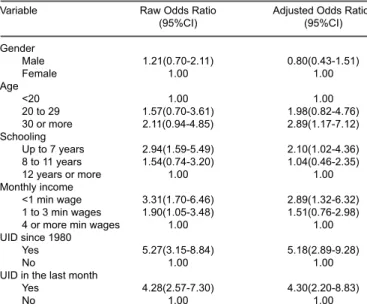
We calculated the raw and adjusted odds ratios for all vari-ables of Table. Subjects who were more than thirty years old had nearly three-fold odds of being seropositive than those
aged less than twenty (OR=2.89 [1.17< OR<7.12]) . Subjects who earned less than one minimum wage when compared to those who earned more than four minimum wages showed similar odds (OR=2.89 [1.32<OR<6.32]). Regarding school-ing, subjects who have studied up to seven years had two-fold odds of being seropositive than those who had studied more than 12 years (OR=2.10 [1.02<OR<4.36]). Intravenous cocaine users also showed greater seropositivity. Their odds increased five-fold when they had being using cocaine since 1980 (OR=5.18 [2.89<OR<9.28]) , and four-fold when they had used it in the month before the interview (OR=4.30 [2.20<OR<8.83]). The interaction between the use of an in-travenous drug since 1980 and age was tested and we veri-fied that the Odds Ratio of seroposotivity of an IDU aged between twenty to thirty compared to those aged less than twenty was 24.8 (p=0.001; IC95%: 3.44-179.0) and for those aged more than thirty was 5 (p=0.09; CI 95%: 0.76-37.1). The gender-adjusted analysis for the outcome also had not a significant difference.
Discussion
It is noteworthy that this study did not utilize a classical epidemiological method: its sample was obtained by conve-nience, and was expanded by referring subjects related to the key-subjects for data collection.5 Although this sampling
model is useful to identify drug users, it is possibly biased, excluding subjects without access to the health system and including those more motivated and concerned and/or more severely dependent users searching for treatment.10 Besides,
due to the heterogeneous form in which the sample was col-lected, it is not representative of the community of drug users of Porto Alegre.
Our results show no significant difference between men and women regarding the odds of being HIV-positive. This may be a finding that reflects a historical change, as we collected data between 1995 and 1997. We believe that there is greater risk for women as the risk for a woman to be infected in an unsafe sexual relation is higher than for a man.11 Besides,
so-ciocultural issues make more difficult for women to negoti-ate the use of condoms with their partners than vice-versa. This may be the reason for women having a greater tolerance to the use of drugs of their partners, which again may put them at risk (several authors suggest that drug users are at greater risk of being infected by HIV).10,12,13 Female drug
us-ers, such as those of the current study, would be theoretically at greater risk as the risk of their own consumption14 would
be added to what we described above.
With regard to age, it seems obvious that older subjects had a higher chance to be exposed to risk behaviors along their lifetime, such as unsafe sexual relationships, what by itself would raise the odds of seropositivity. Besides, our study showed that they used more intravenous cocaine, increasing the chances of being infected by HIV.
Another issue to be discussed is the fact that the use of psy-chotropic drugs starts in adolescence and, consequently, may decrease the perception of infection risk. Older subjects would
Table - Multivariate analysis of risk factors for seropositivity.
Variable Raw Odds Ratio Adjusted Odds Ratio (95%CI) (95%CI) Gender
Male 1.21(0.70-2.11) 0.80(0.43-1.51)
Female 1.00 1.00
Age
<20 1.00 1.00
20 to 29 1.57(0.70-3.61) 1.98(0.82-4.76) 30 or more 2.11(0.94-4.85) 2.89(1.17-7.12) Schooling
Up to 7 years 2.94(1.59-5.49) 2.10(1.02-4.36) 8 to 11 years 1.54(0.74-3.20) 1.04(0.46-2.35) 12 years or more 1.00 1.00 Monthly income
<1 min wage 3.31(1.70-6.46) 2.89(1.32-6.32) 1 to 3 min wages 1.90(1.05-3.48) 1.51(0.76-2.98) 4 or more min wages 1.00 1.00 UID since 1980
Yes 5.27(3.15-8.84) 5.18(2.89-9.28)
No 1.00 1.00
UID in the last month
Yes 4.28(2.57-7.30) 4.30(2.20-8.83)
Rev Bras Psiquiatr 2002;24(3):137-40
140
Age and gender as risk factors for HIV De Boni R & Pechansky F
have a smaller perception of this risk for a longer time period (what perhaps might be inferred from the results of the multi-variate analysis where older IDUs have slightly higher risk than younger ones). Therefore, as our results suggest that age is a risk factor for seropositivity and it is known that the virus
inci-dence has increased in the world wide female population,15-17 it
would be important to develop new studies to prove that age over 25 and female gender are risk factors for seropositivity in drug users, mainly in order to plan strategies against transmis-sion, which would be specifically targeted to these social groups.
References
1. Ministério da Saúde. Programa Nacional de DST-AIDS. Available in the website http://www.aids.gov.br/
2. Pechansky F. Developing a drug abuse research infrastructure in Latin America. Presented at the Annual Meeting and Science Innovation Exposition, American Association for the Advancement of Science, San Francisco; 2001.
3. Pechansky F. Modelo teórico de exposição a risco para transmissão do vírus HIV em usuários de drogas. Rev Bras Psiquiatr 2001;23(1):39-45. 4. Watters JK, Biernacki P. Target Sampling: options for the study of hidden
populations. Social Problems 1989;36:416-30.
5. Pechansky F. Um estudo sobre situações de risco para contaminação pelo vírus HIV em usuários de drogas da cidade de Porto Alegre [Tese]. Porto Alegre: Universidade Federal do Rio Grande do Sul; 1998.
6. Metzger DS. The risk assessment battery (RAB): validity and reliability. Presented in the sixth Annual Metting of the National Cooperative Vaccine development Groups for AIDS, Alexandria, VA; 1993.
7. Inciardi JA. The war on drugs: heroin, cocaine, crime and public policy. Palo Alto: Mayfield Publishing; 1986.
8. Pechansky F, Letti K. Utilidade e Validação do questionário de comporta-mento de risco para Aids (CRA) em Porto Alegre. Anais da XVIII Jorna-da SulRioGrandense de Psiquiatria dinâmica. Porto Alegre: CELG; 1996. 9. Pechansky, F. Modelo teórico de exposição a risco para transmissão do vírus HIV em usuários de drogas. Rev Bras Psiquiatr 2001;23(1):39-45. 10. Pechansky F, Von Diemen L. Homens e mulheres usuários de drogas:
se-melhanças e diferenças na exposição ao vírus em Porto Alegre. Rev ABEAD 1998:12:15-25.
11. Fowler MG. Women and HIV. Epidemiology and global overview. Obstet Gynecol Clin North Am 1997:24(4):705-29.
12. Mccoy C, Inciardi JA. Contagius desire: sex, drugs, disease and HIV. In: MCCoy C, Inciardi JA, eds. Sex, drugs and the continuing spread of AIDS. Los Angeles: Roxbury; 1995.
13. Inciardi JA, Lockwood D, Pottieger AE, editors. Women and crack-cocaine. New York: McMillan Publishing Company; 1993.
14. Pechansky F, Inciardi JA, Surrat H, Lima AFBS, Kessler FP et al. Estudo sobre as características de usuários de drogas injetáveis que buscam aten-dimento em Porto Alegre, RS. Rev Bras Psiquiatr 2000;22(4):164-71. 15. Wortley PM, Fleming PL. AIDS in women in the United States. Recent
trends. JAMA 1997;278(11):911-6.
16. HapigaSH, Lyamuiya EF, Lwihula GK. The incidence of HIV infection among women using family planning methods in Dar es Saloon, Tanzania. AIDS 1998;12(1):75-84.
17. Downs AM, Homers F, CazeinF, Alix J. The HIV/AIDS epidemic among women in Europe: geographic diversity and time trends. Int Conf AIDS 1998;12:121. [abstract 13181]
Correspondence:
Flavio Pechansky Rua Itaqui, 89/103