METABOLIC RESPONSE TO DIFFERENT GLYCEMIC
INDEXES OF PRE-EXERCISE MEAL
RESPOSTA METABÓLICA A DIFERENTES ÍNDICES GLICÊMICOS DA REFEIÇÃO PRÉ-EXERCÍCIO
RESPUESTA METABÓLICA A DIFERENTES ÍNDICES GLUCÉMICOS DE LA INGESTIÓN
DE ALIMENTOS ANTES DE LOS EJERCICIOS
Valéria Cristina de Faria1
(Physical Educator) João Carlos Bouzas Marins1
(Physical Educator) Gustavo Antônio de Oliveira2
(Medical Student) Samuel de Souza Sales2
(Medical Student) Fernando Fonseca dos Reis2
(Doctor)
Juscélia Cristina Pereira1
(Physical Educator) Luciana Moreira Lima2
(Pharmaceutical Biochemistry)
1. Universidade Federal de Viçosa, Departamento de Educação Física, Viçosa, MG, Brasil.
2. Universidade Federal de Viçosa, Departamento de Medicina e Enfermagem, Viçosa, MG, Brasil.
Correspondência:
Rua José de Souza Maciel 192, Dona Suzana. Florestal, MG, Brasil. CEP: 35.690-000.
ABSTRACT
Introduction: To ensure performance and health, the type of food and the time of pre-exercise ingestion should be considered by practitioners of morning physical activity. Objective: This study assessed the metabolic response after pre-exercise meals with different glycemic indexes (GI) and in the fasting state adopting different types of hydration. Methods: Twelve men performed four experimental tests; two with pre-exercise meals of high GI (HGI) and low GI (LGI), and two were performed in the fasting state with hydration: water (H2O) and carbohydrate drink (CHO). Each test consisted of a pre-exercise rest period of 30 minutes followed by 60 minutes of cycle ergometer with continuous load equivalent to 60% of the extrapolated maximal oxygen consumption (VO2MaxExt). During the
exercise, participants were hydrated every 15 minutes with 3mL per kg body weight. During each experimental test, venous blood samples were obtained for fasting and at 15-minute intervals during rest, and every 20 minutes during exercise. The gas analysis was carried out in periods of 5 minutes every 20 minutes of exercise. Results: There was no difference in substrate oxidation. After 20 minutes of exercise, pre-exercise food intake procedures showed similar behavior, having only reduced blood glucose levels compared to fasting procedures (p<0.01). There was maintenance of blood glucose at stable and higher levels during exercise in relation to the other tests in the fast procedure with CHO. Conclusion: The data suggest that despite the similar metabolic behavior between LGI and HGI meals, the adoption of a LGI meal before the morning exercise seems to be a more suitable feeding practice due to higher tendency of rebound hypoglycemia after HGI meal and when morning exercise is performed on fasting, hydration with CHO seems to minimize the hypoglycemic risk arising from that state.
Keywords: carbohydrates, breakfast, fasting, energy drinks, blood glucose.
RESUMO
Introdução: Para garantir o desempenho e a saúde, o tipo de alimento e o tempo de ingestão pré-exercício devem ser considerados pelos praticantes de atividade física matutina. Objetivo: Este estudo avaliou a resposta metabólica após as refeições pré-exercício com diferentes índices glicêmicos (IG) e no estado de jejum, adotando diferentes tipos de hidratação. Métodos: Doze homens realizaram quatro testes; dois com refeições pré-exercício de alto IG (AIG) e baixo IG (BIG), e dois foram conduzidos em jejum com hidratação: água (H2O) e bebida carboidratada (CHO). Cada teste consistiu em 30 minutos de repouso antes do exercício, seguidos por 60 minutos de bicicleta ergométrica com carga contínua equivalente a 60% do consumo máximo de oxigênio extrapolado (VO2MaxExt). Durante o exercício,
os participantes foram hidratados a cada 15 minutos com 3 ml por kg de peso corporal. Durante cada teste, foram obtidas amostras de sangue venoso em jejum e em intervalos de 15 minutos durante o repouso, e a cada 20 minu-tos durante o exercício. A análise de gases foi realizada em períodos de 5 minuminu-tos a cada 20 minuminu-tos de exercício. Resultados: Não houve diferença na oxidação de substrato. Depois de 20 minutos de exercício, os procedimentos de ingestão de alimentos pré-exercício apresentaram comportamento semelhante, mostrando somente redução dos níveis de glicemia em comparação com os procedimentos em jejum (p < 0,01). Houve manutenção da glicemia em níveis estáveis e mais altos durante o exercício com relação aos outros testes no procedimento de jejum com CHO. Conclusão: Os dados sugerem que, apesar do comportamento metabólico semelhante entre refeições de BIG e AIG, a adoção de uma refeição de BIG antes do exercício matinal parece ser uma prática de alimentação mais adequada devido à maior propensão de hipoglicemia de rebote após a refeição AIG e, quando o exercício matinal é realizado em jejum, a hidratação com CHO parece minimizar o risco hipoglicêmico decorrente desse estado.
Palavras-chave: carboidratos, desjejum, jejum, bebidas energéticas, glicemia.
RESUMEN
Introducción: Para garantizar el desempeño y la salud, deben ser considerados por los practicantes de actividad física matutina el tipo de alimento y el tiempo de ingestión antes de los ejercicios. Objetivo: Este estudio evaluó la respuesta metabólica después de la ingestión de alimentos antes de los ejercicios con diferentes índices glucémicos (IG) y en estado de ayuno, adoptando diferentes tipos de hidratación. Métodos: Doce hombres realizaron cuatro tests; dos con alimentación antes de los ejercicios de alto IG (AIG) y bajo IG (BIG), y dos fueron conducidos en ayunas con hidratación: agua (H2O) y bebida carbohidratada (CHO). Cada test consistió en 30 minutos de reposo antes de
ORIGINAL ARTICLE
288
INTRODUCTION
The glycemic index (GI) of food reflects its absorption rate and subsequent glycemic response, which may occur more quickly and at higher levels in the case of high glycemic index (HGI > 70), or more slowly and at lower levels in the case of low glycemic index (LGI < 55)1.
This functional tool has been widely used to determine the most sui-table pre-exercise meal for the maintenance of blood glucose levels du-ring physical exercise1, avoiding the occurrence of hypoglycemia (blood
glucose < 70 mg / dL)2. Special attention is devoted to the performance
of morning physical activity because due to climatic conditions and labor activities, it is a time of great preference by the population, and it is the time of day in which the individual’s muscle and liver glycogen reserves are depleted due to the overnight fasting period3.
In this context, it is known that in practical terms, the time prior to physical activity for food intake is restricted4, and breakfast can lead to
rebound hypoglycemia5, which occurs due to high glucose uptake by
the muscle, caused by the action of high insulin levels, which also inhibits lipolysis, added to the muscular action itself1. This condition obviously
im-pairs an ideal performance during exercise, and should then be avoided. Moreover, training performed in total fasting state can also accelerate the onset of a hypoglycemia condition during exercise, which is also harmful. In the case of training performed in total fasting state is impor-tant to consider a hydration with carbohydrate drink as a strategy to maintain normoglycemic values, however the studies are limited to evaluating it in relation to performance6. Moreover, according to a
sys-tematic review7 conducted previously there are no studies that evaluate
the metabolic impact of a meal offered 30 minutes prior to exercise. Thus, given that hypoglycemia levels are related to sickness, nausea, malaise, and in some extreme cases, with fainting, harming not only the quality of the activity, but exposing the organism to a risk condition8,
the aim of this study was to evaluate the metabolic response after pre-exercise meals with different glycemic indexes and in fasting state adopting different types of hydration.
METHODS
Twelve healthy and physically active men (age 22.9 ± 2 years, body weight 74 ± 5.5 kg, VO2max 42.2 ± 8.9 ml.kg-1.min-1) voluntarily
parti-cipated in this study. The experimental procedure was approved by the Research Ethics Committee (REC) of the institution with process number 140/2011 and all participants signed the Informed Consent Form (ICF) endorsed by the REC. The following inclusion criteria were considered: the regular performance of physical activities, absence of cardiovascular risk factors and any chronic degenerative disease.
los ejercicios, seguidos por 60 minutos de bicicleta ergométrica con carga continua equivalente a 60% del consumo máximo de oxígeno extrapolado (VO2MaxExt). Durante los ejercicios, los participantes fueron hidratados a cada 15
minutos con 3 ml por kg de peso corporal. Durante cada test, fueron obtenidas muestras de sangre venosa en ayunas y en intervalos de 15 minutos durante el reposo, y a cada 20 minutos durante los ejercicios. El análisis de gases fue realizado en períodos de 5 minutos a cada 20 minutos de ejercicio. Resultados: No hubo diferencia en la oxidación de sustrato. Después de 20 minutos de ejercicios, los procedimientos de ingestión de alimentos antes de los ejercicios presentaron comportamiento semejante, mostrando solamente reducción de los niveles de glucemia en comparación con los procedimientos en ayunas (p < 0,01). Hubo mantenimiento de la glucemia en niveles estables y más altos durante los ejercicios con relación a los otros tests en el procedimiento de ayunas con CHO. Conclusión: Los datos sugieren que, a pesar del comportamiento metabólico semejante entre comidas de BIG y AIG, la adopción de una comida de BIG antes de los ejercicios matinales parece ser una práctica de alimentación más adecuada debido a la mayor propensión de hipoglucemia de rebote después de la comida AIG y, cuando los ejercicios matinales son realizados en ayunas, la hidratación con CHO parece minimizar el riesgo hipoglucémico proveniente de ese estado.
Palabras clave: carbohidratos, desayuno, ayuno, bebidas energéticas, glucemia
Artigo recebido em 29/03/2015 aprovado em 22/06/2015. DOI: http://dx.doi.org/10.1590/1517-869220152104147827
Initially, participants completed the Informed Consent Form, the PAR-Q questionnaire9, a medical history, and were submitted to clinical
and anthropometric evaluations (Biodynamics Model 310e, Seattle, WA, USA), and to submaximal test to determine the workload.
To determine the workload, a metabolic gas analyzer (VO-2000, Ae-rosport, Medgraphics, St. Paul, Minnesota) was used during test in elec-tromagnetic cycle ergometer (SciFit model ISO1000, Oklahoma, United States) with load increment up to 85% of the MHRcalculated, which was obtained by the equation THRtraining heart rate = % (HRmax - HRrest) + HRrest10,
in which HRmax was calculated by the equation MHRcalculated = 202 - 0.72
(age)11. This test started with a 3-minute warm-up exercise with load
corresponding to the body weight of each volunteer, and from this load, 30 W were added every minute until reaching the target HR. With the aim of preserving the volunteer’s physical integrity and according with Marsh (2012)12, extrapolated VO
2max (VO2MaxEx) was adopted to calculate
the workload, as it was obtained from equation generated by a linear regression with HR and O2 consumption values recorded during exercise up to the time it was stopped (85% of the MHRcalculated), and from it, the load corresponding to 60% of the VO2MaxEx was determined.
The subjects were instructed to make a similar diet between tests and avoiding exercising on the test day.
Two dietary procedures according to the GI of meals were adopted, with nutritional composition detailed in table 1. Meals were LGI and HGI, both with hydration with water during exercise.
The GI of meals was calculated by the method of Wolever and Jenkins13 with GI values taken from the International table of GI14, and
in the absence of the exact food, the value of the food that most resembled was used.
Besides these procedures, two other procedures in the fasting state were also performed and are differentiated by the type of hydration: water or carbohydrate drink (CHO).
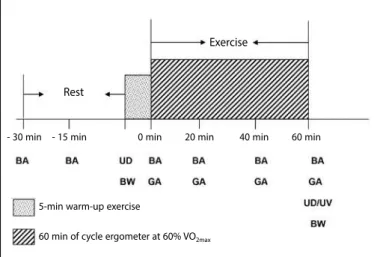
A standardized procedure was adopted for all experimental tests (figure 1), which was composed of a 5-minute warm-up exercise in cycle ergometer with progressive load from 45 to 55% of the VO2MaxExt,
performed after a rest period prior to exercise of 30 minutes, followed by 60 minutes of cycle ergometer with continuous load equivalent to 60% of the VO2MaxExt. During exercise, participants hydrated every 15
minutes with 3 ml per kg body weight.
During each experimental test, fasting blood samples and in 15-mi-nute intervals during rest and every 20 mi15-mi-nutes during exercise were obtained. The equipment used was i-StatOne Blood Analyzer (i-Stat
of scalp and collection of 1 ml of blood in each sampling time. Analy-ses of blood glucose, hematocrit, hemoglobin, calcium, sodium and potassium were performed. In addition, gas analysis was performed (VO-2000, Aerosport, Medgraphics, St. Paul, Minnesota) in periods of 5 minutes every 20 minutes of exercise.
To evaluate the fluid balance, body weight and urine density were recorded before and after exercise and urine volume was recorded after exercise, and weight loss was calculated (initial weight - final weight)15.
For statistical analysis were used the analysis of variance (ANOVA) and the paired t-test. The significance level adopted was 5% and the Sigma Stat software version 1.0 was used.
RESULTS
There was no significant difference in mean respiratory quotient (RQ) between procedures throughout exercise, as well as the oxidation values of CHO and fat (table 2).
There was a glycemic peak in the rest period 15 min after the in-gestion of HGI and LGI meals in relation to fasting procedures (p <0.01), but not significantly different from one another. After 20 minutes of exercise, pre-exercise food intake procedures kept a similar behavior, only showing reduced blood glucose levels compared to the other procedures (p <0.01). At 40 and 60 minutes of exercise, fasting with H2O showed glucose concentration lower than that of fasting with CHO (p = 0.015). The glycemic response during the four procedures is shown in figure 2.
The hemoglobin and hematocrit concentrations showed no significant differences between procedures at all evaluation times; however, in all tests, exercise caused an increase in these variables in relation to rest (table 3).
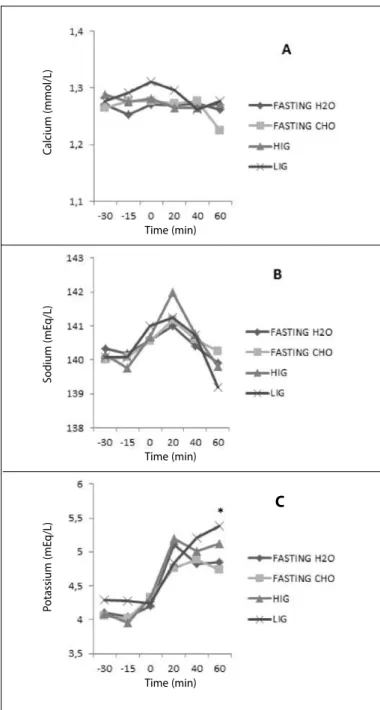
There were differences between groups regarding potassium con-centration at 60 minutes of exercise, being higher in LGI procedure in relation to fasting with CHO (p = 0.019) (figure 3C). Calcium concentra-tions remained constant throughout the testing period in all procedu-res (figure 3A); however, sodium and potassium levels increased after the onset of exercise, and at the end of exercise, sodium levels returned to resting values, while potassium values remained high throughout the exercise (figure 3B and 3C).
Among the parameters related to fluid balance only the final urine volume differed between groups, being higher in HGI compared to fasting with H2O (p = 0.041). Moreover, there was a significant diffe-rence (p = 0.007) between initial and final urine density in the HGI procedure (table 4).
DISCUSSION
HGI foods stimulate greater and faster insulinemic and glycemic response, the latter actually occurred in this study (figure 2). This beha-vior has been associated with increased absorption of available glucose, which is enhanced during physical exercise, since there is translocation of the glucose transporter protein (GLUT-4) to the surface of the muscle fibers caused by its contractions1.
Table 1. Nutrition Composition of pre-exercise meals.
Meal Components Nutritional analysis GI estimated
HGI 80G banana 529.4 kcal 70
1 ceral bar 83% CHO (95.9 g) 3 slices of bread 7% Protein (8.1 g) 10 g of margarine 10% Fat (11.2 g) 300 ml of CHO beverage
15g of glucose
LGI 130 g of apple 544.7 kcal 37
30 g of all bran 81% CHO (98.3 g) 100 ml of whole milk 9% Protein (10.6 g) 1 slice of whole bread 10% Fat (11.8 g)
200 ml of grape juice 7,5 g of margarine
23 g of fructose
The GI of meals was calculated based on the method of Wolever and Jenkins (1986)13 with GI values taken
from the International GI Table (Foster-Powell et al., 2002)14, and in the absence of the exact food, the value
corresponding to the most similar food was used.
Table 2. Respiratory quotient (RQ), CHO oxidation and fat oxidation in different periods during exercise.
RQ CHO oxidation (g.min-1) Fat oxidation (g.min-1)
Test 0-5 min 20-25 min 40-45 min 55-60 min 0-5 min 20-25 min 40-45 min 55-60 min 0-5 min 20-25 min 40-45 min 55-60 min
Fasting/H2O 0,89 ± 0,06 0,86 ± 0,05 0,86 ± 0,07 0,87 ± 0,08 1,5 ± 0,76 1,16 ± 0,62 1,13 ± 0,66 1,2 ± 0,71 0,33 ± 0,21 0,4 ± 0,2 0,4 ± 0,19 0,38 ± 0,2
Fasting/CHO 0,89 ± 0,12 0,86 ± 0,1 0,86 ± 0,12 0,87 ± 0,12 1,45 ± 1,02 1,15 ± 0,86 1,11 ± 1,03 1,16 ± 1,07 0,34 ± 0,4 0,4 ± 0,3 0,41 ± 0,45 0,35 ± 0,46
HGI 0,92 ± 0,09 0,86 ± 0,09 0,86 ± 0,09 0,87 ± 0,08 1,79 ± 1,12 1,42 ± 0,8 1,18 ± 0,83 1,2 ± 0,78 0,24 ± 0,3 0,43 ± 0,3 0,4 ± 0,33 0,4 ± 0,32 LGI 0,91 ± 0,06 0,86 ± 0,06 0,84 ± 0,08 0,86 ± 0,08 1,61 ± 0,83 1,09 ± 0,55 0,94 ± 0,57 1,04 ± 0,67 0,24 ± 0,17 0,4 ± 0,25 0,35 ± 0,29 0,38 ± 0,31
Figure 2. Blood glucose concentration (mg/dL) during rest and exercise in the four procedures. ap<0.01: HGI and LGI vs. fasting procedures. bp = 0.015: fasting with CHO
vs. fasting with H2O.
Blood gluc
ose (mg/dL)
Time (min)
Figure 1. Schematic representation of experimental procedures.
Exercise
Rest
BA: Blood analyses; GA: Gas Analyses; UD: Urine density; UV: Urine volume; BW: Body weight
5-min warm-up exercise
60 min of cycle ergometer at 60% VO2max
290
High insulin levels can inhibit lipolysis, making the energy con-sumption increasingly dependent on CHO oxidation16. In the present
study, regardless of dietary intake of HGI or LGI or fasting state with hydration with H2O or CHO-electrolyte drink, no difference was
obser-ved in CHO and fat oxidation during exercise, which is consistent with result of the study by Moore et al.17, who compared HGI and LGI, and
with results obtained by Chen et al.18 and Wong et al.19, who assessed
pre-exercise meals with different GI but with hydration during exercise with CHO-electrolyte drink. The current results can be justified by the
presence of fructose in the LGI meal composition, since the metabolism of fructose in the liver occurs from the second glycolysis reaction, being readily oxidized20 and thus showing a behavior similar to HGI meal, as
evidenced by the study of Sun et al.21.
In the postprandial glycemic response, there was a peak 15 minutes after ingestion of both meals, with significant differences in relation to fasting procedures, but unlike the vast majority of studies16,18,19, it
sho-wed no difference between pre-exercise HGI and LGI meals (figure 2). Although with no significant differences, pre-exercise HGI meal showed higher glycemic elevation in relation to LGI meal at 15 postprandial minutes and at 30 minutes, immediately before the onset of exercise, blood glucose levels in LGI procedure had already reached baseline while those of HGI pro-cedure still showed higher values (figure 2). These results may have a clinical implication, since blood glucose and insulin levels are higher in response to HGI meal, and if exercise starts with levels still high, there may be a rapid decrease in blood glucose levels in the first moments of exercise, usually at 15 minutes1, which is a phenomenon called rebound hypoglycemia or
reactive hypoglycemia5.
The decrease in plasma glucose levels actually occurred at 20 minu-tes of exercise (figure 2), but with both pre-exercise meals, HGI and LGI; however, the mean values remained within the normoglycemic range (70 to 99 mg / dL)2. Nevertheless, it is noteworthy that the intensity
adopted in this study was low, 60% of the VO2MaxEx, and that values
below 70 mg / dL could be achieved during high-intensity exercise. Considering the report of Jeukendrup and Killer1 in which some
individuals are more likely to develop hypoglycemia, it could be obser-ved that in both HGI as LGI pre-exercise meal at 20 minutes of exercise, 33.3% of volunteers had glucose values below 70 mg / dL, and from these, only one showed the same hypoglycemic values in both meals, and only one volunteer, when submitted to HGI procedure, dropped out due to hypoglycemia symptoms previously mentioned8. These
results point out to the need for monitoring the individual impact of pre-exercise diet, especially in athletes submitted to systematic training, since individual characteristics may or may not facilitate a condition of rebound hypoglycemia.
From 20 minutes and throughout the exercise, fasting with CHO obtained glucose values similar to those of HGI and LGI procedures,
Table 3.Hematocrit and hemoglobin levels during rest and exercise.
Hematocrit (%) Hemoglobin (g/dL)
Test -30 min -15 min 0 min 20 min 40 min 60 min P -30 min -15 min 0 min 20 min 40 min 60 min p
Fasting/H2O 44,9 ± 2,5 43,2 ± 2,6 45,3 ± 2,7 47,7 ± 2* 47,5 ± 2,1* 47,4 ± 1,9* < 0,001 15,3 ± 0,9 14,7 ± 0,9 15,4 ± 0,9 16,2 ± 0,7* 16,1 ± 0,7* 16,1 ± 0,6* < 0,001
Fasting/CHO 44,2 ± 2,4# 43 ± 3,1 45,1 ± 2,5 47,8 ± 2,3* 47,2 ± 2,3* 46,2 ± 2,3 < 0,001 15 ± 0,8# 14,6 ± 1 15,3 ± 0,8 16,3 ± 0,8* 16 ± 0,8* 15,7 ± 0,8 < 0,001
HGI 44,7 ± 2,6# 44,6 ± 2,8# 45 ± 2,8# 48,1 ± 2,1 46,7 ± 2,1 46,5 ± 2,4 0,005 15,2 ± 0,9# 15,2 ± 1# 15,3 ± 0,9# 16,3 ± 0,7 15,9 ± 0,7 15,8 ± 0,8 0,005 LGI 44,4 ± 2,7 45,6 ± 2 46,9 ± 1,9 48,1 ± 2,2¥ 47,8 ± 2,6¥ 47 ± 2,5 0,003 15,1 ± 0,9 15,5 ± 0,7 15,9 ± 0,7 16,4 ± 0,7¥ 16,2 ± 0,9¥ 16 ± 0,8 0,002 Time difference for hematocrit and hemoglobin in each experimental test: * vs. -15 min; # vs 20 min; ¥ vs -30 min.
Table 4. Hydration parameters.
n=12 Fasting with
H2O
Fasting with
CHO HGI LGI P
Initial BW (Kg) 73.4 ± 5.7 73.5 ± 5.8 73.9 ± 5.6 73.9 ± 5.6 0.993
Final BW (Kg) 73.4 ± 5.7 73.6 ± 5.9 73.5 ± 5.7 73.9 ± 5.5 0.996
Urine volume (ml)
40 (30 – 55)¥
40 (32.5 – 70)
70 (51.2 – 157.5)¥
67.5
(40 – 90) 0.041 Weight loss
(Kg)
0.05 (-0.15 – 0.20)
-0.03 (-0.23 – 0.13)
0.07 (-0.15 – 0.475)
0.05
(-0.15 – 0.150) 0.608 Initial urine
density 1.024 ± 0.004 1.026 ± 0.006 1.024 ± 0.005
§ 1.025 ± 0.003 0.450
Final urine
density 1.024 ± 0.007 1.024 ± 0.008 1.016 ± 0.009
§ 1.022 ± 0.007 0.056
n = sample size; CHO = carbohydrate drink; HGI = high glycemic index; LGI = low glycemic index; BW = body
weight.; ¥ p = 0.041: HGI vs. fasting with H2O; § p = 0.007: between initial and final urine density HGI.
Figure 3. Total blood calcium (mmol/L), sodium and potassium concentrations (mEq/L) during rest and exercise in the four procedures. C: * p = 0.019: LGI vs. fasting with CHO.
C
alcium (mmol/L)
S
odium (mE
q/L)
P
otassium (mE
q/L)
Time (min)
Time (min)
Time (min)
which agrees with the results of Chen et al.18 and Wong et al.19, who
showed that the CHO consumption during exercise minimizes the metabolic difference arising from GI.
The data obtained in this study demonstrated that the risks in perfor-ming exercises in the fasting state can be minimized by hydration with CHO, when significantly higher blood glucose values compared to fasting with H2O at 40 and 60 minutes of exercise are observed (figure 2). It was also observed that at 60 minutes of exercise, only in fasting with H2O procedure, blood glucose levels below 70 mg / dL were recorded, and that this showed a tendency to decrease, which would allow a higher occurrence of hypoglycemic values in case exercise is prolonged. This behavior was also observed in a previous study22; however, no significant
difference was observed between fasting procedures.
The results of the fluid balance (table 4) showed greater final urine volume (p = 0.041) in the HGI procedure, which is consistent with the fact that the final urine density was significantly lower (p=0.007) com-pared to the initial volume in the same procedure. That was the only fluid change observed, which does not prevent us from concluding that the type of hydration adopted in experimental tests (3 ml/kg body weight) was sufficient to maintain the initial state of volunteers, since there was no significant body weight loss after exercise. However, in all procedures, participants were hypo-hydrated to begin the exercise (urine density > 1.020 g.ml-1), according to Casa et al.23.
Hydration was also sufficient to maintain hematocrit (40 to 54%) and hemoglobin values (13.5 to 18 g / dL) at normal levels for men24
(table 3); however, exercise duration and intensity adopted in this ex-periment provided hemoconcentration during exercise, which warns us about the importance of adequate hydration especially during phy-sical activities longer and more intense than usual, considering that individuals begin their physical practice dehydrated, as observed in the present study and reported by other authors25,26.
A progressive dehydration condition will cause a decrease in plas-ma volume during the exercise, leading to cardiovascular adaptation by increasing the heart rate in an attempt to maintaining sufficient cardiac output to meet the active muscles and assist in the thermoregulatory
mechanism, since the venous return and consequently the systolic volu-me are affected27. In certain extreme dehydration conditions, the
cardio-vascular adaptation can trigger a collapse, producing a cardiac arrest28.
Of ions evaluated, only sodium maintained throughout the exercise within normal values (135 to 145 mEq / L)29, whereas ionic calcium (1.15
to 1.33 mmol / L)29 and potassium (3.5 to 5.0 mEq / L)29 showed values
above physiological limit. Although no significant difference was ob-served between the four procedures for the total calcium and sodium levels, significantly higher potassium levels were observed at the end of 60 minutes of exercise in the LGI procedure compared to fasting with CHO (figure 3C). This can be attributed to the lower stimulation of insulin release caused by LGI food in contrast to stimulation every 15 minutes caused by CHO, as hypoinsulinemia can be considered as a possible cause of hyperpotassemia30, or due to the total composition
of potassium in the LIG meal be greater when compared to HIG meal (964 mg vs. 599 mg).
The elevation of potassium levels at the beginning of exercise in all procedures occurs because during physical activity, it is released from the intracellular medium to the extracellular medium of the muscle tissue and then into the bloodstream, and as this tissue is the largest potassium deposit in the body30, changes caused by exercise are highlighted.
CONCLUSION
Despite the similar metabolic behavior between LGI and HGI me-als, the adoption of LGI meal before morning exercise appears to be the most suitable nutritional strategy due to the greater propensity of rebound hypoglycemia after HGI meal. When performed in fasting, hydration with CHO seems to minimize the hypoglycemic risk arising from this state. However, although the insulinemic response has not been analyzed, further studies are needed to assess the potassium behavior during exercise after LGI meal.
All authors have declared there is not any potential conflict of interests concerning this article.
REFERENCES
1. Jeukendrup AE, Killer SC. The myths surrounding pre-exercise carbohydrate feeding. Ann Nutr Metab. 2010;57(Suppl 2):18-25.
2. Standards of medical care in diabetes--2015: summary of revisions. Diabetes Care. 2015;38(1):S1-S94. 3. McArdle WD, Katch FI, Katch LF. Fisiologia do exercício: energia, nutrição e desempenho humano. 7a
ed. Rio de Janeiro: Guanabara Koogan; 2011.
4. Brasil TA, Pinto JA, Cocate PG, Chácara RP, Marins JCB. Avaliação do hábito alimentar de praticantes de atividade física matinal. Fit Perf J. 2009;8(3):153-63.
5. Coyle EF, Coggan AR, Hemmert MK, Lowe RC, Walters TJ. Substrate usage during prolonged exercise following a preexercise meal. J Appl Physiol (1985). 1985;59(2):429-33.
6. Del Coso J, Muñoz-Fernández VE, Muñoz G, Fernández-Elías VE, Ortega JF, Hamouti N, et al. Effects of a caffeine-containing energy drink on simulated soccer performance. PLoS One. 2012;7(2):e31380.
7. Faria VC, Oliveira GA, Sales SS, Marins JCB, Lima LM. Índice glicêmico da refeição pré-exercício e me-tabolismo da glicose na atividade aeróbica. Rev Bras Med Esporte. 2014;20(2):156-60.
8. Nybo L, Møller K, Pedersen BK, Nielsen B, Secher NH. Association between fatigue and failure to preserve cerebral energy turnover during prolonged exercise. Acta Physiol Scand. 2003;179(1):67-74. 9. Pollock ML, Wilmore JH. Exercício na saúde e na doença: avaliação e prescrição para prevenção e
reabilitação. 2a ed. Rio de Janeiro: Guanabara Koogan; 1993.
10. Karvonen MJ, Kentala E, Mustala O. The effects of training on heart rate; a longitudinal study. Ann Med Exp Biol Fenn. 1957;35(3):307-15.
11. Jones NL, Makrides L, Hitchcock C, Chypchar T, McCartney N. Normal standards for an incremental progressive cycle ergometer test. Am Rev Respir Dis. 1985;131(5):700-8.
12. Marsh CE. Evaluation of the American College of Sports Medicine submaximal treadmill running test for predicting VO2max. J Strength Cond Res. 2012;26(2):548-54.
13. Wolever TM, Jenkins DJ. The use of the glycemic index in predicting the blood glucose response to mixed meals. Am J Clin Nutr. 1986;43(1):167-72.
14. Foster-Powell K, Holt SH, Brand-Miller JC. International table of glycemic index and glycemic load values: 2002. Am J Clin Nutr. 2002;76(1):5-56.
15. Osterberg KL, Pallardy SE, Johnson RJ, Horswill CA. Carbohydrate exerts a mild influence on fluid reten-tion following exercise-induced dehydrareten-tion. J Appl Physiol (1985). 2010;108(2):245-50. 16. Karamanolis IA, Laparidis KS, Volaklis KA, Douda HT, Tokmakidis SP. The effects of pre-exercise glycemic
index food on running capacity. Int J Sports Med. 2011;32(9):666-71.
17. Moore LJ, Midgley AW, Thomas G, Thurlow S, McNaughton LR. The effects of low-and high-glycemic index meals on time trial performance. Int J Sports Physiol Perform. 2009;4(3):331-44.
18. Chen YJ, Wong SH, Chan CO, Wong CK, Lam CW, Siu PM. Effects of glycemic index meal and CHO-electrolyte drink on cytokine response and run performance in endurance athletes. J Sci Med Sport. 2009;12(6):697-703.
19. Wong SH, Chan OW, Chen YJ, Hu HL, Lam CW, Chung PK. Effect of preexercise glycemic-index meal on running when CHO-electrolyte solution is consumed during exercise. Int J Sport Nutr Exerc Metab. 2009;19(3):222-42.
20. Lê KA, Tappy L. Metabolic effects of fructose. Curr Opin Clin Nutr Metab Care. 2006;9(4):469-75.
21. Sun FH, Wong SH, Huang YJ, Chen YJ, Tsang KF. Substrate utilization during brisk walking is affected by glycemic index and fructose content of a pre-exercise meal. Eur J Appl Physiol. 2012;112(7):2565-74.
22. Faria VC, Cazal MM, Cabral CAC, Marins JCB. Influência do índice glicêmico na glicemia em exercício físico aeróbico. Motriz. 2011;17(3):395-405.
23. Casa DJ, Armstrong LE, Hillman SK, Montain SJ, Reiff RV, Rich BS, et al. National athletic trainers’ associa-tion posiassocia-tion statement: fluid replacement for athletes. J Athl Train. 2000;35(2):212-24.
24. Fischbach FT, Dunning MB. A manual of laboratory and diagnostic tests. 9th ed.Philadelphia: Lippincott; 2014.
25. Marins JCB, Ferreira FG. Nível de conhecimento dos atletas universitários da UFV sobre hidratação. Fit Perf J. 2005;4(3):175-87.
26. Peacock OJ, Stokes K, Thompson D. Initial hydration status, fluid balance, and psychological affect during recreational exercise in adults. J Sports Sci. 2011;29(9):897-904.
27. Carvalho T, Mara LS. Hidratação e nutrição no esporte. Rev Bras Med Esporte. 2010;16(2):144-8.
28. Somboonwong J, Sanguanrungsirikul S, Pitayanon C. Heat illness surveillance in schoolboys partici-pating in physical education class in tropical climate: an analytical prospective descriptive study. BMJ Open. 2012;2(4). pii: e000741. doi: 10.1136/bmjopen-2011-000741.
29. Scott MG, LeGrys VA, Klutts JS. Electrolytes and blood gases. In: Burtis CA, Ashwood ER, Bruns DE, editors. Fundamentals of clinical chemistry and molecular diagnostics (Tietz). 7th ed. Philadelphia: Sauders Elsevier; 2014. p. 412-429.