Rafaela Vivian Valcarenghi
I, Luciana de Fátima Leite Lourenço
I,
Josiane Steil Siewert
II, Angela Maria Alvarez
II Universidade Federal Santa Catarina, Health Sciences Center,
Postgraduate Program in Nursing. Florianópolis, Santa Catarina, Brazil.
II Instituto Federal de Educação, Ciência e Tecnologia de Santa Catarina,
Technical Course in Nursing. Joinville, Santa Catarina, Brazil.
How to cite this article:
Valcarenghi RV, Lourenço LFL, Siewert JS, Alvarez AM. Nursing scientific production on health promotion, chronic condition, and aging. Rev Bras Enferm. 2015;68(4):618-25. DOI: http://dx.doi.org/10.1590/0034-7167.2015680419i
Submission: 04-02-2015 Approval: 04-28-2015
ABSTRACT
Objective: to characterize the scientifi c production of Postgraduate Programs Nursing in Brazil on health promotion with a focus on elderly people with chronic conditions in the period from 2006 to 2010. Method: integrative research developed by searching for dissertations and theses in the database of the Center for Nursing Studies and Research of the Brazilian Nursing Association published in the period from 2006 to 2010 and which focused on health promotion for elderly people with chronic conditions. Results: fi ve themes emerged: “Living with the disease”; “Technologies of care”, “Potential for self-care” “Psycho-spiritual dimension”, and “Family caregiver”. Conclusion: it was possible to identify nursing care as a key element to promote the health of elderly people and make them more independent in their care so as to live with their limitations or disabilities, even when affected by chronic diseases.
Key words: Health Promotion; Chronic Disease; Aging; Nursing Research.
RESUMO
Objetivo: caracterizar a produção científi ca dos Programas de Pós-Graduação em Enfermagem do Brasil, sobre promoção da saúde com enfoque nas pessoas idosas em condição crônica, no período de 2006 a 2010. Método: pesquisa integrativa, realizada através da busca de dissertações e teses da base de dados do Centro de Estudos e Pesquisas em Enfermagem da Associação Brasileira de Enfermagem, publicados no período de 2006 a 2010, que focassem a promoção de saúde de idosos em condição crônica. Resultados: emergiram cinco categorias temáticas: “Convívio com a doença”; “Tecnologias de cuidado”; “Potencialidades para o autocuidado” “Dimensão psicoespiritual” e “Família cuidadora”. Conclusão: pôde-se identifi car a assistência de enfermagem como elemento fundamental para promover a saúde do indivíduo idoso e torná-lo mais independente de cuidados para conviver com suas limitações ou incapacidades, mesmo acometido por doenças crônicas.
Descritores: Promoção da Saúde; Doença Crônica; Envelhecimento; Pesquisa em Enfermagem.
RESUMEN
Objetivo: caracterizar la producción científi ca de la Postgraduate Nursing Brasil, en la promoción de la salud con especial atención a las personas mayores con enfermedades crónicas en el período 2006-2010. Método: la investigación integral realizada mediante la búsqueda de disertaciones y tesis en la base de datos del Centro de Estudios e Investigación en Enfermería Asociación Brasileña de Enfermería, publicada en el período 2006-2010, que se centrará en la promoción de la salud para las personas mayores con enfermedades crónicas. Resultados: cinco temas emergieron: “La convivencia con la enfermedad”, “cuidado Technologies”, “potencial para el propio cuidado” “dimensión psico-espiritual” y “cuidador familiar”. Conclusión: se pudo identifi car el cuidado de enfermería como un elemento clave para promover la salud de las personas mayores y que sea una atención más independiente que vivir con limitaciones o incapacidades, aún afectados por enfermedades crónicas.
Palabras clave: Promoción de la Salud; Enfermedad Crónica; Envejecimiento; Investigación em Enfermería.
Nursing scientifi c production on health promotion,
chronic condition, and aging
Produção científi ca da Enfermagem sobre promoção de saúde, condição crônica e envelhecimento
Producción científi ca de Enfermería de promoción de la salud, condición crónica y envejecimiento
INTRODUCTION
Aging is a natural process that is part of the stages of life and comes with physical, psychological, and social changes that affect in a specific way each individual who survives the previous stages of human existence. It is a stage during which, taking into account even their very existence, elderly people conclude that they have achieved many goals, but have also suffered many losses, a highlight being their health condition as one of the most affected aspects(1).
At the same time, recent public policies on health care for the elderly turn to programs that prioritize active aging, which is consistent with the proposals of the World Health Organization (WHO), resulting not only in an increased life expectancy, but also contributing to the quality and promo-tion of health, along with building a more favorable social and cultural environment for the elderly population(2).
The aging of the Brazilian population increases the preva-lence of chronic Non-Communicable Diseases (NCDs), which added to equally chronic and disabling diseases with a risk of acute events, become costly for individuals, for families, and for healthcare systems as people age(3).
In 2007, about 72% of the deaths in Brazil were attribut-able to NCDs, such as cardiovascular and respiratory diseases, diabetes, cancer, and others including kidney disease; 10% to infectious and parasitic diseases, and 5% to maternal-child health disorders. This distribution is in contrast with that of 1930 when infectious diseases accounted for 45% of deaths in the Brazilian state capitals. This era was marked by a context of advance in economic and social development and with an attempt to resolve major public health problems at that time(4).
According to the above, the epidemiological transition oc-curs due to changes in various aspects such as standards of morbidity, disability, and death. In parallel with this change in disease proportions there was a rapid demographic transition in Brazil, which produced a population aging pyramid with a predominance of adults(5). In the first decade of this century, the number of elderly individuals in the Brazilian population reached 10.78%, a transformation that configured a population with a large segment of young adult and adult-adult individuals, representing significant gains in the country’s workforce(6).
Students of gerontology in Brazil are concerned about the population’s strong aging trend characterized by the large number of adults aged 40 to 59 and that, even considering the current mortality rates, will contribute to enlarging the top of the population pyramid in the next twenty years.
According to the Pan American Health Organization (PAHO), NCDs did not received priority attention in public health poli-cies and programs in proportion to the burden of morbidity in each region of the world. There is clear evidence and effective interventions (depending on cost) available to prevent prema-ture deaths from chronic diseases. Every country, regardless of its economic status, can significantly improve the prevention and control of these diseases. Their main causes are known and if these risk factors are eliminated, at least 80% of all heart diseases, cerebrovascular accidents, and type 2 diabetes, along with over 40% of cancer cases are preventable(5).
Therefore, policies are needed that promote improvements in health since childhood, and that continue throughout life. Among them are cited the promotion of health and universal access to public health services. The importance of environ-mental, economic, social, and educational factors is also con-sidered in the emergence of diseases and disabilities, hence the need for permanent training programs for professionals in health and social services to improve chronic conditions of life and health of the entire population(7).
In recent decades, health promotion policies have been high-lighted worldwide as an important tool in the pursuit of build-ing the expanded concept of health that prioritizes quality of life improvement actions of individuals and groups. Special care fo-cused on aging is aggregated between macro priorities of the Pact in Defense of Life of the Unified Health System (SUS), thus link-ing health promotion concepts with policies for healthy aglink-ing(8).
Considering the care given to the elderly in the SUS in re-cent years, a growth can be identified in scientific publica-tions with a focus on the health of the elderly; while in the field of health, studies emerged on the need to implement strategies to promote healthy aging and prevent complications arising from diseases typical of old age. In nursing care for the elderly, it is essential that the actions be permeated by health promotion. Understanding that aging is characterized by spe-cific changes, professionals should have skills to handle the diversity of situations presented by this population.
In light of the considerations presented here on the en-tire theme of aging, health promotion, and chronic disease, a need was felt to learn how this issue has been dealt with by graduate students in order to characterize the scientific production of the Graduate Programs in Nursing in Brazil on health promotion with a focus on elderly people with chronic conditions in the period from 2006 to 2010.
METHOD
An integrative review research was conducted with the follow-ing guidfollow-ing question: “What is the state-of-the-art scientific produc-tion of the Graduate Programs in Nursing in Brazil on health pro-motion with a focus on elderly people with chronic conditions?”.
The inclusion criteria of the studies were as follows: disserta-tions and theses in the database of the Center for Nursing Studies and Research (CEPEn) of the Brazilian Nursing Association (ABEn) available at the website <http://www.abennacional.org.br> and published in the period from 2006 to 2010, focusing on health promotion for elderly people with chronic conditions. The ex-clusion criteria were as follows: studies that focused on chronic diseases but not on elderly individuals or aging, and studies on chronic communicable diseases such as AIDS and hepatitis C.
on the subject under study. A data collection instrument was developed with the following items: year, study title, place of research, nature of the study, type of research, theoretical frame-work, emphasis of the study, results, and conclusions.
The search resulted in a total of 32 dissertations and theses working with this theme. Three references were excluded be-cause the text could not be captured in full even after searching attempts using CEPEn, Graduate Programs in Nursing, and via the author, therefore totaling 29 references analyzed in this study.
RESULTS
During the period analyzed (2006 to 2010), 32 studies con-ducted in Brazil were assessed with the theme of promoting health with a focus on elderly people with chronic conditions. Two research centers had most of these studies: the University of São Paulo (Ribeirão Preto) and the Federal University of Santa Catarina, with 6 and 5 studies respectively. Of the total studies obtained and as to their nature, 5 were doctoral the-ses and 24 were master’s degree dissertations. Most used the qualitative methodology (20) with the main research being of the convergent-care type, with a total of 8 studies.
The majority of studies were practical research(9-16), which means there was active participation of the research subjects with a focus on fostering changes and/or introducing innova-tions in health care. The research of the convergent-care type is done in conjunction with nursing interventions and involves the researcher and other people representative of the phenomenon to be researched in a mutually cooperative relationship(17).
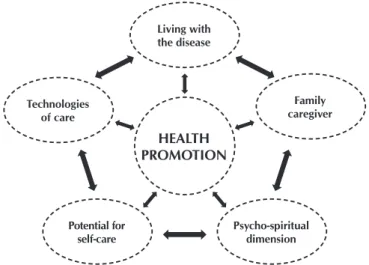
The analysis of the studies made it possible to identify how the scientific production of the Graduate Programs in Nursing in Brazil has developed the knowledge on aging from the per-spective of health promotion. Five themes emerged: “Living with the disease”; “Technologies of care”, “Potential for self-care”, “Psycho-spiritual dimension”, and “Family caregiver”. The following schematic figure shows the link between health promotion and the thematic aspects found in these studies.
Figure 1 - Schematic representation of the categories related to health promotion and chronic diseases in aging found in the scientific production of the Graduate Programs in Nursing in Brazil
DISCUSSION
Living with the disease
Several studies have shown the importance of adaptations needed by the elderly and their families in order to deal with a chronic condition, which are fundamental for health promo-tion. We can highlight aspects related to lifestyle, intellectual and volunteer activities, and the search for positive feelings. In a study on elderly people with diabetes mellitus, it was ob-served that there is an important process with adjustments and readjustments in order to face changes and to cope with this chronic disease(18). In this condition, the adjustments needed are essential to provide quality of life and overcome limita-tions in this stage of life(19).
A study with elderly diabetics showed that those who par-ticipate in volunteer activities in churches or day care facilities feel motivated by this experience even considering their chron-ic condition. Other care measures considered refer to food, specific diets, and changes in lifestyle such as avoid smoking and alcoholic beverages and regular physical activity, which improve blood glucose levels, reduce the risk of cardiovascular complications, and decrease blood pressure while increasing the well-being and quality of life of the elderly(20). Special at-tention should be given to nutritional issues in elderly diabet-ics due to dietary restrictions imposed by the disease(13). This adaptive process is first felt by the elderly people with diabetes mellitus who are obligated to eliminate from their daily menu a number of foods already solidly incorporated into their life history. Attention to diet as a strategy to maintain health and well-being of one of its members becomes an important aspect of accountability in promoting their health(18).
A study with elderly with chronic kidney condition re-vealed that in living with the disease the patient undergoes many obstacles, especially hemodialysis. Other important fac-tors found in the study refer to physical activities, healthy eat-ing habits, and fluid restriction(11). As for non-pharmacological treatment of high blood pressure and elderly patients with heart failure, evidence also shows that changes in lifestyle habits promote healthy living, including dietary changes and practicing physical activities(21-23). Living with a kidney disease and its treatment is quite stressful for elderly people both from the physical and the mental points of view. The disease im-poses changes in daily lifestyle. In the case of elderly people with chronic kidney disease, dietary rigor is difficult to adapt, but accepted as necessary for their health and well-being(24).
A study on mental health showed that many elderly people attributed the meaning of leisure to attitudes, feelings, and the practice of a positive order. In terms of well-being, this feeling is obtained by the elderly through recreation and is translated into the reality of their physical and mental health. In another study, some aspects were addressed as health promoters such as tourism activities, intellectual activities for fun, recreation, and entertainment, and dance activities and music can also contribute to the personal fulfillment of the elderly person(25).
To promote the health of the elderly with chronic condi-tions, the study showed evidence that contact with a harmo-nious environment, offering outdoor excursion opportunities,
Technologies of care
Family caregiver
Psycho-spiritual dimension Potential for
self-care
Living with the disease
knowledge, nursing can and should create a bond of trust be-tween staff and patients to overcome the difficulties encountered when caring for elderly individuals with mental disorder(31).
A study with elderly patients with chronic renal failure showed the important role of nursing in the systematization of educational practices in relation to the disease, care, and es-pecially in the peritoneal dialysis bag exchange(32). In the case of caring for the elderly to prevent pressure ulcers, the role of the nursing professionals becomes evident, as well as dialog as a source of reflection and acquisition of knowledge. In the practice of health education it is necessary that professionals are qualified to gain knowledge about the aging process and health promotion for the elderly with chronic conditions(14). An-other study addressed the nursing actions aimed at promoting health and discussed the importance of creating dialog through a group discussion on the difficulties regarding the interaction of elderly people and their family with the chronic disease(15).
The importance of care technologies directed to the elderly and their families was evident with the preparation of material with written and illustrative information in order to improve the quality of life and promote the health of the elderly in a chronic situation(13,33). Another study analyzed showed that nursing professionals should provide care towards promoting the health of elderly people according to the specificities of each chronic condition(34).
The concept of health promotion and aging should be based on comprehensive care technologies aimed at develop-ing autonomy and improvement of the livdevelop-ing and health con-ditions in order to promote active, integrated, and healthy ag-ing, providing resources able to ensure quality of health care for the elderly by encouraging participation and strengthening social control(35).
Potential for self-care
The care developed by nurses in order to promote health implies in having to deal with chronic and disabling diseases, and the health desired for the elderly person should be con-sidered with this perspective: to achieve the highest possible level of independence and autonomy.
Healthcare professionals should encourage the elderly to be proactive and participate in their care process(28). The elder-ly need to be encouraged to develop skills for their empower-ment, reflecting critically on the decision-making process in order to care for themselves for promoting their health. Living with a chronic disease requires knowledge not only about the nature of the disease, but also the specific skills for self-care(13).
Elderly individuals need care aimed at developing their po-tential for autonomy and individuality(31). A study with elderly people with Alzheimer’s disease addressed health supervision and education through guidance to family members and the elderly about maintaining physical safety, diet, and sleep in order to promote independence and encourage self-care(36). Another study on the health of elderly individuals in peri-toneal dialysis showed that care provided by skilled health professionals was indispensable since they provide care ac-cording to the needs of each elderly person in an individu-al and continuous manner. Another important aspect is the seeking a therapeutic and at the same time pleasant place,
allowed the elderly person to find moments of health and feel healthy even in a disease condition(19).
It is necessary for elderly people to maintain healthy hab-its of life, including principles of interacting with religiosity, leisure, and family and social experiences. To promote the health of the elderly and address the disease, it is necessary to add resources to their life such as encouraging healthy habits that promote caring for their needs(26). Another study showed that systematic activities such as social gatherings, times in groups, and physical activities are very important in people’s lives, especially the elderly, because they bring benefits such as socialization, healthy aging, improved self-esteem, and en-couragement of creativity(12).
In summary, living with the disease requires that the elderly person stays active, makes time to be with others, and develops self-control in relation to the care necessary to prevent complica-tions and to have a healthy life, which are fundamental elements for promoting the health of elderly people with a chronic disease.
Technologies of care
Healthcare professionals play an important role in relation to elderly people and their families particularly in promoting educational activities about dealing with the disease by pro-viding support and guidance. Health education can influence positively the behavior of the elderly for controlling compli-cations and adherence to the treatment in order to promote healthy living even in a chronic condition. The nursing check-up is viewed by the authors as a single action to establish links and guide toward health promotion(21,27-28).
Diseases of the respiratory tract occupy a prominent posi-tion in hospital admissions in the elderly populaposi-tion. A study on the influenza vaccine identified this product as an impor-tant way to prevent and reduce the number of deaths and hos-pitalizations in this age group.Influenza vaccines are able to reduce between 25% and 39% the number of hospitalizations in elderly people. Some of the complications observed during the course of influenza are upper and lower respiratory tract infections, especially bronchitis, pneumonia, exacerbation of asthma, and chronic airway obstructive diseases. Several studies highlight the value of nursing actions, especially in the elderly vaccination programs, a care technology of great relevance to prevent respiratory infections, and promote the health of this population(29).
A study with elderly patients with COPD showed the im-portance of health education for specific care in relation to this type of disease. If elderly people with a chronic disease properly adhere to the treatment and keep their health prob-lems under surveillance and control, this will help reduce the impact of the disease during their lifetime. In this case, nurses play a fundamental role in promoting a dignified life(30).
encouragement for the elderly person to participate actively in self-care(37).
A study on elderly individuals with heart disease high-lighted the importance of health education in which the edu-cational perspective refers to the importance of developing actions for self-care, considering their individual potentials to take care of themselves and having the nurse as the facilitator of the process. For people to develop self-care actions, they need to be aware of the importance of the care, taking control of their own health and the environment in which they live in order to seek and ensure adequate assistance to their needs. The re-dimensioning of this moment in the path of aging may lead to a universe of potentials and possibilities of transforma-tions inherent in living with a chronic disease(9).
Developing educational actions for self-care requires acting as a communication agent, as an agent of dialog for learning and especially respecting the learning pace of each elderly person and their family member caregiver. Sensitive care ex-pressed through the eyes, a smile, an understanding attitude, patience, clear communication, feeling and touching should be part of the nursing care process, being instrumental in de-veloping the educational relationship for self-care(9).
An important and significant event in the lives of elderly individuals has to do with urinary incontinence because it can cause them to have to depend on using shields or uri-nary catheters. A study done on this subject highlighted the professional nurse again as having a crucial role in education for self-care. Health education activities can be done through nursing check-ups, respecting the individuality of each elderly person along with his or her habits, beliefs, customs, and es-pecially prior knowledge. The study also showed the impor-tance of education always having a focus on the learning of attitudes that can be used for self-care of the elderly and that can also improve urinary losses, increasing self-esteem and in-dependence. The nurse acts as a facilitator in the educational process, being capable of assisting the elderly to find ways and considering attitudes that could benefit them with educational activities so as to improve their urinary continence such as perineal exercises and eating and bowel habits(10).
Educational activities are important tools for promoting self-care in elderly people because they encourage the expan-sion of autonomy and promote their independence. In this sense, the training of all professionals to receive, assist, and care for the elderly person with urinary complaints is essential in order to create an environment and bond of trust, thus en-suring the promotion of health.
The care approach for the elderly in a chronic situation should center on the fact that it needs to be comprehensive for the elderly person with sharing information and giving guid-ance whether in a horizontal manner in which health profes-sionals help the elderly person find his or her singular ways to live with the disease(16).
Psycho-spiritual dimension
Psycho-spiritual aspects (religious or theological, ethics, or philosophy of life) are basic human needs that can be stimu-lated by health professionals to promote the health of elderly
people with chronic conditions(38). Many of the studies ana-lyzed highlight the importance of religious practices.
Religion is a very strong aspect in people’s lives and it is rele-vant to consider this aspect as a support in the process of dealing with chronic illness(23). According to one of the studies analyzed, trust in God as a source of energy improves health conditions. The church environment, religion, and faith in God strengthen the family unit and promote the ability to modify, adapt, and obtain new and better results to deal with a chronic disease. It can be observed that belief in a religion promotes reflections on human life, improves health, increases the feeling of hope, pro-moting caring and self-care actions in the organizational system of the elderly person and the family(18). Another study pointed out that patients turn to religion for comfort and support, valuing at this time the existence of God. Their beliefs seem to influence their well-being and stimulate their desire to live. The nursing actions reported were related to spiritual needs and aimed to recognize, encourage, and support the elderly to preserve reli-gious behavior and standards(11).
Religion is a path for faith and provides support for the el-derly when they face many difficulties and obstacles in every-day life(24). In a research on elderly people with cancer, some aspects were observed that helped in the process of dealing with the disease. The reality of the disease unites the family with the goal of healing and focus on faith in God. Its authors argue that these beliefs allow people to free themselves from the uncertainties that surround them and at the same time ad-just to the evolutionary process. Religious practices are loaded with attitudes of caring and that is why they help the patient and his family to re-elaborate the experience of suffering lived and rearrange their perspective of life(39).
Another study emphasized that maintaining a spiritual con-dition, valuing religious practices, and maintaining significant emotional ties are aspects that contribute to the strengthening of the elderly and better quality of life, promoting their health even with chronic conditions(26).
Family caregiver
In family life and in the aging process, the installation of the chronic disease is an experience that can cause discomfort, stress, and demands on the everyday routines of families(18). Through family support, elderly people living with a chronic condition do so in a more positive way, sharing and overcoming difficulties(27).
The studies showed the important role of the family in the diagnosis of the chronic disease, as well as in coping and liv-ing with this condition, and its role has proven to be crucial in promoting health and the quality of life of the elderly. The family is also seen by the authors of the studies analyzed as an essential support for the care of the elderly and that the health professionals should be prepared to respond to this family-elderly with chronic conditions.
to develop feelings of joy in their members, even with the presence of disease(19).
The promotion of health of elderly people is linked to their in-terpersonal relationships with family members. Authors point out that in the family of the elderly person is where help and mutual support take place in which the expressive interactions intertwine to react to new situations, rescuing bonds of a feeling of value(11).
The studies analyzed indicated that the family helps in the process of dealing with the disease, supervises and evaluates the health status of the elderly person, resorting to healthcare pro-fessionals whenever needed. The family is viewed as a support, someone close that enables better quality of life for the elderly. It is the family that follows and shares in the entire evolution, in the conflicts and anguishes related to the disease(23,33).
In order to promote the health of an elderly person with chronic conditions, their family members should also be taken care of as they are an important element in this process, facing the disease together with him or her. A study analyzed addressed important aspects such as an embrace, an encouraging word, and receiving well the family members and the elderly person(40).
CONCLUSION
Analyzing the studies carried out in different graduate study courses made it possible to describe how the topic of
aging in relation to promotion of health of the elderly with chronic conditions has been dealt with by graduate students. The diversity of the themes addressed stands out such as the importance of the role of the family in promoting the health of the elderly and the need for making adaptations in order to live with a chronic disease, the use of care technologies, and the importance of developing the elderly person’s potential for self-care. Besides allowing to identify the magnitude of the subject, it was also possible to reflect on the importance of constant improvement of knowledge on the part of nurses to guide their daily practice toward promotion of health and pre-vention of complications from chronic diseases.
Through the studies, nursing care was also identified as a fundamental element to promote the health of elderly people because they become more independent of care and that even when affected by chronic diseases they know how to live with their limitations or disabilities.
With the increasing number of elderly people and in life expectancy, both in Brazil and around the world, it is believed that through research on health promotion and prevention of chronic diseases it is possible to sharpen the sensitivity of health professionals to broaden discussion about this theme. The expectation is that the nursing sector reorganizes the ac-tions provided to the aging population, taking as a reference the promotion of elderly people and their families.
REFERENCES
1. Mendes MRSSB, Gusmão JL, Faro ACM, Leite RCBO. [The social situation of elderly in Brazil: a brief consideration]. Acta Paul Enferm [Internet]. 2005 Oct-Dec [cited 2012 Oct 23]:18(4):422-6. Available from: http://www.scielo. br/pdf/ape/v18n4/a11v18n4.pdf Portuguese.
2. World Health Organization (CH). Active Ageing: a policy framework [Internet]. Madrid (ES): WHO; 2002 [cited 2012 Oct 23]. Available from: http://whqlibdoc.who.int/ hq/2002/WHO_NMH_NPH_02.8.pdf
3. Ministério da Saúde (BR). Plano de ações estratégicas para o enfrentamento das doenças crônicas não transmissíveis (DCNT) no Brasil 2011-2022 [Internet]. Brasília (DF): Ministério da Saúde; 2011 [cited 2012 Oct 23]. Available from: http://bvsms.saude.gov.br/bvs/publicacoes/plano_ acoes_enfrent_dcnt_2011.pdf
4. Schmidt MI, Duncan BB, Silva GA, Menezes AM, Monteiro CA, Barreto SM, et al. Chronic non-communicable diseases in Brazil: burden and current challenges. Lancet [Internet]. 2011 Jun [cited 2012 Oct 23];377(9781):1949-61. Avail-able from: http://www.thelancet.com/pdfs/journals/lancet/ PIIS0140-6736%2811%2960135-9.pdf
5. Pan American Health Organization (US). Regional strategy and plan of action on an integrated approach to the pre-vention and control of chronic disease. Washington (DC): PAHO; 2007 [cited 2012 Oct 23]. Available from: http:// www1.paho.org/english/ad/dpc/nc/reg-strat-cncds.pdf?ua=1
6. Instituto Brasileiro de Geografia e Estatística (BR). [Inter-net]. Brasília (DF): IBGE; 2010 [updated 2015 Jun 25;
cited 2012 Oct 23]. Available from: http://www.ibge.gov. br/home/estatistica/populacao/perfilidoso/.
7. Camarano AA, Pasinato MT. O envelhecimento populacio-nal na agenda das políticas públicas. In.: Camarano AA. Os novos idosos brasileiros: muito além dos 60? [Internet].Rio de Janeiro (RJ): IPEA; 2004 [cited 2012 Oct 23]. p. 253-92. Avail-able from: http://www.ipea.gov.br/portal/images/stories/ PDFs/livros/Arq_29_Livro_Completo.pdf
8. Ministério da Saúde (BR), Secretaria e Vigilância em Saúde, Secretaria de Atenção à Saúde. Política Nacional de Promoção da Saúde [Internet]. 3. ed. Brasília: Ministério da Saúde; 2010 [cited 2012 Oct 23]. p. 60. Available from: http://bvsms. saude.gov.br/bvs/publicacoes/politica_nacional_promo cao_saude_3ed.pdf
9. Scheidt PPR. Promovendo caminhos para a educação em saúde com idosos portadores de cardiopatias e seus fa-miliares no Setor de Emergência do Hospital Universitário [dissertação]. Florianópolis (SC): Universidade Federal de Santa Catarina; 2006.
10. Honório MO. Educação para o autocuidado: uma alterna-tiva de assistência de enfermagem ao adulto e idoso com incontinência urinária [dissertação]. Florianópolis (SC): Universidade Federal de Santa Catarina; 2006.
11. Modesto AP. O cuidado cultural de enfermagem “com” o idoso renal crônico em tratamento hemodialítico. [disserta-ção]. Curitiba (PR): Universidade Federal do Paraná; 2006.
Enfermagem e Saúde [dissertação]. Rio Grande (RS): Pro-grama de Pós-Graduação em Enfermagem, Universidade Federal do Rio Grande; 2006.
13. Hammerschmidt KSA. O cuidado gerontológico de en-fermagem subsidiando o empoderamento do idoso com diabetes mellitus [dissertação]. Curitiba (PR): Programa de Pós-Graduação em Enfermagem, Universidade Federal do Paraná; 2007.
14. Teixeira MLO. Uma tecnologia de processo aplicada jun-to ao acompanhante no cuidado ao idoso: contribuições à clínica do cuidado de enfermagem [tese]. Rio de Janeiro (RJ): Programa de Pós-Graduação em Enfermagem, Escola de Enfermagem Anna Nery, Universidade Federal do Rio de Janeiro; 2008.
15. Aragão TMS. Construção coletiva de um espaço dialógico com cuidadores familiares de idosos hospitalizados visan-do uma educação em saúde [dissertação]. Rio Grande (RS): Programa de Pós-Graduação em Enfermagem, Uni-versidade Federal do Rio Grande; 2008.
16. Souza EBM. O cuidado transdimensional na consulta de enfermagem com cuidadora familiar de pessoa idosa com Alzheimer [dissertação]. Florianópolis (SC): Programa de Pós-Graduação em Enfermagem, Universidade Federal de Santa Catarina; 2008.
17. Trentini M, Paim L. Pesquisa convergente-assistencial:um desenho que une o fazer e o pensar na prática assisten-cial em saúde e enfermagem. 2. ed. Florianópolis (SC): Insular; 2004.
18. Silva LWS. A dinâmica das relações da família com o membro idoso portador de Diabetes Mellitus tipo 2 [tese]. Florianópolis (SC): Programa de Pós-Graduação em Enfer-magem, Universidade Federal de Santa Catarina; 2007.
19. Carreira L. Cuidado da família ao idoso portador de doen-ça crônica: análise do conceito na perspectiva da família [tese]. Ribeirão Preto (SP): Universidade de São Paulo, Es-cola de Ribeirão Preto; 2006.
20. Sakata S. Diabetes Mellitus entre os idosos no município de São Paulo: uma visão longitudinal [dissertação]. São Paulo (SP): Programa de Pós-Graduação em Enfermagem, Universidade de São Paulo; 2007.
21. Oliveira CJ. Idosos em tratamento farmacológico anti-hip-ertensivo: parâmetros para o cuidado clínico de Enferma-gem [dissertação]. Fortaleza (CE): Universidade Estadual do Ceará; 2007.
22. Scattolin FAA. Qualidade de vida e independência fun-cional do idoso com insuficiência cardíaca [dissertação]. Campinas (SP): Universidade Estadual de Campinas, Fac-uldade de Ciências Médicas; 2006.
23. Marques MB. Avaliação da competência de idosos di-abéticos para o autocuidado [dissertação]. Fortaleza (CE): Programa de Pós-Graduação em Enfermagem, Universi-dade Federal do Ceará; 2009.
24. Costa MS. Idosos em hemodiálise: processos adaptativos em face das repercussões do tratamento [tese]. Fortaleza (CE): Programa de Pós-Graduação em Enfermagem, Uni-versidade Federal do Ceará; 2007.
25. Souza CDF. Lazer e turismo na interface da saúde e da edu-cação como meio de promoção da saúde mental do idoso
[dissertação]. Ribeirão Preto (SP): Programa de Pós-Gradua-ção em Enfermagem Psiquiátrica, Escola de Enfermagem de Ribeirão Preto da Universidade de São Paulo; 2007.
26. Umpierrez Vieira MC. Sentimentos, saberes e fazeres do cuidador principal do idoso com câncer [dissertação]. Maringá (PR): Universidade Estadual de Maringá; 2006.
27. Pedreira LC. Modos de ser do idoso com sequela de aci-dente vascular cerebral: cuidado familiar [tese]. Salvador (BA): Programa de Pós-Graduação em Enfermagem, Uni-versidade Federal da Bahia; 2009.
28. Lopes Fam. Qualidade de vida dos idosos com diabetes mellitus e os fatores de risco relacionados ao aparecimen-to de lesão nos pés [dissertação]. Uberaba (MG): Univer-sidade Federal do Triângulo Mineiro; 2009.
29. Ferrer ALM. Vacinação contra a influenza: redução na hospitalização e óbitos por doença respiratória em ido-sos [dissertação]. Maringá (PR): Universidade Estadual de Maringá; 2006.
30. Ferreira VC. Independência funcional do idoso com Doença Pulmonar Obstrutiva Crônica [dissertação]. Ri-beirão Preto (SP): Programa de Pós-Graduação em En-fermagem, Escola de Enfermagem de Ribeirão Preto da Universidade de São Paulo; 2010.
31. Hansel CG. Envelhecimento institucionalizado do porta-dor de transtorno mental: o viver e o cuidar dos profis-sionais de enfermagem de um hospital psquiátrico [dis-sertação]. Rio e Janeiro (RJ): Universidade Federal do Rio de Janeiro, Escola de Enfermagem Anna Nery; 2008.
32. Ribeiro DF. O cuidador do idoso com insuficiência renal crônica em diálise peritoneal ambulatorial contínua [dis-sertação]. Ribeirão Preto (SP): Programa de Pós-Gradua-ção em Enfermagem, Escola de Enfermagem de Ribeirão Preto da Universidade de São Paulo; 2008.
33. Barros EJL. O ser idoso estomizado sob o olhar complexo: uma proposta de gerontotecnologia educativa [disserta-ção]. Rio Grande (RS): Programa de Pós-Graduação em Enfermagem, Universidade Federal do Rio Grande; 2007.
34. Souza LFF. Desafios para a enfermagem - prevenindo des-vios de memória no idoso e promovendo saúde: a busca de um cuidado possível [dissertação]. Rio de Janeiro: Pro-grama de Pós-Graduação, Universidade Federal do Estado do Rio de Janeiro; 2007.
35. Ministério da Saúde (BR). Portaria nº. 2.528, de 19 de outubro de 2006. Aprova a Política Nacional de saúde da Pessoa Idosa [Internet]. Brasília (DF): Ministério da Saúde; 2006 [updated 2015 Jun 25; cited 2012 Oct 23]. Available from: http://bvsms.saude.gov.br/bvs/saudelegis/ gm/2006/prt2528_19_10_2006.html
36. Talmelli LFS. Nível de independência funcional de idosos com Doença de Alzheimer [dissertação]. Ribeirão Preto (SP): Programa de Pós-Graduação em Enfermagem, Escola de Enfermagem de Ribeirão Preto da Universidade de São Paulo; 2009.
38. NANDA Internacional. Diagnósticos de enfermagem da NANDA: definições e classificação 2009-2011. Porto Alegre: Artmed; 2010.
39. Visentin A. O itinerário terapêutico: história oral de ido-sos com câncer [dissertação]. Curitiba (PR): Programa de Pós-Graduação em Enfermagem, Universidade Federal do
Paraná; 2008.