Early serum tacrolimus levels predict long-term
chronic kidney disease after liver transplantation
Vanessa B. A. Branda˜o,ILuciana C. Faria,IIDanielle M. Bicalho,IIFernando H. Pereira,IIIAgnaldo S. Lima,IV Teresa C. A. FerrariII
IUniversidade Federal de Minas Gerais, Hospital das Clı´nicas, Servico de Nefrologia, Belo Horizonte/MG, Brazil;IIUniversidade Federal de Minas Gerais,
Faculdade de Medicina, Departamento de Clı´nica Me´dica, Belo Horizonte/MG, Brazil;IIIUniversidade Federal de Minas Gerais, Faculdade de Medicina, Nu´cleo de Assessoria em Bioestatı´stica, Belo Horizonte/MG, Brazil;IVUniversidade Federal de Minas Gerais, Faculdade de Medicina, Departamento de Cirurgia, Faculdade de Medicina, Universidade Federal de Minas Gerais, Belo Horizontal/MG, Brazil
OBJECTIVE:To investigate risk factors for the development of chronic kidney disease and death two years post-liver transplantation.
METHOD: Associations between clinical and laboratory parameters and the development of chronic kidney
disease and survival two years post-liver transplant were analyzed in a cohort of 148 adult patients with hepatic cirrhosis consecutively submitted to liver transplantation in a referral Brazilian center.
RESULTS:Median age at liver transplantation was 56 (range, 20-73) years, and 105 (70.9%) patients were males. The prevalence of chronic kidney disease at two years post-liver transplantation was: stage 1 or no chronic kidney disease, 27.5%; stage 2, 33.8%; stage 3, 34.6%; stages 4-5, 4.7%. Four variables were independently associated with the stage of chronic kidney disease two years after liver transplantation: (i) age (at liver transplantation), (ii) male gender, (iii) median tacrolimus levels in the first three months post-liver transplantation, and (iv) median of serum creatinine in the first six months post-liver transplantation. Two variables showed independent association with death in two years post-liver transplantation: (i) stay in Intensive Care Unit for three or more days after the liver transplantation surgery and (ii) median of serum creatinine levels in the first six months post-liver transplantation equal or higher than 1.3 mg/dL.
CONCLUSIONS:Administration of the lowest effective dose of tacrolimus and adoption of strategies to spare renal function are important measures to reduce the risk of late chronic kidney disease and death post-liver transplantation especially in high risk patients.
KEYWORDS: Chronic kidney disease; Kidney dysfunction; Liver transplantation; Tacrolimus.
Branda˜o VBA, Faria LC, Bicalho DM, Pereira FH, Lima AS, Ferrari TCA. Early serum tacrolimus levels predict long-term chronic kidney disease after liver transplantation. MEDICALEXPRESS. 2014 June;1(3):143-149.
Received for publication onApril 05 2014;First review completed onApril 10 2014;Accepted for publication onApril 16 2014 E-mail: [email protected]
B INTRODUCTION
Liver transplantation (LT) is the main treatment for end-stage liver disease. Its results are becoming increasingly favorable. This has been attributed to the greater experience of the surgical and post-LT care teams, improved immuno-suppressive therapy, and improvement of the selection criteria for transplant candidates.1
Chronic kidney disease (CKD) is a critical complication after LT. As the rate of survival of LT recipients increases, so does the incidence of renal disease. The risk of developing severe CKD has been reported to be close to 10%, 18% and 25% at two, five and ten years after LT, respectively.2,3 Several potential causes are recognized, including hepatitis C virus (HCV)-related renal disease, hypertension, diabetes
mellitus, and other glomerular disorders such as IgA nephropathy.4 – 7 Although there is a range of differential diagnosis for the etiology of CKD, several authors believe that the use of calcineurin inhibitors is a major contributor to kidney dysfunction in the context of LT.8,9LT recipients with end-stage kidney disease requiring chronic dialysis are at increased risk of death compared to those without this condition.10
Studies aimed to investigate the risk factors for the development of CKD among LT recipients show some conflicting results.11,12,13 Additionally, the prevalence of CKD has been poorly investigated in the Brazilian liver transplant population.14,15Thus, the aims of this study were to investigate the prevalence of the different stages of CKD two years post-LT, the risk factors associated with its development, and factors that influence survival two years after LT in a referral center in Brazil.
DOI:10.5935/MedicalExpress.2014.03.09
B MATERIALS AND METHODS
This cohort study included adult patients (age$18 years) with liver cirrhosis who underwent LT consecutively at Hospital das Clı´nicas, Universidade Federal de Minas Gerais, Belo Horizonte, Brazil, between January 2006 and July 2009. Patients submitted to a liver-kidney double transplantation were excluded. This study was approved by the Research Ethics Committee of the Institution (ETIC 0242.0.203.000-10).
The associations between different clinical and laboratory parameters, and the development of CKD and survival at two years post-LT were investigated. Data were obtained by referring to the medical records. The pre-LT factors investigated were: (1) age at LT; (2) gender; (3) etiology of the liver disease; (4) presence of hepatocellular carcinoma; (5) presence of ascites (detected on clinical examination and/ or ultrasound); (6) CKD stage based on the creatinine clearance, calculated by the Cockroft Gault method: (140 – age) x weight / serum creatinine x 72 for males, or multiplying the result by 0.85 for females;16(7) presence of systemic arterial hypertension and (8) diabetes mellitus (defined by fasting plasma glucose $126 mg/dL at two different occasions and/or glycohemoglobin (Hb A1C) $6.5% and/or presence of classic symptoms of hyperglyce-mia or hyperglycemic crisis associated with a random plasma glucose$200 mg/dL); (9) 24 hour-proteinuria (total protein $300 mg/dL in a 24-hour urine collection); (10) serum levels of sodium; (11) Model for End-Stage Liver Disease (MELD)-score (calculated according to the Organ Procurement and Transplantation Network [OPTN] 9.6 x log serum creatinine mg/dLþ3.8 x log bilirubin mg/dLþ11.2 x log INR [International Normalized Ratio] þ6.4);17,18 (12) the need for hemodialysis. The perioperative factors investigated were cold ischemia time, need for transfusion of packed red cells and number of units transfused. Regarding the donor, gender and age were the variables investigated. The following factors were considered after LT: length of stay in the Intensive Care Unit (ICU) and time on mechanic ventilation after the LT surgery, need for transfusion of packed red cells and number of units transfused, need for hemodialysis, use of amphotericin B, vancomycin, polymyxin E, acyclovir, and tacrolimus levels in the first three months and serum creatinine levels in the first six months post-LT.
Immunosuppressive regimen
All patients received methylprednisolone during the surgery, followed by prednisone in progressively smaller doses until discontinuation three months after the trans-plant. Calcineurin inhibitors – tacrolimus or cyclosporine – were administered to 143 (96.6%) and five (3.4%) patients, respectively. Target trough serum levels of tacrolimus were as follows: 10-15 ng/mL in the first month post-LT, 8-10 ng/ mL between the second and sixth months, and 3-7 ng/mL after six months of transplantation. In the patients receiving cyclosporine-based treatment, the trough level was main-tained between 200 and 300 ng/mL during the first three months post-LT and then reduced to 100-200 ng/mL thereafter. Mycophenolate mofetil or mycophenolate sodium was administered to 27 (18.2%), azathioprine to two (1.4%); and daclizumab and sirolimus to only one patient (0.7%), each drug.
Renal function evaluation
Based on the creatinine clearance calculated by the Cockroft Gault method, patients were grouped according to the National Kidney Foundation Disease Outcomes Quality Initiative (NKF/KDOQI)e guidelines, in stages 1 to 5: stage 1, glomerular filtration rate (GFR) .90 mL/min /1.73 m2; stage 2, GFR ¼89-60 mL/min; stage 3, GFR ¼ 59-30 mL/min; stage 4, GFR ¼29-15 mL/min; and stage 5, GFR ,15 mL/min or dialysis. Each stage of CKD was defined in the presence of a sustained reduction of the GFR for at least three months.19As an abnormal urinalysis is required for the
diagnosis of stage 1 CKD and was not routinely available, we grouped the patients with a GFR.90 mL/min as a single category, namely, no or mild CKD (stage 1). Stages 4 and 5 were also grouped because of the small number of patients. To analyze the serum creatinine levels during the first six months after LT, a value per month was randomly selected for each patient and the median of these values was used; and to analyze the serum tacrolimus levels during the first three months post-LT, the median of all the measurements performed for each patient during the period was employed.
Statistical analysis
Initially, the association between the different variables and the stage of CKD at two years post-LT was investigated by univariate analysis, using the chi-square test (linear trend) or the Kruskal-Wallis test, as appropriate. The variables that proved to be associated with the outcome on univariate analysis at the significance level of 0.25 were included in the logistic regression model. Since the dependent variable was ordinal (stages for CKD), multivariate ordinal logistic regression was performed using the partial proportional odds model.
Kaplan Meier curves and univariate Cox regression were employed in the comparative analysis of the independent variables and survival at two years post-LT. The Log-Rank test was used to compare the survival curves. The variables that proved to be associated with the outcome on univariate analysis at the significance level of 0.25 were selected for the multivariate Cox regression analysis. The model’s adequacy was assessed by analysis of the residues.
The values of p#0.05 were deemed statistically signifi-cant. For statistical analysis, the SPSS version 19 software (SPSS INC., Chicago IL) was used, with the exception of the partial proportional odds model multivariate analysis, which was performed using the STATAq software (Copyright 1996-2012 StataCorp LP).
B RESULTS
A total of 148 patients were included (105 [70.9%] males and 43 [29.1%] females) with a median age at LT of 56 years (range, 20-73 years). The indications for LT were: chronic HCV infection (26.4%), alcoholic liver disease (25%), cryptogenic cirrhosis (20.9%), autoimmune cirrhosis (6.8%), chronic hepatitis B virus (HBV) infection (5.4%), primary biliary cirrhosis (4.7%), secondary biliary cirrhosis (3.5%), primary sclerosing cholangitis (2.7%), and others (4.8%).
Nineteen (12.8%) of the 148 patients initially included in the study were lost to follow-up or died; therefore, they were not included in the comparative analysis between clinical and laboratory data and two-year post-LT CKD stage. Two years after LT, 35 (27.5%) of the remaining 129 patients presented CKD stage 1 or did not show any evidence of kidney dysfunction, 43 (33.8%) showed evidence of stage 2, 44 (34.6%) of stage 3, and seven (4.7%) of stages 4-5.
Serum tacrolimus levels throughout the first three months post-LT exhibited a relatively steady median of 11.3 ng/mL and a wide range (1.7-30 ng/mL). Serum creatinine concentrations throughout the entire two-year post-LT period exhibited a similarly steady median of 1.29 mg/dL, with an equally wide range of variation (0.34-12.2 mg/dL).
Evolution of CKD. Thirty-four patients were in stage 3
CKD pre-LT; two years post-LT, the renal function improved
in 12 (35.3%), four to stage 1, eight to stage 2; in 18 (52.9%) patients, it remained at stage 3; in three (8.8%) subjects, kidney function worsened, two to stage 4 and one to stage 5. One patient died. Nine patients were in stage 4 CKD pre-LT; two years after the transplant, it improved to stage 1 in one patient, to stage 2 in two patients, and to stage 3 in one patient. It remained at stage 4 in two patients, whereas three died. Two subjects with stage 5 CKD before LT died.
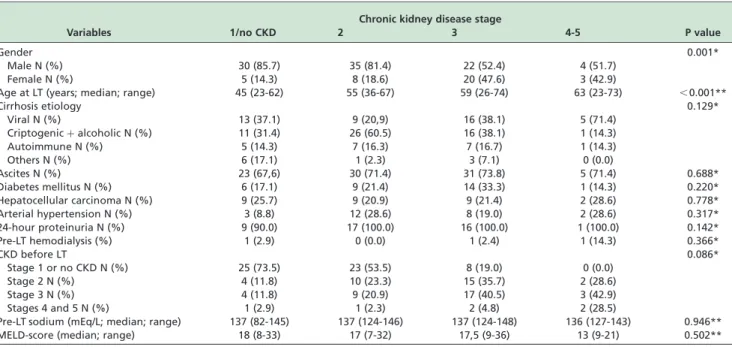
In the multivariate analysis, the variables independently associated with post-LT CKD stage were: recipient’s age at LT and gender, median of the tacrolimus concentrations in the first three months post-LT, and median of the serum creatinine levels in the first six months post-LT (Table 4). For each year increase in the recipient’s age at LT, the risk of developing stages 4-5 CKD at two years post-LT was 1.22 times higher; for each unit increase in the median of the
Table 1 -Frequency of pre-liver transplantation factors and their comparison with the chronic kidney disease stage at two years after liver transplantation (univariate analysis)
Chronic kidney disease stage
Variables 1/no CKD 2 3 4-5 P value
Gender 0.001*
Male N (%) 30 (85.7) 35 (81.4) 22 (52.4) 4 (51.7)
Female N (%) 5 (14.3) 8 (18.6) 20 (47.6) 3 (42.9)
Age at LT (years; median; range) 45 (23-62) 55 (36-67) 59 (26-74) 63 (23-73) ,0.001**
Cirrhosis etiology 0.129*
Viral N (%) 13 (37.1) 9 (20,9) 16 (38.1) 5 (71.4)
Criptogenicþalcoholic N (%) 11 (31.4) 26 (60.5) 16 (38.1) 1 (14.3)
Autoimmune N (%) 5 (14.3) 7 (16.3) 7 (16.7) 1 (14.3)
Others N (%) 6 (17.1) 1 (2.3) 3 (7.1) 0 (0.0)
Ascites N (%) 23 (67,6) 30 (71.4) 31 (73.8) 5 (71.4) 0.688*
Diabetes mellitus N (%) 6 (17.1) 9 (21.4) 14 (33.3) 1 (14.3) 0.220*
Hepatocellular carcinoma N (%) 9 (25.7) 9 (20.9) 9 (21.4) 2 (28.6) 0.778*
Arterial hypertension N (%) 3 (8.8) 12 (28.6) 8 (19.0) 2 (28.6) 0.317*
24-hour proteinuria N (%) 9 (90.0) 17 (100.0) 16 (100.0) 1 (100.0) 0.142*
Pre-LT hemodialysis (%) 1 (2.9) 0 (0.0) 1 (2.4) 1 (14.3) 0.366*
CKD before LT 0.086*
Stage 1 or no CKD N (%) 25 (73.5) 23 (53.5) 8 (19.0) 0 (0.0)
Stage 2 N (%) 4 (11.8) 10 (23.3) 15 (35.7) 2 (28.6)
Stage 3 N (%) 4 (11.8) 9 (20.9) 17 (40.5) 3 (42.9)
Stages 4 and 5 N (%) 1 (2.9) 1 (2.3) 2 (4.8) 2 (28.5)
Pre-LT sodium (mEq/L; median; range) 137 (82-145) 137 (124-146) 137 (124-148) 136 (127-143) 0.946**
MELD-score (median; range) 18 (8-33) 17 (7-32) 17,5 (9-36) 13 (9-21) 0.502**
*Chi-squared test. **Kruskal-Wallis test.
Abbreviations. CKD: chronic kidney disease; LT: liver transplantation; MELD: Model for End-Stage Liver Disease.
Table 2 -Frequency of peri-liver transplantation factors and their comparison with the chronic kidney disease stage at two years after liver transplantation (univariate analysis)
Chronic kidney disease stage
Variables 1/no CKD 2 3 4-5 P value
Peri-LT transfusion of PRC 0.285*
No transfusion N (%) 17 (48.6) 17 (39,5) 12 (29.3) 3 (42.9)
1-2 units N (%) 9 (25.7) 12 (27.9) 14 (34.1) 1 (14.3)
3-5 units N (%) 6 (17.1) 8 (18.6) 10 (24.4) 2 (28.6)
6-10 units N (%) 1 (2.9) 6 (14.0) 4 (9.8) 1 (14.3)
.10 units N (%) 2 (5.7) 0 (0.0) 1 (2.4) 0 (0.0)
Cold ischemia time 0.708*
,12 hours N (%) 9 (69.2) 17 (85.0) 17 (73.9) 2 (100.0)
Gender of donor 0.052*
Male N (%) 18 (51.4) 26 (60.5) 26 (61.9) 7 (100.0)
Female N (%) 17 (48.6) 17 (39.5) 16 (38.1) 0 (0.0)
Age of donor (years; median; range) 29 (17-58) 34 (8-62) 40 (6-58) 30 (22-46) 0.674**
*Chi-squared test. **Kruskal-Wallis test.
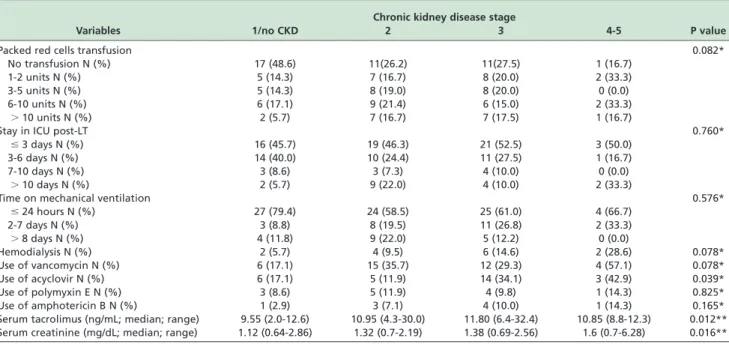
serum tacrolimus concentrations in the first three months after LT, the risk of developing stages 4-5 CKD at two years after LT was 1.69 times higher; and for each unit increase in the median of the serum creatinine levels during the first six months post-LT, the risk of developing CKD (stages 2 to 4-5) at two years post-LT was 5.2 times higher (Table 4).
The results of the univariate analysis comparing the pre-, peri- and post-LT factors and survival after LT are shown in Table 5. In the multivariate analysis, two variables showed independent association with death in two years post-LT: stay in the ICU after the LT surgery for three or more days, and median of serum creatinine levels in the first six months post-LT $1.3 mg/dL. These cut-off values were selected because they were the median values of the variables “length of stay in the ICU” and “median serum creatinine levels during the first six months post-LT”.
The risk of death in two years post-LT of the patients who stayed in the ICU for three days or more was 15.45 times the risk of the patients who stayed fewer than three days in the ICU (OR ¼15.45; 95% CI ¼2.01-118.76; p¼0.008) as seen in Figure 1. The risk of death in two years after LT of the patients with median serum creatinine concentrations in the
first six months post-LT$1.3 mg/dL was 4.26 times the risk of those with a median ,1.3 mg/dL (OR ¼4.26; 95% CI ¼1.33-13.62; p¼0,015), as shown in Figure 2.
B DISCUSSION
CKD is a common complication after LT and is associated with increased morbidity and mortality.2 – 6 Data from the Scientific Registry of Transplant Recipients demonstrate that the incidence of stages 4-5 CKD after LT at one, three, and five years is 8%, 14%, and 18%, respectively, increasing to approximately 25% by 10 years after the transplant.2The risk of CKD and the need for long-term hemodialysis will increase further, given the trend toward increasing longevity in the overall population of recipients of LT.2,7Considering the high incidence of chronic renal failure and the high risk of death associated with it, identifying risk factors for CKD becomes important in order to adopt preventive measures early.
In the present study, the risk factors independently associated with CKD stage, at two years post-LT, were recipient’s age at LT and male gender, and serum levels of
Table 3 -Frequency of post-liver transplantation factors and their comparison with the chronic kidney disease stage at two years after liver transplantation (univariate analysis)
Chronic kidney disease stage
Variables 1/no CKD 2 3 4-5 P value
Packed red cells transfusion 0.082*
No transfusion N (%) 17 (48.6) 11(26.2) 11(27.5) 1 (16.7)
1-2 units N (%) 5 (14.3) 7 (16.7) 8 (20.0) 2 (33.3)
3-5 units N (%) 5 (14.3) 8 (19.0) 8 (20.0) 0 (0.0)
6-10 units N (%) 6 (17.1) 9 (21.4) 6 (15.0) 2 (33.3)
.10 units N (%) 2 (5.7) 7 (16.7) 7 (17.5) 1 (16.7)
Stay in ICU post-LT 0.760*
#3 days N (%) 16 (45.7) 19 (46.3) 21 (52.5) 3 (50.0)
3-6 days N (%) 14 (40.0) 10 (24.4) 11 (27.5) 1 (16.7)
7-10 days N (%) 3 (8.6) 3 (7.3) 4 (10.0) 0 (0.0)
.10 days N (%) 2 (5.7) 9 (22.0) 4 (10.0) 2 (33.3)
Time on mechanical ventilation 0.576*
#24 hours N (%) 27 (79.4) 24 (58.5) 25 (61.0) 4 (66.7)
2-7 days N (%) 3 (8.8) 8 (19.5) 11 (26.8) 2 (33.3)
.8 days N (%) 4 (11.8) 9 (22.0) 5 (12.2) 0 (0.0)
Hemodialysis N (%) 2 (5.7) 4 (9.5) 6 (14.6) 2 (28.6) 0.078*
Use of vancomycin N (%) 6 (17.1) 15 (35.7) 12 (29.3) 4 (57.1) 0.078*
Use of acyclovir N (%) 6 (17.1) 5 (11.9) 14 (34.1) 3 (42.9) 0.039*
Use of polymyxin E N (%) 3 (8.6) 5 (11.9) 4 (9.8) 1 (14.3) 0.825*
Use of amphotericin B N (%) 1 (2.9) 3 (7.1) 4 (10.0) 1 (14.3) 0.165*
Serum tacrolimus (ng/mL; median; range) 9.55 (2.0-12.6) 10.95 (4.3-30.0) 11.80 (6.4-32.4) 10.85 (8.8-12.3) 0.012** Serum creatinine (mg/dL; median; range) 1.12 (0.64-2.86) 1.32 (0.7-2.19) 1.38 (0.69-2.56) 1.6 (0.7-6.28) 0.016**
*Chi-squared test. **Kruskal-Wallis test.
Abbreviations. CKD: chronic kidney disease; LT: liver transplantation; ICU: Intensive Care Unit; Serum tacrolimus: first three months post-LT; Serum creatinine: first six months post-LT.
Table 4 -Multivariate analysis for chronic kidney disease stage after liver transplantation
Comparisons between chronic kidney disease stages
Covariables 1 versus (2þ3þ4/5) 1þ2 versus 3þ4/5 1þ2þ3 versus 4/5
Coef1 OR1 (95% CI) Coef 2 OR2 (95% CI) Coef 3 OR3 (95% CI)
Male 1.855 6.40 (2.42-16.9) 1.855 6.40 (2.42-16.9) 1.855 6.40 (2.42-16.9)
Age at LT 0.082 1.09 (1.02-1.15) 0.199 1.22 (1.11-1.33)
FK Median 0.131 1.14 (1.00-1.30) 0.524 1.69 (1.33-2.14)
Cr Median 1.653 5.20 (2.26-12.0) 1.653 5.20 (2.26-12.0) 1.653 5.20 (2.26-12.0)
tacrolimus and creatinine in the first three and six months post-LT, respectively. Mortality in two years post-LT was associated with a stay in the ICU after the transplant surgery for a period equal or longer than three days, and with a median of serum creatinine levels in the first six months after LT$1.3 mg/dL.
Advanced age of recipients has already been identified as a risk factor for the development of CKD after LT.2,19 – 21This finding was somewhat expected since renal function declines with increasing age, particularly over the age of 60 years.19 On the other hand, the female gender has been
identified by other authors as more commonly associated with CKD post-LT than males.2,20,22,23These non-modifiable factors should be used to help identify patients at higher risk of CKD in our population of post-LT patients.
Calcineurin inhibitors therapy has been implicated as a major cause of post-transplant renal dysfunction24,25, since
these agents may cause severe tubular atrophy, interstitial fibrosis, and focal hyalinosis of small renal arteries and arterioles.26 – 31In the present study, early tacrolimus levels
were associated with CKD development after LT. Fisher et al.32showed that cyclosporine-A levels at one month and a cumulative dose of this agent at five years post-LT were associated with the development of severe CKD in LT recipients. In a Korean population of 431 patients submitted to LT, rapid progression of kidney disease was associated with tacrolimus levels above the target range at one, three and six months post-LT (target range: 8-13 ng/mL at one and thee months, and 5-10 ng/mL at six months).16Calcineurin inhibitors levels minimizing protocols are expected to reduce CKD development in LT recipients, as well as creatinine levels in the first months after the transplant. This last condition was demonstrated to be associated with CKD and survival at two years post-LT in the present study. Most of
Table 5 -Comparison between pre-, peri- and post-liver transplantation factors and the occurrence of death at two years after liver transplantation (univariate analysis)
Kaplan Meier
P value Cox regression
Variables OR (95% CI) P value
Age at LT.56 years 0.703 1.176 (0.510-2.714) 0.703
Gender 0.389
Male 1.460 (0.613-3.484) 0.392
Cirrhosis etiology 0.385
Viral 1.000 0.413
Cryptogenic and ethanolic 0.592 (0.221-1.591) 0.299
Autoimmune hepatopathy 0.684 (0.185-2.527) 0.569
Other etiologies 1.758 (0.476-6.495) 0.398
Pre-LT hemodialysis 0.004 6.528 (1.514-28.159) 0.012
MELD-score.18 0.910 1.049 (0.453-2.429) 0.910
INR.1.61 0.319 0.651 (0.278-1.524) 0.323
Total pre-LT bilirubin (.2.7mg/dL) 0.995 0.998 (0.432-2.301) 0.995
Age of donor.33 years 0.124 1.953 (0.819-4.656) 0.131
Gender of donor 0.765
Male 1.142 (0.479-2.721) 0.765
Peri-LT PRC transfusion 0.095
No transfusion 0.219 (0.024-1.959) 0.174
1-2 units 0.462 (0.056-3.844) 0.475
3-5 units 1.003 (0.125-8.028) 0.997
6-10 units 0.447 (0.040-4.932) 0.511
.10 units 1.000 0.141
Days stay at ICU 0.003
$3 days 9.475 (2.197-40.86) 0.000
Time on mechanical ventilation 0.000
1 day 0.049 (0.013-0.178) 0.000
2-7 days 0.438 (0.166-1.154) 0.095
$8 days 1.000 0.000
Post-LT hemodialysis 0.000 8.893 (3.714-21.290) 0.000
Post-LT PRC transfusion 0.000
No transfusion 0.117 (0.032-0.433) 0.001
1-2 units 0.067 (0.008-0.529) 0.010
3-5 units 0.146 (0.031-0.678) 0.014
6-10 units 0.446 (0.158-1.255) 0.126
.10 units 1.000 0.002
FK median.10.6ng/mL 0.206 1.750 (0.726-4.226) 0.212
Cr median.1.3mg/dL 0.040 2.876 (0.999-8.279) 0.050
Pre-LT CKD stage 0.144
Stage 1 1.000 0.174
Stage 2 1.618 (0.494-5.301) 0.427
Stage 3 2.944 (1.047-8.277) 0.041
Stages 4-5 3.378 (0.681-16.761) 0.136
our patients (81.8%) did not receive mycophenolate mofetil. The association of this agent with the calcineurin inhibitor could have allowed the prescription of lower doses of the last drug and, thus, lower serum tacrolimus levels.
Other studies have already demonstrated that early post-LT kidney dysfunction is associated with CKD development and mortality.32 – 34 This finding suggests that all possible measures should be adopted early to spare renal function after LT, such as avoiding the use of nephrotoxic agents whenever possible, prevent hemodynamic insults to the kidneys and adopting calcineurin inhibitors levels minimiz-ing protocols.
In the present study, we did not find any relationship between pre- and post-LT renal failure and neither between renal dysfunction before LT and mortality post-LT, in contrast to what was observed by others.2,3,7,11,23,24,28,35,36 However, it should be pointed out that our results could
have been influenced by the small number of cases of CKD stages 4 and 5. On the other hand, renal dysfunction in the first six months post-LT was associated with CKD and mortality in the first two years after LT in this study. These findings emphasize the importance of early measures to preserve renal function after LT.
Because serum creatinine is a key component of the MELD-score and impaired pre-LT renal function is con-sidered to be a poor prognostic indicator for both survival and post-LT CKD, a reduction in patient survival was expected after the implementation of this score for ordering patients in the waiting list for LT. However, different studies have shown that the MELD-score predicted neither the development of advanced CKD nor mortality more than one year after LT,5,12,33,37which is in agreement with our findings since, even in the univariate analysis, this variable was not associated with CKD stage or mortality, two years post-LT.
HCV infection has been identified as a risk factor for the development of CKD stages 4 and 5 after LT.3,7,33 This association was not observed in this study, which may be explained, at least partially, by the small number of cases with the more advanced stages of CKD. In a recent study that compared patients transplanted for hepatitis C-related cirrhosis to other etiologies, with similar MELD-scores and mean pre-LT serum creatinine levels, the authors did not find any difference between the two groups regarding the estimated GFR, requirement for dialysis and death in three years post-LT.38 The variables diabetes mellitus and hypertension were not identified as risk factors for CKD development after LT in our cohort. However, these conditions were associated with CKD post-LT in other studies.2,3,7,11,23,24,28
A stay in the ICU after the LT surgery for a period equal or longer than three days was associated with higher mortality in the first two years post-LT. This finding probably reflects the severity of patients who need intensive care for longer time. It is interesting to remark that higher mortality in patients requiring a longer stay in ICU occurred during the first year as shown in Figure 1.
This study was limited because it was retrospective, included a small numbers of patients with the more advanced stages of CKD, and GFR was calculated using a creatinine-based method, which often leads to overestima-tions of renal function in cirrhotic patients before LT, especially in those with poor nutritional status, low muscle mass, weight loss, and edema.31,33
B CONCLUSIONS
The judicious use of calcineurin inhibitors during the early post-LT period may help to preserve kidney function. Therefore, the administration of the lowest effective dose of these drugs and the association with other non-nephrotoxic immunosuppressive agents in the first months after LT may be strategies to spare renal function, avoiding late CKD and increasing long term survival, particularly in patients at high risk. Long term studies are necessary to confirm this hypothesis.
B ACKNOWLEDGEMENTS
Branda˜o VBA, Faria LC and Ferrari TCA: conceived and designed the study, and prepared the manuscript; Branda˜o VBA and Bicalho DM: collected data. Pereira FH performed statistical analysis. Branda˜o VBA, Faria LC, Bicalho Figure 2 -Two-year survival by median of the serum creatinine
levels during the first six months after liver transplantation.
DM, Pereira FH and Ferrari TCA: analyzed and interpreted the data. Lima AS: provided intellectual content of critical importance to the study. All authors read and approved the final version of the manuscript.
B RESUMO
OBJETIVO:Investigar fatores de risco para o desenvolvimento de doenca renal croˆnica e o´bito dois anos apo´s transplante hepa´tico.
ME´TODO: Associaco˜es entre paraˆmetros clı´nicos e laboratoriais e o desenvolvimento de doenca renal croˆnica e sobrevida dois anos po´s-transplante hepa´tico foram analisados em uma coorte de 148 pacientes adultos, com cirrose hepa´tica, submetidos consecutivamente a transplante de fı´gado em centro de refereˆncia no Brasil.
RESULTADOS:A idade mediana ao transplante hepa´tico foi 56 (limites, 20-73) anos, e 105 (70,9%) pacientes eram do geˆnero masculino. A prevaleˆncia de doenca renal croˆnica dois anos po´s-transplante hepa´tico foi: esta´dio 1 ou auseˆncia de doenca renal, 27,5%; esta´dio 2, 33,8%; esta´dio 3, 34,6%; esta´dios 4-5, 4,7%. Quatro varia´veis apresentaram associaca˜o independente com o esta´dio de doenca renal croˆnica, dois anos po´s-transplante hepa´tico: (i) idade ao transplante hepa´tico, (ii) geˆnero masculino, (iii) mediana dos nı´veis de tacrolimus nos primeiros treˆs meses po´s-transplante hepa´tico e (iv) mediana das concentraco¨es se´ricas de creatinina nos primeiros seis meses po´s-transplante hepa´tico. Duas varia´veis apresentaram associaca˜o independente com o´bito dois anos po´s-transplante hepa´tico: permaneˆncia em Unidade de Terapia Intensiva por treˆs ou mais dias apo´s a cirurgia de transplante, e mediana das concentraco˜es se´ricas de creatinina nos primeiros seis e treˆs meses apo´s o transplante hepa´tico igual ou superior a 1,3 mg/dL. CONCLUSO˜ ES:Administraca˜o da menor dose eficaz de tacrolimus e adoca˜o de medidas para preservar a funca˜o renal sa˜o medidas importantes para se reduzir o risco de desenvolvimento de doenca renal croˆnica, tardiamente, apo´s o transplante de fı´gado, especialmente nos pacientes que apresentam fatores de risco.
B REFERENCES
1. Wilkinson A, Pham PT. Kidney dysfunction in the recipients of liver transplants. Liver Transpl. 2005;11(Suppl 2):47-51.
2. Ojo AO, Held PJ, Port FK, Wolfe RA, Leichtman AB, Young EW, et al., Chronic renal failure after transplantation of a nonrenal organ. N Engl J Med. 2003;349(10):931-40.
3. Yalavarthy R, Edelstein CL, Teitelbaum I. Acute renal failure and chronic kidney disease following liver transplantation. Hemodial Int. 2007;11 (Suppl 3):S7-12.
4. Newell GC. Cirrhotic glomerulonephritis: incidence, morphology, clinical features, and pathogenesis. Am J Kidney Dis. 1987;9(3):183-90. 5. Amore A, Coppo R, Roccatello D, Piccoli G, Mazzucco G, Gomez-Chiarri
M, et al. Experimental IgA nephropathy secondary to hepatocellular injury induced by dietary deficiencies and heavy alcohol intake. Lab Invest. 1994;70(1):68-77.
6. Sabry A. A, Sobh MA, Irving WL, Grabowska A, Wagner BE, Fox S, et al. A comprehensive study of the association between hepatitis C virus and glomerulopathy. Nephrol Dial Transplant. 2002;17(2):239-45.
7. Weir MR, Fink JC. Risk for posttransplant diabetes mellitus with current immunosuppressive medications. Am J Kidney Dis. 1999;34(1):1-13. 8. Moreno JM, Cuervas-Mons V, Rubio E, Pons F, Herreros de TA,
Turrio´n VS, et al. Chronic renal dysfunction after liver transplantation in adult patients: prevalence, risk factors, and impact on mortality. Transplan Proc. 2003;35(5):1907-8.
9. Pillebout E, Nochy D, Hill G, Conti F, Antoine C, Calmus Y, et al. Renal histopathological lesions after orthotopic liver transplantation (OLT). Am J Transplant. 2005;5(5):1120-9.
10. Al Riyami D, Alam A, Badovinac K, Ivis F, Trpeski L, Cantarovich M. Decreased survival in liver transplant patients requiring chronic dialysis: a Canadian experience. Transplantation. 2008;85(9):1277-80.
11. Pawarode A, Fine DM, Thuluvath PJ. Independent risk factors and natural history of renal dysfunction in liver transplant recipients. Liver Transpl. 2003;9(7):741-7.
12. Gonwa TA, McBride MA, Anderson K, Mai ML, Wadei H, Ahsan N, et al. Continued influence of preoperative renal function on outcome of orthotopic liver transpl (OLTX) in the US: where will MELD lead us? Am J Transpl. 2006;6(11):2651-9.
13. Cohen AJ, Stegall MD, Rosen CB, Wiesner RH, Leung N, Kremers WK, et al. Chronic renal dvsfunction late after liver transplantation. Liver Transpl. 2002;8(10):916-21.
14. Narciso RC, Ferraz LR, Rodrigues CJ, Monte JC, Mie S, dos Santos OF, et al. Low estimated glomerular filtration rate and chronic kidney failure following liver transplant: a retrospective cohort study. Int J Artif Organs. 2013;36(7):498-505.
15. Boin IF, de Ataide EC, Dias EP, Stucchi RS, Seva-Pereira T, Calomeni G, et al. Can pre-liver transplantation renal insufficiency using a creatinine clearance calculator predict long-term survival? Transplant Proc. 2012;44 (8):2452-4.
16. Cockcroft DW, Gault MH. Prediction of creatinine clearance from serum creatinine. Nephron. 1976;16(1):31-41.
17. Kamath PS, Wiesner R, Malinchoc M, Kremers W, Therneau TM, Kosberg CL, et al. A model to predict survival in patients with end-stage liver disease. Hepatology. 2001;33(2):464-70.
18. Wiesner R, Edwards E, Freeman R, Harper A, Kim R, Kamath P, et al. Model for end-stage liver disease (MELD) and allocation of donor livers. Gastroenterology. 2003;124(1):91-6.
19. National Kidney Foundation. K/DOQI clinical practice guidelines for chronic kidney disease: Evaluation, classification, and stratification. Am J Kidney Dis. 2002;39:S1-266.
20. O’Riordan A, Wong V, McCormick PA, Hegarty JE, Watson AJ. Chronic kidney disease post-liver transplantation. Nephrol Dial Transplant. 2006;21(9):2630-6.
21. Lee JP, Heo NJ, Joo KW, Yi NJ, Suh KS, Moon KC, et al. Risk factors for consequent kidney impairment and differential impact of liver transplantation on renal function. Nephrol Dial Transplant. 2010; 25(8):2772-85.
22. Ramachandran J, Juneja R, John L, Dutta AK, Chen JW, Woodman RJ, et al. Chronic kidney disease following liver transplantation: a South Australian experience. Transplant Proc. 2010;42(9):3644-6.
23. Leithead JA, Ferguson JW, Hayes PC. Modifiable patient factors are associated with the late decline in renal function following liver transplantation. Clin Transplant. 2012;26(3):E316-23.
24. Bennett WM. Insights into chronic cyclosporine nephrotoxicity. Int J Clin Pharmacol Ther. 1996;34(11):515-9.
25. Bennett WM, DeMattos A, Meyer MM, Andoh T, Barry JM. Chronic cyclosporine nephropathy: the Achilles’ heel of immunosuppressive therapy. Kidney Int. 1996;50(4):1089-100.
26. Myers BD. Cyclosporine nephrotoxicity. Kidney Int. 1986;30(6):964-74. 27. Puschett JB, Greenberg A, Holley J, McCauley J. The spectrum of
ciclosporin nephrotoxicity. Am J Nephrol. 1990;10(4):296-309.
28. Iwatsuki S, Esquivel CO, Klintmalm GB, Gordon RD, Shaw BW Jr, Starzl TE. Nephrotoxicity of cyclosporine in liver transplantation. Transplant Proc. 1985;17(Suppl 1):191-5.
29. Porayko MK, Gonwa TA, Klintmalm GB, Wiesner RH. Comparing nephrotoxicity of FK 506 and cyclosporine regimens after liver transplantation: preliminary results from US Multicenter trial. Transplant Proc. 1995;27(1):1114-6.
30. Wheatley HC, Datzman M, Williams JW, Miles DE, Hatch FE. Long-term effects of cyclosporine on renal function in liver transplant recipients. Transplantation. 1987;43(5):641-7.
31. Young EW, Ellis CN, Messana JM, Johnson KJ, Leichtman AB, Mihatsch MJ, et al. A prospective study of renal structure and function in psoriasis patients treated with cyclosporin. Kidney Int. 1994;46(4):1216-22. 32. Fisher NC, Nightingale PG, Gunson BK, Lipkin GW, Neuberger JM.
Chronic renal failure following liver transplantation: a retrospective analysis. Clin Transplant. 1998;66(1):59-66.
33. Cantarovich M, Tchervenkov J, Paraskevas S, Ghali P, Wong P, Descheˆnes M, et al. Early changes in kidney function predict long-term chronic kidney disease and mortality in patients after liver transplantation. Transplantation. 2011;92(12):1358-63.
34. Kamar N, Guilbeau-Frugier C, Servais A, Tack I, Thervet E, Cointault O, et al. Kidney histology and function in liver transplant patients. Nephrol Dial Transplant. 2011;26(7):2355-61.
35. Bahirwani R, Campbell MS, Siropaides T, Markmann J, Olthoff K, Shaked A, et al. Transplantation: impact of pretransplant renal insufficiency. Liver Transpl. 2008;14(5):665-71.
36. Fabrizi F, Dixit V, Martin P, Messa P. Pre-transplant kidney function predicts chronic kidney disease after liver transplant: meta-analysis of observational studies. Dig Dis Sci. 2011;56(5):1282-9.
37. Weber ML, Ibrahim HN, Lake JR. Renal dysfunction in liver transplant recipients: evaluation of the critical issues. Liver Transpl. 2012; 18(11):1290-301.