American Journal of Applied Sciences 6 (11): 1920-1923, 2009 ISSN 1546-9239
© 2009 Science Publications
Corresponding Author: S. Seddighi Chaharborj, Department of Mathematics, Faculty of Science,
University Putra Malaysia, 43400 UPM, Malaysia Tel: +60-17-3009481 Fax: +60-389-437958 1920
Knowledge of the Most-at-Risk Populations about Human Immunodeficiency
Virus
Prevention
1
A. Ebadian,
2V. Alli,
3H. Sedghi,
4S. Seddighi Chaharborj and
4I. Fudziah
1
Department of Mathematics, Faculty of Science, Urmia, University, Urmia, Iran
2
Institute of Mathematical Sciences, Faculty of Science,
University of Malaya, 50603 Kuala Lumpur, Malaysia
2
Department of Mathematics, Imam Hossein University, Tehran, Iran
3
Department of Physics, Faculty of Science, Urmia, University, Urmia, Iran
4
Department of Mathematics, Faculty of Science, University Putra Malaysia, 43400 UPM Malaysia
Abstract: Problem statement: In this study we tried to assess the knowledge of general population (15-45 years), injecting drug users, female sex workers, MSM and male prisoners about HIV prevention in Iran. Approach: Respondents are asked the following set of prompted questions: (a) Can we reduce the risk of HIV transmission by having sex with only one uninfected partner who has no other partners? (b) Can we reduce the risk of getting HIV by using a condom every time we have sex? (c) Can have HIV a healthy-looking person? (d) Can a person get HIV by sharing food with someone who is infected? (e) Can a person get HIV from mosquito bits? Results: In this study at compared with the resent studies we saw that, the general knowledge on the effect of consistent and correct use of condom as means of HIV prevention has been increased. There is a decrease in the number of the youth that assume sting of a mosquito can transmit HIV. There were no remarkable change in the perception of the thought that HIV is not transmitted through eating and the possibility of people living with HIV are safe. Conclusion: The current meta-analysis indicated that the awareness on the positive effect of condomization on HIV prevention has increased in recent years, but it is still far from being satisfactory and other basic knowledge about HIV has not improved and there is still a substantial gap with the desired figures.
Key words: Knowledge, prevention, transmission, female sex workers, male and female IDUs, male prisoners, MSM
INTRODUCTION
The Acquired Immunodeficiency Syndrome (AIDs) epidemic is in its third decade and has become a pandemic disease that threatens the world populations. It affects all body systems as well as the mental health and social relationship of carriers and asymptomatic patients.
In Iran the first case of Human Immunodeficiency Virus (HIV) was reported in 1987. This was followed by a rapid increase in the number of cases. In 2003, officially there were 5086 Iranian living with HIV/AIDs, of which, 4838 were male and 248 were female. According to official data in Iran, 67% of AIDs patients are intravenous drug users and 9% of cases grouped under unspecified route of transmission. It if feared that the HIV/AIDs situation in Iran may be more serious than these published data indicate and the main
concern is the potential spread of infection from injecting drug users to the general population. The strategic geographic situation of Iran and its long borders with the countries of the Golden Grescent (Afghanistan and Pakistan), which produce a substantial proportion of the words heroin, have confronted Iran with the problems of drug trafficking and concomitant drug addiction within the country[1].
Am. J. Applied Sci., 6 (11): 1920-1923, 2009
1921 patterns in young people, which might endure into adulthood. Since there are uncontrolled sexual contacts, high prevalence of addiction, absence or limited sex education and higher marriage age in Iran, the Iranian youth are counted as a high risk group for HIV infection. Moreover, because of unreasonable fears among most Iranian people that AIDs education promotes high risk behaviors, sex education about HIV transmission has no place in schools and universities in Iran. Accordingly, the current HIV/AIDs situation and the fact that antiretroviral drugs are not affordable and available for treating vast numbers of HIV-positive individuals makes primary prevention of HIV infection seem the most important concept in controlling the epidemic[6-22].
MATERIALS AND METHODS
In this study we tried to assess the knowledge of general population (15-45 years), injecting drug users, female sex workers, MSM and male prisoners about HIV prevention in Iran. Respondents are asked the following set of prompted questions: (a) Can we reduce the risk of HIV transmission by having sex with only one uninfected partner who has no other partners? (b) Can we reduce the risk of getting HIV by using a condom every time we have sex? (c) Can have HIV a healthy-looking person? (d) Can a person get HIV by sharing food with someone who is infected? (e) Can a person get HIV from mosquito bits?
RESULTS
Figure 1-6 are results of this study.
Figure: For Fig. 1-6 we have:
a: Can we reduce the risk of HIV transmission by having sex with only one uninfected partner who has no other partners?
b: Can we reduce the risk of getting HIV by using a condom every time we have sex?
c: Can have HIV a healthy-looking person?
d: Can a person get HIV by sharing food with someone who is infected?
e: Can a person get HIV from mosquito bits?
DISCUSSION
In Fig. 1, we observe that the knowledge of female in all ages about reduce the risk of getting HIV by using condom every time we have sex (66%) and getting HIV from mosquito bits (64.64%) are better than other cases.
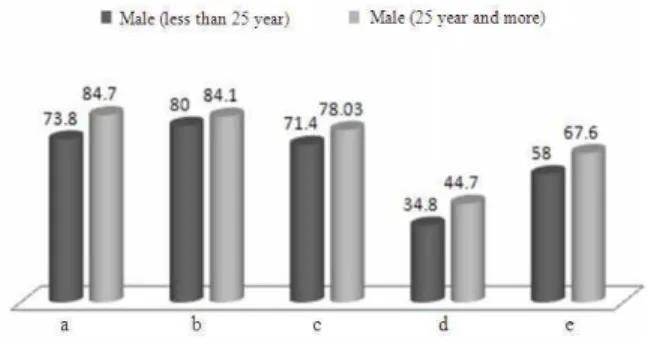
In this group the knowledge about reduce the risk of HIV transmission by having sex with only one uninfected partner who has no other partner (34.64%) and getting HIV by sharing food with someone who is infected (44.64%) are poor. Figure 2, show that the knowledge of male IDUs (25 years and more) (84.7, 84.1, 78.03 and 67.6%) is better than of male IDUs (less than 25 years) (73.8, 80, 71.4, 34.8 and 58%). Also in Fig. 2 we fond that the knowledge of the male IDUs for all ages about questions d, (34.8 and 44.7%) is poor. Figure 3 show that the knowledge of female IDUs for all ages about questions a, b and e is proper, but it is improper about questions c and d. We have to increase the knowledge of female IDUs about all questions, especially about questions c and d.
Fig. 1: Knowledge of female sex workers about HIV prevention
Fig. 2: Knowledge of male IDUs about HIV prevention
Am. J. Applied Sci., 6 (11): 1920-1923, 2009
1922
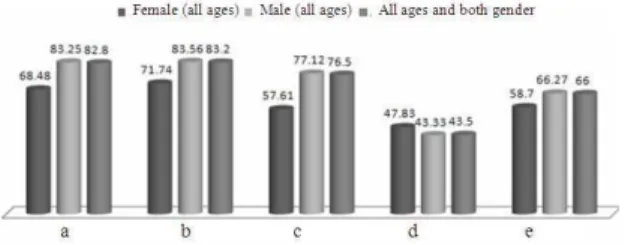
Fig. 4: Knowledge of male and female IDUs about HIV prevention
Fig. 5: Knowledge of male prisoners about HIV prevention
Fig. 6: Knowledge of MSM about HIV prevention
Generally, in Fig. 4, we observe that the knowledge of male IDUs (all ages) about HIV prevention is better than of the knowledge of female IDUs (all ages). In Fig. 4, we compared the knowledge of IDUs HIV prevention for male (all ages) and female (all ages) and both all ages. We see that the knowledge of IDUs (male) for all ages (83.25, 83.56, 77.12 and 66.27%) about questions a, b, c and e, is better than of the knowledge of IDUs (female) for all ages (68.48, 71.74, 57.61 and 58.7%). The knowledge of them is almost same about question d. Figure 5, show that the knowledge of male prisoners about HIV prevention is suitable about questions a, b and c, but it is poor about questions d, e. Also we observed that the knowledge of male prisoners (25 years and more) (64.2%) is better than male prisoners (less than 25) (30%).
From Fig. 6, we conclude that the knowledge of all groups about questions d is poor and the knowledge of MSM (less than 25 years) is unsuitable about questions b, c and e, (53.3, 45.1 and 30%).
CONCLUSION
The results show that the knowledge of all ages about getting HIV by sharing food with someone who is infected (d), is poor and the knowledge of female sex workers about HIV prevention for reducing the risk of HIV transmission by having sex with only one uninfected partner who has no other partner is unsuitable. The addition of knowledge for all groups of people about HIV prevention is very important for reduce the risk of HIV transmission. Thus, we must to increase the knowledge of all groups of people especially youth people about HIV transmission.
REFERENCES
1. Becker, N.G. and K. Dietz, 1995. The effects of the household distribution on transmission and control of highly infectious diseases. Math. Biosci., 127: 207-219. DOI: 10.1016/0025-5564(94)00055-5
2. Blower, S.M. and A.R. Mclean, 1994. Prophylatic vaccines risk behavior change and the probability of eradicating HIV in San Francisco. Science, 265: 1451-1454. DOI: 10.1126/science.8073289 3. Diekmann, O. and Heesterbeek, J. A. P. 2000
Mathematical Epidemiology of Infectious Diseases: Model Building, Analysis and Interpretation. 1st Edn., Wiley, Chichester, IL., England, UK., ISBN: 13: 9780471492412
4. Diekmann, O., J.A.P. Heesterbeek and J.A.J. Metz, 1990. On the definition and computation of the basic reproduction ratio R0 in models for infectious
in heterogeneous populations. J. Math. Biol., 28: 365-382. DOI: 10.1007/BF00178324
5. Diekmann, O., K. Dietz and J.A.P. Heesterbeek, 1991. The basic reproduction ratio for sexually transmitted diseases, Part 1. Theoretical considerations. Math. Biosci., 107: 325-339. DOI: 10.1016/0025-5564(91)90012-8
6. Dietz, K., J.A.P. Heesterbeek and D.W. Tudor, 1993. The basic reproduction ratio for sexually transmitted disease, Part 2: Effects of variable HIV infectivity. Math. Biosci., 117: 35-47. DOI: 10.1177/096228029300200103
7. Gomes, M.G.M., L.J. White and G.F. Medley, 2004. Infection, reinjection and vaccination under suboptimal immune protection: epidemiological perspectives. J. Biol., 228: 539-549. DOI: 10.1016/j.jtbi.2004.02.015
Am. J. Applied Sci., 6 (11): 1920-1923, 2009
1923 9. Heesterbeek, J.A.P. and K. Dietz, 1996. The
concept of R0 in epidemic theory. Stat.
Neerlandica, 50: 89-110. DOI: 10.1111/j.1467-9574.1996.tb01482.x
10. Hethcote, H.W., 2000. The mathematics of infectious diseases. Siam Rev., 42: 599-653. DOI: 10.1137/S0036144500371907
11. Hyman, J.M. and J. Li, 1997. Disaese transmission models with biased partnership selection. Applied Numer. Math. 24: 379-392. DOI: 10.1016/S0025-5564(01)00093-1
12. Hyman, J.M., J. Li and E.A. Stanley, 1994. Threshold conditions for the spread of the HIV infection in age-structured populations of homosexual men. Theor. Biol., 166: 9-31. DOI: 10.1016/j.jtbi.2008.04.021
13. Hyman, J.M., J. Li and A.E. Stanley, 1999. The differential infectivity and staged progression models for the transmission of HIV. Math. Biosci., 155: 77-109. DOI: 10.1016/S0025-5564(98)10057-3
14. Inaba, H., 1990. Threshold and stability for an age-structured epidemic model. J. Math. Biol., 28: 411-434. DOI: 10.1007/BF00178326
15. Jacquez, J.A., C.P. Simon, J. Koopman, L. Sattenspiel and T. Perry, 1988. Modeling and analyzing HIV transmission: The effect of contact patterns. Math. Biosci., 92: 119-199. DOI: 10.1016/0025-5564(88)90031-4
16. Jacquez, J.A., C.P. Simon and J. Koopman, 1991. The reproductive number in deterministic models of contagious diseases. Comm. Theor. Biol., 2: 159-209. DOI: 10.1016/j.laa.2004.07.017
17. Jacquez, J.A., C.P. Simon and J. Koopman, 1995. Core groups and the ,
0
R s for subgroups in Heterogeneous SIS and SI Models. In: Epidemic Models: Their Structure and Relation to Data, Mollison, D. (Ed.). Cambridge University Press, Cambridge, pp: 279-301.
18. Lin, X., 1991. Qualitative analysis of an HIV transmission model, Math. Biosci., 104: 111-134. DOI: 10.1016/0025-5564(91)90033-F
19. Ross, R., 1910. The Prevention of Malaria. 2nd Edn., Dutton, London, pp: 669.
20. Sanchez, M.A. and S.M. Blower, 1997. Uncertainty and sensitivity analysis of the basic reproductive number. Am. J. Epidemiol., 145: 1127-1137. PMID: 9199543
21. Simon, C.P. and J.A. Jacquez, 1992. Reproductive numbers and the stability of equilibria of SI models for heterogeneous. SIAM J. Applied Math., 52: 541-576. DOI: 10.1137/0152030