Long-term evaluation of the antimicrobial susceptibility and microbial profile
of subgingival biofilms in individuals with aggressive periodontitis
Talita Gomes Baêta Lourenço
1, Débora Heller
1,2,3, Renata Martins do Souto
1,
Mayra Xavier e Silva-Senem
2, Victor Macedo Varela
2, Maria Cynesia Barros Torres
2,
Eduardo Jorge Feres-Filho
2, Ana Paula Vieira Colombo
1,2 1Instituto de Microbiologia, Universidade Federal do Rio de Janeiro, Brazil.
2
Departamento de Clínica Dentária, Universidade Federal do Rio de Janeiro, Brazil.
3
Oral Biology Departament, Goldman School of Medicine, Boston, MA, USA.
Submitted: September 25, 2013; Approved: November 11, 2014.
Abstract
This study evaluates the antimicrobial susceptibility and composition of subgingival biofilms in gen-eralized aggressive periodontitis (GAP) patients treated using mechanical/antimicrobial therapies, including chlorhexidine (CHX), amoxicillin (AMX) and metronidazole (MET). GAP patients allo-cated to the placebo (C, n = 15) or test group (T, n = 16) received full-mouth disinfection with CHX, scaling and root planning, and systemic AMX (500 mg)/MET (250 mg) or placebos. Subgingival plaque samples were obtained at baseline, 3, 6, 9 and 12 months post-therapy from 3-4 periodontal pockets, and the samples were pooled and cultivated under anaerobic conditions. The minimum in-hibitory concentrations (MICs) of AMX, MET and CHX were assessed using the microdilution method. Bacterial species present in the cultivated biofilm were identified by checkerboard DNA-DNA hybridization. At baseline, no differences in the MICs between groups were observed for the 3 antimicrobials. In the T group, significant increases in the MICs of CHX (p < 0.05) and AMX (p < 0.01) were detected during the first 3 months; however, the MIC of MET decreased at 12 months (p < 0.05). For several species, the MICs significantly changed over time in both groups,i.e., Strepto-cocciMICs tended to increase, while for several periodontal pathogens, the MICs diminished. A transitory increase in the MIC of the subgingival biofilm to AMX and CHX was observed in GAP pa-tients treated using enhanced mechanical therapy with topical CHX and systemic AMX/MET. Both protocols presented limited effects on the cultivable subgingival microbiota.
Key words:aggressive periodontitis, biofilms, microbial sensitivity tests, DNA probes.
Introduction
Generalized aggressive periodontitis (GAP) is a severe form of periodontal disease characterized by the widespread destruction of the periodontium at a high pro-gression rate in young subjects (Armitage, 1999). The ad-junctive use of antimicrobials combined with the mechani-cal removal of the subgingival biofilm has been demonstrated as an effective therapeutic strategy for treat-ing GAP (Herreraet al., 2002, 2008; Haffajeeet al., 2003). Specifically, the administration of amoxicillin (AMX) and metronidazole (MET), combined or not with the topical use
of chlorhexidine (CHX), provides significant clinical and microbiological benefits for GAP patients post-therapy (Guerreroet al., 2005). However, some patients with se-vere periodontal destruction do not respond favorably to mechanical/antimicrobial therapy (Colomboet al., 1998, 2009). Treatment failure might have several causes, includ-ing the existence of subginclud-ingival microbiota resistant to the drugs of choice (Listgartenet al., 1993, Mejiaet al., 1995). Antimicrobial resistance has become a serious problem for the treatment of a large number of infections worldwide. The inappropriate and irrational use of antimicrobials leads
Send correspondence to T.G.B. Lourenço. Instituto de Microbiologia Paulo de Góes, Universidade Federal do Rio de Janeiro, Bloco I, lab. I2-03; Av. Carlos Chagas Filho 373, Cidade Universitária, 21941-902 Rio de Janeiro, RJ, Brazil. E-mail: [email protected].
to the emergence, spread and persistence of resistant micro-organisms, resulting in prolonged illness and greater risk of death (Gootz, 2010). Thus, an effective antimicrobial pro-tocol for treating periodontitis should consider the severity of the disease, the general health of the host, the target mi-croorganisms, and the pharmacokinetics, adverse effects and costs of the drug (Seymour and Hogg, 2008, Heasman et al., 2011). Moreover, periodontal diseases are poly-microbial, and biofilm-related infections widely vary in mi-crobial composition and diversity among sites and individ-uals with similar clinical manifestations (Socransky and Haffajee, 2002). Bacterial species growing in biofilms are less susceptible to antimicrobial action (Costerton et al., 1999). Nevertheless, few studies have directly examined thein vitroantimicrobial susceptibility of subgingival pla-ques in biofilms or mixed cultures (Wright et al., 1997, Eicket al., 2004, Sedlacek and Walker, 2007). This assess-ment could provide additional information on the suscepti-bility of periodontal microbiota in GAP prior to the use of antimicrobials. Furthermore, subsequent evaluation of the drug administration might reveal potential changes in the resistance profile of this microbiota. Thus, the aims of the current study were to determine the bacterial composition and antimicrobial susceptibility profile of the subgingival biofilm in GAP patients before and up to 12 months after treatment with CHX, AMX, MET or placebo.
Material and Methods
Subject population
This study was conducted as a randomized, dou-ble-blinded, placebo-controlled, single-center, 12-month clinical trial as previously described (Helleret al., 2011, Varelaet al., 2011, Silva-Senemet al., 2013). The study protocol was approved through the Ethics in Human Re-search Committee of the Institute for Community Health Studies at the Federal University of Rio de Janeiro, Brazil (EHRC/ICHS-FURJ, protocol #45/2007). The subjects were selected between March 2008 and June 2009 from a pool of first-time patients referred to the Division of Gradu-ate Periodontics of the School of Dentistry at the Federal University of Rio de Janeiro (UFRJ), Brazil. Included pa-tients were diagnosed with GAP according to criteria of the American Academy of Periodontology (Armitage, 1999). In addition, the patients were between 18-39 years of age and had at least 16 teeth and 4 sites on different teeth (3 sites other than central incisors or first molars), with a probing pocket depth (PPD)³6 mm and clinical attachment level (CAL)³5 mm and bleeding on probing (BOP). The exclu-sion criteria were allergy to penicillin, MET or CHX; dia-betes; immunodeficiency; required antibiotic coverage for periodontal procedures; long-term use of anti-inflamma-tory medication; periodontal treatment and/or use of antibi-otics in the last 6 months; and pregnancy and nursing
(Helleret al., 2011, Varelaet al., 2011, Silva-Senemet al., 2013).
Clinical examination and treatment protocols
A trained and calibrated examiner (D. H.) performed clinical exams at baseline, 3, 6, 9 and 12 months post-therapy. The full-mouth clinical measurements included PPD, CAL, presence or absence of BOP, supragingival vis-ible plaque and gingival marginal bleeding. An experi-enced periodontist (V.M.C.) administered periodontal treatment. The patients received full-mouth debridement with ultrasonics, complemented by the irrigation of all pockets with a 0.2% CHX gel within 24 h. Additionally, pa-tients were instructed to rinse and gargle twice a day with a 0.12% CHX solution and brush the tongue with the same CHX gel for the next 45 days. The patients were subse-quently assigned either to the test (T, systemic administra-tion of AMX 500 mg + MET 250 mg) or the control group (C, placebo tablets). Antimicrobials or placebos were pre-scribed 3 times a day for 10 days, starting at the moment of assignment. In the following week, the patients were treated with staged quadrant manual scaling and root plan-ning, followed by pocket irrigation with 0.2% CHX gel within 4-6 weeks. The patients returned at 3, 6, 9 and 12 months for clinical re-evaluation, microbiological sam-pling, oral hygiene evaluation, and supragingival plaque and calculus removal. Furthermore, sites with PPD > 4 mm and BOP were re-instrumented under local anesthesia (Hel-ler et al., 2011, Varela et al., 2011, Silva-Senem et al., 2013).
Subgingival biofilm sampling
Subgingival biofilm samples were collected from 3-4 of the deepest sites (PPD) using individual sterile Gracey curettes (Hu-Friedy, Chicago, IL, USA). The material was pooled, placed into cryogenic tubes containing 1 mL of mycoplasma broth with 10% DMSO and stored at -20 °C.
Determination of the MIC
antimicro-bials diluted in PRAS-supplemented BHI broth to final concentrations ranging from 2% to 0.02%. Each microplate included positive (bacterial suspension without antimicro-bial treatment) and negative controls (medium only), and all experiments were performed in duplicate. The micro-plates were incubated under anaerobic conditions for 48 h at 37 °C. One examiner obtained visual readings. The MIC was defined as the lowest antimicrobial concentration yiel-ding no visual bacterial growth.
Determination of the Composition of the Subgingival Biofilm through Checkerboard DNA-DNA
Hybridization
The composition of the subgingival biofilm samples cultivated in the microplates without antimicrobials (posi-tive controls) at baseline, 3, 6, 9 and 12 months after treat-ment was determined using the checkerboard method (Socranskyet al., 1994), with modifications (Helleret al., 2011).
Statistical analysis
A statistical program (SPSS, Statistical Package for the Social Sciences, version 19.0, IBM) was used for all analyses. The clinical and demographic features of the groups were compared using the Mann-Whitney and Chi-square tests. The MICs of each antimicrobial for each pa-tient was averaged within the groups at all time points. Sig-nificant differences between groups and over time were ex-amined using the Mann-Whitney, Friedman and Wilcoxon signed rank tests. For the checkerboard data, the levels of each species were computed for each sample and patient and averaged within each group. For graphic presentation, the levels (scores 0 to 5) of each species in a sample were converted to absolute numbers and log10 transformed. Comparisons between groups over time were evaluated us-ing the Mann-Whitney and Friedman tests, whereas the dif-ferences between two time points were assessed using the Wilcoxon signed rank test. For the checkerboard analysis, adjustments for multiple comparisons were made accord-ing to Socransky et al. (1991). Briefly, an overall p of 0.05 = 1 - (1 - k)54was computed, where k was the desired individual p value. Thus, a p value < 0.00095 was consid-ered to be statistically significant at p < 0.05. The level of significance for all the other analyses was 5%.
Results
Information on adverse events, adherence to the local and systemic antimicrobial regimen, and the demographic and full-mouth periodontal clinical features of the subjects in both therapeutic groups has been published elsewhere (Helleret al., 2011, Varelaet al., 2011, Silva-Senemet al., 2013). The MICs for the three antimicrobials in subgingival biofilm samples obtained from GAP patients before and up to 1 year after both treatment protocols are shown in Fig-ures 1A-C. At baseline, no significant differences between
groups were observed for the MICs of all tested antimicrobials (p > 0.05, Mann-Whitney test). However, significant increases in the MICs of CHX (p < 0.05, Figu-re 1A) and AMX (p < 0.01, FiguFigu-re 1B) weFigu-re detected in the T group at 3 months compared with all other time points (Friedman and Wilcoxon tests). Significant differences over time were also observed for the MIC of MET (p < 0.05, Friedman test), which decreased at 12 months post-therapy in the T group (Figure 1C). In the C group, no significant changes in the MICs of any antimicrobial were observed over time post-therapy (p > 0.05, Friedman test). Moreover, no significant differences in the MICs of CHX, AMX or MET between groups were detected at 3, 6, 9 and 12 months post-therapy (p > 0.05, Mann-Whitney test).
Figure 1- Mean (±SD) of the MICs of chlorhexidine (A), amoxicillin (B) and metronidazole (C) in the two therapeutic groups at baseline, 3, 6, 9 and 12 months after periodontal therapy. No differences between groups were observed at any time point (p > 0.05, Mann-Whitney test). Refers to sig-nificant changes over time in the test groups (Friedman test). *p < 0.05 and
†
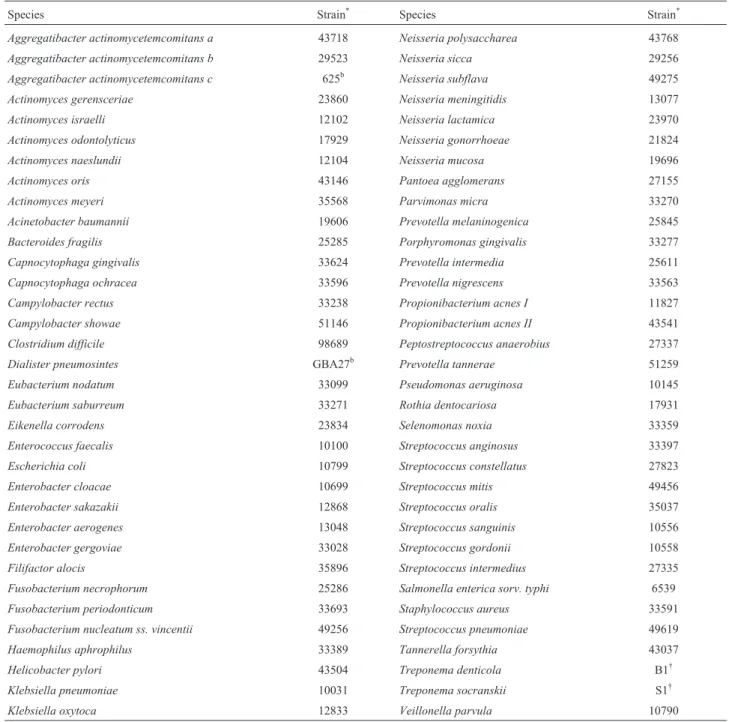
The composition of the subgingival biofilm culti-vatedin vitrofrom patients of the two clinical groups is pre-sented in Figure 2. The species were ordered into different microbial complexes according to Socranskyet al.(1998). The mean levels of the tested species (Table 1) were com-puted for both groups at each time point. At baseline, high mean levels of bacteria (4.4 x 10⁵cells) were detected in both groups, including several periodontal pathogens. No significant differences between groups regarding bacterial mean levels were observed for any species at any time point (adjusted p < 0.00095, Mann-Whitney test). When mean
counts of these species were evaluated within each group over time, few significant changes were observed (Figu-re 2). The numbers ofStreptococcusspp. increased, while the number of periodontal pathogens, such as Agreggatibacter actinomycetemcomitans, Tannerella for-sythia,Parvimonas micra andTreponema socranskii, di-minished in both groups. However, only Streptococcus gordonii and Streptococcus oralis increased, whereas Neisseria gonorrhoeae significantly decreased at 12 months after treatment in the control group (Friedman test, p < 0.00095). In the test group, Actinomyces israelli,
Table 1- Bacterial taxa used for development of whole genomic DNA probes tested against subgingival biofilm samples.
Species Strain* Species Strain*
Aggregatibacter actinomycetemcomitans a 43718 Neisseria polysaccharea 43768
Aggregatibacter actinomycetemcomitans b 29523 Neisseria sicca 29256
Aggregatibacter actinomycetemcomitans c 625b Neisseria subflava 49275
Actinomyces gerensceriae 23860 Neisseria meningitidis 13077
Actinomyces israelli 12102 Neisseria lactamica 23970
Actinomyces odontolyticus 17929 Neisseria gonorrhoeae 21824
Actinomyces naeslundii 12104 Neisseria mucosa 19696
Actinomyces oris 43146 Pantoea agglomerans 27155
Actinomyces meyeri 35568 Parvimonas micra 33270
Acinetobacter baumannii 19606 Prevotella melaninogenica 25845
Bacteroides fragilis 25285 Porphyromonas gingivalis 33277
Capnocytophaga gingivalis 33624 Prevotella intermedia 25611
Capnocytophaga ochracea 33596 Prevotella nigrescens 33563
Campylobacter rectus 33238 Propionibacterium acnes I 11827
Campylobacter showae 51146 Propionibacterium acnes II 43541
Clostridium difficile 98689 Peptostreptococcus anaerobius 27337
Dialister pneumosintes GBA27b Prevotella tannerae 51259
Eubacterium nodatum 33099 Pseudomonas aeruginosa 10145
Eubacterium saburreum 33271 Rothia dentocariosa 17931
Eikenella corrodens 23834 Selenomonas noxia 33359
Enterococcus faecalis 10100 Streptococcus anginosus 33397
Escherichia coli 10799 Streptococcus constellatus 27823
Enterobacter cloacae 10699 Streptococcus mitis 49456
Enterobacter sakazakii 12868 Streptococcus oralis 35037
Enterobacter aerogenes 13048 Streptococcus sanguinis 10556
Enterobacter gergoviae 33028 Streptococcus gordonii 10558
Filifactor alocis 35896 Streptococcus intermedius 27335
Fusobacterium necrophorum 25286 Salmonella enterica sorv. typhi 6539
Fusobacterium periodonticum 33693 Staphylococcus aureus 33591
Fusobacterium nucleatum ss. vincentii 49256 Streptococcus pneumoniae 49619
Haemophilus aphrophilus 33389 Tannerella forsythia 43037
Helicobacter pylori 43504 Treponema denticola B1†
Klebsiella pneumoniae 10031 Treponema socranskii S1†
Klebsiella oxytoca 12833 Veillonella parvula 10790
Bacteroides fragilis,N. gonorrhoeaeandNeisseria mucosa were reduced, and Acinetobacter baumannii, Campylobacter rectus, Filifactor alocis, Salmonella enterica and Streptococcus pneumoniae significantly in-creased over time post-therapy (Friedman test, p < 0.00095).
Discussion
The use of systemic antimicrobials as adjunct treat-ments to mechanical therapy in GAP is controversial. There are no specific antimicrobial therapy protocols for treating different forms of periodontitis, and among the currently
employed protocols, none of these therapies completely eliminated the need for retreatment (Herreraet al., 2002, 2008; Haffajeeet al., 2003). The systemic administration of antimicrobials should always consider the risk-benefits for the patients, particularly the costs and adverse effects of ad-ditional drugs (Seymour and Hogg, 2008, Heasmanet al., 2011). In general, the restricted use of systemic antimicro-bials is the best strategy to avoid the increase in resistance worldwide (Enne, 2010). Thus, alternative approaches of intensive mechanical debridement combined with topical antimicrobials, such as CHX, have been attempted for treating severe forms of periodontitis (Quirynen et al., 1995; Siguschet al., 2005). In previous studies (Helleret
Figure 2- Mean levels of bacterial species in the subgingival biofilm cultivatedin vitrofrom GAP subjects treated using mechanical therapy associated with CHX and AMX combined with MET (test group) or placebo (control group) at baseline, 3, 6, 9 and 12 months post-therapy. No significant differ-ences between groups were observed for any species at any time point, after adjusting for multiple comparisons (Mann-Whitney test, p > 0.00095). *Re-fers to significant changes in bacterial levels over time in the control group, and†refers to significant changes in bacterial levels over time in the test
al., 2011, Varelaet al., 2011, Silva-Senemet al., 2013), we compared the clinical and microbiological efficacy of an enhanced non-surgical mechanical therapy with the exten-sive use of topical CHX associated with systemic AMX and MET or placebos for up to one year. The findings indicated that both therapeutic approaches were efficient in improv-ing clinical parameters and reducimprov-ing periodontal patho-gens. Moreover, we also examined how these treatments would affect the susceptibility profile and composition of cultivable subgingival microbiota over time. Conventional in vitrotests of antimicrobial susceptibility are typically performed in planktonic pure cultures (Wrightet al., 1997; Eicket al., 2004, Sedlacek and Walker, 2007), which do not reflect the complex polymicrobial nature of the subgingival microbiota (Socransky and Haffajee, 2002). Developing heterotypic biofilm models for testing antimicrobial agents is a complex task, and the number of different species co-existing in anin vitromodel is often limited. Although we did not employ a mixed biofilm model for evaluating the susceptibility profile, we directly determined the MICs for the 3 antimicrobials in mixed cultures of subgingival biofilm samples obtained from each patient pre- and post-therapy using the microdilution method for anaerobes (NCCLS, 2004). Given that there are no standardized pro-tocols for antimicrobial testing in anaerobic mixed culture, it is important to interpret these results with caution. At the pre-therapy phase, we observed that the susceptibility of the cultivable subgingival microbiota was similar in both groups. The mean MICs of AMX and CHX were lower than the plasmatic and gingival crevicular fluid concentrations typically observed after the systemic administration of 500 mg of AMX 3 times per day (5-8mg/mL) (Kleinfelder et al., 1999) and the topical use of CHX (0.12 and 0.2%). In contrast, the MIC of MET was much greater than the con-centrations detected in plasma and gingival crevicular fluid (13-14mg/mL) after a dosage of 500 mg administered 3 times per day (Pähklaet al., 2005). Other authors have also reported high MICs for MET in strains ofPrevotellaspp.,
P. gingivalis, Fusobacterium spp. and A.
actinomycetemcomitans isolated from chronic periodon-titis patients in Colombia (Serranoet al., 2009, Ardilaet al., 2010). Moreover, when Spanish and Dutch patients were compared, higher proportions of F. nucleatum and A. actinomycetemcomitansisolates resistant to MET and other commonly used antimicrobials were observed (Van Win-kelhoffet al., 2000). The abusive use of antimicrobials and poor patient compliance, particularly in developing coun-tries (Berquoet al., 2004), may be responsible for the vari-ability in the susceptibility of the periodontal microbiota in subjects from distinct populations, suggesting that a single antimicrobial protocol to treat periodontitis might not be adequate for all patients (Teleset al., 2006). However, the narrow spectrum of MET for strict anaerobes (Seymour and Hogg, 2008) might limit thein vitroeffect of this drug on the mixed culture of subgingival plaques.
After systemic treatment with AMX and MET, a sig-nificant but transitory increase in the MICs of AMX and CHX was observed in the T group. Although a similar pat-tern was detected in the placebo group, the changes in the MICs of all antimicrobials over time were not significant for this group. Interestingly, topical CHX was extensively used in both groups, but the increase in the MIC of this antimicrobial was significant only in the T group. Conceiv-ably, the systemic administration of AMX and/or MET might have a synergistic impact on the susceptibility of the microbiota to CHX, reflecting ecological shifts in the perio-dontal microbiota. Other studies have also reported the se-lective and transient pressure of systemic antimicrobials on the susceptibility of the subgingival microbiota (Feres et al., 2001, Buchmannet al., 2003, Rodrigueset al., 2004). A decrease in the MIC of MET was observed in both groups, although the concentrations remained high at 12 months af-ter treatment. The unusual occurrence of resistance to MET has been associated with technical problems during cultiva-tion under anaerobic condicultiva-tions (Roberts, 2002, Diniz et al., 2004). Nevertheless, genes associated with MET resis-tance have been determined inBacteroidesspp. (Trinhet al., 1996). In addition, periodontal pathogens cultivated in biofilms are 100 times more resistant to MET compared with planktonic cultures (Wrightet al., 1997; Eick et al., 2004; Sedlacek and Walker, 2007).
implications, as pathogenic species colonizing the perio-dontal biofilm might be more resistant to antimicrobials. Previous studies have suggested that major clinical and mi-crobiological changes after mechanical therapy with or without antimicrobials are typically more pronounced in the first 3 months after therapy (Xajigeorgiouet al., 2006, Mestniket al., 2010, Yeket al., 2010). However, as shown in figure 2, a few species continued to diminish after 9 and 12 months in both groups. For example, A. actinomycetemcomitans and P. nigrescens were not de-tected in the cultivated biofilm at 9 and 12 months after both treatment protocols. The reinforcement in oral hy-giene and re-instrumentation during the monitoring visits might have contributed to the continuous reduction of cer-tain pathogenic species.
Thus, these data indicate that enhanced mechanical periodontal therapy associated with the extensive topical use of CHX and systemic administration of AMX and MET leads to a transitory increase in the MICs of the subgingival biofilm to AMX and CHX. Notably, resistance was not evaluated in the present study because there are no break-points to assess susceptibility or resistance when MICs are obtained upon biofilm analysis. Both therapeutic protocols presented similar and limited effects on the composition of the cultivable subgingival microbiota over time. Given the similar clinical benefits of both approaches (Helleret al., 2011, Varelaet al., 2011, Silva-Senemet al., 2013), the en-hanced mechanical periodontal therapy associated with the topical use of CHX may be suggested as a potential and ef-fective alternative for the treatment of individuals with GAP, without major implications on the susceptibility pro-file of the periodontal microbiota.
Acknowledgments
This study was supported in part through funding from the National Council for Scientific and Technological Development (CNPq), Coordination of Improvement of Higher Education Personnel (CAPES), Brasilia, Brazil, and the Foundation for Research Financial Support in the State of Rio de Janeiro (FAPERJ), Rio de Janeiro, Brazil.
References
Ardila CM, Granada MI, Guzmán IC (2010) Antibiotic resistance of subgingival species in chronic periodontitis patients. J Pe-riod Res 45:557-563.
Armitage G (1999) Development of a classification system for periodontal diseases and conditions. Ann Periodontol 4:1-6. Berquo LS, Barros AJ, Lima RCet al.(2004) Use of antimicrobial
drugs in an urban population. Rev Saude Publica 38:239-246.
Buchmann R, Müller RF, Van Dyke TEet al.(2003) Change of antibiotic susceptibility following periodontal therapy. A pi-lot study in aggressive periodontal disease. J Clin Perio-dontol 30:222-229.
Clinical and Laboratory Standards Institute (2004) Methods for Antimicrobial Susceptibility Testing of Anaerobic Bacteria;
approved standard. Document M11-A6 (6th ed.). CLSI, Wikler, MA.
Colombo AP, Haffajee AD, Dewhirst FEet al.(1998) Clinical and microbiological features of refractory periodontitis sub-jects. J Clin Periodontol 25:169-180.
Colombo AP, Teles RP, Torres MCet al. (2002) Subgingival microbiota of Brazilian subjects with untreated chronic periodontitis. J Periodontol 73:360-369.
Colombo AP, Teles RP, Torres MC et al. (2005) Effects of non-surgical mechanical therapy on the subgingival micro-biota of Brazilians with untreated chronic periodontitis: 9-month results. J Periodontol 76:116-122.
Colombo AP, Boches SK, Cotton SLet al.(2009) Comparisons of subgingival microbial profiles of refractory periodontitis, severe periodontitis, and periodontal health using the human oral microbe identification microarray. J Periodontol 80:1421-1432.
Costerton JW, Stewart PS, Greenberg EP (1999) Bacterial bio-films: a common cause of persistent infections. Science 284:1318-1322.
Diniz CG, Farias LM, Carvalho MAet al.(2004) Differential gene expression in a Bacteroides fragilis metronidazole-resistant mutant. J Antimicr Chemoth 54:100-108. Eick S, Seltmann T, Pfister W (2004) Efficacy of antibiotics to
strains of periodontopathogenic bacteria within a single spe-cies biofilm - an in vitro study. J Clin Periodontol 31:376-383.
Enne VI (2010) Reducing antimicrobial resistance in the commu-nity by restricting prescribing: can it be done? J Anti Chemo 65:179-182.
Feres M, Haffajee AD, Allard KAet al.(2001). Change in sub-gingival microbial profiles in adult periodontitis subjects re-ceiving either systemically administered amoxicillin or metronidazole. J Clin Periodontol 28:597-609.
Fritschi BZ, Albert-Kiszely A, Persson GR (2008) Staphylococ-cus aureusand other bacteria in untreated periodontitis. J Dent Res 87:589-593.
Guerrero A, Griffiths GS, Nibali Let al.(2005) Adjunctive bene-fits of systemic amoxicillin and metronidazole in non-sur-gical treatment of generalized aggressive periodontitis: a randomized placebo-controlled clinical trial. J Clin Perio-dontol 32:1096-1107.
Gootz TD (2010) The global problem of antibiotic resistance. Crit Rev Immunol 30:79-93.
Haffajee AD, Socransky SS, Gunsolley JC (2003) Systemic anti-infective periodontal therapy. A systematic review. Ann Periodontol 8:115-181.
Heasman PA, Vernazza CR, Gaunt FL et al. (2011) Cost-effectiveness of adjunctive antimicrobials in the treatment of periodontitis. Periodontol 2000 55:217-230.
Heller D, Varela VM, Silva-Senem MXet al.(2011) Impact of systemic antimicrobials combined to anti-infective mechan-ical debridement on the microbiota of generalized aggres-sive periodontitis: a 6-month RCT.J Clin Periodontol 38: 355-364.
Herrera D, Alonso B, León Ret al.(2008) Antimicrobial therapy in periodontitis: the use of systemic antimicrobials against the subgingival biofilm. J Clin Periodontol. 35:45-66.
Kleinfelder JW, Müller RF, Lange DE (1999) Antibiotic suscepti-bility of putative periodontal pathogens in advanced perio-dontitis patients. J Clin Periodontol 26:347-351.
Listgarten MA, Lai CH, Young V (1993) Microbial composition and pattern of antibiotic resistance in subgingival microbial samples from patients with refractory periodontitis. J Perio-dontol 64:155-161.
Mejia GI, Botero A, Rojas Wet al. (1995) Refractory perio-dontitis in a Colombian population: Predominant anaerobic bacterial flora and antibiotic susceptibility. Clin Infect Dis 20:311-313.
Mestnik MJ, Feres M, Figueiredo Let al.(2010) Short-term bene-fits of the adjunctive use of metronidazole plus amoxicillin in the microbial profile and in the clinical parameters of sub-jects with generalized aggressive periodontitis. J Clin Perio-dontol 37:353-365.
Pähkla ER, Koppel T, Saag Met al.(2005) Metronidazole con-centrations in plasma, saliva and periodontal pockets in pa-tients with periodontitis. J Clin Periodontol 32:163-166.
Quirynen M, Bollen CM, Vandekerckhove BNet al.(1995) Full-vs.partial-mouth disinfection in the treatment of periodontal infections: short-term clinical and microbiological observa-tions. J Dent Res 74:1459-1467.
Roberts MC (2002) Antibiotic toxicity, interactions and resistance development. Periodontol 2000 28:280-297.
Rodrigues RMJ, Gonçalves C, Souto Ret al.(2004) Antibiotic re-sistance profile of the subgingival microbiota following sys-temic or local tetracycline therapy. J Clin Periodontol 31:420-427.
Sedlacek MJ, Walker C (2007) Antibiotic resistance in an in vitro subgingival biofilm model. Oral Microbiol Immunol 22:333-339.
Serrano C, Torres N, Valdivieso Cet al.(2009) Antibiotic resis-tance of periodontal pathogens obtained from frequent anti-biotic users. Act Odont Latinoame 22:99-104.
Seymour RA, Hogg SD (2008) Antibiotics and chemoprophy-laxis. Periodontol 2000 46:80-108.
Silva-Senem MX, Heller D, Varela VMet al.(2013) Clinical and microbiological effects of systemic antimicrobials com-bined to an anti-infective mechanical debridement for the management of aggressive periodontitis: a 12-month ran-domized controlled trial. J Clin Periodontol 40:242-251. Sigusch BW, Güntsch A, Pfitzner Aet al.(2005) Enhanced root
planing and systemic metronidazole administration improve clinical and microbiological outcomes in a two-step treat-ment procedure. J Periodontol 76:991-997.
Socransky SS, Haffajee AD, Smith Cet al.(1991) Relation of counts of microbial species to clinical status at the sampled site. J Clin Periodontol 18:766-777.
Socransky SS, Smith C, Martin Let al.(1994) “Checkerboard” DNA-DNA hybridization. Biotech 17:788-792.
Socransky SS, Haffajee AD, Cugini MAet al.(1998) Microbial complexes in subgingival plaque. J Clin Periodontol 25:134-144.
Socransky SS, Haffajee AD (2002) Dental biofilms: difficult ther-apeutic targets. Periodontol 2000 28:12-55.
Socransky SS, Haffajee AD (2005) Periodontal microbial ecol-ogy. Periodontol 2000 38:135-187.
Teles RP, Haffajee AD, Socransky SS (2006) Microbiological goals of periodontal therapy. Periodontol 2000 42:180-218. Van Winkelhoff AJ, Herrera GD, Winkel EGet al.(2000) Anti-microbial resistance in the subgingival microflora in patients with adult periodontitis. A comparison between The Nether-lands and Spain. J Clin Periodontol 7:79-86.
Varela VM, Heller D, Silva-Senem MXet al.(2011) Systemic antimicrobials adjunctive to a repeated mechanical and anti-septic therapy for aggressive periodontitis: a 6-month ran-domized controlled trial. J Periodontol 82:1121-1130. Xajigeorgiou C, Sakellari D, Slini Tet al.(2006) Clinical and
mi-crobiological effects of different antimicrobials on general-ized aggressive periodontitis. J Clin Periodontol 33:254-264.
Yek EC, Cintan S, Topcuoglu Net al.(2010) Efficacy of amoxi-cillin and metronidazole combination for the management of generalized aggressive periodontitis. J Periodontol 81:964-974.
Associate Editor: Elizabeth de Andrade Marques